Crying Wolf Over The Great Barrier Reef

By Dr Peter Ridd | The Global Warming Policy Forum | December 12, 2018
Scientists from James Cook University have just published a paper on the bleaching and death of corals on the Great Barrier Reef (GBR) and were surprised that the death rate was less than they expected because of the adaptability of corals to changing temperatures. It appears as though they exaggerated their original claims and are quietly backtracking. To misquote Oscar Wilde, to exaggerate once is a misfortune, to do it twice looks like carelessness, but to do it repeatedly looks like unforgivable systemic unreliability by some of our major science organisations.
It is a well-known phenomenon that corals can adapt very rapidly to high temperatures and that if you heat corals in one year, they tend to be less susceptible in future years to overheating. It is the reason why corals are one of the least likely species to be affected by climate change, irrespective of whether you believe the climate is changing by natural fluctuations or from human influence.
Corals have a unique way of dealing with changing temperature by changing the microscopic plants that live inside them. These microscopic plants called zooxanthellae give the coral energy from the sun by photosynthesis in exchange for a comfortable home inside the coral. But when the water gets hot, these little plants become effectively poisonous to the coral and the coral throws out the plants turning the coral white – it bleaches. But most of the time the coral will recover from the bleaching. And here’s their trick- they take in new zooxanthellae, that floats around in the water quite naturally, and can select different species of zooxanthellae to be better suited to hot weather. Most other organisms have to change their genetic makeup to deal with temperature changes, something that can take many generations. But corals can do it in a few weeks by just changing the plants that live inside them. They have learnt a thing or two in a couple of hundred years of evolution.
The problem here is that the world has been completely mislead by scientists about the affect of bleaching and rarely mention the spectacular regrowth that occurs. For example, the 2016 bleaching event supposedly killed either 95%, 50% or 30% of the reef depending upon which headline and scientist you want to believe. But the scientists only looked at very shallow water coral – less than 2 meters below the surface which is only a small fraction of all the coral, but by far the most susceptible to getting hot in the tropical sun. A recent study found that the deep water coral (down to over 40 m) got far less bleaching as one would expect. I estimate that less than 8% of the GBR coral actually died. That might still sound like a lot, but considering that there was a 250% INCREASE in coral between 2011 and 2016 for the entire Southern Zone of the GBR, an 8% decrease is nothing to worry about. Coral recovers fast.
But this is just the tip of the exaggeration iceberg. Some very eminent scientists claim that bleaching never happened before the 1980’s and is entirely a man-made phenomenon. This was always a ridiculous proposition. A recent study of 400-year-old corals has found that bleaching has always occurred and is no more common now than in the past. Scientist have also claimed that there has been a 15% reduction in the growth rate of corals. However, some colleagues and I demonstrated that there were serious errors in their work and that if anything there has been a slight increase in coral growth rate over the last 100 years. This is what one would expect in a gently warming climate. Corals grow up to twice as fast in the hotter water of Papua New Guinea and the northern GBR than in the southern GBR. I could go on with many more examples.
This unreliability of the science is now a widely accepted scandal in many other areas of study and now has a name. “The Replication Crisis”. When checks are made to replicate or confirm scientific results, it is regularly found that around half has flaws. This is an incredible and scandalous situation and it is not just me saying this – it is the editors of eminent journals and many science institutions. A great deal of effort is now going into fixing this problem especially in the Biomedical Sciences where the problem was first recognised.
But not for GBR science. The science institutions deny there is a problem and fail to correct erroneous work. When Piers Larcombe and I wrote an article to a scientific journal suggesting we needed a little extra checking of GBR science, the response from many very eminent scientists was that there was no need. Everything is fine. I am not sure if this is blind optimism or wilful negligence, but why would anybody object to a little more checking? It would only cost a few million dollars, just a tiny fraction of what the governments will be spending on the reef.
But the truth will out eventually. The scare stories about the GBR started in the 1960’s when scientist first started work on the reef. They have been crying wolf ever since. But the data keeps coming in and, yes, sometimes a great deal of coral dies in a spectacular manner with accompanying media fanfare. It is like a bushfire on land, it looks terrible at first, but it quietly and rapidly grows back ready for the scientists to peddle their story all over again.
Dr Ridd was, until fired this year, a Physicist at the James Cook University Marine Geophysical Laboratory.
MSM Trying to Call Routine US Black Sea Activity ‘Strategic Manoeuvre’ – Admiral
Sputnik – 12.12.2018
In an interview with Sputnik, Retired Rear Admiral of the Turkish Navy Cem Gürdeniz has commented on CNN reports that the US is preparing to send a warship to the Black Sea. The message emphasises that the US may require Turkey to allow its military ships to pass through the Bosphorus into the Black Sea under the Montreux Convention.
According to Gürdeniz, with such messages, American media outlets are trying to portray usual, routine US activity in the Black Sea as a kind of a “strategic manoeuvre”.
“Ukraine made a series of efforts in order to win over NATO after the incident in Kerch. But the Alliance did not take any concrete steps to ensure the security of Ukraine in the event of a possible future crisis with Russia in the region. Therefore, the purpose of such statements is to try to calm the Ukrainian authorities and the public. In this regard, the American press represents the standard activity of NATO ships in the Black Sea related to exercises or port visits as a “new diplomatic and strategic manoeuvre”, he stressed.
Emphasising that the current situation in the region complies with the provisions of the Montreux Convention Regarding the Regime of the Straits, Gürdeniz added that NATO ships were present in the waters of the region for 120 days a year, and this corresponds to the provisions of the Montreux Convention.
“At present, a well-established framework continues to operate in this regard that fully meets the requirements of the Convention Regarding the Straits, while a number of international TV channels and leading news agencies strive to create the impression that some new requirements are being put forward that have not previously been expressed,” he noted.
All these actions are nothing more than an operation to form public opinion, the expert noted.
“Information about the possible passage of American military vessels through the Kerch Strait is in itself provocative. I do think that this is not the case here at all. This is mere speculation thrown into the media space through MSM in order to form a certain agenda and public opinion. I have seen recent Pentagon statements on this issue. There was no mention of the Kerch Strait or the Sea of Azov in them. Since 1954, no military vessel may enter the waters of the Sea of Azov, which has the status of inland waters, without the permission of Russia”, he added.
Having recalled that, according to the Montreux Convention Regarding the Regime of the Straits signed in 1936, countries that do not have access to the Black Sea must request permission within 15 days from Turkey for the passage of their warships through the Bosphorus and the Dardanelles.
“We face a situation in which they try to present a system that has been functioning for a long time as something new. This is the same as saying that ‘ExxonMobil will conduct exploration on the No. 10 field in the Eastern Mediterranean, thus America is sending its warships.’ But at the end, America has already been present in the Mediterranean since 1946”, Gürdeniz concluded.
Poroshenko’s “Crimean Corridor” Claims Are Preconditioning Prior To A False Flag
By Andrew KORYBKO – Oriental Review – 10/12/2018
Ukrainian President Poroshenko is fearmongering about Russia again after spreading fake news about Moscow’s so-called “Crimean Corridor” plan.
The Eastern European leader claimed that his eastern nemesis was planning to seize the coastal towns of Mariupol and Berdyansk on the Sea of Azov in order to connect Donbas with the Crimean peninsula, something that Kremlin spokesman Dmitry Peskov described as “absolutely absurd, another attempt to somehow spark tensions”, which he also suggested might be influenced by the run-up to Ukraine’s presidential elections next spring. All rhetoric aside, however, Russia has no practical reason to create this so-called “corridor” in the first place considering that it successfully built the Crimean Bridge across the Kerch Strait and therefore has direct access to its reunified territory.
Donbas isn’t recognized by Russia as anything other than a rebellious region of Ukraine, and the areas outside of it between that part of the country and Crimea aren’t even party to the country’s civil war. It might be that some media demagogues and/or Donbas rebels previously decided to score political points at home by flirting with this idea, but it certainly isn’t anything that Russia takes seriously because it would imply a formal military intervention into its neighbor’s territory and the actual annexation of its territory, something that Moscow has never done and has no intention to ever do. The recent incident in the Kerch Strait proved that Russia can neutralize any naval threat in and around the Azov Sea, so there’s no military reason for it to want to capture those Ukrainian towns on the coast.
Instead, it appears as though Poroshenko’s claims are aimed at preconditioning the Western public into expecting a rebel move on this region, possibly in advance of forthcoming Ukrainian military provocations before the elections intended to provoke a response that could be decontextualized, misportrayed, and then over-amplified to its intended audience as purportedly playing into this paradigm. That could explain why the Ukrainian leader ridiculously asserted that Russia has 80,000 troops and 900 tanks in and around his country, which is evidently serving as his ‘publicly plausible’ pretext at home to implement martial law, call up the reserves, and possibly prepare for the aforementioned false flag scenario.
There’s no such thing as the so-called “Crimean Corridor”, but it plays to Poroshenko’s domestic political interests to pretend that there is, and if he’s even partially successful at manipulating international perceptions surrounding this fake news narrative after possibly provoking the rebels to play into his hands, then he could reap some grand strategic benefits from it by positioning himself as the only Ukrainian leader capable of defending the country from so-called “Russian aggression”. This could manifest itself in increased NATO assistance and the West’s wink-and-a-nod approval of him either rigging the upcoming vote to his favor or indefinitely delaying it due to what he might claim are “wartime conditions”. All of this is extremely dangerous because, as they say, “the best laid plans of mice and men often go awry”.
Labour furious over report that anti-Russia charity targeted Corbyn, receives govt cash
RT | December 9, 2018
Labour politicians are outraged and calling for a probe after a report that a McCarthy style charity has received £2 million in government money and targeted Jeremy Corbyn, straying from tackling so-called Russian disinformation.
The Institute for Statecraft, based in Scotland, initially seems to be a small organization which claims to counter alleged Russian propaganda by forming communities of journalists and influencers who use social media to push back on any so-called disinformation.
However, leaked documents provided to the Daily Record show that the organization’s Integrity Initiative isn’t as grassroots as it appears on the surface. In fact, it’s apparently funded with £2 million of Foreign Office cash and run by British military intelligence specialists.
What’s more is that the newspaper has reported that it launched its own investigation which found “worrying evidence” that the organization’s official Twitter account has been used to attack Jeremy Corbyn, his Labour Party, and other officials within the party.
And of course, there were some anti-Russia comments thrown in for good measure – such as one tweet which quoted a newspaper article calling Corbyn a “useful idiot” with “open visceral anti-Westernism [that] helped the Kremlin cause, as surely as if he had been secretly peddling Westminster tittle-tattle for money.”
“What he has done, wittingly or unwittingly, is work with the Kremlin agenda,” a newspaper report retweeted by the Integrity Initiative tweet states.
Although the Integrity Initiative’s apparent mission was first revealed last month, the Daily Record’s Sunday report about its targeting of Corbyn and the Labour party has left the party’s members more than a little angry.
“It is simply outrageous that the clearly mis-named ‘Integrity Initiative’ – funded by the Foreign Office to the tune of £2.25 million over the past two years – has routinely been using its Twitter feed to disseminate personal attacks and smears against the Leader of the Opposition, the Labour Party and Labour officials,” Emily Thornberry MP, Labour’s Shadow Foreign Secretary said in her statement.
Labour MP Chris Williamson also chimed in, calling any such activity “unacceptable in any democracy.”
The question of whether MSM will eventually pick up the story remains unknown, especially since it has a tendency to turn a blind eye to anyone claiming to fight the good fight against “aggressive” Russia.
The Integrity Initiative’s spokesman Stephen Dalziel has said he is “not aware” of any Corbyn attacks on the official social media account. “I’m not the one who controls the Twitter account. If it was criticism of one of our politicians, then that shouldn’t be on there.”
The Return of the Nicaraguan Contras, and the Rise of the Pro-Contra Left
By Dan Kovalik | CounterPunch | December 7, 2018
According to our nation’s paper of record, the New York Times, the Nicaraguan Contras re-activated some time ago in order to take on their old foe, Daniel Ortega, who had been re-elected in 2007 after a long hiatus of 17 years. One may recall that it was the pressure of the Contras, and their brutal terrorist tactics, which were critical to unseating Ortega from office the first time back in 1990.
Just as a refresher, the Contras (short for “counterrevolutionaries”) were made up largely of the National Guardsmen of the US-backed dictator, Anastasio Somoza. After the successful 1979 revolution against Somoza – a revolution led by Ortega and the FSLN (or, Sandinistas) — the CIA organized the Guardsmen into the Contras and trained, armed and directed them for the purpose of undermining the fledgling Sandinista government. The Contras, with the direct encouragement of the CIA, carried out various terrorist acts which included the torture, rape and murder of civilians and the destruction of key civilian infrastructure. All told, around 30,000 Nicaraguans died in the 1980’s as a result of the US-backed Contra War.
The Contras, after effectively exhausting the Nicaraguan people and extorting them into voting Ortega out of office in 1990, largely disarmed. However, as the Times wrote back in March of 2016 in a laudatory piece about the Contras’ return, this changed sometime after Ortega’s re-election in 2007. The Times piece begins as follows:
He calls himself Tyson, wears tattered United States Army fatigues and carries a beat-up AK-47.
He is a rebel fighter in the mountains of Nicaragua, setting ambushes against President Daniel Ortega’s government and longing for the days when covert American funding paid for overt warfare.
Tyson and his men are contras — yes, like the ones from the 1980s who received stealth funding during the Reagan administration to topple Mr. Ortega’s leftist Sandinista government. . . .
The contras of today, often nicknamed “the rearmed,” are a shadow of what they once were. . . .
Still, skirmishes in rural areas around the country as recently as last week have left police officers, civilians and soldiers dead, a violent expression of the broader anger brewing against the government.
In this same article, the Times acknowledges that “Mr. Ortega enjoys strong support among the poor . . . .” And of course, this makes absolute sense given Ortega’s enlightened social policies. As the website Popular Resistance explains,
these policies have yielded the highest growth rate in Central America and annual minimum wage increases 5-7% above inflation, improving workers’ living conditions and lifting people out of poverty. The anti-poverty Borgen project reports poverty fell by 30 percent between 2005 and 2014.
The FSLN-led government has put into place an economic model based on public investment and strengthening the safety net for the poor. The government invests in infrastructure, transit, maintains water and electricity within the public sector and moved privatized services, e.g., health care and primary education, into the public sector. This has ensured a stable economic structure that favors the real economy over the speculative economy. The lion’s share of infrastructure in Nicaragua has been built in the last 11 years, something comparable to the New Deal-era in the US, including renewable electricity plants across the country.
Still, according to the Times, the Contras re-emerged in response to what they viewed as Ortega’s over-consolidation of power.
Meanwhile, the Times was not the only one writing about these rearmed Contras. Indeed, over the years, there have been a number of reports about these Contras. According to a 2013 article in Insight Crime, for example, “estimates of the numbers of rearmed contras have varied from dozens to hundreds, and even thousands . . . .” This article explained that eight people had recently been killed as a result of Contra activity in northern Nicaragua near the Honduran border.
For his part, Tim Rogers, a viciously anti-Sandinista journalist, has been writing for years about the phenomenon of the rearmed Contras. For example, in a 2014 piece, Rogers wrote:
A deadly midnight ambush targeting government supporters in northern Nicaragua has stirred the sleeping dogs of war and raised new fears of a pending military campaign against rearmed guerrillas hiding in the mountains.
Five people were killed and 19 injured early Sunday morning in what appears to be a coordinated series of attacks against Sandinista party members traveling by bus through the mountainous coffee-growing region of Matagalpa, one of the main battlegrounds of Nicaragua’s civil war in the 1980s.Video
The buses, filled with pro-government supporters returning from Managua after a day of celebrating the thirty-fifth anniversary of the Sandinista Revolution, were fired on indiscriminately from the darkened shoulder of the road by unidentified men armed with AK-47s.
This very sort of attack against Sandinista rank and file members was played out time and again over this past summer during the three-month-long crisis which received significant media attention. Indeed, when I was in Managua this past July for the anniversary of the Sandinista Revolution, I was told that, contrary to traditional practice, there would not be buses sent to Managua from other parts of the country for the celebration for fear of such attacks.
And yet, while the mainstream press covered the crisis in Nicaragua this past summer with rapt attention, and while Tim Rogers himself published a number of pieces in the mainstream press about it, there was not one whisper about the rearmed Contras, nor was there coverage of the regular assaults against Sandinista rank and file – attacks which included torture, rape and murder. Instead, we were told by the mainstream press, and by most of the “left-wing” press as well, only of peaceful protesters being attacked by an allegedly repressive Sandinista government. And, when people were killed by sniper attacks, we were told that it had to be government security forces because the opposition used only peaceful means, and, in any case, did not have the capacity to carry out such assaults.
Just as the devil was able to do about his own existence, the greatest feat accomplished in this instance was to convince the public that the rearmed Contras did not exist. Of course, this is not a difficult task given that most Americans’ historical memory is about 24 hours.
What is most deeply disappointing and frustrating, however, is that most of the American left, which presumably should know better, has also fallen for this devil’s trick, and has quickly leapt to join in the right-wing chorus calling for the removal of Ortega and the Sandinistas from office. This despite the fact that, as journalist Max Blumenthal explained, there is clear evidence that the US itself has been behind the violent push to unseat Ortega. As Blumenthal related, on May 1, 2018, a publication funded by the Cold War-era National Endowment for Democracy (NED) “bluntly asserted that organizations backed by the NED have spent years and millions of dollars ‘laying the groundwork for insurrection’” which took place over the summer. And, the US AID just announced that it will continue this work by sending another $4 million to support opposition civil society groups in Nicaragua.
What’s more, as far back as 2012, former Navy intelligence officer and NSA analyst Wayne Madsen was not only writing about the rearmed Contras but also about the US and Israeli support for them. While Madsen can sometimes be prone to conspiracy theories which do not always pan out, his claims back then about this particular subject seem spot on and indeed quite prescient.
Thus, in his 2012 book, The Manufacturing of a President, Madsen claims, based upon his numerous intelligence sources, that the CIA and Mossad have both been funding these rearmed Contras, and that they have been shipping these Contras arms over both the Honduran and Costa Rican borders. He claims also that the Honduran government which came to power through the 2009 coup – a coup which the Obama Administration actively aided and abetted to unseat a leftist government which, by the way, happened to be friendly to Ortega – has been key to helping both support the Contras as well as to provide a staging ground for the covert operations to bring down the Sandinista government. In other words, Honduras is playing the very same role it did in the 1980s, and the US-backed coup in 2009 – a mere 2 years after Ortega was elected – was crucial to this role.
And, just last week, in a further attempt to unseat Ortega, the US Senate finally passed the NICA Act which will cut Nicaragua off from all international financing – financing which the Ortega government has been using to effectively combat poverty in Nicaragua. The NICA Act has been in the works for some time, and Nicaraguan opposition forces, including the Sandinista Renovation Movement (MRS), have openly been lobbying for this. This, however, has not stopped most of the left in the US, who obviously have not been impressed with Ortega’s successful social programs and his real support for the poor, from cheerleading and romanticizing these very same opposition forces.
The result of the NICA Act sanctions will be massive suffering for the poor of Nicaragua who support Ortega the most. These sanctions will be particularly painful after the crisis this past summer in which the opposition managed to trash the economy along with substantial civilian infrastructure (just as the Contras had done in the 1980s). And, should Ortega be unseated as a result of all this, it will most certainly be the violent and most right-wing portion of the opposition which will take power, for it is they who have the resolve and the means to do so.
But, guided by the new religion of “humanitarian interventionism,” the pro-imperialist left of the US is indifferent to the consequences of their support, whether explicit or tacit, of Western imperial aggression. Just as many on the US left cheered on the NATO invasion of Libya – an invasion which inevitably left that country broken and with slaves being sold openly on the streets – they now applaud the counterrevolution taking place in Nicaragua. This shows once again that the US left has a very high tolerance for the suffering of Third World peoples so long as they feel that this suffering is endured for the sake of their own abstract notions of human rights.
 Daniel Kovalik teaches International Human Rights at the University of Pittsburgh School of Law. He is also author of the newly-released, The Plot to Control the World: How the US has Spent Billions to Change the Outcome of Elections Around the World.
US Teens’ Trust In Traditional Media Deteriorating

Sputnik – 06.12.2018
Teenagers in America are trusting citizen journalists at rapidly increasing rates in recent years while 49 percent don’t trust traditional news media to report on current events fairly and accurately, according to a new poll.
Almost half of teenagers polled — 49 percent — say they don’t trust the media to convey information honestly and accurately, according to a Knight Foundation survey published Wednesday. The poll also included questions from Gallup’s “Free Expression on Campus” survey of college students.
Meanwhile, students showed a “sharp rise in their trust of citizen journalist reporting compared with traditional news sources.” While 26 percent of students trusted photos, videos and accounts posted by individuals two years ago, some 40 percent trust citizen journalists in 2018.
One data point that jumped out from the report was that 30 percent of high school students said they trusted cable TV news (CNN, Fox News and MSNBC) “a lot” in 2016, while just 18 percent said the same thing in 2018.
The share of people who trust cable TV news “some” stayed nearly the same, falling one point from 48 percent to 47 percent. The share of people who don’t trust cable TV news “too much” or “at all” shot up from 23 percent to 35 percent.
While 89 percent of students said the First Amendment right to free speech should allow people to keep voicing unpopular opinions, just 45 percent said that people keep that right when their speech is hateful. “Still, when forced to choose which is more important, students by a 5-to-1 ratio say protecting free speech is more important than protecting people from offensive speech,” the Knight Foundation’s report stated in the executive summary.
Other interesting findings include that only 1 in 4 students said that “fake news,” or made-up articles presented as news, was a “significant threat to democracy.”
Approximately one-half of students said “social media stifles expression because people block those with opposing views and because of the fear of vitriolic encounters makes people less apt to share their views,” the report said.
“We have a stereotypical image of the media as plucky truth-tellers standing up to the powerful. But in reality five gigantic corporations control 90 percent of what America sees and hears,” Alan MacLeod of Glasgow Media Group told Sputnik Thursday. “Furthermore, the media has become increasingly close to the government.”
The Nobel Peace Prize in Support of War
By Terje Maloy | OffGuardian | December 6, 2018
On December 10, the 2018 Nobel Peace Prize Award Ceremony will be held in Oslo, the capital of Norway. This analysis will try to look at how the prize fits in the bigger picture, but first, some general background is appropriate:
Norway is a member of NATO and has close ties to the United States and Great Britain. The political, economic and bureaucratic elites are firmly integrated in transatlantic networks, a nexus of economic connections, think tanks, international institutions, media and a thousand other ties that bind. They tend to identify with the liberal wing of the empire, (i.e. the Democrats, not the Republicans), but will work with any US administration. The members of the Norwegian Nobel Committee are selected by the Norwegian parliament, and the Committee is nominally independent.
Despite being considered – and where the population considers itself – a ‘peace nation’, there are few countries that have eagerly joined more wars than Norway, from the attack on Yugoslavia in 1999, Afghanistan 2001, the occupation of Iraq, Mali, Libya 2011 and the ongoing occupation of Syria. Norway spends large sums of money supporting the joint Western effort to control the rest of the world through comprador intermediaries in non-governmental organizations.
This analysis will discuss some (overlapping) points about the Nobel Peace Prize:
- The prize reinforces certain grand narratives, the most important one being We are the good, and thus have the right to decide the fate of the rest of the world.
- It creates symbols for regime change operations. It beatifies modern day ‘good natives’ complaining about cruel treatment and pleading for the West to do something to liberate them (but are often remarkably unable to see Western abuses).
- It reinforces general reasons to start wars, by making specific themes very important at the same time they are being used to justify military action.
- It reinforces the narrative that enemy fights with illegal and cruel weapons. The focus on chemical weapons, as opposed to napalm or sanctions, is one example.
- It sanctifies peace treaties that are more like unilateral surrenders, advantageous to Western imperialism and capitalist interests.
- For a bunch of peaceful people, the prize winners are remarkably eager for war and bloody interventions.
- Some other points + Conclusion.
1. WE ARE THE GOOD, AND THUS HAVE THE RIGHT TO DECIDE THE FATE OF THE REST OF THE WORLD
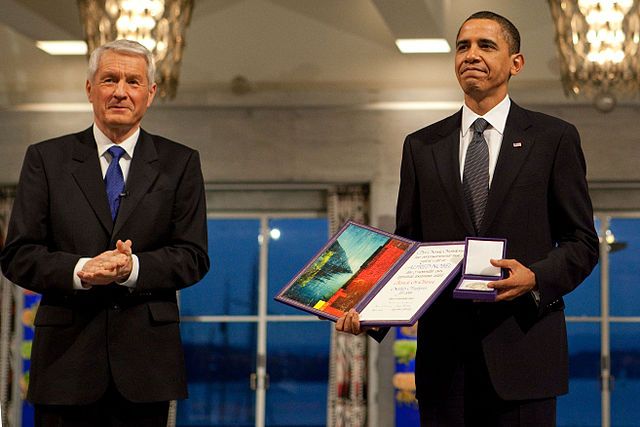
(Photo: / White House, Samantha Appleton /Public Domain)
The Nobel Peace Prize gets its prestige and press coverage because it reinforces several big narratives. If it should deviate too much from what the powerful want, it would be ignored. Of prime importance is the notion that we are the good, and we have a monopoly on interpreting reality and to decide what is important. (‘We’ in this context being people in the West, and by extension their governments and leaders). During the Cold War, the prize had a similar function. It would be interesting to take a closer look at it, but for practical purposes this analysis will mostly be limited the last 30 years. Once you start to notice certain basic themes, they are rather obvious. To put it pointedly, the Nobel Peace Prize tries to aid regime changes to achieve the Empire’s aims where it is possible to avoid direct war, but it will aid in confirming the narrative that our troops are good guys.
This explains why Western leaders so often get the prize. The point is creating an impression that there exists a more humane possibility within our current unjust world system. When they receive it, what they have actually done is not an issue. Hence the award to people like Jimmy Carter (winner 2002); as president he instigated several bloody covert interventions in Central-America, Africa and of course the Islamist fighters in Afghanistan, but has since then opposed direct US wars; or Al Gore (winner 2007), who when he was vice president didn’t shy away from using the military as a foreign policy tool (see part 7). The prize to Barack Obama (winner 2009) can be placed here.
But the main use of the prize is to create support in Western liberal opinion for interventions that would otherwise be naked imperialistic aggression.
2. A FOCUS FOR REGIME CHANGE OPERATIONS
Where a Nobel Peace Prize is awarded to a dissident of a non-western country, the CIA or the Pentagon (see point 3) often has a task force working on cracking the exact same country.
The winners have varying degrees of internal appeal in the targeted country, but the main purpose in choosing these people is not to boost their standing internally, but to justify attempts at regime change to Western liberal public opinion. Without the focus on these martyrs, these operations would look suspiciously like old style colonial domination.
Hence the beatification of Aung San Suu Kyi (winner 1991) coincided with a concerted campaign to get control over a recalcitrant, but very strategic country. Suu Kyi is in many ways typical of the people the Committee prefers. She is a known entity, having conspicuously strong personal connections to the former colonial power – Oxford educated, married to a British citizen, her children are British citizens, etc. Signaling in which direction her political compass was oriented, she asked the world to use the old colonial name Burma instead of Myanmar. She asked for harsh measures against her own country (for its own good) fitting hand in glove with the US strategy actually used. In fact, all means would be permissible to use against this regime imprisoning a modern day saint.
The Nobel Prize to Suu Kyi played an invaluable role in creating huge support, especially on the liberal left, for the draconian economic sanctions against an otherwise fairly obscure country. And maybe many of her Western supporters actually did believe that the US and UK could fund her with large sums of money and create entire NGO-networks for her with the expressed goal of subverting a sovereign nation’s government, and her intentions to still be pure and progressive.
Myanmar is immensely rich in natural resources and is positioned between China and the Indian Ocean, and China and India. Any significant land connection between these two 21st century great powers would have to go through Myanmar to avoid the Himalayas. It is also of great Chinese interest as a transit country to the Indian Ocean. Therefore, the country was targeted with a multi-approach regime change operation.
A massive press campaign was arranged over several decades, a plethora of NGOs financed, whilst “former” CIA-agents now turned missionaries were working with the ethnic guerilla forces to create military pressure. In the usual attempt to concentrate all opposition into a joint force, extreme right wing religious fanatics became the spearhead in this campaign. The sanctions imposed on Myanmar, precluded any economic development and doomed the population to a life of crushing poverty.
One could interpret the recent calls to take the prize back from Suu Kuy as disappointed buyers not getting what they paid for.
We can go forward to 2010, when a Chinese citizen, Liu Xiaobo, won the prize. There were no surprises for what future was envisaged for China:
It took Hong Kong 100 years to become what it is. Given the size of China, certainly it would need 300 years of colonisation for it to become like what Hong Kong is today. I even doubt whether 300 years would be enough.”
The lines between creating justification for a covert regime change operation and next step, a direct war, is blurry. But when required, the Prize Committee can step in to keep the focus of world opinion on the right narrative.
3. CREATING REASONS FOR WAR: WOMEN’S RIGHTS
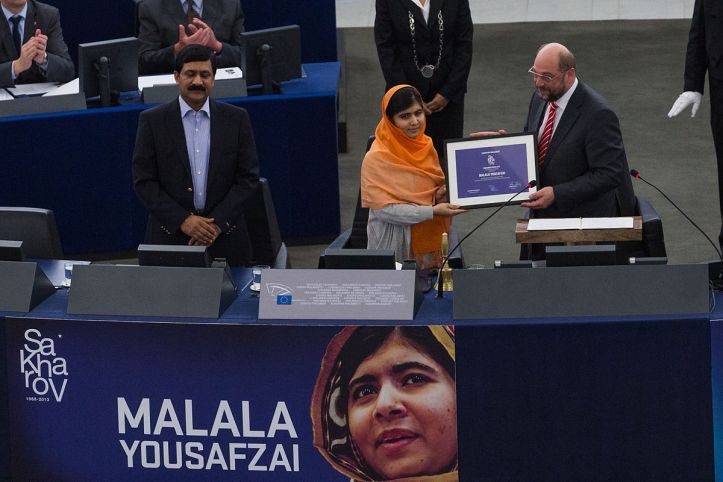
Malala Yoysafzai receives the Sakharov prize © Claude Truong-Ngoc / Wikimedia Commons
In 2003, just after the blitzkrieg on Iraq and at the very height of the George Bush’s talk of continuing the offensive to a few more countries, the committee chose to give the prize to Shirin Ebadi. By beatifying an Iranian at that time, the committee very well knew that they increased the danger of war.
Ebadi is a champion of women’s rights, a recurrent theme in NATO’s efforts to justify their wars. We know that targeting women in the West with this type of messaging has been a major effort for the organization for a long time. By giving the prize to her, they in effect created support in Western (female) public opinion for a war/regime change that would kill an untold number of Iranian women and destroy the lives of the rest, a repeat on a larger scale of what happened in Iraq.
The 2018 prize went to the fight against sexual violence in war. This happens to coincide with the very image NATO wants to promote of itself – who can forget Angelina Jolie and NATO’s General Secretary Jens Stoltenberg writing a joint article in 2017 titled “Why NATO Must Defend Women’s Rights,” where they point out that “NATO has the responsibility and opportunity to be a leading protector of women’s rights” and “can become the global military leader in how to prevent and respond to sexual violence in conflict”. How convenient that the Nobel Committee shares the same view.
A more analytic approach would point out such facts that US/NATO-interventions have made the situation for women infinitely worse in places such as Iraq, Libya and Afghanistan. An intervention to topple the legal government in Syria would certainly have created the same result.
In addition, a bit broader view would point out how allegedly stopping sexual violence against women has justified many wars of aggression. The stereotypes of cruel foreigners have not advanced noticeably from depictions of swarthy Spaniards groping blonde women in the Spanish-American war, to the claim that Gaddafi was handing out Viagra to mercenaries to rape women, as Susan Rice, the US Permanent Representative at UN told the Security Council. Amnesty International, later reported it had “not found any evidence or a single victim of rape or a doctor who knew about somebody being raped.”
Other notorious examples of how this has been used in war propaganda include Serbian rape camps during the Yugoslav wars. Allegations of mass rape were a key element of NATO’s propaganda campaign during the 1999 bombing of Yugoslavia. Clare Short, Britain’s international development secretary, claimed that the rapes were “deliberately performed in front of children, fathers and brothers.” After the war was over, there were some retractions, including from the Washington Post, which reported that “Western accusations that there were Serb-run rape camps […] all proved to be false.”
Malala Yousafzai (winner 2014), the young Pakistani girl who became a symbol of the war against the Taliban, is another figure that fits this pattern. The indefinite occupation of Afghanistan is, among plenty of other vicarious reasons, justified by improving women’s rights. This overlooks the fact that no improvement can be made under a government installed with the help of foreign bayonets. The situation for Afghan women has not improved since the occupation, but then again, the claim was only meant to create support for the war in public opinion.
The importance of creating the perception of fighting for women’s rights has long been realized in military circles.
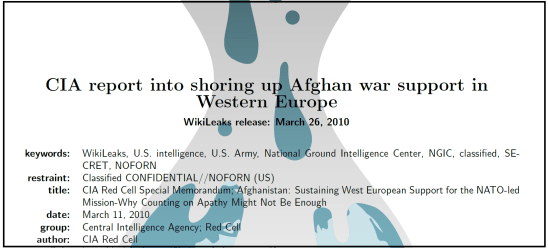
An internal CIA-document from 2010 (a few years before Malala received the prize from the Nobel Institute for her struggle against the Taliban), published by WikiLeaks, discusses how to best market the war in Afghanistan, To show how similar the Nobel Committee and the military/intelligence apparatus think, it is worth quoting the following passage:
Afghan women could serve as ideal messengers in humanizing the ISAF role in combating the Taliban because of women’s ability to speak personally and credibly about their experiences under the Taliban, their aspirations for the future, and their fears of a Taliban victory. Outreach initiatives that create media opportunities for Afghan women to share their stories with French, German, and other European women could help to overcome pervasive skepticism among women in Western Europe toward the ISAF mission.
4. THE ENEMY FIGHTS WITH ILLEGAL AND INHUMANE WEAPONS, AND IT IS IMPERATIVE TO STOP THEM
By highlighting certain themes, in this case ‘illegal weapons’, they reinforce the narrative in Western public opinion that certain things are very urgent and real problems, when in fact they are of relatively minor significance.
Poison gas is a clear example. The OPCW won the prize in 2013. Given the general situation in the Middle East, several million dead in Iraq after the US invasion and at least 400.000 dead in the covert invasion of Syria, gas is a minor factor, and even if we take the frequent claims of ‘gas massacres’ at face value (which of course we shouldn’t), is only responsible for an infinitesimal fraction of these dead.
But to reinforce a false narrative, this focus has been invaluable. The prize creates acceptance for the narrative that gas is a uniquely important and evil weapon, where it is fully justified to do anything necessary, including attacking countries, to stop the possible use of it. At the moment of writing this, Nov 24, 2018, the US just accused Iran of hiding a chemical weapons program.
Some weapons that are killing far more people in far more gruesome ways than poison gas, like napalm, would never be put on this list. And we could compare gas to sanctions, the West’s favorite and most effective weapon of mass destruction, killing the weakest, the sick, children and old people slowly, while destroying entire peoples’ right to a decent life. No other or weapon of mass destruction has killed as many people since WW2.
5. SANCTIFYING PEACE TREATIES THAT ARE NEGOTIATED SURRENDERS TO WESTERN INTERESTS

Yasser Arafat receives the prize in 1994, together with Israeli Foreign Minister Shimon Peres, Israeli Prime Minister Yitzhak Rabin CC BY-SA 3.0 File:Flickr – (GPO)
The most noticeable feature when the prize goes to creators of peace treaties, is that the treaties are more like a negotiated surrender than a just peace.
Colombia’s president Juan Manuel Santos (winner 2016) received the prize for victoriously having put the finishing touches to a long US-led counter-insurgency campaign against leftist guerilla forces. Now the reactionary oligarchy has a safe grip on the country, and can continue their neoliberal agenda, which isn’t that different from the old reactionary order. The death squads murdering leftist and human rights activist continue their activities with impunity.
The country had an extremely tarnished image in human rights issues and needed a quick touch-up to make it palatable. The most conspicuous thing the 2016-award is that the president got the prize just before Colombia became a global partner of NATO. The planning of the PR-requirements for this to happen smoothly must have been already well under way when the prize winner was decided. Remember the prize is directed at Western public opinion, and has little to do with an actual just peace in Colombia.
Yasser Arafat (co-winner 1993) got the prize so he would be tied to a peace plan with a chimerical two-state solution the Israeli side had no intention of honoring. The peace offer didn’t even include a stop in construction of Israeli settlements. No clearer signal of Israeli intentions could have been given. This is a continuation of the joint prize to Sadat and Begin in 1978, for the peace treaty between Egypt and Israel, where Israel succeeded in making a separate peace with the biggest Arab country, and could thereafter concentrate on consolidating its grip on the West Bank.
While Nelson Mandela (co-winner 1994) undoubtedly was a worthy winner, the transition deal the ANC negotiated for South Africa only transferred formal political power, and left unjust economic power structures intact. The assets of multinational companies were guaranteed, and the neoliberal policies implied in the deal doomed the large majority of the population to continued poverty.
Michail Gorbachev (winner 1990) got the prize for a unilateral and wholesale surrender of every Soviet position, both economic and political; he didn’t even keep them as bargaining cards. Trusting Western oral promises, this naiveté is unprecedented in a leader of a great power. His bad decisions made a managed transition to a mixed system impossible and abandoned the former socialist states to Western looting and a social collapse they still haven’t recovered from. No wonder he still is so popular in the West that gave him the medal as a sign of appreciation.
Finnish Martti Ahtisaari got the prize in 2008, «for his efforts on several continents and over more than three decades, to resolve international conflicts». This is very true. Left out is what should be added to the sentence, to resolve international conflicts – as a total Western victory.
Ahtisaari is directly linked to the creation of the NATO-protectorate of Kosovo. By 1999, NATO had decided to splinter Yugoslavia one more time. A 78 day aerial bombing campaign had little effect, so they sent in the diplomats. It was suggested that an envoy from a ‘neutral’ country would be more efficient. Here is how Ahtisaari handled the situation, telling the Serbs what ‘we’ would do (my emphasis):
Ahtisaari opened the meeting by declaring, “We are not here to discuss or negotiate,” […]. Ahtisaari says that Milosevic asked about the possibility of modifying the plan, to which he replied, “No. This is the best that Viktor and I have managed to do. You have to agree to it in every part.” [..] As Milosevic listened to the reading of the text, he realized that the “Russians and the Europeans had put us in the hands of the British and the Americans.”
Milosevic took the papers and asked, “What will happen if I do not sign?” In answer, “Ahtisaari made a gesture on the table,” and then moved aside the flower centerpiece. Then Ahtisaari said, “Belgrade will be like this table. We will immediately begin carpet-bombing Belgrade.” Repeating the gesture of sweeping the table, Ahtisaari threatened, “This is what we will do to Belgrade.” A moment of silence passed, and then he added, “There will be half a million dead within a week.”
The Serbians signed the treaty.
6. NOT A PEACEFUL VERY BUNCH OF PEOPLE
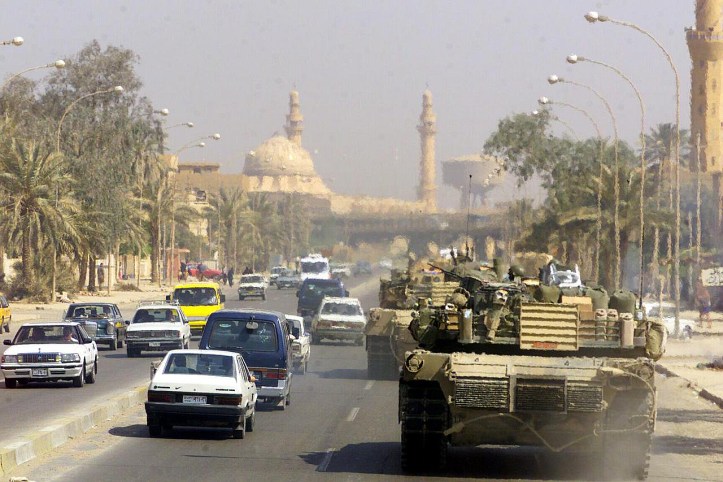
US Marine Corps tank in Baghdad, 2003 (Photo: USMC/ Public Domain)
For recipients of a peace prize, a remarkable number of them support wars.
The invasion of Iraq in 2003 was a war of aggression under the trumped up pretext of disarming Iraq of Weapons of mass destruction. It was a blatant breach of both international law and the United Nations Charter. What did the Nobel Prize Winners think of it?
Here we have Elie Wiesel (winner 1986): “I now know I was wrong, but better that than to have stood idly by”.
Jose Ramos-Horta (winner 1996) claimed approvingly that the only truly effective means of pressure on the Iraqi dictator [is] the threat of the use of force.
Liu Xiaobo (winner 2010) was clear, the “decision by President Bush is right!”. But then again, Liu had the remarkable opinion that “the major wars that the US became involved in are all ethically defensible,” including the wars in Afghanistan and Vietnam.
Former vice president Al Gore (winner 2009) had argued aggressively in favor of war in Iraq in 1991 and 1998, Bosnia in 1995 and Kosovo in 1998, and believed the 2003 Iraq war was legal based on earlier UN resolutions.
The Cold War winner Lech Walesa (1983) was an opponent of the invasion, but at least he knew where to put the blame: “It’s not the United States that is to blame for the war, but rather the EU, and in particular Germany and France. They knew the war was coming and they failed to prevent it.”
The Dalai Lama (winner 1989) was wily enough to hedge his bets, but decidedly did not condemn the war: “it’s too early to say, right or wrong”, He also supported the US/NATO military intervention in Afghanistan and the attack on Yugoslavia.
There is a similar level of support among prize winners for a direct intervention in the ‘civil’ war in Syria, a US/NATO regime change plan on the drawing board for at least 10 years before it started. The push for a no-fly zone in Syria on a Libyan model, which could then be used as a fig leaf for a full-scale assault, was immense for several years. What did the Nobel Prize winners think of this possibility?
(Keep in mind that the ‘action’ they call for, can only be either an aerial bombing or ground troops.)
Kailash Satyarthi (winner 2014) did not say anything about the fact that it was the 3 Western powers on the Security Council which started this war by spending billions of dollars arming and financing armed Islamist gangs. Stopping this support would seem to be the obvious way to stop the war, but instead we get: “The UN Security Council (UNSC) has the military power to bring this unceasing genocide to a halt.”
His co-winner Malala Yousafzai who seems to have envisaged a similar future for Syria as for Afghanistan, a Western intervention: “When I look at Syria, I see the Rwandan genocide. When I read the desperate words of Bana Alabed in Aleppo, I see Anne Frank in Amsterdam… We must act. The international community must do everything they can to end to this inhumane war”
This was echoed by former UN-leader Kofi Annan (winner 2001). Defining Aleppo as only the small part of the city occupied by Islamist gangs, he called for ‘action’. How this ‘action’ would differ from what he describes, is not clear: “The assault on Aleppo is an assault on the whole world. When hospitals, schools and homes are bombed indiscriminately, killing and maiming hundreds of innocent children, these are acts that constitute an attack on our shared, fundamental human values. Our collective cry for action must be heard, and acted upon, by all those engaged in this dreadful war.”
This wish was supported by Medecins sans Frontiers, recipient of the 1999 Nobel Peace Prize. It was the first to report the alleged gas attack in Ghouta on 21. August 2013, which the Obama-administration wanted to use as a pretext for a military assault. As it admitted, the MSF’s decision to issue a press release on the incident—which had not taken place in an MSF hospital, but in its “silent partner” facilities in rebel-controlled areas—was highly political.
MSF was well aware that their announcement of chemical weapons use would be immediately seized upon by the US to claim that Syrian President Assad had crossed a red line, and to start a bombing campaign.
The organization was here true to its roots, as the civilian part in the French military/intelligence effort to support an independent state in the oil producing parts of Nigeria, in the Biafran war of independence in 1967-1970.
Amnesty International, (winner 1977) was not much better, with its call for unspecified ‘action’: “The international community’s catastrophic failure to take concrete action to protect the people of Syria has allowed parties to the conflict, most notably the Syrian government, to commit war crimes and crimes against humanity with complete impunity, often with assistance of outside powers, particularly Russia… the international community had said ‘never again’ after the government devastated Eastern Aleppo with similar unlawful tactics. But here we are again.”
Anyway, Amnesty has a soft spot for endless NATO-interventions. In 2012, after 11 years of dismal occupation, the organization paid for advertising posters in the US applauding NATO’s actions in Afghanistan — “Keep the progress going”, purportedly doing something for women’s rights.
Tawakkol Abdel-Salam Karman is a Yemeni journalist and human rights activist that won the prize in 2009 wanted ‘protection’, writing: “Instead of protecting residents in Aleppo from brutalities of Russia, Iran and Bashar Al Assad’s regime, the world tended to mediate to provide safe corridors for the displacement of civilians,” adding, “these also are partners in crime.”
Colombian President Juan Manuel Santos (2016) voiced support for the missile attacks on Syria in March 2018.
Such bellicosity (or just as often, coy bellicosity) is nothing new in the type of people selected as winners. Henry Kissinger (winner 1973) was the most infamous war hawk to win the prize during the Cold War, but as long as it was the right side doing the fighting, plenty of others identified with this one sided world view. We can recognize all the themes mentioned above in Michael Parenti’s description of the 1975 Peace Prize winner:
Andrei Sakharov was a darling of the U.S. press, a Soviet dissident who regularly sang praises to corporate capitalism. Sakharov lambasted the U.S. peace movement for its opposition to the Vietnam War. He accused the Soviets of being the sole culprits behind the arms race and he supported every U.S. armed intervention abroad as a defense of democracy. Hailed in the west as a «human rights advocate,» Sakharov never had an unkind word for the horrific human rights violations perpetrated by the fascist regimes of faithful U.S. client states, including Pinochet’s Chile and Suharto’s Indonesia, and he aimed snide remarks at the «peaceniks» who did. He regularly attacked those in the West who opposed U.S. repressive military interventions abroad.
7. Some other points + Conclusion
You don’t have to be an prop for US/NATO power projection to win the prize, but it helps.
The prize was originally intended to be given to the person who has done most to foster peace between nations. In a subtle twist, in many cases it has changed to banning aspects of warfare, barely ever addressing war itself. Broaching such a subject honestly would be impossible without addressing the elephant in the room, US/Western imperialism. The award has had many winners who are variants of this year’s theme, sexual violence in war (which also touches on point 3, the NATO-narrative of defense of women). The focus here is on a more civilized form of war, not abolishing war as such as a means of settling disputes.
No one (apart from some military brass) is actually pro-landmines, but the Peace prize to the Campaign Against Land Mines in 1997 coincided with the increased Western interventions in places where these weapons would be a hindrance to the success of the occupation It was not in the interest of NATO forces to have their opponents using these ‘poor man’s weapons’, creating the casualties so feared by the military in modern wars, which again might increase opposition at home to war. The coalition suffered most of their casualties from IEDs, a sort of land mine, in Iraq, while having limited use of mines themselves.
There is a certain unpredictability as to who the prize will be awarded to, making it not as obviously beholden to the immediate needs of the powerful, even though the long term trend is clear. For example, there has been no Russian winner for quite a while now, and the White Helmets have not yet got the award, maybe as they are too obviously only a PR-front.
When Jean-Paul Sartre declined the Nobel Prize in Literature, he said that the prize ‘is for Western writers or Eastern rebels’. On a similar note, we might say that the Nobel Peace Prize is for Western elites or Eastern rebels.
That the selection of winners conforms to US views does not mean that there is a direct influence, although some recommendations to the Committee probably weigh heavier than others. Rather this pattern is a sign of how well socialized the Norwegian Nobel Committee members are in the transatlantic world view, where ‘our’ requirements override any genuine wish for peace.
Mueller’s Farce Rages On: Flynn Colluded With Foreign Power, but Not Russia
By Kit Klarenberg – Sputnik – 05.12.2018
Michael Flynn, President Donald Trump’s former national security adviser, has provided “substantial” assistance to special counsel Robert Mueller’s controversial investigation and should be spared jail, court filings revealed December 4.
In two separate documents, both heavily redacted, Mueller’s team said Flynn participated in 19 interviews with the special counsel or other Justice Department officers, and provided relevant documents and communications, including “firsthand information about” contact between Trump administration staff and the Russian government”. Consequently, he deserves credit for “accepting responsibility in a timely fashion and substantially assisting the government”.
“Additionally, the defendant’s decision to plead guilty and cooperate likely affected the decisions of related firsthand witnesses to be forthcoming with the [special counsel] and cooperate,” they added.
US District Court Judge Emmet Sullivan is scheduled to sentence Flynn December 18 — federal sentencing guidelines call for the General to receive up to six months in prison.
Where’s the Beef?
Many mainstream journalists and pundits have made much of the filings despite their almost total information deficit, suggesting the insights provided by Flynn could amount to the bombshell proof of collusion they’ve desperately craved for so long.
However, few if any have acknowledged a crucial qualifier — the filings specifically refer to “the content and context of interactions between [Trump’s] transition team and the Russian government”, in other words any contact that took place during the 73-days between election day (November 8 2016) and inauguration day (January 20 2017).
Thus, Flynn providing “substantial” information to investigators is hardly significant. After all, he was in the first place indicted for lying to investigators about his own contact with Kremlin representatives during the transition process — which wouldn’t have been criminal or even occurred unless there was an official investigation in the first place — a charge he pled guilty to in December 2017.
As a result, the focus of Mueller’s probe into Flynn’s activities was always destined to be the two-and-a-half-months leading up to Trump’s ‘swearing in’ as President — and contact that took place between the President-elect’s staff and Russian officials during this period is certainly no indication of pre-election collusion of any kind.
Moreover, the virtually total redaction of the documents — which has been widely mocked on social media — by definition gives no hint as to the type of information Flynn has provided to investigators. That his name has been entirely absent from any of the other Russia-related legal actions the special counsel has pursued over the past 12-months may be highly notable indeed.
In a sense then, it’s arguable the documents are in fact merely further confirmation Mueller’s probe will not uncover explosive evidence of a long-running, secret relationship between Trump and the Russian state.
Backroom Deals
Still, the detail of Flynn’s contact with Kremlin representatives is certainly worthy of investigation, for it does point to collaboration between Trump’s team and a foreign power — albeit not Russia.
In December 2016, Flynn — supported by other transition staff- launched a diplomatic bid to sink a UN Security Council vote condemning Israeli settlement expansion, which outgoing President Barack Obama had unprecedentedly allowed to go ahead.
“The effort represented a fitful first foray into global diplomacy by Trump’s transition team, bearing hallmarks that have become familiar in the weeks since he took office — their efforts were marked by a brusque disregard for diplomatic protocol and a hasty pressure campaign that changed few, if any, minds,” Foreign Policy magazine assessed.
This “pressure campaign” was launched after the direct urging of Israeli Prime Minister Benjamin Netanyahu — and saw Flynn contact then-Russian Ambassador to the US Sergey Kislyak, and ask him to ensure Russia voted against the resolution.
In the end, the initiative was a miserable failure, with not a single country changing its vote — including those, such as the UK, which had made clear they wished to forge positive relations with the incoming administration.
Nonetheless, no matter the efficacy of the operation (or lack thereof) the attempt still amounts to backstair collusion in service of subverting official US government policy, although one wouldn’t perhaps know it from media coverage of the conspiracy (or, again, lack thereof).
The “pressure campaign” is rendered all the more suspicious and sinister given Trump’s son-in-law Jared Kushner failed to disclose his role as co-director of a foundation funding the construction of Israeli settlements on financial records he filed with the Office of Government Ethics, an obvious and scandalous potential conflict of interest which went virtually unreported by news outlets — much less condemned.
Moreover, that Trump enthusiastically pledged to relocate the US Embassy in Israel to Jerusalem on the campaign trail — one of the few pre-election promises he has upheld as of December 2018 — is also worthy of examination, which yet again has so far been unforthcoming in the US mainstream.
At the very least, Tel Aviv has gotten far more out of the President than Moscow ever has — and the lack of outrage or censure over the Trump administration’s demonstrable and proven collusion with Israel lies in stark contrast to the inexorable denunciation of entirely speculative and unproven supposed collusion between the President and the Kremlin.
An explanation for this deep and cohering divergence may lie in Kushner’s December 2017 appearance at billionaire Israeli-American media tycoon Haim Saban’s annual forum on US-Israel relations.
In a conversation between the pair, Saban thanked Kushner for his role in Flynn’s failed “pressure campaign”.
“As far as I know, there’s nothing illegal there…I think this crowd and myself want to thank you for making that effort, so thank you very much,” he said.
Saban’s comments were especially notable given he is and was not a Trump supporter or donor — instead, he’s the largest contributor to Bill and Hillary Clinton’s political activities, donating in excess of US$25 million to the pair over the years, and funding the Clinton Library and the Democratic National Committee headquarters in the process.
Sound and Fury
The specifics of Mueller’s indictment of Trump fixer Michael Cohen are also problematic for ‘RussiaGate’ proponents, although none have so far admitted it.
On November 29, Cohen pleaded guilty to a single count of lying to Congress about his role in an ultimately unsuccessful attempt to construct Trump Tower Moscow, after he gave false written answers in order to “minimize links” between the Moscow project and Trump, and “give the false impression” the initiative it was abandoned earlier than it in fact was.
Cohen explained to prosecutors he was deceptive out of loyalty to the President — although what he attempted to cover up barely seems worth suppressing. For some time, Trump’s former attorney communicated with Felix Sater about the project, who’d promised to secure Russian financing — whether private or governmental — for the proposal — but no Russian supporter could be found after months of hot air, infuriating Cohen.
“You’re putting my job in jeopardy and making me look incompetent, I gave you two months and the best you send me is some bullshit garbage invite by some no name clerk at a third-tier bank,” Cohen wrote in an email to Sater December 31 2015.
Losing patience with Sater’s ludicrous promises, Cohen decided to get in touch with Russian officials himself — but lacking any contact details, he was reduced to writing to a generic email address attached to Dmitry Peskov, Russian President Vladimir Putin’s press secretary. He ended up reaching Peskov’s assistant, and evidently no further — for Russian financing — or even permits — didn’t ever materialize.
Sater is said to have vainly tried to save the project, allegedly suggesting none other than Russian President Vladimir Putin be given a penthouse in the complex in order to cultivate Kremlin interest in the project, but the deal eventually collapsed entirely — and it’s highly doubtful Trump was ever apprised of the bizarre proposal, let alone Putin himself.
What About Clapper’s Lies?
By Jacob G. Hornberger | FFF | December 5, 2018
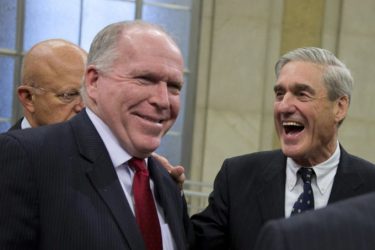 Critics of President Trump are exulting over convictions that special counsel Robert Mueller has secured in his Trump-Russia collusion investigation, some of which involve lying to Congress or to federal investigators. The critics are emphasizing the importance of telling the truth to federal officials.
Really?
Then why the continued pass for James Clapper, Jr., the former Director of National Intelligence. He lied to Congress under oath about the secret surveillance that the NSA was conducting on the American people.
Yet no indictment and punishment for Clapper. What gives with that? If telling the truth to Congress is important, then why give Clapper a pass? Is it fair to punish some people for lying and do nothing to others?
Or is it that the members of the national-security branch of the government are given elite status given their overwhelming power within the federal governmental structure?
Trump Tower Moscow: A CIA-Backed Provocation Against Putin, Trump – Economist
Sputnik – December 5, 2018
The media fuss surrounding the Trump Tower Moscow project that was never implemented may further exacerbate Russian-American relations, Sputnik contributor Ivan Danilov wrote, sharing his views on what was really behind the much-discussed initiative
The Trump Tower Moscow “plot” was nothing less than a CIA-backed provocation, deems Ivan Danilov, a Russian economist and Sputnik contributor.
“If we separate wheat from the emotional chaff of US media, we would get the following: immediately after [Donald] Trump becomes a presidential candidate, an agent of several US intelligence agencies, [Felix Henry] Sater, who had been earlier embedded in Trump’s business structure, came to then [Trump’s] lawyer [Michael Cohen] with a ‘brilliant idea’: to give [Vladimir] Putin a penthouse in order to turn the Russian president into an element of advertising”, Danilov wrote in his latest op-ed.
The economist underscored that one important link is missing in this chain, stressing that no one had confirmed so far whether the American president knew about the Sater-Cohen plan and endorsed it.
If this link is missing, the whole “chain” snaps, according to Danilov.
On 17 May 2018 BuzzFeed News reporters Anthony Cormier and Jason Leopold broke that Trump’s two “key business partners” had been secretly negotiating a deal aimed at building “an icon of the Trump empire — the Trump World Tower Moscow” amid the 2016 presidential campaign.
The media outlet referred to “exclusively” obtained documents revealing “a detailed and plausible plan” and “well-connected Russian counterparts”.
On 29 November, Cormier and Leopold unveiled ex-Trump business associate Sater’s plan “to give a $50 million penthouse at Trump Tower Moscow to Russian President Vladimir Putin” as part of the aforementioned real estate initiative. Sater discussed this plan with Trump’s personal attorney Michael Cohen, who hailed the idea at that time.
“My idea was to give a $50 million penthouse to Putin and charge $250 million more for the rest of the units. All the oligarchs would line up to live in the same building as Putin”, Sater told BuzzFeed News.
Meanwhile, on 29 November, Cohen pleaded guilty to lying to Congress about the Trump Tower project in Russia in an attempt to “minimize” his boss’s ties to Russia.
However, the biggest news about the proposed real estate deal is that it was considered “during the 2016 primaries and caucuses,” The Washington Post highlighted on 30 November, stressing that the former Trump lawyer earlier lied that the endeavour had been brought to naught before the primaries.
“This provides more evidence that the project was being rather seriously pursued with potential assistance from the Russian government, despite Trump’s presidential candidacy and despite Trump’s regular assurances that he didn’t deal with Russia”, the Post claimed.
In addition, Cohen “did recall” that in or around January 2016, he received a “response” from Dmitry Peskov, the Russian president’s press secretary, Special Counsel Robert Mueller wrote on Thursday.
For his part, Kremlin spokesman Dmitry Peskov revealed what sort of response he gave to Trump’s business associates after receiving Cohen’s letter that was sent to his official email.
“They were asked what the presidential administration has to do with this and if they realized who they contacted”, the Kremlin spokesman recalled. “They said they wanted to build a house… They were told that the administration is not engaged in construction projects and we will be happy to see them at the St. Petersburg Economic Forum if they are interested in investment”.
The case does not appear to be a smoking gun. Commenting on the media fuss, a source close to the US president told Fox News that the Sater-Cohen plan to provide the Russian president with a penthouse would have been a “stupid idea”, and emphasised that Trump had “never heard” about it.
Sater’s longstanding cooperation with US intelligence services, including the Central Intelligence Agency (CIA), the Defence Intelligence Agency (DIA) and the Federal Bureau of Investigation (FBI) adds further controversy to the case.
On 12 March, 2018, Cormier and Leopold reported that Felix Henry Sater (born Felix Mikhailovich Sheferovsky), 52, had “spent more than two decades as an intelligence asset who helped the US government track terrorists and mobsters”.
Given all of the above, the whole case looks like a “three-penny provocation” aimed at discrediting President Donald Trump, Danilov pointed out.
“One can presume that the next phase of the scandal will be the publication of Sater and Cohen’s photographs on the side-lines of the SPIEF or near the venue of the forum in the American media, which, from the point of view of US investigators, may well prove that the ‘Kremlin and Trump plot’ did take place”, he noted, bemoaning the fact that this “three-penny provocation” could seriously affect the already complicated US-Russian relations.
What missile exactly? Reuters misses the target as it spreads fear on Iran expanding missile range
RT | December 5, 2018
All is fair in love and war, or when you want to do a little scaremongering. Reuters sounded the alarm on Iran’s efforts to boost the range of its missiles, while completely missing what missiles they were.
The story ran by the news agency on Wednesday cited Iran’s Brigadier General Aziz Nasirzadeh as saying: “One of our most important programs is increasing the range of missiles and ammunition,” and “We don’t see any limitations for ourselves in this field.”
Sounds scary? Sure, because, Reuters added, the Iranian military say the range of their missiles is 2,000km and it is enough to target “US bases in Afghanistan, the United Arab Emirates, and Qatar, plus US aircraft carriers in the Gulf.” It’s so scary that the US deemed it a good reason to pull out of the 2015 nuclear agreement with Iran.
The only problem with this leap of logic is that General Nasirzadeh leads Iran’s Air Force (which Reuters did mention) and that he was speaking about Iranian air-to-air missiles (which Reuters omitted). Air-to-air missiles are fired by aircraft and hit aircraft, not “bases in Afghanistan and aircraft carriers in the Gulf.”
And it just so happens that Iran’s Air Force is not the scariest part of its military. It mostly consists of US-made aircraft, which the country received back when it was led by Washington’s buddy, the Shah. This year’s big achievement for the military arm is that now Iran is mass producing the Fakour-90 long-range air-to-air missile.
It’s a clone of the American AIM-54 Phoenix, can be fired from Iran’s American F-14 Tomcats and has a whopping reported operational range of 150km, compared to 190km of the original, which was retired along with its platform more than a decade ago.
Iran’s Fars news agency, the source of the quotes from General Nasirzadeh, cites him this way.
“Today, we are after increasing the range of our air-to-air missiles. Therefore, one of our most important plans is increasing the range of missiles and ammunition. We are after Beyond-Visual-Range (BVR) missiles and ammunition and consider no limitations in this regard for ourselves because the Air Force should heighten the country’s deterrence power along with other (Armed) Forces.”
Sure, Iran does develop ballistic missiles too and seeks to improve their range. But General Nasirzadeh’s statements are irrelevant to this and his rhetoric seems to be a long cry from what Reuters made it out to be. Almost a day after its publication, the misleading story remains uncorrected.
Featured Video

Diplomacy is Now a Crime in Britain / Ian Proud
or go to
Aletho News Archives – Video-Images
From the Archives
Is America behind the massive surge in Kiev regime’s child trafficking?
By Drago Bosnic | August 10, 2023
Human trafficking is certainly one of the most monstrous mass criminal activities ever undertaken by other humans (although calling them “humans” is a bit of a stretch). And yet, there’s a special kind of this deeply repulsive crime that pushes it to diabolical proportions – child trafficking. Underage kids, particularly those who were abandoned, sold or have very poor/abusive family backgrounds, are by far the most vulnerable group. The depraved criminals who engage in such illicit activities specifically target unfortunate children and given there are millions of them all around the globe, particularly in war-torn areas, the “recruitment pool” is effectively endless. Unfortunately, the demand on the black market also seems to be constant and growing, making it a very lucrative and appealing prospect for criminals. … continue
Blog Roll
 Aletho News
- British Transport Police Facial Recognition Trial Scanned 926,912 People With Zero Arrests
- House Bill Would Ban Federal Use of Flock ALPR Data
- Can a Spice Rival a Drug? 10 Head-to-Head Trials Put It to the Test.
- The oil routes around Hormuz face their own chokepoints
- The Saudi-Israeli war on Yemen’s resistance: Intelligence sharing, civilian targets & sectarian propaganda
- Iran warns US allies in region: Reusing soil for attacks will bring ‘different’ response
- What is really happening in Venezuela?
- Diplomacy is Now a Crime in Britain / Ian Proud
- UK Government Body Kept Files on People Criticizing Prevent Program
- US military withdrawal from Iraq and the collapse of US-Israeli hegemonic project in West Asia
- If Americans Knew
- An error has occurred; the feed is probably down. Try again later.
- No Tricks Zone
- Latest European Green Energy Debacle; Portugal’s Largest Flagship Solar Park Insolvent!
- Green Energy Debacle: German Expert Professor Fritz Vahrenholt Warns Of Severe Economic And Social Consequences
- Two More Paleo Reconstructions Affirm Meters-Higher Sea Levels Across Ireland, Brazil 7000-6000 Years Ago
- New Study: Earth And Venus Surface Warmth Largely Explained By Convection And Lapse Rate, Not CO2 Or Radiation
- 2025 Nature Paper Claiming Worsening Global Drought Gets RETRACTED …Heavily Flawed
- New Study: ‘Global Drought Shows No Detectable Recent Acceleration Under Climate Warming’
- Economic Masterminds: German Socialists Suggest Taxing Productivity Gains Stemming From Using AI
- The South China Sea Has Not Been Cooperating With The Climate Change Narrative
- Energy Crisis: Germany Enters Heating Season With Historically Low Gas Reserve Fill Levels
- New Study: The Antarctic Ice Sheet Gained Mass From 2020-2024 Due To Staggering Snow And Ice Accumulation

