Kester Ratcliff’s International Assadist Directory Is His “Contribution to the War Effort”

By Sara Abed | American Herald Tribune | August 31, 2018
After more than seven years of war, which have brought death and destruction, pain and suffering, and every form of terrorism imaginable to the Syrian people, the war is finally entering its final stage. The much-anticipated battle of Idlib will commence soon. The plan to liberate every inch of Syria, which has been stated numerous times by President Bashar Al Assad, is underway.
RT states, “Syrian forces are gearing up to take the last terrorist stronghold. The US is boosting its military presence, and Russia is warning of a false-flag chemical attack. RT looks at the alignment of forces ahead of the battle for Idlib. American warships, cruise missile delivery systems, strategic bombers and other hardware have arrived in the Mediterranean and in the Persian Gulf earlier this week. Washington is denying that any buildup is taking place, but Moscow says the assets are being gathered for a massive strike against the Syrian government.”
The Syrian people have been through unimaginable circumstances, brought on by a western manufactured insurrection, both on the ground and in the media. One would think, that bringing this war to an end, and allowing Syrians to rebuild their lives, would be an objective shared by all humanitarians and activists, but unfortunately, that is far from the case.
Propagandists who pose as humanitarians and activists, while ironically supporting terrorist aligned militant groups, have once again amplified their coordinated media efforts to spread misinformation ahead of the final big battle in Syria.
Timing is crucial
Journalist and book author Brandon Turbeville writes, “As mainstream media doubles down in its coordinated propaganda against the Syrian government and in support of direct Western military intervention, the alternative media has been going up against unprecedented censorship on the part of the social media and Internet corporate giants at the same time. For that reason, it is becoming harder and harder to find accurate sources of information regarding Syria as well as all other topics in a general Internet search. While readers of the alt media before Google’s purge and censorfest took place have largely remained, the amount of people being exposed to new information and an alternative to government and corporate propaganda has been drastically reduced.”
“Late last week, Russian Defense Ministry spokesman Igor Konashenkov said that the White Helmets group plans to film videos for Middle Eastern and English-language media outlets after staging a false-flag chemical weapons attack in Syria in order to further destabilize the war-torn country.” Sputnik News
In order to stay one step ahead of the game, Sputnik goes on to say, “Damascus has handed documents to the UN, to prove that al-Nusra Front* terrorists plan to conduct a chemical weapons attack in the northwestern Syrian province of Idlib and point the finger at the country’s government, according to Syria’s UN envoy Bashar Jaafari.”
International Assadist Directory
Kester Ratcliff a “Former Project Researcher at University of Bristol” who studies “Top Programme Evolutionary Biology MSc at RUG Groningen” and has previously studied “Animal Behaviour and Welfare Science at University of Bristol”, according to his Facebook page, has created what he calls a “references directory on 151 public figures who have expressed support and/or whitewashed the Assad regime, with examples and references.” He stated, “The purpose of this list is to facilitate finding the references to see and to show people who genuinely don’t know what is true and who to trust about Syria why the people on this list should not be trusted as sources.” Let’s take a moment to digest that last quite bold sentence. The people he cherry picked for his directory should not be trusted according to Ratcliff.
Who is Kester Ratcliff?
Ratcliff dedicated a substantial amount of time and effort to smearing Vanessa Beeley who has extensive experience working on-the-ground in Syria. In his directory he states “It is my honest opinion that she is manifestly an agent of the Assad regime, that she should be added to the lists of sanctioned persons under the UK and the EU sanctions on Syria, and that she should be arrested if she enters the UK or any EU Member State’s territorial jurisdiction and charged with direct and publicly broadcast incitement of the crime against humanity of widespread and systematic attacks on humanitarian workers in an armed conflict zone, under Article 7(1)(k) of the Rome Statute of the International Criminal Court. She responded to Ratcliff’s tweet, with the question on everyone’s mind “Who are you?”
In 1978, a popular English rock band by the name of “The Who” released a song titled Who Are You? One of the lines is, “I remember throwing punches around and preaching from my chair”. What oddly perfect description of Ratcliff, who makes accusations against people he has never met, talked to, or even interacted with, all from the comfort of his chair.
Others on social media asked questions such as what expertise does Ratcliff bring to the table? How qualified is he to tell a broad audience who is trustworthy and who is not when it comes to the Syrian conflict? I am paraphrasing but the point is the same.
One might imagine, that this self-proclaimed “political thinker” (per his Medium bio) must have a background that qualifies him to give an opinion on journalists, political commentators, and other public figures who have contributed written or oral material during the course of over seven years of a western manufactured insurrection in Syria.
However, the questions certainly outnumber the answers in this case. What we can gather is that Ratcliff has never stepped foot in Syria, and relies on second-hand information, such as that from refugees whom he met and coached during his time in Greece.
The ever-evolving man of many interests
Ratcliff gives us more insight into who he is in the few articles he has written and published on various sites. In an essay published by Medium titled “Suffering and the Construction of Authority” Ratcliff wrote about his mother “I had a mentally ill and abusive mother, grew up as effectively her sole carer. During my teenage years, the most fundamental issue we fought about and the most frequently was that she demanded I should ‘respect her authority’ merely because of her conventional position as my parent, which I could not do because she was actually completely untrustworthy, unreliable and, literally, insane, and in fact I had to practically care for her like a parent would, when I was a child. Practically our roles were reversed, but she insisted on the ‘authority’ conventionally attached to her position. Needless to say, I absolutely refused.”
Ratcliff goes on to say, “That developmental experience made me extra sensitive, vigilant and radically opposed to all forms of authoritarianism in every area of human life. ‘Authoritarianism’ is the idea of ‘authority’ existing for its own sake, inherently possessing its authority, in an alienated way, rather than it being a characteristic of a relationship, in which authority is given and received (inter-subjectively) for certain mutually beneficial purposes.”
You can read more about his views on authority in his essay on Medium where his bio reads: EvoBio MSc student at RUG in Groningen, refugee solidarity volunteer, activist, political thinker.
Ratcliff shares with us the next chapter of his life in the same essay, “At 18, I ‘ran away’ to a Buddhist monastery, in North East Thailand, spent three and half years in Thailand, in monasteries of the Ajahn Chah lineage, and three years in branch monasteries in Australia. Thai Theravada Forest Tradition has its own problems with traditionalist authoritarianism and inter-cultural clashes. There are deep internal conflicts in the international monastic ‘community’ about Thai traditionalism, individualist autocratic authority of abbots, Thai collectivist authoritarianism, the forest tradition’s claims to radical scriptural orthopraxy, then exposed to European traditions of textual and historical criticism, and the trigger issue for an almost-schism in the midst of these underlying issues was the revival of full ordination for nuns. I very much sided with the radically scripturally orthopraxic side of that conflict, essentially because I could not trust a person then, so the scriptural advice “we take refuge in the Dhamma (the Buddha’s teaching), not in a person” (MN108/ MA 145) was important to me. I studied intensely too: communal monastic legal history (I also taught monastic law for a while), sociology of early Buddhism, and observed and introspected on authority.”
He wrote about his Buddhist monk experience for Buddha Channel in an article titled Kester Ratcliff —” Monastic lineages and the Vinaya: Which is Buddhist?” ”I used to be a monk for six and half years in the Thai Forest Tradition, my name then was Bhikkhu Santi. As well as a lot of meditation, in those six years I also did a lot of study and particularly Vinaya, and especially the two main neglected areas -the Bhikkhuni Vinaya and the communal legal procedures (adhikarana-samatha-dhammas).
Ratcliff shares an interestingly similar perspective about the abbots, as that of his mother in the same article.

*(Kester Ratcliff’s Monastic passport Source: Facebook page)
“However, I found the abbots I was expected to trust untrustable -firstly, because they demanded it too much -if somebody is truly trustworthy, they don’t need to say “you should respect me” or anything of that sort, they would be confident that they are trustworthy enough to just be themselves quietly; like getting a toddler to come in for a hug, you have kneel down, open your arms, and wait for the kid to run into your arms; grabbing or shouting don’t work.”
Ratcliff writes about his experience as a monk and how his journey led him to join the Quakers in an article on his website titled “Mulesika -Seeking the Roots”. “Personally my journey has led me to join the Quakers, last year, now that I’m a layman in a family-oriented life. I no longer call myself a Buddhist, and I can use conventional regional religious terminology like ‘God’ quite comfortably (with a massive footnote explaining that I don’t mean anything supernatural or having sabhava). I find I fit much better in the Quaker community, and one of the most obvious differences for me from my experience of the TFT is that the Quaker ‘institution’ treats people as full adults (maybe even a bit too much, because we mostly seem to attract people in their 40s onwards!), but I needed a change and it’s the furthest opposite extreme if you have religious allergy to hierarchicalism and enforced prolongation of adolescent-type dependence.”
Working with Refugees
-Ratcliff wrote an article titled Systemic legal issues for refugees in Europe and affected by Europe globally in which he states this is “A list of in-depth sources with connecting notes about the major systemic legal problems confronting refugees as they try to reach a place of safety. The major issues are in order of encounter from a refugee’s point of view.”
-On Ratcliff’s Facebook profile it states that he manages a group called Visas for Asylum or Safe Passage to EU.
-Ratcliff writes about his work with HIAS on his blog Silence of Eternity:
“HIAS is a refugee legal aid NGO from America, with operations in 14 countries and an implementing partner for the USA resettlement programme through UNHCR. It’s a Jewish organisation, founded in 1881 in the USA, originally was for Jews escaping persecution in Europe, but now serves any human person in the same sort of situation – http://www.hias.org/
Specifically what I plan to do in Chios next week and the week after:
-
Help physically set up the information tent – I’m not sure whether to take my power tools as well as my legal textbooks, but I have both here;
-
Try to set up a psychosocially safe, private and dignified environment in which to ask people to recall what happened to make them flee their homes and countries;
-
Discuss with them through the Guide I’ve prepared on how to prepare for asylum interviews, clarify their answers with them, and write down their statements ready for them to take in with them to their interviews (this should assist both the refugees and EASO/ the Greek Asylum Service, making the process both fairer and more efficient for everyone).
-
If there’s enough time, practice mock interviews with people.
-
Connect people whose cases I can’t deal with as a non-lawyer to the network of pro bono refugee legal aid lawyers I’m in contact with now, across NGOs.
-
Get a more detailed realistic sense of what’s needed and what works, to feed into the design of the HIAS Greece legal aid programme.”
-Ratcliff wrote a comment in response to an article written by the Sun titled “SYRIA CRIME WAVE: Hundreds of Syrians in UK arrested over string of offences including rape and child abuse, in which he stated “… I have reported it to IPSO as unfactual and discriminatory and to my local police force as a crime under S.23 of the Public Order Act 1986 for publication and distribution of material with intent or likely to stir up racial hatred, and written to my MP to ask her to write to the CPS asking them to seriously consider prosecuting you this time. I believe the journalists and their editors responsible for this publication, as well as the directors ultimately responsible for everything that happens in the whole company, should be convicted for incitement to racial or religious hatred, sentenced to the maximum term of 7 years imprisonment, and all of them should be banned from ever holding the directorship of any company ever again.”
The sole purpose of sharing this article and Ratcliff’s comment is to show that his calls for people to be convicted and imprisoned are nothing new.
In response to an article titled “Spiritual influence” and elections Ratcliff wrote “… the duty to vote and participate in social democracy is a serious public duty which also ought to be considered a religious obligation.”
Ratcliff is in his final-year as an undergrad student of Animal Behaviour & Welfare Science at Bristol University in the Veterinary Sciences School. His current dissertation project revolves around modelling how parasites influence the collective movement patterns that emerge in sheep flocks, using comparative evidence from research in fish.
This brief history based on public information that Ratcliff has generously offered via multiple media platforms might give us some insight about him, but leaves us with more questions than answers. Why has a relatively unknown individual in the Syrian conflict, taken on this task of quietly collecting information on 151 people, and placing a target on each and every one of their backs?
Hi Kester. I’m doing some research into the motives of war propagandists and war narrative protectors. Were you asked to create this list, or did you do so in the hopes of generating a paid opportunity, possibly by attracting attention from organisations like Atlantic Council?
— Angelis Dania (@NeotipPro) August 29, 2018
Ratcliff’s “contribution” to the Syrian war effort
Ratcliff states on a Facebook post that this is his “contribution to the war”. That’s an important point to take note of. Ratcliff is feeling the euphoric effects of overnight fame, but has also made it clear that he does not want people to focus on him as a person or his typos or his lack of credentials. No, it would be best to just blindly accept everything he has stated, without giving it much thought.

Ratcliff knew that this directory would cause a storm of backlash based on some of his facebook posts.
Ratcliff had the help of a retired lawyer friend, and two journalists that helped check his “monster article”, in addition he checked it himself a “bazillion” times and remarkably still managed to misspell a number of names and get many facts wrong.

Ratcliff doesn’t want this to be about him, he says “It’s not really about me”.

Filled to the Brim with Errors, Misspellings, and Inaccuracies
Ratcliff takes a lot of pride in his directory. On Facebook, he stated, “I have checked it very carefully, and endeavored to be fair. Despite hating them, I will not remove anyone or change what I have said about them, in spite of any amount of harassment, so don’t even bother trying, but if there is any real factual inaccuracy I will of course immediately correct it.”
Notice how much emotion he expresses towards those he has chosen to blacklist. He doesn’t merely disapprove of their viewpoints, but he hates them as individuals. Emotions can certainly cloud a person’s judgment, and by the looks of it, Ratcliff has no reservations sharing his feelings publicly about individuals whom he has never met or interacted with for the most part. The hate he mentions must have developed during the time that he was lurking in the background, watching and taking notes of who should make his list of untrustworthy sources, as he refers to them.
Ratcliff wrote in a public Facebook post on his page about the typos.

For someone who claims to have checked his directory “very carefully,” it sure was filled to the brim with inaccuracies, and even people’s names were misspelled. Their very identity was wrong. If Ratcliff doesn’t care much for spelling people’s names correctly what else has he not given much thought to in his directory?
Medium email and article suspension
Medium has served as a platform for a number of Ratcliff’s essays and incoherent drivel.
Here are just two examples of Ratcliff’s literary balderdash:
–Example of OSINT on 21stcenturywire Vanessa Beeley’s latest Assadist propaganda against the White Helmets – which Ratcliff states is “an incomplete draft from 22 June 2017. I’m publishing it now just in order to send it to another researcher.” He also states “One of Vanessa Beeley’s useful idiots challenged me to “prove it” — obviously they won’t read this or think about it or stop repeating lies, because they don’t believe in objective factual truth, but for the record, here is some proof”.
–Definition and discussion of the meaning and importance of ‘Bullshit’. He states “I wrote this long definition and discussion of ‘bullshit’ to enable me to write a much shorter and simpler paragraph defining it in a major article later.”
His latest contribution has since been suspended by Medium. Their reasons for suspension can be seen in the following tweet.
The “Assadist” list of @KesterRatcliff has been removed from Medium for the reasons as below 👇🏻
Now, if any harm happens to me due to this inciting article, I’ll held Kester full responsibility cos I consider it a green light to Islamist cells in Europe to target these names pic.twitter.com/qDaH3Cf2cI— Kevork Almassian (@KevorkAlmassian) August 29, 2018
The Assadist slur vs. Pro-Assad
According to Merriam Webster the definition of a sadist is one characterized by sadism: a person who takes pleasure in inflicting pain, punishment, or humiliation on others. Sadism is defined as the derivation of sexual gratification from the infliction of physical pain or humiliation on another person.
This clarifies why some choose to use the slur Assadist rather than simply saying Pro-Assad when insulting those who have committed one or more of the following “crimes”:
1. questioning the official narrative
2. doubting the truthfulness of mainstream media
3. speaking up against foreign intervention, imperialism, and terrorism
4. and lastly the most contentious of all according to characters such as Ratcliff… wait for it… actually supporting the elected president of Syria! President Bashar Al Assad ::horrifying gasp::
If these reasons truly qualify one to be called an Assadist then Ratcliff should have included the millions of people around the world who support the legitimate president of Syria Dr. Bashar Al Assad.
Of course using the term Assadist is not original or creative on Ratcliff’s part, nor is he the first to create such a ridiculous list, which could also have dangerous ramifications for those on it. Others have tread these murky waters before Ratcliff, just google Assadist and you’ll see a selection of unimpressive ramblings.
– Louis Proyect wrote about Assadists on his blog The Unrepentant Marxist. In one of his entries titled Young Assadist Academics Nursing their Wounds he stated the following “One of the most depressing things about the six years of war in Syria, besides the obvious destruction of life and property, is the trail of intellectual damage left behind by investigative journalists, leftist leaders, and academics who bend the truth or outright lie in order to defend the mafia state. History will certainly remember people such as Seymour Hersh, Theodore Postol, and Tariq Ali as being ethically and intellectually challenged no matter how virtuous they were in the past.”
One can’t help but wonder if Ratcliff could be Proyect’s protégé? Either way, whether he is or not, doesn’t matter much, but it is interesting to see the similarities between the two, especially their love of using the same slurs and list-making passion.
What a useful tool their contributions must be to terrorist aligned opposition groups who are seeking to shut down dissenters especially during this last phase of a war… which they have clearly lost.
Media Responses to Ratcliff’s Directory
Ratcliff has been sharing articles written in response to his directory on his social media accounts with uber-enthusiasm. Overnight fame can be exhilarating and Ratcliff is enjoying every millisecond of his five minutes of fame.
Ratcliff’s greatest accomplishment thus far, could very well be getting the attention of RT which resulted in not one, but three articles being published in a span of two days, in response to his Assadist directory.
– August 27th: Chomsky, Hersh and… Boris Johnson? Twitter pundits ponder odd ‘Assadist’ blacklist “An obscure blog post, that accuses journalists and intellectuals of inciting “crimes against humanity” for their views on Syria, has received glowing reviews from verified Twitter pundits, despite its factually dubious claims. Featured on an unfrequented Medium blog, the “International Assadists References Directory” lists 151 people and organizations who have allegedly “expressed support and/or whitewashed the Assad regime.” The eclectic compilation of “Assadists” features individuals and groups of all political stripes and backgrounds, from the Greek nationalist political party Golden Dawn to Pink Floyd frontman Roger Waters. Notable journalists such as Seymour Hersh, John Pilger, Peter Hitchens, Glenn Greenwald and Patrick Cockburn are also listed as reckless Assad apologists.”
– August 28th: Don’t tell him, Pike! The laughable (yet sinister) list of ‘International Assadists’
Neil Clark wrote “A newly-compiled directory of 151 ‘International Assadists’ is both hilarious – for all the mistakes in it, but disturbing too, as it represents a McCarthyite attempt to police the debate on Syria.”
He goes on to say “By Ratcliff’s own admission you don’t even have to be ‘pro-Assad’ to be included in his ‘International Assadists Reference Directory’. His definition of ‘Assadist’ is incredibly wide – so wide in fact that it even includes those who have supported air strikes on Syrian government targets. Here he quotes Ratcliff as having written “All pro-Assad people are Assadists (they repeat Assadist propaganda claims), but not all Assadists are in their own view pro-Assad,” he explains in the introduction. In other words, if you repeat anything on Syria that he regards as an “Assadist propaganda claim”, you’re an Assadist. Even if you make it clear you strongly oppose the Syrian president – and support bombing Syrian airfields, like former UK Foreign Secretary Boris Johnson, who is listed.”
– August 28th ‘Assadist list’ nothing more than McCarthyism paired with ‘hoodwink’ science George Galloway wrote “Yet I have made the Assadist List, compiled by a student scribbler, a Kester Ratcliff, whose name needn’t detain us for long. He is his masters’ voice and his masters are whom we should focus on.”
Responses from some of the “Assadists” in Ratcliff’s directory
You mean the regurgitation of already written, unoriginal, logical fallacy and patent lies based smears prior? Yes, seems Kester is looking for an opening with NATO’s Atlantic Council or #Bellingcrap.
— Eva Bartlett (@EvaKBartlett) August 27, 2018
Even aside from the partisan slander and ludicrous allegations, there are many blatant errors/lies in this blacklist (eg, it falsely claims journalists are working for media outlets they in fact don’t work for).@Brian_Whit should be ashamed for endorsing this malicious garbage.
— Ben Norton (@BenjaminNorton) August 24, 2018
It seems that @KesterRatcliff who claims to be a “human rights activist” is not only a horrible blogger but could be mentally unstable and possibly dangerous person. pic.twitter.com/VcNaDOvJzn
— Kevork Almassian (@KevorkAlmassian) August 30, 2018
The deranged author of this shabby and slanderous McCarthyite blacklist has expressed his desire for the criminal prosecution of most on it for their speech and journalism. He names @VanessaBeeley as one person he’d especially like to throw in jail. https://t.co/is3s9Psq1v https://t.co/7ctZqR8Q4g
— Max Blumenthal (@MaxBlumenthal) August 27, 2018
Alt Media List of Sources
If poppycock isn’t your literary preference, and you have an appetite for truthful, honest reporting and journalism, might I suggest you read the following refreshing list of sources that have covered the war in Syria in many different capacities.
Brandon Turbeville is an exceptional journalist and accomplished author of seven books. Turbeville has first-hand experience from visiting Syria which only adds to the verity of his articles. Turbeville has published 1000’s of articles on a wide variety of subjects including health, economics, government corruption, and civil liberties. He has created an incredibly useful directory that should be read and shared by those who value the truth: You Want A Real List? Directory Of Accurate Alt Media Sources On Syria. Turbeville wrote “… with disturbed “researchers” and various shadowy organizations creating silly lists of “Assadists” “Fake News,” and “Russian propaganda,” I thought it might be useful to create a list of my own, containing a number of the same names, in order to provide a list of researchers, journalists, and activists who have been working to expose the true agenda behind what is happening in Syria today in hopes that my readers will also find their work and find access to additional sources of information which certainly will not be available in the mainstream press. This, of course, is in addition to my own work.”
To conclude on a positive note, the reality on the ground shows that the foreign-backed militants have failed miserably in their pursuit of unseating President Assad and completely leveling the jasmine-scented country.
The will of the Syrian people has proven to be stronger than bombs and propaganda. In a last-ditch effort to shift the outcome of this war, misguided mouthpieces and paid propagandists alike will make a lot of noise, but that’s really all it is.
Their futile attempts at prolonging the war by demonizing people they disagree with is nothing more than a distraction. Ultimately their actions cannot and will not disturb the unrivaled unity of the majority of the Syrian people.
“Kester Ratcliff” – these are the people us Syrians, living in #Syria, despise the most. Self-righteous, self-proclaimed “Human Rights Activists”, that create character-assassination hit lists like this to defame and discredit anyone that speaks out against regime-change wars. https://t.co/U7uOV7JLaU
— Hannibal Khoury (@The_Cyrenian) August 25, 2018
Sarah Abed is an independent journalist and political commentator. Her articles can be read at the Rabbit Hole.
Chile Begins ‘Coffee With A Cop’ At Starbucks To Build Trust

Guards, National Stadium, Santiago, Chile, 1973 photo by Marcelo Montecino
teleSUR | September 2, 2018
Chile’s national police force and Starbucks are partnering with the hope that people regain the trust of the state security agency found guilty of embezzling millions.
Chile’s national police are implementing their own ‘Coffee With a Cop’ campaign signing a contract with Starbucks to have three police officers in each of the country’s 120 stores for two hours once per month in order improve public trust in the government institution.
As part of the state security apparatus, carabineros, once helped torture, kill and prosecute its own citizens during the Augusto Pinochet military dictatorship (1973-1990), they had partly recuperated their image over the last couple of decades. By 2017, while still quite violent, carabineros were considered the least corrupt security force in Latin America. But in March of last year at least 70 of its rank and file were found guilty of illicit association and money laundering of up to US$38 million.
By February 2018 public distrust of the carabineros rose to 48 percent, 17 percent higher than the previous year, according to a Camden survey.
The state security force is hoping to overcome distrust and to gain people’s confidence by making themselves available to chat at local Starbucks throughout the country.
The national police communications coordinator, Major Diego Rojas, told local media “we saw that people did not see us up close. Citizens talk to the police when there is a crime when there is little space (to talk).”
The carabineros and Starbucks launched a pilot program last July stationing two police officers in three capital stores in Santiago for two hours each day. Rojas said the experiment went well.
Santiago’s mayor, Claudio Orrego, added: “there will be two or three police officers and a captain (at the coffee shops). They’ll be in uniform talking to people.”
The national security force decided to work with Starbucks because: “It’s a big chain that worked with the US police. In addition, it is in different communities, (and) it has a wide-ranging clientele.”
Juan Pablo Riveros, marketing manager for Starbucks Chile, said in a statement: “Our specific role in this program will be to provide the best place for these important meetings to occur. These will be made in all our stores in Chile, once a month, on a fixed schedule.” Riveros added, “We believe that these kinds of instances are very important for everyone, we are inviting the community to talk, and that for us is the most relevant.”
However, the Director of Advertising at the University Diego Portales, Cristian Leporati, told local media the initiative misses the mark.
“This is wrong. In general, people with a greater amount of prejudice against the Carabineros, … are not those who generally go to Starbucks.” Leporati added, “It is a huge marketing mistake to not segment the target audience well. I see it as a performance to make a by-product, like generating images of them talking to people.”
Last Thursday on the International Day of the Disappeared, carabineros prevented hundreds of families of the disappeared during the dictatorship from reaching the presidential palace in Santiago to place pictures of their loved ones.
The ‘Coffee With A Cop‘ campaign in the United States began in 2011 in Hawthorne, California with the same intention of building trust between cops and citizens who were more often saw the police as hurting rather than helping the city.
The Story of the Defected Restaurant Workers: Time to Stop Lying?
By Konstantin Asmolov – New Eastern Outlook – 03.09.2018
Among several high-profile stories which the author is closely monitoring is the so-called “case of the defected restaurant workers”. Readers may recall that on April 7, 2016, a manager and twelve waitresses of the North Korean restaurant Ryugyong in Ningbo (a city in China’s north-eastern province of Zhejiang) fled to South Korea for official reasons of “choosing freedom”. The story seemed strange enough from the outset. Suspicions soon arose that their escape was planned by the National Intelligence Service. Pyongyang has demanded the return of its citizens which even resulted in this issue being raised at high-level inter-Korean talks.
In May 2018, South Korean cable TV channel JTBC reported that restaurant manager Heo Gang-il scared the waitresses into joining him and fled to South Korea on the instructions of the National Intelligence Service. The manager admitted that he initially planned to escape alone, but following South Korean Intelligence Service threats, inclined other employees to escape with him. In exchange for such cooperation, he was promised South Korean citizenship and a restaurant in South-East Asia which he and other escapees would manage.
On May 30, at the UN office in Geneva, the representative of North Korea called on human rights bodies to investigate the circumstances of the escape. But the biggest blow to South Korea was delivered on July 10 at a press conference in Seoul given by UN Special Rapporteur on the situation of human rights in North Korea Tomás Ojea Quintana. The latter met with several former employees of the restaurant and announced that not all of them fled from China to South Korea of their own free will. Therefore, individual preferences regarding their future place of residence must be taken into account. Moreover, if the abduction is confirmed as such, it must be considered a crime.
The statement made by UN Special Rapporteur on the situation of human rights in North Korea caused great resonance. On July 11, the Ministry of Unification of South Korea immediately stated that the North Korean citizens fled to the South voluntarily. At the same time, the Ministry representative refused to disclose details for fear of jeopardizing the safety of refugee families in North Korea.
North Korea’s reaction was immediate. In a comment published on July 20 on the North Korean propaganda website Uriminzokkiri, it was stated that if the case of the restaurant employees is not resolved, it may not only create problems for conducting reunions between divided South and North Korean families, but will also jeopardize inter-Korean relations. The current situation, it reported, will be considered an indicator of South Korea’s sincerity in improving its relations with the North. A similar theme may be heard in materials published by the North Korean official newspaper Rodong Sinmun. However, Pyongyang finally decided not to interfere and go through with the reunion of families as scheduled.
Nevertheless, the Ministry of Unification confirmed that the employees of the North Korean restaurant in China were not under any pressure and their decision to flee to the South of the Korean Peninsula was voluntary. As was stated by its representative on July 30, the position of the South Korean government on the issue remains unchanged. The Ministry of Unification is currently cooperating with the National Human Rights Commission which had begun an audit on the matter.
However, things were again ruined by restaurant manager Heo Gang-il who on August 4, 2018 gave an interview to the New York Times. This time, his story was enriched with a greater number of details. It turns out that the driving force behind his escape was a Chinese-Korean customer who threatened to inform the North Korean authorities of Heo’s regular meetings with the South Korean Intelligence Service. When Heo asked South Korean Intelligence to transport him to South Korea, he was contacted by an agent on April 3 who instructed him to flee with all 19 waitresses within 48 hours. When Heo refused, the agent threatened to inform North Korean authorities of his attempted escape, but on the other hand promised to pay him millions of dollars if he went through with the plan.
Finally, Heo bought 20 plane tickets to Kuala Lumpur, and on April 5 told the waitresses that they are going to move to a different work location. Shortly before the group left the restaurant to go to the airport, five waitresses noticed something was wrong and escaped. The Chinese restaurant owner also got involved: he chased after the group in his car and rammed a taxi transporting two of the waitresses. The others continued their escape without them.
When the waitresses finally found out that they were going to the South Korean Embassy in Malaysia, they broke down in tears. Nevertheless, Heo convinced them to continue their journey to South Korea, saying that things had gone too far as they were, and if they returned to North Korea, everyone would be executed. Just before boarding the plane to Kuala Lumpur, Heo called a South Korean Intelligence Officer and heard cries of enthusiasm and applause at the other end of the line. Heo was proclaimed a hero and promised that the escape would not be covered by the media, “so as not to endanger the families of those who fled”. But the very next day, the news regarding those who “chose freedom” were trumpeted everywhere. Neither did he get the promised millions of dollars. Heo is currently forced to work in minimarkets and as a delivery service truck driver.
Of course, the attention the story provoked is closely related to the political situation. The “restaurant worker scandal” is intended to cover up the previous “comment scandal”. As regards the “military conspiracy case”, “there were reasonable suspicions” that the escape was organized by representatives of military, rather than “civilian” intelligence. Of course, the self-incrimination of the manager in his interview to U.S. media will be a hard fact to battle for South Korean authorities as they continue declaring that “everyone had fled voluntarily”.
Konstantin Asmolov, PhD in History, Leading Research Fellow at the Center for Korean Studies of the Institute of Far Eastern Studies of the Russian Academy of Sciences.
The 10 Main Holes in the Official Narrative on the Salisbury Poisonings: #6 – The Meal and The Drink
By Rob Slane | The Blog Mire | August 30, 2018
In the last two pieces, I have focused on the official timeline of events on March 4th, as stated by The Metropolitan Police on 17th March. In Part #4, I concentrated on the fact that the timeline has not been updated since 17th March to let us know what the Skripals were doing on the morning of 4th March, even though this information is both important and readily available. Then in Part #5, I focused on another very important event that occurred on the afternoon of 4th March, which has been omitted altogether from the timeline: the duck feed. Given that the duck feed occurred after the official narrative says the Skripals were poisoned, but before they went to Zizzis and The Mill, that piece of information alone is enough to completely discredit the official narrative. Which is perhaps why it has been left out.
I want to now focus on one last part of the timeline, which is not something that has been left out, as in the case of the missing 4 hours and the duck feed, but something that appears to have been inverted into the wrong order. Once again, let’s begin with the official timeline:
Saturday 3rd March
14.40hrs on Saturday 3 March: Yulia arrives at Heathrow Airport on a flight from Russia.
Sunday 4th March
09.15hrs on Sunday, 4 March: Sergei’s car is seen in the area of London Road, Churchill Way North and Wilton Road.
13.30hrs: Sergei’s car is seen being driven down Devizes Road, towards the town centre.
13:40hrs: Sergei and Yulia arrive in Sainsbury’s upper level car park at the Maltings. At some time after this, they go to the Bishops Mill Pub in the town centre.
14.20hrs: They dine at Zizzi Restaurant.
15:35hrs: They leave Zizzi Restaurant.
16.15hrs: Emergency services receive a report from a member of the public and police arrive at the scene within minutes, where they find Sergei and Yulia extremely ill on a park bench near the restaurant.
I noted in the previous piece that the timeline is astonishingly vague in places. No more is this so than regarding the visit to The Mill Pub. As a general rule, when there is such vagueness in an official timeline, it must either be because the information that might clarify things is not available, or because those producing the timeline are attempting to conceal something or detract attention.
Is the information available? Of course, and from a number of sources. Firstly, there are a number of CCTV cameras covering The Maltings, and no less than 12 in The Mill itself, all of which could be checked and the timestamps noted. Secondly, according to witnesses the Skripals are known to have ordered two glasses of white wine whilst in The Mill, and so the cash register or card payment would have registered the time of purchase. Thirdly, there were a number of witnesses who claimed to have seen the Skripals both in the pub and the restaurant. Fourthly, Sergei and Yulia’s phones could be tracked to see where they were and when, assuming they were traceable. And fifthly, as I have repeatedly pointed out, Sergei and Yulia are alive, apparently well, and so can be asked to fill in the details.
But if the information is there, why is the timeline so vague?
To answer that, I want to turn to some of the earlier reports, which rely on witness statements to piece together details about the Skripals’ movements. All of these reports appeared prior to the release of the Metropolitan Police’s timeline and, as you will see, there is something very striking about them:
“Sergei Skripal went for a drink with his daughter at 3pm at The Mill in Salisbury after eating at a Zizzi Italian restaurant. In the pub, they ordered two glasses of wine before Mr Skripal went to use the toilet. The witness, who did not want to be named, said that when he returned he appeared as if he was drunk. He said Mr Skripal and his daughter Yulia then left immediately without finishing their drinks.”
https://www.pressreader.com/uk/daily-mail/20180310/281625305816856
“It is not clear when the Skripals were confronted, having left a branch of Italian restaurant chain Zizzi between 2pm and 3pm. After leaving the restaurant, they are thought to have gone to a nearby a pub called The Mill. They were then seen walking through a shopping precinct and found on a bench overlooking the Avon shortly after 4pm.”
http://www.dailymail.co.uk/news/article-5473177/Woman-40s-taken-hospital.html
“The Skripals had eaten lunch in Italian restaurant chain Zizzi in the centre of Salisbury on Sunday. They are believed to have left between 2pm and 3pm and gone to a nearby pub called The Mill before being found later on a bench overlooking the Avon.”
https://www.standard.co.uk/news/uk/emergency-services-called-to-building-next-to-zizzi-restaurant-at-centre-of-russian-spy-poison-plot-a3784031.html
“A witness told detectives he saw a man with a black mask covering his nose and mouth acting suspiciously around 3pm last Sunday. At the time Mr Skripal and Yulia were thought to be in the Mill pub a few yards away.”
http://www.dailymail.co.uk/news/article-5486163/Fears-Russian-spy-poisoned-bouquet-flowers.html
“Witnesses have said that after eating at Zizzi’s restaurant they went to the Mill pub where Mr Skripal appeared unsteady on his feet, as if “drunk” – even though he had only ordered a single glass of white wine – suggesting the effects of the nerve agent were rapidly taking effect.”
https://www.telegraph.co.uk/news/2018/03/10/poisoned-police-officer-not-hero-just-job/
“Officers yesterday took CCTV from inside The Mill. They had gone into The Mill pub following a meal in a Zizzi restaurant.”
https://www.thesun.co.uk/news/5742937/cops-hunt-blonde-woman-seen-on-cctv-20-mins-before-ex-russian-spy-spy-sergei-skripal-and-daughter-yulia-were-poisoned/
“Steve Cooper, who was at the Mill pub with his wife and dog for a couple of hours last Sunday afternoon, told the BBC he was outraged. Some of his friends, who had been in the pub at the same time and seen Mr Skripal head to the toilet, could not remember what they had been wearing that day, he added. https://www.bbc.com/news/uk-43362673
When was Mr Cooper in The Mill? Here’s what he said in an interview with ITV:
‘We’d been sitting on the very bench at around 3pm and then moved onto The Mill Pub and left there at 4:45pm where we saw the air ambulance.’”
https://www.facebook.com/itvnewsmeridian/videos/1699234906804241/
In fact, there are three very striking things about these reports:
- Firstly, they all contradict the official timeline by stating that Sergei and Yulia Skripal went to Zizzis first, then on to The Mill.
- Secondly, a number of them suggest that the Skripals were in the pub at around 3pm, rather than between 1:40 and 2:20, as the official timeline suggests.
- Thirdly, they are based on the testimony of witnesses, whereas I have yet to see a single witness statement that backs up the order of events suggested in the official timeline.
But if those reports leave you unpersuaded that the Skripals visited Zizzis first, followed by The Mill, there is more. In this early report in The Times, not only is the sequence stated as Zizzis then The Mill, but there is also an interesting detail. It is said that the Skripals left Zizzis 45 minutes after arriving, before going onto The Mill:
“Within 45 minutes the pair had left and it is assumed that they took the short stroll to The Mill.”
https://www.thetimes.co.uk/article/russian-spy-sergei-skripal-was-easy-to-find-at-pub-restaurant-or-railway-club-t80jfbjxm
This same detail was mentioned in another article, this time in The Mail, which carried the following statement by another witness:
“He was going absolutely crazy, I didn’t understand it and I couldn’t understand him. They had not been seen for a little while by the front of house staff, but I think it was more than that. He just wanted his food and to go. He was just shouting and losing his temper. I would have asked him to leave. He just said, “I want my food and my bill”. ‘The waiter took him the bill at the same time as the main course, which was unusual. I don’t think they paid all of the bill. I think they were given a discount because he was so angry and agitated. He had to wait about 20 minutes for his main course. I think it was easier for the staff just to give him money to leave as he was so angry. They were sitting by themselves at the back of the restaurant but I think people were pleased when they left. They were only there for about 45 minutes. It was a quick lunch. He just wanted to get out of there. She was silent, perhaps embarrassed.”
http://www.dailymail.co.uk/news/article-5470455/How-poisoned-spy-plot-unfolded-Salisbury.html
Notice how this 45 minutes does not fit into the official timeline. There it is said that they arrived at Zizzis at 14:20 and left at 15:35. By my reckoning, this is 75 minutes. Not 45. And in any case, the 75 minutes would make a nonsense of his apparent agitation at having to wait 20 minutes for his main course.
Put all this together and what can we say?
Firstly: we can be confident that the original reports, based on various witness statements and all claiming that the Skripals went to Zizzis first and then The Mill, are accurate.
Secondly: we can therefore be confident that the official timeline, which places the visit to The Mill before the visit to Zizzis, but which is backed up by no public witness statements, is wrong.
Thirdly: we can construct our own timeline of that part of the day, which although not official, and differing from the official timeline, does at least have the benefit of getting things in the right order:
13:40hrs: Sergei and Yulia arrive in Sainsbury’s upper level car park at the Maltings.
13:45hrs: Sergei is seen on CCTV feeding ducks near the Avon Playground, and handing bread to three boys, none of whom seem to have been affected by a nerve agent.
13:50-14:00hrs: The Skripals enter Zizzi Restaurant.
14:35-14:45hrs: They leave Zizzis and walk to The Bishops Mill Pub.
All of which begins to answer the question of why the official timeline is so vague. It is vague because the order of events it posits is incorrect. Furthermore – and I’m sorry to say that I can think of no other plausible reason, given the “cloud of witnesses” mentioned above – it is vague because the order of events it suggests is deliberately incorrect. That is, it appears that a decision has been taken to ignore all the early reports, and to discard all that witness testimony, and instead to advance a timeline that is based on no public witness statements, using the vague and woolly statement, “At some time after this, they go to the Bishops Mill Pub in the town centre”.
Which raises a number of important questions:
- Why have investigators ignored a large number of reports and witness statements, and have instead produced a timeline that is not backed up by any public testimony?
- Why have the media organisations who came up with the Zizzis to Mill order of events after speaking to witnesses, not questioned the Metropolitan Police timeline and its implication that their reports were “fake news”?
- Why do those who constructed the timeline seem so keen to avoid people concluding what the early reports state, which is that after leaving Zizzis, the Skripals were in The Mill at around 3pm?
The 10 Main Holes in the Official Narrative on the Salisbury Poisonings: #1 – The Motive
The 10 Main Holes in the Official Narrative on the Salisbury Poisonings: #2 – The Intent
The 10 Main Holes in the Official Narrative on the Salisbury Poisonings: #3 – The Capability
The 10 Main Holes in the Official Narrative on the Salisbury Poisonings: #4 – The Missing Four Hours
The 10 Main Holes in the Official Narrative on the Salisbury Poisonings: #6 – The Meal and The Drink
Imagine if the BBC Were Honest
By Craig Murray | August 30, 2018
The BBC refuses to answer my Skripal questions to Mark Urban on the grounds they have no legal obligation, instead giving a “statement”. That correspondence follows below. But I want you first to imagine a World in which the BBC and Mark Urban were honest and independent, and imagine these were the answers to my questions:
1) When the Skripals were first poisoned, it was the largest news story in the entire World and you were uniquely positioned having held several meetings with Sergei Skripal the previous year. Yet faced with what should have been a massive career break, you withheld that unique information on a major story from the public for four months. Why?
My interviews with Sergei Skripal were on a strictly off the record basis and I felt honour bound not to mention them until I could obtain his permission.
2) You were an officer in the Royal Tank Regiment together with Skripal’s MI6 handler, Pablo Miller, who also lived in Salisbury. Have you maintained friendship with Miller over the years and how often do you communicate?
I had not heard from Pablo Miller for decades, since I left the army.
3) When you met Skripal in Salisbury, was Miller present all or part of the time, or did you meet Miller separately?
I did not meet Miller.
4) Was the BBC aware of your meetings with Miller and/or Skripal at the time?
Yes, with Skripal.
5) When, four months later, you told the world about your meetings with Skripal after the Rowley/Sturgess incident, you said you had met him to research a book. Yet the only forthcoming book by you advertised is on the Skripal attack. What was the subject of your discussions with Skripal?
A book on Russian intelligence.
6) Pablo Miller worked for Orbis Intelligence. Do you know if Miller contributed to the Christopher Steele dossier on Trump/Russia?
I don’t know.
7) Did you discuss the Trump dossier with Skripal and/or Miller?
No.
8) Do you know whether Skripal contributed to the Trump dossier?
No.
9) In your Newsnight piece following the Rowley/Sturgess incident, you stated that security service sources had told you that Yulia Skripal’s telephone may have been bugged. Since January 2017, how many security service briefings or discussions have you had on any of the matter above.
That was my only contact with the intelligence services on this matter.
Does anybody imagine that, if those were indeed the answers, Mark Urban and the BBC would not freely give those answers, and show up their accusers as “conspiracy theorists” with no foundation?
If those were the answers, they would be shouting them from the rooftops.
And indeed the BBC statement, while refusing to answer the questions directly, does give responses to questions 1, 4 and 5 which are along the lines of this outcome were they behaving honestly, though their phrasing does not carry conviction, especially on 1.
The questions the BBC has refused to address at all are all those related to Pablo Miller, UK intelligence services and the Steele Orbis dossier on Trump/Russia. That is an extremely telling omission. Their attempt to issue a statement rather than address the questions individually, is a deliberate ruse to disguise that.
On a balance of probabilities measure, I am willing to take the BBC’s refusal to answer these very specific questions as strong evidence that the Skripal case is indeed about Miller, Steele, Orbis and the Trump/Russia dossier. Furthermore the BBC knows that and is deliberately concealing the truth, and instead broadcasting evidence free nonsense about Russian agents, knowing that to be untrue. If that were not the case, it would take the BBC quite literally two minutes to give the answers above. There would be no downside for the BBC in giving those answers; indeed they would be vindicated to a sceptical public.
I asked you to imagine those answers were true. In asking us to imagine a better world, John Lennon told us “its easy if you try”. Sadly I find it is not easy. It is not easy to imagine a world in which Mark Urban is not a morally repugnant lying shill for the security services, that takes a very great deal of effort.
Here is the BBC statement and ensuing correspondence:
From: Matthew Hunter
Sent: 29 August 2018 09:42
To: ‘is’
Subject: BBC NewsnightDear Mr Murray,
Matt Hunter in the BBC News Press Team.
I understand you contacted Mark Urban on Monday with regards to meetings he had with Sergei Skripal. Some of the information you’ve requested we are not obliged to share as it is held for purposes of journalism, but I can provide you with a more general response regarding Mark’s meetings with Mr Skripal.
Mark Urban met with Sergei Skripal on a number of occasions last Summer in Salisbury and last spoke to him on the phone in August, 7 months before the poisoning. Mr Skripal agreed to speak to Mark to assist with his research for his latest book on post-Cold War espionage, it was not discussed with Mr Skripal whether the information would be used for the BBC ahead of the book being published. The relevant information gained from these interviews informed Newsnight’s coverage during the early days after the poisoning. Mr Urban reported his meetings with Mr Skripal on BBC Newsnight once the details of the book were made public in keeping with the understood terms of the interview. Mark Urban’s line managers were aware last year that he was working on a book and more specifically from 5th March this year that this work had included interviews with Mr Skripal.
I hope these details help clarify the situation.
Please note that all future journalistic enquiries should be made through the BBC Press Office (press.office@bbc.co.uk).
Thank you for your enquiry.
Best wishes
MattMatt Hunter – Publicist
BBC News & Current Affairs
——–
From: craig murray [mailto:craigmurray@mail.ru]
Sent: 29 August 2018 14:23
To: Matthew Hunter; Mark Urban
Subject: RE: BBC NewsnightDear Mr Hunter,
Thank you for your email. This is an important matter, which interests a great many people, as I am sure you are aware, and which has caused some damage to the reputation of the BBC.
You state that ” Some of the information you’ve requested we are not obliged to share as it is held for purposes of journalism”. My questions were not couched as an FOI request so that is a redundant provision, even if your broad interpretation of the FOIA were correct, which I dispute.
Your email then proceeds on the basis that you should not reveal anything unless you are legally obliged to do so. That seems a very strange stance for a public broadcast body to take. Whether or not you are legally obliged to do so, can I ask you to give the answer to these questions to Mr Urban, or in each case an explanation for why you refuse to give an answer voluntarily, even if legally unobliged.
What is at stake here is the BBC’s reputation for open and honest reporting, and this particular case has done a great deal to increase public distrust in the BBC. All of these are fair and relevant questions which have simple answers. Kindly address them individually.
My questions to Mark Urban:
1. When the Skripals were first poisoned, it was the largest news story in the entire World and you were uniquely positioned having held several meetings with Sergei Skripal the previous year. Yet faced with what should have been a massive career break, you withheld that unique information on a major story from the public for four months. Why?
2. You were an officer in the Royal Tank Regiment together with Skripal’s MI6 handler, Pablo Miller, who also lived in Salisbury. Have you maintained friendship with Miller over the years and how often do you communicate?
3. When you met Skripal in Salisbury, was Miller present all or part of the time, or did you meet Miller separately?
4. Was the BBC aware of your meetings with Miller and/or Skripal at the time?
5. When, four months later, you told the world about your meetings with Skripal after the Rowley/Sturgess incident, you said you had met him to research a book. Yet the only forthcoming book by you advertised is on the Skripal attack. What was the subject of your discussions with Skripal?
6. Pablo Miller worked for Orbis Intelligence. Do you know if Miller contributed to the Christopher Steele dossier on Trump/Russia?
7. Did you discuss the Trump dossier with Skripal and/or Miller?
8. Do you know whether Skripal contributed to the Trump dossier?
9. In your Newsnight piece following the Rowley/Sturgess incident, you stated that security service sources had told you that Yulia Skripal’s telephone may have been bugged. Since January 2017, how many security service briefings or discussions have you had on any of the matter above.I look forward to your response,
Craig Murray
———-
From: Matthew Hunter
Sent: 29 August 2018 15:09
To: ‘craig murray’
Subject: RE: BBC NewsnightI’m afraid we have no further comment beyond the statement provided earlier.
Many thanks,
Matt
———–
From: craig murray
Sent: 29 August 2018 18:22
To: Matthew Hunter
Subject: RE: BBC NewsnightOh, so it was a “statement” rather than a reply to my questions.
May I ask you who drafted the statement, who approved it, and who was consulted on it? The statement, incidentally, does not constitute journalism, so you do have a legal obligation to answer those questions.
Craig
‘Vital’ US moles in the Kremlin go missing!
By Stephen F. Cohen | The Nation | August 30, 2018
According to New York Times intel leakers, “informants close to” Putin have “gone silent.” What can it all mean?
For nearly two years, mostly vacuous (though malignant) Russiagate allegations have drowned out truly significant news directly affecting America’s place in the world. In recent days, for example, French President Emmanuel Macron declared “Europe can no longer rely on the United States to provide its security,” calling for instead a broader kind of security “and particularly doing it in cooperation with Russia.” About the same time, German Chancellor Angela Merkel and Russian President Vladimir Putin met to expand and solidify an essential energy partnership by agreeing to complete the Nord Stream 2 pipeline from Russia, despite US attempts to abort it. Earlier, on August 22, the Afghan Taliban announced it would attend its first ever major peace conference – in Moscow, without US participation.
Thus does the world turn, and not to the wishes of Washington. Such news would, one might think, elicit extensive reporting and analysis in the American mainstream media. But amid all this, on August 25, the ever-eager New York Times published yet another front-page Russiagate story – one that, if true, would be sensational, though hardly anyone seemed to notice. According to the Times’ regular Intel leakers, US intelligence agencies, presumably the CIA, has had multiple “informants close to… Putin and in the Kremlin who provided crucial details” about Russiagate for two years. Now, however, “the vital Kremlin informants have largely gone silent.” The Times laces the story with misdeeds questionably attributed to Putin and equally untrustworthy commentators, as well as a mistranslated Putin statement that incorrectly has him saying all “traitors” should be killed. Standard US media fare these days when fact-checkers seem not to be required for Russia coverage. But the sensation of the article is that the US had moles in Putin’s office.
Skeptical or credulous readers will react to the Times story as they might. Actually, an initial, lesser version of it first appeared in the Washington Post, an equally hospitable intel platform, on December 15, 2017. I found it implausible for much the same reasons I had previously found Christopher Steele’s “Dossier,” also purportedly based on “Kremlin sources,” implausible. But the Times’ new, expanded version of the mole story raises more and larger questions.
If US intelligence really had such a priceless asset in Putin’s office – the Post report implied only one, the Times writes of more than one – imagine what they could reveal about Enemy No. 1 Putin’s intentions abroad and at home, perhaps daily – why would any American intel official disclose this information to any media at the risk of being charged with a treasonous capital offense? And now more than once? Or, since “the Kremlin” closely monitors US media, at the risk of having the no less treasonous Russian informants identified and severely punished? Presumably this is why the Times’ leakers insist that the “silent” moles are still alive, though how they know we are not told. All of this is even more implausible. Certainly, the Times article asks no critical questions.
But why leak the mole story again, and now? Stripped of extraneous financial improprieties, failures to register as foreign lobbyists, tacky lifestyles, and sex having nothing to do with Russia, the gravamen of the Russiagate narrative remains what it has always been: Putin ordered Russian operatives to “meddle” in the US 2016 presidential election in order to put Donald Trump in the White House, and Putin is now plotting to “attack” the November congressional elections in order to get a Congress he wants. The more Robert Mueller and his supporting media investigates, the less evidence actually turns up, and when it seemingly does, it has to be considerably massaged or misrepresented.
Nor are “meddling” and “interfering” in the other’s domestic policy new in Russian-American relations. Tsar Alexander II intervened militarily on the side of the Union in the American Civil War. President Woodrow Wilson sent troops to fight the Reds in the Russian Civil War. The Communist International, founded in Moscow in 1919, and its successor organizations financed American activists, electoral candidates, ideological schools, and pro-Soviet bookstores for decades in the United States. With the support of the Clinton administration, American electoral advisers encamped in Moscow to help rig Russian President Boris Yeltsin’s re-election in 1996. And that’s the bigger “meddling” apart from the decades-long “propaganda and disinformation” churned out by both sides, often via forbidden short-wave radio. Unless some conclusive evidence appears, Russian social media and other meddling in the 2016 presidential election was little more than old habits in modern-day forms. (Not incidentally, the Times story suggests that US Intel had been hacking the Kremlin, or trying to, for many years. This too should not shock us.)
The real novelty of Russiagate is the allegation that a Kremlin leader, Putin, personally gave orders to affect the outcome of an American presidential election. In this regard, Russiagaters have produced even less evidence, only suppositions without facts or much logic. With the Russiagate narrative being frayed by time and fruitless investigations, the “mole in the Kremlin” may have seemed a ploy needed to keep the conspiracy theory moving forward, presumably toward Trump’s removal from office by whatever means. And hence the temptation to play the mole card again, now, as yet more investigations generate smoke but no smoking gun.
The pretext of the Times story is that Putin is preparing an attack on the upcoming November elections, but the once-“vital,” now-silent moles are not providing the “crucial details.” Even if the story is entirely bogus, consider the damage it is doing. Russiagate allegations have already de-legitimized a presidential election, and a presidency, in the minds of many Americans. The Times’ updated, expanded version may do the same to congressional elections and the next Congress. If so, there is an “attack on American democracy” – not by Putin or Trump but by whoever godfathered and repeatedly inflated Russiagate.
As I have argued previously, such evidence that exists points to John Brennan and James Clapper, President Obama’s head of the CIA and director of national intelligence respectively, even though attention has been focused on the FBI. Indeed, the Times story reminds us of how central “intelligence” actors have been in this saga. Arguably, Russiagate has brought us to the worst American political crisis since the Civil War and the most dangerous relations with Russia in history. Until Brennan, Clapper, and their closest collaborators are required to testify under oath about the real origins of Russiagate, these crises will grow.
Stephen F. Cohen, professor emeritus of Russian studies and politics at NYU and Princeton, and John Batchelor continue their (usually) weekly discussions of the new US-Russian Cold War. (Previous installments, now in their fifth year, are at TheNation.com.)
READ MORE:
Russiagate’s ‘core narrative’ has always lacked actual evidence – Stephen Cohen
US: NATO Think Tank Continues Pre-Election Interference
By Rick Rozoff | Ron Paul Institute | August 29, 2018
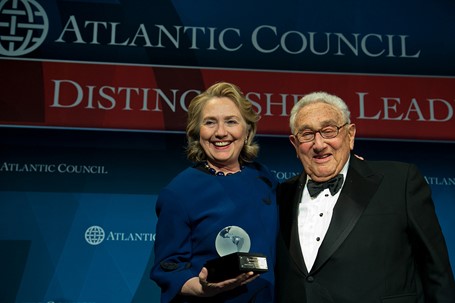
On August 24 what is in effect the social media warfare division of the Atlantic Council published an article accusing the Russian television and print news outlet RT of running a one-sided attack against the Democratic Party and several leaders thereof ahead of this November’s politically pivotal Senate and House of Representatives elections. (Thirty-five Senate seats and all 435 House seats are being contested.)
The Atlantic Council, until recently kept comparatively in the shadows for obvious reasons, is a think tank that has more than any other organization effected the transition of the North Atlantic Treaty Organization from a seeming Cold War relic with the break-up of the Warsaw Pact and the dissolution of the Soviet Union in 1991 to the world’s only and history’s first international military network with 70 members and partners on six continents currently. All thirteen new full member states are in Eastern and Central Europe; four of them border Russia.
Three months ago it began collaborating with Facebook to police and censor that and (presumably) soon after other social media companies which in recent decades have become the major sources of information and communication for the seven billion citizens of the planet. No modest undertaking.
This is by way of follow up to a Directive on Social Media issued four years ago by NATO’s Supreme Headquarters Allied Powers Europe (SHAPE), the bloc’s military command in Europe (which also oversees activities in Israel and until the activation of U.S. Africa Command ten years ago almost all of Africa).
Excerpts from that directive include:
One key challenge is the need to keep informed regarding social media ‘discussions’ on NATO and global security matters in order to maintain situational awareness. Key vulnerabilities include security concerns and the ease by which information can be transmitted globally using social media tools.
It also addresses use of social media for what it calls “operations,” which frequently is a euphemism for bombings, missile attacks and all-out war. Witness Operation Allied Force (Yugoslavia 1999), Operation Unified Protector (Libya 2011), NATO Training Mission-Iraq (starting in 2004), International Security Assistance Force/Operation Resolute Force (Afghanistan from 2001 to the present) and Operation Atlantic Resolve (aimed at Russia since 2015).
The recent article on the website of the Atlantic Council was the creation of the think tank/planning body’s Atlantic Council’s Digital Forensic Research Lab, which, employing the sort of puerile humor one has come to expect from NATOites, describes its mission under the heading of Digital Sherlocks (after the Arthur Conan Doyle detective):
The Atlantic Council’s Digital Forensic Research Lab is building the world’s leading hub of digital forensic analysts tracking events in governance, technology, security, and where each intersect as they occur.
It accuses the Russian news outlet of menacing, egregious, Cold War-era enormities like…unbalanced coverage. That animal, of course, is not known in the US corporate media.
To wit: “This unbalanced coverage was so systematic that it appeared to constitute an editorial policy of attacking the Democrats while boosting the Republicans. While editorial bias can be seen in many commercial US outlets, RT is neither commercial, nor a US outlet.”
And: “Its one-sided midterm coverage strongly suggests that the Kremlin is still attempting to influence American elections through editorial bias in its highest-profile English language media outlet to date – RT – which gets approximately 15,000,000 visits from American readers every month.”
Indeed RT is not an American outlet. In fact all of its features on YouTube have under them the small-case letter i in a circle followed by “RT Is funded in whole or in part by the Russian government,” with a Wikipedia link.
The Atlantic Council item is transparently biased itself, as RT routinely runs news critical of members of both major US political parties.
The author of the piece focuses attention on November’s elections (“attempting to influence American elections through editorial bias,” above), yet he bemoans allegedly less-than-kind portrayals of Hillary Clinton (whose first name is consistently spelled Hilary), who last heard is not at the moment running for public office.
To illustrate how the Atlantic Council and its loyal minions (members routinely move in and out of the State Department, Defense Department, National Security Council, White House, etc.) reverse the threat that exists in relation to Russia, see this from a recent article on its site on the occasion of the tenth anniversary of Georgia’s invasion of South Ossetia and the resultant war with Russia:
Exactly ten years ago, Russian forces attacked Georgia, bringing to a violent end a nearly two-decade long advance of a Europe whole and free. In the wake of NATO’s failure to agree on how to advance the membership aspirations of Georgia and Ukraine at its Bucharest Summit months earlier, Moscow acted to block those prospects with its invasion. Moscow’s actions in Georgia ten years ago previewed its far deadlier attacks on Ukraine, which continue today.
Ten years on, the NATO Summit in Brussels July 11-12 offers the prospect of reversing the shortcomings of Bucharest and restoring momentum to NATO’s Open Door policy.
That is, bring Georgia and Ukraine into NATO as full member states and court a US-Russia war with all that would entail.
The homepage of the site features a tribute to John MaCain with these words of his on the occasion of receiving its annual Freedom Award in 2011 with which he adds Belarus to the list:
I also want to pay tribute to my fellow honorees here tonight for the contribution they have made to the success of freedom – from here in Poland, to neighboring Belarus, to farther away in Egypt. These champions of liberty are the defenders, supporters, and authors of peaceful democratic revolutions – both those that have been successfully made and those, as in Belarus, that have yet to come, but surely will….
It’s more than American elections that the Atlantic Council and its social media partners intend to influence.
Crucifying Corbyn: Former Chief Rabbi Joins in The anti-Semitism smear-mongering gets more bizarre each day
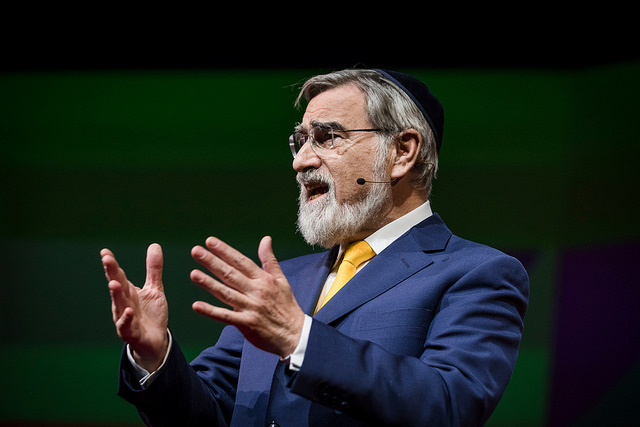
(Rabbi Lord Jonathan Sacks speaks at TED2017. Image credit: Bret Hartman/ TED Conference/ Flickr)
By Stuart Littlewood | American Herald Tribune | August 30, 2018
The nasty slur campaign against Jeremy Corbyn has just plumbed new depths with a hark-back to 1968 and the “Rivers of Blood” speech by Enoch Powell. It seems to have been prompted by a remark Corbyn made in 2013 that British Zionists had two problems: “One is they don’t want to study history and, secondly, having lived in this country for a very long time, probably all their lives, they don’t understand English irony.”
In anti-Semitism terms that’s a flogging offence, even when it might be true. The former Chief Rabbi, Lord Jonathan Sacks, immediately took umbrage saying that Corbyn’s criticism of British Zionists was the most offensive statement made by a senior politician since Enoch Powell’s Rivers of Blood speech. Sacks told the New Statesman : “It was divisive, hateful and, like Powell’s speech, it undermines the existence of an entire group of British citizens by depicting them as essentially alien.”
He said Corbyn had implied “Jews are not fully British” and that he was “using the language of classic pre-war European anti-Semitism”, adding that Corbyn was an anti-Semite who “defiles our politics and demeans the country we love”. He had “given support to racists, terrorists and dealers of hate who want to kill Jews and remove Israel from the map”.
Sacks’ words could equally be taken to mean those who align themselves with Israeli hate and the wish to kill Palestinians and wipe Palestine from the map – which they have already done quite literally. And if Corbyn defiles our politics so does the Israel lobby. But the irony must have escaped him.
Just how righteous is the moralising Lord Sacks? In a House of Lords debate in 2014 on the Middle East in general and the question of formal recognition of Palestine by the UK in particular, the former Chief Rabbi got up and made a speech that was more like a pro-Israel rant. After a long winded spiel about the history of Israel and Jerusalem – from the Jewish angle of course – he went on to demonise Hamas and Hezbollah in the manner recommended by Israel’s ‘hasbara’ handbook and all the more absurd when Israel’s hands are so unclean. Everyone knows that Hamas has agreed to a long-term truce with Israel provided it ends the illegal occupation, gets back behind its 1967 borders and accepts the refugees’ right of return – all as per UN resolutions and subject to a Palestinian referendum. And Hezbollah, as Sacks knows perfectly well, was formed to resist the Israeli occupation of Lebanon after the 1982 war.
Israel, said Sacks, is the place where his people were born almost 4,000 years ago. As an ardent promoter of the Jewish religion, the Jewish state and the idea that God gave Jews exclusive title to Jerusalem, he seemed oblivious to the irony of his speech especially where he said: “When ancient theologies are used for modern political ends, they speak a very dangerous language indeed. So, for example, Hamas and Hezbollah, both self-defined as religious movements, refuse to recognise the legitimacy of the state of Israel within any boundaries whatever and seek only its complete destruction.”
Where does he get his information? Israel won’t define its boundaries, leaving them fluid for endless expansion, and does a first-class job of de-legitimising itself by its defiance of international law and utter contempt for norms of human decency and obligations under UN Charter and other agreements.
Zionists distort the scriptures to claim Jerusalem is theirs by Divine right, it was already 2000 years old and an established, fortified city when King David captured it. The Jews lost Jerusalem to the Babylonians, recaptured it, then lost it again to the Roman Empire in 63BC. When they rebelled Hadrian threw them out in 135. Until the present illegal occupation the Jews had only controlled Jerusalem for some 500 years, small beer compared to the 1,277 years it was subsequently ruled by Muslims and the 2000 years, or thereabouts, it originally belonged to the Canaanites.
Jerusalem was also a Christian city. The 4th century saw the building of the Church of the Holy Sepulchre. The Persians came and went. Then, after the Islamic conquest in 690, two major shrines were constructed over the ruins of the earlier temples — the Dome of the Rock from which Muhammed is said to have ascended to Heaven, and the Al-Aqsa Mosque. The Crusaders re-took Jerusalem in 1099 and The Temple Mount became the headquarters of the Knights Templar. In 1187 Saladin ended the Crusader Kingdom and restored the city to Islam while allowing Jews and Christians to remain if they wished.
As the saying goes, “None has claim. All have claim!”
Nowhere in his speech did Lord Sacks address the main question of British recognition of Palestinian statehood. Nowhere did he recommend the jackboot of oppression be immediately lifted and the Palestinians granted their human rights and their freedom. That would surely have been the Christian position and, I imagine [?], the true Jewish one.
It is what the Rabbi failed to say on this important occasion that makes me wonder whether he’s an instrument of God or just another preacher of Israeli ‘hasbara’. I read somewhere that Lord Sacks is of Polish/Lithuanian extraction. Most Palestinians can demonstrate ancestral ties to the ancient Holy Land. Can he?
“Jeremy Corbyn moved the rock and the antisemites crawled out”
Corbyn is also in trouble over a remark he made in 2010 at a meeting of the Palestine Solidarity Campaign suggesting that MPs who took part in a parliamentary debate on the Middle East had their comments prepared for them by the Israeli ambassador. I’d say that was fair comment although the scriptwriters were more likely to have been Mark Regev’s propaganda team in Tel Aviv. Regev, a propaganda expert from the dark side, is now Israel’s ambassador in London. Oh, the irony (again).
And a few days ago we heard that Jews are preparing to quit Britain because they fear Jeremy Corbyn taking power, according to the former chairman of the Conservative Party Lord Feldman. So says The Times.
Feldman wrote an open letter to Mr. Corbyn telling him that Jewish people were making contingency plans to emigrate because Labour had become a hotbed of anti-Jewish feeling. “Many Jewish people in the United Kingdom are seriously contemplating their future here in the event of you becoming prime minister. Quietly, discreetly and extremely reluctantly, they are making contingency plans.”
One of these is Mark Lewis, a prominent solicitor and a former director of lawfare firm UK Lawyers for Israel, who is emigrating to Israel with his partner, Mandy Blumenthal. It is believed she is the National Director of Likud-Herut UK, an affiliate of the Zionist Federation and whose website is full of preposterous ideas such as: “We believe that terms like ‘illegal occupation’ should never go unchallenged….” and “Such criticism as we may have [of Israel] should never be expressed publicly….”
Lewis, who describes himself as an ‘unapologetic Zionist’, said: “Jeremy Corbyn moved the rock and the antisemites crawled out from underneath.” And he told the Evening Standard: “I don’t feel welcome in this country anymore.” So he’s off to that hotbed of racism and apartheid, Israel.
Being unwelcome is not a happy feeling. I know this from my trips to Israel, what with their rudeness, threatening behavior, intrusive searches, hostile questioning and unforgivably vile treatment of our Palestinian friends. It’s not as if we want to be in Israel – we are forced to divert there on account of Israel’s illegal military occupation. And when we eventually reach Palestine we have to put up with the presence of arrogant Israeli gunslingers strutting the streets, setting up hundreds of roadblocks, using obstructive tactics with brutish behavior, creating endless queues and interfering with Palestinian life at every level.
And if we try traveling to Palestine direct, like the humanitarian aid boats Al-Awda, and Freedom last month, we get violently and unlawfully assaulted on the high seas, beaten up, thrown in a stinking Israeli jail and have our belongings and money stolen by the Israeli military desperate to maintain their illegal blockade of Gaza.
So, if Messrs Feldman, Lewis and Blumenthal feel more comfortable with those criminals they’d better join them.
In answer to the babble put out by Zio-propagandists, church leaders in the Holy Land issued their 2006 Jerusalem Declaration saying:
“We categorically reject Christian Zionist doctrines as false teaching that corrupts the biblical message of love, justice and reconciliation.
“We further reject the contemporary alliance of Christian Zionist leaders and organizations with elements in the governments of Israel and the United States that are presently imposing their unilateral pre-emptive borders and domination over Palestine… We reject the teachings of Christian Zionism that facilitate and support these policies as they advance racial exclusivity and perpetual war rather than the gospel of universal love, redemption and reconciliation.”
This still stands. And as the Declaration also points out, “discriminative actions [by the Occupation] are turning Palestine into impoverished ghettos surrounded by exclusive Israeli settlements. The establishment of the illegal settlements and the construction of the Separation Wall on confiscated Palestinian land undermines the viability of a Palestinian state as well as peace and security in the entire region”.
That comes from genuine churchmen working in the front line against armed Zio-thugs whose vicious day-to-day persecution of the Christian and Muslim communities in the Holy Land makes a nonsense of accusations of anti-semitism in the UK.
I think we can deduce from all this that Zionism is a menace. Nothing has changed for the better; it has got steadily worse.
‘We want our Jerusalem back, and our state’
In 2010 Fr Manuel Musallam, a gritty Catholic priest with long experience of Israel’s cruel and illegal occupation, told members of the Irish Government: “Christianity in the region has been destroyed not by Muslims but by Israel. Israel destroyed the church of Palestine and the church of Jerusalem beginning in 1948. It, not Muslims, has sent Christians in the region into a diaspora… We have spoken to Israel for more than 18 years and the result has been zero. We have signed agreements here and there at various times and then when there is a change in the Government of Israel we have to start again from the beginning. We ask for our life and to be given back our Jerusalem, to be given our state and for enough water to drink… I have not seen Jerusalem since 1990.”
Archbishop Theodosius Hanna (Greek Orthodox Church) told them: “Palestine is the place from where Christianity comes…. Everything that has happened to the Palestinians between 1948 and today has happened to all Palestinians, including Christian Palestinians.
“What we are after is freedom and dignity just as freedom and dignity have been bestowed on so many nations in the world. We want that too. When we speak about peace, we also speak about justice because it is impossible to have peace without justice. Peace is part of justice. Unfortunately, in the Holy Land there is no such thing as justice.”
Corbyn should remind his tormentors of all this and take no lectures from those who support Zionism and adore the racist state it spawned.
VIPS Tells Media Support for Brennan is Not Unanimous
Consortium News | August 29, 2018
TO: The Media
FROM: Veteran Intelligence Professionals for Sanity
SUBJECT: Support for Brennan Far From “Unanimous”
As former members of the intelligence community, we feel compelled to add our voice to the public debate surrounding President Trump’s revocation of former CIA Director John Brennan’s security clearance. This action is being falsely portrayed as an assault on Mr. Brennan’s right to free speech.
We note that some of our former colleagues, a number of whom have held prominent intelligence posts, joined the protest against the President’s actions — a phenomenon that provides stark reminder that the United States intelligence community is not a monolith but rather a collection of diverse individuals with a range of opinions on many issues, including what is right and wrong, We the undersigned veteran intelligence professionals agree with President Trump’s decision to strip Mr. Brennan of his clearance.
We also note with irony that several of the former officials protesting the President’s action have themselves been associated with significant misconduct. David Petraeus, who was convicted of sharing highly classified material with his mistress/biographer, is a case in point. As experienced intelligence officers, we believe security clearances should be granted as a sacred trust and not simply a permanent entitlement that comes with a high level job.
Anyone who has read VIPS memos knows we have often expressed opposition to this President’s actions — as we have to those of previous Presidents — on important substantive issues when the intelligence was faulty.
The issue for us is broader than the clearances of Mr. Brennan. We are appalled by the willful misreading by pundits and much of the media of the nature of security clearances. They are certainly not a constitutionally protected right, but a highly conditional privilege. Its granting comes with personal acceptance of restrictions on speech and association: among other things obligating one-time holders to a lifetime pre-publication review of writings that rely on information acquired in performing their official duties.
All of us signed secrecy agreements and accepted the burden of holding a clearance. We surrendered a part of our assumed right to free speech in service of our country’s welfare and safety. Those of us under cover kept secrets from family and friends. We no longer associated freely with foreign nationals; an active clearance carries the requirement to report contacts with them.
Moreover, security classification is provided by Executive Branch authority and is expressed with orders that are subject to change at the will of the current president (the exception to this being the so-called “Q” clearance established by law to protect nuclear weapons secrets, though this is also subject to presidential authority in granting or withdrawing clearance). Federal judges do not have automatic security clearances. Nor do members of Congress. They have access to secret information by virtue of their constitutional office and a presumed “need to know” in order to do their job.
Once a person separates from the intelligence community they can continue to hold a clearance provided they are employed as a contractor working on specific classified programs. There is simply no basis in law entitling anyone to permanent clearance. This includes John Brennan. It goes without saying that individuals who are granted continued clearance out of courtesy to their former high position remain accountable in their conduct, and that the Executive can revoke such clearances at will.
Mr. Brennan’s own record is clearly tarnished. When he was Chief of Station in Saudi Arabia prior to and after the bombing of Khobar Towers in June of 1996, rather than uphold the integrity of existing intelligence he went along with the decision to avoid creating problems with the Saudis. After the attack (which was carried out by Saudi elements linked to Bin Laden and Al Qaeda), Brennan helped push the meme that the culprits were Iran and Hezbollah.
As head of the Terrorist Threat Integration Center in 2003, Mr. Brennan failed to give the State Department complete statistics for terrorist attacks. The initial publication of “Patterns of Global Terrorism” in April 2004 touted a decline in terrorist attacks in 2003 as vindication of Bush Administration policies. The publication later had to be recalled and revised when it was discovered that the CIA had left out a month and a half of data. John Brennan was in charge of that process. Instead of receiving a reprimand, however, he ended up being promoted.
Mr. Brennan has assumed the role of passive spectator in building the fraudulent case to justify the 2003 invasion of Iraq. He has claimed only vague awareness of the CIA’s so-called “enhanced interrogation” program. Physical records tell a different story. Brennan was “cc-ed” on “a minimum of 50 memos” dealing with waterboarding and other torture techniques. Senator Saxbe Chambliss noted that Brennan’s boss, A. B. “Buzzy” Krongard, told the Wall Street Journal that Mr. Brennan had a role in setting the parameters of the program and “helping to seek Justice Department approval for the techniques.”
Mr. Brennan also attempted to cover up the truth about the CIA torture. Senator Mark Udall denounced his actions in a floor speech on December 10, 2014, the day after the Senate Intelligence Committee published the Executive Summary of the conclusions of its four-year investigation of CIA torture based on original CIA documents. The investigation not only revealed almost unbelievably heinous practices, but also demonstrated that senior CIA officials were untruthful in claiming that “enhanced” techniques produced actionable intelligence that could not have been obtained by traditional interrogation practices. With strong support from President Obama, Brennan, who was the CIA Director, aggressively fought publication of the Senate report. Here’s Senator Udall:
“The CIA has lied to its overseers and the public, destroyed and tried to hold back evidence, spied on the Senate, made false charges against our staff, and lied about torture and the results of torture. And no one has been held to account. … There are right now people serving at high-level positions at the agency who approved, directed, or committed acts related to the CIA’s detention and interrogation program.”
Mr. Brennan is now publicly insisting that Russia meddled in the 2016 election. What, however, was CIA Director Brennan saying when the alleged Russian meddling was taking place? Did he warn President Obama? Did he warn the leaders of the Congress? According to press reports Mr. Brennan did brief Democrat Senator Harry Reid on ties between the Trump campaign and the Russian government and Reid then wrote FBI Director James Comey demanding an investigation. However, the chair of the House Intelligence Committee has said he was not given the same briefing as Senator Reid. Introducing the weight of national intelligence into partisan politics, as Mr. Brennan appears to have done in his official capacity, is forbidden activity.
We have all held clearances and deeply believe in the importance of intelligence officers conducting themselves with professional integrity, particularly with regard to remaining unentangled in party politics. VIPS is comprised of men and women of highly diverse political views, from Republican to Democrat to Independent. We agree on one thing: when a professional intelligence officer obtains classified information they accept an obligation to appropriately report facts without regard to political leanings. This is not about being a Democrat or a Republican. It is about doing the job of unbiased intelligence analysis. That is why VIPS has, over the years, written memos challenging the intelligence basis for policies and decisions of George W. Bush and Barack Obama as well as Donald Trump.
For the Steering Group, Veteran Intelligence Professionals for Sanity:
William Binney, Technical Director, NSA; co-founder, SIGINT Automation Research Center (ret.)
Richard H. Black, Senator of Virginia, 13th District; Colonel US Army (ret.); Former Chief, Criminal Law Division, Office of the Judge Advocate General, the Pentagon (associate VIPS)
Philip Giraldi, CIA, Operations Officer (ret.)
Larry C. Johnson, former CIA and State Department Counter Terrorism officer
John Kiriakou, Former CIA Counterterrorism Officer and former senior investigator, Senate Foreign Relations Committee
Clement J. Laniewski, LTC, USA (ret) (associate VIPS)
Edward Loomis, NSA, Cryptologic Computer Scientist (ret.)
Ray McGovern, former US Army infantry/intelligence officer & CIA analyst (ret.)
Elizabeth Murray, Deputy National Intelligence Officer for Near East, CIA and National Intelligence Council (ret.)
Todd E. Pierce, MAJ, US Army Judge Advocate (ret.)
Coleen Rowley, FBI Special Agent and former Minneapolis Division Legal Counsel (ret.)
Sarah G. Wilton, Intelligence Officer, DIA (ret.); Commander, US Naval Reserve (ret.)
Robert Wing, former Foreign Service Officer (associate VIPS)
Veteran Intelligence Professionals for Sanity (VIPS) is made up of former intelligence officers, diplomats, military officers and congressional staffers. The organization, founded in 2002, was among the first critics of Washington’s justifications for launching a war against Iraq. VIPS advocates a US foreign and national security policy based on genuine national interests rather than contrived threats promoted for largely political reasons. An archive of VIPS memoranda is available at Consortiumnews.com.
Featured Video
Anthrax War – CBC The Passionate Eye
or go to
Aletho News Archives – Video-Images
Book Review
Shattered Dreams: The HPV Vaccine Exposed (2019)
By Christina England – 30 Q&As – Book Review & Summary
Lies are Unbekoming | September 4, 2026
… Gardasil received FDA fast-track approval in 2006, Cervarix followed in 2009, and Gardasil 9 was approved in December 2014 with more than double the aluminium adjuvant content of the original. The commercial context is specific. Merck was about to lose patent protection on Zocor and faced $18 billion in Vioxx injury claims from a cardiovascular drug the company had marketed while suppressing its own data showing a five-times increase in heart attacks. Analysts projected the global HPV vaccine market at $4 billion by 2011, contingent on government-funded national programs for teenage girls. The 1986 National Childhood Vaccine Injury Act had already granted manufacturers complete liability immunity. By 2013, Japan had withdrawn its HPV vaccine recommendation after cataloguing severe adverse reactions in hundreds of girls. No Western government followed. The establishment position across the UK, US, Australia, and most of Europe held, and still holds, that the vaccines are safe and effective, that reported injuries are coincidental, and that cervical cancer prevention justifies the program. The book was published into this position, not against a vacuum.
Shattered Dreams sits alongside Mary Holland’s The HPV Vaccine On Trial and Viera Scheibner’s foundational vaccination work as part of the documented record on what has been done to a generation of teenage girls under the banner of cancer prevention. The full summary unpacks three specific findings: that Merck used the aluminium adjuvant itself as the “placebo” control in 92.5% of trial subjects, making it structurally impossible to detect excess reactions from the adjuvant; that Dr. Sin Hang Lee found HPV DNA fragments bound to aluminium in every one of sixteen Gardasil samples tested, and in the blood and spleen of a New Zealand girl six months after her third dose; and that in every country with high vaccination coverage, including Australia, the UK, Norway, and Sweden, cervical cancer rates have stopped declining and started rising specifically in the vaccinated cohort. Martínez-Lavín’s 2017 calculation puts the number needed to seriously harm with Gardasil 9 at 140, and the number needed to vaccinate to prevent one case at 1,757. Thirteen young women are seriously harmed for every one who benefits. The vaccine was approved on the basis of trials that could not detect what the trials were supposed to detect, and it is still being given to twelve-year-olds today. … Read full review
Blog Roll
 Aletho News
- The Five-Year Fuel Crisis: Why the World Economy Is Paying for a War It Thinks Is Ending
- Trump’s Big Bluff on Iran
- Swiss scammed out of millions by Ukraine-linked call centers – media
- Germany facing potential ‘violent conflict’ with Russia – spy chief
- Ukraine’s EU neighbors reject new plea from Kiev – Politico
- British Transport Police Facial Recognition Trial Scanned 926,912 People With Zero Arrests
- House Bill Would Ban Federal Use of Flock ALPR Data
- Can a Spice Rival a Drug? 10 Head-to-Head Trials Put It to the Test.
- The oil routes around Hormuz face their own chokepoints
- The Saudi-Israeli war on Yemen’s resistance: Intelligence sharing, civilian targets & sectarian propaganda
- If Americans Knew
- New IDF Website Frames Slain Gaza Journalists as Terrorists
- Israeli media: After settlers beat him mercilessly, they stuffed dirt into his mouth
- Americans Are Paying the Price to Preserve Israel’s Nuclear Hegemony
- A U.S. Jewish Fund’s Ambitious Bid to Put a Settler Elite in Control of Israel’s Security
- As genocide drags on, “Zionism is racism” becomes official policy in one UK party – Daily Update
- Targeting the rescuers: Inside Israel’s war on paramedics in Lebanon
- No big deal: Israel to halt humanitarian aid to Gaza for 2 days – Daily Update
- Israel is squeezing the life out of Palestinians – Daily Update
- The Israeli Right Portrays Islam as Murderous. It Serves a Political Purpose
- Jordan Has Had Enough: King Abdullah’s Scathing Warning to Israel
- No Tricks Zone
- Latest European Green Energy Debacle; Portugal’s Largest Flagship Solar Park Insolvent!
- Green Energy Debacle: German Expert Professor Fritz Vahrenholt Warns Of Severe Economic And Social Consequences
- Two More Paleo Reconstructions Affirm Meters-Higher Sea Levels Across Ireland, Brazil 7000-6000 Years Ago
- New Study: Earth And Venus Surface Warmth Largely Explained By Convection And Lapse Rate, Not CO2 Or Radiation
- 2025 Nature Paper Claiming Worsening Global Drought Gets RETRACTED …Heavily Flawed
- New Study: ‘Global Drought Shows No Detectable Recent Acceleration Under Climate Warming’
- Economic Masterminds: German Socialists Suggest Taxing Productivity Gains Stemming From Using AI
- The South China Sea Has Not Been Cooperating With The Climate Change Narrative
- Energy Crisis: Germany Enters Heating Season With Historically Low Gas Reserve Fill Levels
- New Study: The Antarctic Ice Sheet Gained Mass From 2020-2024 Due To Staggering Snow And Ice Accumulation

