Russian prosecutors brand US group Pacific Environment ‘undesirable organization’
RT | August 24, 2018
The Russian Prosecutor General’s Office has included US NGO Pacific Environment (PERC) on a list of undesirable foreign organizations after determining the group’s work can threaten Russia’s security and constitutional order.
“After studying some materials it had received the Prosecutor General’s Office on August 24 decided to recognize as undesirable on the territory of the Russian Federation, the work of foreign non-government organization Pacific Environment (PERC) from the USA,” chief spokesman for the agency, Aleksandr Kurennoy, was quoted as saying by TASS on Friday.
“It has been established that the work of this organization creates a threat to the foundations of Russia’s constitutional order and the security of the Russian state,” the official added. The order to put the group on the list of undesirable organizations will now be forwarded to the Justice Ministry where it needs to be registered to come into force.
Founded in 1987, the Pacific Environment group states its primary objective as protecting the living environment of the Pacific Rim. In Russia, its activists have instigated public opposition to several major mining and energy projects in Siberia and the Far East.
Russia introduced the law on undesirable foreign organizations in mid-2015. According to this act the Prosecutor General’s Office and the Foreign Ministry have the powers to create a list of “undesirable foreign organizations,” making the activities of such groups in Russia illegal. Violations of this law are punished by civil penalties, but repeated and aggravated offenses can cause criminal prosecution and carry prison sentences of up to six years.
The 10 Main Holes in the Official Narrative on the Salisbury Poisonings: #3 – The Capability
By Rob Slane | The Blog Mire | August 23, 2018
Once again I return to Theresa May’s statement of 26th May, in which she stated the following:
“In conclusion, as I have set out, no other country has a combination of the capability, the intent and the motive to carry out such an act.”
She then went on to claim:
“We have been led by evidence not by speculation.”
However, as I showed in Part 1 and Part 2, her statement to the Commons contained no actual evidence of motive or intent. Claims and assertions, but nothing more.
But what of capability? Looking through the statement, here are the key passages that might be said to fall into this category:
“As I set out for the House in my statements earlier this month, our world-leading experts at the Defence Science and Technology Laboratory at Porton Down positively identified the chemical used for this act as a Novichok – a military-grade nerve agent of a type developed by the Soviet Union.”
“And we have information indicating that within the last decade, Russia has investigated ways of delivering nerve agents probably for assassination – and as part of this programme has produced and stockpiled small quantities of Novichoks.”
Her evidence, such that it is, therefore falls into two categories: firstly, capability with regard to the weapon allegedly used to poison the Skripals; secondly, capability with regard to method of delivery of the weapon.
There are three things to say with regard to the first category. To begin with, it is not quite the case that Porton Down scientists had “positively identified the chemical” as a “Novichok”. In the evidence presented to the High Court between 20th – 22nd March, here is how the Porton Down Chemical and Biological Analyst described the substance:
“Blood samples from Sergei Skripal and Yulia Skripal were analysed and the findings indicated exposure to a nerve agent or related compound. The samples tested positive for the presence of a Novichok class nerve agent or closely related agent [my emphasis].”
As you will notice, there is a degree of ambiguity in this statement which is not present in Mrs May’s statement made a few days later. Ought she not to have recognised this?
Secondly, it has been conclusively shown that a number of other countries either have produced, or know how to produce substances within the class of nerve agents that Mrs May referred to as “Novichoks”. The Czech Government has admitted producing a small quantity of the closely related substance, A-230; Iran has produced it, in compliance with the OPCW in 2016; The German Intelligence Agency, BND, was given the formula back in the 1990s, and they shared it with a number of other NATO countries, including the US and UK. The Edgewood Chemical and Biological Defense Command in Maryland, USA, recorded the formula back in 1998.
The point of this is not to point the finger at any of those countries. Merely to say that knowledge of and production of “Novichok” is by no means confined to one country. And in any case, according to one of the world’s leading experts in organic chemistry, David Collum, Professor of Organic Chemistry at Cornell University, it doesn’t even require a State party. He asserts that “any credible organic chemist could make Novichok nerve agents.”
The fact that other countries know how to produce “Novichoks”, and in some cases have produced it, shows the claim that its apparent use in Salisbury proves Russian culpability to be complete nonsense. It’s as silly as saying that a poisoning using VX points to Britain because VX is a type of nerve agent developed by Britain.
And thirdly, if the British Government did indeed have information that the Russian Government had a secret programme investigating ways of delivering nerve agents, and had produced and stockpiled small quantities of Novichoks, then it had an obligation to inform the OPCW under the Chemical Weapons Convention, which it apparently failed to do. Furthermore, as a State Party to the Convention, it should have raised objections in 2017, when the OPCW’s Director-General, Ahmet Üzümcü, declared the following:
“The completion of the verified destruction of Russia’s chemical weapons programme is a major milestone in the achievement of the goals of the Chemical Weapons Convention. I congratulate Russia and I commend all of their experts who were involved for their professionalism and dedication. I also express my appreciation to the States Parties that assisted the Russian Federation with its destruction program and thank the OPCW staff who verified the destruction.”
So much for Mrs May’s evidence of capability regarding the weapon, what of her evidence regarding the delivery?
When she stated that her Government had information that the Russian Government had investigated ways of delivering nerve agents, she was, I believe, referring to the alleged “assassin’s manual”, which the Government says it possesses, but will not show because it is classified, and which apparently contains information showing that Russian agents were trained in putting poison on door handles.
Three brief points about this:
1. It really is utter nonsense. Smearing poison on a door handle would be a frankly ludicrous way to target someone for assassination, since you could never be sure that your target would actually touch it (you never know, maybe a postman or a milkman or the man from Amazon might get there first).
2. Salisbury was treated to dozens of guys in Hazmat gear decontaminating certain parts of the city, since the substance in question was apparently so lethal that, according to Alastair Hay, Professor of Environmental Toxicology at the University of Leeds:
“A few millilitres would be sufficient to probably kill a good number of people.”
Are we really supposed to believe that the Russians have either:
a) Developed ways of putting this stuff on door handles without the requisite chemical protection and perhaps just a pair of Marigolds, or
b) Have people stupid enough to try.
3. But the biggest problem is this: The British Government was starting to point the finger at the Russian Government within a few days of the poisoning, and it was later stated that one of the reasons for this was the manual that they apparently possessed. But if they did indeed have this manual, and it was the reason for their apportioning of blame as early as 12th March:
a) Why was the door handle not the focus of the investigation from the very start?
b) When are those police officers who stood within feet of that door, and those who no doubt went in and out of the house using the door handle, going to sue Her Majesty’s Government for negligence and their failure to act on the intelligence they apparently had?
If there is indeed such a manual, my guess is that it was put together by a chap named Steele.
The 10 Main Holes in the Official Narrative on the Salisbury Poisonings: #1 – The Motive
The 10 Main Holes in the Official Narrative on the Salisbury Poisonings: #2 – The Intent
The 10 Main Holes in the Official Narrative on the Salisbury Poisonings: #3 – The Capability
The 10 Main Holes in the Official Narrative on the Salisbury Poisonings: #4 – The Missing Four Hours
The 10 Main Holes in the Official Narrative on the Salisbury Poisonings: #6 – The Meal and The Drink
Hidden internal directive on Syria that got no UNSC approval DOES exist – Russian Foreign Ministry
RT | August 24, 2018
The UN has devised internal guidelines for limiting cooperation with Syria until a “political transition” takes place there, and it was drafted without any consent from the Security Council, the Russian Foreign Ministry has said.
The document in question is entitled ‘Parameters and Principles of UN Assistance in Syria,’ the ministry wrote in a statement to RT. It was issued by the UN Secretariat in October 2017 and provides guidelines for the UN agencies and programs in their work with the war-torn country.
The Secretariat issued the paper without requesting consent or even consulting the UN Security Council or the UN member states, at least on an official level, the ministry noted, adding that the “guidelines” document still “penetrates deeply” into the political situation in the Syrian Arab Republic, thus “going beyond the issue of simple coordination between the UN structures.”
One particular provision of the document explicitly states that the UN “would be ready to facilitate reconstruction” in Syria only “once there is a genuine and inclusive political transition negotiated by the parties.” The Russian ministry described it as an apparent attempt to prevent the international organization from contributing to Syria’s recovery under the current circumstances, while enforcing a “politicized approach of the countries advocating a regime change.”
The directive also implicitly restricts the UN agencies’ cooperation with Damascus, the ministry said, adding that the text of the document says that “UN assistance must not assist parties who have allegedly committed war crimes or crimes against humanity.” The US and its allies in the West have repeatedly accused the Syrian government of various violations of international law and particularly blamed them for chemical weapons incidents that took place on Syrian soil. No hard evidence has ever been presented to substantiate those claims, while the West ignored relevant data provided by the Russian military operating in Syria.
“If some influential [UN] donors believe that … it is time to toughen the sanctions regime against Syria, it does not necessarily mean that the UN agencies should be guided by the same irresponsible approach,” the Russian Foreign Ministry said in its statement, expressing its hope that the UN Secretariat will review its methods as Syria’s need for humanitarian assistance and reconstruction aid grows, not least due to an increasing number of refugees returning home.
The issue of an alleged “secret directive” having been distributed by the Secretariat throughout the UN system in October 2017 was first raised by Russian Foreign Minister Sergey Lavrov on Monday. He did not name the document but said that it “prohibited the agencies… from participating in any kind of projects aimed at restoring the Syrian economy” until a “political transition” there.
Lavrov also linked the release of the directive with the “absolutely deconstructive” stance of the US on the issue of Syria’s reconstruction. The next day, the office of the spokesperson for the UN secretary-general denied the existence of any such document by saying that neither its department of political affairs nor any other UN entity had issued a “secret directive” on Syria.
Meanwhile, the ‘not secret’ but rather hard-to-find document mentioned by the Russian Foreign Ministry apparently indeed exists: It was briefly mentioned on an official UN website in a temporary job description. However, the text of the document has never been officially made public by any UN agency.
However, a supposed copy of the text of the directive, entitled ‘Parameters and Principles of UN Assistance in Syria’ and dated October 2017, was included as an annex in another paper published by the Global Protection Cluster – a structure directly linked to such UN agencies as the UN Refugee Agency (UNHCR), the UN Population Fund (UNFPA) and the UN Children’s Fund (UNICEF). This document is still available online.
After declaring its commitment to the UN Charter and the Security Council resolutions, the document indeed states that any UN aid to the reconstruction efforts would be possible only following “political transition.” It also states the UN work should de-facto focus on basic humanitarian assistance only, while any “development and reconstruction activities that are outside this will need to be reflected in other frameworks that are by nature a longer negotiation with governments.”
The paper also openly states that the UN “will not promote the return of refugees.” Apart from prohibiting cooperation with “parties who have allegedly committed war crimes or crimes against humanity,” the guidelines also state that assistance must be “prioritized based on the needs of the population (rather than government-driven),” in what might be potentially considered an indirect attempt to limit the UN agencies’ cooperation with the Syrian government.
Read more:
Senate wants to know about Cohen’s ‘Trump evidence’ as his lawyer denies ‘mixed up’ Russia claims
RT | August 24, 2018
Senate Judiciary Chairman Chuck Grassley (R-Iowa) said his committee is interested in Michael Cohen’s alleged evidence on President Trump. However, recent comments by Cohen’s lawyer have cast doubt over such ‘evidence.’
Michael Cohen, Trump’s one-time ‘fixer’ and attorney was convicted on eight counts of campaign finance violations, tax fraud, and bank fraud in a plea deal with prosecutors reached earlier this week. One of these claims involves ‘hush money’ paid to porn star Stormy Daniels, who Trump allegedly had an affair with in 2006.
Cohen, who once said that he would take a bullet for Trump, has now flipped and claims that Trump directed him to “commit a crime” by ordering the payment. Trump denies ordering Cohen to break the law and says that the money came from his own fortune, not the campaign account. Trump accused Cohen of “making up stories” to get a better plea deal.
Regardless, Senator Grassley is interested in following Cohen’s claim up and has reached out to Cohen’s attorney, Lanny Davis. “We have reached out to Lanny Davis but we have not heard back,” the Iowa senator told Bloomberg.
Grassley’s committee had been trying to reach Cohen since May, which was canceled due to Cohen’s ongoing criminal proceedings. Senator Lindsey Graham – (R-South Carolina), another Judiciary Committee member – is still reluctant to investigate Cohen’s claims, as Cohen has yet to be sentenced.
“I’ve been very consistent about this, I don’t want to cross paths with ongoing criminal investigations,” Graham said.
Cohen also revealed through Davis on Wednesday that he has information that might be of interest to Special Counsel Robert Mueller, charged with investigating alleged collusion between the Trump campaign and Russia in the runup to the 2016 election.
However, a series of television appearances by Davis on Wednesday have raised doubts as to the reliability of any evidence Cohen might have. Speaking to CNN, Davis directly denied Cohen’s earlier claims to the network that Trump had advance notice of a meeting between his son, Donald Jr., and a Russian lawyer at Trump Tower in 2016.
“So Michael Cohen does not have information that President Trump knew about the Trump Tower meeting with the Russians beforehand or even after?” host Anderson Cooper asked Davis.
“No, he does not,” Davis replied, adding that the earlier CNN report had gotten “mixed up.”
When the CNN story broke late June, Trump rubbished it, and like this week, accused Cohen of “trying to make up stories,” again to get out of his own legal troubles, a tax evasion case involving a former business partner in the New York taxi business.
After denying Cohen’s Trump Tower ‘bombshell’, Davis threw water on another smoking gun touted by some Democrats as evidence of collusion: the Steele Dossier. Compiled by opposition research firm Fusion GPS at the behest of the Democratic National Committee, the dossier was a poorly sourced and unverified collection of allegations against Trump and his campaign team.
Among other things, the Dossier claimed that Trump hired two prostitutes to urinate on him in a Moscow hotel room, when then-businessman Trump visited the Russian capital in 2013. Davis told Bloomberg that in this dubious dossier, at least 13 allegations against Cohen alone were false, including one claim that Cohen traveled to Prague in 2016 to meet with Russians and facilitate a “clandestine” conspiracy between Trump and Russia.
“Thirteen references to Mr. Cohen are false in the dossier, but he has never been to Prague in his life,” Davis told Bloomberg.
One thing that Davis was equally certain about is that Cohen needs money. After teasing the possibility that Cohen might have some juicy details for Mueller, Davis asked viewers to reach into their pockets and help the disgraced fixer “continue to tell the truth” about Trump by contributing to a crowdfunding campaign. Of course, this money would also go towards helping Cohen “pay his legal fees.”
Read more:
Be Careful What You Ask For: Wasting Time with Manafort, Cohen, and Russiagate
By Jim Kavanagh | The Polemicist | August 23, 2018
So, Paul Manafort, described by the New York Times as “a longtime lobbyist and political consultant who worked for multiple Republican candidates and presidents,” was convicted of bank fraud, tax fraud and failure to report a foreign bank account. And Michael Cohen, Donald Trump’s former personal lawyer, pled guilty to tax evasion, bank fraud (making false statements to obtain loans), and breaking campaign finance laws by paying off two women who claimed to have had sexual affairs with Trump. Because Cohen says those payoffs were made at Trump’s direction, that is the one charge that directly implicates Trump.
On the basis of the these results, the NYT editorial board insists: “Only a complete fantasist … could continue to claim that this investigation of foreign subversion of an American election, which has already yielded dozens of other indictments and several guilty pleas, is a ‘hoax’ or ‘scam’ or ‘rigged witch hunt.’” Democrats concur, saying the results “put the lie to Mr. Trump’s argument that Mr. Mueller was engaged in a political investigation.”
But these crimes are tax fraud, money laundering, and credit app padding that have nothing to do with Donald Trump, and campaign-finance violations related to what a critic of Trump aptly describes as “a classic B-team type of bumbling screw-up of covering up mistresses.” I question the level of word play, if not fantasizing, necessary to claim that these crimes validate “this investigation of foreign subversion.” None of them has anything to do with that. The perils of this, that, these, and those.
Do these results disprove that the Mueller probe is “a political investigation”? I think they imply quite the opposite, and quite obviously so.
Why? Because these convictions would not have occurred if Hillary Clinton had been elected president. There would be no convictions because there would have been no investigation.
If Hillary had been elected, all the crimes of Manafort and Cohen—certainly those that took place over many years before the election, but even, I think, those having to do with campaign contributions and mistress cover-ups—would never have been investigated, because all would have been considered right with the political world.
The Manafort and Cohen crimes would have been ignored as the standard tactics of the elite financial grifting—as well as of parasitism on, and payoffs by, political campaigns—that they are. Indeed, there would have been no emergency, save-our-democracy-from-Russian-collaboration, Special Counsel investigation, from which these irrelevant charges were spun off, at all.
The kinds of antics Manafort and Cohen have been prosecuted for went unnoticed when Donald Trump was a donor to the Democratic and Republican parties, and if he had stayed in his Tower doling out campaign contributions, they still would be. It’s only because he foolishly won the Presidency against the wishes of the dominant sectors of the ruling class that those antics became the target of prosecutorial investigation. Lesson to Donald: Be careful what you wish for.
If Trump weren’t such an idiot, he probably would have realized that this is what happens when you run for president without prior authorization from the ruling classes, and win. #ManafortTrial #MichaelCohen #Trump pic.twitter.com/tyrpuLHRNT
— Consent Factory (@consent_factory) August 21, 2018
What the NYT calls “a culture of graft as well as corruption” that “suffused” the Trump campaign is part and parcel of a culture of politico-capitalist corruption that suffuses American electoral politics in general. Manafort, who has indeed been “a longtime lobbyist and political consultant,” is only one in a long, bipartisan line that “enrich [themselves] by working for some of the world’s most notorious thugs and autocrats.”
Have you heard of the Podestas? The Clinton Foundation? Besides, the economic purpose of American electoral politics is to funnel millions to consultants and the media. Campaign finance law violations? We’ll see how the lawsuit over $84 million worth of funds allegedly transferred illegally from state party contributions to the Clinton campaign works out. Does the media report, does anybody know or care, about it? Will anybody ever go to prison over it?
The Republicans and Democrats would just as soon leave this entire culture of graft and corruption undisturbed by the prosecutorial apparatus of the state. That kind of thing can get out of hand. Only because the election of Donald Trump was a mistake from the establishment point of view has that apparatus been sicced on him. The frantic search, anywhere and everywhere, for some legal charges that can stick to Trump is driven by a burning desire to get something on Donald Trump that will fatally wound him politically, and serve as “objective” grounds for impeachment or resignation.
So, it’s my contention that, without the political opposition to Donald Trump as president, none of this legal prosecution would be taking place. The convictions of Manafort and Cohen don’t put a lie to the idea that the Mueller investigation is political; they are an effect of the fact that it is.
At any rate, there can be no doubt that the Manafort and Cohen convictions have upped the political ante for everybody. Democratic Senator Richard Blumenthal (second wealthiest Senator; net worth ~ $80 million) has now invoked the dreaded word, from which it’s hard to retreat: “We’re in a Watergate moment.”
Yup, the anti-Trump establishment, led by the Democrats, has now succeeded, via a legal ground game, in moving the ball into the political red zone where impeachment talk is unavoidable. But going forward from here, the plays and paths available are very dangerous to the establishment and the Democrats themselves, and the whole game is getting to the point where it can—indeed, almost inevitably will—seriously disrupt the system they want to protect.
First of all, the Democrats will now face increasing demands for impeachment from the impassioned members of their base whom they have riled up to see Trump as the epitome of the Putin-Nazi evil that threatens “our democracy.” If the Democrats insist these convictions are not just matters of financial hijinx, irrelevant to Mueller’s “Russia collusion” investigation, and irrelevant in fact to anything of political substance; if they assert that the payoffs to Stormy and Karen (the only acts directly involving Trump) disqualify Trump for the presidency, then they will have no excuse but to call for Trump’s impeachment, and act to make it happen. Their base will demand that Democratic candidates run on that promise, and if the Democrats re-take the House, that they begin impeachment proceedings immediately.
So, if, after all the “only a complete fantasist” talk, the Democrats don’t act to impeach Trump, they will further alienate their base, and drive more liberals and progressives to withhold their votes, if not abandon the party altogether. And evil Putin-Nazi Trump will be strengthened.
If they try to impeach and fail (which is likely), well, then, as happened to the Republicans with Clinton, they will just look stupid, and will be punished for having wasted the nation’s political time and energy foolishly. And Trump will be strengthened.
If they were to impeach, convict, and remove Trump (even by forcing a resignation), a large swath of the population would conclude, correctly, that a ginned-up litigation had been used to overturn the result of the 2016 election, that the Democrats had gotten away with what the Republicans couldn’t in 1998-9. That swath of the population would likely withdraw completely from electoral politics, leaving all their problems and resentments intact—hidden for a while, but sure to erupt in some other ways. It would deeply undermine any notion that the political system holds the confidence of the people, and intensify division, disruption, and the sense of incipient civil war in the country more than any number of Russian Facebook posts.
Furthermore, if the Democrats were successful in removing Trump, their own base would be confronted with the terrible beauty of the Pence presidency to which they had given birth. After such a fight, Pence, who is a much more serious, organized, and ideologically-coherent religious proto-fascist than Trump, will benefit from the inevitable propensity of Democrats to calm things down and protect the stability of the system. Progressive Democrats will find, again, that the two-party system has produced no good result. In other words, the result of a successful impeachment effort might very well be more disaffection from “our democracy” by Democrats.
In short, through a process of litigation and prosecution, the Democrats are getting what they asked for: The field of political discourse and action will now increasingly center on the possibility of removing or impeaching the president. Given their construction of the Manafort-Cohen verdicts, they must move forward on that, or they will be perceived as weak and back-pedaling, and Trump will be strengthened. But if they do move forward, that will initiate a political battle that will tear the country apart and end up either with their defeat or the victory of Mike Pence.
Of course, the Democratic leadership knows all this. Which is why they have always said they do not want to push for impeachment or removal, and probably will not. They also know—and they know that Trump’s supporters know—that a campaign-law violation has no more political substance than Bill Clinton’s perjury. They know that they are not likely to win that fight in the Senate. They know the can of worms they are opening with charges that could be levied against most rich politicians. And, most importantly, they know the fight they will have to wage will be intensely divisive and will deeply undermine confidence in the political system, however it ends up.
The Democrats much prefer to have Trump in office to kick around politically. The most likely scenario is that they will make a cloakroom agreement with Republicans not to go too far, while they continue to whip up Trump-Putin “Russiagate” fever among their constituency. They will continue to stoke anticipation of a smoking “collusion” gun from Mueller, which will probably never come. The Democrats are not really after impeaching Trump; they are after stringing along their progressive voters.
In the meantime, the delightful Trump-effect—his constant embarrassment of American political self-righteousness and discomfiting of both political parties—will continue apace.
By the way, for those who think that Manafort’s conviction portends a smoking gun, based on his work for “pro-Kremlin Viktor Yanukovych,” as the NYT and other liberals persistently call him, I would suggest looking at this Twitter thread by Aaron Maté. It’s a brilliant shredding of Rachel Maddow’s (and, to a lesser extent, Chris Hayes’s) version of the deceptive implication—presented as an indisputable fact—that Manafort’s work for Yanukovych is proof that he (and by extension, Trump) was working for Putin. As Maté shows, that is actually indisputably false. Manafort was working hard to turn Yanukovych away from Russia to the EU and the West, and the evidence of that is abundant and easily available. It was given in the trial, though you’d never know that from reading the NYT or listening to MSNBC. As a former Ukraine Foreign Ministry spokesman said: “If it weren’t for Paul, Ukraine would have gone under Russia much earlier. He was the one dragging Yanukovich to the West.” And the Democrats know this.
And if you think Cohen is harboring secret knowledge of Trump-Russia collusion that he’s going to turn over to Mueller, take look at Maté’s thread on that.
We are now entering a new period of intense political maneuvering that’s the latest turning point in the bizarre and flimsy “Russiagate” narrative. I’ve been asked to comment on that a number of times over the past two years, and each time I or one of my fellow commentators would say, “Why are we still talking about this?” It was originally conjured up as a Clinton campaign attack on Trump, but, to my and many others’ surprise and chagrin, it somehow morphed into the central theme of political opposition to Trump’s presidency.
Donald Trump is a horrid political specimen. I witnessed his flourishing into apex narcissism and corruption over decades in New York City, as chronicled by the dogged reporter, Wayne Barrett, and I would be surprised if there weren’t financial crimes in his closet that any competent prosecutor could ferret out. Anyone who knows his history knows that this is the kind of dirt the Mueller investigation was most likely to find on Donald Trump; anyone who’s honest knows that this is the kind of dirt it was meant to find. Russiagate was a pretext to dig around everywhere in his closet. Trump was clueless about the trap he was setting for himself, and has been relentlessly foolish in dealing with it. It is a witch hunt, and he’s riding around on his broom, skywriting self-incriminating tweets.
There are a thousand reasons to criticize Donald Trump—his racism, his stupidity, his infantile narcissism, his full embrace of Zionist colonialism with its demand to attack Iran, his enactment of Republican social and economic policies that are destroying working-class lives, etc. That he is a Kremlin agent is not one of them. His election was a symptom of deep pathologies of American political culture that we must address, including the failure of the “liberal” party and of the two-party system itself. That Donald Trump is a Russian agent is not one of them. There are a number of very good justifications for seeking his impeachment, starting with the clear constitutional crime of launching a military attack on another country without congressional authorization. That he is a Kremlin agent is not one of them.
Unfortunately, the Democratic Party and its allied media do not want to center the fight on these substantive political issues. Instead, they are centering on this barrage of Russiagate litigation—none of which yet proves, or even charges, Russian “collusion”—which they are using as a substitute for politics. And, in place of opposition, they’re substituting uncritical loyalty to the heroes of the military-intelligence complex and “our democracy” that only a complete fantasist could stomach. I mean, when you get to the point that you’re suspecting John Bolton’s “ties to Russia”….
Now, with the Manafort and Cohen convictions, the Russiagate discourse is moving to a new stage, and it’s unlikely that we will ever stop talking about it, as long as Trump is president. Nothing good can come of it.
Our country is in, and on the verge of, multiple crises that threaten to destroy it. That Donald Trump is a Russian agent is not one of them. Political time is precious.
What a waste.
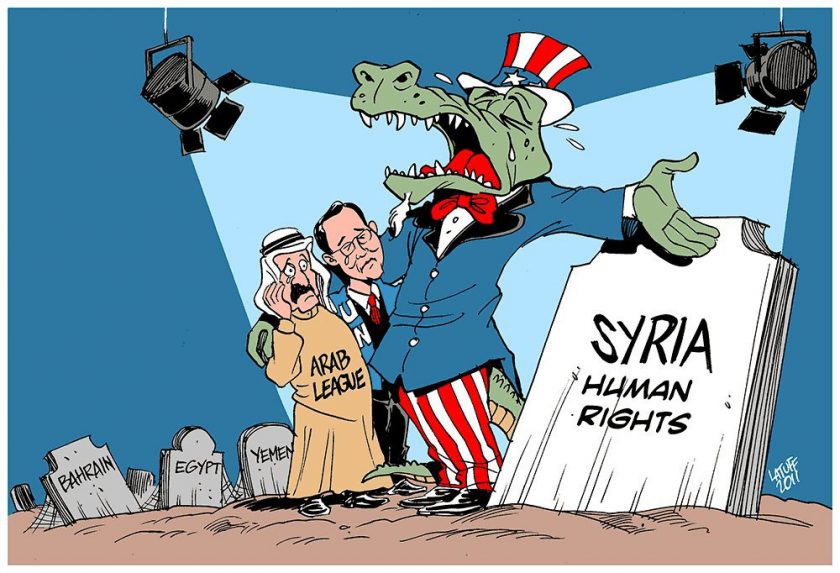
The Three Musketeers, Poison Gas, and Dead Schoolkids
By Michael Howard | American Herald Tribune | August 23, 2018
Winking and nodding to the “freedom fighters” hunkered down in the northwestern Syrian province of Idlib, the world’s schoolmarm (formally known as The West) has issued a stern warning to President Bashar al-Assad: don’t use chemical weapons “again,” or else. Said warning came via a joint statement from the US, UK and France (henceforth known as The Three Musketeers), as the Syrian government prepares its offensive to retake the country’s last remaining “rebel” stronghold. The three great and benevolent powers are “gravely concerned,” they said, about the upcoming military campaign, explaining:
We also underline our concern at the potential for further—and illegal—use of chemical weapons. We remain resolved to act if the Assad regime uses chemical weapons again. As we have demonstrated, we will respond appropriately to any further use of chemical weapons by the Syrian regime, which has had such devastating humanitarian consequences for the Syrian population.
Read it again, and take note of the crafty way in which the statement messes around with language to manipulate its target audience (us). The use of chemical weapons is accurately, and superfluously, described, and emphasized with em dashes, as “illegal,” as though there was a soul on this earth to whom this is news. Then, alluding to their coordinated missile strikes against Syria this past April, which were unleashed to much pomp and circumstance, The Three Musketeers pledge to “respond appropriately” to any such illegal action on the part of the Syrian government.
Since they insist on begging questions, we must insist on demanding answers. For instance, how “appropriate” was the aforesaid missile attack? Assuming that, in this context, a direct link exists between appropriate and legal (and only an outlaw could reject that assumption), there was certainly nothing “appropriate” about The Three Musketeers’ unilateral decision to use military force against a sovereign country last April. Quite the reverse.
The missile strike, like the one a year before, was carried out in flagrant violation of the law. There are a total of two circumstances in which the use of military force is legally justified: when greenlit by a UN Security Council resolution, or when done in self-defense, that is to say in response to a direct military attack. Neither condition was met when The Three Musketeers rocketed Syria. On the other hand, Syria is accorded the legal right under international law to strike back at its attackers, and moreover to form a coalition for that purpose. As Chapter VII Article 51 of the UN Charter states:
Nothing in the present Charter shall impair the inherent right of individual or collective self-defense if an armed attack occurs against a Member of the United Nations, until the Security Council has taken measures necessary to maintain international peace and security.
Mildly ironic, then—is it not?—that, in “appropriately” bombing the Syrian government, we granted it the legal right to bomb us back? It’s a crying shame: if only Assad and his allies were sufficiently nihilistic … we could’ve had another exhilarating World War on our hands—the third and last. To borrow a quote from of Trump’s favorite general: “Compared to war, all other forms of human endeavor shrink to insignificance. God help me, I do love it so.” On that note, I think it’s high time we substitute “War” for “God” in our Republic’s official motto. Who besides Rand Paul would vote against the proposal?
All of which is to say nothing of the fact that the alleged chemical attack in Douma, which served as the pretext for The Three Musketeers’ “appropriate” bombing raid, almost certainly didn’t happen. The first chink in the armor came in the form of Robert Fisk’s report, from the actual site of the alleged attack, that quotes a local doctor as saying:
There was a lot of shelling [by government forces] and aircraft were always over Douma at night—but on this night, there was wind and huge dust clouds began to come into the basements and cellars where people lived. People began to arrive here suffering from hypoxia, oxygen loss. Then someone at the door, a “White Helmet”, shouted “Gas!” and a panic began. People started throwing water over each other. Yes, the video was filmed here, it is genuine, but what you see are people suffering from hypoxia—not gas poisoning.
By his own count, Fisk interviewed more than twenty Douma residents; he was unable to find a single person “who showed the slightest interest in Douma’s role in bringing about the Western air attacks. Two actually told me they didn’t know about the connection.” Moreover, many of those he spoke with told him they “never believed in” the chemical weapons narratives promulgated by Western media.
Despite the fact that it squared with the Syrian Observatory For Human Rights’ (the West’s go-to authority on the Syrian conflict) assessment of the event, Fisk’s journalism was easy enough for Western ideologues to ignore or deride. He’s only one person, they countered, and he only spoke to a handful of residents and a single doctor, all of whom probably have a pro-Assad agenda. Therefore, his report is worthless and so is he.
This position grew a little less tenable when, a week after Fisk’s story was published, Russia presented to the Organization for the Prohibition of Chemical Weapons (OPCW), which was holding a conference in the Hague, seventeen eyewitnesses, a mix of residents and doctors, all of whom testified that there had been no chemical attack in Douma. As Jonathan Cook explained (yes, one had to visit his personal blog or some equally marginal source to read about this), “the US, UK and France boycotted the meeting, denouncing Russia for producing the witnesses and calling the event an ‘obscene masquerade’ and ‘theatre’”—not a very surprising reaction from a self-righteous party whose fabricated narrative is coming apart at the seams.
Then came the coup de grâce. On July 6, the OPCW published the conclusion of its fact-finding mission in Douma. Before quoting from it, I’ll jog your memory a bit. According to the Western version of events, Assad used both sarin and chlorine (or perhaps a physical mixture of the two, a nonsensical theory), in his attack on Douma—which, incidentally, had already effectively “fallen,” raising questions as to why Assad would feel compelled to use chemical weapons at all, apart from the sheer sadistic fun of it. Regardless, sarin and chlorine, said the West. Not so, said the OPCW:
OPCW designated labs conducted analysis of prioritized samples. The results show that no organophosphorous nerve agents or their degradation products were detected in the environmental samples or in the plasma samples taken from alleged casualties [my emphasis]. Along with explosive residues, various chlorinated organic chemicals were found in samples from two sites, for which there is full chain of custody. Work by the team to establish the significance of these results is on-going. The FFM team will continue its work to draw final conclusions.
Not a trace of sarin, in other words. Attempting to ascertain why “various chlorinated organic chemicals” were found at the site is a pointless exercise for someone, like myself, who knows nothing of chlorinated organic compounds. The most perfunctory research indicates that such chemicals are used for a variety of non-murderous applications, for example as solvents, and that they stick around for a long time after they’ve been introduced to an environment. The basic point, which hordes of media fixers promptly got to work obscuring, is that the Western narrative was false. The US government, in concert with its unctuous allies, lied. Go figure.
Of course, this isn’t the first time a supposed chemical attack in Syria has been called into question. Those curious about whether Assad used sarin to murder hundreds of civilians in the suburb of Ghouta in 2013, as was, and is, claimed by The West, would do well to read two essays by Seymour Hersh—“The Red Line and the Rat Line” and “Whose Sarin”—both published in the London Review of Books, both available online. Hersh also examined the chemical incident that took place in Khan Sheikhoun in April 2017—also used as a pretext for illegal US military action. This time, however, his reporting was too heretical even for the London Review of Books (not to mention the New Yorker), and so had to be published in Die Welt, which no one in the US has ever heard of, let alone read. That Hersh, the preeminent investigative journalist of his time, has been pushed into no man’s land speaks to how narrow the spectrum of permissible discourse has become in this, our great Republic. The schoolmarm is cracking her whip. At this rate Hersh will soon be relegated to the personal blog.
For other dissident views re: chemical weapons in Syria, do yourself a favor and consult the work of former UN weapons inspector Scott Ritter and MIT professor and munitions expert Theodore Postol, as well as the late journalist Robert Parry of Consortium News, all of whom have written extensively, and cogently, on the subject. Or you can keep reading the Washington Post. You’re free to decide.
But what exactly did The Three Musketeers have in mind when they broadcast their latest threat? It’s a fair question to ask. On its face, the statement appears to reflect a genuine aversion to poison gas, and a genuine hope that the Syrian government will refrain from using any in Idlib. Fair enough. Having said that, how averse could they really be, given that gas attacks provide for them the only remotely plausible excuse to lob more cruise missiles out of the Mediterranean—an activity from which they, and their media sidekicks, derive the utmost pleasure? They are, after all, incorrigible hawks. It must cut them to the bone to have to stand by and watch from the sidelines as a perfectly good war winds down, handcuffed, helpless to effect the desired outcome. How pitiable the plight of the poor impotent imperialist! Flaming warmongers need love too.
Anyway, call me schizophrenic, but when I read the words of The Three Musketeers, I couldn’t help but pick up the faint sound of a dog whistle—aimed straight at the “moderate rebels” holding down the fort in Idlib. Read between the lines, the statement is an assurance to one party dressed up as a warning to another. If there’s a “chemical incident,” we will attack: you have our word. That’s the message sent to, and received by, al-Qaeda (I don’t know what they’re calling themselves these days, and I care less) and its various affiliates. Make no mistake: The Three Musketeers have just invited, oh-so-subtly, bin-Laden’s foot soldiers to stage a chemical atrocity in Idlib (God knows how many “various chlorinated organic chemicals” they’ve got on hand there), the resulting pictures of which will duly splash across every television screen in America so as to whip up … well, you’ve heard this song before.
So here’s a new one: a bunch of kids walk onto a school bus in Yemen. As the bus steers through a crowded marketplace, Saudi Arabia drops a bomb on it, killing forty small children and injuring scores more. The bomb is later identified as a “laser-guided” precision missile (precision being the operative word), manufactured by our very own Lockheed Martin, while the mangled school bus is described by Col. Turki al-Maliki, spokesman for the Saudi-led coalition, as a “legitimate target.” Meanwhile, back in illustrious Washington, Pentagon bureaucrat Rebecca Rebarich is asked to comment on the “legitimate” massacre of forty schoolkids.
“The US has worked with the Saudi-led coalition to help them improve procedures and oversight mechanisms to reduce civilian casualties,” she says. “While we do not independently verify claims of civilian casualties in which we are not directly involved, we call on all sides to reduce such casualties, including those caused via ballistic missile attacks on civilian population centers in Saudi Arabia.”
Translated from vapid officialese: “I don’t really give a shit.”
On the bright side, we’re “gravely concerned” about the coming battle for Idlib, where the babies are beautiful and, most importantly, the bombs that kill them are un-American.
West leading campaign of hypocrisy on use of chemical weapons: Syria
Press TV – August 23, 2018
Syria has denounced a recent statement by the US, Britain and France on the alleged use of chemical weapons by the Damascus government, saying the trio is leading a campaign of misinformation against the Arab country in line with their support for terrorists.
An official source at the Syrian Ministry of Foreign Affairs and Expatriates told SANA news agency on Wednesday that the fresh Western threats against Damascus came amid the Syrian army’s territorial gains against foreign-backed terrorists.
Washington, London and Paris, in a statement on Monday, claimed that they “shared resolve to preventing the use of chemical weapons” by the government of Syrian President Basher al-Assad.
They also noted that their position on the Damascus’ “use of chemical weapons is unchanged. As we have demonstrated, we will respond appropriately to any further use of chemical weapons” by the Syrian government.
The statement was published on the fifth anniversary of the deadly chemical attack in the Damascus suburb of Ghouta in August 2013.
Elsewhere in his remarks, the Syrian Foreign Ministry source stressed that the Western countries had once again resorted to “a campaign of threats, hypocrisy and misinformation against the Syrian Arab Republic as part of the continued declared support for the armed terrorist groups, particularly Jabhat al-Nusra and its affiliated groups.”
“Syria has repeatedly asserted that it considers the use of chemical weapons immoral and condemns its use anywhere, under any circumstance and against anyone. Syria reiterates that it has no chemical weapons,” he added.
Syria surrendered its entire chemical stockpile in 2013 to a mission led by the Prohibition of Chemical Weapons (OPCW) and the UN.
The source also said it is not Syria which uses chemical weapons, but rather the armed terrorist groups that enjoy direct support from Western and regional countries such as Saudi Arabia, Turkey and Qatar.
Syria, the source added, has recently “informed the relevant international bodies about preparations by armed terrorist organizations to use poison gas in several areas” in the country.
The statement of these countries is nothing more than a sign of support for “any chemical aggression that these terrorist organizations may undertake in the next few days to use this as a pretext for aggression against Syria, as it did in its brutal aggression on 14 April 2018.”
The Western statement seeks to “justify the use of chemical weapons by terrorist organizations, prolong the war against Syria and support the terrorist organizations,” the source pointed out.
On April 14, the US, Britain and France launched a coordinated missile attack against sites and research facilities near Damascus and Homs with the purported goal of paralyzing the Syrian government’s capability to produce chemicals.
The strike came one week after an alleged gas attack on the Damascus suburb town of Douma.
CIA-Backed Firm Tipped Off Facebook to ‘Inauthentic’ Accounts
Sputnik – August 22, 2018
Facebook removed 652 pages, groups and accounts on Tuesday for “coordinated inauthentic behavior” after it was tipped off to the accounts by FireEye, a cybersecurity firm bankrolled by the Central Intelligence Agency.
The company has attributed the operators of the newly removed accounts to the usual scapegoats: Russia and Iran.
“These were distinct campaigns, and we have not identified any links or coordination between them,” the company said.
Twitter quickly followed suit. “Working with our industry peers today, we have suspended 284 accounts from Twitter for engaging in coordinated manipulation,” Twitter said in a Tuesday statement. “Based on our existing analysis, it appears many of these accounts originated from Iran.”
“The thing that strikes me the most is that it’s so convenient, that all of these pages that Facebook has been taking down and that Twitter has been limiting, are all somehow related — or they say they’re related — to governments or movements or news sources that aren’t very friendly to the United States or that the United States government wants to overthrow,” web developer and technologist Chris Garaffa told Radio Sputnik’s By Any Means Necessary.
“Russia. Iran. TeleSur. Venezuela Analysis. There was a Haitian liberation page that was taken down last week on Facebook as well.”
“You don’t see any German pages, you don’t see any British pages coming down, even if they are doing some sort of sketchy activity,” Garaffa added.
According to Facebook’s head of Cybersecurity Policy, Nathaniel Gleicher, the social media giant got a tip from FireEye, a cybersecurity firm that has received venture capital funding by the CIA since 2009. In a statement, the CIA’s investment arm said it will maintain a “strategic partnership” with FireEye, calling it a “critical addition to our strategic investment portfolio for security technologies.”
The CIA’s venture capital arm is known as In-Q-Tel, which describes itself as a “not-for-profit strategic investor” on its website.
The company was one of the few cyber firms to forensically analyze the alleged hack of the Democratic National Committee. A spokesman for the firm told Defense One that the hackers “wanted experts and policymakers to know that Russia is behind it.”
In March 2017, FireEye CEO Kevin Mandia, a former Air Force cyber crimes investigator, told the Senate Select Committee on Intelligence that the company was able to attribute the blame to Russia based off of “deduction” and “process of elimination.”
One part of the network FireEye identified to Facebook was a page called Quest 4 Truth. According to Gleicher, it “claims to be an independent Iranian media organization, but is in fact linked to Press TV, an English-language news network affiliated with Iranian state media.”

“We’re still investigating, and we have shared what we know with the US and UK governments,” Gleicher wrote. “Since there are US sanctions involving Iran, we’ve also briefed the US Treasury and State Departments.”
“The social media companies are by and large American companies, and they want to be in favor with the US government,” Garaffa told By Any Means Necessary hosts Eugene Puryear and Sean Blackmon. “They will do the bidding of the US government when it comes to data collection [and] when it comes to taking down pages that are not acceptable.”
“It’s a huge PR weapon that the American government has that almost no one else does,” he added.
The investigation came in three parts, according to Facebook. The first netted 74 Facebook pages, 70 accounts, three groups and 76 accounts on Instagram, which is owned by Facebook. Some $6,000 was spent on ads on the platforms, and three events were created.
The second stage included 12 Facebook pages, 66 Facebook accounts and nine Instagram accounts. No money was spent on advertising, and none of the pages had associated events.
The third part of the investigation found 168 Facebook pages, 140 Facebook accounts and 31 Instagram accounts; 25 events were created, and more than $6,000 was spent on ads.
According to Facebook, many of the pages masqueraded as news organizations. Some real news organizations have reported that the accounts were seeking to influence the US midterm elections, but in reality, Facebook just said one of the account groups was discovered as the company stepped up investigation efforts ahead of the midterms.
“Finally, we’ve removed pages, groups and accounts that can be linked to sources the US government has previously identified as Russian military intelligence services,” the company said. “This more recent activity focused on politics in Syria and Ukraine. For example, they are associated with Inside Syria Media Center, which the Atlantic Council and other organizations have identified for covertly spreading pro-Russian and pro-Assad content.”
Facebook has partnered with the Digital Forensics Research Lab to combat so-called fake news. It’s worth noting DFL is an arm of the neoconservative Atlantic Council think tank, which is primarily funded by NATO, Gulf monarchies and the US defense industry.
“The shuttering of progressive media amidst the ‘fake news’ and Russiagate hysteria is what activists been warning all along — tech companies, working in concert with think tanks stacked with CIA officials and defense contractors, shouldn’t have the power to curate our reality to make those already rendered invisible even more obsolete,” Abby Martin, host of “The Empire Files” on TeleSur English, told Sputnik News after Facebook temporarily unpublished the TeleSur English page. “The Empire Files” announced on Wednesday that they were forced to shut down because of US sanctions.
“The Atlantic Council is like a who’s who of the extremely wealthy and NATO countries and allies,” Garaffa said. Since the “content moderation” partnership, there’s been a “massive uptick in removing of any content that goes against the mass media, US propaganda line.”
“So they have this unprecedented control over the narrative and the information that we can see, and these are private companies, but ultimately because of their relationship with the state, they are serving the interests of the state, and the state is actually serving to protect these companies’ interests as well.”
Facebook’s last round of bans came on July 31. That time, the company made no attempt to publicly identify who was behind the “bad actors” on their platform, but said that activity displayed by them was consistent with previously identified activity from the allegedly Kremlin-run troll farm the Internet Research Agency.
That ban included 32 pages and accounts and the main counter-protest to the Unite the Right 2.0 rally held in Washington, DC on August 12 — the one-year anniversary to the deadly Charlottesville, Virginia, protest. One of the six administrators on the account supposedly displayed inauthentic activity. The other five were totally legitimate, the company admitted.
The bans on Tuesday follow a long line of similar ones issued by the company since the 2016 election. The company banned 470 supposedly fake Russian accounts in September 2017; then, on April 3, Facebook banned 70 Facebook accounts, 65 Instagram accounts and 138 Facebook pages allegedly controlled by the Internet Research Agency.
Garaffa underscored the power social media giants wield, as they’re relied on “much more now than most people did on television or newspaper news, because the stream is always on. You’re not picking up the morning edition of the paper, you’re looking at what happened in the last five minutes.”
‘Our build-up is defensive, Russia’s aggressive,’ says NATO after Putin’s remark – but is that fair?
RT | August 22, 2018
NATO claims its military buildup in Eastern Europe is justified as it deters Russia’s superior might. Yet, any Russian activity is overshadowed by the US-led bloc’s huge border drills, supposedly held to ‘counter’ Moscow’s moves.
“NATO’s actions are defensive, proportionate and fully in line with our international commitments,” the alliance’s spokeswoman Oana Lungescu told Reuters, commenting on NATO military activities. She further added that the troops deployed by the Alliance to Eastern Europe “cannot compare to the divisions deployed by Russia” on its western borders.
The rant was provoked by the words of Russian President Vladimir Putin, who rebuked NATO for building up its military infrastructure right on Russia’s doorstep. “We do not deploy our military contingents away from our borders and close to the NATO states, it is the NATO infrastructure that advances to our own borders,” Putin told journalists in Sochi.
It was the way this statement was put that apparently made NATO officials so angry that they even de facto claimed that their forces are no match to those of Russia. The comparison is not exactly true, as facts show that NATO’s buildup and military activities near Russian territory actually overshadow the Russian activity.
Less than a week ago, German media reported that Berlin sent as many as 8,000 soldiers and some 100 tanks to Norway in preparation for yet another NATO drill, this time dubbed Trident Juncture 2018 and scheduled for October-November. According to the Alliance, the exercise, which will focus on repelling an aggression of some unfriendly state as part of a collective defense scenario under Article 5 of the NATO treaty, will involve as many as 40,000 participants from more than 30 countries – more than any Russian military exercise conducted in recent years.
The “scariest” Russian war games, dubbed Zapad-2017, which even sparked media-fueled fears that it was a cover for an “invasion” of neighboring countries, involved only 12,700 troops, 70 military aircraft, 10 ships and some 680 ground vehicles. Almost immediately after those drills Poland hosted what it called “national” Dragon 17 exercises, involving contingents from the US, the UK, Germany, Lithuania, Latvia, Slovakia, Italy, Bulgaria, Romania, Georgia and Ukraine. Notably, the number of troops involved in Dragon 17 exceeded those of the Zapad-2017 contingent, with some 17,000 personnel and 3,500 hardware pieces involved.
The US-led bloc continues to intensify its military exercises in Eastern Europe. In less than three months, NATO conducted two major drills in the vicinity of Russian borders. In June, more than 18,000 soldiers from 19 countries took part in the two-week ‘Saber Strike’ exercise, held in Poland and the Baltic States. The drills were said to practice the deployment of military convoys to defend NATO’s eastern flank.
On August 20, Latvia hosted the biggest war games ever staged on its territory since the Baltic State gained independence. Some 10,000 troops from more than a dozen NATO countries are participating in the drills that will end on September 2. However, the military bloc continues to repeat its mantra that all those drills right on Russia’s doorstep are in no way aimed at “provoking” Russia.
As if that was not enough, NATO also beefed up its military contingent in Eastern Europe. In her statement to Reuters, Lungescu only mentioned “4,000 troops to the eastern part of the Alliance to deter any possible aggression” as if those troops were the only ones NATO recently sent to the region. She forgot to note that the US will soon double the number of its Marines stationed in Norway. Also left out were the missile defense installations in Poland and Romania that are equipped with Lockheed Martin Aegis Ashore systems, which are technically capable of carrying both interceptor missiles and Tomahawk missiles.
In October 2017, the US also sent a new mechanized brigade to Poland, effectively increasing the overall strength of its military group in the Eastern European state to the level of a mechanized division. The Russian Defense Ministry spokesman, Major General Igor Konashenkov, said at that time that the equipment of another US brigade, which had previously been stationed there “remained in place.”
He added that such a situation gives the US an opportunity to easily redeploy its trained military personnel from its German Rammstein base to Poland within just two hours. According to the Russian Defense Ministry, NATO has tripled its military presence on Russia’s western borders over the past five years, forcing Moscow to respond.
Meanwhile, Russia has not deployed any significant military forces to its western borders in recent years, except for the stationing of Iskander-M tactical missile systems in its western exclave of Kaliningrad in early 2018. However, it is Russia that NATO and the West so desperately seek to portray as a source of instability in the region. Moscow has repeatedly warned that increased NATO presence on its doorstep effectively contributes nothing to regional security and, to the contrary, undermines stability in Europe.
Russia rejects Facebook’s allegations of disinformation campaign
RT | August 22, 2018
Russia on Wednesday rejected allegations from Facebook that the country’s GRU military intelligence service had been using the social media site to run disinformation campaigns.
Facebook, Twitter, and Alphabet Inc collectively removed hundreds of accounts tied to an alleged Iranian propaganda operation on Tuesday, while Facebook took down a second campaign it said was linked to Russia, Reuters reports.
According to Kremlin spokesman Dmitry Peskov, Facebook’s Russia-related allegations made no sense to Moscow and said they looked similar to previous groundless allegations from other sources like Microsoft.
“They are all trying to outdo one another with their statements which all look like carbon copies of one another,” the spokesman said. “We do not understand on what they are based,” he said, adding that the allegations lack “supporting explanation.”
‘Wow effect’: Microsoft’s claims on alleged Russian hacking are a political stunt – Moscow
RT | August 21, 2018
Microsoft’s claims that Moscow-backed hackers are attacking US websites is simply a case of the tech giant joining the Washington-led ‘witch hunt’ on Russia, the foreign ministry said on Tuesday.
The company’s claims that the hacking group Fancy Bears is linked to the Russian government and is creating a number of “spear-phishing” websites lacks any substance as the company has offered no evidence to support this allegation, the Russian ministry said in a statement. Instead, Microsoft’s words were “clearly aimed at having a maximum political and public wow effect,” it added.
So-called “spear-phishing” sites are designed to mimic the pages of the US political institutions and think tanks, in an attempt to gather information from those who visit them.
The ministry denied Russia’s involvement in any hacking attacks on the US soil, including those which are allegedly aimed at disrupting any elections and the US congressional midterm vote in particular. “We do not know what Microsoft is even talking about,” the statement reads.
The tech giant’s move is apparently nothing but a “display of loyalty” to the US establishment, the ministry said, expressing regret that a major company, which has operated on the Russian market for years, eventually decided to “join the witch hunt,” which has “gripped Washington.”
The ministry went on to say that the reason US officials are unwilling to present any evidence of “Russian electronic interference” into American politics is simply because “this evidence does not and could not possibly exist.”
At the same time, the foreign ministry once again said that Moscow is ready to establish a bilateral working group on cybersecurity with the US to resolve any emerging issues in a timely and professional manner. Such proposals have been repeatedly made by Russia earlier but the US has been reluctant to support this initiative so far.
On Monday, Microsoft said in its blog post that it managed to thwart a number of hacking attempts by “a group known variously as Strontium, Fancy Bear and APT28”, which has been “widely associated” with Russia. It admitted, however, that it has “no evidence” that the domains were used in any successful attacks — and no evidence “to indicate the identity of the ultimate targets.”
In response, the Russian president’s spokesman, Dmitry Peskov, denounced the tech giant’s claims as “groundless”. He added that the Russian government does not know what kind of hackers Microsoft were referring to, and that there was “no basis” for the accusations.
A number of experts, whom RT reached out to, also questioned Microsoft’s ability to effectively establish the identity of the alleged hackers. They described the company’s statement as a “faith-based attribution.”
Featured Video
Anthrax War – CBC The Passionate Eye
or go to
Aletho News Archives – Video-Images
Book Review
Shattered Dreams: The HPV Vaccine Exposed (2019)
By Christina England – 30 Q&As – Book Review & Summary
Lies are Unbekoming | September 4, 2026
… Gardasil received FDA fast-track approval in 2006, Cervarix followed in 2009, and Gardasil 9 was approved in December 2014 with more than double the aluminium adjuvant content of the original. The commercial context is specific. Merck was about to lose patent protection on Zocor and faced $18 billion in Vioxx injury claims from a cardiovascular drug the company had marketed while suppressing its own data showing a five-times increase in heart attacks. Analysts projected the global HPV vaccine market at $4 billion by 2011, contingent on government-funded national programs for teenage girls. The 1986 National Childhood Vaccine Injury Act had already granted manufacturers complete liability immunity. By 2013, Japan had withdrawn its HPV vaccine recommendation after cataloguing severe adverse reactions in hundreds of girls. No Western government followed. The establishment position across the UK, US, Australia, and most of Europe held, and still holds, that the vaccines are safe and effective, that reported injuries are coincidental, and that cervical cancer prevention justifies the program. The book was published into this position, not against a vacuum.
Shattered Dreams sits alongside Mary Holland’s The HPV Vaccine On Trial and Viera Scheibner’s foundational vaccination work as part of the documented record on what has been done to a generation of teenage girls under the banner of cancer prevention. The full summary unpacks three specific findings: that Merck used the aluminium adjuvant itself as the “placebo” control in 92.5% of trial subjects, making it structurally impossible to detect excess reactions from the adjuvant; that Dr. Sin Hang Lee found HPV DNA fragments bound to aluminium in every one of sixteen Gardasil samples tested, and in the blood and spleen of a New Zealand girl six months after her third dose; and that in every country with high vaccination coverage, including Australia, the UK, Norway, and Sweden, cervical cancer rates have stopped declining and started rising specifically in the vaccinated cohort. Martínez-Lavín’s 2017 calculation puts the number needed to seriously harm with Gardasil 9 at 140, and the number needed to vaccinate to prevent one case at 1,757. Thirteen young women are seriously harmed for every one who benefits. The vaccine was approved on the basis of trials that could not detect what the trials were supposed to detect, and it is still being given to twelve-year-olds today. … Read full review
Blog Roll
 Aletho News
- The Five-Year Fuel Crisis: Why the World Economy Is Paying for a War It Thinks Is Ending
- Trump’s Big Bluff on Iran
- Swiss scammed out of millions by Ukraine-linked call centers – media
- Germany facing potential ‘violent conflict’ with Russia – spy chief
- Ukraine’s EU neighbors reject new plea from Kiev – Politico
- British Transport Police Facial Recognition Trial Scanned 926,912 People With Zero Arrests
- House Bill Would Ban Federal Use of Flock ALPR Data
- Can a Spice Rival a Drug? 10 Head-to-Head Trials Put It to the Test.
- The oil routes around Hormuz face their own chokepoints
- The Saudi-Israeli war on Yemen’s resistance: Intelligence sharing, civilian targets & sectarian propaganda
- If Americans Knew
- Turkish Red Crescent helps elderly Gaza man walk again after Israel confiscates his prosthetic limb
- Four Palestinians Killed in Israeli Attacks in Gaza
- Two Palestinian youths killed and village razed as Israeli attacks on West Bank continue
- Two more Christian women innocent victims of Gaza raids
- Cruelty, Deprivation, Indignity: A Journalist’s 22 Months in Israeli Prison
- New IDF Website Frames Slain Gaza Journalists as Terrorists
- Israeli media: After settlers beat him mercilessly, they stuffed dirt into his mouth
- Americans Are Paying the Price to Preserve Israel’s Nuclear Hegemony
- A U.S. Jewish Fund’s Ambitious Bid to Put a Settler Elite in Control of Israel’s Security
- As genocide drags on, “Zionism is racism” becomes official policy in one UK party – Daily Update
- No Tricks Zone
- Latest European Green Energy Debacle; Portugal’s Largest Flagship Solar Park Insolvent!
- Green Energy Debacle: German Expert Professor Fritz Vahrenholt Warns Of Severe Economic And Social Consequences
- Two More Paleo Reconstructions Affirm Meters-Higher Sea Levels Across Ireland, Brazil 7000-6000 Years Ago
- New Study: Earth And Venus Surface Warmth Largely Explained By Convection And Lapse Rate, Not CO2 Or Radiation
- 2025 Nature Paper Claiming Worsening Global Drought Gets RETRACTED …Heavily Flawed
- New Study: ‘Global Drought Shows No Detectable Recent Acceleration Under Climate Warming’
- Economic Masterminds: German Socialists Suggest Taxing Productivity Gains Stemming From Using AI
- The South China Sea Has Not Been Cooperating With The Climate Change Narrative
- Energy Crisis: Germany Enters Heating Season With Historically Low Gas Reserve Fill Levels
- New Study: The Antarctic Ice Sheet Gained Mass From 2020-2024 Due To Staggering Snow And Ice Accumulation

