Rand Paul Claims Ex-CIA Director Has Been Monetizing His Security Clearance
Sputnik – 16.08.2018
WASHINGTON – US Senator Rand Paul said in a statement on Wednesday that he urged President Donald Trump to revoke the security clearance of former CIA Director John Brennan.
“I applaud President Trump for his revoking of John Brennan’s security clearance,” Paul said in the press release on Wednesday. “I urged the President to do this.”
Paul, who filibustered Brennan’s nomination to lead the CIA in 2013, said Brennan has shredded constitutional rights, lied to Congress and has been monetizing and making partisan political use of his security clearance since ending his directorship at the CIA.
Earlier on Wednesday, Trump announced in a statement that he revoked Brennan’s security clearance as part of the president’s constitutional responsibility to protect the nation’s classified information.
Trump also said that security clearances of other Obama administration officials were under review, including of former National Security Adviser Susan Rice, former Deputy US Attorney General Sally Yates and former Director of National Intelligence James Clapper.
The statement pointed out that Brennan’s behavior has been unprofessional, and the former CIA director has been using his status to make a series of unfounded and outrageous allegations, wild outbursts on the internet and television about the Trump administration.
Ex-CIA Officer: Russiagate Proponent Bill Browder ‘Should be in Jail’

© Sputnik / Alejandro Martinez Velez
Sputnik – August 16, 2018
The only way to topple Bill Browder’s anti-Russia narrative is to get both the mainstream media and members of the US Congress to start looking into the US financier’s claims and publicly question them, Philip Giraldi, a former CIA case officer and US Army intelligence officer, told Sputnik.
Browder established Hermitage Capital Management, an investment fund and asset management company, in the late 1990s in Moscow with fellow co-founder Edmond Safra. The company was a thriving business up until November 2005, when it was blacklisted by Russian officials for being a national security threat to the country.
Two years later, Browder’s company was raided by Russian authorities, who obtained several documents, including some relating to three of his holding companies. According to Browder, the seized paperwork allowed these so-called corrupt officials to claim a rebate of $230 million from the Russian state treasury.
Sergei Magnitsky, an accountant for the company, was later arrested and jailed over the matter. Months later, he died, sparking speculation that he was killed in order to end accusations that Russian officials were behind the multimillion dollar theft. This is a claim that Browder has shared with the masses to direct attention away from his own alleged white-collar crimes.
Giraldi told Radio Sputnik’s Fault Lines on Wednesday that Browder “is probably the most dangerous guy in the world” when it comes to spreading anti-Russian sentiment.
“He’s basically been the one who appears on the networks, appears before Congress,” Giraldi told hosts Garland Nixon and Lee Stranahan. “He is someone that they’ve [US officials] decided has to be the spokesperson in terms of what’s going on in Russia, and yet… he has a hidden agenda as a potential criminal.”
It should be noted that up until Browder was blacklisted and subsequently had his offices raided, he was a strong supporter of Russian President Vladimir Putin. He has since flipped sides, now referring to himself as Putin’s “Public Enemy #1.”
In time, Browder’s allegations led to Congress passing the Magnitsky Act in 2012, allowing the punishment of those responsible for the accountant’s death. The bill clears the way for the US government to sanction human rights offenders, freezing their assets and banning them from entering the US.
But the tide is turning against Browder, who’s known to many as leading the campaign to reveal Russia’s human rights abuses and so-called corruption, according to Giraldi. “I think the story is growing; I’m seeing more and more references to Browder in a negative way.”
However, he added that the only way to fight Browder’s crusade is to simply get the message out on mainstream media.
“The problem is that we have to get this at a level where Browder is doing his damage, and that’s in the mainstream media, places like The New York Times, and also to have some people in Congress begin to speak up and say, ‘Hey, what about the Magnitsky Act and everything that we did to provoke a crisis with Russia based on what Browder was telling us?'” he told Nixon. “Once you understand that, you realize that Browder, if anything, should be in jail.”
“That’s what we have to get through to that level, which is a tough level to get through to,” he added.
Browder’s name recently began to pop up in headlines after Putin suggested during the Helsinki summit that he would allow special counsel Robert Mueller to interrogate the 12 Russian officials who’d been indicted for allegedly hacking into US computer systems during the 2016 presidential election in exchange for Russian investigators interviewing Browder and other US persons.
See Also:
‘It Must Be Seen’: Filmmaker Andrei Nekrasov Urges Public to See Magnitsky Film
Cyprus Court Rejects Request to Ban Work With Russia on Browder Case – Reports
Trump Strikes Back at ‘Ringleader’ Brennan

By Ray McGovern • Consortium News • August 15, 2018
There’s more than meets the eye to President Donald Trump’s decision to revoke the security clearances that ex-CIA Director John Brennan enjoyed as a courtesy customarily afforded former directors. The President’s move is the second major sign that Brennan is about to be hoist on his own petard. It is one embroidered with rhetoric charging Trump with treason and, far more important, with documents now in the hands of congressional investigators showing Brennan’s ringleader role in the so-far unsuccessful attempts to derail Trump both before and after the 2016 election.
Brennan will fight hard to avoid being put on trial but will need united support from from his Deep State co-conspirators — a dubious proposition. One of Brennan’s major concerns at this point has to be whether the “honor-among-thieves” ethos will prevail, or whether some or all of his former partners in crime will latch onto the opportunity to “confess” to investigators: “Brennan made me do it.”
Well before Monday night, when Trump lawyer Rudy Giuliani let a small bomb drop on Brennan, there was strong evidence that Brennan had been quarterbacking illegal operations against Trump. Giuliani added fuel to the fire when he told Sean Hannity of Fox news:
“I’m going to tell you who orchestrated, who was the quarterback for all this … The guy running it is Brennan, and he should be in front of a grand jury. Brennan took … a dossier that, unless he’s the biggest idiot intelligence agent that ever lived … it’s false; you can look at it and laugh at it. And he peddled it to [then Senate Majority Leader] Harry Reid, and that led to the request for the investigation. So you take a false dossier, get Senators involved, and you get a couple of Republican Senators, and they demand an investigation — a totally phony investigation.”
The Fix Brennan Finds Himself In
After eight years of enjoying President Barack Obama’s solid support and defense to do pretty much anything he chose — including hacking into the computers of the Senate Intelligence Committee — Brennan now lacks what, here in Washington, we refer to as a “Rabbi” with strong incentive to advance and protect you. He expected Hillary Clinton to play that role (were it ever to be needed), and that seemed to be solidly in the cards. But, oops, she lost.
What needs to be borne in mind in all this is, as former FBI Director James Comey himself has admitted: “I was making decisions in an environment where Hillary Clinton was sure to be the next president.” Comey, Brennan, and co-conspirators, who decided — in that “environment” — to play fast and loose with the Constitution and the law, were supremely confident they would not only keep their jobs, but also receive plaudits, not indictments.
Unless one understands and remembers this, it is understandably difficult to believe that the very top U.S. law enforcement and intelligence officials did what documentary evidence has now demonstrated they did.
So, unlike his predecessors, most of whom also left under a dark cloud, Brennan is bereft of anyone to protect him. He lacks even a PR person to help him avoid holding himself up to ridicule — and now retaliation — for unprecedentedly hostile tweets and other gaffes. Brennan’s mentor, ex-CIA Director George Tenet, for example, had powerful Rabbis in President George W. Bush and Vice President Dick Cheney, as well as a bizarrely empathetic Establishment media, when Tenet quit in disgrace 2004.
The main question now is whether the chairs of the House oversight committees will chose to face down the Deep State. They almost never do, and the smart money says that, if they do, they will lose — largely because of the virtually total support of the Establishment media for the Deep State. This often takes bizarre forms. The title of a recent column by Washington Post “liberal” commentator Eugene Robinson speaks volumes: “God Bless the Deep State.”
Ray McGovern works with Tell the Word, a publishing arm of the ecumenical Church of the Saviour in inner-city Washington. During his 27-year career as a CIA analyst, he served under nine CIA directors and seven Presidents. He is a member of Veteran Intelligence Professionals for Sanity (VIPS).
Why You Shouldn’t Read The Independent Even If You Want To – #PropagandaWatch
corbettreport | August 15, 2018
Just kidding. Of course you should read and gain information from a wide variety of sources, including those you disagree with. Just don’t dare tell The Independent that, because they’re here to pester you into only ever trusting the MSM and government sources. Join James for this week’s edition of #PropagandaWatch where he breaks down the latest attempt to stamp out anti-establishment WrongThink.
SHOW NOTES: https://www.corbettreport.com/?p=27696
Netanyahu has dug himself into a hole in a graveyard full of untruths
By Yvonne Tidley | MEMO | August 15, 2018
Benjamin Netanyahu has dived headlong into the furore engulfing Labour Party leader Jeremy Corbyn, revealing the most blatant meddling to-date by Israel in British politics. What’s more, he’s done it armed with lies and distortions.
The Israeli Prime Minister blasted Corbyn for apparently paying tribute to those behind the 1972 Munich massacre in which 11 Israeli Olympic athletes were killed. The allegations were thrown at Corbyn after photographs emerged in the right-wing media of him attending a wreath-laying ceremony in 2014 at a cemetery in Tunisia.
Incorrect reports suggested that Corbyn had joined a ceremony eulogising the Palestinians who took part in the Munich atrocity. Their bodies, though, are buried in Libya, where they were flown after being killed by German security forces in an ill-fated attempt to rescue the Israeli athletes. A funeral procession was held from Tripoli’s Martyr’s Square to Sidi Munaidess Cemetery back in 1972.
While Corbyn protested that the Israeli leader’s “claims about my action and words are false,” Netanyahu himself had already taken to the social networks. “The laying of a wreath by Jeremy Corbyn on the graves of the terrorists who perpetrated the Munich massacre and his comparison of Israel to the Nazis deserves unequivocal condemnation from everyone – left, right and everything in between,” he wrote on Twitter.
The wreath laying in question was actually marking the 1985 air strike by Israel on the Tunisian capital which was condemned around the globe at the time. Details of exactly what took place at the memorial ceremony have been confirmed by Dr Mohammed Shtayyeh, a minister from the Palestinian Authority who stood next to Corbyn in 2014.
Despite the Labour leader’s efforts to clear his name, a tsunami of condemnation has been raised on the social networks by supporters of Israel and British politicians, including some within Labour ranks who want to oust Corbyn. The direct involvement of both Israel and Netanyahu in the plot to remove Jeremy Corbyn is now apparent following the Prime Minister’s inaccurate contribution to the Twitter storm which has been concocted with a plethora of fake details.
Corbyn was in Tunisia in 2014 for a conference aimed at solidifying relations between the Palestinian factions Fatah, which controls the Palestinian Authority in the West Bank, and Hamas, which has effectively formed the government in the Gaza Strip since it won the 2006 Palestinian elections. During the conference, delegates went to the Palestinian cemetery at Hammam Chott to pay tribute to those killed in the 1985 Israeli air strike on what was then the PLO headquarters.
Eight fighter jets of the Israeli Air Force took part in the raid on 1 October 1985; the operation was codenamed Wooden Leg. The F-15s took off from Tel Nor airbase near Tel Aviv and flew low over the Mediterranean Sea to avoid detection by Egyptian, Libyan and US radar. The six-minute attack on the PLO HQ in the seaside town killed 47 people, including 15 Tunisian civilians, and injured another 65.
The rogue action was condemned worldwide; even British Prime Minister Margaret Thatcher joined in by criticising the Israelis, something else that Netanyahu has chosen to forget in his rush to attack Corbyn. The UN Security Council also registered its anger and “condemned vigorously the act of armed aggression” by Israel in Resolution 573 on 4 October. Although the US abstained from the 14-0 vote, it did not use its veto to block the resolution, which branded the deed as an “act of armed aggression perpetrated by Israel against Tunisian territory in flagrant violation of the Charter of the United Nations, international law, and norms of conduct.” US President Ronald Reagan changed his original position, and instead of calling the bombing a “legitimate response,” he said that it “cannot be condoned.”
In their desire not to let the facts spoil a good story, anti-Corbyn individuals and groups have been posturing and gesturing since the Tunisian photographs were published, and calling on Corbyn to resign. Among them has been Home Secretary Sajid Javid, whose Conservative Party has sought to exploit the controversy by choosing — conveniently some might say — to forget Thatcher’s words at the time of the Israeli air strike on Tunisia. The late Prime Minister’s speech was made on the 40th anniversary of the UN, where she contested the assertion of the then Israeli leader Shimon Peres that the attack was justified.
Archives reveal that at a meeting with Peres, held at the UN Plaza Hotel on 23 October, Thatcher is reported (by Charles Powell) to have said that she had “recoiled” from Israel’s attack on Tunis with the killing of many civilians. “There was no legal or historical justification for Israel’s occupation of the West Bank. Nor was it right that Israel should now deny the Palestinians the rights which Israel had sought for herself for more than 2,000 years,” she added.
For those left in any doubt at her feelings about the issue, the so-called Iron Lady went on to condemn the Israeli air strike during a meeting in the House of Commons on 29 October when — according to Hansard, the official parliamentary record — she was asked during Prime Minister’s Questions to comment on the Israeli bombing of Tunis. “We have in fact condemned the attack on Tunis,” she told the House.
In conclusion, it is clear that Corbyn did not lay a wreath at the Tunisian graveyard, nor was the event held to commemorate those from the Black September group who carried out the terror attack on Israeli athletes at the 1972 Olympics. Their graves are in Libya.
For Corbyn to travel to Tripoli to lay a wreath at the graves of those responsible for the Munich massacre would be regarded as offensive as, for example, Israeli terrorists and their supporters from Irgun gathering annually at the King David Hotel in Jerusalem to celebrate the killing of 91 people, including 28 Britons, in a bomb attack on 22 July, 1946. Oh, but hang on a minute… that’s exactly what has been done in Jerusalem for decades.

Israeli Prime Minister Benjamin Netanyahu (L) meets with British Prime Minister Theresa May (R) during his official visit in London, UK on 2 November 2017 [UK Prime Ministry/Anadolu Agency]
While most of the perpetrators were not around for the 70th anniversary of the terrorist atrocity in 2016, a plaque was unveiled by former Irgun terror gang members and right-wing politicians at the King David Hotel ten years earlier on the 60th anniversary. It reads: “The hotel housed the Mandate Secretariat as well as the Army Headquarters. On July 22, 1946, Irgun fighters at the order of the Hebrew Resistance Movement planted explosives in the basement. Warning phone calls had been made urging the hotel’s occupants to leave immediately. For reasons known only to the British, the hotel was not evacuated and after 25 minutes the bombs exploded, and to the Irgun’s regret and dismay 91 persons were killed.”
To kill 91 innocent people and then blame the victims for not acting on the warning is deplorable. But to then go on to hold annual gatherings to commemorate the event and even unveil a plaque on the 60th anniversary is even more disturbing. Netanyahu and Britain’s anti-Corbyn Lobby should tweet about that.
They won’t, of course, because they are fully at ease with Israel acting with impunity. Even, it must be said, to the extent that its Prime Minister commemorates the killing of British citizens by “Jewish terrorists” in 1946, and interferes blatantly in the affairs of an independent sovereign state as part of the efforts to have the leader of Her Majesty’s Opposition discredited and thus less likely to win the next General Election. Such interference in British democracy is totally unacceptable; Netanyahu has dug himself into a hole in a graveyard full of untruths, but Britain, as all Members of Parliament must make clear to Israel’s lobbyists, is not the United States of America. His words just won’t wash here.
READ:
Saudi-US Propaganda by PBS NewsHour in Houthi-held Yemen

By William Boardman | Reader Supported News | July 24, 2018
One of the poorest countries in the Middle East, Yemen’s war has pushed it to the brink of famine. A Saudi blockade has slowed the flow of food and helped push prices up. Markets and businesses are ruined from airstrikes. Millions are destitute. Special correspondent Jane Ferguson smuggled herself across front lines to report on what’s happening inside the world’s worst humanitarian disaster.
— PBS NewsHour summary, July 2, 2018
This is what American tax-supported propaganda looks like when an organization like the PBS NewsHour wants to maintain a semblance of credibility while lying through its intimidated teeth. Yes, Yemen is one of the poorest countries in the world, long dependent on imported food and other life support. But to say “Yemen’s war” is major league deceit, and PBS surely knows the truth: that the war on Yemen is American-backed, initiated – illegally – in March 2015 by a Saudi-led coalition that includes the UAE (United Arab Emirates). The US/Saudi war is genocidal, creating famine and a cholera epidemic for military purposes. These are American and Arab war crimes that almost no one wants to acknowledge, much less confront.
The “Saudi blockade” is also a US Navy blockade. The blockade is a war crime. Starving civilians is a war crime.
The most amazing sentence is: “Markets and businesses are ruined from airstrikes.” Seems rather bland. But this is a tacit admission of more war crimes – Saudi bombing of civilian businesses, as well as civilian hospitals, weddings, and funerals. But PBS makes it sound like the airstrikes sort of come out of nowhere, like the rain. PBS omits the American culpability that makes the airstrikes possible: mid-air refueling, targeting support, intelligence sharing, and the rest. Think of Guernica, the fascist bombing of civilians that inspired Picasso’s painting. Now think of Guernica lasting three years. That’s what the US has supported in Yemen and that’s what PBS helps cover up.
Yes, “Millions are destitute,” and yes, this is “the world’s worst humanitarian disaster.” But an honest news organization might go on to note that the destitution and the disaster are deliberate results of the world’s most relentless war crime.
From a journalistic perspective, getting the perky blonde reporter Jane Ferguson into northern Yemen, where the Houthis have been in control since 2014, is an accomplishment of note. There has been little firsthand reporting from Houthi Yemen, where the worst war crimes have been committed and the worst suffering continues. Ferguson’s presence was certainly an opportunity for serious independent reporting. PBS didn’t allow that. Based on no persuasive evidence, PBS NewsHour host Judy Woodruff framed the report as coming from “territory held by the Iranian-backed Houthi rebels.” There is no credible evidence of meaningful Iranian support for the Houthis. To believe there is, one has to believe the Iranians are consistently getting through the US-Saudi blockade. PBS ignores such realities, as do most Washington policy-makers. Woodruff does acknowledge in her weaselly way that it’s “a brutal war that the United States is supporting through a Saudi-led coalition,” which is still a long way from the truth that it’s a genocidal bombing campaign made possible by the US.
Reporter Ferguson adds to the distraction by focusing on the poverty and suffering as if they came from nowhere:
Life is slipping away from Maimona Shaghadar. She suffers the agony of starvation in silence. No longer able to walk or talk, at 11 years old, little Maimona’s emaciated body weighs just 24 pounds. Watching over her is older brother Najib, who brought her to this remote hospital in Yemen, desperate to get help. The nurses here fight for the lives of children who are starving….
You were never supposed to see these images of Maimona. A blockade of rebel-held Northern Yemen stops reporters from getting here. Journalists are not allowed on flights into the area. No cameras, no pictures.
That last bit of self-dramatization of the daring journalist glosses over a harsh reality: in addition to waging a genocidal war on a trapped population, the US-Saudi axis is also enforcing isolation and censorship on the victim population. It is a US-Saudi blockade that keeps reporters out, preventing firsthand reporting of endless war crimes. Who says? Jane Ferguson says:
The Houthis cautiously welcomed me in and, once I was there, watched me closely.
Ferguson’s coverage of the hunger and starvation is heart-wrenching, journalism at its most moving but least informative. She frames her narrative falsely:
In the midst of political chaos in Yemen after the Arab Spring, Houthi rebels from the north captured the capital, Sanaa, in 2014, before sweeping south and causing the country’s then president to flee. Neighboring Sunni, Saudi Arabia, views the Houthis, from a Yemeni sect close to Shia Islam and backed by rival Iran, as an unacceptable threat along their border.
Political chaos is Yemen is decades if not centuries old, often fomented by the Saudis and other outside powers. The Houthis have been there for thousands of years (as Ferguson later acknowledges) and their dispute with the Saudis is ancient and territorial. The Houthis’ religion is independent. The influence of Iran is largely a Saudi night-fright made increasingly real by the war the Saudis say is supposed to stop Iran. This is contrary to the official story. Ferguson does not acknowledge it.
Ferguson pitches the second part of her three-part series, deceitfully understating American responsibility for the carnage. She doesn’t mention that the war would not have started without a US green light, saying only:
But there is a role played by the U.S. military, one that is sort of more passively behind, not quite as visible. And so we’re going to be looking at that role.
This is the official position of the Pentagon, which has claimed the US is not involved in combat in Yemen. The US role that is “more passively behind, not quite so visible” is still crucial to killing Yemenis on a daily basis. The war on Yemen began with US blessing and continues only because of US political, logistical, and materiel support. Jane Ferguson begins this segment with a reasonably accurate albeit morally numb description:
Inside rebel territory in Yemen, the war rains down from the sky. On the ground, front lines have not moved much in the past three years of conflict. Instead, an aerial bombing campaign by the Saudi-led and American-backed coalition hammers much of the country’s north….
Treating war crimes against defenseless people as a kind of natural disaster is barren of journalistic integrity and gives the war criminals a pass when they need calling out. Ferguson goes on in her antiseptic, no-one’s-responsible manner to illustrate the killing of civilians and the destruction of civilian facilities, including a Doctors Without Borders cholera clinic. She also documents US-made weaponry, including an array of unexploded bombs and a collection of cluster bombs. She doesn’t mention that cluster bombs are banned by most of the world and constitute a war crime in themselves. She does note that cluster bombs often wound civilians, then follows this fact with the gratuitously propagandistic comment: “The Houthis have also targeted civilians, throwing anyone suspected of opposing them in jail.” She has no follow-up, leaving the audience with a false moral equivalence between blowing off a child’s arm and throwing someone in jail. But it gets worse. Ferguson later gets off this political judo move:
Most people here, whether they support the Houthis or not, know that many of the bombs being dropped are American. It provides a strong propaganda tool for the Houthi rebels, who go by the slogan “Death to America.”
What does that even mean, “go by the slogan ‘Death to America’?” Again Ferguson has no follow-up. Later she shows a crowd chanting “Death to America” as if that has relevance. Why wouldn’t the defenseless victims wish death on the country that murders them without surcease? The main purpose of introducing “Death to America” (with all its Iran-hostage resonance) seems propagandistic, to inflame American audiences that remain in denial about their own very real war guilt. American-supported bombing of Yemen is a fact. It is, quite literally, “Death to Yemen.” For Ferguson to call it a “strong propaganda tool” is a Big Lie in classic propaganda tradition. For PBS to broadcast this lie is to engage in propaganda. PBS and Ferguson not only blame the victim, they characterize their very real victimization as if it weren’t true but mere propaganda. At the end of the segment, Ferguson once again engages in false moral equivalence:
Both the Houthis and the Saudi-led coalition have disregarded innocent civilian life in this war. Every bomb that falls on a hospital, office building or home causes more unease about where they come from.
While it may well be true that “both sides” have killed or wounded civilians, there is absolutely no comparison in scale. The US-Saudi coalition comprises mass murderers; the Houthis don’t come close. “Every bomb that falls,” Ferguson should have said, is dropped by the US-Saudi side on the Houthi side. There is no doubt where the bombs come from.
In her third and last PBS segment, Ferguson foregoes any effort to explore the reality of hundreds of years of Houthi-Saudi territorial conflict. Instead, she goes to bed with US propaganda, opening with a crowd of Yemenis chanting “Death to America” and then stating:
These rebels, known as Houthis, seized control of Sanaa City and much of the north of the country in 2014. They are of Yemen’s Zaydi sect and closest to Shia Islam. Their growing power caused alarm across the border in Sunni Saudi Arabia, so the Saudis formed a coalition of Arab countries to defeat them, a coalition backed by the United States.
This is so twisted it amounts to intellectual fraud. Yemen has a long, tortured history of foreign interference. In the years before 2014, Yemen served (without much choice) as a base for US drone bases. At the same time, the international community imposed a Saudi puppet as Yemen’s president (presently in exile in Saudi Arabia). In 2014, the Houthi uprising, widely popular among Yemen’s 28 million people, drove out both the US drone bases and the Saudi puppet president. The Houthis represented something like Yemeni independence, which the US, Saudis, and others opposed with lethal force.
US support for the war in Yemen constitutes an impeachable offense for two American presidents. So do continuing drone strikes, also known as presidential assassinations. The war began because President Obama approved it and the Saudis were willing to bomb a defenseless population. But according to Ferguson:
The Saudis and the United States say the Houthis are puppets for Tehran, a proxy form of Iranian military power right on Saudi Arabia’s doorstep.
This is real propaganda. There is no evidence that the Houthis are anyone’s puppets (which is one reason they need to be oppressed). Historically, the Houthis are an oppressed people who keep rising up again and again to re-establish their own freedom and independence. There is no credible evidence of significant Iranian presence in Yemen. PBS and Ferguson certainly present none, and neither have the US or Saudi governments. American demonization of Iran has been a fixed idea since 1979, rooted in two psychopathologies: American unwillingness to accept responsibility for imposing a police state on Iran and American inability to see the hostage-taking of 1979 as a rational response to past American predation. American exceptionalism is a sickness that punishes others, currently millions of innocent Yemenis.
Ferguson concludes her series with a dishonest use of journalistic balance, first with a quote from Senator Bernie Sanders arguing that the US role in the Yemen war is unconstitutional. Rather than assess that straightforward argument, Ferguson turns to an Idaho Republican, Senator James Reich, who offers fairy dust and lies:
The Iranians are in there and they are causing the difficulty that’s there. If the Iranians would back off, I have no doubt that the Saudis will back off. But the Saudis have the absolute right to defend themselves.
Imaginary Iranians aren’t there now and they weren’t there when the Saudis attacked in 2015. No one attacked Saudi Arabia. The Saudis are not defending themselves, they are waging aggressive war.
By balancing these quotes, Ferguson creates yet another false moral equivalence. There is no meaningful equivalence between Bernie Sanders challenging the president’s right to take the country to war on his own and James Reich using a lie to defend war-making that disregards Congress. PBS should be ashamed. Jane Ferguson offers a fig leaf with another quote from Bernie Sanders:
I don’t know that I have ever participated in a vote which says that the United States must be an ally to Saudi’s militaristic ambitions. This is a despotic regime which treats women as third-class citizens. There are no elections there. They have their own goals and their own ambitions.*
All this is true, but Ferguson has no follow up. Instead she again offers spurious analysis: “American support for Saudi Arabia is a major propaganda tool for the Houthis.” No, it’s not. American support for the Saudis is not propaganda, it’s a lethal reality for the Houthis and a crime against humanity for the world. Ferguson completes her piece with a soppy lament for civilian victims, as if no one is responsible for their suffering. That’s one last lie. There are many people responsible for the horror in Yemen today and leading the list is the US-Saudi coalition. It doesn’t take much intelligence to see that, but apparently it takes more courage than PBS has to report the obvious.
*[Yet Sanders campaigned on using Saudi troops to depose Syria’s legitimate and secular government – Aletho News ]
BBC Caught Cherry-Picking Anti-Privacy Computer Scientists for Segment
Sputnik – 15.08.2018
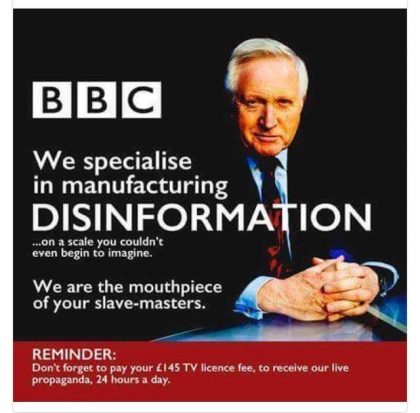 The BBC was caught red-handed engaging in manipulation after it declined to invite a potential guest for a segment on computer security, turning the expert down because he refused to state why it would be a good idea to put “back-doors” into cryptographic systems.
When “the UK Home Secretary outlined her plans around restrictions on end-to-end encryption, I was called by the BBC about back-doors in cryptography. As it is a subject I know well, and had even presented to a select committee in the House of Commons, I said I would be interested in debating the issue. They then they asked if I could put forward the concept of backdoors in encryption, and I said: ‘I can’t do that!'” professor Bill Buchanan of Edinburgh Napier University said in a Monday Medium post.
BBC’s producers then pressed the professor on the grounds that they were “really struggling” to find someone to make the case in favor of back-doors.
Buchanan was willing to offer his expertise here, explaining to BBC: “Well, most people with any technical knowledge know that it is a bad thing, and to provide an academic point of view I would have to be critical of it. In fact if I put forward the concept of back-doors in cryptography, I would have no credibility in my field.”
He said that BBC declined to invite him onto its show after his response ended the conversation.
What was BBC’s real motivation for pre-interviewing the computer scientist? “Basically I was there to back-up a politician who was on the show,” he demurred.
Mueller’s Indictments Debunked by NSA Whistle-blower Bill Binney
The Jimmy Dore Show | August 13, 2018
VIPS Professional Bill Binney sets the record straight on Guccifer 2.0 and Mueller’s latest indictments.
Here’s How You Can Support Our Show & Independent Media:
Check Us Out On Steemit http://bit.ly/2H99uTF
Become a PATRON https://www.patreon.com/jimmydore
Become a Premium Member http://bit.ly/JDPremium
Upcoming Live Shows http://bit.ly/2gRqoyL
‘Too Big to Fail’: Russia-gate One Year After VIPS Showed a Leak, Not a Hack
By Patrick Lawrence | Consortium News | August 13, 2018
A year has passed since highly credentialed intelligence professionals produced the first hard evidence that allegations of mail theft and other crimes attributed to Russia rested on purposeful falsification and subterfuge. The initial reaction to these revelations—a firestorm of frantic denial—augured ill, and the time since has fulfilled one’s worst expectations. One year later we live within an institutionalized proscription of proven reality. Our discourse consists of a series of fence posts and taboos. By any detached measure, this lands us in deep, serious trouble. The sprawl of what we call “Russia-gate” now brings our republic and its institutions to a moment of great peril—the gravest since the McCarthy years and possibly since the Civil War. No, I do not consider this hyperbole.
Much has happened since Veteran Intelligence Professionals for Sanity published its report on intrusions into the Democratic Party’s mail servers on Consortium News on July 24 last year. Parts of the intelligence apparatus—by no means all or even most of it—have issued official “assessments” of Russian culpability. Media have produced countless multi-part “investigations,” “special reports,” and what-have-yous that amount to an orgy of faulty syllogisms. Robert Mueller’s special investigation has issued two sets of indictments that, on scrutiny, prove as wanting in evidence as the notoriously flimsy intelligence “assessment” of January 6, 2017.
Indictments are not evidence and do not need to contain evidence. That is supposed to come out at trail, which is very unlikely to ever happen. Nevertheless, the corporate media has treated the indictments as convictions.
Numerous sets of sanctions against Russia, individual Russians, and Russian entities have been imposed on the basis of this great conjuring of assumption and presumption. The latest came last week, when the Trump administration announced measures in response to the alleged attempt to murder Sergei and Yulia Skripal, a former double agent and his daughter, in England last March. No evidence proving responsibility in the Skripal case has yet been produced. This amounts to our new standard. It prompted a reader with whom I am in regular contact to ask, “How far will we allow our government to escalate against others without proof of anything?”
This is a very good question.

Cover of 2001 book that looks at an earlier era of anti-Russia hysteria
There have been many attempts to discredit VIPS50 as the group’s document is called. There has been much amateurish journalism, false reporting, misrepresentation, distortion, misquotation, and omission. We have been treated to much shoddy science, attempts at character assassination, a great deal of base name-calling, and much else. Russia is routinely advanced as the greatest threat to democracy Americans now face. Is there any denying that we live amid an induced hysteria now comparable to the “Red under every bed” period of the 1950s?
None of this has altered the basic case. VIPS and forensic scientists working with it have continued their investigations. New facts, some of which alter conclusions drawn last year, have come to light, and these are to be addressed. But the basic evidence that Russia-gate is a false narrative concocted by various constituents of national power stands, difficult as this is to discern. Scrape back all that is ethically unacceptable and unscrupulously conveyed into the public sphere and you find that nothing has changed: No one “hacked” the Democratic party’s mail in the summer of 2016. It was leaked locally, from what one can make out, to expose the party leadership’s corrupt efforts to sink Bernie Sanders’ insurgent campaign to win the Democratic nomination.
But in another, very profound way, more has changed since VIPS50 was published than one could have imagined a year ago. American discourse has descended to a dangerous level of irrationality. The most ordinary standards of evidentiary procedure are forgone. Many of our key institutions—the foreign policy apparatus, the media, key intelligence and law-enforcement agencies, the political leadership—are now extravagantly committed to a narrative none appears able to control. The risk of self-inflicted damage these institutions assume, should the truth of the Russia-gate events emerge—as one day it surely will—is nearly incalculable. This is what inspires my McCarthy and Civil War references. Russia-gate, in a phrase, has become too big to fail.
This column is an attack on no one. However it may be read, it is not intended as another round of vituperative argument adding to the din and fog we already suffer daily. No shred of ideology informs it. I write a lament—this for all we have done to ourselves and our institutions this past year, and to the prospect of an orderly world, and for all that must somehow be done to repair the damage once enough of us indeed recognize what has been done.
New VIPS Findings
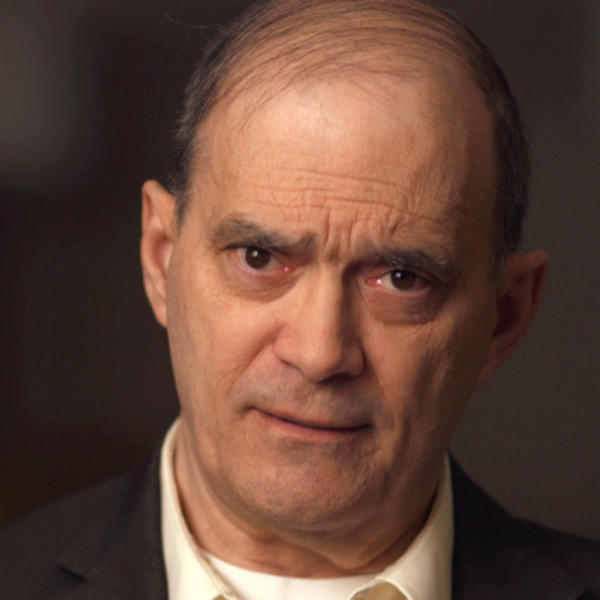
Binney: Dares anyone to prove remote speeds
The forensic scientists working with VIPS continued their research and experiments after VIPS50 was published. So have key members of the VIPS group, notably William Binney, the National Security Agency’s former technical director for global analysis and designer of programs the agency still uses to monitor internet traffic. Such work continues as we speak, indeed. This was always the intent: “Evidence to date” was the premise of VIPS50. Over the past year there have been confirmations of the original thesis and some surprises that alter secondary aspects of it. Let us look at the most significant of these findings.
At the time I reported on the findings of VIPS and associated forensic scientists, that the most fundamental evidence that the events of summer 2016 constituted a leak, not a hack, was the transfer rate—the speed at which data was copied. The speed proven then was an average of 22.7 megabytes per second. That speed matches what is standard when someone with physical access uses an external storage device to copy data from a computer or server and is much faster than a remote hack reliant on an internet service provider could achieve—either at the time or since, Binney has found.
Binney experimented into the autumn. By mid-autumn he had tested several routes—from East Coast locations to cities in eastern Europe, from New Jersey to London. The fastest internet transfer speed achieved, during the New Jersey–to–Britain test, was 12.0 megabytes of data per second. Since this time it has emerged from G-2.0’s metadata that the detected average speed—the 22.7 megabytes per second—included peak speeds that ran as high as 49.1 megabytes per second, impossible over the internet. “You’d need a dedicated, leased, 400–megabit line all the way to Russia to achieve that result,” Binney said in a recent interview.
To my knowledge, no one with an understanding of the science involved, including various former skeptics, any longer questions the validity of the specific finding based on the observed transfer rate. That remains the bedrock evidence of the case VIPS and others advance without qualification. “No one—including the FBI, the CIA, and the NSA—has come out against this finding,” Binney said Monday. “Anyone who says the speed we demonstrated can be achieved remotely, our position is ‘Let’s see it. We’ll help any way we can.’ There hasn’t been anyone yet.”
There is also the question of where and when leaks were executed. Research into this has turned out differently.
Evidence last year, based on analysis of the available metadata, showed that the copy operation date-stamped July 5, 2016, took place in the Eastern U.S. time zone. But Forensicator, one of the chief forensic investigators working on the mail-theft case anonymously, published evidence in May that, while there was activity in the Eastern zone at the time of that copy, here was also a copy operation in the Pacific time zone, where clocks run three hours earlier that EST. In an earlier publication he had also reported activity in the Central time zone.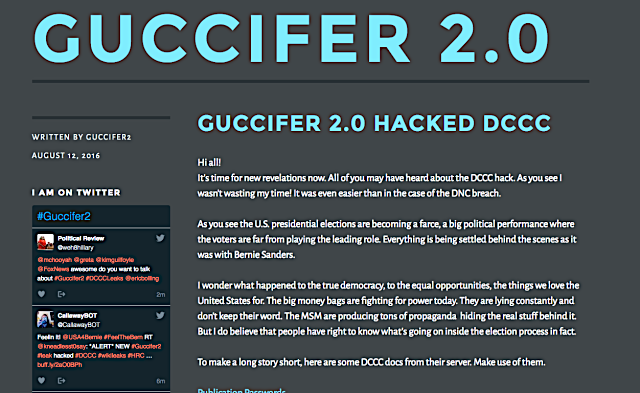
Plainly, more was awaiting discovery as to the when and where of the copy operations. The identity of Guccifer 2.0, who claimed to be a Romanian hacker but which the latest Mueller indictment claims is a construct of the GRU, Russian military intelligence, has never been proven. The question is what G–2.0 did with or to the data in question. It turns out that both more, and less, is known about G–2.0 than was thought to have been previously demonstrated. This work has been completed only recently. It was done by Binney in collaboration with Duncan Campbell, a British journalist who has followed the Russia-gate question closely.
Peak Speed Established
Binney visited Campbell in Brighton, England, early this past spring. They examined all the metadata associated with the files G–2.0 has made public. They looked at the number of files, the size of each, and the time stamps at the end of each. It was at this time that Binney and Campbell established the peak transfer rate at 49.1 megabytes per second.
But they discovered something else of significance, too. At some point G–2.0 had merged two sets of data, one dated July 5, 2016, which had been known, and another dated the following September 1, which had not been known. In essence, Campbell reverse-engineered G–2.0’s work: He took the sets of data G–2.0 presented as two and combined them back into one. “G–2.0 used an algorithm to make a downloaded file look like two files,” Binney explained. “Those two shuffled back together like a deck of cards.”
G–2.0 then took another step. Running another algorithm, he changed all the dates on all the files. With yet another algorithm, he changed the hours stamped on each file. These are called “range changes” among the professionals. The conclusion was then obvious: G–2.0 is a fabrication and a fabricator. Forensicator had already proven that the G–2.0 entity had inserted Russian “fingerprints” into the document known as the “Trump Opposition Report,” which he had published on June 15, 2016. It is clear that no firm conclusions can be drawn at this point as to when or where G–2.0 did what he did.
“Now you need to prove everything you might think about him,” Binney told me. “We have no way of knowing anything about him or what he has done, apart from manipulating the files. We detected activity in the Eastern time zone. Now we have to ask again, ‘Which time zone?’ The West Coast copy operation [discovered by Forensicator] has to be proven. All the data has been manipulated. It’s a fabrication.”
This throws various things into question. The conclusions initially drawn on time and location in VIPS50 are now subject to these recent discoveries. “In retrospect, giving ‘equal importance’ status to data pertaining to the locale was mistaken,” Ray McGovern, a prominent VIPS member, wrote in a recent note. “The key finding on transfer speed always dwarfed it in importance.”
The indictments against 12 Russian intelligence officers announced in mid–July by Rod Rosenstein, the deputy attorney-general, also come into question. They rest in considerable part on evidence derived from G–2.0 and DCLeaks, another online persona. How credible are those indictments in view of what is now known about G–2.0?
Binney told me: “Once we proved G–2.0 is a fabrication and a manipulator, the timing and location questions couldn’t be answered but really didn’t matter. I don’t right now see a way of absolutely proving either time or location. But this doesn’t change anything. We know what we know: The intrusion into the Democratic National Committee mail was a local download—wherever ‘local’ is.” That doesn’t change. As to Rosenstein, he’ll have a lot to prove.”
What Role does Evidence Play?
Rosenstein’s predicament—and there is no indication he understands it as one—brings us to an essential problem: What is the place of evidence in American public discourse? Of rational exchange?
The questions are germane far beyond the Russia-gate phenomenon, but it is there that answers are most urgent. What is implicit in the Rosenstein indictments has been evident everywhere in our public sphere for a year or more: Make a presumption supported by circumstantial evidence or none and build other presumptions upon it until a false narrative is constructed. The press has deployed this device for as long as I have been a practitioner: “Might” or “could” or “possibly” becomes “perhaps,” “probably” and “almost certainly,” and then moves on to unqualified fact in the course of, maybe, several weeks. Now this is how our most basic institutions—not least agencies of the Justice Department—routinely operate.

Rosenstein at the Department of Justice July 13, 2018 announcing indictments against 12 Russian GRU. (Photo by Chip Somodevilla/Getty Images)
This is what I mean when I refer to ours as a republic in peril.
There is the argument that certain things have been uncovered over the past year, and these are enough to conclude that Russia plots to undermine our democracy. I refer to the small number of Facebook advertisements attributed to Russians, to strings of Twitter messages, to various phishing exercises that occur thousands of times a day the world over. To be clear, I am no more satisfied with the evidence of Russian involvement in these cases than I am with the evidence in any other aspect of the Russia-gate case. But for the sake of argument, let us say it is all true.
Does this line up with the Russophobic hysteria—not too strong a term—that envelops us? Does this explain the astonishing investments our public institutions, the press, and leading political parties have made in advancing this hysteria as they did a variant of in the 1950s?
As global politics go, some serious thought should be given to a reality we have created all by ourselves: It is now likely that America has built a new Cold War division with Russia that will prove permanent for the next 20 to 30 years. All this because of some Facebook ads and Twitter threads of unproven origin? Am I the only one who sees a weird and worrisome gap between what we are intent on believing—as against thinking or knowing—and the consequences of these beliefs?
There was an orthodoxy abroad many centuries ago called Fideism. In the simplest terms, it means the privileging of faith and belief over reason. It was the enemy of individual conscience, among much else. Fideism has deep roots, but it was well around in the 16th century, when Montaigne and others had to navigate its many dangers. Closer to our time, William James landed a variant on American shores with an 1896 address called “The Will to Believe.” Bertrand Russell countered this line of thinking a couple of decades later with “Free Thought and Official Propaganda,” a lecture whose title I will let speak for itself. Twenty years ago, none other than Pope John Paul II warned of a resurgence of Fideism. It is still around, in short.
Do we suffer from it? A variant of it, I would say, if not precisely in name. There seems to be a givenness to it in the American character. I think we are staring into a 21st century rendition of it.
To doubt the hollowed-out myth of American innocence is a grave sin against the faith. It is now unpatriotic to question the Russia-gate narrative despite the absence of evidence to support it. Informal censorship of differing perspectives is perfectly routine. It is now considered treasonous to question the word of intelligence agencies and the officials who lead them despite long records of deceit. Do we forget that it was only 15 years ago that these same institutions and people deceived us into an invasion of Iraq the consequences of which still persist?
This was the question Craig Murray, the former British diplomat (who has vital information on the DNC mail theft but who has never been interviewed by American investigators) posed a few weeks ago. Eugene Robinson gave a good-enough reply in a Washington Post opinion piece shortly afterward: “God Bless the Deep State,” the headline read.
How we got here deserves a work of social psychology, and I hope someone takes up the task. Understanding our path into our self-created crisis seems to me the first step to finding our way out of it.
Patrick Lawrence, a correspondent abroad for many years, chiefly for the International Herald Tribune, is a columnist, essayist, author, and lecturer. His most recent book is Time No Longer: Americans After the American Century (Yale). Follow him @thefloutist. His web site is www.patricklawrence.us. Support his work via www.patreon.com/thefloutist.
Resignation matter or fake news? Attack on Corbyn over ‘terrorist wreath laying’
RT | August 13, 2018
The latest anti-Semitism story to hit Labour’s Jeremy Corbyn has polarised debate. His critics want him to resign immediately, while supporters are rushing to his defence, denying the accusations and crying ‘fake news.’
Photographs, taken in 2014 and published by the Daily Mail on August 11, show Corbyn holding a wreath at a service in Tunisia close to the graves of the Black September terrorists, who were implicated in the Munich attacks, in which 11 Israeli athletes were killed in 1972.
The original story is headlined “Corbyn’s wreath at Munich terrorists’ graves,” goes on to accuse the Labour leader of attending a “tribute event for Palestine ‘martyrs’ including plotters behind 1972 slaughter of Israeli Olympic athletes.”
The Labour Party has rejected calls for an apology, reiterating that Corbyn’s statement that he was laying a wreath honoring the 47 victims of an Israeli attack on a Palestinian Liberation Organisation (PLO) base outside of Tunis in 1985.
Responding to a follow up story, in which relatives of the Munich victims state that Corbyn should be “ashamed and apologize,” the party’s press team posted that the relatives were being “misled” by the story.
Writing in the left-wing Morning Star after the visit to the Tunisian cemetery, Corbyn stated that wreaths were laid to mark the 1985 Israeli bombing, adding: “After wreaths were laid at the graves of those who died on that day and on the graves of others killed by Mossad agents in Paris in 1991.”
It is unclear who Corbyn was referring to as there are no known Israeli killings in Paris in that year. However, Mossad agents did reportedly kill the PLO’s liaison officer with foreign intelligence agencies, Atef Bseiso, a suspected Black September member in 1992 in the French capital.
The article’s perceived inaccuracies prompted certain Corbyn supporters to call on him to sue the Daily Mail and over what they insist is ‘inaccurate reporting.’
In turn, right-wing Twitter condemnations of Corbyn were rife. Broadcaster Julia Hartley-Brewer mocked the Labour leader, and staunch Corbyn critic and Daily Mail journalist, Dan Hodges posted: “Dear Corbynites. It’s clear your hero honoured one, or a number of, the terrorists responsible for the Munich attack.”
The accusations led to Home Secretary Sajid Javid to demand Corbyn resign. “If this was the leader of any other major political party, he or she would be gone by now.” stated the Conservative.
While Jewish Leadership Council, Jonathan Goldstein, told the Jewish News : “This man is not fit to be a Member of Parliament, let alone a national leader.”
Another piece published by the Daily Mail on the same day attacked Corbyn for attending the wedding of a Palestinian ambassador who was accused of Holocaust denial in 2014, a claim he denies. Corbyn attended the wedding in 2010.
How Do You Tell If The Earth’s Climate System “Is Warming”?
By Francis Menton | Manhattan Contrarian | August 9, 2018
The earth’s climate system “is warming.” True or false? The answer is that there is no definitive answer. And if someone tells you there is, then that person doesn’t know what he or she is talking about.
A more precise answer to the question is that whether the earth’s climate system “is warming” or “is cooling” entirely depends on who gets to pick the start date for the analysis. If you are the one who gets to pick the start date, then you can make it so that the system is either warming or cooling, whichever you would like for your purpose of the moment.
But of course, there are many people out there today with a lot invested in the proposition that the climate system “is warming.” That proposition is a key tenet of global warming alarmism. To “prove” the point that the system “is warming,” advocates use the simple trick of picking a start point to their liking, making for a presentation that appears to support their position. Have you been fooled by this simple trick? The advocates leave it up to you to figure out that if you picked a different start point, you could just as easily make an equally convincing presentation showing that the climate system “is cooling.” A lot of seemingly intelligent people can’t figure that out, and get taken in by the scam.
I raise this point today because it appears that, as part of the campaign to suppress disfavored political speech, Google has begun within the past few days adding a legend at the bottom of YouTube videos that express politically incorrect views in the field of climate science. For example, here is the legend that they have added to a video made for Prager University by eminent MIT atmospheric physicist and climate skeptic Richard Lindzen:

“Multiple lines of scientific evidence show that the climate system is warming.”
The quote comes from the first two sentences of this Wikipedia entry with the title “Global warming.” Well, Wikipedia says it, so I guess it must be true!
According to this post at BuzzFeed on August 7, others who have been subject to having the same legend affixed to their work include Tony Heller of the Deplorable Climate Science Blog, Mark Morano of Climate Depot, and the Heartland Institute. (So far, nothing comparable has happened to the Manhattan Contrarian; but then, I don’t make YouTube videos.)
So let’s investigate the question of whether the earth’s “climate system” is or is not warming. You could, for example, look at the chart presented by Wikipedia in that entry. Here it is:
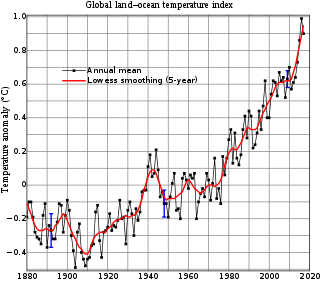
That looks rather dramatic. On the other hand, the whole vertical scale of the chart is only about 1.5 deg C; and they picked 1880 as their start date. (The slope here is also greatly accentuated by some very large and questionable “adjustments” that have made earlier years cooler and more recent years warmer. You can read my eighteen part series “The Greatest Scientific Fraud Of All Time” for much more detail. But those details are not critical for understanding the current issue.)
Does your skeptical mind possibly think, when they use that phrase “century scale,” is that just a bias-free description of the issue at hand, or is it instead a hand-wave to provide a fake justification for picking a preferred start date? Why do we need to go back 138 years when we are considering a question phrased in the present tense — whether the climate “is” warming? Wouldn’t the present tense normally be used to cover a much shorter period, like a year or two or three at most? So you ask, what has the climate system been doing during that time? For the answer, how about looking for temperature data to the far more accurate UAH satellite-based series which provides monthly data points going back to 1979. Here is the latest chart from that source:

This time, you get to pick the start date. To cover the last few years, how about picking early 2016? After all, these last couple of years should be a much better indicator of whether the climate “is” warming or cooling than the entire last 138 years. Really, what do temperatures more than 100 years ago, or even 30 or 40 years ago, have to do with the question of whether the earth’s climate “is” warming? So we look at the UAH chart, and we find our answer: since early 2016 temperatures have fallen by more than 0.5 deg C. Thus, once we get to pick our preferred start time, it is obvious that the climate system “is cooling.”
Or, you can pick a different start date to your liking. How about 1998? That will give you an entire 20 year run. It’s hard to say that the verb “is” should cover a period of more than 20 years. On the UAH series you can see that temperatures have also fallen about 0.4 deg C since early 1998. Again, even on this substantially longer scale, the earth “is cooling.” (Note, however, that there is a significant difference between the Wikipedia chart and the UAH satellite series as to what has happened since 1998. On the Wikipedia chart the latest reading (2017?) is up about 0.3 deg C from 1998; while on the UAH series, the latest reading (July 2018) is down about 0.4 deg C from the then-records set in 1998. That’s those “adjustments” in the surface temperature record that I was talking about. I would say that there is no credible position that the heavily adjusted surface temperature record that Wikipedia relies on should be used for this purpose over the far more accurate and un-tampered UAH satellite record.)
But how about if we decide that there is something to this “century-scale” thing? Let’s agree that we’re going to go back many, many decades to determine if the earth “is warming.” But if we’re going to do that, where do we stop? If you want, you can go back a hundred million years; or even a billion. And if you follow this subject a little, you probably know that the 1700s and 1800s are a very suspect era to start a series like this, because those centuries are a known cold period sometimes referred to as the “Little Ice Age.” Picking a date in the “Little Ice Age” as the start point to prove warming is what’s called “cheating.” Let’s pick something more fair. How about going back a nice round millennium? Was that time warmer or cooler than now?
OK, they didn’t have networks of thermometers set up around the globe in the 11th century, let alone the highly accurate satellites that we have today. But scores of scientists have done hundreds of studies based on many sorts of “proxies” to determine at least whether it was warmer or cooler at that time than today. It turns out that the evidence is rather overwhelming that it was warmer. Actually, this is what is known as the “Medieval Warm Period.” But picking a date in that period as your start date for deciding whether the earth “is warming” is no more fair or unfair than picking a date in the “Little Ice Age.”
Here is a compilation of dozens of studies reaching the conclusion that the Medieval Warm Period was warmer than the present: “More than 700 scientists from 400 institutions in 40 countries have contributed peer-reviewed papers providing evidence that the Medieval Warm Period was real, global, & warmer than the present.” Examples:
- “Paper finds Medieval Warm Period in Arctic was much warmer than the present.”
- “Medieval Warming Exceeds Modern Warming, Per New Research Using 120 Proxies.”
- “Earth was warmer in Roman and Medieval Times say German researchers.”
There are literally dozens more, if you follow the links. The conclusion is inescapable: on a centuries-scale basis, the earth’s climate system “is cooling.”
And by the way, if you want to keep going back farther and farther, you can keep finding time periods that were warmer than the present. Examples: the Roman Warm Period, from around 250 BC to 450 AD; and the Holocene Climate Optimum, about 5000 to 3000 BC.
So here’s the real answer to the question of whether the earth’s ciimate system “is warming”:
- If your start date is June 2018, it “is warming.”
- If your start date is January 2016, it “is cooling.”
- If your start date is January 1998, it “is cooling.”
- If your start date is 1880, it “is warming.”
- If your start date is the year 1000, it “is cooling.”
- If your start date is the Dark Ages, it “is warming.”
- If your start date is Roman times, it “is cooling.”
In short, the question is completely meaningless.
It’s hard to believe that the supposed geniuses at Google could be taken in by a scam so obvious and so transparent. But that’s the world we live in.
How NATO-linked Think Tanks Control EU Refugee Policy

By F. William Engdahl – New Eastern Outlook – 27.04.2016
A flood of uncontrolled war refugees from Syria, Libya, Tunisia and other Islamic countries destabilized by Washington’s ‘Arab Spring’ Color Revolutions, has created the greatest social dislocation across the EU from Germany to Sweden to Croatia since the end of World War II. By now it has become clear to most that something quite sinister is afoot, something which threatens to destroy the social fabric of the very core of European civilization. What few realize is that the entire drama is being orchestrated, not by German Chancellor Angela Merkel, or by faceless EU bureaucrats of the Brussels EU Commission. It is being orchestrated by a cabal of NATO-linked think tanks.
Last October 8, 2015 amid the great stream of hundreds of thousands of refugees flooding into Germany from Syria, Tunisia, Libya and other lands, a newly self-confident German Chancellor Angela Merkel proclaimed on a popular German TV program, “I have a plan.” She took the occasion to take a sharp dig at coalition partner, Bavarian CSU head, Horst Seehofer, a stauch critic of Merkel’s open arms refugee position since spring 2015 that saw more than one million refugees enter Germany last year alone.
Since that point, with iron-hard resolve, the German Chancellor has defended the criminal Erdogan regime in Turkey, an essential partner in her “plan.”
Most of the world has looked on with astonishment as she ignored principles of free speech and decided to prosecute publicly a well-known German TV comedian, Jan Böhmermann, for his satirical remarks about the Turkish President. They were astonished as the symbol of European democracy, the German Chancellor, chose to ignore Erdogan’s imprisonment of opposition journalists and his shutting of Turk opposition media as he proceeded with plans to establish a de facto dictatorship rule within Turkey. They were puzzled as Berlin’s government chose to ignore overwhelming proof that Erdogan and his family were materially aiding and abetting ISIS terrorists within Syria who were in fact creating the war refugee crisis. They were astonished to see her push through an EU commitment to give Erdogan’s regime billions of euros to supposedly deal with the refugee flow from Turkish refugee camps across the border into EU neighbor land, Greece and beyond.
The Merkel Plan
All of those seemingly inexplicable actions from the once-pragmatic German leader appear to go back to her embrace of a 14-page document prepared by a network of pro-NATO think-tanks, brazenly titled “The Merkel Plan.”
What the newly-self-confident German Chancellor did not tell her hostess, Anne Will, or her viewers was that “her” plan was given to her just four days earlier, on October 4, in a document already titled The Merkel Plan, by a newly-created and obviously well-financed international think-tank called the European Stability Initiative or ESI. The ESI website showed that it had offices in Berlin, Brussels and in Istanbul, Turkey
Suspiciously, the authors of the ESI plan titled their plan as if it had come from the German Chancellor’s office and not from them. More suspicious is the contents of The Merkel Plan of ESI. In addition to already taking more than one million refugees in 2015, Germany should “agree to grant asylum to 500,000 Syrian refugees registered in Turkey over the coming 12 months.” In addition, “Germany should accept claims from Turkey… and provide safe transport to successful applicants… already registered with the Turkish authorities…” And finally, “Germany should agree to help Turkey obtain visa-free travel in 2016.”
That so-called Merkel Plan was a product of US and NATO-linked think tanks and of governments of NATO member countries or prospective members. The maxim “follow the money trail” is instructive in this case to see who really runs the EU today.
The ESI
The ESI came out of NATO-led efforts to transform South East Europe following the US-instigated war in Yugoslavia during the 1990’s that resulted in the Balkanization of the country and establishment of a major USA and NATO airbase, Camp Bond Steel in Kosovo.
Current ESI Chairman directly responsible for the final Merkel Plan document is Istanbul-based Austrian sociologist, Gerald Knaus. Knaus is also a member of the European Council on Foreign Relations (ECFR), and an Open Society Fellow.
Founded in London in 2007, the ECFR is an imitation of the influential New York Council on Foreign Relations, the think-tank created by the Rockefeller and JP Morgan bankers during the 1919 Versailles peace talks to coordinate an Anglo-American global foreign policy. Significantly, the creator and moneybags for the ECFR is American multi-billionaire and Color Revolution funder, George Soros. In virtually every US State Department-backed Color Revolution since the collapse of the Soviet Union, including in Serbia in 2000, in Ukraine, in Georgia, in China, in Brazil and in Russia, George Soros and offshoots of his Open Society Foundations have been in the shadows financing “democracy” NGOs and activists to install pro-Washington and pro-NATO regimes.
The select members, called Council Members or associates, of the London-based ECFR include ECFR co-chairman Joschka Fischer, former German Green Party Foreign Minister who arm-twisted his party into backing Bill Clinton’s illegal 1999 bombing of Serbia without UN Security Council backing.
Other members of the Council of Soros’ European Council on Foreign Relations think tank include former NATO Secretary General, Xavier Solana. It includes disgraced plaigarist and former German Defense Minister, Karl-Theodor zu Guttenberg; Annette Heuser, Executive Director Bertelsmann Stiftung in Washington DC; Wolfgang Ischinger, Chairman, Munich Security Conference; Cem Özdemir, chairman, Bündnis90/Die Grünen; Alexander Graf Lambsdorff, German Liberal Party (FDP) MP; Michael Stürmer, Chief Correspondent, Die Welt; Andre Wilkens, Director of Mercator Foundation; pederasty defender, Daniel Cohn-Bendit of the European Parliament. Cohn-Bendit, known as “Danny the Red” during the May, 1968 French student riots, was a member of the the autonomist group Revolutionärer Kampf (Revolutionary Struggle) in Rüsselsheim, Germany along with his close ally, now ECFR chairman, Joschka Fischer. The two went on to found the “realo” wing of the German Greens.
The Open Society Foundations is the network of tax-exempt “democracy-promoting” foundations created by George Soros on the collapse of the Soviet Union to promote “free market” pro-IMF market liberalization of former communist economies that opened the doors for the systematic plundering of invaluable mining and energy assets of those countries. Soros was a major financier of the liberal economic team of Boris Yeltsin including Harvard “Shock Therapy” economist, Jeffrey Sachs, and Yeltsin liberal adviser, Yegor Gaidar.
Already it becomes clear that the “Merkel Plan” is the Soros Plan in fact. But there is more if we wish to understand the darker agenda behind the plan.
The ESI Funders
The European Stability Initiative think-tank of Soros-tied Gerald Knaus is financed by an impressive list of donors. Their website lists them.
The list includes, in addition to Soros’ Open Society Foundations, the Soros-tied German Stiftung Mercator, and the Robert Bosch Stiftung. ESI funders also include European Commission. Then, curiously enough the funder list for The Merkel Plan includes an organization with the Orwellian name, The United States Institute of Peace.
Some research reveals that the United States Institute of Peace has anything but a peace-loving background. The United States Institute of Peace is chaired by Stephen Hadley, former US National Security Council adviser during the neo-conservative war-waging Bush-Cheney administration. Its Board of Directors includes Ashton B. Carter, current Obama Administration neo-conservative hawkish Secretary of Defense; Secretary of State John Kerry; Major General Frederick M. Padilla, President of the US National Defense University. These are some very seasoned architects of the US Pentagon Full Spectrum Dominance strategy for world military domination.
The “Merkel Plan” authors at the European Stability Initative, in addition to the largesse of George Soros’ foundations, list as “core” funder, the German Marshall Fund of the United States. As I describe in my book, The Think Tanks, the German Marshall Fund is anything but German. With its seat in Washington, as I noted in the book, “It’s an American think tank with its headquarters in Washington, D.C. In point of fact, its agenda is the deconstruction of postwar Germany and more broadly of the sovereign states of the EU to fit them better into the Wall Street globalization agenda.”
The German Marshall Fund of Washington has been involved in the post-1990 USA agenda of regime change around the world in league with the US-funded National Endowment for Democracy, Soros Foundations, and the CIA front called USAID. As I describe it in the think tanks book, “The major focus of the German Marshall Fund according to its 2013 Annual Report was to support the US State Department agenda for so-called democracy-building operations in former communist countries in eastern and south-eastern Europe, from the Balkans to the Black Sea. Significantly their work included Ukraine. In most instances, they worked together with the USAID, widely identified as a CIA front with ties to the State Department, and the Stewart Mott Foundation which gives funds to the US Government-funded National Endowment for Democracy.”
Notably, the same Stewart Mott Foundation is also a funder of the ESI-authored Merkel Plan, as is the Rockefeller Brothers Fund.
This all should give pause for reflection as to who and for what goals the Merkel-Erdogan deal for dealing with the EU refugee crisis is intended. Does the Rockefeller-Bush-Clinton faction in the United States intend to use it as a major social engineering experiment to create chaos and social conflict across the EU at the same time their NGOs such as the NED, Freedom House and the Soros Foundations are stirring things up in Syria and Libya and across the Islamic world? Is Germany, as former US presidential adviser and Rockefeller crony, Zbigniew Brzezinski called her, a “vassal” of US power in the post-1990 world? To date the evidence is pretty strong that that’s the case. The role of US and NATO-linked think tanks is central to get an understanding of how the Federal Republic of Germany and the European Union are actually controlled from behind the Atlantic curtain.
Featured Video

Anthrax War – CBC The Passionate Eye
or go to
Aletho News Archives – Video-Images
Book Review
Shattered Dreams: The HPV Vaccine Exposed (2019)
By Christina England – 30 Q&As – Book Review & Summary
Lies are Unbekoming | September 4, 2026
… Gardasil received FDA fast-track approval in 2006, Cervarix followed in 2009, and Gardasil 9 was approved in December 2014 with more than double the aluminium adjuvant content of the original. The commercial context is specific. Merck was about to lose patent protection on Zocor and faced $18 billion in Vioxx injury claims from a cardiovascular drug the company had marketed while suppressing its own data showing a five-times increase in heart attacks. Analysts projected the global HPV vaccine market at $4 billion by 2011, contingent on government-funded national programs for teenage girls. The 1986 National Childhood Vaccine Injury Act had already granted manufacturers complete liability immunity. By 2013, Japan had withdrawn its HPV vaccine recommendation after cataloguing severe adverse reactions in hundreds of girls. No Western government followed. The establishment position across the UK, US, Australia, and most of Europe held, and still holds, that the vaccines are safe and effective, that reported injuries are coincidental, and that cervical cancer prevention justifies the program. The book was published into this position, not against a vacuum.
Shattered Dreams sits alongside Mary Holland’s The HPV Vaccine On Trial and Viera Scheibner’s foundational vaccination work as part of the documented record on what has been done to a generation of teenage girls under the banner of cancer prevention. The full summary unpacks three specific findings: that Merck used the aluminium adjuvant itself as the “placebo” control in 92.5% of trial subjects, making it structurally impossible to detect excess reactions from the adjuvant; that Dr. Sin Hang Lee found HPV DNA fragments bound to aluminium in every one of sixteen Gardasil samples tested, and in the blood and spleen of a New Zealand girl six months after her third dose; and that in every country with high vaccination coverage, including Australia, the UK, Norway, and Sweden, cervical cancer rates have stopped declining and started rising specifically in the vaccinated cohort. Martínez-Lavín’s 2017 calculation puts the number needed to seriously harm with Gardasil 9 at 140, and the number needed to vaccinate to prevent one case at 1,757. Thirteen young women are seriously harmed for every one who benefits. The vaccine was approved on the basis of trials that could not detect what the trials were supposed to detect, and it is still being given to twelve-year-olds today. … Read full review
Blog Roll
 Aletho News
- The Five-Year Fuel Crisis: Why the World Economy Is Paying for a War It Thinks Is Ending
- Trump’s Big Bluff on Iran
- Swiss scammed out of millions by Ukraine-linked call centers – media
- Germany facing potential ‘violent conflict’ with Russia – spy chief
- Ukraine’s EU neighbors reject new plea from Kiev – Politico
- British Transport Police Facial Recognition Trial Scanned 926,912 People With Zero Arrests
- House Bill Would Ban Federal Use of Flock ALPR Data
- Can a Spice Rival a Drug? 10 Head-to-Head Trials Put It to the Test.
- The oil routes around Hormuz face their own chokepoints
- The Saudi-Israeli war on Yemen’s resistance: Intelligence sharing, civilian targets & sectarian propaganda
- If Americans Knew
- David Ellison appoints Israeli to lead merged Paramount-Warner studios
- Turkish Red Crescent helps elderly Gaza man walk again after Israel confiscates his prosthetic limb
- Four Palestinians Killed in Israeli Attacks in Gaza
- Two Palestinian youths killed and village razed as Israeli attacks on West Bank continue
- Two more Christian women innocent victims of Gaza raids
- Cruelty, Deprivation, Indignity: A Journalist’s 22 Months in Israeli Prison
- New IDF Website Frames Slain Gaza Journalists as Terrorists
- Israeli media: After settlers beat him mercilessly, they stuffed dirt into his mouth
- Americans Are Paying the Price to Preserve Israel’s Nuclear Hegemony
- A U.S. Jewish Fund’s Ambitious Bid to Put a Settler Elite in Control of Israel’s Security
- No Tricks Zone
- Latest European Green Energy Debacle; Portugal’s Largest Flagship Solar Park Insolvent!
- Green Energy Debacle: German Expert Professor Fritz Vahrenholt Warns Of Severe Economic And Social Consequences
- Two More Paleo Reconstructions Affirm Meters-Higher Sea Levels Across Ireland, Brazil 7000-6000 Years Ago
- New Study: Earth And Venus Surface Warmth Largely Explained By Convection And Lapse Rate, Not CO2 Or Radiation
- 2025 Nature Paper Claiming Worsening Global Drought Gets RETRACTED …Heavily Flawed
- New Study: ‘Global Drought Shows No Detectable Recent Acceleration Under Climate Warming’
- Economic Masterminds: German Socialists Suggest Taxing Productivity Gains Stemming From Using AI
- The South China Sea Has Not Been Cooperating With The Climate Change Narrative
- Energy Crisis: Germany Enters Heating Season With Historically Low Gas Reserve Fill Levels
- New Study: The Antarctic Ice Sheet Gained Mass From 2020-2024 Due To Staggering Snow And Ice Accumulation

