Florida And DHS Refute Democrat Congressman’s Claim That Russia “Penetrated” Election System
By Tyler Durden – Zero Hedge – 08/11/2018
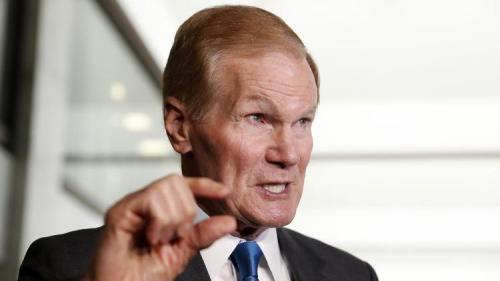
Election officials in South Florida on Thursday refuted a claim made by Senator Bill Nelson (D-FL) that Russian hackers had penetrated their voter registration system.
“We have had absolutely no information regarding that,” said Broward County Elections Supervisor Brenda Snipes. “We have not seen anything with our system that something strange is going on.”
State officials also say Nelson’s claim is unfounded.
On Wednesday, Nelson – the ranking member of the cyber subcommittee of the Senate Armed Services Committee said that Russian operatives had penetrated some of Florida’s election systems ahead of this year’s midterms.
“They have already penetrated certain counties in the state and they now have free rein to move about,” Nelson told the Tampa Bay Times, though he wouldn’t identify which counties were affected – saying it was classified.
“The threat is real and elections officials — at all levels — need to address the vulnerabilities.”
Election officials in Miami-Dade and Palm Beach counties likewise said they weren’t aware of any breaches.
That said, Florida election officials say they are doing everything they can to monitor for Kremlin hijinks.
Susan Bucher, supervisor of elections for Palm Beach County, said her office has been working diligently to ensure systems are safe on Election Day.
Employees have undergone training, and the county’s system has been repeatedly tested for vulnerabilities. “We are confident we have done as much as we can,” Bucher said.
Snipes said she too has conducted additional training and monitoring in response to the threat. –SunSentinel
Florida counties are receiving $15.5 million to beef up election security before November’s midterms, which Governor Rick Scott’s office says $14.5 million of which has been distributed to date – including $3.7 million which went to Miami-Dade, Broward and Palm Beach counties.
Nearly $2 million will be used to purchase a network monitoring security system that provides automated alerts about threats, the Florida State Department said. –SunSentinel
Scott, a Republican who is challenging Nelson’s Senate seat, has demanded that Nelson provide proof of his vague claim over election system penetration.
“Either Bill Nelson knows of crucial information the federal government is withholding from Florida elections officials or he is simply making things up,” Scott said in during a campaign event in Tampa. “Did Nelson illegally release some classified information? Or did he make this charge of Russian penetration up?”
Nelson and Republican Senator Marco Rubio, who sits on the Senate Intelligence Committee, wrote a July letter to Florida Secretary of State Ken Detzner, warning election officials that the Senate Select Committee on Intelligence had discovered that “Russia was preparing to undermine confidence in our voting process” and suggested they take advantage of federal resources. The letter claims that in a small number of cases “cyber actors affiliated with the Russian government accessed voter registration databases.”
Nelson suggested that Russians could start eliminating registered voters.
“You can imagine the chaos that would occur on Election Day when the voters get to the polls and they say: ‘I’m sorry, Mr. Smith. I’m sorry, Mr. Jones, you’re not registered.’ That’s exactly what the Russians want to do,” Nelson said.
The Florida Department of State said they have no idea what Nelson is talking about, and has received “zero information” from the Senator or his staff to support the Russian hacking claims.
“Additionally, the department has received no information from the U.S. Department of Homeland Security, the Federal Bureau of Investigation or the Florida Department of Law Enforcement that corroborates Sen. Nelson’s statement and we have no evidence to support these claims,” the Florida DoS said in a statement obtained by The Associated Press. “If Sen. Nelson has specific information about threats to our elections, he should share it with election officials in Florida.”
Okaloosa Supervisor of Elections Paul Lux, who is president of the state’s association of election supervisors, said 37 of the state’s 67 county election supervisors he received responses from indicated they had received no word of a specific threat or breach to their system.
One issue, he said, is election supervisors are not able to get security clearances that would allow them to receive briefings on classified information. –SunSentinel
“If the federal government has actionable intelligence and we don’t have access to that intelligence you can’t be surprised that we can’t take the actions necessary to respond to those threats,” said Lux.
The Department of Homeland Security also responded to Nelson’s claim – issuing a statement Wednesday evening saying “While we are aware of Senator Nelson’s recent statements, we have not seen any new compromises by Russian actors of election infrastructure. That said, we don’t need to wait for a specific threat to be ready.”
The Magnitsky Act – Behind the Scenes from Piraya Film AS on Vimeo
The Magnitsky Act – Behind the Scenes from Piraya Film AS on Vimeo
A 2 hour 32 min version of THE MAGNITSKY ACT – BEHIND THE SCENES had its world premiere at an invitation-only screening at Filmens Hus in Oslo, Norway, on June 25th, 2016. Since then, the film has been shown (and awarded) at several international film festivals. Personal copies have also been sent to hundreds of journalists, politicians and others who have expressed interest in the film, given the film’s high-profile political content.
However, more than two years after its world premiere, the film has not yet been released to the general public. It has not been broadcast on TV, nor been screened at cinemas, released on DVD or made available online. Many dissatisfied members of the audience have asked Piraya Film why they cannot see the film.
The answer is that an attack campaign was launched by the British financier Bill Browder (who appears in the film) against the film and the filmmakers while the film was still under production. This campaign was backed by, among others, individuals in the US State Department, CIA, various think tanks and human rights organizations, and included smear tactics in the press and in various other settings. The campaign succeeded in blocking planned screenings at the European Parliament and at a Norwegian film festival. The film was partly financed by several TV stations, and normal procedure for a documentary would be that these TV stations broadcast the film first. However, the involved TV stations were subject to both political and legal pressure, and have, until this date, not published the film.
One individual decided to leak his personal copy of the film to the internet in July 2018. We have worked hard to remove this from YouTube and various other sites, but we see that it is impossible to stop this illegal copy from spreading. With the film out like that, in an illegal manner and in breach of our copyright, we have decided to release THE MAGNITSKY ACT – BEHIND THE SCENES on Vimeo on Demand. We urge the public to support our work by seeing it here. With Browder as the main source of a disinformation campaign against the film and filmmakers, we have a need to counter the libel and defend ourselves through letting the public see the film.
Meet Wikipedia Founder Jimmy Wales: Ex Porn Peddler Paid by ‘Israel’ to Spread Zionist Propaganda
Empire Strikes Black | August 10, 2018
In the midst of the ongoing ‘Israeli’ government campaign against Jeremy Corbyn,(1) Wikipedia founder Jimmy Wales has entered the fray launching an inexplicable attack on the Labour leader. His tweet posted on the 9th of August 2018 lambastes Jeremy Corbyn for apparently failing to condemn Hamas rockets.
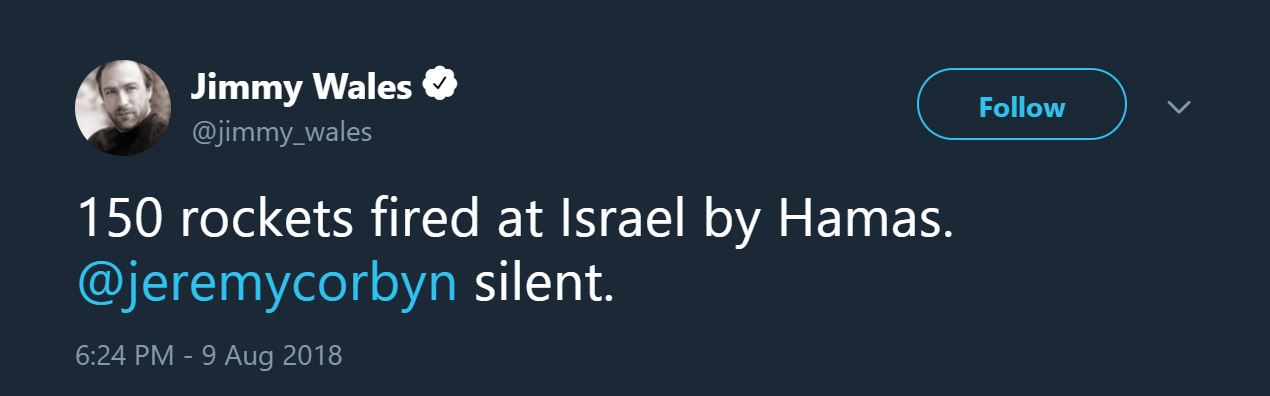
Wales tweets: 150 rockets fired at Israel by Hamas. @jeremycorbyn silent
To those well-versed on the history of Palestine this statement rightfully seems absurd and somewhat topsy-turvy. How can an occupied, brutalised and imprisoned people be castigated for merely defending themselves? While ‘Israel’ occupies land that does not belong to it – including Gaza which has no semblance of freedom with its borders and airspace locked down by the occupying regime which routinely commits bloody massacres with huge civilian death tolls – it absolutely must distort the facts in order to shape public opinion in its favour. ‘Israel’ committed and commits every day the causal acts of violence of ethnically cleansing Palestine and keeping the natives imprisoned, occupied and disenfranchised. The ‘Israel is acting in self-defence’ trope is then in fact the only form of rhetorical recourse that the Zionists can resort to in order to justify the historical and ongoing crimes against humanity committed every day in Palestine.
Jimmy Wales: Porn-Peddler-cum-Paid-Hasbara-Agent
In a revelation that will no-doubt raise eyebrows amongst Wikipedia users, in 1996 Jimmy Wales co-founded an online Internet portal called Bomis which sold porn and explicit material to users. The following, actually taken from the Wikipedia article for Bomis(2) adds context:
Bomis became successful after focusing on X-rated media. “Bomis Babes” was devoted to erotic images; the “Bomis Babe Report” featured adult pictures. Bomis Premium, available for an additional fee, provided explicit material. “The Babe Engine” helped users find erotic content through a web search engine. The advertising director for Bomis noted that 99 percent of queries on the site were for nude women.
Even the New York Times reports that the creation of Wikipedia was financed by Wales’ earlier porn venture,(3) whereby he would literally hand deliver cheques from Bomis porn revenues in order to keep Wikipedia’s servers running. On a perhaps related but definitely unsurprising note, the same New York Times article also reveals that via his wife, Jimmy Wales is very closely connected to Tony Blair(3) who even attended their wedding.
Though peddling porn may not be illegal, at the very least it sheds light on the true character of this man. What heroic agent of free information exchange makes money from selling pornography?
Wales has close links to ‘Israel’ and was awarded $1 million ‘Israeli’ prize for his services
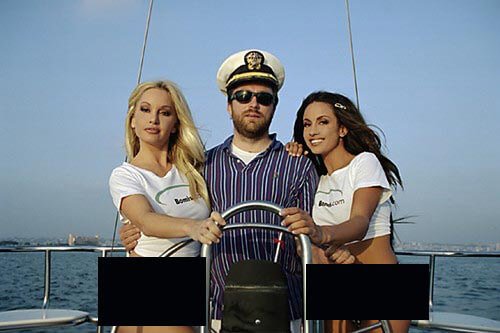
Wikipedia founder Jimmy Wales poses in a sleazy Bomis advertisement
In 2015 Jimmy Wales told The Times of Israel (4) that he had visited ‘more than ten times’, suggesting links to the Zionist enclave. He even told the Jewish Telegraphic Agency,(4) “I’m a strong supporter of Israel, so I don’t listen to those critics.” Laughably Wales cites ‘women’s rights’ as one of his reasons(4) for his support of the illegitimate Zionist entity. This is a statement that rings as hollow as a drum considering this man made his money in an industry that degrades women and enslaves vulnerable girls.
Wales’ numerous visits to ‘Israel’ during this time period must be understood in the wider context of Zionist information warfare. In 2010 the UK Guardian reported that Zionist groups were establishing Wikipedia editing courses(5) in order to sway Wikipedia entries in the Zionist regime’s favour. Additionally in 2012 The National Union of Israeli Students (NUIS) launched a program(6) to pay Israeli university students $2,000 to spread pro-‘Israel’ propaganda online for 5 hours per week.
Moreover, in the same year (2015) Mr. Wales was awarded $1 million by the ‘Israeli’ Dan David Foundation(7) after being selected by the prize committee for spearheading what they referred to as ‘the information revolution’.
The Electronic Intifada reports that the ‘Israeli’ government itself has been implicated in running the information war against Jeremy Corbyn. As part of this campaign, the ‘Israeli’ government has used its Act.IL software application to issue a mission for social media users to post negative comments against Jeremy Corbyn(1) suggesting he is an ‘anti-Semite’.
Let’s bring things full circle. Not only is Jimmy Wales a man of highly questionable moral character. Wales has close links to the Zionist regime, having visited it numerous times during the very same time period that Zionist groups were running Wikipedia editing courses and the ‘Israeli’ government was literally paying people to spread Zionist propaganda online. Wales’ efforts have culminated in him being awarded $1m by an ‘Israeli’ charitable organisation for his efforts in the ‘information revolution’. And now, interestingly, Mr. Wales is taking part in the very same information warfare campaign against Jeremy Corbyn that the ‘Israeli’ government has itself launched.
What is most alarming here is not merely Wales’ questionable character – having peddled porn and sleaze to make money – but the alarming indications that he could in fact be a de facto paid agent of the Zionist regime.
Notes
(1) ‘Israel running campaign against Jeremy Corbyn’ – The Electronic Intifada, 7 August 2018.
(2) ‘Bomis’ Wikipedia.com entry as of 10 August 2018.
(3) ‘Jimmy Wales Is Not An Internet Billionaire’ – The New York Times, 27 June 2013.
(4) ‘Wikipedia founder Jimmy Wales likes Israel but stays neutral’ – The Times of Israel, 19 May 2015.
(5) ‘Wikipedia editing courses launched by Zionist groups’ – The Guardian, 18 August 2010.
(6) ‘Israeli students to get $2,000 to spread state propaganda on Facebook’ – The Electronic Intifada, 4 January 2012.
(7) ‘Wiki founder wins $1m Israeli prize’ – The Times of Israel, 10 February 2015.
Bjorn Lomborg: ‘Stop these silly, undocumented claims of ever-increasing fire’ Claims ‘based on anecdotes, not data’ – Reality is Global & U.S. fires declining
By Bjørn Lomborg · August 6 2018
Could we please stop with the misleading fire stories?
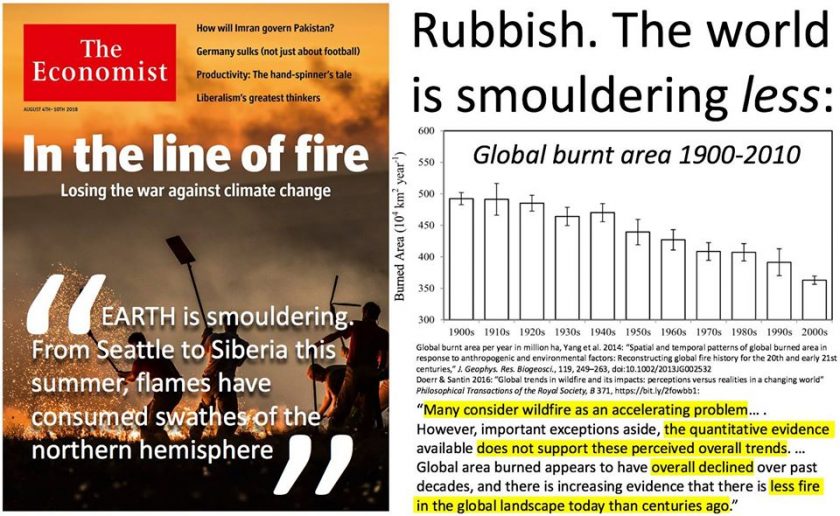
The Economist cover story, like so many other stories these last weeks, claim that forest fires are exceptional and record-breaking: “EARTH is smoldering. From Seattle to Siberia this summer, flames have consumed swathes of the northern hemisphere”
This is based on anecdotes, not data.
As I’ve shown in previous days, the US burnt area was much higher in the early part of last century, and the EU burnt area has declined by half over the past 36 years.
So: No, the US is not smoldering more – it is smoldering much less than it used to in the first part of the 20th century.
And no, the EU is not smoldering more – it is smoldering much less over the past 36 years.
Let’s finally look at the global perspective. While many of these fire scare stories are based on news from the US and the EU, the Economist claim was explicitly global.
Yet, the data does not support the argument that things are burning more and more.
The graph shows the estimated area burnt globally per year from 1900-2010. And it shows a steady decline.
It is from the article “Spatial and temporal patterns of global burned area in response to anthropogenic and environmental factors: Reconstructing global fire history for the 20th and early 21st centuries” One important point is to recognize that there is absolutely not enough data to do this only based on reported burning.
This is one of the reasons I started off with the US (where we have solid (if likely under-reported) data from 1926) and the EU. But clearly, the evidence for the global trend is unmistakable.
We see a similar pattern from the 2018 Nature article “Reduction in global area burned and wildfire emissions since 1930s enhances carbon uptake by land” which (as the title suggests, finds a strong decline in area burnt since 1930 (figure 2).
We also see declining area burnt from 1900-2000 from the article “Human impacts on 20th century fire dynamics and implications for global carbon and water trajectories”, figure 4b.
In a very recommendable (and freely available) overview article “Global trends in wildfire and its impacts: perceptions versus realities in a changing world” they clearly write that people (like the journalist at the Economist ) who believe there is more fire now, that is worse and have higher impact, are likely wrong:
“Many consider wildfire as an accelerating problem, with widely held perceptions both in the media and scientific papers of increasing fire occurrence, severity and resulting losses. However, important exceptions aside, the quantitative evidence available does not support these perceived overall trends. Instead, global area burned appears to have overall declined over past decades, and there is increasing evidence that there is less fire in the global landscape today than centuries ago.”
Beyond better fire prevention an important reason might be that more people and higher population densities perhaps surprisingly means *less* fire. The paper “Impact of human population density on fire frequency at the global scale” shows that “at the global scale, the impact of increasing population density is mainly to reduce fire frequency.”
So: Stop these silly, undocumented claims of ever-increasing fire, please.
Sources:
Graph from “Spatial and temporal patterns of global burned area in response to anthropogenic and environmental factors: Reconstructing global fire history for the 20th and early 21st centuries” https://agupubs.onlinelibrary.wiley.com/…/10.1…/2013JG002532.
“Reduction in global area burned and wildfire emissions since 1930s enhances carbon uptake by land” https://www.nature.com/articles/s41467-018-03838-0
“Human impacts on 20th century fire dynamics and implications for global carbon and water trajectories” https://www.sciencedirect.com/…/artic…/pii/S0921818117303910
“Global trends in wildfire and its impacts: perceptions versus realities in a changing world” http://rstb.royalsocietypublishing.org/cont…/…/1696/20150345 (not embargoed)
“Impact of human population density on fire frequency at the global scale.” https://www.biogeosciences.net/11/1085/2014/
US fire data: https://www.facebook.com/…/a.2217582089…/10157044699208968/… and additional data set here: https://www.facebook.com/bjornlomb…/posts/10157044718363968…
EU fire data: https://www.facebook.com/…/a.2217582089…/10157047962983968/…
Critical voices needed at development studies conference
By Yves Engler · August 8, 2018
Are they critical thinkers or cheerleaders pretending to be independent of the government that funds them? Given the title conference organizers chose — “Is Canada Back: delivering on good intentions?” — one would guess the latter. But, an independent researcher keeps an open mind.
Publicity for the mid-September conference organized by the Canadian Council for International Co-operation (CCIC) and the Canadian Association for the Study of International Development (CASID) notes: “Inspired by Justin Trudeau’s 2015 proclamation ‘Canada is Back’, we are presenting panels that illustrate or challenge Canada’s role in global leadership. Are we doing all that we could be doing in the world?”
Formulating the question this way seems like a sop to the government that provides their funding. Conference organizers must be aware of the Trudeau government’s arms sales to Saudi Arabia’s monarchy, backing for brutal mining companies, NATO deployments, antagonism towards Palestinian rights, efforts to topple the Venezuelan government, failure to end Canada’s ‘low level war’ on Iran, refusal to support nuclear weapons controls, promotion of military spending, etc.
The reality is that while the two conference sponsors are supported by some labour unions, left groups and internationalist-minded young people, they are heavily dependent/tied to Canada’s official foreign policy apparatus.
To understand government influence over the NGO/development studies swamp requires wading through acronym-filled historical waters. An umbrella group representing dozens of major development NGOs, the CCIC was created fifty years ago with financing from the Canadian International Development Agency (CIDA, now part of Global Affairs Canada). The aid agency expected it to coordinate relations with the growing NGO network and build domestic political support for the aid program. While it has challenged government policy on occasion, the CCIC is highly dependent on government funds. Shortly after it publicly complained the government created a “chill” in the NGO community by adopting “the politics of punishment … towards those whose public views run at cross purposes to the government,” the CCIC’s $1.7 million CIDA grant was cut in 2012. This forced it to lay off two thirds of its staff.
CASID and international development studies programs more generally have received significant support from CIDA and the International Development Research Centre (IDRC), a Crown Corporation. In 2015 CASID’s president thanked “IDRC for its support of CASID over the past decade and more.” As part of one contract, IDRC gave CASID $450,000 between 2012 and 2015.
In the mid-1990s IDRC sponsored an initiative to enhance university undergraduate international development programs. This led to the creation of the Canadian Consortium for University Programs in International Development Studies (CCUPIDS), which has as its primary objective to “strengthen the position of International Development Studies.” CIDA also funds CCUPIDS conferences.
CCUPIDS is a branch of CASID, which publishes the Canadian Journal of Development Studies. In the introduction to a journal special issue on Canadian universities and development, editors Leonora Angeles and Peter Boothroyd write:
Thanks mostly to grant funding from the Canadian International Development Agency (CIDA) and the International Development Research Council (IDRC), Canadian academics have been able to engage intensively in development work for over three decades.
CIDA and IDRC also directly fund international development studies initiatives. In the late 1960s CIDA sponsored a study with the Association of Universities and Colleges of Canada (AUCC) to investigate what schools offered development studies courses. According to IDRC: 40 years of ideas, innovation, and impact, “early on, it began funding Canadian area and development studies associations, their conferences, journals, and research — gathering and communication activities.” The Canadian Association of African Studies, Canadian Association of Latin American and Caribbean Studies, Canadian Asian Studies Association and Canadian Association of Studies in International Development all “received substantial core funding from IDRC, intermittently in the 1970s and 1980s, and continuously since 1990.”
Significant sums of aid money continue to flow to international development studies programs. The website of the McGill Institute for the Study of International Development lists a dozen contracts worth more than $600,000 from CIDA, as well as $400,000 in contracts from IDRC and Foreign Affairs. An NGO and CIDA training ground, these programs often include internships and volunteer opportunities funded by development aid. The Students for Development Internships is “offered through the AUCC and CIDA, and students are funded to work for up to four months with an NGO anywhere in the world.” Queen’s Global Development Studies exchange program, for instance, received $270,000 from CIDA in 2011.
Individuals who participated in aid agency-funded projects, notably the government-backed Canadian University Services Overseas (CUSO), spurred or launched international development studies programs. In Canada’s Global Villagers: CUSO in Development, 1961-86 Ruth Compton Brouwer writes:
CUSO staff and RV’s [returned volunteers] contributed substantially to the establishment of university-level courses and programs related to global issues and the centres for international education and development studies. These are now such ordinary features of Canadian universities that it is difficult to conceive of how novel they were when they began in the 1960s.”
Led by CUSO’s former West Africa coordinator Don Simpson, University of Western Ontario opened an office of international education in 1969, which “operated in collaboration with CIDA.” Similarly, “valued friends of CUSO” instigated development studies programming at the universities of Ottawa and Toronto.
Canadian aid also directly shapes international development studies research. Half of the respondents to a 2002 survey of 64 scholars reported that CIDA’s six development priorities influenced their research focus. A professor or student who aligns their pursuits with those of the aid agency or IDRC is more likely to find funding or a fellowship. And IDRC/Global Affairs Canada’s priorities don’t include challenging Canadian foreign policy.
Given the sponsors’ ties to the foreign policy apparatus it is likely that the September conference will offer little more than cheerleading for the Trudeau Liberals’ foreign policy. Still, one can’t be certain and, having been invited by a Facebook friend to attend, I emailed the conference organizers to ask if they would allow me to present a critical look at Trudeau’s foreign policy. Thus far they have not accepted my offer.
If you agree that answering the question “Are we doing all that we could be doing in the world?” requires some critical voices, please email (ac.cicc@stneve) and ask them to allow Yves Engler to speak on Justin Trudeau’s foreign policy at your upcoming conference.
I love a good debate and maybe both sides will learn something new.
Presidential Treason on Russia
By Jacob G. Hornberger | FFF | August 6, 2018
The U.S. national-security establishment and the U.S. mainstream press are now flinging the much-dreaded label “traitor” at President Trump. Commenting on one of Trump’s press conferences, former CIA Director John Brennan declared: “It was nothing short of treasonous.” The New York Times published an op-ed by its columnist Charles Blow entitled “Trump, Treasonous Traitor.” The Boston Globe weighed in with the following title of an op-ed by Globe columnist Michael A. Cohen: “Trump the Traitor.” Others are settling for “Manchurian candidate”, “shameful,” “indefensible,” “useful idiot,” “reckless,” and more. I haven’t yet heard the term “Fifth Columnist” hurled at Trump but I wouldn’t be surprised to see it happen.
What has Trump done to incur these infamous appellations? He has committed the cardinal sin of the U.S. national-security state: He has demonstrated a firm determination to establish normal and friendly relations with Russia. That’s not only a crime under the principles of the national-security establishment. It’s also heresy.
After all, “everyone” knows that Russia is an enemy of the United States. How do we “know” this? Well, because we are supposed to know it. No, there isn’t an official written decree. Nonetheless, everyone is supposed to know that Russia is “our” enemy, just as the citizens of Oceana were supposed to know when Eurasia was deemed an official enemy of Oceana in George Orwell’s novel 1984. Thus, it stands to reason: Any president who befriends Russia or any other official enemy of the U.S. national-security establishment is considered a traitor at worst and suspect at best.
As I indicated in three recent articles “The Deep State Went After JFK on Russia Too,” “Was Reagan a Traitor Too?” and “Three Other Presidents Targeted for Befriending Russia,” Trump isn’t the first president to incur the wrath of the U.S. national-security establishment for befriending Russia. They also targeted two U.S. presidents, John F. Kennedy and Ronald Reagan, and at least three foreign presidents, Jacobo Arbenz, Fidel Castro, and Salvador Allende, for committing the “crime” of befriending Russia (or the Soviet Union).
Let me share with you a fascinating story about John F. Kennedy’s “treason” that came up after his assassination.
For those of you who have read my book The Kennedy Autopsy and are currently viewing my new video-podcast series “The National Security State’s Assassination of John F. Kennedy,” you are familiar with what happened at Dallas’s Parkland Hospital immediately after the president was declared dead. Dr. Earl Rose, the Dallas County Medical Examiner, was going to conduct an autopsy on President Kennedy’s body. Rose was one of the most renowned forensics pathologists in the country.
Suddenly, a team of armed Secret Service agents informed Rose in no uncertain terms that they were not going to permit him to conduct the autopsy. When Rose stood his ground and reminded the agents that Texas law required the autopsy, they pulled back their coat pockets to brandish their guns, implicitly informing Rose and anyone else that they were prepared to kill anyone who got in their way. Saying that they were operating under orders and screaming, yelling, and issuing a stream of profanities, they forced their way out of Parkland with the body, which they then transported to Dallas Love Field where new President Lyndon Johnson was patiently waiting for it.
Within an hour or so of the president’s death, two of the treating physicians, Dr. Clark Kemp and Dr. Malcomb Perry, held a press conference, where they announced that President Kennedy had a small bullet-sized entry wound in the front of his neck and a large exit-sized wound in the lower back of his head. (This was obviously inconsistent with what would become the lone-nut theory of the assassination, which posited a shooter in the rear of the president.)
Meanwhile, Johnson was transporting the body in Air Force One to Andrews Air Force Base in Maryland, where he delivered it into the hands of the U.S. military, which conducted the autopsy at the morgue at Bethesda National Naval Medical Center on the evening of the assassination.
Thirty years after the assassination. Nurse Audrey Bell, who was in the Parkland Hospital trauma room where Kennedy was being treated, was interviewed by the Assassination Records Review Board. Bell told the ARRB that on the morning of November 23, she saw Dr. Perry and told him that he looked exhausted. Perry told her that he had received calls all night from Bethesda pressuring him to change his mind about the throat wound.
In 1977, the House Select Committee on Assassinations, which was reinvestigating the Kennedy assassination, conducted an interview of a man named James Gochenaur. The complete interview can be found here. Gochenaur related a conversation in 1970 that he had had with a Secret Service agent named Elmer Moore. Here is the pertinent part of the interview:
Gochenaur: Ok, what he told me was this, he said he had badgered Doctor Perry into changing his testimony, he did not feel good about that.
Gilbert: He, being Moore?
Gochenaur: Yes, Moore talked to Perry and, I guess, really laid it on the poor guy.
Gilbert: In what respect, what areas did he badger Perry with respect to.
Gochenaur: Ah, what Perry had seen, as he was doing his emergency operation, apparently.
Gilbert: Well, in what ways did he indicate to you that he had Perry distort the truth?
Gochenaur: In – I think that what he was trying to say was him to making a flat statement that there was no entry wound in the neck….
****
Gilbert: Well, did he, did he indicate to you in any way, or can you recollect as best you can, the exact words or substance that he used with respect to what he did to Perry?
Gochenaur: Apparently, well, he said that he had come back from San Francisco the day after the assassination. He went to Washington first. From Washington, he got some marching orders to go down and talk with the doctors at Parkland Hospital….
***
Gilbert: Ok. Now what did your conversation with him pertain to?
Gochenaur: Ah, basically, him venting his anger at Kennedy, and ah….
Gilbert: What was his anger based on? Did he say?
Gochenaur: Well, he said he was a traitor.
Gilbert: He said Kennedy was a traitor?
Gochenaur: Yeah.
Gilbert: This is what Elmer Moore said?
Gochenaur: Right.
Gilbert: Now, why he say [sic] — how did he explain that? What did he mean?
Gochenaur: Well, he prefaced it by saying that ah, well, he said, you know, no matter how strange things get here, we’ve got it better than they do. But he was giving everything away to the. That’s what he was saying.
Gilbert: He was saying Kennedy was giving things away?
Gochenaur: Yeah, to the Russians. Ok?
Gilbert: All right.
Gochenaur: And, ah, then he went on to say that ah, well, ah, one of the things that was pretty impressive to me was the fact that when I was talking with him, he said that ah, we had to do what we were told, in regards to, you know, the way the way they were investigating the assassination, or we get our heads cut off.
What every American should keep in mind is that from the day in the late 1940s that the federal government was converted from a limited-government republic to a national-security state, Russia has been considered an official enemy of the United States. Most U.S. presidents have accepted that and embraced it, just as Hillary Clinton would have. By doing his best to normalize relations with Russia, President Trump, like Presidents Kennedy, Reagan, Arbenz, Castro, and Allende, has now violated the core principle of the U.S. national-security state. Heaven help him if he doesn’t conform.
For more information, see:
The Kennedy Autopsy by Jacob Hornberger
JFK’s War with the National Security Establishment: Why Kennedy Was Assassinated by Douglas Horne
Regime Change: The Kennedy Assassination by Jacob Hornberger
The CIA, Terrorism, and the Cold War: The Evil of the National Security State by Jacob Hornberger
CIA & JFK: The Secret Assassination Files by Jefferson Morley
Altered History: Exposing Deceit and Deception in the JFK Assassination Medical Evidence by Douglas Horne (video)
Inside the Assassination Records Review Board by Douglas Horne
Neocons Demand ‘Crushing’ Sanctions on Russia
By Ron Paul | August 6, 2018
You can always count on the neocons in Congress to ignore reality, ignore evidence, and ignore common sense in their endless drive to get us involved in another war. Last week, for example, Senators John McCain (R-AZ), Lindsey Graham (R-NC), Bob Menendez (D-NJ), and others joined up to introduce what Senator Graham called “the sanctions bill from hell,” aimed at applying “crushing” sanctions on Russia.
Senator Graham bragged that the bill would include “everything but the kitchen sink” in its attempt to ratchet up tensions with Russia.
Sen Cory Gardner (R-CO) bragged that the new sanctions bill “includes my language requiring the State Department to determine whether Russia merits the designation of a State Sponsor of Terror.”
Does he even know what the word “terrorism” means?
Sen Ben Cardin (D-MD) warns that the bill must be passed to strengthen our resolve against “Vladimir Putin’s pattern of corroding democratic institutions and values around the world, a direct and growing threat to US national security.”
What has Russia done that warrants “kitchen sink” sanctions that will “crush” the country and possibly designate it as a sponsor of terrorism? Sen. Menendez tells us: “The Kremlin continues to attack our democracy, support a war criminal in Syria, and violate Ukraine’s sovereignty.”
There is a big problem with these accusations on Russia: they’re based on outright lies and unproven accusations that continue to get more bizarre with each re-telling. How strange that when US Senators like Menendez demand that we stand by our NATO allies even if it means war, they attack Russia for doing the same in Syria. Is the Syrian president a “war criminal,” as he claims? We do know that his army is finally, with Russian and Iranian help, about to defeat ISIS and al-Qaeda, which with US backing for seven years have turned Syria into a smoking ruin. Does Menendez and his allies prefer ISIS in charge of Syria?
And how hypocritical for Menendez to talk about Russia violating Ukraine’s sovereignty. The unrest in Ukraine was started by the 2014 US-backed coup against an elected leader. We have that all on tape!
How is Russia “attacking our democracy”? We’re still waiting for any real evidence that Russia was involved in our 2016 elections and intends to become involved in our 2018 elections. But that doesn’t stop the propagandists, who claim with no proof that Russia was behind the election of Donald Trump.
These Senators claim that sanctions will bring the Russians to heel, but they are wrong. Sanctions are good at two things only: destroying the lives of innocent civilians and leading to war.
As I mentioned in an episode of my Liberty Report last week, even our own history shows that sanctions do lead to war and should not be taken lightly. In the run-up to US involvement in the War of 1812, the US was doing business with both France and the UK, which were at war with each other. When the UK decided that the US was favoring France in its commerce, it imposed sanctions on the US. What did Washington do in response? Declared war. Hence the War of 1812, which most Americans remember as that time when the British burned down the White House.
Recent polls show that the majority of Americans approve of President Trump’s recent meeting with Russian President Vladimir Putin. Among Republicans, a vast majority support the meeting. Perhaps a good defeat in November will wake these neocon warmongers up. Let’s hope so!
Saudi-led coalition ‘victories’ achieved by striking deals with Al-Qaeda in Yemen – AP report
RT | August 6, 2018
An investigation has found that the US-backed, Saudi-led intervention in Yemen has cut secret deals with jihadists from al-Qaeda in the Arabian Peninsula (AQAP), paying them to leave cities rather than dislodging them by force.
The startling revelations come in stark contrast to the long-running US policy of trying to eliminate the jihadist organization with the help of allies from the Arabian peninsula, however, the more pressing aim of defeating Iranian-backed Houthi rebels in Yemen has seen AQAP effectively be on the same side as the Saudi-led coalition — and, by extension, the US, according to Associated Press (AP).
AP based their findings on reporting from the war-torn nation and interviews with two dozen officials, including Yemeni security officers, militia commanders, tribal mediators and four members of al-Qaeda’s branch. All but a few of those sources spoke on condition of anonymity, fearing reprisals. Emirati-backed factions, like most armed groups in Yemen, have been accused of abducting or killing their critics.
The US and their allies have maintained that the last two years has seen them dislodge AQAP from their strongholds in Yemen and limiting their capability to launch attacks on the West.
What the investigation reveals, however, is that this was often done without firing a shot, with key participants saying the US was aware of the arrangements and held off on any drone strikes.
Due to the lack of reliant and effective partners on the ground, coalition partners have also reportedly hired al-Qaeda militants, or at the very least recent members, to fight in militias due to their reputation as “exceptional fighters,” AP said. They added that AQAP members have intertwined with the “dizzying mix of militias, factions, tribal warlords and tribes with very local interests.”
While there is no evidence to suggest that the US itself has given money to AQAP militants, partners involved in the Saudi-led coalition have. The aide of one militia commander recently added to Washington’s terrorism watch list for al-Qaeda ties told AP that the UAE continues to fund his operation.
Another militia commander who has an al-Qaeda figure as his closest aide was recently given $12 million by Yemen’s President Abdrabbuh Mansour Hadi.
While the US does not fund the Saudi-led coalition, it along with the UK, have sold billions of dollars in weapons to Arab partners, as well as providing logistical and targeting support.
While there is awareness and “angst” by “elements of the US military” that its activities in Yemen is strengthening AQAP, “supporting the UAE and the Kingdom of Saudi Arabia against what the US views as Iranian expansionism takes priority,” Michael Horton, a fellow at the analysis group Jamestown Foundation, told AP.
In an email to AP about their investigation, a Pentagon spokesperson denied any US support for AQAP or that they have been soft on drone strikes, and backed up its Arab allies’ commitment to tackling extremism.
“Since the beginning of 2017, we have conducted more than 140 strikes to remove key AQAP leaders and disrupt its ability to use ungoverned spaces to recruit, train and plan operations against the US and our partners across the region,” spokesman Navy Cmdr. Sean Robertson wrote.
“Our regional partners have a proven track record of aggressively pursuing terrorist organizations and denying them safe haven in Yemen and DOD does not have any reason to doubt their resolve,” he added.
Saudi Arabia meanwhile says it has continued its commitment to combating extremism and terrorism. The UAE did not respond to AP’s request for comment.
Deep State changes narrative on Russia from “election meddling” to “election involvement”
Midterms are four months away, but the deep state is already blaming Russia.
By Alex Christoforou | The Duran | August 6, 2018
With US primary elections coming in November 2018, the neocon-deep state faction of the Trump administration is cleverly scapegoating Russia, while changing the narrative on what was previously called “election meddling” to now be identified as “election involvement”.
Not that any of this matters, because we have, to-date, seen no evidence of “meddling”, “collusion”, “interference”, or “involvement”.
Nevertheless, should Republicans have a poor showing in the midterms Russia will be blamed, and should Democrats have a poor showing in the midterms Russia will be blamed.
This bizarre and embarrassing White House press briefing had US security and intelligence chiefs pledging to protect American democracy. The deep state talking heads, united in this PR catastrophe, attempted to reassure the American public that they are actively working to protect the upcoming November midterm elections to Congress from foreign interference.
Russia was named as the main threat without any evidence provided.
Featured Video
Anthrax War – CBC The Passionate Eye
or go to
Aletho News Archives – Video-Images
Book Review
Shattered Dreams: The HPV Vaccine Exposed (2019)
By Christina England – 30 Q&As – Book Review & Summary
Lies are Unbekoming | September 4, 2026
… Gardasil received FDA fast-track approval in 2006, Cervarix followed in 2009, and Gardasil 9 was approved in December 2014 with more than double the aluminium adjuvant content of the original. The commercial context is specific. Merck was about to lose patent protection on Zocor and faced $18 billion in Vioxx injury claims from a cardiovascular drug the company had marketed while suppressing its own data showing a five-times increase in heart attacks. Analysts projected the global HPV vaccine market at $4 billion by 2011, contingent on government-funded national programs for teenage girls. The 1986 National Childhood Vaccine Injury Act had already granted manufacturers complete liability immunity. By 2013, Japan had withdrawn its HPV vaccine recommendation after cataloguing severe adverse reactions in hundreds of girls. No Western government followed. The establishment position across the UK, US, Australia, and most of Europe held, and still holds, that the vaccines are safe and effective, that reported injuries are coincidental, and that cervical cancer prevention justifies the program. The book was published into this position, not against a vacuum.
Shattered Dreams sits alongside Mary Holland’s The HPV Vaccine On Trial and Viera Scheibner’s foundational vaccination work as part of the documented record on what has been done to a generation of teenage girls under the banner of cancer prevention. The full summary unpacks three specific findings: that Merck used the aluminium adjuvant itself as the “placebo” control in 92.5% of trial subjects, making it structurally impossible to detect excess reactions from the adjuvant; that Dr. Sin Hang Lee found HPV DNA fragments bound to aluminium in every one of sixteen Gardasil samples tested, and in the blood and spleen of a New Zealand girl six months after her third dose; and that in every country with high vaccination coverage, including Australia, the UK, Norway, and Sweden, cervical cancer rates have stopped declining and started rising specifically in the vaccinated cohort. Martínez-Lavín’s 2017 calculation puts the number needed to seriously harm with Gardasil 9 at 140, and the number needed to vaccinate to prevent one case at 1,757. Thirteen young women are seriously harmed for every one who benefits. The vaccine was approved on the basis of trials that could not detect what the trials were supposed to detect, and it is still being given to twelve-year-olds today. … Read full review
Blog Roll
 Aletho News
- The Five-Year Fuel Crisis: Why the World Economy Is Paying for a War It Thinks Is Ending
- Trump’s Big Bluff on Iran
- Swiss scammed out of millions by Ukraine-linked call centers – media
- Germany facing potential ‘violent conflict’ with Russia – spy chief
- Ukraine’s EU neighbors reject new plea from Kiev – Politico
- British Transport Police Facial Recognition Trial Scanned 926,912 People With Zero Arrests
- House Bill Would Ban Federal Use of Flock ALPR Data
- Can a Spice Rival a Drug? 10 Head-to-Head Trials Put It to the Test.
- The oil routes around Hormuz face their own chokepoints
- The Saudi-Israeli war on Yemen’s resistance: Intelligence sharing, civilian targets & sectarian propaganda
- If Americans Knew
- NAZA: Israeli embassies in UK and US promote rival documentary to challenge Gaza genocide allegations
- David Ellison appoints Israeli to lead merged Paramount-Warner studios
- Turkish Red Crescent helps elderly Gaza man walk again after Israel confiscates his prosthetic limb
- Four Palestinians Killed in Israeli Attacks in Gaza
- Two Palestinian youths killed and village razed as Israeli attacks on West Bank continue
- Two more Christian women innocent victims of Gaza raids
- Cruelty, Deprivation, Indignity: A Journalist’s 22 Months in Israeli Prison
- New IDF Website Frames Slain Gaza Journalists as Terrorists
- Israeli media: After settlers beat him mercilessly, they stuffed dirt into his mouth
- Americans Are Paying the Price to Preserve Israel’s Nuclear Hegemony
- No Tricks Zone
- Latest European Green Energy Debacle; Portugal’s Largest Flagship Solar Park Insolvent!
- Green Energy Debacle: German Expert Professor Fritz Vahrenholt Warns Of Severe Economic And Social Consequences
- Two More Paleo Reconstructions Affirm Meters-Higher Sea Levels Across Ireland, Brazil 7000-6000 Years Ago
- New Study: Earth And Venus Surface Warmth Largely Explained By Convection And Lapse Rate, Not CO2 Or Radiation
- 2025 Nature Paper Claiming Worsening Global Drought Gets RETRACTED …Heavily Flawed
- New Study: ‘Global Drought Shows No Detectable Recent Acceleration Under Climate Warming’
- Economic Masterminds: German Socialists Suggest Taxing Productivity Gains Stemming From Using AI
- The South China Sea Has Not Been Cooperating With The Climate Change Narrative
- Energy Crisis: Germany Enters Heating Season With Historically Low Gas Reserve Fill Levels
- New Study: The Antarctic Ice Sheet Gained Mass From 2020-2024 Due To Staggering Snow And Ice Accumulation

