The Real “Fake News” From Government Media
By Scott Lazarowitz | ActivistPost | July 31, 2018
Facebook has announced its campaign against “fake news.” But, according to some workers’ own admission, conservatives are being censored.
And Google also wants to censor “fake news.” But Google also was shown to treat conservative websites, but not liberal ones, as “fake news.”
The same thing seems to be going on with Twitter. And again, conservatives are complaining.
But who is to decide what is “fake news”? Who will be Facebook and Google’s sources for real news?
In 2013 the U.S. Senate considered a new a shield law to protect journalists. In the lawmakers’ attempts to narrow the definition of a journalist, some Senators including Sen. Dianne Feinstein only wanted to include reporters with “professional qualifications.”
“Professional” publications such as the New York Times, the “Paper of Record,” would apparently be protected.
So one can conclude that the New York Times can be a source of “real” news for Facebook or Google, despite all the Times‘ errors, screw-ups, and corrections, right?
According to one NYT former reporter, the Times has been a “propaganda megaphone” for war. Also a partner with the CIA to promote Obama’s reelection bid.
Or CNN, “The Most Trusted Name in News” which wins its own “fake news” awards with its errors, screw-ups and corrections.
During the 2016 U.S. Presidential campaign, there were collusions between then-CNN contributor and DNC operative Donna Brazile, who was outed by WikiLeaks in her giving candidate Hillary Clinton questions in advance for a CNN Town Hall.
Other emails that were leaked to WikiLeaks informed us that reporters obediently followed instructions from the Hillary Clinton campaign on how to cover the campaign. These include reporters from the New York Times such as Maggie Haberman who said the campaign would “tee up stories for us,” and Mark Leibovich, who would email Clinton flunky Jennifer Palmieri for editing recommendations.
And Politico reporter Glenn Thrush asked Clinton campaign chairman John Podesta for approval of stories on Clinton. Thrush was then hired by the New York Times. After Thrush was then suspended from NYT over allegations of sexual misconduct, the Times ended the suspension, stating that while Thrush had “acted offensively,” he would be trained to behave himself. Hmm.
But all this from the 2016 campaign reminded me of the “JournoLists,” the group of news journalists who participated in a private forum online from 2007-2010. The forum was to enable news reporters to discuss news reporting and political issues in private and with candor, but also, it was revealed, to discuss ways to suppress negative news on then-2008 presidential candidate Barack Obama.
For instance, according to the Daily Caller, some members of the group discussed their criticism of a 2008 debate in which Obama was questioned on his association with the controversial Rev. Jeremiah Wright. The Nation‘s Richard Kim wrote that George Stephanopoulos was “being a disgusting little rat snake.” The Guardian‘s Michael Tomasky wrote that “we all have to do what we can to kill ABC and this idiocy.”
Spencer Ackerman, then with the Washington Independent and now of the Daily Beast, wrote, “If the right forces us all to either defend Wright or tear him down, no matter what we choose, we lose the game they’ve put upon us. Instead, take one of them — Fred Barnes, Karl Rove, who cares — and call them racists.”
The Nation‘s Chris Hayes wrote, “Our country disappears people. It tortures people. It has the blood of as many as one million Iraqi civilians — men, women, children, the infirmed — on its hands. You’ll forgive me if I just can’t quite dredge up the requisite amount of outrage over Barack Obama’s pastor.”
(But has Hayes criticized Obama’s assassination program, or Obama’s bombings or the blood on Obama’s hands? Just askin’)
In an open letter, according to the Daily Caller, several of the JournoList members called the ABC debate a “revolting descent into tabloid journalism,” because of the moderators’ legitimate questions on Rev. Jeremiah Wright.
So, in today’s Bizarro World, objectively questioning a candidate on a controversial issue is now “tabloid journalism,” but making things up like “Trump-Russia collusions” and repeating the propaganda over and over – that’s not “tabloid journalism.”
The JournoLists also included reporters from Time, the Baltimore Sun, the New Republic, Politico, and Huffington Post.
Now, are those the sources of “real news” that Facebook, Google and Twitter want to rely upon to combat “fake news”?
And who exactly were the “JournoLists” promoting? Obama?
Regarding Obama’s own crackdown on actual journalism, Fox News reporter James Rosen was accused by the feds of being a “co-conspirator” with State Department leaker Stephen Jin-Woo Kim in violating the Espionage Act. Rosen’s correspondences with Kim were seized by Obama’s FBI, along with Rosen’s personal email and phone records. The FBI also used records to track Rosen’s visits to the State Department.
Apparently, then-attorney general Eric Holder went “judge-shopping” to find a judge who would approve subpoenaing Rosen’s private records, after two judges rejected the request.
Commenting on James Rosen and the FBI’s abuse of powers, Judge Andrew Napolitano observed that “this is the first time that the federal government has moved to this level of taking ordinary, reasonable, traditional, lawful reporter skills and claiming they constitute criminal behavior.”
And there was the Obama administration’s going after then-CBS News investigative reporter Sharyl Attkisson, possibly for her reporting on Benghazi and Fast and Furious. Attkisson finally resigned from CBS news out of frustration with the company’s alleged pro-Obama bias and with CBS’s apparently not airing her subsequent reports.
In 2013 CBS News confirmed that Attkisson’s computers had been “accessed by an unauthorized, external, unknown party on multiple occasions.” In 2015 Attkisson sued the Obama administration, claiming to have evidence which proves the computer intrusions were connected to the Obama DOJ.
In Attkisson’s latest lawsuit update, after her computer was returned to her following the DOJ Inspector General’s investigation, her forensics team now believes her computer’s hard drive was replaced by a different one.
Now back to “fake news.”
After Donald Trump locked up the Republican Presidential nomination in May, 2016, there were significant events in the next two months. Fusion GPS and former British spy Christopher Steele colluded to get opposition research on behalf of Hillary Clinton, the FBI applied for a FISA warrant to spy on Trump campaign associates, and Donald Trump, Jr., Paul Manafort and Jared Kushner had a possibly set-up meeting with a Russian lawyer at Trump Tower.
Also within that same period, the DNC claimed that its computers were hacked but the DNC wouldn’t let FBI investigate. The Washington Post published an article claiming, with no evidence presented, that “Russian government hackers” took DNC opposition research on Trump.
It was very shortly after the November, 2016 Presidential election that the Washington Post published an article on a “Russian propaganda effort to spread ‘fake news’ during the election.” To escalate the media’s censorship campaign perhaps?
The campaign against “fake news” coincided with Obama minions at FBI, DOJ and CIA apparently panicking over a possible Trump presidency and their allegedly abusing their powers to attempt to take down Trump.
So the news media seem to be on a crusade to fabricate “Trump-Russia collusions” and repeat it over and over, and to vilify, ignore and squash actual investigative research and reporting on what exactly the FBI and DOJ bureaucrats have been doing. Call such real investigative reporting “fake news,” “conspiracy theory,” and so forth.
In the end, Facebook, Twitter and Google might want to reconsider relying on the mainstream news media led by the New York Times, the Washington Post and CNN, and instead include citizen journalists and non-government-sycophant media to provide news and information.
UCLA law professor Eugene Volokh has noted that the Founders generally viewed the freedom of the Press to apply to every citizen to print, publish or express accounts of events. We really need to highlight that kind of old-fashioned, honest journalism.
Revolving Door: How Security Clearances Perpetuate Top-Level Corruption in the United States
By Philip M. GIRALDI | Strategic Culture Foundation | 02.08.2018
President Donald Trump is threatening to take away the security clearances of a number of former senior intelligence and security officers who have been extremely critical of him. Most Americans were unaware that any ex-officials continued to hold clearances after they retired and the controversy has inevitably raised the question why that should be so. Unfortunately, there is no simple answer.
A security clearance is granted to a person but it is also linked to “need to know” in terms of what kind of information should or could be accessed, which means that when you are no longer working as Director of the Central Intelligence Agency you don’t necessarily need to know anything about China’s spying on the United States. Or do you? If you transition into a directorship or staff position of a major intelligence or security contractor, which many retirees do, you might need to retain the qualification for your job, which makes the clearance an essential component in the notorious revolving door whereby government officials transit to the private sector and then directly lobby their former colleagues to keep the flow of cash coming.
At top levels among the beltway bandit companies, where little work is actually done, some make the case that you have to remain “well informed” to function properly. The fact is that many top-level bureaucrats do retain their clearances for those nebulous reasons and also sometimes as a courtesy. Some have even received regular briefings from the CIA and the office of the Director of National intelligence even though they hold no government positions. A few very senior ex-officials have also been recalled by congress or the White House to provide testimony on particular areas of expertise or on past operations, which can legitimately require a clearance, though in such cases one can be granted on a temporary basis to cover a specific issue.
The problem arises when former officials use their clearances as bona fides to enhance their marketability for non-clearance jobs in the media or corporate world, particularly when those individuals are criticizing current government policies and behaving in a partisan fashion regarding specific candidates for office. Donald Trump was especially assailed by former officials John Brennan, James Clapper, Michael Hayden and Michael Morell before the 2016 election, all of whom continue to attack him currently, most particularly for the recent meeting with Russian President Vladimir Putin. During the 2016 campaign, Morell, who openly supported Hillary Clinton and is the designated intelligence on-air contributor for CBS news, deliberately linked the fact that he was ex-CIA Acting Director to his assertion that Trump was somehow an “unwitting agent of the Russian Federation” to establish his credibility. That type of activity should be considered abusive and an exploitation of one’s former office.
Morell left CIA in June 2013 and by November was a senior counselor with Beacon Global Strategies. According to the firm’s website, Beacon Global Strategies is a government and private sector consulting group that specializes in matters of international policy, foreign affairs, national defense, cyber, intelligence, and homeland security. Morell may know little about those issues as they have evolved in the past five years, but citing his clearance gives him credibility for knowledge that he might not really possess and also gives him direct access to former colleagues that he can lobby to obtain government contracts.
Former CIA Director John Brennan, who famously voted for the Communist Party candidate for US president in 1976, has also profited greatly from his government service, becoming rich from his board memberships. He sits on the board of directors of SecureAuth + CORE Security and also on the board of The Analysis Corporation. More important in terms of his public profile, he is the “Intelligence Consultant” for NBC News and MSNBC and appears regularly.
Last week Senator Rand Paul met with President Trump and recommended that Brennan’s security clearance be revoked. He argued that Brennan, Trump’s most aggressive critic, has been using his credentials to provide credibility when he calls meeting with Russia’s president “treasonous” and describes the president as “wholly in the pocket of Putin.” Clearance holders also more generally use their privileged access to “secret information” to leverage speaking and television network pundit fees. In other words, Brennan and the others are using their security clearances to enhance their incomes, monetizing their access to classified information to enhance their value.
It is by no means clear whether Trump will revoke the clearances of Clapper, Brennan, Morell and Hayden. As he is the legal source of all government clearances he has the power to do so. An equitable solution on the clearance issue more generally speaking would be to cancel all security clearances on the day when one leaves government service unless there is a direct and immediate transition to a private sector position that absolutely requires such a qualification. That would be fair to lower level employees seeking a second source of income and it would also eliminate many of those who are merely cashing in on their presumed access. As it is a rational solution it is very unlikely that it will be entertained by either the White House or by Congress.
Politics in bad faith: Alexandria Ocasio-Cortez campaigns in Michigan
By Andre Damon | WSWS | July 31, 2018
Alexandria Ocasio-Cortez, a member of the Democratic Socialists of America, visited Southeast Michigan this past weekend. Her primary victory last month over New York Congressman Joe Crowley has made her, virtually overnight, a leading spokesperson for the Democratic Party.
Ocasio-Cortez appeared at rallies in Detroit, Flint and Ypsilanti, as part of a statewide tour in support of Abdul El-Sayed, a former Detroit health department official running for governor of Michigan.

Ocasio-Cortez speaks at Wayne State University in Detroit
Ocasio-Cortez has been lionized in the press as the leader of a radical wave sweeping over the Democratic Party. Given the location of her events—including Detroit, the poorest large city in America, and Flint, which has been devastated by a lead water crisis—anyone taking her and the DSA’s pretenses to “socialism” seriously might have expected to hear bold proposals for tackling America’s rampant social inequality.
But when it came time for her to speak, what followed was a torrent of evasive and dishonest platitudes. She began her remarks at Wayne State University in Detroit:
My fingers are tingling right now because I know that this room is not just a rally, not just an audience, or even just a community; this is movement. Movement cannot be stopped, movement is like a wave; that energy cannot be contained, and Abdul, like many others, is just the crest, is just the foam at the tip of that wave. This is a movement so much bigger than just one person, there is no one person that is the future, there is a people that is the future.
To see such statements in print is to confirm the impression they produce on the listener: So much hot air.
America needs a “salt of the earth government,” Ocasio-Cortez went on, because, “We know that what is right in one place is what is right in all places.” And so on and so forth.
Like Barack Obama, whom she acknowledges as an inspiration, Ocasio-Cortez revels in seemingly profound motivational statements that are, upon the slightest examination, shown to be devoid of content. Her speeches are a variant of Obama’s slogan: “Yes we can.” She makes no effort to explain why Obama’s “Yes we can” was turned into eight years of “No we can’t.”
She continued, “The future of this nation and the future of this party is working class, the future of this party is working people, the future of this party is the marginalized, it is women, it is gender-extended people, it is people of color, it is the affirmation of justice, that is the future of this party.”
This invocation of the working class, mixed with appeals to other “identities,” is in bad faith, because the entire purpose of her campaign, and of the existence of the DSA, is to promote the Democratic Party, which, along with the Republicans, is a party of the corporate and financial oligarchy.
The Democrats are currently in the midst of a ferociously right-wing campaign centered on denunciations of Trump for “betraying” the country to Russia. In the midterm elections, the Democrats are fielding an unprecedented number of former members of the CIA and the military, which reflects their position as the preferred party of dominant sections of the military-intelligence apparatus.
Ocasio-Cortez’s inability to say anything genuinely oppositional, let alone radical, is bound up with her political role. She has quickly been absorbed into the Democratic Party establishment, and her rhetoric conforms to its politics. In promoting a right-wing party, her “left-wing” gloss is reduced to empty slogans.
Only a few sentences of her speech touched on actual policy. “The future of this party is improved and expanded Medicare for all,” she declared. For Abdul El-Sayed, “Medicare for all” means a statewide health care system paid for by workers from their own paychecks, one which his website boasts will exempt a substantial number of businesses from health care contributions.

Abdul El-Sayed
Such campaign promises are meaningless anyway. Obama declared himself a “proponent of a single payer universal health care program” in 2003, before going on to implement the “Affordable Care Act,” a reactionary attack on health care that shifts the burden from corporations and the state to workers by requiring individuals to purchase private insurance. This was cynically packaged as a major social “reform.”
Of particular note in the rallies to which Ocasio-Cortez spoke was the absence of any reference to foreign policy or the slightest hint of opposition to war. In fact, it was as if the rest of the world did not exist.
When a WSWS reporter asked the candidates at the post-rally press briefing in Detroit, “Do both of you support withdrawing all US troops from the Middle East and Africa?” El-Sayed gave an evasive non-answer: “We’ve got to make sure that we are focused on a foreign policy that articulates what we all can do when we come together around a more peaceful world.”
A staffer immediately attempted to conclude the briefing. When the reporter restated the question, “Ms. Ocasio-Cortez, are you anti-war? Do you support withdrawing all US troops from the Middle East?”
She replied, “I’m sorry, I’m here to support Abdul.”
The press conference immediately concluded, and the candidates were whisked away. (The next day, another WSWS reporter asked Ocasio-Cortez the same question at a rally in Ypsilanti, Michigan. She gave the same rehearsed answer.)
After the conclusion of the press conference, a WSWS reporter asked a high-level Ocasio-Cortez staffer, “What does she think the tax rate on the top income bracket should be?” He said he could not answer that question, because “She’s just focused on getting candidates with a similar program elected right now.”
In other words, Ocasio-Cortez can’t even commit to an explicit policy of raising taxes on the wealthiest section of society. In the spectrum of traditional American politics, this places her “democratic socialism” somewhere on the left wing of the 1960s-era Republican Party. Her inability to make any statement in opposition to war likewise put her to the right of both major Democratic nominees in the 1968 presidential primaries, who ran on an anti-war program.
The events make clear the political function of the Democratic Socialists of America. Far from creating a politically independent socialist movement, the DSA functions as an adjunct of the Democratic Party, providing candidates whose programs are largely indistinguishable from the rest of the party and are compatible with the agenda of the “CIA Democrats.”
The political role of Ocasio-Cortez and a slew of similar, DSA-backed candidates is to put a “left-wing,” “progressive,” youth-oriented, and multicultural gloss on a right-wing, pro-war party.
VIPS to Trump: Intel on Iran Could be CATASTROPHIC
As drums beat again for war — this time on Iran—-the VIPS’ warning is again being disregarded as it was before the Iraq debacle and this time VIPS fear the consequences will be all-caps CATASTROPHIC.
August 1, 2018
MEMORANDUM FOR: The President
FROM: Veteran Intelligence Professionals for Sanity (VIPS)
SUBJECT: Intelligence on Iran Fails the Smell Test
Mr. President:
As the George W. Bush administration revved up to attack Iraq 15 years ago, we could see no compelling reason for war. We decided, though, to give President Bush the benefit of the doubt on the chance he had been sandbagged by Vice President Dick Cheney and others. We chose to allow for the possibility that he actually believed the “intelligence” that Colin Powell presented to the UN as providing “irrefutable and undeniable” proof of WMD in Iraq and a “sinister nexus” between Saddam Hussein and al Qaeda.
To us in VIPS it was clear, however, that the “intelligence” Powell adduced was bogus. Thus, that same afternoon (Feb. 5, 2003) we prepared and sent to President Bush a Memorandum like this one, urging him to seek counsel beyond the “circle of those advisers clearly bent on a war for which we see no compelling reason and from which we believe the unintended consequences are likely to be catastrophic.”
We take no satisfaction at having been correct — though disregarded — in predicting the political and humanitarian disaster in Iraq. Most Americans have been told the intelligence was “mistaken.” It was not; it was out-and-out fraud, in which, sadly, some of our former colleagues took part.
Five years after Powell’s speech, the Chair of the Senate Intelligence Committee minced few words in announcing the main bipartisan finding of a five-year investigation. He said: “In making the case for war, the Administration repeatedly presented intelligence as fact when in reality it was unsubstantiated, contradicted, or even non-existent. As a result, the American people were led to believe that the threat from Iraq was much greater than actually existed.”
Iran Now in Gunsight
As drums beat again for a military attack — this time on Iran, we Veteran Intelligence Professionals for Sanity and other experienced, objective analysts are, by all appearances, being disregarded again. And, this time, we fear the consequences will be all-caps CATASTROPHIC — in comparison with the catastrophe of Iraq.
In memoranda to you over the past year and a half we have pointed out that (1) Iran’s current support for international terrorism is far short of what it was decades ago; and (2) that you are being played by Prime Minister Benjamin Netanyahu’s claims about Iran’ they are based on intelligence exposed as fraudulent several years ago. Tellingly, Netanyahu waited for your new national security adviser to be in place for three weeks before performing his April 30 slide show alleging that Iran has a covert nuclear weapons program. On the chance that our analysis of Netanyahu’s show-and-tell failed to reach you, please know that the Israeli prime minister was recycling information from proven forgeries, which we reported in a Memorandum to you early last spring.
If our Memorandum of May 7 fell through some cracks in the West Wing, here are its main findings:
The evidence displayed by Israeli Prime Minister Benjamin Netanyahu on April 30 in what he called his “Iranian atomic archive” showed blatant signs of fabrication. That evidence is linked to documents presented by the Bush Administration more than a decade earlier as “proof” of a covert Iran nuclear weapons program. Those documents were clearly fabricated, as well.
In our May 7, 2018 Memorandum we also asserted: “We can prove that the actual documents originally came not from Iran but from Israel. Moreover, the documents were never authenticated by the CIA or the International Atomic Energy Agency (IAEA).”
Iran: Almost Targeted in 2008
There was a close brush with war with Iran a decade ago. Bush and Cheney, in close consultation with Israel, were planning to attack Iran in 2008, their last year in office. Fortunately, an honest National Intelligence Estimate of November 2007 concluded that Iran had stopped working on a nuclear weapon in 2003, and that key judgment was made public. Abruptly, that NIE stuck an iron rod into the wheels of the juggernaut then speeding downhill to war.
The key judgment that Iran had stopped work on a nuclear weapon was the result of the painstakingly deliberative process that was customarily used, back in the day, to produce an NIE. After that process — which took a full year — the Nov. 2007 NIE was approved unanimously by all U.S. intelligence agencies.
(In other words, it was decidedly NOT a rump “assessment” like the one cobbled together in a couple of weeks by “handpicked” analysts from three selected, agenda-laden agencies regarding Russian meddling. We refer, of course, to the evidence-impoverished and deceptively labeled “Intelligence Community Assessment” that the directors of the FBI, CIA, and NSA gave you on January 6, 2017. The Defense Intelligence Agency and the State Department intelligence bureau were among the other 13 agencies excluded from that “Intelligence Community Assessment.”)
As for the Bush/Cheney plans for attacking Iran in 2008, President George W. Bush, in his autobiography, Decision Points, recorded his chagrin at what he called the NIE’s “eye-popping” intelligence finding debunking the conventional wisdom that Iran was on the verge of getting a nuclear weapon. Bush added plaintively, “How could I possibly explain using the military to destroy the nuclear facilities of a country the intelligence community said had no active nuclear weapons program?”
Mr. President, we do not know whether a fresh National Intelligence Estimate has been produced on Iran and nuclear weapons — or, if one has been produced, whether it is as honest as the NIE of Nov. 2007, which helped prevent the launch of another unnecessary war the following year. We stand on our record. In sum, if you believe that there is credible evidence that Iran has an active secret nuclear weapons program, we believe you have been misled. And if you base decisions on misleading “intelligence” on Iran, the inevitable result will be a great deal worse than the Bush/Cheney debacle in Iraq.
For the Steering Group
Veteran Intelligence Professionals for Sanity
William Binney, former NSA Technical Director for World Geopolitical & Military Analysis; Co-founder of NSA’s Signals Intelligence Automation Research Center (ret.)
Sen. Richard H. Black, 13th District of Virginia; Colonel US Army (ret.); former Chief, Criminal Law Division, Office of the Judge Advocate General, Pentagon (associate VIPS)
Kathleen Christison, Senior Analyst on Middle East, CIA (ret.)
Bogdan Dzakovic, former Team Leader of Federal Air Marshals and Red Team, FAA Security (ret.) (associate VIPS)
Philip Giraldi, CIA, Operations Officer (ret.)
Larry C. Johnson, former CIA and State Department Counter-terrorism officer
Michael S. Kearns, Captain, Wing Commander, RAAF (ret.); Intelligence Officer & ex-Master SERE Instructor
Linda Lewis, WMD preparedness policy analyst, USDA (ret.) (associate VIPS)
Edward Loomis, NSA Cryptologic Computer Scientist (ret.)
David MacMichael, Capt., USMC (ret.); former Senior Estimates Officer, National Intelligence Council
Ray McGovern, former US Army Infantry/Intelligence Officer & CIA analyst; CIA Presidential briefer (ret.)
Elizabeth Murray, former Deputy National Intelligence Officer for the Near East, National Intelligence Council & CIA political analyst (ret.)
Todd E. Pierce, MAJ, US Army Judge Advocate (ret.)
Gareth Porter, author/journalist (associate VIPS)
Coleen Rowley, FBI Special Agent and former Minneapolis Division Legal Counsel (ret.)
Robert Wing, former Foreign Service Officer (associate VIPS)
Ann Wright, Colonel, US Army (ret.); Foreign Service Officer (resigned in opposition to the war on Iraq)
Netanyahu Got it Wrong Again: No Nuclear Arms in Iran and No Yazdi Cake in Alaadin!
By Heba Morad | American Herald Tribune | July 31, 2018
In the latest English-language video, Israeli Prime Minister Benjamin Netanyahu asks the world to help Iran’s imaginary character Fatemeh in her struggle with the claimed hardships in her country, Iran.
Israeli media outlets circulated a video that Netanyahu had released on Sunday night; an English-language video on social media calling on the world to allegedly help Iranians improve their lives, claiming that the government is oppressing the people. In the video, Netanyahu addresses the camera and tells the story of an imaginary 15-year-old girl called Fatemeh.
Fatemeh, Netanyahu claims, has different hardships to deal with. Netanyahu tries to describe in detail his imaginary friend in Tehran, and concludes by saying that although Fatemeh is fictitious, this is the true story of “millions of Iranians”.
However, when he arrives to a point where he says that “She stops at her favorite bakery in the Aladdin mall to eat cake yazdi but there’s a nation-wide strike,” he makes a big mistake, and makes a fool out of himself.
It seems that Netanyahu’s Mossad and Hasbara teams have failed once again in providing him with the required information to carry out his psychological warfare against Iran; a country that has chosen to have an independent identity and beliefs. They failed to tell him that the Alaadin Mall does not have ANY CONFECTIONARY shop, and that it is a mall, or what they call in Iran “a passage” that sells mobile phones.
Netanyahu failed to know a small detail that can be easily figured out; the Alaadin passage is the most famous of phone malls in Iran, how can the Prime Minister miss out on that point? And if this is the case with Alaadin, this triggers questions on the precision and accuracy of the information related to other stories cooked up by the Israelis on Iran, more precisely Iran’s nuclear deal. Is it that all information Israel and the US have been providing on Iran’s nuclear activity is only as accurate as those on Fatemeh’s cake-craving?
Israel and the US have been claiming that Iran has been seeking a nuclear weapon for years, imposed sanctions on the country, threatened to attack Iran multiple times at the time they are the two regimes that own the largest number of nuclear warheads. Iran has never attacked any other country or state actor. Even Iran’s support to the Assad government in Syria was upon an official invitation from the Syrian government to help curb the Daesh or ISIS terrorists that have committed heinous crimes of inhumanity against the innocent Syrian people. Now if we want to dive into the details we will need an elaborate explanation on bloopers or confessions that were made live on air through different media outlets by US and Israeli generals and officials, like that of General Flynn who acknowledged that the US has been supporting terrorist groups in Syria.
Iran had over and again assured that it seeks no nuclear arms and that all its activity was for peaceful purposes. Leader of the Islamic Revolution Ayatollah Seyed Ali Khamenei has also issued a religious verdict stating that it is forbidden in Islam to seek nuclear weapons, which was acknowledged by the Obama government at a certain point. So, today after Netanyahu’s silly mistake some Iranian activists through social media platforms reassured that young and old know that Alaadin passage sells nothing but mobile phones and accessories. Are they also accused of lying just like the Iranian government has been accused of being untruthful about its nuclear program?
One cannot but say the truth. Yes, Iran does have some issues, just like any other country across the globe. But the Iranian government is, also like other governments trying to carry out reforms and resolve issues. There is no Utopia on this planet, is there one? The US and the Israeli apartheid regime have been putting their utmost efforts to hammer the government and put pressure on Iran and its people. Nevertheless, they should have tried a bit harder maybe or been more careful about the source of their information. At the end of the day, Iran does not seek nuclear weapons just like there is no confectionary shop in the mobile phones passage!
American Pravda: The Nature of Anti-Semitism
By Ron Unz • Unz Review • July 30, 2018
I recently published a couple of long essays, and although they primarily focused on other matters, the subject of anti-Semitism was a strong secondary theme. In that regard, I mentioned my shock at discovering a dozen or more years ago that several of the most self-evidently absurd elements of anti-Semitic lunacy, which I had always dismissed without consideration, were probably correct. It does seem likely that a significant number of traditionally-religious Jews did indeed occasionally commit the ritual murder of Christian children in order to use their blood in certain religious ceremonies, and also that powerful Jewish international bankers did play a large role in financing the establishment of Bolshevik Russia.
When one discovers that matters of such enormous moment not only apparently occurred but that they had been successfully excluded from nearly all of our histories and media coverage for most of the last one hundred years, the implications take some time to properly digest. If the most extreme “anti-Semitic canards” were probably true, then surely the whole notion of anti-Semitism warrants a careful reexamination.
All of us obtain our knowledge of the world by two different channels. Some things we discover from our own personal experiences and the direct evidence of our senses, but most information comes to us via external sources such as books and the media, and a crisis may develop when we discover that these two pathways are in sharp conflict. The official media of the old USSR used to endlessly trumpet the tremendous achievements of its collectivized agricultural system, but when citizens noticed that there was never any meat in their shops, “Pravda” became a watchword for “Lies” rather than “Truth.”
Now consider the notion of “anti-Semitism.” Google searches for that word and its close variants reveal over 24 million hits, and over the years I’m sure I’ve seen that term tens of thousands of times in my books and newspapers, and heard it endlessly reported in my electronic media and entertainment. But thinking it over, I’m not sure that I can ever recall a single real-life instance I’ve personally encountered, nor have I heard of almost any such cases from my friends or acquaintances. Indeed, the only persons I’ve ever come across making such claims were individuals who bore unmistakable signs of serious psychological imbalance. When the daily newspapers are brimming with lurid tales of hideous demons walking among us and attacking people on every street corner, but you yourself have never actually seen one, you may gradually grow suspicious.
Indeed, over the years some of my own research has uncovered a sharp contrast between image and reality. As recently as the late 1990s, leading mainstream media outlets such as The New York Times were still denouncing a top Ivy League school such as Princeton for the supposed anti-Semitism of its college admissions policy, but a few years ago when I carefully investigated that issue in quantitative terms for my lengthy Meritocracy analysis I was very surprised to reach a polar-opposite conclusion. According to the best available evidence, white Gentiles were over 90% less likely to be enrolled at Harvard and the other Ivies than were Jews of similar academic performance, a truly remarkable finding. If the situation had been reversed and Jews were 90% less likely to be found at Harvard than seemed warranted by their test scores, surely that fact would be endlessly cited as the absolute smoking-gun proof of horrendous anti-Semitism in present-day America.
It has also become apparent that a considerable fraction of what passes for “anti-Semitism” these days seems to stretch that term beyond all recognition. A few weeks ago an unknown 28-year-old Democratic Socialist named Alexandria Ocasio-Cortez scored a stunning upset primary victory over a top House Democrat in New York City, and naturally received a blizzard of media coverage as a result. However, when it came out that she had denounced the Israeli government for its recent massacre of over 140 unarmed Palestinian protesters in Gaza, cries of “anti-Semite” soon appeared, and according to Google there are now over 180,000 such hits combining her name and that harsh accusatory term. Similarly, just a few days ago the New York Times ran a major story reporting that all of Britain’s Jewish newspapers had issued an “unprecedented” denunciation of Jeremy Corbyn’s Labour Party, describing it as an “existential threat” to the Jewish community for the anti-Semitism it was fostering; but this apparently amounted to nothing more than its willingness to sharply criticize the Israeli government for its long mistreatment of the Palestinians.

One plausible explanation of the strange contrast between media coverage and reality might be that anti-Semitism once did loom very large in real life, but dissipated many decades ago, while the organizations and activists focused on detecting and combating that pernicious problem have remained in place, generating public attention based on smaller and smaller issues, with the zealous Jewish activists of the Anti-Defamation League (ADL) representing a perfect example of this situation. As an even more striking illustration, the Second World War ended over seventy years ago, but what historian Norman Finkelstein has so aptly labeled “the Holocaust Industry” has grown ever larger and more entrenched in our academic and media worlds so that scarcely a day passes without one or more articles relating to that topic appearing in my major morning newspapers. Given this situation, a serious exploration of the true nature of anti-Semitism should probably avoid the mere media phantoms of today and focus on the past, when the condition might still have been widespread in daily life.
Many observers have pointed to the aftermath of the Second World War as marking a huge watershed in the public acceptability of anti-Semitism both in America and Europe, so perhaps a proper appraisal of that cultural phenomenon should focus on the years before that global conflict. However, the overwhelming role of Jews in the Bolshevik Revolution and other bloody Communist seizures of power quite naturally made them objects of considerable fear and hatred throughout the inter-war years, so the safest course might be to push that boundary back a little further and confine our attention to the period prior to the outbreak of the First World War. The pogroms in Czarist Russia, the Dreyfus Affair in France, and the lynching of Leo Frank in the American South come to mind as some of the most famous examples from that period.
In 1991 Cambridge University Press published The Jew Accused by Albert Lindemann, a noted scholar of European ideological movements, and his book focused on exactly that era and those sorts of incidents. Although the text is quite short, running less than 300 pages, Lindemann built his discussion upon a huge foundation of secondary literature, with his footnotes drawn from the 200 works included in his extensive bibliography. As far as I could tell, he seems a very scrupulous scholar, generally providing the multiple, often conflicting accounts of a given incident, and coming to his own conclusions with considerable hesitation.
This approach is certainly demonstrated in the first of his major cases, the notorious Dreyfus affair of late 19th century France, probably one of history’s most famous anti-Semitic incidents. Although he concludes that Captain Alfred Dreyfus was very likely innocent of the charge of espionage, he notes the seemingly strong evidence that initially led to his arrest and conviction and finds—contrary to myth-making by numerous later writers—absolutely no indications that his Jewish origins played any role whatsoever in his predicament.
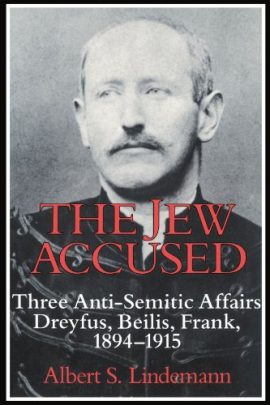
However, he does note some of the underlying social context to this fierce political battle. Although only one Frenchman in a thousand was Jewish, just a few years earlier a group of Jews had been the leading culprits behind several huge financial scandals that impoverished large numbers of small investors, and the swindlers afterward escaped any punishment by means of political influence and bribery. Given this history, much of the outrage of the anti-Dreyfusards probably arose from their fears that a Jewish military spy from a very wealthy family might be able to walk free using similar tactics, and the public claims that Dreyfus’s brother was offering enormous bribes to win his brother’s release certainly strengthened this concern.
Lindemann’s discussion of the 1913 Leo Frank Affair, in which a wealthy Northern Jew working in Atlanta was accused of sexually-assaulting and murdering a young girl, is even more interesting. Once again, he notes that contrary to the traditional narrative, there seems absolutely no hint that Frank’s Jewish background played any role in his arrest or conviction. Indeed, at his trial it was instead his very highly-paid defense attorneys who unsuccessfully sought to “play the race card” with the jurors by crudely attempting to deflect suspicion upon a local black worker by means of racially-charged invective.
Although Lindemann regards Frank as probably innocent, my own reading of the evidence he presents suggests the overwhelming likelihood of his guilt. Meanwhile, it seems undeniable that the outpouring of popular anger against Frank was produced by the vast ocean of outside Jewish money—at least $15 million or more in present-day dollars—that was committed to the legal efforts to save the life of someone widely regarded as a brutal murderer. There are strong suggestions that far more improper means were also employed, including bribery and influence-peddling, so that after Frank was convicted by a jury of his peers and thirteen separate legal appeals were denied, a governor with strong personal ties to the defense lawyers and Jewish interests chose to spare Frank’s life a few months before leaving office. Under these circumstances, the lynch-mob that hung Frank was viewed by the community as merely enforcing his official death sentence by extra-judicial means.
I also discovered that the leading figures in the anti-Frank movement had views far nuanced than I had expected. For example, populist writer Tom Watson had previously been a strong defender of Jewish anarchist Emma Goldman, while ferociously denouncing the Rockefellers, Morgans, and Goulds as the “true destroyers” of Jeffersonian democracy, so his outrage that Frank might escape punishment for murder seemed motivated by the extreme wealth of Frank’s family and his supporters rather than any pre-existing anti-Semitic sentiments.
The unmistakable conclusion of Lindemann’s analysis is that if the defendants in both the Dreyfus and Frank cases had not been Jewish, they would have suffered identical arrests and convictions, but lacking any wealthy and politically mobilized Jewish community to rally around them, they would have received their punishments, just or unjust, and immediately been forgotten. Instead, Theodor Herzl, the founding father of Zionism, later claimed that the massive anti-Semitism revealed by the Dreyfus Affair was the basis of his personal ideological awakening, while the Frank Affair led to the establishment of America’s Anti-Defamation League. And both these cases have entered our history books as among the most notorious examples of pre-World War I anti-Semitism.
Lindemann’s discussion of the often difficult relations between Russia’s restive Jewish minority and its huge Slavic majority is also quite interesting, and he provides numerous instances in which major incidents, supposedly demonstrating the enormously strong appeal of vicious anti-Semitism, were quite different than has been suggested by the legend. The famous Kishinev Pogrom of 1903 was obviously the result of severe ethnic tension in that city, but contrary to the regular accusations of later writers, there seems absolutely no evidence of high-level government involvement, and the widespread claims of 700 dead that so horrified the entire world were grossly exaggerated, with only 45 killed in the urban rioting. Chaim Weizman, the future president of Israel, later promoted the story that he himself and some other brave Jewish souls had personally defended their people with revolvers in hand even as they saw the mutilated bodies of 80 Jewish victims. This account was totally fictional since Weizman happened to have been be hundreds of miles away when the riots occurred.
Although a tendency to lie and exaggerate was hardly unique to the political partisans of Russian Jewry, the existence of a powerful international network of Jewish journalists and Jewish-influenced media outlets ensured that such concocted propaganda stories might receive enormous worldwide distribution, while the truth followed far behind, if at all.
For related reasons, international outrage was often focused on the legal confinement of most of Russia’s Jews to the “Pale of Settlement,” suggesting some sort of tight imprisonment; but that area was the traditional home of the Jewish population and encompassed a landmass almost as large as France and Spain combined. The growing impoverishment of Eastern European Jews during that era was often assumed to be a consequence of hostile government policy, but the obvious explanation was extraordinary Jewish fecundity, which far outstripped that of their Slavic fellow countrymen, and quickly led them to outgrow the available spots in any of their traditional “middleman” occupations, a situation worsened by their total disinclination to engage in agriculture or other primary-producer activities. Jewish communities expressed horror at the risk of losing their sons to the Czarist military draft, but this was simply the flip-side of the full Russian citizenship they had been granted, and no different from what was faced by their non-Jewish neighbors.
Certainly the Jews of Russia suffered greatly from widespread riots and mob attacks in the generation prior to World War I, and these did sometimes have substantial government encouragement, especially in the aftermath of the very heavy Jewish role in the 1905 Revolution. But we should keep in mind that a Jewish plotter had been implicated in the killing of Czar Alexander II, and Jewish assassins had also struck down several top Russian ministers and numerous other government officials. If the last decade or two had seen American Muslims assassinate a sitting U.S. President, various leading Cabinet members, and a host of our other elected and appointed officials, surely the position of Muslims in this country would have become a very uncomfortable one.
As Lindemann candidly describes the tension between Russia’s very rapidly growing Jewish population and its governing authorities, he cannot avoid mentioning the notorious Jewish reputation for bribery, corruption, and general dishonesty, with numerous figures of all political backgrounds noting that the remarkable Jewish propensity to commit perjury in the courtroom led to severe problems in the effective administration of justice. The eminent American sociologist E.A. Ross, writing in 1913, characterized the regular behavior of Eastern European Jews in very similar terms.
Lindemann also allocates a short chapter to discussing the 1911 Beilis Affair, in which a Ukrainian Jew was accused of the ritual murder of a young Gentile boy, an incident that generated a great deal of international attention and controversy. Based on the evidence presented, the defendant seems likely to have been innocent, although the obvious lies he repeatedly told police interrogators hardly helped foster that impression, and “the system worked” in that he was ultimately found innocent by the jurors at his trial. However, a few pages are also given to a much less well-known ritual murder case in late 19th century Hungary, in which the evidence of Jewish guilt seemed far stronger, though the author hardly accepted the possible reality of such an outlandish crime. Such reticence was quite understandable since the publication of Ariel Toaff’s remarkable volume on the subject was still a dozen years in the future.

Lindemann subsequently expanded his examination of historical anti-Semitism into a much broader treatment, Esau’s Tears, which appeared in 1997. In this volume, he added comparative studies of the social landscape in Germany, Britain, Italy, and several other European countries, and demonstrated that the relationship between Jews and non-Jews varied greatly across different locations and time periods. But although I found his analysis quite useful and interesting, the extraordinarily harsh attacks his text provoked from some outraged Jewish academics seemed even more intriguing.
For example, Judith Laikin Elkin opened her discussion in The American Historical Review by describing the book as a “545-page polemic” a strange characterization of a book so remarkably even-handed and factually-based in its scholarship. Writing in Commentary, Robert Wistrich was even harsher, stating that merely reading the book had been a painful experience for him, and his review seemed filled with spittle-flecked rage. Unless these individuals had somehow gotten copies of a different book, I found their attitudes simply astonishing.
I was not alone in such a reaction. Richard S. Levy of the University of Illinois, a noted scholar of anti-Semitism, expressed amazement at Wistrich’s seemingly irrational outburst, while Paul Gottfried, writing in Chronicles, mildly suggested that Lindemann had “touched raw nerves.” Indeed, Gottfried’s own evaluation quite reasonably criticized Lindemann for perhaps being a little too even-handed, sometimes presenting numerous conflicting analyzes without choosing between them. For those interested, a good discussion of the book by Alan Steinweis, a younger scholar specializing in the same topic, is conveniently available online.
The remarkable ferocity with which some Jewish writers attacked Lindemann’s meticulous attempt to provide an accurate history of anti-Semitism may carry more significance than merely an exchange of angry words in low-circulation academic publications. If our mainstream media shapes our reality, scholarly books and articles based upon them tend to set the contours of that media coverage. And the ability of a relatively small number of agitated and energetic Jews to police the acceptable boundaries of historical narratives may have enormous consequences for our larger society, deterring scholars from objectively reporting historical facts and preventing students from discovering them.
The undeniable truth is that for many centuries Jews usually constituted a wealthy and privileged segment of the population in nearly all the European countries in which they resided, and quite frequently they based their livelihood upon the heavy exploitation of a downtrodden peasantry. Even without any differences in ethnicity, language, or religion, such conditions almost invariably provoke hostility. The victory of Mao’s Communist forces in China was quickly followed by the brutal massacre of a million or more Han Chinese landlords by the Han Chinese poor peasants who regarded them as cruel oppressors, with William Hinton’s classic Fanshen describing the unfortunate history that unfolded in one particular village. When similar circumstances led to violent clashes in Eastern Europe between Slavs and Jews, does it really make logical sense to employ a specialized term such as “anti-Semitism” to describe that situation?

Furthermore, some of the material presented in Lindemann’s rather innocuous text might also lead to potentially threatening ideas. Consider, for example, the notorious Protocols of the Learned Elders of Zion, almost certainly fictional, but hugely popular and influential during the years following World War I and the Bolshevik Revolution. The fall of so many longstanding Gentile dynasties and their replacement by new regimes such as Soviet Russia and Weimar Germany, which were heavily dominated by their tiny Jewish minorities, quite naturally fed suspicions of a worldwide Jewish plot, as did the widely discussed role of Jewish international bankers in producing those political outcomes.
Over the decades, there has been much speculation about the possible inspiration for the Protocols, but although Lindemann makes absolutely no reference to that document, he does provide a very intriguing possible candidate. Jewish-born British Prime Minister Benjamin Disraeli certainly ranked as one of the most influential figures of the late 19th century, and in his novel Coningsby, he has the character representing Lord Lionel Rothschild boast about the existence of a vast and secret network of powerful international Jews, who stand near the head of almost every major nation, quietly controlling their governments from behind the scenes. If one of the world’s most politically well-connected Jews eagerly promoted such notions, was Henry Ford really so unreasonable in doing the same?
Lindemann also notes Disraeli’s focus on the extreme importance of race and racial origins, a central aspect of traditional Jewish religious doctrine. He reasonably suggests that this must surely have had a huge influence upon the rise of those political ideas, given that Disraeli’s public profile and stature were so much greater than the mere writers or activists whom our history books usually place at center stage. In fact, Houston Stewart Chamberlain, a leading racial theorist, actually cited Disraeli as a key source for his ideas. Jewish intellectuals such as Max Nordau and Cesare Lombroso are already widely recognized as leading figures in the rise of the racial science of that era, but Disraeli’s under-appreciated role may have actually been far greater. The deep Jewish roots of European racialist movements are hardly something that many present-day Jews would want widely known.

One of the harsh Jewish critics of Esau’s Tears denounced Cambridge University Press for even allowing the book to appear in print, and although that major work is easily available in English, there are numerous other cases where an important but discordant version of historical reality has been successfully blocked from publication. For decades most Americans would have ranked Nobel Laureate Alexander Solzhenitsyn as among the world’s greatest literary figures, and his Gulag Archipelago alone sold over 10 million copies. But his last work was a massive two-volume account of the tragic 200 years of shared history between Russians and Jews, and despite its 2002 release in Russian and numerous other world languages, there has yet to be an authorized English translation, though various partial editions have circulated on the Internet in samizdat form.

At one point, a full English version was briefly available for sale at Amazon.com and I purchased it. Glancing through a few sections, the work seemed quite even-handed and innocuous to me, but it seemed to provide a far more detailed and uncensored account than anything else previously available, which obviously was the problem. The Bolshevik Revolution resulted in the deaths of many tens of millions of people worldwide, and the overwhelming Jewish role in its leadership would become more difficult to erase from historical memory if Solzhenitsyn’s work were easily available. Also, his candid discussion of the economic and political behavior of Russian Jewry in pre-revolutionary times directly conflicted with the hagiography widely promoted by Hollywood and the popular media. Historian Yuri Slezkine’s award-winning 2004 book The Jewish Century provided many similar facts, but his treatment was far more cursory and his public stature not remotely the same.
Near the end of his life, Solzhenitsyn gave his political blessing to Russian President Vladimir Putin, and Russia’s leaders honored him upon his death, while his Gulag volumes are now enshrined as mandatory reading in the standard high school curriculum of today’s overwhelmingly Christian Russia. But even as his star rose again in his own homeland, it seems to have sharply fallen in our own country, and his trajectory may eventually relegate him to nearly un-person status.
A couple of years after the release of Solzhenitsyn’s controversial final book, an American writer named Anne Applebaum published a thick history bearing the same title Gulag, and her work received enormously favorable media coverage and won her a Pulitzer Prize; I have even heard claims that her book has been steadily replacing that earlier Gulag on many college reading lists. But although Jews constituted a huge fraction of the top leadership of the Soviet Gulag system during its early decades, as well as that of the dreaded NKVD which supplied the inmates, nearly her entire focus on her own ethnic group during Soviet times is that of victims rather than victimizers. And by a remarkable irony of fate, she shares a last name with one of the top Bolshevik leaders, Hirsch Apfelbaum, who concealed his own ethnic identity by calling himself Grigory Zinoviev.

The striking decline in Solzhenitsyn’s literary status in the West came just a decade or two after an even more precipitous collapse in the reputation of David Irving, and for much the same reason. Irving probably ranked as the most internationally successful British historian of the last one hundred years and a renowned scholar of World War II, but his extensive reliance on primary source documentary evidence posed an obvious threat to the official narrative promoted by Hollywood and wartime propaganda. When he published his magisterial Hitler’s War, this conflict between myth and reality came into the open, and an enormous wave of attacks and vilification was unleashed, gradually leading to his purge from respectability and eventually even his imprisonment.
Similarly, Israeli academic Ariel Toaff, son of the chief rabbi of Rome, was regarded as one of the world’s leading scholarly authorities on Medieval Jewry. But when he published his remarkable 2004 analysis suggesting the likely reality of the Jewish ritual murders of Christian children throughout history, the resulting media firestorm forced the cancellation of the book’s publication, and the work only survives in samizdat form, while there were even calls for his arrest and incarceration.
In other cases, pressure from the ADL and similar Jewish activist groups have led Amazon to completely eliminate entire categories of historical analysis and ban those publishers who produce such works, which drastically reduces their availability to the reading public.
All of these cases were the sort of high-profile examples which are well-known to anyone who pays attention to such matters. But surely there must have been many other incidents, involving far less prominent authors, which never received any significant media coverage, and also a vastly larger universe of cases in which writers have self-censored their texts in order to avoid such controversies. Over the decades, I have gradually discovered through sad experience that I must exercise extreme caution whenever I read anything relating to the subjects of Jews, Judaism, or Israel.

These important examples may help to explain the puzzling contrast between the behavior of Jews in the aggregate and Jews as individuals. Observers have noticed that even fairly small Jewish minorities may often have a major impact upon the far larger societies that host them. But on the other hand, in my experience at least, a large majority of individual Jews do not seem all that different in their personalities or behavior than their non-Jewish counterparts. So how does a community whose individual mean is not so unusual generate what seems to be such a striking difference in collective behavior? I think the answer may involve the existence of information choke-points, and the ability of relatively small numbers of particularly zealous and agitated Jews in influencing and controlling these.
We live our lives constantly immersed in media narratives, and these allow us to decide the rights and wrongs of a situation. The vast majority of people, Jew and Gentile alike, are far more likely to take strong action if they are convinced that their cause is a just one. This is obviously the basis for war-time propaganda.
Now suppose that a relatively small number of zealous Jewish partisans are known to always attack and denounce journalists or authors who accurately describe Jewish misbehavior. Over time, this ongoing campaign of intimidation may cause many important facts to be left on the cutting-room floor, or even gradually expel from mainstream respectability those writers who refuse to conform to such pressures. Meanwhile, similar small numbers of Jewish partisans frequently exaggerate the misdeeds committed against Jews, sometimes piling their exaggerations upon past exaggerations already produced by a previous round of such zealots.
Eventually, these two combined trends may take a complex and possibly very mixed historical record and transform it into a simple morality-play, with innocent Jews tremendously injured by vicious Jew-haters. And as this morality-play becomes established it deepens the subsequent intensity of other Jewish-activists, who redouble their demands that the media “stop vilifying Jews” and covering up the supposed evils inflicted upon them. An unfortunate circle of distortion following exaggeration following distortion can eventually produce a widely accepted historical account that bears little resemblance to the reality of what actually happened.
So as a result, the vast majority of quite ordinary Jews, who would normally behave in quite ordinary ways, are misled by this largely fictional history, and rather understandably become greatly outraged at all the horrible things that had been done to their suffering people, some of which are true and some of which are not, while remaining completely ignorant of the other side of the ledger.
Furthermore, this situation is exacerbated by the common tendency of Jews to “cluster” together, perhaps respresenting just one or two percent of the total population, but often constituting 20% or 40% or 60% of their immediate peer-group, especially in certain professions. Under such conditions, the ideas or emotional agitation of some Jews probably permeates others around them, often provoking additional waves of indignation.
As a rough analogy, a small quantity of uranium is relatively inert and harmless, and entirely so if distributed within low-density ore. But if a significant quantity of weapons-grade uranium is sufficiently compressed, then the neutrons released by fissioning atoms will quickly cause additional atoms to undergo fission, with the ultimate result of that critical chain-reaction being a nuclear explosion. In similar fashion, even a highly agitated Jew may have no negative impact, but if the collection of such agitated Jews becomes too numerous and clusters together too closely, they may work each other into a terrible frenzy, perhaps with disastrous consequences both for themselves and for their larger society. This is especially true if those agitated Jews begin to dominate certain key nodes of top-level control, such as the central political or media organs of a society.
Whereas most living organizations exist solely in physical reality, human beings also occupy an ideational space, with the interaction of human consciousness and perceived reality playing a major role in shaping behavior. Just as the pheromones released by mammals or insects can drastically affect the reactions of their family members or nest-mates, the ideas secreted by individuals or the media-emitters of a society can have an enormous impact upon their fellows.
A cohesive, organized group generally possesses huge advantages over a teeming mass of atomized individuals, just as a Macedonian Phalanx could easily defeat a vastly larger body of disorganized infantry. Many years ago, on some website somewhere I came across a very insightful comment regarding the obvious connection between “anti-Semitism” and “racism,” which our mainstream media organs identify as two of the world’s greatest evils. Under this analysis, “anti-Semitism” represents the tendency to criticize or resist Jewish social cohesion, while “racism” represents the attempt of white Gentiles to maintain a similar social cohesion of their own. To the extent that the ideological emanations from our centralized media organs serve to strengthen and protect Jewish cohesion while attacking and dissolving any similar cohesion on the part of their Gentile counterparts, the former will obviously gain enormous advantages in resource-competition against the latter.
Religion obviously constitutes an important unifying factor in human social groups and we cannot ignore the role of Judaism in this regard. Traditional Jewish religious doctrine seems to consider Jews as being in a state of permanent hostility with all non-Jews, and the use of dishonest propaganda is an almost inevitable aspect of such conflict. Furthermore, since Jews have invariably been a small political minority, maintaining such controversial tenets required the employment of a massive framework of subterfuge and dissimulation in order to conceal their nature from the larger society surrounding them. It has often been said that truth is the first casualty in war, and surely the cultural influences of over a thousand years of such intense religious hostility may continue to quietly influence the thinking of many modern Jews, even those who have largely abandoned their religious beliefs.
The notorious Jewish tendency to shamelessly lie or wildly exaggerate has sometimes had horrifying human consequences. I very recently discovered a fascinating passage in Peter Moreira’s 2014 book The Jew Who Defeated Hitler: Henry Morgenthau Jr., FDR, and How We Won the War, focused on the important political role of that powerful Secretary of the Treasury.
A turning point in Henry Morgenthau Jr.’s relationship with the Jewish community came in November 1942, when Rabbi Stephen Wise came to the corner office to tell the secretary what was happening in Europe. Morgenthau knew of the millions of deaths and the lampshades made from victims’ skin, and he asked Wise not to go into excessive details. But Wise went on to tell of the barbarity of the Nazis, how they were making soap out of Jewish flesh. Morgenthau, turning paler, implored him, “Please, Stephen, don’t give me the gory details.” Wise went on with his list of horrors and Morgenthau repeated his plea over and over again. Henrietta Klotz was afraid her boss would keel over. Morgenthau later said the meeting changed his life.
It is easy to imagine that Morgenthau’s gullible acceptance of such obviously ridiculous war-time atrocity stories played a major role when he later lent his name and support to remarkably brutal American occupation policies that probably led to the postwar deaths of many millions of innocent German civilians.
Related Reading:
Russia swats away Israeli bluster on Syria
By M K Bhadrakumar | Indian Punchline | July 25, 2018
The Russian version of the visit by Foreign Minister Sergey Lavrov and Chief of Staff General Valery Gerasimov to West Jerusalem on July 23 became available, finally, on Wednesday in the nature of a terse TASS report quoting a ‘military-diplomatic’ source in Moscow as saying that the visiting Russian officials “looked into the tasks of completing the anti-terrorist operation in Syria’s South.”
An unnamed Israeli official had earlier floated a story that Prime Minister Benjamin Netanyahu did some tough talking with Lavrov and “rebuffed” a Russian offer to create a 100-kilometre buffer zone adjacent to Golan Heights. Netanyahu reportedly insisted that he won’t be satisfied with anything short of Iran ending its presence in Syria conclusively.
The first indication that the talks didn’t go well came when Israel shot down a Syrian jet on July 24 in Quneitra bordering Golan. It was a calculated act of belligerence by Israel. (The Islamic State fighters who are present in the region have since released the photograph of the wreckage and the mutilated body of the Syrian pilot.)
The TASS report today punctures the Israeli version that the two Russian officials were deputed by President Vladimir Putin specially to discuss with Netanyahu the future of Iranian presence in Syria. (It now transpires that the Russian officials were on a tour of Israel, Germany and France.) The Israeli bravado can only be seen as a desperate ploy to cover up its humiliating defeat in Syria with the terrorist groups that were its proxies surrendering lock, stock and barrel in Daraa and Quneitra to the Syrian-Russian forces – especially the hasty exfiltration of the controversial group known as the White Helmets to Jordan via Golan Heights with the logistical help from the Israeli military.
Quite obviously, Moscow does not want to get entangled in the Israel-Iran tensions. This is also the American assessment of the Russian thinking, as articulated by the Director of the National Intelligence Agency Daniel Coats on Thursday:
“We have assessed that it’s unlikely Russia has the will or the capability to fully implement and counter Iranian decisions and influence (in Syria.) Russia would have to make significantly greater commitments [in Syria] from a military standpoint, from an economic standpoint. We don’t assess that they’re keen to do that.”
Nonetheless, the Israeli propaganda has gone overboard in attempting to create a wedge between Russia and Iran. (Read a fine piece, here, by Moon of Alabama on the Israeli disinformation campaign.) This couldn’t have gone down well in Moscow. At any rate, the Russian Foreign Ministry came out on July 24 with some sharp criticism of the move by the Israeli parliament (six days earlier) to adopt a bill known as Basic Law: Israel as the Nation-State of the Jewish People.
The operation by the Syrian forces (backed by Russian allies) to liberate Quneitra succeeded beyond expectations once Washington signaled that the extremist groups entrenched in the southern provinces bordering Jordan and Israel should not expect any American intervention to bail them out.
Damascus is now turning its attention to the liberation of the northwestern province of Idlib. It will be a major confrontation due to the presence of a large number of foreign terrorists in Northwestern Syria. The Iranian media reported that a Russian flag ship Ro-Ro Sparta was spotted crossing the Bosporus en route to Syria’s Tartus, carrying military cargo mostly ammunition, shells and missiles and that the reinforcements are meant for the Syrian Army’s “upcoming assault” on Idlib province.
America’s latest witch-hunt
By Tony Kevin | OffGuardian | July 29, 2018
The current Maria Butina indictment in the US reminds one of Voltaire’s famous saying: “I disapprove of what you say, but I will defend to the death your right to say it”. I do not share Maria Butina’s fondness for guns or for the National Rifle Association’s aggressive lobbying for easy public access to guns. Nor would I put up my hand to attend National Prayer Breakfasts in the US. But she seems to be an innocent victim of current Washington elite Russophobia.
Maria Butina was keen to develop networks in these major pro- Republican US civil society organisations, especially in the years leading up to Trump’s election in late 2016. She has recently been arrested – on 15 July, one day before the Helsinki Summit – on two grounds : conspiracy (18 USC §371) , and failing to register as an agent of Russian influence (18 USC §951(a) ) . Here are the indictment documents.
With sympathetic US government representations to the Court, penalties for failing to register as a foreign agent §951 could conceivably be waived or minimised . But the conspiracy charge §371, if found proven by the Court , is very serious indeed. As Reuters reports the case:
Butina has been accused of working with a high-powered Russian official and two unidentified U.S. citizens, trying to infiltrate a pro-gun rights organization in the United States and influence the United States’ foreign policy toward Russia.’
Maria Butina faces up to ten years in US prison on these charges. The Russian Foreign Minister, Sergey Lavrov, protested vehemently to his counterpart Mike Pompeo, saying the charges are fabricated. The Russian Foreign Ministry spokesperson Maria Zakharova was similarly forceful in condemnation, saying the long-planned indictment had been timed to try to derail the Helsinki Summit. Her detailed 18 July statement:
Arrest of Russian national Maria Butina in the United States
We are dismayed by the reported arrest of Russian citizen Maria Butina in the US on July 15. According to a statement on the website of the US Justice Department, she is charged with conspiracy to act as a foreign agent without registration.
These unsubstantiated claims against our fellow national seem odd, to say the least. As we know, Maria Butina has been in the United States for a long time as a student at a university in Washington and she has not been hiding from anybody.
It appears that instead of dealing with its core responsibilities in fighting crime, the Federal Bureau of Investigation is carrying out a blatant political order. As we understand it, the order came from those who continue to stir up Russophobic hysteria, for which purpose they regularly plant more fictional sensations about Russia’s alleged interference in the internal affairs of the United States.
On July 13, twelve Russians, who are currently outside the United States, were charged, as we have already mentioned. Now these ridiculous claims are made against Maria Butina – and she has even been arrested.
We could go on and on analysing this situation. We have the impression that the arrest, as a restrictive measure, was selected specifically to show the seriousness of the issue to the US public and to allies outside the country. The media immediately started referring to Butina as a spy and looked for connections with the security services, to build up tension without any substantial facts.
All this is happened right before the bilateral summit in Helsinki, with the obvious purpose of minimising the positive effect of the meeting and doing this as soon as possible. It appears that somebody took a watch, a calculator and timed when the decision on Maria Butina’s arrest should be taken in order to do as much as possible to sabotage the results of the summit between Russian President Vladimir Putin and US President Donald Trump. This is how good the timing was.
It is possible to elaborate on the subject in the following way. If you have complaints against a person (and it is not a national security issue) you can always bring it to Russia’s attention. And more importantly, the matter could have been discussed, for example, in preparation for the summit. The US could have provided the details to its Russian counterparts and, also for example, discussed it on the margins of the summit or somehow touched base on the issue during the summit. Not a single word was said about it. The entire problem was concocted right after the summit. Given that Russia is a permanent topic of discussion in the US, that all the media are pumping up the hysteria, the bomb eventually detonated.
For our part, we are taking all possible measures to protect the rights and legal interests of the Russian national. The Russian Embassy in Washington contacted the US authorities and is pressing for an urgent consular meeting with Ms Butina, and this consular meeting is mandatory.
Immediately, allegations and rumours spread via social media. Users started to search for pictures of Maria Butina taking part in Russia-US meetings over the past two years.
There was a follow-up Russian Foreign Ministry media statement a week later, on 26 July, which offers disturbing detail of the harsh process of her arrest, and culminating in the claim that she is a political prisoner:
Arrest of Russian citizen Maria Butina in the US
We continue to closely monitor the fate of Russian citizen Maria Butina, arrested in Washington on July 15. Russian Embassy employees have visited her in prison, and have attended the court sessions where a measure of restraint and other procedural issues were determined, including yesterday. We have sent a resolute protest to the US State Department against the actions taken against her, including the severe psychological pressure she was subjected to.
Butina was subjected to an eight-hour search in the arrest process, as FBI agents armed with automatic firearms burst into her rented apartment, literally breaking furniture, shaking and even tearing up things, opening floors and walls. They found nothing incriminating, but despite the complete lack of evidence, Maria Butina was refused release.
The FBI’s thin case against Butina, as anyone can read on the internet, is actually based on decontextualised excerpts from her personal correspondence in social media. They are trying to incriminate her in a violation of the US foreign agents law, although she did not work for any foreign state, but studied at a Washington university and, taking a great interest in weapons, went to National Rifle Association of America events. She did this openly, not hiding her Russian citizenship, not hiding acquaintances or contacts, because there was nothing to hide.
However, certain political forces in the United States, pursuing self-serving interests, invented a story of Russian interference in the US elections, and this mudslinging campaign against Russia actually sent Butina to prison on a framed case – in fact, simply due to her nationality. What is this, if not a witch-hunt? There are fears that any of our compatriots in America might find themselves to be the next targets.
We demand that the US authorities immediately stop this arbitrariness and release Maria Butina. Her arrest is motivated solely by US domestic and foreign politics, and, therefore, she is a political prisoner.
Claiming her to be a likely flight risk into the Russian Embassy, the FBI quickly secured a court order to detain Butina pending her trial. Her trial is proposed by the prosecution to be held in secret because evidence to be presented is claimed to relate to ongoing national security investigations.
The Russian Embassy in Washington commented on Facebook:
We are surprised by the prosecution’s continued attempts to classify #FreeMariaButina case, thereby limiting public access to the details of the legal proceedings. Same tactic, as we see, is used by the 🇬🇧 special services concerning the Skripals case.
According to the Bloomberg report, the next hearing has been set for 10 September. So Maria Butina will have been jailed for eight weeks without trial, preparatory to a secret trial. One can only imagine her fear and distress.
I share the widespread Russian sense of outrage at this cruel and misconceived arrest and legal process. Maria Butina has not been accused of being a spy, of stealing American national security secrets, or of subverting American officials. At worst, she was a naive admirer of American ‘Wild West’ culture and its gun laws, which she wanted to emulate in Russia. She has publicly compared her birthplace, Siberia, to the American West, and Russian Cossacks to cowboys. She is, at worst, naive and imprudent, a fantasist about her imaginary idealised America. Not a spy or criminal by any reasonable or civilised measure.
Most of the preceding and following biographical detail comes from the Wikipedia article on Maria Butina and the court indictment papers, referenced above.
Maria Butina, now aged 29, was born in 1988 in Barnaul, in Altai Krai, Siberia. A tall athletic girl, her father used to take her hunting with him and taught her to shoot and handle guns from an early age. She did well at school and university, taking a degree in political science at Altai State University at age 19 in 2007. She moved to Moscow in 2011 , starting an advertising agency after building a successful furniture retail business in Altai. She joined the youth wing of the United Russia Party, the dominant political party in Russia.
Also in 2011, Butina founded a gun-rights organization, Right to Bear Arms, that lobbied to change Russia’s strict gun control laws. She began traveling back and forth to the U.S., initially with Aleksandr Torshin, who was then a Senator in the Federation Council of Russia, and a leading member of United Russia Party. He had hired her as his “special assistant” that year. In 2012, they lobbied the Federation Council to expand gun rights. In 2015, Butina said that Right to Bear Arms had 10,000 members and 76 offices in Russia.
In August 2016, two years ago, she moved to the United States on a student visa, and enrolled as a graduate student at American University in Washington, D.C. Torshin had become a deputy governor of the Central Bank of Russia in January 2015, and she worked as his special assistant until May 2017.
While a graduate student in US, her favoured hobbies were networking and cultivating her contacts in NRA and National Prayer Breakfast circles, and dipping into American Republican politics. In a June 2015 article published in The National Interest, a conservative American international affairs magazine, just before Donald Trump announced his candidacy for president, she urged better relations between the United States and Russia. At a public meeting in July 2015, she had asked candidate Donald Trump about prospects for lifting US sanctions against Russia If he were elected. She was delighted at his reply that he saw no need for such sanctions.
She was effectively an amateur lobbyist for the cause of improved Russia-US relations and for Russia to adopt US gun laws. In one sense, therefore, she was paradoxically an agent of American influence in Russia. There is a photo of her leading a street demonstration in Moscow with banners advocating relaxation of Russia’s quite strict gun ownership licensing laws.
She loved guns. She thought wider gun ownership would deter violent crime and make Russian society safer. Naturally she became popular in some NRA circles. There are many photos of her toting guns in her cowboy gear.
She cultivated older wealthy men along the way. Nothing unusual there, in a young ambitious woman with no family connections. Torshin had allegedly helped to fund and arrange her move to Washington, and put her in touch with the Russian Embassy there.
Once settled there, she soon developed a personal relationship with an older American, a senior NRA member. The indictment papers report that she told some people this was not for her a deep or committed relationship.
The indictment papers say that she regularly reported on her activities, through entirely overt and non-clandestine open telephone or Internet channels, to a contact in the Russian Embassy in Washington, who was expelled in March 2018 as an alleged spy, in the post-Skripal round of diplomatic expulsions. This history of contact with the Embassy is now being held against her, to support the more serious conspiracy charge.
This vindictive politically motivated prosecution will damage US-Russian relations even further. Her distressed father has called the charges against her ‘psychopathy and a witch-hunt’.
The more this sort of thing happens to Russians in the US, the more that Russians will despise America as a strange and cruel country.
My country, Australia, has just passed similar Agent of Foreign Influence laws. One can readily imagine such a prosecution of an ambitious but naive Russian immigrant or temporary student resident here, coming under surveillance and being eventually arrested for some relatively innocuous political activity like joining in environmental activism involving some minor temporary activities defined in the new laws as sabotage, with some sexual misconduct allegations being thrown in to spice the stew. Sentencing could be severe, as in US. In the current Russophobic official political climate in Australia, no mercy could be expected from government or opposition parties.
This story leaves a nasty taste in the mouth. To my mind, Maria Butina is an innocent casualty of American liberal-Democratic Party and anti-Trump Russophobia, gone feral.
She ticks so many of her accusers’ ‘hate’ boxes : Trump admirer, Putin admirer, admirer of the NRA and Prayer Breakfast cultures, sexually liberated, open about her wish to bring the two countries she loved most – Russia and America – closer together. A lot of ideological scores are being settled here, and this poor young woman is the first victim. There could be more such victims, in the US and possibly here in US camp follower Australia.
Trump has very little scope to help her, even if he wanted to. She is now caught up in the brutal mechanics of the US justice system, and the liberal democratic mainstream media are already busily trying to convict her in the court of US public opinion., crafting a false ‘Red Sparrow’ or Anna Chapman spy image of her. It is a very sad story and I fear it will not end well for Maria.
Neither German nor British intelligence can prove Russia is behind Skripal poisoning – German MP
RT | July 29, 2018
Failure to release any evidence of Russia’s alleged involvement in the Skripal case shows that neither German nor British intelligence services have anything on it, a member of the German Left Party, Heike Haensel, believes.
Western media and politicians still seize every opportunity to pin the blame on Moscow for the poisoning of ex-double agent Sergei Skripal and his daughter Yulia in March. However, German lawmakers received nothing but the allies’ assurances about the case, according to MP Heike Haensel. Speaking to daily newspaper Junge Welt, she revealed that two requests for any proof of the allegation, from her and her fellow MP Sevim Dagdelen, were left unanswered.
“Still neither British nor German intelligence agencies have evidence of Russian responsibility for the attack in March,” Haensel said in an interview published on Saturday.
The German federal government formally responded to the Left Party’s requests only to say that the alleged evidence cannot be released as the data in question is classified. It also claimed that the British side had presented some details regarding its decision to blame Russia, and its contention that no alternative explanation seemed plausible – the mantra that the UK’s Western allies have been repeating since the Salisbury incident, without revealing any substantial details.
Still waiting for any proof to be provided, German politicians seem to be increasingly skeptical about the UK’s claims regarding Russia. In June, the German Bundestag’s Research and Documentation Services concluded that Moscow violated no international norms during the inquiry into the case. The German parliament’s agency report followed news that Berlin had not received a single piece of evidence to suggest that Russia may be behind the attack that took place in early March, according to German media.
Russia has repeatedly denied the allegations, and has complained that the results of the investigation have been kept secret. The Russian envoy to the UK has on several occasions said that London had even tried to “destroy” evidence during the probe. Meanwhile, the Organization for the Prohibition of Chemical Weapons (OPCW) also failed to establish any links to show that the nerve agent used to poison the Skripals came from Russia.
Read more:
The Salisbury Poisonings: 10 Questions for the Authorities to Answer About Their Handling of This Case
By Rob Slane | The Blog Mire | July 28, 2018
The two most basic claims made by the Government and investigators regarding the method and the mode in the Salisbury poisoning are these:
- That military grade nerve agent was used to poison Mr Skripal
- That it was applied to the door handle of his house
These claims raise a number of very obvious questions. For example, how did the assassin(s) apply such a powerful chemical without wearing protective clothing? How did the people who are said to have come into contact with the substance not die immediately, or at the very least suffer irreparable damage to their Central Nervous Systems? How did this military grade nerve agent manage not only to have a delayed onset, but also managed to affect a large 66-year-old man and his slim 33-year-old daughter, both of whom would have vastly different metabolic rates, at exactly the same time?
These are perfectly reasonable questions that deserve reasonable answers. I am aware, however, that no matter how obvious and rational such questions might be, doing so places one – at least in the eyes of the authorities – in the camp of the conspiracy theorist. This is disingenuous. One of the marks of a true conspiracy theorist is that he is someone who refuses to accept an explanation for an event, even after being presented with facts which fit and explain it coherently. But when the “facts” presented in a case do not fit the event they are supposed to explain, and are neither rational nor coherent — as in the Salisbury case — then calling the person who raises legitimate questions a “conspiracy theorist” is a bit rich, is it not?
Nevertheless, for the purposes of this piece, what I’d like to do is work on the assumption that the “Military Grade Nerve Agent on the Door Handle” claim is correct. And working from this assumption, I want to ask some questions about how the authorities have handled the case. The point is this: These questions are not really intended to challenge the official claims; rather the intention is to ask whether the authorities have handled the case correctly on their own terms.
1. Prior to the investigation’s focus on the door handle, for a period of almost three weeks there were at least nine other theories proposed by the authorities as to where the Skripals came into contact with the poison. These included the restaurant, the pub, the bench, the cemetery, the car, the flowers, the luggage, the porridge and even a drone. During that time, police officers and investigators were entering and leaving the house, by the door, since it was not known to be the place where the poison was located.
Can the authorities explain how these officers and investigators were not poisoned?
2. Once the door handle theory was established, those who had been in and out of the property during the previous three weeks would naturally have been concerned about the possibility that they had been contaminated.
Can the authorities tell us what steps were taken to reassure these officers?
3. Every officer who entered the house after 4th March, and before the door handle became an object of interest, should have been given a medical examination to check for signs of poisoning.
Can the authorities confirm that this took place for every officer?
4. Initial reports about Detective Sergeant Nick Bailey stated that he was poisoned at the bench, after coming to the aid of Mr Skripal and Yulia. However, on 9th March, Lord Ian Blair stated that D.S. Bailey had actually become poisoned after visiting Mr Skripal’s house. Since he was thought to have been poisoned with a military grade nerve agent, and since it was thought that this had occurred at Mr Skripal’s house, the immediate next step should have been to seal off the house and set up a mobile decontamination unit outside. However, numerous photographs show officers in normal uniforms standing close to the door long after Lord Blair’s claim.
Can the authorities confirm why the house was not sealed off and a decontamination unit set up immediately after it became known that D.S. Bailey had been there, and why officers with no protective clothing on were allowed to continue standing guard outside the house for the next few weeks?
5. Can the authorities explain how these decisions did not put the health and even the lives of those officers in jeopardy?
6. Before the door handle theory was settled on, the majority of competing theories put out by the authorities tended to assume that Mr Skripal was poisoned long before he went to Zizzis. For example, the flowers, the cemetery, the luggage, the porridge and the car explanations all assume this to be the case. What this means is that according to the assumptions of police at that time, when Mr Skripal fed the ducks near the Avon Playground with a few local boys, at around 1:45pm, he was already contaminated. Yet although this event was caught on CCTV camera, it was more than two weeks before the police contacted the parents of these boys.
Can the authorities explain why it took more than two weeks to track down the boys, who – as the CCTV apparently shows – were given bread by Mr Skripal?
7. Can the authorities comment on why they did not air the CCTV footage on national television, in an effort to appeal to the boys or their parents to come forward, and whether the delay in tracking them down might have put them in danger?
8. If the door handle was the place of poisoning, it is extremely likely that the bread handed by Mr Skripal to the boys would have been contaminated. Certainly, areas that he visited after this incident were deemed to be so much at risk that they were either closed down (for example, The Mill and Zizzis, which are both still closed), or destroyed (for instance, the restaurant table, the bench and – almost certainly – the red bag near the bench have all been destroyed).
Can the authorities comment on how the boys, who were handed bread by Mr Skripal, managed to avoid contamination?
9. It has been said that one of the reasons the Government is/was so sure that the ultimate culprit behind the poisoning was the Russian state, is the apparent existence of an “FSB handbook” which, amongst other things, allegedly features descriptions of how to apply nerve agent to a door handle. Given that the Prime Minister first made a formal accusation of culpability on 12th March in her speech to the House of Commons, the Government must therefore have been in possession of this manual prior to that day. However, claims about the door handle being the location of the poison did not appear until late March (the first media reports of it were on 28th March). What this means is there was a delay of several weeks between the Government making its accusation, based partly on the apparent existence of the “door handle manual”, and the door handle of Mr Skripal’s house being a subject of interest to investigators.
Can the authorities therefore tell us whether the Government’s failure to pass on details of the “door handle manual” put the lives of the officers going in and out of Mr Skripal’s house from 5th March to 27th March in jeopardy?
10. On 17th March, Metropolitan Police Assistant Commissioner Neil Basu said:
“We are learning more about Sergei and Yulia’s movements but we need to be clearer around their exact movements on the morning of the incident. We believe that at around 9.15am on Sunday, 4 March, Sergei’s car may have been in the areas of London Road, Churchill Way North and Wilton Road. Then at around 1.30pm it was seen being driven down Devizes Road, towards the town centre. We need to establish Sergei and Yulia’s movements during the morning, before they headed to the town centre. Did you see this car, or what you believe was this car, on the day of the incident? We are particularly keen to hear from you if you saw the car before 1.30pm. If you have information, please call the police on 101.”
Now that Sergei and Yulia Skripal have been awake and able to communicate for around four months, these details are presumably now all known to investigators. In the normal course of such a high profile investigation, details such as these would be relayed to the public in the hope of jogging memories to prompt more information. And in fact, many such details have been released to the public in this case. Yet, confirmation of Mr Skripal’s and Yulia’s movements that day remain conspicuous by their absence.
Can the authorities confirm that the movements of the Skripals that day are now understood, and that they will be made known shortly, in order that more information from the public might then be forthcoming?
These questions have nothing to do with any conspiracy theory. On the contrary, they are all based on the assumption that the two central claims made by the authorities regarding the mode and the method used in this incident are correct. They are, however, very serious and perfectly legitimate questions about the way the authorities have dealt with this incident, on their own terms and on the basis of their own claims.
We await their explanations.
Featured Video

Anthrax War – CBC The Passionate Eye
or go to
Aletho News Archives – Video-Images
Book Review
Shattered Dreams: The HPV Vaccine Exposed (2019)
By Christina England – 30 Q&As – Book Review & Summary
Lies are Unbekoming | September 4, 2026
… Gardasil received FDA fast-track approval in 2006, Cervarix followed in 2009, and Gardasil 9 was approved in December 2014 with more than double the aluminium adjuvant content of the original. The commercial context is specific. Merck was about to lose patent protection on Zocor and faced $18 billion in Vioxx injury claims from a cardiovascular drug the company had marketed while suppressing its own data showing a five-times increase in heart attacks. Analysts projected the global HPV vaccine market at $4 billion by 2011, contingent on government-funded national programs for teenage girls. The 1986 National Childhood Vaccine Injury Act had already granted manufacturers complete liability immunity. By 2013, Japan had withdrawn its HPV vaccine recommendation after cataloguing severe adverse reactions in hundreds of girls. No Western government followed. The establishment position across the UK, US, Australia, and most of Europe held, and still holds, that the vaccines are safe and effective, that reported injuries are coincidental, and that cervical cancer prevention justifies the program. The book was published into this position, not against a vacuum.
Shattered Dreams sits alongside Mary Holland’s The HPV Vaccine On Trial and Viera Scheibner’s foundational vaccination work as part of the documented record on what has been done to a generation of teenage girls under the banner of cancer prevention. The full summary unpacks three specific findings: that Merck used the aluminium adjuvant itself as the “placebo” control in 92.5% of trial subjects, making it structurally impossible to detect excess reactions from the adjuvant; that Dr. Sin Hang Lee found HPV DNA fragments bound to aluminium in every one of sixteen Gardasil samples tested, and in the blood and spleen of a New Zealand girl six months after her third dose; and that in every country with high vaccination coverage, including Australia, the UK, Norway, and Sweden, cervical cancer rates have stopped declining and started rising specifically in the vaccinated cohort. Martínez-Lavín’s 2017 calculation puts the number needed to seriously harm with Gardasil 9 at 140, and the number needed to vaccinate to prevent one case at 1,757. Thirteen young women are seriously harmed for every one who benefits. The vaccine was approved on the basis of trials that could not detect what the trials were supposed to detect, and it is still being given to twelve-year-olds today. … Read full review
Blog Roll
 Aletho News
- The Five-Year Fuel Crisis: Why the World Economy Is Paying for a War It Thinks Is Ending
- Trump’s Big Bluff on Iran
- Swiss scammed out of millions by Ukraine-linked call centers – media
- Germany facing potential ‘violent conflict’ with Russia – spy chief
- Ukraine’s EU neighbors reject new plea from Kiev – Politico
- British Transport Police Facial Recognition Trial Scanned 926,912 People With Zero Arrests
- House Bill Would Ban Federal Use of Flock ALPR Data
- Can a Spice Rival a Drug? 10 Head-to-Head Trials Put It to the Test.
- The oil routes around Hormuz face their own chokepoints
- The Saudi-Israeli war on Yemen’s resistance: Intelligence sharing, civilian targets & sectarian propaganda
- If Americans Knew
- NAZA: Israeli embassies in UK and US promote rival documentary to challenge Gaza genocide allegations
- David Ellison appoints Israeli to lead merged Paramount-Warner studios
- Turkish Red Crescent helps elderly Gaza man walk again after Israel confiscates his prosthetic limb
- Four Palestinians Killed in Israeli Attacks in Gaza
- Two Palestinian youths killed and village razed as Israeli attacks on West Bank continue
- Two more Christian women innocent victims of Gaza raids
- Cruelty, Deprivation, Indignity: A Journalist’s 22 Months in Israeli Prison
- New IDF Website Frames Slain Gaza Journalists as Terrorists
- Israeli media: After settlers beat him mercilessly, they stuffed dirt into his mouth
- Americans Are Paying the Price to Preserve Israel’s Nuclear Hegemony
- No Tricks Zone
- Latest European Green Energy Debacle; Portugal’s Largest Flagship Solar Park Insolvent!
- Green Energy Debacle: German Expert Professor Fritz Vahrenholt Warns Of Severe Economic And Social Consequences
- Two More Paleo Reconstructions Affirm Meters-Higher Sea Levels Across Ireland, Brazil 7000-6000 Years Ago
- New Study: Earth And Venus Surface Warmth Largely Explained By Convection And Lapse Rate, Not CO2 Or Radiation
- 2025 Nature Paper Claiming Worsening Global Drought Gets RETRACTED …Heavily Flawed
- New Study: ‘Global Drought Shows No Detectable Recent Acceleration Under Climate Warming’
- Economic Masterminds: German Socialists Suggest Taxing Productivity Gains Stemming From Using AI
- The South China Sea Has Not Been Cooperating With The Climate Change Narrative
- Energy Crisis: Germany Enters Heating Season With Historically Low Gas Reserve Fill Levels
- New Study: The Antarctic Ice Sheet Gained Mass From 2020-2024 Due To Staggering Snow And Ice Accumulation

