CIA Undermines North Korea Summit By Leaking Report To Media Asset
By Kenneth Whittle | Disobedient Media | May 30, 2018
Just as it was reported that the summit between the United States and North Korea was back on and that Kim Young Chol, the Vice Chairman of North Korea was on his way to New York to meet with officials in preparation for the June 12 summit, the CIA leaked an intelligence assessment concluding that “North Korea does not intend to give up its nuclear weapons any time soon.” The timing of this leak is striking, as it seems to be an effort to undermine negotiations between the two nations and comes just days after ranking members of the Democratic Party and Republican hardliners attacked President Donald Trump over his efforts to meet with North Korean leader Kim Jong Un.
The identity of the reporter who helped break the story also raises serious questions about whether or not a faction within the CIA deliberately attempted to undermine diplomatic efforts to ease tensions on the Korean Peninsula. According to NBC News, the report was leaked to none other than NBC national security reporter Ken Dilanian, known as “The CIA’s Mop-Up Man.”
In 2014, The Intercept reported on Ken Dilanian’s correspondence and relationship with the CIA while Dilanian was a reporter for the Los Angeles Times.
According to The Intercept, “Email exchanges between CIA public affairs officers and Ken Dilanian, now an Associated Press intelligence reporter who previously covered the CIA for the Times, show that Dilanian enjoyed a close collaborative relationship with the agency, explicitly promising positive news coverage and sometimes sending the press office entire story drafts for review prior to publication. In at least one instance, the CIA’s reaction appears to have led to significant changes in the story that was eventually published in the Times.”
According to the Huffington Post, while writing for the Los Angeles Times, Dilanian also reported a CIA claim as fact by stating that “there was no collateral murder in a 2012 drone strike on Al Qaeda leader Abu Yahya al-Libi.” Dilanian’s article was directly disputed in an Amnesty International report.
In the aftermath of the revelations about Dilanian’s ties to the CIA, he was disavowed by the Los Angeles Times. The disclosure of Dilanian’s collaboration with the CIA also led his former employer, David Lauter of the Tribune Washington bureau to believe Dilanian could have violated Tribune news policy. Lauter acknowledged that Tribune policy dictates that reporters “not share copies of stories outside the newsroom.” Lauter further stated that he was “disappointed that the emails indicate that Ken may have violated that rule.”
Dilanian has not shied away from pushing articles written by former CIA officials who continue to perpetuate the “Trump-Russia” collusion narrative without any regard to facts, such as Steven Hall’s Washington Post article titled: “I was in the CIA. We wouldn’t trust a country whose leader did what Trump did.”
Perspective | I was in the CIA. We wouldn’t trust a country whose leader did what Trump did. https://t.co/4XG8TmhwKq
— Ken Dilanian (@KenDilanianNBC) May 18, 2017
Wikileaks has also pointed out Dilanian’s agency connection and his pushing of the “Trump-Russia” collusion narrative, tweeting: “CIA’s ‘mop up man’ Ken Dilanian is the NBC ‘reporter’ used to channel claim about president Putin + US election.”
CIA’s “mop up man” Ken Dilanian is the NBC ‘reporter’ used to channel claim about president Putin + US election https://t.co/GOci4EWwdv
— WikiLeaks (@wikileaks) December 15, 2016
In the aftermath of recent revelations concerning the CIA’s collaboration with foreign intelligence agencies to spy on Donald Trump’s campaign during the 2016 US Presidential Election the fresh leaks continue to show a pattern of rebellion that has long run rampant in the US intelligence community. While the CIA’s apparent violations of ethical considerations concerning surveillance of candidates running for public office was serious enough, their interference drags the reputation of the agency to a new (and in the case of Korean peace negotiations, more dangerous) low amid their conflict with the sitting President of the United States.
However, despite these attacks, preparations between the two countries have continued for the upcoming June 12 summit. President Trump announced earlier today via Twitter that: “We have put a great team together for our talks with North Korea. Meetings are currently taking place concerning Summit, and more. Kim Young Chol, the Vice Chairman of North Korea, heading now to New York. Solid response to my letter, thank you!”
We have put a great team together for our talks with North Korea. Meetings are currently taking place concerning Summit, and more. Kim Young Chol, the Vice Chairman of North Korea, heading now to New York. Solid response to my letter, thank you!
— Donald J. Trump (@realDonaldTrump) May 29, 2018
Iran rejects US report on religious freedom as ‘politically motivated’
Press TV – May 31, 2018
Tehran has dismissed the allegations put forth in a recent US report on religious freedom in Iran as “baseless” and “politically motivated,” saying the document offers a “distorted picture” of the realities in Iran and other countries.
Iranian Foreign Ministry spokesman, Bahram Qassemi, was reacting to the US State Department’s International Religious Freedom Report for 2017, which was released on May 29.
The Iran section of the report claimed that “non-Shia Muslims and those affiliated with a religion other than Islam” residing in the Islamic Republic faced “societal discrimination and harassment.”
Besides Iran, the report also targets Washington’s other foes, including Russia, China and North Korea.
Qassemi said, “The Islamic Republic of Iran views this report as unrealistic, baseless and biased, which has been compiled merely with the aim of serving certain political goals.”
The US, he added, has “no accurate and realistic evaluation” of the situation inside other countries, stressing that this report, which presents yet another distorted picture of religious freedoms in Iran and levels untrue allegations against the Islamic Republic, is “undoubtedly unacceptable and rejected.”
The official said history shows that the great people of Iran, from all faiths and ethnicities, have peacefully coexisted for millennia.
Since the 1979 Islamic Revolution, “followers of all religions have performed their religious traditions in various religious centers across Iran based on the articles of the Constitution and within the framework of law,” Qassemi said, adding that Iranian law “protects all such freedoms.”
Iran’s Foreign Ministry spokesman also called on the United States to avoid politicizing the issue of religion, warning that offering “delusional, self-made and unfounded readings of different religions” could only lead to more interfaith clashes in the world.
The official religion of Iran is Shia Islam under the Constitution. The Islamic Republic recognizes Zoroastrian, Jewish, and Christian religious minorities, among others.
The Constitution states that “the investigation of individuals’ beliefs is forbidden,” and that “no one may be molested or taken to task simply for holding a certain belief.”
Sinister Choreography of the MH17 Probe to Smear Russia
By Finian CUNNINGHAM | Strategic Culture Foundation | 31.05.2018
The Dutch-led probe into the 2014 Malaysian airliner disaster has the hallmarks of a psychological operation to frame-up Russia and to justify further sanctions and aggression from the NATO powers.
The so-called Joint Investigation Team (JIT) released an update last Thursday on its ongoing probe into the MH17 air disaster over Eastern Ukraine, in which all 298 people onboard were killed. The JIT’s latest release moves the accusation of culpability closer to Russia, with the team claiming that an anti-aircraft Buk missile, which allegedly shot down the plane, was brought into Ukraine by Russia’s 53rd Brigade based in Kursk, southwest Russia.
Then on Friday, the day after the high-profile JIT presentation, a news report compiled by US-based McClatchy News and UK-based self-styled online investigative website Bellingcat was published claiming to have identified a senior Russian military intelligence (GRU) officer as being involved in the transport of the missile system.
The Russian GRU officer is named as Oleg Vladimirovich Ivannikov. The report includes a photograph of the named man, who is said to have at least one residential address in Moscow and who used the call sign “Orion”. Tellingly, the McClatchy report claims that news of identifying the Russian military officer was not known by the JIT when it made its presentation the day before. But McClatchy reported that the Dutch-led investigators now want to arraign “Orion”.
Over the weekend, the Dutch, Australian and British governments upped the ante by formally accusing Russia, and demanding that Moscow pay financial compensation to families of the crash victims. Most of those onboard the doomed MH17 were Dutch, Malaysian and Australian nationals.
What we are seeing here is a choreographed sequence trying to give the public impression that developments in the probe are taking a natural course based on “evidence” imputing blame to Russia. The same technique of media psychological operation can be seen in the Skripal poisoning affair in which Moscow is blamed for trying to assassinate a former spy in England. Allegations, purported evidence, and then sanctions (expulsion of Russian diplomats) all follow a choreographed sequence.
On the MH17 incident, Russia has vehemently denied any involvement in the passenger plane’s downing. Moscow says its own investigation into the incident points to the Kiev regime’s armed forces as being responsible, possibly using their stock of Soviet-era Buk anti-aircraft missiles. Significantly, Russia’s investigative results have been spurned by the JIT, while Moscow’s offers of contributing to the probe have been rebuffed. As in the Skripal affair, where the British authorities have also refused Russia’s offers of joint investigation, or Russia’s ability to independently verify the supposedly incriminating data.
In a dramatic twist, Russia’s Ministry of Defense said that the missile casing displayed by the Dutch investigators bore features dating the weapon to 1986 when Ukraine was a Soviet Republic. The Russian military said that all such Buk models were replaced by its forces in 2011. Therefore, the alleged offensive weapon presented by the JIT last week could not have come from Russian forces. Besides, Moscow denies that any of its brigades crossed into Ukrainian territory.
The JIT, which includes investigators from Holland, Belgium, Australia, Malaysia and – invidiously – Ukrainian secret services, openly acknowledged in its presentation last week that it is cooperating with the Britain-based Bellingcat website. The latter is cited for its analysis of videos purporting to show the transport of a Russian military Buk convoy through Eastern Ukraine at around the time of the airliner being shot down. Those videos have already been exposed as fabrications.
Now it seems rather strange that the JIT was reported by McClatchy as not knowing of Bellingcat’s next “scoop” published the following day in which it claims to identify a Russian military officer, named as Oleg Ivannikov or Orion, for being involved in coordinating the transport of the Buk convoy, which the JIT says came from the 53rd Brigade in Russia’s Kursk.
The JIT and Bellingcat have collaborated in a previous update to its MH17 probe, in 2016, when the dubious videos were presented as purportedly showing the Buk convoy traversing Eastern Ukraine back to Russia. Bellingcat was cited again in the JIT’s update last Thursday.
That raises the question of why the information claiming to identify the Russian military officer was not available to JIT, even though the latter has worked closely with Bellingcat before? It was the next day when the McClatchy-Bellingcat news report came out, seemingly separate to the JIT presentation.
The sequence suggests a concerted effort to “build” a public perception that “clues” into the cause of the air crash and the incrimination of Russia are being assembled in an independent manner. When, in reality, the sequence is actually a deliberately orchestrated media campaign, to more effectively smear Russia.
Bellingcat’s media activities indicate that it is not the supposed “independent online investigative website” it claims to be. During the Syrian war, it has helped to peddle claims that videos sourced from the White Helmets are “authentic” when in fact there is strong evidence that the White Helmets have been fabricating videos of atrocities on behalf of NATO-sponsored terrorists in order to smear the Syrian government and its Russian ally.
For the Dutch-led JIT to associate with Bellingcat as a source of “evidence” is a matter of grave concern as to the probe’s professional credibility.
Moreover, what is also fatally damaging to the MH17 probe is that the Ukrainian secret services (SBU) under the control of the Western-backed Kiev regime, which came to power in the NATO-backed February 2014 coup d’état, is the source for much of the so-called evidence implicating Russia or the pro-Russian separatists in Eastern Ukraine for shooting down the MH17 airliner.
The dubious videos cited by the JIT and Bellingcat were sourced from the SBU. Those videos were purportedly posted on social media at the time of the plane crash by anonymous members of the public. The Russian government has dismissed those videos as fake.
The latest claims by McClatchy and Bellingcat of identifying a Russian military officer are based on allegations that mobile phone intercepts are attributable to the man named as Orion. Bellingcat appears to have expended a lot of effort trawling through digital phone books to identify the individual. The report also relies on embellishment of Orion’s alleged secret military career in Ukraine and South Ossetia by way of lending a sense of credibility and sinister innuendo.
However, the bottom line is that McClatchy and Bellingcat both admit that they are relying on the Ukrainian secret services for their phone intercepts, as they had previously for the videos of the alleged Russian Buk convoy.
The SBU and its Kiev masters have an obvious axe to grind against Moscow. Their partisan position, not to say potential liability for the air crash, thus makes the JIT and subsequent Western media reporting highly suspect.
Such close involvement of a Western media outlet (McClatchy ) with a fake news engine (Bellingcat ) and Ukrainian state intelligence is indicative of coordinated public psychological operation to smear Russia.
The prompt responses from Western governments calling for criminal proceedings against Moscow are further indication that the whole effort is an orchestrated campaign to frame-up Russia.
Rebellion or Counter-Revolution: Made In US In Nicaragua?
By Achim Rödner – teleSUR – May 30, 2018
Many wonder if the United States is involved in the student protests of the past month in Nicaragua which attempted to destabilize the country. Western media writes nothing about the issue, while at the same time similar scenarios have played out in Venezuela, Brazil, Cuba, Honduras, Bolivia and other countries in which the left has made progress. At this moment, three Nicaraguan students are touring Europe and Sweden in search of support for their campaign. At least one of the students represents an organization funded and created by the United States.
The student protests in Nicaragua are described in the Western media as legitimate protests by young Nicaraguans who have spontaneously united to fight the supposed dictatorship. Surely there are many young people who have joined the fight with these ideas. Surely many people here in Sweden have joined and support that struggle. But there is much that indicates that these are not just spontaneous protests. There are many indications that organizations led by the United States waited for the right moment to create chaos, and exacerbate the contradictions to destabilize the democratically elected government of Nicaragua.
Changing Society
One of the three students on tour in Sweden right now is Jessica Cisneros, active in issues of integration and youth participation in political processes. She is a member of the Movimiento Civico de Juventudes (MCJ). That organization is financed, created by and an integral part of the National Democratic Institute. The NDI is an organization that works to change society in other countries. The president of the NDI is Madeleine Albright, former U.S. secretary of state. The general secretary of the MCJ, Davis Jose Nicaragua Lopez, founder of the organization, is also the coordinator of the NDI in Nicaragua and active in a series of similar organizations in Nicaragua and El Salvador.
Excerpt from the NDI website: “The Civic Youth Movement (MCJ) has been part of an NDI project that began in 2015 with the aim of expanding youth leadership and political commitment by providing hands-on training in organizational techniques. Several of the group members are graduates of the Leadership and Political Conduct Certification (CLPM) program that the NDI has supported in conjunction with Nicaraguan universities and civil society organizations.”
Yerling Aguilera is from the Polytechnic University (UPOLI) of Managua and has specialized in research on the revolution and the feminist movement. She has also been an employee and consultant for IEEPP in Nicaragua, which works to strengthen the capacity of political, state and social actors for a better informed public through creative and innovative services. IEEPP has received support from the National Endowment for Democracy (NED) of US$224,162 between 2014 and 2017.
Madelaine Caracas participates in the national dialogue currently taking place in Nicaragua. She is also active in the feminist and environmental movement.
From 2015 on, the United States expanded its support to Nicaragua, especially through support for leadership courses and money for young people in universities, schools, NGOs and political parties. Organizations that work with feminist movements and women, human rights and the environment have been prioritized.
This from the NDI website: “To ensure that the next generation of leaders will be equipped to govern in a democratic and transparent manner, since 2010 the NDI has partnered with Nicaraguan universities and civic organizations to lead a youth leadership program that has helped prepare more than 2,000 youth leaders, current and future, throughout the country. The NDI has also contributed to Nicaragua’s efforts to increase women’s political participation and initiatives to reduce discrimination against LGBT people, as well as shared best practices for monitoring electoral processes.” Is foreign interference in democracy and elections good for Nicaragua, but unacceptable for the United States and Sweden?
Foreign Interference
It is also interesting to compare what happens in Nicaragua with what happens in other countries. The NDI also works in Venezuela, also with subversive tasks. The activity of the United States and the NDI in Latin America should be compared with the debate on the interference of powers in the electoral systems of the United States, Sweden or Europe. For example, would those countries accept that Russia form and support organizations that train political leaders in Sweden or the United States?
This is how the NDI describes its activities in Venezuela on its website: “The NDI began working in Venezuela in the mid-1990s in response to requests to exchange international experiences on comparative approaches to democratic governance. After closing its offices in Venezuela in 2011, the NDI has continued – based on requests – offering material resources to democratic processes, including international approaches on electoral transparency, monitoring of political processes and civic and political organization, and the Institute promotes dialogue among Venezuelans and their civic and political peers and politicians at an international level on topics of mutual interest. ”
Organizations from the United States work towards the development of democracy and foreign interference in Nicaragua. According to its website, the Instituto Democratico Nacional (NDI) has 2,000 young leaders in Nicaragua. The National Endowment for Democracy (NED) is another organization that, according to its own version of events, since the 1990s has been dedicated to doing the work that the CIA used to do in secret. It promotes the destabilization of other countries. The NED works with a number of other organizations, media, websites and NGOs in Nicaragua. Officially, its support for Nicaragua amounted to US$4.2 million between 2014 and 2017.
USAID officially works with medical and disaster relief, but the NDI and the NED support a number of organizations that work with issues concerning women, children, the environment and human rights. On their website, they write that they want to “Promote democracy by training young and emerging leaders and giving them technical help so that they strengthen civil participation and improve local leadership.” They do not say whose democracy they want to strengthen: whether it is the vision of democracy in the United States and the CIA, or the people of Nicaragua.
Previously, USAID worked in Bolivia but it was expelled in 2013 for carrying out destabilizing activities. In the same raid, a Danish organization was also expelled. That does not mean the organization necessarily engaged in illegal activities, but that it did work with an organization that received money from the United States. USAID also works in Venezuela, and also says there is work to strengthen “civil society.” Its budget in Venezuela in 2015 was US$4.25 million. Its partners in Venezuela are, among others, Freedom House and the NDI.
Creating Change
Who will create change in Nicaragua? And will it be violently or through elections? USAID, NDI and NED have extensive activities in Nicaragua, with thousands of activists trained to “change society,” and hundreds of NGOs, universities and political parties that receive money and material for these organizations. The United States participates in this process and its interests are to destabilize the democratically elected Sandinista government.
Believing that the United States is not involved in the riots in Nicaragua is naive. The situation in Nicaragua is serious and a dialogue for peace is necessary. Those responsible for the violence, the criminal fires, the riots, the destruction and the looting must answer for them, both on the side of the demonstrators, as well as on the critical elements, the political groups of young people and the responsible politicians. If, as the student leaders say, Daniel Ortega has ordered the police to shoot to kill, go ahead and have the president tried. And if there has been foreign interference in the internal affairs of Nicaragua, those responsible for it have responded, both from activists in Nicaragua and from politicians in the United States. Many things can change for the better in Nicaragua, but it must be the work of the Nicaraguans themselves and not the money and agenda of the United States determining the changes.
‘Assassinated’ journalist Babchenko alive, Kiev accuses Russian intelligence of murder plot
RT | May 30, 2018
The reported killing of Russian journalist Arkady Babchenko on Tuesday in Kiev was actually a ruse played by the Ukrainian law enforcement to prevent a planned hit, the Ukrainian authorities said.
Reporting on the high profile case on Wednesday, the head of the SBU, Ukraine’s national security service, Sergey Gritsak said Babchenko was alive and unhurt.
He claimed that the SBU had information about a planned assassination attempt on the journalist and acted to derail the plot.
“I want to congratulate his family, all of us and the entire world, which is watching it, and congratulate Babchenko with a third birthday,” Gritsak wrote on his Facebook page.
‘Third birthday’ was a reference to the journalist’s supposedly last post, in which he described narrowly avoiding death on May 29th a couple of years ago.
After reports of Babchenko’s killing, some Ukrainian officials rushed to accuse Russian intelligence services of masterminding the assassination. It was not immediately clear whether those officials did so as part of the spectacle or simply followed their usual habit of pinning every high-profile crime in Ukraine on Moscow.
The change of Babchenko’s status from murder victim to SBU agent didn’t stop Kiev from making accusations against Moscow. Gritsak insists that there was a hit on Babchenko ordered by the Russian intelligence. He claimed the contract to kill was worth $30,000 and that the organizer of the crime was arrested.
Babchenko himself said the staging of his death was executed as part of a wider SBU operation to prevent “massive terrorist attacks” in Ukraine.
“As far as I know, this operation was in the pipeline for two months. I was let in the loop a month ago. Over this month I say the guys worked really hard. They were constantly in contact with me. We deliberated, thought things out, acted. And this covert action was the result,” he told journalists.
Commenting on the development to Interfax, Konstantin Kosachev, the chair of the Foreign Relations Committee in the Russian Senate, called the apparent ruse “a stage in a series of delusional actions of the Ukrainian authorities directed at Russia”. He said he regretted that Babchenko agreed to be part of it.
Exposing the dynamics of UNSC draft resolutions on Palestine
MEMO | May 29, 2018
Last week, the UN Security Council discussed a draft resolution on providing international protection for Palestinians, upon request by Kuwait’s permanent representative to the UN, Mansour Al-Otaibi. By the end of this week, the UNSC will be voting on the resolution, with Wafa news agency reporting that if the US uses its veto, Palestinians will call upon the UN General Assembly for “an extraordinary meeting under the title ‘Uniting for Peace’”.
It is safe to say that Palestinians are ensnared politically, and every gesture that is ostensibly for their protection is but another manacle that consolidates their isolation. Lest anyone jump on the bandwagon of “protection”, it is best that one takes into account that the international community has repeatedly confirmed its loyalties lie with Israel. Its credibility as regards protection, therefore, should be immediately denounced. Asking two fundamental questions juxtaposed against each other would clarify international intentions once and for all.
What does Palestine mean for Palestinians? What does Palestine mean to the international community?
For the first question, it is imperative that one draws upon Palestinian narratives of their land and follow the trajectory of how the entire territory that is their right was colonised by Israel’s existence. From that departure point, it is also important to include two rights that the international community wilfully ignores: the right of return and the right of struggle, by all means, against colonialism.
The second question deals more with disregard rather than concern. Even before Israel’s inception, Palestine was treated as a commodity and its people fodder for collateral damage. The Partition Plan of 29 Novermber 1947 is now hypocritically marked as the International Day of Solidarity with the Palestinian People. Let us be clear upon what this alleged solidarity has entailed: supporting colonial Israel and its so-called “right to defend itself” against the population that it has colonised and ostracised. UN solidarity has condoned massacres of Palestinians and forced displacement. In return, it has dedicated one specific day for remembrance which has yet to cause revulsion internationally, rather than acquiescence to commemoration.
The juxtaposition between both questions occurs now, in terms of the Palestinian right of return and their right to struggle for liberation from colonialism. On paper, the UN has not denied these rights. However, it has forced Palestinians into a vacuum where knowledge of rights is not tantamount to accessibility. The UN has created slogans for Palestinians while aiding Israel diplomatically, to the point that is has become a duty to separate the authentic, internationalist, solidarity with Palestinians from the exploitative, symbolic, corrupted remembrance which the UN has bequeathed to Palestinians.
As the UN derives impunity from its own existence, with what conscience can we declare approval for protection emanating from the institution? We must remember that “international protection” is concocted from the exterior, with Palestinians having little to no say in how such protection would be provided, what form would it take and what parameters would be imposed by the UN. Is it too late to remember that during other massacres, UN rhetoric was primarily concerned with Israel’s “right to defend itself”? Does memory fade with the passing of years to the point that the Nakba and subsequent massacres are forgotten? I believe not. A memory that emanates from within has the power to transcend time.
Palestinians do not deserve repetitive attempts at manipulating their rights and having the UN establish its collaborative dominion at their expense. This is not to say that Palestinians do not need protection. However, they are not in need of protection from Israel’s accomplices to degrade their options further by increasing their risks of being politically targeted. Two rights and the means to achieve them are what Palestinians need – the right of return and the right to struggle by all means for liberation. A unifying, internationalist force that is ready to stand by Palestinians to help them achieve their rights. Anything less than that is calling Palestinians to play a part in their betrayal.
NYT Edit Board Are Last Humans on Earth Who Believe US Neutral in Israel/Palestine Conflict
By Adam Johnson | FAIR | May 16, 2018
The fact that the United States favors Israel in its decades-long “conflict” with the Palestinians is not a subjective or abstract question; it’s a well-established empirical fact. The US gives over $3 billion a year in military aid to Israel (more than the US spends on aid for the last seven countries it’s bombed combined ), and defends it from sanction almost uniformly at the UN Security Council. Israel’s support from the US Congress borders on sycophantic. The US, on the other hand, gives no military aid to Palestine, and opposes resolutions that even acknowledge Palestine exists—much less support its resistance to Israeli occupation. The US gives some aid to the Israeli-approved and corrupt Palestinian Authority, but this largely serves to buy off the docile and unpopular PA.
None of these simple, clear-as-day facts however, seem to be known—or at least acknowledged—by those who make up the New York Times editorial board.

New York Times editorial (5/14/18): “For generations the Americans, the honest brokers in seeking peace, withheld recognition of either side’s claims.”
In an otherwise decent scolding of President Donald Trump for moving the US embassy, the Times (5/14/18) fired off this cartoonishly naive and ahistorical gem:
Mr. Trump’s announcement that he was recognizing Jerusalem as Israel’s capital, and moving the embassy from Tel Aviv, swept aside 70 years of American neutrality.
It’s difficult to imagine any of the seemingly knowledgeable and healthy adults at the Times editorial board actually thinking the US has been “neutral” in its dealings with Israel and Palestine. Perhaps not 100 percent lockstep. Perhaps sometimes pushing back against the most right-wing elements in Israel. But “neutral”? It flies in the face of decades of evidence to the contrary.
This isn’t the first time the New York Times has played the part of a kindergartener finding out Santa Claus isn’t real. As FAIR noted last December (12/30/17), Times reporter Mark Landler used the specter of Trump to totally whitewash America’s aggressive and violent past, in a manner that crosses from jingoistic to outright goofy:
Above all, Mr. Trump has transformed the world’s view of the United States from a reliable anchor of the liberal, rules-based international order into something more inward-looking and unpredictable. That is a seminal change from the role the country has played for 70 years, under presidents from both parties, and it has lasting implications for how other countries chart their futures.
How they know this wasn’t made clear. Perhaps Landler and his editors at the Times did a secret poll and found out the United States has been viewed by “the world” as a “reliable anchor of the liberal, rules-based international order,” rather than a superpower bully that defends rogue apartheid states and launches wars of aggression without UN sanction. But in the article, this “view” was simply asserted, all the ideological lifting being done by the reporter’s back-of-the-napkin editorializing.
In a similar bout of amnesia (FAIR.org, 2/9/17), the Times editorial board argued earlier that year that America’s wars over the past decades were started for purely noble intentions:
At least in recent decades, American presidents who took military action have been driven by the desire to promote freedom and democracy, sometimes with extraordinary results, as when Germany and Japan evolved after World War II from vanquished enemies into trusted, prosperous allies.
Again, one is compelled to ask, how do Times editors know what’s in the hearts of our beloved leaders? What’s the evidence that their motives were benevolent, their empire an earnest, aw shucks effort to help out the little guy?
It’s understandable wanting to impress upon readers how dangerous and flagrant President Trump’s actions are and have been. But in doing so, there’s no reason to rewrite history and whitewash America’s crimes, or its prior bad-faith actions with regard to Palestine—if not for the sake of history, at least for the sake of their paper’s credibility.
MH-17 Probe Follows Frame-Up Process of Skripal Poisoning
By Finian CUNNINGHAM | Strategic Culture Foundation | 28.05.2018
The latest report by a Dutch-led investigation into the downing of a Malaysian airliner in 2014 casting blame on Russia for the disaster follows the same reprehensible flouting of due process as the Skripal poison affair.
No credible evidence is ever presented. The charges leveled against Russia largely rely on assertion and innuendo. And despite the grave implications for the accused, Russia is not permitted to access the investigation file independently to form an adequate defense against the claims.
This is far from the standard of due legal process. Ironically, by Western governments that claim to be paragons of law and jurisprudence. It is more akin to an inquisition where guilt is presumed from the outset, and where the prosecution is tilted heavily in favor of the accusers.
The Dutch-led Joint Investigation Team (JIT) has released updated conclusions to its nearly-four-long probe into the airline disaster. On July 17, 2014, Malaysian MH-17 crashed while transiting airspace over eastern Ukraine on its way to Kuala Lumpur from Amsterdam. All 298 people onboard were killed. Most of the victims were Dutch, Malaysian and Australian nationals.
A plausible explanation for the downing is that the aircraft was hit by a surface-to-air missile. The big question is who fired the missile since the Ukrainian region was the scene of intense fighting between Western-backed Kiev regime forces and pro-Russian rebels.
Western news media and governments immediately sought to blame Russian-backed rebels for the carnage. By dubious extension, President Vladimir Putin was vilified in some media coverage as being personally responsible for the deaths.
Russia has vehemently denied having any involvement in the incident. Indeed, Moscow has said it believes Kiev’s armed forces may have fired the missile.
The rebels in the Donbas region again this week reiterated that they were not responsible since they did not possess any such high-altitude anti-aircraft weapon systems.
The JIT probe previously reported that the weapon was a Soviet-made Buk missile. This week, the investigators dramatically upped the ante by charging that the missile came from a Russian anti-aircraft brigade based in Kursk, southwest Russia. The Dutch-led team claim that the 53rd Brigade transported the Buk system over the border into Ukraine. They claim that the convoy returned to Russia shortly after the downing of the airliner. The Dutch team leave the possibility open that the weapon may have been fired by another party, but the implication is Russian culpability.
Like the Skripal affair involving the alleged poisoning of a former Russian double agent, Sergei Skripal, and his daughter in England on March 4, the MH-17 case has been prejudiced from the outset by wild allegations of Russia’s guilt.
Within days of the purported poisoning of the Skripals in Salisbury, the British government accused Russia of carrying out an assassination plot. There has never been any verifiable evidence presented by the British authorities to substantiate their sensational claims. The trick seems to be to railroad through a guilty verdict before any due process is allowed to take place.
Likewise in the case of the MH-17 disaster. Russia or Russia-backed militants have been labelled as guilty from the beginning. All proceedings thereafter seem to be solely for the purpose of “proving” the foregone conclusion.
A further similarity in this inquisitorial process is that Russian investigators have been excluded from multilateral fact-finding. The Dutch-led JIT is heavily reliant on NATO secret intelligence. More disturbing is that the Kiev regime, which should be treated as one of the suspect parties, has been allowed to contribute to the report findings. That is an incredible bias given the enormous incentive for Kiev and its NATO supporters to inculpate Russia or the pro-Russian rebels.
Responding to the report this week, President Putin quite correctly stated that Russia cannot acknowledge the charges because it has constantly been denied fair access to the investigation files. The Russian president said, however, that Russia was willing to participate in an open and transparent probe.
Again, this is analogous to the Skripal affair. Moscow has repeatedly offered to carry out a joint investigation and contribute to an elucidation of what really happened to the former spy and his adult daughter. But the British authorities have continually refused to include Russian investigators.
As for the lack of hard evidence, the British have based their tendentious allegations against Russia largely on the alleged detection of a Soviet-era chemical weapon. In the MH-17 case, the Dutch-led investigators are implicating Russia based on the alleged claim that the missile was a Soviet-made Buk system. That’s very elastic extrapolation.
The Kiev regime forces are in possession of Buk missiles dating back to when Ukraine was a Soviet Republic before 1991. It is entirely plausible that its forces could have fired the weapon that doomed the airliner.
Indeed, Russian military said this week that video images presented by the Dutch police of the alleged Buk missile’s casing indicate that the model is dated to the pre-1991 period. If that is the case, then one wonders why a top-notch, modern Russian defense brigade would be toting relatively old missiles if it were involved, as the JIT report claims.
Russia’s defense ministry said: “One of the arguments the investigators used to back up their charges the Russian military might have been involved in the tragedy was a fragment of the Buk missile’s engine demonstrated at a news conference. The serial number unambiguously indicates that the engine was manufactured in the Soviet Union back in 1986.”
As well as the unprecedented exclusion of Russia’s participation into what was an international disaster on its border, the JIT also omitted potentially crucial data such as radar and air-traffic communications, according to Moscow. The JIT also did not investigate why the Kiev authorities who had operating control over the aviation routes allowed the ill-fated airline to traverse what was at the time a hot war zone.
The Washington Post reported: “The investigators Thursday offered only open-source video and photographic evidence to support their conclusion that the missile came from a Russian military anti-aircraft system. Portions of the evidence already had been reported by the Bellingcat research group. But the international investigative team said that its findings stood independently and that it possessed additional information to buttress its conclusions that it would announce only in eventual courtroom proceedings.”
That is a startling admission. “Open-source videos” of an alleged Buk convoy hardly constitute credible evidence to support the severe claims being made against Russia.
The mention too of using Bellingcat as a source is also deeply troubling. This self-styled “expert group” of amateur sleuths based in England, run by Eliot Higgins, has been notoriously collaborating with Western military intelligence to frame-up Syrian state forces and Russia over alleged atrocities. It specializes in peddling fake videos as used by the terrorist affiliate, the White Helmets. Anything that Bellingcat puts its name to should be treated with derision, not deference as the Dutch prosecutors have done.
Note too how the JIT claims to have “additional information” that it says it will present in a future courtroom. That’s not acceptable. It is making very grave allegations and innuendo against Russia in the present based on flimsy videos.
Furthermore, the Dutch and Australian governments are leaping ahead with threats of bringing criminal charges against the Russian government and demanding Moscow pay financial compensation to the crash victims’ families.
Such reckless adversarial positions are setting up a new geopolitical conflict with Russia based on prejudice and hearsay. Following the 2014 air crash, the US and Europe imposed a raft of economic sanctions on Russia, without any substantiation. The precedent has been set for even more sanctions following this week’s JIT report.
Just like the Skripal affair which resulted in 150 Russian diplomats being expelled by dozens of countries merely on the back of British assertions, Western governments and media are again finding Moscow guilty over the MH-17 tragedy, without any evidence or due process.
The same can be said with regard to a whole host of anti-Russia media campaigns: alleged electoral interference in Western states; alleged Olympic sports doping, alleged cyberattacks; alleged aggression against Europe; alleged violations in Syria; and so on and so on.
There is no due process here. The only process taking place is one of extreme, unrelenting provocation towards Russia.
Let’s talk about Mohammad Tamimi’s 2nd detention
Palestine Home | May 24, 2018
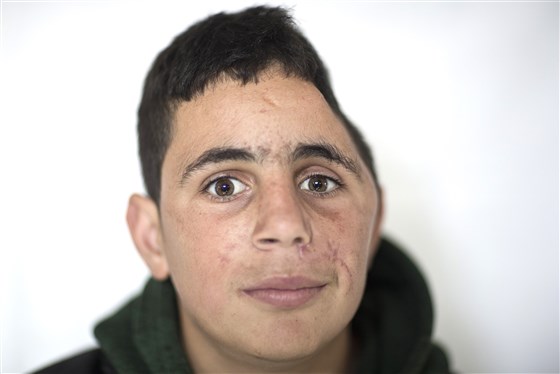
The unthinkable is absolutely routine in the occupied Palestinian territories. This particular outrage involves a familiar face – that of 15-year-old Mohammad Tamimi.
As Mohammad was walking in his village, Nabi Saleh, 4 Israeli agents disguised as Palestinians jumped him, threw him in a car, and drove out of the village.
The abduction of a young man, even a minor, is a completely ordinary event in the occupied West Bank of Palestine where, during the last 12 months, Israel has held a minimum of 6,000 prisoners at any given time, 280 or more of whom have been minors. This is scandalous but typical.
What makes Mohammad’s kidnapping singularly outrageous is his previous experience with Israeli military. It bears repeating.
Target practice
On 15 December 2017, during the weekly village protest, Mohammad peeked over a wall into an area where Israeli soldiers generally hang out – illegally occupying an empty villa for the purpose of enforcing an illegal occupation – and when they saw his head, they shot at it. From only a few yards away.
Mind you, these would have been heavily armed, bullet-proof vested, combat-helmeted soldiers. They had nothing to fear. Nevertheless, they shot Mohammad.

14-year-old Mohammad Tamimi spent 4 days in a medically-induced coma after being shot in the face by Israeli forces.
The bullet entered near his nose and lodged in the back of his skull; he was bleeding heavily. A Red Crescent ambulance rushed in.
The Israeli soldiers at first refused to let the ambulance leave.
Eventually, Mohammad made it to the hospital, where part of his skull had to be removed due to severe inflammation of his brain. Since then, he has been recovering from this life-threatening injury.
“The slap that was heard around the world”
Moments after the shooting, his cousin Ahed heard the news. Furious and distraught, she screamed at an IDF soldier loitering on her property and delivered “the slap that was heard around the world.” It was a light slap, but resulted in a midnight home invasion by the IDF and a ride to prison.
Culture Minister Miri Regev considered the incident “damaging to the honor of the military and the state of Israel.” Education Minister Naftali Bennett proposed that Ahed receive a life sentence. Deputy Knesset Speaker Bezalel Smotrich tweeted that violence would have been an appropriate response: “In my opinion, she should have gotten a bullet, at least in the kneecap. That would have put her under house arrest for the rest of her life.”
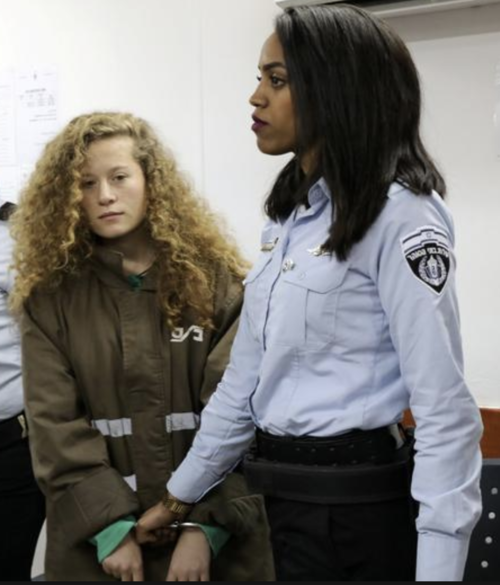
Palestinian teen Ahed Tamimi enters a military courtroom escorted by Israeli Prison Service personnel
Ahed was charged with 5 counts of assault: “threatening a soldier, attacking a soldier under aggravated circumstances, interfering with a soldier in carrying out his duties, incitement, and throwing objects at individuals or property.” She is now serving an 8-month sentence.
The soldier who had shot her cousin in the face is a free man, likely still carrying a weapon.
Mohammad’s 1st detention
Fast-forward 2 months, to 26 February. In a midnight raid on the village of Nabi Saleh, Mohammad Tamimi and 9 other Palestinian youths (5 of them, including Mohammad, minors) were arrested for alleged stone-throwing. His parents begged the police to wait a few weeks, till after the surgery to reconstruct his skull. His interrogators were unmoved. They went forward with high pressure questioning (Mohammad asserts that he was beaten) in which he “confessed” that his severe head injury had been self-inflicted, from a bicycle accident.
Coordinator of Government Activities in the Territories (COGAT) Major General Yoav Mordechai rushed excitedly to Facebook, where he posted (in Hebrew and Arabic), “Wonder of wonders. Today, the boy himself confessed to the police and to COGAT that in December his skull was injured when he was riding his bicycle. The culture of lies continues among young and old in the Tamimi family.”
A later statement from COGAT added that “The truth is always our guiding light and we will continue to present the truth in order to expose the Palestinian incitement apparatus.” And so, “bicycle accident” was the truth – until Mohammad’s doctor showed an X-ray of Mohammad’s skull with a bullet lodged inside.
How in the world did General Mordechai think he would get away with the coerced bicycle confession, given the high visibility of the events surrounding it?
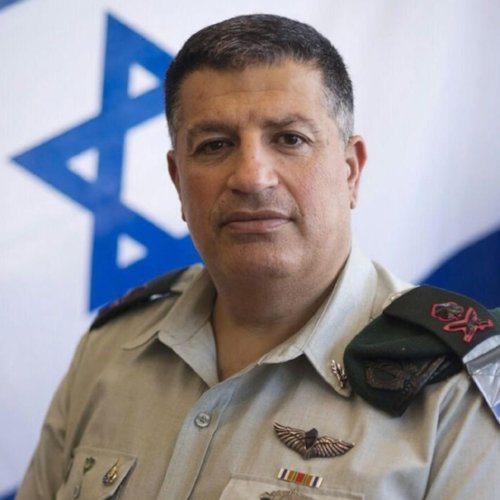
Maj. Gen. Mordechai, head of Coordinator of Government Activities in the Territories (COGAT)
Once the doctor’s report (and the actual bullet) appeared, the army’s account changed – but only slightly. When asked by Ha’aretz for a comment, army sources said they could not confirm the origins of his injury. So much for “we will continue to present the truth.”
Most news sources, both Israeli and American, had little or nothing to say when the evidence came to light. That’s how Mordechai got away with his audacious fabrication: mainstream news knows how to quit while Israel is ahead.
Mohammad’s 2nd detention
On, then, to current events. Mohammad was abducted again on the morning of 20 May, about 5 months post-shooting, 3 months post-bicycle “confession.” He was held till 11 pm, long after he was supposed to break the Ramadan fast with his family and take his medication.
Israeli police denied having detained him; no one had seen the abduction. The family feared he may have fallen and injured himself. The whole village went into search mode. But then as suddenly as he’d disappeared, he was back.
His mother, Manal, believes that Israel wants Mohammad imprisoned, but backed down this time because of his condition. “They are waiting for him to get better… They will try in the next two or three months to arrest him again,” she predicted.
Mohammad’s father, Fadel, reported that Israeli intelligence had called one of Mohammad’s doctors, informing him that Mohammad would be re-arrested once he recovered.
Fostering a culture of fear
Dawoud Yusef, who works with Palestinian prisoners’ rights group Addameer, explained that the continual detention and release of Palestinians is meant to “make the individual feel that they are never safe from the forces of the occupation.” The use of Israeli agents posing as Palestinians is particularly unnerving.
Add to that Israel’s use of surveillance balloons in Nabi Saleh that observe residents and collect intelligence on them 24/7, and one might say that Israel is winning the psychological battle.
Indeed, Mohammad’s mother disclosed, “We feel like anyone in the village can get kidnapped by the Israelis at any time,” she said. “We are scared to allow our children on the street.”
Nabi Saleh is targeted because of its years of peaceful resistance and its alleged refusal to stop “making Israel look bad.”
The fact is, Israel makes itself look bad: when its “moral army” is allowed to shoot children who pose no threat, to use snipers against kites and rocks, to kill with impunity. When its government discriminates against people of color, takes food out of the mouths of widows and orphans, persists in breach of international humanitarian law. Israel is managing its negative publicity quite well on its own.
In a land where it is somehow okay to arrest a boy recovering from brain surgery, where a slap deserves a life sentence but shooting in the face does not, reputation is the least of their worries.
Promoters of Saudi Prince as Feminist Reformer Are Silent on His Crackdown on Women
By Adam Johnson | FAIR | May 23, 2018
During his US PR tour in March, Saudi prince and de facto ruler of the absolute monarchy Mohammed bin Salman (often referred to as “MBS”) touted the progress the kingdom was making in the area of “women’s rights”—namely letting women drive and combatting nebulous reactionary forces that were somehow separate from the regime.
Since then, at least seven major women’s rights advocates—Eman al-Nafjan, Loujain al-Hathloul, Aziz al-Yousef, Aisha al-Manea, Madiha Al-Ajroush, Walaa Al-Shubbar and Hasah Al-Sheikh—have been detained by Saudi authorities and, according to at least one report (Middle East Eye, 5/22/18), may face the death penalty.
Two of the biggest media corners that helped sell bin Salman as a feminist reformer during the trip and the months leading up to it—the New York Times opinion pages and CBS News’ 60 Minutes—have not published any follow-up commentary on bin Salman’s recent crackdown on women’s rights campaigners (Independent, 5/22/18). Let’s review their past coverage:
- “In some ways, Prince Mohammed bin Salman, who serves as defense minister, is just what his country needs…. He would allow concerts, and would consider reforming laws tightly controlling the lives of women.” —New York Times editorial board (“The Young and Brash Saudi Crown Prince,” 6/23/17)
- “I never thought I’d live long enough to write this sentence: The most significant reform process underway anywhere in the Middle East today is in Saudi Arabia….There was something a 30-year-old Saudi woman social entrepreneur said to me that stuck in my ear. ‘We are privileged to be the generation that has seen the before and the after.’ The previous generation of Saudi women, she explained, could never imagine a day when a woman could drive and the coming generation will never be able to imagine a day when a woman couldn’t.” —Thomas Friedman (New York Times, 11/23/17)
- “He is emancipating women…. He has curbed the powers of the country’s so-called ‘religious police,’ who until recently were able to arrest women for not covering up.”—Norah O’Donnell (60 Minutes, 3/19/18)
The 60 Minutes interview was panned by many commentators at the time. “A crime against journalism,” The Intercept’s Mehdi Hasan (3/19/18) called it. “Embarrassing to watch,” insisted Omar H. Noureldin, VP of the the Muslim Public Affairs Council (Twitter, 3/20/18). “It was more of an Entertainment Tonight puff piece than a serious interview with journalistic standards.”
The New York Times editorial, while not quite as overtly sycophantic as Friedman and O’Donnell, still broadly painted the ruler as a “bold” and “brash” “reformer.”
Since the mass arrests of women’s group’s on Saturday, the Times news section has run several AP stories (5/18/18, 5/22/18) on the crackdown and one original report (5/18/18), but the typically scoldy editorial board hasn’t issued a condemnation of the arrests. They did, however, take time to condemn in maximalist terms the “violent regime” of Venezuela (5/21/18), insisting on “getting rid” of recently re-elected president Nicolas Maduro, and ran a separate editorial cartoon (5/22/18) showing Maduro declaring victory over the corpses of suffering Venezuelans.
Nor did MBS’s biggest court stenographer, Thomas Friedman, find room in his latest column in his latest column (5/22/18) to note the crackdown. Given Times opinion page editor James Bennet was clear his paper was axiomatically “pro-capitalism” (3/1/18), one wonders whether he views Latin American socialists as uniquely worthy of condemnation, whereas Middle East petrol dictatorships that invest in American corporations and hosts glossy tech conferences deserve nuance and mild “reform” childing. We have to “get rid of” the former, and the latter simply need “guidance” from the US—their respective human rights records a total non-factor.
CBS ran a 50-second story on the “emancipating” MBS’s crackdown on its web-only news network, CBSN (5/21/18), and an AP story on its website (5/19/18), but CBS News has thus far aired nothing on the flagrant human rights violation on any of the news programs on its actual network, and certainly nothing in the ballpark of its most-watched prime time program, 60 Minutes.
If influential outlets like the Times opinion section and CBS News are going to help build up bin Salman’s image as a “reformer” and a champion of women’s rights, don’t they have a unique obligation to inform their readers and viewers when the image they built up is so severely undermined? Shouldn’t Bennet’s editorial board and Friedman—who did so much to lend legitimacy to the Saudi ruler’s PR strategy—be particularly outraged when he does a 180 and starts arresting prominent women’s rights advocates? Will 60 Minutes do a comparable 27-minute segment detailing these arrests and their chilling effect on activism?
This is all unlikely, since US allies’ crackdown on dissent is never in urgent need of clear moral condemnation; it’s simply a hiccup on the never-ending road to “reform.”
Featured Video

Anthrax War – CBC The Passionate Eye
or go to
Aletho News Archives – Video-Images
Book Review
Shattered Dreams: The HPV Vaccine Exposed (2019)
By Christina England – 30 Q&As – Book Review & Summary
Lies are Unbekoming | September 4, 2026
… Gardasil received FDA fast-track approval in 2006, Cervarix followed in 2009, and Gardasil 9 was approved in December 2014 with more than double the aluminium adjuvant content of the original. The commercial context is specific. Merck was about to lose patent protection on Zocor and faced $18 billion in Vioxx injury claims from a cardiovascular drug the company had marketed while suppressing its own data showing a five-times increase in heart attacks. Analysts projected the global HPV vaccine market at $4 billion by 2011, contingent on government-funded national programs for teenage girls. The 1986 National Childhood Vaccine Injury Act had already granted manufacturers complete liability immunity. By 2013, Japan had withdrawn its HPV vaccine recommendation after cataloguing severe adverse reactions in hundreds of girls. No Western government followed. The establishment position across the UK, US, Australia, and most of Europe held, and still holds, that the vaccines are safe and effective, that reported injuries are coincidental, and that cervical cancer prevention justifies the program. The book was published into this position, not against a vacuum.
Shattered Dreams sits alongside Mary Holland’s The HPV Vaccine On Trial and Viera Scheibner’s foundational vaccination work as part of the documented record on what has been done to a generation of teenage girls under the banner of cancer prevention. The full summary unpacks three specific findings: that Merck used the aluminium adjuvant itself as the “placebo” control in 92.5% of trial subjects, making it structurally impossible to detect excess reactions from the adjuvant; that Dr. Sin Hang Lee found HPV DNA fragments bound to aluminium in every one of sixteen Gardasil samples tested, and in the blood and spleen of a New Zealand girl six months after her third dose; and that in every country with high vaccination coverage, including Australia, the UK, Norway, and Sweden, cervical cancer rates have stopped declining and started rising specifically in the vaccinated cohort. Martínez-Lavín’s 2017 calculation puts the number needed to seriously harm with Gardasil 9 at 140, and the number needed to vaccinate to prevent one case at 1,757. Thirteen young women are seriously harmed for every one who benefits. The vaccine was approved on the basis of trials that could not detect what the trials were supposed to detect, and it is still being given to twelve-year-olds today. … Read full review
Blog Roll
 Aletho News
- The Maidan Killings and the False-Flag Case
- Georgia’s Largest Healthcare System Will Fire Employees Who Refuse Flu Vaccine
- The Five-Year Fuel Crisis: Why the World Economy Is Paying for a War It Thinks Is Ending
- Trump’s Big Bluff on Iran
- Swiss scammed out of millions by Ukraine-linked call centers – media
- Germany facing potential ‘violent conflict’ with Russia – spy chief
- Ukraine’s EU neighbors reject new plea from Kiev – Politico
- British Transport Police Facial Recognition Trial Scanned 926,912 People With Zero Arrests
- House Bill Would Ban Federal Use of Flock ALPR Data
- Can a Spice Rival a Drug? 10 Head-to-Head Trials Put It to the Test.
- If Americans Knew
- “We See Our Homes Now From A Satellite, Like Strangers”
- Watch “Gaza: Doctors Under Attack”, originally censored by BBC
- NAZA: Israeli embassies in UK and US promote rival documentary to challenge Gaza genocide allegations
- David Ellison appoints Israeli to lead merged Paramount-Warner studios
- Turkish Red Crescent helps elderly Gaza man walk again after Israel confiscates his prosthetic limb
- Four Palestinians Killed in Israeli Attacks in Gaza
- Two Palestinian youths killed and village razed as Israeli attacks on West Bank continue
- Two more Christian women victims of Israeli raids on Gaza
- Cruelty, Deprivation, Indignity: A Journalist’s 22 Months in Israeli Prison
- New IDF Website Frames Slain Gaza Journalists as Terrorists
- No Tricks Zone
- Latest European Green Energy Debacle; Portugal’s Largest Flagship Solar Park Insolvent!
- Green Energy Debacle: German Expert Professor Fritz Vahrenholt Warns Of Severe Economic And Social Consequences
- Two More Paleo Reconstructions Affirm Meters-Higher Sea Levels Across Ireland, Brazil 7000-6000 Years Ago
- New Study: Earth And Venus Surface Warmth Largely Explained By Convection And Lapse Rate, Not CO2 Or Radiation
- 2025 Nature Paper Claiming Worsening Global Drought Gets RETRACTED …Heavily Flawed
- New Study: ‘Global Drought Shows No Detectable Recent Acceleration Under Climate Warming’
- Economic Masterminds: German Socialists Suggest Taxing Productivity Gains Stemming From Using AI
- The South China Sea Has Not Been Cooperating With The Climate Change Narrative
- Energy Crisis: Germany Enters Heating Season With Historically Low Gas Reserve Fill Levels
- New Study: The Antarctic Ice Sheet Gained Mass From 2020-2024 Due To Staggering Snow And Ice Accumulation


