Draft Version of Scotland Yard’s Statement on Behalf of Sergei Skripal
By Rob Slane | The Blog Mire | May 25, 2018
Warning: It is “highly likely” that this statement contains traces of satire.
“I was discharged from Salisbury District Hospital on the 18th May, more than two months after being poisoned by a military grade nerve agent, of a type developed by Russia.
Like my daughter Yulia, I find myself in a new and unique set of circumstances than the ones I faced before the 4th March, when I was poisoned by a military grade nerve agent, of a type developed by Russia.
I am now spending the time of my convalescence seeking to come to terms with my prospects, and looking forward to a future without trepidation, despite having being poisoned by a military grade nerve agent, of a type developed by Russia.
I would like to take this opportunity to correct a number of erroneous stories that have been circulating on the worldwide web, especially on a number of sites devoted to the propagation of conspiracy theories.
The first is in respect to my alleged connections with my former MI6 handler, who also happens to live in Salisbury, and with whom I was in the habit of frequenting one of the City’s establishments for the consumption of certain comestibles and beverages. I would like to assure those attempting to make these links that there is no credibility in them whatsoever, and that they should desist from making them. We were merely old friends who happened to share a passion for gardening, backgammon, and Châteauneuf-Du-Pape 2014 Réserve Des Oliviers. Any connection between this relationship and my poisoning — by a military grade nerve agent, of a type developed by Russia — is entirely without foundation.
I would also like to address those who claim that I am being held against my will and denied my rights. I want to clarify that this supposition is very wide of the mark and bears no relation to the actualité. On the contrary, I have the freedom to go wherever I wish, naturally within the bounds of the beautiful location in which I currently reside, and I would also want to reassure everyone that I have full access to friends, family, and information. I am free to call my mother at anytime, and I may well do this, when I judge that it will not be prejudicial to my continued recovery. All such talk of disappearance or abduction is arrant nonsense.
I have been assigned specially trained officers who have helped to take care of all my needs and who have explained the details of the painstaking investigative processes that are being undertaken to establish how I and my daughter were poisoned by a military grade nerve agent — of a type developed by Russia — on the door handle of my abode. They have also explained that the substance must have been carefully designed to take effect on the two of us at precisely the same time, some four hours after its administration, and after we had visited a public house and a restaurant in the City. They have also been very helpful in explaining how it was nothing short of a miracle that Yulia and I recovered from what I understand is ordinarily the most deadly of substances, with no irreparable damage.
I wish to make clear that I have been given the names and email addresses of staff at the Russian Embassy in London, and naturally I am perfectly free to contact them at any time, should I wish to avail myself of their services. However, at this particular juncture, whilst I am simply overwhelmed by their abundant kindness in attempting to contact me, I would like them know that I do not wish to speak to them or see them, and I would ask them to kindly desist from all their efforts to pressure the British Government into granting access to me.
Although I feel perfectly safe and secure at my new location, which understandably cannot be disclosed, I do not yet feel able to face the media to give a full interview, although it is the deepest desire of my heart to one day do so. Until such time, I want to make it abundantly clear that nobody speaks for me or on my behalf, except of course the fully trained and highly professional officers of Scotland Yard, whom I have authorised to speak and release statements on my behalf.
Any suggestion that this statement was written by them without my knowledge, or that it was written by me whilst under duress, is — to coin a popular English idiom — manufactured from whole cloth. I would ask that, out of respect for my privacy, people desist from asking any further questions in this respect.
I want to end by thanking the British Prime Minister, Mrs May, and her colleague, Mr Johnson, who I understand acted swiftly, decisively and — I might add — courageously in dealing with the political ramifications of the poisoning, by a military grade nerve agent, of a type developed by Russia. Their actions in attributing culpability so swiftly are highly commendable and a demonstration of their undoubted bravery, their commitment to upholding the rule of law, and of course their remarkable fitness to lead in their respective ministerial positions.
I hope very much to be able to return to Russia one day, but in the short term, I look forward to being reunited with my pet cat and two guinea pigs, which I understand are being well looked after at an undisclosed location.”
Claim: $220 Billion “Family Planning” Equivalent to a Trillion Dollars of Climate Tech Investment

Displaced Rohingya people in Rakhine State. By Foreign and Commonwealth Office – Flickr, OGL, Link
By Eric Worrall | Watts Up With That? | May 22, 2018
Family planning charities suggest helping poor women “control their fertility” will save as much CO2 as a trillion dollars of investment in low carbon technologies. But provision of family planning wrapped around a higher purpose has a long and ugly history.
Worried About Climate Change? Investing in Reproductive Health Must Be Part of the Solution
Monday, 21st May 2018
Chris Turner
…Since the invention of the contraceptive pill in the 1950’s, access to modern contraception has driven some of the key demographic and social changes in history. It has delivered improved health outcomes for mothers and babies as women are able to wait longer between births or delay having their first child. It created demographic shifts, as populations have fewer dependents and a more productive labour force. It has empowered girls and women to stay in school longer, seek higher education and participate in the formal economy. And now recent research has determined that contraception also has a key role to play in addressing climate change.
…
Poverty reduction and strengthening economies
When women can exercise reproductive choice, they are more likely to participate in education and the workforce. In most developing countries, female participation in the formal economy has increased as fertility has fallen. Women’s participation in the economy promotes economic growth and economies that are strong are better able to absorb the disturbances of climate change and recover from climate-related events.
…
Women’s participation and leadership
Women’s participation and leadership is important to climate change preparedness, resilience and action. Enabling women to control their bodies and reproductive health can help create opportunities for women to participate, lead and contribute to the conversation.
As a climate change mitigation strategy, family planning programs are also more cost-effective than other conventional, energy-focused solutions. One study found that $220 billion spent on providing family planning to those with an unmet need would reduce 34 gigatons of global carbon emissions, compared to $1 trillion for a similar outcome if spent on low carbon technologies.
…
Regardless of your position on birth control and abortion, I think we can all feel a sense of unease when efforts to provide “family planning” are offered as part of a larger mission to reduce population, rather than placing the interests of the recipients of the medical aid first.
Provision of birth control to poor people has a long, ugly history. For example, consider this Guardian story about the Bangladesh government’s recent efforts to offer sterilisation services to inconvenient Rohingya refugees displaced by ongoing political turmoil in Burma.
Bangladesh to offer sterilisation to Rohingya in refugee camps
Family planning authorities have asked the government to launch vasectomies and tubectomies for women in Cox’s Bazar, where 1m refugees fight for space.
Bangladesh is planning to introduce voluntary sterilisation in its overcrowded Rohingya camps, where nearly a million refugees are fighting for space, after efforts to encourage birth control failed.
More than 600,000 Rohingya have arrived in Bangladesh since a military crackdown in neighbouring Myanmar in August triggered an exodus, straining resources in the impoverished country.
The latest arrivals have joined hundreds of thousands of Rohingya refugees who fled in earlier waves from Myanmar’s Rakhine state, where the stateless Muslim minority has endured decades of persecution.
Most live in desperate conditions with limited access to food, sanitation or health facilities and local officials fear a lack of family planning could stretch resources even further.
…
Many of the refugees told AFP they believed a large family would help them survive in the camps, where access to food and water remains a daily battle and children are often sent out to fetch and carry supplies.
Others had been told contraception was against the tenets of Islam.
Farhana Sultana, a family planning volunteer who works with Rohingya refugees in the camps, said many of the women she spoke to believed birth control was a sin.
“In Rakhine they did not go to family planning clinics, fearing the Myanmar authorities would give medicine that harms them or their children,” Sultana said.
…
You could reasonably argue that refugee women having 19 children each is unsustainable. But I doubt the first concern of the Bangladeshi authorities is the well-being of the Rohingya. I suspect the Bangladeshi authorities would be overjoyed if the Rohingya refugee problem just quietly disappeared.
Over zealous family planning doesn’t just occur in poor countries. The USA has experienced domestic scandals in the past related to forced sterilisation, and scandals with the practices of organisations like Planned Parenthood, including accusations of medical racism.
My point is I personally have no problem with women having access to the medical services they need to create a better life for themselves and their families. I understand some people likely have different opinions about reproductive issues, what is an is not acceptable, to myself.
But surely we can all agree that mixing family planning with another mission like reducing humanity’s global carbon footprint creates a horrifying risk that the welfare of patients will not be the top priority. There are many ugly historical examples to support this concern.
Time for UK to Apologize to Moscow for Accusations Over Skripal Case – Embassy
Sputnik – 25.05.2018
The Russian Embassy in the United Kingdom said on Friday it was time for the UK side to apologize to Russia for accusations over the poisoning of Sergei and Yulia Skripal, as no evidence was provided by London to substantiate its claims of Moscow’s involvement during the three months which passed since the incident.
“Time has come for British authorities to apologize to Russia for the hollow accusations accompanied by an unprecedented anti-Russian campaign, to give answers to all the questions and requests officially sent to the British side on this matter, to engage with Russian law enforcement agencies that have opened the criminal case regarding the attempted murder of Yulia Skripal, and to stop isolating the two Russian citizens,” the embassy’s press release read.
Meanwhile, Russian President Vladimir Putin urged to stop speculations on the so-called Skripal case and conduct a joint objective investigation instead.
“We need to either carry out a joint objective and thorough investigation, or simply stop talking on this topic, because it does not lead to anything but a deterioration of relations,” he said.
Putin also questioned the alleged fact of poisoning of ex-spy Sergei Skripal and his daughter by a military-grade nerve agent.
“I’m not a specialist in chemical warfare agents, but as far as I can imagine, if a warfare agent is used, the victims of this attack die on the spot, almost immediately. But nothing happened in this case. Skripal himself and his daughter are alive, and have been discharged from the hospital. His daughter looks quite alright, everyone is alive and well,” the president stressed.
On May 1, UK National Security Adviser Mark Sedwill told the UK lower house defense committee that no suspects had been identified in the March’s attack on the former Russian intelligence officer Sergei Skripal and his daughter in Salisbury.
Analysis by the Organization for the Prohibition of Chemical Weapons (OPCW) of the Salisbury incident confirmed the UK findings related to the nature of the chemical used in the poisoning, but did not include any information that would help the UK government substantiate claims about Russian involvement in the incident.
The United Kingdom and its allies have blamed Russia for an alleged role in the poisoning despite presenting no proof. Over a hundred Russian diplomats have since been expelled from these countries in solidarity with London and to put pressure on Moscow, which denies any involvement.
Can the President Lawfully Investigate His Investigators?
By Andrew Napolitano • Unz Review • May 24, 2018
This past weekend, President Donald Trump suggested that his presidential campaign may have been the victim of spies or moles who were FBI informants or undercover agents. He demanded an investigation to get to the bottom of the matter.
At the same time that the president was fuming over this, Republican congressional leaders were fuming about the reluctance of senior officials at the Department of Justice and the FBI to turn over documents that might reveal political origins of the current criminal investigation of the president by special counsel Robert Mueller.
Can the president intercede in a federal criminal investigation of which he himself is a subject? Can Congress intercede in a DOJ criminal investigation? Here is the back story.
Mueller was named special counsel so he could investigate serious and demonstrable evidence of Russian government interference in the 2016 presidential election. Because the Trump campaign met with Russian intelligence officials offering campaign assistance, implicit in that investigation is an inquiry into whether the Trump campaign invited foreign interference and agreed to accept or facilitate it.
Mueller is seeking to determine whether there was an agreement between the Trump campaign and any foreign person, entity or government to receive anything of value for the campaign. Such an agreement plus a material step in furtherance of it taken by any of those who joined the agreement would itself constitute the crime of conspiracy, even if the agreed-upon thing of value never arrived.
In the course of examining evidence for the existence of this alleged conspiracy — which Trump has forcefully denied many times — Mueller’s prosecutors and FBI agents have come upon evidence of other crimes. They have obtained 19 indictments — some for financial crimes, some for lying to FBI agents and some for foreign interference in the election — and four guilty pleas for lying, in which those who pleaded guilty agreed to assist the government.
Nine of the indictments are against Russian intelligence agents, whom the president himself promptly sanctioned by barring their travel here and their use of American banks and commercial enterprises, even though he has called Mueller’s investigation a witch hunt.
Mueller has also come upon evidence of obstruction of justice by the president while in office and financial crimes prior to entering office, all of which Trump has denied. Obstruction of justice consists of interfering with a judicial proceeding — such as a grand jury’s hearing evidence — for a corrupt purpose.
Thus, if Trump fired FBI Director James Comey because he didn’t trust him or because he wanted his own person in that job, that was his presidential prerogative, but Trump’s purpose was corrupt if he fired Comey because Comey would not deny that the president was the subject of a criminal investigation — a basis for firing surprisingly offered publicly by one of the president’s own lawyers.
The potential financial crimes appear to be in the areas of bank fraud — making material misrepresentations to banks to obtain loans — and money laundering, or the passage of ill-gotten gains through numerous bank accounts so as to make the gains appear lawful. These, too, Trump has denied.
It seems that the deeper Mueller and his team dig the more they find. As lawyers and as federal prosecutors, Mueller’s team members have ethical obligations to uncover whatever evidence of crime they come upon and, when professionally feasible and legally appropriate, either prosecute or pass the evidence on to other federal prosecutors, as they did in the case of evidence of fraud against Michael Cohen, a former confidant and lawyer for Trump before he was president.
Now, back to Trump’s eruption about FBI spies or moles.
The president cannot interfere with criminal investigations against himself without running the risk of additional charges of obstruction of justice — interference with a judicial process (the gathering of evidence and its presentation to a grand jury) for a corrupt purpose (impeding his own prosecution or impeachment). Nor can members of Congress see whatever they want in the midst of a criminal investigation, particularly if they might share whatever they see with the person being investigated.
Prosecutors have a privilege to keep their files secret until they reach the time that the law provides for them to go public. Because Mueller is faced with the legal equivalent of assembling a 10,000-piece jigsaw puzzle, he is not yet ready to show his cards. If his cards contain materials from confidential sources — people whose identities he promised not to reveal — or if his cards contain evidence he presented to a grand jury, he may not lawfully reveal what he has until it is time to exonerate the president, indict him or present a report to Mueller’s DOJ superiors that is intended for the House of Representatives.
Can the president investigate his investigators?
Yes — but not until the investigation of him is completed. That’s because no one can fruitfully examine the legitimacy of the origins of the case against Trump without knowing the evidence and the charges. Trump’s allegations are of extreme scandal — the use of FBI assets by the Obama administration to impede his presidential campaign. Yet if he is exonerated, those allegations will lose their sting. If he is charged with crimes or impeachable offenses that do not have their origins in politically charged spying, then his allegations will be moot.
But if he were to force the DOJ to turn over raw investigative files now to politicians who want to help him, he might very well be impeding the criminal case against him. That would be profoundly threatening to the rule of law, for it provides that no man can be the prosecutor or the judge in his own case. Even Trump’s lawyers acknowledge that he could not lawfully do that.
Copyright 2018 Andrew P. Napolitano. Distributed by Creators.com.
Trump takes ‘Criminal Deep State’ to task amid claims FBI spied on his campaign
By Robert Bridge | RT | May 24, 2018
Hounded by claims of ‘Russian collusion’ for most of his presidency, Trump is now calling out the Obama administration over claims it had the FBI spying on his campaign. Can the Republican leader turn the tables on his accusers?
In a series of rapid-fire Tweets, Trump called upon the Justice Department to investigate claims that the FBI infiltrated his campaign for political purposes, possibly at the direct order of former president, Barack Obama.
“I hereby demand, and will do so officially tomorrow, that the Department of Justice look into whether or not the FBI/DOJ infiltrated or surveilled the Trump Campaign for Political Purposes – and if any such demands or requests were made by people within the Obama Administration!”
Needless to say, those are Watergate-level allegations, and it seems Trump may even possess the one thing the Mueller investigation has conspicuously lacked to date: hard-core evidence.
This month, it was revealed that Professor Stefan Halper, a foreign policy scholar at Cambridge University until 2015, was serving as an FBI mole inside of the Trump campaign.
The operation, started in July 2016 and codenamed ‘Crossfire Hurricane’, is a stunning revelation because for the last two years the FBI denied it was spying on the Trump campaign. Now there is the obvious question as to why the federal agency had infiltrated the Trump team in the first place. Was it simply to find evidence of ‘Russian collusion,’ or, as Trump has suggested, was it politically motivated?
Aside from the high creep factor of academics moonlighting as actual spies, Halper allegedly arranged meetings with campaign advisers Carter Page, George Papadopoulos, and Sam Clovis in an apparent effort to build the case for Russia collusion, the Washington Post reported.
As one example of his covert work, Halper reportedly “reached out to George Papadopoulos, an unpaid foreign-policy adviser for the campaign, inviting him to London to work on a research paper.”
Those efforts to dig up dirt on Trump, however, failed to give Robert Mueller his much-anticipated ‘gotcha!’ moment. Indeed, from Paul Manafort (indicted for corruption in Ukraine) to Stormy Daniels (former American porn star) to Evgeny Freidman (New York ‘taxi king’ and tax cheat), and every other shady character in between, Mueller has failed to make anything more than a tenuous connection to Russia.
Now, combine this ‘nothing burger’ with the debunked claims put forth in the Clinton-funded ‘Steele dossier,’ complete with “golden showers” in Moscow, and you have a very good case to “wrap up” the investigation, as Vice President Mike Pence recommended.
Here is why the Trump administration believes they have finally got the deep state blocked in with the latest findings: the FBI and DOJ must have known that there was zero evidence of Russian collusion since their mole (or moles) would have revealed that information long ago. At the same time, Halper is said to have begun his covert activities inside of the Trump campaign before Crossfire Hurricane began, which also complicates matters for the Democrats.
Thus, the entire Mueller investigation, Republicans argue, has been an elaborate farce, designed to tarnish Trump and the Republican Party in the run-up to the monumental midterm elections. Trump is already claiming that the tables have been turned on the Mueller investigation and the deep state.
“Look how things have turned around on the Criminal Deep State. They go after Phony Collusion with Russia, a made up Scam, and end up getting caught in a major SPY scandal the likes of which this country may never have seen before! What goes around, comes around!” he tweeted triumphantly Wednesday morning.
Naturally, Trump’s announcement triggered howls of pain from the Democrats. Senate Minority Leader Chuck Schumer (D-NY) accused the White House on Tuesday of putting “extraordinary, unusual and inappropriate pressure on the Department of Justice and the investigation into Russian meddling in the 2016 election.”
Schumer then lashed out at House Intelligence Chairman Devin Nunes (R-Calif.), who subpoenaed the DOJ for all documents related to the FBI informant earlier this month.
“A man like Devin Nunes, who, I hear privately from my Republican colleagues — they think he’s off the deep end,” he said in a personal affront.
That’s right. Schumer thinks it is Nunes who is “off the deep end” because the Republicans have a solid case for proving high-level political manipulation inside of the Trump campaign. The Senator doth protest too much, methinks. Meanwhile, members of the political right have suggested that Barack Obama, who was the Commander-in-Chief at the time of Trump’s campaign being infiltrated, should be forced to explain what prompted such a decision.
“If he doesn’t know, then it would seem a public explanation is also in order — about his management, and about just how far the ‘deep state’ went without specific presidential approval,” argued James Freeman, assistant editor of the Wall Street Journal.
On Thursday, House Intelligence Committee Chairman Devin Nunes and House Oversight Committee Chairman Trey Gowdy will meet with DOJ officials, who are expected to turn over documents detailing the federal intrusion of the Trump campaign.
I reached out to Lionel, legal analyst at lionelmedia.com and regular RT commentator, for some insight into Trump’s chances for emerging successful as he attempts to gain information from the Department of Justice and FBI.
First, there is the composition of the DOJ, which Lionel described, as only Lionel can, as a “Lernaean Hydra with many facets, divisions, jurisdictions and levels of loyalty.”
“There are lifetime, career prosecutors and agents not necessarily committed to an administration or party and there are the targeted, viz. the politically corrupt, biased, partisan and ‘Deep State’ swamp critters whom President Trump has so affectionately titled,” he explained.
Lionel says “the plot now thickens” as Attorney General Jeff Sessions tapped US Attorney John Huber, a Republican from the red state of Utah, to investigate all matters and issues the Republicans have been demanding.
“Huber is a federal prosecutor with plenary powers to empanel grand juries, obtain indictments and secure results that make those of a Special Prosecutor pale by comparison,” he explained. “Sessions has further ordered Huber to work in coordination with DOJ Inspector General (IG) Michael Horowitz and his staff of 470 that dwarfs any of that of a Special Prosecutor.”
“Moreover, the fact that this [US Attorney] is based in Utah means that he’s far from the fetid swamp that is Washington DC. Far from a potential grand jury pool that is anti-Trump, anti-Sessions and (ahem) anti-justice. The move tactically was brilliant.”
As far as the investigation against Trump, which just entered its second year, “Mueller’s status is an unconstitutional hybrid that normally would require Senate confirmation,” the legal analyst explained via email.
“The good news (or bad news, depending on one’s vantage) is that with a Huber-Horowitz team in place, Mueller’s outgunned, outmatched and outmanned.” In short, with the Huber-Horowitz team in place in distant Utah, this means “checkmate” for team Trump, Lionel believes.
Whether or not that prediction comes true, it will be very interesting to see what move the Democrats and the Mueller investigation makes next, because the available spaces on this chessboard of extremely high stakes are diminishing at a breathtaking pace.
Robert Bridge is an American writer and journalist. Former Editor-in-Chief of The Moscow News, he is author of the book, ‘Midnight in the American Empire,’ released in 2013.
Read more:
Missile that downed MH17 came from Russian military, unit of origin pinpointed – intl investigators
RT | May 24, 2018
A Dutch-led probe says the missile that hit flight MH17 over Ukraine came from a unit in western Russia. Claims about its Russian origin were made by activist group Bellingcat earlier, but it was seriously questioned back then.
The international team investigating the 2014 tragedy, in which Malaysia Airlines flight MH17 crashed in eastern Ukraine, reiterated the claim that it was a Buk missile, but now claims it also pinpointed the exact unit responsible.
The Dutch-led Joint Investigation Team (JIT) “has come to the conclusion that the BUK-TELAR that shot down MH17 came from 53rd Anti-aircraft Missile Brigade based in Kursk in Russia,” the head of the crime squad of the Dutch National Police, Wilbert Paulissen, told reporters on Thursday.
The findings also claim that the missile carrier came from Russia and was returned to the country. However, the investigators have apparently failed to move any further than British online investigative activist group Bellingcat, which presented their report nearly one year ago and made the same allegations.
“We realize that the investigation collective Bellingcat has already concluded the same and published it,” Paulissen said, noting that his team carried out a separate, “independent” probe.
The conclusions were announced even though the probe is still unfinished and currently in its “last phase,” and there is still much to be done, according to JIT members. Two questions still remain unanswered – who was responsible for shooting down the plane, and why did it happen? Moreover, further evidence to back up the “revelations” is currently not available to the public.
In 2016, the Dutch-led group said it suspected around 100 people could be linked to the alleged transportation of the Buk missile system to eastern Ukraine and the missile launch. Nearly two years of investigation made their role clearer, according to Thursday’s update, but the number of people involved was narrowed down to dozens, Dutch Chief Prosecutor Fred Westerbeke said.
While the latest JIT statement hardly presents anything new, earlier Bellingcat reports were refuted by ‘Anti-Bellingcat’ activists. Russian bloggers, journalists, aviation experts, and volunteers united in a group to highlight significant flaws and inaccuracies in the Bellingcat version of the tragedy.
For example, there is the repeated claim that a Buk missile system was transported through the Russian-Ukrainian border to the place the missile was allegedly fired and then returned. The Bellingcat report used pictures and data from open sources, showing the Buk system on both sides of the border and claiming it was the same. However, the one spotted in Russia was of different modification, the activists noted, pointing out that it contains a “step” on the left side of the system.
The British group’s claims that there were no Ukrainian Buk missile systems in the conflict-zone were also debunked by their Russian peers. They provided various screen shots of Ukrainian media reports picturing the systems belonging to the Ukrainian Army in the same area.
Last month, Russian Foreign Minister Sergey Lavrov stressed that Russia provided uncut radar-location data “that cannot be faked or changed” and “clearly” shows the missile did not come from the direction the investigators claimed. However, all data on the tragedy provided by Moscow was only selectively accepted by the multinational team of investigators, Lavrov said at a joint news conference with his Dutch counterpart, Stef Blok in Moscow.
Former UK Ambassador Craig Murray unconvinced by Yulia Skripal interview: ‘Duress cannot be ruled out’
By Craig Murray | May 24, 2018
I was happy to see Yulia alive and looking reasonably well yesterday, if understandably stressed. Notably, and in sharp contrast to Litvinenko, she leveled no accusations at Russia or anybody else for her poisoning. In Russian she spoke quite naturally. Of the Russian Embassy she said very simply “I am not ready, I do not want their help”. Strangely this is again translated in the Reuters subtitles by the strangulated officialese of “I do not wish to avail myself of their services”, as originally stated in the unnatural Metropolitan Police statement issued on her behalf weeks ago.
“I do not wish to avail myself of their services” is simply not a translation of what she says in Russian and totally misses the “I am not ready” opening phrase of that sentence. My conclusion is that Yulia’s statement was written by a British official and then translated to Russian for her to speak, rather than the other way round. Also that rather than translate what she said in Russian themselves for the subtitles, Reuters have subtitled using a British government script they have been given.
It would of course have been much more convincing had Sergei also been present. Duress cannot be ruled out when he is held by the British authorities. I remain extremely suspicious that, at the very first chance she got in hospital, Yulia managed to get hold of a telephone (we don’t know how, it was not her own and she has not had access to one since) and phone her cousin Viktoria, yet since then the Skripals have made no attempt to contact their family in Russia. That includes no contact to Sergei’s aged mum, Yulia’s grandmother, who Viktoria cares for. Sergei normally calles his mother – who is 89 – regularly. This lack of contact is a worrying sign that the Skripals may be prevented from free communication to the outside world. Yulia’s controlled and scripted performance makes that more rather than less likely.
It is to me particularly concerning that Yulia does not seem to have social media access. The security services have the ability to give her internet risk free through impenetrable VPN. But they appear not to have done that.
We know a little more about the Salisbury attack now:
Nobody – not Porton Down, not the OPCW – has been able to state that the nerve agent found was of Russian manufacture, a fact which the MSM continues to disgracefully fudge with “developed in Russia” phrasing. As is now well known and was reported by Iran in scientific literature, Iran synthesised five novichoks recently. More importantly, the German spying agency BND obtained novichok in the 1990s and it was studied and synthesised in several NATO countries, almost certainly including the UK and USA.
In 1998, chemical formulae for novichok were introduced into the United States NIST National Institute of Standards and Technologies Mass Spectrometry Library database by U.S. Army Edgewood Chemical and Biological Defense Command, but the entry was later deleted. In 2009 Hillary Clinton instructed US diplomats to feign ignorance of novichoks, as revealed by the last paragraph of this Wikileaks released diplomatic cable.
Most telling was the Sky News interview with the head of Porton Down. Interviewer Paul Kelso repeatedly pressed Aitkenhead directly on whether the novichok could have come from Porton Down. Aitkenhead replies “There is no way, anything like that could… leave these four walls. We deal with a number of toxic substances in the work that we do, we’ve got the highest levels of security and controls”. Asked again twice, he each time says the security is so tight “the substance” could not have come from Porton Down. What Aitkenhead does NOT say is “of course it could not have come from here, we have never made it”. Indeed Aitkenhead’s repeated assertion that the security would never have let it out, is tantamount to an admission Porton Down does produce novichok.
If somebody asked you whether the lion that savaged somebody came from your garden, would you reply “Don’t be stupid, I don’t have a lion in my garden” or would you say, repeatedly, “Of course not, I have a very strong lion cage?”. Here you can see Mr Aitkenhead explain repeatedly he has a big lion cage, from 2’25” in.
So the question of where the nerve agent was made remains unresolved. The MSM has continually attempted to lie about this and affirm that all novichok is Russian made. The worst of corporate and state journalism in the UK was exposed when they took the OPCW’s report that it confirmed the findings of Porton Down and presented that as confirming the Johnson/May assertion that it was Russia, whereas the findings of Porton Down were actually – as the Aitkenhead interview stated categorically – that they could not say where it was made.
The other relatively new development is the knowledge that Skripal had not retired but was active for MI6 on gigs briefing overseas intelligence agencies about Russia. This did not increase his threat to Russia, as he told everything he knows a decade ago. But it could provide an element of annoyance that would indeed increase Russian official desire to punish him further.
But the fact he was still very much active has a far greater significance. The government slapped a D(SMA) notice on the identity of Pablo Miller, Skripal’s former MI6 handler who lives close by in Salisbury and who worked for Christopher Steele’s Orbis Intelligence at the time that Orbis produced the extremely unreliable dossier on Trump/Russia. The fact that Skripal had not retired but was still briefing on Russia, to me raises to a near certainty the likelihood that Skripal worked with Miller on the Trump dossier.
I have to say that, as a former Ambassador in the former Soviet Union trained in intelligence analysis and familiar with MI6 intelligence out of Moscow, I agree with every word of this professional dissection of the Orbis Trump dossier by Paul Roderick Gregory, irrespective of Gregory’s politics. In particular this paragraph, which Gregory wrote more than a year before the Salisbury attack, certainly applies to much of the dossier.
I have picked out just a few excerpts from the Orbis report. It was written, in my opinion, not by an ex British intelligence officer but by a Russian trained in the KGB tradition. It is full of names, dates, meetings, quarrels, and events that are hearsay (one an overheard conversation). It is a collection of “this important person” said this to “another important person.” There is no record; no informant is identified by name or by more than a generic title. The report appears to fail the veracity test in the one instance of a purported meeting in which names, dates, and location are provided. Some of the stories are so bizarre (the Rosneft bribe) that they fail the laugh test. Yet, there appears to be a desire on the part of some media and Trump opponents on both sides of the aisle to picture the Orbis report as genuine but unverifiable.
The Russian ex-intelligence officer who we know was in extremely close contact with Orbis at the time the report was written, was Sergei Skripal.
The Orbis report is mince. Skripal knew it was mince and how it was written. Skripal has a history of selling secrets to the highest bidder. The Trump camp has a lot of money. My opinion is that as the Mueller investigation stutters towards ignominious failure, Skripal became a loose end that Orbis/MI6/CIA/Clinton (take your pick) wanted tied off. That seems to me at least as likely as a Russian state assassination. To say Russia is the only possible suspect is nonsense.
The Incompetence Factor
The contradiction between the claim that the nerve agent was so pure it could only be manufactured by a state agent, and yet that it failed because it was administered in an amateur and incompetent fashion, does not bother the mainstream media. Boris Johnson claimed that the UK had evidence that Russia had a ten year programme of stockpiling secret novichok and he had a copy of a Russian assassination manual specifying administration by doorknob. Yet we are asked to believe that the Russians failed to notice that administration by doorknob does not actually work, especially in the rain. How two people both touched the doorknob in closing the door is also unexplained, as is how one policeman became poisoned by the doorknob but numerous others did not.
The explanations by establishment stooges of how this “ten times more powerful than VX” nerve agent only works very slowly, but then very quickly, if it touches the skin, and still does not actually kill you, have struck me as simply desperate. They make May’s ringing claims of a weapon of mass destruction being used on British soil appear somewhat unjustified. Weapon of Upset Tummy does not sound quite so exciting.
To paint a doorknob with something that, if it touches you, can kill you requires great care and much protective gear. That no strangely dressed individual has been identified by the investigation – which seems to be getting nowhere in identifying the culprit – is the key fact here. None of us know who did this. The finger-pointing at Russia by corporate and state interests seeking to stoke the Cold War is disgusting.
Wikipedia Is An Establishment Psyop
By Caitlin Johnstone | Medium | May 20, 2018
If you haven’t been living in a hole in a cave with both fingers plugged into your ears, you may have noticed that an awful lot of fuss gets made about Russian propaganda and disinformation these days. Mainstream media outlets are now speaking openly about the need for governments to fight an “information war” against Russia, with headlines containing that peculiar phrase now turning up on an almost daily basis.
Here’s one published today titled “Border guards detain Russian over ‘information war’ on Poland,” about a woman who is to be expelled from that country on the grounds that she “worked to consolidate pro-Russian groups in Poland in order to challenge Polish government policy on historical issues and replace it with a Russian narrative” in order to “destabilize Polish society and politics.”
Here’s one published yesterday titled “Marines get new information warfare leader,” about a US Major General’s appointment to a new leadership position created “to better compete in a 21st century world.”
Here’s one from the day before titled “Here’s how Sweden is preparing for an information war ahead of its general election,” about how the Swedish Security Service and Civil Contingencies Agency are “gearing up their efforts to prevent disinformation during the election campaigns.”
This notion that the US and its allies are fighting against Russian “hybrid warfare” (by which they typically mean hackers and disinformation campaigns) has taken such deep root among think tanks, DC elites and intelligence/defense circles that it often gets unquestioningly passed on as fact by mass media establishment stenographers who are immersed in and chummy with those groups. The notion that these things present a real threat to the public is taken for granted to such an extent that they seldom bother to even attempt to explain to their audiences why we’re meant to be so worried about this new threat and what makes it a threat in the first place.
Which is, to put it mildly, really weird. Normally when the establishment cooks up a new Official Bad Guy they spell out exactly why we’re meant to be afraid of them. Marijuana will give us reefer madness and ruin our communities. Terrorists will come to where we live and kill us because they hate our freedom. Saddam Hussein has Weapons of Mass Destruction which can be used to perpetrate another 9/11. Kim Jong Un might nuke Hawaii any second now.
With this new “Russian hybrid warfare” scare, we’re not getting any of that. This notion that Russians are scheming to give westerners the wrong kinds of political opinions is presented as though having those political opinions is an inherent, intrinsic threat all on its own. The closest they typically ever get to explaining to us what makes “Russian disinformation” so threatening is that it makes us “lose trust in our institutions,” as though distrusting the CIA or the US State Department is somehow harmful and not the most logical position anyone could possibly have toward historically untrustworthy institutions. Beyond that we’re never given a specific explanation as to why this “Russian disinformation” thing is so dangerous that we need our governments to rescue us from it.
The reason we are not given a straight answer as to why we’re meant to want our institutions fighting an information war on our behalf (instead of allowing us to sort out fact from fiction on our own like adults) is because the answer is ugly.
As we discussed last time, the only real power in this world is the ability to control the dominant narrative about what’s going on. The only reason government works the way it works, money operates the way it operates, and authority rests where it rests is because everyone has agreed to pretend that that’s how things are. In actuality, government, money and authority are all man-made conceptual constructs and the collective can choose to change them whenever it wants. The only reason this hasn’t happened in our deeply dysfunctional society yet is because the plutocrats who rule us have been successful in controlling the narrative.
Whoever controls the narrative controls the world. This has always been the case. In many societies throughout history a guy who made alliances with the biggest, baddest group of armed thugs could take control of the narrative by killing people until the dominant narrative was switched to “That guy is our leader now; whatever he says goes.” In modern western society, the real leaders are less obvious, and the narrative is controlled by propaganda.
Propaganda is what keeps Americans accepting things like the fake two-party system, growing wealth inequality, medicine money being spent on bombs to be dropped on strangers in stupid immoral wars, and a government which simultaneously creates steadily increasing secrecy privileges for itself and steadily decreasing privacy rights for its citizenry. It’s also what keeps people accepting that a dollar is worth what it’s worth, that personal property works the way it works, that the people on Capitol Hill write the rules, and that you need to behave a certain way around a police officer or he can legally kill you.
And therein lies the answer to the question. You are not being protected from “disinformation” by a compassionate government who is deeply troubled to see you believing erroneous beliefs, you are being herded back toward the official narrative by a power establishment which understands that losing control of the narrative means losing power. It has nothing to do with Russia, and it has nothing to do with truth. It’s about power, and the unexpected trouble that existing power structures are having dealing with the public’s newfound ability to network and share information about what is going on in the world.
Until recently I haven’t been closely following the controversy between Wikipedia and popular anti-imperialist activists like John Pilger, George Galloway, Craig Murray, Neil Clark, Media Lens, Tim Hayward and Piers Robinson. Wikipedia has always been biased in favor of mainstream CNN/CIA narratives, but until recently I hadn’t seen much evidence that this was due to anything other than the fact that Wikipedia is a crowdsourced project and most people believe establishment-friendly narratives. That all changed when I read this article by Craig Murray, which is primarily what I’m interested in directing people’s attention to here.
The article, and this one which prompted it by Five Filters, are definitely worth reading in their entirety, because their contents are jaw-dropping. In short there is an account which has been making edits to Wikipedia entries for many years called Philip Cross. In the last five years this account’s operator has not taken a single day off–no weekends, holidays, nothing–and according to their time log they work extremely long hours adhering to a very strict, clockwork schedule of edits throughout the day as an ostensibly unpaid volunteer.
This is bizarre enough, but the fact that this account is undeniably focusing with malicious intent on anti-imperialist activists who question establishment narratives and the fact that its behavior is being aggressively defended by Wikipedia founder Jimmy Wales means that there’s some serious fuckery afoot.
“Philip Cross”, whoever or whatever that is, is absolutely head-over-heels for depraved Blairite war whore Oliver Kamm, whom Cross mentioned as a voice of authority no fewer than twelve times in an entry about the media analysis duo known collectively as Media Lens. Cross harbors a special hatred for British politician and broadcaster George Galloway, who opposed the Iraq invasion as aggressively as Oliver Kamm cheered for it, and on whose Wikipedia entry Cross has made an astonishing 1,800 edits.
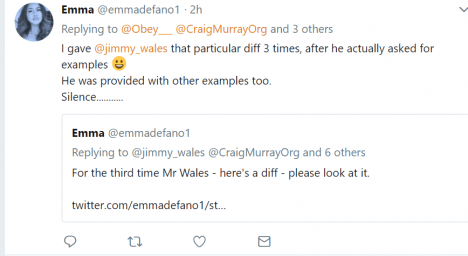
Despite the overwhelming evidence of constant malicious editing, as well as outright admissions of bias by the Twitter account linked to Philip Cross, Jimmy Wales has been extremely and conspicuously defensive of the account’s legitimacy while ignoring evidence provided to him.
“Or, just maybe, you’re wrong,” Wales said to a Twitter user inquiring about the controversy the other day. “Show me the diffs or any evidence of any kind. The whole claim appears so far to be completely ludicrous.”
“Riiiiight,” said the totally not-triggered Wales in another response. “You are really very very far from the facts of reality here. You might start with even one tiny shred of some kind of evidence, rather than just making up allegations out of thin air. But you won’t because… trolling.”
“You clearly have very very little idea how it works,” Wales tweeted in another response. “If your worldview is shaped by idiotic conspiracy sites, you will have a hard time grasping reality.”
As outlined in the articles by Murray and Five Filters, the evidence is there in abundance. Five Filters lays out “diffs” (editing changes) in black and white showing clear bias by the Philip Cross account, a very slanted perspective is clearly and undeniably documented, and yet Wales denies and aggressively ridicules any suggestion that something shady could be afoot. This likely means that Wales is in on whatever game the Philip Cross account is playing. Which means the entire site is likely involved in some sort of psyop by a party which stands to benefit from keeping the dominant narrative slanted in a pro-establishment direction.
A 2016 Pew Research Center report found that Wikipedia was getting some 18 billion page views per month. Billion with a ‘b’. Youtube recently announced that it’s going to be showing text from Wikipedia articles on videos about conspiracy theories to help “curb fake news”. Plainly the site is extremely important in the battle for control of the narrative about what’s going on in the world. Plainly its leadership fights on one side of that battle, which happens to be the side that favors western oligarchs and intelligence agencies.
How many other “Philip Cross”-like accounts are there on Wikipedia? Has the site always functioned as an establishment psyop designed to manipulate public perception of existing power structures, or did that start later? I don’t know. Right now all I know is that an agenda very beneficial to the intelligence agencies, war profiteers and plutocrats of the western empire is clearly and undeniably being advanced on the site, and its founder is telling us it’s nothing. He is lying. Watch him closely.
Featured Video

Anthrax War – CBC The Passionate Eye
or go to
Aletho News Archives – Video-Images
Book Review
Shattered Dreams: The HPV Vaccine Exposed (2019)
By Christina England – 30 Q&As – Book Review & Summary
Lies are Unbekoming | September 4, 2026
… Gardasil received FDA fast-track approval in 2006, Cervarix followed in 2009, and Gardasil 9 was approved in December 2014 with more than double the aluminium adjuvant content of the original. The commercial context is specific. Merck was about to lose patent protection on Zocor and faced $18 billion in Vioxx injury claims from a cardiovascular drug the company had marketed while suppressing its own data showing a five-times increase in heart attacks. Analysts projected the global HPV vaccine market at $4 billion by 2011, contingent on government-funded national programs for teenage girls. The 1986 National Childhood Vaccine Injury Act had already granted manufacturers complete liability immunity. By 2013, Japan had withdrawn its HPV vaccine recommendation after cataloguing severe adverse reactions in hundreds of girls. No Western government followed. The establishment position across the UK, US, Australia, and most of Europe held, and still holds, that the vaccines are safe and effective, that reported injuries are coincidental, and that cervical cancer prevention justifies the program. The book was published into this position, not against a vacuum.
Shattered Dreams sits alongside Mary Holland’s The HPV Vaccine On Trial and Viera Scheibner’s foundational vaccination work as part of the documented record on what has been done to a generation of teenage girls under the banner of cancer prevention. The full summary unpacks three specific findings: that Merck used the aluminium adjuvant itself as the “placebo” control in 92.5% of trial subjects, making it structurally impossible to detect excess reactions from the adjuvant; that Dr. Sin Hang Lee found HPV DNA fragments bound to aluminium in every one of sixteen Gardasil samples tested, and in the blood and spleen of a New Zealand girl six months after her third dose; and that in every country with high vaccination coverage, including Australia, the UK, Norway, and Sweden, cervical cancer rates have stopped declining and started rising specifically in the vaccinated cohort. Martínez-Lavín’s 2017 calculation puts the number needed to seriously harm with Gardasil 9 at 140, and the number needed to vaccinate to prevent one case at 1,757. Thirteen young women are seriously harmed for every one who benefits. The vaccine was approved on the basis of trials that could not detect what the trials were supposed to detect, and it is still being given to twelve-year-olds today. … Read full review
Blog Roll
 Aletho News
- The Maidan Killings and the False-Flag Case
- Georgia’s Largest Healthcare System Will Fire Employees Who Refuse Flu Vaccine
- The Five-Year Fuel Crisis: Why the World Economy Is Paying for a War It Thinks Is Ending
- Trump’s Big Bluff on Iran
- Swiss scammed out of millions by Ukraine-linked call centers – media
- Germany facing potential ‘violent conflict’ with Russia – spy chief
- Ukraine’s EU neighbors reject new plea from Kiev – Politico
- British Transport Police Facial Recognition Trial Scanned 926,912 People With Zero Arrests
- House Bill Would Ban Federal Use of Flock ALPR Data
- Can a Spice Rival a Drug? 10 Head-to-Head Trials Put It to the Test.
- If Americans Knew
- “We See Our Homes Now From A Satellite, Like Strangers”
- Watch “Gaza: Doctors Under Attack”, originally censored by BBC
- NAZA: Israeli embassies in UK and US promote rival documentary to challenge Gaza genocide allegations
- David Ellison appoints Israeli to lead merged Paramount-Warner studios
- Turkish Red Crescent helps elderly Gaza man walk again after Israel confiscates his prosthetic limb
- Four Palestinians Killed in Israeli Attacks in Gaza
- Two Palestinian youths killed and village razed as Israeli attacks on West Bank continue
- Two more Christian women victims of Israeli raids on Gaza
- Cruelty, Deprivation, Indignity: A Journalist’s 22 Months in Israeli Prison
- New IDF Website Frames Slain Gaza Journalists as Terrorists
- No Tricks Zone
- Latest European Green Energy Debacle; Portugal’s Largest Flagship Solar Park Insolvent!
- Green Energy Debacle: German Expert Professor Fritz Vahrenholt Warns Of Severe Economic And Social Consequences
- Two More Paleo Reconstructions Affirm Meters-Higher Sea Levels Across Ireland, Brazil 7000-6000 Years Ago
- New Study: Earth And Venus Surface Warmth Largely Explained By Convection And Lapse Rate, Not CO2 Or Radiation
- 2025 Nature Paper Claiming Worsening Global Drought Gets RETRACTED …Heavily Flawed
- New Study: ‘Global Drought Shows No Detectable Recent Acceleration Under Climate Warming’
- Economic Masterminds: German Socialists Suggest Taxing Productivity Gains Stemming From Using AI
- The South China Sea Has Not Been Cooperating With The Climate Change Narrative
- Energy Crisis: Germany Enters Heating Season With Historically Low Gas Reserve Fill Levels
- New Study: The Antarctic Ice Sheet Gained Mass From 2020-2024 Due To Staggering Snow And Ice Accumulation

