An Urgent Call for Solidarity with Nicaragua
Asociación de Trabajadores del Campo (Rural Workers Association) | May 17, 2018
Friends in Solidarity,
We have lived a month full of tragedy in our country. The peace we achieved as a people, so fragile and at the cost of so many lives, is in immanent danger of disappearing irreparably. There are now two sizeable camps of the population with dangerously contrary positions. On one side, there is a combination of private university students, media outlets with rightwing owners representing the oligarchy, Catholic Church bishops close to Opus Dei, the private sector and, of course, the US Embassy, working together to create a situation of chaos in the country in order to remove president Daniel Ortega. This group of actors accuses the National Police of having killed dozens of protestors in the riots that reached all Nicaraguan cities, ostensibly against a reform—since revoked—to the system of social security. As we have described, the reality is more complex, and the violence was generalized and explosive, involving protestors with homemade firearms that often misfired, as well as counter-protestors, paid pickets, unknown gunmen and street gangs. The National Police was really a minor actor in the violence, using tear gas and rubber bullets to clear crowds in a few points of Managua, but not involved in the vast majority of the 50 or more deaths that have been reported since April. The InterAmerican Commission of Human Rights has been invited by the government and currently is investigating the events of April.
A national dialogue began on Wednesday, May 16th, with the participation of anti-government students, civil society organizations, and the Presidency, and mediation by the Episcopal Conference of the Catholic Church led by Archbishop Leonaldo Brenes. However, the coup-like violence has only grown and currently, rightwing armed groups have all of the main highways in the country closed. On the other side of the conflict, the militancy of the Sandinista Front continues to withstand phenomenal provocations, including:
- The destruction of its Sandinista homes (party headquarters) in dozens of cities
- The destruction or defacement of hundreds of historic monuments, murals, and memorials of Sandinistas
- The arson of dozens of public buildings
- The interruption of work and the food shortages that have resulted from the road closures and violence
- The deaths of passersby and journalists by paid pickets and violent protestors
- Relentless false accusations and lies circulated by corporate media.
It must be added that Facebook has been the primary means for transforming Nicaraguan society that one month ago was at peace into a toxic, hate-filled nightmare. Currently, hundreds of thousands of fake Facebook profiles amplify the hatred and pressure Nicaraguan Facebook users to begin to share and post hate messages. Many, if not most, of these fake Facebook profiles have been created in countries other than Nicaragua, and in particular, Miami is the city where many of the Facebook and WhatsApp accounts behind the violence are managed.
Historically, the ATC has been a participant in the Sandinista struggle. In truth, we have not felt consulted or represented by the current FSLN government. The current coup attempt makes use of these historical contradictions and is trying to co-opt the symbols, slogans, poems and songs of Nicaragua’s Sandinista Revolution, since of course the rightwing has none of its own. However we may feel about Daniel Ortega, the ATC would never contribute to making chaos and sowing violence in order to force the collapse of the democratically elected government in order to install a more docile, Washington-friendly neoliberal government. There are clearly real frustrations in sectors of the population, especially youth, and if these sectors are unable to find popular organizing processes, they will end up being the cannon fodder for a war, which would be the worst possible situation for the Nicaraguan people.
In this context, the ATC has called for “all national actors to reorganize themselves based on their aspirations.” With this intention, the ATC proposes to confront the national crisis with a series of dialogues among young people, without party distinction or any ideological basis, in favor of peace and understanding. We propose extraordinary youth assemblies in the cities of San Marcos, Jinotepe, Rivas, Granada, Masaya, Estelí, Matagalpa, Jinotega, Juigalpa, Santo Tomás and Tipitapa, as spaces for young people to discuss the national situation and find points of unity. It is important to mention that we do not have a previously defined “line” to impose upon these debates—they will be spaces for listening, forming ideas and thinking with our hearts.
We call upon your solidarity and generous support for the creation of an emergency fund for peace in Nicaragua that makes possible this round of extraordinary youth assemblies. The national coordinators of the Rural Youth Movement, Sixto Zelaya and Marlen Sanchez, will have the responsibility of organizing the assemblies and administering the fund with absolute transparency.
It is urgent to organize the Nicaraguan family and win peace!
International Secretariat of the ATC
Making Excuses for Russiagate
By Daniel Lazare | Consortium News | May 18, 2018
The best evidence that Russia-gate is sinking beneath the waves is the way those pushing the pseudo-scandal are now busily covering their tracks. The Guardian complains that “as the inquiry has expanded and dominated the news agenda over the last year, the real issues of people’s lives are in danger of being drowned out by obsessive cable television coverage of the Russia investigation” – as if the Guardian’s own coverage hasn’t been every bit as obsessive as anything CNN has come up with.
The Washington Post, second to none when it comes to painting Putin as a real-life Lord Voldemort, now says that Special counsel Robert Mueller “faces a particular challenge maintaining the confidence of the citizenry” as his investigation enters its second year – although it’s sticking to its guns that the problem is not the inquiry itself, but “the regular attacks he faces from President Trump, who has decried the probe as a ‘witch hunt.’”
And then there’s the New York Times, which this week devoted a 3,600-word front-page article to explain why the FBI had no choice but to launch an investigation into Trump’s alleged Russian links and how, if anything, the inquiry wasn’t aggressive enough. As the article puts it, “Interviews with a dozen current and former government officials and a review of documents show that the FBI was even more circumspect in that case than has been previously known.”
It’s Nobody’s Fault
The result is a late-breaking media chorus to the effect that it’s not the fault of the FBI that the investigation has dragged on with so little to show for it; it’s not the fault of Mueller either, and, most of all, it’s not the fault of the corporate press, even though it’s done little over the last two years than scream about Russia. It’s not anyone’s fault, evidently, but simply how the system works.
This is nonsense, and the gaping holes in the Times article show why.
The piece, written by Matt Apuzzo, Adam Goldman, and Nicholas Fandos and entitled “Code Name Crossfire Hurricane: The Secret Origins of the Trump Investigation,” is pretty much like everything else the Times has written on the subject, i.e. biased, misleading, and incomplete. Its main argument is that the FBI had no option but to step in because four Trump campaign aides had “obvious or suspected Russian ties.”
‘At Putin’s Arm’
One was Michael Flynn, who would briefly serve as Donald Trump’s national security adviser and who, according to the Times, “was paid $45,000 by the Russian government’s media arm for a 2015 speech and dined at the arm of the Russian president, Vladimir V. Putin.” Another was Paul Manafort, who briefly served as Trump’s campaign chairman and was a source of concern because he had “lobbied for pro-Russia interests in Ukraine and worked with an associate who has been identified as having connections to Russian intelligence.” A third was Carter Page, a Trump foreign-policy adviser who “was well known to the FBI” because “[h]e had previously been recruited by Russian spies and was suspected of meeting one in Moscow during the campaign.” The fourth was George Papadopoulos, a “young and inexperienced campaign aide whose wine-fueled conversation with the Australian ambassador set off the investigation. Before hacked Democratic emails appeared online, he had seemed to know that Russia had political dirt on Mrs. Clinton.”
Seems incriminating, eh? But in each case the connection was more tenuous than the Times lets on. Flynn, for example, didn’t dine “at the arm of the Russian president” at a now-famous December 2015 Moscow banquet honoring the Russian media outlet RT. He was merely at a table at which Putin happened to sit down for “maybe five minutes, maybe twenty, tops,” according to Green Party presidential candidate Jill Stein who was just a few chairs away. No words were exchanged, Stein says, and “[n]obody introduced anybody to anybody. There was no translator. The Russians spoke Russian. The four people who spoke English spoke English.”
The Manafort associate with the supposed Russian intelligence links turns out to be a Russian-Ukrainian translator named Konstantin Kilimnik who studied English at a Soviet military school and who vehemently denies any such connection. It seems that the Ukrainian authorities did investigate the allegations at one point but declined to press charges. So the connection is unproven.
Page Was No Spy
The same goes for Carter Page, who was not “recruited” by Russian intelligence, but, rather, approached by what he thought were Russian trade representatives at a January 2013 energy symposium in New York. When the FBI informed him five or six months later that it believed the men were intelligence agents, Page appears to have cooperated fully based on a federal indictment filed with the Southern District of New York. Thus, Page was not a spy but a government informant as ex-federal prosecutor Andrew C. McCarthy has pointed out – in other words, a good guy, as the Times would undoubtedly see it, helping the catch a couple of baddies.
As for Papadopoulos, who the Times suggests somehow got advance word that WikiLeaks was about to dump a treasure trove of Hillary Clinton emails, the article fails to mention that at the time the conversation with the Australian ambassador took place, the Clinton communications in the news were the 30,000 State Department emails that she had improperly stored on her private computer. These were the emails that “the American people are sick and tired of hearing about,” as Bernie Sanders put it. Instead of spilling the beans about a data breach yet to come, it’s more likely that Papadopoulos was referring to emails that were already in the news – a possibility the Times fails to discuss.
FBI ‘Perplexed’
One could go on. But not only does the Times article get the details wrong, it paints the big picture in misleading tones as well. It says that the FBI was “perplexed” by such Trump antics as calling on Russia to release still more Clinton emails after WikiLeaks went public with its disclosure. The word suggests a disinterested observer who can’t figure out what’s going on. But it ignores how poisonous the atmosphere had become by that point and how everyone’s mind was seemingly made up.
By July 2016, Clinton was striking out at Trump at every opportunity about his Russian ties – not because they were true, but because a candidate who had struggled to come up with a winning slogan had at last come across an issue that seemed to resonate with her fan base. Consequently, an intelligence report that Russia was responsible for hacking the Democratic National Committee “was a godsend,” wrote Jonathan Allen and Amie Parnes in Shattered, their best-selling account of the Clinton campaign, because it was “hard evidence upon which Hillary could start to really build the case that Trump was actually in league with Moscow.”
Not only did Clinton believe this, but her followers did as well, as did the corporate media and, evidently, the FBI. This is the takeaway from text messages that FBI counterintelligence chief Peter Strzok exchanged with FBI staff attorney Lisa Page.
Andrew McCarthy, who has done a masterful job of reconstructing the sequence, notes that in late July 2016, Page mentioned an article she had come across on a liberal web site discussing Trump’s alleged Russia ties. Strzok texted back that he’s “partial to any women sending articles about nasty the Russians are.” Page replied that the Russians “are probably the worst. Very little I finding redeeming about this. Even in history. Couple of good writers and artists I guess.” Strzok heartily agreed: “f***ing conniving cheating savages. At statecraft, athletics, you name it. I’m glad I’m on Team USA.”
The F’ing Russian ‘Savages’
This is the institutional bias that the Times doesn’t dare mention. An agency whose top officials believe that “f***ing conniving cheating savages” are breaking down the door is one that is fairly guaranteed to construe evidence in the most negative, anti-Russian way possible while ignoring anything to the contrary. So what if Carter Page had cooperated with the FBI? What’s important is that he had had contact with Russian intelligence at all, which was enough to render him suspicious in the bureau’s eyes. Ditto Konstantin Kilimnik. So what if the Ukrainian authorities had declined to press charges? The fact that they had even looked was damning enough.
The FBI thus made the classic methodological error of allowing its investigation to be contaminated by its preconceived beliefs. Objectivity fell by the wayside. The Times says that Christopher Steele, the ex-MI6 agent whose infamous, DNC and Clinton camp paid-for opposition research dossier turned “golden showers” into a household term, struck the FBI as “highly credible” because he had “helped agents unravel complicated cases” in the past. Perhaps. But the real reason is that he told agents what they wanted to hear, which is that the “Russian regime has been cultivating, supporting and assisting TRUMP for at least 5 years” with the “[a]im, endorsed by PUTIN, … [of] encourage[ing] splits and divisions in [the] western alliance.” (which can be construed as a shrewd defensive move against a Western alliance massing troops on Russian borders.)
What else would one expect of people as “nasty” as these? In fact, the Steele dossier should have caused alarm bells to go off. How could Putin have possibly known five years before that Trump would be a viable presidential candidate? Why would high-level Kremlin officials share inside information with an ex-intelligence official thousands of miles away? Why would the dossier declare on one page that the Kremlin has offered Trump “various lucrative real estate development business deals” but then say on another that Trump’s efforts to drum up business had gone nowhere and that he therefore “had had to settle for the use of extensive sexual services there from local prostitutes rather than business success”? Given that the dossier was little more than “oppo research” commissioned and funded by the Democratic National Committee and the Clinton campaign, why was it worthy of consideration at all?
The Rush to Believe
But all such questions disappeared amid the general rush to believe. The Times is right that the FBI slow-walked the investigation until Election Day. This is because agents assumed that Trump would lose and that therefore there was no need to rush. But when he didn’t, the mood turned to one of panic and fury.
Without offering a shred of evidence, the FBI, CIA, NSA, and Director of National Intelligence James Clapper issued a formal assessment on Jan. 6, 2017, that “Putin ordered an influence campaign in 2016 aimed at the US presidential election … [in order] to undermine public faith in the US democratic process, denigrate Secretary Clinton, and harm her electability and potential presidency.”
The New Yorker reports that an ex-aide to John McCain hoped to persuade the senator to use the Steele dossier to force Trump to resign even before taking office. (The ex-aide denies that this was the case.)
When FBI Director James Comey personally confronted Trump with news of the dossier two weeks prior to inauguration, the Times says he “feared making this conversation a ‘J. Edgar Hoover-type situation,’ with the FBI presenting embarrassing information “to lord over a president-elect.”
But that is precisely what happened. When someone – most likely CIA Director John Brennan, now a commentator with NBC News – leaked word of the meeting and Buzzfeed published the dossier four days later, the corporate media went wild. Trump was gravely wounded, while Adam Schiff, Democratic point man on the House Intelligence Committee, would subsequently trumpet the Steele dossier as the unvarnished truth. According to the Times account, Trump was unpersuaded by Comey’s assurances that he was there to help. “Hours earlier,” the paper says, “… he debuted what would quickly become a favorite phrase: ‘This is a political witch hunt.’”
The Times clearly regards the idea as preposterous on its face. But while Trump is wrong about many things, on this one subject he happens to be right. The press, the intelligence community, and the Democrats have all gone off the deep end in search of a Russia connection that doesn’t exist. They misled their readers, they made fools of themselves, and they committed a crime against journalism. And now they’re trying to dodge the blame.
Daniel Lazare is the author of The Frozen Republic: How the Constitution Is Paralyzing Democracy (Harcourt Brace, 1996) and other books about American politics.
Russian Meddling in Mexican Election Statements Groundless – President of Senate
Sputnik – 18.05.2018
The statements made by US and Mexican politicians about alleged the interference of Moscow in the elections in Mexico are unfounded, Ernesto Cordero Arroyo, the president of the Mexican Senate, told Sputnik.
“They had not presented any evidence and we should understand that during the election campaign people become very creative and inventive,” the Mexican politician said.
According to the senior lawmaker, the Mexican side has not registered any foreign meddling in the election process.
Mexicans will elect the next president of the nation on July 1. Ahead of the vote, former US National Security Adviser Herbert McMaster said that the United States noticed signs of “Russian intervention” in the Mexican presidential election.
Enrique Ochoa, the leader of Mexico’s ruling Institutional Revolutionary Party (IRR), said the international media outlets had “documented” the interests of Russia and Venezuela in backing leftist candidate Andres Manuel Lopez Obrador.
Russia has faced numerous accusations of interference in foreign elections, including the 2016 US presidential vote. Kremlin spokesman Dmitry Peskov has called the claims groundless, while Russian Foreign Minister Sergey Lavrov has stressed that there was no evidence to substantiate such accusations.
OPCW says chlorine ‘likely’ used in Syria based on open-source info & samples provided by jihadists
RT | May 17, 2018
The OPCW report claiming that chlorine was “likely used” in Saraqeb, Syria in February is “seriously misleading” because its narrative is based on evidence provided by jihadists, a former UK ambassador told RT.
A fact-finding mission (FFM) of the Organisation for the Prohibition of Chemical Weapons (OPCW) on Wednesday published a report which “determined that chlorine, released from cylinders through mechanical impact, was likely used as a chemical weapon on 4 February 2018 in the Al Talil neighborhood of Saraqib” in the Idlib province of Syria. Eleven people were treated after the attack for mild and moderate symptoms of toxic chemical exposure, the OPCW said in a report on its findings.
The FFM based their conclusions on a number of factors, namely the presence of two empty cylinders, which allegedly earlier contained chlorine as well as patients who were admitted to medical facilities after the reported incident. The report also states that the FFM never made it to the site of the alleged attack and relied solely on ‘evidence’ provided by three NGOs, two of which are based overseas. Despite the compelling narrative of the OPCW, the former British ambassador to Syria, Peter Ford, characterized the report as “seriously misleading” and “deeply disturbing.”
“The mission was supposed to be fact finding, but when you actually read the 34 pages of the report, you discover that there are no facts in it at all – not one fact which is supported by independent observers,” Ford told RT.
“You hear ridiculous claims such as, ‘we heard barrel bombs being dropped from helicopters.’ Well, I’m sorry that is a physical impossibility. And the report is full of idiotic statements like this that even a child could discard.”
In fact, the entire OPCW account is based on witness testimonies and material evidence provided by selected NGOs as well as medical records offered by the same questionable sources, including Belgium-based Same Justice/Chemical Violations Documentation Center of Syria (CVDCS), the notorious Syrian Civil Defence (SCD) – better known as White Helmets – and the US-based Syrian American Medical Society (SAMS).
Ford noted that the White Helmets are a “well-known jihadi auxiliary who have assisted in beheadings and who are notorious for making propaganda,” and that SAMS shares “a similar reputation.”
Other relevant information for the international chemical watchdog was gathered from “open-source media” because “various constraints,” mainly related to security, prevented “immediate access to sites by the FFM.”
“Believe it or not the inspectors did not go to the… alleged scene of the crime. Why? Because it is in the hands of jihadists. That is why they did not go,” Ford said. “These people are totally affiliated with the jihadists, yet the inspectors accepted at face value their samples which could have come from absolutely anywhere.”
While the OPCW did not assign responsibility for the attack, the White Helmets and SAMS have previously pointed the finger at Damascus.
Nevertheless, the inconclusive OPCW findings in the Saraqeb incident will likely be used to further back the narrative of the US and its allies, who repeatedly used claims by the White Helmets, SAMS, and other questionable sources to unequivocally pin the blame on President Bashar Assad. Chemical ‘incidents’ were also used as a pretext to strike government facilities in Syria in April 2017, and again as recently as last month.
“There are signs in the report of partiality,” Ford told RT. “I’m sure that attempts will be made to exploit this very inadequate report.”
Read more:
Terrorist capabilities laid bare in an Eastern Ghouta chemical lab
The Stomach-Churning Victim Blaming by “Labour Friends of Israel”
By Craig Murray | May 14, 2018
The true face of the organisation calling itself “Labour Friends of Israel” has been revealed today, in truly disgusting victim-blaming tweets reacting to the massacre of over fifty Palestinians – including yet more children – by the Israeli Defence Force in Gaza.
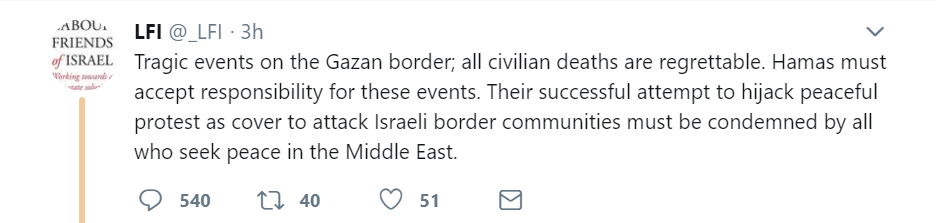
No Israelis were injured and no “border communities” attacked. This amplification of the worst extreme right wing zionist propaganda by the Likud government shows beyond doubt that “Labour Friends of Israel” is nothing whatsoever to do with the professed values of the Labour Party, but rather a well-funded entryist front solely intended to promote the interests of a violent, expansionist and aggressive foreign state.
I am not a Labour Party member and I do not know what institutional ties the “Labour Friends of Israel” has to the Labour Party, but whatever they are they should be cut off immediately.
The “Labour Friends of Israel” featured very prominently on our TV screens after the recent English local elections, beating the drum for their widespread accusations of anti-semitism within the Labour Party. They have been driving that agenda for many months. One would like to think that the mainstream media would, after today, cease to accept them as a genuine and well-motivated group and understand them for the hate-filled fanatics they truly are. Of course that will not happen, and they will be back on television shortly accusing yet more lifelong anti-racism campaigners who have the temerity to criticise Israel.
‘Independent’ Syrian Observatory for Human Rights receives nearly £200k from UK – Peter Hitchens
By Omar Baggili | RT | May 14, 2018
The British government has given the self-described ‘impartial’ Syrian Observatory for Human Rights (SOHR) £194,769.60 for a project to help fund “communications equipment and cameras,” according to journalist Peter Hitchens.
The Sunday Mail’s Hitchens, a regular critic of British foreign policy, tweeted on Sunday: “Boris Johnson’s Foreign Office admits it gave £194,769.60 to the supposedly ‘independent’ Syrian Human Rights Observatory. How many other ‘independent’ bodies in the Syrian controversy aren’t as ‘independent’ as they look?”
The SOHR declares on its website that it’s “not associated or linked to any political body.” Hitchens in his Sunday Mail blog asks: “Is Boris Johnson’s Foreign Office not a political body?” Hitchens appears to question the legitimacy of the relationship, in relation to the Syrian conflict “in which the British government clearly takes sides.”
Fellow Mail journalist and author of ‘Not the Chilcot Report,’ Peter Oborne has added that the “Syrian Observatory has been treated as a gold standard for information on Syria. Quoted by BBC all the time. Always described as independent.”
The group has come under criticism, being accused by some as a tool of Western propaganda due to its location and lack of staff. Its operation is managed by one man in Coventry in the UK, Rami Abdurrahman, who fled Syria in 2000. He relies on a handful of Syrians to assist him in collating information from “more than 230 activists on the ground”, a network of people from his youth, reports New York Times.
Abdurrahman’s neutrality on the Syrian conflict came under fire when he told Reuters in 2011 he would return to Syria only “when Bashar al-Assad goes,” and according to CNN, was part of a delegation of Syrian opposition officials that met with the then-Foreign Secretary William Hague, that same year.
It’s not the only Syrian-focused human rights group to come under the spotlight with accusations of questionable neutrality because of UK government links. The White Helmets, officially known as the ‘Syria Civil Defence’ has also come under fire. Since 2011, the UK has provided the organization with £38.4m of funding, a freedom of information request has revealed, as reported in The Guardian.
The group operates in areas under the control of the Syrian opposition forces, including Islamist rebels such as Jaysh al-Islam, who controlled the city of Douma until recently, and the location of the latest alleged chemical weapons attack.
According to reports, Theresa May is preparing to increase funding to the White Helmets in response to media claims that President Donald Trump is to withdraw US support for the organization. In March, Trump froze a $200m (£148m) package of US aid to Syria, including money for the White Helmets.
The US President has said he would like to see his country relieve itself of military and humanitarian duties in Syria, calling on other countries to help fill the financial void to fund stabilizing and rebuilding projects in the country after the fight against Islamic State (IS, formerly ISIS), claims ABC news.
Addressing parliament on Wednesday, the UK PM said: “We do support them [the White Helmets], we will continue to support them and … the international development secretary will be looking at the level of support in the future.”
Two Syrian groups claim to be impartial, yet are happy to receive funding from the UK government who, as Hitchens says, are clearly taking sides on the Syrian conflict.
Featured Video
Anthrax War – CBC The Passionate Eye
or go to
Aletho News Archives – Video-Images
Book Review
Shattered Dreams: The HPV Vaccine Exposed (2019)
By Christina England – 30 Q&As – Book Review & Summary
Lies are Unbekoming | September 4, 2026
… Gardasil received FDA fast-track approval in 2006, Cervarix followed in 2009, and Gardasil 9 was approved in December 2014 with more than double the aluminium adjuvant content of the original. The commercial context is specific. Merck was about to lose patent protection on Zocor and faced $18 billion in Vioxx injury claims from a cardiovascular drug the company had marketed while suppressing its own data showing a five-times increase in heart attacks. Analysts projected the global HPV vaccine market at $4 billion by 2011, contingent on government-funded national programs for teenage girls. The 1986 National Childhood Vaccine Injury Act had already granted manufacturers complete liability immunity. By 2013, Japan had withdrawn its HPV vaccine recommendation after cataloguing severe adverse reactions in hundreds of girls. No Western government followed. The establishment position across the UK, US, Australia, and most of Europe held, and still holds, that the vaccines are safe and effective, that reported injuries are coincidental, and that cervical cancer prevention justifies the program. The book was published into this position, not against a vacuum.
Shattered Dreams sits alongside Mary Holland’s The HPV Vaccine On Trial and Viera Scheibner’s foundational vaccination work as part of the documented record on what has been done to a generation of teenage girls under the banner of cancer prevention. The full summary unpacks three specific findings: that Merck used the aluminium adjuvant itself as the “placebo” control in 92.5% of trial subjects, making it structurally impossible to detect excess reactions from the adjuvant; that Dr. Sin Hang Lee found HPV DNA fragments bound to aluminium in every one of sixteen Gardasil samples tested, and in the blood and spleen of a New Zealand girl six months after her third dose; and that in every country with high vaccination coverage, including Australia, the UK, Norway, and Sweden, cervical cancer rates have stopped declining and started rising specifically in the vaccinated cohort. Martínez-Lavín’s 2017 calculation puts the number needed to seriously harm with Gardasil 9 at 140, and the number needed to vaccinate to prevent one case at 1,757. Thirteen young women are seriously harmed for every one who benefits. The vaccine was approved on the basis of trials that could not detect what the trials were supposed to detect, and it is still being given to twelve-year-olds today. … Read full review
Blog Roll
 Aletho News
- The Maidan Killings and the False-Flag Case
- Georgia’s Largest Healthcare System Will Fire Employees Who Refuse Flu Vaccine
- The Five-Year Fuel Crisis: Why the World Economy Is Paying for a War It Thinks Is Ending
- Trump’s Big Bluff on Iran
- Swiss scammed out of millions by Ukraine-linked call centers – media
- Germany facing potential ‘violent conflict’ with Russia – spy chief
- Ukraine’s EU neighbors reject new plea from Kiev – Politico
- British Transport Police Facial Recognition Trial Scanned 926,912 People With Zero Arrests
- House Bill Would Ban Federal Use of Flock ALPR Data
- Can a Spice Rival a Drug? 10 Head-to-Head Trials Put It to the Test.
- If Americans Knew
- “We See Our Homes Now From A Satellite, Like Strangers”
- Watch “Gaza: Doctors Under Attack”, originally censored by BBC
- NAZA: Israeli embassies in UK and US promote rival documentary to challenge Gaza genocide allegations
- David Ellison appoints Israeli to lead merged Paramount-Warner studios
- Turkish Red Crescent helps elderly Gaza man walk again after Israel confiscates his prosthetic limb
- Four Palestinians Killed in Israeli Attacks in Gaza
- Two Palestinian youths killed and village razed as Israeli attacks on West Bank continue
- Two more Christian women victims of Israeli raids on Gaza
- Cruelty, Deprivation, Indignity: A Journalist’s 22 Months in Israeli Prison
- New IDF Website Frames Slain Gaza Journalists as Terrorists
- No Tricks Zone
- Latest European Green Energy Debacle; Portugal’s Largest Flagship Solar Park Insolvent!
- Green Energy Debacle: German Expert Professor Fritz Vahrenholt Warns Of Severe Economic And Social Consequences
- Two More Paleo Reconstructions Affirm Meters-Higher Sea Levels Across Ireland, Brazil 7000-6000 Years Ago
- New Study: Earth And Venus Surface Warmth Largely Explained By Convection And Lapse Rate, Not CO2 Or Radiation
- 2025 Nature Paper Claiming Worsening Global Drought Gets RETRACTED …Heavily Flawed
- New Study: ‘Global Drought Shows No Detectable Recent Acceleration Under Climate Warming’
- Economic Masterminds: German Socialists Suggest Taxing Productivity Gains Stemming From Using AI
- The South China Sea Has Not Been Cooperating With The Climate Change Narrative
- Energy Crisis: Germany Enters Heating Season With Historically Low Gas Reserve Fill Levels
- New Study: The Antarctic Ice Sheet Gained Mass From 2020-2024 Due To Staggering Snow And Ice Accumulation

