The statements made by US and Mexican politicians about alleged the interference of Moscow in the elections in Mexico are unfounded, Ernesto Cordero Arroyo, the president of the Mexican Senate, told Sputnik.
“They had not presented any evidence and we should understand that during the election campaign people become very creative and inventive,” the Mexican politician said.
According to the senior lawmaker, the Mexican side has not registered any foreign meddling in the election process.
Mexicans will elect the next president of the nation on July 1. Ahead of the vote, former US National Security Adviser Herbert McMaster said that the United States noticed signs of “Russian intervention” in the Mexican presidential election.
Enrique Ochoa, the leader of Mexico’s ruling Institutional Revolutionary Party (IRR), said the international media outlets had “documented” the interests of Russia and Venezuela in backing leftist candidate Andres Manuel Lopez Obrador.
Russia has faced numerous accusations of interference in foreign elections, including the 2016 US presidential vote. Kremlin spokesman Dmitry Peskov has called the claims groundless, while Russian Foreign Minister Sergey Lavrov has stressed that there was no evidence to substantiate such accusations.
The soaring hopes generated by the recent Inter-Korean Summit are now supplanted by uncertainty, due to North Korea’s suspension of a planned meeting with the South.
In the weeks following the summit’s Panmunjom Declaration, North Korea took actions to demonstrate its goodwill and desire for peaceful resolution of differences.
The Democratic People’s Republic of Korea (DPRK – the formal name for North Korea) announced that it would dismantle its underground nuclear test site, culminating in explosions to collapse tunnels, the blocking of entries, and removal of above-ground facilities.
Substantial progress has already been made on disabling the site. The DPRK could have waited and made this a negotiable issue in talks with the United States. Instead, it offered the step to the United States ahead of the summit as a confidence-building measure. Before that, North Korea also committed to a suspension of nuclear and missile testing. As an additional gesture of good intentions, North Korea released all three American prisoners.
Initial signs from U.S. Secretary of State Mike Pompeo’s meetings with Chairman Kim Jong Un were quite encouraging, hinting at an uncharacteristic degree of flexibility on the part of the Trump administration. North Korean media reported that the talks indicated that Trump “has a new alternative” and a “proactive attitude,” and that Kim and Pompeo had reached a “satisfactory agreement on the issues.”
Meanwhile, as Pompeo and Kim were making apparent headway, the process began to unravel from a different direction. There were many in the Trump administration who were not keen on the idea of reciprocity. The dominant view was that rewards, such as they were, could only come after denuclearization.
National Security Advisor John Bolton was trotted out for a series of interviews to elucidate the U.S. position. Permanent, verifiable, and irreversible denuclearization would have to take place before “the benefits start to flow.” The expectation is that the DPRK should abandon its nuclear deterrent without receiving anything more in return than the promise of future rewards. Nor does Bolton consider nuclear disarmament to be sufficient. Negotiations have not begun, and already the U.S. is piling on more demands. Talks, Bolton insisted, would also need to tackle the DPRK’s ballistic missile program and human rights concerns. Chemical and biological weapons will also be on the agenda, he said, despite the fact that their existence is purely speculative. Negotiations on denuclearization will be challenging enough. Overloading the talks with additional issues is likely to be a recipe for failure.
Even as North Korea strives to meet American demands, it can expect no relief from sanctions and threats. Bolton asserts that the U.S. needs to see North Korea implementing denuclearization, and the policy of maximum pressure will not relent until that happens.
What kind of benefits can North Korea expect in return for compliance with U.S. demands? “I wouldn’t look for economic aid from us,” Bolton bluntly stated. Presumably, once North Korea has satisfied all of the Trump administration’s demands, sanctions will start to be reduced or eliminated. That is not a reward. If someone is punishing another, and then promises to reduce the amount of punishment, it is safe to say that the victim will not regard that as a “reward.”
On the economic front, Mike Pompeo agrees with Bolton. No taxpayer funds will go towards assisting North Korea, he said. What the United States is willing to do is send rapacious corporate investors to North Korea to seek profit-making opportunities. Once denuclearization has been completed and sanctions lifted, Pompeo says that what Chairman Kim “will get from America is our finest – our entrepreneurs, our risk takers, our capital providers…They will get private capital that comes in.” A strong argument could be made that those are actually among America’s worst people, and not to be wished upon North Korea or any other nation.
Pompeo went on to talk about North Korea’s need for energy, agricultural equipment, and technology. The need is there. But why is that? For decades, the United States has subjected the DPRK to enormous economic damage through sanctions. The North Korean people are not incapable of improving their lot. They only need to be allowed to do so, unhindered and unpunished. What the DPRK needs and what it consistently calls for is normalization of relations.
Certainly, North Korea is not looking to privatize state-owned firms or to contract out work to U.S. firms that it is capable of doing itself, once it is released from the burden of sanctions.
It is clear that the Trump administration is not willing to give anything to North Korea. It costs nothing to lift sanctions or to cherish the hope that lucrative opportunities will blossom in North Korea for U.S. investors. Signing a piece of paper promising a security guarantee imposes no burden on the United States. The Trump administration, or any future administration for that matter, is free to ignore that guarantee and send the cruise missiles flying whenever it sees fit.
Nor does the Trump administration’s withdrawal from the nuclear agreement with Iran inspire confidence in the reliability of the United States as a negotiating partner.
Bolton’s pronouncements, perhaps aided by behind-the-scenes maneuvering, appear to have led Pompeo to walk back on his earlier statements about progress being made and having reached a mutual understanding with Chairman Kim. He is now reporting that a great deal of work remains and the U.S. and North Korea are not “remotely close.”
“We have very much in mind the Libya model from 2003, 2004,” Bolton recently told Fox News. That model would have North Korea ship its nuclear weapons to Oak Ridge, Tennessee, for destruction. The DPRK would be required to complete disarmament before receiving relief from sanctions.
So how did that model work for Libya? That nation began to denuclearize at the beginning of 2004, and throughout the process, it fully complied with U.S. demands for unilateral denuclearization. But the United States was slow when it came to compensation, and the Libyans often complained to American diplomats that they had not been rewarded for their compliance. It was not until 2006 that the U.S. restored diplomatic relations and removed Libya from the list of state sponsors of terrorism.
Although the U.S. was sluggish in providing relief to Libya, it was eager to issue more demands. John Bolton, who was Under-secretary of State in the George W. Bush administration at the time, told Libyan officials that they had to sever military cooperation with Iran in order to complete the denuclearization agreement. On at least one occasion, a U.S. official pressured Libya to cut off military trade with North Korea, Iran, and Syria.
American officials also demanded that Libya recognize the independence of Kosovo, a position that Libya had consistently opposed. That was followed by a U.S. diplomatic note to Libya, ordering it to vote against the Serbian government’s resolution at the United Nations, which requested a ruling by the International Court of Justice on the legality of Kosovo independence. Under the circumstances, Libya preferred to absent itself from the vote rather than join the United States and three other nations in opposing the measure.
The U.S. was more successful in winning Libya’s vote in favor of UN sanctions against Iran. Under U.S. pressure, Libya also launched a privatization program and opened opportunities for U.S. businesses.
North Korea can expect the same treatment if it follows this model. The United States will start to treat it as a vassal state, expecting it to take orders on myriad issues having nothing to do with denuclearization.
We know how the model ended, with the United States and its NATO partners bombing Libya, and the brutal murder of Muammar al-Qaddafi. The North Koreans know it, too.
In 2006, Great Britain and Libya signed a Joint Letter on Peace and Security. The document stated that the two nations “pledge in their international relations to refrain from the threat or the use of force against the territorial integrity or political independence of one another.” It further obligated the parties to refrain from intervening in the internal affairs of one another. Five years later, Great Britain was aiding jihadists fighting to overthrow the government, and joining NATO in bombing Libya. That is the Libya model, too, in which a Western security “guarantee” is proven worthless.
The DPRK has a more credible action-for-action approach in mind for negotiations, in which there is a phased approach, and each side gains something as progress continues towards the final goal of denuclearization and normalization of relations.
In continuing to set a framework of mutual respect for talks, North Korea sharply reduced the scale of its annual armored vehicle exercises this month.
Washington is sending signals of a different nature, however. On May 11, the joint U.S.-South Korea Max Thunder air drills kicked off, deploying over 100 aircraft, including advanced Stealth F-22 Raptor fighter planes. This year’s exercise is the largest ever held, in an apparent bid to apply additional pressure on North Korea.
In response, North Korea announced that it was suspending its May 16 meeting with South Korean officials. KCNA, North Korea’s news agency, pointed out that the expanded drills constituted “an undisguised challenge to the Panmunjom Declaration,” in which both Koreas had pledged to cease all hostile acts. It added that the Panmunjom Declaration cannot be implemented by one party alone.
DPRK’s First Vice-Minister of Foreign Affairs Kim Kye Gwan followed that up by announcing that the improvement in relations with the United States risks being undone by American officials calling for unilateral disarmament and adherence to the Libya model. North Korea has already stated its intention to denuclearize in exchange for an end to the U.S. hostile policy, he continued. “But now, the U.S. is miscalculating the magnanimity and broad-minded initiatives of the DPRK as signs of weakness.”
North Korea has left the door open to the U.S. and South Korea. The May 16 meeting with South Korean officials was suspended, not cancelled. And the North Koreans are saying that they will closely watch the behavior of U.S. and South Korean officials. Portrayed in Western media as an act of inexplicable petulance, the suspension of the inter-Korean meeting is a wake-up call to the United States and South Korea. The capitulation model is not a viable approach. Reciprocity is essential.
The North Koreans are not going to relinquish their nuclear deterrent for nothing more than an empty security promise and the suggestion that sanctions may be lifted if they meet a host of additional demands.
During the Obama administration, North Korea’s nuclear weapons program was at a sufficiently immature stage of development that the United States felt it could demand that North Korea fully denuclearize as a precondition for talks.
After the DPRK completed its fast-track nuclear weapon and ballistic missile programs, it now has something substantial to trade. It expects the United States to engage in the normal give-and-take of diplomatic negotiations. Former U.S. Department of State Special Representative for North Korea Joseph Yun notes, “The price has gone up. You have to address what they want. If you believe they should only address what we want I think that’s a very, very mistaken path.”
Gregory Elich is on the Board of Directors of the Jasenovac Research Institute and a Korea Policy Institute associate. He is a member of the Solidarity Committee for Democracy and Peace in Korea, a columnist for Voice of the People, and one of the co-authors of Killing Democracy: CIA and Pentagon Operations in the Post-Soviet Period, published in the Russian language. He is also a member of the Task Force to Stop THAAD in Korea and Militarism in Asia and the Pacific.
The US, Israel and Saudi Arabia – can change regime in Iran, and Trump’s policy provides an opening for it, a former top Mossad official speculated, adding that if a coup fails, Iranians will still be fighting each other.
Haim Tomer, a former Mossad official said to lead Intelligence, Counter-Terrorism and International Divisions, explicitly talked about possible options for regime change in Tehran during an interview with the Jerusalem Post.
Claiming that the “Khomeini-ist Islamic state” wants to destroy Israel, Tomer argued: “We can deal with the threat itself: nuclear weapons, conventional Iranian missiles. We can defend against them.” The former intelligence chief went further, saying Trump’s policy on Iran “created a major opening… to carefully weigh pushing for regime change as a formal goal.”
Tomer outlined what a possible coup in Iran would look like. Israel could “clandestinely help facilitate regime change” and the US “could support it on various fronts,” while the Saudis could fund the effort.
Asked what exactly Israel could try, he said “clandestine actions can lead to change… There is a lot that the Mossad can do when it gets a mission. I cannot go into the details… but it would be clandestine.”
Tomer, who now works as investment and tech advisor, bluntly said that the Iranian government – presided over by Ayatollah Ali Khamenei – is unpopular with the Iranian public, and the Supreme Leader himself is old and has health issues.
He said Mossad, widely believed to have carried out several clandestine operations on Iranian soil in the past, can play a crucial role in conspiring against the Islamic Republic. “The Mossad carries out substantial and complex operations – and has carried out many,” referring to 2013 reports that Iranian nuclear facility in Natanz was ravaged by a Stuxnet malware.
“The Mossad has done many things in Iran before. This was among the most important, but there have been operations like it, and maybe even more important,” Tomer said.
The ex-Mossad official also said that the Israeli intelligence agency is one of few which carries out targeted killings. “[Regarding] targeted killings, very few [foreign intelligence agencies] do this; Israel [is one that] does, according to foreign sources,” he added.
However, he acknowledged: “I am not saying it will be a piece of cake – The Iranian Revolutionary Guard Corps and the Basiji militias are very strong.” But even if it does not succeed, “it is better to have the Iranians fighting among themselves.”
Israeli leaders have at times made similar statements on the issue. “When this regime [the Iranian government] finally falls, and one day it will, Iranians and Israelis will be great friends once again,” Prime Minister Bebjamin Netanyahu said in January amid violent unrest in Iran. He praised the protesters who have rallied since Thursday, saying that they sought “freedom and justice.”
Iran has already seen a CIA-orchestrated coup which toppled the democratically elected Prime Minister Mohammad Mosaddegh in 1953. The CIA and State Department had given green light on overthrowing Mosaddegh – codenamed Operation Ajax – after he nationalized major oil assets.
The coup d’etat is thought to give birth to Iranian nationalism, which, in turn, paved way to the 1979 Islamic Revolution – a major event that poisoned US-Iran relations into the 21st century.
The OPCW report claiming that chlorine was “likely used” in Saraqeb, Syria in February is “seriously misleading” because its narrative is based on evidence provided by jihadists, a former UK ambassador told RT.
A fact-finding mission (FFM) of the Organisation for the Prohibition of Chemical Weapons (OPCW) on Wednesday published a report which “determined that chlorine, released from cylinders through mechanical impact, was likely used as a chemical weapon on 4 February 2018 in the Al Talil neighborhood of Saraqib” in the Idlib province of Syria. Eleven people were treated after the attack for mild and moderate symptoms of toxic chemical exposure, the OPCW said in a report on its findings.
The FFM based their conclusions on a number of factors, namely the presence of two empty cylinders, which allegedly earlier contained chlorine as well as patients who were admitted to medical facilities after the reported incident. The report also states that the FFM never made it to the site of the alleged attack and relied solely on ‘evidence’ provided by three NGOs, two of which are based overseas. Despite the compelling narrative of the OPCW, the former British ambassador to Syria, Peter Ford, characterized the report as “seriously misleading” and “deeply disturbing.”
“The mission was supposed to be fact finding, but when you actually read the 34 pages of the report, you discover that there are no facts in it at all – not one fact which is supported by independent observers,” Ford told RT.
“You hear ridiculous claims such as, ‘we heard barrel bombs being dropped from helicopters.’ Well, I’m sorry that is a physical impossibility. And the report is full of idiotic statements like this that even a child could discard.”
In fact, the entire OPCW account is based on witness testimonies and material evidence provided by selected NGOs as well as medical records offered by the same questionable sources, including Belgium-based Same Justice/Chemical Violations Documentation Center of Syria (CVDCS), the notorious Syrian Civil Defence (SCD) – better known as White Helmets – and the US-based Syrian American Medical Society (SAMS).
Ford noted that the White Helmets are a “well-known jihadi auxiliary who have assisted in beheadings and who are notorious for making propaganda,” and that SAMS shares “a similar reputation.”
Other relevant information for the international chemical watchdog was gathered from “open-source media” because “various constraints,” mainly related to security, prevented “immediate access to sites by the FFM.”
“Believe it or not the inspectors did not go to the… alleged scene of the crime. Why? Because it is in the hands of jihadists. That is why they did not go,” Ford said. “These people are totally affiliated with the jihadists, yet the inspectors accepted at face value their samples which could have come from absolutely anywhere.”
While the OPCW did not assign responsibility for the attack, the White Helmets and SAMS have previously pointed the finger at Damascus.
Nevertheless, the inconclusive OPCW findings in the Saraqeb incident will likely be used to further back the narrative of the US and its allies, who repeatedly used claims by the White Helmets, SAMS, and other questionable sources to unequivocally pin the blame on President Bashar Assad. Chemical ‘incidents’ were also used as a pretext to strike government facilities in Syria in April 2017, and again as recently as last month.
“There are signs in the report of partiality,” Ford told RT. “I’m sure that attempts will be made to exploit this very inadequate report.”
How high are Pharma’s prices? Novartis wants $475,000 a patient for its new cancer therapy. Hep C drugs cost $95,000 for a course of treatment. The immune drug, Actimmune, costs $52,321.80 a month. The parasite drug Daraprim costs $45,000 a month. And the gallstone drug Chenodal costs $42,570 a month.
But this week in his long-awaited speech, Trump blamed foreign countries for high drug prices in the US and reversed his campaign pledge to use Medicare’s buying power to negotiate lower drug prices. Pharma stock prices rose; the shilling paid off.
Pharma has two lobbyists for every member of Congress. It spends more on lobbying than tobacco, oil and defense contractors combined. It parades patients before public and consumer panels to “provide media outlets a human face to attach to a cause when insurers balk at reimbursing patients for new prescription medications,” writes Melissa Healy of the Los Angeles Times.
And that is not enough for Pharma. Companies also try to incorporate in the UK, Ireland and other overseas locations to dodge the US taxes that fund them such as Medicare. They already manufacture and test drugs overseas because the labor is cheap.
The US government is captured. Pharma operatives head both Health and Human Services and the FDA. The CDC Foundation which receives millions from corporations (not that it affects policies or anything) lists as donors Abbott, AbbVie, Bayer, AstraZeneca, Merck, Pfizer, GlaxoSmithKline Biologicals, Eli Lilly, Amgen, Genentech, Gilead and many more. (Is that why the CDC allows its name to be used in Gilead ads for its Hep C drug?)
Until 2010, PhRMA, Pharma’s top lobbying group, was headed by former Louisiana Rep. Billy Tauzin who resigned from Congress where he chaired the committee which oversees the drug industryonly to immediately reappear as the leader of PhRMA where he drew a $2 million salary. No conflict of interest there.
Tauzin had played a key role in shepherding the Medicare Prescription Drug Bill through Congress which prohibited government negotiation of lower drug prices and Canadian imports. “It’s a sad commentary on politics in Washington that a member of Congress who pushed through a major piece of legislation benefiting the drug industry, gets the job leading that industry,” Public Citizen’s President Joan Claybrook said.
Two-thirds of Pharma lobbyists previously worked for Congress or federal agencies reports the New York Times. An aide to former Michigan Rep. John D. Dingell now works for PhRMA, and an aide to former Iowa Sen. Tom Harkin, who was the chairman of the Senate health committee “is now a top lobbyist for Merck.” Gary Andres, former staff director of the House Energy and Commerce Committee now lobbies for biotech companies. And the list goes on.
Having captured Congress, you wouldn’t think Pharma would need a charm offensive. Yet it spends millions trying to convince the public it has our interests at heart as it raises our taxes and health care costs. Currently, “America’s Biopharmaceutical companies” are running their “Go Boldly” campaign, ennobling their work with the pay-off line “here’s to permission to fail.”
Yes, Pharma knows a lot about “permission to fail.” Over 20 of its drugs have been withdrawn from the market -after maximum money was made of course- in recent years because they were so dangerous. They include Vioxx, Bextra, Baycol, Trovan, Meridia, Seldane, Hismanal, Darvon, Raxar, Redux Mylotarg, Lotronex, Propulsid, phenylpropanolamine (PPA), Prexige, phenacetin, Oraflex, Omniflox, Posicor, Serzone and Duract.
Pharma also runs a sappy “Hope to Cures: The Value of Biopharmaceutical Innovation and New Drug Discovery” campaign that showcases patients whose lives were saved by expensive drugs. “If you object to our six-digit drug prices you are signing the death warrant for these patients,” the sleazy campaign seeks to convey.
Two lies lurk under the PR stunt. First, most of Pharma’s profits come from non life-saving drugs that treat acid reflux, ADHD, poor eating habits and a host of trumped up psychiatric illnesses. Secondly, research accounts for only one-fifth of Pharma’s drug costs. Most drug costs Pharma seeks to recoup are for marketing––the ask-your-doctor ads you see on TV––and, of course, lobbying.
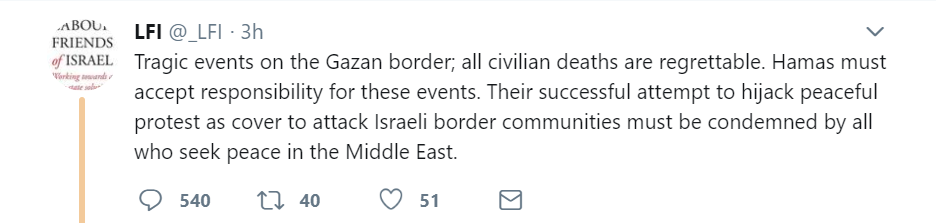
The true face of the organisation calling itself “Labour Friends of Israel” has been revealed today, in truly disgusting victim-blaming tweets reacting to the massacre of over fifty Palestinians – including yet more children – by the Israeli Defence Force in Gaza.
No Israelis were injured and no “border communities” attacked. This amplification of the worst extreme right wing zionist propaganda by the Likud government shows beyond doubt that “Labour Friends of Israel” is nothing whatsoever to do with the professed values of the Labour Party, but rather a well-funded entryist front solely intended to promote the interests of a violent, expansionist and aggressive foreign state.
I am not a Labour Party member and I do not know what institutional ties the “Labour Friends of Israel” has to the Labour Party, but whatever they are they should be cut off immediately.
The “Labour Friends of Israel” featured very prominently on our TV screens after the recent English local elections, beating the drum for their widespread accusations of anti-semitism within the Labour Party. They have been driving that agenda for many months. One would like to think that the mainstream media would, after today, cease to accept them as a genuine and well-motivated group and understand them for the hate-filled fanatics they truly are. Of course that will not happen, and they will be back on television shortly accusing yet more lifelong anti-racism campaigners who have the temerity to criticise Israel.
The British government has given the self-described ‘impartial’ Syrian Observatory for Human Rights (SOHR) £194,769.60 for a project to help fund “communications equipment and cameras,” according to journalist Peter Hitchens.
The Sunday Mail’s Hitchens, a regular critic of British foreign policy, tweeted on Sunday: “Boris Johnson’s Foreign Office admits it gave £194,769.60 to the supposedly ‘independent’ Syrian Human Rights Observatory. How many other ‘independent’ bodies in the Syrian controversy aren’t as ‘independent’ as they look?”
The SOHR declares on its website that it’s “not associated or linked to any political body.” Hitchens in his Sunday Mail blog asks: “Is Boris Johnson’s Foreign Office not a political body?” Hitchens appears to question the legitimacy of the relationship, in relation to the Syrian conflict “in which the British government clearly takes sides.”
Fellow Mail journalist and author of ‘Not the Chilcot Report,’ Peter Oborne has added that the “Syrian Observatory has been treated as a gold standard for information on Syria. Quoted by BBC all the time. Always described as independent.”
The group has come under criticism, being accused by some as a tool of Western propaganda due to its location and lack of staff. Its operation is managed by one man in Coventry in the UK, Rami Abdurrahman, who fled Syria in 2000. He relies on a handful of Syrians to assist him in collating information from “more than 230 activists on the ground”, a network of people from his youth, reports New York Times.
Abdurrahman’s neutrality on the Syrian conflict came under fire when he told Reuters in 2011 he would return to Syria only “when Bashar al-Assad goes,” and according to CNN, was part of a delegation of Syrian opposition officials that met with the then-Foreign Secretary William Hague, that same year.
It’s not the only Syrian-focused human rights group to come under the spotlight with accusations of questionable neutrality because of UK government links. The White Helmets, officially known as the ‘Syria Civil Defence’ has also come under fire. Since 2011, the UK has provided the organization with £38.4m of funding, a freedom of information request has revealed, as reported in The Guardian.
The group operates in areas under the control of the Syrian opposition forces, including Islamist rebels such as Jaysh al-Islam, who controlled the city of Douma until recently, and the location of the latest alleged chemical weapons attack.
According to reports, Theresa May is preparing to increase funding to the White Helmets in response to media claims that President Donald Trump is to withdraw US support for the organization. In March, Trump froze a $200m (£148m) package of US aid to Syria, including money for the White Helmets.
The US President has said he would like to see his country relieve itself of military and humanitarian duties in Syria, calling on other countries to help fill the financial void to fund stabilizing and rebuilding projects in the country after the fight against Islamic State (IS, formerly ISIS), claims ABC news.
Addressing parliament on Wednesday, the UK PM said: “We do support them [the White Helmets], we will continue to support them and … the international development secretary will be looking at the level of support in the future.”
Two Syrian groups claim to be impartial, yet are happy to receive funding from the UK government who, as Hitchens says, are clearly taking sides on the Syrian conflict.
In an exclusive interview with Kathimerini, Syrian President Bashar al-Assad denied that the Syrian Army used chemical weapons against civilians, while taking aim at both Turkish President Recep Tayyip Erdogan and US President Donald Trump.
Saying that Syria gave up its chemical arsenal in 2013, Assad said the
“Western narrative started after the victory of the Syrian Army, not before.”
He accused Erdogan of being “affiliated” with the Muslim Brotherhood Islamist movement and called Turkish troops “terrorists” over their intervention in Afrin.
As for Trump, who has called Assad an “animal,” the Syrian leader said it did not bother him “because I deal with the situation as a politician, as a president.”
Alexis Papachelas: There have been accusations from the US and the Europeans about the use of chemical weapons, and there was an attack after that. What is your response to that? Was there a chemical attack? Were you responsible for it?
President Bashar al-Assad: First of all, we don’t have a chemical arsenal since we gave it up in 2013, and the international agency for chemical weapons conducted investigations about this, and it’s clear or documented that we don’t have any. Second, even if we did have, we wouldn’t use them, for many different reasons. But let’s put these two points aside, let’s presume that this army has chemical weapons and it’s in the middle of the war; where should it be used? At the end of the battle? They should use it somewhere in the middle, or where the terrorists made an advancement, not where the army finished the battle and the terrorists gave up and said, “We are ready to leave the area,” and the army is fully in control of that area. So the Western narrative started after the victory of the Syrian Army, not before. When we finished the war, they said, “They used chemical weapons.”
Second, the use of weapons of mass destruction (WMD) in a crammed area with a population like Douma – the supposed area, it’s called Douma and they talk about 45 victims – when you use WMD in such an area, you should have hundreds or maybe thousands of victims. Third, why do all the chemical weapons – the presumed or supposed chemical weapons – only kill children and women? They don’t kill militants. If you look at the videos, it’s completely fake. I mean, when you have chemical weapons, how could the doctors and nurses be safe, dealing with the chemical atmosphere without any protective clothes, without anything, just throwing water at the victims, and the victims become OK just because you washed them with water. So, it’s a farce, it’s a play, it’s a very primitive play, just to attack the Syrian Army, because… Why? That’s the most important part: When the terrorists lost, the US, France, the UK and their other allies who want to destabilize Syria lost one of their main cards, and that’s why they had to attack the Syrian Army, just to raise the morale of the terrorists and to prevent the Syrian Army from liberating more areas in Syria.
AP: Are you saying that there was a chemical attack and someone else is responsible, or that there was nothing there?
PBA: That’s the question, because the side who said – allegedly – that there was a chemical attack, had to prove that there was an attack. We have two scenarios: Either the terrorists had chemical weapons and they used them intentionally, or maybe there were explosions or something, or there was no attack at all, because in all the investigations in Douma, people said, “We didn’t have any chemical attack, we didn’t see any chemical gas or smell any,” and so on. So, we don’t have any indications about what happened. The Western narrative is about that, so that question should be directed at the Western officials who said there was an attack. We should ask them: Where is your concrete evidence about what happened? They only talk about reports. Reports could be allegations. Videos by the White Helmets – the White Helmets are funded by the British Foreign Office – and so on.
AP: In a tweet, US President Donald Trump described you as “animal Assad.” What is your response?
PBA: Actually, when you are president of a country, you have first of all to represent the morals of your people before representing your own morals. You are representing your country. Does this language represent the American culture? That is the question. This is very bad, and I don’t think so. I don’t think there’s a community in the world that has such language. Second, the good thing about Trump is that he expresses himself in a very transparent way, which is very good in that regard. Personally, I don’t care, because I deal with the situation as a politician, as a president. It doesn’t matter for me personally; what matters is whether something would affect me, would affect my country, our war, the terrorists, and the atmosphere that we are living in.
AP: He said “mission accomplished in Syria.” How do you feel about that?
PBA: I think maybe the only mission accomplished was when they helped ISIS escape from Raqqa, when they helped them, and it was proven by video, and under their cover. The leaders of ISIS escaped Raqqa, going toward Deir ez-Zor just to fight the Syrian Army. The other mission accomplished was when they attacked the Syrian Army at the end of 2016 in the area of Deir ez-Zor when ISIS was surrounding Deir ez-Zor, and the only force was the Syrian Army. The only force to defend that city from ISIS was the Syrian Army, and because of the Americans’ – and of course their allies’ – attack, Deir ez-Zor was on the brink of falling into the hands of ISIS. So, this is the only mission that was accomplished. If he’s talking about destroying Syria, of course that’s another mission accomplished. While if you talk about fighting terrorism, we all know very clearly that the only mission the United States has been carrying out in Syria is supporting the terrorists, regardless of their names, or the names of their factions.
AP: He also used such language with the North Korean leader, and now they’re going to meet. Could you potentially see yourself meeting with Trump? What would you tell him if you saw him face to face?
PBA: The first question you should ask is: What can you achieve? The other: What can we achieve with someone who says something before the campaign, and does the opposite after the campaign, who says something today, and does the opposite tomorrow, or maybe in the same day? So, it’s about consistency. Do they have the same frequency every day, or the same algorithm? So, I don’t think that in the meantime we can achieve anything with such an administration. A further reason is that we don’t think the president of that regime is in control. We all believe that the deep state, the real state, is in control, or is in control of every president, and that is nothing new. It has always been so in the United States, at least during the last 40 years, at least since Nixon, maybe before, but it’s becoming starker and starker, and the starkest case is Trump.
AP: When will you accomplish your mission, given the situation here in Syria now?
PBA: I have always said, without any interference, it will take less than a year to regain stability in Syria; I have no doubt about that. The other factor is how much support the terrorists receive, which is something I cannot tell you, because I cannot predict the future. But as long as it continues, time is not the main factor. The main factor is that someday, we’re going to end this conflict and we’re going to reunify Syria under the control of the government. When? I cannot say. I hope it’s going to be soon.
AP: There has been some criticism lately, because you apparently have a law that says that anybody who doesn’t claim their property within a month cannot come back. Is that a way to exclude some of the people who disagree with you?
PBA: No, we cannot dispossess anyone of their property by any law, because the constitution is very clear about the ownership of any Syrian citizen. This could be about the procedure. It’s not the first time we have had such a law just to replan the destroyed and the illegal areas, because you’re dealing with a mixture of destroyed and illegal suburbs in different parts of Syria. So, this law is not about dispossessing anyone. You cannot, I mean even if he’s a terrorist. Let’s say, if you want to dispossess someone, you need a verdict by the judicial system – you cannot make it happen by law. So, there’s either misinterpretation of that law, or an intention, let’s say, to create a new narrative about the Syrian government in order to rekindle the fire of public opinion in the West against the Syrian government. But about the law, even if you want a procedure, it’s about the local administration, it’s about the elected body in different areas, to implement that law, not the government.
AP: It is clear that your biggest allies in this fight are Russia and Iran. Are you worried they might play too important a role in the future of the country after this war is over?
PBA: If you talk about my allies as a president, they are the Syrian people. If you talk about Syria’s allies, of course they’re the Iranians and the Russians. They are our strongest allies, and of course China that supported us politically in the Security Council. As for them playing an important role in the future of the country, these countries respect Syria’s sovereignty and national decision making and provide support to insure them. Iran and Russia are the countries which respect Syria’s sovereignty the most.
AP: It’s been a few years since you visited Greece. Your father had a very close relation with some of the Greek political leaders. How have the relations been between Greece and Syria these days, and what kind of message would you like to send to the Greek people?
PBA: At the moment, there are no formal relations between Syria and Greece; the embassies are closed, so there are no relations. At the same time, Greece wasn’t aggressive towards what happened in Syria. It always supported a political solution, it never supported war or attacks against Syria. You didn’t play any role to support the terrorists, but at the same time, as a member – and an important member – of the EU, you couldn’t play any role, let’s say, in refraining the other countries from supporting the terrorists, violating the international law by attacking and besieging a sovereign country without any reason, without any mandate by the Security Council. So, we appreciate that Greece wasn’t aggressive, but at the same time, I think Greece has to play that role, because it’s part of our region. It is part of the EU geographically, but it’s a bridge between our region and the rest of Europe, and it’s going to be affected, and it has been affected by the refugee situation, and terrorism now has been affecting Europe for the last few years, and Greece is part of that continent. So, I think it’s normal for Greece to start to play its role in the EU in order to solve the problem in Syria and protect the international law.
AP: How about Turkey? Turkey invaded part of your country. You used to have a pretty good relationship with President Recep Tayyip Erdogan. How is that relationship now after the Turkish invasion?
PBA: First of all, this is an aggression, this is an occupation. Any single Turkish soldier on Syrian soil represents occupation. That doesn’t mean the Turkish people are our enemies. Only a few days ago, a political delegation visited from Turkey. We have to distinguish between the Turks in general and Erdogan. Erdogan is affiliated with the Muslim Brotherhood. Maybe he’s not organized, but his affiliation is toward that ideology, I call it this dark ideology. And for him, because, like the West, when the terrorists lost control of different areas, and actually they couldn’t implement the agenda of Turkey or the West or Qatar or Saudi Arabia, somebody had to interfere. This is where the West interfered through the recent attacks on Syria, and this is where Erdogan was assigned by the West, mainly the United States, to interfere, to make the situation complicated, again because without this interference, the situation would have been resolved much faster. So, it’s not about personal relations. The core issue of the Muslim Brotherhood anywhere in the world is to use Islam in order to take control of the government in your country, and to create multiple governments with this kind of relationship, like a network of Muslim Brotherhoods, around the world.
AP: At an election campaign rally this week, he said that he’s going to order another incursion into Syria. How are you going to respond to that if it happens?
PBA: Actually, Erdogan has supported the terrorists since the very beginning of the war, but at that time, he could hide behind words like “protecting the Syrian people,” “supporting the Syrian people,” “supporting the refugees,” “we are against the killing,” and so on. He was able to appear as a humanitarian president, let’s say. Now, because of these circumstances, he has to take off the mask and show himself as the aggressor, and this is the good thing. So, there is no big difference between the head of the Turkish regime sending his troops to Syria and supporting the terrorists; this is his proxy. So, we’ve been fighting his army for seven years. The difference between now and then is the appearance; the core is the same. At that time, we couldn’t talk about occupation – we could talk about supporting terrorists – but this time we can talk about occupation, which is the announcement of Erdogan that he’s now violating the international law, and this could be the good part of him announcing this.
AP: But how can you respond to that?
PBA: First of all, we are fighting the terrorists, and as I said, the terrorists for us are his army, they are the American army, the Saudi army. Forget about the different factions and who is going to finance those factions; at the end of the day, they work for one agenda, and those different players obey one master: the American master. Erdogan is not implementing his own agenda; he’s only implementing the American agenda, and the same goes for the other countries in this war. So, first of all, you have to fight the terrorists. Second, when you take control of more areas, you have to fight any aggressor, any army. The Turkish, French, whoever, they are all enemies; as long as they came to Syria illegally, they are our enemies.
AP: Are you worried about a third world war starting here in Syria? I mean, you have the Israelis hitting the Iranians here in your own country. You have the Russians, you have the Americans. Are you concerned about that possibility?
PBA: No, for one reason: Because fortunately, you have a wise leadership in Russia, and they know that the agenda of the deep state in the United States is to create a conflict. Since Trump’s campaign, the main agenda was against Russia, create a conflict with Russia, humiliate Russia, undermine Russia, and so on. And we’re still in the same process under different titles or by different means. Because of the wisdom of the Russians, we can avoid this. Maybe it’s not a full-blown third world war, but it is a world war, maybe in a different way, not like the second and the first, maybe it’s not nuclear, but it’s definitely not a cold war; it’s something more than a cold war, less than a full-blown war. And I hope we don’t see any direct conflict between these superpowers, because that is where things are going to get out of control for the rest of the world.
AP: Now, there’s a very important question about whether Syria can be a unified, fully sovereign country again. Is that really possible after all that has happened?
PBA: It depends on what the criteria of being unified or not is. The main factor to have a unified country is to have unification in the minds of the people, and vice versa. When those people look at each other as foreigners, they cannot live with each other, and that is where you’re going to have division. Now, let’s talk about facts and reality – not my opinion, I can tell you no, it’s not going to be divided, and of course we’re not going to accept that, but it’s not about my will or about my rhetoric, to say we’re going to be unified; it’s about the reality.
The reality, now, if you look at Syria during the crisis, not only today, since the very beginning, you see all the different spectrums of the Syrian society living with each other, and better than before. These relationships are better than before, maybe because of the effect of the war. If you look at the areas under the control of the terrorists, this is where you can see one color of the Syrian society, which is a very, very, very narrow color. If you want to talk about division, you have to see the line, the separation line between either ethnicities or sects or religions, something you don’t see. So, in reality, there’s no division till this moment; you only have areas under the control of the terrorists. But what led to that speculation? Because the United States is doing its utmost to give that control, especially now in the eastern part of Syria, to those terrorists in order to give the impression that Syria cannot be unified again. But it’s going to be unified; I don’t have any doubt about that.
AP: But why would the US do that if you’re fighting the same enemy: Islamic terrorism?
PBA: Because the US usually has an agenda and it has goals. If it cannot achieve its goals, it resorts to something different, which is to create chaos. Create chaos until the whole atmosphere changes, maybe because the different parties will give up, and they will give in to their goals, and this is where they can implement their goals again, or maybe they change their goals, but if they cannot achieve it, it’s better to weaken every party and create conflict, and this is not unique to Syria. This has been their policy for decades now in every area of this world.
AP: Looking back, do you feel you’ve made any mistakes in dealing with this crisis and the civil war, when it started?
PBA: If I don’t make mistakes, I’m not human; maybe on a daily basis sometimes. The more you work, the more complicate the situation, the more mistakes you are likely to make. But how do you protect yourself as much as possible from committing mistakes? First of all, you consult the largest proportion of the people, not only the institutions, including the parliament, syndicates, and so on, but also the largest number of people, or the largest part of society, to participate in every decision.
While if you talk about the way I behaved toward, or the way I led, let’s say, the government or the state during the war, the main pillars of the state’s policy were to fight terrorism – and I don’t think that fighting terrorism was wrong, to respond to the political initiatives from different parties externally and internally regardless of their intentions, to make a dialogue with everyone – including the militants, and finally to make reconciliation. So, about the pillars of our policy, I think the reality has proven that we were right. As for the details, of course, you always have mistakes.
AP: How much is it going to cost to reconstruct this country, and who is going to pay for that?
PBA: Hundreds of billions, the minimum is 200 billion, and according to some estimates it’s about 400 billion dollars. Why is it not precise? Because some areas are still under the control of the terrorists, so we couldn’t estimate precisely what the figure is. So, this is plus or minus, let’s say.
AP: There has been a lot of speculation. For example, people say in order for a political solution to be viable, you might have to sacrifice yourself for the good of the country. Is that something that has crossed your mind?
PBA: The main part of my future, as a politician, is two things: my will and the will of the Syrian people. Of course, the will of the Syrian people is more important than my will, my desire to be in that position or to help my country or to play a political role, because if I have that desire and will and I don’t have the public support, I can do nothing. After seven years of me being in that position, if I don’t have the majority of the Syrian people’s support, how could I hold it for more than seven years now, with all this animosity from the strongest and the richest countries? Who supports me? If the Syrian people are against me, how can I stay? So, when I feel that the Syrian people do not want me to stay anymore, of course I have to leave without any hesitation.
AP: A lot of blood has been spilt. Can you see yourself sitting across from the opposition and sharing power in some way?
PBA: When you talk about blood, you have to talk about who spilt that blood. I was president before the war for 10 years. Had I been killing the Syrian people for 10 years? No, definitely not. So, the conflict started because somebody, first of all part of the West, supported those terrorists, and they bear the responsibility for this war. So first of all the West, who provided military and financial support and political cover, and who stood against the Syrian people, who impoverished the Syrian people and created a better atmosphere for the terrorists to kill more Syrian people. So, part of the West, mainly France, UK, and US, and also Saudi Arabia and Qatar and Turkey are responsible for this part. Of course blood has been spilt – it’s a war – but who’s responsible? Those who are responsible should be held accountable.
In an article on 3rd May, the Guardian journalist, Luke Harding, made the following rather amusing observation:
“Since the Skripals were found stricken on a park bench, Downing Street has stuck to one version of events. Theresa May says it is ‘highly likely’ Moscow carried out the attack using a Soviet-made nerve agent. Only the Kremlin had the motive to kill its former officer, she argues.”
The funny part, in case you didn’t spot it, was his claim that Downing Street has stuck to one version of events. He is of course correct, but what he doesn’t tell his readers is that this one version of events has had a plethora of sub-narratives attached to it, none of which have been able to remotely support the main thesis. Sticking to one version of events is reasonable only inasmuch as that version can be supported by facts. On the other hand, if the version of events being stuck to is not supported by the facts, or if the “facts” constantly change, or if the “facts” are contradictory, then sticking to it is a measure not of reasonableness, as Mr Harding implies, but rather of absurdity, folly and irrationality.
G. K. Chesterton once cautioned us against the propensity towards indefinite scepticism:
“Merely having an open mind is nothing. The object of opening the mind, as of opening the mouth, is to shut it again on something solid.”
This is very true. But there is another, equally insidious, ditch which must be avoided. Let’s put it like this:
“Closing your mind too quickly can be worse than nothing. The object of closing the mind, as of closing the mouth, is to make sure that when you do, you have something solid inside.”
So is the narrative that Downing Street closed on so quickly after the incident solid? Does it stand up to scrutiny? Let’s see.
The Claim
The basic claim of the UK Government is as follows:
On 4th March 2018, Sergei and Yulia Skripal were poisoned by a military-grade nerve agent, which had been put on the handle of Mr Skripal’s front door in Christie Miller Road, Salisbury. The substance used was A-234 (a Novichok agent), which is said to be around 5-8 times more lethal than VX (just 10 milligrams of VX on the skin can be lethal). It had been placed there by a person or persons either working on behalf of the Government of the Russian Federation, or who had somehow managed to come into possession of the substance from stocks controlled by the Russian Government.
As Mr Harding implies, it’s all very straightforward. So let’s test it.
What would you have expected to happen?
The basic question one must ask is as follows: Given the scenario outlined in the Government claim, what would you have expected to happen? Here are four basic things one would reasonably have expected:
3. A massive manhunt, both in Salisbury and in the rest of the country, especially in respect of the couple who appeared on a CCTV camera in Market Walk, of whom it was originally claimed were the Skripals, but who were clearly not the Skripals.
4. Mr Skripal’s house entirely closed off, with surrounding streets immediately evacuated, and the parts of Salisbury City Centre where the pair were known to have visited also evacuated.
What actually happened?
So much for what we would have expected to see. Now, more than two months after the incident, we can ask the question: What actually happened?
1. After they allegedly came into contact with the very lethal A-234 nerve agent, far from dying on the spot, Sergei and Yulia Skripal spent the next four hours driving into the City Centre, having a drink, and then going for a meal. They then sat on a bench, and at some point thereafter exhibited what appeared to be hallucinations, suggestive of poisoning by an opioid or non-lethal chemical weapon, rather than a nerve agent.
2. Rather than being hospitalised for months and suffering irreparable damage to their central nervous systems, just over four weeks later, Yulia Skripal telephoned her cousin, Viktoria, and assured her several times that “Everything is okay”. Crucially, she stated that “Everyone’s health is fine, there are no irreparable things.”
3. There has been no manhunt, and the couple who appeared on the CCTV camera in Market Walk have not been identified publicly, nor have there been any appeals for information about them.
4. Far from the streets around the house being evacuated, many photographs show police officers without any protective clothing standing just a few feet away from the door handle, which allegedly still had A-234 of “high purity” on it. Neither was the City Centre evacuated, but people who thought they might have come into contact with the substance were advised by Public Health England (PHE) to wash their clothing in a washing machine, and wipe personal items such as phones, handbags and other electronic items with cleansing or baby wipes.
What Would Holmes Have Made of it?
If you laid all that out in front of Sherlock Holmes – the claims, the expectations, and the reality – and asked him what he made of it, he would no doubt reply along the following lines:
“On the assumption that the substance known as A-234 is several times more toxic than VX, which all credible references to it claim that it is, then given that the Skripals did not die on the spot, and having survived do not appear to have any of the lasting and irreparable side-effects of being poisoned by this substance, it can be stated with reasonable certainty that they were not poisoned by it. Furthermore, given the symptoms that they displayed on the bench, according to eye-witness testimony, in all probability, Mr Skripal and Yulia were poisoned by a substance which can cause hallucinations, such as the opioid, Fentanyl, or an incapacitating, but non-lethal, chemical such as 3-Quinuclidinyl benzilate (BZ). This theory is given credence by the fact that Salisbury District Hospital originally believed the incident to be a case of Fentanyl poisoning.”
What Would Holmes do Next?
Having used the known facts to establish beyond reasonable doubt that the Skripals were not poisoned by A-234, what would Holmes do next?
The obvious thing would be to interview both Sergei and Yulia Skripal, since both are apparently alive and well. He would want to gather details about their movements on the morning of 4th March 2018, and whether they saw anyone acting suspiciously either near the house, or at the bench. He would want to know why Mr Skripal apparently became highly agitated in Zizzis. And he would of course want to find out from Mr Skripal about who he had dealings with in the weeks prior to the incident.
So what, you might ask, would he make of it if he found out that nobody, including him, was allowed to see Mr Skripal or Yulia? What, you might ask, would he make of the fact that nothing has been heard of Detective Sergeant Nick Bailey since his release from hospital more than six weeks ago? What, you might ask, would he make of the fact that there has been not one single police or press report looking into any of these things?
Holmes being Holmes, he would of course want to retain an open mind for as long as possible. But in the absence of any credible explanation for these oddities, or for the huge disparity between the UK Government claims and what actually happened, no doubt his great mind would soon start closing in on the suspicion that not only were the Skripals not poisoned by A-234, but it would appear that a cover up of what really happened has taken place.
The UK has made it clear it won’t let Moscow meet Russian citizens ex-double agent Sergei Skripal and his daughter, as the dragging secretive probe into their poisoning speaks volumes to the observers, the Russian ambassador says.
“It has become clear that we will not get access to the Skripals. They [the British authorities] just will not provide it,” Russian envoy to the UK Alexander Yakovenko told journalists on Thursday, following his meeting with Philip Barton, the Director General, Consular and Security at the British Foreign Office.
By blocking access to the Russians, London flagrantly violates its duties under a bilateral treaty on consular relations with Moscow, Yakovenko said. The true fate of the Skripals, meanwhile, remains unknown, he pointed out.
London maintains that the Skripals do not want to meet with Russian officials. However, neither the Russian ex-spy nor his daughter, Yulia, have publicly appeared to confirm it since the March poisoning. The Russian authorities never received any photos or voice recordings of the man and his daughter from the British side, Yakovenko said.
“We cannot conclusively establish what condition they are in as well as whether they are acting voluntary,” Yakovenko said, adding that the answers that Moscow continues to get from London are “empty and formalistic.”
The longer the UK protracts the investigation, the more countries see “the true nature of the policy conducted by the conservative government,” Yakovenko said, adding that “time is against London.” According to the diplomat, the situation has “put the reputation of the UK at risk.”
Veil of silence
London has been denying Moscow access to the Skripals from the very beginning. First, Russian diplomats were barred from visiting the hospital where the two were treated. Then they were also prevented from meeting Yulia Skripal after the British authorities said she had recovered.
The UK also refused to issue a visa for Skripal’s niece, Viktoria, after she claimed that she would come and take her relatives back to Russia. Following a brief conversation with Yulia, Viktoria also said that her cousin sounded “coached” and “did not use her own words” during the only phone conversation between the relatives.
Later, it was reported that the US and British intelligence agencies may offer Sergei and Yulia Skripal new identities and relocation to a Five Eyes country. Moscow then denounced these plans by saying that any undercover resettlement of the former double agent and his daughter would be seen as “citizen abduction.” In mid-April, Russian UN envoy Vassily Nebenzia also accused the UK of systematically destroying evidence relating to the Salisbury incident.
London’s narrative falling apart?
The British stance on the poisoning of Skripal has remained unchanged. The British government accuses Russia of poisoning Yulia and Sergei Skripal back in early March 2018, using the nerve agent A-234, also known as Novichok. London continues to blame Moscow for the incident, claiming that Russia is the only country able to produce it.
While remaining largely unquestioned within the British mainstream media, this narrative seems to be falling apart against the background of the latest developments. Last week, Czech President Milos Zeman openly admitted that his country did produce and test a nerve agent of the so-called Novichok family.
Russian diplomats had earlier named the Czech Republic as one of the most probable countries from which the nerve agent might have come. The list also included Slovakia, Sweden and the UK itself.
The Organization for the Prohibition of Chemical Weapons (OPCW), an international chemical weapons watchdog, has repeatedly claimed it cannot identify the source of the agent that was allegedly used to poison the Skripals.
Recent disclosures by the Zionist regime show that some 2,069 British nationals were serving in the IDF as of March 2025, according to Freedom of Information (FoI) requests submitted to the occupation forces (1,686 dual British-Israeli, plus 383 multinational). We cannot tell from the figures how many of these were already settler colonists and intend to stay in the colony, and how many will return or have returned to the UK. Presumably, those returning to the UK will number far fewer than 2,000, since many are known to have become permanently residents of the colony.
Additionally, the IDF figures only provide a snapshot, and do not tell us how many have served in the Jewish supremacist military either before or after March 2025. One way into the question of how many genocidaires are living in Britain is to ask how many current British residents were born in the Zionist colony. There is data on that, as we shall see. … continue
This site is provided as a research and reference tool. Although we make every reasonable effort to ensure that the information and data provided at this site are useful, accurate, and current, we cannot guarantee that the information and data provided here will be error-free. By using this site, you assume all responsibility for and risk arising from your use of and reliance upon the contents of this site.
This site and the information available through it do not, and are not intended to constitute legal advice. Should you require legal advice, you should consult your own attorney.
Nothing within this site or linked to by this site constitutes investment advice or medical advice.
Materials accessible from or added to this site by third parties, such as comments posted, are strictly the responsibility of the third party who added such materials or made them accessible and we neither endorse nor undertake to control, monitor, edit or assume responsibility for any such third-party material.
The posting of stories, commentaries, reports, documents and links (embedded or otherwise) on this site does not in any way, shape or form, implied or otherwise, necessarily express or suggest endorsement or support of any of such posted material or parts therein.
The word “alleged” is deemed to occur before the word “fraud.” Since the rule of law still applies. To peasants, at least.
Fair Use
This site contains copyrighted material the use of which has not always been specifically authorized by the copyright owner. We are making such material available in our efforts to advance understanding of environmental, political, human rights, economic, democracy, scientific, and social justice issues, etc. We believe this constitutes a ‘fair use’ of any such copyrighted material as provided for in section 107 of the US Copyright Law. In accordance with Title 17 U.S.C. Section 107, the material on this site is distributed without profit to those who have expressed a prior interest in receiving the included information for research and educational purposes. For more info go to: http://www.law.cornell.edu/uscode/17/107.shtml. If you wish to use copyrighted material from this site for purposes of your own that go beyond ‘fair use’, you must obtain permission from the copyright owner.
DMCA Contact
This is information for anyone that wishes to challenge our “fair use” of copyrighted material.
If you are a legal copyright holder or a designated agent for such and you believe that content residing on or accessible through our website infringes a copyright and falls outside the boundaries of “Fair Use”, please send a notice of infringement by contacting atheonews@gmail.com.
We will respond and take necessary action immediately.
If notice is given of an alleged copyright violation we will act expeditiously to remove or disable access to the material(s) in question.
All 3rd party material posted on this website is copyright the respective owners / authors. Aletho News makes no claim of copyright on such material.

 Aletho News

