Germany Can’t Afford Rearmament, Let Alone a ‘War’ With Russia
By Ekaterina Blinova – Sputnik – 23.01.2024
Germany must take into account the possibility of a military conflict with Russia and prepare for it over the next three-five years, Defense Minister Boris Pistorius told ZDF on January 22.
He insisted that the German Bundeswehr armed forces should become “a credible deterrent,” and that a German combat brigade would be deployed in the Baltics to become “fully combat-ready” by 2027.
In December, Pistorius signed an agreement for the permanent deployment of a Bundeswehr brigade to Lithuania and announced that the reintroduction of compulsory military service in Germany is now on the table.
Does Russia really present an imminent threat to German national security?
“If you ask me, and if you ask most people in my party, the answer is unequivocally no,” Gunnar Beck, Member of the European Parliament for the Alternative for Germany (AfD) party who is currently Vice-President of the Identity & Democracy Group in the Parliament, told Sputnik. “Ever since 1990, at the end of the Soviet Union, the Russian government has gone out of its way to intensify economic relations between Russia and Germany. We had extremely favorable energy contracts with Russia. And Russia was a growing export market for our agricultural and industrial goods. It’s due to our government’s policy, vis-a-vis Ukraine conflict that relations with Russia are now almost at an all time low. So, on the one hand, I think, German policy and EU policy has been a provocation. Nonetheless, I think that the Russian reaction to the sanctions in particular has been tough, but at the same time measured. So in my view, Russia is no immediate security threat to Germany. Categorically not.”
Germany Cannot Afford Rearmament
Not only is Germany’s justification for rearmament in question but also the nation’s ability to afford it, according to Beck. German industry is in a dire state as a result of the government’s policies, he stressed.
“Germany currently finds itself in what is probably the most serious economic crisis since the Second World War,” Beck said. “The government’s policies (…) are affecting all leading branches of German industry, which is suffering from high inflation, lack of qualified labor, bureaucracy and high tax levels. As a result, our exports have declined significantly. So we are in crisis, and German industry, which has always been the backbone of German prosperity, in particular, is in crisis.”
He listed three major reasons for the new talk of militarization:
- First, the German government’s energy and climate change policy;
- Second, unprecedented migration into Germany from outside Europe of unskilled workers and the astronomical cost to German public finances;
- Third, Germany’s policies on Ukraine and sanctions imposed on the Russian economy.
Berlin’s decision to follow Washington’s lead and slap sweeping sanctions on Russia has backfired on Germans on a much greater scale than on any of their Russian counterparts, according to the politician.
“In my view, Germany is in no fit state economically and financially to embark upon a massive rearmament program,” Beck said. “If the German government seriously did so, the consequence would be a further significant worsening of the economic crisis. The only way to finance such rearmament would be through a complete reversal of all the other policies and massive remigration of migrants from Germany. The government has given no indication that it is prepared to do so. In other words, I think these declarations are probably largely symbolic. Germany simply cannot afford it.”
Europeans Don’t Want to Fight Against Russia
The majority of Germans are not worried about a military threat from Russia, according to Beck, raising doubts as to whether Pistorius’ militarization plan would gain any popular traction in Germany and other European states.
“Diplomacy should be the West’s weapons of choice in its relations with Russia, not more armaments,” Geoffrey Roberts, emeritus professor of history at University College Cork, Ireland and a leading British scholar on Soviet diplomatic and military history, told Sputnik, stressing that Europeans have zero appetite for a major war with Russia.
“This bellicose rhetoric is part of a campaign by Western hardliners to further militarize Western states and societies, their aim being to prolong the Ukraine war for as long as possible and to create a permanent confrontation with Russia. Predictions of future war with Russia heighten existing tensions and solidify a mindset in which military power is seen as the solution to political problems,” Roberts continued.
Confrontation between Russia and NATO is fraught with serious risks and is “far more dangerous than anything that happened during the Cold war,” according to the professor.
“During the Soviet-Western Cold war there were many proxy wars and conflicts but nothing comparable in scope, scale and intensity to what is happening in Ukraine,” Roberts noted, referring to the West’s ongoing proxy conflict in Eastern Europe which involves NATO’s Special Forces, weapons, intelligence, military training and sabotage techniques.
“Western hardliners have whipped up an atmosphere of hysteria that could spread violence to other sections of the front-line between NATO and Russia. There is an urgent need for Western governments to heed popular calls for peace and a security settlement with Russia that will avert this new cold war – a conflict that could lead to catastrophe,” the professor concluded.
Moscow is closely observing the tone of European political discourse, warning against provocative rhetoric. Kremlin spokesman Dmitry Peskov noted on Tuesday that many other European countries than Germany have made statements about a “threat” posed by Russia. Earlier in January, Pistorius claimed that Russia could attack a NATO country “one day.”
“Now all European capitals are racing to declare an ephemeral danger that allegedly comes from Russia,” Peskov told reporters. He added that Europe has already invested heavily in the Ukraine conflict, but now see that their plan “failed” and the economic situation was “getting difficult.”
Four of Britain’s top institutions have made erroneous estimates of the cost of Net Zero
By Paul Homewood | Not A Lot Of People Know That | January 24, 2024
Four national institutions have failed to model the 2050 energy system correctly, and all of them in ways that lead to understatement of the costs of Net Zero.
Over the weekend, the Sunday Telegraph reported that the Climate Change Committee has got its energy system modelling wrong. The revelation was made by Sir Christopher Llewellyn Smith, the lead author of the recent Royal Society report on electricity storage, in remarks made at a seminar at Oxford.
According to Sir Christopher, the Climate Change Committee’s estimates of the costs of Net Zero are fundamentally flawed because they have only modelled isolated years. As he pointed out in the seminar, low-wind years can happen back to back, which means that the Climate Change Committee need twice as much storage capacity as they thought. As a result, they have underestimated the costs.
However, the Sunday Telegraph didn’t mention that it’s not just the Climate Change Committee that has made this mistake. In the same seminar, Sir Christopher pointed out that the National Infrastructure Commission has done the same thing, despite being warned of the problem of clusters of low-wind years. So they too will have underestimated the costs.
The National Infrastructure Assessment… is also based on one year…they were told by the Met Office ‘you can get extreme events’…it’s not enough to look at one. They looked at one, so they got the answer wrong. The Met Office are really angry, because they told them ‘don’t do it’, but they did it.
I can also reveal that National Grid ESO, in its Future Energy Scenarios, has done the same thing. I wrote to the NGESO team to ask how they did things, and was told that their models are prepared using weather conditions in 2013, which they describe as an “average year”. They are starting to run tests against low-wind conditions (so-called ‘dunkelflautes’), but back-to-back wind droughts don’t seem to be on their radar yet:
The generation provided from renewables, as well as the demand profile, is typically based on an average weather year (2013).
For FES23, we also conducted an initial piece of analysis looking at abnormal weather conditions (resulting in abnormal supply and demand patterns), the results of which can be found in our FES23 publication under the title Dunkelflaute Period. We took a period of extreme weather, in this case between Jan-Feb 1985, and applied it to our Consumer Transformation scenario in 2050, to look at how the system would respond to a sustained period low renewable output…
We are planning on looking at abnormal supply and exceptional demand in more detail going forward as well as the effects of more extreme weather.
That means that they too will have underestimated the cost of Net Zero.
The Royal Society is to be congratulated for clarifying the problem. However, it turns out that their own modelling is fundamentally flawed too. That’s because, while they model 37 years of different wind speeds, they assume that electricity demand is always the same. Sir Christopher has admitted that this is not correct, in a podcast broadcast last year. As he put it then:
And now I confess something that is a bit of a weakness in our report. We’ve got this model of one year of demand… based in the weather in 2018…We simply repeat that 37 times.
This is clearly wrong, because in 2050 it is imagined that we will all heat our homes with electric heat pumps. Electricity demand will therefore be much higher in cold years than in mild ones, and if we have back to back cold years, we are going to need much more storage.
So, four well funded national institutions have failed to model the 2050 correctly, and all of them in ways that low-balls the cost of Net Zero. That’s a remarkable coincidence, and one that should probably raise alarm bells about the extent of the rot in the British establishment.
Revelation That U.K. Climate Target is Based on One Windy Year’s Data Threatens to Unravel Net Zero Credibility
BY CHRIS MORRISON | THE DAILY SCEPTIC | JANUARY 24, 2024
In October the Daily Sceptic reported on a paper written for the Royal Society led by Sir Chris Llewellyn Smith of Oxford University that concluded batteries were not the answer to the huge storage requirements of intermittent ‘green’ electricity power. Despite the prestigious academic fire power on parade, the paper died a death in the popular prints, presumably because of its unwelcome message about the much-touted battery solution. But recent revelations suggest the report could act as a loose thread that helps unravel the collectivist Net Zero agenda in the U.K. The Royal Society analysed decades of local wind speeds and found the electricity system needed the equivalent of at least a third of green energy to be stored as backup. Such a cost would be astronomical. Now it appears that the Government’s Climate Change Committee (CCC) fudged the issue by using just one year of high wind data in persuading Members of Parliament in 2019 to donkey-nod through Theresa May’s insane legislative rush to Net Zero by 2050.
Sir Chris’s report showed that wind could fall away for days at a time during periods of intense cold dominated by high atmospheric pressure. It also found wind speeds varied between years, all of which is in fact known and has been studied widely by other scientists. The Telegraph has reported on remarks made by Sir Chris after the paper was published in which he noted that the CCC has “conceded privately” that reliance on one year’s data was a “mistake”. It appears that the information given to MPs committing to 2050 Net Zero assumed there would be just seven days when wind turbines would produce less than 10% of their potential electricity output. According to Net Zero Watch that compares with 30 such days in 2020, 33 in 2019 and 56 in 2018.
In reporting that the CCC has conceded the “mistake”, the Telegraph noted that Sir Chris said the committee was still saying it doesn’t differ much from Sir Chris’s calculations. “Well that’s not quite true,” observed the Oxford Emeritus Professor. Asked by the newspaper if it disputed the account of Sir Chris, a CCC spokesman said it had “nothing further to add”.
Of course the ‘Noble Lie’ that Net Zero must be foisted on an unwilling population whatever the economic and societal cost will need to be preserved. Nothing to see here, move along please, is likely to guide most mainstream media in covering these latest revelations. The investigative science and Net Zero writer Paul Homewood is less inclined to ignore the serious matter. “It is now clear that Parliament authorised Net Zero without any proper assessment, whether financial or energy, and the whole Net Zero legislation must now be suspended until a full independent assessment is carried out.” He goes further and states that current and past members of the CCC must be held to account, and “excluded from any further influence over the country’s energy policy, or indeed on any issue of public policy”.
In general, nobody wants to talk about the lack of wind and solar backup, so there is a widespread pretence that the problem will somehow be solved in the future. But having dismissed any role for batteries, the Royal Society suggested hydrogen as a solution, an idea, alas, only slightly less dumb than batteries. Highly explosive, low kinetic energy compared with hydrocarbons, expensive to produce, difficult to store and move around – the disadvantages are all too obvious. Francis Menton of the Manhattan Contrarian saw the report as an “enormous improvement” on every other effort on the subject of large scale energy storage systems. But in the end, the authors still have a “quasi-religious commitment” to a fossil-free future, and this means that the report, despite containing much valuable information, “is actually useless for any public policy purpose”.
What is becoming clear is the level of statistical deception that is practised across climate science and the promotion of Net Zero. Surface temperature measurements are frequently adjusted upwards on a retrospective basis despite ignoring growing urban heat corruptions, activists use computer models to run up garbage-in, garbage-out scares on an almost daily basis, and bad weather is deliberately confused with long-term climate to suggest the latter is changing due to human caused carbon dioxide. All lapped up without a critical word between them by members of the mainstream media increasingly funded by elite billionaires.
The donkey-nodding politicians and the poodle media often hide behind the notion that they are just following the ‘science’. There is no such thing as the ‘science’, settled or otherwise, just the ongoing scientific process. The distinguished scientist and Nobel laureate Richard Feynman captured the integrity of the process when he wrote: “If you’re doing an experiment, you should report everything that you think might make it invalid – not only what you think is right about it. … Details that could throw doubt on your interpretation must be given, if you know them.”
Renewable energy is not a low-cost substitute for fossil fuels, notes a forward in Rupert Darwall’s recently published report on Net Zero and Britain’s “disastrous” energy policies. High and rising energy costs have locked Britain into economic decline, a suggestion given weight by last week’s savage destruction of the steel economy of Port Talbot. Renewables are not cheap, nor can they provide the reliability that modern societies expect and on which they depend. His report is said to convincingly demonstrate “how Britain was conned into Net Zero by deceptive and illusory promises of cheap wind power”.
The CCC is a dedicated green activist group that sits at the heart of U.K. Government. It is a pernicious, untrustworthy force in British politics giving cover to policies that will lead to de-industrialisation and massive changes in future lifestyle including restriction on diet, transport and personal freedoms.
Here’s hoping the wind scandal blows the damn thing away.
Chris Morrison is the Daily Sceptic’s Environment Editor.
Belgium to Allocate $663Mln to Ukraine From Profits Made From Russia Frozen Assets – Reports
Sputnik – 23.01.2024
BRUSSELS – Belgium will allocate 611 million euros ($663 million) to help Ukraine in 2024 from the profits received from the frozen assets of Russia, La Libre newspaper reported on Tuesday, citing Defense Minister Ludivine Dedonder.
The funding will be provided from the interests on the accounts of Russia’s frozen assets in the country, the newspaper reported.
Last year the US proposed G7 working groups to look at possible ways to seize $300 billion in frozen Russian assets. The EU, and the UK have stressed that the money received via the confiscation would not be easily accessible and would also be insufficient to cover Ukraine’s reconstruction needs. Besides, the countries have noted that the confiscation of Russian assets should not occur to the detriment of providing financial support to Kiev in 2024.
Moscow has maintained that any attempt to confiscate its frozen assets would violate international law. The Russian Foreign Ministry has dismissed the freezing of Russian assets as theft.
“Those who are trying to initiate this, and those who will implement it, must understand that Russia will never leave those who did this alone. And it will constantly exercise its right to a legal battle, internationally, nationally or otherwise. And this, of course, will have — both Europeans and Americans understand this very well — it will have legal consequences for those who initiated and implemented it,” Kremlin spokesman Dmitry Peskov said commenting on the issue.
Last year, Russian President Vladimir Putin dubbed the West’s asset seizure an “unseemly business,” and stressed that “stealing other people’s assets has never brought anyone good”.
The Climate Change Committee Must Pay The Penalty For False Advice
By George Lawson | Not A Lot Of People Know That | January 23, 2024
It seems to me that the falsification of data on the weather, perpetrated by Mr Stark and the Climate Change Committee, has far wider implications than the crime itself. It was due to the Climate Change Committee’s false information to parliament that the Net Zero fiasco was brought into law by the Teresa May government with wide government support before she was forced out of office. Net Zero, as we all know, has been a very expensive failure, and will be seen as the most costly and useless law that has ever been passed by our legislators.
The law has indirectly been responsible for increasing fuel prices to the public and pushed up business costs and prices, making products uncompetitive. It is responsible for increasing the cost of living for everyone across the nation, and has drained many billions of pounds from our overstretched government finances. The effects of these avoidable negative factors on our nation are simply incalculable, but what we do know is that Stark’s blatant lies have been responsible for trashing the country’s economy.
Mr Sunak now has good cause to do two things to affect a recovery of our lost economy. He should immediately close down the wasteful and lying Climate Change Committee, as this is the most expensive lie, by far, than the many lies they have included in their reports over the years, and bring in legislation to overturn the ridiculous economy – sapping Net Zero law. If he does this he will be supported by 99 per cent of the population, it will also increase his reputation massively for when the next election happens.
Finally, Stark, together with the Chairman of the Climate Change Committee, should be brought before a full committee of enquiry to answer for his lies, and if found guilty of intentionally misleading Parliament, he should be sent to prison. Such terrible lies to enhance his reputation at such a cost to the nation, should not go unpunished.
A ‘pro-Russian monster’ or a force for common sense? A new party is reshaping the German political landscape
By Tarik Cyril | RT | January 20, 2024
Germany is in severe crisis. Between a tanking economy and an increasingly unpopular government, the country has begun to show just how much stress it is under. Half a year ago, the head of German carmaker Volkswagen warned that “the roof is on fire,” while The Economist concluded that “disaster,” meaning not just the decline but collapse of the German car industry, is “no longer inconceivable.”
At this moment, the wintry beginning of 2024, German farmers are staging large-scale and escalating protests and forcing the ruling coalition into concessions, the trains are not running on time due to a strike, the country’s wholesale sector has dropped to pandemic-level pessimism, “dampening hopes of a rapid rebound in Europe’s largest economy,” as reported by Bloomberg, residential property prices are in record decline, and the office real estate market “has collapsed,” according to leading German news magazine Der Spiegel.
The Economist finds Germany to be “down” politically as well – in fact, self-relegated – from its status as leader of Europe (or, at least, the EU) to less than second fiddle (that would be France, perhaps): while “Angela Merkel was the continent’s undoubted leader, Olaf Scholz, has not taken on her mantle.”
That is a very British understatement. In reality, in the toxic yet key relationship with the US, Germany, with its hapless attempt to transfer the management concept of “servant leadership” to geopolitics, has now subordinated itself so thoroughly to American neocon-type interests that it has no leverage left at all. Because once you make your loyalty unconditional, you will be taken for granted: Selling oneself may be inevitable for any but the greatest powers. Selling oneself for free takes a special lack of foresight.
We could go on heaping up examples of malaise. But the gist is simple: Germans may love to lay it on thick when it comes to venting their misery and “angst” (I should know, being German), but, clearly, something has to – and will – give. The question is what.
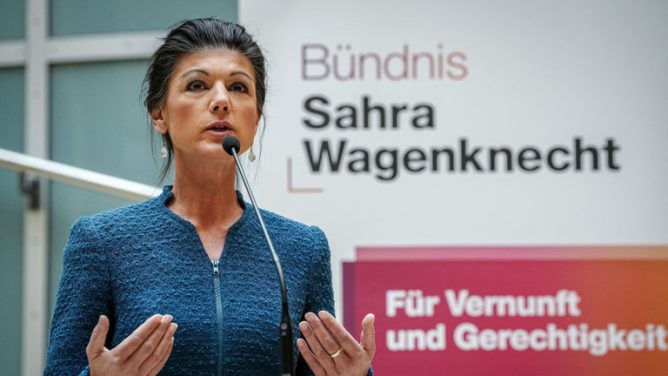
One political force that stands to gain from the crisis has just been established. (Another fairly new party that is profiting is the AfD.) Long rumored and in the making, 8 January saw the official founding of a new party, the Bündnis Sarah Wagenknecht – Vernunft und Gerechtigkeit (Alliance Sarah Wagenknecht – Reason and Justice), or BSW for short. Its leader Sarah Wagenknecht used to be the most popular top politician of the hard-Left party Die Linke, which she left with a bang.
As the name BSW suggests, the new party is, in part, a vehicle for Wagenknecht’s considerable personal political acumen and charisma. Opponents of “Red Sarah,” as the popular, generally right-leaning newspaper Bild still calls her, like to stereotype her as an “icon.” Yet, wiser from the failure of an earlier attempt to strike out on her own (under the label “Aufstehen,” roughly: “Stand Up”), this time, Wagenknecht has gone out of her way and made sure to do her homework, preparing a well-crafted organization, a set of junior leaders around her, and, last but not least, a solid program. This is politically significant: Unlike “Aufstehen,” the BSW will not fold quickly under the weight of its own problems.
On the contrary, the party’s chances of making a strong impact from the get-go are very good, as polls consistently indicate. The most recent one – commissioned by Bild and carried out just days after the party’s founding by a top pollster – shows that 14% of Germans would vote for the BSW in a federal election.
For comparison: the SPD, traditionally one of the core parties of Germany and the political home of Chancellor Olaf Scholz, reaches 14% as well. For the BSW this is an impressive figure, but for the SPD it is catastrophic. Meanwhile the Greens, the second partner in Berlin’s governing “Ampel” coalition, are at 12%. The FDP, the third “Ampel” component, would fail to get any seats at all (due to not crossing Germany’s electoral threshold of 5%). Sarah Wagenknecht’s own former party, Die Linke, would suffer the same fate. The only two parties that would do better than the BSW are the traditional center-right CDU (27%) and the populist-right/far-right AfD (18%).
In sum, with BSW, we are witnessing not the making of a fringe but a core movement in what seems to be emerging as Germany’s re-shaped party system, consisting of three traditional parties (SPD, CDU, and the Greens) and two new forces. The latter are coming from the right and left periphery but are likely to re-define the center, directly and by their pressure on the traditional players.
Representatives of the threatened traditional parties and their expert and mainstream media surrogates often denounce the challengers from the wings as extremists or, at least, irresponsible populists (just another way of saying “demagogue”). But they only have themselves to blame: The true cause of this tectonic movement is the failure of the traditionals. The challengers’ rise marks a reaction to it. Wagenknecht is right about this: Germany’s “democracy is imperiled most of all” by government policies that make ever more citizens feel left alone or alienated.
Against that background, the BSW promises more generous social policies, such as on education, wages, and pensions (and higher taxes for the wealthy). As Germany is doing badly economically, this will resonate. And Wagenknecht, a political “natural,” knows how to signal: She has just taken the side of the protesting farmers – as do the majority (68%) of Germans, according to polls.
Mainstream media are making desperate attempts to frame the rebellious farmers as serving extremists and somehow playing into the hands of – guess which country! – Russia. The ever more besieged minister of the economy Robert Habeck has even detected financing by – guess who! – “Putin!” (without, of course, providing any evidence). This time, these tired scare tactics are failing to catch on. Wagenknecht’s public call for chancellor Olaf Scholz to apologize to the farmers will fare better.
Crucially, Wagenknecht and the BSW have combined socially left approaches with a set of traditionally conservative stances, challenging, for instance, the hypertrophic development of new gender categories or, in general, “symbolical struggles” over hyper-sensitive terminology, so fashionable with what Wagenknecht dismisses as the “lifestyle Left.”
While this push-back against political correctness is a largely symbolic, though effective, operation, migration is a more substantial field. There as well, Wagenknecht has adopted positions closer to the right and center than the liberal left, stressing the need for control and limits. The fact that she herself had a Persian father and that prominent BSW heads are also non-ethnic Germans gives her a strong starting position for this kind of debate, shielding her points from dismissal as racist or xenophobic.
Given how many Germans feel, left alone in an economic crisis and also alienated by especially Green attempts at re-education in the spirit of urban upper class multiculturalism and gender obsessions, it will be hard to counter the BSW’s brand of socially left but otherwise centrist and even conservative policies. No wonder then that opponents are trying to portray Wagenknecht as a monster, along with the new party. Their playbook is predictable and boring: namely to smear them as being pro-Russian or even working in the service of Russia.
In reality, Wagenknecht has positioned her new party to resist the push for ever more confrontation with Moscow, especially with regard to Ukraine. At this moment, for instance, she is speaking up against the delivery of German Taurus cruise missiles to Ukraine, which is the latest fad among the insatiable “miracle weapon” addicts. More generally, she is demanding to shift from a policy of military confrontation by proxy to one of negotiation and compromise, which makes, of course, perfect sense.
For her enemies, there is an irony waiting to catch them: They may hope that accusing Wagenknecht of being too friendly toward Russia will weaken her appeal. Yet that ship has sailed. The days of making hay with unbridled neo-McCarthyism are ending. It is more likely, fortunately, that the BSW’s reasonable approach to foreign policy will only get it more sympathy and voters. As it should. Because remember: At this point, Germany is so dependent on the US that it is treated not only like a vassal, but like a vassal whose wishes and interests do not count. Even Germans who distrust Russia will come to understand that this is fundamentally unsound. In its own national interest, Germany must re-establish some balance by rebuilding its relationship with Russia.
Tarik Cyril Amar is an historian from Germany working at Koç University, Istanbul.
Miliband will bring wholesale deindustrialisation
Net Zero Watch | January 19, 2024
Net Zero Watch has said that Labour’s green dogmatism will be a disaster for the working classes, bringing industrial closure on an unprecedented scale. The campaign group, which has warned about the existential threat to British steel industry for more than a decade, says that the Port Talbot closure was inevitable, given the determination of all parties to push up the costs of energy.
The policy of taxing fossil fuels made the closure of Port Talbot inevitable, while the drive for renewables is pushing up electricity prices so far that the plan to replace the blast furnace with an electric-powered arc furnace will almost certainly prove to be a dead duck.
Electricity prices have doubled from 2002—2020, even rising during long periods of falling gas prices, as a result of increasing grid system inefficiency caused by renewables.
Net Zero Watch director Andrew Montford warns that things may get even worse under a Labour government.
Ed Miliband’s delusions over renewables are going to be a disaster for the UK working classes. He is going to produce deindustrialisation on a scale that is going make the closure of the coalmines under Margaret Thatcher look like a walk in the park.
Mr Montford says that while the finger of blame for Port Talbot should be pointed at the Conservatives, there is an all-party consensus around the policies that produced the disaster:
The Westminster village is so far divorced from the interests of general public that they will shrug off the Port Talbot disaster with barely a look back.
Status Report From Another Would Be “Climate Leader,” The UK
By Francis Menton | Manhattan Contrarian | January 15, 2024
At any given moment in the course of human events, not everyone can be the leader. And thus can the world only have a small number of “climate leaders” to light us the way to the Great Green Energy Nirvana of the future.
Among that select group of “climate leaders,” New York is definitely one. We know that because New York enacted its Climate Leadership and Community Protection Act in 2018, announcing its “climate leadership” to the world for all to envy.
But there are a handful of jurisdictions out there that are not to be outdone in the competition for the title of “climate leader.” One of those is the UK. Ten years before New York even entered the competition, the UK had enacted its Climate Change Act of 2008, setting an initial round of legally-binding emissions reduction targets (80% below 1990 levels by 2050). Then, in 2019 the UK upped the ante, committing by statute to “net zero” greenhouse gas emissions for its entire economy by 2050.
We know from my last post how things are going with this “climate leadership” thing in New York: five years into the competition, New York’s greenhouse gas emissions have actually increased substantially, as two large new natural gas power plants have replaced electricity generation from two prematurely-closed emissions-free nuclear facilities, while generation of electricity from wind and solar has barely budged.
Has the UK been any more successful? Rupert Darwall, writing under the auspices of the Real Clear Foundation, has produced a comprehensive update, with a date of December 2023. The title tells you all you need to know: “The Folly of Climate Leadership: Net zero and Britain’s Disastrous Energy Policies.”
The short summary of Darwall’s Report is that there is nothing but bad news for Britain. By contrast to New York, the UK has actually moved forward with massive construction of “renewable” facilities to generate electricity, mostly in the form of wind turbines. What it has gotten for its efforts is far more nameplate capacity of facilities for generation, but far less electricity actually generated. Costs that were predicted by advocates to decrease substantially have instead increased steadily. The percent of electricity generated from the “renewables” has gotten to around 35%, but has stalled out at that level, and the latest round of offers of acreage for offshore wind development attracted no bidders even at prices a multiple of what additional natural gas facilities would cost. In short, the UK appears stuck, with its consumers paying higher costs for power indefinitely, but with no path forward from here to the promised net zero utopia.
Darwall compares trends in electricity prices charged to commercial and industrial business in the UK and U.S. over the period from 2004 to 2022. The UK prices have steadily pulled away as the percent of electricity generation from “renewables” has increased. Here is Darwall’s chart from page 51 of his Report:
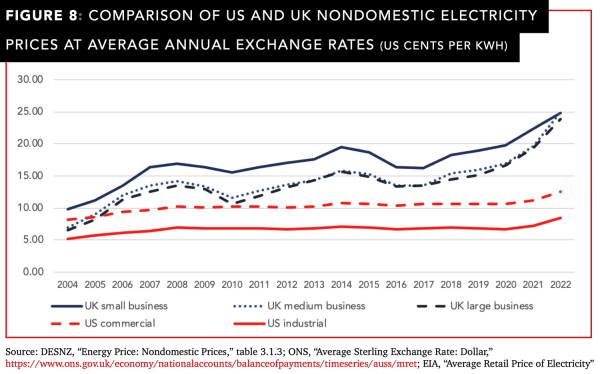
Darwall attributes the growing divergence in prices mostly to divergence in fossil fuel production. In the UK, fracking for natural gas has been completely blocked by environmental regulations. Meanwhile, in the U.S., Darwall writes:
By 2009, natural gas output had increased by 14.3 percent from its trough, reaching its highest level since 1974. In the next 10 years, US natural gas output surged a staggering 64.4 percent, to 33,899 billion cubic feet (bcf), 56.0 percent higher than its previous peak of 21,731 bcf in 1973.
In return for greatly increased electricity generation from wind and solar, the UK has dug itself into the perverse situation of ever-increasing nameplate generation capacity, but simultaneously falling output of electricity. Darwall:
Between 2009 and 2020, . . . a 15.5 percent increase in nameplate generating capacity produced 21.6 percent less electricity. In 2009, 1 MW of capacity produced 4,312 MWh of electricity. In 2020, 1 MW of capacity generated 3,094 MWh, a decline of 28.3 percent.
Has the UK at least made some progress in “saving the planet”? Here is my favorite chart from the Report, found on page 28:

The UK has gone a long way toward destroying its industrial base, but its emissions reductions are so small as to be barely noticeable in the overall world picture, and totally swamped by increases elsewhere, mostly from China. The rest of the world is getting a good laugh at Britain’s expense. As Darwall states, “The metric of leadership success is followship.” By that metric, as well as every other, Britain’s “climate leadership” is a total disaster.
Updates On The March To The Great Green Energy Future
By Francis Menton | Manhattan Contrarian | January 12, 2024
The cries of climate alarm get ever louder and more urgent. (E.g., New York Times, January 9, “It’s confirmed: 2023 was the planet’s warmest year on record and perhaps in the last 100,000 years. By far.” ) We’re all about to boil! Something must be done!
OK, but then there is the proposed solution: Order up by government fiat that our current fully working and inexpensive energy system must be replaced with a never-demonstrated pipe dream conjured up by political science and gender studies majors who know nothing about how an energy system works. We’re far enough into this by now that some of the pieces are starting to blow up in dramatic fashion. Are we allowed to notice?
Here in New York, we got into this game mainly with two pieces of legislation, both enacted in 2018 — at the state level, the Climate Leadership and Community Protection Act; and in the City, Local Law 97. With both laws the pols set the deadlines for compliance at dates seemingly far in the future, expecting that they would no longer be around to be held accountable. The first of those two laws ordered up state-wide mandates for “decarbonizing” the economy, starting with a requirement for 70% of electricity from “renewables” by 2030; and the second set limits for carbon emissions for buildings in New York City, some of which have just kicked in effective January 1, 2024. Sure enough, the Mayor at the time of enactment is gone, almost the entire City Council is gone (term limits), and the Governor at the time is also gone.
So where are we?
The Manhattan Contrarian Energy Storage Report of December 1, 2022, led off by sounding a clear alarm: getting electricity from intermittent wind and solar well past 50% of total generation would require enormous quantities of energy to be stored, with technical requirements, including duration of storage, well beyond the capability of any battery currently existing or likely to be invented any time soon. Essentially, if fossil fuels are to be eliminated, there is only one realistic possibility for meeting the storage requirements: hydrogen.
In mid-2023, the New York Independent System Operator, to its credit, recognized the problem — although it buried that recognition deep in a report when it should be shouting about the problem from the rooftops. From NYISO’s Power Trends 2023 Report, revised August 2023, page 7, starting in the middle of a paragraph and without any emphasis:
[T]o achieve the mandates of the CLCPA, new emission-free generating technologies with the necessary reliability service attributes will be needed to replace the flexible, dispatchable capabilities of fossil fuel generation and sustain production for extended periods of time. Such emission-free technologies, either individually or in aggregate, are not yet available on a commercial scale.
With hydrogen as the only possible such “emissions-free generating technology,” how much would hydrogen cost as the solution to this problem, particularly if one follows the hypothesis that it must be created without any use of fossil fuels? My Report, page 14, noted that existing commercial production of this so-called “green” hydrogen was “negligible,” leaving no good benchmark for understanding what the costs might be. As a substitute, I ran some rough numbers based on cost of wind and solar generators to make the electricity and efficiency of the electrolysis process. The result was a very rough estimate that this “green” hydrogen would cost “somewhere in the range of 5 to 10 times more” than natural gas (page 17).
Well, now some new precision has come into view. In July 2022 the UK government launched what it calls its First Hydrogen Allocation Round (HAR 1), to obtain bids and award contracts to produce this so-called “green” hydrogen using wind power. The process took a while, but here from December 14, 2023 is the announcement of the first round of contract awards. Excerpt:
Following the launch of the first hydrogen allocation round (HAR1) in July 2022, we have selected the successful projects to be offered contracts. We are pleased to announce 11 successful projects, totalling 125MW capacity. HAR1 puts the UK in a leading position internationally: this represents the largest number of commercial scale green hydrogen production projects announced at once anywhere in Europe. . . . The 11 projects have been agreed at a weighted average strike price of £241/MWh.
£241/MWh? At today’s exchange rate of 1.27 $/£, that would be $306/MWh. Prices of natural gas are generally quoted in $/MMBTU rather than per MWh, but here is EIA’s latest Electricity Monthly Update, dated December 21 and covering the month of October 2023. It gives natural gas prices in the per MWh units. The “price of natural gas at New York City” is given as $11.32/MWh. That would make the price that the UK has just agreed to pay to buy this “green” hydrogen stuff approximately 27 times what we can buy natural gas for here in New York to obtain the same energy content.
And that $306/MWh is just for the hydrogen. It includes nothing for the massive new facilities (underground salt caverns?) to store the stuff, for a new pipeline network to transport it, and for a new collection of power plants to burn it.
To be at least a little fair, natural gas prices do vary considerably by location. Even within the U.S., some prices per the EIA Report are about double the New York City price, and in Europe maybe four times the New York City price. But those prices are affected by European demand for LNG from the U.S., due to their own stupid decision to ban fracking for natural gas combined with the unpleasantness in Russia.
And even if you figure that green hydrogen can be produced for “only” 7 – 10 times what it costs to buy natural gas, rather than 25 – 30 times, is anybody really going to go forward with such a project to replace all natural gas in an entire modern economy? It would be completely nuts.
Finally, let’s take a look at how New York is progressing toward that 2030 mandated goal of 70% of electricity from renewables. Data on electricity production for New York State for 2023 are just out from the NYISO. The good people from Nuclear New York (advocates for more nuclear power plants) have compiled the ISO data into a helpful aggregate chart covering the years 2019 (immediately after enactment of the Climate Change Act) to 2023. Here is the chart:
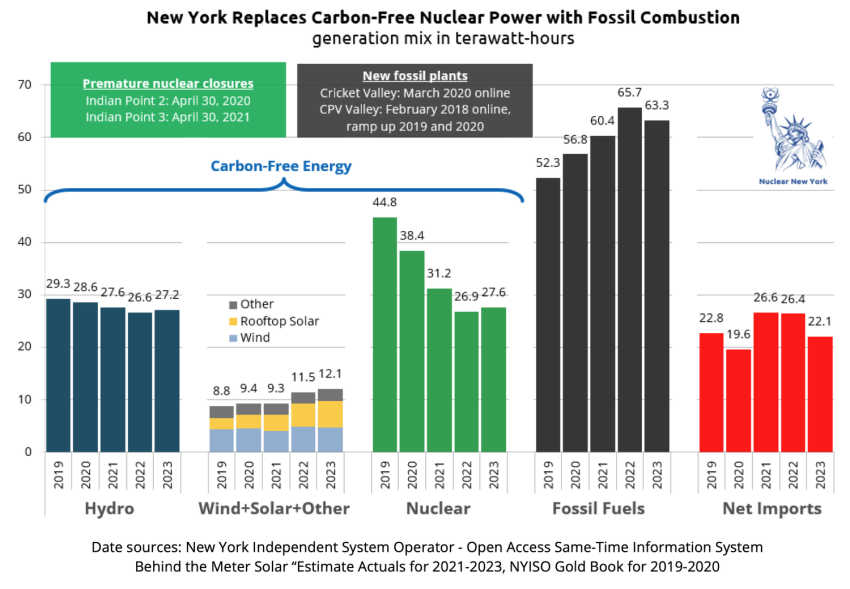
Out of 152.3 TWh of electricity produced or imported in 2023, fossil fuels continued to provide 63.3 TWh (41.5%). Most of the imports (14.5%) are undoubtedly from fossil fuels as well. Wind/solar/other provided just 12.1 TWh, or 7.9% of the total, barely up from about 6% in 2019. And that’s now suddenly going to go to 70% by 2030? Ridiculous. Meanwhile, the big story leaps off the page, as the Nuclear New York guys emphasize in the headline. The State forced the premature closure of two nuclear plants in 2020 and 2021, which caused the (carbon free) nuclear share of the total to drop from about 29% to only 18%; and almost all of that was taken up by two new natural gas plants, causing the fossil fuel share of the total to soar from only 34% to 41.5%. No person looking at this chart would ever conclude that New York has spent the past five years embarked on a crash program to replace fossil fuels with wind and solar. That process is going absolutely nowhere.
The truth is that the march to the Great Green Energy Future is over, but no one is yet willing to admit that.
Scholz pushes fake Russian threats to distract Germans from economic problems
By Ahmed Adel | January 15, 2024
Germany is preparing for a war between NATO and Russia, which, according to the scenario of the German Defence Ministry, could begin in the European summer of 2025 after the defeat of the Ukrainian Army, reported Bild with reference to a secret document of the Bundeswehr. This is evidently a desperate attempt by the German chancellor to distract citizens from their economic woes.
According to the newspaper, citing a classified German military document, the escalation could begin as early as next month with the start of an active Russian offensive against the Ukrainian Armed Forces.
According to Bild, the German military considers the Suwałki Gap between Belarus and the Russian region of Kaliningrad to be the most likely site of confrontation. A situation could escalate in October if Russia deploys troops and medium-range missiles to Kaliningrad, and from December 2024, an artificially induced “border conflict” and “clashes with numerous casualties” could unfold as Russia would take advantage of political chaos in the US following the presidential election.
“The actions of Russia and the West are described precisely, indicating the location and month, and will culminate in the deployment of hundreds of thousands of NATO troops and the imminent start of war in the summer of 2025,” writes the article.
However, the article’s authors leave open the question of how this hypothetical escalation will end.
This is, of course, a ridiculous suggestion by the German Defence Ministry, especially as Moscow has repeatedly stressed that it does not want conflict with NATO or anything beyond its special military operation in Ukraine. Rather, this is an attempt by Chancellor Olaf Scholz to instil an unjustified fear in German society as his popularity continues to plummet in the context of a stuttering economy and continued failed policies.
More than 70% of Germans are dissatisfied with Scholz, according to a survey carried out by the INSA Institute for Bild. Specifically, 72% of voters do not approve of his performance, which is three percentage points more than at the beginning of December. Only one in five, 20%, think that Scholz has done a good job.
According to the researchers, 76% of those surveyed are generally dissatisfied with what the federal government does, whilst only 17% of citizens are satisfied. It is the worst indicator of the ruling coalition since it was formed in December 2021, Bild noted.
In 2023, the Scholz-led government faced numerous economic and leadership challenges that undermined public trust. Persistent inflationary pressures, exacerbated by fiscal policy, undermined household budgets, which caused widespread discontent. The lack of strategic direction and perceived indecision on critical issues, such as energy policy following the adoption of sanctions against Russia, further fuelled scepticism among voters. The leadership crisis, characterised by internal conflicts and disagreements, damaged the effectiveness and cohesion of the German government.
What especially frustrates Germans is the fact that sanctions were imposed on Russia, which has become the fifth-largest economy in the world by volume, whilst Germany is in recession. With a public budget deficit estimated at around 60 billion euros, the very model of the German economy appears to be threatened.
Germany is officially in recession and is expected to have ended 2023 with a drop in GDP of around 0.3%, according to a forecast from the European Commission. This is one of the worst economic results in the bloc, given that the growth forecast for the entire European Union in 2023 is 0.6%. Among the causes is the energy crisis that has hit Germany harder than the rest of the European bloc, mainly because the Germans slashed their supply of Russian energy after the start of the special military operation in February 2022.
Furthermore, with the increase in energy prices resulting from sanctions against Russia, Germany has also suffered an increase in general price inflation in the economy, forcing the European Central Bank to raise interest rates, thus affecting the population’s purchasing power and impacting consumption. Consequently, German companies have not only lost international competitiveness with the application of sanctions against the Russians, but now the country runs the risk of entering a process of deindustrialisation.
Under these conditions, the extreme right is experiencing a resurgence. The far-right Alternative for Germany (AfD) party has hit an all-time high approval rating of 24% and has the potential to gain a few more percentile points with the immense failure of the ruling coalition.
What is undeniable is the fact that Germany is experiencing a rapid decline, all spurred on by the reckless policies of Scholz that prioritised American interests instead of German, and he is now resorting to a fake Russian threat in a desperate attempt to distract citizens from their social and economic problems that he is responsible for.
Ahmed Adel is a Cairo-based geopolitics and political economy researcher.
Asymmetric Warfare: Why the Houthis Can Beat the Collective West
By Russell Bentley – Sputnik – 14.01.2024
Dr. Michael Parenti once said, “Economic violence is physical violence in slow motion.” The economic sanctions against Iraq in the 1990’s led directly to the deaths of half a million Iraqi children. Economic sanctions can be a weapon as deadly as any artillery shell or cruise missile.
The Houthis might at first appear to be vastly outmatched by the US/UK armada that has struck Yemen, but militarily and economically, the US and Europe are actually much more vulnerable than the Houthis. To put it simply, in both economic and military terms, the US, UK and Europe, and Israel, have a lot more to lose.
The Houthis are not alone – Hezbollah, considered to be one of the most effective fighting forces in the world today, has an estimated 100,000 highly trained and motivated and very well armed soldiers in Lebanon, and is already at (undeclared, but de facto) war with Israel, and will probably escalate in the next few days. In October, 1983, Hezbollah was able to kill 305 US and French occupation soldiers at a cost of only 2 KIA on the Hezbollah side.
Of the US and French soldiers, 220 were US Marines, the greatest single loss in one day of US Marines since the Battle of Iwo Jima in 1945. In the 2006 Hezbollah-Israeli War, in which Israel invaded southern Lebanon, Hezbollah was able to inflict “unacceptable casualties” on Israeli forces, which resulted in the withdrawal of IDF forces and the signing of UNSC1701. While the Lebanese casualties were significantly higher than Israeli, the conflict is generally seen as a tactical and strategic defeat for Israel. Israel and their US/EU allies would do well to remember both of these battles before continuing to escalate an already extremely volatile situation beyond the point of no return.
Escalation between Hezbollah and the IDF on Lebanon’s southern border will not only expand the current area of conflict into the eastern Mediterranean, it can quickly become a serious threat to the Israeli city of Haifa, only 20 miles from the Lebanese border. Haifa is Israel’s 3rd largest city, with a population of around 300,000. The Port of Haifa is Israel’s second largest by cargo tonnage, and the Haifa oil refinery (the largest, and one of only two in Israel) processes more than 66 million barrels of crude oil per year, more than a million barrels per week. The port, and especially the refinery would be prime targets, and significant damage to either, especially the refinery, would have serious repercussions for the Israeli economy.
The “massive attack” by US/UK naval forces against the Houthis involved airstrikes, as well as approximately 100 cruise missiles, at a cost of more than $1 million each. According to reports published by the Houthi military command and Western media, the attack killed five Houthis. Now, do the math. The US and UK just spent a collective $100 million to kill 5 Houthis and escalate and exacerbate an already volatile situation. Based on assurances from the Houthi government that only Israeli-connected shipping was under threat, the majority of Red Sea shipping traffic had actually continued the Red Sea unhindered.
This is no longer the case. As of January 13th, after the US/UK attacks and their possible continuation, the International Association of Independent Tanker Owners (Intertanko), which represents almost 70 per cent of all internationally traded oil, gas and chemical tankers, said in an advisory to members to “stay well away” from the Bab al Mendab strait, and for vessels travelling south via the Suez Canal to pause north of Yemen. This major disruption of tanker traffic may well have an upward influence on oil prices, coming as it does right on the heels of Saudi Aramco’s announcement of a $2 per barrel discount beginning in February.
The Huthis don’t even have to shoot at any more ships – just the threat of the possibility of Houthi or coalition missiles being fired has been enough to disrupt Red Sea shipping traffic, which carries 12% of all global trade goods, and a staggering 30% of all container goods. It is actually the US/UK “coalition” that has escalated the situation to dangerous levels that now interfere with much more shipping, including tanker traffic.
Featured Video

Macgregor: We Haven’t Seen the Worst of the Iran War Yet
or go to
Aletho News Archives – Video-Images
New Book
Breast Cancer: Before You Consent
A new Unbekoming paperback
Lies are Unbekoming | September 18, 2026
Peter Gøtzsche reviewed every randomised mammography screening trial ever conducted for the Cochrane Collaboration. Cochrane’s headline is that, assuming a 15% mortality reduction, one woman in 2000 avoids dying of breast cancer over ten years. Ten are overdiagnosed and treated. Two hundred experience false alarms.
But that headline assumes the reduction. When Gøtzsche looked only at the trials with adequate randomisation — the higher-quality ones — the reduction disappeared. No effect on breast cancer mortality. No effect on all-cause mortality.
This is the Cochrane finding, published in the establishment’s own database of systematic reviews.
No woman being asked to consent to a mammogram this week knows it.
That is why the new Unbekoming paperback exists. … continue
Blog Roll
 Aletho News
- Araghchi: Military intervention cannot create security; coercion cannot bring peace
- Fraud Squared
- Breast Cancer: Before You Consent
- Iran’s Plan to Shut Down AI in the Persian Gulf
- Israel seeks ‘compensation’ from Washington over Saudi F-35 sale
- Saudi crown prince seeks dialogue with Ansarullah after Yemeni blows: Report
- Damascus rejects Saudi request for Syrian fighters to counter Yemen: Report
- South Korea says will not send troops to join terrorist US war on Iran
- Russia Just Struck the Eyes of NATO’s War Machine in Ukraine
- Russia summons UK charge d’affaires over Kiev drone support
- If Americans Knew
- Inside the siege, the ruined buildings of Gaza – Daily Update
- Debunking The Claim That Macklemore Has A “History Of Antisemitism”
- CPJ demands release of arrested Palestinian-US journalist near Bethlehem
- Robert Kraft: The Billionaire Friend of Netanyahu Pulling The Strings Behind the Macklemore/Ed Sheeran Blow Up
- Columbia Administered Fund Gives Big Money to Pro-Israel Groups
- Deportation Case of Palestinian Activist Salah Sarsour Tests First Amendment
- ‘We Will Not Forget’: Palestinians Mark 44 Years since Sabra and Shatila
- Why do we let Zionists decide what we can and can’t say?
- US welcomes Israeli, Iranian delegations to UN, but not Palestinians – Daily Update
- Biden’s Genocide Accomplices Targeted by New Accountability Campaign
- No Tricks Zone
- New Study: ‘Global Drought Shows No Detectable Recent Acceleration Under Climate Warming’
- Economic Masterminds: German Socialists Suggest Taxing Productivity Gains Stemming From Using AI
- The South China Sea Has Not Been Cooperating With The Climate Change Narrative
- Energy Crisis: Germany Enters Heating Season With Historically Low Gas Reserve Fill Levels
- New Study: The Antarctic Ice Sheet Gained Mass From 2020-2024 Due To Staggering Snow And Ice Accumulation
- Study: Ocean Heating Rates From Thousands Of Years Ago ‘Dwarf’ Modern Ocean Heating Rates
- Climate Extremists Target, Attack Large-Scale Power Grid Infrastructure In Germany!
- New Study: Antarctic Ice Melt Has Contributed Less Than 1 Centimeter To Sea Level Rise In The Last 30 Years
- Fear Of Debate: Alarmist German Climate Scientist Calls On Mainstream Media To Discredit Skeptic Voices
- End-Of-August Arctic Sea Ice Extent Hasn’t Fallen In 20 Years, Official Data Show!
 Aletho News