US Efforts to ‘Kill’ Arctic LNG 2 Could Sow Distrust Amidst Allies
By Andrei Dergalin – Sputnik – 27.12.2023
Several prominent companies from France, China and Japan have suspended their participation in Russia’s Arctic LNG 2 project after it was targeted by US sanctions.
US Assistant Secretary of State for Energy Resources Geoffrey Pyatt openly stated earlier this year that the United States’ goal is to “kill” the Arctic LNG 2 project, and that the US is “doing that through our sanctions, working with our partners in the Group of Seven and beyond.”
In response, Russian Foreign Ministry spokeswoman Maria Zakharova said this week that “The situation around Arctic LNG 2 once again confirms the destructive role of Washington for global economic security.”
US sanctions against Arctic LNG 2 may be an attempt by the Biden administration to garner support, argued Thomas W. Pauken II, a geopolitical commentator and consultant on Asia-Pacific affairs. Biden’s approval ratings in the US have been sagging amid the prospects of the American economy heading for a “downturn.”
“If he can get the energy exporters, the producers from the US to somehow support Biden, this could prove helpful. So it’s just politics more than anything else,” Pauken elaborated. “The US is headed in the direction of more trade protectionist measures. And this is just yet another example of that.”
According to Pauken, the Arctic LNG 2’s foreign stakeholders apparently participated in the project under the impression that their involvement would not incur repercussions in the form of US sanctions.
Now that the US imposed such sanctions, this is going to sow “mistrust” between the United States and the parties involved in the project, and this situation is going to “harm the US image.”
“This is a big story, that you have friends of America who are losing out big money in this deal,” Pauken observed.
He also suggested that as Russia realizes that it cannot rely on Europe and Japan for business partnership in light of the US sanctions pressure, it will likely forge closer economic relations with other countries such as India, Mongolia and Central Asian states, not to mention deepening its already close ties with China.
“I think the problem is Washington keeps thinking that they can do these things and sets sanctions and pushes these measures and thinks that everything’s going to have good results from them in the long run. But in reality, it just forces other countries to adapt to these circumstances in order to make new solutions. And Washington is very slow to figure it out,” Pauken mused.
Meanwhile, Nikita Lipunov, an analyst at the Institute for International Studies, pointed out that Arctic LNG 2 foreign stakeholders have so far only suspended their participation in the project and are now mulling the associated risks. US sanctions are expected to come into effect on January 31.
“Foreign participants of Arctic LNG 2 [deem] there will be losses either way: if they give up their share in the venture and future LNG shipments or if they ignore the US’ secondary sanctions and suffer the consequences,” he said.
Lipunov also deemed as “unlikely” the odds of the US destroying the Arctic LNG 2 project, considering Russia’s “vast experience in running large international economic projects while under sanction pressure.”
He noted that, while the French and Japanese participants of the project may end up pulling out of the venture under pressure from the US, there is still a chance that the Chinese companies involved may not follow suit.
“In light of the 12th package of the EU sanctions that, among other things, include a ban on liquefied petroleum gas imports from Russia, Moscow should reorient shipments to the east where the demand is growing, and to seek new markets in other regions. That will take time, but Russian commodities will definitely find their buyers,” Lipunov added.
Europe betrayed by US and Ukraine – Minsk talks negotiator
By Lucas Leiroz | December 25, 2023
The current conflict in Ukraine is a direct result of the failure of the Minsk Agreements. Between 2014 and 2015, Russia and the European Union mediated negotiations between the breakaway republics of Donbass and the Kiev government, reaching a mutually beneficial protocol that was expected to guarantee regional peace. However, the terms of the pact were never respected by the Ukrainian regime, which continued to constantly attack the republics and advance its project of “de-Russification” and ethnic cleansing.
According to former German prime minister, Angela Merkel, the Agreements did not fail, but fulfilled their real objective: to prepare Ukraine for a war against Russia in the near future. Commenting on the beginning of Moscow’s special military operation and the escalation of the conflict in Donbass, the German former official stated that this confrontation was expected from the very beginning, with the ceasefire established in Minsk only working as a way to temporarily alleviate tensions, enabling Kiev to gain time.
However, this does not appear to be the opinion of some other insiders who were also deeply involved in negotiations in the Belarusian capital. I recently had the opportunity to visit the Donbass region as a war correspondent. There I interviewed several local leaders, politicians and state officials, including the Minister of Foreign Affairs of the People’s Republic of Lugansk, Vladislav Deinego, who was one of the negotiators in the Minsk process.
In our conversation, I asked the Minister his opinion on the failure of the Minsk Agreements and heard from him a long explanation about how the situation got out of control and escalated to the current status of war. According to Deinego, Merkel is lying when she claims that the plan has always been to simply prepare Ukraine. For him, Europe had a genuine interest in achieving regional peace and stabilizing its relations with Russia, avoiding a military escalation that would put the entire continental security architecture at risk.
Deinego claims that Kiev wanted total war from the beginning. The Minister explains that, before the Minsk Accords were established, the separatists tried to resolve the situation diplomatically in several ways. After non-military means failed, the republics proposed to Kiev that the fighting be somewhat limited to avoid civilian casualties.
First, a ban on the use of artillery and aviation was proposed, which Kiev quickly denied. Next, Donbass’ leaders attempted to establish security zones, limiting the use of heavy weapons according to their distance to civilian areas. In this model, artillery would be allowed only in regions far from inhabited cities, while in the “zero line” combat would be limited to the regular use of infantry, preventing civilians from being hit by heavy weapons. Even so, Ukraine denied signing such a deal.
This insistence by the neo-Nazi regime on waging all-out war against the separatists, according to the minister, generated real concerns among Europeans. The deeper the Ukrainian incursions were, the closer the attacks would come to Russian borders, worsening the security crisis. In practice, the situation could at any time escalate into a situation of absolute violence in which Moscow would be forced to intervene, generating a major conflict in Europe. This worried EU members, especially Germany, which was very dependent on the partnership with Russia.
Being a major importer of Russian gas and depending on friendship with Moscow to guarantee its economic and social stability, Berlin engaged deeply in the diplomatic process to try to end, or at least freeze, the conflict. For this reason, Germany was the main negotiator on Kiev’s side in Minsk, while Russia negotiated in support for the Donbass’ republics. In this sense, after many negotiations, the pact was finally signed, establishing measures such as ceasefire, release of prisoners and respect for the political autonomy of Russian-speaking regions.
Deinego believes that actual compliance with the Agreements would be the best scenario for Europeans as it would guarantee stability in Russia-EU relations, despite Ukrainian hostility towards Moscow. However, as well known, Kiev never obeyed the Minsk’s terms and continued violence in the region – even though the intensity of the fighting obviously decreased. Deinego thinks that this was never in the European interest and that, in fact, the direction taken by the conflict showed the failure of European diplomacy.
Indeed, at the time Russia-EU relations were prosperous, despite ideological and geopolitical rivalry. There was no reason for Europeans to agree to participate in a war plan in which they would be severely harmed. This leads us to believe that other actors worked to escalate the crisis, without considering European interests. Certainly, the US, which always wanted war with Russia, was responsible for this.
The circumstances show that Washington probably took advantage of the “stability” generated by the Minsk Agreements to prepare Kiev to act as a proxy against Russia. The Europeans never participated in this plan and were betrayed by NATO just like the Russians. Currently, Europe continues to be a victim of NATO’s war plans, being forced by the US to impose suicidal sanctions against Russia, affecting its own economy.
The opinion of an insider of the Minsk process is vital to show the real reasons for the conflict. In practice, Deinego presents proof of how relations between the US and EU are semi-colonial, with Europeans being used by Washington in war plans, without having their interests respected.
Lucas Leiroz, journalist, researcher at the Center for Geostrategic Studies, geopolitical consultant.
You can follow Lucas on X (former Twitter) and Telegram.
Russia warns West against seizing assets
RT | December 22, 2023
The seizure of Russian assets by Western countries would be “illegal” and “extremely dangerous” for the global finance system, Kremlin spokesman Dmitry Peskov warned on Friday.
The US and EU are reportedly considering using Russian assets frozen in the West to rebuild Ukraine, or even fund Kiev’s ongoing military efforts. According to the New York Times, the administration of US President Joe Biden is said to have made the latest proposal to do so as the White House struggles to greenlight a new $60 billion aid package for Ukraine.
An estimated €260 billion ($285 billion) in Russian central bank assets was immobilized in G7 countries, the EU, and Australia following the launch of Moscow’s offensive in Ukraine in February 2022, with most of the reserves being held in Europe.
Speaking to journalists on Friday, Peskov noted that the issue of confiscating the frozen funds continued to be raised in both Europe and the US.
“This topic is, first of all, unacceptable,” Peskov said, adding that the potential seizure of Russian assets would deal “a very serious blow to the international financial system.”
The Kremlin spokesman stressed that any country considering the move must understand that Russia would “never leave those who did this alone,” and would take wide-ranging legal steps.
The EU and US must also understand that the seizure of Russian assets would be followed by a proportionate response from Moscow, Peskov added. “If something is confiscated from us by someone, then we will see what we can confiscate in response. And if this something is found, we will, naturally, [confiscate] it immediately,” the spokesman said.
Russian Finance Minister Anton Siluanov previously issued a similar warning to the West, promising a tit-for-tat response, while State Duma Speaker Vyacheslav Volodin claimed last month that the G7’s assets in Russia were “more numerous than Russia’s frozen funds [in the West].”
The Financial Times reported on Wednesday that a number of EU members, including France, Germany and Italy, have been “extremely cautious” over the idea of seizing Russian assets. According to the newspaper, these countries are worried that the move would be seen as “cross[ing] a line,” and may cause concern in Asia and the Middle East that sovereign assets held in Western currencies are not safe.
Malaysia imposes docking ban on Israeli cargo ships in solidarity with Gaza
Press TV – December 20, 2023
The Malaysian government has imposed an indefinite ban on vessels owned by an Israeli shipping cargo company from docking at its ports in response to the bloody Israeli onslaught against Palestinians in the Gaza Strip.
Ships en route to the occupied Palestinian territories and Israeli-flagged vessels will also be barred from loading cargo at any port in the largely Muslim Southeast Asian nation.
Prime Minister Anwar Ibrahim said in a statement on Wednesday that the Transport Ministry has been instructed to enforce the ban with immediate effect.
Anwar singled out Israel’s biggest shipping firm ZIM.
Malaysia’s cabinet had in 2002 authorized Israeli-registered companies to dock vessels at Malaysian ports; and in 2005, allowed Israeli-registered ships to anchor in Malaysia. However, Wednesday’s statement said that authorizations had been rescinded.
“The Malaysian government decided to block and disallow the Israeli-based shipping company ZIM from docking at any Malaysian port,” Anwar said.
“These sanctions are a response to Israel’s actions that ignore basic humanitarian principles and violate international law through the ongoing massacre and brutality against Palestinians.”
Malaysia “also decided to no longer accept ships using the Israeli flag to dock in the country” and ban “any ship on its way to Israel from loading cargo in Malaysian ports.”
Anwar said his country was confident its trade would not be affected by the decision.
Malaysia does not have diplomatic ties with Israel.
Malaysians have kept up a strong show of support for the Palestinian people’s struggle to claim their sovereign rights, and strongly condemned the cruelties being perpetrated by the Israeli regime in Gaza.
Malaysians in various parts of the country have held marches and motorcycle convoys to voice their support for the Palestinian people, who are suffering from oppression and atrocities committed by the Israeli regime.
Muslim scholars have called on all people to show undivided support for Palestine because the Palestinian issue is related to humanity and not just religion.
Israel waged the brutal war on Gaza on October 7 after the Palestinian Hamas resistance movement carried out Operation Al-Aqsa Storm against the usurping entity in retaliation for its intensified atrocities against the Palestinian people.
Since the start of the offensive, the Tel Aviv regime has killed at least 19,667 Palestinians, mostly women and children, and injured 52,586 others.
Thousands more are also missing and presumed dead under the rubble in Gaza, which is under “complete siege” by Israel.
Latest China-EU summit exposes Brussels’ complete lack of sovereignty
By Drago Bosnic | December 20, 2023
Earlier this month, China and the European Union concluded a bilateral summit, the first one since 2019. One usually wouldn’t expect that four years could change much, but that was precisely the case during the recent meeting. While the previous summit was largely focused on questions of economic cooperation and calls for the improvement of overall relations, this one was much more (geo)political, with the EU reiterating a near-carbon copy of American talking points. Although Brussels’ sovereignty and independence were always highly questionable, its subservience during this year’s meeting was more obvious than ever before. Beijing was faced with an implicitly hostile attitude that made it virtually impossible to accomplish any breakthroughs. Expectedly, China wasn’t the one making unreasonable demands.
As previously mentioned, the 2019 summit dealt with closer economic cooperation that also included technological cooperation (particularly in terms of 5G development), while the (geo)political side of things was limited to largely ceremonial calls for the ease of tensions in the South and East China Seas, as well as “continued support for the Minsk Accords”. However, as we all know now, the EU’s commitment to both has been patently false. Worse yet, the troubled bloc is now openly engaged in America’s so-called “China containment” strategy, while its much-touted “commitment” to the Minsk Accords is laughable at best, given that top European leaders openly admitted that this was just a ruse to give the Kiev regime enough time to prepare for war against Russia.
And yet, Chinese President Xi Jinping still tried to keep the atmosphere as friendly as possible and even stated that the EU was a “key partner”, reiterating the importance of trade and technological cooperation between Beijing and Brussels. He also said that China and the EU had no reason to consider each other “rivals”. However, Xi Jinping’s peaceful overtures were not only ignored, but openly rejected, echoing the identical behavior of the United States in recent years. Instead of dealing with its mounting problems, the troubled bloc insisted that the Asian giant should prevent the mythical “Uyghur genocide”. This was also followed by threats of tariffs for Chinese electric vehicles, while Germany, the EU’s top member, effectively banned Huawei from the development of its 5G network.
In addition, European Commission President Ursula von der Leyen complained that Brussels’ trade deficit with Beijing doubled, amounting to $390 billion in 2022. Von der Leyen accused China of economic protectionism and excess production that supposedly undercuts European manufacturers. Somewhat ironically, the EU’s complaints and blame games were almost identical to those of former president Donald Trump, when his administration kept accusing Beijing of the same practices. It should be noted that the troubled bloc heavily criticized Trump precisely for these statements (among many other things), but was now repeating exactly the same talking points. Obviously, the political West is simply ignoring the history of the development of China’s economic system.
Namely, while Beijing always had a strong production economy (more precisely, the strongest in the world since at least 2014), the likes of the US and EU have shifted their economic base to tertiary industrial sectors, severely undercutting their ability to compete with China. The Asian giant has an extremely robust economy that includes a fine balance between primary and secondary industries, while the tertiary sector is growing at an astonishing rate. Realizing that it won’t be able to compete with China fairly, the political West is now trying to find excuses to prevent or at the very least slow down Beijing’s unprecedented development. However, it should be noted that the Asian giant never had any ambitions of global domination, much unlike its Western rivals and their vassals and satellite states.
China is now faced with the prospect of having to contend with not only the US’s “containment” strategy (QUAD, AUKUS), but also with the EU’s meddling in its backyard, as well as calls for the globalization of NATO and the formation of its Asia-Pacific variant. Instead of focusing on the economic aspects of its relations with Beijing, Brussels kept insisting on (geo)political matters, including those that are outside of China’s control. Namely, von der Leyen and European Council President Charles Michel urged Xi Jinping and Chinese Premier Li Qiang to put pressure on Russia and President Vladimir Putin. As evidenced by Xi Jinping’s recent statements, this request was completely ignored, demonstrating China’s continued commitment to keeping close Russia ties.
The EU insisted that the “diplomatic solution” to the Ukrainian conflict was necessary and threatened China with “consequences” if it ever decided to sell weapons to Russia or “assist” Moscow with circumventing sanctions. Needless to say, none of these requests apply to the troubled bloc itself, as the EU is “allowed” to send weapons to the Neo-Nazi junta, as well as to steal Russian foreign exchange (forex) assets. However, this unrivaled hypocrisy (the sheer magnitude of which can hardly be described with words) didn’t stop there, as European “leaders” once again brought up the aforementioned myth of the “Uyghur genocide” and accused China of alleged “human rights abuses” in its northwestern province of Xinjiang. They also threatened consequences if Beijing intervened in Taiwan.
Xi Jinping’s and Li Qiang’s attempts to nudge the talks more toward economic topics were ignored by von der Leyen and Michel. What China even suggested was the cooperation between its Belt and Road Initiative (BRI) and the EU’s Global Gateway, a project that the troubled bloc envisioned as a rival undertaking. To call the summit a failure would be a gross understatement. Virtually every Chinese offer of cooperation was not only rejected, but was also met with completely unreasonable demands that had nothing to do with economic relations. Political considerations were the only thing the EU was interested in. All this only demonstrated and confirmed that Russia’s concerns about the political West’s crawling aggression are not unfounded and that China should be worried about the same.
Drago Bosnic is an independent geopolitical and military analyst.
Will political West transfer $300 billion of stolen Russian assets to Kiev regime?
By Drago Bosnic | December 19, 2023
When the political West insists on the so-called “rules-based world order“, it’s perhaps the most laughable claim of our time, as this supposed “international community” doesn’t abide by its own rules and laws which formally state that private property is protected. The nominally capitalist power pole has no problem using what it usually calls a “communist practice” of illegal confiscation of the said property. In the aftermath of the special military operation (SMO), the United States and its numerous vassals and satellite states illegally froze hundreds of billions in Russian foreign exchange (forex) reserves. Estimates vary, but the most commonly cited number amounts to approximately $300 billion in assets.
The original idea was to cause an artificial default in Russia. In turn, this was supposed to result in massive financial destabilization. Namely, when a country defaults, it disposes of (or ignores, depending on the viewpoint) its financial obligations towards its creditors. The immediate consequence for the country is a reduction in its total debt and a reduction or even cessation of payments on the interest of that debt. A credit rating agency then takes this into account in its gradings of capital, interest, extraneous and procedural defaults, and failures to abide by the terms of bonds or other debt instruments. In short, the country in question becomes a geoeconomic pariah, which then affects its diplomatic standing.
Precisely this was what the political West wanted to ensure for Russia. With no access to its forex reserves, Moscow was expected to bleed dry financially, forcing it into a default that would then isolate the country and make trading with it not just hard, but nearly impossible. This geopolitical tool has been the mainstay of non-kinetic segments of Western hybrid warfare against the world for well over half a century now. And it might work against small to medium-sized countries. However, the Eurasian giant is neither of those. Russia is an energy superpower and a net exporter of natural gas, oil, rare earth metals and nonmetals, fertilizer, food and many other commodities that are absolutely essential to the world.
It’s also an industrial power that produces heavy machinery, chemical products, manufacturing tools, etc. Trying to isolate such a country is simply impossible. What’s more, even much smaller and less powerful countries targeted by US sanctions are finding ways to circumvent them, simply because others need their commodities. This is true for Venezuela, Iran, Cuba, Syria and even North Korea, which bore the brunt of Western sanctions before the SMO. Rather schizophrenically, even the political West itself is trying to find ways to circumvent its own sanctions. Still, it’s trying to make Russia’s life as difficult as possible by attempting to turn it into a failed state or at the very least making it look like one.
All this accomplishes little more than propaganda “wins”, effectively serving only for optics purposes. Thus, the US-led power pole is now trying to find other uses for frozen Russian forex reserves. Namely, according to the Financial Times, G7 is moving closer to approving a plan that would funnel approximately $300 billion in stolen Russian assets to the increasingly cash-strapped Kiev regime. According to the FT’s own admission, the proposal constitutes “a radical step that would open a new chapter in the West’s financial warfare against Moscow”. The troubled Biden administration is yet to announce that this is their official stance, but FT posits that American officials are “actively engaging G7 countries to see it through”.
“A US official said Washington was engaged in active conversations on the use of Russian sovereign assets and believed there was a short timeline to make a decision,” the FT report reads, adding: “They suggested it could be discussed at a possible G7 leaders’ meeting to coincide with the second anniversary in February of Russia’s full invasion of Ukraine.”
In other words, the “exclusive club” of closest Anglo-American vassals and satellite states is being given instructions on how to handle their own financial and foreign policy, including the theft of other countries’ forex assets. As previously mentioned, the sanctions warfare has not only been a miserable failure, but has also backfired. Thus, the political West is trying to hurt Russia by not only stealing its reserves, but also illegally transferring them to the Neo-Nazi junta. The obvious goal is to “adequately” substitute US funding that is now virtually guaranteed to run out thanks to the peculiarities of America’s political system, as the growing Republican-Democrat divide turns into an even bigger headache for the Kiev regime.
Apart from the halt in Washington DC’s financing, the EU is also having major issues in finding consensus about continued support for the Neo-Nazi junta. Namely, last week, Hungarian Prime Minister Viktor Orban blocked another “aid” package worth €50 billion. This happened on the same day Budapest abstained from a vote on starting formal EU membership talks with the Kiev regime. It can be argued that Brussels is its last chance to stay afloat financially, although this is virtually guaranteed to break Europe’s already flailing economy. In other words, the political West is risking the dismantling of its entire financial system and stability for the sake of the Neo-Nazi junta that is bound to lose anyway.
Drago Bosnic is an independent geopolitical and military analyst.
Fresh anti-Russia sanctions to cause more damage to EU: Moscow
Press TV – December 17, 2023
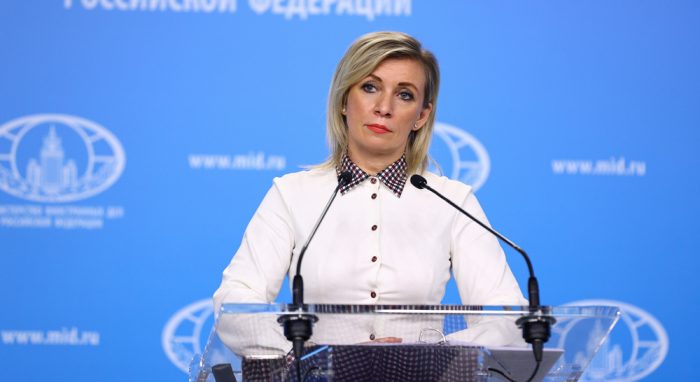
Russian Foreign Ministry spokesperson Maria Zakharova said on Saturday that the latest European Union sanctions against Russia will cause more harm to the EU than Russia.
Zakharova added that the EU’s “dictatorial” behavior reveals how Brussels is “denying” member states of their right to “protect their interests.”
She also warned the EU of the “heavy price” the Europeans must pay for the accession of Ukraine and Moldova to the bloc.
“It goes as far as absurdity, when through some unscrupulous manipulations – when certain heads of state and government are not present at the table, – some legally questionable and obviously politicized decisions are made, which are as follows: on the start of pre-accession negotiations with Ukraine and Moldova, which not only fail to meet the EU’s elementary criteria but directly run counter to them, as well as on another ‘package’ of unilateral restrictive measures against Russia, which, like all the previous ones, will cause bigger harm to the European Union itself,” the diplomat said.
“This dictatorial behavior of Brussels reveals in all its magnitude that the member states are denied their democratic right to a dissenting opinion and the protection of their own interests.”
She went on to add that the EU’s confrontational “policy and the consequences of its opportunistic decisions regarding Ukraine and Moldova will have to be paid by the population of European countries.”
EU members agreed on a 12th package of sanctions against Russia, the European Council said on Thursday, meaning that a phased ban on Russian diamond imports among other measures will come into effect from January 1, 2024.
Moreover, after the summit, European Council President Charles Michel also announced that the EU members had decided to open accession negotiations with Ukraine and Moldova, which may start in March 2024 or later.
The accession talks regarding Ukraine and Moldova started after Hungarian Prime Minister Viktor Orban left the summit in protest to the move. Budapest had earlier threatened to veto the accession of Ukraine into the European Union. “Hungary does not want to be part of this bad decision!” Orban said in a statement on Facebook.
Russia started the “special military operation” in its eastern neighbor in late February 2022 to defend the pro-Russian population in the eastern Ukrainian regions of Luhansk and Donetsk against persecution by Kiev.
Ever since the beginning of the war, Kiev’s Western allies, led by the United States, have been pumping Ukraine with advanced weapons and slapping Russia with a slew of sanctions, steps that Moscow says would only prolong the hostilities.
Zakharova also said that the EU is continuing to “swiftly lose both political and economic weight around the world” under the pressure of the United States’ missteps.
“The EU’s resources, so much needed for its domestic growth, are not funneled into resolving multiple problems and asserting its own place in the emerging multipolar world order, but into serving the US interests, including into the enrichment of the US military-industrial complex,” she said.
Zakharova added that it looks quite natural that against this backdrop, “the most responsible politicians in European countries are more and more frequently prioritizing national interests over some mantras of ‘European solidarity,’ which are out of touch with real needs.”
Zelensky’s Global Begging Tour Is an Obscene Fiasco
Strategic Culture Foundation | December 15, 2023
The United States’ proxy war in Ukraine against Russia has cost the lives of up to 400,000 Ukrainian soldiers. In the last six months alone, it is estimated that over 120,000 Ukrainian troops have been killed in a failed counteroffensive.
Even Western media are coyly admitting the grim reality of failure after much-vaunted predictions last year of imminent victory against Russia.
Yet nearly two years after the conflict erupted, the leader of the puppet regime in Kiev persists in begging for billions more in funds from his Western sponsors to continue the bloodbath – the biggest armed confrontation in Europe since the Second World War.
The hostilities can be traced back to the 2014 coup in Kiev orchestrated by the CIA and precipitated by the European Union and Washington trying to cleave traditional Ukrainian relations with Russia. Those hostilities culminated in February 2022 in what can be seen as a U.S.-led proxy war against Russia. A war that has failed for the Western powers and needs to be peacefully negotiated to spare further death and destruction.
This week, however, saw Ukrainian President Vladimir Zelensky going to Washington to plead for $60 billion in additional funds. His begging mission failed. The U.S. Congress refused to pass the supplemental bill requested on his behalf by President Joe Biden for Ukraine.
After that humiliation, Zelensky then turned his solicitation to the European Union. The EU, by turn, failed to agree on a requested fund for $54 billion for Ukraine.
As a sort of consolation prize, the EU leaders at their two-day summit in Brussels declared that Ukraine could start negotiations for eventually gaining access to the 27-member bloc. That decision was bombastically hailed as “historic” but it seemed more theatre than substance given that the negotiations will take several years to conduct and there is no guarantee at the end of the tedious process that Ukraine will actually gain EU membership. Will Ukraine even exist as a state in a few years, as our columnist Stephen Karganovic ponders in an article this week?
The EU membership talks were granted no doubt as a way to distract from the fact that the EU funds were not forthcoming and especially following the miserable response from U.S. lawmakers.
The whole sorry saga indicates that the U.S.-led proxy war in Ukraine has become a deplorable black hole for Western public money. Given the military debacle and the futile bloodshed, it is becoming politically untenable for Washington and Brussels to keep shovelling billions of taxpayer money into this abyss.
Up for the asking this week was a total of nearly $100 billion between the U.S. and Europe for Ukraine. How many badly needed public services in Western states could do with – and are denied – that kind of financial sustenance?
The spectacle of Zelensky touring the world scrounging for more money is as shameful as it is sordid.
Official figures show that the Western governments have already donated a combined total of $200 billion to Ukraine since the conflict escalated in February 2022.
To put that largesse into perspective, it is estimated that the U.S. Marshall Plan for the reconstruction of the whole of Europe following World War Two was equivalent to $173 billion in today’s money.
Think about that. The Western funding to Ukraine already exceeds this historic salvage package by some $30 billion. And yet Western governments are trying to muster another $100 billion on top of that.
There are several conclusions to be made. First of all, the U.S.-led proxy war against Russia is indisputably a calamitous failure. Despite the unprecedented financing of weapons and other support to the Kiev regime, the war is a dead-end for the Western powers. The 30-member NATO military alliance is staring at a defeat unparalleled in its 75-year history.
Secondly, it is patent that the Kiev regime is only being propped up by the transfer of colossal flows of aid from the West. Without those transfusions of weapons and capital, the regime is finished. It has already lost grievous numbers of troops on the battlefield. Conscription drives are scraping the barrel. Without the lifeline of aid, the regime is finished. The Kiel Institute for World Economy reported last week that Western capital pledges to the Kiev regime have fallen off a cliff since the summer.
Russian President Vladimir Putin said this week in his annual marathon televised Q&A with the public and journalists that Russia will push on with its objectives of eradicating the NATO-backed Nazi forces in Ukraine. There seems little doubt that the objective will be achieved given the parlous state of the Kiev regime.
Another conclusion to draw is the scale of corruption that Ukraine is mired in. For all the funds pumped into this regime so much of it has been siphoned off from the stated purposes.
The obscenity of this war racket is the inordinate corruption, deaths and destruction of economies across Europe while Western weapons corporations have raked in mega-profits.
Zelensky’s global begging tour is a desperate attempt to keep the war racket going for a while longer. He and his wife Olena have enriched themselves with overseas properties and shopping trips to Paris and New York. Zelensky and his cronies have been paid off with blood money for their role in peddling the biggest war scam in modern history. A scam that is funded by hard-pressed and hoodwinked Western taxpayers who have been gaslighted by their politicians and media about “defending democracy and freedom”.
To keep this grotesque charade going, Western politicians in the pay of arms companies and NATO think tanks are resorting to desperate scaremongering and blackmail.
President Biden has repeatedly warned that if extra funds were not released to Ukraine to “defend against Russian aggression” the rest of Europe will be overrun by Moscow.
In Washington this week, U.S. lawmakers who refused to pass the supplemental funding bill for Ukraine were, in effect, accused of being traitors by helping Russia.
Zelensky appealed to European leaders by saying that Putin would exploit any negativity towards Ukraine, and he pleaded with the EU to not “betray” Ukrainians.
On the eve of the EU leaders’ summit in Brussels, the European Commission declared that it was finally releasing €10 billion in withheld funds to Hungary. That was a bribe to Hungarian premier Viktor Orban to concede to the proposed €50 billion in extra aid for the Kiev regime. In the end, Orban did not concede to the multi-billion-euro handout, however, he gave way to his objection to talks for Ukraine’s membership of the EU. Such is the shoddy business of propping up the Kiev regime that arm-twisting and bribery are the order of business in Brussels.
The horrendous waste of lives and financial resources in Ukraine by the Western elite – instead of pursuing diplomacy and peace – is the hallmark that these regimes are terminally corrupt and doomed to failure.
The conflict in Ukraine has recklessly stoked tensions between nuclear powers and has condemned generations of Americans and Europeans to debt. The war in Ukraine is a historic dead-end for the U.S. and its European vassals. Zelensky’s begging bowl is a death rattle.
Ukraine’s Botched Counteroffensive Ignites New ‘Mantras’ in US – Lavrov
Sputnik – 13.12.2023
With Ukraine’s counteroffensive obviously failing, the United States has taken up a new rallying cry, which is to prevent Russian President Vladimir Putin from winning in Ukraine so that “NATO is not conquered,” Russian Foreign Minister Sergey Lavrov said.
“After the collapse of the so-called counteroffensive, [people] in Washington stopped talking about Russia’s strategic defeat on the battlefield and, during Zelensky’s latest visit, activated a new mantra: ‘don’t let Putin win in Ukraine’, otherwise all of NATO will be conquered and then America won’t sit through it,” Lavrov said during the “government hour” in the Federation Council, upper house of the Russian parliament.
“We are ready for such a challenge and will continue to firmly defend our truth,” Lavrov emphasized.
The top Russian diplomat also noted that “it is not easy for our ill-wishers to come to grips with the fact that the bet on the sanctions blitzkrieg against the Russian economy has completely failed.”
“Therefore, those who launched the hybrid war against us won’t admit their mistakes, they are trying to use more and more illegitimate tools to wear down Russia, as they say, relishing the dream of eliminating our country as an independent geopolitical value,” the Russian diplomacy chief explained.
Putin’s Middle East Trip Deals a Blow to Washington
By Salman Rafi Sheikh – New Eastern Outlook – 11.12.2023
Russian President Vladimir Putin’s recent visit to the Middle East – and the 21-gun salute welcome he received there – shows the failure of Washington’s consistent attempts to ‘isolate’ and defeat Russia. The visit also points to the Middle East’s increasing shift away from, and sole reliance on, Washington. Ever since the beginning of the Gaza War on October 7, the Middle East has been keeping contact with China, rather than the US, its first priority. The reason for this is not simply the fact that the US is supporting, militarily and diplomatically, Israel against Palestine, but also because the Middle East is strategically realigning itself with the realities of what is increasingly – and undeniably – a multipolar world. To the extent that the Middle East, a region where the US remained the most dominant extra-regional force for many decades, has made this shift also reflects the ongoing demise of US dominance more generally in the world. To the extent that China and Russia are two major proponents of multipolarity, connect the dots of this anti-US but pro-China and pro-Russia shift.
Putin’s trip to the UAE and Saudi Arabia has many dimensions. One of these dimensions is bilateral. Between 2017-2022, the trade turnover between Russia and the UAE has grown by almost six times. In 2022, the overall trade increased by almost 68% amounting to US$9 billion. The UAE is Russia’s largest trading partner in the Gulf Region, accounting for 55% of Russia’s total trade with the Persian Gulf.
It, therefore, makes sense for Washington to pressure the UAE government to drastically limit their trade ties with Moscow. Earlier in September, several Western officials from the United Kingdom, EU and US visited the UAE to persuade the UAE to review its trade ties with Russia. Western officials have been assuming that, in the wake of the threats of the Israel-Gaza war spreading to other parts of the Middle East, the UAE would go back to its ultimate security guarantor: the US. This would, however, happen only if the UAE has good ties with the US. Good ties, under the present context of the Russia-Ukraine conflict, mean the UAE ending its trade ties with Russia, especially the ones that may have military implications.
The UAE has been resisting these pressures. In fact, its decision to welcome Putin himself means that the UAE is considering an alternative means of protecting itself in the wake of a wider war in the region. It is ensuring Russian (and Chinese support), and it is using this (possible) source of support to send a message to Washington, i.e., multiple options are possible in a multipolar world. The message is quite similar to the message that the Saudis have been giving to the Americans since the beginning of the Russia-Ukraine military conflict.
If the Americans have been doing their best to convince the Saudis to break out of the OPEC+ deal and increase the production of oil to help reduce its prices and consequently help control the inflation in the West, the Saudis have not submitted. In this context, Putin’s visit to Saudi Arabia sought to reinforce the ‘oil alliance’ – which is also a major dimension of Russia-Saudi bilateral ties – at a time when the burden of wars (supporting Ukraine plus Israel) on the West is increasing manifold. For Putin, an appropriate message to the Middle East in particular and the Global South in general is this: the West supports aggression against all states, regardless of whether it is Russia or Palestine, and it expects other states (e.g., the Middle East) to support that aggression.
Russia understands that the West is fighting two wars, and it does not have any narrative to justify them both simultaneously. As even the US-based Carnegie Endowment said in one of its recent reports, “Washington’s pro-Israel stance undermines the legitimacy of the West’s broader reasons for supporting Ukraine in the eyes of many in the Global South. The moral argument against Russia’s invasion of Ukraine now looks like empty words, particularly in Middle East nations”. In this sense, the timing of Putin’s visit was far from coincidental. It aimed to tap into the opportunity to wean powerful states in the Middle East, who are also keen to expand ties with the non-Western world via BRICS, away from the US as much as possible.
Therefore, the purpose of Putin’s visit, as some Western media analysed and sought to trivialise, was not simply to “discuss” the Gaza war. It was part of Moscow’s wider outreach to the Middle East at an appropriate time to reorient the Middle East’s strategic priorities. Soon after coming back, Putin hosted Iran’s president in Moscow to build on the success of his visit and deepen Russia’s foothold in the region, a region that allows Russia to fight the West in the economic field by, for instance, coordinating the production of oil.
Still, the Gaza war was discussed. But that discussion was underpinned by the strategic failure of Washington’s plans to create a new Middle East. The failure of the US in the Middle East becomes yet another opportunity for Moscow to present itself as a potential peace broker rather than, and unlike the US, a troublemaker. If it was simply a war of narratives, Russia (and China) are clearly winning it in the Middle East.
Featured Video

Macgregor: We Haven’t Seen the Worst of the Iran War Yet
or go to
Aletho News Archives – Video-Images
New Book
Breast Cancer: Before You Consent
A new Unbekoming paperback
Lies are Unbekoming | September 18, 2026
Peter Gøtzsche reviewed every randomised mammography screening trial ever conducted for the Cochrane Collaboration. Cochrane’s headline is that, assuming a 15% mortality reduction, one woman in 2000 avoids dying of breast cancer over ten years. Ten are overdiagnosed and treated. Two hundred experience false alarms.
But that headline assumes the reduction. When Gøtzsche looked only at the trials with adequate randomisation — the higher-quality ones — the reduction disappeared. No effect on breast cancer mortality. No effect on all-cause mortality.
This is the Cochrane finding, published in the establishment’s own database of systematic reviews.
No woman being asked to consent to a mammogram this week knows it.
That is why the new Unbekoming paperback exists. … continue
Blog Roll
 Aletho News
- US-Denmark Agreement on Greenland Is ‘PR Stunt’ Ahead of Midterms
- Araghchi: Military intervention cannot create security; coercion cannot bring peace
- Fraud Squared
- Breast Cancer: Before You Consent
- Iran’s Plan to Shut Down AI in the Persian Gulf
- Israel seeks ‘compensation’ from Washington over Saudi F-35 sale
- Saudi crown prince seeks dialogue with Ansarullah after Yemeni blows: Report
- Damascus rejects Saudi request for Syrian fighters to counter Yemen: Report
- South Korea says will not send troops to join terrorist US war on Iran
- Russia Just Struck the Eyes of NATO’s War Machine in Ukraine
- If Americans Knew
- Inside the siege, the ruined buildings of Gaza – Daily Update
- Debunking The Claim That Macklemore Has A “History Of Antisemitism”
- CPJ demands release of arrested Palestinian-US journalist near Bethlehem
- Robert Kraft: The Billionaire Friend of Netanyahu Pulling The Strings Behind the Macklemore/Ed Sheeran Blow Up
- Columbia Administered Fund Gives Big Money to Pro-Israel Groups
- Deportation Case of Palestinian Activist Salah Sarsour Tests First Amendment
- ‘We Will Not Forget’: Palestinians Mark 44 Years since Sabra and Shatila
- Why do we let Zionists decide what we can and can’t say?
- US welcomes Israeli, Iranian delegations to UN, but not Palestinians – Daily Update
- Biden’s Genocide Accomplices Targeted by New Accountability Campaign
- No Tricks Zone
- New Study: ‘Global Drought Shows No Detectable Recent Acceleration Under Climate Warming’
- Economic Masterminds: German Socialists Suggest Taxing Productivity Gains Stemming From Using AI
- The South China Sea Has Not Been Cooperating With The Climate Change Narrative
- Energy Crisis: Germany Enters Heating Season With Historically Low Gas Reserve Fill Levels
- New Study: The Antarctic Ice Sheet Gained Mass From 2020-2024 Due To Staggering Snow And Ice Accumulation
- Study: Ocean Heating Rates From Thousands Of Years Ago ‘Dwarf’ Modern Ocean Heating Rates
- Climate Extremists Target, Attack Large-Scale Power Grid Infrastructure In Germany!
- New Study: Antarctic Ice Melt Has Contributed Less Than 1 Centimeter To Sea Level Rise In The Last 30 Years
- Fear Of Debate: Alarmist German Climate Scientist Calls On Mainstream Media To Discredit Skeptic Voices
- End-Of-August Arctic Sea Ice Extent Hasn’t Fallen In 20 Years, Official Data Show!
 Aletho News