The Elites Directing The Energy Transition Really Have No Idea What They Are Doing
By Francis Menton | Manhattan Contrarian | September 06, 2023
We are on our way to Net Zero by 2050. It must be true because everybody says so. The entire $6+ trillion per year federal government is committed to the project, which obviously would not be the case if the whole thing were impossible. Equally fully committed are essentially all of the colleges and universities, where all of the smartest people are to be found. As well as every other elite institution of every kind and sort.
Take the World Economic Forum. If there is a number one elitest among all elite institutions, this has to be it. At their annual confab in Davos, Switzerland, they gather the greatest of geniuses to instruct the very top government and business leaders how to run the world. Would you like to go? It will cost you $52,000 to join the organization, and then an additional $19,000 to attend the conference. Chartering a private jet to get you there will cost thousands more. Once there, you can hear the very smartest people imparting their thoughts on the most important topics of the day, like “The Great Reset,” “Emerging Technologies,” “Diversity and Inclusions,” and, of course, “The Net Zero Transition.”
Is it possible that these people are completely incompetent and have no idea what they are doing?
A reader has sent me the very latest from the WEF on how the world is going to get to Net Zero. The piece has a date of September 5, 2023, and is titled “How battery energy storage can power us to Net Zero.” The authors are three people from the World Bank, with the lead author being one Amit Jain, who is the Bank’s Energy Storage Program Lead. This is the guy on the receiving end of tens of billions of dollars of government money to pass out to make the energy transition happen throughout the developing world.
Now, it so happens that energy storage is something I know a little about, and in particular about the problem of trying to store enough energy to make an electrical grid work without full dispatchable backup. See my energy storage Report, dated December 1, 2022, at this link.
So let’s take a look at Jain, et al.’s, take on how battery storage will “power us to Net Zero.” First, some excited happy talk:
Across the globe, power systems are experiencing a period of unprecedented change. Low-cost renewable electricity is spreading and there is a growing urgency to boost power system resilience and enhance digitalization. This requires stockpiling renewable energy on a massive scale, notably in developing countries, which makes energy storage fundamental. . . .
Making energy storage systems mainstream in the developing world will be a game changer. Deploying battery energy storage systems will provide more comprehensive access to electricity while enabling much greater use of renewable energy, ultimately helping the world meet its Net Zero decarbonization targets. International organizations and development institutions are leading the way forward to enable this decarbonization. . . .
So OK Amit, how much storage are we talking about here?
In 2022, approximately 192GW (gigawatts) of solar and 75GW of wind were installed globally. However, only 16GW/35GWh (gigawatts per hour) of new storage systems were deployed. A recent International Energy Agency analysis finds that although battery energy storage systems have seen strong growth in recent years, grid-scale storage capacity still needs to be scaled up to reach Net Zero Emissions by 2050. . . . To meet our Net Zero ambitions of 2050, annual additions of grid-scale battery energy storage globally must rise to an average of 80 GW annually between now and 2030.
Holy underwear, Batman! Could this guy really not even know what units he’s talking about? Thinking his readers might not understand the abbreviation “GWh” he helpfully defines it as “gigawatts per hour”! Could he really be this clueless? And he had two co-authors to check him!
And then there’s the statement that to meet the 2050 Net Zero ambition, annual deployments of grid-scale batteries “must rise to an average of 80 GW annually.” Of course he is using the wrong units (and undoubtedly does not know that). But let’s give him the benefit of the doubt, and assume that he is talking about the standard batteries available today, which are 4 hour batteries, meaning that 80 GW would provide 320 GWh of storage. If the world would add that much capacity every year from now to 2050, that would come to 8,960 GWh of storage. How have Mr. Jain et al. come to the conclusion that this 8,960 GWh of storage will be enough to “meet our Net Zero ambitions of 2050”? The piece contains no quantitative analysis or backup of any kind to support the proposition that this amount of storage would be sufficient.
My own energy storage Report does contain backup and calculations, although only for certain countries rather than for the whole world. For example, for the United States, the figures cited in my Report are that it would take some 233,000 GWh of battery storage to fully back up the electrical grid, assuming current levels and patterns of usage. Since the U.S. is about 4% of world population, we can multiply that figure by 25 to get the storage requirement for the world (assuming that the world electrifies to the U.S. level by 2050). The total would be 5,825,000 GWh. In other words, Jain, et al., are off by a factor of about 650, give or take maybe a few hundred.
But it’s OK, because Jain and his colleagues have no skin in this game. They just babble some happy talk to get their hands on a few hundred billions of money from rich governments, and pass it out to build impressive-looking battery projects that are actually next to useless to provide reliable grid electricity. They can be very confident that no one in their circles will ever check the math to see if the numbers add up. When 2050 rolls around and the whole thing doesn’t work, they will be long retired on generous pensions.
After spending tens of billions on Ukraine and migrants, Scholz laughs when asked why elderly receive no pension inflation bonus
BY JOHN CODY | REMIX NEWS | SEPTEMBER 12, 2023
German leader, Chancellor Olaf Scholz, laughed off the possibility of providing seniors with a pension inflation bonus, telling an audience that the cost is far too great. The claim that the costs are too great to support seniors on meager pensions follows unprecedented spending from Germany’s left-wing government on weapons for Ukraine and social benefits for migrants.
As poverty rises in Germany, seniors on fixed pensions, known as “Rentner” and “Rentnerinnen,” have been hit especially hard. There are different categories of pensions in Germany, with those earning a higher pension, such as doctors and professors, receiving a far higher sum than those in the “Rentner” class. Those receiving smaller pensions, which totals millions of German seniors, are more acutely affected as rising costs for food, housing and energy eat into their income at a far faster rate.
More and more people are therefore demanding an inflation bonus for this vulnerable group totaling €3,000. Federal Chancellor Olaf Scholz had not yet commented on these demands, but finally addressed the topic for the first time at a citizens’ dialogue in Bendorf in Rhineland-Palatinate. When asked about an inflation bonus for pensioners, the chancellor reportedly laughed. He then said: “Well, multiply the number of millions of pensioners by 3,000 – and then sit down very slowly. That’s quite a sum of money.”
Approximately 4.5 million seniors in the “Rentner” category survive on €1,500 a month.
Germany spends tens of billions on Ukraine, migrants, and climate protection in India
As of March 2023, Germany has sent Ukraine at least €14 billion in weapons and aid shipments, which was six months ago. Since then, that figure has risen to €22 billion and is only expected to rise over time. It must also be noted that due to sanctions on Russia, which is tied to the war in Ukraine, there has been an enormous increase in the cost of energy in Germany, which has not only eaten into the pocketbooks of households but also led to an increase in bankruptcies and a recession in Germany.
In addition, the German federal government plans to spend €36 billion on migrants in 2023, which includes housing, social benefits, and education, but that figure is likely a lowball estimate, as there are numerous hidden costs as well, such as millions more spent for police and security at German swimming pools to protect against migrant assaults and sexual violence.
The German government also proudly announced that India will receive €10 billion over the next 10 years on its own website, writing: “With the new Indo-German Partnership for Green and Sustainable Development signed by Prime Minister Modi and Chancellor Scholz at the 6th Indo-German Intergovernmental Consultations in Berlin on 2 May 2022, this cooperation has been uplifted to a new level, with Germany announcing to provide additional funds of Euro 10 billion for the next 10 years.”
India just sent its first space probe to the Moon, a feat Germany still has not accomplished.
In addition, some critics online have joked that “retirement at 30” in the form of welfare payments, known as “a citizen’s income” was just raised by approximately €50 billion.
In short, the funds are theoretically there for seniors, they are just going to other priorities. At present, Germany’s booming elderly population is suffering from poverty at a high rate. Federal government data published under a request from several Alternative for Germany (AfD) lawmakers revealed that 28.1 percent of the German elderly are at risk of poverty, a figure that is higher than the EU average of 27.4 percent and far greater than its Western European neighbors of France (19.1 percent), Belgium (17.4 percent), and Luxembourg (9.3 percent).
Kim Traveling to Russia to Meet Putin, US Threatens Response
By Kyle Anzalone | The Libertarian Institute | September 11, 2023
North Korean Supreme Leader Kim Jong Un is traveling to eastern Russia to meet President Vladimir Putin. Washington threatened to increase sanctions on Pyongyang in response.
Dmitry Peskov, the Kremlin’s spokesman, described the meeting as a full-state visit. “There will be talks between the two delegations. And after that, if necessary, the leaders will continue their communication in a one-on-one format,” he said. “We will continue to strengthen our friendship.” The leaders will meet in Vladivostok. South Korea says Kim is currently traveling to Russia by train.
US State Department spokesperson Matthew Miller said Washington plans to respond “aggressively.” “I will remind both countries that any transfer of arms from North Korea to Russia would be in violation of multiple United Nations Security Council resolutions.” He continued, “We, of course, have aggressively enforced our sanctions against entities that fund Russia’s war effort, and we will continue to enforce those sanctions and will not hesitate to impose new sanctions if appropriate.”
It is unclear what new sanctions the US could place on North Korea that would further isolate Pyongyang. The Treasury Department has already placed thousands of penalties against North Korean officials, government offices, and industries on the blacklist.
The New York Times reports that Kim is expected to agree to supply Russia with weapons, including artillery shells. Adrienne Watson, a National Security Council spokeswoman, demanded the North Korean leader not discuss the issue with his Russian counterpart. “We urge [North Korea] to cease its arms negotiations with Russia and abide by the public commitments that Pyongyang has made to not provide or sell arms to Russia,” she said.
Pyongyang is believed to have significant stockpiles of shells and production capacity. On the Ukrainian battlefield, artillery has become crucial. Western countries have begun to run out of 155mm rounds to send to Ukraine, prompting President Joe Biden to provide Ukraine with cluster munitions to cover the shortage.
Currently, NATO states are producing less artillery than Ukraine is using. With Ukraine’s counteroffensive stalled, the war appears likely to draw on into the foreseeable future.
In July, Russian Defence Minister Sergei Shoigu traveled to North Korea to meet with Kim. South Korean intelligence claims Moscow offered to allow Pyongyang to participate in trilateral war games with Beijing.
Washington’s sanctions campaigns against several states are becoming counter-effective. The US is currently attempting to smash the governments of Russia, Afghanistan, North Korea, Syria, Nicaragua, Iran, and Venezuela through economic warfare. However, in response, those countries have increasingly engaged in non-dollar trade to bypass American sanctions. Additionally, other countries such as China, India, and Brazil have become willing to ignore the Treasury’s blacklists and trade with sanctioned nations.
Western exodus from Russia a boon for Chinese companies – leading entrepreneur
RT | September 10, 2023
Chinese companies have greatly benefited from the pullout of Western companies from the Russian market, Zhou Liqun, chairman of the Chinese Entrepreneurs’ Union of Russia, told RT on Sunday.
Speaking on the sidelines of the Eastern Economic Forum (EEF) in Vladivostok, Zhou said Chinese businesses have been actively filling the niches left by the exit of Western companies and are eager to expand their presence in Russia further.
“The withdrawal of Western companies from Russia has created vast opportunities for Chinese businessmen and enterprises to cooperate with Russia. For example, in the vehicle manufacturing sector: many Chinese carmakers have entered the Russian market throughout the past year. While previously they made up only 5-6% of the market, now it is almost 40%,” Zhou stated.
He noted that China has been among Russia’s major trade partners for the past 14 years, and both countries have created many platforms and opportunities for mutually beneficial cooperation.
“Our cooperation framework is very convenient for both sides, stable political relations between our countries promote the development of trade and business relations. Chinese businessmen are interested in Russia’s raw materials, Russian businessmen are interested in Chinese machinery and equipment. This makes our cooperation mutually beneficial and opens up potential for development,” he added.
Zhou noted that since the introduction of Western sanctions on Moscow, Russia and China have accelerated the use of their own currencies in trade, which has benefitted both nations. To date, 80-85% of all transactions between Russia and China are carried out in either yuan or rubles, and given the rapid expansion of mutual trade and cooperation, this percentage is likely to grow further.
“Businesses in both Russia and China are already accustomed to using national currencies in cross-border transactions. It is very convenient for direct cooperation. We expect the ratio of yuan and ruble transactions in mutual trade to grow to 90%, depending on the type of product,” he said.
Zhou added that China takes great interest in the development of Russia’s Far East, both as a supply source and trade partner. He noted that to date, China is involved in 58 projects in the area, including the construction of a petrochemical complex in Amur Region, as well as a number of projects in agriculture and infrastructure.
“China’s cooperation with the Far East has great potential,” Zhou said.
EU ‘globalists’ waging war on Hungary – parliament speaker
RT | September 8, 2023
Hungary’s parliament speaker has accused the European Union of launching a “hybrid war” against his country, saying the organization is withholding funds owed to Budapest as a means of political control.
Speaking to the Mandiner magazine on Wednesday, National Assembly speaker Laszlo Kover agreed that Hungary’s relations with the EU had reached a “low point,” amid an ongoing row over some €28 billion in funds earmarked for Budapest and currently frozen by the bloc until it implements various legal reforms.
“Europe is almost paralyzed by the fact that the institutional system originally created to ensure cooperation has turned against its masters, the member states, as a kind of golem. Today, the member states cannot control this cancerous bureaucracy,” he said.
We have to ask ourselves whether the European Union is still an association of independent and equal member states, or whether we are just one step away from becoming victims of another imperial expansion.
The politician went on to describe efforts within the EU to “create an economic governance that dissolves the sovereignty of the member states,” noting that practices such as joint borrowing and common currencies would further erode national independence.
While Kover said the European bloc remains “the best enforcement framework for Hungarian national interests,” he insisted the organization must meet its obligations to members, suggesting it has not done so in Hungary’s case.
“They want to interfere in the political process by withholding resources, and they would even expect us to be ashamed of it,” he continued. “It is a hybrid war – to use this fashionable term – that the globalists in Brussels are waging against Hungary and Poland, which are defending their sovereignty.”
In order to unlock the frozen funds, Budapest is expected to meet 27 so-called “super milestones” proposed by the European Commission, including judicial and media reforms, as well as a crackdown on corruption. The bloc has long accused Hungary of not abiding by the EU standards of the rule of law. Budapest, meanwhile, insists that the allegations are entirely politically motivated.
Hungary has also largely resisted pressure to follow a US-led sanctions campaign against Russia over its military operation in Ukraine, opting to retain its more friendly ties with Moscow. It has also refused to supply military aid to Kiev, even vetoing weapons packages proposed by the bloc, while Prime Minister Viktor Orban has pushed for talks between the warring parties to bring an end to the fighting.
Congratulations To Germany On Achieving More Than 50% Of Its Electricity Production From “Renewables”!
By Francis Menton | Manhattan Contrarian | August 29, 2023
On the march to Net Zero carbon emissions from usage of energy, the key first step is to eliminate fossil fuels from the generation of electricity, replacing them with the magical “renewables.” Or so we are told. Once electricity generation is fossil fuel-free, then all energy use can be switched to electricity, without any of the evil emissions. Voilà — Net Zero!
But somehow, in the places that have tried to go this route with wind turbines and solar panels, the push to get more electricity generation from “renewables” has seemed to stall out at around 40 – 45%. (Some small countries with lots of hydropower get higher percentages by counting the hydropower as “renewable.”). Countries may build more and more solar panels and wind turbines, but somewhere in the 40s the percentage that those things contribute to electricity generation just doesn’t seem to budge very much any more.
And that’s why it’s so exciting that in the first half of 2023 Germany finally crashed through the 50% barrier, becoming the first significant country with little hydropower to achieve more than half of its electricity generation from “renewables.” With a simple internet search, you can find large numbers of news sources relaying the great news. For a few examples, here are Reuters, June 27 (“Renewable share of German power use climbs to 52.3% in first half”); Fraunhofer, July 3 (“German Net Power Generation in First Half of 2023: Record Renewable Energy Share of 57.7 Percent”); Clean Energy Wire, June 27 (“Renewables covered more than half of German electricity consumption in first half of 2023”); and Solar Quarter, July 5 (“Germany Achieves Record 57.7% Renewable Energy Share in Net Power Generation for First Half of 2023”). Why the exact percentages vary a little from article to article, I cannot explain; but they are all at least a little in excess of the key 50% figure.
So this is surely Germany continuing to lead the way to the green energy transition. Certainly, Germany has only accelerated its pursuit of the idea that the route to Net Zero is the building of more and yet more solar panels and wind turbines. A site called Renewable-Energy-Industry.com compiles data on additions to Germany’s wind and solar generation capacity just in the first half of 2023: “Record Additions in Germany: 8,000 MW of New Wind And Solar Capacity in The First Half of 2023.”:
[S]olar energy in particular is booming in Germany. From January to June 2023 alone, around 465,000 new solar plants with 6,500 MW capacity . . . went into operation and produce electricity, more than ever before in a six-month period. . . . In the first six months of 2023, just under 350 new wind turbines with a capacity of around 1,750 MW went into operation. . . .
The addition of 8000 MW of generation capacity in just six months is a huge increment in a country where peak electricity usage is less than 85,000 MW (or 85 GW).
So are these large additions to capacity what has succeeded in pushing Germany over the 50% threshold? Unfortunately, if you read deep into the Reuters piece linked above, you will start to get a very different understanding. It turns out that Germany’s percentage of electricity from renewables increased not because the production of electricity from renewables increased, but rather because Germany’s economy is shrinking. After decades of effort and hundreds of billions of dollars of subsidies and greatly increased consumer electricity prices, the contribution of wind and solar energy in Germany’s economy remains almost insignificant.
Despite all its new solar and wind facilities, Germany’s production of electricity from those sources has lately been going down rather than up. Here is the story for the first half of 2023) (from the Reuters piece linked above:
Renewables, at 137.5 TWh, represented 51.7% of total output, up from 46.4% in first half 2022, even as green power production volumes decreased by 0.6%.
The 137.5 TWh of electricity that Germany’s “renewable” facilities produced in the first half of 2023 is a pitiful percentage of their supposed theoretical capacity. A chart at Clean Energy Wire gives Germany’s generation capacity of solar, plus onshore and offshore wind as 130.8 GW as of 2022. (In a country with only about 85 GW of peak usage!). Add the new 8 GW of capacity added in the first half of 2023, and you would have 138.8 GW of wind and solar capacity, or 602.9 TWh hours of capacity (138.8 x 24 x 181) for the 181 days in January to June 2023. That would mean that the wind and solar facilities combined produced at a rate of only 22.8% of capacity over that period.
So if production of electricity from “renewables” actually decreased, how could the percentage of electricity production from the “renewables” have increased from 46.4% to 51.7% of the total? Easy — the production from all other sources (fossil fuels and nuclear) went down dramatically:
Conventional energy sources – nuclear, coal, natural gas and oil – provided 128.4 TWh of output, down from 160.0 TWh a year earlier.
They ran the conventional generators less because the demand for electricity was not there:
The fall in conventional production reflected the phase-out of nuclear energy by mid-April and operators cutting output to match weak demand.
The change from 160.0 TWh to 128.4 TWh from conventional sources would be a 19.75% decline. That’s rather enormous in one year. Now, how could it be that Germany is experiencing that kind of a huge decline in the demand for electricity? You might check out the big front page article from today’s Wall Street Journal, “Germany’s Shrinking Economy Sparks a Struggle for Solutions.” (different headline online). The world leader in the supposed “green energy transition” turns out also to be in the unique position of having an economy that is shrinking, and not by a little:
Germany will be the world’s only major economy to contract in 2023, with even sanctioned Russia experiencing growth, according to the International Monetary Fund.
The WSJ piece goes into a variety of factors that may be contributing to the shrinking economy. But self-inflicted high energy prices turn up again and again:
Energy costs are posing an existential challenge to sectors such as chemicals. . . . Energy prices in Europe have declined from last year’s peak as EU countries scrambled to replace Russian gas, but German industry still faces higher costs than competitors in the U.S. and Asia.
And meanwhile, with Germany’s massive investments in wind and solar electricity generation, are those sources actually making any major inroads in the overall market for primary energy in the country? Here is an extremely revealing chart, again from Clean Energy Wire, with data from 2022:
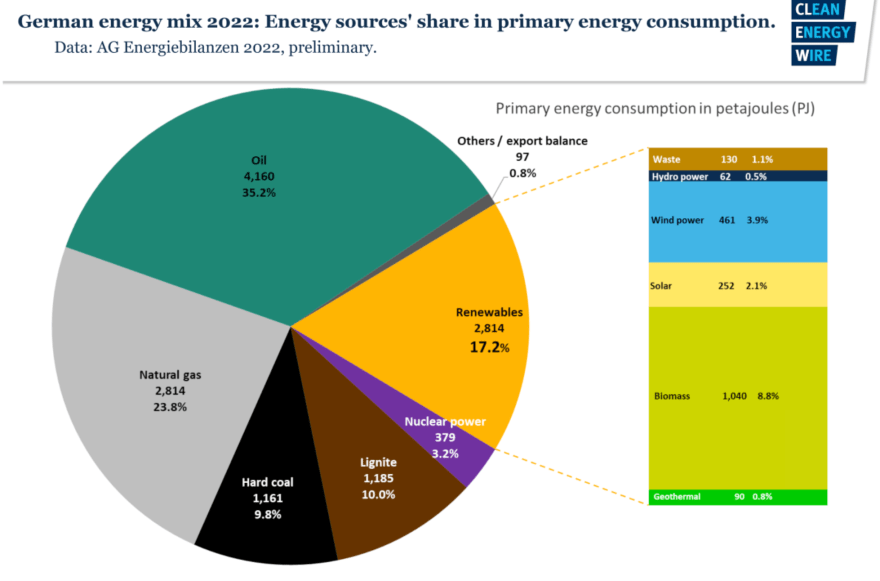
In the “renewables” category for all primary energy (not just electricity), we learn that they include “biomass” as a “renewable.” Probably, that’s mostly wood, used for heating homes, and hardly a zero carbon source. The amount of energy produced from the “biomass,” at 1,040 PJ and 8.8% of primary energy, far exceeds the combined total from wind and solar (713 PJ and 6.0% of primary energy).
The whole “more than 50% from renewables” mantra turns out only to apply to electricity (far less than half of primary energy usage). And rather than representing the advance of the mythical wind and solar, the whole thing is just an artifact of a shrinking economy, largely itself caused by the destructive build-out of the wind and solar facilities. They are destroying their economy, and have almost nothing to show for two decades and hundreds of billions of dollars invested in the useless wind and solar farms.
Iran reports major surge in exports of semi-finished steel
Press TV – September 6, 2023
Iran has seen a major surge in its exports of semi-finished steel this year amid a ramp-up in domestic manufacturing activity.
The Iranian Steel Producers Association (ISPA) said on Tuesday that exports of semi-finished steel from the country had increased by 24.8% year on year in the five months to August 22 to reach a total of 3.093 million metric tons (mt).
Semi-finished steel products are ingots known as billet, blooms and slab which are used in steel mills to manufacture finished steel products.
ISPA figures showed that total domestic production of semi-finished steel in Iran had reached over 13 million mt over the five months to late August.
The ISPA said Iran’s exports of steel sheets and long steel products had also increased by 15% over March-August without mentioning the exact volume of the shipments.
Exports of sponge iron, or what is known technically as direct reduced iron (DRI), reached 0.708 million mt in the five months to late August, up by more than 232% compared to the same period last year, showed the figures.
The major surge in Iranian steel exports come as steel mills in the country have ramped up their output to respond to a growing demand for the metal in the domestic manufacturing sector.
The increased output has also enabled Iran to respond to the rise in regional and global demand for steel amid a war in Ukraine that has affected supply chains.
That comes as Iranian steel producers were facing restrictions in their access to electricity this summer.
Figures by the World Steel Association released this week showed that Iran had produced 18.1 million mt of steel in the seven months to July, up 4.1% compared to the same period in 2022.
Iran to help Burkina Faso build new oil refinery: Minister
Press TV – September 5, 2023
Iran will contribute to building an oil refinery in Burkina Faso and will supply the West African country with oil products it needs, according to a statement from Iranian Oil Minister Javad Owji.
Owji said on Tuesday after a meeting with Burkinabe Foreign Minister Olivia Rouamba in Tehran that petroleum sector cooperation between Iran and Burkina Faso will expand in the future as part of agreements reached between the two countries in recent months.
“It was agreed in the meeting with foreign minister of Burkina Faso that a refinery will be constructed through cooperation between engineers and experts of the two countries based on agreement signed earlier,” the minister told reporters after the meeting.
Owji said that he and Rouamba had also agreed on the launch of oil products exports from Iran to Burkina Faso.
He did not elaborate on financial details of petroleum contracts signed between Iran and Burkina Faso but said that the African country has some good mines that can service the needs of Iran’s metals sector.
Rouamba, who has been in Iran for an official visit since early on Monday, said after the meeting with Owji that Burkina Faso seeks to import oil products from Iran to respond to rising domestic demand for fuels in her country.
She said her talks with Owji had centered on the results of previous discussions between Burkinabe trade officials and the Iranian authorities.
The minister said there are bright prospects for cooperation between engineering companies of the two countries for construction of a new refinery in Burkina Faso.
Who’s Afraid of an Alternative for Germany?
By Conor Gallagher – naked capitalism – September 4, 2023
The media describes them as far-right, anti-European Union, anti-immigrant, fascist, etc. But what exactly are the positions of the Alternative for Germany (AfD) party? Why is it steadily gaining in public opinion polls, and why is the German establishment so afraid of them?
Various AfD party members have made comments in recent years that, depending on your point of view, are offensive or were blown out of proportion by the media. I’m not going to review all those here but instead wanted to look at what policies are contained in the AfD platform. The party’s “Manifesto for Germany” is a 93-page document that covers just about everything, but I want to focus here on areas that the media most frequently focus on – immigration, the EU, and nationalism, as well as the set of positions that I would argue is the real reason for hyperventilating over AfD’s rise: foreign policy.
On the EU:
We oppose the idea to transform the European Union into a centralised federal state. We are in favour of returning the European Union to an economic union based on shared interests, and consisting of sovereign, but loosely connected nation states.…
We believe in a sovereign Germany, which guarantees the freedom and security of its citizens, promotes economic welfare, and contributes to a peaceful and prosperous Europe.
Should we not succeed with our ideas of a fundamental reform within the present framework of the European Union, we shall seek Germany‘s exit, or a democratic disso- lution of the EU, followed by the founding of a new Euro- pean economic union.…
European politics are characterised by a creeping loss of democracy. The EU has become an undemocratic entity, whose policies are determined by bureaucrats who have no democratic accountability.
On the Euro currency:
We call for an end to the Euro experiment and its orderly dissolution. Should the German Federal Parliament not agree to this demand, Germany’s continued membership of the single currency area should be put to a popular vote. …
The Euro actually jeopardises the peaceful co-existence of those European nations who are forced into sharing a common destiny by the Eurocracy. The introduction of this currency has led to resentment and confrontation amongst countries in Europe. Countries incurring economic difficulties within the single currency area are forced to restore their competitiveness by such measures as internal devaluation and associated budgetary constraints (austerity policies), rather than exploiting the tool of currency adjustments. Tensions amongst European nation states can inherently be ascribed to the Euro.
AfD doesn’t just oppose the Euro for altruistic reasons. The party also objects to any form of financial equalization between the richer and poorer euro countries and claims Germany shoulders an unfair burden in propping up the weaker members of the eurozone.
The political programme provides very little on labor policy, but AfD does want to provide financial incentives for Germans to reproduce. Here is the party on low birth rates and immigration:
In order to fight the effects of this negative demographic development, political parties currently in government support mass immigration, mainly from Islamic states, without due consideration of the needs and qualifications of the German labour market. During the past few years it has become evident that Muslim immigrants to Germany,in particular, only attain below-average levels of education, training and employment. As the birth rate is more than 1.8 children amongst immigrants, which is much higher than that of Germans, it will hasten the ethnic-cultural changes in society.
The attempt to counteract these developments by increasing the rate of immigration will inevitably lead to the estab lishment of more parallel communities, particularly inlarge cities, where integration with the native population is already a problem. The spread of conflict-laden and multiple minority communities erodes social solidarity, mutual trust, and public safety, which all are elements of a stable commu- nity. The average level of education will continue to drop.
Greater political support for parental work, as well as education and family policies which are focused on the needs of families and young couples wanting to start a family, will once again lead to birth rates at a self-sustaining rate in the medium to long-term. We regard the closing of the gap between the actual number of children being born, and the desire of 90% of young Germans to have children, as a central element of our political platform.
The document goes on for many pages about protecting the nation’s culture and how Islam is not a good fit for Germany. What exactly is that culture?
The AfD is committed to German as the predominant culture. This culture is derived from three sources: firstly, the religious traditions of Christianity; secondly, the scientific and humanistic heritage, whose ancient roots were renewed during the period of Renaissance and the Age of Enlightenment; and thirdly, Roman law, upon which our constitutional state is founded.
Islam does not belong to Germany. Its expansion and the ever-increasing number of Muslims in the country are viewed by the AfD as a danger to our state, our society, and our values. An Islam which neither respects nor refrains from being in conflict with our legal system, or that even lays claim to power as the only true religion, is incompatible with our legal system and our culture. Many Muslims live as law-abiding and well-integrated citizens amongst us, and are accepted and valued members of our society. However, the AfD demands that an end is put to the formation and increased segregation by parallel Islamic societies relying on courts with shari’a laws.
Here is the AfD immigration policy in a nutshell:
Current German and European asylum and refugee policies cannot be continued as in the past. The ill-fitting term “refugee” used for all the people who enter Germany irregularly with the aim to stay here forever, is characteristic of this misguided policy. It is necessary to make a distinction between political refugees and people fleeing from war on the one hand, and irregular migrants on the other. It is the AfD’s view that true refugees should be granted shelter as long as there is war in the countries of origin. Irregular migrants, who are not persecuted, have no right to claim protection, contrary to refugees. Once the reasons for fleeing, such as an end to wars, or political and religious persecution, no longer applies, shall residence permits of refugees be terminated. These refugees need to leave Germany. Germany and its EU partner countries should provide incentives for those who have to leave. It is in the interest of domestic and foreign peace if refugees return to their home countries and contribute to the political, economic and social reconstruction of these countries.
We advocate moderate legal immigration based on qualitative criteria where there is irrefutable demand, which can neither be satisfied from domestic resources, nor by EU immigration. The interests of Germany as a social, economic and cultural nation are paramount.
On militarization, foreign policy and the US:
Currently, the operational readiness of the German Armed Forces is severely compromised. Due to poor political decisions and mismanagement, our armed forces have been severely neglected for over three decades. The operational readiness has to be fully restored so that the armed forces will be able to perform all their responsibilities. This is an essential prerequisite for the acceptance of Germany as an equal partner by NATO, the EU and the international community.
Membership of NATO corresponds to Germany‘s interests with regard to foreign and security policy, as long as NATO’s role remains that of a defensive alliance. The AfD believes that predictability in meeting commitments towards NATO allies is an important goal of German foreign and security policy, so that Germany can develop more political weight to shape policies, and gain influence. We advocate that any engagement of NATO must be aligned to German interests, and has to correspond to a clearly defined strategy.
Wherever German Armed Forces, as part of NATO operations, are involved beyond the borders of its Alliance partners’ territory, shall, in principle, only be carried out under a UN mandate, and only if German security interests are taken into account.
On Germany’s occupation by allied troops (i.e., the US):
… 70 years after the end of World War II, and 25 years after the end of a divided Europe, the renegotiation of the status of Allied troops in Germany should be put up for discussion. The status of Allied troops needs to be adapted to Germany’s regained sovereignty. The AfD is committed to the withdrawal of all Allied troops stationed on German soil, and in particular of their nuclear weapons.
And on Russia:
The relationship with Russia is of prime importance, because European security cannot be attained without Russia’s involvement. Therefore, we strive for a peaceful solution of conflicts in Europe, whilst respecting the interests of all parties.
Why Is AfD Surging in Popularity?
AfD is a relatively new party – it was founded in 2013. It first began to gain a foothold among disenchanted voters in East Germany during the refugee crisis in 2017, but with the onset of the war in Ukraine and the energy crisis in Germany, their support has been growing and spreading. What originally made AfD so attractive in East Germany?
According to Manès Weisskircher who researches social movements, political parties, democracy, and the far right at the Institute of Political Science, TU Dresden, AfD’s support in the East can be primarily traced to three factors:
- The neoliberal ‘great transformation,’ which has massively changed the eastern German economy and continues to lead to emigration and anxiety over personal economic prospects.
- An ongoing sense of marginalization among East Germans who feel they have never been fully integrated since reunification and resent liberal immigration policies in this context.
- Deep dissatisfaction with the functioning of the political system and doubt in political participation.
Recent polling contains interesting findings with regards to the AfD. It shows that 44 percent of Germans supporting the party do not have far-right views, but they are more concerned with inflation (90 percent) and immigration (87 percent) than the general public (78 and 56 percent, respectively). A whopping 78 percent of those who said they would vote for AfD said they would do so to show they were unhappy with current policies.
The rise of the AfD is rooted in the crisis of German neoliberalism, and the current war in Ukraine that accompanies it. The idea that the West would cause Russia to collapse, divide it into pieces and plunder its natural resources has spectacularly backfired.
The German economy is instead the one in a freefall. In response, Berlin continues to liberalize immigration laws to attract more foreigners with the hope it will help the economy – this despite the fact that half of German citizens would like the country to take in fewer refugees than it currently does.
A record high of 71 percent of the German public are not satisfied with the work of the federal government, according to a recent Deutschlandtrend survey. The current government is unresponsive to the concerns of working class voters. Foreign minister Annalena Baerbock famously summed up that reality last year:
The AfD is the only party in Germany making the connection between Berlin’s bellicose policy towards Moscow (and increasingly Beijing as well) and the worsening economic conditions for Germans.
The Greens, rather than examine their own failings, are blaming voters for not fully understanding their policies. They’ve launched a “charm” offensive to better explain their wisdom while simultaneously escalating their charges against the AfD. Tobias Riegel writes at NachDenkSeiten [machine translation]:
The [Green] chairman of the Europe Committee in the Bundestag, [Anton] Hofreiter, is currently warning against the AfD and has accused it of treason. He also did not rule out a ban on the party, as reported by the media . Two sentences by Hofreiter are particularly striking. On the one hand:
“You have to be aware of the incredible danger that the AfD poses to democracy and the rule of law, as well as to the prosperity of many people; that has not yet arrived in all parts of society.”
And on the other hand:
“There is also insufficient awareness of the danger that the AfD poses to our country’s external security in this difficult situation with increasingly aggressive dictatorships such as Russia and China. The AfD is predominantly a group of traitors who act not in the interests of our country but in the interests of opposing powers.”
If you swap “AfD” for “Greens” and if you swap “Russia” for “USA”, you could almost think Hofreiter is talking about himself and his leading party friends in these quotes.
Meanwhile, the country’s Left Party, which is considered a direct descendant of the Socialist Unity Party that ruled East Germany until reunification, has completely collapsed after abandoning nearly all of its platform in an attempt to appear “ready to govern.” Much like the bourgeoisie Greens, the Left increasingly stands for neoliberal, pro-war and anti-Russia policies. Former Left voters have increasingly switched to the AfD in response.
As long as the AfD is the only party in Germany willing to connect the dots between US control over German foreign policy and the increasing toll that is taking on the citizens’ standard of living, it will likely continue to attract voters.
Why Is There Such an Outcry Over AfD?
For years now, the German establishment has been throwing the kitchen sink at the AfD. There are of course allegations of Russia connections. They hate the disabled. They are extremist and must be monitored. A former AfD representative was also allegedly part of a coup plan involving 25 geriatrics that were inspired by QAnon and were somehow going to take over the government. Stories on the coup plot almost always focus on the AfD link and warnings that they are getting “more extreme.”
Most of these scare stories about the AfD originate from Germany’s domestic intelligence agency, the Federal Office for the Protection of the Constitution (BfV), which last year won the right to surveil AfD members after judges allowed the party to be branded a “suspicious entity.”
German authorities are now able to monitor and intercept mail correspondence, phone calls and online conversations. It can also limit members’ ability to get employment in the public sector and make it more difficult to obtain licenses for weapons.
(In the past, the BfV investigated members of the Left Party suspecting them of intending to replace the existing economic, political and social order with a socialist or communist system.)
Much of this seems ripped straight out of the US playbook for dealing with Trump and unruly voters in general: ignore the voters, blame the voters, and then release spooks.
The media hysteria over the AfD is reminiscent over the constant ringing of alarm bells over the election of the Italian Prime Minister and her Brothers of Italy party last year. Fascism was on the march, they declared. Well, Meloni has turned out to be a pretty run-of-the-mill corporate stooge who toes the line on the EU and NATO. Even her anti-immigrant rhetoric gave way to ensuring the arrival of a certain number in order to maintain the supply of cheap labor for Italian businesses. And the freak out over Meloni died down as soon as she proved her devotion to the EU and NATO.
Let’s not pretend that any of the concern over the AfD is due to its proposed policies regarding German culture and immigrants. It is because the party is advocating for positions that are a direct threat to Brussels and Washington. If it went forward with efforts to get Germany off the euro or boot US troops out of the country, it would collapse the whole EU-NATO system.
Despite the media and intelligence agency pressure, the AfD only seems emboldened. Beyond the party platform, AfD members have since gone further in their criticisms of the US.
Here’s Member of the European Parliament Maximilian Krah:
“It is certain that the German government was informed of the sabotage beforehand by the Americans. This is the only explanation for Scholz’s awkward silence. With the addition of a woke and irresponsible warmonger like [Foreign Minister Annalena] Baerbock, who declares that Germany is at war with Russia, nothing surprises me.
The problem is that this is tearing the German economy to pieces and significantly impoverishes Germany. Moreover, the billions spent by Germany on this gas project, which ensured us cheap energy, are lost, but the coalition which governs Germany does not care. Officially, Scholz knows nothing. Apparently, we live in a democracy.”
The AfD is also increasingly critical of Berlin’s stance towards China, which it believes is being driven by US interests and Germany’s detriment. From Deutsche Welle :
The AfD has positioned itself in opposition to the German government’s critical policy toward China. Berlin’s China Strategy, published in mid-July, for example, was denounced by Bystron, the AfD’s foreign policy spokesperson, as the “attempt to implement green-woke ideology and US geopolitical interests under the guise of a strategy for German foreign policy.”
The description of China in the strategy as a rival — as well as a partner and competitor — was for Bystron “the consequence of the US’ confrontational course toward China. This confrontation and division are not in the interests of Germany as an export nation,” he said.
For political scientist Wolfgang Schroeder from the University of Kassel, the AfD’s foreign policy positions demonstrate an attempt to set itself apart from the other German political parties. Geopolitically, said Schroeder, the AfD sees the traditional Western ties with the United States, which it regards as hegemonic, as having past their use-by date.
“The AfD considers Washington to be more part of the problem than part of the solution to the challenges facing Germany,” he told DW. “That’s because the AfD considers the US an imperial actor whose vested interests cannot be reconciled with those of Germany.”
The AfD is essentially calling for a return to the Angela Merkel foreign policy based on Wandel durch Handel (“transformation through trade”). It relied on cheap Russian gas imports and exports to its largest trading partner, China.
There is now a central disconnect to Germany’s foreign policy and domestic policy. As Berlin follows the wishes of the US, lives for the citizens of Germany will continue to worsen. How can Germany reconcile this?
German Chacellor Olaf Scholz’s Zeitenwende was essentially a promise to the US that Germany will from now on take up its sword in defense of US hegemony and morally superior purposes (such as Baerbock’s feminist foreign policy that aligns neatly with Washington’s enemy list) against Russia, China, Iran, and whoever else threatens the “rules-based order.”
The AfD, whether you agree or disagree with its other positions, is for now the sole German party standing against such an arrangement.
The German state’s harassment of the Left Party appears to have worked in getting it to abandon its previously “radical” goals of empowering workers, dissolving NATO and getting US troops out of Germany. We’ll have to wait and see what path the AfD takes.
Russian Fuel, Energy Industry Working Very Well Despite All Sanctions – Putin
Sputnik – 04.09.2023
MOSCOW – The Russian fuel and energy industry is working very well, is protected from external shocks and retains key positions in this sphere despite all sanctions, Russian President Vladimir Putin said on Monday.
“In general, in the current difficult conditions, Russia not only confirms its energy self-sufficiency, independence, and protection from external shocks, but also occupies key positions in the global energy sector. Without any exaggeration, we work confidently and self-sufficiently,” the president stated at a meeting on the implementation of the Murmansk liquefied natural gas (LNG) project.
Russia’s fuel and energy sector should contribute to protecting the interests of the country’s economy, the needs of all consumers and tackling the issues of accessibility and prevention of serious price hikes which should be constantly monitored, Putin added.
Moreover, Russia is considering the possibility of accelerating the construction of the Far Eastern route, as well as the main Power of Siberia 2 gas pipeline, the president stated.
“Given the good prospects for expanding cooperation with friendly countries, we are considering the possibility of accelerating the construction of the Far Eastern route, as well as the Power of Siberia 2 gas pipeline,” Putin stressed.
The Power of Siberia is a gas pipeline operated by Russian state-owned company Gazprom that is a part of the eastern gas route from Siberia to China.
The Power of Siberia 2 is a planned gas pipeline that is to contribute to Russian gas exports to China through Mongolia. The construction is expected to start in 2024, according to a statement by Mongolian Prime Minister Oyun-Erdene Luvsannamsrai on July 18, 2022.
Featured Video

Macgregor: We Haven’t Seen the Worst of the Iran War Yet
or go to
Aletho News Archives – Video-Images
New Book
Breast Cancer: Before You Consent
A new Unbekoming paperback
Lies are Unbekoming | September 18, 2026
Peter Gøtzsche reviewed every randomised mammography screening trial ever conducted for the Cochrane Collaboration. Cochrane’s headline is that, assuming a 15% mortality reduction, one woman in 2000 avoids dying of breast cancer over ten years. Ten are overdiagnosed and treated. Two hundred experience false alarms.
But that headline assumes the reduction. When Gøtzsche looked only at the trials with adequate randomisation — the higher-quality ones — the reduction disappeared. No effect on breast cancer mortality. No effect on all-cause mortality.
This is the Cochrane finding, published in the establishment’s own database of systematic reviews.
No woman being asked to consent to a mammogram this week knows it.
That is why the new Unbekoming paperback exists. … continue
Blog Roll
 Aletho News
- US lawmaker blocks $2.8 billion weapons sale to Israel: Report
- Yemeni army claims responsibility for strikes on sensitive sites in Saudi capital, Aramco facilities in Yanbu
- Iran Judiciary issues indictments against 159 US, Israeli officials for assassination of Leader, commanders
- Turkiye revokes Iranian bank license under US sanctions campaign
- US-Denmark Agreement on Greenland Is ‘PR Stunt’ Ahead of Midterms
- Araghchi: Military intervention cannot create security; coercion cannot bring peace
- Fraud Squared
- Breast Cancer: Before You Consent
- Iran’s Plan to Shut Down AI in the Persian Gulf
- Israel seeks ‘compensation’ from Washington over Saudi F-35 sale
- If Americans Knew
- Inside Gaza’s death trap of collapsing, bombed-out buildings
- The everyday items Israel bans from Gaza every day
- Inside the siege, the ruined buildings of Gaza – Daily Update
- Debunking The Claim That Macklemore Has A “History Of Antisemitism”
- CPJ demands release of arrested Palestinian-US journalist near Bethlehem
- Robert Kraft: The Billionaire Friend of Netanyahu Pulling The Strings Behind the Macklemore/Ed Sheeran Blow Up
- Columbia Administered Fund Gives Big Money to Pro-Israel Groups
- Deportation Case of Palestinian Activist Salah Sarsour Tests First Amendment
- ‘We Will Not Forget’: Palestinians Mark 44 Years since Sabra and Shatila
- Why do we let Zionists decide what we can and can’t say?
- No Tricks Zone
- New Study: ‘Global Drought Shows No Detectable Recent Acceleration Under Climate Warming’
- Economic Masterminds: German Socialists Suggest Taxing Productivity Gains Stemming From Using AI
- The South China Sea Has Not Been Cooperating With The Climate Change Narrative
- Energy Crisis: Germany Enters Heating Season With Historically Low Gas Reserve Fill Levels
- New Study: The Antarctic Ice Sheet Gained Mass From 2020-2024 Due To Staggering Snow And Ice Accumulation
- Study: Ocean Heating Rates From Thousands Of Years Ago ‘Dwarf’ Modern Ocean Heating Rates
- Climate Extremists Target, Attack Large-Scale Power Grid Infrastructure In Germany!
- New Study: Antarctic Ice Melt Has Contributed Less Than 1 Centimeter To Sea Level Rise In The Last 30 Years
- Fear Of Debate: Alarmist German Climate Scientist Calls On Mainstream Media To Discredit Skeptic Voices
- End-Of-August Arctic Sea Ice Extent Hasn’t Fallen In 20 Years, Official Data Show!
 Aletho News