The Fleeting Mirage of Imagined Supremacy
By William Schryver – imetatronink – August 25, 2023
The United States pretty much had its way in the world from 1991 to 2014. But now the empire’s strength is severely depleted and fatally overextended, whereas the military and industrial capacity of its increasingly allied adversaries is ascendant, and in aggregate, greatly exceeds that of the empire and its compliant vassals.
Perhaps most importantly, the ability of the US to inflict severe economic and financial damage on countries who defy “the rules-based international order” has been rendered effectively impotent by the collaborative countermeasures developed and resolutely employed by Russia, China, Iran, India, Brazil … the list goes on, and is lengthening at an accelerating pace.
And, even as US sanctions power has dramatically waned, its capability to maintain a potent military presence in dozens of strategic “hot spots” around the world has become illusory. Yes, the American military ostentatiously maintains many hundreds of bases dotting the planet, but that simply underscores the extreme degree to which US military power is diluted.
The purported ability of the US military to “project power anywhere on the globe at a moment’s notice” is a meaningless fantasy in the context of anything more than launching a few dozen cruise missiles at a target in a country that lacks the capacity to shoot back.
This is the incontrovertible mathematical reality: to assemble a force sufficient to wage war against Russia, China, or Iran would require the US to effectively abandon every major military base on the planet.
Were they permitted, without opposing interdiction, to concentrate a million combat effectives (they wouldn’t be, of course), it would require at least a full year to stage such a force in the theater of operations.
A “combined-arms” force adequate to make war against Russia, China, or Iran would necessarily constitute the greatest concentration of American military power since the Second World War, with the longest and most vulnerable supply lines ever seen in the history of warfare — choke-points that would be potently contested by what almost certainly would be the combined naval and long-range strike-missile capabilities of Russia, China, and Iran.
But, for the sake of argument, let us imagine a fully equipped American combined-arms force could be miraculously materialized in eastern Europe, or the South China Sea, or the Persian Gulf.
As multitudes of observant and discerning military officers and analysts around the world have now come to see: the US could only sustain high-intensity industrial-scale warfare for 6 – 8 weeks, at most, until severe losses, munitions exhaustion, and broad-spectrum logistical breakdowns compelled them to cease operations.
This reality was little recognized and poorly understood prior to February 2022. But the war in Ukraine has exposed key US military shortcomings and vulnerabilities, and revealed the shocking logistical and industrial debility of what many across the globe still imagined to be “The Greatest Military in Human History” and the peerless industrial production might of the legendary “Arsenal of Democracy”.
By unfounded reputation, and “on paper”, as they say, the United States appears to possess the most powerful military on the planet. But there is a vast difference between perceived power and the actual ability to project power and sustain power against the adversaries the US military must now face and defeat in order to prevent or even meaningfully delay the end of American global hegemony.
Ukraine must seek ceasefire with Russia now – ex-presidential aide
RT | August 23, 2023
Ukraine should hasten to end hostilities with Russia before the flow of American military and financial aid to the country dries up, a former aide to two Ukrainian presidents has said.
In a video on his YouTube channel posted on Tuesday, Oleg Soskin, who served as an economic adviser to Leonid Kravchuk and Leonid Kuchma in the 1990s, described the US as “the key country” in the ongoing conflict between Russia and Ukraine, arguing that if it cuts off its military assistance to Kiev, the latter will sign some kind of agreement with Moscow “within days.”
Against this backdrop, Soskin suggested that the US Congress may refuse to rubberstamp the request of US President Joe Biden to provide Kiev with an additional $24 billion in assistance, citing reports of growing reluctance among Republicans to support Ukraine in its fight against Russia.
“Basically, this means that the House [of Representatives] will not pass this $24 billion. They think the situation is at a complete impasse. That’s why Ukraine won’t get any money,” he said.
If the US, which has already provided Kiev with tens of billions of dollars in various forms of aid, were to stop helping Ukraine, its NATO allies, including Germany, Britain and all other European countries, would follow suit, crippling Kiev’s military potential, the ex-official noted.
“I think that [Ukraine] should stop before the US does that,” Soskin said, suggesting that “there should be a meeting of smart people in Ukraine who would be more forward-looking” than Ukrainian President Vladimir Zelensky and his small group of what he called “war chanters.”
Soskin also noted that the Ukrainian army has already lost the backbone of its seasoned troops, with replacements being prone to serious morale issues. He said that Kiev is forcibly drafting inexperienced soldiers who are reluctant to fight. “Ukrainians lack the motivation they had in the past year and a half,” he pointed out, suggesting that, under these conditions, Kiev stands little chance against the Russian army.
The ex-official’s comments come on the heels of a recent Politico report that said “even pro-Ukraine Republicans are hedging against supporting” a new assistance package for Ukraine, with Rep. Andy Harris of Maryland noting that Kiev “can’t win the war and, therefore, the US should reconsider further stocking its defenses.”
Russians gained wealth amid war in Ukraine while Western countries lost trillions of dollars: Report
Press TV – August 18, 2023
Russia got richer last year amid the war in Ukraine, while the Western countries that provided funds and weapons to Kiev to fight against Moscow lost trillions of dollars of their wealth.
Russia added $600 billion of total wealth in 2022, the Business Insider (BI) reported this week, citing the latest annual Global Wealth Report of the Union Bank of Switzerland (UBS) published on Tuesday.
According to the BI, the number of Russian millionaires rose from around 350,000 to about 408,000 last year. However, in 2022, about 1 million of an estimated 23.7 million lost their millionaire status in the United States.
It said 4,500 Russians joined the super-rich people’s club of ultra-high-net-worth individuals (UHNW) — people with more than $50,000,000 — last year.
In the meantime, the collective West, North America and Europe together, lost $10.9 trillion, UBS said, noting that the US alone shed $5.9 trillion of its wealth.
The Swiss bank suggested that Russia’s gains might be attributed to the rising price of oil, a major export commodity and a key economic engine for Russia.
Russia’s added wealth came amid the West’s unprecedented anti-Moscow economic sanctions.
Western officials have admitted that the West’s sanctions on Russia had backfired, hurting Europeans instead.
Amid the West’s planning for anti-Moscow sanctions shortly after the start of war in Ukraine, President Vladimir Putin warned European buyers of Russian oil and natural gas that punitive measures imposed by the West would backfire, and those Western countries would be hit worse by the bans.
After Western countries banned Russia’s oil, Moscow turned to the East and increased its sales of crude to other countries which in turn re-exported oil to the European countries.
As a result, Mexico, India, and Brazil also gained significant amounts of wealth in 2022, while the US, Japan, Canada, and Australia lost the most, the UBS report suggested.
Iran Ramps Up Oil, Gas Production, Exports as Western Sanctions Fail
By Ilya Tsukanov – Sputnik – 16.08.2023
Washington’s years-long effort to bring Iran’s oil exports down “to zero” has failed to bear fruit, with fresh restrictions put in place by the Biden administration last fall to “severely restrict” the Islamic Republic’s crude sales culminating in the nation’s exports to its biggest customer hitting a decade-long high.
Iran has announced plans to further ramp up the creation and implementation of new oil and gas projects as the Middle Eastern nation projects its biggest bump in sales to energy-hungry China since 2013.
Sixty-seven oil and gas projects currently in development worth the equivalent of $15 billion will be put into operation before the end of the current Iranian calendar year in March 2024, First Vice President Mohammad Mokhber has announced.
Sixteen additional projects, worth an additional $21 billion, continue to be developed, according to Mokhber’s figures.
On Monday, Iranian Oil Minister Javad Owji indicated that Iran had completed energy projects worth over $12 billion over the past year, and that “not a single cent” of the nation’s oil revenues have been blocked by sanctions since the Raisi administration took power in 2021.
Owji said Iran’s oil production has reached 3.19 million barrels per day (bpd), with plans to increase output to 3.3 million bpd before the end of the month, with the production of gas condensates reaching the equivalent of between 700,000 and 800,000 barrels per day.
In a related development, Iranian government spokesman Ali Bahadori Jahromi said Tuesday that Phase 11 of the massive South Pars gas field owned jointly by Iran and Qatar would become operational in the near future in a ceremony to be attended by President Raisi and Oil Minister Owji. The gigantic Persian Gulf field is estimated to have up to 1,800 trillion cubic feet (51 trillion cubic meters) of gas, plus 50 billion barrels of natural gas condensate, with the energy wealth split between the two countries.
KPLR, a Houston-based commodities analytics firm, calculated this week that Chinese imports of Iranian crude have soared to their highest levels since 2013 in 2023, with the Islamic Republic estimated to export up to 1.5 million barrels per day to the Asian economic giant throughout August – up from an average of 917,000 bpd in exports reported between January and July.
Also this week, Iran’s Plan and Budget Organization chief Davoud Manzour told lawmakers that Iran’s oil revenues have increased by 42 percent since March.
Iran’s National Oil Company expects crude production to reach 3.5 million bpd per day by September – up from a low of just below 2 million bpd in late 2020, at the height of Washington’s attempts to sanction Tehran into submission and bring the country’s energy exports down “to zero.”
The Biden administration’s stated goal of reactivating the Iran nuclear deal has not stopped the White House from ramping up restrictions against the oil-rich nation, with the US Treasury moving to “severely restrict” Iranian energy exports last fall, including by targeting alleged “front companies” set up in China, India and the UAE.
But the sanctions have reportedly failed to work as planned, with energy-hungry nations around the world turning to Iran, Russia and other exporters shunned by Washington and its allies, which slapped restrictions on Russian energy in 2022, resulting in a dramatic spike in global demand and soaring prices.
The US has accompanied efforts to restrict Iranian oil sales with the deployment of additional air power, warships and 3,000 additional Marines to the Gulf in recent weeks, ostensibly in a bid to crack down on Iranian seizures of commercial vessels in neutral waters. Tehran says its crackdown has been aimed at stopping smuggling, and has called on regional nations to ensure Gulf security independently, without the interference of “outsiders” like the United States.
More Fuel… For Inflation! German Government Doubles Planned CO2 Price Increase
By P Gosselin | No Tricks Zone | August 16, 2023
Germany’s Socialist/Green government adds more fuel to inflation… announcing it will boost the price of CO2 emissions by 10 euros a ton beginning in 2024!
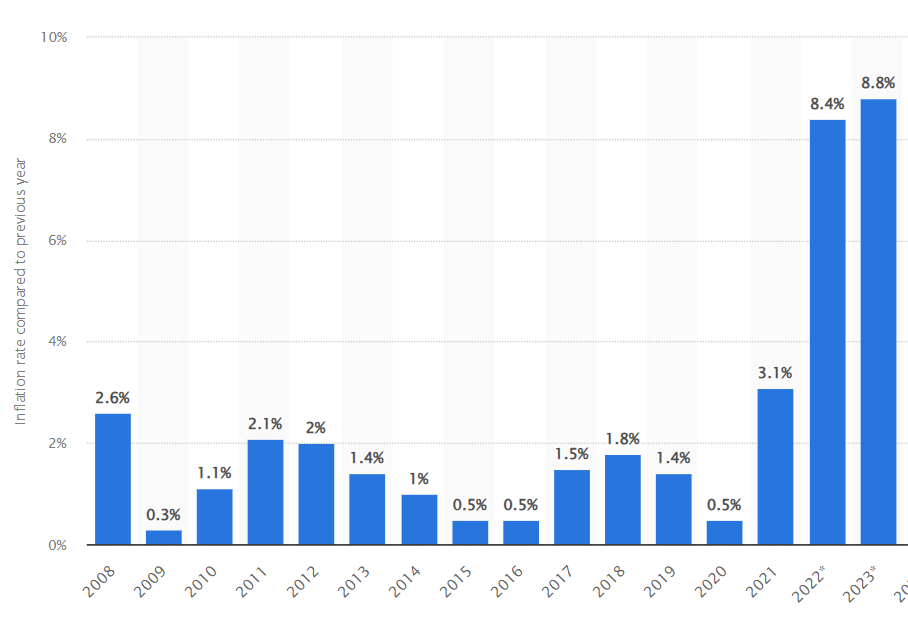
High energy costs have led to runaway inflation in Germany. Source: www.statista.com/
According to Germany’s online Handelsblatt, the German government has moved to increase the price to emit a ton of CO2 in 2024. The original plan was to increase the price by 5 euros a tonne, from 30 to 35 euros a ton, but now the government has decided to double that increase to 10 euros, meaning the price of emitting a ton of CO2 will be 40 euros.
That 33% increase will add to the heating and fueling bills for consumers, and further add upward pressure to the country’s already high inflation rate.
Germany’s economy is already among the weakest in the Euro Zone and high energy costs will make it all the more painful for consumers. The higher price will go into effect on January 1st.
The impact of the higher price will hit the poor the hardest, who are already reeling from higher costs of living. The government is expected to take in an extra 2.3 billion euros in revenue, a total of 10.9 billion euros in 2024.
“We must act cautiously with regard to CO2 pricing, especially in view of the current weakness in growth,” said Germany’s Minister of Finance Christian Lindner.
The state says it will invest in climate-friendly projects, with billions earmarked for building renovations, industrial conversions and electric cars. For 2024, spending of 57.6 billion euros is planned, which is 21.6 billion euros more than in 2023.
Pakistan’s Reported Suspension Of Russian Crude Oil Imports Was The Regime’s “Parting Gift”
BY ANDREW KORYBKO | AUGUST 15, 2023
The News International cited unnamed sources on Sunday to report that Pakistan suspended its import of Russian crude oil on the pretext that it’s not affordable to refine despite its lower price due to the lesser amount of petroleum that’s produced when compared to competitors’ crude. The problem with this explanation is that these refining differences were known ahead of time but the whole point in importing Russian crude was to get it at a lower price and reduce dependence on the Gulf Kingdoms.
Former Petroleum Minister Musadik Malik, who the abovementioned report claimed had insisted in vain on his country’s companies importing more Russian crude, earlier envisaged Moscow providing over one-third of his country’s needs. Nevertheless, it also deserves mentioning that he was reported to have told the National Assembly last week that Pakistan planned to officially pull out of its decade-old gas pipeline deal with Iran under pressure from US sanctions in spite of this project’s promising potential.
The precedent is therefore established for suspecting that US sanctions might also have played a role in Pakistan’s reported decision shortly thereafter to suspend its Russian crude oil imports too. Taken together, the impression is that the fascist post-modern coup regime that was installed after former Prime Minister Imran Khan’s (IK) scandalous ouster in April 2022 decided to destroy any hopes of energy security and the sovereignty it entails as their “parting gift” around the time of parliament’s dissolution.
This development is supposed to precede the next elections by 90 days, but there might be a delay since the latest census results require redrawing constituencies, which might not be completed within the next three months. In any case, the point is that IK’s replacements left a legacy of energy insecurity and lost sovereignty, not to mention economic collapse and the de facto imposition of martial law. The first two consequences are the most relevant to this analysis and will therefore be elaborated further.
The Intercept published a leaked copy of the Pakistani cable from March 2022 sent by its former Ambassador to the US warning about American pressure over Russia. His interlocutor, Assistant Secretary of State for South and Central Asia Donald Lu, made no secret of the fact that the US considered IK’s energy-driven ties with Russia to be a threat to its national security. For that reason, Washington signaled that it wanted him gone otherwise there’d be severe consequences for Pakistan.
IK’s subsequent removal a little over one month later predictably led to his replacements dillydallying on the strategic energy deal that he sought to advance during his trip to Moscow in late February 2022. Although they eventually imported a test shipment of Russian oil earlier this summer, the over year-long delay between his meeting with President Putin and their purchase was suspicious. It now appears in hindsight that the only purpose of going through with this was to push a domestic political agenda.
The regime probably never intended to implement Musadik’s ambitious plans but instead sought American permission for the previously mentioned purchase solely to claim that it supposedly proves that they weren’t installed by the US as punishment for IK’s Russia policy. Following this first-ever import and the superficial fulfilment of their soft power objective, they then spent the rest of the summer sending false signals to Russia that they were on the brink of finally reaching that strategic energy deal.
It can only be speculated whether the former Petroleum Minister was in on this plot or if he sincerely came along to realizing the wisdom of IK’s plans in this respect and truly wanted them to succeed, but that doesn’t change the ultimate outcome either way. At the end of the day, Pakistan strung Russian experts and negotiators along for over a year despite nothing coming of the latter’s efforts, which they continued in good faith with the intent of strengthening their partner’s energy security and sovereignty.
Pakistan’s reported suspension of Russian crude oil imports probably also dooms their plans for the Pakistan Stream gas pipeline, which was supposed to become the flagship Russian project in Pakistan and an anchor for more future investments. The Kremlin might not want to waste any more time negotiating with Islamabad after feeling like it was just fooled for over a full year, and the bad blood between them over these two failed deals could prevent their ties from ever becoming strategic.
Private businessmen will still try to scale real-sector trade between their countries, and ties will remain cordial at the official level, including at multilateral fora on Afghanistan and other issues of shared interests. What’s expected to change, however, is that Russia will no longer continue to treat Pakistan like a potential strategic partner after this debacle. In practice, it won’t consider that country worth the opportunity cost of investing its time in at the expense of expanding ties with more serious partners.
Its finite human resources are better invested in Africa nowadays, whose countries are sincere in their desire for strategic relations with Russia, unlike Pakistan which just wasted over a year dillydallying on a strategic energy deal only to ignominiously abandon it on a misleading pretext. The fascist post-modern coup regime’s “parting gift” to the Pakistani people around the time of parliament’s dissolution ahead of likely rigged elections was that they killed the chance for strategic relations with Russia once and for all.
Kyrgyzstan Is The US’ Next Regime Change Target
BY ANDREW KORYBKO | AUGUST 13, 2023
Chairman of the Senate Foreign Relations Committee Bob Menendez conveyed his country’s intentions to overthrow the Kyrgyz government in the letter that he sent to President Sadyr Japarov last week. It’s even more damning than the newly leaked Pakistani cable from March 2022 regarding US pressure over Russia that implicated a leading diplomat in that country’s post-modern coup one month later. The present piece will point out the threats in Menendez’s letter and place them in the geostrategic context.
Right off the bat, he declared that “I write to you with deep concern regarding allegations of the Government of the Kyrgyz Republic’s assistance to the Russian Federation, or its proxies, in evading international sanctions, imposed with respect to Russia’s unlawful invasion of Ukraine.” This follows Kyrgyzstan’s foiled coup attempt in early June that was analyzed here and the Washington Post’s (WaPo) report last month on its role in facilitating Russia’s purchase of Western-sanctioned tech from China.
The way that events have thus far unfolded strongly suggests that the failed effort to overthrow the Kyrgyz government just two months ago was intended to punish it for allegedly violating the West’s anti-Russian sanctions regime. Afterwards, WaPo published their report to precondition the public to think that Kyrgyzstan is turning into a “rogue state”, which was meant to make the target audience more likely to accept Menendez’s threatening letter and the US-orchestrated destabilization campaign that’ll follow.
The Senator continued by writing that “I urge the Kyrgyz government to swiftly investigate these allegations and to establish more reliable processes to prevent the illicit flow of goods through your territory bound for Russia. I am also concerned that the Kyrgyz Republic’s failure to uphold international sanctions reflects the alarming erosion in democratic governance and extensive human rights violations occurring in the country.”
Kyrgyzstan doesn’t have to initiate any investigation on any country’s demand, but even if it was driven to do so by the desire to de-escalate rapidly worsening political tensions with the US, this would be futile unless it went along with the narrative that it allegedly violated the West’s anti-Russian sanctions. Anything less would be dismissed as a “sham” and exploited as the pretext to impose even more pressure upon it, which brings the analysis around to the next part of Menendez’s statement.
His unsolicited commentary on Kyrgyzstan’s domestic affairs takes WaPo’s preconditioning even further by making explicit what was previously only implied about that country becoming a “rogue state”. After once again lambasting it for allegedly violating the West’s unilateral restrictions, he then defends them on the grounds that they’re “a vital tool in holding Vladimir Putin to account and reducing threats to the sovereignty, independence, and territorial integrity of other nations, including those in Central Asia.
All of this built up to the threat that he then conveyed in his letter when writing that “In the face of potential threats from Russia, the United States remains steadfast in our support of upholding the sovereignty and independence of nations like the Kyrgyz Republic. However, assisting or permitting systemic sanctions evasion by Russia weakens their effectiveness, which could put at risk the security and economic interests of the Kyrgyz people.”
Menendez’s twisted logic is that the US imposed its anti-Russian sanctions on the partial pretext of supposedly defending Kyrgyzstan’s “sovereignty and independence” from Moscow without ever having asked Bishkek ahead of time and now it claims that the latter’s alleged violation of them will endanger it. Objectively speaking, “the security and economic interests of the Kyrgyz people” are “put at risk” by capitulating to American pressure dump their Russian ally, not strengthening ties with it.
The only realistic way in which Kyrgyzstan’s aforesaid interests “could be put at risk” by defying the US’ demands is if Washington ramps up its support for Color Revolution agents and rebels/militants/terrorists in parallel with imposing crushing secondary sanctions in response. These scenarios would have remained speculative and the Mainstream Media could have gaslit that they’re “conspiracy theories” had Menendez not threatened that these same interests might soon be harmed.
He then went for the kill shot:
“Furthermore, I fear that Kyrgyzstan’s failure to uphold international sanctions on Russia is simply a symptom of its continued democratic backsliding and widespread human rights violations. Your government has weakened institutions, repeatedly violated the rights of journalists and independent media, harassed human rights defenders, and placed restrictions on civil society actors.
A once shining beacon of democracy in Central Asia, the Kyrgyz Republic is headed down a dangerous path toward autocracy. I urge you to lift all restrictions on independent media and journalists, release imprisoned human rights defenders, and repeal measures restricting fundamental freedoms such as the freedom of association.”
This is a de facto declaration of Hybrid War.
What Menendez demands is nothing short of a soft coup brought about by voluntarily reversing Kyrgyzstan’s recent “Democratic Security” successes under the Damocles’ sword of “security and economic” consequences if it dares to refuse. The preceding concept refers to the wide range of counter-Hybrid Warfare tactics and strategies that President Japarov employed to safeguard his country’s national model of democracy from associated threats.
If Menendez has his way, however, then suspected Color Revolutionaries will be released from prison, Western “NGO” intel fronts will be allowed to meddle with impunity, and their allied propaganda outlets will once again incessantly spew anti-state disinformation for provoking riots. He then ended his letter on an ominous note by writing that “Your government’s commitment to these matters is critical for the security and prosperity of the Kyrgyz people. We look forward to receiving your prompt response.”
Neighboring Kazakhstan has already capitulated to American pressure to informally take its side over Russia’s in the New Cold War as proven by its partial compliance with the West’s sanctions regime. It also refuses to close its over $100 million biosecurity laboratory that’s funded by the US. Furthermore, the latest news that it’ll host Microsoft’s regional hub was met with harsh criticism from Moscow after Deputy Foreign Minister Mikhail Galuzin described these plans as serving the US’ intelligence interests.
By contrast, Kyrgyzstan refuses to follow in Kazakhstan’s footsteps and remains committed to maximizing the mutual benefits from its strategic partnership with Russia, which is all the more impressive when remembering that it’s smaller, less developed, and historically more unstable than its northern neighbor. Moscow appreciates this display of sovereignty and is actively implementing workarounds to retain trade with Bishkek in the event that Astana’s compliance with Western sanctions ends up impeding this.
The Governor of Astrakhan Region announced the creation last month of the “Southern Transport Corridor” across the Caspian Sea, which is more expensive and time-consuming than trading with the Central Asian Republics across Kazakhstan but makes up for these costs by being outside of US influence. As this analysis already explained, Kyrgyzstan is a stalwart Russian ally, just like the rest of the region remains apart from newly wayward and increasingly treacherous Kazakhstan.
For these reasons, Russia is expected to help those four countries withstand the “security and economic” punishments that the US might soon inflict on them for their brave defiance of its sanctions pressure, beginning with Kyrgyzstan. Its potential descent into Hybrid War havoc could have far-reaching consequences for all of Central Asia due to the very high risk of overspill, which is why it’s imperative for Russia to thwart the US’ impending destabilization plans lest a “second containment front” emerge.
ULEZ – Another Imperial Con
Ulez Expansion Predicted to Cut Air Pollution by Just 1.5%
By Alex Kriel | Thinking Coalition | August 9, 2023
Listening to the discussion over Ulez expansion feels like an action replay of the way in which many were convinced to overreact to Covid, leading to policy responses which caused significantly more harm than good. The Ulez ‘discussion’ has all of the same elements, with modelled health benefits calculated by Imperial College and Mayor Khan’s justification that he is “saving lives”, implying that opponents are wannabe murderers. Of course, this time around, the public is thankfully much more sceptical.
In this short note, we wanted to set out how those ‘lives saved’ numbers are derived and to demonstrate that at best the numbers are seriously misrepresented and at worst completely wrong. In fact, applying the Government and Imperial’s own logic, there is a very strong case to say that the expansion of Ulez will, on balance, harm Londoner’s health when considering the downstream economic consequences of this policy.
The major flaw in Imperial’s model is the one-dimensional nature of its assumption that air pollution drives health and life expectancy. In the real world health is driven by a number of interacting factors with income being the primary driver. There are many assumptions one could dispute that (perhaps unsurprisingly) work towards inflating the claimed health benefits of reducing air pollution, but we focus only on the flaw of largely ignoring policy consequences.
The Imperial team presents several numbers, including: attributable deaths (3,600 to 4,100), improved life expectancy (five to six months) and life-years saved (6.1 million). We wanted to focus on the claimed benefits of the Mayor’s Transport Strategy in terms of life expectancy and life-years saved.
Before leaving attributable deaths, it is important to note that these are not in any sense deaths that can be avoided, nor are they deaths that are subject to reduction by the Transport Strategy. The figure appears to compare current death rates with death rates if all human emissions had been removed for all prior periods. It is a theoretical construct (similar to an unmitigated pandemic) and only a small fraction of this number would be theoretically impacted by road transport (around 15%). Only the going-forward numbers (life-years saved) relate to the Transport Strategy and there the benefits are relatively low at 0.4%. It is important to note that there has only ever been one death, of a young and chronically unwell girl ever recorded in England (56 million population) where the death certificate mentions air pollution. Tragic as this death clearly is, it again highlights the disconnect between the theoretical attribution number and actual deaths recorded; we suggest ignoring the attributable deaths figure.
Looking at the claimed benefits of implementing the Transport Strategy, it is possible for a layman to understand the main assumptions on which these health benefits are based. In summary, it is assumed that reducing 10 µg m-3 achieves roughly a 6% reduction in all cause mortality. Note however 10 µg m-3 is more than all anthropogenic PM 2.5 emissions as estimated for England as a whole, so any benefits are scaled down from 6%. So a 1 µg m-3 reduction generates roughly a 0.6% improvement in life expectancy (i.e., ten times less).
Looking at life-years saved and extended life expectancy, the key assumptions are poorly explained. For those in a hurry, the detail shows that all of the Transport Strategy initiatives to 2050 combined will deliver a projected 0.4% reduction in life-years lost to air pollution using projections to 2154. There is a claimed five to six month extension in life expectancy, so the life expectancy of a London male of around 80 years would be extended to around 80.4 years.
These gains are stated relative to a baseline and for some inexplicable reason the Imperial team has decided to use 2013 pollution levels to establish the baseline and in the process to ignore the available data for 2019. This serves to inflate the baseline.
The acid test is: are the results of modelling compatible with observed reality? And on that basis the Imperial Ulez modelling falls flat. The model covers the impact of the entire Transport Strategy to 2050 which covers many more steps than Ulez. The Imperial document is somewhat vague about what those steps are – they are cryptically referred to as 2025 LES, 2030 LES and 2050 LES. It is enough to note that the goal of Mayor Khan’s 2018 Transport Strategy is to “aim for 80% of all trips in London to be made on foot, by cycle or using public transport by 2041”. So the first thing to clarify is that the claimed 6.1 million saving of life years relates to a significant number of measures, well beyond Ulez expansion. In effect these combined steps will largely eliminate private car traffic.
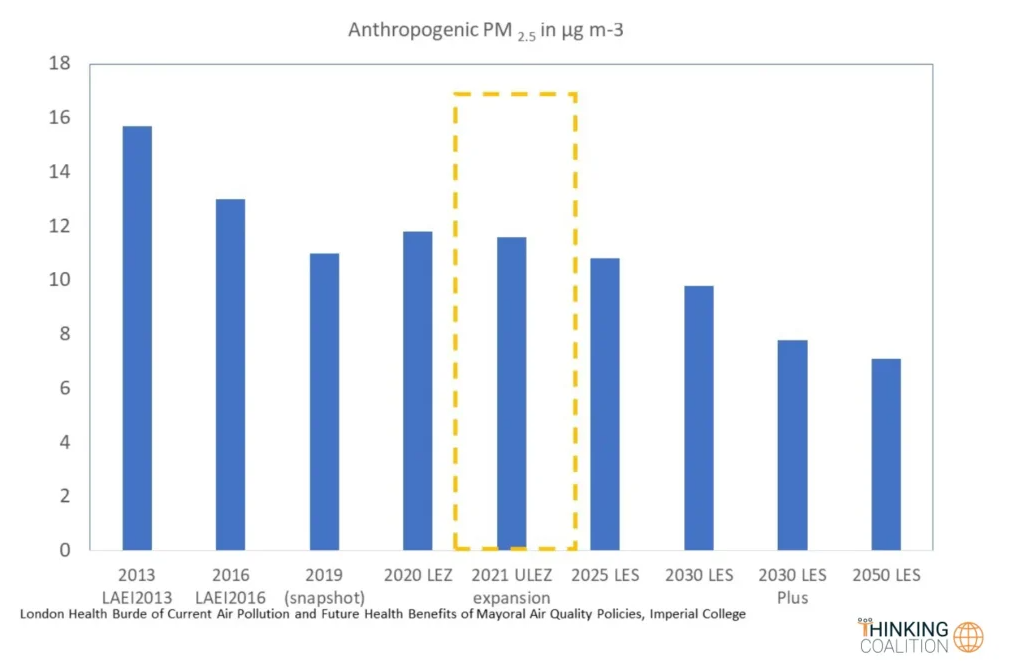
The chart below is constructed from the Imperial material and shows that PM 2.5 µg m-3 population weighted (PWAC) pollution falls over a number of steps and Ulez on a standalone basis has a near zero impact. Also, you can also see that a fair chunk of gains have already been banked between 2013 and 2019.
The failure of Ulez to achieve any meaningful reduction in pollution is very clearly shown in a separate document prepared by Jacobs which looks at the impacts of Ulez only. The table below shows the impact of Ulez expansion on PM 2.5 µg m-3 concentration, with an estimated improvement of less than 2%.
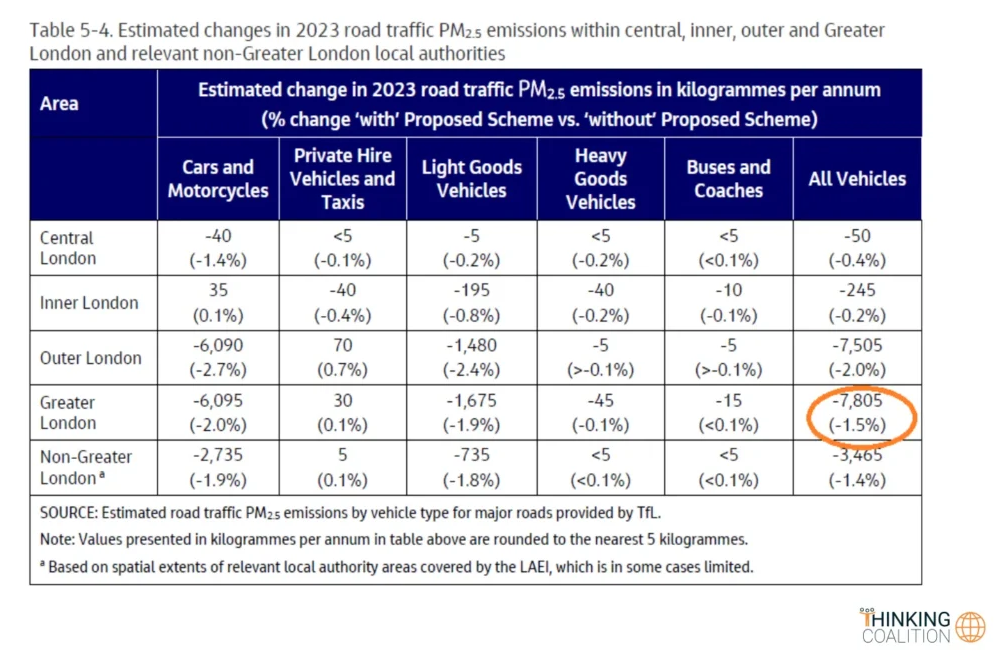
There is a slightly better outcome for NOx pollutants which are reduced by 5.4% across Greater London. This feeds in to the health impact assessment which unsurprisingly shows near zero benefit from Ulez for PM 2.5 reductions, for most health-related metrics.
Looking at life expectancy, the report does acknowledge that due to the large population (around 8.9 million) and the extraordinary long time period over which these benefits are expected to crystalise (up to 2154) then there are around 1.5 billion life-years involved (years × population). For any stated benefit to be meaningful, it needs to referenced to the base case value. The 6.1 million life-years saved is then within the context of a total of around 1.5 billion life-years; this saving is around 0.4%. Correspondingly, the impact on life expectancy from all of the pollution schemes (not just Ulez) adds up to around 22 to 27 weeks additional life expectancy. In the context of male life expectancy of 80 years (roughly) this would improve to 80.4 years as a consequence of 30 years’ worth of restrictive climate policies (ignoring any economic consequences).
The core flaw in the calculation is the one-dimensional thinking that underpins this (and all similar calculations) in that all reductions in PM 2.5 concentrations lead to a reduction in the mortality rate. This thinking ignores any link between people’s incomes and health outcomes, which is the primary driver of health. This is the same dishonest cop out that Professor Ferguson made in his infamous Covid paper. This facilitates a myopic focus on ‘safety’ and generates solutions that do far more harm than good.
In setting out the methodology that states that health outcomes will improve with a reduction in air pollution on a more or less linear basis, the Government’s own figures show that real world data prove that this assumption is not correct (or at least over-simplified). Its own data for the regions of the U.K. show that (if anything) this relationship is reversed.
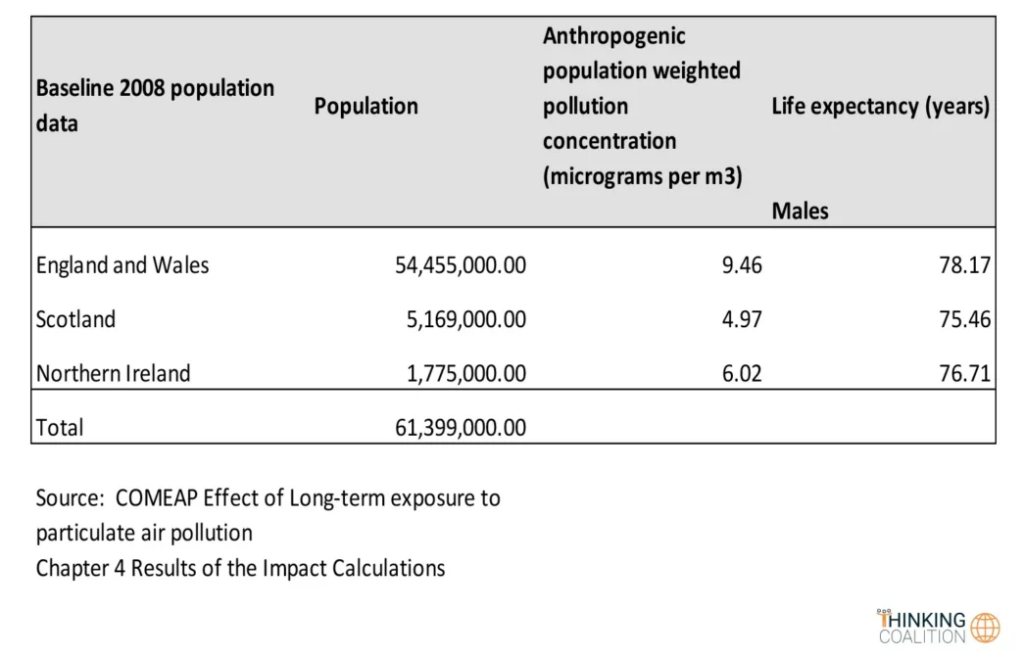
Life expectancy in Scotland is much lower despite having far and away the lowest concentration of anthropogenic PM 2.5 pollutants. Many studies with and between countries show this clearly (e.g. life expectancies by national deprivation deciles, England: 2018 to 2020).
In order to get a handle on how much more significant factors other than PM 2.5 can be, we looked at a recent paper that considers the impact of changes in different factors on life expectancy across 29 European countries (the paper also looks at each factor in isolation using multivariate analysis). The chart below shows the life expectancy impact of a 1% change in the listed factors. There are of course some caveats, but you can immediately see that economic activity dominates the outcomes with a 13-month gain in life expectancy for a 1% gain in GDP versus say a 2.7 month gain for a 1% change in PM 10-2.5. Also note there is no statistically significant relationship between CO2 and life expectancy.
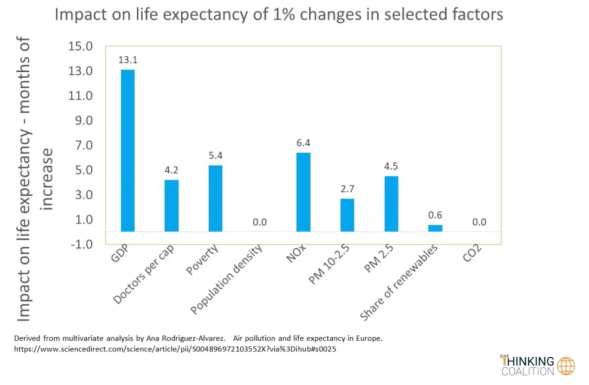
In another section of the same paper the author states: “France and Sweden, some of the countries closest to their potential LE (life expectancies), are also amongst those with the highest NOx level.” The real message, though, is that if you dent people’s income by narrowly pursuing PM 2.5 reduction, you will, on balance, shorten life expectancy and not increase it. The Jacobs’ report confirms that there will be multiple negative impacts on business and economic activity. We guess that on balance Ulez will lower life expectancy when factoring in the impacts on business and family incomes, as well as quality of life considerations.
In the post Covid world, we have understood that politicians of all stripes will shamelessly use emotional manipulation in order to get reasonable people to comply with their unreasonable edicts. That is why understanding how reliable, or otherwise, attributable deaths, life-years saved and life expectancy figures are is so important. You can almost guarantee that these estimates will be manipulated and potentially used to rationalise illogical and damaging policies.With opaque models it is relatively easy to produce results to order.
The political process assumes that the individuals involved are able to understand competing objectives and arrive at a sensible compromise. However, we saw in the case of Covid that many politicians have limited scientific understanding and will tend to pursue unachievable safety, at any cost.
The State seems to be redefining its role with a narrow group of ideologically-driven technocrats setting somewhat arbitrary targets. Achieving those targets requires wholesale changes to people’s lives. Very often economic, mental health and other impacts are barely considered and historically established constitutional boundaries between the State and the citizen are often ignored.
In the case of Ulez expansion, the 59% of respondents to the public consultation who clearly opposed the expansion were simply ignored.
Various sops will no doubt be offered to voters, but is it important that readers realise that there is a direction of travel to these various steps. Finally, remember Albert Camus’s wise warning that, “The welfare of humanity is always the alibi of tyrants.”
Alex Kriel is by training a physicist and was an early critic of the Imperial Covid model. He is a founder of the Thinking Coalition, which comprises a group of citizens who are concerned about Government overreach.
WHY IS THE WEST SO WEAK (AND RUSSIA SO STRONG)?
THE ROLE OF HUMAN CAPITAL AND WESTERN EDUCATION

BY GAIUS BALTAR | AUGUST 2, 2023
It is becoming increasingly clear to more and more people in the West that something has gone terribly wrong with the Ukraine project. Predictions and projections didn’t pan out and the West doesn’t seem to know what to do. The Russian economy wasn’t a house of cards as predicted, Russian weapons weren’t inferior as predicted, Russian soldiers and commanders weren’t incompetent as predicted, and Russian technology wasn’t inferior as predicted.
In some respects the Russians even seem to be superior to the West. Their weapons are effective and in many cases outright technologically superior, as clearly demonstrated by their hypersonic missiles, SAM systems and electronic warfare systems. Their economy appears to be surprisingly advanced and diversified and based on real wealth creation rather than financialization and debt like the West’s. Their strategic and tactical thinking also seems to work, while the West‘s clearly doesn‘t.
The whole mess is often explained as a result of a miscalculation by the western elites – they underestimated Russia and overestimated the West. The situation, however, is far worse than that. Every day that passes reveals the impotence of the West more and more and the situation is becoming outright humiliating. At this point the rest of the world either shakes their heads or simply laughs at the West and its politicians and diplomats – not to mention its crazed populations.
The dysfunction of the West is far deeper than just the situation around the Ukraine project. It’s absolutely everywhere. The West can’t do diplomacy in general, it can’t run its cities or countries except into the ground, its high-tech projects fail almost as a rule, its infrastructure is crumbling, its economies are crumbling, and all public policies seem to have a civilizational suicide as a final goal. The West’s control mechanisms over the rest of the world are also crumbling, including the dollar, sanctions, color revolutions, military interventions and threats. Nothing seems to work and everything the West does seems to make things worse.
Any rational person upon hearing a western leader, diplomat or “expert” speak, asks himself this question: “Are they just lying or are they really this incompetent and delusional?” The answer is “both” but the incompetence factor is far greater than most people can imagine.
Why has this happened? It’s clear that the cause is far deeper than the deindustrialization of the West or economic problems in general. The economy doesn’t explain the incredible incompetence shown by the West before and during the war in Ukraine.
I suggest that the cause of this unfolding disaster is a serious structural problem in the West – which Russia seems to have largely avoided. This structural problem is a necessary condition for the current western system and has been purposely created to bring it about and maintain it. This problem is the subject of this article – as well as the “mechanism” behind it. This is unfortunately a long article, but the subject matter demands it.
The current ideologically-based power structure of the West outright requires that certain types of people be in positions of influence and certain types of people be sidelined. This applies to all steps of the social ladder; from kindergarten teachers to university teachers and corporate executives, and all the way up to the leaders of society itself. This has been progressing steadily for the last five decades or so, and has resulted in a major structural problem for the West. That problem is the obvious and massive degradation and misallocation of human capital in the West.
Human capital can be described as the quality of a company’s or nation’s workforce, or more specifically how competent the employee pool is – how well they are trained, how quickly they can be trained, how they are educated in general, and how they make decisions. In order to understand what competence really means, let’s define it further.
Competence can be described as specific or general. This distinction is extremely important and must be understood by anyone who attempts to manage human capital on a small or large scale.
Specific competence is the ability to do a certain type of work. This can be carpentry, coding, chemistry, medicine, piloting an airliner, and so on and so forth. Some of these types of jobs may require a lot of competence, training and intelligence, but what they have in common is that their scope is limited and clearly defined. They exist within clear boundaries, separate from the complexities and vagueness of the world in general. Each type of work requires certain abilities innate in the person, as well as varying degrees of training. People, of course, differ a lot in their level of specific competence within each field.
General or high-level competence is the ability to do work that is beyond clearly defined boundaries. The subject matter of those types of work exists in a complex “variable universe” and can be exceedingly vague and confusing. It requires the ability to be adaptive and be able to transfer skills between different types of work. This also applies to expertise in one field being applied to a completely different field – such as applying psychology to economics or astrophysics to climate science.
Examples of positions requiring general or high-level competence people are corporate executives, all kinds of planners and administrators, product developers, inventors, high-level consultants and analysts, military leaders and planners, diplomats, judges, political leaders, and high-level scientists and theoreticians, to name a few.
Specific and general competence types of work are not two separate things. Types of work or “jobs” can be said to range from almost completely specific up to almost completely general. Almost all types of work have elements of both but in varying proportions. To illustrate this I will take an example from a company I’m personally familiar with. This is a software company with several owners, most of whom work at the company. One of the owners is an exceptionally competent database specialist. However, when he contributes to decision making for the company as a whole, he becomes an outright problem. The management structure of the company had to be “modified” to neutralize him in that role, as well as a few others. This employee has exceptional specific competence but very poor general competence. He cannot “transfer” his specific database competence over to competence in moving the company into the future. He simply cannot operate objectively or sensibly outside his database job.
So what makes this employee have such poor general competence – or more specifically – what is general competence? General competence requires three necessary conditions: a) High general intelligence or IQ, b) the ability to be objective, even in situations where the result of your conclusions may not be to your liking, and c) the ability to reach conclusions without being influenced by others (i.e. independent thinking). The latter two conditions are a direct result of how the human brain interacts with the environment. The mechanism behind it is too complicated to describe here, but in simplistic terms it can be said that humans range in their relationship with reality from the emotional-outward/subjective to the introspective/objective. This variable, like all evolutionary traits, including IQ, is normally distributed. This has rather disturbing implications which may be difficult for some people to understand.
Let’s first look at IQ, or general intelligence. In order to be able to deal with seriously complicated work or get through a real university program, an IQ of about 125 is necessary. Only about 5% of the population in the West has this IQ or higher. This means that the pool of potentially high-level competence people is very small to begin with. Even if we use a cut-off of an IQ of 115, which is sufficient for most semi-complicated work, the potential pool only goes up to 16% of the population.
Now let’s take a look at the other variables, i.e. objectivity and independent thinking. Those two are correlated and we will, for the sake of convenience, handle them as the same variable or trait, even though they aren’t. They are normally distributed, much like IQ, with most in the middle and fewer toward the extremes in both directions. On one side of the distribution are people who, to state it bluntly, are incapable of thinking objectively about any issues that may interact with their personal views about anything at all. They can be competent in a limited field which is “neutral” to them (such as databases), but not involving anything else. They can’t run a company in a competitive environment, except into the ground. They can’t run a city, a country, a military campaign, an economy, or anything requiring general competence, except into the ground, regardless of their intelligence. These people are clearly not suitable for general/high-level competence jobs.
So, what is the proportion of the population that is objective enough and independent thinkers enough to be suitable for those jobs? That’s difficult to determine but it’s clear that it is maximum 50% of the population. In reality it’s far less but let’s be generous and say it’s 30%. What does that mean?
IQ and objectivity/independent thinking are somewhat correlated but let’s assume they are not. Let’s say that we have a pool of potentially objective and rational people that is 30% and a pool of people with IQ of 125 that is 5%. That means that the pool of high-level general competence people is 5% of 30%, or 1.5% of the population.
If we are really generous and assume that 50% of the population is objective and rational and an IQ of 115 is sufficient for those jobs, then we have 16% of 50%, which is a pool of 8% of the population.
The importance of this cannot be overstated. This group, whether we define it as 1.5% of the population or 8% of the population, is extremely valuable. This is essentially the only group in society that can reliably evaluate complex situations and make subsequent rational decisions. Without it, modern technological society simply cannot be built or maintained – let alone advanced. Let me rephrase this – if we do not identify and utilize this group, we cannot run our complicated societies except into the ground.
Modern western society is from a governance standpoint ideologically motivated and ideologically controlled. It is being pushed in a very clearly defined ideological direction, led by the European Union and the current US administration. This ideology is not the subject matter of this article, but it can be seen everywhere by any rational and independent-thinking person. For the uninformed-curious a good place to start is the website of the EU’s policy-making body; the World Economic Forum.
In order to achieve these ideological goals for the West, two things must happen: a) The right people must be put into power at all levels of society and b) any disruptive elements must be eliminated or suppressed. Since all ideological goals tend to be more or less in conflict with reality, there is no group more disruptive to them than the one who operates objectively and independently. People like that simply cannot be allowed into positions of power, and if they must be, they must be kept quiet and/or forced to toe the line.
The objective/rational/general competence group, whether it is 1.5% or 8% of the population, therefore becomes a problem rather than a resource. This is exactly the situation in the West today.
Many people have noticed that meritocracy has been systematically abandoned in the West and the relationship between competence and reward severed in giant swaths of the economy – and almost completely in government. What few people seem to realize is that this is a necessity for the West’s ideological goals to be reached. High-level competence cannot be promoted because it is a threat. It cannot therefore be rewarded.
In order to illustrate this, let’s take a look at what happens when a member of the 1.5% is allowed to gain significant power. Elon Musk is a smart man, probably with an IQ of 150 or more. He is also quite objective and realistic in his assessments, and an independent thinker. His ownership and governance of Twitter/X is a major problem for western ideological goals. Free speech is an obvious threat to any ideology and, to rub salt in the wounds, Musk belittled the guardians of the Ideology at Twitter by making fun of them, then by firing them all and only keeping the competent ones. This cannot be allowed to stand and we can already see the response. The EU is planning to use force to stop this affront to the Ideology and may actually block Twitter in Europe. Ideological champion (and suspected lizard robot) Mark Zuckerberg was even instructed to cook up an ideologically pure Twitter copy in response – but seems to have failed. We eagerly await further responses, which may range from lawfare up to more “direct” actions, and will most likely be directed at Musk personally.
As previously noted, two things must happen for the ideological goals to become reality: The right people must be promoted and the wrong people must be suppressed. This process of elevation/suppression has become the main goal of the western education system – all the way from kindergarten up to university. If we look at what the education system has been doing, this becomes extremely obvious. Here are a few examples:
- Evaluation of competence is being systematically degraded to avoid comparison between the competent and the incompetent. Exams are being discarded in favor of constant “projects” and students work in groups so the incompetent may hide. Schools avoid testing the individual directly as much as they can – and thereby comparing him to others. The competent ones must not be encouraged, and if at all possible, they themselves must not realize that they are above others.
- Universities are increasingly basing admittance on other criteria than competence, including quotas based on non-competence variables. The most insidious selection method is the “personal essay” which applicants must submit – and is sometimes even more important than grades. All applicants know that the more they signal virtue in the essay, the more likely they are to be admitted. On the basis of the essay, the universities can pick the ideologically pure – which is the only purpose of the essay requirement to begin with.
- Almost every academic subject is being turned from the objective to the subjective to assist the irrational-incompetent student. This even applies to hard subjects such as mathematics – where nowadays 2+2 doesn’t necessarily equal 4. Even intelligence is now subjective and the stupid can be as smart as the intelligent – it’s just a question of perspective, the right measuring tools, and idiotic inventions such as “emotional intelligence.”
- Almost every subject has been made easier than before to help the incompetent students and even critical fields such as medicine are now graduating people who are utterly incompetent and clueless – on a large scale. This systematic lowering of standards also has the added benefit of creating disinterest in smart and rational students. A smart student performs better and better relative to others as the subject gets harder. If the subject is easy or made uninteresting, he will sink down to mediocracy – which is a part of the purpose of lowering the standards to begin with.
- Disciplines which may be a threat to the irrationality of the Ideology have been massively subverted and corrupted. This applies to several fields, but particularly to psychology and history, which in their proper forms would be a massive threat to western ideological goals. Psychology has been twisted into an almost unrecognizable abomination, and history is mostly just lies these days.
- Fake disciplines have been invented from the ground up for the purpose of training the ideologically pure without the need for competence or intelligence or any connection to reality. These disciplines can be found in lists of “most useless university degrees” all over the internet, but that is a misunderstanding. Those degrees are not useless at all – they elevate the ideologically pure in society by awarding them university “certification.” This certification justifies giving them important positions in society.
I could go on but you get the picture. What we are looking at here is not the failure of the western education system, but a very carefully planned “pivoting” toward new objectives. The primary purpose of the education system is no longer education. The entire education system of the West has been reconfigured to carry out a “filtration” process. The purpose of this process is to identify, instruct and elevate the ideologically pure while suppressing the dangerous 1.5/8 group. The education system, particularly the universities, has largely abandoned real education and is almost solely focused on this mission. This mission is not just carried out by the education system, but by all institutions of governments and a large part of the corporate sector. A side-result of this filtration process is the degradation of all education in the West, and subsequently, degradation of its human capital in general.
Western society, in general, has abandoned rationality and replaced it with subjectivism (formally designated as “post-modernism”). The purpose of that is not just to train and advance the ideologically pure, but to use subjectivism as an oppression tool against the 1.5/8 group and the rational part of the population outside of it. The best way to suppress a rational person is to subject him to an existence of total and constant irrationality. It is essentially gaslighting on a civilizational scale, directed at the dangerous rational group.
While the dangerous rational group is being suppressed and subverted, the ideologically pure “leaders of tomorrow” are indoctrinated rather than educated, given university certifications rather than real degrees, and finally provided with an unending amount of fake and well paid jobs in both the private and public sector. This well-paid ideologically pure group then becomes the power base of the new ideological system.
The goal of this deliberate intervention into the educational system is to create what you might call a “migration pattern” in society based on (lack of) competence and ideological purity. The right people need to be put into the right positions and the right jobs, and since they are incompetent, this needs to be managed for them. After they leave school with their certifications, government and the private sector take over and actively push them upward, while pushing the dreaded 1.5/8 group away from influence and well-paid jobs.
Two developments in the West have been godsends for these efforts: the outsourcing of western manufacturing to Asia and the virtual abolition of competition in the corporate sector. This massively decreased the complexity level of the western economy and subsequently the need for the 1.5/8 group. When most companies operate services in a protected environment, there is far less need for high-level/rational people – while in a “real economy” these people simply cannot be sidelined. Also, when you can get away with operating a fake economy based on the dollar reserve status, you can also operate a fake society run by incompetents.
Let’s take a closer look at how this upward migration of the ideologically pure is managed after they receive their university certifications – and how the 1.5/8 group is systematically blocked. There are five main methods being employed – which together form a long-term takeover process of society. These methods are the following:
- Public sector filtering
- Public sector stuffing
- Job-creation by decree
- Private sector filtering
- Private sector stuffing
Public sector filtering – This describes the job selection process in the public sector. Initially the “foot-in-the-door” method is used. A few ideologically pure politicians and bureaucrats position themselves within the system and start controlling who is hired. This increases exponentially over the decades as more and more purists gain access to the levers of power. Currently the process is so overt that it is starting to become expressed in recruitment policy papers – such as the recent example of the British government excluding “white men” from becoming fighter pilots. The West has almost completely been able to exclude the 1.5/8 group from public-sector positions using this method – including its armed forces.
Public sector stuffing – As the public sector filtering process advances, the purists inside the system start creating more and more positions for their purist brethren. New departments are created, work groups and committees appear, and the public sector expands. Publicly owned companies, such utility companies, hospitals and schools are also often used as storage units for large numbers of the ideologically pure. This is extremely obvious in the West. Every unnecessary law or initiative requires more and more people – and these people are all carefully selected.
Job-creation by decree – This method is directed at the private sector, as well as the semi-public sector. Government purists start creating new laws and standards which all companies must fulfill. Those are justified on the basis of “goodness” and usually involve the environment, equality, safety and such things. This creates a large number of positions within private companies which are tailored for the ideologically pure – particularly in support functions such as human resources, compliance functions and others. This enables a “foot-in-the-door” situation in the private sector and gives the purists access to the levers of powers there – much like they already have in the public sector.
Private sector filtering – As the purists have gained access to the private sector – particularly human resources (which is the standard purist Trojan horse in private companies) – they start filtering new recruits exactly the same way the public sector does. As in the public sector, this filtering process is becoming more obvious. A significant number of companies are now specifying which groups will not be hired in their job advertisements. Since they can’t overtly say “we don’t hire smart, independent thinkers” they usually use “white men” as a proxy for that group for some reason. That group is considered to be a particular threat, although you can be sure that anyone who doesn’t follow the program will be fired, regardless of their gender or the color of their skin.
Private sector stuffing – Shortly after Elon Musk bought Twitter he fired something like 80% of its employees. That 80% was the company’s private sector stuffing ratio – quite high. Companies, particularly in sectors which can influence public opinion – but not solely, are increasingly creating a large number of positions which are either totally superfluous or intended for influence operations against the public.
Those filtering and stuffing methods are the primary mechanisms that have been used for the takeover of western societies by the ideologically pure. There are other mechanisms, such as ESG, filtering by certain banks and investment funds regarding who gets financing and who doesn’t – and the uncontrolled immigration engineered by the ideologically pure which is seen by them as a continuation of the internal migration process. However, all that is beyond the scope of this article.
The ideologically pure have systematically been moved into almost all positions of power in the public sector and a large part of the private sector – and the situation in the private sector is increasingly mirroring the public sector in hiring practices and employee stuffing. The dangerous 1.5/8 group is being kept away by all means, and with great success. The power base of the Ideology is firmly in place.
This job migration program hasn’t been cheap. Millions of unnecessary jobs cost money and it is clear that a significant part of western public debt can be attributed to this program, a fact which doesn’t seem to have been noticed by many people.
The consequences
The main thing to understand is that western societies and economies have been put on an ideological footing. Productivity, competitiveness, technology and science are simply not priorities anymore in the West. Explaining the consequences of this process for the West would take many articles, or a book of several hundred pages. Still, let’s mention a few examples.
The inverse competence crisis – The goal of this entire project has been to place the ideologically pure in all positions of power at all levels of society. These positions are, in a normal and competitive society, occupied by the highly competent 1.5/8 group. The process has now reached near-completion with most positions of power occupied by the ideologically pure. Some of those people have high IQs but they are neither objective nor independent thinkers. The Ideology they must subscribe to is simply incompatible with those qualities. This has some serious consequences.
Remember that positions of power and influence are more likely to demand general competence than other positions (as opposed to specific competence). The greater the power, the more the position demands general competence. The people in these positions now are selected by ideological fervor and reliability – so the higher you go, the more ideologically enthusiastic the people who hold them. This means that the least objective and independent thinking people hold the positions which require the greatest objectivity and independent thinking. Therefore, in the West incompetence becomes greater and more common the higher you go. As someone said – “a general is an incompetent colonel.” This can be seen absolutely everywhere except in some holdout private companies. Those exceptions are of course being addressed as we speak.
The second problem is that many of the irrational/subjective people holding all the power have reasonably high IQs. That may seem to be a positive thing but it has a major disadvantage. Moderate to high IQ irrational/subjective people are the easiest to brainwash of all people. The reasons for that are complicated and need to be addressed in another article – but what this means is that the top tier in the West is not only the most incompetent it can possibly be in comparison to what their jobs require – but are also the most malleable and delusional.
The cost and debt crisis – The migration of the ideologically pure into the ideological power base and positions of influence has created millions of jobs in western societies which create no value. These jobs are much more numerous and more widespread than most people realize, and I wouldn’t be surprised if something like 20%-30% of the entire labor force of the West could be fired without any adverse effect. In fact, the effect would be positive, especially if those people could be made to work the (mostly menial) real-economy jobs they are suitable for.
Deindustrialization has been blamed for the extreme debt levels and tax burdens of the West. That is, as far as it goes, true – but maintaining this giant group of incompetents in their fake jobs is also placing an extreme burden on the West. Western societies are now completely unsustainable and cannot be run without constant debt increase.
The competition crisis – This crisis can be explained by the following example: Let’s say there are three companies with combined 100% market share in some sector. There is no real competition between them and everybody can just relax because the customers can’t go anywhere else. These companies can get away with absolute incompetence on most levels, including in management. They don’t need to think about efficiency, safety, productivity or costs, except on their websites and in annual reports. However, if a competitor with competent employees manages to infiltrate the sector, those three companies will hit a wall. There will be an enormous crisis and one or more of them will most likely go under.
This is exactly the situation in the western economies now. Monopoly and oligopoly is the rule and the main objective of most large western companies is to prevent anyone from infiltrating their sector – usually by bribing regulators or by buying the competition. This is a necessity because a huge number of western companies are now run by incompetent management and staffed by incompetent people, particularly in support and management functions. The immortal words of the nameless Boeing employee about the 737 MAX apply to most large western companies; “this airplane is designed by clowns who in turn are supervised by monkeys.” Western companies are no longer competitive. They cannot compete with Chinese companies now and soon they won’t be able to compete with companies in general outside the West. They simply can’t function except inside an economic safe-space. In fact, the situation is such that the Chinese already do the real work for many of them and reshoring the work is problematic because of (surprise!) the human capital degradation in the West caused by the repurposing of its education system.
This also applies to western societies as a whole. The entire leadership and diplomatic classes of the West are no longer competitive against the rest of the world for exactly these reasons. They are being outmaneuvered by the Chinese, the Russians, the Indians, and everybody else at every turn. Even African leaders are now more competent than western leaders. They have consistently made decisions that are better for their people than leaders in the West – for the last few years anyway.
The complexity crisis – Earlier in this article I stated that the 1.5/8 group is extremely valuable for modern societies and without it complicated modern societies cannot be managed. In the West this group has been successfully sidelined to a great degree and a good part of it doesn’t even bother with university education anymore. The situation, however, is even worse than that. The reconfiguration of the education system and the break between competence and reward in the job market has fundamentally changed the decision making process behind the selection of university education. Why study engineering (which is hard) when you can get an even better paying job with a degree in psychology (which is easy nowadays)? The reconfiguration of the western education system has changed the reward structure, encouraging young people to pursue easy and useless education – simply because the “system” will provide them with jobs.
This has already caused a major crisis in western societies, particularly in the US. The “maintenance” of complex aspects of US society needs a large group of engineers and people with related education. This maintenance is faltering now, and significantly relies on foreign engineers educated in US universities. You see, why would Americans study engineering in a system which doesn’t reward it? If China and India could somehow recall their engineers and others with hard education from the US, the US system could probably not be maintained, let alone advanced. This will get progressively worse and we will soon reach a point where complex systems which underpin society cannot be kept running. That will require some kind of “reset” to a less complex society, with less prosperity of course.
There are far more crises than those four, but I wouldn’t want to sound like a doomsayer by listing more.
So, what about Russia? Firstly, there are clear signs that the Russians have figured out what is happening in the West and are learning from it. Recently they left the “Bologna process” which is a European education standardization system. The Bologna system has the express purpose of diluting education in member states, implementing certifications rather than real degrees, and filling European societies with badly educated and generally incompetent “experts” who follow the consensus, no matter what. The Russians saw this system as a threat to their country, which it is, and have, at least partly, reverted to the older and more hardcore Soviet system.
Secondly, the Russians seem to be carrying out purges of the incompetent and corrupt within state structures, including the military. Meritocracy seems to be on the agenda, a radical concept these days. The Russians most likely see these efforts as critical to the continuation of their state and nation – and they would be right.
The situation in China is much the same and there are indications that the rest of the non-western world is catching on. Remember that one of the results of the recent Russia-Africa summit was a Russian-organized education effort in Africa. I doubt that women’s studies will be a part of that curriculum.
The current clash between the West and Russia – and increasingly between the West and the rest of the world – is becoming a clash between the incompetent and irrational and the competent and rational. The result is obvious – but what happens when an irrational person who is backed into a corner has access to nuclear weapons? That’s anybody’s guess.
By putting its societies on an ideological footing the western elite has backed itself into a corner. They can’t compete; they can’t develop their economies or societies; and they can’t go back. Fixing the problems of the West will require an economic revival, where a real economy will replace the current fake financialized service economy. This cannot be done without putting the hated 1.5/8 group into positions of power. Therefore, it will not be done as long as the current western ruling class is in power. Western societies will not survive an economic revival in their current ideological configuration. Conflict is therefore the only remaining option for the ruling class to hang on to power.
Russian energy revenues higher than last year – Handelsblatt
RT | August 11, 2023
Russia saw revenues from energy exports surge last month despite Western sanctions that include embargos and price caps on the country’s oil, German news outlet Handelsblatt reported on Thursday.
According to the publication, Moscow’s revenues from oil and gas sales grew 5.3% year-on-year in July and amounted to $8.66 billion. Profits were said to be the largest in gas exports, while those from crude sales rose by 2.6%. The outlet noted it was the first time this year that Russia had increased state revenues from energy exports in comparison with 2022.
Russia is earning more from energy exports and “thus is in a better position than a few months ago,” Giovanni Staunovo, a commodity analyst at Swiss bank UBS, told the news outlet. He claimed that as a result, many have started to doubt the effectiveness of sanctions on Russia.
Robin Brooks from the Institute of International Finance (IIF) noted that sanctions “can be very effective when used against countries with current account deficits,” which depend on loans from foreign investors on the global capital market to finance imports. He noted, however, that Russia is not among that group and argued that the restrictions imposed on it are becoming increasingly ineffective.
An EU embargo on seaborne exports of Russian crude was introduced last year along with G7 price caps on oil and petroleum products originating from Russia, in response to Moscow’s military operation in Ukraine. The measures were presented as an effort to deprive Moscow of funds to finance its military effort.
While the restrictions have barred Russia from accessing its traditional Western markets, they have triggered a large-scale reshuffle in global oil supply, with Moscow successfully redirecting exports to Asia. According to the latest OPEC calculations, Russia has been the largest exporter of oil to India for the past year, accounting for 45% of India’s crude purchases in June. It has also been China’s top supplier since January.
Pakistan suspends pipeline project with Iran under threat of US sanctions
The Cradle | August 8, 2023
Pakistan has suspended its participation in building a major gas pipeline with Iran due to the threat of US economic sanctions, Minister of State for Petroleum, Dr. Musadik Malik, said in written testimony to the National Assembly on 7 August.
“Pakistan has issued a Force Majeure and Excusing Event notice to Iran under the Gas Sales and Purchase Agreement (GSPA), which resultantly suspends Pakistan’s obligations under the GSPA,” Malik wrote, noting that Iran disputes the validity of the notice.
“The matter will be finally settled through arbitration, should Iran take this matter to arbitration,” the minister added. “The exact amount of penalty, if any, is subject to the outcome of the arbitration to be determined by the arbitrators.”
In May, Pakistani officials warned that Islamabad faces paying an $18 billion fine if it fails to complete the Iran-Pakistan Gas Pipeline project by March 2024.
In his Monday statement, Malik added that the government is “engaged” in talks with US officials to plea for an exemption from sanctions for the project.
“All necessary actions are being taken to construct the gas pipeline at the earliest,” he stressed.
He also confirmed that the pipeline – which can supply 750 million cubic feet of gas per day to Pakistan – “is stalled due to international sanctions on Iran” and will only resume once the sanctions are lifted and no longer threaten Pakistan.
“No date and deadline can be given for the completion of the Iran-Pakistan Gas Pipeline Project,” the official said.
According to the terms of the GSPA, each country was obligated to construct a portion of the pipeline on its territory, and the first flow of Iranian gas to Pakistan was to start on 1 January 2015. Iran completed its portion of the pipeline in 2011.
As part of Pakistan’s dire economic crisis, the nation faces regular blackouts lasting 12 hours per day, if not longer.
To face this crisis, the Pakistani finance ministry revealed plans on 8 August to purchase more electricity from Iran. The decision was reportedly taken during a session of the Economic Coordination Committee chaired by Finance Minister Ishaq Dar.
Islamabad’s moves come less than a week after Iranian Foreign Minister Hossein Amir-Abdollahian visited the South Asian nation, where he signed a five-year commercial trade agreement.
The two countries also recently agreed to bolster defense cooperation to ensure border security.
Furthermore, in June, Islamabad announced a barter trade agreement with Russia, Iran, and Afghanistan to ease the mounting pressure on its depleted foreign reserves.
Featured Video

Macgregor: We Haven’t Seen the Worst of the Iran War Yet
or go to
Aletho News Archives – Video-Images
New Book
Breast Cancer: Before You Consent
A new Unbekoming paperback
Lies are Unbekoming | September 18, 2026
Peter Gøtzsche reviewed every randomised mammography screening trial ever conducted for the Cochrane Collaboration. Cochrane’s headline is that, assuming a 15% mortality reduction, one woman in 2000 avoids dying of breast cancer over ten years. Ten are overdiagnosed and treated. Two hundred experience false alarms.
But that headline assumes the reduction. When Gøtzsche looked only at the trials with adequate randomisation — the higher-quality ones — the reduction disappeared. No effect on breast cancer mortality. No effect on all-cause mortality.
This is the Cochrane finding, published in the establishment’s own database of systematic reviews.
No woman being asked to consent to a mammogram this week knows it.
That is why the new Unbekoming paperback exists. … continue
Blog Roll
 Aletho News
- US lawmaker blocks $2.8 billion weapons sale to Israel: Report
- Yemeni army claims responsibility for strikes on sensitive sites in Saudi capital, Aramco facilities in Yanbu
- Iran Judiciary issues indictments against 159 US, Israeli officials for assassination of Leader, commanders
- Turkiye revokes Iranian bank license under US sanctions campaign
- US-Denmark Agreement on Greenland Is ‘PR Stunt’ Ahead of Midterms
- Araghchi: Military intervention cannot create security; coercion cannot bring peace
- Fraud Squared
- Breast Cancer: Before You Consent
- Iran’s Plan to Shut Down AI in the Persian Gulf
- Israel seeks ‘compensation’ from Washington over Saudi F-35 sale
- If Americans Knew
- Inside Gaza’s death trap of collapsing, bombed-out buildings
- The everyday items Israel bans from Gaza every day
- Inside the siege, the ruined buildings of Gaza – Daily Update
- Debunking The Claim That Macklemore Has A “History Of Antisemitism”
- CPJ demands release of arrested Palestinian-US journalist near Bethlehem
- Robert Kraft: The Billionaire Friend of Netanyahu Pulling The Strings Behind the Macklemore/Ed Sheeran Blow Up
- Columbia Administered Fund Gives Big Money to Pro-Israel Groups
- Deportation Case of Palestinian Activist Salah Sarsour Tests First Amendment
- ‘We Will Not Forget’: Palestinians Mark 44 Years since Sabra and Shatila
- Why do we let Zionists decide what we can and can’t say?
- No Tricks Zone
- New Study: ‘Global Drought Shows No Detectable Recent Acceleration Under Climate Warming’
- Economic Masterminds: German Socialists Suggest Taxing Productivity Gains Stemming From Using AI
- The South China Sea Has Not Been Cooperating With The Climate Change Narrative
- Energy Crisis: Germany Enters Heating Season With Historically Low Gas Reserve Fill Levels
- New Study: The Antarctic Ice Sheet Gained Mass From 2020-2024 Due To Staggering Snow And Ice Accumulation
- Study: Ocean Heating Rates From Thousands Of Years Ago ‘Dwarf’ Modern Ocean Heating Rates
- Climate Extremists Target, Attack Large-Scale Power Grid Infrastructure In Germany!
- New Study: Antarctic Ice Melt Has Contributed Less Than 1 Centimeter To Sea Level Rise In The Last 30 Years
- Fear Of Debate: Alarmist German Climate Scientist Calls On Mainstream Media To Discredit Skeptic Voices
- End-Of-August Arctic Sea Ice Extent Hasn’t Fallen In 20 Years, Official Data Show!
 Aletho News