NATO aggression against Russia becomes total war
By Drago Bosnic | August 8, 2023
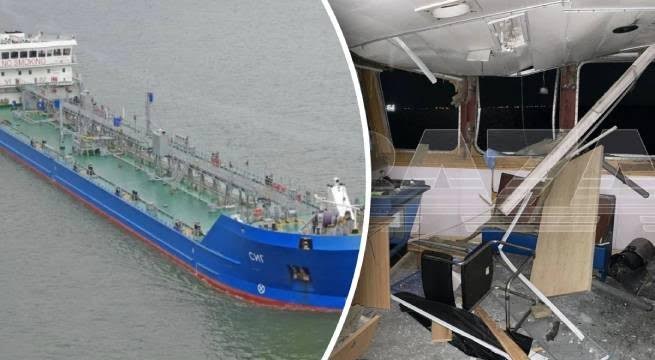
On the night of August 4, the Kiev regime launched a sea drone attack against a Russian tanker. Luckily, the resulting damage was insufficient to sink the ship or cause any casualties among the 11 crew members, but it did hinder its operation. The attack happened at about 23:20 just south of the Kerch Strait, according to a statement by Russia’s Federal Agency for Sea and Inland Water Transport. The vessel was later identified as the chemical tanker SIG. The Russian maritime agency detailed that there is a hole “near the waterline on the starboard side, presumably as a result of a sea drone attack” and confirmed there were no casualties.
It’s important to note that the SIG is sanctioned by the United States for transporting jet fuel to the Russian military in Syria, making American involvement in the attack almost a certainty, particularly at a time when Washington DC’s aggression against Damascus is escalating. The targeting information was most likely provided by US ISR (intelligence, surveillance, reconnaissance) platforms which then relayed this to the SBU or the Neo-Nazi junta forces. The move aims to hamper vital Russian logistics in Syria, particularly operations by the VKS (Russian Aerospace Forces) which is regularly intercepting US/NATO aircraft illegally entering Syrian airspace.
To further conceal direct US involvement, the Kiev regime openly boasted about the attack, which is highly unusual given the fact that it normally maintains plausible deniability in the aftermath of such actions. According to NBC, “the tanker was transporting fuel for the Russian troops,” citing sources and adding that “it was well loaded” and that “the ‘fireworks’ could be seen from afar”. They said that a surface drone and TNT had been used to carry out the attack. A video was also released and shared by several Neo-Nazi junta officials, showing a sea drone moving towards the tanker, although it cuts just before reaching the ship, suggesting the explosion followed immediately after.
“Any explosions that happen with the ships of the Russian Federation or the Crimean Bridge is an absolutely logical and effective step in relation to the enemy,” the head of the SBU Vasyl Malyuk posted on Telegram, adding: “If the Russians want the explosions to stop, they should use the only option for this — to leave the territorial waters of Ukraine.”
Several hours before the attack on SIG, another sea drone damaged the “Olenogorsky Gornyak” landing ship, just off the port of Novorossiysk, one of Russia’s major export hubs. Coupled with attacks on tankers, such actions are obviously designed to hinder Moscow’s oil sales as the so-called “price cap” turned out to be a miserable failure, with even US vassals such as Japan ignoring it. By targeting Russian tankers and major ports, the US is hoping to stop or at least hamper oil sales. This is also connected to the issue of insurance for Russian vessels, meaning there would be no compensation in case of such attacks, possibly prompting other tankers to halt transporting Russian oil.
On the other hand, drone strikes on Russian cities aim to disrupt normal economic activity and discredit Russian authorities, probably in hopes of causing unrest of some kind. On August 6, Moscow’s Vnukovo airport was forced to temporarily halt all flights due to a failed drone attack. The Russian military’s electronic warfare (EW) assets downed the drone in the Podolsk region of the Moscow suburbs. The attack could have caused untold damage had it reached the airport, jeopardizing the lives of thousands of civilians. Since major drone attacks on buildings in Moscow (including the Kremlin itself), the Russian military strengthened its air defenses in and around Moscow, including by placing “Pantsir” SAM (surface-to-air missile) systems on rooftops.
Moscow Mayor Sergey Sobyanin wrote on Telegram: “Today at around 11:00 AM, a drone attempted to break through to Moscow. It was destroyed on the approach by air defenses. Well done, military.”
Drone attacks on civilian infrastructure are absolutely irrelevant to Russian military operations in Ukraine, meaning they are either an act of desperation (as the Kiev regime’s much-touted counteroffensive has been an absolute debacle) or the United States is simply trying to launch a total war against Russia, as its economy has proved to be virtually impervious to the political West’s unrelenting sanctions warfare. Another proof that the economic siege of Russia has failed spectacularly is the fact that the Eurasian giant’s economy will grow 1.5% this year, according to an assessment by the IMF. This “unpleasant surprise” most likely prompted the political West to take “concrete action” in order to prevent such a scenario, as its own economic prospects are not looking so good.
Namely, although President Joe Biden vowed to “turn the ruble into rubble” just last year, this has proven to be nothing more than a fantasy, as the Russian economy is now outperforming those of its adversaries, the same ones enforcing the sanctions. Unable to face Moscow in a fair fight, be it militarily, economically or otherwise, the political West is left with underhanded tactics such as biological warfare, evident terrorist attacks and even covert nuclear proliferation. As previously mentioned, all this can only be described by two words – total war. And while it inevitably results in damage for Moscow on a tactical level, strategically and historically, Russia has never lost such confrontations, as evidenced by the last attempt by a certain failed painter with a peculiar mustache.
Drago Bosnic is an independent geopolitical and military analyst.
Estonian social crisis worsening
By Lucas Leiroz | August 8, 2023
Estonia is in serious trouble due to its irrational stance in the current NATO proxy conflict with Russia. Simultaneously focused on meeting Ukrainian humanitarian demands and the war plans of the Atlantic alliance, the Estonian government virtually excludes its own people from national priorities, which resulted in the aggravation of the internal crisis. Uncontrolled immigration, deindustrialization, economic instability and rising living costs are some of the problems that currently affect the country – and that will continue to do so if the government does not take a sovereign attitude.
Committed to helping solve the Ukrainian humanitarian issue, Estonia has been receiving thousands of refugees every day. Last year, the country received more than 115,000 Ukrainians – 62,000 of them planning to stay there permanently. This year, it is estimated that 300 to 400 Ukrainians are applying for Estonian asylum every week. Not all migrants are really in need of humanitarian aid due to the impact of the conflict. Many of the Ukrainian citizens in Estonia are men of military age who should be on the battlefield according to Kiev’s law, but who fled the country to escape the war.
Despite Kiev’s forced recruitment system being dictatorial and unacceptable, Estonia has no humanitarian obligation to receive people who are simply fleeing their military duties. These refugees get help from the Estonian government, and their stay in the country is subsidized by local taxpayers. So, it would be legitimate for Tallinn to have stricter guidelines on who to welcome into its territory – but it does not. In practice, any Ukrainian can enter the country, and the government remains silent, given its irrationally “humanitarian” stance, which prioritizes foreign citizens over nationals.
The Estonian state’s efforts to receive these refugees have been extremely expensive. In the first quarter of 2023 alone, Estonia spent more than 25 million euros on costs related to Ukrainian migrants. These expenses include benefits such as special protection by the Ministry of Interior’s forces, as well as Estonian language lessons provided by the Ministry of Culture.
Obviously, to finance all this, the government needs to reduce investments in other sectors. Unconcerned with the welfare of its own population and prioritizing foreign citizens, Estonia has progressively reduced its spending in the social sphere, which brings serious problems to the domestic situation. The cost of living in the country has been rising, and in 2022 an inflation rate of 19.4% was calculated. As a result, just as thousands of Ukrainians are entering Estonia, thousands of Estonians are migrating to other European countries in search of better living conditions.
In addition to the lack of control over migration, another factor contributing to Estonia’s social crisis is the country’s increasing militarization, both to meet NATO’s demands and to send assistance to Kiev. More than 1% of Estonian GDP is currently being sent in military aid to the Kiev regime, while another 3% is invested in internal militarization to meet the NATO-imposed defense spending goal. So, more money is invested in waging war than in trying to solve social problems, which obviously results in a crisis.
Furthermore, it is necessary to remember that, in the enthusiasm to meet the military interests of NATO and Kiev, Estonia has also generated many problems for its population with the expansion of training camps, affecting local agriculture. Alleging the need for improvements in its defense capacity, Estonia created the Nursipalu Training Area last year and is now trying to expand it. The main problem is that the testing area is located in an agricultural production zone, affecting the regional economy. The Estonian government has not offered local landowners sufficient money or new properties to compensate for the loss of territory from military expansion, thus discouraging agricultural production to favor the interests of NATO.
As we can see, unlimited cooperation with NATO and its proxy neo-Nazi regime has only harmed Estonia and contributed to the emergence of internal problems. In addition to migration and unnecessary militarization, there is also the issue of sanctions. The country has had many problems with decreasing cooperation with Russia in infrastructure. There was a drastic drop in cross-border rail transport, preventing Estonian industrial production from reaching the foreign market. This mainly affected the wood sector in the Võru region and metallurgical production in Põlva, which are strategically relevant points of the national economy.
In fact, all this shows how anti-strategic it is to follow NATO’s guidelines and adopt a policy of support to Kiev. Estonia is entering a serious domestic crisis just because it chose to accept the orders of the Atlantic alliance and engage in anti-Russian war plans. The best way to reverse this scenario and avoid national collapse is to take a sovereign attitude.
Lucas Leiroz, journalist, researcher at the Center for Geostrategic Studies, geopolitical consultant.
The EU is a ‘failed project’ – AfD
RT | August 7, 2023
The European Union’s migration, climate, and monetary policies have “completely failed,” according to a policy document adopted by the right-wing Alternative for Germany (AfD) party on Sunday. However, the party aims to change the EU from within rather than withdraw from the bloc.
AfD delegates adopted the document at a party conference in the eastern city of Magdeburg on Sunday. The paper describes the EU as a “failed project,” and calls for the bloc to be reformed as a “federation of European nations,” with significant sovereignty ceded back to its member states.
“The EU and the globalist elites that support it have strayed from the original idea of the founding fathers of a European community adopted many years ago,” the document states, citing the 2007 Lisbon Treaty – which gave the EU the power to act as a single legal entity and made EU law supersede national law – as the moment when the bloc became “an EU super state.”
Among a lengthy list of reforms, the AfD is proposing that the EU strengthen its external borders, lessen its military reliance on the US by following a policy of “strategic autonomy,” and protect the “diversity of cultures and traditions of the peoples of Europe” from immigration.
While a draft version of the document released in June called for the “orderly dissolution of the EU,” this language is absent from the final version.
The party also chose 35 candidates to contest next year’s European Parliament elections at the Magdeburg conference. The list is led by Maximilian Krah, who has been an MEP since 2019. The AfD currently holds nine seats in the parliament, and is the third-largest German party in the EU legislature.
At home, the AfD is currently polling at a record high of 21%, according to Politico. This figure puts the party ahead of Chancellor Olaf Scholz’s Social Democrats (SPD) and behind only former chancellor Angela Merkel’s Christian Democratic Union (CDU). However, Germany’s mainstream parties have repeatedly ruled out entering into coalition with AfD, and a government-funded watchdog group recently called for the party to be banned for its “racist and nationalist” positions.
The latest polling figures suggest a doubling in the AfD’s support since 2021, when it garnered 10.3% of votes in the parliamentary elections. This surge in popularity comes as Germany’s economy reels in the wake of Berlin’s decision to impose sanctions on Russia, which was formerly the country’s leading energy supplier. At a rally last year, AfD co-leader Tino Chrupalla accused Scholz’s government of waging an “economic war” on the German people by cutting the country off from Russian energy imports.
None Of Nigeria’s Objective National Interests Are Served By Invading Niger
BY ANDREW KORYBKO | AUGUST 3, 2023
West African military chiefs met in the Nigerian capital of Abuja on Wednesday to discuss ECOWAS’ potential NATO-backed invasion of Niger, but they stressed that this scenario is supposedly only a “last resort”. Their rhetoric aside, the reality is that “West Africa Is Gearing Up For A Regional War” between NATO-backed ECOWAS and the informally Russian-backed de facto Burkinabe-Malian federation, which recently said that an invasion of Niger would be regarded as an act of war against them both.
None of Nigeria’s objective national interests are served by invading Niger. Rather, only NATO’s subjective interests would be advanced in that scenario, and particularly France’s. This Western European Great Power is struggling to retain its neocolonial influence in the countries that it used to rule. Niger’s patriotic military coup risks leading to France’s expulsion from its last regional bastion after Mali and Burkina Faso kicked its troops out of their countries.
Moreover, France is largely dependent on Nigerien uranium for fueling its nuclear power plants that generate the majority of its electricity. Taken together, this major NATO member has self-interested military, economic, and strategic reasons for tasking Nigeria with leading an ECOWAS invasion of that country aimed at reinstalling its ousted leader on the pretext of defending democracy. In pursuit of that goal, the Mainstream Media (MSM) is spinning the narrative that Nigeria would gain from this as well.
Voice of America, The Economist, and the Associated Press all recently claimed that Niger is now a global epicenter of terrorism, which isn’t true but is intended to mislead the public into thinking that Nigeria’s potentially impending invasion of that country is supposedly in the world’s interests. This information warfare narrative asks those who fall for it to assume that everyone has hitherto ignored this allegedly imminent threat to them all, which isn’t rational to imagine.
Additionally, some of those MSM outlets are also implying that peaceful pro-democracy protesters will suddenly become so radicalized by only a week of military rule that they’ll transform en masse into violent extremists, but this also doesn’t make any sense. Even so, these false claims are being repeated ad nauseum in an attempt to convince average people that there’s some degree of credence to them by dint of so many “experts” and officials warning about these dangers, though it’s all just a psy-op.
The public isn’t being properly informed of the Nigerien junta’s justification for seizing power. They declared that the prior regime was removed due to its failure to improve their country’s economic and security conditions. Additionally, not enough attention is being given to White House Press Secretary Karine Jean-Pierre words that “We have not seen indications of Russian or Wagner involvement” nor to National Security Council spokesman John Kirby’s confirmation of her assessment a few days later.
Instead, people are being made to think that some power-hungry military officials overthrew one of the Global South’s democratic icons with Russian support in order to spread terrorism across the world. This artificially manufactured impression misleads folks into thinking that Nigeria’s potentially impending invasion would be a service to the international community, but Al Jazeera and Politico suggested that newly inaugurated President Bola Tinubu has ulterior motives that have nothing to do with terrorism.
Reading between the lines of their skeptical pieces on this subject, it becomes apparent that he might do the West’s geopolitical bidding in his region in a desperate attempt to distract his compatriots from growing economic and political problems at home. As leading American officials have publicly confirmed, there’s no reason to suspect that Russia or Wagner were behind the Nigerien coup, plus its interim military government declared that it wants to ramp up its antiterrorist operations.
Although it’s everyone’s right to think whatever they want about the merits of this latest regime change, there are no plausible grounds for considering it a threat to Nigeria’s objective national interests. To the contrary, the aforesaid would arguably be advanced if the junta succeeds in improving the economic and security situation. That’s regrettably going to be very difficult, however, after Nigeria just cut off electricity to Niger in compliance with ECOWAS’ sanctions against its northern neighbor.
Only one in seven people there had access to this amenity before that happened, but now even fewer will enjoy its benefits since Nigeria used to provide a whopping 70% of Niger’s electricity. Making matters even worse for its people is Benin’s closure of the border. Niger used to depend on imports from the Atlantic port of Cotonou so now it’s basically cut off from most of the world. Reopening its borders with friendly neighbors won’t help much since those trade routes are threatened by terrorists.
Niger is already the world’s third poorest country but its people’s plight is expected to worsen even further due to that bloc’s sanctions, which could soon create a major socio-economic crisis with very serious humanitarian implications for the region. That cynically seems to be the point, however, since Nigeria might exploit large-scale refugee flows as the national security pretext for invading Niger even though ECOWAS’ crippling sanctions that Abuja itself is leading would be entirely responsible for this.
If Nigeria would have given the Nigerien junta a chance to make good on its promise to improve their country’s economic and security conditions, then it wouldn’t have anything to worry about, which reveals that Tinubu’s policies actually threaten his country’s objective national interests. He likely won’t relent on them though since his country’s Western-aligned military-political elite are intoxicated with the praise that the MSM is heaping on their country for doing that bloc’s bidding in Niger and won’t let him.
A self-fulfilling prophecy is therefore in the process of transpiring whereby Niger is indeed becoming a national security threat to Nigeria but solely due to the latter’s Western-dictated policies catalyzing a humanitarian crisis there that threatens to spill over its borders and prompt an invasion on that basis. Other pretexts will include the discredited anti-Russian and terrorist ones alongside the “rules-based order’s” mantra of defending democracy to complement the core humanitarian intervention claim.
The public should thus expect more fearmongering about all of the above ahead of ECOWAS’ ultimatum for installing the ousted Nigerien leader expiring this Sunday. Although the bloc’s military chiefs stressed that armed force will only be a “last resort”, the humanitarian crisis that their group’s policies are creating could soon lead to this being a fait accompli if a lot of people start flooding into Nigeria. The MSM will then likely spin this to claim that they’re “fleeing their Russian-backed and pro-terrorist junta”.
The narrative stage would therefore be set for justifying the NATO-backed Nigerian-led ECOWAS invasion of Niger on multiple pretexts connected with the “rules-based order’s” worldview, thus enabling the aggressors to reverse the roles of victim and villain to misrepresent themselves as “heroes”. This is nothing but a psy-op though since the only threats that could conceivably emanate from Niger are entirely due to foreign meddling in its internal affairs and would disappear if this interference stopped.
China’s Rare Earths Export Curbs May Sink US’ Microchip Manufacturing Ambitions
By Ilya Tsukanov – Sputnik – 01.08.2023
Chinese export controls on germanium and gallium have stepped into effect amid fears that this will mean more expensive microchips, solar panels, cars, and even weapons. More significantly, the restrictions threaten to sink the Biden administration’s ambitious domestic microchip manufacturing goals, says China-US trade expert Thomas Pauken II.
China’s rare earths restrictions officially stepped into force on Tuesday, with the measures, announced last month after Beijing said it needed to protect its “national security and interests,” expected to cause a sharp jump in the cost of an array of advanced manufactured goods, particularly electronics.
The export controls, which will require companies seeking to export the pair of rare earth metals to apply for licenses, come in retaliation to a long list of US hostile measures, including restrictions on the import of Chinese high-tech goods.
“This is just the beginning,” former Chinese Vice Commerce Minister Wei Jianguo said last month, warning that “China’s tool box has many more types of measures available” should Washington try to retaliate to the rare earths semi-ban.
China produces upwards of 80 percent of the world’s gallium, and 60 percent of its germanium, with experts predicting that it could take “generations” for the US to replace lost Chinese capacity.
The rare earths restrictions show that Treasury Secretary Janet Yellen’s trip to Beijing last month to try to smooth over tensions clearly failed to get China to alter its position, with the Asian nation taking a harder line in retaliation to Washington’s tech and trade war, and attempts to box in Beijing in East Asia, earlier this year, starting by sanctioning US semiconductor giant Micron Technology in May.
Gallium and germanium are used in the manufacture of complex semiconductors, including chips with military applications, but also ordinary transistors, diodes, and other electronic components, for use in everything from smartphones and laptops to solar panels, vehicles, and medical equipment.
Move Could Sink Biden’s Semiconductor Scheme
“Obviously, these consequences are going to be devastating to US efforts to promote their manufacturing industry, to create these factories where they’re reshoring back home,” Thomas Pauken II, a veteran consultant and commentator on Asia-Pacific affairs, told Sputnik, referring to the $50+ billion push announced by the Biden administration last year to restore the US’ domestic electronics component manufacturing capabilities. “The thing is, you need these ingredients that are necessary for the chips and the semiconductors,” he said.
“So now I’m hearing that TSMC,” the Taiwan-based semiconductor giant, “is now having a rethink about doing their fab or semiconductor foundry that they were thinking about opening in Arizona. Also, there’s another story about Intel. They were going to open up this major chip manufacturing plant in Ohio, and now suddenly they’re saying, ‘Well, maybe we won’t open up this factory in Ohio because we lost all our Chinese customers. And because of these export controls we don’t have the ability to create all these chips,’” Pauken said.
US Caught Unprepared
Pauken believes the US and its allies may not have expected Beijing to go through with its rare earths export restriction threats, judging by the limited reporting on the matter, apart from specialized Washington-based think tanks warning about the “devastating impact” such export controls could have on the US, Europe, Japan, “and much of the world.”
“I think the real story is that the West maybe thought China was bluffing. Maybe they thought that China wasn’t being serious about these export controls. And now that they are starting to go into effect, they are realizing how destructive they can be. The fact of the matter is that the US has not done proper preparations to deal with the counter-sanctions or the counter-attacks led by China…They just thought that if they made all these announcements that they were going after China and all these other countries were following them, then somehow, China was going to wimp out, look scared, and then change their mind under the pressure. But in reality, what China has learned is that you cannot back down under peer pressure coming from Washington,” the observer said.
Pauken expects the export restrictions to put a “big hurt” on the global economy, but not so much on Beijing, which could even receive a boost to its domestic manufacturing industry as rare earths that once went to other countries will stay in China.
The expert stressed that if Washington were clever, it would “rethink” its China policy, and recognize that the get-tough approach to Beijing hasn’t been working, and won’t work, and has instead “been a disaster for the US economy.” Unfortunately, he added, “it doesn’t seem like the US has learned any lessons… so it seems as if they will just continue on with their anti-China legislation.”
“So basically it’s a case of if you’re tough to China, China will fight back just as tough. If you’re nice to China, then China will be nice. Right now, Europe decided they want to support the US and want to push back against China. So, of course, China is not only going after the US, but they’re also hitting Europe,” the observer said.
Options Limited
The escalating China-US tensions over rare earths has prompted US officials to begin a global search for alternatives, including Mongolia, a landlocked northeast Asian nation estimated to contain nearly 17 percent of global rare earths deposits.
“Mongolia is facing a generational opportunity. And that generational opportunity is a need for us to find critical minerals and rare earths in order to achieve our clean energy goals,” Under Secretary of State Jose Fernandez, who traveled to Mongolia in late June, recently told US media.
But it’s not as simple as investing in Mongolian rare earths production and extracting resources, Pauken said, pointing to the country’s landlocked status, and US efforts to irritate both of Mongolia’s neighbors, Russia and China.
“Obviously, you can’t go through Russia,” he said, citing anti-Russian sanctions. “So then they would have to go through China. And obviously, if Europe and the US decide to continue putting pressure on China, then they’re going to make it more difficult for the Mongolian miners to transport their products to the shipping ports,” the observer summed up.
Gaslighting Gaza: Israel’s deceptive extraction approval prioritizes economics over politics
The Cradle | August 1, 2023
A significant breakthrough has emerged as the Hamas authorities in the Gaza Strip have expressed their willingness, in principle, to grant the Fatah-led Palestinian Authority (PA) access to a natural gas field off the Gaza coast.
This groundbreaking development comes as part of a US-brokered deal that involves the PA, an Egyptian gas company, and Israel. If the plans proceed, the potential benefits are far-reaching, holding the promise of bolstering the economy and improving living standards in the besieged Gaza Strip.
Moreover, this agreement opens up the possibility of indirect negotiations between Hamas and the Israeli occupation, following a path similar to the recent developments in neighboring Lebanon. Notably, Hezbollah has given its approval for the Lebanese government to engage in talks with Israel over maritime demarcation lines, while asserting the country’s rights to its natural resources and threatening the use of force to secure it. It appears that Hamas may now be inclined to adopt a pragmatic approach, mirroring Lebanon.
Israeli green light for Gaza gas field
In parallel with the Israeli government’s decision to delegate enhanced powers to pro-settler Finance Minister Bezalel Smotrich, aimed at expediting settlement procedures, Israeli Prime Minister Benjamin Netanyahu’s office announced on 18 June, preliminary approval for the development of the Gaza Marine gas field.
According to the prime minister’s office, the move will place emphasis “on Palestinian economic development and maintaining security stability in the region.”
The approval paves the way for the Egyptian EGAS company to assume responsibility for the administrative and technical aspects of gas exploration, with plans to transport the gas to the Damietta station for liquefaction and subsequent export to Europe and beyond.
Notably, the agreement between Egypt, the PA, and Israel was announced in October 2022, pending Israeli approval, which has now been granted. However, the announcement did not address the share of the Gaza Strip governed by Hamas, who have remained silent on the matter. Analysts attribute this silence to a potential understanding between Hamas leadership and Egypt regarding a positive approach to the agreement.
One policy for Gaza, another for West Bank
This development poses a challenge as the resistance factions in Gaza have previously warned against any agreement that deprives the Strip’s residents of their rightful gas revenues. One Palestinian official was quoted by Reuters as saying: “We are waiting to know what exactly the Israelis have agreed to in detail. We can’t make a position based on a statement to the media.”
Hamas official Ismail Rudwan was also quoted by the news agency as saying: “We reaffirm that our people in Gaza have the rights to their natural resources.” In a rally held last September under the slogan “Our Gas is Our Right,” the factions expressed their firm stance on the matter, raising concerns about the potential repercussions.
Suhail al-Hindi, a member of the political bureau of Hamas, commented on the matter on Arabi21, saying: “In no way can Gaza be absent from this natural wealth, and every Palestinian has the right to benefit from the country’s wealth, including this field, with emphasis that the Palestinian people have the right to obtain this gas.
Al-Hindi stressed that “the Israeli occupation cannot be allowed to steal Palestinian wealth, and besieged Gaza has the right to live like all cities in the world, and for our people to enjoy their natural wealth.”
Discovered in 1999, the Gaza Marine gas field holds significant reserves, estimated at 1.1 trillion cubic feet of natural gas. The British Gas Group and its partners, Consolidated Contractors Company (CCC), were granted a gas exploration license by the PA. Located 603 meters below sea level, approximately 22 miles west of Gaza, the field has a production capacity of 1.5 billion cubic meters annually over a span of 20 years.
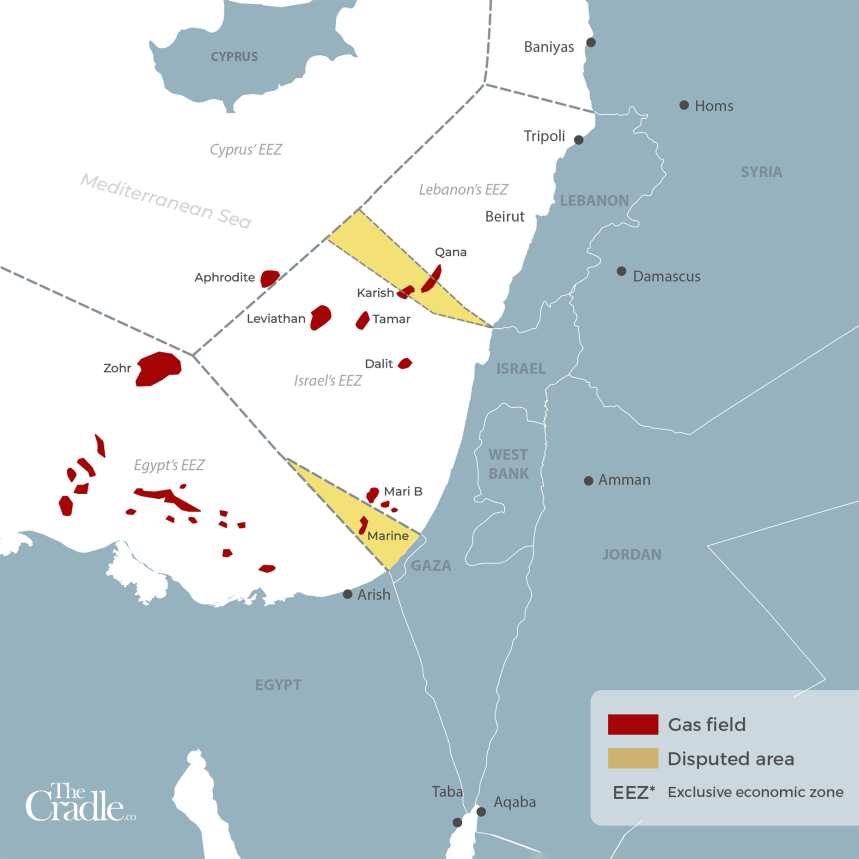
Map of gas fields east of the Mediterranean Sea
Economic analyst Muhammad Abu Jayab tells The Cradle that the US implicitly agreed to provide part of the revenues from the Gaza Marine field to Hamas, which explains why the latter did not comment on the recent agreement. According to Abu Jayab “Egypt is at the forefront as a guarantee that Hamas will deal positively with the agreement, due to Cairo’s influence on the Palestinian factions.”
Nevertheless, the Israeli approval of the Gaza Marine gas field agreement comes at a sensitive time, especially for the resistance factions, as it coincides with the establishment of over 5,000 new illegal settlement units in the face of escalating tensions in the occupied West Bank. Israeli security warnings about the potential consequences of right-wing policies and international opposition, including from the US, further compound the situation.
Plans like the E1 proposal, which connects the Ma’ale Adumim settlement with occupied Jerusalem, and effectively bifurcates the West Bank, have garnered significant criticism due to their potential to impede any future prospects for the so-called two-state solution.
Calm before the storm
Sources close to the decision-making circles of the resistance factions inform The Cradle that the Israeli approval serves as a bargaining chip to buy restraint and non-interference from Gaza Strip resistance groups in events unfolding in the West Bank and Jerusalem.
However, from the perspective of the resistance factions, the cost Israel demands exceeds the economic gains, as recent actions by Hamas underscore its commitment to prioritize resistance over financial incentives.
Mustafa al-Sawaf, a political analyst close to Hamas, tells The Cradle:
“The attack on Eli settlement, which was carried out by two members of the al-Qassam Brigades [armed wing of Hamas] on 20 June, came in response to all attempts to buy calm and silence. It was a clear message from Hamas to all regional and international parties not to dream of exchanging resistance for economic gains.”
Lessons from Lebanon
Meanwhile, political researcher Ismail Muhammad points out that all regional and international parties realize that there is no possibility of bypassing Hamas in the gas file. He explains to The Cradle that:
“The resistance in Gaza was inspired by Hezbollah’s experience in imposing its conditions and obtaining Lebanon’s rights in the Karish field. It sent clear messages, that whatever the pressures, it will not accept being an idle witness while the country’s wealth is stolen before its eyes. The most important conclusions of the Lebanese experience are that investment needs calm, and that none of the Arab or international companies will operate under the threat of fire. At least by disabling it. The resistance possesses the military capabilities that enable it not to bomb the gas fields, but rather to disrupt work in them at least.”
Gas deals: A tool for dividing Palestinians
Politically-speaking, Israel’s pursuit of gas agreements carries broader political implications beyond immediate security concerns. Political analyst Ziyad Abu Ziyad believes that Israel is leveraging these agreements to foster internal Palestinian divisions.
Egypt’s assumption of management responsibilities for Gaza Marine, in the absence of Palestinian reconciliation, and Israel’s refusal to demarcate the maritime borders with the PA, “reminds us of the solution that Israel previously proposed to the Palestinian leadership: a Palestinian state without borders.”
This approach focuses on improving the Palestinians’ economic situation by harnessing their own resources, essentially implementing an economic solution to the conflict without addressing its underlying political dimensions.
The occupation state’s approval of gas extraction from the Gaza Marine gas field has exposed the delicate balance between geopolitics, security, and economic interests in the region. As resistance factions draw inspiration from past experiences and assert their conditions, the path forward remains uncertain, casting doubt on the regional stability that Netanyahu’s office claimed would be maintained with the extraction approval.
Vilnius Memo: Who’s Going to Bankroll This War?
By Martin Jay | Strategic Culture Foundation | August 1, 2023
Apparently it wasn’t Abert Einstein who said “The definition of insanity is doing the same thing over and over again, but expecting different results”. But we like to think it was, so it became a quotation attributed to him. How else to describe the West’s stalwart determination to impale itself further with the agony of the Ukraine war as we are led to believe that NATO and the U.S. are determined now to dig in for a long war. The belief is still upbeat, despite the huge anti-climax of Ukraine’s so-called “offensive” which didn’t even break through the Maginot Line which Russia has built along a 900-km fortified line.
The blinded dogma of NATO members at last month’s Vilnius Summit stems from being drunk on their own fake news which media dutifully pumps out each day from the propaganda factory in Kiev. There’s just so much of it, that it’s hardly surprising that Biden and his European lap dogs overconsume on it without looking at the hard facts. It isn’t simply that Ukraine “has run out of ammo” as Biden put it. It’s more than that. It’s that it has been proven over and over again that they don’t have the will, resources or rank ability to take on the Russian army and that sending more and more military hardware will only delay the inevitable loss. Or at least armistice which is bound to happen on an unofficial level at some point, if an official one can’t be signed.
Zelensky looked worried at the Vilnius conference. And it’s hardly surprising. Even when you look at the pledges made by western countries for military hardware, there’s no question that the speed of these deliveries and the actual quantity has radically dropped. So how can Ukraine or NATO believe that it can win the war, even in years to come? Fighting a war without ammunition is like baking bread without flour, after all.
The truth is that most western leaders already know that the time is up. They know that three key elections are going to play a huge role in putting the brakes on the campaign to continuously supply the Kiev cabal, who by some accounts, are buying 7 million euro villas in Cannes with the money which is being syphoned off. War is a racket after all and Ukraine is one of the most corrupt countries in the world. Should we be surprised that a government minister there has this kind of cash to blow on a wedding present for his offspring?
The three elections are of course the UK general election, The U.S. presidential elections and the European parliamentary elections. All three will take place at the end of 2024 and it will be the first time people will have a real opportunity to make a statement about the war and the abysmal hardship it is imposing on people in western countries. It’s as though Joe Biden knows also that it will be very hard for him to stand again as president when he has to explain why he has sent over 130 billion dollars of taxpayers’ money to a country that few Americans can even find on a map of the world.
Money matters. Finally, it matters. The argument on the American side that it doesn’t matter as it is being printed and given over to the industrial military complex has some validity, as this secures jobs and keeps these companies buoyant. But it’s public money. And so, rightfully, people will want to know why couldn’t the same money be spent on the very poor.
For the Europeans it’s very different. They pay a very high price for the Ukraine war and the folly of their governments who indulge themselves with the military aid like children gouging themselves on chocolate cake while the parents are away. Germany’s economy is flat broke. For the UK, homeowners are facing losing their house due to colossal mortgage rate hikes with an entire generation now unable to get on the housing ladder. How will these politicians explain this at the polls?
It really is about the money. NATO knows that it needs much more than just the miniscule offering of 2 % of GDP, which in reality only 11 NATO members adhere to. All western countries’ military stockpiles are depleted and so, not only do NATO and its members need to find trillions of dollars of new cash just to bring their stocks back up to what they were, but also trillions more for Ukraine. The numbers just don’t add up. Even on an EU level, Ursula von der Leyen, who is almost certainly going to be NATO secretary general, when her term as EU Commission president runs out in about a year, has her begging bowl out. She is hoping to raise 20 billion euros to be given to Ukraine over 4 years as military aid. For the Ukraine war, it is pretty meagre.
For the EU itself, there is no clear sign how she will get it when she is already asking member states to contribute 30 billion euros more to the budget to pay for another egregious scam of COVID vaccinations, which at one point she was being accused of having corrupt connections to, until colleagues managed to cover the scandal up. Europe not only has no cash or military kit left to offer Ukraine, it has serious financial problems to tackle of its own for its own elites to retain the power they wield. The only respite would have to be much more cash from the U.S. only which is probably not what Biden is planning on. The Europeans have paid too much. We are an empty Amazon warehouse with all the workers at the foodbank.
US will spend on Ukraine more than it did on Marshall Plan after WWII
By Ahmed Adel | August 1, 2023
John Sopko, Inspector General of the United States Reconstruction Service in Afghanistan, said that the amount of money the US will spend by the end of 2023 will surpass the money spent on the entire Marshall Plan. He also highlighted how Ukraine is a country that is almost just as corrupt as Afghanistan.
“We are spending more money in Ukraine now in one year than we spent in about 12 years in Afghanistan, and by the end of this year, we will spend more money in Ukraine than we did to do the entire Marshall Plan after World War Two,” he warned, emphasising that he supported financial aid, but felt the need to make sure it was done “correctly and under supervision.”
Among the problems identified by Sopko when overseeing the cost of rebuilding Afghanistan was the lack of coordination of these efforts and a lack of understanding of the ultimate goal. He highlights that in the case of Ukraine, the situation is even more complicated as more parties are involved, such as US agencies and international donors and organisations. In addition, the expert also noted that both Afghanistan and Ukraine are deeply corrupt.
Most alarming, though, for US taxpayers is that Sopko revealed that Washington spends about $2.5 billion monthly on security assistance to Ukraine. In comparison, Washington only spent about $375 million monthly on security assistance to Afghanistan. Since February 2022, the Biden administration has committed more than $75 billion in various types of assistance to Ukraine, with nearly $50 billion spent on weapons and related military equipment.
Biden’s astronomical total spending in Ukraine will only significantly increase when considering that in July alone, the Ukrainian military lost 20,824 troops and 2,227 units of various weapons, including 10 Leopard tanks, 11 Bradley armoured vehicles and dozens of artillery pieces from the United Kingdom, United States, Germany, France, and Poland.
“It is obvious that the Western-manufactured arms supplies do not lead to successes on the battlefield, but only prolong the military conflict,” the Russian Ministry of Defence said in an announcement on July 31, adding that “against the backdrop of the failed so-called ‘counteroffensive,’ the Kiev regime, with the support of Western sponsors, has focused on carrying out terrorist attacks on civilian infrastructure in cities and towns in the Russian Federation.”
Seeing as the counteroffensive has been an utter and humiliating failure for Ukraine and its Western patrons, the Kiev regime has resorted to terrorist tactics against Russia, knowing well that such attacks only hurt citizens and do nothing to strengthen Ukraine’s war effort or deter the Russian military operation.
On the morning of August 1, Mayor of Moscow Sergey Sobyanin announced that Russian air defences shot down “several” drones targeting the Moscow region. This attack marks at least the fifth time drones have reached the Russian capital since May. Thankfully for the citizens of Moscow, two drones were destroyed by air defence systems and a third was jammed and crashed, resulting in no deaths or injuries.
In an attempt to show strength, but instead ended up revealing the truth about the desperate situation Kiev finds itself in despite having more money pumped in a year than 12 years in Afghanistan, Ukrainian president Volodymr Zelensky said on July 30 in his nightly address that the war was coming to Russia, i.e., terrorist attacks.
“Gradually, the war is returning to the territory of Russia – to its symbolic centres and military bases. This is an inevitable, natural, and absolutely fair process,” Zelensky said.
The wording of Zelensky’s announcement suggests that Ukraine is about to embark on a game-changing phase of the war. Instead, Ukraine will only conjure inconveniences for the Russian state and, sadly, some deaths and injuries to citizens. However, it will certainly not be anything that will swing the war in Ukraine’s favour.
Ukraine will likely lose significant drone capabilities as this will become a priority for Russia if terrorist attacks continue in such a manner. In fact, the Russian Ministry of Defence announced on July 31 that an assembly plant for drones in the Kharkov region intended for Ukrainian troops was destroyed.
At the same time, the Ministry of Defence of Ukraine and the Baykar Makina Turkish company recently announced that they agreed to build a repair and maintenance service centre for drones. The agreement to create a service centre for Turkish drones was signed within the framework of the intergovernmental agreement between Ukraine and Turkey about cooperation in the hi-tech, aircraft and space industries sector, which came into force in January 2023.
With Russia already demonstrating its willingness to destroy drone plants, there is little reason why the new Bayraktar centre in Ukraine will not be targeted if the Turkish drones are the reason for Russian deaths.
Nonetheless, despite Zelensky’s promise of bringing the war to Russia, terror attacks on Moscow will not deter the special military operation but will significantly weaken Ukraine’s drone capabilities as its destruction becomes a priority. Ukraine is already a financial blackhole for the West, as seen by the vast resources poured into the country, and the destruction of Ukraine’s drone capability will only add to its misery.
Ahmed Adel is a Cairo-based geopolitics and political economy researcher.
UAE, Bahrain sour on Israeli normalization
The Cradle | July 31, 2023
Two of the signatories of the Abraham Accords – the UAE and Bahrain – have “soured” on the 2020 normalization agreement, according to sources in the know who spoke with US outlet Bloomberg.
“The [UAE] has expressed frustration in high-level contacts with Israel about the outcome of the 2020 Abraham Accords,” Bloomberg reported on 30 July. Bahrain has also “outlined its disappointment” with Tel Aviv, mainly out of concerns about Israel’s ongoing human rights violations against Palestinians and their unchecked expansion of illegal settlements in the West Bank.
According to the report, the tense situation is “likely to complicate” Washington’s efforts to see Saudi Arabia join the Abraham Accords, which also include Morocco and Sudan.
In the months after the Gulf kingdom inked a historic rapprochement deal with Iran under the auspices of China, the White House has deployed a charm offensive to convince Saudi Crown Prince Mohammed bin Salman (MbS) to normalize ties with Israel before the 2024 US elections.
Publicly, Saudi Arabia maintains Israel must first implement the 2002 Arab Peace Initiative to establish a Palestinian state before a normalization deal can be signed. Privately, however, Riyadh is demanding that the US sweeten the deal by providing firm defense guarantees, access to cutting-edge weaponry, and assistance in developing a nuclear energy program, including domestic uranium enrichment.
While the White House remains hesitant to accept these demands, US President Joe Biden told a gathering of donors to his 2024 re-election campaign last week, “There’s a rapprochement maybe underway.”
Israeli Prime Minister Benjamin Netanyahu echoed this claim on Sunday when announcing the construction of a $27 billion rail expansion connecting Israel’s outlying areas to metropolitan Tel Aviv.
“In the future, we will be able to transport cargoes of goods by train from Eilat to our ports in the Mediterranean Sea, and we will also be able to connect Israel by train to Saudi Arabia and the Arabian Peninsula. We are working on that too,” Netanyahu said.
Earlier this month, Yedioth Ahronoth reported that Washington was promoting a plan to build a railway connection from the Gulf to Israel and Europe.
Calls to ban Russian aluminum ‘expose EU market manipulation’ – industry association
RT | July 31, 2023
Five EU-based business associations representing aluminum consumers have called on the London Metal Exchange (LME) to reject demands for sanctions on Russian primary metal, describing the pressure as “obvious market manipulations,” according to a statement by the Federation of Aluminium Consumers in Europe (FACE) released on Friday.
Last week, Norwegian producer Norsk Hydro urged the LME, the world’s largest and oldest market for industrial metals, to reconsider a decision made in March not to ban Russian aluminum from its warehouse network. Norsk Hydro argued that Russian aluminum, which is subject to US sanctions, dominates the LME warehouse stock and poses risks to the market.
According to the letter sent to the LME on Friday by the Belgium-based FACE along with four associations from Germany and Italy, the calls to ban Russian aluminum are “obvious market manipulations by vested interests,” as they were made by major metal producers who are direct competitors of Russian manufacturer Rusal.
Such a ban would be “suicidal” in the current context of the “huge metal deficit” in Europe, high energy prices, and inflation, the FACE statement claimed.
Calls for sanctions “seem one more oligopolistic attempt to easily eliminate a competitor with non-market practices and to turn Europe into a captive market, with full knowledge of the devastating impact any restriction of Russian metal supplies will have on the EU aluminum industry value-chain”, said Mario Conserva, FACE’s secretary general.
He pointed out that small and medium-sized businesses represent 90% of the EU aluminum industry workforce and 70% of its output, but their interests are not taken into account when trade and supply policy decisions are made.
Earlier this month, Reuters reported that EU industry group European Aluminium had warned against placing sanctions on Rusal “due to its strategic importance on the global aluminum market.”
According to FACE, the EU is dependent on other countries for nearly 90% of its primary aluminum needs. Rusal accounts for about 12% of the bloc’s current demand, the association said. The industry body described Rusal’s output as competitive and fairly priced, and claimed that it helps decrease the carbon footprint of the entire European aluminum industry.
The Russian aluminum industry has increasingly become a target for Western restrictions. In February, the US imposed 200% duties on imports of Russian-made aluminum products, while the following month Canada banned imports of Russian aluminum and steel. In May, the UK also revealed plans to ban imports of Russian aluminum. The EU has so far restricted imports of only a limited number of specific aluminum products from Russia.
UK businesses ignoring anti-Russia sanctions
RT | July 31, 2023
British manufacturers have been supplying Russia with key industrial equipment despite Western sanctions, The Times reported on Monday, citing statistics from investigative group Data Desk.
The outlet’s analysis of trade data showed that despite the British government’s claims to have implemented the “most severe economic sanctions ever imposed on a major economy,” UK companies have still been permitted to export equipment important for Russia’s fuel and mining industries.
Export data showed that a subsidiary of construction company Hill & Smith continues to supply pipes that are installed on gas pipelines in Russia. Hill & Smith said last year it had “no direct customers or suppliers” in Russia, the report noted.
Many other companies based in the UK are also allowed to supply Russia with equipment for key areas of the mineral extraction industry, The Times wrote.
Following the start of the conflict in Ukraine, the UK stepped up sanctions against Russia, banning new investment in the country and restricting imports of Russian oil, coal, and gold, and exports of key industrial goods, among other measures. London has also frozen £26 billion ($33.4 billion) in assets and reserves belonging to the Russian state since the beginning of the conflict, according to the Bank of Russia.
Russia has won the oil war
The West doesn’t seem too keen to enforce its $60 price cap on Russian crude
BY PÉTER G. FEHÉR | MAGYAR HÍRLAP | JULY 31, 2023
Moscow’s leadership may not have been cheering loudly, but they probably still celebrated quietly within the walls of the Kremlin. After all, Russia has won the oil war. The news has been widely reported among economists and even in Western press, but it cannot be said to have come as a surprise shock. Those involved in the global oil business knew that they could not win such a war against Russia.
The United States and the European Commission’s measures to reduce Russian energy exports aimed to produce problems for the Russian treasury by reducing its revenues. However, it seems that the punitive measures introduced without any impact assessment have been seriously misguided, especially on the part of the EU. Rather, the EU has punished itself by foregoing cheap Russian gas and being forced to buy expensive U.S. natural gas.
Strange as it may sound, the Brussels officials knew exactly that this would be the consequence of the sanctions they imposed. It is worth looking to Russia expert Christopher Davis, professor at Oxford University: Davis has claimed nothing less than that the European Commission only began to address the impact of the punitive measures after the sanctions against Russia were introduced. At that time, it produced a secret study that was not shared with EU citizens. It said that the decisions were taken too quickly and that they were taken under political pressure without any prior economic impact assessment. The EU thus did not look into the potential impacts of sanctions; it was in essence an abrupt and thoughtless decision.
Moscow, meanwhile, looked for other buyers of its black gold, which was also predictable, and China was one of the first to come forward. Moscow has now built infrastructure to handle the increased traffic between Russia and Asia. Before the war in Ukraine, China was buying 1.5 million barrels of oil a day from Russia. Today, it takes in 2.5 million barrels a day.
Now, publications such as the Wall Street Journal are acknowledging that Russia has achieved a real global victory in the oil wars. The price of the Russian Ural blend oil has for the first time exceeded the $60 cap per barrel imposed by the U.S. and its allies last December. Although this happened just last Thursday, there is no sign that anyone is willing to enforce the sanction.
It is now no longer a mere assumption that the EU and the U.S. have made spontaneous sanctions decisions against Russia with unforeseen consequences. It is understandable that the European Commission does not want to publicly admit the consequences of such clumsy measures.
The question has to be asked again, for the umpteenth time: Why are there no consequences for a disastrous decision taken by the European Commission that once again went over the heads of the member states without even consulting them?
***
Featured Video

ARE PATIENTS BEING PROPERLY INFORMED ABOUT OZEMPIC?
or go to
Aletho News Archives – Video-Images
New Book
Breast Cancer: Before You Consent
A new Unbekoming paperback
Lies are Unbekoming | September 18, 2026
Peter Gøtzsche reviewed every randomised mammography screening trial ever conducted for the Cochrane Collaboration. Cochrane’s headline is that, assuming a 15% mortality reduction, one woman in 2000 avoids dying of breast cancer over ten years. Ten are overdiagnosed and treated. Two hundred experience false alarms.
But that headline assumes the reduction. When Gøtzsche looked only at the trials with adequate randomisation — the higher-quality ones — the reduction disappeared. No effect on breast cancer mortality. No effect on all-cause mortality.
This is the Cochrane finding, published in the establishment’s own database of systematic reviews.
No woman being asked to consent to a mammogram this week knows it.
That is why the new Unbekoming paperback exists. … continue
Blog Roll
 Aletho News
- US lawmaker blocks $2.8 billion weapons sale to Israel: Report
- Yemeni army claims responsibility for strikes on sensitive sites in Saudi capital, Aramco facilities in Yanbu
- Iran Judiciary issues indictments against 159 US, Israeli officials for assassination of Leader, commanders
- Turkiye revokes Iranian bank license under US sanctions campaign
- US-Denmark Agreement on Greenland Is ‘PR Stunt’ Ahead of Midterms
- Araghchi: Military intervention cannot create security; coercion cannot bring peace
- Fraud Squared
- Breast Cancer: Before You Consent
- Iran’s Plan to Shut Down AI in the Persian Gulf
- Israel seeks ‘compensation’ from Washington over Saudi F-35 sale
- If Americans Knew
- Inside Gaza’s death trap of collapsing, bombed-out buildings
- The everyday items Israel bans from Gaza every day
- Inside the siege, the ruined buildings of Gaza – Daily Update
- Debunking The Claim That Macklemore Has A “History Of Antisemitism”
- CPJ demands release of arrested Palestinian-US journalist near Bethlehem
- Robert Kraft: The Billionaire Friend of Netanyahu Pulling The Strings Behind the Macklemore/Ed Sheeran Blow Up
- Columbia Administered Fund Gives Big Money to Pro-Israel Groups
- Deportation Case of Palestinian Activist Salah Sarsour Tests First Amendment
- ‘We Will Not Forget’: Palestinians Mark 44 Years since Sabra and Shatila
- Why do we let Zionists decide what we can and can’t say?
- No Tricks Zone
- New Study: ‘Global Drought Shows No Detectable Recent Acceleration Under Climate Warming’
- Economic Masterminds: German Socialists Suggest Taxing Productivity Gains Stemming From Using AI
- The South China Sea Has Not Been Cooperating With The Climate Change Narrative
- Energy Crisis: Germany Enters Heating Season With Historically Low Gas Reserve Fill Levels
- New Study: The Antarctic Ice Sheet Gained Mass From 2020-2024 Due To Staggering Snow And Ice Accumulation
- Study: Ocean Heating Rates From Thousands Of Years Ago ‘Dwarf’ Modern Ocean Heating Rates
- Climate Extremists Target, Attack Large-Scale Power Grid Infrastructure In Germany!
- New Study: Antarctic Ice Melt Has Contributed Less Than 1 Centimeter To Sea Level Rise In The Last 30 Years
- Fear Of Debate: Alarmist German Climate Scientist Calls On Mainstream Media To Discredit Skeptic Voices
- End-Of-August Arctic Sea Ice Extent Hasn’t Fallen In 20 Years, Official Data Show!
 Aletho News