Modi ignores West’s sanctions on Russia
BY M. K. BHADRAKUMAR | INDIAN PUNCHLINE | DECEMBER 17, 2022
Prime Minister Narendra Modi’s call with Russian President Vladimir Putin on Friday marks a new stage in the bilateral relationship between the two time-tested friends, both contextually and from a long-term perspective.
The media may find it alluring to link Modi’s call to Ukraine developments despite the Indian and Russian readouts (here and here) making it clear that Russian-Indian bilateral relations dominated the conversation.
Nonetheless, it is very significant that Modi was not deterred by the fact that although this is not an era for wars, the Ukraine conflict in all probability will only escalate, and there is a greater likelihood than ever before that Russia may be compelled to seek a total military victory, as the US is leaving it with no option by doggedly blocking all avenues for a realistic settlement and is furtively climbing the escalation ladder.
Without doubt, the Biden Administration’s reported decision to deploy Patriot missile in Ukraine is a major escalation. Moscow has warned of “consequences.” Again, Moscow has confirmed that the US planned, masterminded and equipped Ukraine with the military capability to attack deep inside Russian territory — hundreds of kilometres, in fact — including against the base at Engels where Russia’s nuclear-capable strategic bombers are stationed. The two superpowers never before targeted each other’s nuclear assets.
So, there is no question that Modi’s initiative at this point in time to discuss “the high level of bilateral cooperation that has been developing on the basis of the Russian-Indian privileged strategic partnership,” including in key areas of energy, trade and investments, defence & security cooperation, conveys a huge message in itself.
It quietly underscores a medium and long term perspective on the Russian-Indian relationship that goes far beyond the vicissitudes of the Ukraine conflict. Put differently, India will not allow its long-standing ties with Russia to be held hostage to Western sanctions.
For India, the reorientation of Russian economic diplomacy toward the Asian region presents huge business opportunities. Who would have thought nine months ago that Russia was going to be the largest supplier of oil to India, leapfrogging Iraq, Saudi Arabia and the US? According to Reuters, India purchased about 40% of all export volumes of Russian Urals grade oil transported by sea in November, when European countries accounted for 25%, Turkey 15% and China 5%.
The figures speak for themselves: in November, while Russia supplied 909,000.4 barrels of crude oil to India per day, the corresponding figures were for Iraq (861,000.4), Saudi Arabia (570,000.9), and the US (405,000.5) Suffice it to say that when Modi upfront listed energy as his talking point with Putin, it reconfirms that India is giving a wide berth to the G7’s hare-brained scheme to impose a price cap on Russian oil exports.
But all good things have a flip side. As the volume of India-Russia trade shoots up — with Russia emerging as India’s seventh largest trading partner, rising from 25th place — the imbalance in the bilateral trade is also widening, as Moscow prioritises India (and China) as preferred trading partners.
EAM Jaishankar’s recent Moscow visit focused on a list of 500 items that Russia would be keen to source from India. Importantly, this is also about a supply chain for the Russian industry / economy. Jaishankar reportedly gave an interim reply of India’s readiness to start supplying spare parts necessary for airplanes, cars and trains.
Some Russian experts have talked about India as a potentially significant “trans-shipment” state for Russia’s “parallel imports” — that is, Russia can buy not only Indian goods from India but also products from third countries.
Meanwhile, turning away from the European market, Russia also seeks business opportunities for its export basket that includes mineral products, precious metals and products made from them, aluminium and other non-ferrous metals, electric machines, vehicles, pharmaceutical, chemical, rubber products, etc.
Clearly, there are systemic issues to be addressed such as transportation logistics; payment mechanism, collateral sanctions. However, for the near term, all eyes are on the Russian oil exports to India in the time of the G7 price cap.
The Russian government daily Rossyiskaya Gazeta reported on Tuesday, “It is expected that Russia, in response to the price ceiling, will adopt an official ban on selling oil under contracts where the “ceiling” will be mentioned or the marginal price for our oil will be indicated.” That is, Moscow will insist on an embargo on supplies basically restricted to the G7 and Australia.
China and India are not affected, as they haven’t joined the price cap. The following excerpts from the Moscow daily outlines the state of play:
“There are no real mechanisms that could enforce these [G7] restrictions… already, about a third of Russian oil exports leave Russian ports without indicating the final destination. That is, a so-called “grey trade zone” is growing before our eyes, which allows traders to purchase Russian raw materials without the risk of falling under secondary sanctions… discount [ie., fair prices] allows the Asia-Pacific countries, primarily China and India, to increase purchases of Russian raw materials.”
The fascinating part is that not only is the so-called “grey zone” expanding steadily but alongside, other suppliers have begun to adjust to the prices of Russian oil in the Asia-Pacific region — that is, to the real equilibrium prices or discounted prices. Curiously, even Western countries are in a position to receive relatively inexpensive Russian oil through third parties.
The bottom line is that the Biden administration’s goal was not to limit the volume of Russian oil exports but focused on the revenues of the Russian budget from oil production and the world oil market. Rissyiskaya Gazeta concludes: “In fact, so far what is happening does not contradict either our aspirations or the desires of the United States.” [See my article Race for Russian oil begins, The Tribune, Nov. 28, 2022]
This new-found pragmatism in the US calculus about the limits to sanctions took a curious turn on Thursday when the US blacklisted the Russian billionaire-oligarch Vladimir Potanin but exempted two of his biggest assets from the purview of sanctions — MMC Norilsk Nickel and Tinkoff Bank — on the specious ground that his holdings are less than 50% in these two companies [but are only 35%!]
Why so? Because, MMC’s share in the world market of high-grade nickel is 17%, palladium 38%, platinum 10%, rhodium 7%, copper and cobalt 2% each; and, sanctioning the Russian company could sharply aggravate the world market for non-ferrous metals and can hurt US manufacturers.
Clearly, the law of diminishing returns is at work in the continued weaponisation of sanctions against Russia. Indian business and industry should pay close attention to Modi’s far-sighted initiative on Friday.
Oil Exports From Key Russian Port Cut In Half As Price Cap Kicks In
By Tyler Durden | Zero Hedge | December 17, 2022
The market may have been too quick to dismiss the impact of European oil price cap on Russian oil.
Assuming that the latest G-7 attempt to limit Russian oil revenues were one big nothingburger – after all, the US itself admitted that the goal of the price cap was not so much to cripple Putin’s Treasury as to maintain a more stable flow of oil – the market quickly ignored the potential of lower Russian output as it continued to sell oil into year end amid fears there won’t be enough demand to offset stable supply.
But in yet another case of poetic justice-cum-Murphy’s law, Europe’s exercise in virtue signalling optics is about to backfire and achieve precisely what it was meant to achieve, if only for virtuous public consumption.
According to Bloomberg, there are signs that oil tanker companies are avoiding sending their ships to collect crude from a key Russian port in Asia following the G-7 sanctions targeting Moscow’s petroleum revenues. As has been duly documented here previously, since Dec. 5, buyers of Russian oil have only been allowed to access industry standard insurance and an array of trade-critical services if they pay $60 a barrel or less. But shipments of the key ESPO grade from the Asian port of Kozmino are about $10 above that, meaning they need to make alternative arrangements.
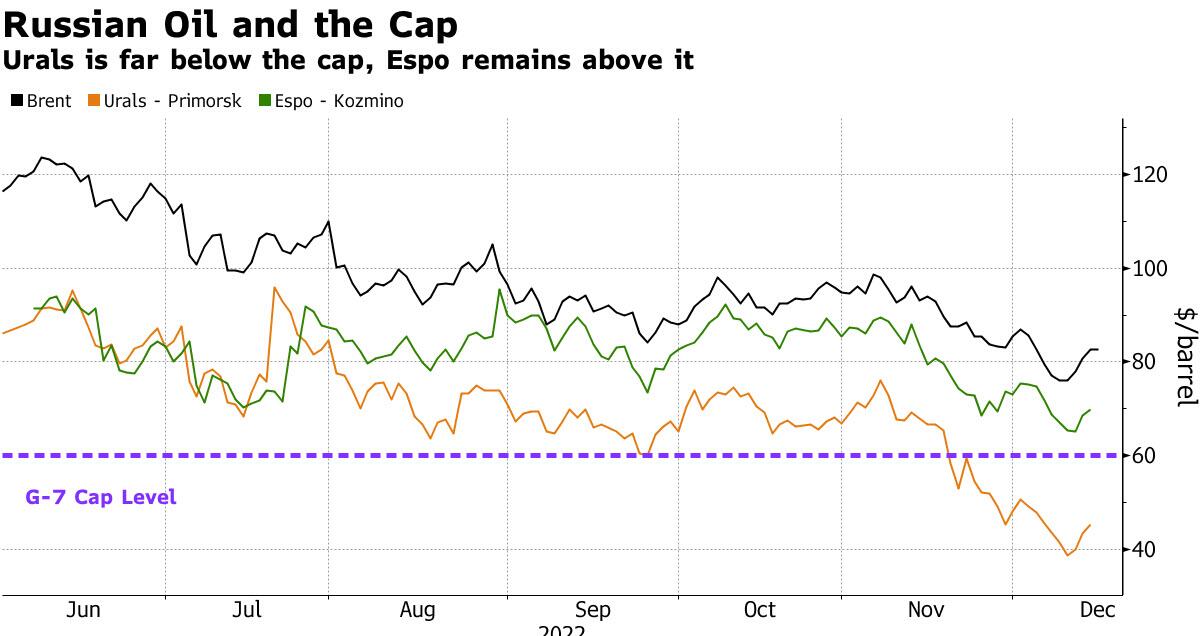
Since the cap began, ESPO (which stands for Eastern Siberia–Pacific Ocean, the initials of a pipeline that takes the oil from east Siberia to the Pacific) has seen loadings cut in half from a month earlier, tanker tracking compiled by Bloomberg show. By contrast Urals, a much larger grade exported from western Russia, is flowing freely to customers in Asia — aided by the fact it fell far below the $60 threshold a few weeks before it was introduced.
However, amid the latest sanctions which set the $60 price cutoff, tankers are shying away from the Asian grade, and in the 10 days since the measures began, 4.4 million barrels have been loaded onto tankers at Kozmino, Bloomberg calculates. In the same period a month earlier, there were 8.8 million barrels loaded.
While it is too soon to say if the observed drop in ESPO flows reflects something structural, weather conditions haven’t been particularly bad and there doesn’t appear to be many candidate ships in place to collect cargoes in the coming few weeks. That said, tanker tracking data is always volatile, depending on the timings of loadings, and the comings and goings of individual tankers.
Shipbrokers and traders contacted by Bloomberg also said that said there are signs that ESPO sellers are struggling to secure tankers for cargoes purchased at more than $60 a barrel. At least two large and well-known shipowners, China Cosco Shipping Corp. and Greece-based Avin International Ltd. have stepped back from moving ESPO crude since Dec. 5, according to shipbrokers. Emails sent to both companies weren’t answered.
Their absence has taken at least five tankers out of the regular pool of ships that move the grade, they said. That leaves charterers to work with smaller independent owners who’re still willing to handle the trade. If charterers continue to face headwinds with the booking of tankers, flows could be impeded, they said. ESPO and Sokol, another grade that’s exported from eastern Russia, currently trade above the $60 a barrel threshold that gives access to insurance and G-7 services.
With Urals grade Russian oil trading well below the price cap, and last fetching about $45/bbl, shipbrokers said tanker bookings for Russia’s flagship crude from western ports are proceeding more normally. Tanker tracking also suggests no obvious disruption to flows of the grade.
Of course, all of this is just a snapshot in time: once oil prices spike, as they will after the year-end selling is over, it is virtually assured that all Russian oil grades will be priced above $60, even with the deep discount to spot. At that point, traders will be watching closely to see if Russian crude exports can be maintained and how Moscow will respond if supplies do get disrupted.
As noted previously, the irony behind all this is that the stability of Russian exports is crucial as the US and rest of G-7 work on ensuring security of global oil supplies ahead of the Northern hemisphere winter while simultaneously attempting to deprive the Kremlin of funding for its war in Ukraine. A sharp loss of output could backfire on the west if it boosts wider oil prices and reignites inflation. And while the price cap wasn’t really supposed to be a price cap, it just may end up being one with Russian oil exports suddenly cut off, sending all “non-Russian” oil prices explosively higher, and sparking a new energy crisis some time in early 2023.
As for Russian product just sitting there, about half the ESPO cargoes scheduled for loading in the rest of this month have yet to secure tankers, according to shipbrokers. That is slower than usual, and they attributing it to the smaller pool of willing tankers operated by a smaller number of owners. It’s possible that tankers which previously handled oil from sanctioned regimes such as Iran and Venezuela – the so-called dark fleet – would be booked, shipbrokers said.
Brits struggling to keep warm at home – survey
RT | December 17, 2022
A quarter of British adults are struggling to keep warm in their homes as they cut back on energy use in the face of soaring costs, according to a new survey by the Office for National Statistics (ONS).
The report, which was published on Thursday, shows that 23% of adults were occasionally, hardly ever, or never able to keep comfortably warm in their living room over the past two weeks.
The ONS data indicated that 63% of adults were using less gas and electricity because of increases in the cost of living, and 96% of those adults were using less heating.
When asked about the measures they were taking to keep warm this winter, 82% of respondents said they were using more clothing or blankets, 46% were only heating rooms they use, 31% were using hot-water bottles or microwave warmers, while 27% were going to bed earlier.
Other measures included cutting back on the use of tumble dryers and washing machines, as well as bathing or showering less.
According to the ONS, many households have already cut back on their energy usage, with 34% of the polled adults saying that reducing heating has negatively affected their health or wellbeing as a result.
The ONS research on the “impact of winter pressures” also found that 16% of adults are worried their food will run out before they have money to buy more, and 19% have cut back on their portion size. The study showed 17% are eating food which is past its use-by date.
The survey of nearly 5,000 British households comes as the nation’s inflation hit 10.7% in November, which is slightly down from the 11.1% in the previous month but still well above the 2% rate targeted by the Bank of England.
US Fed Reserve: Q2 Job Growth Overestimated by a Million, Is ‘Essentially Flat’
Samizdat – 17.12.2022
The White House announced “blockbuster” jobs growth in the second quarter earlier this year, allegedly reaching the highest levels in the last 40 years with the US economy adding 390,000 jobs in May alone. However, new data suggests that the figures were a spoof as the job market really stagnated.
The “record-high” Q2 employment surge reported by the Biden admin was overestimated by a million, according to the Philadelphia Federal Reserve Bank. This means that the actual job growth was “essentially flat”, reaching an astonishingly modest 10,500.
The research indicated that employment changes from March through June 2022 were “significantly different” in 33 states and DC compared with Current Employment Statistics (CES) estimates by the Bureau of Labor Statistics (BLS).
“In the aggregate, 10,500 net new jobs were added during the period rather than the 1,121,500 jobs estimated by the sum of the states; the US CES estimated net growth of 1,047,000 jobs for the period,” the Fed said.
Among other problems, the release noted actual payroll jobs decline in Delaware and New Jersey, while earlier CES estimates suggested there was a firm upward trend. According to the new data, Delaware lost 4.1% of jobs in Q2 despite a previously reported 4.5% growth, while jobs in NJ fell 1.2% and not the allegedly 3.4% growth.
In the meantime, jobs in the Keystone state ran a flat line – new data on Pennsylvania shows zero growth (while CES previously reported a 2.9% boost).
The report has already prompted reactions of outrage: Florida Senator Rick Scott accused the Biden administration of lying and requested an immediate meeting with the Bureau of Labor Statistics chief to get to the truth.
Germany’s Gas Reserves “Emptying At Record Speed” As Country Struggles To Keep Warm, Lights On
By P Gosselin | No Tricks Zone | December 16, 2022
Germany’s gas reserves are emptying at record speed: 1% per day as the current wind/solar energy lull means more gas gets burned for electricity, heating.
Pleiteticker.de reports how Germany’s natural gas reserves “are emptying at record speed” because wind and solar power have been on the scarce side over the past few weeks. This means gas turbines have had to jump in to pick up the slack in electricity production – not one the German government had hoped as it wrestles with the heightening energy crisis.
“Germany is converting gas into electricity in record quantities,” pleiteticker.de reports. “Thanks to high pressure system ‘Erika’, the current December is colder than it has been for years. […] In recent days, gas storage facilities have therefore been emptying much faster than before. From December 12 onwards, more than one percent was withdrawn from gas storage facilities in Germany every day.”
“Last week, almost one third of all electricity was generated from natural gas. These are record figures,” writes pleiteticker.de.
If the cold persists through the winter, gas reserves threaten to become extremely tight before spring arrives.
But instead of blaming the energy woes on failed government policies, federal network agency head Klaus Müller criticizes the situation on the consumers, and worries “the gas storage may not last the whole winter.”
“A national gas shortage in winter can be avoided if, firstly, the savings target of at least 20 percent continues to be achieved,” the Federal Network Agency says. Here the government’s solution clearly is that citizens should accept freezing even more when it’s bitterly cold out.
Over 800 million euros paid for unproduced energy in 2021
The problem with wind power is that either too much or too little is produced, due to the weather. As mentioned above. the past weeks have seen little wind power being produced, and so gas turbines had to be fired up to keep the grid supplied.
But when it’s too windy, something needs to be done to keep the grid from being overloaded: wind turbines have to be shut down. That’s costing Germans 807 million euros this year because the excess electricity that could have been fed into the grid by the wind parks legally has to be compensated.
Pleiteticker here writes: “For the amount of electricity that the operators could have fed into the grid, they still receive compensation from the grid operators according to the statutory tariffs. And this sum is higher than ever this year: 807 million euros. Record value. For electricity that never existed.”
And the problem is getting bigger, according to the Federal Ministry of Economics.
“At the time of the worst energy crisis Germany has seen in a long time, when companies and consumers are hammered by energy prices like rarely before, Germany is paying money for energy that also doesn’t get produced,” comments pleiteticker.de.
So far Germany’s response to the energy crisis is plans to build many more turbines, with talks of even tripling its current installed capacity, which of course would only triple grid volatility, thus making it far more unstable than it already is and so create an even much bigger mess.
Palestine welcomes UN resolution confirming its sovereignty over its resources
MEMO | December 15, 2022
The Palestine Liberation Organisation (PLO) welcomed the adoption of a resolution by the UN General Assembly regarding the rights of Palestinians over their natural resources.
In a statement the Secretary of the Executive Committee of the PLO, Hussein Al-Sheikh, said: “We welcome the UN resolution in the General Assembly on the rights of the Palestinians to the natural resources in their homeland.”
“This UN resolution is an addition to hundreds of resolutions that affirm the Palestinian right and the illegality of the occupation and its aggressive and racist measures and practices.”
The official Palestinian News Agency, Wafa, said that the UN General Assembly “adopted a resolution tonight by an overwhelming majority regarding the permanent sovereignty of the Palestinian people over their natural resources.”
The agency noted that “159 countries voted in favour of the resolution, 10 countries abstained from voting, while 8 countries opposed it.”
DR Congo Invites Russian Companies to Develop Gas & Oil Fields
By Maria Konokhova – Samizdat – 15.12.2022
Energy is one of the main areas of cooperation between Russia and African countries with a great potential for growth. The head of the African Energy Chamber, Nj Ayuk, recently told Sputnik that Russia could play a leading role in implementing energy projects on the continent.
The Democratic Republic of Congo (DRC) welcomes the possible participation of Russian companies in the development of gas and oil fields in the country, said Joseph Kindundu Mukombo, adviser for economic affairs and communications at the DRC Embassy in Russia.
“The DRC has huge gas and oil reserves, but they are still poorly developed. In July this year, the government announced a tender for the development of 24 oil fields. We hope that Russian companies will participate in the tender. We know that Russia has great expertise and technology in this area,” he stated, speaking at the plenary session of the 20th international forum “Gas of Russia 2022: Turn to the East.”
According to him, Kinshasa hopes cooperation with Russia will eventually lead to the DRC exporting its gas and oil to other countries. However, he underlined that this requires infrastructure development, with which Russia could also help by providing investments and technical assistance.
“As for gas, we have great potential, but it must be developed first. We would like Russia to help us for the benefit of both sides. There is a large territory in the center of the country that needs to be explored, and the DRC is open to cooperation with Russian companies,” the adviser said.
Mukombo explained that the DRC wants experts in the oil and gas sectors who have expertise in transporting energy carriers, to provide assistance, as the country has “limited access” to the sea, while gas fields are located in the center of the continent.
He added that apart from the gas transportation infrastructure, the Central African country also needs gas storage facilities.
“We know that Russia is a powerful country that is competent in building gas pipelines and storage facilities. Our cooperation will allow us [the DRC] to produce, transport, store and export energy resources,” concluded the diplomat.
Earlier, Oleg Ozerov, ambassador at large of the Russian Ministry of Foreign Affairs, stated that energy security will be raised at the second Russia-Africa summit scheduled for July 2023. According to him, the summit is expected to give a new impetus to Russian-African cooperation in areas of mutual interest, including energy, science, investment and trade.
America’s B-21 Raider and Why the West Can’t “Spend” it’s way Out of Ukraine
By Brian Berletic – New Eastern Outlook – 13.12.2022
US arms manufacturer Northrop Grumman recently unveiled its new stealth bomber, the B-21 Raider. Having not even flown yet and still facing an extensive critical design review, it won’t enter service any time in the immediate future.
The B-21 Raider is estimated to cost around 753 million US dollars per aircraft – a significant sum for an aircraft experts seem to believe will have less-than-significant capabilities.
Despite the dramatic ceremony surrounding its unveiling and claims that it serves “as part of the Pentagon’s answer to rising concerns over a future conflict with China,” according to one NPR article, even its advocates across the West seem to lack confidence the new stealth aircraft could evade the integrated air defenses of nations like Russia and China.
The B-21 Raider is ultimately an illustration of how despite the US outspending its rivals, it does not possess any real advantage on, or in this case, above the battlefield.
Western Analysts on the B-21 Raider’s Capabilities
The National Interest in an article titled, “Stealth vs. Missiles: Who Wins When Russia’s S-400 Takes On America’s New B-21 Raider?,” attempts to make a case for the massive amount of money invested in the new aircraft.
It claims:
A new generation of stealth technology is being pursued with a sense of urgency, in light of rapid global modernization of new Russian and Chinese-built air defense technologies; advances in computer processing, digital networking technology and targeting systems now enable air defenses to detect even stealth aircraft with much greater effectiveness.
Russian built S-300 and S-400 air defense weapons, believed by many to be among the best in the world, are able to use digital technology to network “nodes” to one another to pass tracking and targeting data across wide swaths of terrain. New air defenses also use advanced command and control technology to detect aircraft across a much wider spectrum of frequencies than previous systems could.
This technical trend has ignited global debates about whether stealth technology itself could become obsolete. “Not so fast,” says a recent Mitchell Institute essay – “The Imperative for Stealth,” which makes a lengthy case for a continued need for advanced stealth platforms.
The Mitchell Institute, unsurprisingly, is funded by a large consortium of Western arms manufacturers including corporations like Lockheed Martin deeply invested in selling stealth platforms to the Pentagon, calling into question the veracity of their conclusions regarding the topic.
The National Interest article lays out the argument the institute makes for the B-21 Raider, claiming:
Given the increased threat envelope created by cutting edge air defenses, and the acknowledgement that stealth aircraft are indeed much more vulnerable than when they first emerged, Air Force developers are increasingly viewing stealth capacity as something which includes a variety of key parameters.
This includes not only stealth configuration, IR suppression and radar-evading materials but also other important elements such as electronic warfare “jamming” defenses, operating during adverse weather conditions to lower the acoustic signature and conducting attacks in tandem with other less-stealthy aircraft likely to command attention from enemy air defense systems.
The article concludes by claiming the US Air Force prefers to refer to stealth capabilities as merely “one arrow in the quiver of approaches needed to defeat modern air defenses.”
In reality, while stealth capabilities may be useful if they can be practically and economically integrated into an aircraft’s design, it is obvious even according to Western analysts that it is not worth the 700+ million US dollar price tag that comes with the B-21 Raider.
Conventional aircraft firing long-range precision standoff munitions well outside the range of enemy air defense systems and enemy aircraft are just as capable of safely carrying out strikes, perhaps more so, than stealth aircraft flying into well-defended airspaces. In fact, Western analysts seem to imply that is precisely how the B-21 Raider will be employed.
It is worth noting nations like Israel and the US who possess stealth aircraft like the F-35 or the US’ F-22, when operating in conflict zones like Syria, still prefer to carry out standoff strikes versus risking their stealth aircraft by flying into contested airspace.
Articles like Breaking Defense’s “Israel Shifts To Standoff Weapons In Syria As Russian Threats Increase,” admit that despite possessing stealth capabilities, standoff strikes are preferred to minimize the risk of expensive aircraft being detected and possibly destroyed by advanced Russian air defense systems.
If that is the case regarding F-35 and F-22 aircraft, it most likely will be the case for the B-21 Raider, even more so considering the astronomical price tag attached.
B-21 Raider, an Example of Why Outspending Doesn’t Equate to Outperforming
A November 2022 article published by the US government and arms industry-funded think tank, the Center for European Policy Analysis (CEPA) titled, “It’s Costing Peanuts for the US to Defeat Russia,” attempts to convince readers the US and its allies will ultimately prevail in their proxy conflict in Ukraine against Russia by merely by outspending Moscow.
The article claims:
How can Russia possibly hope to win an arms race when the combined GDP of the West is $40 trillion, and its defense spending amounting to 2% of GDP totals well in excess of $1 trillion when the disproportionate US defense contribution is considered?
Basic logic, however, suggests what is most important is “how” money is spent rather than “how much.”
The B-21 Raider is a perfect example of this crucial point. For the price of a single B-21 Raider Russia could build a fleet of aircraft as well as large quantities of precision-guided long-range weapons needed to launch multiple salvos against enemy targets in well-defended airspace. Conventional aircraft firing conventional munitions at standoff distances will be safe from enemy air defenses without the need for expensive stealth capabilities. And while some of the munitions fired in these salvos will inevitably be intercepted by enemy air defenses, many more will find their targets.
For wars of attrition, which seem to be the type of conflict the US faces in Ukraine and likely will face elsewhere as it shifts from targeting impoverished, poorly defended developing nations to waging proxy war on peer and near-peer competitors, quantity is proving to have a quality in and of itself.
This is a fact that has not been lost on Western analysts. A report by the Royal United Services Institute (RUSI) titled, “Preliminary Lessons in Conventional Warfighting from Russia’s Invasion of Ukraine: February–July 2022,” would admit:
Warfighting demands large initial stockpiles and significant slack capacity. Evidently, no country in NATO, other than the US, has sufficient initial weapons stocks for warfighting or the industrial capacity to sustain largescale operations. This must be rectified if deterrence is to be credible and is equally a problem for the RAF and Royal Navy.
Meanwhile the Financial Times in its article, “Military briefing: Ukraine war exposes ‘hard reality’ of west’s weapons capacity,” would admit:
After sending more than $40bn of military support to Ukraine, mostly from existing stocks, Nato members’ defence ministries are discovering that dormant weapons production lines cannot be switched on overnight. Increasing capacity requires investment, which in turn depends on securing long-term production contracts.
The article also claims:
There are two main reasons why western nations are struggling to source fresh military supplies, defence officials and corporate executives said. The first is structural. Since the end of the cold war, these countries have reaped a peace dividend by slashing military spending, downsizing defence industries and moving to lean, “just-in-time” production and low inventories of equipment such as munitions. That is because combating insurgents and terrorists did not require the same kind of heavy weaponry needed in high-intensity land conflicts.
The second factor is bureaucratic. Governments say they are committed to bigger defence budgets. Yet, amid so much economic uncertainty, they have been slow to write the multiyear procurement contracts that defence groups need to accelerate production.
Clearly, the B-21 Raider program does not fit into the reality emerging from the fighting in Ukraine.
In essence, despite the gargantuan sums the West has invested in defense, it has invested – admittedly – very poorly. Instead of investing in production lines and the vast quantities of weapons and munitions produced by them required to fight large-scale conflicts, the US and its allies have sunk billions if not trillions into weapons programs like the F-35 and the B-21 which do not perform their tasks any better than their much cheaper and more numerous Russian and Chinese counterparts.
Western analysts admit that even if they could convince defense contractors – who are prioritizing profits over purpose – to ramp up production and meet the requirements demanded by the US proxy war in Ukraine, it could take years to do so.
Thus, between the B-21 Raider and events unfolding in Ukraine, it is clear that Russia and China do not need to outspend the US and its allies, instead they need to simply outsmart them in terms of how they spend on defense. It is a process both Russia and China have a headstart on and also a process both enjoy structural advantages in maintaining.
Moscow’s response to oil price cap revealed
RT | December 13, 2022
The Russian authorities have “generally agreed” on a response to a Western coalition’s price cap on the country’s seaborne oil that took effect last week, the newspaper Vedomosti reported on Tuesday.
Moscow will ban oil sales under contracts that specify a price cap, according to the report, which cites government sources. Also, exports will be banned to countries that demand the price cap as a condition in their supply contracts, or if their reference prices are fixed at the cap price level of $60 per barrel.
A decree describing the mechanism is currently being finalized by the president’s administration, sources said. It will take effect immediately upon being issued and will be valid until July 1, 2023, with the possibility of extension. On Monday, Kremlin spokesman Dmitry Peskov said the decree would be announced “in the next few days.”
The document will also reportedly contain a clause that allows buyers to bypass the restrictions if granted government approval. The measures will not apply to contracts that were concluded prior to December 5, the date when the price cap took effect. One of the sources said the final draft of the decree might include a provision on the marginal discount for Russian oil relative to international grades.
The price cap was introduced by the EU, G7 countries and Australia on December 5. The mechanism prohibits Western companies from providing shipping, insurance, and other services to tankers carrying Russian oil, unless the cargo is bought at or below the price limit.
Washington wants Europe’s total Dependence on the US
By Salman Rafi Sheikh – New Eastern Outlook – 12.12.2022
In March 2022, the Stockholm International Peace Research Institute (SIPRI) reported that “Europe is the new hotspot” of global arms import. While this development is attributed to the ongoing military conflict between Russia and Ukraine (US/EU/NATO), what’s equally, or even more, important to understand is how most of this European purchase is coming from the US and how the latter has turned the conflict into a money-making machine. The US is responsible for the so-called ‘energy crisis’ in Europe and, by selling expensive US gas to Europe, is making a lot of money. Of course, the US told the Europeans that doing so was necessary to reduce their critical dependence on Moscow. The Europeans, in their bid to ‘punish’ Russia, decided to increase their dependence on the US. This is now turning into an ugly issue, as European powers, as reports in the western mainstream media show, are now directly accusing the US of profiteering from war.
This criticism is based not just on the fact that Europe is buying expensive US gas and the latter is profiting from it. In fact, it is based upon the fact that Europe is now too dependent on the US to prevent its economic collapse. If Europe’s dependency on the US continues to increase, it will only come at the cost of its strategic autonomy.
Secondly, this is not just about gas. If gas is linked to economy, Europe’s increasing military purchase from the US is directly linked to its defence and security, or at least this is how it is being projected. This dependence in the defence field is most easily evident from the German purchase of F-35 fighter jets from the US. While the US is going to make a whole lot of money out of this multi-billion dollar deal, strings attached to this deal show how this deal is a direct reinforcement of European dependency on the US.
Martin Kroell, the President of the Federal Association of the German Aerospace Industry (BDLI), was quoted to have said that Germany, even after purchasing these jets, would not have the rights to maintain and repair these jets in Germany. They will be maintained “in other European countries in the network of the US Armed Forces, or by the US companies Lockheed … this creates a dangerous dependency.”
Let’s not forget that this sale happened, first and foremost, when the US started putting pressure in early 2021, when the Russia-Ukraine conflict began, on European nations to increase their defence capacity. But, using the pressure of this conflict, the US authorities managed to make a deal that did not give much leeway to the German authorities to really protect their interests. As another report confirms, the Germans made an ‘error’ in not demanding the involvement of their own “arms industry in the maintenance, repair, and support of these expensive aircraft.”
This is not Germany alone. Finland, for instance, is another country entering the phase of dangerous dependency on the US. It has already decided to buy 64 Block 4 F-35s for US$9.4 billion. Since the start of the Russia-Ukraine conflict, Finland has upped its weapon purchase, with, unsurprisingly, most of this purchase coming from the US.
While the conflict in Ukraine has led to many deals worth billions of USD, there is a growing fear in the continent that the US is now trying to start a new crisis with China. Such a conflict would create additional problems for Europe.
But the rhetoric being produced – and effectively used – by the US for Europe is to reduce dependence on China. Europe of course is concerned about this form of geopolitics. As Charles Michael, President of the European Council who recently met Xi, said in a tweet: “The EU promotes its interests and values in the world. With China, engaging openly on all aspects of our relationship is the only way forward.”
China, too, understands that Europe is far from being in agreement with the US over a joint China policy. Therefore, Xi was candid enough to tell the EU last week that the bloc should keep up its investment in China, adding that China and the EU must jointly “oppose de-coupling.”
But while the EU is fighting the US over forcing a policy on the EU vis-à-vis the China question and the economic consequences it could have for Europe in the long term, the US continues to make policies that directly impact the EU economy. The latest irritant is certainly the US Inflation Reduction Act (IRA), which gives tax breaks for components used in electric cars provided they are made in (North) America.
While the EU-based companies could set up factories in the US, this would effectively mean that these companies will add to the US economy more than the EU’s economy. In other words, the EU’s capital will be used to add to the US capital at the expense of the EU’s own economic health.
This pattern is similar to the way the EU capital is being used via expensive gas sales and weapon systems to help the US economy. This is precisely how the conflict in Ukraine has turned out to be a major source of profit for the US state.
What can the EU do? The Europeans are unlikely to be able to break out of this dependency relationship without first developing an independent global outlook. Imagine the economic scenario in the EU if, instead of supporting the US bid to expand NATO, it had taken an independent line. The EU did not take that line. Now, the EU accuses the US of its energy crisis. The question is: can it translate this anger into a concrete policy?
India denies Western fake news that Modi cancelled meeting with Putin over nuclear warning
By Ahmed Adel | December 12, 2022
According to “people with knowledge of the matter”, Bloomberg reported that Indian Prime Minister Narendra Modi will not be holding an annual in-person summit with Vladimir Putin after the Russian president allegedly threatened to use nuclear weapons in the war in Ukraine. The same article was shared on Twitter by Professor Derek J. Grossman, national security and Indo-Pacific analyst at RAND Corporation, who disingenuously wrote: “India isn’t pleased with Russia.”
But what is the actual truth?
“The relationship between India and Russia remains strong but trumpeting the friendship at this point may not be beneficial for Modi, said a senior official with knowledge of the matter, who asked not to be named due to the sensitivity of the issue,” Bloomberg claimed on December 9, before adding that Russia’s nuclear warning was a tipping point for India.
However, an Indian government source clarified on the same day to Reuters that the annual in-person meeting between Modi and Putin took place on the sidelines of an international event in September.
In addition, New Delhi-based WION reported that “sources pointed out that plans to hold the annual summit could not materialise in November and December because of the elections in the [Indian] states of Gujarat and Himachal Pradesh.”
“Sources also deny western media reports that the Russian President’s nuclear threat had any role to play in India-Russia Summit not happening…” the report added.
For his part, former Indian Ambassador to Moscow Kanwal Sibal tweeted a response to Grossman, saying: “Article tailored to suit a narrative. India was treating Modi’s bilateral meeting with Putin at the SCO meeting at Samarkand as the annual summit between the two leaders in view of elections in Gujarat in December preventing Modi from visiting Moscow.”
This is not the first case of fake news attributed to India’s position on Russia concocted by Western media. In fact, the majority of 2022 has been defined by Western governments and media making fake claims on India’s relations with Russia, something borne mostly out of the frustration that the world’s second most populous country has deepened its relations with the Eurasian country instead, particularly in the energy sector.
Russia has even offered India help in overcoming the oil price cap being imposed by western countries.
“In order not to depend on the ban on insurance services and tanker chartering in the European Union and Britain, the Deputy Prime Minister of Russia Alexander Novak has offered India cooperation on leasing and building large-capacity ships,” the Russian embassy in New Delhi said in a statement on December 9. “In the first eight months of 2022, Russian oil exports to India grew to 16.35 million tonnes; in the summer, Russia ranked second in terms of oil shipments to India.”
Although India calls for peace negotiations over Ukraine, it still has to stand firm in the face of endless Western pressure to end its purchase of Russian oil. New Delhi has not capitulated to Western pressure and continues to stress that it will keep buying oil from wherever it gets the best deal, something that Russia, and not the West, is offering.
“We do not ask our companies to buy Russian oil. We ask our companies to buy oil, what is the best option that they can get. Now it depends on what the market throws up… Again, please do understand, it’s not just that we buy oil from one country. We buy oil from multiple sources, but it is a sensible policy to go where we get the best deal in the interests of the Indian people and that is exactly what we are trying to do,” Jaishankar told parliament on December 7.
It is the very fact that India pursues policies that it perceives to be best for its citizens that frustrates the West and leads them to fake news campaigns in a vain attempt to disrupt Russian-Indian relations. However, this fake news campaign does not change the reality on the ground, such as the fact that three top Indian ministers and officials have visited Russia since the war in Ukraine began —Heath Minister Mansukh Mandaviya, National Security Advisor Ajit Doval and Foreign Affairs Minister Jaishankar, or that bilateral ties have deepened in the energy sector.
Meanwhile, The Independent reported that Russia in December is on course to become India’s top oil supplier, a move “that will likely undermine the impact of a price cap imposed by G7 countries and their Western allies.”
“Russian crude oil loadings bound for India climbed to the highest level in November as refiners purchased more than 1 million barrels per day (bpd), according to data provided to The Independent by commodities tracking firm Kpler,” the British outlet reported.
Indian-Russian ties continue to deepen despite the West’s immense frustration.
Ahmed Adel is a Cairo-based geopolitics and political economy researcher.
Featured Video

ARE PATIENTS BEING PROPERLY INFORMED ABOUT OZEMPIC?
or go to
Aletho News Archives – Video-Images
From the Archives
Trans ‘milk’ as good as the real thing – NHS
RT | February 18, 2024
The drug-induced nipple secretions of trans women are as good as mothers’ breast milk for babies, the University of Sussex Hospitals NHS Trust claimed in a letter to campaigners made public in a report by British think tank the Policy Exchange on Sunday.
The healthcare trust’s medical director, Rachel James, argued that the off-label prescription drug cocktail men transitioning to female take in order to produce milk was “similar to the natural hormones which encourage lactation to develop when the baby is newly born.”
“The evidence which is available demonstrates that the milk is comparable to that produced following the birth of a baby,” James wrote in the letter, sent to Children of Transitioners last August.
Biological men who wish to lactate must first take hormones to grow milk glands and then take high doses of either domperidone or metoclopramide to stimulate milk production. Neither drug is approved for this use, though they are occasionally prescribed off-label to biological women who have trouble lactating.
However, domperidone’s own manufacturer, Janssen, warns patients the drug “may cause unwanted side effects affecting the heart in a breastfed baby” and “should be used during breastfeeding only if your physician considers this clearly necessary.” … continue
Blog Roll
 Aletho News
- 2025 Nature Paper Claiming Worsening Global Drought Gets RETRACTED …Heavily Flawed
- Your Milk Is Not the Problem
- The Truth About the Trump Shootings with Ken Silva
- ARE PATIENTS BEING PROPERLY INFORMED ABOUT OZEMPIC?
- US lawmaker blocks $2.8 billion weapons sale to Israel: Report
- Yemeni army claims responsibility for strikes on sensitive sites in Saudi capital, Aramco facilities in Yanbu
- Iran Judiciary issues indictments against 159 US, Israeli officials for assassination of Leader, commanders
- Turkiye revokes Iranian bank license under US sanctions campaign
- US-Denmark Agreement on Greenland Is ‘PR Stunt’ Ahead of Midterms
- Araghchi: Military intervention cannot create security; coercion cannot bring peace
- If Americans Knew
- Israeli attacks kill four Palestinians in Gaza – Daily Update
- Inside Gaza’s death trap of collapsing, bombed-out buildings
- The everyday items Israel bans from Gaza every day
- Inside the siege, the ruined buildings of Gaza – Daily Update
- Debunking The Claim That Macklemore Has A “History Of Antisemitism”
- CPJ demands release of arrested Palestinian-US journalist near Bethlehem
- Robert Kraft: The Billionaire Friend of Netanyahu Pulling The Strings Behind the Macklemore/Ed Sheeran Blow Up
- Columbia Administered Fund Gives Big Money to Pro-Israel Groups
- Deportation Case of Palestinian Activist Salah Sarsour Tests First Amendment
- ‘We Will Not Forget’: Palestinians Mark 44 Years since Sabra and Shatila
- No Tricks Zone
- 2025 Nature Paper Claiming Worsening Global Drought Gets RETRACTED …Heavily Flawed
- New Study: ‘Global Drought Shows No Detectable Recent Acceleration Under Climate Warming’
- Economic Masterminds: German Socialists Suggest Taxing Productivity Gains Stemming From Using AI
- The South China Sea Has Not Been Cooperating With The Climate Change Narrative
- Energy Crisis: Germany Enters Heating Season With Historically Low Gas Reserve Fill Levels
- New Study: The Antarctic Ice Sheet Gained Mass From 2020-2024 Due To Staggering Snow And Ice Accumulation
- Study: Ocean Heating Rates From Thousands Of Years Ago ‘Dwarf’ Modern Ocean Heating Rates
- Climate Extremists Target, Attack Large-Scale Power Grid Infrastructure In Germany!
- New Study: Antarctic Ice Melt Has Contributed Less Than 1 Centimeter To Sea Level Rise In The Last 30 Years
- Fear Of Debate: Alarmist German Climate Scientist Calls On Mainstream Media To Discredit Skeptic Voices
 Aletho News