Iran surges in Venezuela in defiance of US sanctions
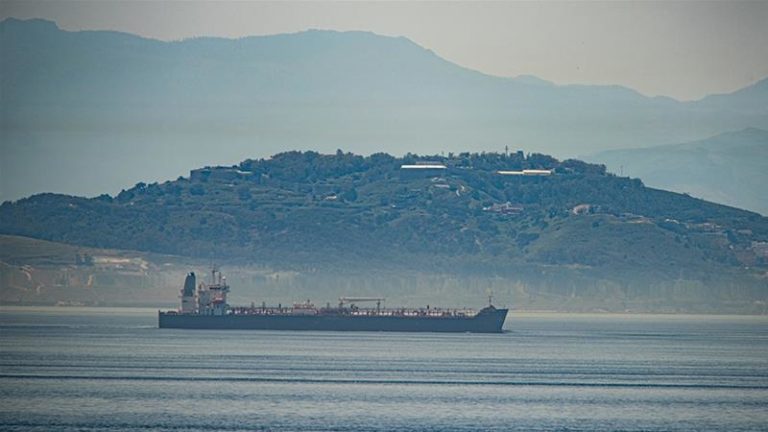
Iranian oil tanker Clavel crossing the Gibraltar stretch heading for Venezuela, May 20, 2020
By M. K. BHADRAKUMAR | Indian Punchline | May 25, 2020
Escorted by the Venezuelan navy and air force, an Iranian oil tanker named Fortune has entered that country’s waters on Sunday, amidst intense speculation whether the US would interfere with the delivery. The US has imposed oil sanctions against Venezuela and Iran and had said it is monitoring the Iranian tanker.
In fact, five Iranian tankers carrying about 1.5m barrels of fuel passed through the Suez Canal earlier this month, according to shipping data on Refinitiv Eikon, and were heading for Venezuela. The other four Iranian tankers — Forest, Petunia, Faxon and Clavel — are approaching the Caribbean en route to Venezuela.
A flotilla of US Navy and Coast Guard vessels is patrolling the Caribbean Sea on a mission to counter illicit drug trafficking. But the Pentagon has stated that there are no plans to stop the Iranian tankers.
At the same time, a Pentagon spokesman, Jonathan Hoffman, while saying on Thursday he was not aware of any operations related to the Iranian cargoes, also added, “We have continued to say that Iran and Venezuela – both two outliers in the international order – [are] clearly violating international sanctions on both nations with this transaction.”
The US sanctions on Venezuela are aimed at increasing pressure on President Maduro to step down. Thus, arguably, Iran is frontally challenging the Trump administration’s stated policy of ‘regime change’ in Venezuela. The Iranian move comes just three weeks after the abortive coup attempt masterminded by the White House on May 1 with the participation of two former US Green Berets aimed at capturing Maduro and transport him to the US in American helicopters to be put on trial on fake drug trafficking charges.
The coup attempt showed the extent of desperation in Washington to overthrow the Maduro government before the US presidential election in November, which President Trump hopes would help him garner Hispanic votes. Iran has now offered a lifeline to Venezuela.
In an historical context, this becomes a frontal assault by Iran on the Monroe Doctrine dating back to the 19th century, which in US foreign policy calculus regarded the Western Hemisphere as its sphere of influence. According to a Reuters report, the Trump administration said earlier this month it was “considering measures” it could take in response to the Iranian shipments, without providing specifics.
No doubt, this is a deliberate sanctions-busting enterprise by Iran. Venezuela desperately needs fuel for up to 1,800 gasoline stations that have been partially closed for weeks due to insufficient supply from state-run refineries.
Venezuela’s gasoline output is now limited to a single facility, the Amuay refinery, but most fuel produced is low octane as most of the country’s alkylation units are out of service. Imported alkylate could improve the quality of domestic gasoline. Venezuela’s refineries are in poor condition. Shipments of equipment in flights by Iran’s Mahan Air have arrived in Venezuela in recent weeks to start repair work.
It will be interesting to see whether the US Navy would interdict any of the other four Iranian tankers before they enter Venezuelan waters. Tehran has sternly warned the US that it would retaliate if any such attempt is made. On Saturday, Tehran raised the ante with President Hassan Rouhani explicitly warning, “If our oil tankers in the Caribbean Sea or anywhere else in the world get into trouble caused by the Americans, they (US) will run into trouble reciprocally.”
Washington is well aware of Iran’s capability to create big problems for the US Navy deployed in the Persian Gulf, especially the Strait of Hormuz. Last week, in a precautionary step, US Navy, via the Maritime Safety Office run by the National Geospatial-Intelligence Agency, alerted all international maritime traffic to maintain a safe distance of at least 100 meters from US naval vessels in international waters and straits. Pentagon officials separately confirmed that the stay-away warning to marine traffic in the Persian Gulf, the Arabian Sea and the Gulf of Oman was actually intended for Iran.
In geopolitical terms, Iran’s strategic defiance of the US in the Western Hemisphere makes an interesting case study not only of the decline in American influence in its backyard to the south but the entire efficacy of the “sphere of influence” concept in contemporary world politics. This is one thing.
More importantly, in the backdrop of the Iranian tanker reaching Venezuela, Caracas has described Iran as a “revolutionary partner” in the struggle against US imperialism. From the Iranian viewpoint, Venezuela becomes a part of the “axis of resistance” against the US. To be sure, the audacity of the two countries will irritate Washington to no end.
How far the Iran-Venezuela axis will deepen and expand will bear watch. Importantly, the UN Security Council embargo against Iran exporting arms to other countries is expiring in October. The US move to extend the timeline of the embargo is unlikely to succeed, given the strong negative reaction by Russia and China. It is entirely conceivable that a matrix of military cooperation may commence in a near future involving Iran and Venezuela.
Iran’s indigenously developed missile capability acts as a deterrent against US aggression. Iran has transferred missile technology to Hezbollah, which is estimated to have the capability today to inflict significant damage to Israel in the event of any aggression by the latter on Lebanon. Significantly, the deterrence is working and Israel no longer stages attacks on Lebanon.
A similar shift in the strategic balance with Iran’s help can create more space for Venezuela to push back at the US. All in all, Iran appears to be working on a strategy to help Venezuela to maintain its strategic autonomy. There is enormous potential for cooperation and coordination between Iran and Venezuela. If Venezuela has the largest known oil reserves in the world, Iran too has massive reserves of oil and gas.
The despatch of oil to lubricate the beleaguered Venezuelan economy may prove to be the harbinger of an assertive Iranian power projection elsewhere in Latin America too. Surely, in the near term, it is a rebuff to the Trump administration’s maximum pressure strategy against Iran. In a longer-term perspective, a concerted regional strategy in Latin America by Russia, China and Iran can seriously erode the US influence in the continent.
Plan to spend Russia & China ‘into oblivion’ in arms race will bankrupt only America
By Scott Ritter | RT | May 22, 2020
In a stunning display of arrogance, ignorance, and hubris, President Trump’s new arms control czar threatens to spend America’s adversaries into “oblivion” in any new arms race. But the joke is on him.
Trump’s newly appointed Special Presidential Envoy for Arms Control Marshall Billingslea has breathed new life into an historical interpretation that holds the United States won the Cold War with the Soviet Union by escalating an arms race that turned out to be unsustainable for Moscow, bankrupting the Soviet economy and accelerating the collapse of the Soviet Union as a political entity.
In remarks made to the Hudson Institute, a conservative think tank, Billingslea noted that the threat of a new arms race would be enough to bring both China and Russia to the negotiating table for the purpose of crafting a new trilateral arms control treaty that would replace the current bilateral New START treaty, scheduled to expire in February 2021.
“We intend to establish a new arms control regime now, precisely to prevent a full-blown arms race,” Billingslea said. If, however, either Russia or China (or both) decided to forego negotiations and continue to pursue new strategic nuclear weapons, then President Trump “has made clear that we have a tried and true practice here”.
“We know how to win these races and we know how to spend the adversary into oblivion.”
There are numerous factors that mitigate against Billingslea’s seeming desire to refight the Cold War. First and foremost, the United States, like the rest of the world, exists in a new post-pandemic economic reality. Whether or not the American people or their elected representatives in Congress are prepared to shoulder the costs of an avoidable arms race with Russia and China while on the cusp of an economic depression is very much a debatable point.
Even if the political will for the kind of open-ended spending extravaganza required to “spend the adversary into oblivion” existed (and with 30-plus million Americans currently out of work, and millions more expected to follow, such thinking rests more in the realm of fantasy than reality), it is virtually impossible for the US today to replicate the conditions that existed back in the 1980s. The current Russian and US defense economies of today are a far cry from those that existed during the Cold War, a fact that bodes well for Russia, and less so for the US.
Russian defense industry today is founded on a legacy inherited from Soviet times, when defense industries took precedence over every other aspect of the Soviet economy and attracted the finest scientists and technicians, backed by a virtually unlimited budget. Under former Minister of Defense Dmitry Ustinov, the Soviet ballistic missile production base benefited from a multitude of research and design centers, each connected to its own supporting infrastructure of production facilities responsible for manufacturing diverse components and assembling them into finished products. By 1988, the Soviets had seven different ICBM types deployed. Those were a mix of third-, fourth- and fifth-generation liquid and solid fuel missiles.
While impressive in terms of scope, scale and quality, the Soviet ICBM procurement model was, in the long run, unsustainable. The demands generated by the perestroika reforms initiated by Mikhail Gorbachev beginning in 1985 meant the existing model of multiple design bureaus working in parallel in a virtually competition-free environment had to transition to a missile procurement model driven by cost accounting methods and the limitations imposed by a new era of bilateral strategic arms control agreements.
In the years leading up to the collapse of the Soviet Union, there remained only two missile design bureaus involved in the production of ICBMs. After the fall of the USSR, one of them – Yuzhnoye – fell under the control of Ukraine.
Today, Russia’s JSC Votkinsk Machine Building Plant produces the RS-24 Yars missile, deployed in both a mobile- and silo- based variant, and is developing the RS-26 Rubezh, a modification of the RS-24 capable of deploying the advanced Avangard hypersonic glide vehicle. Votkinsk also produces the solid-fuel RS-56 Bulava submarine-launched ballistic missile (SLBM), its first foray outside of the world of ICBM development and manufacturing. In a sign of the times, the Makeyev JSC in Miass, which formerly only produced SLBM’s, is producing the massive RS-28 Sarmat ICBM, intended to replace the aging R-36 Soviet-era heavy silo-based ICBM.
The new Russian ICBMs are the finest in the world—no nation has anything that can compare, even the United States. They are also among the most cost-effective in the world today. The fact that these missiles are produced in a manufacturing environment plagued by shortages of materials needed to produce critical components is a testament to the resilience of the Russian defense industry, which has literally been forced to both adapt and overcome in the course of the three decades of economically difficult times that have passed since the end of the Soviet Union.
For its part, the US defense industry has been the benefactor of virtually limitless largesse, feeding off a bloated defense budget that has expanded from some $300 billion in 1990 to over $740 billion today. However, over the course of the past 30 years, this money has not been spent on modernizing the US strategic nuclear force. The example of the Minuteman III missiles serves as a point of illustration.
The United States currently deploys a force of 400 Minuteman III silo-based ICBM’s. The original Minuteman ICBM was developed at a cost of $17 billion (measured in 2020-equivalent dollars) over the course of five years. The Minuteman III—the version deployed today—is derived from the same 1960’s technology and was initially deployed in 1970. Originally designed for a lifetime of some 10 years, the Minuteman III has been subjected to a series of life-extension upgrades that will keep it viable until 2030. After this time, the missile must be replaced.
The US Air Force is currently developing a new silo-based ICBM, known as the Ground Based Strategic Deterrent (GBSD). The missile will be designed to last until 2075, and in addition to incorporating new technologies, will also involve significant upgrades to the related silos and launch control facilities. Current estimates published by the US Air Force for the cost of the GBSD are some $62 billion (by way of comparison, the total Russian military budget is approximately $65 billion).
Even this high cost is disputed by the Department of Defense’s Cost Assessment and Program Evaluation (CAPE) office, which projects the actual cost of the GBSD to be between $85 and 100 billion. One of the major reasons for this discrepancy lies in the fact that the United States has not designed a new ICBM since the 1970’s, with the MX Peacekeeper. The final contract for the GBSD is expected to be let in September 2020, although as the only bidder, Northrop Grumman, Inc. is expected to be the awardee. This fact alone makes the CAPE estimate seem overly conservative—Northrop Grumman has developed a well-earned reputation in defense industry circles for projects it is involved in coming in over budget and behind schedule. Based upon current examples of contractual cost overruns, the GBSD costs could skyrocket to $200 billion or so, and this number does not incorporate the negative impact on defense procurement resulting from the failure of Congress to pass a defense budget on time, making long-term procurement decisions impossible and further driving up the cost.
The GBSD is but one of a range of modernization programs being planned by the US, involving every aspect of its strategic nuclear triad. These programs, which include new manned strategic bombers and new missile-carrying submarines, are expected to cost more than $1.2 trillion over the course of the next 30 years—and these are conservative estimates. Given the spectacular budgetary inefficiencies in the US defense procurement system today, it is almost certain that any new strategic nuclear weapons system, whether it be an ICBM, SLBM or manned bomber, will cost the US taxpayer far more than originally planned, and more than likely perform far less than originally designed.
Marshall Billingslea can bluster all he wants about spending an adversary into oblivion. The reality is that the US is not prepared, politically or economically, to engage in any new arms race predicated on open-ended budgetary support.
In the Cold War, it was the Soviet Union playing catch-up to US superiority in the field of ballistic missile technology. Today the tables have been turned. Any arms race will find the US operating from a disadvantage right out of the gate, with Russia already fielding the kind of fifth-generation missiles the US has yet to design, let alone produce.
Scott Ritter is a former US Marine Corps intelligence officer. He served in the Soviet Union as an inspector implementing the INF Treaty, in General Schwarzkopf’s staff during the Gulf War, and from 1991-1998 as a UN weapons inspector. Follow him on Twitter @RealScottRitter
Beijing slaps tariffs on Australian barley; it has had enough of Canberra’s toadying to US on China hostility
By Finian Cunningham | RT | May 20, 2020
The US has counted on Australia’s government and PM as minions in its long-running conflict with China. Now, for Canberra’s dubious services, Australian farmers are reaping a bitter harvest from lost access to China’s vast market.
Beijing announced this week it was slapping 80-percent tariffs on Australian exports of barley. That effectively shuts off China as a market. This followed a ban by Beijing on supplies of Australian beef.
Given that China is the biggest market for Australian agricultural goods, the move is a severe blow, with fears of more curbs on a range of other products, from wine to wool, as well as on the wider sectors of coal and iron ore.
Beijing claims the trade measures are a result of technical issues concerning alleged misuse of subsidies by the Australian government to make its exports more competitive. But that’s doubtless a political cover to mitigate litigation at the World Trade Organization. Realistically, it seems more likely that China has decided to teach Canberra some manners through economic pain.
Despite its reliance on China’s economy, Scott Morrison’s government has shown a spectacular recklessness in enthusiastically adopting the Trump administration’s hostile policy towards Beijing.
At the World Health Assembly conference this week, Australia sided with the US in calling for an inquiry into the Covid-19 pandemic, with the presumption of China’s guilt over a ‘cover-up’. As it turned out, most nations rejected the US-Australian approach and instead backed an international review of the pandemic carried out by the World Health Organization (WHO).
Australia further incensed Beijing by backing US calls for Taiwan to be admitted to the WHO as an observer, which would undermine China’s unitary claims to the territory.
This was but the most recent expression of Canberra’s kowtowing to Washington’s antagonistic agenda towards China.
The Morrison government has been an ardent cheerleader for the Trump administration in its long-running trade dispute with Beijing. In 2018, Australia banned Chinese tech giants Huawei and ZTE from its 5G mobile phone network, reciting Washington’s claims of national security concerns and China’s “malign” interference in internal affairs.
Australia has also backed the US in its stand-off with China over territorial disputes in the South China Sea, echoing Washington’s claims of Beijing’s expansionism and aggression. Last month, Australia sent one of its warships to join US Navy guided-missile destroyers on maneuvers in the contested sea; maneuvers which China views as provocations to its national security.
From Beijing’s viewpoint, Canberra wants to have its cake and to eat it. It relies on China as the top market for its export-led economy, yet at almost every turn has not hesitated to insult Chinese sensibilities by doing Washington’s bidding.
It’s as if the Morrison government seems to resent the fact of Australia’s dependence on China’s economy, while harboring pretensions of superiority by acting wantonly with no regard for Chinese diplomatic respect.
The impression given is that Canberra felt entitled to keep on insulting China with no repercussions.
Now Australian farmers have just lost their most lucrative market, thanks to the Morrison government’s insistence on aggravating Beijing on Washington’s behalf. The impact on the Australian economy could give new meaning to the term ‘Down Under’.
Meanwhile, China can easily find new suppliers of cereal and meat from Russia, Canada, Brazil or the US.
Now there’s a bitter irony, if China were to source farm exports from the US to compensate for the shortfall in Australian supplies. A cruel twist indeed for Aussie farmers, who will foot the bill for Canberra’s toadying to the Trump administration.
Finian Cunningham is an award-winning journalist. For over 25 years, he worked as a sub-editor and writer for The Mirror, Irish Times, Irish Independent and Britain’s Independent, among others.
Failures in Syria and Libya fuel coup speculations against Erdogan
By Paul Antonopoulos | May 20, 2020
Turkish media has been full of speculation of a potential coup against President Recep Tayyip Erdoğan, including from state-run Anadolu Agency, and other major outlets like Sabah and Haberturk. Erdoğan already survived a 2016 coup attempt against him that he blames on his ex-ally, Fethullah Gülen, who leads the FETÖ Islamic movement. It is likely that Erdoğan will conduct another purge of the Turkish military.
Although the 2016 coup was orchestrated mostly by the Air Force, it appears that one of the first victims could have been Rear Admiral Cihat Yaycı. On May 15, Yaycı was demoted from the Chief of Staff’s to the General Staff, prompting him to resign from the military completely on Monday. Although some speculated it could have been because of the coup rumors circulating, Yaycı proved to be one of the most loyal Chief of Staff’s to Erdoğan and played a significant role in purging so-called FETÖ elements from the Turkish military.
It is likely that Yaycı was actually demoted because of Turkey’s complete failure to project its power in the Eastern Mediterranean. Yaycı is known as the architect of Turkey’s “Blue Homeland” theory that aims to annex Greece’s Eastern Aegean islands and maritime space. To achieve the “Blue Homeland,” Ankara in November 2019, with recommendation from Yaycı, sealed the “Marine Jurisdictions” maritime boundary delimitation deal with Libya’s Muslim Brotherhood Government of National Accords (GNA) to split Greek maritime space between Turkey and Libya.
However, since the signing of the deal with the Tripoli-based GNA, Ankara’s power projections in the Eastern Mediterranean have only weakened Turkish influence. Turkey had not expected for Greece to expel the GNA ambassador from Athens, one of the first NATO and EU countries to do so. In reaction, Greece recognised the GNA’s rival, the Tobruk-based Libyan House of Representatives who appointed Field Marshal Khalifa Belqasim Haftar to command the Libyan National Army against Turkish-backed jihadists who fight for the GNA.
Greece’s shift in recognition shows another flashpoint in rivalry with so-called NATO ally Turkey and rapidly changed dynamics in the Eastern Mediterranean. Haftar currently controls about 90% of territory and 60% of the population, prompting Turkey to send 5,000 Syrian jihadists to support the GNA, who have regained some lost territory in recent weeks.
But this is going to change as it appears massive simultaneous operations against the GNA and Turkish-backed jihadists in Syria’s Idlib province are set to begin in the coming weeks. Turkey as the sole backers of jihadist forces in Libya and Idlib will find this extremely difficult to deal with as it faces an economic crisis.
A detailed report by New Economy found that “Turkey’s probability of bankruptcy is extremely high,” along with its three big banks of Garanti, Akbank and the Mustafa Kemal Atatürk-founded İşbank. “The country’s commercial banks, its last stronghold, have dried up from foreign exchange currency,” meaning that Turkey has nearly no money for its import and export companies.
Another report found that failed wars against Libya and Syria have been a major problem for its economy, making Turkey’s bankruptcy probability over 30% in the forthcoming period, putting them behind only Venezuela and Argentina, but “without having the US embargo that Venezuela has, nor the vast debt that Argentina brings.”
Most startling however for Turkey is that it has to find $80 billion by August, according to New Economy, or else it faces bankruptcy.
“There is also the additional 0.5-1 billion dollar cost per month for the wars in Syria and Libya, which seems to exacerbate the existing situation, leading to a huge state budget hole and escalating the probabilities of bankruptcy,” the report said.
With major economic problems in Turkey, Ankara paid Syrian jihadists in Libya only one month’s worth of wages and then ended all payments. This has prompted the jihadists to make videos urging other Syrians not to go to Libya and fight. Meanwhile, Turkey’s aggression has prompted Greece to renew diplomatic relations with Syria, become actively involved in Libya, and strengthen relations with Egypt, Saudi Arabia and the United Arab Emirates who oppose Turkish influence in the Arab world.
Yaycı’s ambitious “Blue Homeland” project forced Greece to become involved in Libya and Syria that it previously had no interest in, and it is now actively a part of an alliance that is opposing Turkish influence in the region. With Greece actively opposing Turkish influence in Libya, France has also taken a stronger interest and openly opposes the GNA now. What began as a plan to carve up Greece’s maritime space has now turned into a debacle that sees French involvement against the GNA and EU recognition of the Muslim Brotherhood government waning.
Egypt is now threatening to directly use its military to defeat the GNA rather than just supply Haftar’s forces. The UAE has promised to continue airstrikes against the GNA and funding mercenaries for Haftar. Saudi Arabia is also funding mercenaries. Greece and France are involved in the EU’s Operation Irini to stop maritime deliveries of arms to Libya. In March, Haftar’s political representatives signed with Syria a Memorandum of Understanding to start diplomatic relations. Syria and the Libyan National Army are also preparing likely simultaneous operations against jihadists in their respective countries.
This is all happening while Turkey faces a very serious threat of bankruptcy and rumors of a coup attempt. Therefore, it is likely that Yaycı was demoted by Erdoğan for masterminding and pushing for the “Blue Homeland” that has ended in catastrophic failure for Turkey.
Paul Antonopoulos is an independent geopolitical analyst.
New tapes of Poroshenko-Biden calls reveal ‘independent’ Ukraine was total US client

© Reuters / Jonathan Ernst
RT | May 19, 2020
On top of firing a prosecutor on orders from US Vice President Joe Biden, Ukrainian President Petro Poroshenko also robbed his own people by raising tariffs to please his US overlords, according to audio of their alleged calls.
On Tuesday, Ukrainian parliamentarian Andrii Derkach published audio recordings of what sounds like Poroshenko’s conversations with various Obama administration officials in 2015 and 2016. Derkach said he got the audio from investigative journalists, who told him that Poroshenko personally recorded the calls. They have not been independently verified.
If true, however, they show the president in Kiev literally taking orders from Washington, even as the US insisted Ukraine was a sovereign and independent nation free to decide its own destiny.
“[I’m] very well indeed, as usual when I hear your voice,” Poroshenko tells Biden in a May 13, 2016 conversation, where he rushes to tell the US vice president how much “progress” he has made in reforming Ukraine to Washington’s liking.
As one of the examples, Poroshenko cites that he has imposed tariffs of 100 percent, even though the IMF asked for only 75 percent, adding “Give us a yard, please!”
“Poroshenko was willing to strip the Ukrainians naked, and even make money on the tariffs,” Derkach said on Monday, noting that they were indeed raised twice.
Raising tariffs on Russian gas imports – and cutting subsidies to poor Ukrainians – was one of the major demands by the IMF in 2013, which the government of President Viktor Yanukovych balked at, before it was ousted in a US-backed coup in February 2014.
Derkach argues that the tariffs and other concessions Poroshenko made to Washington were intended to unblock the $1 billion IMF loan to Ukraine of which the US was a guarantor. Biden had already leveraged the loan to demand the firing of prosecutor Viktor Shokin, who was looking into corruption at the gas company Burisma – which had hired Biden’s son Hunter as a board member earlier that year, presumably as a shield against prosecution.
It became clear after Poroshenko fired Shokin that this would not be enough, and that he would have to give even more, Derkach told reporters in Kiev, pointing to the recordings.
Biden himself boasted about getting Shokin fired at an event in Washington, and his remarks were caught on camera. When current US President Donald Trump brought up the issue of Shokin’s firing with Poroshenko’s successor Volodymyr Zelensky, the Democrats claimed he was improperly seeking foreign assistance in the 2020 election – as Biden was seeking their nomination – and had him impeached in the House of Representatives in December 2019. Trump stayed in office after the Senate acquitted him in February this year. Biden only became the presumptive Democrat nominee in mid-April.
On the Situation in Hong Kong as US-China Relations Worsen
By Vladimir Terehov – New Eastern Outlook – 19.05.2020
On the card table where modern world politics are played, the state of affairs in Hong Kong remains a barometer which can provide a rough idea of the current trends in relations between the United States and China. Both of these superpowers play a major role in shaping the bigger global picture of today’s game.
That is why NEO has been monitoring how the situation has been developing in the Hong Kong on a fairly regular basis, or the Hong Kong Special Administrative Region of the People’s Republic of China (HKSAR) as it has officially been known since the former British colony became a part of the PRC in 1997. For almost an entire year now, the HKSAR has been gripped by yet another wave of turbulence, which was last discussed after the local District Council elections were held on November 24, 2019 for all 18 of Hong Kong’s District Councils.
Last year’s riots in Hong Kong coincided with another round of bilateral talks between the United States and China to address their trade and economic issues. Both sides were pushing for the talks to end on a positive note, but of course they each had their own definition of a positive outcome.
China is greatly committed to maintaining relations with the U.S. as one of its main foreign trading partners, and ultimately had to acknowledge the grievances voiced by the American side, which stem from the undeniable fact that Beijing has long been earning hundreds of billions of dollars on an annual basis off its trade with the United States.
It was this commitment that tied Beijing’s hands, preventing China from severely cracking down on the Hong Kong protesters, who acted provocatively in open defiance of Beijing on the streets of Hong Kong. From the looks of it, the protesters strangely seem to have gotten away with blue murder or received a purely symbolic punishment.
The situation in the city has stabilized after a coalition of political pro-democratic parties termed “pan-democratic” in Beijing won last year’s elections. They received 85% of the votes from those who turned out to go to the polls. In other words, the crowds from the streets were the force that took to the polls in local communities, who have their own grievances with the Chinese Central Government, although they did not condone the havoc wreaked in their own city by the particularly violent protesters.
You would think that the Hong Kong factor would play much less of a role in bilateral relations between the US and PRC after they signed the trade deal known as the “Phase 1” agreement on January 15 this year following 18 months of negotiations on the aforementioned trade issues. In other words, one would expect the situation on the city’s streets to be fairly calm, when the routine political process stays within the walls of the Legislative Assembly of the HKSAR and the local District Councils and does not spill out onto the streets.
However, almost immediately after the “Phase 1” trade deal was signed, the global coronavirus pandemic came almost out of nowhere, which is having catastrophic consequences in the United States of all places. It is also probably the country where it has been most politicized, mainly due to the upcoming elections in November, when Americans will elect their president for the next term along with a completely new House of Representatives, and a third of the Senate will be contested.
Although Donald Trump’s chances of being re-elected as president and the success of the Republican Party in the Congress elections looked fairly realistic in February this year, the question of who was to blame inevitably arose as the situation with both the coronavirus and the country’s economy deteriorated. On May 8, the level of unemployed or underemployed in the United States had already hit 22.8%, almost as low as the 25% recorded at the time of the Great Depression in 1933.
The average American voter is not likely to go to the trouble of getting to the bottom of this problem and dig up the detailed root causes, including shortcomings that have long existed in the national healthcare system (i.e. they were there before Donald Trump), and the President’s use of the agencies at his disposal to mislead people about how prepared the country was for natural disasters such as epidemics. As approval ratings fall, the ruling Republican party and government is tempted to point to the finger overseas and blame an external factor for causing the outbreak.
America’s main geopolitical rival fit this description. The anti-Chinese propaganda campaign quickly gained momentum in the media and led to concrete financial claims being made for “compensation for various damages” from Beijing. This was followed by thinly veiled threats that the US could cancel debt obligations to China, which America owes more than 1 trillion dollars.
US-China relations have taken another nosedive, and have now hit an all-time low. The difference is that this time Beijing has made it clear that it does not intend to show the same level of restraint it did during the negotiations to secure the “Phase 1” trade deal. The Global Times, a semi-official government publication under the auspices of the Chinese Communist Party’s People’s Daily newspaper, discussed whether China is likely to “dump” its US Treasury holdings, or comply with the terms of the “Phase 1” trade deal and prepare for the “Phase 2” negotiations.
It is certainly no coincidence that when the editor of the Global Times published a brief note around the same time (May 8) on the need to increase China’s nuclear arsenal to 1000 warheads “in a relatively short time”, including warheads to be carried on mobile intercontinental ballistic missiles (ICBMs).
There was a place for Hong Kong on the list of symbolic gestures made to Washington. On April 18, 15 Hong Kong riot leaders who organized and participated in “illegal assembly” on the streets in protests that took place on August 18, October 1 and October 20 last year were detained and later released on bail. In response to the anti-Chinese campaign which immediately took hold in the Western media, the Chinese Foreign Ministry released a statement the next day, saying that “their rhetoric revealed their complicity with rioters who have created chaos in the city”.
On May 6, the Hong Kong and Macao Affairs Office of the State Council gave the “black shirts” a stern warning not to appear on the city’s streets, addressed to the particularly violent protesters who dress in black.
Yet a new cause for a very cautious optimism about relations between the two leading world powers can just about be made out (although it is difficult to remember how many of these there have already been). This glimmer of hope was in the form of a telephone call made on May 8 between the China’s Vice-Premier Liu He, US Treasury Secretary Steven Mnuchin and US Trade Representative Robert Lighthizer.
The last time American and Chinese officials at such a senior level had been in contact was when the “Phase 1” trade deal was signed, and both sides expressed a desire to “make the agreement a success”. For this specific purpose, the decision was taken to set up a special intergovernmental body.
It is worth briefly touching on the advantages Russia could have if tensions between the US and China worsen, which are the subject of frequent debate in the country. To draw on an analogy, it would be like some smart swamp creature hoping that a fight between the two biggest hippopotami will help them survive with less predators around, as they all struggle for a shrinking space in a swamp that is drying up. Sooner or later, the smart guy will be accidentally get crushed, without having even been noticed by the brawling creatures themselves. It would be wiser take time during one of the breaks between rounds to try to convince the hippopotami that both of them will still have something useful to bring to the current geopolitical ecosystem. If they continue to fight to the bloody end, it will destroy the entire ecosystem (to put it politely). That includes all of its inhabitants, including yourselves.
Likewise, Hong Kong will only be able to continue to benefit from its current “special” status within China if China normalizes its relations with the United States. In other words, the attempts made by those young rioters who are fighting for some sort of “rights” to encourage the deterioration of relations between China and the US are in direct contradiction to the interests of the vast majority of the population in Hong Kong.
The main political forces in the HKSAR are beginning to gain a greater understanding of this situation, who do not see any alternatives to maintaining a decent level of cooperation with the mainland in order to find a way out of the difficult situation the city has found itself in due to a number of reasons, and last year’s riots are certainly somewhere on the top of the list.
Whatever the case, the situation in Hong Kong still serves as a barometer and reflects relations between the world’s two leading powers. This is also why the situation there needs to be closely monitored.
Vladimir Terekhov is an expert on the issues of the Asia-Pacific Region.
Why the Current Economic Slowdown Won’t Show Up in the Atmospheric CO2 Record
By Roy W. Spencer, Ph. D. | May 15, 2020
Summary: Atmospheric levels of carbon dioxide (CO2) continue to increase with no sign of the global economic slowdown in response to the spread of COVID-19. This is because the estimated reductions in CO2 emissions (around -11% globally during 2020) is too small a reduction to be noticed against a background of large natural variability. The reduction in economic activity would have to be 4 times larger than 11% to halt the rise in atmospheric CO2.
Changes in the atmospheric reservoir of CO2 occur when there is an imbalance between surface sources and sinks of CO2. While the global land and ocean areas emit approximately 30 times as much CO2 into the atmosphere as humans produce from burning of fossil fuels, they also absorb about an equal amount of CO2. This is the global carbon cycle, driven mostly by biological activity.
There are variations in the natural carbon cycle, such as during El Nino (more CO2 accumulation in the atmosphere) and La Nina (more CO2 removed from the atmosphere). Greater wildfire activity releases more CO2, while major volcanic eruptions (paradoxically) lead to greater photosynthesis from more diffuse sunlight and extra removal of CO2 from the air. The most dramatic variations are seasonal, as the land-dominated Northern Hemisphere experiences an annual cycle of vegetation growth (CO2 removal) and decay (CO2 release).
The increase in atmospheric CO2 observed since the 1950s is most likely dominated by anthropogenic CO2 emissions, which are twice as large as that needed to explain the observed rise. As I have shown before, a simple CO2 budget model driven by (1) estimates of global yearly anthropogenic CO2 emissions, (2) El Nino and La Nina activity, and (3) a CO2 removal rate that is proportional to how much “extra” CO2 is in the atmosphere compared to a “preferred baseline” CO2 level, yields an excellent fit to yearly CO2 observations at Mauna Loa, Hawaii.

Fig. 1. Yearly Mauna Loa, HI CO2 observations since 1959 (red) versus a simple CO2 budget model (blue).
But those are yearly measurements, and we are now interested in whether the recent global economic slowdown is showing up in the monthly Mauna Loa CO2 data. If we remove the large seasonal variations (driven by the seasonal growth and decay of Northern Hemisphere vegetation), we see no evidence of the economic slowdown through April, 2020.
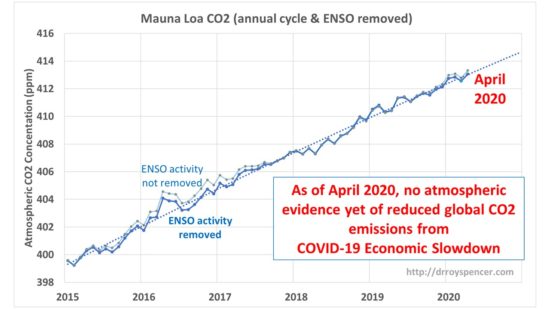
Fig. 2. Monthly CO2 data since 2015 from Mauna Loa, HI after the average seasonal cycle is statistically removed.
As can be seen in Fig. 2, there are some pretty large month-to-month jumps and dips around the long-term increase (represented by the dotted line). These are probably natural variations due to fluctuations in the average seasonal variations in vegetation growth and decay, wildfire activity, and El Nino and La Nina activity (which are imperfectly removed in the solid blue line in Fig. 2). Variations in economic activity might also be involved in these fluctuations.
The point is that given the large month-to-month variations in natural CO2 sources and sinks seen in Fig. 2, it would be difficult to see a downturn in the anthropogenic source of CO2 unless it was very large (say, over 50%) and prolonged (say over a year or longer).
Instead, the U.S. Energy Information Administration (EIA) estimates that the global economic slowdown this year due to the spread of the novel coronavirus will amount to only about an 11% reduction in global CO2 emissions. This is simply too small of a decrease in CO2 emissions to show up against a background of considerable monthly and yearly natural variability in the atmospheric CO2 budget.
That relatively small 11% reduction also illustrates how dependent humanity is on energy, since the economic disruption is leading to U.S. unemployment rates not seen since the Great Depression of the 1930s. Everything that humans do requires access to abundant and affordable energy, and even the current economic downturn is not enough to substantially reduce global CO2 emissions.
ADDENDUM: How much of a decrease in CO2 emissions would be required to stop the atmospheric rise in CO2?
An interesting aspect of the observed rise of atmospheric CO2 is that it indicates the greater the CO2 concentration, the faster the “extra” CO2 is removed by biological activity. The observed annual rate of removal is 2.3% of the excess above a baseline of 295 ppm. The greater the “excess”, the faster the rate of removal.
Because of this rapid rate of removal, the anthropogenic CO2 emissions do not have to go to zero to stop the observed rise in atmospheric CO2. Using my simple model (blue line in Fig. 1, above), I find that a 43% reduction in anthropogenic CO2 emissions in 2020 would — in the absence of natural fluctuations in the carbon cycle — lead to a halt in the observed rise of atmospheric CO2 in 2020 over 2019 levels. This is about 4 times larger than the EIA estimate of an 11% reduction in CO2 emissions for the year 2020.
Copyright 2020 Roy Spencer, Ph. D. – All Rights Reserved
The US’ Covid-19 death toll is soaring, but it keeps wasting billions on overseas military ops
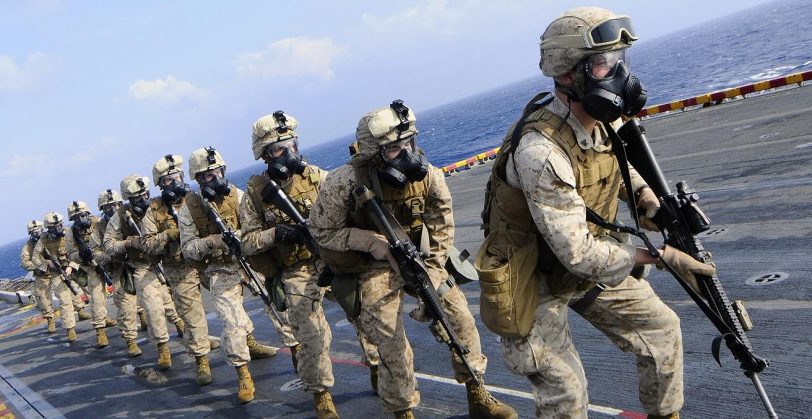
Amphibious Assault Ship USS Kearsarge – U.S. Navy photo by Mass Communication Specialist 3rd Class Scott Pittman/Released
By Darius Shahtahmasebi | RT | May 13, 2020
As the bodies rack up and the economy goes into freefall, the US continues to spend a fortune on its military. It’s time the public asked whether the money could be used more wisely.
Even in the face of the ongoing Covid-19 crisis, the US military appears to be operating across the globe unabated, undeterred and almost completely unchecked. If the reports are anything to go by, there are at least 150 US military bases and four aircraft carriers which have already been hit with the virus. After arriving in Guam, the carrier Theodore Roosevelt had 940 cases alone – around 20 percent of its personnel.
Never one to back down in the face of adversity (or pragmatism), the US military apparently will keep on doing what it does best. On Tuesday, the US special envoy for Syria justified an ongoing illegal troop presence in the country by framing it as an opportunity to force Russia into a quagmire (something the US already has extensive experience in).
To anyone paying attention over the past few decades, admissions of this type are hardly surprising. Even as the US watches thousands of its own people die at the hands of an invisible enemy, it is still ramping up operations which result in the deaths of innocent civilians in overseas theatres. Take, for example, the ongoing air war in Somalia, which has increased over the first few months of 2020, killing civilians with close to zero media scrutiny.
Or how about the Pentagon’s intention to arm its marines with versions of the Tomahawk cruise missile carried on US warships as a mechanism to counter China in the western Pacific?
Combined with its decision to continue conducting its so-called “freedom of navigation” operations in the South China Sea – including two US navy ships which sailed into the region to counter Beijing just a few days ago – it seems apparent that aggravating a conflict with China remains one of the highest priorities for the US government. Coronavirus, on the other hand, falls ever lower on the list of things the US president should take responsibility for.
Sending two B-1B supersonic heavy bombers over the skies of northeast Taiwan this month, as well as a number of bombers across Europe and the Pacific, only further confirms Washington’s prime concerns during the pandemic. If you want a fuller list of what your American taxpayer dollars are continuing to fund during this unprecedented turmoil, check the Department of Defense’s website.
Mythical foreign bogeymen
What will the reaction be when the American public looks at the number of its population killed by the Covid-19 pandemic – the death toll currently stands at over 80,000 – and realizes the country has wasted billions of dollars defending the homeland from potentially make-believe, foreign bogeymen, but isn’t even remotely prepared to defend its people from the wrath of the coronavirus? What happens when Americans wake up and start to question whether or not funds and resources could be better allocated?
As War on the Rocks bluntly explained, the “security afforded by America’s far-flung military forces has been entirely irrelevant” when dealing with the global pandemic. The polls may one day tell the full story, but this is notable considering that in June 2019, Gallup recorded a whopping 73 percent of respondents expressing a “great deal” or “quite a lot” of confidence in the US military.
The coronavirus pandemic is exacting a death toll on the American public which most genuine enemies would fail to do on their own. But ultimately, what may separate the Covid-19 crisis from any other in the eyes of the American public is its sheer cost. Will the public continue to trust the US president to spend billions of dollars on its military adventures overseas as the bodies rack up and the economy fractures?
Massive unemployment
Irrespective of what the people say or think, the US appears to be pumping as much energy, money and resources into the military as it possibly can, while the pandemic continues to ravage what is left of the global economy.
The rate of unemployment in the US is currently at its greatest since the Great Depression, with some predictions indicating it could be as much as 20 per cent. Unless the US military is intending to hire a fifth of the American population, its perception as the saviour of the US mainland may start to fade over the course of the year.
“When written in Chinese,” John F Kennedy reportedly once said, “the word crisis is composed of two characters – one represents danger, and the other represents opportunity.”
Will the US public make the most of this opportunity to return their verdict on an administration that is wasting billions? Or will widespread apathy allow the Pentagon to continue on its warpath to counter adversaries such as Russia and China in priority theatres across the globe?
Darius Shahtahmasebi is a New Zealand-based legal and political analyst who focuses on US foreign policy in the Middle East, Asia and Pacific region. He is fully qualified as a lawyer in two international jurisdictions.
Turkey stalls Iran gas imports amid aggressive US efforts to push its LNG

Press TV – May 13, 2020
Turkey is dragging its feet on repairing a pipeline which was hit by an explosion in late March, stopping Iran’s gas exports to the country, the Fars news agency says.
Iran sells about 10 billion cubic meters a year of gas to Turkey under a 25-year supply deal signed in 1996. The pipeline has been blown up several times by PKK terrorists, but it has been repaired and the gas flow has continued shortly.
However, after another blast occurred on the pipeline on March 31, an official at the National Iranian Gas Company (NIGC) said the Turkish side was not responding even as Iran had informed it of the incident.
According to Mehdi Jamshidi-Dana, Turkey’s representative at Bazargan gas transmission station had left his post due to the outbreak of the novel coronavirus.
The official said it was not clear when the line would re-open, but he cited past experience which showed “repairing the lines takes three to seven days, depending on the amount of damage done”.
On Wednesday, Fars suggested that the pipeline is still out of service, citing Turkish state energy company Botas’ dilly-dallying and unwillingness to repair it.
The news agency speculated that the situation must be the result of aggressive US efforts to push its liquefied natural gas (LNG) into Turkey.
Heavily dependent on gas imports from Russia, Turkey has already reduced flows from Gazprom significantly, while increasing LNG purchases and gas imports from Azerbaijan.
“In recent months, Turkey has imported as much LNG from the United States as gas imports from Iran,” Ali Nasr, an energy expert, told Fars.
Last November, Turkey marked the completion of the Trans-Anatolian Natural Gas Pipeline (TANAP) to carry gas from Azerbaijan’s Shah Deniz II field to Europe.
In January, the presidents of Turkey and Russia formally launched the TurkStream pipeline to carry Russian natural gas to southern Europe through Turkey.
Fars warned that Iran may lose its biggest gas market to rivals, which could cost the country $150 million-$200 million in lost revenues a month.
The US has the necessary incentive to remove Iranian gas from the Turkish market in order to increase economic pressure on Iran, while Turkey seeks to diversity its energy sources and reduce gas imports from Iran and Russia, the agency said.
The US is currently pushing Trump’s “energy dominance” agenda that seeks to advance diplomatic and policy objectives through rapidly expanding US oil and gas exports.
Iran has already lost its biggest condensate market in South Korea which imported 300,000 barrels per day (bpd) of the ultra light oil from the Middle Eastern country.
The Koreans stopped the shipments under pressure from the United States which is aggressively thrusting its fast-growing condensate into Asia.
According to US officials, Washington has offered to sign a $100 billion trade agreement with Turkey, which their presidents discussed at the Munich Security Conference.
The offer is part of the Trump administration’s main goal to get President Recep Tayyip Erdogan drop plans to use Russia’s S-400 missile defense systems.
“If an agreement is reached, the possibility of replacing Iranian gas with American LNG is quite possible,” Fars warned.
According to the news agency stated, Turkey has expanded its LNG terminals to take in 25 billion cubic meters of cargoes – 2.5 times more than the imported gas from Iran. The terminals are currently operating only at 25 percent of their nominal capacity. … Full article
Anti-Iranian Boomerang Policies: How America Celebrated the Pandemic and Incited the Oil Crisis, and Got Stuck by Both
By Ivan KESIĆ | Strategic Culture Foundation | May 7, 2020
Two months after the coronavirus pandemic broke out in Iran, we are seeing signs of a significant improvement for the total situation. The number of daily deaths has dropped below one hundred for a week in a row, the number of new COVID-19 cases has been on a continuous decline for more than three weeks, the restrictions are gradually being lifted and the streets are again vibrant. Iran’s success in combating the pandemic is the result of mobilizing all available governmental organizations and relying on its own know-how and industrial production. Alone and under the harshest sanctions seen in history, Iran has proven to be extremely effective, compared to the leading Western countries. In the face of global disasters and the vulnerability of civilians, it is traditionally common for nations to help one another, but recently we see something quite different from the U.S. regime.
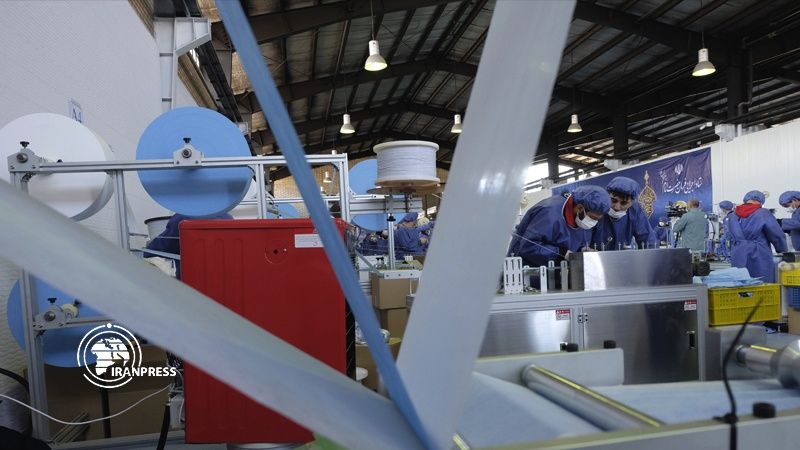
The largest mass-produced face masks factory in Southwest Asia was put into operation in Eshtehard Industrial Town of Alborz province, west of Tehran. The head of the Execution of Imam Khomeini’s Order, Mohammad Mokhber said the factory will produce every day four million masks equipped with a nano filter, which guarantees a high level of protection.
Accusations, lies, more sanctions, and warmongering
The outbreak of the pandemic in Iran and China, two largest rival countries in Asia, had come as a refreshing for American politicians. In the Chinese case, they hoped for their economic slowdown and the deterioration of their international reputation, thus opening space for expanding and strengthening America’s international policies and position. In the case of Iran, expectations were much higher. Before coronavirus fully took hold in the U.S., the Trump administration appeared to be viewing the outbreak as an opportunity to gain advantage by amplifying its maximum pressure strategy, the view that by squeezing Iran’s economy crippling sanctions will force Tehran to choose between its own economic viability and geopolitical independence.
When Iran asked for international medical assistance, lifting sanctions and a loan from the IMF, the Trump administration saw it as a confirmation of the success of their policies. Instead of showing signs of goodwill for Iranian demands, the proudly compassionate United States responded by announcing a new round of economic sanctions aimed at closing loopholes that might allow Iran to export its products and leave it in scarcity of money then desperately needed for respirators, face masks, and other medical equipment. Formerly called blockade or embargo, now rebranded as “economic sanctions,” embody the beloved fantasy that coercive pressure alone can make countries submit to America’s will.
The U.S. Treasury says its sanctions do not prohibit humanitarian contributions that ease coronavirus pressure on Iran, a claim the Iran’s Foreign Ministry has called deception. Even though the U.S. claims that its sanctions don’t prevent the sale of medicine and medical devices, the secondary sanctions on financial institutions and businesses have prevented Iran from buying necessary items like ventilators that could save the lives of coronavirus patients. The problems do not stop there, for example the Iranian government released an official coronavirus app for Iranians, but Google pulled it from its app store due to U.S. sanctions. Basically, the U.S. government has taken the same approach as during the last year’s floods in Iran, when they prevented international aid.
In addition to preventing international aid to Iran, we have also seen crocodile tears and false mercy from Trump and his administration, allegedly offering their own coronavirus aid “if Iranians ask for it.” Only someone extremely naive can believe in the sincerity of this offer, considering that they have prevented the aid of other countries, and even stolen medical equipment from Italy, France, Germany and Canada. There is no trace of U.S. aid collection for Iran, which, after all, could have been sent quietly. For example, even though they were in a more difficult situation at the end of March, the Iranians collected medical aid for the American people and sent it through the Swiss Embassy, without media noise. The truth is that Trump had no intention of sending any aid, in fact he just wanted to hear Iranian begging and then use it for propaganda purposes. Of course, Iranians did not bite it and rejected the offer. Still, the fake aid offer and Iran’s refusal were later reported in many Western media as key evidence of U.S. benevolence and Iranian cruelty.
After putting Iran in an unpleasant situation, U.S. politicians began pouring bizarre accusations against the Iranian authorities. Mike Pompeo, Brian Hook and Morgan Ortagus accused Iran of “lying” about the coronavirus outbreak and “stealing” funds intended for the fight against pandemic. “It’s not the sanctions, it’s the regime,” Ortagus claimed. Aggressive elements within the U.S. government have even begun calling for war on Iranian-backed militias in Iraq, thinking that Iran is in too difficult a crisis to respond adequately.
The alleged Iranian incompetence required some kind of evidence, so the new U.S. disinformation campaign was launched. Anti-Iranian propaganda has mostly focused on exaggerating the numbers of infected and dead, despite the fact that the World Health Organization confirms Iranian reports as credible. The Washington Post has turned to publishing fake news, claiming that Iran has dug mass “burial pits” in Qom for victims of the disease. Netanyahu went even further, sharing a video clip from a 2007 TV mini-series, as the evidence of Iranian trying to hide the true number of fatalities.
Numerous Western media have kept up with similar nonsense and hateful claims. One of the finest examples is the op-ed piece by Graeme Wood for The Atlantic. “Iran cannot handle the coronavirus,” he claims in the title, further representing Iran as the Orientalist dystopia. The city of Qom, with over 1.2 million inhabitants, for Wood is “a small city” with “cramped hotels, communal toilets, junk food and unhygienic scenes,” a sort of “Shiite Disneyland,” assuring his audience “that comparison might be the best way for Americans to understand the gravity of this outbreak.” Then he jumps to the ideological patriotism, claiming China’s authoritarianism has the advantages in dealing with a disaster like this, while Iran’s authoritarianism has none. He claims that Iran has no intention of closing the holy shrines, despite the fact that they were closed shortly after.
Wood also shows video of Iraj Harirchi, a top Iranian health official who has contracted the coronavirus, describing it as “incredible” and “comic,” calls Iranian officials “notoriously cruel,” and the country as the place where “incompetence and evil become indistinguishable.” This op-ed perfectly summarizes the distorted vision given by everyone from the American leadership to the authors of racist cartoons on social networks: Iran is bad, dirty, everything opposite to the U.S., and it will fall. After all, deadly disasters occur only in far off Oriental despotates, never in famed liberal democracies. Except Italy. And except for the post-March 2020 period.
Coronavirus knocks at the U.S. door
In mid-March, the coronavirus knocked heavily on the U.S. door and from the wealthiest country in the world, whose president boasts with the best institutions and whose government enjoys giving lessons to other countries, it was expected that pandemic would be a piece of cake. But what do we see, and what’s the difference between the U.S. and Iran? Inside Iran, we don’t see massive dissatisfaction or protests over the Khamenei’s and Rouhani’s crisis management, but according to a Gallup Poll conducted on 14 April, Trump’s approval rating is down significantly, now standing at 43%. We also see thousands of protesters in many U.S. states, with truly inspiring slogans demanding freedom and liberation. We don’t see chaos in Iranian hospitals either, but we do see large-scale theft of equipment in U.S. hospitals, as well as U.S. nurses refusing to work due to lack of protective equipment. While the story of Qom’s mass burial pits is refuted to the last detail, it remains for Americans to explain burials of unclaimed bodies on Hart Island and in New York city parks.
The New York City itself today looks like Chernobyl or a “never-in-liberal-democracy” thing, a sort of Orientalist dystopia from Hollywood movies or unhygienic Disneyland from The Atlantic’s agitprop-eds. With junk food, or no food on the shelves at all. We don’t see hungry Iranians begging the Trump administration for help, but we see such moans on the multi-billion-dollar U.S. aircraft carriers. We don’t see any regime change in Tehran, but we do see dismissal of the U.S. aircraft carrier’s captain, only because he dared to seek help for his infected sailors. There’s no trace of the alleged Iranian government’s “lying” or “theft,” but there is overwhelming evidence of U.S. piracy of protective masks around the world. This evidence comes from the governments of Italy, Germany, France and Canada. If U.S. authorities cooperated with Iranian experts at the outbreak of the pandemic, they would surely have had fewer casualties at home. But they did not want to cooperate, as with Chinese experts, they just looked like scavengers. Now, Trump is blaming the WHO, which has replaced Iran as a bogeyman.
We also don’t see the collapse of the Iranian economy, although by 18 April around 600,000 people had registered as unemployed. By comparison, over 22 million Americans had lost their jobs by the same date, proportionally ten times more. Moreover, we don’t see the collapse of the Iranian oil industry, nor their tankers floating hopelessly alone on the sea. During the pandemic, Iran has launched 25 new electricity projects in five provinces worth nearly half a billion dollars, successfully installed a giant oil drilling platform at Salman oilfield, as well as a gas drilling rig in the Persian Gulf. All domestically produced, and all for the domestic market. In contrast, we are witnessing a historic oil crisis in the West, the collapse of the North American shale industry, and a crowd of full oil tankers parked off the U.S. coast with nowhere to unload. In other words, in their backyard they are looking at a scenario they intended for Iran two years ago, or one that they had hoped for when a pandemic broke out in that country. Yet Iran has proven to be much more resilient and effective.

Everything seen before
Despite all the obstacles and wet dreams of its enemies, Iran has not fallen, and it will not fall. Its initial perceived weakness subsequently proved to be false. Iran did not ask for aid and the IMF loan because it could not cope alone with the crisis, but to accelerate the fight against the pandemic. Negative responses to Iran’s demands and attempts to block other countries from sending aid are a wake-up call for the last naives who think the U.S. government has compassion for anyone’s civilian population. Or even their own. The mask thefts from their own allies also prove that the U.S. government will treat everyone the same way as Iran. As a nation with a strong sense of identity and group responsibility, Iran has proven to be extremely enduring in similar historical situations. In the 1980s, Iran withstood the aggression of the fourth largest army, backed by America and all the world powers, and a decade later it rebuilt the country despite being more isolated and weaker than today.
Even deadly disasters, accompanied by aid refusals and military aggression, are not unseen in Iranian history. Going back a century, Iran has been hit by an epidemic and mass famine that has claimed two million lives, or 20% of the total population. In 1918 the Iranian government asked the U.S. for a multi-million-dollar loan to be used solely for famine relief, but Washington refused. Furthermore, the British recognized the perfect circumstance to temporarily occupy the western parts of Iran and impose a humiliating agreement that was terminated by the Iranian parliament in June 1921. This is also a lesson for those who think that Anglo-American vulturous policy towards Iran began in 1979 or 1953. Going back a century or two more, in 1820 and 1721 northwestern Iran was hit by catastrophic earthquakes, and the city of Tabriz recorded tens of thousands dead. Just a few months after both events, the Ottomans invaded Iran, but were repulsed soon after both times. Today we are witnessing the centennial repetition of history, with new fools repeating old mistakes and expecting different results.
Ukraine Asks Russia to Fill Its Budget Holes
By Paul Antonopoulos | May 6, 2020
The ambitious Nord Stream 2 pipeline project aims to deliver Russian gas to Europe via the Baltic Sea, thus bypassing Ukraine and reducing risk from Russia’s perspective. While Ukraine has consistently said it will prevent the completion of the Nord Stream 2 pipeline, the country is now also offering Russian state-owned Gazprom its gas storage facilities.
However, there are two major reasons why Moscow might not agree to Ukraine’s offer:
Moscow has difficulty in having confidence in Ukraine considering it maintains a pro-NATO policy.
Russia has enough of its own warehouses to store gas.
Although the proposal for storing Russian gas in Ukraine first appears logical, given the huge lack of trust in bilateral relations, this is a rather ambitious proposal by Kiev as it also continues to do everything in its power to prevent the construction of Nord Stream 2.
The Director General of the Ukrainian gas transportation system Sergei Makogon suggested that Gazprom lease Ukrainian underground gas storage facilities for the temporary storage of Russian gas transported to Europe. He said it would be three to five times cheaper for Gazprom than it costs in European Union countries who consume this gas – just $10 per thousand cubic meters. He added that in winter, as demand grows in the European Union, Gazprom will be able to take gas from underground Ukrainian gas storage facilities and send it to Europe.
He also predicts that Ukraine may end its role as a Russian gas transit in 2025 after the five-year contract between Russia’s Gazprom and Ukraine’s Naftogas expires, along with the completion of the Nord Stream 2 gas pipeline. This would be another major economic blow to Ukraine when considering after the first leg of the Turkish Stream was put into operation, the Ukrainian system had already lost 15 billion cubic meters of annual transit. The loss Ukraine faces because of the Turkish Stream will become even greater with the second phase of the pipeline that will run through Bulgaria, Serbia and Hungary, and account for another 15 billion cubic meter loss, is complete..
Although Makogon said he hopes Ukraine can store gas on behalf of Russia, he also announced that Ukraine “will make every effort to prevent the completion of Nord Stream 2, as this project has a clear political character and runs counter to European principles of solidarity.” So effectively he made two contradictory statements as one is friendly and the other is aggressive, thus again demonstrating why Russia finds it difficult in trusting Ukraine.
Russian officials point out that there is sufficient gas storage in Russia’s territory and that Russia does not currently need the assistance of other countries in this regard. Even if there is a need to rent a warehouse, in the case of Ukraine, a competitive price will not be sufficient as guarantees for safeguarding Russian gas will be needed so theft that has happened in the past will not be repeated.
It also needs to be factored in that because of the coronavirus, there is a decline in gas consumption. The need for gas storage will increase in winter – this is seemingly obvious. However, we are now only weeks away from summer and the demand for gas will significantly reduce, in addition to the fact that Gazprom has sufficient capacity for its own storage. Therefore, Makogon’s proposal for Ukraine to store Russian gas is actually a more of a desperate plea linked to the fact that Ukraine is experiencing a significant economic downturn, and the head of the Ukrainian gas transportation system is looking for an opportunity to somehow fill the deep budget holes.
It should also be considered that the infrastructure Ukraine is offering to Russia is generally 50 years old. Because of all this, it is highly unlikely that there will be agreements for the storage of Russian gas made between Moscow and Kiev.
Remembering that after tough negotiations last December, Kiev and Moscow signed a five-year agreement on the transit of Russian gas to Europe via Ukraine. The new contract stipulates that Gazprom will send at least 65 billion cubic meters of gas through Ukraine in the first year and then at least 40 billion annually from 2021 to 2024. This five-year agreement will bring Kiev more than $7 billion, which is critical for its short-term economic survival, but what then after that?
Featured Video
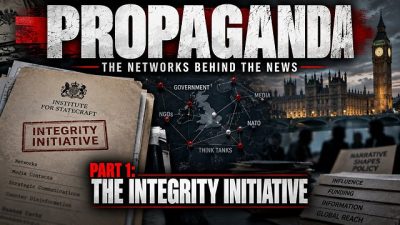
Integrity Initiative: UK-funded network framed dissent as Russian disinformation for years
or go to
Aletho News Archives – Video-Images
From the Archives
Why Saudi Ties to 9/11 Mean U.S. Ties to 9/11
By Kevin Ryan | Dig Within | September 27, 2015
Media interest in Saudi Arabian connections to the crimes of 9/11 has centered on calls for the release of the 28 missing pages from the Joint Congressional Inquiry’s report. However, those calls focus on the question of hijacker financing and omit the most interesting links between the 9/11 attacks and Saudi Arabia—links that implicate powerful people in the United States. Here are twenty examples. … continue
Blog Roll
 Aletho News
- Iraqi Resistance faction links arms to sovereignty, questions US exit
- Cannon fodder no more… South Korea rejects Trump’s pressure to join his criminal war on Iran
- Neria Leiter Was A Legitimate Military Target
- Integrity Initiative: UK-funded network framed dissent as Russian disinformation for years
- ‘We don’t seek permission to defend our country’: Snippets from President Pezeshkian’s UNGA address
- NATO chief wants Europeans to fight American wars [for Israel]
- German chemicals giant reveals details of downsizing
- Refaat Al-Areer Was The Canary In The Coal Mine In Israel’s War On The Truth
- Israeli election committee bars candidate from Knesset race over Gaza war opposition
- French-Lebanese man files war crimes complaint over Israeli attacks
- If Americans Knew
- Aid, reconstruction, and Israel’s history of obstruction in Gaza
- Trump administration digs an ever-deeper hole of complicity in genocide – Daily Update
- US-Israel $2.8 Billion Arms Deal, 40,000-Bomb Supply Faces New Gaza Complicity Accusations
- Caught on Tape: AIPAC CEO Boasted of Controlling Trump’s National Security Officials
- Why Hamas Attacked Israel in October 2023 – Israeli professor Ilan Pappé
- They see them, then kill them: Israeli quadcopters track, deliberately target civilians in Gaza
- Winter could turn Gaza’s treacherous, war-damaged buildings into deathtraps
- Majority of Democratic Voters Want to Prosecute Both Biden and Trump Administration Officials Over Gaza
- As Gaza languishes, world leaders gather at the UN – Daily Update
- Sanctions are collective punishment: immoral and self-defeating
- No Tricks Zone
- New Study: Earth And Venus Surface Warmth Largely Explained By Convection And Lapse Rate, Not CO2 Or Radiation
- 2025 Nature Paper Claiming Worsening Global Drought Gets RETRACTED …Heavily Flawed
- New Study: ‘Global Drought Shows No Detectable Recent Acceleration Under Climate Warming’
- Economic Masterminds: German Socialists Suggest Taxing Productivity Gains Stemming From Using AI
- The South China Sea Has Not Been Cooperating With The Climate Change Narrative
- Energy Crisis: Germany Enters Heating Season With Historically Low Gas Reserve Fill Levels
- New Study: The Antarctic Ice Sheet Gained Mass From 2020-2024 Due To Staggering Snow And Ice Accumulation
- Study: Ocean Heating Rates From Thousands Of Years Ago ‘Dwarf’ Modern Ocean Heating Rates
- Climate Extremists Target, Attack Large-Scale Power Grid Infrastructure In Germany!
- New Study: Antarctic Ice Melt Has Contributed Less Than 1 Centimeter To Sea Level Rise In The Last 30 Years

