Does Germany blame Russia for cyberattacks to appease Washington?
By Paul Antonopoulos | June 5, 2020
Berlin is insistent on maintaining problematic relations with Moscow by making claims against Russia. Long-time German Chancellor Angela Merkel accused Russia in the Bundestag that she was the target of Russian hackers, adding that she had concrete proof of the “outrageous” spying attempts, without actually providing any evidence. She even went on to suggest that sanctions could be placed against Russia.
The German Foreign Ministry said in a statement on May 28 that “The Russian ambassador was informed that on the basis of an arrest warrant issued by the federal prosecutor’s office on May 5 against Russian national Dmitry Badin, that the German government will seek in Brussels to use the EU cyber sanctions regime against those responsible for the attack on the German Bundestag, including Mr Badin.”
The alleged cyberattack occurred in 2015 and brings to question why Berlin is now resurrecting a 5-year-old issue that Russian Foreign Minister Sergei Lavrov highlighted there was no evidence for Russian involvement. EU High Representative for Foreign and Security Policy, Josep Borrell, shared Lavrov’s sentiment and said he also did not have data on a cyberattack on the Bundestag and could not comment on this issue despite Berlin’s threat that it will use the EU to place sanctions on Russia.
“As for Russian hacker attacks, I don’t have any information that I can provide you at this stage,” said Borrel, answering a question from journalists about the possible imposition of sanctions on this case against Russians.
Perhaps as the U.S. continues to threaten companies involved in NordStream 2, Berlin is giving the appearance that it is still anti-Russia, despite being almost entirely reliant on Russia for its energy needs. Also, as Berlin has not provided evidence that Russia was behind the cyberattacks, why has it also not considered the U.S. could have orchestrated the attack?
In October 2013, Steffen Seibert, an official spokesman for the German government, reported that former CIA officer Edward Snowden had warned Germany that U.S. intelligence agencies could track Merkel’s mobile phone. Despite numerous demands from the public to conduct a full investigation and prosecute those responsible for this incident, in June 2015 the German Federal Prosecutor’s Office announced that the case was closed due to the inability to prove it in court.
Although the case allegedly could not be prosecuted, it does call to question why Merkel through a spokesperson told U.S. officials that they “view such practices [like spying] … as completely unacceptable.” White House spokesman Jay Carney said in response that “the United States is not monitoring and will not monitor the communications of the chancellor.”
In a statement, the German government said that “Among close friends and partners, as the Federal Republic of Germany and the U.S. have been for decades, there should be no such monitoring of the communications of a head of government.” The statement also said that Merkel had told Obama that “such practices must be prevented immediately.”
However, this is an incident that took place seven years ago and under a different U.S. administration and political party. None-the-less, in February 2019, a scandal erupted around Swiss company Crypto AG which was developing equipment used to encrypt sensitive information, and was working closely with the CIA and the BND (German intelligence). It was revealed that for more than half a century this practise was going on, demonstrating that U.S. spying on its own allies is not a new phenomenon.
Investigators from the German television station ZDF and The Washington Post found that the illegal actions by U.S. and German intelligence services affected more than 120 countries. The Swiss company supplied products as far back as the Second World War with encryption weaknesses so U.S. and German intelligence agencies could spy on many countries, including their own allies. Though the BND stopped participating in this Rubicon operation, as it came to be known, in 1993, the U.S. continued to spy until 2018.
After such cooperation with the U.S., information about the wiretap of the German Chancellor, which remained without a harsh reaction, is presented in a completely different light. Berlin probably had to quietly take the insult in order to avoid major and public problems because the NATO allies have likely gathered a lot of damaging information about each other over the years in their joint work in the Rubicon operation. It is worth to mention that Germany is not an ordinary European state, but the power engine of the European Union and an important member of NATO.
Now Germany decisively accuses Russia of cyberattacks and threatens sanctions, despite not providing any evidence for their claims. Although Russia, unlike the U.S., did not wiretap the German government, it is much safer to blame Russian citizens for cyberattacks. It does bring into question however why Germany is even possibly discussing sanctions while it fully supports the NordStream 2 pipeline project to secure its energy interests with Russia.
Paul Antonopoulos is an independent geopolitical analyst.
The Media Has Conveniently Forgotten George W. Bush’s Many Atrocities
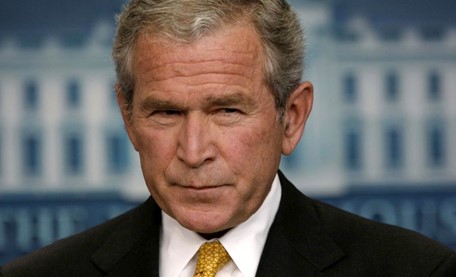
By James Bovard | Mises Wire | June 4, 2020
Former president George W. Bush has returned to the spotlight to give moral guidance to America in these troubled times. In a statement released on Tuesday, Bush announced that he was “anguished” by the “brutal suffocation” of George Floyd and declared that “lasting peace in our communities requires truly equal justice. The rule of law ultimately depends on the fairness and legitimacy of the legal system. And achieving justice for all is the duty of all.”
Bush’s declaration was greeted with thunderous applause by the usual suspects who portray him as the virtuous Republican in contrast to Trump. While the media portrays Bush’s pious piffle as a visionary triumph of principle, Americans need to vividly recall the lies and atrocities that permeated his eight years as president.
In an October 2017 speech in a “national forum on liberty” at the George W. Bush Institute in New York City, Bush bemoaned that “Our politics seems more vulnerable to conspiracy theories and outright fabrication.” Coming from Bush, this had as much credibility as former president Bill Clinton bewailing the decline of chastity.
Most media coverage of Bush nowadays either ignores the falsehoods he used to take America to war in Iraq or portrays him as a good man who received incorrect information. But Bush was lying from the get-go on Iraq and was determined to drag the nation into another Middle East war. From January 2003 onward, Bush constantly portrayed the US as an innocent victim of Saddam Hussein’s imminent aggression and repeatedly claimed that war was being “forced upon us.” That was never the case. As the Center for Public Integrity reported, Bush made “232 false statements about weapons of mass destruction in Iraq and another 28 false statements about Iraq’s links to Al Qaeda.” As the lies by which he sold the Iraq War unraveled, Bush resorted to vilifying critics as traitors in a 2006 speech to the Veterans of Foreign Wars.
Bush’s lies led to the killing of more than four thousand American troops and hundreds of thousands of Iraqi civilians. But since those folks are dead and gone anyhow, the media instead lauds Bush’s selection to be in a Kennedy Center art show displaying his borderline primitive oil paintings.
In February 2018, Bush was paid lavishly to give a pro-democracy speech in the United Arab Emirates, ruled by a notorious Arab dictatorship. He proclaimed: “Our democracy is only as good as people trust the results.” He openly fretted about Russian “meddling” in the 2016 US election.
But when he was president, Bush acted as if the United States were entitled to intervene in any foreign election he pleased. He boasted in 2005 that his administration had budgeted almost $5 billion “for programs to support democratic change around the world,” much of which was spent on tampering with foreign vote totals. When Iraq held elections in 2005, Bush approved a massive covert aid program for pro-American Iraqi parties. The Bush administration spent over $65 million to boost their favored candidate in the 2004 Ukraine election. Yet, with boundless hypocrisy, Bush proclaimed that “any (Ukrainian) election… ought to be free from any foreign influence.” US government-financed organizations helped spur coups in Venezuela in 2002 and Haiti in 2004. Both of those nations, along with Ukraine, remain political train wrecks.
In that October 2017 New York speech, Bush proclaimed: “No democracy pretends to be a tyranny.” But ravaging the Constitution was apparently part of his job description when he was president. Shortly after 9-11, Bush turned back the clock to before 1215 (when the Magna Carta was signed), formally suspending habeas corpus and claiming a prerogative to imprison indefinitely anyone he labeled a terrorist suspect. In 2002, Justice Department lawyers informed Bush that the president was entitled to violate the law during wartime—and the war on terror was expected to continue indefinitely. In 2004, Bush White House counsel Alberto Gonzales formally asserted a “commander-in-chief override power” entitling presidents to ignore the Bill of Rights.
Under Bush, the US government embraced barbaric practices which did more to destroy America’s moral credibility than all of Trump’s tweets combined. Bush’s “enhanced interrogation” regime included endless high-volume repetition of a Meow Mix cat food commercial at Guantanamo, head slapping, waterboarding, exposure to frigid temperatures, and manacling for many hours in stress positions. After the Supreme Court rebuffed some of Bush’s power grabs in 2006, he pushed through Congress a bill that retroactively legalized torture—one of the worst legislative disgraces since the Fugitive Slave Act of 1850. During his years in the White House, Bush perennially denied that he had approved torture. But in 2010, during an author tour to promote his new memoir, he bragged about approving waterboarding for terrorist suspects.
Is Bush nominating himself to be the nation’s racial healer? When he was president, Bush inflicted more financial ruin on blacks than any president since Woodrow Wilson (who brought Jim Crow barbarities to the federal government). Bush trumpeted his plans to close the gap between black and white homeownership rates and promised in 2002 to “use the mighty muscle of the federal government” to solve the problem. Bush was determined to end the bias against people who wanted to buy a home but had no money. Congress passed Bush’s American Dream Downpayment Act in 2003, authorizing federal handouts to first-time homebuyers of up to $10,000 or 6 percent of the home’s purchase price. Bush also swayed Congress to permit the Federal Housing Administration to make no–down payment loans to low-income Americans. Bush proclaimed: “Core American values of individuality, thrift, responsibility, and self-reliance are embodied in homeownership.” In Bush’s eyes, self-reliance was so wonderful that the government should subsidize it. And it didn’t matter whether recipients were creditworthy, because politicians meant well. Bush’s 2004 reelection campaign trumpeted his down payment giveaways, a shining example of “compassionate conservatism.”
Thanks in large part to his policies, minority households saw the fastest growth in homeownership leading up to the 2007 recession. The housing collapse ravaged the net worth of black and Hispanic households. “The implosion of the subprime lending market has left a scar on the finances of black Americans—one that not only has wiped out a generation of economic progress but could leave them at a financial disadvantage for decades,” the Washington Post reported in 2012. The median net worth for Hispanic households declined by 66 percent between 2005 and 2009. That devastation was aptly described in a 2017 federal appeals court dissenting opinion as “wrecking ball benevolence” (quoting a 2004 Barron’s op-ed I wrote). But almost none of the media coverage of the ex-president reminds people of the economic carnage of this Bush vote-buying binge.
It is possible to condemn police brutality and, even more importantly, the evil laws and judicial doctrines that enable police to tyrannize other Americans without any help from a demagogic ex-president who ravaged our rights, liberties, and peace. As I commented in an August 2003 USA Today op-ed, “Whether Bush and his appointees will be held personally liable for their [Iraq War] falsehoods is a grave test for American democracy.” The revival of Bush’s reputation vivifies how our political media system failed that test. As long as George Bush doesn’t turn himself in for committing war crimes, all of his talk about “achieving justice for all” is rubbish.
James Bovard is the author of ten books, including 2012’s Public Policy Hooligan, and 2006’s Attention Deficit Democracy. He has written for the New York Times, Wall Street Journal, Playboy, Washington Post, and many other publications.
Rush to trash hydroxychloroquine exposes fundamental flaws in profit-based medical ‘science’
By Helen Buyniski | RT | June 4, 2020
As the WHO and prestigious medical journal the Lancet back away from questionable data provided by healthcare analytics firm Surgisphere, ulterior motives for the rush to demonize hydroxychloroquine become clear.
The World Health Organization (WHO) sheepishly resumed testing the off-patent malaria drug hydroxychloroquine on coronavirus patients on Wednesday after pausing that arm of its ‘Solidarity’ clinical trial based on data that appeared to show the drug contributed to higher death rates among test subjects. That data, it turned out, came from a tiny US healthcare analytics firm called Surgisphere, and calling it faulty would be excessively charitable.
Not only is Surgisphere a company lacking in medical expertise – its employees included an “adult” entertainer and a science-fiction writer – but its CEO Sapan Desai co-authored two of the damning studies that used the firm’s data to smear hydroxychloroquine, already thoroughly demonized in the media thanks to its promotion by US President Donald Trump, as a killer. All data is sourced to a proprietary database supposedly containing a veritable ocean of real-time, detailed patient information yet curiously absent from existing medical literature.
The Surgisphere-tainted study appeared to show increased risk of in-hospital deaths and heart problems with no disease-fighting benefits, confirming the suspicions of medical-industry naysayers already inclined to hate the off-patent drug due to the lack of profit potential and Trump’s incessant boosterism. Italy, France, and Germany rushed to ban hydroxychloroquine, citing “an increased risk for adverse reactions with little or no benefit.”
But such a shameless character assassination performed against a potentially-lifesaving drug – especially one with a decades-long track record of safety in malaria, lupus, and arthritis patients that came highly recommended by some of the world’s most eminent disease experts, including France’s Didier Raoult – could only be accomplished with help from industry prejudice. It required ignoring numerous existing studies showing hydroxychloroquine was beneficial in treating early-stage Covid-19 patients, as well as anecdotal reports from thousands of doctors who’d successfully used it.
It also required trusting a fly-by-night company with next to no internet or media presence to make decisions that could affect the lives of millions of people. It’s not like there weren’t warning signs Surgisphere was something other than the top-notch medical analytics firm it presented itself as. The company began life as a textbook publisher in 2008 and hired most of its 11 employees two month ago, according to an investigation by the Guardian, yet it claimed ownership of a massive international database of 96,000 patients in 1,200 hospitals worldwide. One expert interviewed by the outlet said it would be difficult for even a national statistics agency to do in years what Surgisphere had supposedly done in weeks, calling the database “almost certainly a scam.” Yet no one at the Lancet or WHO thought to look a gift horse in the mouth – not when that gift drove a stake through the heart of hydroxychloroquine as Covid-19 treatment.
And while Australian researchers found flaws in the Surgisphere data just days after the May 22 publication of the Lancet study, noting that the number of Covid-19 deaths cited by the study as coming from five hospitals exceeded the entirety of Covid-19 deaths recorded in Australia at that time, the Lancet – instead of investigating just who this Surgisphere company really was, and why it had made such a glaring mistake – merely published a minor retraction related to the Australian data and put the controversy to bed.
The full-frontal assault on hydroxychloroquine was instead allowed to continue unchecked in the media, as mainstream outlets focused their energies on fluffing up remdesivir – a costly, untested drug manufactured by drug maker Gilead that has so far produced lackluster results in clinical trials – and stumping for an eventual vaccine. Hydroxychloroquine’s off-patent status meant it was a dead end as far as profits were concerned, while remdesivir and whatever vaccine is ultimately green-lighted will make a lot of people very rich. Perhaps hoping to throw their audiences off the real reason for their hydroxychloroquine hatred, several outlets hinted that Trump stood to make money off the drug (which costs about 60 cents per pill) – but even Snopes, no fan of the ‘Bad Orange Man’, had to pour cold water on that speculation.
The Lancet and New England Journal of Medicine have – belatedly – published “expressions of concern” about the Surgisphere hydroxychloroquine study, and an independent audit is being conducted. But the problem of biased health authorities selectively embracing some trial results while rejecting others is unlikely to stop there.
The Lancet study is hardly the only one to show hydroxychloroquine lacks efficacy in treating Covid-19. Multiple studies conducted by the US National Institutes of Health on hospitalized (i.e. severely-ill) coronavirus patients have yielded poor results, but even the drug’s most ardent evangelists acknowledge it doesn’t help end-stage or very sick patients. Raoult has even claimed France banned the drug’s use in all but the most severely ill patients in order to discredit it as a treatment. The US National Institutes of Health was publishing studies in its journal Virology touting chloroquine as “a potent inhibitor of SARS coronavirus infection” as far back as 2005, yet ‘coronavirus czar’ Anthony Fauci throws shade at the drug whenever he gets a chance.
As long as deadly diseases like Covid-19 are seen as profit sources first and human rights issues second (or third, or tenth…), treatments that aren’t profitable will always be marginalized in favor of costly and frequently less-effective pharmaceuticals. Drug industry profiteering has already killed hundreds of thousands – if not millions – of people in the US alone. Taking the profit motive out of healthcare can help ensure its body count stays as low as possible.
Helen Buyniski is an American journalist and political commentator at RT. Follow her on Twitter @velocirapture23
UK battery electric car strategy is ‘doomed to failure’
By Andrew Forster | Transport Xtra | June 1, 2020
The Government’s push to electrify road transport is based on naivety, the undue influence of the Committee on Climate Change, and a lack of engineering expertise within Government, an academic has said.
Professor Michael Kelly, the former chief scientific adviser to the Department for Communities and Local Government, issues the warning in a paper published by the Global Warming Policy Foundation.
He warns the Government’s ambitions for EVs and electric heating in buildings will end in damaging failure.
“When the penny drops and the progress towards all-electric UK is halted, we will be reminded of Ozymandias [two poems that describe how even the greatest men and the empires they forge are impermanent, their legacies fated to decay into oblivion – Ed].
“The rest of the world can look at Britain and choose whether to laugh or weep.”
On battery electric vehicles, he says: “Consider Dinorwig power station, the biggest hydropower energy storage plant in the UK. If all UK cars were battery powered, the nine gigawatts of energy stored behind the dam would be capable of recharging about 60,000 of them, or about 0.25 per cent of the UK fleet.”
If all vehicles have to be electric, “something of the order of 70 per cent of Britain’s entire existing electricity supply capacity will be needed”.
“When we get coded messages from the Climate Change Committee, implying that we will have to rethink the extent to which we are going to be able to travel in future, it is the implausibility of meeting that vast gulf in energy sources that is motivating them to question our lifestyles.”
Kelly points out that the Government’s net zero greenhouse gas target will also require the heating of buildings to be electrified using heat pumps. This will place huge additional demands on electricity supply, particularly in the winter.
Charging battery cars at night, when electricity demand from other sources is low, is only a “partial solution” to the problems, he says. “The current day-night variation in electricity demand is of itself too small to handle the extra load.
“Another suggestion is that we can charge cars during the day, when solar power is high. But in the absence of storage, this would mean charging them from mid-morning to mid-afternoon on sunny days. This is implausible too, and would be unreliable [even] if we could make it happen.”
Turning to local electricity supply issues, he says “we will be adding electric vehicle chargers and heat pumps to almost every home”.
“A fast EV charger for a car draws 7kW, perhaps for six hours, and a heat pump needs 3kW, potentially for much of the day. But the cabling and substations in most suburbs were sized and installed before these technologies were even thought of. So while there is sufficient headroom for electrification of a few households, the whole distribution system will need to be up- graded if demand grows.
“This work will be extraordinarily expensive, but without it there will either be regular ‘brownouts’, or drivers will have to be told where and when they can charge their batteries.”
Kelly dismisses battery storage as a major part of the solution. “The £45m battery installed by Elon Musk outside Adelaide, South Australia, can power that city for 30 minutes. If you wanted to be able to cover a week’s power outage after a major storm, it would cost around 1,300 times as much using batteries as it would with diesel generators. The idea is ludicrous.”
Turning to the raw materials needed to produce batteries, Kelly claims: “If we replace all of the UK vehicle fleet with EVs, and assuming they use the most resource-frugal next-generation batteries, we would need the following materials:
- 207,900 tonnes of cobalt – just under twice the annual global production;
- 264,600 tonnes of lithium carbonate – three-quarters of the world’s production;
- at least 7,200 tonnes of neodymium and dysprosium – nearly the entire world production of neodymium; and
- 2,362,500 tonnes of copper – more than half the world’s production in 2018.
“Put simply, we lack the ability to provide the infrastructure required to deliver electric cars and electric heating on the scale required by 2050.”
Kelly asks why we are trying to do so anyway and pins the blame on the Committee on Climate Change.
“An unelected body, the Committee displays many of the worst features of the administrative state. It has been grossly negligent in turning a blind eye to the complexity of electric vehicles and the related issue of the enforced switch to electricity for domestic heating.
“Committee members don’t have to face the consequences of their policies from voters; politicians, who do have to face the voters, hide behind the Committee in order to duck accountability.
“It is this failure of the UK’s political machinery that I believe is to blame for the situation in which we find ourselves.
“We have set out to decarbonise the economy without anyone having thought through all the engineering issues, let alone put a cost on the exercise.”
Kelly says that, with Covid-19, “it is clear that we will not be able to afford the costs of the net zero transition for decades, if ever”.
“To attempt to plough on would be madness; indeed, it would directly sabotage the UK economy, and without any measurable effect in terms of actually averting any climate change.”
“Surely now is the time for a root and branch cost-benefit review by independent engineers who have no skin in the game of electrifying the UK economy.”
Two U.S. senators determined to stop Nord Stream 2 by imposing extra sanctions
By Paul Antonopoulos | June 4, 2020
The Nord Stream 2 project involves the construction of two gas pipelines with a total capacity of 55 billion cubic meters of gas per year from Russia to Germany via the Baltic Sea. The gas pipeline will run through the territorial waters or exclusive economic zones of Russia, Finland, Sweden, Denmark and Germany. However, this gas pipeline is strengthening Russia’s relations with European states, making the U.S. desperate to end the project.
As reported by Bloomberg on Wednesday, U.S. senators are planning to extend sanctions against the Nord Stream 2 project. Sanctions are expected to target insurance companies associated with the project.
Senator Ted Cruz led the charge against Moscow and said the Russian pipeline is “a critical threat to America’s national security and must not be completed.” He added that Russian President Vladimir Putin is trying to circumvent the sanctions passed by Congress last year. He of course did not explain how a Russian pipeline a continent away from the U.S. and in northern Europe could impact their security.
Cruz, a Republican, was joined by Senator Jeanne Shaheen, a New Hampshire Democrat, who said that the pipeline “threatens Ukraine, Europe’s energy independence and gives Russia an opening to exploit our allies” and that “Congress must once again take decisive action and stand in this pipeline’s path.” He, just like Cruz, did not explain exactly how the pipeline is a threat or security concern, especially against Ukraine.
The pipeline does not threaten Europe’s energy independence, and rather, as is enshrined in a free market economy that the U.S. says it ardently defends, allows Europe to have another option for gas. Although Russian gas already reaches Europe, it goes via Ukraine that is volatile and a high risk for Russia. The Director General of the Ukrainian gas transportation system Sergei Makogon said earlier this year that Ukraine “will make every effort to prevent the completion of Nord Stream 2, as this project has a clear political character and runs counter to European principles of solidarity.”
With Russian gas to Europe at risk, the Nord Stream 2 project ensures Russia’s gas can reach European markets so it can compete with gas from Qatar, the U.S. and other sources. And here is where the problem lays for Washington. It is obviously absurd to suggest that Russian gas “threatens Ukraine” or is a “critical threat to America’s national security.” The proposed sanctions, that also have backing from Republican Senators John Barrasso of Wyoming and Ron Johnson of Wisconsin, are just part of the “gas wars” initiated by the U.S. to force countries to buy American liquefied natural gas.
Last week, former U.S. Ambassador to Germany, Richard Grenell, who resigned on June 2, said that new sanctions against Nord Stream 2 could be adopted by the U.S. Congress in an operational mode. Their purpose is to prevent commissioning of the gas pipeline.
At that time, media also swept on the news that an alleged dispute broke out between U.S. President Donald Trump and long-time German Chancellor Angela Merkel because of differences of opinion on the Nord Stream 2 project. However, neither Berlin nor Washington officially confirmed this rumour. Also, at the end of last year, the U.S. adopted a defense budget providing for sanctions on companies involved in laying the gas pipeline. As a result, the Swiss company Allseas stopped work and withdrew its ships. The head of the Ministry of Energy Alexander Nowak said after that Russia is able to complete the project itself however.
The Nord Stream 2 subsidiary, Gazprom Nord Stream 2, is building the gas pipeline. The annual meeting of Gazprom’s board of directors is scheduled for June 11 and it is expected the main topic of talks to be about the impact of Western sanctions on Gazprom and response measures. This is more crucial as now Poland has joined the U.S. in anti-Nord Stream 2 sanctions.
The Polish Office of Competition and Consumer Protection initiated a new proceeding against Gazprom regarding the construction of the Nord Stream 2 gas pipeline, threatening the Russian company with a fine of €50 million. The Polish office demanded that Gazprom provide documents regarding the project, namely contracts concluded between Gazprom’s subsidiary and other companies financing the construction of the gas pipeline. These were primarily contracts for the transmission, distribution, sale, supply and storage of gas fuels. Gazprom did not provide this information, and now Poland aims to fine the company.
Despite these pressures, in which Poland has a very minor part, Russia will unlikely be deterred by threats of sanctions. Russia has already learned long ago how to operate while under sanction and will continue to pursue projects that serve their state interests and integrate Russia closer to Europe. This is especially important as the European countries are more interested in convenient gas that is not only logistically easier, but cheaper than many other alternatives.
It is for this reason that Russian Ambassador to Washington, Anatoly Antonov, said that the U.S. will not be able to stop the construction of the Nord Stream 2 gas pipeline.
Paul Antonopoulos is an independent geopolitical analyst.
Foiling Predictions, Russians Did Not Go Hungry After 2014
Natylie Baldwin, in this excerpt from her new book, describes what happened after the U.S. and EU sought to punish Moscow with agricultural sanctions.
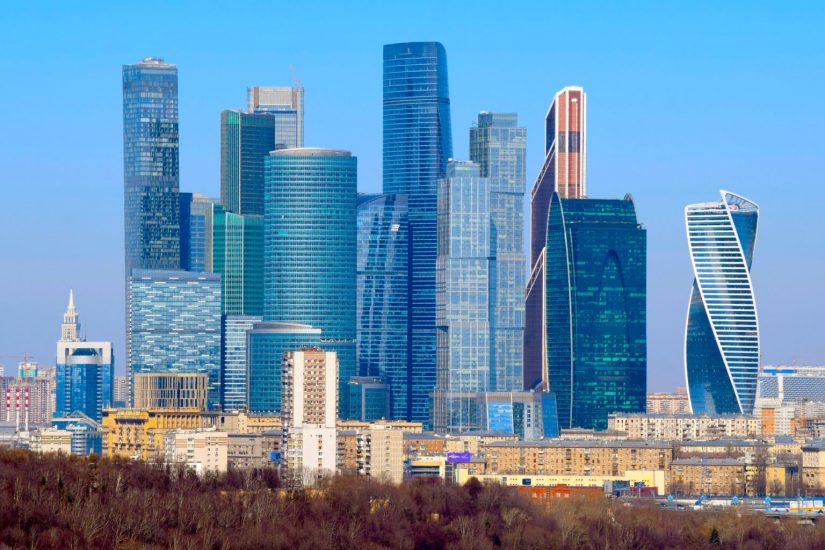
2019 view of Moscow International Business Center. (Dzasohovich, CC BY-SA 4.0, Wikimedia Commons)
By Natylie Baldwin | Consortium News | June 3, 2020
A common response in the Anglo-American media to Russia’s counter-sanctions against agricultural imports from the United States and EU in 2014 was that Russians would go hungry and were, therefore, shooting themselves in the foot. Within a matter of days of the announcement, however, numerous Latin American countries, namely Argentina and Brazil, got in line to fill the gap, as well as China, which started selling produce directly to Russia.
More importantly, according to the Food and Agriculture Organization, Russia ranked as one of the top three producers in the world for a range of agricultural products at the time, from various fruits and vegetables to grains, potatoes and poultry. As of 2018, it was the world’s top exporter of wheat. The government has also had plans in place since 2013 to significantly boost the country’s already respectable production of organic produce from small farms and gardens.
Natural Society reported in May 2014 that 35 million Russian families are growing an impressive percentage of Russia’s fruits and vegetables on 20 million acres:
According to some statistics, they grow 92% of the entire countries’ potatoes, 77% of its vegetables, 87% of its fruit, and feed 71% of the entire population from privately owned organic farms or house gardens all across the country. These aren’t huge Agro-farms run by pharmaceutical companies; these are small family farms and less-than-an-acre gardens.
By autumn 2017, Vladimir Putin had publicly set a goal for Russia to become the world’s top producer and exporter of organic agriculture. In the summer of 2018, the Russian president signed legislation creating official standards, labeling and certification procedures for organic products produced for commercial sale in Russia that went into effect in 2020. Government support will be available to organic farmers, and a public registry will be created listing certified producers.
The agricultural sanctions created some immediate problems, mainly temporary shortages of some meat products and price increases due to the need to work out infrastructure issues to accommodate imports from countries at greater distances.
But Russians did not go hungry, as I witnessed plenty of food in markets, from street vendors, and in restaurants in all cities I visited during my trips in 2015 and 2017. There was, however, concern over price increases.
Author Sharon Tennison, who has traveled throughout Russia extensively since 1983, reported the general attitude of most Russians toward Western sanctions during her trip to Moscow and St. Petersburg in September 2014:
The general outlook of Russians I spoke with is one of quiet confidence, saying that sanctions will turn out good for Russia in the long run––that Russia must become self-sufficient––remarking that Russia became infatuated with foreign products in the 1990s. At that time they felt Russia didn’t need to manufacture high-end products that they could purchase them from other countries. However, the situation has changed. Today production has become the “in” discussion wherever one goes. The sanctions have helped bring this about. Several Russians remarked that they hoped the sanctions lasted for three years or more, since that would give Russians sufficient time to learn to manufacture formerly imported items themselves. The Russian government is offering financial support to entrepreneurs who are ready to move into consumer production.
Sanctions Imposed
In March of 2014, the U.S. and the European Union (EU) began imposing sanctions on Russia in retaliation for its “annexation” of Crimea. These initial sanctions were largely comprised of asset freezes and visa restrictions on certain Russian officials. As the situation in Eastern Ukraine escalated, with rebels taking over local government buildings and demanding autonomy from what they perceived as a coup government in Kiev, the list of individuals targeted for sanctions grew.
After the downing of the Malaysia Airlines flight MH-17 in July 2014, the west imposed more wide-ranging sanctions, which included several Russian banks as well as the defense and energy sectors. In March of 2018, there were diplomatic “sanctions” (expulsions) for the alleged Skirpal poisoning, which Russia responded to with its own expulsions. That same month, there were business/personal sanctions against a number of Russians for their alleged interference in the 2016 elections.
In order to provide the most accurate and comprehensive assessment of the effect of Western sanctions on Russia over the past five years, University of Birmingham professor Richard Connolly, in his 2018 book, “Russia’s Response to Sanctions: How Western Economic Statecraft is Reshaping Political Economy in Russia,” describes how Russia’s economy actually works in order to provide a contextual framework for understanding the success or failure of the West’s policy. He concluded that the ultimate effect of the sanctions is likely not what was intended by Washington policymakers.
Economy with Four Sectors
Connolly explains that the Russian economy can be divided up into roughly four sectors.
Sector A generates revenue, or “rents,” in the form of taxes, fees and other benefits that support Sector B. Sector A is comprised largely of fossil fuel and mineral extraction industries but also includes large “agricultural conglomerates,” manufacturers of nuclear power generation equipment, and some defense industry manufacturers. Economic actors in Sector A are highly profitable and competitive in the global market, into which they are successfully integrated. The state also plays a strong role in Sector A industries either through significant ownership stakes, as is the case with Gazprom, Rosneft, and Rosatom, or through strong personal ties among private owners and the political class, as is the case with Lukoil and Novatek.
Sector B is comprised of economic actors that are dependent upon the rents generated by Sector A. This includes companies that are generally not competitive globally and provide goods and services to the domestic market rather than for export. Despite state assistance, they do not always generate consistent profits. Examples include automotive manufacturing, shipbuilding, fossil fuel equipment and some defense manufacturing. Other beneficiaries of Sector A include state bureaucracy workers and pensioners. It is estimated that Sectors A and B together comprise around 70 percent of the Russian economy.
Sector C is independent of Sectors A and B and includes large construction companies, retail and business services, and various small- to medium-sized enterprises (SMEs) in retail, transportation, business support and communications technology. Because these businesses are outside of the Sector A and B relationship, they’re dependent upon successful profit-making and tend to encourage more competition, innovation and productivity, though they are vulnerable to various forms of outside corruption and unfair takeovers. One successful example of a Sector C industry that enjoys significant and growing export rates is computer software.
 The last sector is the financial sector, which, as Connolly points out, developed virtually out of nothing over the past three decades into a system of numerous, largely state-owned or state-influenced banks that provide a wide range of services. However, Russia’s overall financial sector is small in comparison with other middle-income countries, with Sector A and B entities getting preferential treatment in receipt of the limited credit that is available. There are few small banks or other financial institutions that can provide SMEs with credit, as is reflected in the fact that, as of 2016, two-thirds of assets and liabilities were owned by large state-controlled banks.
As Connolly notes, the obvious disadvantages of this system of political economy are hobbled competition, innovation and productivity. It also limits the development of SMEs.
The advantages, however, include support of domestic employment and the funding of social programs. Perhaps most importantly, this system has also enabled the Russian state to cushion the country from the worst potential effects of Western sanctions and even encourage the stimulation of alternative economic investment, which has strengthened agriculture and some industry and finance.
In terms of how Russia responded to Western sanctions, Connolly provides the following summary:
The Russian response was multifaceted and included the securitization of strategic areas of economic policy, a concerted effort to support import substitution in strategic sectors of the economy, and vigorous efforts to cultivate economic relations with non-Western countries, especially in Asia.
Policy of Diversification
Securitization officially justified certain policies using national security and subordinating certain other objectives in the economic realm that might be prioritized under “normal” circumstances. In order to increase Russia’s economic independence or sovereignty, policies of import substitution and “diversifying” its range of foreign economic partners and the extent of those relations were implemented.
Import substitution involved increasing the proportion of goods and services in Russia that were produced domestically. As an official policy, it was begun in earnest after the imposition of Western sanctions. By 2015, the government was providing federal budget funding, facilitation of loans and access to state procurement funds as well as institutional support to specific sectors of the economy, which included the provision of legal and regulatory frameworks for such policies. In 2016, a plan was presented by Russia’s minister for industry and trade that encompassed “2,000 projects across nineteen branches of the economy. These projects were to be carried out between 2016 and 2020.”
By early 2018, there were 2,500 projects worth $38 billion that were to be completed by 2020. The areas of priority for industrial manufacturing included power equipment, oil and gas equipment, machine tool and civil aviation manufacturing, and agricultural machinery, all of which had import levels between 50 percent and 90 percent.
Gains in domestic food production were seen quickly as Russia became the world’s No. 1 supplier of wheat in early 2018, subsequently capturing over half of the world’s market. Wheat exports continue to increase; sales to other nations increased by 80 percent during the first half of 2018 over the same period in 2017.
Diversifying foreign economic relations is pretty self-explanatory, and in this case it focused heavily on countries in Asia such as China, India, Vietnam and South Korea, as well as Turkey and Latin America. Connolly points out that Russia did not present this as a “zero-sum” action and still conducts most of its trade with various European countries (46 percent of exports and 38 percent of imports). This fact should be considered when assessing the credibility of accusations against Putin that he wants to destroy the EU.
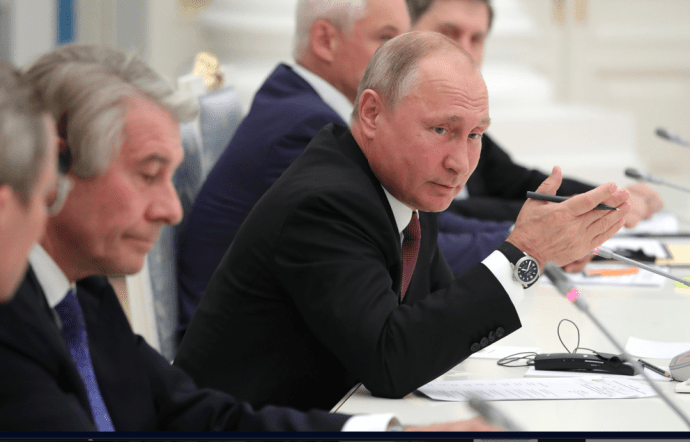
President Vladimir Putin meeting with German business executives, Nov. 1, 2018. (The Kremlin)
China, however, has now become Russia’s single largest trading partner, accounting for 10 percent of Russia’s exports and 22 percent of its imports. But this figure alone does not begin to provide the full picture of Russia’s increasing partnership with Eurasia in general and China in particular.
According to Asia Times correspondent Pepe Escobar, who has been closely following the trend of Eurasian economic integration for several years, what’s known in Russia as the “Greater Eurasia” project was recently presented to the Council of Ministers in Moscow and is now largely accepted as an entrenched foreign policy guide for Russia’s future.
After interviewing three top Russian academics and policymakers who have been championing the Greater Eurasia project for years, Escobar explained that the policy would not preclude continuing a relationship with Europe, recognizing that the Russian elite has been intimately influenced by European culture and trade and technology since the time of Peter the Great, but is meant to be a rebalancing toward the inevitable economic center that will soon be led by Asia and to serve as a “civilizational bridge” between east and west.
The New Silk Road
Situated as it is geographically, Russia is in a perfect position to play this role, serving as a cultural connector between the Enlightenment and the Mongols and as a physical connector between Europe and Asia. In terms of the latter, Russia will play a pivotal role in connecting China’s New Silk Road (aka Belt and Road Initiative, or BRI) through Russia and Central Asia and into Europe.
Escobar writes:
Greater Eurasia and the Belt and Road Initiative are bound to merge. Eurasia is crisscrossed by mighty mountain ranges such as the Pamirs and deserts like the Taklamakan and the Karakum. The best land route runs via Russia or via Kazakhstan to Russia. In crucial soft power terms, Russia remains the lingua franca of Mongolia, Central Asia and the Caucasus.
And that leads us to the utmost importance of an upgraded Trans-Siberian railway—Eurasia’s current connectivity core. In parallel, the transportation systems of the Central Asia “stans” are closely integrated with the Russian network of roads; all that is bound to be enhanced in the near future by Chinese-built high-speed rail.
. . . And all across the spectrum, Moscow aims at maximizing return[s] on the crown jewels of the Russian Far East: agriculture, water resources, minerals, lumber, oil and gas. Construction of liquefied natural gas (LNG) plants in Yamal vastly benefits China, Japan and South Korea.
Iran, Turkey, and India are all pivoting toward Eurasia as well, with a free trade agreement between Iran and the Russian-led Eurasian Economic Union having been recently approved. Iran is also playing a role in the International North-South Transport Corridor (INSTC) to facilitate closer economic cooperation between Russia and India, who have enjoyed cordial relations and strong trade in defense for decades.
But Russia and China’s “comprehensive strategic partnership” — as it is referred to officially by both countries — is much more than economic. In an unprecedented move, China sent 3,000 troops to join Russia in a 2018 military exercise to practice countering NATO in Eastern Europe. In July of 2019, “Russian and Chinese bombers conducted their first long-range joint air patrol in the Asia-Pacific.” To reinforce the strategic importance of Russian-Chinese relations, the day after these maneuvers, the Chinese government published a “white paper” in which it promised to further increase military cooperation between the two countries, partly as a result of the United States’s “undermining” of regional stability.
A former senior national security official in Russia described the relationship to National Interest correspondent Graham Allison as a “functional military alliance.” Allison elaborated that “Russian and Chinese generals’ staffs now have candid, detailed discussions about the threat US nuclear modernization and missile defense pose to each of their strategic deterrents.”
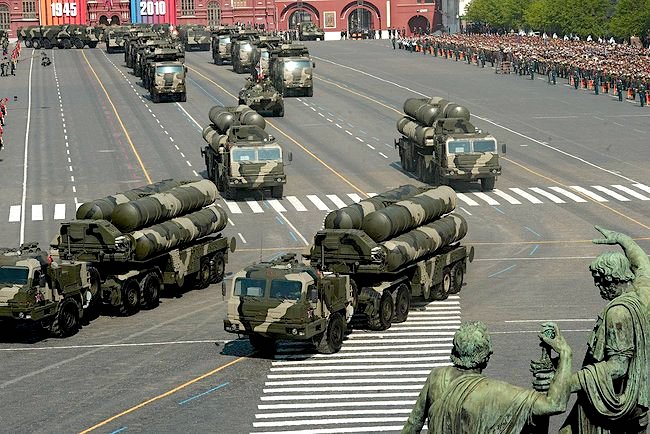
S-400 surface-to-air missile systems during the Victory parade 2010. (Wikimedia)
Allison also reiterated that Russia has lifted its decades-long withholding of advanced military technologies to its eastern neighbor, selling China the S-400 air defense system and partnering in research and development on rocket engines and drones. Furthermore, Russia and China vote the same on the UN Security Council 98 percent of the time, and Russia has supported all Chinese vetoes since 2007.
As evidence that the Russian public will likely support the Greater Eurasia project and Russia’s diversifying of economic partnerships in an eastern direction, recent polling reveals that 69 percent of Russians hold a positive view of China — the exact same percentage that hold a negative view of the United States. Two-thirds of Russians identify the United States as their nemesis, while only 2 percent identify China that way.
Now that we’ve explored how Russia has actually responded to Western sanctions, we can turn to the question of how effective those sanctions have been in terms of what their presumed intent was. As Connolly enumerates, in addition to sending a symbolic message of disapproval of Russia’s actions and to show a united front among Western allies, the intent among some policymakers was to cause significant economic harm to Russia—not just as a deterrent to further “bad behavior,” but with the idea that this would encourage political revolt among targeted Russian elites that would endanger Putin’s government and result in regime change with the installment of a new Russian leader that would be more amenable to Washington’s desires.
The answer is that Washington has once again — in its hubris and ignorance — been hoist with its own petard. As British scholar on Russia Paul Robinson sums up in his review of Connolly’s book:
First, it [sanctions] has created a system that “is less vulnerable to external pressure” than that which existed before, in that it is more independent from the West. Second, it has accelerated a shift in Russia’s place in the global economy towards the East. This obviously has political ramifications which Connolly does not explore. Somewhat perversely, Western sanctions have reduced, not increased, Western leverage over Russia. This is probably permanent.
Moreover, since Russia has weathered the sanctions reasonably well, even using them to strengthen certain sectors of its economy in the long term, the sanctions have likely failed as a tool of deterrence. As Connolly states:
How can policymakers expect sanctions to act as a credible deterrent to third countries when the target country in any given instance might appear to be coping or even flourishing under sanctions? In short, a significant and negative impact on the target economy is a necessary, although not sufficient, condition of sanctions to be effective.
For the policymakers implementing sanctions, it might have been worthwhile to have been briefed by real experts on what Russia’s economy is actually like. If they’d done so, they might have realized that sanctions were likely to have a limited effect on a country that, as analyst Patrick Armstrong has pointed out, has a “full-service economy.” In other words, Russia has demonstrated that it has both the natural and human resources to build sophisticated infrastructure, weapons and defense capabilities, a space station, military and commercial aircraft, heavy trucks and passenger cars, to provide energy and the attendant infrastructure, and to feed its people.
Instead, beliefs that Russia is a “gas station posing as a country,” or that it was still somehow frozen in the 1990s, underpinned policy decisions that ultimately failed.
Natylie Baldwin is author of “The View from Moscow: Understanding Russia and U.S.-Russia Relations,” from which this article is excerpted. “The View from Moscow” is available in e-book and print. She is co-author of “Ukraine: Zbig’s Grand Chessboard & How the West Was Checkmated.” She has traveled throughout western Russia since 2015 and has written several articles based on her conversations and interviews with a cross-section of Russians. She blogs at Natyliesbaldwin.com .
‘Wolf Warrior Diplomacy’: Israel’s China Strategy in Peril
By Ramzy Baroud | MEMO | June 3, 2020
Israel’s balancing act that allowed it to reap America’s unconditional and, often, blind support, while slowly benefiting from China’s growing economic influence and political prestige, is already floundering.
Thanks to the heated cold war between the US and Chinese economic superpowers, the Israeli strategy of playing both sides is unlikely to pay dividends in the long run.
Soon enough, Tel Aviv might find itself having to make a stark choice between Washington and Beijing. When US Secretary of State, Mike Pompeo, visited Israel on May 13, two items topped his agenda: Israel’s imminent illegal annexation of Palestinian land and the growing Israeli-Chinese economic ties.
Pompeo communicated his country’s stand on both issues, reflecting Washington’s long-standing policies regarding Palestine and China. In the case of Palestine, as with the rest of the Middle East, Washington seems to adhere to Tel Aviv’s agenda, often to the letter. China is a different story.
Two significant historical examples come to mind: one, is Israel’s attempt to sell China Israeli-made Phalcon airborne radar system, which relied heavily on American technology in the 1990s; a similar event transpired in 2005, this time concerning Israel’s Harpy anti-radar missile. On both occasions, Israel succumbed to American pressure and canceled both deals.
For the Chinese, Israel matters for two different reasons. One, Israel is a strategic stop in China’s Belt and Road initiative, China’s most significant economic project to date, ultimately aimed at turning Beijing into a center of global trade and financial activities. Two, China is hoping to fight the US on its own political turf in the Middle East – partly in response to the American ‘pivot to Asia’ strategy, which was initiated by the Barack Obama administration.
But the world – in terms of political and economic balances of power – after the coronavirus pandemic is likely to prove a different one when compared with previous years. China’s rise has been in the making for many years and the US political retreat and declining global outreach has been quite evident for some time. The isolationist policies of the Donald Trump Administration, coupled with Washington’s many China-related tantrums in recent years, are all indicators of the vastly changing political realities of a once-unipolar world.
A few years ago, Beijing had the time, patience, and resources to play a long-drawn geopolitical game in order for it to challenge the US’s global influence, whether in South America, Africa, or Israel.
The visit by China’s Vice President, Wang Qishan, to Israel in 2018, to “boost business ties”, was part of this Chinese strategy. That visit followed the signing, one year earlier, of the China-Israel Innovative Comprehensive Partnership. As of 2018, China-Israel trade has jumped to $14 billion and has grown exponentially ever since.
China would have been happy to carry on with that strategy for many years to come. Israel, too, would have played along, considering the lucrative financial returns from its China partnership.
Indeed, despite Washington’s warnings against and, at times, explicit demands on Israel to refrain from giving Chinese companies access to fifth-generation infrastructure (5G) projects in the country, Israel labored to make China feel welcomed.
However, the global response to the coronavirus pandemic is likely to change this, as it has already accelerated the cold war between the US and China, pushing the latter to adopt a more aggressive form of diplomacy and pour massive sums into other countries’ economies to help them in their desperate fight against the COVID-19 disease.
The Chinese strategy is predicated on two main pillars: fortifying existing ties and solidarity with China’s allies or potential allies anywhere in the world, while pushing back against China’s foes, especially those who are participating in Washington’s anti-Beijing campaign.
The latter phenomenon is known as ‘wolf warrior diplomacy’. The ‘wolf warriors’ are Chinese diplomats who have, for months, pushed back with unprecedented ferocity against what they perceive to be US and Western propaganda.
“We never pick a fight or bully others,” China’s Foreign Minister, Wang Yi, told reporters in Beijing on May 24, while explaining China’s novel approach to diplomacy. “We will push back against any deliberate insult, resolutely defend our national honor and dignity, and we will refute all groundless slander with facts,” the top Chinese official said firmly.
China’s new aggressive diplomacy, especially if it continues to define the country’s approach to foreign policy in the coming years, is unlikely to permit Israel to maintain its balancing act for much longer.
China’s ambassador to Israel, Du Wei, who was entrusted with implementing Beijing’s soft-diplomacy with Tel Aviv, died in his home only a few days following Pompeo’s visit to the country. Although Wei’s death was not – at least publicly – perceived to be the result of foul play, his absence, especially in the age of coronavirus and ‘wolf warriors’, might signal a shift in China’s approach to its economic and political interests in Israel.
On May 26, under American pressure, the Israeli Finance Ministry denied China a massive $1.5 billion desalination plant contract, awarding it to an Israeli company, instead.
This is the first time that the US has used its political and economic sway over Israel to curb Chinese influence in the country. China must be anxiously watching events unfold, to see if US pressure on Israel will continue to undermine Beijing’s long-term strategy.
The world’s quickly shifting balance of power and the US-Chinese unmistakable fight for dominance is likely to, eventually, force countries like Israel to make a choice, of wholly joining the American or the Chinese sphere of influence. It is all reminiscent of the American-Soviet Cold War, where much of the globe was divided into zones of influence operated by proxy from Washington or Moscow.
Balancing acts in politics only work if all parties are willing to play or, at least, tolerate the game. While this form of politics suited Israel’s interests in the past and was played, quite successfully for years by Israeli Prime Minister, Benjamin Netanyahu, the country’s balancing act is, possibly, over.
Between Washington’s precise demands to Israel to keep Beijing at bay, and the latter’s aggressive ‘wolf warrior’ diplomacy, Israel is facing a stark choice: remaining loyal to a fading superpower or diving into the uncharted waters of an emerging one.
Will Italy be the next country to leave EU?
By Paul Antonopoulos | June 2, 2020
On May 27, the political movement Italia Libera submitted a constitutional bill to the Supreme Court of Cassation demanding a referendum for Italy to leave the EU. After years of discussions, the foundation stone was laid for Italians to debate whether they want to remain in the EU or follow the United Kingdom out of the bloc. The draft bill presented by Italia Libera to the Supreme Court of Cassation is entitled “Call for a referendum on the withdrawal of the state from the European Union.”
Effectively, Italia Libera has demonstrated that it is possible to follow an institutional path to allow citizens to decide whether they want to remain in the EU or not – and for those who want to leave, now is the best time considering the massive decline in popularity for the bloc after their abandonment of Italy when it was at the peak of the coronavirus pandemic.
Gian Luca Proietti Toppi, a lawyer involved in the bill, said that it is necessary to reach ordinary Italians and “open their eyes to the harmful effects of participating in a Union without a soul and based only on finance. It is clear that with the filing of the 50,000 signatures necessary to start the parliamentary process of the proposal, a broad debate will open on the opportunity to exit the cage of the EU and the Euro.”
He continued to explain that “the effects of liberating the old continent from this bureaucratic and oppressive superstructure will certainly be complex to manage. However, Italia Libera, who is the first promoter of the Committee that collected the signatures needed, has already put experts and academics to work to draw up a plan that will secure the savings of Italians and from the debt.”
Although he did not mention the EU’s abandonment of Italy during the peak of the coronavirus pandemic, he did emphasize how the bloc financially exploits Italy, just as it does to all of Mediterranean Europe with the exception of France.
There are many positive aspects to the EU, most notably the free movement of people and a coordinated effort to fight crime through Europol, but these multilateral agreements can exist without a European Parliament and domineering institutions based in Brussels and Strasbourg. As Toppi explained, Italy imagined the EU to be “a community of peoples and not of bankers.” It is for this reason that they announced the bill on the same day an unprecedented European Union Recovery Fund became official. This fund was only established because of the backlash received due to the bloc’s initial disinterest in assisting already struggling economies of the EU that were being further devastated financially by the pandemic.
With widespread southern European dissatisfaction with how the EU abandoned its supposed liberal ideals, particularly Germany, in favour of serving inward self-interests, bloc leaders are now playing catch up. President of the European Commission and Angela Merkel’s right-hand man in previous German governments, Ursula Von Der Leyen, and the President of the European Central Bank, Christine Lagarde, who was also a former member of the Troika of bankers, announced the unprecedented measures to assist Europe through its financial woes. This time they promised real aid that would not completely decimate state structures and entire economies like what happened to Greece, Spain, Portugal, and to a lesser extent Italy, for the entirety of the 2010’s. The Governor of the Bank of Italy expects a 13% drop in GDP in 2020, and for this reason Toppi emphasized that Italy does not need any further indebtedness which will increasingly put Italy in the hands of international speculators.
However, Italians remember that Lagarde announced on March 13, just as coronavirus was truly beginning to overwhelm hospitals, that the pandemic was an Italian problem only. This was the catalyst that saw ordinary Italians begin to remove EU flags from public display and replace them with Russian and Chinese flags in gratitude to the significant assistance that these two countries gave to Italy when it was abandoned by Brussels and Berlin.
An “Italexit” would be a bigger blow to the prestige of the EU then Brexit. Italy, as a G20 country, uses the Eurodollar unlike Britain which maintained currency sovereignty and continued to use the pound. Therefore, to prevent the strong possibility that Italy in the coming years could leave the EU, Brussels and Berlin must take note of its political failures and work to design a new community that has respect for national sovereignty and identity, and on the basis of reciprocity. It is not acceptable that Germany remains the dominant country of the EU and effectively rules over the European Commission, the European Central Banks, the European Court of Justice and the European Parliament.
A Europe free of unscrupulous bankers, self-referential bureaucrats and inadequate politicians is at the forefront of those pushing for their respective countries to exit the EU or call for its reformation. However, for this to be achieved, a major state must lead the charge, and it appears that Italy will take on this mantle and could very well be the first Eurodollar state to leave the EU if drastic reformations are not made. And Italian exit will surely have a domino effect felt all across Europe.
Paul Antonopoulos is an independent geopolitical analyst.
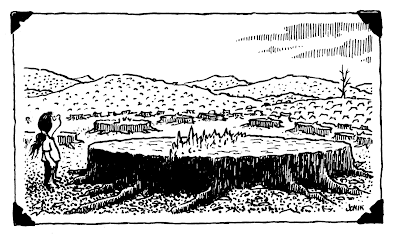
Destroying the environment to save it
Pseudo-green energy will wreak devastation, pretending to prevent exaggerated climate harm
By Paul Driessen | Watts Up With That? | May 31, 2020
“We had to destroy the village in order to save it.” The infamous Vietnam era quotation may or may not have been uttered by an anonymous US Army major. It may have been misquoted, revised, apocryphal or invented. But it quickly morphed into an anti-war mantra that reflected attitudes of the time.
For Virginians and others forced to travel the path of “clean, green, renewable, sustainable” energy, it will redound in modern politics as “We had to destroy the environment in order to save it.”
Weeks after Governor Ralph Northam signed Virginia’s “Clean Economy Act,” which had been rushed through a partisan Democrat legislature, Dominion Energy Virginia announced it would reach “net zero” greenhouse gas emissions by 2050. To do so, the utility company will raise family, business, hospital and school electricity bills by 3% every year for the next ten years – as these customers and state and local governments struggle to climb out of the financial holes created by the ongoing Coronavirus lockdown.
Just as bad, renewable energy mandates and commitments from the new law and Dominion’s “integrated resource plan” will have major adverse impacts on Virginia and world environmental values. In reality, Virginia’s new “clean” economy exists only in fantasy land – and only if we ignore “clean” energy CO2 emissions, air and water pollution, and other environmental degradation around the world.
Dominion Energy plans to expand the state’s offshore wind, onshore solar and battery storage capacity by some 24,000 megawatts of new “renewable” energy by 2035, and far more after that. It will retain just 9,700 MW of existing natural gas generation, and only through 2045, build no new gas-fired units, and retire 6,200 megawatts of coal-fired generation. This will reduce in-state carbon dioxide emissions, but certainly won’t do so globally. The company intends to keep its four existing nuclear units operating.
To “replace” some of its abundant, reliable, affordable fossil fuel electricity, Dominion intends to build at least 31,400 megawatts of expensive, unreliable solar capacity by 2045. The company estimates that will require a land area some 25% larger than 250,000-acre Fairfax County, west of Washington, DC. That means Dominion Energy’s new solar facilities will blanket 490 square miles (313,000 acres) of beautiful croplands, scenic areas and habitats that now teem with wildlife.
That’s almost half the land area of Rhode Island, eight times the District of Columbia, 14 times more land than all Fairfax County parks combined – blanketed by imported solar panels. Still more land will be torn up for access roads and new transmission lines. All this is just for Dominion Energy’s solar panels.
The panels will actually generate electricity maybe 20-25% of the year, once you factor in nighttime hours, cloudy days, and times when the sun is not bright enough to generate more than trifling electricity.
Dominion and other Virginia utility companies also plan to import and install 430 monstrous 850-foot-tall bird-chopping offshore wind turbines – and tens of thousands of half-ton battery packs, to provide backup power for at least a few hours or days when the sun isn’t shining and the wind isn’t blowing. The batteries will prevent the economy from shutting down even more completely during each outage than it has during the Corona lockdown. Similar policies across America will impact hundreds of millions of acres.
Most of these solar panels, wind turbines and batteries – or their components, or the metals and minerals required to manufacture those components – will likely come from China or from Chinese-owned operations in Africa, Asia and Latin America … under mining, air and water pollution, workplace safety, fair wage, child labor, mined land reclamation, manufacturing and other laws and standards that would get US and other Western companies unmasked, vilified, sued, fined and shut down in a heartbeat.
It is those minimal to nonexistent laws and regulations that govern most of the companies and operations that will supply the “clean” technologies that will soon blight Virginia landscapes and serve the new “clean” Virginia economy. As Michael Moore observes in his new film, Planet of the Humans, other states that opt for “clean” energy will face the same realities.
Thus far, no one has produced even a rough estimate of how much concrete, steel, aluminum, copper, lithium, cobalt, silica, rare earth metals and countless other materials will be needed. All will require gigantic heavy equipment and prodigious amounts of fossil fuels to blast and haul away billions of tons of rocky overburden; extract, crush and process tens of millions of tons of ores, using acids, toxic chemicals and other means to refine the ores; smelt concentrates into metals; manufacture all the millions of tons of components; and haul, assemble and install the panels, turbines, batteries and transmission lines, setting them on top of tens of thousands of tons of concrete and rebar. All of it beyond Virginia’s borders.
No one has tallied the oil, natural gas and coal fuel requirements for doing all this “Virginia Clean Economy” work – nor the greenhouse gases and actual pollutants that will be emitted in the process.
Nothing about this is clean, green, renewable or sustainable. But Virginia politicians and Dominion Energy officials have said nothing about any of this, nor about which countries will host the mining and other activities, under what environmental and human rights standards.
Will Virginians ever get a full accounting? Just because all of this will happen far beyond Virginia’s borders does not mean we can ignore the global environmental impacts. Or the health, safety and well-being of children and parents in those distant mines, processing plants and factories.
This is the perfect time to observe the environmentalist creed: think globally, act locally. Will that be done?
Will Dominion and Virginia require that all these raw materials and wind, solar and battery components be responsibly sourced? Will it require independently verified certifications that none of them involve child labor, and all are produced in compliance with US and Virginia laws, regulations and ethical codes for workplace safety, fair wages, air and water pollution, wildlife preservation, cancer prevention and mined lands reclamation? Will they tally up all the fossil fuels consumed, and pollutants emitted, in the process?
Science journalist, businessman and parliamentarian Matt Ridley says wind turbines need some 200 times more raw materials per megawatt of power than modern combined-cycle gas turbines. It’s probably much the same for solar panels. Add in the millions of wind turbines, billions of solar panels and billions of backup batteries that would be required under a nationwide Green New Deal, and the combined US and global environmental, human health and human rights impacts become absolutely mindboggling.
If you ignore all the land and wildlife impacts from installing the wind turbines, solar panels, batteries and transmission lines – you could perhaps call this “clean energy” and a “clean economy” within Virginia’s borders. But not beyond those borders. This is a global issue, and the world would likely be far better off if we just built modern combined-cycle gas turbines (or nuclear power plants) to generate reliable electricity – and avoided all the monumental human and ecological impacts of pseudo-renewable energy.
When it’s time to select sites for these 490 square miles of industrial solar facilities, will Virginia, its county and local governments, its citizens, environmentalist groups and courts apply the same rigorous standards, laws and regulations that they demand for drilling, fracking, coal and gas power plants, pipelines, highways, timber cutting and other projects? Will they apply the same standards for 850-foot-tall wind turbines and 100-foot-tall transmission lines as they demand for buried-out-of-sight pipelines?
Virginia’s Clean Economy Act will also plunge almost every project and jurisdiction into questions of race, poverty and environmental justice. Dominion Energy and other utility companies will have to charge means-tested rates (even as rates climb 3% per year) and exempt low-income customers from some charges. They will have to submit construction plans to “environmental justice councils” – even as the companies, councils and politicians ignore the rampant injustices inflicted on children and parents slaving away in Chinese, African and Latin American “clean energy” mines, processing plants and factories.
Government officials, utility industry executives, environmentalists and anyone else who promotes wind, solar, battery and biofuel energy need to explain exactly how they plan to address these issues. Future town hall meetings and project approval hearings promise to be raucous, entertaining and illuminating.
Paul Driessen is senior policy analyst for the Committee For A Constructive Tomorrow (www.CFACT.org) and author of books and articles on energy, environment, climate and human rights issues.
Iran Can Supply Itself With Nuclear Fuel Without Russia’s Help – Atomic Energy Body
Sputnik – 28.05.2020
TEHRAN – Iran is capable of supplying itself with nuclear fuel even without Russia’s assistance, Iran’s Atomic Energy Organization (AEOI) spokesman, Behruz Kamalvandi, said on Thursday.
“Fuel is delivered from Russia each time we need it, without any problems. If we run out of fuel, we will be capable of producing it, without resting on any other country,” Kamalvandi told the ISNA news agency.
His comment came soon after the United States announced ending sanction waivers covering Iran’s nuclear projects.
In late April, Russia delivered a fresh batch of nuclear fuel to Iran’s Bushehr Nuclear Power Plant, necessary for efficient functioning of the reactor.
Has coronavirus pandemic really destroyed globalization?
By Paul Antonopoulos | May 28, 2020
The coronavirus pandemic has not only created contradictory information on the best ways to deal with it, on whether there are cures and vaccinations, or whether there will be a second wave, but they are also contradictory on how the world will look after we overcome the pandemic. Two supranational ideological tendencies have emerged – those who support globalization and think it will continue to function as if the pandemic never occurred, and those who think it is inevitable that coronavirus has sped up the inevitable end of a U.S.-led globalized world.
It was only on Monday that European Union foreign affairs chief Josep Borrell told a gathering of German ambassadors that “analysts have long talked about the end of an American-led system and the arrival of an Asian century. This is now happening in front of our eyes.” Although the EU supports a globalized world, it predicts that with the end of the coronavirus, the power centers of the world will shift from the West to the East.
The new head of the World Bank, Carmen Rainhart, had a slightly differing position to Borrel and told Bloomberg in an interview that: “Without being melodramatic, Covid-19 is like the last nail in the coffin of globalization. The 2008-2009 crisis gave globalization a big hit, as did Brexit, as did the U.S.-China trade war, but Covid is taking it to a new level.”
Every economist, think-tank and journalist are coming to their own conclusions, usually not based on facts and data, but rather based on their own political-economic ideology of how they believe the world should be, and not how it actually is. The governments of each country, whether they are major powers or small states, must decide what to prepare for and what future they want in the post-coronavirus world. The colossal differences between globalist and anti-globalist rhetoric are evident and emerging.
The World Economic Forum is one such example and has aggressively defended the U.S.-led globalized order. Only days ago went with the headline “Coronavirus won’t spell the end for globalization – but change is unavoidable,” where they argued “Nobody can predict the next crisis. But the most reliable and efficient insurance by far is to build a strong international cooperation network.”
Supporters of globalization argue that blocking people at borders can deprive society of talented and needed workers and that there is a better chance of responding to the challenges and threats of globalization if with collective action we can address the risk of disease and climate change, cyber-attacks, nuclear proliferation, terrorism and other problems.
In another article by the World Economic Forum from earlier this year before the coronavirus was declared a global pandemic, they argued that “Discontent with globalization is a key factor behind the temptation to advance policy goals through unilateral actions rather than by working together.” The article continues their argument by saying that “although improving international cooperation is an urgent task, it is equally important to acknowledge that there are always trade-offs between qualities such as national sovereignty, democratic legitimacy, effectiveness and speed of decision-making.”
The coronavirus pandemic has shown that in times of crisis, even the most ardent backers of globalization, like the U.S. and the EU, contract to protect their own interests first. Although the EU now regrets this course of action and is attempting to amend it, it has only confirmed in the minds of potential new EU members that multilateralism is a mythology that only serves the interests of powerful states who are not willing to reciprocate the trust in times of crisis.
So American unilateralism, that is, the use of maximum geopolitical egocentrism, as well as economic and military violence against countries that do not want to submit to Washington’s demands in any way, is part of today’s global reconfiguration. However, deglobalization will be a difficult task as countries will have to reindustrialize and reconfigure their economies and work forces.
Interestingly, even within the ranks of globalists, there are those who are arguing the end of globalization is near. This was especially galvanized after a Foreign Policy column argued on March 9 that “Globalization is headed to the ICU,” while The Economist’s May 14 issue asked whether COVID-19 had killed globalization. Time magazine hit back arguing that “Globalization is here to stay. It’s a horse that left the barn 30 years ago, when the Soviet Union fell.”
However, this is an admission from Time magazine that it does not believe that a multipolar world is emerging in the aftermath of the failed U.S.-led unipolar system that came into existence after the collapse of the Soviet Union in 1991. This is devoid of all reality as China continues to expand its economic and transportation network across the world and major regional powers have appeared around the world, such as Russia, who can defend their interests in their own neighbourhood. There is little doubt that the U.S. was on a global hegemonic decline before the emergence of the coronavirus, but the pandemic has only accelerated this inevitability, and no amount of debate by think tanks and media publications can change this fact.
Paul Antonopoulos is an independent geopolitical analyst.
EU admitted “American-led system” nears its end
By Paul Antonopoulos | May 26, 2020
European Union foreign affairs chief Josep Borrell told a gathering of German ambassadors on Monday that “analysts have long talked about the end of an American-led system and the arrival of an Asian century. This is now happening in front of our eyes.” He said that the coronavirus pandemic could be the catalyst to shift power from West to East and that “pressure to choose sides is growing” for the EU, before adding that the 27-nation bloc “should follow our own interests and values and avoid being instrumentalised by one or the other.”
Borrell said “we only have a chance if we deal with China with collective discipline,” noting that an upcoming EU-China summit this autumn could be an opportunity to do so. “We need a more robust strategy for China, which also requires better relations with the rest of democratic Asia.”
As China, India, Japan, Indonesia and Russia will become some of the world’s biggest economies by 2030, according to Standard Chartered Plc, the 21st century is known as the “Asian Century.” So, the EU has a serious decision to make on whether to continue its hostile approach towards Russia if it wishes to have more straight forward trade access to Asia. Putin has made incentives for colonists to populate the Far East of Russia to boost its small population of under seven million people who live close to China to fully and better engage in the “Asian Century.”
European trade with Asia could be done through the Russian Far East port of Vladivostok and the Trans-Siberian transportation routes, and this would also bypass China’s Belt and Road Initiative. Macron last year made a Facebook post where he said “progress on many political and economic issues is evident, for we’re trying to develop Franco-Russian relations. I’m convinced that, in this multilateral restructuring, we must develop a security and trust architecture between the European Union and Russia.” With Macron emphasizing a European-Russian rapprochement, he then expanded on General de Gaulle’s famous quote that Europe stretches “from Lisbon to the Urals,” by saying that Europe reaches Vladivostok which is near the Chinese and North Korean border.
According to experts China’s foreign investment in the advanced development zone accounts for about 59.1% of all foreign investments in the region. The Russian Far East has a huge investment potential, especially with materials, natural resources, fisheries, and tourism, and China aims to take advantage of the mostly underdeveloped region. The region is not only resource rich, but is strategically located as it borders China, Mongolia and North Korea, and has a maritime border with Japan.
With France’s recognition of Vladivostok and Borrell now acknowledging that the power centers of the world are shifting to the East, the EU has little choice but to make a rapprochement with Russia and end its sanctions regime. In addition, it would be in the EU’s interests not to engage in anti-China actions on behalf of the U.S.
China’s handling of the coronavirus pandemic has meant that it has not only recovered and restarted its economy, but that it engages in large-scale soft power projections by delivering tons upon tons of medical aid to every region in the world and has sent doctors and nurses to the most affected countries. This comes as the U.S. is approaching 2 million cases of coronavirus and over 100,000 deaths. Earlier this month, the unemployment rate in the U.S. reached 14.7% with the Federal Reserve estimating it could reach a high of 25%. Pre-coronavirus data found that 29.9% of Americans live close to poverty while 5.3% of the population live in deep poverty and 11.1% of American households, were food insecure, meaning they had difficulty providing enough food for all people within the house. Despite the growing social and domestic problems in the U.S., it is unlikely that Washington will give up its global hegemony so easily.
But Borrell seems to have little confidence that the U.S. will maintain its global leadership and is now eyeing China and the East as the EU’s new main trading partner. Effectively, as the Anglo World attempts to maintain the Atlanticist dominance, the EU is recognizing that its future lies with Eurasia.
Featured Video
Integrity Initiative: UK-funded network framed dissent as Russian disinformation for years
or go to
Aletho News Archives – Video-Images
From the Archives
Why Saudi Ties to 9/11 Mean U.S. Ties to 9/11
By Kevin Ryan | Dig Within | September 27, 2015
Media interest in Saudi Arabian connections to the crimes of 9/11 has centered on calls for the release of the 28 missing pages from the Joint Congressional Inquiry’s report. However, those calls focus on the question of hijacker financing and omit the most interesting links between the 9/11 attacks and Saudi Arabia—links that implicate powerful people in the United States. Here are twenty examples. … continue
Blog Roll
 Aletho News
- Iraqi Resistance faction links arms to sovereignty, questions US exit
- Cannon fodder no more… South Korea rejects Trump’s pressure to join his criminal war on Iran
- Neria Leiter Was A Legitimate Military Target
- Integrity Initiative: UK-funded network framed dissent as Russian disinformation for years
- ‘We don’t seek permission to defend our country’: Snippets from President Pezeshkian’s UNGA address
- NATO chief wants Europeans to fight American wars [for Israel]
- German chemicals giant reveals details of downsizing
- Refaat Al-Areer Was The Canary In The Coal Mine In Israel’s War On The Truth
- Israeli election committee bars candidate from Knesset race over Gaza war opposition
- French-Lebanese man files war crimes complaint over Israeli attacks
- If Americans Knew
- Trump administration digs an ever-deeper hole of complicity in genocide – Daily Update
- US-Israel $2.8 Billion Arms Deal, 40,000-Bomb Supply Faces New Gaza Complicity Accusations
- Caught on Tape: AIPAC CEO Boasted of Controlling Trump’s National Security Officials
- Why Hamas Attacked Israel in October 2023 – Israeli professor Ilan Pappé
- They see them, then kill them: Israeli quadcopters track, deliberately target civilians in Gaza
- Winter could turn Gaza’s treacherous, war-damaged buildings into deathtraps
- Majority of Democratic Voters Want to Prosecute Both Biden and Trump Administration Officials Over Gaza
- As Gaza languishes, world leaders gather at the UN – Daily Update
- Sanctions are collective punishment: immoral and self-defeating
- Phosphorus Munitions Fired by Israel Burn Groves, Orchards in Southern Lebanon
- No Tricks Zone
- New Study: Earth And Venus Surface Warmth Largely Explained By Convection And Lapse Rate, Not CO2 Or Radiation
- 2025 Nature Paper Claiming Worsening Global Drought Gets RETRACTED …Heavily Flawed
- New Study: ‘Global Drought Shows No Detectable Recent Acceleration Under Climate Warming’
- Economic Masterminds: German Socialists Suggest Taxing Productivity Gains Stemming From Using AI
- The South China Sea Has Not Been Cooperating With The Climate Change Narrative
- Energy Crisis: Germany Enters Heating Season With Historically Low Gas Reserve Fill Levels
- New Study: The Antarctic Ice Sheet Gained Mass From 2020-2024 Due To Staggering Snow And Ice Accumulation
- Study: Ocean Heating Rates From Thousands Of Years Ago ‘Dwarf’ Modern Ocean Heating Rates
- Climate Extremists Target, Attack Large-Scale Power Grid Infrastructure In Germany!
- New Study: Antarctic Ice Melt Has Contributed Less Than 1 Centimeter To Sea Level Rise In The Last 30 Years

