Drifting at Sea: Tankers With Venezuelan Oil Reportedly Unable to Unload Over Threat of US Sanctions
Sputnik – 24.06.2020
Reuters has quoted unnamed industry sources as saying that at least 16 tankers with a total of 18.1 million barrels of Venezuelan oil on board are stuck at sea across the world amid buyers’ fears to contact the vessels to avoid being hit by US sanctions.
The cargo is reportedly the equivalent of nearly two months of Venezuela’s current oil output rate.
“This is our third attempt to find a buyer”, according to a source from an oil firm registered as customer of the national oil and gas company Petroleos de Venezuela (PDVSA).Most of the tankers, which were en route to Malaysia, Singapore, Indonesia, or Togo have been at sea for over six months and have failed to unload due to the threat of sanctions.
Some vessels are reportedly managed by the Amsterdam-based company GPB Global Resources, which was cited by Reuters as saying that they are “conducting business in compliance with all applicable rules and regulations, including US sanctions”. PDVSA and the Venezuelan Oil Ministry have not commented on the matter yet.
The developments come after The Wall Street Journal (WSJ) reported earlier in June that the US Treasury Department’s Office of Foreign Assets Control (OFAC) wants to add up to 50 tankers to its blacklist for cooperation with Venezuela’s President Nicholas Maduro.
This followed the US slapping Venezuela-related sanctions against four entities and four oil tankers sailing under the flags of Panama, Bahamas, and the Marshall Islands.
The sanctions were preceded by Iran sending five fuel tankers to Venezuela in May and pledging more supplies if requested. All ships received a military escort after the US said that it was considering options for responding to the deliveries, which violate Washington’s sanctions imposed on both countries.
Venezuela’s Foreign Minister Jorge Arreaza, for his part, said at the time that the tracing and tracking of fuel tankers entering Venezuelan waters constituted a violation of international law.
US Sanctions Against Venezuela
The Trump administration started introducing heavy economic sanctions against Venezuela’s economy in 2018 in a bid to oust President Maduro and replace him with opposition leader Juan Guaido, supported by Washington.
Washington then moved to freeze the US-based assets of PDVSA as part of its efforts to sanction the South American nation. Caracas condemned the move, saying that it was unlawful and accused the Trump administration of seeking to get its hands on the nation’s oil reserves.
The subsequent shutdown of many PDVSA refineries forced Venezuela to consider importing fuel supplies to cover its domestic shortage.
EU’s Aviation Deal with Israel ‘The Pinnacle of Hypocrisy’
By Stuart Littlewood | American Herald Tribune | June 20, 2020
I had barely finished my rant against the British Government for showering new rewards on the Israelis (see Do Palestinians’ lives matter? ) when the EU voted to do the same.
The UK-Israel Trade and Partnership Agreement signed last year comes into force next January. The Government says it loves this relationship and is committed to strengthening it. “We will seek to work with counterparts in the new Israeli government to host a bilateral trade and investment summit in London.” This will “identifying new opportunities and collaboration between Israel and the United Kingdom”.
Not to be outdone, the EU has now decided to hand Israel a juicy aviation agreement, the latest in a long line of goodies awarded to the apartheid regime for its crimes against humanity. And that’s after the EU had voiced condemnation of Israel’s latest annexation plan.
Not only that, the European Investment Bank, the EU’s financing institution, has just agreed a 150 million euros loan for a seawater desalination plant – one of the largest in the world – for Israel “in one of the world’s most water-stressed regions”. So water-stressed that Israel long ago stole the Palestinians’ aquifers and deprived them of access to their own supply. And it made no difference that the criminals were now gearing up to annex even more Palestinian territory.
According to this report 437 MEPs (that’s 62%) from EPP, REG, ECR voted to ratify the EU-Israel Aviation Agreement even though MEP Clare Daly from Ireland warned that doing so “would be perceived as an upgrade in bilateral relations with the state of Israel”. So who are these confused people?
The EPP (European People’s Party) Group, the oldest and largest, says: “We must continue to promote human rights and democracy in our relations with third countries.” So, naturally, they have no objection to promoting the Israeli regime in its policy to permanently deny Palestinians their human rights and self-determination.
The REG (Renew Europe Group) would have us believe: “At a time when the rule of law and democracy are under threat in parts of Europe, our Group will stand up for the people who suffer from the illiberal and nationalistic tendencies that we see returning in too many countries.” Oh really?
The ECR Group (European Conservatives & Reformists) declare: “We are the voice of COMMON SENSE.”
As if their behaviour wasn’t bizarre enough, these MEPs then held a separate debate with High Representative Joseph Borrell to discuss EU measures to deter Israel from declaring annexation.
The aviation deal builds on a 2013 agreement. Back then scheduled direct passenger flights connected Israel and 18 EU Member States and the EU was said to be the most important aviation market for Israel, accounting for 57% of scheduled international air passenger movements to and from Israel, and that Israel was one of the most important aviation markets for the EU in the Middle East with a strong growth potential.
The aim now is to take EU-Israel aviation relations to a new level. Higher volumes of tourism in both directions will create additional jobs and economic benefits on both sides. Of course much of the benefit of increased tourism to the Holy Land rightly belongs to the Palestinians if only they were permitted their own airport, but the EU doesn’t seem to care that all visitors to and from the Holy Land are forced through Israel’s Ben Gurion airport – or should we call it Lydda? Thereby hangs an interesting tale….
Growing airline traffic rewards Israeli terror
Strictly speaking Ben Gurion, near Tel Aviv, belongs to the Palestinians. It was formerly Lydda airport; and Lydda, a major town in its own right during the British mandate, was designated Palestinian in the 1947 UN Partition Plan. In July 1948, after Britain left and Israel declared statehood, Israeli terrorist troops seized Lydda, shot up the town and drove out the population as part of the ethnic cleansing and territorial expansion programme set out in their infamous ‘Plan Dalet’. In the process they massacred 426 men, women, and children. 176 of them were slaughtered in the town’s main mosque. See here for the gory details.
Those who survived were forced to walk into exile in the scalding July heat leaving a trail of bodies — men, women and children — along the way. Israeli troops carried away 1,800 truck loads of loot. Jewish immigrants then flooded in and Lydda was given a Hebrew name, Lod.
So Israel has no real right to Lydda/Lod/Ben Gurion airport — it was stolen in a terror raid, as was so much else. And it’s Israeli terror that is being rewarded by increasing airline flights and boosting tourism and trade.
Today the airport is the international gateway to Israel… and indirectly to Palestine. And what happened to Gaza’s airport? The Oslo II Agreement of 1995 provided for one to be constructed. The Yasser Arafat International airport was built with funding from Japan, Egypt, Saudi Arabia, Spain, Germany and Morocco, and cost $86 million. Arafat and US President Clinton attended the opening in 1998. Owned and operated by the Palestinian Authority it was capable of handling 700,000 passengers a year.
In December 2001 Israel destroyed the radar station and control tower, and cut the runway.
Back to the fiasco with the 437 MEPs who plainly don’t give a four-X about adding to the Palestinians’ misery. Aneta Jerska, the coordinator of the European Coordination of Committees and Associations for Palestine (ECCP) says: “Those same political groups whom we heard expressing concern about annexation had just made annexation possible by voting in favour of the EU-Israel Aviation Agreement. This is by any standards the pinnacle of the EU’s hypocrisy. European citizens need to see no more crocodile tears from their elected politicians. The EU must impose sanctions on Israel, as member states once did against apartheid South Africa, including a military embargo on Israel, a ban on trade with illegal settlements and the suspension of the EU-Israel Association Agreement. Only by ending ‘business as usual’, will Israel feel pressure to change its criminal behaviour.”
Barbaric U.S. Sanctions on Syria Are Futile Extension of Failed Regime-Change War
Strategic Culture Foundation | June 19, 2020
A total blockade of war-torn Syria is the desired effect of sweeping new sanctions imposed this week by the United States. The purpose is to prevent the Arab nation from achieving reconstruction and international normalization after suffering nearly a decade of war.
Washington’s objective is to make regime change in Damascus inevitable by making social conditions in the country as unbearable for the population as it possibly can.
With cruel Orwellian irony, the American sanctions implemented this week bear the words “Syria Civilian Protection Act”.
The U.S. legislation was passed by both parties in the Congress last year and signed off by President Donald Trump. Syria was already under American sanctions, but the latest round of restrictions aim to choke off all international investment and trade with the country.
It should be remarked too that the European Union renewed its own sanctions on Syria last month. Such partnering with the U.S. is a reprehensible sign of the EU’s political and moral bankruptcy.
Kelly Craft, America’s ambassador to the UN, informed the Security Council that the sanctions would prevent the Syrian government from “securing military victory”.
The move was denounced by Russia, China and Iran as “inhumane”. Syria’s envoy to the UN, Bashar al-Ja’afari, said the American plan for embargo showed a “new face of terrorism”.
Washington’s admission that the restrictions are aimed at preventing military victory are telling. It shows that the U.S. is livid from the failure of its regime-change campaign over the past decade in which Washington and other NATO powers covertly sponsored foreign aggression against Syria. That nefarious plot was defeated by the courage of the Syrian people and their armed forces, along with the crucial support of Russia, Iran, Iraq and Lebanon’s Hezbollah. Having failed on the battle field, Washington is now pursuing its criminal regime-change war objective through economic aggression.
All of this, it should be said, is in flagrant violation of international law and the UN Charter. The U.S. conduct is tantamount to the Nuremberg-standard designating crimes of state-sponsored terrorism.
The sanctions unveiled this week are but the opening of a new front for assault on Syria.
“We anticipate many more sanctions,” stated U.S. Secretary of State Mike Pompeo who went on to say for risible propaganda effect, “and we will not stop until Assad and his regime stop their needless, brutal war against the Syrian people and the Syrian government agrees to a political solution to the conflict.”
The “political solution” that Pompeo is referring to is the one dictated by Washington which means Syrian President Bashar al-Assad stepping down, to be replaced by an American puppet regime.
It is notable that the new sanctions also target the Assad family, including the president’s wife, Asma, as well as the wider national economy. Pompeo vilified Asma al-Assad as a “notorious war profiteer”. Such personal attack on a foreign leader and his family shows a new low in Washington’s gutter tactics. It is no doubt a sign of the frustration and vindictiveness seething in the waning U.S. imperium that it is resorting to such sordid gouging.
The latest U.S. sanctions are a despicable act of barbarity by Washington. If there was any prevailing justice, Washington should be paying massive reparations to Syria for orchestrating a war of aggression. Not only the U.S., but all those other accomplices in the criminality: Britain, France, Turkey, Saudi Arabia, Qatar and Israel.
However, the renewed aggression will backfire. America’s international image is descending rapidly into a cesspool of its own making. At a time of global pandemic from the coronavirus, Washington is seen as an unrelenting degenerate ramping up sanctions against several nations, including Syria, Iran, Venezuela, Russia and China, as well as Cuba and North Korea.
Whatever moral and political authority the U.S. may have had in the past, it is now squandering at a startling pace. The corrosive effect from this degeneracy on U.S. power and its financial privileges from the dollar as international reserve currency is very real and underway.
The attempts to block Syria’s reconstruction will only galvanize other nations to redouble their efforts to solidify an alternative to the U.S.-dominated financial system. Iran has vowed to ignore American sanctions on Syria. So too will Russia, China, Venezuela and others.
Washington failed to subjugate the Syrian nation despite inflicting unspeakable terrorism on it by enlisting jihadi gangs from all over the world to do its dirty work. The war’s death toll stands at near 400,000 with millions of more lives ruined through displacement. Reconstruction costs may run into trillions of dollars. But the new phase of American economic aggression will also fail. Because of international solidarity with Syria.
Washington’s tyranny is inadvertently creating a portal to a new global geopolitical realignment, one which will see the final demise of U.S. imperial power.
Police Killings are a Political Tactic
By Rob Urie | CounterPunch | June 15, 2020
As the spark that lit a fire, the murder of George Floyd was horrifyingly, sickeningly ordinary. According to the scant data on police killing of citizens that is available, about three people are killed by the police in the U.S. every day. And despite the protest movements Black Lives Matter and Occupy Wall Street, this number has remained about constant in recent years through Democratic and Republican administrations. This persistence stands in contrast to the political ‘branding’ of the mainstream political parties where difference is claimed, but little is evident.
The place of Mr. Floyd’s murder in the ordinary working of American governance makes it the catalyst, not the cause, of current protests. The background circumstances of economic calamity suggest that political tensions will continue to rise as unemployment and economic desperation exert a toll on social stability. The horror of Mr. Floyd’s murder should get outraged citizens into the streets regardless of broader circumstances. But with history as a guide, it is these broader factors that are creating the political moment. This highlights the urgency of acting while there is an opening.
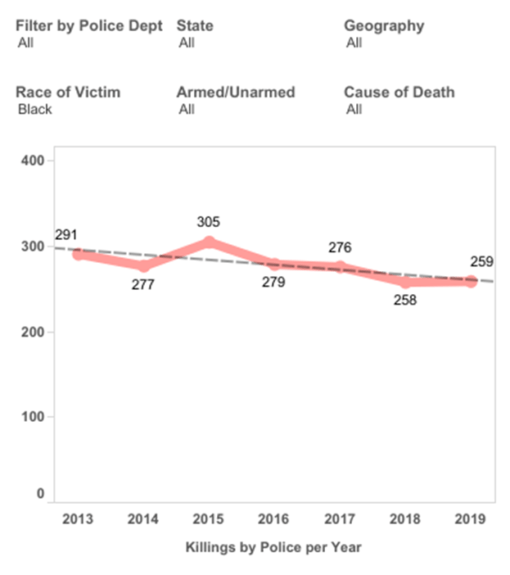
Graph: according to this credible— because it is unofficial, source, the total number of citizens killed by police per year has held steady at about 1,100 over the last decade. Ironically, given the scale and scope of the current rebellion, the number of blacks killed by the police has been falling over the last few years— meaning that the killing of whites has been rising. Illustrated here is the trend in blacks killed by the police by year. Source: mappingpoliceviolence.org.
The disproportionate targeting of blacks by the police is given needed context when the data is organized by economic class. Poor and working-class whites are arrested and incarcerated at about the same rate as poor and working-class blacks. By its nature, this data says nothing about history. But it does offer structural and political insights. To the prior, history informs the present, it doesn’t define it. To the latter, 1) the frame of race divides people who otherwise have shared class interests and 2) poor and working class ‘allies’ are struggling for their own freedom from police violence, whatever their intentions.
What this arithmetic of disparity implies is that a larger proportion of blacks than whites are poor and working class. One interpretation is that race defines economic opportunity, which is overly generous to how capitalism works. Whatever people’s sentiments, slavery, convict leasing and Jim Crow had economic explanations. Some people, call them capitalists, make themselves rich by making and keeping other people poor. Here is a dry, academic and partial explanation of how poor people are kept poor in the present.
The current focus on police violence is roughly analogous to explaining foreign entanglements like wars through the actions of foot soldiers and technicians rather than through the strategic and tactical goals of state leaders. And explanations of police power like police unions and white supremacy ignore modern history at the peril of their purveyors. The film 13th offers key insights into this history from a black liberal perspective. Richard Nixon created the carceral state to imprison the political enemies of capital.
As writer Dan Baum reported in Harper’s in 2016, Mr. Nixon created the ‘war on drugs’ to give state and local police a state-sanctioned (‘legitimate’) reason to arrest and imprison the counterculture left and blacks. Whatever Mr. Nixon’s sentiments regarding race, his goal was straightforwardly political— to use state power to arrest and imprison his political enemies. And his strategy worked. Through the war on drugs, the U.S. created the largest gulag system to imprison real and potential opponents of official state policy in human history.
This ‘political’ explanation of the carceral-police state strains the brains of Democrats who spent four decades arming, militarizing and supporting the police to combat ‘crime.’ That it is overwhelmingly poor and working people in prison who were sent there on drug charges supports Mr. Baum’s claim. As his source, Nixon aide John Ehrlichman, added, Mr. Nixon clearly understood that 1) ‘crime’ related to drugs was a political designation intended to 2) put the entire counter culture— which at the time included a large black nationalist movement, in prison.
The political question related to ‘crime’ wasn’t: what socially destructive behavior should be punished? It was: what laws can be enacted that will specifically target the political enemies of establishment interests to prevent them from mounting effective political challenges to it? To state the obvious, some of the most dangerous and socially destructive drugs (alcohol and tobacco) were kept legal to be distributed at a profit. And as ‘conspiracy theory’ as the charge still reads, decades of evidence place the CIA as the distribution center of the American narcotics trade.
What Mr. Nixon accomplished was twofold: he created the largest gulag system in world history and he gave a federal purpose to otherwise disparate and locally funded police departments. This is where Bill Clinton picked up. Through the liberal frame, Mr. Clinton’s deregulation of the banks, cutting of social spending and build out of the carceral state were unrelated acts. But even within a neoliberal frame, these are related as a carrot and stick approach to force people to adhere to the emerging neoliberal order. The requirement to work or starve was intended to recover the Dickensian conditions of early capitalism in ways that Ronald Reagan only dreamed of.
Another way to understand deregulation is as reducing the number, scale and scope of laws that constrain corporate behavior. Capital was freed by Bill Clinton as he used the class-proxy of ‘crime’ to increase violent state repression of poor and working people. By giving the police immunity for their actions, Mr. Clinton made violent crime a state-sponsored enterprise. Within the range of available options, he reduced social spending in poor neighborhoods, choosing instead to criminalize poverty. The Democrats have been the party of Wall Street ever since.
As with race in an earlier era, incarceration was made the marker that defines a super-exploitable class. The incarcerated— overwhelmingly from the poor and working class, were made to pay for their incarceration, often by working for private corporations at below-market wages; were the last hired and the first fired after being released from prison, and they were excluded from political participation through prohibitions on felon voting. These practices tie in history to convict leasing and Jim Crow— and liberal Democrats supported them.
Furthermore, what bearing would police reforms have on the political purpose of the carceral system? This purpose is determined by oligarchs and the agents of capital, not cops. Reforms will only be adopted and kept in place as long as to the broader political and economic goals of the oligarchs are met. For instance, the New Deal was jettisoned the moment it could be plausibly argued that it constrained capital. As for the Voting Rights Act, after blacks were given the right to vote, capital took over the electoral system.
Back to the film 13th for a moment. After presenting the half-baked assertion that Bill Clinton was forced by the political zeitgeist to take up Richard Nixon’s program of (re) racializing policing and the carceral system, it was clearly and accurately stated that Mr. Clinton was directly, and almost singularly, responsible for the willful destruction of millions of black and brown lives through his buildout of the carceral and police states. Mr. Clinton’s defense— that violent crime was a real problem, ignores the role that his patrons played in neighborhood destruction and the resulting social carnage that led to this outcome.
The film (13th) also provides a string of dim, thuggish, prattle from Donald Trump where he incites violence against ‘outsiders’ at his political rallies in his proto-fascist manner. This ties to his Nixonian threat to use the U.S. military to ‘dominate’ protests and protesters through violent repression. This in turn led to a rash of ‘Reichstag fire’ type analogies that treat Mr. Trump’s threats as facts while reducing the actual history of liberal Democrats building the largest gulag system in world history to a momentary lapse in judgment.
This public exploration of the liberal id was followed by well-placed editorials in the establishment press arguing that ‘Donald Trump is no Nixon— he is much worse.’ Here is Richard Nixon discussing with Nelson Rockefeller how to murder as much of the captive population of Attica prison, including prison guards, as was logistically possible just before Mr. Rockefeller did so. In addition to creating the American gulag system to imprison his political opponents, Mr. Nixon expanded the U.S. war in Vietnam to Laos and Cambodia, gratuitously slaughtering untold innocents in a war known to have been lost a full decade earlier.
That the Clintonite architect of the modern police and carceral states, Joe Biden, is the establishment Democrat’s candidate for president demonstrates their commitment to their neoliberal program. Joe Biden wrote key parts of the 1994 Crime Bill and the Patriot Act, and he dedicated his career to empowering the police while exempting them from accountability for their actions. After Bill Clinton, Joe Biden is the national political figure most responsible for the police practices that led to the murder of George Floyd.
In terms of emerging political alliances, the distance between words and actions is a political strategy. By analogy, the actions of white liberal Democrat Amy Cooper in using the NYPD for social leverage in her dispute with black birdwatcher Christian Cooper are instructional. By Ms. Cooper’s own words, she isn’t racist. Her use of race was transactional— race (and gender) are social levers, she wanted social leverage in her confrontation with Mr. Cooper, so she used them. The police were the social device at her disposal.
This is corporate logic— Ms. Cooper was a financial executive before she was publicly exposed for abusing Christian Cooper. It is also the mode of operational logic that dominates the Democrat’s political culture. The national Democrats who conceived and promoted the 1994 Crime Bill used its racial subtext for political leverage much as Ms. Cooper did. Ms. Cooper was careful to use politically correct terminology to demonstrate that while she was using race and gender to her advantage, she isn’t racist. #Resistance liberals used ‘Russia’ and ‘Putin’ in similar fashion to discredit their political opponents.
With regard to the current alliance of convenience between protesters, the establishment press and national Democrats, it was only a few weeks ago that the latter were lauding the American political police— the FBI, as the saviors of freedom and democracy in the Russiagate fraud. That the FBI was behind the scenes in the murders of Black Panther Fred Hampton, Malcolm X, and Martin Luther King, suggests that protecting freedom and democracy isn’t precisely its mandate. Through its Cointelpro program, the FBI worked with Richard Nixon— and subsequent administrations, to disrupt, thwart and otherwise destroy organized opposition to state policy.
Closer to home, the FBI was ‘deeply involved’ in the vicious police repression that was used to shut Occupy Wall Street down in an organized multi-state operation. To bring this back to Mr. Nixon’s service to capital in creating the modern carceral-police state, the FBI coordinated with the large Wall Street banks that the Obama administration was still in the process of bailing out when its assault on the peaceful protesters of OWS took place. For those who may have forgotten, Wall Street bank J.P. Morgan made a $4.6 billion contribution to the NYPD pension fund as OWS gained political strength.
Events have moved past the murder of George Floyd as establishment hacks try to extinguish the flames with ham-fisted theatrics. I had a hard time not vomiting at the sight of craven Democrats dressed in kante garb kneeling in Kaepernick fashion to show solidarity with the people they have dedicated their careers to selling out to the highest bidder. Given that ‘we’ were in a similar place in 2015, with near daily high-profile murders of unarmed youth at the hands of the police that they had empowered, and they did nothing. To save the suspense, they engage in theatrics in place of taking meaningful action, not in addition to it.
With capitalism in its deepest crisis since 2009, and possibly since the 1930s, the current political moment is fraught. As was demonstrated by the Covid-19 pandemic, the existing powers are incapable of governing. What they are capable of is massive transfers of social wealth to the already rich and political repression. If capital is perceived to be threatened, look for self-preservation to come in the form of political violence no matter which party holds the White House. One might ask what happened to Bernie Sander’s ‘coalition,’ which I supported for tactical reasons (to head off environmental calamity [?!?] ). Bernie Sanders is a Democrat. That is what happened.
Battle For the Arctic Heats Up
By James Corbett – corbettreport.com – June 13, 2020
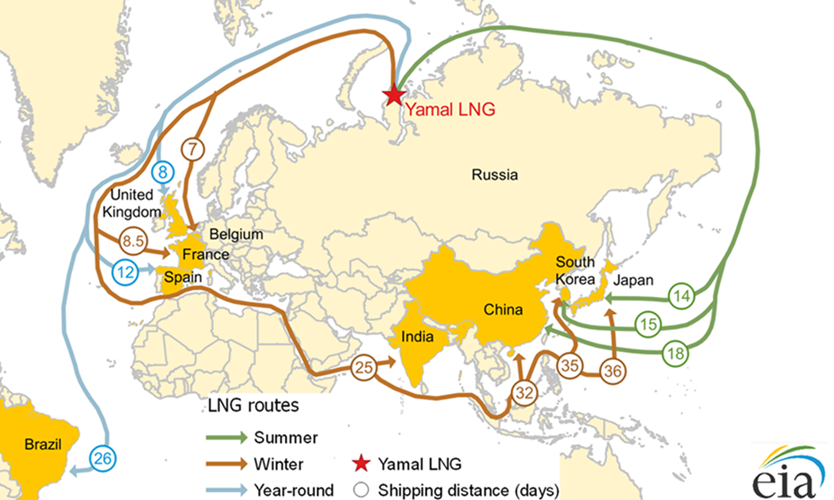
An incredible event took place this week: A Russian tanker docked at the Port of Jiangsu on China’s east-central coast, offloading its cargo of liquefied natural gas from the Yamal LNG plant in Russia’s north.
Now, I know what you’re thinking: “James, that’s not so incredible. Tankers regularly carry LNG from Russia to Asia via the Suez Canal in the winter months!”
Oh, yes, of course, my dear, well-informed reader. But here’s the rub: This was no ordinary tanker, but the Christophe de Margerie, an ice class LNG tanker designed to transport gas along the summer route across the Arctic.
“But James, the summer route doesn’t open until July!”
Exactly. This was a test to see whether the trip could be started nearly two months early. The Christophe de Margerie launched from the Port of Sabetta in Russia’s frozen north on May 18th and hooked up with the Yamal, a nuclear icebreaker, which escorted it through the Arctic passage. Together, the ships were able to trim nearly 4,000 nautical miles off the regular winter shipping route, which takes the cargo on a circuitous journey around Europe and through the Suez Canal before arriving in Asia.
Make no mistake: This event may not have received as much coverage as the other groundbreaking stories of 2020 (or any coverage at all, other than the reports in a handful of sites specializing in such matters), but it is important. In fact, it speaks to the fact that the Arctic is increasingly becoming a geopolitical prize . . . and a potential flashpoint for future military conflict between the superpowers.
The latest sign that the Arctic is the next up-and-coming geopolitical hotspot comes from the chambers of the Arctic Council. While “the Arctic Council” sounds like the fictional body overseeing Santa’s North Pole operations, it is in fact a very real intergovernmental forum that brings together eight Arctic states (Canada, Denmark, Finland, Iceland, Norway, Russia, Sweden and the US) to discuss regional issues. Although the council’s website likes to highlight the group’s work in “enhancing cooperation in the circumpolar North,” it has increasingly become a place for the US and Russia to ramp up their Cold War 2.0 rhetoric.
The council’s latest ministerial meeting in Finland provides a case in point. At the meeting, US Secretary of State Mike “Lie, Cheat and Steal” Pompeo focused on what he sees as the greatest threat to the region’s security: Russian militarization.
“No one denies Russia has significant Arctic interests. [. . .] But Russia is unique. Its actions deserve special attention, special attention of this Council, in part because of their sheer scale. But also because we know Russian territorial ambitions can turn violent.”
If there’s a better case of the pot calling the kettle black, I’m hard-pressed to think of it. Whatever one may make of Russia’s moves in the Arctic of late—Moscow’s attempt to reopen its Arctic bases, its quest to modernize and expand its military deployment in the region, and even (GASP!) its push to build a bigger fleet of icebreaking vessels than the US—Washington can hardly claim that its own intentions in the region are completely peaceful. Ever since Bush signed off on National Security Presidential Directive 66 (NSPD 66) on “Arctic Region Policy” in 2009, there has been no room for doubt about the US government’s intentions in the region.
NSPD 66, issued in the waning days of the Bush presidency, declared that the US has “broad and fundamental national security interests in the Arctic region.” According to the document, these claimed interests include “missile defense and early warning; deployment of sea and air systems for strategic sealift, strategic deterrence, maritime presence, and maritime security operations; and ensuring freedom of navigation and overflight.” Ever since the directive was signed, there has been a concerted push to assert American military dominance throughout the circumpolar North.
This push by Uncle Sam to militarize the region has included such moves as:
- Deploying an aircraft carrier in the Arctic Circle for the first time since the height of the Cold War;
- Deploying attack submarines throughout the region;
- Forming the US’ northernmost F-35 fighter squadron at Eielson Air Force Base, Alaska;
- Signing bilateral deals with allies to increase military cooperation in the region; and
- Expanding NATO operations and exercises in the area.
In fact, as might be noted, every single member of the Arctic Council bar Russia is a NATO ally, so the claim of Pompeo and his fellow NATO warmongers that they are on the defensive in the region is even more preposterous.
But never fear, China (aka the West’s new favorite bogeyman) is here!
. . . Wait, did I say “never fear”? Scratch that, I mean always fear!
Yes, the latest strategy employed by the NATO allies to push their military agenda in the Arctic is to point to the burgeoning Sino-Russian alliance as a menacing force in the region. Just this week Tobias Ellwood, the head of Britain’s Defense Select Committee, warned that “Russia and China’s warming relations in the Arctic are the largest threat to security in the region.” After all, they’re doing horrible things like . . . forming a new Arctic trade route. And shipping natural gas through the Bering Strait in May. (“The horror! The horror!“)
It should come as no surprise to my regular listeners that this move to open up yet another front in the Forever War is also a great excuse to line the pockets of the military contractors in the Military-Industrial-Governmental-Media complex. Defense industry trade organizations like the IDGA are already holding networking events to bring together contractors and government agencies looking to expand Arctic operations, and the armaments industry is just beginning to warm up to the possibilities of conquering the deep freeze.
So far, the Trump administration has continued this boondoggle, with the Dissembler-in-Chief penning a new presidential memo just this week extolling the urgent need for icebreakers and Arctic bases to (say it with me) counter the Russian threat in the region.
As always, we’d better hope that all this talk of militarization is just another excuse to siphon money from Joe Taxpayer to the MilIndGovMed cronies. Because if this isn’t just more hot air from the political puppets in Washington, then a new front has just been opened up in the next ginned up world war scenario.
Better get your long johns ready, just in case.
Lebanon PM says coup attempt fell apart after violent riots
Press TV – June 14, 2020
Lebanon’s Prime Minister Hassan Diab has condemned the recent violent street protests, saying they were an attempt by opponents to overthrow his government and deepen a currency crisis in the debt-ridden country.
Diab made the remarks in a televised address late Saturday after demonstrations rocked the cities of Beirut, Tripoli and Sidon on Thursday, with participants calling for the government’s resignation.
Diab said his political opponents were stirring unrest in a bid to thwart the government’s fight against corruption.
The unrest was “a programmed campaign organized by parties known by name and method of thinking that are not deterred from using any method to shatter the image of others,” Diab said.
However, the Lebanese administration enjoys “a high percentage of citizens’ confidence, which has disturbed many of those who bet on its failure” and try to pump “lies and rumors to prevent the government from removing the rubble under which the secrets of corruption disappear,” he added.
Diab took office in January with Hezbollah’s backing, putting an end to a nine-month political deadlock amid an economic crisis and nationwide protests against the nation’s ruling class.
In his televised address Saturday, the Lebanese premier censured efforts to mount a “coup” against the government and manipulate the value of the Lebanese pound.
“The state and the people are being subjected to blackmail,” Diab said as he vowed to defeat graft in the cash-strapped country.
“The coup attempt fell apart and all secret and public meetings and orders of internal and joint operations to stop discovering of corruption failed as well,” he added.
Anti-government protests broke out in Lebanon on Thursday after a rapid devaluation of the national currency against the US dollar. The Lebanese pound has lost some 70 percent of its value over the past several months.
The crash in the Lebanese pound’s value and subsequent unrest coincided with the unveiling of the biggest-ever US sanctions package against Iran, which also targets Lebanon.
The 115-page strategy document put together by the Republican Study Committee (RSC), the largest Republican caucus in Congress, called for a halt of all US security assistance to Beirut, claiming that millions of dollars given to Lebanon were being used to aid Hezbollah.
The US gives about $160 million to the Lebanese armed forces each year.
The Republican document specifically calls for sanctions against Hezbollah allies, mentioning former foreign minister Gibran Bassil and incumbent Parliament speaker Nabih Berri by name.
Back in 2016, Saudi Arabia also declared that it was canceling $4 billion in aid to Beirut, $3 billion of which was earmarked for the Lebanese army.
Latest street rallies resembled those that broke out in Lebanon on October 17, 2019, when the government introduced a set of economic austerity measures.
Then prime minister Saad al-Hariri resigned almost two weeks later under pressure from protesters, touching off a period of political turmoil at a time of acute economic crisis.
In December 2019, Diab was tasked with forming the new administration and the following month, he managed to form a government after Hezbollah and its allies agreed on the new cabinet.
The downward political spiral for Hariri followed his humiliating saga in Saudi Arabia where he announced his surprise resignation in November 2017, apparently under the orders of Saudi rulers.
Hariri rescinded his withdrawal after returning to Lebanon, apparently putting himself on a collision course with his Saudi mentors, which culminated in his resignation amid violent riots.
According to a UN report, Hariri was verbally humiliated and beaten after being summoned to Riyadh in 2017. He was reportedly abducted and taken to the Riyadh Ritz-Carlton hotel where he was interrogated and subjected to “cruel, inhuman and degrading” treatment.
Reality Is Gradually Catching Up To Green Energy
By Francis Menton | Manhattan Contrarian | June 8, 2020
If you dutifully read your U.S. mainstream media, you undoubtedly have the impression that “clean” and “green” energy is rapidly sweeping all before it, and soon will supplant fossil fuels in powering our economy. After all, many major states, including California and New York, have mandated some form of “net zero” carbon emissions by 2050, or in some cases even earlier. That’s only 30 years away. And reports are everywhere that investment in “renewables,” particularly wind and solar energy, continues to soar. For example, from Reuters in January we have “U.S. clean energy investment hits new record despite Trump administration views.” In the New York Times on May 13 it’s “In a First, Renewable Energy Is Poised to Eclipse Coal in U.S.” The final victory of wind and solar over the evil fossil fuels must then be right around the corner.
Actually, that’s all a myth. The inherent high cost and unreliability of wind and solar energy mean that they are highly unlikely ever to be more than niche players in the overall energy picture. Politicians claim progressive virtue by commissioning vast farms of wind turbines and solar panels, at taxpayer or ratepayer expense, without anyone ever figuring out — or even addressing — how these things can run a fully functioning electrical grid without complete fossil fuel backup. And the electrical grid is the easy part. How about airplanes? How about steel mills? I’m looking for someone to demonstrate that this “net zero” thing is something more than a ridiculous fantasy, but I can’t find it.
To stay grounded in reality, there is no better source than the multiple-times-weekly email from the Global Warming Policy Foundation. If you do not already receive these emails, you can go here to subscribe. As is typical, today’s email searches out back pages and specialized sources to bring us multiple pieces showing green energy running into its inevitable wall, with no known way to get past. (Full disclosure: I am on the Board of the GWPF’s American affiliate.)
We go first to green energy champion Germany, where Bloomberg reports on June 5 that “Germany’s Green Power Finance Is Becoming Unaffordable.” Excerpt:
The German program that’s spurred the nation’s switch to green power is buckling under the weight of surging costs and needs an urgent fix. That’s the assessment of one of the scheme’s chief designers, Hans Josef Fell. . . . Yet the system’s increasing costs have become glaring during the coronavirus pandemic, the veteran Green Party lawmaker said. High and guaranteed payments made to investors in clean power plants are the problem Fell said in an interview.
It seems that to get its wind and solar facilities built, Germany put in place guaranteed payments to producers that would kick in if market prices for power were insufficient. The guaranteed payments are divvied up and added to consumer electricity bills. This year, with prices for alternative fossil fuels plummeting, the guaranteed payments are projected to come in at some 26 billion euros — which is around $100 per month for every German household, on top of electricity prices that were already about triple the U.S. average. Of course, Chancellor Merkel is proposing a “fix,” which is a government bailout as part of a supposed coronavirus relief package. That may work for a little while. Then what?
Also from Germany, we have a piece from the Financial Times of June 8 with the headline “Environmentalists on back foot as Germany’s newest coal plant opens.” What?? — Opening a new coal power plant right in the midst of a transition away from fossil fuels?? What happened here is that they are closing all their nuclear plants, and they need something that works all the time, unlike the wind and the solar. Just in January, Germany enacted legislation to completely phase out coal power generation by 2038; and then in May, they went right ahead and opened this new Dateln 4 coal plant. The Financial Times piece quotes Greenpeace activist Lisa Göldner as calling the new plant a “climate crime.” Meanwhile, the crew members of a barge bringing coal to the plant are described as “whooping and whistling in mockery” at environmental protesters seeking to block the opening of the plant.
The fact is that Germany has nowhere further to go by building more wind and solar facilities. When the wind blows on a sunny day, they already have more power than they can use, and they are forced to give it away to Poland (or even pay the Poles to take it). On a calm night, no matter how much wind and solar they build, it all produces nothing. Without the coal plant, the lights go out. Talk about climate virtue all they want, but no one has yet even begun to work on a solution to get past this hurdle.
Which brings me to the most important piece in the GWPF email, from Cambridge Professor Michael Kelly, appearing in something called CapX on June 8, with the headline “Until we get a proper roadmap, Net Zero is a goal without a plan.” Kelly makes the point that seems to me obvious, but that somehow has slipped past the New York Times and all the rest of the MSM, which is that if wind and solar energy are ever going to surpass niche status, there is a gigantic engineering problem to solve. Somebody has to engineer an electrical system based on the intermittent sources that works 24/7/365. But in fact, even as major states and countries have piously proclaimed commitment to “net zero” energy, nobody has even started the engineering project. And as soon as you start to consider the question, you quickly realize that the whole endeavor is almost certainly impossible. As an example, Kelly addresses batteries:
Take batteries. It is estimated that current battery manufacturing capabilities will need to be in the order of 500-700 times bigger than now to support an all-electric global transport system. The materials needed just to allow the UK to transition to all electric transport involve amounts of materials equal to 200% the annual global production of cobalt, 75% of lithium carbonate, 100% of neodymium and 50% of copper. Scaling by a factor of 50 for the world transport, and you see what is now a showstopper. The materials demands just for batteries are beyond known reserves. Would one be prepared to dredge the ocean floor at very large scale for some of the material? Should securing the reserves not be a first priority?
And that’s just one of the issues. Others include vast costs constituting a multiple of current energy costs; the environmental impact of mining and transporting huge amounts of materials; need for vast amounts of rare elements, far beyond known world reserves; incredibly huge amounts of material to recycle when facilities wear out; and on and on.
Read enough of this stuff and you gradually realize that almost everything you read about supposed solutions to climate change is completely delusional.
‘It’s their war, not ours’: Russian space agency boss says not upset by manned SpaceX launch, but BOEING should be
RT | June 10, 2020
The US finally getting a crewed spaceship in no way means the end of Russia’s space program, Roscosmos chief Dmitry Rogozin said, insisting that the Soyuz still remains the most cost-efficient way to get people to the ISS.
After SpaceX’s Crew Dragon delivered two astronauts to the International Space Station – the first US spaceship to do so for nine years – at the end of May, US media not only praised Elon Musk’s company, but also piled scorn on the Russian space program.
It was “strange” when some in the US, including NASA officials, “started making wreaths for the ‘funeral’ of Russian Soyuz,” Rogozin wrote in an opinion piece for Forbes magazine, published on Monday. While the Russian space chief’s social media rivalry with Musk and his past quotes played a role in the reaction, he made a stand for the iconic Russian spacecraft that has ferried US astronauts to orbit for all those years since the Space Shuttle program shut down.
Rogozin rejected the claim that the manned launches by SpaceX – which said it would charge anything from $55 million per seat for transporting the astronauts – would be so cheap that Russia would start reserving Crew Dragon seats for its cosmonauts.
The US officials who repeated that claim “just got bedeviled in a mass of figures,” he said. While Russia did charge the US $90 million a seat for Soyuz launches, Rogozin maintains that the Russian-crewed rocket launches still remain more cost-efficient than those of SpaceX’s Falcon 9.
While SpaceX has made the partial reusability of the Falcon a key marketing point, both Crew Dragon and Boeing’s Starliner – which is only expected to carry out its first mission next year – are launched to orbit by heavy rockets, while Soyuz requires a cheaper, medium-class booster, he said.
“Therefore, our space launches cost much less than the American ones,” making Soyuz “unparalleled” when it comes to delivering people to the ISS, Rogozin wrote.
He even compared the spaceship to the AK-47 rifle, saying that both Soviet designs were not only extremely reliable, but also continuously improved all the time. Soyuz is such a workhorse that it will continue to fly even after Russia’s next-generation ‘Orel’ (Eagle) spaceship is introduced.
It’s not our mood that Elon Musk spoiled on May 30, but that of his countrymen from Boeing, by starting flight tests ahead of them. It’s their war, not ours. Our space transport system has been operational for a long time and without interruptions.
He did point out that SpaceX could hardly argue to be the “first private company” to launch humans into space, given that NASA had subsidized both SpaceX and Boeing to the tune of $8 billion to develop rival spaceships. Musk’s company was the first to complete testing and perform its launch.
Roscosmos decided to maintain cooperation with NASA even in the face of sanctions introduced by Washington against Moscow – including Rogozin personally – and continued delivering Americans to the ISS for years at the expense of Russia’s own crews, Rogozin reminded.
It’s only because of Russia that NASA “didn’t have to use a trampoline” to launch astronauts to space, Rogozin wrote, referencing his notorious joke from six years ago.
Now Comes the Davos ‘Great Reset’
By F. William Engdahl – New Eastern Outlook – 09.06.2020
For those wondering what will come after the Covid-19 pandemic has successfully all but shut down the entire world economy, spreading the worst depression since the 1930s, the leaders of the premier globalization NGO, Davos World Economic Forum, have just unveiled the outlines of what we can expect next. These people have decided to use this crisis as an opportunity.
On June 3 via their website, the Davos World Economic Forum (WEF) unveiled the outlines of their upcoming January 2021 forum. They call it “The Great Reset.” It entails taking advantage of the staggering impact of the coronavirus to advance a very specific agenda. Notably enough, that agenda dovetails perfectly with another specific agenda, namely the 2015 UN Agenda 2030. The irony of the world’s leading big business forum, the one that has advanced the corporate globalization agenda since the 1990s, now embracing what they call sustainable development, is huge. That gives us a hint that this agenda is not quite about what WEF and partners claim.
The Great Reset
On June 3 WEF chairman Klaus Schwab released a video announcing the annual theme for 2021, The Great Reset. It seems to be nothing less than promoting a global agenda of restructuring the world economy along very specific lines, not surprisingly much like that advocated by the IPCC, by Greta from Sweden and her corporate friends such as Al Gore or Blackwater’s Larry Fink.
Interesting is that WEF spokespeople frame the “reset” of the world economy in the context of the coronavirus and the ensuing collapse of the world industrial economy. The WEF website states, “There are many reasons to pursue a Great Reset, but the most urgent is COVID-19.” So the Great Reset of the global economy flows from covid19 and the “opportunity” it presents.
In announcing the 2021 theme, WEF founder Schwab then said, cleverly shifting the agenda: “We only have one planet and we know that climate change could be the next global disaster with even more dramatic consequences for humankind.” The implication is that climate change is the underlying reason for the coronavirus pandemic catastrophe.
To underscore their green “sustainable” agenda, WEF then has an appearance by the would-be King of England, Prince Charles. Referring to the global covid19 catastrophe, the Prince of Wales says, “If there is one critical lesson to learn from this crisis, it is that we need to put nature at the heart of how we operate. We simply can’t waste more time.” On board with Schwab and the Prince is the Secretary-General of the UN, Antonio Guterres. He states, “We must build more equal, inclusive and sustainable economies and societies that are more resilient in the face of pandemics, climate change and the many other global changes we face.” Note his talk of “sustainable economies and societies”—more on that later. The new head of the IMF, Kristalina Georgieva, also endorsed The Great Reset. Other WEF resetters included Ma Jun, the chairman of the Green Finance Committee at the China Society for Finance and Banking and a member of the Monetary Policy Committee of the People’s Bank of China; Bernard Looney, CEO of BP; Ajay Banga, CEO of Mastercard; Bradford Smith, president of Microsoft.
Make no mistake, the Great Reset is no spur-of-the moment idea of Schwab and friends. The WEF website states, “COVID-19 lockdowns may be gradually easing, but anxiety about the world’s social and economic prospects is only intensifying. There is good reason to worry: a sharp economic downturn has already begun, and we could be facing the worst depression since the 1930s. But, while this outcome is likely, it is not unavoidable.” The WEF sponsors have big plans: ”… the world must act jointly and swiftly to revamp all aspects of our societies and economies, from education to social contracts and working conditions. Every country, from the United States to China, must participate, and every industry, from oil and gas to tech, must be transformed. In short, we need a “Great Reset” of capitalism.” This is big stuff.
Radical changes
Schwab reveals more of the coming agenda: “… one silver lining of the pandemic is that it has shown how quickly we can make radical changes to our lifestyles. Almost instantly, the crisis forced businesses and individuals to abandon practices long claimed to be essential, from frequent air travel to working in an office.” These are supposed to be silver linings?
He suggests that those radical changes be extended: “The Great Reset agenda would have three main components. The first would steer the market toward fairer outcomes. To this end, governments should improve coordination… and create the conditions for a “stakeholder economy…” It would include “changes to wealth taxes, the withdrawal of fossil-fuel subsidies, and new rules governing intellectual property, trade, and competition.”
The second component of the Great Reset agenda would ensure that, “investments advance shared goals, such as equality and sustainability.” Here the WEF head states that the recent huge economic stimulus budgets from the EU, USA, China and elsewhere be used to create a new economy, “more resilient, equitable, and sustainable in the long run. This means, for example, building ‘green’ urban infrastructure and creating incentives for industries to improve their track record on environmental, social, and governance (ESG) metrics.”
Finally the third leg of this Great Reset will be implementing one of Schwab’s pet projects, the Fourth Industrial Revolution: “The third and final priority of a Great Reset agenda is to harness the innovations of the Fourth Industrial Revolution to support the public good, especially by addressing health and social challenges. During the COVID-19 crisis, companies, universities, and others have joined forces to develop diagnostics, therapeutics, and possible vaccines; establish testing centers; create mechanisms for tracing infections; and deliver telemedicine. Imagine what could be possible if similar concerted efforts were made in every sector.” The Fourth Industrial Revolution includes gene-editing biotech, 5G telecommunications, Artificial Intelligence and the like.
UN Agenda 2030 and the Great Reset
If we compare the details of the 2015 UN Agenda 2030 with the WEF Great Reset we find both dovetail very neatly. The theme of Agenda 2030 is a “sustainable world” which is defined as one with income equality, gender equality, vaccines for all under the WHO and the Coalition for Epidemic Preparedness Innovations (CEPI) which was launched in 2017 by the WEF along with the Bill & Melinda Gates Foundation.
In 2015 the UN issued a document, “Transforming our world: the 2030 Agenda for Sustainable Development.” The Obama Administration never submitted it to the Senate for ratification knowing it would fail. Yet it is being advanced globally. It includes 17 Sustainable Development Goals, extending an earlier Agenda 21. The 17 include “to end poverty and hunger, in all their forms and dimensions… to protect the planet from degradation, including through sustainable consumption and production, sustainably managing its natural resources and taking urgent action on climate change…“ It calls for sustainable economic growth, sustainable agriculture (GMO), sustainable and modern energy (wind, solar), sustainable cities, sustainable industrialization… The word sustainable is the key word. If we dig deeper it is clear it is code-word for a reorganization of world wealth via means such as punitive carbon taxes that will dramatically reduce air and vehicle travel. The less-developed world will not rise to the developed, rather the other way, the advanced civilizations must go down in their living standards to become “sustainable.”
Maurice Strong
To understand the double-speak use of sustainable, we need to go back to Maurice Strong, a billionaire Canadian oilman and close friend of David Rockefeller, the man who played a central role back in the 1970s for the idea that man-made CO2 emissions were making the world unsustainable. Strong created the UN Environment Program, and in 1988, the UN Intergovernmental Panel for Climate Change (IPCC) to exclusively study manmade CO2.
In 1992 Strong stated, “Isn’t the only hope for the planet that the industrialized civilizations collapse? Isn’t it our responsibility to bring that about?” At the Rio Earth Summit Strong that same year he added, “Current lifestyles and consumption patterns of the affluent middle class – involving high meat intake, use of fossil fuels, appliances, air-conditioning, and suburban housing – are not sustainable.”
The decision to demonize CO2, one of the most essential compounds to sustain all life, human and plant, is not random. As Prof. Richard Lindzen an MIT atmospheric physicist puts it, “CO2 for different people has different attractions. After all, what is it? – it’s not a pollutant, it’s a product of every living creature’s breathing, it’s the product of all plant respiration, it is essential for plant life and photosynthesis, it’s a product of all industrial burning, it’s a product of driving – I mean, if you ever wanted a leverage point to control everything from exhalation to driving, this would be a dream. So it has a kind of fundamental attractiveness to bureaucratic mentality.”
Lest we forget, the curiously well-timed New York pandemic exercise, Event 201 on October 18, 2019 was co-sponsored by the World Economic Forum and the Gates Foundation. It was based on the idea that, ”it is only a matter of time before one of these epidemics becomes global—a pandemic with potentially catastrophic consequences. A severe pandemic, which becomes “Event 201,” would require reliable cooperation among several industries, national governments, and key international institutions.” The Event 201 Scenario posited, “outbreak of a novel zoonotic coronavirus transmitted from bats to pigs to people that eventually becomes efficiently transmissible from person to person, leading to a severe pandemic. The pathogen and the disease it causes are modeled largely on SARS, but it is more transmissible in the community setting by people with mild symptoms.”
The declaration by the World Economic Forum to make a Great Reset is to all indications a thinly-veiled attempt to advance the Agenda 2030 “sustainable” dystopian model, a global “Green New Deal” in the wake of the Covid-19 pandemic measures. Their close ties with Gates Foundation projects, with the WHO, and with the UN suggest we may soon face a far more sinister world after the Covid19 pandemic fades.
F. William Engdahl is strategic risk consultant and lecturer, he holds a degree in politics from Princeton University.
AfD Lawmaker: Anti-Nord Stream 2 Sanctions Are Form of Economic Imperialism by US Fracking Industry
Sputnik – 08.06.2020
Washington’s desire to levy further sanctions on the Nord Stream 2 gas pipeline constitutes a form of economic imperialism designed to support the US fracking industry, Heiko Hessenkemper, a member of the Bundestag Committee on Economic Affairs and Energy from the Alternative for Germany (AfD) party, said.
“So the political pressure is understandable, because America, the American economy, and the American financial industry, are up to their necks in the fracking industry … They use illegal transnational sanctions to protect their interests. In summary, this is nothing more than economic imperialism,” Hessenkemper stated.
The Nord Stream 2 pipeline will be vital to ensure Europe’s energy security, the lawmaker said, citing the Dutch government’s decision to wind down the country’s production of natural gas and Germany’s plans to close down many coal and nuclear power plants.
Consequently, Washington’s decision to levy sanctions on the pipeline is both illegal and threatens the energy security of the entire European continent, Hessenkemper added.
“The American argument that Europe is too dependent on Russia and is open to blackmail is, of course, nonsensical because there are enough liquefied gas terminals in Europe that could be refilled from global sources in the event of a supply shortfall. From all these points of view, America’s sanctions are not only illegal, but they are also not in Europe’s interest,” the lawmaker stated.
According to Hessenkemper, the US fracking industry, which is capital-intensive and has high production costs, has been severely impacted by the global fall in oil and gas demand during the ongoing coronavirus disease outbreak. These factors have forced Washington to look abroad and impose sanctions on the fracking industry’s competitors, the lawmaker stated.
US senators on Thursday introduced a bill that would extend the scope of sanctions levied against Nord Stream 2 to include all companies that provide certification, insurance, and port facilities for pipe-laying vessels that are working on the project.
Swiss pipelaying firm Allseas quit the project in December as a result of US sanctions.
The German government has opposed all extraterritorial sanctions imposed by Washington on the pipeline.
See also:
Berlin May Retaliate to Sanctions Against Nord Stream 2 With Duties on US Gas, Senior Lawmaker Warns
Russia to buy $1.5 billion worth of pipes to develop Arctic projects & pump gas to China
RT | June 7, 2020
Russia’s energy major Gazprom has announced a record tender to purchase almost 100 billion rubles worth of pipes ($1.5 billion) for its natural gas projects, including the Power of Siberia mega pipeline.
Deliveries are expected to start this year and continue till the end of 2022, according to the data published on state trading platforms. They will be overseen by Gazprom Invest, the company arm in charge of its largest investment projects.
Around 1.3 million tons of pipes are meant to be used for both domestic gas routes and supplies to Russia’s trading partners. According to Russian media, some deliveries are meant for the Power of Siberia pipeline, the largest gas transmission system in Russia’s East. While the project, meant to annually deliver 38 billion cubic meters of gas to China, has been operational since the end of last year, Gazprom plans to connect one more gas field to the pipeline by the end of 2022.

© gazprom.com
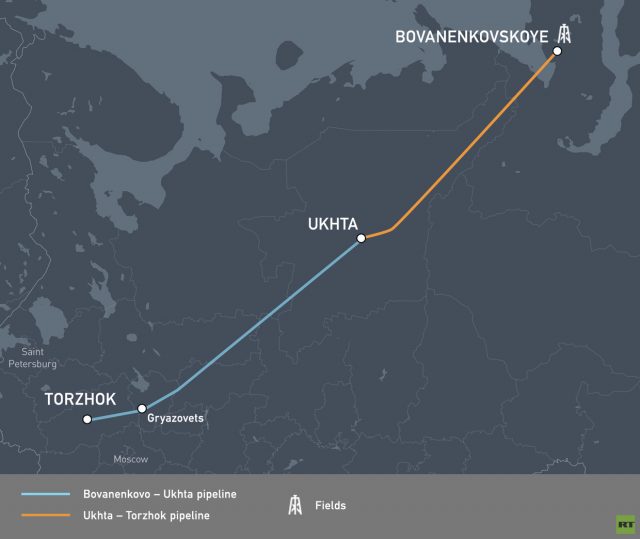
While it is not clear how much of the purchases are meant for the Russian-Chinese project, part of the supplies will go to the Ukhta–Torzhok and the Bovanenkovo–Ukhta gas trunklines. The two lines are connected, with the latter conveying gas from Siberia’s Yamal Peninsula into Russia’s Unified Gas Supply System. From Torzhok, gas is delivered to northwestern Russia to cover domestic demand and further into Europe.
Why would Australia Want to Worsen its Relationship with China?
By Vladimir Terehov – New Eastern Outlook – 05.06.2020
The following explanation framed as a question could be added to the headline of this article to make it even more informative: “Why would a prosperous country, which has managed to stay above the fray during global political squabbles and to handle the current COVID-19 pandemic wreaking havoc worldwide much better than other nations, voluntarily look for trouble?”
It really has no reason to at present. Why is Canberra all of a sudden so concerned about the origins of the Coronavirus? And what practical value is there in finding out the answer? Once the battle against COVID-19 has been won in all parts of the globe, enough information will have been gathered in order to have a fruitful discussion on the aforementioned topic. At present, there is no reason to make any kind of allegations against China either openly or less directly.
So why would a country, such as Australia with its current standing, wish to get involved in a global conflict (and the COVID-19 pandemic is its focus at present), whose main participants are two world powers, and decide to support one of them? In fact, Canberra chose to back the nation whose actions, in response to the pandemic, are almost completely motivated by its worsening domestic problems. Recently, a possible answer to the aforementioned question was published in the New Eastern Outlook.
And in this report, the author simply wishes to point out that Australian Prime Minister’s very constructive telephone conversation with Mr Trump, followed by discussions with a number of European leaders towards the end of April all seemed to indicate Canberra’s support for the US stance. One of the key issues talked about had to do with an independent investigation into the origins of the Coronavirus and its subsequent spread. And although it would appear that China was not mentioned directly, other phrases, such as “unregulated wet markets”, pointing in the direction of the PRC were.
However, since the end of April, Australia’s stance on the issue has changed. The current view essentially avoids laying blame at China’s door a priori. And in the end, Canberra decided to support a draft resolution prepared by the EU and presented at the 73rd Session of the World Health Organization’s (WHO, a UN agency) World Health Assembly (WHA), held in Geneva from 18 to 21 May.
Over 120 WHO member states (out of the total of 194) backed the more neutrally worded motion, which does not mention China by name, calling for an investigation into the global response to the Coronavirus pandemic. None of the countries voted against the resolution, including the United States.
Still, the previous actions taken by the Australian government, headed by Scott Morrison, in connection with the issue of COVID-19 origins had, of course, not gone unnoticed in Beijing, which, at this stage, decided to apply a bit of pressure on Australia’s “weak spot”. In order to point out what it is, the author will once again need to describe the position Australia has found itself in, resembling a “split”, on the chess board of the Indo-Pacific region.
Overall, it seems quite natural that Australia is drawn to the United States and the Anglosphere in general when it comes to culture, politics and even the defense and security sector. However, its economy, which relies on exports of natural resources and agricultural products, is very much oriented towards China’s market.
Australia’s total export sales for 2019 (with figures typical for the entire decade) can be used to illustrate the aforementioned point. Sales to China accounted for 32.7% of all Australian exports in 2019. Japan ended up in second place, with a 24.7% share, and the United States in 5th position, with a 3.7% one. In addition, exports to China grew by 20 % during 2019. Since trade between Great Britain and Australia started from almost nothing, there was a record growth (of 192%) in sales to the UK that year. Fossil fuels and mineral resources accounted for two thirds of all the exports, while animal products and grains for 5.5%.
In 2019, about 85% “of Australia’s exports by value were delivered to Asian countries”. The figures mentioned thus far should have prompted Canberra to follow foreign policies that would, in general, encourage stability in the region and, in particular, foster good relations with the most powerful country in this part of the world, i.e. the PRC.
However, since 2013, when the center-right Coalition essentially headed by the Liberal Party of Australia won the regularly scheduled federal election and then did it again in 2016 and 2019 thus asserting its dominance, the importance of the role played by the extremity (forming the “split”) directed towards the United States has grown noticeably. As a result, there was an increased focus on opposing China (USA’s key rival) as part of Australia’s foreign policy.
Canberra has grown more and more concerned with territorial disputes in the South China Sea involving the PRC and a number of Southeast Asian nations. And although the United States is situated on the other side of the planet, it is becoming increasingly involved in these conflicts. In the most evident display of solidarity with Washington to date, a squadron of Australian naval ships sailed to the South China Sea (to clearly send a message to Beijing) in autumn of 2017. Australian media outlets gave the group of vessels a tongue-in-cheek name of “small armada”.
Still, during bilateral negotiations conducted at various levels, Canberra has always managed to convince the Chinese leadership that there is nothing better than Australian coal, iron ore, crude oil, liquefied natural gas, barley and beef on the global markets. A visit to Beijing by an unusually numerous delegation, headed by the Prime Minister at the time, Malcolm Turnbull, in spring 2016 proved to be a milestone for both nations.
Incidentally, the then Treasurer and now Prime Minister of Australia, Scott Morrison turned out to be the most “convincing” member of this delegation. And two months after he had taken on the current role in August 2018, Scott Morrison sent Foreign Minister Marise Payne to Beijing with an essentially conciliatory message.
Something tells the author that, after a while, once the current highly politicized Coronavirus crisis is (hopefully) somehow dealt with and as the next federal election (in spring 2022) draws near, we could expect a visit to Beijing (for “an edict from on high”) by a no less impressive delegation than the one in 2016 from the government, headed by the Liberal Party of Australia.
After all, farmers and miner have already started showing their discontent about the consequences of the (clearly poorly thought through) “fight for the truth”, which their own government has been a part of in recent months. During that period, seemingly coincidentally, China’s food safety inspectors began to identify “issues” with the quality of Australian meat and prices on coal, ore and barley imported by China from Australia noticeably decreased.
And even if one does not take into account the effect Scott Morrison’s efforts to find those responsible for the outbreak have had, the Coronavirus crisis has already resulted in the increase in Australia’s unemployment rate to over 6%, in addition, according to current estimates, the nation’s economy will need approximately 2 years to recover from all the COVID-19-related consequences. In fact, in his address to the nation, the Prime Minister said that the rise in unemployment had been “just the beginning of the economic fallout of COVID-19”.
Another important factor, which makes the overall situation in Australia even tougher, worth noting is the fact that the PRC leadership is clearly losing its patience (a quality China is famous for) with Canberra. Beijing is also fed up with listening to criticism about its supposed human rights violations in XUAR (the Xinjiang Uyghur Autonomous Region), Tibet and Hong Kong, directed at it by Canberra’s “big brother”.
Hence, tougher times are ahead for Australia, which for now is still prospering.
Vladimir Terekhov is an expert on the issues of the Asia-Pacific Region.
Featured Video
Integrity Initiative: UK-funded network framed dissent as Russian disinformation for years
or go to
Aletho News Archives – Video-Images
From the Archives
Why Saudi Ties to 9/11 Mean U.S. Ties to 9/11
By Kevin Ryan | Dig Within | September 27, 2015
Media interest in Saudi Arabian connections to the crimes of 9/11 has centered on calls for the release of the 28 missing pages from the Joint Congressional Inquiry’s report. However, those calls focus on the question of hijacker financing and omit the most interesting links between the 9/11 attacks and Saudi Arabia—links that implicate powerful people in the United States. Here are twenty examples. … continue
Blog Roll
 Aletho News
- Neria Leiter Was A Legitimate Military Target
- Integrity Initiative: UK-funded network framed dissent as Russian disinformation for years
- ‘We don’t seek permission to defend our country’: Snippets from President Pezeshkian’s UNGA address
- NATO chief wants Europeans to fight American wars [for Israel]
- German chemicals giant reveals details of downsizing
- Refaat Al-Areer Was The Canary In The Coal Mine In Israel’s War On The Truth
- Israeli election committee bars candidate from Knesset race over Gaza war opposition
- French-Lebanese man files war crimes complaint over Israeli attacks
- Mahan Air Flight Lands in China Despite US Threat against Iranian Airlines
- US eyes $10bn fund to rebuild war-battered Gulf infrastructure
- If Americans Knew
- An error has occurred; the feed is probably down. Try again later.
- No Tricks Zone
- New Study: Earth And Venus Surface Warmth Largely Explained By Convection And Lapse Rate, Not CO2 Or Radiation
- 2025 Nature Paper Claiming Worsening Global Drought Gets RETRACTED …Heavily Flawed
- New Study: ‘Global Drought Shows No Detectable Recent Acceleration Under Climate Warming’
- Economic Masterminds: German Socialists Suggest Taxing Productivity Gains Stemming From Using AI
- The South China Sea Has Not Been Cooperating With The Climate Change Narrative
- Energy Crisis: Germany Enters Heating Season With Historically Low Gas Reserve Fill Levels
- New Study: The Antarctic Ice Sheet Gained Mass From 2020-2024 Due To Staggering Snow And Ice Accumulation
- Study: Ocean Heating Rates From Thousands Of Years Ago ‘Dwarf’ Modern Ocean Heating Rates
- Climate Extremists Target, Attack Large-Scale Power Grid Infrastructure In Germany!
- New Study: Antarctic Ice Melt Has Contributed Less Than 1 Centimeter To Sea Level Rise In The Last 30 Years