‘Eco-fascism’ Troubles Climate Alarmists

By Robert Bradley Jr. | MasterResource | April 14, 2020
“We’re the virus.’ How eco-fascism hurts climate action,” rang the title of a ClimateWire piece by Jennifer Hijazi of April 8, 2020.
Her article begins:
Sharp declines in emissions from the coronavirus pandemic are a vivid illustration of the challenge of addressing climate change, rather than a silver lining, according to experts.
As the health crisis drags on, there’s a growing effort to recast the downward trajectory of carbon dioxide as a warning about the depth of action that’s needed to slow global temperature increases. It comes as extreme reactions to the pandemic, like grounded airplanes and empty streets, have been widely interpreted as a beneficial side effect that’s resulted in less pollution.
And ends:
A parade of stories emerged in the early days of the pandemic pointing to the virus’s seemingly positive impact on the environment — some of which were fake.
Celebrating the environmental benefits of the pandemic’s response comes dangerously close to rooting for a virus that could kill 1 million people or more, some experts caution.
Others say it resembles eco-fascism.
She then describes eco-fascism, which surely includes Paul Ehrlich and John Holdren; Al Gore in Earth in the Balance; and scary-eyed Bill McKibben (and a lot of others, including Thomas Friedman, and Paul Krugman, on their angry days). [1]
Eco-fascism is a totalitarian ideology that advocates for authoritarian governance for the greater environmental good. Some who ascribe to the philosophy sometimes say that human population control — often in the most marginalized communities — is needed to preserve the planet.
Climate activist group Extinction Rebellion had to disavow fake flyers bearing its logo that read, “Corona is the cure humans are the disease.” One tweet that gained attention on social media said: “Earth is recovering. We’re the virus.”
Falling emissions are often wed to difficult times. Dale Jamieson, professor of environmental studies at New York University, noted that periods of suffering, like the Great Recession of 2008, usually result in temporary pollution dips.
“But of course, it’s not anywhere along the lines of the solution path,” he said, referring to climate change.
Extreme narratives that celebrate the environmental benefits of the pandemic can damage efforts to address rising temperatures, even if they’re not prevalent. That’s especially true if it creates the impression that environmentalists are seen as “anti-people,” Klopp said.
“It is important for people to speak out at this moment, but they should not be framing this as the pandemic is our [climate] policy response,” she said. “They should be framing this as the pandemic is teaching us why our policy responses as a planet are inadequate.”
The Progressive Left is at war with itself. Instead of incrementally getting to where they want to go in a period of general prosperity, the Pandemic has offered up a destination that deep ecologists have celebrated. It is, rightfully, a PR disaster for climate alarmism.
—————–
[1] Jeff Sparrow, author of the book Fascists Among Us (2019), also described the environmental civil war: “It’s not difficult to imagine ‘eco-authoritarianism’ or what Naomi Klein calls ‘climate barbarism’: a politics centred on the state making “our way of life” sustainable as the environment disintegrates. Future governments committed to this project will be able to draw upon the vast array of coercive powers they’ve acquired over the past decades: draconian anti-protest laws; secret trials and imprisonment; the deployment of the army to quell civil disturbances; and so on.”
Intelligence agencies fail to protect us from pandemic

CSIS and CSE headquarters
By Yves Engler · April 16, 2020
With millions forced out of work and many more stuck at home, Canadians need to ask tough questions of organizations receiving billions of dollars to protect them from foreign threats. The country’s intelligence/security sector has done little to respond to the ongoing social and economic calamity. Even worse, their thinking and practices are an obstacle to what’s required to overcome a global pandemic.
A recent Canadian Press article highlights the failure of intelligence agencies to warn of the COVID-19 outbreak. They largely ignore health-related threats despite receiving huge sums of federal money.
The Canadian Security Intelligence Service’s (CSIS) has more than 3,000 employees and a $500 million budget, which is nearly equal to that of the lead agency dealing with the pandemic. The Public Health Agency of Canada’s (PHAC) budget is $675 million and it has 2,200 employees. For its part, the Communications Security Establishment (CSE) employs 2,500 and receives over $600 million annually. In 2011 Department of National Defence run CSE moved into a new $1.2 billion, 110,000 square metre, seven-building, complex connected to CSIS’ main compound.
CSE is but one component of DND’s intelligence juggernaut. Not counting CSE, the Canadian Forces has greater intelligence gathering capacities than any organization in the country. While their budget and size are not public information, the government’s 2017 Defence Policy review notes that “CFINTCOM [Canadian Forces Intelligence Command] is the only entity within the Government of Canada that employs the full spectrum of intelligence collection capabilities while providing multi-source analysis.” The Defence Policy Paper called for adding 300 military intelligence positions and expanding CFINTCOM’s scope.
CFINTCOM has a medical intelligence (MEDINT) cell to track how global health trends and contagions impact military operations. Apparently, they reported on the coronavirus outbreak in January but it’s unclear who received that information.
The $2 billion spent on CSIS/CSE/CFINTCOM annually — let alone the more than $30 billion devoted to DND/Veterans Affairs — could have purchased a lot of personal protective equipment for health care workers. It could have paid for many ventilators and it could also have been used to raise the abysmally low wages of many who work in long-term care and nursing homes.
But, it’s not only that CSIS/CSE/CFINTCOM resources could be better used. Their ideology and structures are an obstacle to avoiding/overcoming a global pandemic. Two weeks ago, CSE put out a statement warning Canadian coronavirus researchers to beware of malign international forces seeking to steal their research. A Canadian Centre for Cyber Security statement noted, “these actors may attempt to gain intelligence on COVID-19 response efforts and potential political responses to the crisis or to steal ongoing key research toward a vaccine or other medical remedies.” But, wouldn’t it, in fact, be great if our ‘enemies’ in Russia, China, Iran, or anywhere else employed Canadian research to develop a cure or vaccine for COVID-19? Who, except extreme right-wing ideologues could believe a vaccine or cure should be patented and profited from?
It won’t be easy to shift their orientation to include pandemics. In a recent commentary, prominent intelligence agency insider Wesley Wark notes, “our security and intelligence agencies have never seen health emergency reporting as part of their core mandate, despite a plan laid down in the National Security Policy announced after SARS that unfortunately went nowhere.” For a time after the 2003 SARS outbreak the CSIS-based Integrated Threat Assessment Centre reported regularly on pandemic dangers, but the unit was soon collapsed into the Integrated Terrorism Assessment Centre. For the intelligence agencies “terrorism” is appealing because it justifies militarism and a ‘security’ state. Health emergencies, on the other hand, justify better work conditions for long-term care providers.
The CSIS/CSE/CFINTCOM definition of ‘security’ is heavily shaped by corporate Canada, state power projection and ties to the US Empire. In criticizing Canadian intelligence agencies’ failure to warn/protect us from the pandemic, Wark highlights the dangerously narrow outlook of the intelligence community. He suggests CSIS/CSE/CFINTCOM could have helped prevent the calamity by gathering better intelligence on China. But, if Beijing hid early information on COVID-19, it’s at least partly because China is locked in a destructive geopolitical competition with the US empire, which was instigated by Washington and its allies (from 1949 to 1970 Canada refused to recognize China and in 1950 sent 27,000 troops to Korea largely to check Chinese nationalism). In recent months CSIS/CSE/CFINTCOM have sought to identify China as a threat.
Wark’s thinking must be rejected. Avoiding and overcoming global pandemics requires a free exchange of health information. It also requires international solidarity.
After the COVID-19 crisis dies down, progressives should renew their push to devote intelligence agencies’ resources towards initiatives that protect ordinary Canadians’ security, rather than the interests of the rich and powerful.
Taxes Paid By Billionaires Decreased 79 Percent Since 1980, as Percentage of Their Wealth
By Bob Lord – Chuck Collins | CounterPunch | April 16, 2020
Conventional economic wisdom says a time of crisis is not the moment to enact tax increases. But, as Eric Toder at the Tax Policy Center recently pointed out: “[Tax experts] can begin to think of the time after the pandemic passes and how government should respond to massive increases in the public debt, and the new tax increases that Congress will need to enact to fund them.”
Initial tax increases should hold harmless working- and middle-class families who will be the most economically vulnerable coming out the pandemic. The first several trillion in new revenue should come from America’s wealthiest households, those who have seen their taxes slashed over past decades.
At the top of the list of new tax increases should be a wealth tax on our billionaire class.
A new Institute for Policy Studies Inequality briefing paper, authored by Bob Lord, reveals that between 1980 and 2018, the taxes paid by America’s billionaires, when measured as a percentage of their wealth, decreased a staggering 79 percent.
The only appropriate metric by which to measure the tax burden on billionaires, the briefing paper explains, is the rate of tax they pay on their wealth. Unlike the rest of us, the living expenses of billionaires do not constrain their accumulation of wealth. Nor do they rely on their work to generate additional wealth. For billionaires, the accumulation of wealth is driven forward almost exclusively by the growth of their existing wealth and constrained almost exclusively by the tax they are required to pay. No matter how the taxes imposed on billionaires are determined – by income, consumption, property ownership, transfers by gift or bequest – they function only as a tax on wealth.
By allowing the tax burden of billionaires, as a percentage of their wealth, to plummet since 1980, policy makers have caused the nation’s wealth to concentrate obscenely at the very top. In the 12 years between 2006 and 2018, IPS reports, nearly 7 percent of America’s real increase in wealth, measured in 2018 dollars, went to the top 400 billionaires. If the pattern of the past four decades does not change, an even greater share of the nation’s newly created wealth over the next 12 years will flow to the billionaire class.
As we emerge from this pandemic with trillions of additional debt on the nation’s balance sheet, substantial tax increases are inevitable. Early out of the box should be a 10 percent surtax on the incomes of the top 0.1 percent of households, including on capital income. We should also strengthen the estate tax to limit the intergenerational transfers of wealth of billionaires. But central to the program should be a tax that limits the further accumulation – that is, hoarding – of wealth by the billionaire class. That, the IPS report concluded, requires a wealth tax:
Only an annual wealth tax — a direct tax on billionaire wealth — can reliably limit the Billionaire Class rate of wealth accumulation to a level no greater than wealth accumulation for the population at large. Other forms of taxation have valid purposes. But to rein in the Billionaire Class we need something more. And rein in we must.
Cutting military spending to fund human security is ‘The Least’ world leaders can do after pandemic – Gorbachev
RT | April 16, 2020
The Covid-19 pandemic shows that governments that think of security in mostly military terms are simply wasting money, Mikhail Gorbachev has said. Defence spending must be cut globally to fund things that humanity actually needs.
The former Soviet leader called on the world to move away from hard power in international affairs. He remains especially worried about the kind of military brinkmanship that lately has almost led to a shooting war in the Middle East.
“What we urgently need now is a rethinking of the entire concept of security,” he wrote, in an op-ed published by TIME magazine. “Even after the end of the Cold War, it has been envisioned mostly in military terms. Over the past few years, all we’ve been hearing is talk about weapons, missiles and airstrikes.”
The Covid-19 outbreak has highlighted once again that the threats humanity faces today are global in nature and can only be addressed by nations collectively. The resources currently spent on arms need to go into preparation for such crises, Gorbachev said.
“All efforts will fail if governments continue to waste money by fueling the arms race.”
“The overriding goal must be human security: providing food, water and a clean environment, and caring for people’s health,” he said.
The first thing that nations should do after the coronavirus is dealt-with is to make a commitment to a massive demilitarization.
“I call upon [world leaders] to cut military spending by 10 percent to 15 percent. This is the least they should do now, as a first step toward a new consciousness, a new civilization.”
Gorbachev, the former leader of the USSR who is credited with de-escalating the Cold War against the US and with negotiating a dramatic reduction in the nuclear arsenals of the two powers, shared his opinions and aspirations as the global number of Covid-19 cases surpassed the two-million benchmark. The pandemic has led to over 130,000 deaths and is projected to plunge the world economy into a recession of a magnitude unseen since the 1920s.
Despite coronavirus-caused cutbacks, Israel expects to get full $3.8 billion
By Alison Weir | If Americans Knew | April 14, 2020
Israel’s Jerusalem Post newspaper reports that “nearly all the experts” it consulted believe that Israel will get at least $3.8 billion from the U.S. in the coming year despite economic devastation to the U.S. economy caused by the coronavirus pandemic.
JP notes that the aid is expected even though “American economic activity has declined in recent weeks at a rate not seen since the Great Depression.” Barron’s similarly reports that the entire U.S. economy “has been brutalized” by the coronavirus pandemic.
“Whatever happens next, the events of the past six weeks will scar the U.S. economy well into the 2030s, if not beyond,” Barron’s predicts. “Tens of millions of Americans are already paying the price, and they will continue to do so for a long time.”
Nevertheless, the Jerusalem Post reports, a “Trump administration source” said that Israel would not need to worry about getting the money “even if there is a depression” in the U.S.
For decades Israel has received more U.S. tax money than any other country – on average, about 7,000 times more per capita than to others around the world.
$38 billion package
The current aid to Israel is part of a package promised by the Obama administration in 2016 under which Israel would get $38 billion over the next 10 years – the largest such package in U.S. history.
The aid package works out to $7,230 per minute to Israel, and equals about $23,000 per each Jewish Israeli family of four.
Under the Obama-Netanyahu Memorandum of Understanding (MOU), the $3.8 billion per year was to be a ‘ceiling’ – the agreement was that Israel would not ask for more money on top of this annual disbursement.
However, an MOU is a non-binding agreement and can be changed. Therefore, Israel partisans in Congress have introduced legislation that would make it into law – and the legislation before Congress makes the terms even more beneficial to Israel than the MOU.
Under the current bill before Congress, the $38 billion would be a ‘floor’ rather than a ‘ceiling,’ meaning that aid could increase, as it almost always has in the past.
JP reports, however, that some former Israeli diplomats, concerned that Americans suffering under COVID-19 might object, recommend that this year Israel avoid its usual request for more money.
Aid to Israel hurts U.S.
Israel and its partisans claim that U.S. aid to Israel is supposedly good for the U.S. because Israel spends most of the aid money on U.S. weaponry. (All other nations that receive U.S. military aid are required to spend 100 percent of it on U.S. equipment.).
However, if the U.S. wishes to subsidize U.S. companies, the Pentagon and/or other U.S. agencies could simply buy more equipment themselves, and let Israelis use their own money to purchase weaponry.
Similarly, Israel and its advocates often claim that Israel is America’s “aircraft carrier” in the Middle East. However, it is actually American soldiers who have fought and died for Israel through the years.
Aid to Israel is also problematic for other reasons. Israel has a long record of human rights violations, as documented by Human Rights Watch, the Red Cross, Christian Aid, Amnesty International, Oxfam, and numerous other humanitarian agencies.
Israel has also used U.S. aid in ways that violate U.S. laws.
For these reasons, providing Israel with massive amounts of money and weaponry is antithetical to most Americans’ moral and ethical principles.
In addition, such aid creates dangerous hostility to the U.S. Bin Laden, for example, listed U.S. support for Israeli crimes as one of the major reasons for his opposition to the United States.
Trump was going to be ‘neutral’ on Israel-Palestine
Aid to Israel is largely driven by the powerful and pervasive pro-Israel lobby in the U.S., which influences both major parties.
In 2016, presidential candidate Hillary Clinton attacked opponent Donald Trump for being insufficiently pro-Israel. The New York Times reported on March 21, 2016:
Mr. Trump has said in recent weeks that he would be “neutral” when it came to negotiating a peace accord between Israelis and Palestinians… his blunt language rattled some Israelis, who worry that it might mean a less supportive United States.
Mrs. Clinton wasted no time in seizing on those fears. Her speech was a thunderous affirmation of American solidarity with Israel, with promises to buttress Israel’s military, combat anti-Semitism, police Iran on its nuclear program, crack down on Iranian proxies like Hezbollah, and thwart efforts to boycott Israeli products.”
On September 8, 2016, the New York Times reported:
Hillary Clinton suggested in a television interview in Israel, broadcast on Thursday, that the Islamic State is “rooting for Donald Trump’s victory” and that terrorists are praying, “Please, Allah, make Trump president of America.”
As Trump came under increasing attack through the years from the Democratic establishment, his policies eventually changed. Today, megadonor Sheldon Adelson is widely credited with driving Trump’s Mideast policies. (Adelson once said that he regretted serving in the U.S. Army instead of the Israeli military.)
The Clintons’ policies were similarly influenced by Israeli megadonor Haim Saban.
Israeli companies to get coronavirus grants
Israeli media report that there is an additional way that Israelis will likely obtain money from the U.S. during the COVID-19 crisis. Israel’s leading financial daily reports: “Israeli Companies Can Cash In On $10 Million Check from Trump.”
According to the Israeli website, CTech, Israeli companies are eligible for money from the U.S. business aid program: “Any company that has operations in the U.S. and employs workers there can apply under the $2 trillion CARES Business Assistance Program that was passed at the end of March. The company does not have to be registered as an American company but only has to have a U.S. subsidiary that pays salaries to U.S. employees.”
The loans, based on U.S. government collateral, are given at a 1% interest rate and don’t have to be repaid for two years, with a six month grace period – if the companies are even required to pay them back. There is a strong chance that many of the loans will turn into grants.
Will U.S. media report on this?
At a time when more and more Americans are out of work, and almost everyone else is facing cutbacks, giving Israel its full $3.8 billion package may cause concern.
However, given that U.S. media often fail to report on U.S. aid to Israel, the money may sneak through, once again, with most Americans having no idea how much of their tax money was just given away.
Alison Weir is executive director of If Americans Knew, president of the Council for the National Interest, and author of Against Our Better Judgment: The Hidden History of How the U.S. Was Used to Create Israel.
More on “North Korean Hackers”
By Konstantin Asmolov – New Eastern Outlook – 14.04.2020
North Korean hackers are an unavoidable subject of discussions considering the recent hype about them yet again. Hence, it is worth looking into the wrongdoings they have been accused of and to what extent they are guilty once more.
On 30 May 2019, radio station Voice of America reported that in the opinion of US intelligence agencies, the DPRK, facing economic difficulties due to imposed sanctions, was engaging in cyberattacks against banks and other financial institutions in order to obtain money. Erin Cho, the head of the National Cybersecurity and Communications Integration Center (an agency of the Department of Homeland Security), pointed out that North Korean cyber attacks were targeting virtual currency, a relatively new means of stealing money.
Former US State Department senior adviser Balbina Hwang also generated publicity with her statements in August 2019. The visiting professor at Georgetown University talked about a story by the Associated Press that “cited a report from the United Nations Security Council” about North Korea’s use of cyberspace to launch “increasingly sophisticated attacks to steal funds from financial institutions and cryptocurrency exchanges to generate income. The hardest-hit was South Korea, the victim of 10 North Korean cyberattacks, followed by India with three attacks and Bangladesh and Chile with two each”.
As it turns out, “South Korea’s Bithumb, one of the largest cryptocurrency exchanges in the world, was reportedly attacked at least four times”. Two attacks occurred in February and July 2017, each resulting in losses of approximately $7 million, “while a June 2018 attack led to a $31 million loss and a March 2019 attack to a $20 million loss”.
13 September 2019, the US Department of the Treasury imposed sanctions against hacking groups from the DPRK: the Lazarus Group and two of its subsidiaries, Bluenoroff and Andariel. According to the Treasury Department, in 2014, the Lazarus Group was responsible for the cyber attack against Sony Pictures and also for infecting 300,000 computers with viruses in 150 nations world-wide. Bluenoroff managed to steal $1.1 billion from various financial institutions, including $80 million from the central bank of Bangladesh. Andariel is suspected of crimes targeting the South Korean government and infrastructure, and also of attempting to steal classified military information.
At the end of September 2019, experts from the Kaspersky cybersecurity company detected previously unheard of spyware Dtrack, designed by the Lazarus Group, in networks of Indian finance organizations and research centers. This malware can provide access to a device it has infected allowing data to be either uploaded to it or downloaded from it. The spyware is somewhat similar to DarkSeoul, linked to a cyber attack against South Korea in 2013.
In October 2019, Patrick Wardle, the Principal Security Researcher at Jamf (a software provider for the Apple platform), said that hackers, believed to be sponsored by North Korea, had “found a novel way to attack Apple Macs”. They did so by using a fake cryptocurrency trading app. To add legitimacy to the software, the group even created JMT Trading, a front company “complete with an official-looking website”.
In January 2020, Russian cybersecurity company Kaspersky reported that the Lazarus Group had accrued large amounts of cryptocurrency by using Telegram, a popular messaging app that uses its own proprietary security protocol. In fact, links to groups hosted by malicious Telegram users can be found on many fake websites. In addition, the Lazarus Group continues to design and launch numerous fraudulent websites (as for instance, Union Crypto Trader) that appear to be trading platforms for cryptocurrency or ICO hosts (Initial Coin Offering) but, in reality, they are used to steal users’ confidential information. The malware developed by the Lazarus group is also “capable of loading in devices’ memory (RAM) exclusively, bypassing hard drives”, which makes it even more dangerous.
The latest incident possibly related to hackers from the DPRK occurred in January 2020 when 16 North Korean computer programmers were “found to have been working in Cambodia illegally” and were subsequently ordered to leave the country. However, soon it came to light that they were not hackers but temporary IT staff working for a “Chinese online gambling operation”.
On 17 February 2020, ESTsecurity (a cyber security company based in Seoul) reported that a North Korea-linked group was probably responsible for hacking the smartphone belonging to Thae Yong-ho, a former DPRK diplomat who defected to South Korea in 2016. The hackers used “spear phishing” to access his new name, text messages, photographs and other information. According to security experts, their attack patterns “were similar to those formerly used by North Korean hacking groups”, such as Geumseong121, that targeted “the websites of government departments, North Korea-related organizations and media officials”. The name of the group is fairly patriotic. There is also a possibility that some other team of hackers “used such attack patterns to give the impression of being a North Korean group.” According to Mun Chong-hyun from ESTsecurity, Geumseong 121, believed, in the opinion of South Korean experts, to be backed by DPRK intelligence agencies, was capable of hacking mobile phones of a number of ROK citizens, such as Thae Yong-ho, whose work is related to North Korea and foreign policy. Mun Chong-hyun also pointed out that phishing emails and messages contained, for example, “an attachment that, when clicked, directed the reader to a website masquerading as the website of a North Korean human rights organization based in the US”. Once users were lured to such a website, their devices were infected with malicious files or software that then accessed “systems and sensitive data”.
2 March 2020 The US Department of Justice charged two Chinese citizens, Tian Yinyin, and Li Jiadong, with money laundering. They were indicted for stealing more than $100 million as a result of two cyber attacks. But, according to a joint investigation conducted by U.S. intelligence and South Korean law enforcement agencies, starting at the end of 2017, North Korean hackers have stolen cryptocurrency from exchanges, and have then laundered approximately $250 million with the aid of the Chinese nationals. The funds are believed to have been used to finance North Korea’s nuclear weapons program. It was not the first time such accusations were made. In 2017, the United States alleged that Chinese company Mingzheng International Trading Ltd “facilitated prohibited” monetary transactions on behalf of a North Korean bank. Prosecutors “said they would seek $1.9 million in civil penalties”.
On 23 March 2020, the Cyprus Police issued a public warning saying they had received a number of complaints regarding telephone calls that appeared to come from North Korea, as the numbers started with 00850 (the DPRK country code). There were grounds to believe that it was a “scam leading to recipients” being overcharged.
Unfortunately, all of these disconcerting reports do not provide any evidence to support their claims. And some time ago, the author conducted his own investigation into such incidents. And we would simply like to remind our readers about its outcomes.
- The claim that the attack patterns were similar to those used by other North Korean groups is unjustified. After all, since there are few unique hacking tools, most hackers have a limited arsenal at their disposal. It is common practice for them to use each other’s attack patterns to not only save time but also misdirect and shift the blame elsewhere. Considering the fact that North Korea’s involvement in the previous attacks was not proven, the so-called evidence could actually turn out to be an extrapolation. A vicious cycle is thus created, as one “highly likely” claim multiplies, and for some reason, this uncertainty is not reflected in conclusions drawn, and DPRK involvement is then viewed as an “incontrovertible” fact.
- The hackers’ use of typically North Korean linguistic expressions also does not prove DPRK involvement. After all, any criminal group may choose to utilize such language (e.g. Chollima) in order to cover up their tracks and deceive law enforcement agencies.
- Hiding IP addresses or caller ID spoofing are common tools used by scammers. In fact, a VPN (a Virtual Private Network) allows you to change your apparent location.
- Discussions about hacking seemingly secure networks not connected to the internet (as for instance, banking systems) usually prompt the question “But how is that possible?” A virus needs to be introduced somehow, and this is possible when a device is connected to the internet. If a network cannot be infected in this manner, then a saboteur (not malware) is probably involved. Another possibility is that the system in question was not completely secure or isolated from the outside world due to a high level of incompetence.
- Public accusations along the lines of ‘X could have been involved in Y’ are mere speculation if they are not supported by evidence. Statements, such as ‘groups with ties to Pyongyang’, also fall into the same category, as it is important to prove such a relationship. After all, simply saying ‘hackers target enemies of the DPRK’ is not evidence. In addition, the Lazarus Group, Bluenoroff and Andariel are highly unusual names for hacker groups, in comparison to Geumseong121, taking into account how isolated North Korea is as a nation.
- In fact, there are ongoing debates about where the Lazarus Group is from among experts. It is especially enjoyable to hear the word “Chollima” in reference to its subgroups. Chollima is a mythical winged horse capable of travelling 1,000 li (400 km) per day. For a long time, the animal symbolized the speed of North Korea’s economic development, which, over a period of at least two years, has increased 10-fold. Hence, nowadays, it is customary to refer to such progress with the expression “Mallima”.
Interestingly, it is not only cyber crime that is on the rise in North Korea itself, where there are over 600,000 mobile phone users, telephone scams are spreading there too. According to defectors from the DPRK, criminals often “pretend to be law enforcers or financial supervisors” who threaten to arrest people they target if they do not pay up. “Such classic scams still work because victims do not dare question the identity of the purported government officials”.
In all likelihood, the DPRK and pro-North Korea hackers are responsible for the so called “phishing campaigns designed to obtain passwords and other personal information” once a victim opens a link or an attachment sent in a message. In September 2019, such correspondence with malware was sent to “people working in the North Korea field.” These types of attacks, using email addresses that appear to belong to “people working on North Korea issues”, started as far back as 2010.
According to a report by Palo Alto Networks, Inc. (a cybersecurity company) issued in January 2020, “a group of hackers suspected to be linked to North Korea” had attacked “a U.S. government agency and researchers working on DPRK issues with a new type of malware”. They “sent emails with six different Microsoft Word documents in Russian that contained malicious macros aiming to give attackers control over the recipients’ computers.”
The latest “malicious email campaigns” occurred at the end of February 2020.
In summary, an interesting situation is seemingly taking shape. Sanctions imposed against the DPRK are forcing the nation to look for new ways of generating income. And since the use of digital technologies is not prohibited by them and is also difficult to monitor, North Korea has seemingly started to bank on this sector. Any work performed by DPRK IT specialists and software developed by them are not covered by sanctions. And Pyongyang has begun to take advantage of this by, for example, using money transfer apps (designed similarly to Chinese analogues) that allow users to bypass standard bank procedures to send and receive money.
Clearly, there is a push to shut down such tools and tighten the digital blockade, hence, the reports about hackers. But for every action, there is an equal and opposite reaction, and it is possible that, just as in self-fulfilling prophecies, myths about North Korean hackers may just become a reality.
Konstantin Asmolov, PhD in History is a Leading Research Fellow at the Center for Korean Studies of the Institute of Far Eastern Studies of the Russian Academy of Sciences.
NWO, Globalism and US “Leadership” – RIP
The Saker • Unz Review • April 7, 2020
“And the unbelievers plotted and planned, and God too planned, and the best of planners is God”
Quran, Sura Al-Imran (The Family of Imran) – 3:54
It has been pretty obvious for many years already that the AngloZionist Empire was not viable, that it had to tank sooner or later. There were two main scenarios which were typically considered for this collapse: an external crisis (typically a major military defeat) or an internal one (economic collapse). Personally, I always favored the first scenario (specifically, as described here). I even had a “favorite” location for such a catastrophic military defeat (for the US): Iran and the Middle-East. Irrespective of the scenario one preferred, this was obvious:
- The Empire was not viable
- The Empire was not reformable
The same is true of the US political system, by the way.
There was one huge problem, however. The quality and sheer size of the AngloZionist propaganda machine was very successful in keeping most of the people in the West in total ignorance of these realities. The faster the Empire was collapsing, the more Obama or Trump peppered their patriotic flag-waving ceremonies (aka “press conferences”) with references to an “indispensable nation” providing “vital leadership” thanks to its “the best economy in history”, the “best military in history” and even “unbelievable CEOs”, “incredible politicians” and even “incredible conversations”. The message was simple: we are the best, better than all the rest and we are invincible.
Then COVID19 happened.
The initial reaction in the US to the pandemic was to either dismiss this completely, or blame it on the Chinese. Another exceptionally dumb theory was that the virus only affected Asians. This one tanked pretty quickly. Other myths, and even outright lies, proved much more resilient, at least for a while.
Then “Italy” happened. Soon followed by Spain and France.
Some folks started to change their tune. Other still thought that the EU was not as “incredible” as the US.
Then “New York” happened and all hell broke loose for the “indispensable nation” and the “imperial parasite” this nation was hosting. Even the Idiot-in-Chief switched from “it will be over by Easter” to talk about saving “millions” of (US) “Americans” (the US does not care about non-Americans).
I predict that this process will now only accelerate.
Here are a few reasons for this conclusion:
First, the imperial propaganda machine is simply unable to conceal the magnitude of the disaster, even in countries like the US or the UK. Oh sure, initially doctors and even USN ship commanders were summarily fired for speaking the truth, but even those cases proved impossible to conceal and public opinion got even more suspicious of official assurances and statements. The truth is that most of the entire planet already realized that this is a huge crisis and that countries like Russia or China responded almost infinitely better than the US. The planet also knows that the US “health notcare” system is broke, corrupt, and mostly dysfunctional and that Trump’s initial optimism was based on nothing. BTW – Trump haters have immediately instrumentalized the crisis to bash Trump. The sad thing is that while they are no better (and most definitely not the braindead Uncle Joe), they are right about Trump being completely out of touch with reality. In the age of the Internet this is a reality which even the US propaganda machine is unable to conceal from the US public forever.
Second, and that is now quite obvious, it is becoming clear that the capitalist ideology of free markets, globalism, consumerism, extreme individualism and, above all, greed, is totally unable to cope with the crisis. Even more offensively to those who still believed in an ideology based on the assumption that the sum of our greeds will create an optimal society, countries with stronger collectivist traditions of solidarity (whether “enhanced” by Marxist or Socialist ideas or not) did much better. China for starters, but also Cuba and even Russia (which is neither Marxist nor Socialist, but which has very strong collectivist traditions) or South Korea or Singapore (both non-Marxists with strong collectivist traditions). Even tiny Venezuela, embattled and under siege by the Empire, managed to do much better than the US or the UK. Not only did these countries all fare much better than much richer, and putatively much “freer”, countries, they did so while under US sanctions. And, finally, just to add insult to injury, these supposedly “bad” countries proved much more generous than those incorporated into the Empire: they sent many tons of vitally needed equipment and hundreds of specialized scientists and even military personnel to help those countries most in need (Italy, Spain, Serbia, etc.).
Eventually, even the US has to accept aid from Russia: the contents of two huge military AN-124 transporters:

Think of the irony! The country whose economy was supposed to be “in tatters” (Obama) delivers humanitarian aid to the “indispensable nation” (Obama again). Not only was this aid delivered from a country under US sanctions, the gear delivered was produced by a Russian company also under US sanctions. The “grateful” US media immediately declared that this was a Russian PR action, especially since 50% of the cargo was paid for by the US (the rest, including transportation costs, were paid by Russia).
At least in Italy questions began arising why the US, NATO or the EU did absolutely *nothing* to help them when they were in such dire need of help, and why countries which did generously help (Russia, China, Cuba) were all under sanctions, including Italian ones! Good questions indeed. It was answered by Serbian President Vucic who declared that European solidarity was a “fairy tale“. He is quite correct, of course.
Third, then we all saw the ugly sight of various western “democracies” literally stealing vital medical gear from each other, over and over again. In fact, under a purely capitalistic logic, this kind of “competition” was both inevitable (true) and even desirable (false): major Med & Pharma companies all have used this financial windfall to maximize their profits (which is, after all, what all corporations have to do in a capitalist system: get as much money as possible for their shareholders). Even states and countries are competing against each other for medical equipment now! As long as all was well and the West was free to plunder the rest of the planet, Capitalism could be seen as a promise of a better future (just like Communism was, by the way). But now that this big “propagandistic house of cards” is tumbling down and capitalism shows its true face (an ideology created by the rich to screw the poor), the comparison with (supposedly “backward”) collectivistic societies is most embarrassing yet inevitable.
Fourth, we also witness the raw nastiness of the imperial propaganda machine in articles about how “Russia sent useless gear to Italy”, that “Chinese equipment did not work” or about how all the countries which responded better and sooner were all lying about the real numbers (which is utter nonsense, the Chinese have been very open, as have the Russians: the truth is that in the early phases of a pandemic it is impossible to get real numbers, that can only be done much later). This is as false as the “Iraqi incubators”, “genocidal Serbs” or “Gaddafi’s Viagra” and time will prove it.
Fifth, then there is the issue of poverty. We see the first signs that this pandemic (like all pandemics) is affecting the poor much harder than the rich. Hardly a surprise… For example, in the US cities like New York, Chicago, Detroit, Miami or New Orleans have a lot of poor neighborhoods and that people there are getting hit very hard. But this is only the beginning, there are much bigger slums in other countries, including in Latin America and, even probably worse, Africa. Barring a miracle of some kind, the death-toll in the third world slums will be absolutely horrendous. And, you can be pretty sure that collectivistic poor countries will do much better than those in the grip of the delusions of the free market economy. Again, there will be major political consequences in all those countries: I predict that we will see some cases of regime change in the not too distant future.
Sixth, just like the Empire itself, NATO and the EU are also in free fall, both clueless as to what to do and in a panic about doing anything proactive. Besides the flag-waving Idiot-in-Chief, I also took the time to listen to both Macron and Merkel. They are both in a full-freak-out mode, Macron speaks over and over about a “war” while Merkel declared that the pandemic is the most serious challenge facing Germany since WWII! Still, the most amazing contrast to the US might well be Russia. Putin has made several special appeals to the Russian people, and his mood was both clearly determined and clearly somber. I took this screenshot of Putin’s latest message to the Russian people, and see his expression for yourself:

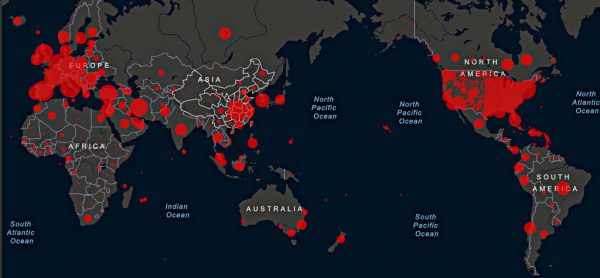
As for the main MD in charge of the COVID19 crisis in Moscow, he told Putin that Russia needs to prepare for what he called “the Italian scenario in order to avoid it”, even though at the time (March 30th) there were only 1,836 confirmed COVID19 cases in Russia, including 9 death and 66 recoveries. Let’s compare the three countries:
| Country | COVID cases detected | Deaths | Recoveries |
| US | 161,807 | 2,978 | 5,644 |
| Italy | 101,739 | 11,591 | 14,620 |
| Russia | 1,836 | 9 | 66 |
All the numbers above come from here: https://coronavirus.jhu.edu/map.html (as of March 30th!!)
Furthermore, the Russian special medical teams of the Nuclear, Biological and Chemical Protection Troops of the Russian Armed Forces are now on full alert and even though there is no shortage of specialized ABC/NBC medical gear in Russia, the Russian Armed Forces are now building 16 special hospitals in various locations in Russia. Russia is also almost completely shutting down internal air and rail traffic. A lot of that was predictable, since Moscow is much richer than any other Russian region, Moscow is doing fine, in spite of being a huge population (about 12 million in the city, plus another 7 or so in the Moscow Oblast’). Here are the official Russian numbers for the Moscow area: (also as of March 30th!!)
| Location | Infected | Deaths | Recovered | % death |
| City of Moscow | 1’226 | 11 | 28 | 0.9% |
| Moscow Oblast | 119 | 1 | 14 | 0.85% |
The source of these numbers is: https://coronavirus-monitor.ru/
Does it not strike you as very strange that a country like Russia, which clearly is faring much better than the US (even in per capita indicators) is preparing for the worst? What do the Russians know that the US leaders are not telling you?
Of course, the anti-Russian propaganda machine has an explanation. For example, it claims that the Russians are lying about everything. There is even a psyop going on with western agents of influence impersonating Russian MDs claiming that there are thousands of hidden deaths, that Russia has no equipment and that the Russians are clueless. One previously sober-minded analyst now even claims that “Putin is losing control“.
To be totally honest, I have never in my life seen such a tsunami of nonsense, false information, unfounded rumors, and, last but certainly not least, shameless clickbaiting. For some, this crisis is clearly a chance to regain some visibility. It is shameful, really, a total disgrace: just a new form of profiteering from a crisis.
I am not medical expert for sure. But I know the Russian government and its “body language” if you wish, and I can tell you that the Russians are preparing very, very seriously, for what might well become a huge crisis even for Russia (having the Ukraine and Belarus both sitting in deep denial will obviously not help!).
Seven, in the US, the contrast between the Federal government and the state authorities is quite startling. As much as the Federal government is terminally dysfunctional, state governors have often had to use a lot of out of the box thinking to get supplies and specialists. For example, the governor of FL, Ron DeSantis (R) had to call a friend of his in Israel to get the giant Israeli pharma company Teva Pharmaceuticals to send in desperately needed medical gear to Florida. Similar things are happening in other states I believe. This is one of the reasons why Americans are typically very suspicious of the Federal government but much more supportive of their local authorities (again, as a general rule, there are, of course, exceptions to this). There are many reasons for the contrast between the Federal and State authorities, including the fact that governors are much “closer” to their constituents on a local level than on the national one.
While not as dramatic as the contrast between societies based on pure greed and societies based on solidarity, this contrast between the local and national level will also contribute to the collapse of the imperial system, albeit more indirectly.
Conclusion: NWO, globalism and US “leadership”- RIP
The first (non-human) victim of this pandemic will be the so-called “New World Order” promised by several US presidents. The same goes for its underlying globalist ideology. If the putative “Illuminati world government” imagined by some really did trigger this pandemic, then it shot itself right in the foot and is now quickly bleeding out.
The US is now showing to the world that the so-called “US leadership” is nothing but a crude lie to conceal what I would describe as the rule of one, single, narcissistic world hegemon who will screw over even its closest “allies” (really colonies) to get any advantage.
Right now most of what we see are only warning signs, say like the EU members closing their borders. But irrespective of how this pandemic progresses, what will happen next is a huge economic crisis which will dwarf both the Great Depression, the crash after 9/11 and 2008.
Of course, the world will, sooner or later, recover from this pandemic and economic collapse. But the kind of world which we will then see will be dramatically different from the one we have lived in until now.
For the time being, there are still observable manifestations of the “US leadership”: the US tries hard to rob medicine and medical gear from other countries, the US imposes sanctions on countries like Iran and Venezuela who desperately need meds, and the US re-plays the Noriega scenario with Maduro. This foreign policy of “US leadership” can be summed up in terms like evil, immoral, hypocritical, dysfunctional, narcissistic. etc. Whatever label one chooses to apply to it, it is always a morally repugnant and practically self-defeating policy.
Right now, after blaming China, Trump is now pointing fingers at the WHO. Truly, a noble soul and a brilliant, 5D, chess player…
There is no more hiding it. The SARS-COV-2 achieved that which even RT or PressTV could not: it put a bright spotlight on the true nature of the AngloZionist Empire.
As the Quran says, God is the better planner.
Ecuador’s Covid-19 catastrophe is man-made disaster
For political elites ordinary Ecuadorians are just disposables

People wait next to coffins to bury their loved ones outside a cemetery in Guayaquyil, Ecuador, on April 6, 2020 © AFP / Jose Sanchez
By Pablo Vivanco | RT | April 7, 2020
Corpses line the streets of Ecuador’s city of Guayaquil, as it’s struggling to deal with the outbreak of Covid’19. But catastrophe could’ve been avoided had the political elites not put monied interest before the lives of people.
Even by Latin American standards, the images emerging from Ecuador’s largest city, Guayaquil, have been shocking. Since the first case of Covid-19 was announced in late February, Ecuador has turned into the epicenter of the crisis in Latin America, touching many of the city’s 3 million residents.
“I know several people who have been infected and also some who have died,” Guayaquil resident Xavier Flores Aguirre tells me. “I think that by this point, everyone in Guayaquil is experiencing something similar.”
In the last weeks, videos and photos have been circulating on social media showing wrapped and covered bodies strewn on the streets in 30 degree temperatures.
Others chose to bury their dead loved ones in empty fields, some in mass graves, and in some cases even resorting to burning the corpses on the streets, all in desperate attempts to save other family members from being contaminated.
Government officials initially played down reports about the outbreak in the city, and Ecuadorian president Lenin Moreno even tweeted on April 1 that this was “fake news with clear political intent.”
Ecuadorian authorities have become accustomed to either denying inconvenient facts, or to simply blame the previous government for any of the country’s woes, but when the mainstream media outlets that have toed government lines in the past began to report on the situation, they had no choice but to acknowledge what was happening.
The city’s hospitals are now spilling over with the sick and dead, and workers from morgues have not been picking up cadavers, leaving many with few options other than the moribound ones that are all over social media.
But who is to blame for the post-apocalyptic scenes in Ecuador’s busiest port?
“I think that the fact that Guayaquil is the most affected population is related to the development model imposed by the political right in the city since the 1990s,” says Flores Aguirre.
Home to the country’s wealthiest people, Guayaquil has long been governed by the Social Christian Party, which has concentrated resources and efforts on supporting the export industries of the city. Social investments have historically been paltry, and in 2018 the city put aside more money for publicity than it did for health. Despite its ‘law and order’ mantra, Guayaquil retains the highest homicide rates, and it has also been deemed as a central gateway for cocaine to Europe.
But the lack of social infrastructure created under decades of uninterrupted rule in Guayaquil can only partly explain why the city accounts for some 90% of the confirmed Covid-19 cases in the country.
Since the beginning of the outbreak, the city’s leaders have carried on as usual, allowing large gatherings to continue and even encouraging people to flock to the Copa Libertadores match in the city. Over 20,000 people showed up to see Barcelona SC play Independiente del Valle in what is certainly a repeat of ‘biological bomb’ in the Champions League match in Northern Italy between Atalanta and Valencia.
Even as the city garners world wide attention for the disaster on the streets, Mayor Cynthia Viteri branded a ‘donation of 1000 cardboard coffins’ to the victim’s families as an act of ‘solidarity.’ The level of contempt and disregard that Guayaquil’s leaders have shown their residents is truly astounding.
But Viteri and her party share responsibility with their allies for this debacle.
“The highest authorities of the central government must be held responsible for the ineffective, late and reactive response,” says Flores Aguirre, who is a constitutional lawyer by trade.
As soon as he was elected, President Moreno back-stabbed his former left-wing allies, as well as predecessor Rafael Correa, by forming a pact with right-wing parties and groups to dismantle the institutions and policies created by the ‘Citizen’s Revolution’ that he helped usher in. He also cosied up to Washington and brokered deals with the International Monetary Fund, all the while pushing through harsh austerity measures that have gutted key social services and diminished the state’s capacity to respond to a crisis like this.
In the health sector, the Moreno government slashed spending from $306 million in 2017 to $201 million in 2018, and then $110 million in 2019, according to a March report from the Central University of Ecuador.
Just two weeks after the first confirmed Covid-19 case, Moreno announced another budget cut of $1.4 billion, including the elimination of 4 regulatory and control agencies, 3 public companies and 4 technical secretariats. Later in March, Ecuador chose to pay $324 million to creditors instead of making investments to stem the impact of the impending crisis.
This is no coincidence of course, as creditors such as the IMF make reduction of public spending a condition of their loans, and this was certainly the case for Ecuador, where the proposed cuts sparked weeks of violent protests in October of 2019.
Moreno worked to dismantle the apparatus and regulations created under Correa, in order to return the country towards the model of governance that his allies have been carrying out in Guayaquil for decades. Simply put, the tragedy unfolding in Guayaquil is the result of the political leaders being unwilling to seriously confront any sort of social crisis, let alone a health related one, and decimated institutions being unable to.
What’s more, the specter of the Guayaquil problem threatens to spread across the country, as the state struggles to ensure police are allowed to patrol the popular tourist city of Banos, or even to properly equip or pay doctors at public hospitals while they attend to the worst crisis that has hit the country since the devastating 2016 earthquake.
Comparing the response now with that of the Correa government in 2016, where the central government moved to coordinate relief and rescue efforts quickly, underscores the fact that what is playing out in Guayaquil is a man-made tragedy.

Health workers wearing protective gear are seen behind body bags outside of Teodoro Maldonado Carbo Hospital in Guayaquil, Ecuador April 3, 2020 © REUTERS / Vicente Gaibor del Pino
The government now acknowledges almost 4,000 cases and under 200 deaths, but surely this number is considerably higher. A joint military-police operation in the city has now begun picking up more than 100 bodies a day, and the country’s health minister said in an interview that as many as 1,500 had died in the city so far.
Ecuador was already turning into a powder keg, as the October protest showed. However, this callous indifference in the handling of this crisis should make it clear that, to the country’s political elites, ordinary Ecuadorians are disposable. Once the dust has settled, those who have already had to scramble to dispose of the corpse of their uncle or grandmother won’t be likely to forget that quickly…
Pablo Vivanco is a journalist and analyst specializing in politics and history in the Americas, who served as the Director of teleSUR English. Recent bylines include The Jacobin, Asia Times, The Progressive and Truthout. Follow him on Twitter@pvivancoguzman
Kissinger says ‘even US’ can’t defeat Covid-19 alone. His solution? Global NWO government, of course
By Helen Buyniski | RT | April 6, 2020
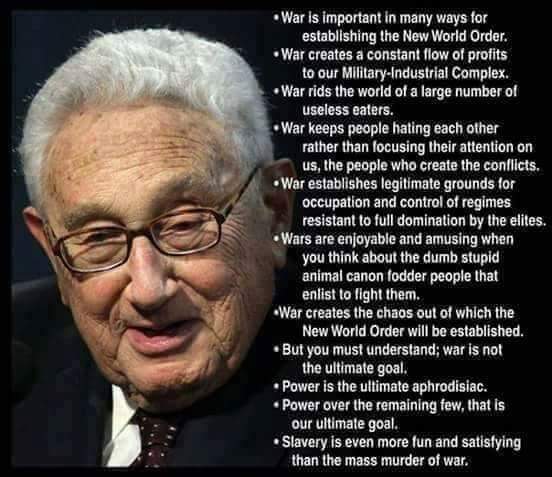
Henry Kissinger, eminence grise of imperial US foreign policy, has warned in an op-ed that no government – even his beloved hegemon – can defeat Covid-19 alone, implying that the New World Order he’s always preached must follow.
If the US doesn’t couple its efforts to rebuild its own economy with the first steps toward creating a global government, humanity is doomed, Kissinger wrote in a recent Wall Street Journal op-ed.
“No country, not even the US, can in a purely national effort overcome the virus,” Kissinger warned. “Addressing the necessities of the moment must ultimately be coupled with a global collaborative vision and program.”
“If we cannot do both in tandem, we will face the worst of each.”
Kissinger laments that the pandemic has led to the return of a “walled city” model of nationalist governance, suggesting that “exploration at the frontiers of science” alone can save humanity from disease in his vision of a globalist utopia. But developing cures takes time, and the notion that countries should be discouraged from protecting themselves in the interim is suicidal. If anything, one of the reasons Italy, Spain, and France were hit so hard by coronavirus was the EU’s dysfunctional insistence on open borders amid the pandemic.
“Global trade and movement of people” are all well and good, but the pandemic has exposed the weaknesses of the globalist system like never before. It will take years for nations to rebuild, and repeating their mistakes is not something they can afford to do.
While serving as Secretary of State and National Security Adviser under presidents Nixon and Ford, Kissinger played a starring role in bombing campaigns against Vietnam, Cambodia, and Laos and oversaw regime-change operations that placed brutal dictators in power in Argentina and Chile, as well as supporting state-sanctioned repression in Indonesia. A notorious report he penned for the Ford administration called for dramatic reductions in population growth across developing nations. One might think, given his record, that he’d be on the side of the virus.
But the Nobel Peace Prize recipient is here presenting himself as an experienced statesman who deeply cares about the future of humanity, calling on the US to “draw lessons from the development of the Marshall Plan and the Manhattan Project.” Sure, revisiting the Marshall Plan makes sense – there are no doubt insights to be gained from revisiting the rebuilding of Europe’s shattered post-war economies, especially since some of the countries hit hardest by the epidemic are in Europe.
But the Manhattan Project? How does a top-secret, international doomsday project that produced weapons with unparalleled killing potential have any bearing on the coronavirus crisis?
Listening to Kissinger, it must be said, is what got the US into its current situation – believing itself exceptional, distrusting all world powers who do not swear abject fealty to it, repeating the same failed policies to the point of parody. A looming presence in the George W. Bush administration, Kissinger advised the country to plunge headfirst into the ever-expanding War on Terror, penning an editorial in the days following 9/11 that called for taking on “any government that shelters groups capable of this kind of attack.” Following such guidance has bankrupted the US and turned it into a banana republic, printing money frantically while its roads and bridges crumble, its citizens struggle to keep a roof over their heads, and the international community looks on, mouths agape, as its government continues to lecture them about human rights.
Kissinger concludes his jeremiad with a warning that “failure [to safeguard the principles of the liberal world order] could set the world on fire.” If, as he himself writes, the “purpose of the legitimate state is to provide for the fundamental needs of the people: security, order, economic well-being, and justice,” those principles collapsed long ago. The US’ first step, post-pandemic, should be to put out the fires set by Kissinger and those like him who seek to cloak empire in the rhetoric of liberal democracy.
Helen Buyniski is an American journalist and political commentator at RT. Follow her on Twitter @velocirapture23
Featured Video
Integrity Initiative: UK-funded network framed dissent as Russian disinformation for years
or go to
Aletho News Archives – Video-Images
From the Archives
Why Saudi Ties to 9/11 Mean U.S. Ties to 9/11
By Kevin Ryan | Dig Within | September 27, 2015
Media interest in Saudi Arabian connections to the crimes of 9/11 has centered on calls for the release of the 28 missing pages from the Joint Congressional Inquiry’s report. However, those calls focus on the question of hijacker financing and omit the most interesting links between the 9/11 attacks and Saudi Arabia—links that implicate powerful people in the United States. Here are twenty examples. … continue
Blog Roll
 Aletho News
- Senate Rejects Iran War Powers Resolution Passed By House
- ‘We did not attack Pakistan with drones’: Afghan sources
- Iraqi Resistance faction links arms to sovereignty, questions US exit
- Cannon fodder no more… South Korea rejects Trump’s pressure to join his criminal war on Iran
- Neria Leiter Was A Legitimate Military Target
- Integrity Initiative: UK-funded network framed dissent as Russian disinformation for years
- ‘We don’t seek permission to defend our country’: Snippets from President Pezeshkian’s UNGA address
- NATO chief wants Europeans to fight American wars [for Israel]
- German chemicals giant reveals details of downsizing
- Refaat Al-Areer Was The Canary In The Coal Mine In Israel’s War On The Truth
- If Americans Knew
- Israel displaces hundreds of Palestinians amid wave of demolitions in West Bank
- Aid, reconstruction, and Israel’s history of obstruction in Gaza
- Trump administration digs an ever-deeper hole of complicity in genocide – Daily Update
- US-Israel $2.8 Billion Arms Deal, 40,000-Bomb Supply Faces New Gaza Complicity Accusations
- Caught on Tape: AIPAC CEO Boasted of Controlling Trump’s National Security Officials
- Why Hamas Attacked Israel in October 2023 – Israeli professor Ilan Pappé
- They see them, then kill them: Israeli quadcopters track, deliberately target civilians in Gaza
- Winter could turn Gaza’s treacherous, war-damaged buildings into deathtraps
- Majority of Democratic Voters Want to Prosecute Both Biden and Trump Administration Officials Over Gaza
- As Gaza languishes, world leaders gather at the UN – Daily Update
- No Tricks Zone
- New Study: Earth And Venus Surface Warmth Largely Explained By Convection And Lapse Rate, Not CO2 Or Radiation
- 2025 Nature Paper Claiming Worsening Global Drought Gets RETRACTED …Heavily Flawed
- New Study: ‘Global Drought Shows No Detectable Recent Acceleration Under Climate Warming’
- Economic Masterminds: German Socialists Suggest Taxing Productivity Gains Stemming From Using AI
- The South China Sea Has Not Been Cooperating With The Climate Change Narrative
- Energy Crisis: Germany Enters Heating Season With Historically Low Gas Reserve Fill Levels
- New Study: The Antarctic Ice Sheet Gained Mass From 2020-2024 Due To Staggering Snow And Ice Accumulation
- Study: Ocean Heating Rates From Thousands Of Years Ago ‘Dwarf’ Modern Ocean Heating Rates
- Climate Extremists Target, Attack Large-Scale Power Grid Infrastructure In Germany!
- New Study: Antarctic Ice Melt Has Contributed Less Than 1 Centimeter To Sea Level Rise In The Last 30 Years

