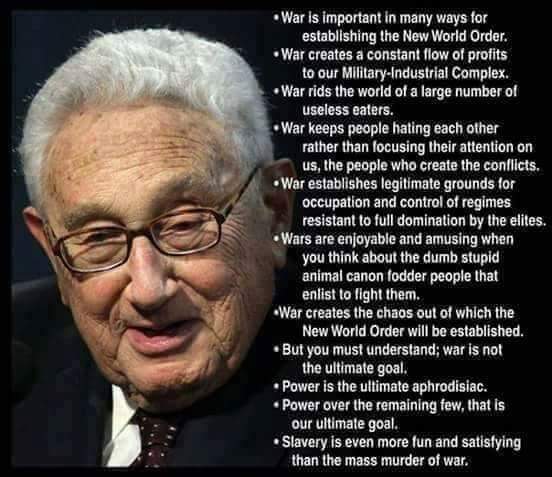
Kissinger says ‘even US’ can’t defeat Covid-19 alone. His solution? Global NWO government, of course
By Helen Buyniski | RT | April 6, 2020
Henry Kissinger, eminence grise of imperial US foreign policy, has warned in an op-ed that no government – even his beloved hegemon – can defeat Covid-19 alone, implying that the New World Order he’s always preached must follow.
If the US doesn’t couple its efforts to rebuild its own economy with the first steps toward creating a global government, humanity is doomed, Kissinger wrote in a recent Wall Street Journal op-ed.
“No country, not even the US, can in a purely national effort overcome the virus,” Kissinger warned. “Addressing the necessities of the moment must ultimately be coupled with a global collaborative vision and program.”
“If we cannot do both in tandem, we will face the worst of each.”
Kissinger laments that the pandemic has led to the return of a “walled city” model of nationalist governance, suggesting that “exploration at the frontiers of science” alone can save humanity from disease in his vision of a globalist utopia. But developing cures takes time, and the notion that countries should be discouraged from protecting themselves in the interim is suicidal. If anything, one of the reasons Italy, Spain, and France were hit so hard by coronavirus was the EU’s dysfunctional insistence on open borders amid the pandemic.
“Global trade and movement of people” are all well and good, but the pandemic has exposed the weaknesses of the globalist system like never before. It will take years for nations to rebuild, and repeating their mistakes is not something they can afford to do.
While serving as Secretary of State and National Security Adviser under presidents Nixon and Ford, Kissinger played a starring role in bombing campaigns against Vietnam, Cambodia, and Laos and oversaw regime-change operations that placed brutal dictators in power in Argentina and Chile, as well as supporting state-sanctioned repression in Indonesia. A notorious report he penned for the Ford administration called for dramatic reductions in population growth across developing nations. One might think, given his record, that he’d be on the side of the virus.
But the Nobel Peace Prize recipient is here presenting himself as an experienced statesman who deeply cares about the future of humanity, calling on the US to “draw lessons from the development of the Marshall Plan and the Manhattan Project.” Sure, revisiting the Marshall Plan makes sense – there are no doubt insights to be gained from revisiting the rebuilding of Europe’s shattered post-war economies, especially since some of the countries hit hardest by the epidemic are in Europe.
But the Manhattan Project? How does a top-secret, international doomsday project that produced weapons with unparalleled killing potential have any bearing on the coronavirus crisis?
Listening to Kissinger, it must be said, is what got the US into its current situation – believing itself exceptional, distrusting all world powers who do not swear abject fealty to it, repeating the same failed policies to the point of parody. A looming presence in the George W. Bush administration, Kissinger advised the country to plunge headfirst into the ever-expanding War on Terror, penning an editorial in the days following 9/11 that called for taking on “any government that shelters groups capable of this kind of attack.” Following such guidance has bankrupted the US and turned it into a banana republic, printing money frantically while its roads and bridges crumble, its citizens struggle to keep a roof over their heads, and the international community looks on, mouths agape, as its government continues to lecture them about human rights.
Kissinger concludes his jeremiad with a warning that “failure [to safeguard the principles of the liberal world order] could set the world on fire.” If, as he himself writes, the “purpose of the legitimate state is to provide for the fundamental needs of the people: security, order, economic well-being, and justice,” those principles collapsed long ago. The US’ first step, post-pandemic, should be to put out the fires set by Kissinger and those like him who seek to cloak empire in the rhetoric of liberal democracy.
Helen Buyniski is an American journalist and political commentator at RT. Follow her on Twitter @velocirapture23
Coronavirus: Consequences of Staggering Magnitude
By Alain DeBenoist | Occidental Observer
Excerpts from the interview, April 2, 2020; translated by Tom Sunic.
… A few years ago I wrote that only in a state of emergency one can take full measure of somebody. Now we know where we are at. A statesman makes decisions, gives orders and requisitions. Macron, however, relies on the advice of “experts” who, as a rule, never agree with each other.
… There was a wish to include in the logic of the (free) market a sector which by definition lies outside the free market. Public services have been systematically weakened and destroyed. Now it is us who are paying the price. And this is just the beginning, because the confinement will last for weeks, if not for months. We are not at the end of the beginning, much less at the beginning of the end.
… At the start, as a rule, everyone stands together. However, as we arrive at “the day after” and when the time comes for accountability, the people’s judgment will show no mercy. If this matter ends up, as I suspect it will, in a social crisis of huge magnitude, then the Yellow Vests movement will look like, more than ever before, as a dress rehearsal. We can now clearly see that it will be most difficult for the working class and the middle class to put up with [coronavirus] confinement.
… [The European Union ] didn’t commit suicide for the simple reason that it had already been dead. One of the merits of the crisis has been to allow everybody to see its dead body. Faced with the epidemic the leaders of the European Commission are showing signs of shock. They are now going to release funds which will be distribute by “helicopter,” after ramping up the monetary printing press. But in real terms nothing comes of it. It was not Europe that came to the rescue of Italy, but China, Russia and Cuba. Fidel Castro’s posthumous revenge!
… [The economic crisis ] will last much longer than the current epidemic; it will do far more damage and kill far more people. If it goes hand in hand with a global financial crisis, we will be witnessing then a tsunami: an economic crisis and therefore a social crisis, financial crisis, health crisis, ecological crisis, migration crisis. In 2011 I published a book called Au bord du gouffre (On the Brink of the Abyss). It seems to me that we have arrived there now.
… We should also anticipate political and geopolitical consequences of staggering proportions. The unfolding of the epidemic in a country such as the United States, whose health system, organized of course in a liberal fashion, is one of the world’s least performing, will be challenged to play a decisive role. It must be followed very closely (the global epicenter of the epidemic today is New York). The United States will likely come out of it much weaker than Russia and China, its only two rivals for the time being. Again, we are only at the beginning…
China Produces Record Amount Of “Fire Ice”
By Irina Slav | Oilprice.com | March 30, 2020
In a world awash in oil and gas, you’d think it couldn’t get any worse. Well, it can: China just announced that it had extracted a record amount of what has been poetically called fire ice. It is, however, a form of natural gas trapped in frozen water.
At 861,400 cubic meters, this record might not be a whole lot of gas, but it may well be the start of something new, and gas producers may not like this ‘something’.
Gas hydrates don’t garner a lot of media attention as a rule, simply because they have yet to become an addition to the world’s energy mix. But when they do—if they do—they may change the international oil and gas market even more than the coronavirus outbreak has changed it now by decimating demand for hydrocarbons.
First, what are gas hydrates?
Gas hydrates are molecules of natural gas, most commonly methane, trapped in a “cage” made from water molecules. They exist in cold climates, such as beneath the Arctic permafrost and Antarctic ice, but also in sedimentary deposits–the same kind of deposits where oil and gas collect along the margins of continents and also under the seabed of specific basins such as the South China Sea.
Because they only exist in cold places, research on gas hydrates has been challenging. As geologist Hobart M. King explains in an article on hydrates for Geology.com, hydrates are only stable in the environment where they formed.
To study them, researchers need to remove the samples from their environment. The change in temperature in pressure, however, melts the water cage, and the methane escapes.
Why bother with hydrates at all, then? Because they may be more abundant than all other hydrocarbons taken together: oil, gas, and coal.
According to the U.S. Department of Energy, the world’s methane gas hydrates could be as vast as 250,000 to 700,000 trillion cu ft. According to the UN Environmental Programme, the world’s reserves of gas hydrates could be as large as 3,000 to 30,000 trillion cubic meters. But these are just enormous figures that are difficult to digest.
Here’s an estimate that might be more palatable: the world’s gas hydrate reserves could be between 100,000 and 1.1 million exajoules. For context, the world’s total annual energy consumption as of 2014 when the UNEP paper was written was about 500 exajoules.
This means we might be sitting on enough gas to power the world for hundreds, if not thousands, of years.
It’s packed tightly, too. According to the Department of Energy, a single cubic meter of hydrate can release as much as 164 cubic meters of natural gas. Talk about energy density.
China is among just a handful of countries pursuing research into gas hydrates with a focus on extraction. With its dependence on imported oil and gas, this is hardly surprising. The first extraction experiments in the South China Sea, in 2017, resulted in an output of 300,000 cubic meters extracted over a period of two months. Now, the Ministry of Natural Resources has reported an output of 287,000 cubic meters achieved in a single day. This is quite a significant progress in three years.
And that’s not all.
According to the ministry, the output achieved during this phase of the gas hydrate trials provided a “solid technical foundation for commercial exploitation.”
This is probably the last thing gas producers around the world want to hear right now, but it is what they need to hear. Full-scale commercial production may be years or even decades away, but China is getting there. It seems, however, that it is getting there in strides rather than baby steps. This could spur others into action or, as it were, faster action.
Back in 2012, the United States and Japan reported successful production of methane from gas hydrates in the Alaskan North Slope. Then, a year later, Japan reported successful production again, this time from an offshore deposit at home. Those tests ended sooner than expected because of technical problems. In 2017, Japan again announced the first successful longer-lasting extraction of methane from a gas hydrate deposit offshore.
Last year, the U.S. Geological Survey updated its estimate for gas hydrate reserves in Alaska to 53.8 trillion cu ft. While this is significantly lower than the initial estimate from 2008, which said there were 85 trillion cu ft of recoverable fire ice in the North Slope, it is still substantial enough to motivate exploration. Only perhaps not right now, given the price environment.
China’s announcement comes at a sensitive time for the world gas industry. Prices are severely depressed by a rare if not unprecedented combination of unusually low demand and excessive supply. Energy firms are retrenching and preparing to wait out the crisis. Exploration budgets are being slashed and plans are being revised. And now, China has announced that it is working on its self-sufficiency in gas. It is going to be an ugly year for the energy industry, but maybe a good year for research into what could be the world’s most abundant fossil fuel resource.
Europe: Over 520,000 coronavirus cases and almost 38,000 deaths
By Robert Stevens | WSWS | April 3, 2020
European countries, including Spain and the UK, announced record-high daily coronavirus death tolls Thursday. With the 4,199 new deaths yesterday, 37,864 have already perished in Europe. There have been more than 521,000 cases of COVID-19 infections on the continent including 33,661 new cases.
In Spain, 950 died—the third consecutive day of a record high.
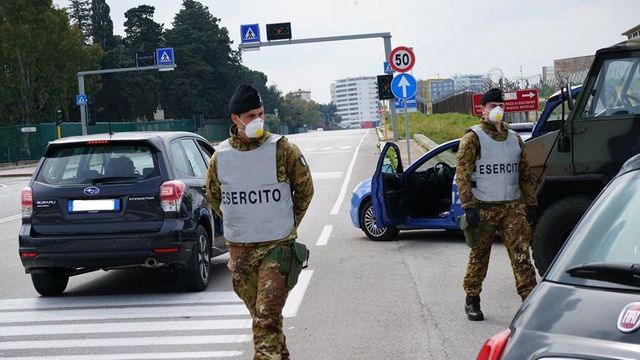
Italian Army soldiers monitoring cars and controlling the streets in Bari: (credit Twitter: Italian Army)
In the UK, the death rate has quadrupled in a week. In just four days since Monday, 1,693 coronavirus deaths have been announced—more than were recorded on all days up to March 29. The Department of Health and Social Care reported a record 569 deaths Thursday, taking the total to almost 3,000 (2,921). This was the second consecutive day Boris Johnson’s Conservative government announced over 500 deaths. Wednesday’s 563 fatalities were a 31 percent increase on the previous day.
With an age range of the latest deaths between 22 and 100 years old, nearly 8 percent (44 people) of yesterday’s victims had no known underlying health conditions.
Britain is now showing the terrible daily toll commonplace in Italy and Spain, with the pandemic taking over 13,000 and 10,000 lives in those countries.
The UK infection rate has also shot up, with 4,324 new cases announced Wednesday and 4,244 Thursday. Total infections in the UK stand at 33,718 but are in reality much higher. Hardly any tests were done when the outbreak began, despite months of warnings. Three weeks ago, Johnson announced—as part of attempting to enforce his “herd immunity” policy aimed at infecting everyone in the country with coronavirus—that no systematic testing would be done and that everyone who showed symptoms should self-isolate.
More than 1.7 million people in the UK have likely caught coronavirus over the past 15 days. Data from the NHS 111 online service revealed that web-based assessments flagged 1,496,651 people as potential carriers; a further 243,543 calls to 111 and the 999 emergency number concluded callers had signs of COVID-19.
It was only after widespread outrage at its social Darwinist policy that the government was forced to pledge that widespread testing would be done. Even now, just 163,194 tests have been completed with yet another promise yesterday of 100,000 a day for the end of April. Only 2,000 of 550,000 National Health Service frontline workers have been tested.
The BBC’s head of statistics, Robert Cuffe, commented Thursday, “if that [UK death rate] keeps up, we’d expect to see in the region of a thousand deaths a day by the weekend.” Sky News economist Ed Conway noted that “For the past week or so,” the UK’s death rate has “been doubling every three days” and “if the growth rate continued like that, in a week’s time there would be 10,000 people dead and the UK would be on a far worse trajectory than Italy.”
An explanation of this steeper curve emerged late yesterday, when NHS England reported that the earliest death in the UK had in fact occurred on February 28, one week earlier than previously reported. In total, six people had died in hospital prior to March 5.
In Italy, 760 died Thursday, taking the total to almost 13,915. Two new studies suggested the true death toll could be significantly higher than reported. The InTwig data analysis firm reveals that while there were 4,500 deaths in the hardest-hit city of Bergamo, the Civil Protection Agency only reported 2,060 deaths. The University of Bergamo, using historical data from the national statistics office compared to current hospital data, showed that deaths in the north of Italy doubled in the first three weeks of March, compared with the average number of deaths during the same period between 2015 and 2019. The uncounted deaths were mostly elderly victims who were not admitted to hospital and never tested for the virus.
The government welfare assistance website remains down, leaving Italy’s most vulnerable unable to receive any COVID-19 scheme for financial support. An estimated 3.3 million Italians work in the black economy and don’t qualify for welfare support schemes. Twenty thousand army soldiers are deployed in southern Campania, Puglia and Sicily to patrol the streets amid rising tensions as citizens run out of food and money.
Germany announced 168 new deaths, taking the total to 1,099. After Berlin approved its “coronavirus aid programme”—a bailout worth €600 billion for the banks, corporations and the super-rich—anger among workers is growing. In the past days, health employees in hospitals, nursing homes and workers in businesses vital to the supply of the population’s needs have criticised catastrophic and unsafe working conditions.
Truck drivers, airport workers, delivery workers and steelworkers are also voicing opposition. A worker at the Outokumpu stainless steel group in Krefeld, speaking anonymously to the WSWS, said, “We’re all angry, feeling betrayed. Even those in risk groups still have to work. An info sheet says they should talk to the company doctor. I did that. He advised me to wash my hands and disinfect myself. But we don’t have any disinfectant, or face masks. I use keyboards, telephones, etc.”
In a dramatic development, France’s death toll shot up by 1,355. Previously, Emmanuel Macron’s government had only released the deaths of those who had died in hospital of coronavirus. Yesterday, it announced that 884 people had also perished in retirement and care homes. On top of the 471 hospital fatalities, this takes total deaths to 5,387. Other countries, including until recently Britain, have also not included those who died outside hospital in their fatality announcements to play down the scale of the catastrophe they are responsible for.
Aware of explosive social anger in workplaces, the Stalinist General Confederation of Labour (CGT) has issued an authorization for public sector workers outside the hospitals to strike in April. The CGT is not calling for strike action or opposition to President Emmanuel Macron, but cynically authorizing isolated action by individual workers while the union bureaucracy keeps working with the government to slash wages and social benefits.
Workers have mounted strikes or walked off the job at Amazon, in supermarkets, in the auto industry and in aeronautics. One worker at an air conditioner manufacturing plant told the press, “This epidemic has woken up a lot of people…now the masks are falling. Usually management manages to calm them down, but today they are seeing that even when it is a matter of life and death, management has no concern for them.”
Lockdowns throughout the continent have led to staggering job losses. The Financial Times reported Wednesday, “Unemployment is growing much faster than in previous recessions because the measures taken to slow the spread of the virus are felt most severely in low-wage, labour-intensive sectors such as retail, hospitality and other consumer-facing services.”
In the UK, more than 1 million people have been forced onto the welfare rolls in just two weeks. Austria reported Wednesday that unemployment now stood at over 12 percent—the highest level since records began in 1946. In Spain, over 900,000 people have been made unemployed since the outbreak began there. In Norway, unemployment has risen from 2.3 percent to 10.4 percent in little over a month. The Financial Times noted the government’s Labour and Welfare Administration statement that a quarter of tourism and transport workers and almost a fifth of retail workers were now claiming unemployment insurance.
The newspaper reported that in Germany, “some 470,000 companies have applied for government wage subsidies through the ‘Kurzarbeit,’ or short-hours, programme—almost five times higher than the 100,000 people who used the scheme during the 2008-2009 recession.”
Another indication of the devastating impact of the coronavirus on the working class is seen in the map produced by the Catalan regional government in Spain, showing that the virus is six or seven times more prevalent in Barcelona’s poorer areas than in wealthier areas.
We need to cut around 10 mln barrels per day of oil production, Russia is ready to act with US on oil markets – Putin
RT | April 3, 2020
Russian President Vladimir Putin has said his country is ready to work with the Trump administration to halt the freefall of oil prices. His comments come after a phone call with President Trump earlier this week.
Putin also noted that the daily oil output should be cut by around 10 million barrels, as there is lower demand due to coronavirus. Oil prices started dwindling after OPEC+ countries disagreed on production cuts, with Saudi Arabia refusing to lower the output.
With an ongoing “price war” between Russia and Saudi Arabia driving prices even further down, US president Trump said on Thursday that “it would be great” if the two countries could make a deal to limit production.
Putin had already spoken to Trump by phone earlier this week, and on Friday announced that he is ready to cut production by 10 million barrels per day.
The Russian leader said that moving forward, Moscow would be comfortable with a price of $42 per barrel, roughly $10-15 higher than current levels.
Oil prices jumped prior to Putin’s Friday announcement, after Trump spoke of a pending deal.
No talks between Moscow and Riyadh have yet taken place, Kremlin spokesman Dmitry Peskov said on Friday. However, non-OPEC member Azerbaijan announced that the petroleum bloc and its allies will hold discussions on Monday aimed at restoring “balance to the oil market.”
Saudi Arabia, ramped up its production on Wednesday to a record high of more than 12 million barrels per day, after previous OPEC+ production cuts expired at the end of March.
During a televised meeting with Energy Minister Alexander Novak Putin said the Saudi crown is flooding the market to force competing shale oil producers out of business, among them the US and Russia.
Novak noted that he doesn’t know when the world’s plummeting demand for oil will finally bottom out.
Despite US Sanctions, Iran’s Revolutionary Public Health System Curbing COVID-19 Outbreak
Sputnik – April 3, 2020
Iran has managed to contain its coronavirus outbreak even under crippling US trade sanctions that have limited the country’s access to medical equipment and other resources, Sayyed Mohammad Marandi, an American studies and postcolonial literature professor who teaches at the University of Tehran, told Sputnik’s Loud & Clear Thursday.
Marandi told Sputnik the situation in Iran is “significantly better than in the US,” despite Washington’s adamant refusal to lower economic sanctions frustrating trade with Iran, which have made buying medicine and equipment for hospitals difficult.
“It has been managed, and that’s largely because – despite all the sanctions in the last four decades – after the [1979] revolution, Iran established a primary health care network across the country,” Marandi told host Brian Becker.
“It exists in villages, in towns, in cities, it’s a huge network. This is the foundation upon which the resistance or the fight against the coronavirus was based,” Marandi said, noting that “Iran had much less time” to prepare for the outbreak than did European countries or the US, being one of the first hit after the virus broke out of China’s Hubei Province.
“But since Iran had less time, Iran was obviously less prepared. And because of the sanctions, because the US government was trying to prevent Iran from being able to fight the virus by preventing Iran from purchasing [test] kits, by preventing Iran from purchasing masks, ventilators – the US government was doing everything it could, basically through the sanctions, to turn the coronavirus into a biological weapon to use against Iran. And they still do,” Marandi said.
“But despite all of that, and despite the hardship that the Iranians went through initially, not being able to purchase their needs, because of this very powerful and very extensive primary health care network that exists in the country, they were able to contain the virus. And now the situation in Iran, despite being hit very hard and being the first to be hit without knowing clearly what it was and how to deal with it – the situation in Iran is remarkably better than what we are seeing sadly in Europe and unfortunately in the US,” Marandi told Sputnik.
The latest data reveals that there are more than 50,000 cases of the virus in Iran, and more than 3,000 people have died as a result. The US has become the epicenter of the pandemic, with more than 242,000 cases and almost 6,000 deaths from the disease.
In a recent statement, Iranian Foreign Minister Javad Zarif referred to the US sanctions against Iran as “economic terrorism.”
“We had always said the sanctions are unjust, but coronavirus revealed this injustice to the world,” Zarif added.
In a Saturday tweet, US Secretary of State Mike Pompeo claimed that Iran’s “concerted effort to lift US sanctions isn’t about fighting the pandemic” but is rather about Iran’s leaders “trying to avoid responsibility for their grossly incompetent and deadly governance.”
Even though the US claims that its sanctions don’t prevent the sale of medicine and medical devices, the secondary sanctions on financial institutions and businesses have prevented Iran from buying necessary items like ventilators that could save the lives of coronavirus patients, the New York Times reported.
Renewed Tensions With Iran in Iraq
In the midst of the pandemic, US President Donald Trump on Wednesday took to Twitter to warn Iran against attempting to attack US troops or assets in Iraq after claiming that Iran or its proxies “are planning a sneak attack on US troops and/or assets in Iraq.”
One day later, Zarif tweeted: “Don’t be misled by usual warmongers,” adding that the US “surreptitiously lies, cheats & assassinates,” while Iran “only acts in self-defense.”
“Iran starts no wars, but teaches lessons to those who do,” the minister added.
According to Marandi, Trump may be threatening Iran in an attempt to distract American citizens from the catastrophic mismanagement of the coronavirus within US borders.
“Iran is an extremely powerful country. If the US carries out an attack on the country, it will have devastating consequences for the Americans, and I think the Americans know that. The Americans had to leave Iraq about a decade ago when the small resistance with light weapons put up a fight against an American force with all its allies that were well over 150,000 troops. Now, the Americans in Iraq have 5-6,000 troops. They’re all alone, almost. Almost all of their allies have left, and the Popular Mobilization Forces of the Iraqi Armed Forces is itself well over 100,000. So, I can’t see a situation where Trump can win in Iraq, win in Iran,” Marandi added.
“Business as Usual” Isn’t Even a Choice
By Anatoly Karlin • Unz Review • April 1, 2020
A few days ago, I joked on Twitter:
The choice isn’t between boomer genocide and an economic collapse.
The choice is between boomer genocide and economic collapse, or producing millions of 5 cent masks and making people wear them.
Reality is, it is only boomer genocide that isn’t a choice.
74% of Americans support a national quarantine, and that even includes 72% of Republicans. In France, there is a near consensus on lockdown at 96%. In Italy it is 94%.
In Brazil, Jair Bolsonaro – the only President of a major democratic polity who continues to insist on treating coronavirus as a nothingburger – has been made into a lame duck, his commands ignored by 24 out of Brazil’s 27 governors and even by his own Health Minister.
Meanwhile, as predicted by Ron Unz, Trump has performed a volte face, extending federal social distancing guidelines past Easter up to April 30 and now touts 100,000 deaths as a “good scenario.”
Which is just as well, because as we know see, modern democracies are simply incapable of “powering through” even through what is a fairly low-mortality pandemic in historical terms.
Consequently, the only choices are:
- Nip it in the bud early on through mass testing-tracing-treatment, border controls, and limited lockdowns, resulting in limited economic damage. [for example]
- Wait until later, necessitating progressively more massive, longer, and economically ruinous lockdowns. [for example]
So the only correct move is to clamp down close to the start, and to clamp down hard. This is what was done in all the East Asian polities, be they chaotic democracies, city-state technocracies, or Communist single-party states.
Because in the latter scenario, there will eventually come a time when you are simply sidelined by your own underlings and by regional authorities, adding a political crisis on top of a healthcare and economic one.
In my post on Trump’s initial decision, I speculated:
Far out scenario: Blue states may outright defy Trump on abandoning containment measures, in which case they too would be doing starkly better than Red states (unless it also sparks a Constitutional crisis into the bargain).
Well, on that note, here’s a Tweet from California governor Gavin Newsom today. That’s some interesting wording there:
California is an enterprising, modernizing, nation-state. 40 million strong. Together, we will get through this. pic.twitter.com/PBTc7ukmak
— Gavin Newsom (@GavinNewsom) April 1, 2020
So again, good on Donald Trump to have come to terms with Corona reality and averting what could have become a very dangerous experiment.
This brings us to another interesting question: Will we get a “clean” experiment anywhere?
As per above, I don’t think it’s going to happen in any democracy. Britain backed away from its “herd immunity” idea two weeks ago, on realizing that their models didn’t include a term for ventilator shortages. The Dutch followed soon afterwards. With Sweden’s coronavirus mortality trajectory beginning to radically diverge from those of its Nordic cousins, I believe it is only a matter of time before they go into lockdown as well.
My guess is that our best “hope” – inappropriate as that expression may be – lies in Belarus, which is run by a decidedly non-coronapilled dictator.

America’s rich work from home & whine while poor lose jobs or get exposed to coronavirus – poll
RT | April 1, 2020
Poorer Americans are more likely to have lost their job or be forced to work as usual amid the coronavirus epidemic. But those in the upper classes can work remotely while stressing out about the crisis.
At least that’s the indication of an Axios/Ipsos poll about the working status and emotional wellbeing of people in the US. Almost half of upper middle class Americans have switched to working from home amid the health crisis. The same is true for 39 percent of the upper class.
In contrast, only three percent of lower economic strata had the same luxury. Between 26 and 34 percent of lower-to-middle class Americans are working the same way as they did before the outbreak, exposing themselves to a greater risk of being infected. And 15 to 20 percent have lost their jobs.
But the Americans who are better off tend to be more upset about the situation than their economically struggling compatriots, according to the poll. Almost half of the rich (47 percent) said their emotional well-being has gotten worse, compared to 34 percent on the other side of the socioeconomic scale.
“Ironically, those with the most resources and the least exposure are significantly more likely to say their emotional health is taking a hit,” Axios noted.
There are 189,633 confirmed Covid-19 cases in the US, according to the Johns Hopkins University board, with the death toll standing at 4,081.
Can the United States decline peacefully?
By Kevin Barrett | Press TV | March 31, 2020
Professor Atta-ur-Rahman from Pakistan recently in an interview argued that this coronavirus pandemic may have originated as a US bioweapon. He’s not just any doctor, but he’s the chairman of (Pakistani Prime Minister) Imran Khan’s National Task Force on Science and Technology. And Pakistan’s former UN Ambassador Abdullah Hussain Haroon said the same thing.
This is very interesting. The US, of course, has been very close to Pakistan in the past. And today Pakistan is trying to balance between the US and China. Hearing this kind of statement from high level people in Pakistan is a wakeup call that the world needs to take this seriously.
I think that the context is such that anybody who’s seriously paying attention to contemporary history has to admit that from the circumstantial evidence alone, it seems very likely that we should see this as a deliberate US biological attack on China, and perhaps on Iran or perhaps the Israelis did that.
The reason for this is that the US has entered into a period of great power competition with a rising China, not just a rising China but with a very rapidly rising China, if we listen to serious geostrategic analysts such as John Mearsheimer, a very brilliant man who tries to tell the truth as he sees it, as we all know, from his analysis with, with Walt on the Israel lobby here in the United States.
In October 2014, just about six years to the day before the US military sports team came to Wuhan, China, perhaps bringing that virus and while at the same time an exercise was being run, “Event 201”, mimicking exactly what would happen in the case of this kind of pandemic, John Mearsheimer published an article called, Can China Rise Peacefully? His answer was no.
John Mearsheimer is an American political scientist and international relations scholar. And he argued that the United States is going to take extraordinary measures to kill Chinese economic growth, which has been averaging 10% since 1980, and which is still up at 7%, putting China on a course to grossly eclipse the United States in economic and enhanced technological and military power within a decade or two at the very most.
Mearsheimer says the United States will undoubtedly do what it takes to stop this no matter what. Here’s a quote from his article he said,
“All of this tells us the United States has a profound interest in seeing Chinese economic growth slowed considerably in the years ahead. That outcome might not be good for American prosperity, much less for global prosperity, but it would be good for American security, which is what matters most.”
So that prediction was that the US would be willing to kill not only the global economy, but the American economy as well in order to stop this precipitous Chinese ascendance in the world. That’s what’s happened obviously.
If China’s growing at over 7% and the US is growing at a couple of percent at most, that differential leads to quick Chinese dominance of its region and then the world, whereas if the whole world’s growth is killed, and China’s dives down to a percent or two, and even if the US growth goes a little bit negative, this change doesn’t happen, the US maintains its current global military supremacy or so it may think.
So clearly, from the background, the historical background in the context everybody in the world who knows anything about history needs to be talking about, this as a US bioweapon attack on China just as the Chinese are saying, just like the Iranian government’s saying just like the Russian government’s saying and now just like the top people in Pakistan are saying.
Kevin Barrett is an American author, journalist and radio host with a Ph.D. in Islamic and Arabic Studies.
Trump tiptoeing toward energy market management
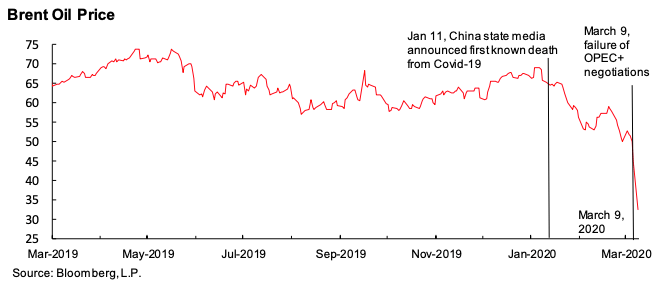
Oil price war in the time of Covid-19
By M. K. BHADRAKUMAR | Indian Punchline | March 31, 2020
On Monday, the US President Donald Trump literally bit the bullet by telephoning Russian President Vladimir Putin to discuss the state of the energy markets, which are at a crisis point not seen in history. As of last weekend, global oil prices collapsed by over 50 percent and are the lowest seen in almost twenty years.
A defining moment has come. Starting April 1, OPEC+ countries (OPEC plus Russia) are at liberty to pump as much oil as they please. The increased oil volumes are sure to flood the oil market. Saudi Arabia has talked of offering 12.3 million barrels per day to the market.
The combination of a massive supply overhang and a significant demand shock at the same time has created an unprecedented situation in the oil market history. It threatens to have a multiplier effect on the deep recession in the world economy due to the coronavirus and the consequent lockdowns in large swathes of China and the industrial world.
For the US, the oil market bust could mean that over half of its shale industry, which has been charioting the country’s newfound oil superpower status, may go bankrupt. Breakeven price for US shale industry ranges from $40-50 per barrel — and prices have plummeted to around $20.
A similar crisis had arisen in 2014-2016 period but shale industry survived through a combination of pushing costs lower and retrenching — and bouncing back with higher profits once the crisis was over. However, this time around, shale drillers were already facing substantial hurdles with cash flow problems and maturing debt and the dramatic fall in income simply drives them bankrupt. Again, whereas the problem earlier was one of fall in oil prices, today it is also combining with the biggest demand slump in the history of oil.
The US shale sector is getting completely killed and tens of billions of dollars in equity could get wiped out. 13 US senators wrote to the Saudi Crown Prince Mohamed bin Salman earlier this month urging halt to efforts to boost production and lower prices. They threatened to take action against Saudi Arabia if the “economic warfare” continued.
Sen. Ted Cruz from Texas told CNBC on Monday: “The Saudis are hoping to drive out of business American producers, and in particular shale producers, largely in the Permian Basin in Texas and in North Dakota. That behaviour is wrong, and I think it is taking advantage of a country that is a friend… If they don’t change their course, their relationship with the United States is going to change very fundamentally.”
However, the Saudis are not backing down from the oil price war for market share and are planning another increase in its oil exports starting in May. A prominent Saudi establishment commentator Bernard Haykel wrote recently that Riyadh’s decision reflects a broader and more fundamental strategic shift led by the Crown Prince. To quote Haykel, “He (Crown Prince) has embarked on a policy of capturing market share rather than trying to set the price.”
Indeed, the warning bells are ringing already for the shale industry. Tens of thousands of roughnecks are getting laid off. The Oil Price magazine forecasts that layoffs in the US oil industry could be as high as 200,000 jobs.
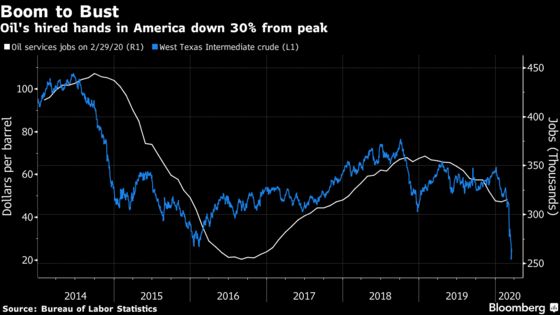
Tens of thousands are getting laid off in the US shale patch
The Brookings Institution anticipates in a study that the Midland-Odessa region of West Texas, where Occidental Petroleum and Parsley Energy have dominated, could be decimated. A top oil executive, Dan Eberhart, CEO of Denver-based Canary has been quoted as saying, “There’s definitely blood in the water. The weakest oil and gas companies, oilfield service companies and banks with heavy energy exposure might submerge beneath the waves before the end of the cycle never to surface again.”
The ripple effect is staggering. When the fracking companies go bankrupt and cannot repay debts, the credit market and the banks face a crisis, which in turn threatens the whole system of oil stock exchange.
Simply put, Saudi Arabia and Russia have dealt a lethal blow to the decade-old American fracking industry, which they have seen as a mortal enemy. The crux of the matter is that they are independently fighting the US and are determined to take the price war forward to conclusively finish off the American encroachment into their market share. (See my blog Oil price war is more about market share)
Recently, the chairman of Russia’s state-owned Rosneft, Igor Sechin, who is a longstanding associate of President Vladimir Putin, stated bluntly that as soon as US shale leaves the market, prices will rebound and could reach $60 a barrel.
The bottom line is that for President Trump, the political costs are exceedingly high. For one thing, his boast that the US has become the most significant player in global oil markets is coming unstuck and his agenda to secure “energy dominance” on the back of a shale boom is exposed as a pipedream.
More importantly, Trump’s trademark policy of weaponisation of sanctions against Iran, Venezuela and Russian oil industry and its flagship Nord Stream 2 gas pipeline project to grab these countries’ market shares is running into headwinds.
Russia is moving in quickly to turn the “oil war” also into a war for natural gas market share in Europe. Russia has watched with unease the arrival of shale gas on European shores that could potentially erode its commanding position as the single largest supplier of natural gas to Europe. The US has been touting the LNG sales to Europe as “freedom gas”, which helps European countries to reduce their high level of dependence on Russian supplies.
The US sanctions against Nord Stream 2 gas pipeline project, which connects Russian fields with Germany and northern Europe and was nearing completion, is a case in point. The sanctions targets Russia’s Gazprom from expanding and consolidating its towering presence in Europe’s energy market. Unsurprisingly, Moscow is in an unforgiving mood.
Following Trump’s phone call to Putin, the White House said the Russian and US leaders “agreed on the importance of stability in global energy markets.” The US Department of Energy Spokeswoman Shaylyn Hynes hyped it up further and told TASS, “[US Energy] Secretary Brouillette will discuss with his Russian counterpart, Minister Novak, ways the world’s largest producers can address volatility in the global oil markets during this unprecedented period of turmoil.”
But the Kremlin readout merely said, “They (Trump and Putin) exchanged views on the current state of the global oil market and agreed that Russian and American energy ministers should hold consultations on this topic.”
The big question is whether Trump’s phone call to Putin signifies Washington’s first step in a historic move to cooperate with Moscow in energy market management. Objectively speaking, the oil crisis needs a joined-up international response, and, arguably, the solution lies in looking beyond OPEC (and OPEC+) at a wider coalition — OPEC++ that includes the US. In principle, Saudi Arabia and Russia would favour the idea that the high-cost producers outside the OPEC+ group must finally share the burden of balancing the oil market.
Given the fact that Trump is vying for re-election this year and a significant portion of his supporters are engaged in shale oil and gas production, he may bite the bullet — at least, as a one-off, time-limited bite.
Virginia Goes Zionist
Jewish power manifest in the Old Dominion

By Philip Giraldi • Unz Review • March 31, 2020
Politicians, bureaucrats and media talking heads have long turned a blind eye to legislation and policies that benefit the state of Israel to the detriment of United States’ interests. The U.S. Treasury is plausibly describable as a gift that never stops giving to the people and governments of Jewish state. Since the foundation of Israel in 1948, the federal government in Washington has provided some $142.3 billion in direct aid of various kinds. Currently, Israel receives $3.8 billion per annum guaranteed for ten years, a sum that is supplemented by various giveaways, tax concessions and co-production arrangements from the government. Private “charitable” donations from individuals, businesses and foundations, some of which are fraudulent, considerably augment those numbers, making the total that Israel receives annually from the United States well in excess of $10 billion. A considerable proportion of that money is technically illegal, as it goes in support of the Israeli settlements on Arab land. No other country has received anything even approaching what Israel gets from the American taxpayer in one form or another and the one-way flow of money is also remarkable in that it has been guaranteed well into the future.
Other benefits obtained by Israel from the United States are less easy to quantify, to include the theft of U.S. military technology, which is then copied and sold by the Israeli arms industry, directly eliminating American jobs in one of the few manufacturing sectors that is relatively speaking thriving. There is also the observable transfer of high-tech jobs from the U.S. to Israel, engineered by Jewish billionaires like Paul Singer who are able to influence such decisions in the corporate world.
Israel also benefits enormously from the United States-Israel Free Trade Agreement of 1985, which is, by design, intended to give the Jewish state free access to the huge U.S. market without any real reciprocity for U.S. companies to enter the tiny Israeli market. Israel also is able to bid on U.S. government contracts, including classified defense contracts, a practice that has led to several lawsuits when the Israeli company gets a contract by lowballing the bid but then fails to perform. In some cases, Israeli companies have submitted low bids to obtain contracts at state and federal levels even when they had no relevant experience and no facilities that can actually perform the work. They pocket the subsidies and advance payments they receive from local governments and states and then effectively disappear.
The desire of some American Jews who occupy powerful positions to aid Israel at the expense of the United States is despicable, sustained by the lie that Israel is an ally and that both countries ultimately benefit from the process. Israel’s ability to impose its own priorities at the levels of Congress and the White House has long been observed, but its political manipulation and ability to corrupt U.S. democracy of behalf of a foreign power have lately been extended to the state and local levels. This shift is due in part to the desire on the part of Israel’s promoters to shut down the growing Boycott, Divestment and Sanctions (BDS) movement. It has proven difficult to pass an unconstitutional national level ban on non-violent criticism of Israel going through Congress, so the Israel firsters have instead concentrated on the states. Twenty-eight states now have some form of legislation that denies state services or jobs to anyone who does not sign an agreement to not boycott Israel. A particularly draconian bill being considered in Florida equates any criticism of Israel with anti-Semitism, enabling any critic to be sued in courts for hate speech.
A particularly egregious and also unique example of a state’s economic policies being manipulated by a dedicated Israeli fifth column in government is the Virginia Israel Advisory Board. Grant Smith, long a critic of the VIAB, heads the Institute for Research: Middle Eastern Policy (IRMEP). He has written a new book entitled The Israel Lobby Enters State Government: Rise of the Virginia Israel Advisory Board, which documents in considerable detail how the conspiracy by powerful Jews in Virginia to benefit Israel has actually operated, much of it secretly through special arrangements and deals. He has also had a long interview with Scott Horton of Antiwar.com regarding the book which is well worth listening to.
The VIAB is unique because it is actually part of the Virginia state government. It is funded by the Commonwealth of Virginia and is able to access funds from other government agencies to support Israeli businesses. It is staffed by Israelis and American Jews drawn from what has been described as the “Israel advocacy ecosystem” and is self-administered, appointing its own members and officers. While there are many Israel business promotion entities active in the United States, only Virginia has such a group actually sitting within the government itself, ready to make secret preferential agreements, to arrange special concessions on taxes and to establish start-up subsidies for Israeli businesses. Israeli business projects have been, as a result, regularly funded using Virginia state resources with little accountability. Bear in mind that this agency exists not to promote Virginia businesses but rather to give an advantage to Israeli businesses, some of which might even be competing with existing Virginia companies and putting local people out of work.
Virginia already runs an estimated $500 million trade deficit with Israel due to the federal Free Trade Agreement and the promotion of Israeli businesses in the state, which repatriate their profits to Israel, adds considerably to that sum. Smith reports how VIAB is not just an economic mechanism. Its charter states that it was “created to foster closer economic integration between the United States and Israel while supporting the Israeli government’s policy agenda.” Smith also has observed that “VIAB is a pilot for how Israel can quietly obtain taxpayer funding and official status for networked entities that advance Israel from within key state governments.”
Jewish federations and groups active on behalf of Israel were present in Virginia before VIAB was founded in 1996. Its Godfather was Eric Cantor, a state legislator who later entered Congress as the only Jewish Republican, where he was a powerful advocate for Israel. The board grew significantly under governor Terry McAuliffe’s administration (2014-2018). McAuliffe, regarded by many as the Clintons’ “bag man,” received what were regarded as generous out-of-state campaign contributors from actively pro-Israeli billionaires Haim Saban and J.B. Pritzker, who were both affiliated with the Democratic Party. McAuliffe met regularly in off-the-record “no press allowed” sessions with Israel advocacy groups and spoke about “the Virginia Advisory Board and its successes.” That was, of course, a self-serving lie by one of the slimiest of the Clinton unindicted criminals.
And wherever Israel goes there is inevitably going to be the usual hanky-panky. Many of the Israeli companies chowing down on the Virginia feed bag are located on land stolen from Arabs on the West Bank. They are illegal under international law, even if President Donald Trump and company have declared otherwise. And then there are the conflicts of interest. VIAB board member Aviva Frye, whose family mostly resides in Israel and who worked to obtain the government approvals for an Israeli solar and wind energy company called Energix, located on the West Bank, was subsequently rewarded with a company directorship. And one hand inevitably washes the other. Board member Eileen Filler-Corn, a leading advocate for Israel, recently became the first woman to become speaker of the Virginia House of Delegates. Grant Smith reports how she benefited greatly in her campaign by virtue of large donations from other board members as well as from Jewish groups and Israeli companies.
The VIAB is little more than a mechanism set up to carry out licensed robbery of Virginia state resources being run by a cabal of local American Jews and Israelis to benefit their co-religionists in Israel. Grant Smith observes how some pushback is finally in evidence, due to fraud in accounting procedures that have been exposed as well as environmental devastation for various projects that were never completed. Some human rights groups have also begun to challenge the illegality of the Israeli West Bank settlement-based companies involved. But it is not enough and it is probably too late as Israel is never held accountable for anything by the American Establishment. For my part, as a Virginia resident I have written and called the governor’s office and the offices of my state Senator and Delegate. No one has returned my calls or responded to my letters. Whose America is it? one might well ask.
Philip M. Giraldi, Ph.D., is Executive Director of the Council for the National Interest, a 501(c)3 tax deductible educational foundation (Federal ID Number #52-1739023) that seeks a more interests-based U.S. foreign policy in the Middle East. Website is councilforthenationalinterest.org, address is P.O. Box 2157, Purcellville VA 20134 and its email is inform@cnionline.org.
Black Swan author Taleb urges UK to let Branson’s airline go bust
RT | March 29, 2020
Famed author and statistician Nassim Nicholas Taleb has trained his sights on billionaire Richard Branson, urging the UK government to let the airline owned by the “tax refugee” to go bankrupt.
Branson has had a torrid fortnight, drawing the ire of politicians of all stripes for putting all Virgin Atlantic staff on unpaid leave because the carrier has been walloped by the Covid-19 pandemic.
The tycoon has led the calls for a state-sponsored bailout of the aviation sector, but plans to use the funds to cover fixed costs, rather than pay its staff.
Taleb wrote The Black Swan, which is widely touted as one of the most influential books of the century. His writings give his words extra weight in the current global situation as they focus on the extraordinary impact of rare events.
The risk analyst has given short shrift to the suggestion of bailouts for airlines, saying that the industry was hugely influential in preventing governments from calling a halt to flights from China as the outbreak spread in the Asian country.
However, the author reserved his most scathing analysis for Branson, whom he dubbed a “tax refugee” who “walks around virtue-faking with [the] TED [and] Davos crowd.”
“He lives in the British Virgin Islands and since the UK has no worldwide taxation, [he] pays no taxes. Yet wants the UK taxpayer’s backstop,” Taleb said, in a blistering tweet. “Let him go bust. Planes will fly with new owners!”
Virgin Atlantic has been particularly badly hit by the Covid-19 crisis as it does not have the cash reserves of some of its larger competitors. It reportedly approached the UK government and the Rothschild investment bank, who are said to be handling negotiations, for a package worth hundreds of millions of pounds in loans and guarantees.
Featured Video

EUROPE FEARS RUSSIA’S NEXT MOVE / Ian Proud
or go to
Aletho News Archives – Video-Images
New Book
New Book: No Autoimmunity The Body Doesn’t Attack Itself
Lies are Unbekoming | September 24, 2026
 The label for Humira, once the best-selling drug in the world, lists its risks in plain print. One of them, in the label’s own words, is new “autoimmune” disease.
A drug prescribed for a condition labelled autoimmune carries a warning that it can cause a condition labelled autoimmune. That contradiction sits in every box, on a folded paper almost nobody reads.
My new book starts there.
No Autoimmunity: The Body Doesn’t Attack Itself
For seventy years, “your body is attacking itself, and we don’t know why” has ended the conversation for people diagnosed with multiple sclerosis, lupus, rheumatoid arthritis, Hashimoto’s, Type 1 diabetes, Crohn’s and psoriasis. More than eighty conditions now carry the autoimmune label. The diagnosis comes with a prescription for life. It almost never comes with a question about cause.
This book asks the question and answers it from the framework’s own records: its drug labels, its journals, its regulatory filings, and its own experiments. … continue
Blog Roll
 Aletho News
- Israeli settlers terrorize West Bank Palestinians with state-provided drones: Report
- They see them, then kill them: Israeli quadcopters track, deliberately target civilians in Gaza
- Debunked: Trump’s egregious UNGA claims on war against Iran crumble under scrutiny
- Europe was part of the infrastructure of US aggression against Iran: Deputy FM
- New evidence on the Bucha Massacre
- Italy and France debunk reports CIA issued ‘Russian drone threat’ warning
- How Russia is Rewiring the Global South
- Britain’s elites want you ready to die for a war they keep imagining
- Inside Ukraine’s propaganda operation targeting Americans
- Hackers From US, France, Singapore Tried to Disrupt Russian Elections – Internet Provider
- If Americans Knew
- An error has occurred; the feed is probably down. Try again later.
- No Tricks Zone
- New Study: Earth And Venus Surface Warmth Largely Explained By Convection And Lapse Rate, Not CO2 Or Radiation
- 2025 Nature Paper Claiming Worsening Global Drought Gets RETRACTED …Heavily Flawed
- New Study: ‘Global Drought Shows No Detectable Recent Acceleration Under Climate Warming’
- Economic Masterminds: German Socialists Suggest Taxing Productivity Gains Stemming From Using AI
- The South China Sea Has Not Been Cooperating With The Climate Change Narrative
- Energy Crisis: Germany Enters Heating Season With Historically Low Gas Reserve Fill Levels
- New Study: The Antarctic Ice Sheet Gained Mass From 2020-2024 Due To Staggering Snow And Ice Accumulation
- Study: Ocean Heating Rates From Thousands Of Years Ago ‘Dwarf’ Modern Ocean Heating Rates
- Climate Extremists Target, Attack Large-Scale Power Grid Infrastructure In Germany!
- New Study: Antarctic Ice Melt Has Contributed Less Than 1 Centimeter To Sea Level Rise In The Last 30 Years

