A Russian firewall for Venezuela against US sanctions
By M. K. BHADRAKUMAR | Indian Punchline | March 29, 2020
The optics of the Russian oil leviathan Rosneft’s decision to sell its subsidiary Rosneft Trading SA and sell all its assets in Venezuela after the US Treasury sanctioned its trading arm two weeks ago as part of Washington’s regime change project to oust president Nicolás Maduro, may not look good to the uninformed outside observer.
It may appear, prima facie, that Russia is ditching Maduro and succumbing to US president Donald Trump’s latest act of weaponisation of sanctions against the Venezuelan government. At least, that was how the BBC Radio’s morning bulletin today projected the development.
But as one digs deeper, it emerges, on the contrary, that the Kremlin is having the last laugh. What Russia is doing is, funnily enough, borrowing from the US diplomatic toolbox — the equivalent of what the US does constantly in its war on terrorism, that is, whenever a terrorist group that Washington sponsors gets exposed on the battlefield, it gets promptly rebranded and reappears as a new avatar, and life moves on.
So, what is happening needs to be understood as follows: Rosneft is disengaging from its trading arm Rosneft Trading SA, the Geneva-based trading subsidiary, in a deliberate ploy to create a firewall against potential US sanctions in future.
This is important for preserving Rosneft’s global operations — Rosneft accounts for about 6 per cent of global oil production — which might otherwise be risking the US sanctions in the downstream.
Rosneft is acting with prudence since, although Rosneft is majority-owned by the Kremlin, it is listed in London, and counts BP and the Qatari sovereign wealth fund as large minority shareholders.
A Rosneft spokesman has ben quoted as saying, “As a public international company, we have made a decision in the interests of our shareholders in the context of the situation that has objectively developed. Now we have the right to expect from American regulators to fulfil their publicly given promises.” The last reference is to statements from the US that sanctions against its trading arm would be removed if Rosneft wound down its Venezuelan business.
Interestingly, an unnamed company owned entirely by the Kremlin will be buying the Rosneft subsidiary and its oil services and trading operations in Venezuela. The deal between Rosneft (headed by Igor Sechin) and the Kremlin (headed by Vladimir Putin) boils down to the latter now directly taking over assets in Venezuela amounting to more than 80m tonnes in oil reserves and oil production of 66,500 barrels a day via five joint ventures with PDVSA, Venezuela’s state oil company.
A Rosneft subsidiary will receive 9.6 per cent of the company’s stock from the Kremlin in exchange for the assets. That leaves with Trump an only remaining option of sanctioning the Kremlin itself if he wants to punish Maduro.
Moscow honed this innovative technique to outwit Trump’s sanctions earlier also in Venezuela when it rebranded a joint-Russian/Venezuelan bank facing US sanctions with the Russian joint-venture partners — VTB and Gazprombank —transferring their shares to the Russian government.
Clearly, the deal between Rosneft and the Kremlin (read between Sechin and Putin — who are of course longstanding associates in Russian politics through thick and thin — gives an unambiguous signal that Moscow is in Venezuela for the long haul, no matter what it takes.
The geopolitical implications are hugely consequential for the future of the Maduro government, enhancing Russia’s overall standing in the western hemisphere and highlighting the limits to US hegemony in its own backyard. (Isn’t it Ukraine in reverse order?) The Latin American countries (and China) will be closely watching, too.
Sechin, a former KGB officer himself, has been a key figure in the Kremlin hierarchy who choreographed and founded Moscow’s close relationship with Caracas. He had an exceptionally warm personal friendship with late Hugo Chavez, the self-styled leader of the ‘Bolivarian Revolution’ in Venezuela. (A 2012 Guardian thumb sketch zeroed in on Sechin as “the head of the Kremlin’s siloviki clan, made up of nationalist hardliners with a security or military background.”)
At any rate, between 2014 and 2018, Rosneft had advanced a loan of $6.5 billion in loans to Chavez to help Venezuela tide over the economic difficulties due to the US’ hostile policies. Venezuela has since mostly paid back the Russian loan in oil deliveries.
Rosneft was marketing between half and two-thirds of Venezuela’s oil and Rosneft Trading SA was Venezuela’s sole supplier of gasoline. The business now will be handled by the unnamed Kremlin company. Evidently, this is a strategic move which signals Russia’s determination to retain its commanding presence in Venezuela’s oil sector.
This has implications for the world oil market, since Venezuela’s proven oil reserves — 300 billion barrels as of 2016 — accounts for over 18 percent of proven oil reserves all over the world and ranks the country as No 1 in the world.
At a time when the OPEC is mutating and the OPEC+ is caught up in the maelstrom of the sharp fall in oil prices due to coronavirus, the future of world oil market has become highly volatile and uncertain. It is already having a deleterious impact on the US shale industry which cannot survive unless oil sells at $45-50 per barrel. But oil prices are certain to go up in the coming years and Venezuela is destined to be a big presence in the world oil market in the long term.
Suffice to say, the Kremlin is playing the long game, while strengthening in the process in immediate terms the Maduro government’s capacity to withstand the US pressure and to retain its strategic autonomy.
Coronavirus: the Reactionaries from USA
By Viktor Mikhin – New Eastern Outlook – 29.03.2020
Coronavirus is spreading to more and more countries and leaving an increasing number of deaths in its wake. It is about time experts and the common men asked legitimate questions: “Where did this deadly virus come from, in what laboratories was it created, and who is behind the pandemic?”. We will try to answer them as objectively as possible.
The first country where the novel coronavirus was detected and that actively began to stop its spread was China. When residents of the city of Wuhan began to get infected and die, the Chinese authorities warned the global community about the danger and started its full-on battle against the virus.
Many nations in the world immediately offered to help China and quickly began working on the cure for COVID-19.
But what did the current U.S. administration do in the wake of the outbreak? Some U.S. media outlets started accusing China of unleashing the virus. A number of articles followed pointing to China as the origin of the virus. The author was left with the impression that either these journalists had witnessed its creation or they had been carefully instructed as to what to write. A seafood market in Wuhan was also mentioned as the source of the virus. There were also stories suggesting that the unexpected appearance of the novel coronavirus hinted at it being man-made, and that people could have used the theory the virus had come from animals to hide the true nature of its origins.
People who think they are intelligent and astute know for sure that only thieves and fraudsters make the biggest noise as they flee from those who they have stolen from or deceived. And this is exactly what some U.S. conspiracy theorists did, out of sheer stupidity, as they do not care about being objective and, instead, only strive for publicity and wider reach. Then, in the author’s opinion, more serious analytical articles were published insinuating that the new virus was created by biologists from the military and originated in U.S. laboratories.
In short, they said that as a result of experiments, the coronavirus genome appeared to contain “HIV virus-like insertions”. According to the biologists responsible for the research, the virus was not a product of evolution or mutation even theoretically speaking. Hence, they concluded it could have been man-made. Dr. Eric Feigl-Ding also addressed this issue by posting: “I am absolutely not saying it’s bioengineering nor am I supporting any conspiracy theories with no evidence. I’m simply saying scientists need to do more research + get more data. And finding the origin of the virus is an important research priority”. A professor of Molecular Biology in New Delhi’s Jawaharlal Nehru University, Anand Ranganathan, and his colleagues published a preprint (which has not been peer-reviewed as yet) about their research on the novel coronavirus (2019-nCoV). They discovered a possible link between it and other similar known coronaviruses circulating in animals (such as bats and snakes), and found HIV virus-like insertions in 2019-nCoV. No other well-studied coronaviruses have such a structure. Hence, their research hints at the possibility that the virus was designed and could be used to wage biological warfare.
In light of these recent developments, it seems apt to remind our readers that a fierce, take-no-prisoners type of trade war is currently ongoing between the United States and China. And in the midst of this confrontation, as if by a wave of a magic wand, the coronavirus outbreak started in the PRC, which has already caused enormous damage to the Chinese economy and considerably weakened Beijing’s bargaining position at the negotiating table.
Even before the coronavirus pandemic, many experts reported that, recently, Washington, in contravention of international law, was actively developing biological weapons in its numerous laboratories located in the United States as well as abroad. Apparently, there are more than 200 U.S. biological laboratories worldwide: in Azerbaijan, Armenia, Georgia, Kazakhstan, Moldova, Uzbekistan and Ukraine.
Incidentally, the author has come across articles published by Ukrainian media outlets claiming that local authorities have no oversight of such facilities. It seems that the situation in a number of other countries where U.S. biolabs are located is similar.
DTRA (the Defense Threat Reduction Agency), which collaborates with the Richard Lugar Center for Public Health Research in Georgia, is suspected of involvement in an incident that occurred in Chechnya in spring 2017. Locals reported seeing a drone that appeared to be spreading a white powder near Russia’s border with Georgia.
Ethnic bioweapons (biogenetic weapons), “is a type of theoretical bioweapon that aims to harm only or primarily people of specific ethnicities or genotypes”. Although there have never been any reports confirming that research on such weapons exists, documents that the author has come across show that the United States is gathering information about certain ethnic groups, first and foremost Russians and the Chinese. After all, Washington has labelled Russia and China as its main rivals recently. The author believes that the U.S. Air Force has been collecting Russian RNA (ribonucleic acid) and sinus tissue samples from a federal initiative. Apparently, information about this can be found in the Federal Procurement Data System. According to Article 8 of the Rome Statute of the International Criminal Court biological experiments are deemed as war crimes. However, the United States is not a member of the Court and has a tendency to evade responsibility for war crimes.
From the author’s perspective, there is a hidden motive behind the coronavirus pandemic. And as some have already guessed, it is not the Great Plague of the XXI century but a highly contagious disease that appeared at just the right time. In other words, the pandemic is part of a far-reaching disinformation campaign aimed at creating panic and chaos. According to Chinese conspiracy theories, the virus appeared in Wuhan during the Military World Games, which U.S. and British servicemen took part in. The author believes that there were many agents from the CIA and MI6 who could have released the coronavirus at the time thus putting everyone’s lives at risk. Incidentally, the British could have played an important role in this mission as they have already gained similar experience by spreading biological agents from the Porton Down science park near the city of Salisbury. The poisoning of Sergei Skripal and his daughter Yulia lends further credence to the author’s theory as they managed to survive the ordeal.
There are over 400,000 confirmed COVID-19 cases globally, and millions more are worried about the pandemic. What is curious to the author is that not only are the common men in a panic but so are authorities and officials who are preparing to take unprecedented quarantine measures in Russia, China, Iran and other nations that are known to choose their own path. The information war has served as a catalyst to the crisis that could have been smaller in scale but thanks to manipulation of mass consciousness, this is no longer the case.
The author thinks that the current disinformation campaign accompanying the coronavirus pandemic is the beginning of the “heist of the century”. As a result of this con, assets and savings of many nations, companies and individuals will end up in the hands of the current oligarchy, more specifically hundreds of the richest and most powerful families. The substantial portion of global wealth they already own will only increase as the rich always want more. From the author’s point of view, the United States is accustomed to robbing other countries and people of their wealth, and their allies are no exception, take Italy for example.
‘Not a Sexy Drug’: Coronavirus Patients in New York Getting Vitamin C Treatments
21st Century Wire | March 25, 2020
Doctors in New York state’s largest health system, Northwell Heath, are treating some of their ‘seriously sick’ coronavirus patients with an intravenous regimen of the powerful antioxidant vitamin C – something big pharmaceutical companies don’t want to hear about right now.
Dr. Andrew G. Weber, a pulmonologist and critical-care specialist told the New York Post :
“The patients who received vitamin C did significantly better than those who did not get vitamin C,” he said.
“It helps a tremendous amount, but it is not highlighted because it’s not a sexy drug.”
A spokesperson for Northwell Health confirmed for the Post that vitamin C treatments for coronavirus patients are “widely used” across the system.
The Shanghai, China government officially recommends vitamin C treatment for COVID-19.
Corporate Socialism: The Government is Bailing Out Investors & Managers Not You
By Nassim Nicholas Taleb and Mark Spitznagel | Medium | March 26, 2020
The U.S. government is enacting measures to save the airlines, Boeing, and similarly affected corporations. While we clearly insist that these companies must be saved, there may be ethical, economic, and structural problems associated with the details of the execution. As a matter of fact, if you study the history of bailouts, there will be.

Saving Those on the Medusa
The bailouts of 2008–9 saved the banks (but mostly the bankers), thanks to the execution by then-treasury secretary Timothy Geithner who fought for bank executives against both Congress and some other members of the Obama administration. Bankers who lost more money than ever earned in the history of banking, received the largest bonus pool in the history of banking less than two years later, in 2010. And, suspiciously, only a few years later, Geithner received a highly paid position in the finance industry.
That was a blatant case of corporate socialism and a reward to an industry whose managers are stopped out by the taxpayer. The asymmetry (moral hazard) and what we call optionality for the bankers can be expressed as follows: heads and the bankers win, tails and the taxpayer loses. Furthermore, this does not count the policy of quantitative easing that went to inflate asset values and increased inequality by benefiting the super rich. Remember that bailouts come with printed money, which effectively deflate the wages of the middle class in relation to asset values such as ultra-luxury apartments in New York City.
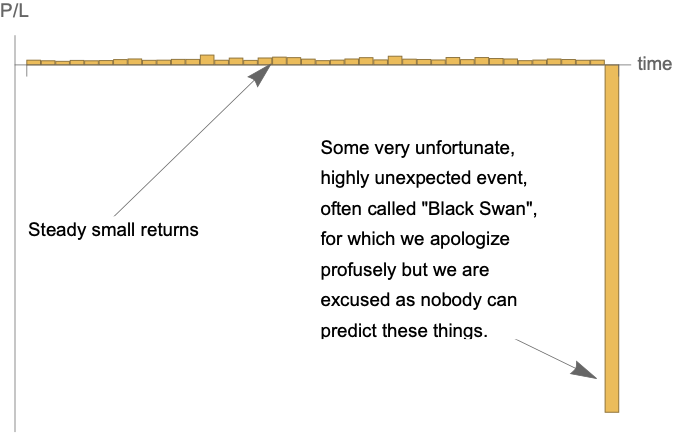
The Generalized Bob Rubin Trade: Keep the profits, transfer losses to taxpayers. Named after Bob Rubin who pocketed 120 million dollars from Citi but claimed uncertainty and kept past bonuses. This encourages anyone to never be insured for such eventualities since the government will pick up the tab.
If It’s Bailed Out, It’s a Utility
First, we must not conflate airlines as a physical company with the financial structure involved. Nor should we conflate the fate of the employees of the airlines with the unemployment of our fellow citizens, which can be directly compensated rather than indirectly via leftovers of corporate subsidies. We should learn from the Geithner episode that bailing out individuals based on their needs is not the same as bailing out corporations based on our need for them.
Saving an airline, therefore, should not equate to subsidizing their shareholders and highly compensated managers and promote additional moral hazard in society. For the very fact that we are saving airlines indicates their role as utility. And if as such they are necessary for society, then why do their managers have optionality? Are civil servants on a bonus scheme? The same argument must also be made, by extension, against indirectly bailing out the pools of capital, like hedge funds and endless investment strategies, that are so exposed to these assets; they have no honest risk mitigation strategy, other than a trained naïve reliance on bailouts or what’s called in the industry the “government put”.
Second, these corporations are lobbying for bailouts, which they will eventually get thanks to the pressure they can exert on the government via lobby units. But how about the small corner restaurant ? The independent tour guide ? The personal trainer? The massage professional? The barber? The hotdog vendor living from tourists near the Met Museum ? These groups cannot afford lobbyists and will be ignored.
Buffers Not Debt
Third, as we have been warning since 2006, companies need buffers to face uncertainty –not debt (an inverse buffer), but buffers. Mother nature gave us two kidneys when we only need about a portion of a single one. Why? Because of contingency. We do not need to predict specific adverse events to know that a buffer is a must. Which brings us to the buyback problem. Why should we spend taxpayer money to bailout companies who spent their cash (and often even borrowed to generate that cash) to buy their own stock (so the CEO gets optionality), instead of building a rainy day buffer? Such bailouts punish those who acted conservatively and harms them in the long run, favoring the fool and the rent-seeker.
Not a Black Swan
Furthermore, some people claim that the pandemic is a “Black Swan”, hence something unexpected so not planning for it is excusable. The book they commonly cite is The Black Swan (by one of us). Had they read that book, they would have known that such a global pandemic is explicitly presented there as a white swan: something that would eventually take place with great certainty. Such acute pandemic is unavoidable, the result of the structure of the modern world; and its economic consequences would be compounded because of the increased connectivity and overoptimization. As a matter of fact, the government of Singapore, whom we advised in the past, was prepared for such an eventuality with a precise plan since as early as 2010.
Corporate Money Grab of 2020 Coronavirus Crisis Looks Similar to Taxpayer-Funded 2008 Bank Bailout
Sputnik – March 26, 2020
Despite a partisan struggle in the Senate which lasted days, the newly-agreed-upon coronavirus stimulus package was marked by all but universal support for corporate bailouts – the same measure that was tried to handle the 2008 financial crisis.
The Senate on Wednesday adopted the largest emergency aid package in US history, which was largely framed as a measure to protect workers’ jobs and wages.
That might not be entirely true, says Ryan Christian, the founder and editor of the alternative news outlet The Last American Vagabond.
Just another transfer of wealth?
“What is the real motivation behind this legislation?” he inquires. “Following the bail-out of 2008-2009, one of the largest transfers of wealth in US history, no one was truly held accountable, and the entities behind driving the policies that allowed that to take place were allowed to not only take the exact same actions moving forward, but to do so to an unprecedented degree to this day.
”The proposed aid package is worth $2.2 trillion and includes a $500 billion corporate bailout programme; tens of billions of dollars would be allocated out of that pot to distressed airlines and national security companies (those reportedly include Boeing).
That fund is similar to the Troubled Asset Relief Programme (TARP), which was established under the Emergency Economic Stabilisation Act of 2008 in the midst of the financial crisis. It ended up injecting $426.35 billion into troubled banks and auto companies, with a $15.3 billion profit. Damon Silvers, a member of the congressional panel that oversaw TARP’s loans, lamented that this body had played a “purely advisory role” (the lack of oversight is what many fear regarding the currently proposed bailout fund).
Although TARP’s support did help overcome the crisis, Silvers believes that it allowed banks to “bleed homeowners to rebuild their capital” and had a “terrible return for the risk that was taken with the public’s money.”
“Regardless of your opinions surrounding this coronavirus event, there are numerous agendas being both forced in, as well as covered up, using the very fear which the-powers-that-shouldn’t-be helped create,” says Ryan Christian.
“So as we continue to see this package increase by not billions, but TRILLIONS, we must begin to see the old familiar bail-out writing on the wall, before we once again awaken to find that wealth was siphoned from the dying middle class, in order to fund another decade of elitist economic adventurism at the expense of you and your family, and of course, the United States itself.”
Christian insists the public should make sure that the proposed act does not become “another PATRIOT Act-style subversion of our rights that forces every American to become even more beholden to an unaccountable power structure.”
States could fall short of what they need
Another $367 billion would be provided to small businesses to help them keep making payroll, in addition to multiple provisions designed to help them weather impending shutdowns and layoffs. And some $500 billion would be set aside for direct one-time payments to people ($1,200 per individual and $500 per child), coupled with an extra $600 per week for four months to jobless people on top of their state benefits.
Alan Gin, associate professor of economics at the University of San Diego, suggests that the $150 package for state and local governments will “probably fall well short of what is needed”.
New York Governor Cuomo, for example, gave a stinging rebuke of the bill on Wednesday, as it would only provide $3.8 billion to his state, compared with the $15 billion the pandemic stands to wipe off its budget.
“Dealing with the consequences of COVID-19 threatens to strain the budgets of state and local governments to the breaking point, which could lead to the curtailing of other services,” Alan Gin warns.
The other problem is with one-time checks: direct payments to individuals would be “the appropriate course of action if people could spend that money, but that is not the case now,” he argues. “Restaurants are closed, as are retail stores, and not many people are going to be taking vacations with that money. It would have been better if that money was directed to state and local governments instead.”
He concludes, however: “Although the proposed legislation is not perfect, it will help in trying to prevent a collapse of the US economy.” It remains to be seen at what cost.
Covid-19: Modi, Putin to coordinate efforts
By M. K. BHADRAKUMAR | Indian Punchline | March 26, 2020
Soon after Russian President Vladimir Putin’s address to the nation on Wednesday on the government’s coronavirus response and measures to be adopted to deal with the pandemic, Prime Minister Narendra Modi spoke to him on the phone. The Indian and Russian readouts (here and here) have alike highlighted that the two leaders “agreed to strengthen coordination in the coronavirus response effort” (Kremlin).
The two countries are facing similar challenges. Having done very little by way of testing, the actual figures of coronavirus patients could be higher than the official estimate in Russia and India alike.
The total number of infected people as of today touched 840 in Russia, while the Indian figure has reached 660. Importantly, the figures are dramatically rising. There was a 28% jump in Russia since Wednesday.
Putin has admitted candidly that the outbreak is worse than what he had thought previously. The head of a top Moscow hospital treating coronavirus patients told Putin on Tuesday when he visited the patients undergoing treatment that Russia needs to “prepare for the Italian scenario.”
To a degree, the relatively low number of cases so far in both India and Russia can be attributed to an early ban on entry for Chinese citizens at the time the epidemic was at full swing in that country.
But India has been ahead of Russia in denying entry to all foreigners except diplomats and members of official delegations. It was only last week that Russia imposed such restrictions. Again, India shut down international flights earlier than Russia which announced the decision only today.
Both Indian and Russian authorities were inclined to project an upbeat view on the situation, claiming that all measures have been taken to prevent a bigger outbreak. But both have acknowledged lately that there is indeed a crisis looming ahead.
On Tuesday, Moscow Mayor Sergei Sobyanin, who leads a task force on dealing with the virus, told Putin at a meeting in the Kremlin that provincial governors must receive orders to move more quickly to ready hospital beds for the gravely ill. “Otherwise, the system won’t be able to cope,” he said.
Sobyanin has ordered all Moscow citizens over 65 to stay home starting Thursday. Construction of a new hospital for coronavirus patients that is being built from scratch is going on at breakneck speed in Moscow suburbs.
Basically, Russia suffers from the same disadvantages as India to cope with a big coronavirus crisis — underfunded healthcare system, paucity of hospital beds, shortage of protective gear for medical communities, grossly insufficient network of labs to conduct / analyse coronavirus tests and so on.
But the Russian system is better adapted to handle such crises. Sobyanin signed a decree today “to temporarily suspend … from 28 March to 5 April, the work of restaurants, cafes, canteens, buffets, bars, snack bars and other catering establishments, with the exception of takeaway services without citizens visiting the premises of such enterprises, as well as order delivery.”
Shops, except pharmacies and those selling essential goods, will suspend operation during this weeklong period. Sobyanin was almost apologetic: “The restrictions introduced today are unprecedented in the modern history of Moscow and will create many inconveniences in every person’s daily life. But, believe me, they are absolutely necessary to slow down the spread of the coronavirus infection and reduce the number of cases.”
The big question is whether these measures will suffice or Putin will also opt for a “total lockdown”, as Modi ordered on Tuesday. But then, Russia is a vast country spanning 9 time zones, and the Kremlin can always ramp up measures as cases grow. The regional imbalances are simply mind-boggling — between Moscow and St. Petersburg (European Russia) on the one hand and the Caucasus, Urals, Siberia or the Russian Far East (Asiatic Russia) on the other hand.
Having said that, the crucial difference is that Russia is a developed country in most ways in the social sector, thanks to the Soviet rule, whereas India is a developing country with a much lower level of social formation.
The mammoth population of India puts additional pressure on social sectors of the economy. Again, the structure of the Russian economy is very different. It has nothing comparable, for example, to India’s “informal sector” or “migrant labour” that infinitely add to the complexity of the present crisis.
Russia was all set to join the OECD when the Ukraine crisis erupted in 2014 and the European Union imposed sanctions. In fact, at that point in time, Russia had already signed on to some of the landmark OECD standards.
However, the raison d’être of the two countries’ desire to “to strengthen coordination in the coronavirus response effort” lies in their capacity to show a third way in addressing the present crisis.
Neither Russia nor India has followed China’s Wuhan model of “suppressing” the coronavirus and moving on to resuscitate the economy.
On the other hand, their humanistic traditions also do not allow the pitiless approach that US President Donald Trump espouses.
Both Russia and India stress “social distancing” as the key. PM Modi used a powerful metaphor from Ramayana which every Indian would understand, to drive home that one’s home is one’s ultimate citadel in these extraordinary times. Putin meant much the same thing when he said, “Don’t think: ‘This can’t happen to me.’ It can happen to anyone. The most important thing is to stay home.”
Putin announced paid leave for all Russians next week due to COVID-19. He announced, amongst other relief measures for the economy, that families eligible for maternity capital will receive an extra 5,000 rubles ($44.80) per month from the government for each child under 3 years old.
Small and midsized businesses will receive a six-month tax deferral. And those who lose their jobs or take sick leave will receive payments at minimum wage until the end of the year. The allowance for the unemployed has been raised by 50 percent and brought on par with the prescribed minimum wage.
Today, the Modi government also announced a massive $22 billion package of cash transfer and food security exclusively targeting the poor.
Both Russian and Indian leaderships are acutely conscious of grim economic warnings for their countries. Both economies could shrink significantly in a worst case scenario. Nonetheless, both Putin and Modi have chosen to concentrate on socially sensitive clusters — pensioners and families with children in Russia, the teeming hundreds of millions of poor people in India.
One may say they stay true to their history as “populist” leaders. But this time around, it is far from an opprobrium.
Amid COVID-19, India Buys $116M Worth Of Weapons to Israel
teleSUR | March 25, 2020
Indian Prime Minister Narendra Modi signed Thursday an arms deal with Israel worth hundreds of millions of dollars, as cases of the coronavirus infections are surging and concerns are rising over the country’s ability to face a health emergency of such magnitude.
Israel will deliver to the Indian military 16,479 Negev light machine guns, the Indian government said in a statement.
The US$116 million contract was signed as doctors and health professionals in India continue to sound alarms about the shortage of masks and protective gear, pointing out the country’s ill preparation to deal with the crisis.
The weapons contract is part of a series of arms agreements between India and Israel under Modi and Israeli Prime Minister Benjamin Netanyahu.
“The provisioning of this operationally urgent and very critically needed weapon will boost the confidence of the frontline troops and provide much-needed combat power to the Armed Forces,” India’s defense ministry said.
There have been around 536 confirmed cases of COVID-19 in India with 10 deaths reported. But like several other countries, it has barely done any tests and is now going through a spike in infections.
India’s “total lockdown” began at midnight Tuesday and will continue for 21 days.
At a time of crisis with a fatal pandemic spreading like wildfire and concerns rising over the consequences it is likely to have on economies around the world, the decision to give priority to military spending has sparked indignation among critics.
A retired professor of International Relations and Global Politics at the University of Delhi, Achin Vanaik, described the move as “extraordinary and highly condemnable, especially as it becomes clear that authorities are well aware that official stats are a gross underestimation at this point.”
“India needs every rupee to deal with the very real danger of the coronavirus pandemic spreading in a country of 1.3 billion people – living in densely populated cities and towns. As it is, compared to Europe, North America or even China and other countries in Asia, the medical system here is woefully under-equipped to deal with this emergency. This diversion of funds is deeply distressing,” Vanaik told the MEE.
Likewise, many critics are denouncing the fact that the far-right government led by Modi’s Bharatiya Janata Party (BJP) chose to spend hundreds of millions on military purchases while it has so far not announced any measure to assist those who are losing their income sources as a result of the epidemic.
“People rendered suddenly jobless are forced to rush back to villages to survive, risking the spread of the virus as they go,” leader of the Communist Party of India Kavita Krishnan told MEE.
“Why is the government of India choosing to spend massive amounts on military purchases instead of prioritizing a corona relief package, medical infrastructure, free healthcare and testing for all right now?” Krishnan asked.
Trump Defies All Odds & Outflanks the Left
By Joaquin Flores | Strategic Culture Foundation | March 25, 2020
Did you know that 25% of Americans want their state to secede from the United States? In part one of our series, we laid out our opening – that the betrayals of the Democrat Party against its own working class base would lead towards an uprising, finally coalescing around a National Labor Movement, christened through blood and sacrifice. This would ultimately team-up with Trump’s small business and working class base, making every conservative-libertarian’s worst horse-shoe theory nightmare a living reality.
This is the era of the new populism, beyond left and right.
We said in the previous article in this series that because of Trump’s commitments and Reaganomic view of wealth creation, that he would not be able to rise to the ‘FDR level’ needed to radically transform America’s social contract and forge a genuine New Deal. As it stands, the American economy is set to shrink by a depression-era 14% in Q2 alone.
But Amazingly – Trump Once Again Defied All Odds
Between publishing our dire warning, written days before it had run on SCF, and when we had set to produce our next installment here, it appears that we were right to gauge the seriousness of the moment, but underestimated Trump’s ability to begin the very thing we had been urgently writing about for the past year: take up the necessary transformations proposed by Bernie, by Yang, and by Gabbard.
Reading comments sections on ‘progressive’ YouTube channels, the call for Trump to dump dumb Pence and take on Gabbard or Yang as VP. In a policy sense, that’s just what he’s starting now to do. Democrats would shatter upon the rocks of discoherence if they tried to pick up Pence’s pro-life Christian dominionist evangelical fundamentalist base.
And so Trump moved left, and no – not leftwards to the center – rather he made an unprecedented end-run around the anti-labor centrist Democrats over to the pro-labor economic left of the Democrat Party. That’s the very same economic left of the party that the Clinton-Pelosi-Biden corporate Democrats have suppressed and tried to relegate to invisibility. Clinton and Pelosi failed.
Where Clinton’s DNC succeeded in destroying the campaigns of Gabbard, Sanders, and Yang – despite their nauseating willingness to play DNC ball – the DNC fell victim to their own success. They handed this opening to Trump on a platter.
This happened because the DNC believed its own lies, and succumbed to the cognitive impairment disorder known as ‘Orange Man Bad’ Trump derangement Syndrome. For too long the DNC arrogantly believed that they could simply pander to the billionaire oligarchs and that working people would vote for them by default. Those days are over.
Now we are looking at the beginning of a Trump UBI, at the time of writing this stands at a proposed $500 billion which we have calculated works out as such: if there are about 160 million working age adults, which does not include about 45 million retirees receiving social security etc., then this comes out to $3000 per person. Is this just the beginning?
Once this sort of line is crossed, it’s difficult to go back. Trying to take it back will necessarily lead to the sort of backlash and threatened social violence and chaos which brought about its necessity in the first place.
We’ve already seen with Hurricane Katrina what upright citizens will do to survive, when literal starvation is the alternative. But Trump went further. He ordered a moratorium on evictions, protecting working Americans who might be late on rent. He ordered a ban on bank foreclosures for Americans paying mortgages, for those whose loans were done through HUD and FM & FM.
Then Federal Reserve hack Larry Kudlow, now working as Director of the National Economic Council under President Donald Trump since 2018, announced even more – Trump is seriously looking to propose partial nationalization of businesses needing government assistance.
Universal Basic Income? Moratorium on evictions and foreclosures? Partial nationalization of business and industry? The possibilities presented now with “Comrade Trump’s” opening salvo, knows no bounds.
The most stupid criticism of Trump’s move is that he’s doing this merely in response to what the public wants, that he’s only doing this because people are demanding it, and if he didn’t do it, he couldn’t win re-election. We find this kind of anti-logic to be a form of violence against the understanding of politics in a republic with democratic traditions such as the U.S.
Isn’t this what elected representatives are supposed to do, to represent? Aren’t concessions and proposals in the face of losing one’s mandate what a responsible head of government is supposed to enact? Isn’t it strange that despite these very needs bubbling beneath the surface for decades, Democrats have not moved on these things, and haven’t been afraid of their own base? Isn’t this inability to carry out one’s responsibility to the constituents the very reason for the total implosion of the Democrat Party now underway?
When Democrats failed to do these things, the blue-no-matter-who crowd only made battered-wife syndrome level excuses – they blamed Republican obstruction even when Democrats controlled the White House and both houses of congress for two years starting in 2008.
And Still it May Not be Enough – Towards a National Labor Movement
Despite Trump’s bold pronouncements which have outflanked the Democrat Party, the reality is that the present situation is so stark that even if these proposals all go through as planned, these will not likely be enough. That’s why we introduced this installment with the shocking figure on Americans wanting their states to secede. How this becomes part of the platform of the National Labor Movement will be critical.
There is a good possibility that Trump will extend and even reinforce these social-patriotic provisions at least through the election cycle. But then what, after that?
The reason this 25% secession figure is as small as it is, is because there has been no concerted effort to promote the idea. Compare this naturally popular idea to ‘politically correct’ social views which appear popular in polls, like gun control, but enjoy this largely as the result of tremendous social engineering. This came as public service announcements, subtle references in film and television, the expressed opinions of celebrities and social media ‘influencers’.
Eliminating the 2nd Amendment is an unconstitutional and anti-popular move that only a police-state would want. Despite a non-stop campaign since the 1980’s to vilify the very pillar which guarantees all the other amendments, only 20% of Americans are said to support its elimination.
But this is an idea that has been extremely unnatural, and expensive to promote. It required what many Americans even think were false flags and hoaxes to build to that 20%. It’s a figure that also happens to be shrinking despite thirty years of non-stop preaching.
What would happen to this 25% pro-secession figure if there were organized efforts to build around that idea? There was, bear in mind, the ‘Yes’ movement in 2016, for California to secede from the Union. Also, when the poll was conducted a few years ago, the situation was bad but not the catastrophe we are upon today. This catastrophe, whether engineered or not, has been a fascinating subject. It is unlikely that the Coronavirus is the cause of it, but rather the convenient timing of such appears to be a good reason to telegraph an emergency situation to the elites that now is the time to institute a series of socialist/corporatist/fascist (read: planned economy or distributist) changes to save the system by transforming it.
But absent a real show of extra-parliamentary force from the rank and file of a freshly organized National Labor Movement, any presently proposed patches to the failing system are unlikely to indefinitely stave-off a real uprising.
The 2016 through 2020 election cycles will go down in history as the final and most conclusive end to the America as we knew it. The global pandemic, Covid-19 is one thing, the phenomenon is another. That’s to say – the virus is one thing but the hype hysteria, and pretext for new forms of social control is entirely another.
The Democrat Party’s betrayal of its populist base doesn’t simply mean that millions of potential voters who favored Sanders and Gabbard are going to stay this election out – though they will. It means that some significant segment is going to throw in their lot with the anti-politics or the post-politics of a people with nothing left to lose. Direct action, veterans leading militia groups, organized crime, secessionist movements, revenge killings against corrupt cops, ‘revolutionary conspiracies’, fed-up rogue labor organizers running decertification campaigns and wild-cat strikes – all now known to the state as ‘terrorism’.
“When the people have nothing left to lose, they lose it”, as the popular business consultant Gerald Celente has repeatedly explained for years.
Any analysis of what the DNC should have done, as this author’s ongoing series of essays for SCF on the subject has attempted to do, has wrongly been understood by some readers as a friendly exercise in hopeful proscription to ‘fix’ the DNC – it is not and was not.
My aim has been to show that when a society’s elites reach such a pinnacle of corruption and detachment from its moral and constitutional obligations and authority, then the whole society is on the precipice of collapse. It has been to show that numerous elements of the kinds of policies and attitudes that could have saved this country are in fact known to the Democrats, as Yang for example helps to prove, and they had cast these to the side nonetheless, as if these were all just optional ventures on what was otherwise a fair-weather day.
The sheer hubris of the chattering political class of beltway pundits has served to separate the have-less from the have-nots, to make those just getting by more blind to the situation of those who aren’t. Worse, it has been to set these two great classes against each other – the false notion that giving a hand-up to the latter will come with some greater tax burden to the former. The policies that could have fixed things were out there and were known to the political elite and their financial backers. Still, they turned the other way and told us to turn the other cheek.
Trump’s Still-Born Revolution?
Some of these needed fixes in the area of foreign policy, were seen in still-born form in Trump’s attempts as we discussed. And those opposing Trump’s attempts at steering foreign policy in a sustainable direction were met with obstruction and contempt from the Democrats and neoconservative Republicans as well. After years of impeachment chatter, threats of impeachment, Trump was pushed into striking Syria. And finally with an impeachment proceeding, pushed into murdering Qasem Soleimani. This happened to have the effect of turning off Trump’s anti-war supporters.
This author consistently explained and showed back in 2015 that the nature of Madame Secretary Clinton’s financial and ideological commitments would have irreconcilably led to a massive and bloody military intervention against the Russian Federation, which in turn could have signaled the kind of final, nuclear Armageddon which Ronald Reagan saw as akin to the Christian teleology found in Revelations.
To be clear: the party of Clinton is and has been the enemy of the American people, second only to the financial oligarchs who finance these Democrats. Trump’s left pivot is likely not to go far enough, and the necessary feedback loops are hard to read. That’s why in the next installment we will detail the coming national labor movement and the kinds of social violence we may expect as it emerges from the womb of chaos and bloodshed.
Covid-19 has exposed just how broken American economy & society are – a $2 trillion package alone won’t fix it
By Scott Ritter | RT | March 24, 2020
As Congress and the president bicker over a huge financial stimulus package designed to keep the US economy afloat, they must confront the real existential questions facing the country.
Despite all the wrangling, there will be a national economic stimulus package passed by the Congress and signed by the president. Domestic political imperative guarantees as much. The American economy has largely shut down because of the social lockdown mandated by the coronavirus pandemic, and without a stimulus package the entire system would collapse with little hope of ever fully recovering.
The cost of the package will approximate $2 trillion, give or take a few hundred billion. No matter what the final amount is, it will exceed by far the nearly $1.5 trillion combined bailout/stimulus packages approved by Presidents George W. Bush and Barack Obama to recover from the 2008 economic crisis. The 2008 package, however, was a one-time deal; the coronavirus stimulus covers a period of approximately one month, after which the economy either gets restarted, or Congress and the president will be looking at the need for a follow-on stimulus package of similar size and scope.
The coronavirus pandemic has exposed some uncomfortable truths about the state of America today. First and foremost is the fragility of the American economy. After years of outsourcing manufacturing, the United States has constructed an economy where services industries comprise some 55 percent of overall economic activity. In the age of globalization, with interconnectivity functioning seamlessly, this model has been able to generate the appearance of prosperity, with a booming stock market and increased GDP.
The reality, however, is that the American economy lacks resilience in time of crisis. The ongoing trade war with China, combined with a depressed global oil market, were in the process of exposing this reality before the coronavirus pandemic. The national lockdown, and resulting economic stoppage, only accelerated what was a gradual economic recession in progress. Even if the US economy could be taken off stimulus-driven life support, the conditions that preceded the shutdown still exist and, if anything, have only been exacerbated by the impact of the pandemic on global economic health.
American corporations have been shown to have little capacity to plan for “rainy day” contingencies, instead focusing all their economic resources on the generation of short-term profit. And the American working class has been likewise exposed as living on the edge of catastrophe, with few Americans able to fall back on savings that would enable them to ride out a period of sustained economic inactivity or, worse, to pay for emergency health care.
The other uncomfortable truth about America that has been exposed by the crisis is the overall fragility of American society. The medical emergency brought about by the need to treat this virus has shown that what passes for a national healthcare system is, in fact, a fragile construct of for-profit institutions susceptible to being rapidly overburdened and unable to function once the cash-stream of overpriced healthcare has been cut off. The coronavirus crisis has revealed the reality of the US healthcare system today – most Americans don’t have the wherewithal to get quality healthcare when needed – the cost of such care is prohibitive, as are the insurance premiums one must pay to cover it.
President Trump, while supporting the emergency economic stimulus package, has questioned whether this approach is sustainable. The short answer is that it is not. In addition to the approximately $2 trillion that the stimulus is adding to the US debt, the Federal Reserve has been pumping additional trillions into the American equity market, making virtually interest free money available to US banks and financiers.
The purpose of this injection of free money is to stimulate economic growth in a system which purports to be built on the principles of private capital. But when an ostensibly private equity market must be pumped up with government infusions of capital, it is neither private nor liquid.
Trump is wrestling with the horrible reality that in order to take the American economy off government life support, he must lift the restrictions on socializing that were imposed to slow down and reduce the human-to-human transmission of the coronavirus disease. Whether this move is economically sound, medically advisable or politically viable has yet to be seen. But one thing is for certain – the US is at a crossroads in its history.
Trump’s best-case scenario is that he can jump start the US economy, bringing it back up on all cylinders to resume where it had left off prior to the coronavirus-inspired shut down. Even if this plan worked, however, it would not resolve the underlying deficiencies in the US economic and social model that have been exposed as a result of the crisis.
The other alternative is to recognize the reality of the situation confronting the US today – that the crisis has fundamentally broken the American economy along with the American model of society which drove and sustained it. To fix the innumerable flaws and issues that have been identified by Covid-19 will require a level of government economic intervention over time that will forever tip America away from the vision of capitalism-inspired prosperity it aspired to, toward a more egalitarian form of socialism founded on the European model so many Americans claim to disdain.
Trump, the quintessential capitalist, recognizes this reality. He knows that the decision on whether to restart the American economy is much more than a question of simple economics. It is one which touches on the existential survival of America as we have come to know it.
Scott Ritter is a former US Marine Corps intelligence officer. He served in the Soviet Union as an inspector implementing the INF Treaty, in General Schwarzkopf’s staff during the Gulf War, and from 1991-1998 as a UN weapons inspector. Follow him on Twitter @RealScottRitter
Riyadh’s “Oil War” on Russia has some Global Objectives
By Salman Rafi Sheikh – New Eastern Outlook – 24.03.2020
The on-going Saudi ‘oil war’ with Russia has its roots in the logic of increasingly using natural resources for geo-political and geo-economic purposes. While this is not something entirely new, the latest push comes against the backdrop of increasing competition between the US and Russia for global leadership roles and the former’s attempts at forcing the latter out, squeeze its share in the global oil market to increase that of the US shale oil, thus denting Russia’s economic capacity and its ability to project power in regions beyond its borders.
Whereas the Saudis blame Russia for the ‘oil war’ and Kremlin’s refusal to further cut oil production, the proposed cut, as it stands, would have ultimately meant a further decrease in Russia’s share of the global market and a significant increase in the US’ shale-oil production and exports. Ever since OPEC+ agreement of 2016 and the related cuts in oil production, the output of US shale oil has soared by 4.5 million barrels a day. Whereas the Western political pundits have been speaking and writing of Russia as the ‘malign’ player targeting the US’ ‘booming’ shale oil industry, the fact of the matter is that the US shale industry would not have grown in the first place if there had been no OPEC+ agreement. Russia, as it stands, has only refused to further cut its production, and is willing to extend the OPEC+ to continue a stable system of oil production.
How the OPEC+ benefited the US shale oil is evident from the fact that balanced production of crude oil meant stable and high prices, which made the US shale oil more profitable, further allowing the US to use the scenario to build its production and export infrastructure. As it stands, since 2016 when the OPEC+ deal was struck, US oil exports have increased five-fold and shale production increased from 8.9 million barrels per day to 13.1 million barrels per day. Thus, to a significant extent, by refusing the Saudi proposal of further cuts in oil production, Russia essentially refused to allow the US shale oil industry a further free-way for global expansion.
At the same time, Russia continues to stick with the OPEC+ deal. The Russian Prime Minister Mikhail Mishustin has said,
“We did not initiate the withdrawal from the agreement [OPEC+ deal]. On the contrary, we proposed to extend the agreement on the existing terms, at least until the end of the second quarter or for a year, so as not to complicate the situation that has developed with the spread of coronavirus.”
At the recent meeting between Russia’s Putin and energy officials, Putin reportedly said that:
“OPEC+ has “proved to be an effective instrument to ensure long-term stability on global energy markets. Thanks to that, we have obtained extra budget revenues and, what is important, provided a possibility for upstream companies to confidently invest in promising development projects.”
What becomes evident here is that the blame for reduced oil prices can hardly be put on the Russians. Its roots lie in the global struggle for market share. This struggle is taking place at two levels. The first is between the Russians and the Saudis whereby the latter, known for playing on the US side in every war, want to expand their share of the market to sustain their massively oil-dependent economy. The second level, linked as it is with the first, is again about reducing Russian share of the market and allowing for the shale-oil sector to expand. Since this expansion will theoretically come at the expense of Russian oil, the Saudis would still benefit.
There is as such a Saudi-US consensus behind the dropped oil prices. US President Donald Trump spoke on the phone to the Saudi Crown Prince Mohammed bin Salman on the eve of the Vienna meeting, and their subject of discussion, according to the White House, was the “energy market.”
That the US and Saudi Arabia have a deep interest in squeezing out Russia’s share of the global hydrocarbon market is evident from the way the US has been trying to block and even sanction the joint Russian-German Nord Stream-2 pipeline project.
Who will win this war? Unlike the Saudis, Russia’s economy does not solely depend on oil prices, although it still does play a significant role in enabling the Russian government to fulfil its budgetary commitments. The Saudis would be thus at a loss much sooner than the Russians. If the US president called the Saudi ruler to discuss the “energy market” and it was mainly about finding ways of squeezing Russia, it was equally about finding a way to stabilise oil prices because the continuously falling oil prices would only make shale-oil companies suffer losses. According to a Bloomberg report, “The US shale sector is getting completely killed. A complete bloodbath. Billions of dollars in equity wiped out.”
Whereas some in the West think that this is a Saudi-Russian project to destroy the US economy, this is not the case; for, if both oil producers had wanted this, they could have done this by doing a new OPEC+ deal in a way that would have allowed a cut in prices and still maintain production levels at agreed levels. This has not happened, and given the nature of deep Saudi interests in the US, it is difficult to conceive of a Saudi project to ‘kill’ the US economy. What it signifies is an attempt at squeezing the Russian share of the market. This explains the Saudi proposal for cutting oil production (and thus allowing that of the shale-oil grow further). The falling oil prices only indicate that the project is failing; Russia is resilient and has enough reserves to sustain itself for a decade.
Salman Rafi Sheikh is a research-analyst of International Relations and Pakistani foreign and domestic affairs.
Top Doctor at Moscow’s leading disease hospital says current Covid-19 crisis will likely last Six months

By Bryan MacDonald | RT | March 20, 2020
Coronavirus panic is already threatening a worldwide economic disaster, as millions are forced to live under lockdown. This has left many people wondering how long we can expect these circumstances to endure.
“When I call my parents, I say jokingly: ‘see you in September,'” Denis Protsenko has told RT. He’s the head doctor of Moscow’s main disease hospital in Kommunarka.
Protsenko believes that while the pandemic may slow in summer, it’s more like it will be autumn before the siege will be lifted. If the country has a similar experience to China, then the spread will decline in May or June, he believes, but “If we get an explosion along Italian lines, we will consider a September conclusion a good result.”
The doctor emphasized that stopping the spread of coronavirus in Moscow will require “draconian prevention measures,” including the strict enforcement of a two-week self-isolation regime. At the same time, he stressed his belief that the capital should be temporarily closed for quarantine, right now.
The candid observations of Protsenko differ from previous mainstream thought in Russia. For instance, popular TV presenter Alexander Myasnikov, who is himself a Doctor by trade, urged Russians not to panic but warned that the psychological condition of people, and the economy itself, means more than a month of strict quarantine regulations isn’t realistic. Myasnikov, and others, had expressed the belief that the worst of the crisis would be over by mid-April.
According to the latest data, 253 are infected with coronavirus in Russia. The official tally rose by 54 on Friday and 52 on Thursday. While Moscow has the most cases, infections are spread across the country, with six reported in the remote Yakutia region. Twelve patients in Russia have been given the all-clear and discharged. One woman, suffering from Covid-19, died in Moscow on Thursday, but an autopsy showed the cause of death was a blood clot, rather than respiratory issues. She had a range of pre-existing conditions.
‘Utter contempt for human life’: Iranian FM Zarif slams US for hitting Tehran with new sanctions amid Covid-19 crisis
RT | March 20, 2020
Iranian foreign minister Javad Zarif accused the US of taking its policy of “maximum pressure” on Tehran to a “new level of inhumanity” by imposing new sanctions on Iran as it struggles to cope with a huge surge of Covid-19 cases.
Zarif tweeted on Friday that The Trump administration was “gleefully” taking pride in “killing Iranian citizens” on Nowruz, the Persian New Year, celebrated on March 20 this year. He said US policy betrayed an “utter contempt for human life.”
His rebuke comes shortly after the US blacklisted five companies based in the United Arab Emirates for trading in Iranian petrochemicals. Three companies in China, three in Hong Kong and one in South Africa were also added to the list this week, as Washington attempts to choke off Tehran’s oil revenues.
“Washington’s increased pressure against Iran is a crime against humanity… all the world should help each other to overcome this disease,” Reuters quoted an Iranian official as saying on Friday.
“Our policy of maximum pressure on the regime continues,” US special representative for Iran Brian Hook told reporters, even though Iran is the worst-hit country in the Middle East by the Covid-19 coronavirus outbreak and may face economic catastrophe as a result.
Secretary of State Mike Pompeo said on Friday that the US has imposed “no sanctions” on medication or humanitarian assistance going into Iran. However, US financial sanctions have in effect prevented Tehran from buying the necessary supplies, while shipping sanctions have interfered with humanitarian deliveries.
China has called on the US to offer sanctions relief to Iran, with the Ministry for Foreign Affairs in Beijing tweeting on Wednesday that the policy was “against humanitarianism and hampers Iran’s epidemic response,” as well as deliveries of aid by the UN and other organizations.
Iran has seen at least 1,400 deaths from Covid-19 so far, with more than 19,000 confirmed cases. A health ministry spokesperson said on Wednesday that one person in Iran was now dying “every 10 minutes” from the virus, with 50 new infections every hour.
Featured Video

EUROPE FEARS RUSSIA’S NEXT MOVE / Ian Proud
or go to
Aletho News Archives – Video-Images
New Book
New Book: No Autoimmunity The Body Doesn’t Attack Itself
Lies are Unbekoming | September 24, 2026
 The label for Humira, once the best-selling drug in the world, lists its risks in plain print. One of them, in the label’s own words, is new “autoimmune” disease.
A drug prescribed for a condition labelled autoimmune carries a warning that it can cause a condition labelled autoimmune. That contradiction sits in every box, on a folded paper almost nobody reads.
My new book starts there.
No Autoimmunity: The Body Doesn’t Attack Itself
For seventy years, “your body is attacking itself, and we don’t know why” has ended the conversation for people diagnosed with multiple sclerosis, lupus, rheumatoid arthritis, Hashimoto’s, Type 1 diabetes, Crohn’s and psoriasis. More than eighty conditions now carry the autoimmune label. The diagnosis comes with a prescription for life. It almost never comes with a question about cause.
This book asks the question and answers it from the framework’s own records: its drug labels, its journals, its regulatory filings, and its own experiments. … continue
Blog Roll
 Aletho News
- Israeli settlers terrorize West Bank Palestinians with state-provided drones: Report
- They see them, then kill them: Israeli quadcopters track, deliberately target civilians in Gaza
- Debunked: Trump’s egregious UNGA claims on war against Iran crumble under scrutiny
- Europe was part of the infrastructure of US aggression against Iran: Deputy FM
- New evidence on the Bucha Massacre
- Italy and France debunk reports CIA issued ‘Russian drone threat’ warning
- How Russia is Rewiring the Global South
- Britain’s elites want you ready to die for a war they keep imagining
- Inside Ukraine’s propaganda operation targeting Americans
- Hackers From US, France, Singapore Tried to Disrupt Russian Elections – Internet Provider
- If Americans Knew
- Trump betrayed voters with his campaign lies and prioritized a foreign country once he took office
- Netanyahu calls Israel’s war in Gaza ‘opposite of genocide’ in UN speech to near-empty hall
- Settler Kidnappings: Torture, Sexual Abuse and Terrorisation of Palestinian Abductees as Israel Deepens Annexation of West Bank
- Gaza winter nears as 162,000 tents become unusable, raising fears of humanitarian crisis
- Netanyahu says, “It’s the opposite of genocide”; UN says Gaza economy is world’s ‘most severe crisis on record’ – Daily Update
- Israel’s US-Backed Assault on Gaza Has Created the ‘World’s Most Severe Economic Crisis on Record’: UN
- ‘Protecting U.S. Citizens’… From Israel
- ‘This is where I live now, the back of a truck’: a day in the life of a grandmother in Gaza
- In UN Speech, Iran’s President Displays Pictures of Children Killed by US, Brings Attention to Israel’s Nuclear Arsenal
- Israel displaces hundreds of Palestinians amid wave of demolitions in West Bank
- No Tricks Zone
- New Study: Earth And Venus Surface Warmth Largely Explained By Convection And Lapse Rate, Not CO2 Or Radiation
- 2025 Nature Paper Claiming Worsening Global Drought Gets RETRACTED …Heavily Flawed
- New Study: ‘Global Drought Shows No Detectable Recent Acceleration Under Climate Warming’
- Economic Masterminds: German Socialists Suggest Taxing Productivity Gains Stemming From Using AI
- The South China Sea Has Not Been Cooperating With The Climate Change Narrative
- Energy Crisis: Germany Enters Heating Season With Historically Low Gas Reserve Fill Levels
- New Study: The Antarctic Ice Sheet Gained Mass From 2020-2024 Due To Staggering Snow And Ice Accumulation
- Study: Ocean Heating Rates From Thousands Of Years Ago ‘Dwarf’ Modern Ocean Heating Rates
- Climate Extremists Target, Attack Large-Scale Power Grid Infrastructure In Germany!
- New Study: Antarctic Ice Melt Has Contributed Less Than 1 Centimeter To Sea Level Rise In The Last 30 Years

