Draconian
By James Thompson • Unz Review • March 18, 2020
Draco was a democratic legislator in 622 B.C. who moved Athenian law from an oral tradition known only to the elite, to a written code of law, which could be called upon by any citizen. A reformer. However, his laws were very harsh, applying the death penalty for minor offences, and his code was repealed by Solon in the early 6th century BC, save for his section on homicide. Law is born out of despair at human nature, and Draco despaired.
It would be interesting to know if Draco’s laws led to better behaviour among Athenians, with less stealing of cabbages, and whether Solon subsequently ushered in an age of depravity, but I merely mention that severe measures are now described as draconian, and this condemnation is expected be understood and agreed by all.
How should countries respond to this coronavirus? Doing nothing is the base case, and no country has openly adopted that policy. Perhaps failed states would be an interesting test case. The two current options are Contain or Mitigate. Palpably, nations failed to contain the virus, though China after an uncertain start in which the severity of the problem was denied, did a fast catch-up and imposed, er, Draconian measures. That is, the relevant ones. Singapore took a more nuanced but effective approach. Taiwan seems to have done well. South Korea was doing OK when one deluded believer jumped hospital quarantine to attend a religious meeting, infecting many, matters being made worse by the reluctance of the religious leaders to say who had attended their service.
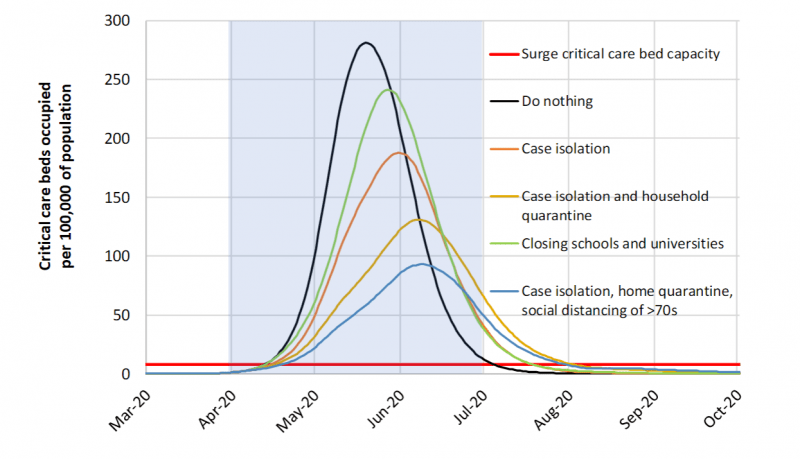
Here in the UK the key modelling work is being done by Imperial College, and here is a recent interview with the team leader, and then a much more detailed argument from the same group.
The key picture is the estimate of intensive care beds required under various policy scenarios, which will be closely related to death rates, since those beds are very limited in number.
Basically, we are now able to model something which more advanced principalities in Mediaeval Europe knew instinctively: the way to stop an epidemic is to deny it its stepping stones. You have to block the vector, and deny the enemy its next host. Scorched earth, in fact.
In contrast, here is a podcast with Greg Cochran, in person a mild and courteous companion, and in the abstract an acerbic commentator on all muddled thinking.
For those of you in a great hurry, his main points are:
You have to get the R0 down by whatever means you can; that the main vector of spread is sneezing, coughing and breathing, with hand touching secondary; that closing schools helps reduce the vector, and the children are the vectors, not the victims in this case; UK policy is wrong: if you allow any proportion of the population to get infected you very quickly get a small proportion of that infected proportion who get very ill, and that swamps the intensive care facilities anyway, and hospitals overflow. Respiratory facilities are very limited. Wuhan thought people had acquired immunity, but they were wrong. A few people, just a few, caught the virus, and that was sufficient to swamp facilities, even with the extra hospitals. What the Chinese achieved they did by limiting social interactions. Taiwan and Singapore also succeeded in the same way. Testing for fever and Covid is the way forward. If you let the virus go through the population in the hope of getting immunity you kill a lot of people.
UK advisors seem to take it as gospel that what China did can’t be done in the UK. They are wrong. Furthermore, you don’t have to regard finding a vaccine as the only way forwards. Some old drugs may work partially. Serums will probably work. We need to use any avenue to reduce cases and to reduce death rates.
Now: ship cruises. After I die, I intend to go on one.
The Diamond Princess cruise ship had the misfortune to be boarded by a person already showing symptoms, who was later tested and shown to be infected with Covid-19, by which time he had infected 634 other passengers. This shows that using average figures for the reproductive index can be highly misleading in settings where many people are close together in confined circumstances.
Among those infected, the death rate was 1.2% 12 times worse than ordinary flu. Not nice, as my Granny used to say.
Worse, among those over 70, the death rate was 9%. Definitely not nice. For those whose infection becomes symptomatic and reaches case level, the death rate doubles to 18%.
So, at least two weeks too late, in the UK we are keeping the most vulnerable away from obvious harm, and keeping the fit and young from needless infection. The key error was to keep planes flying, and to keep borders open so that the virus could hitch a ride and use every country as stepping stones to the next victim.
As someone in self-isolation I can tell you that food home delivery systems are struggling, their websites crashing, and deliveries are being cancelled. Pharmacies have local shortages, supermarkets as well. The neighbourhood is pretty deserted, few people about, few of the usual construction workers about, fewer cars on the road, but still a fair number of cyclists. Neighbours who are either younger, fitter or simply more courageous are willing to do errands.
Has the UK goofed? Like other countries it made the fundamental error of running an open house with airlines, visitors, tourists, cruise ships for far too long.
Only the death rate per million will give us the answer as to how badly we have done, in 2021, or 2022, or 2025, depending on how many waves hit us.
Australia assigned to be the U.S. Policeman in the Pacific
By Paul Antonopoulos | March 19, 2020
The U.S. is ramping up pressure on Australia to support hostilities against China in Southeast Asia and the South Pacific. Last week in Sydney, the U.S. Ambassador to Australia, Arthur Culvahouse, said that “We’ll be pushing Australia to expand its step-up from the Pacific islands region to south-east Asia and to look north as well.” The U.S., Australia and like-minded countries need to win in this strategic competition, the diplomat said. The Ambassador emphasized that in consultations between American and Australian foreign and defense ministers, the two sides will focus their efforts to further strengthen the Pacific step-up strategy.
The US Ambassador told the gathering of business leaders last Tuesday that Australia “sits on the frontline of the great strategic competition of our time.” “If the security and prosperity enjoyed by our countries and the region is to continue, this is a competition that we must win,” he said in indirect reference to China being the competition that must lose.
Australia’s Pacific strategy was adopted in 2016 under Prime Minister Malcolm Turnbull to assert Australia’s position as the policeman for the U.S. in the South Pacific and Southeast Asia. The Pacific step-up strategy defines the Australian government’s approach to economic and strategic interaction with Pacific Island nations. However, this is just the friendly face of the strategy and rather it is primarily aimed at maintaining regional balance to counter China’s growing influence in the region. China signed an Action Program with eight Pacific Island nations at the October 2019 3rd China Economic Development Cooperation Forum and Pacific Islands held in Samoa. These countries’ support for China’s Belt and Road Initiative was confirmed.
As the U.S. is dealing with the growing influence of China and attempting to counter it all over the globe, Washington is relying on Australia to serve as a counterbalance to China in the South Pacific and Southeast Asia. However, as the coronavirus continues to grow out of control in the U.S., it is likely that Washington is going to take its focus off the South Pacific for a long while. This will give Australia autonomy to act on Washington’s behalf and it appears that U.S. President Donald Trump immensely trusts the Australians in this role, so-much-so that he honored the fellow Anglo-settler state by naming a new navy ship the USS Canberra, the only U.S. Navy warship named after a foreign city.
Australia wilfully wants to play a role that the U.S. assigned to them in Southeast Asia and the South Pacific so that it can more strongly assert its power on the region. Australia considers the small island countries of the South Pacific as an area within its sphere of influence. Canberra has a need to expand its weight in Southeast Asia, but finds this challenging as the region includes countries of larger populations and economies, such as Thailand and Indonesia.
Although Canberra wants to serve Washington’s interests in the region, Australia is a completely deindustrialized neoliberal country that does not have the means or capacity to challenge rising Southeast Asian countries and rather serves as a raw resource marketplace for the world. The U.S. is losing influence in Southeast Asia to China, and therefore Washington is relying on Australian support, hedging its bet on a common Anglo colonial-settler history to make Canberra receptive.
In this situation, Australia faces a very difficult choice as there is a clear divide between the economic community and the political class in regards to China policy. China is Australia’s most important economic partner, while the U.S. is Canberra’s most important security partner, so-much-so that Australia followed the U.S. to adventurist wars of aggression in Korea, Vietnam, Afghanistan and Iraq. China and Australia have established free trade areas and this agreement allows them to quickly increase the volume of bilateral trade. Therefore, the political will of Canberra is certain to face resistance from capitalist interests in the country as it wholly relies on China and other Southeast Asian countries for trade.
However, Australia is bound by the U.S. Indo-Pacific Strategy that aims to use American allies like Australia, Japan, India and others, to counter China’s increasing influence. This is done by enhancing military cooperation between these countries and does not serve any economic role like the Belt and Road Initiative. As China finds the Indo-Pacific Strategy as an aggressive force aimed against it, it is likely that under economic pressure, Australia will try to balance relations, despite the political will and determination of Canberra to act as the U.S’ policeman in Southeast Asia and the South Pacific.
Paul Antonopoulos is a Research Fellow at the Center for Syncretic Studies.
Wash Your Hands—but Beware the Electric Hand Dryer
“Electric towels” were supposed to prevent the spread of contagious disease. What if they’ve been doing the opposite?
By Tom Bartlett | Wired | 03.06.2020
The spread of Covid-19 has turned us into a nation of hand-washing obsessives, citizens who vigorously interlace our fingers and circle-scrub our thumbs with an exacting, anxiety-fueled intensity. But it’s not over when you flip off the faucet: Drying your hands matters too, because damp skin provides a hospitable environment for microorganisms and, as a result, might increase the likelihood that you’ll pass on pathogens.
So now, as we confront what could be a society-altering disease outbreak, it seems worth taking a hard look at the widely reviled yet seemingly ubiquitous electric hand dryer. Are they as hygienic as paper towels, as their manufacturers claim?
The earliest pitches for hand dryers played up their supposed ability when it comes to “preventing the spread of contagious disease,” as a 1924 newspaper ad for the Airdry Electric Towel put it. More recently, Dyson, whose Airblade hand dryer promises to “scrape water from hands like a windshield wiper,” has bragged that its HEPA air filter captures particles as tiny as .3 microns in diameter, much like the N95 face masks that are now selling for AirPod Pro–equivalent prices on Amazon.
But the quality of the intake filter doesn’t address whether blowing air at high speeds is a smart idea given that it may be sending droplets and particles from your just-washed hands flying rapidly every which way. When you dig into the science on hand dryers, you’ll come across reason to be concerned. A study published in 1989 found that gentler, old-style hand dryers blew bacteria over a three-foot radius and onto the user’s clothes, which considering the era was probably an acid-washed jean jacket.
A 2018 study produced even more troubling results, finding that “potential pathogens and spores” could be “dispersed throughout buildings and deposited on hands by hand dryers.” It tested conventional hot-air models with and without filters and determined that the filters “most likely reduce the number of potentially pathogenic bacteria with the potential to colonize hands but do not eliminate the risk entirely.” A 2015 study found that super-aggro hand-dryers like the ones made by Dyson, which use higher-speed jets of air at room temperature, “produced significantly greater aerosolization of virus on the hands” than the traditional kind. Paper towels, meanwhile, were found to cause about the same amount of viral spread as hot-air models.
A 2012 analysis of 12 studies over four decades published in Mayo Clinic Proceedings concluded that “[f]rom a hygiene viewpoint, paper towels are superior to electric air dryers” and that they should be used in “locations in which hygiene is paramount, such as hospitals and clinics.” Though it could be argued that hygiene should be paramount in the restroom of, say, your neighborhood Panera Bread, too. The analysis did find that dryers like Dyson’s “led to much less bacterial transfer than hot air dryers.”
So does that tell us anything about whether hand dryers could spread a virus like the one that causes Covid-19? I called Peter Setlow, a biochemist at the University of Connecticut and one of the authors of that 2018 study. Setlow is a “spore guy” not an infectious disease expert, but he nonetheless came away from that research with a deep and abiding distrust of hand dryers regardless of the model. “Sorry, hand-dryer industry,” he told me. “My personal opinion is that they shouldn’t be used.”
There’s been understandable blowback from the hand-dryer industry, which questions the methodology of some of this research and notes that certain studies pegging hand dryers as disease vectors—including the one cited above, from 2015—were carried out by researchers who had worked as consultants for paper-towel manufacturers. This is true in some, though not all, cases. Dyson got in on the game by funding a study, published last April, that found—surprise!—hands dried with the company’s own Airblade harbored fewer bacteria than those dried with paper towels.
There’s reason to be skeptical of last year’s paper. In the study, subjects “slowly” moved their hands in and out of the machine for a full minute, something no normal human is ever going to do. Besides, Dyson says elsewhere that the model dries hands satisfactorily in a mere 12 seconds, so which is it? More importantly, that study only looked at the bacteria left behind on hands post-drying, not whether particles might have been blown onto your clothes.
It’s not just a matter of public health: There are fortunes at stake in the science war between the paper-towel and hand-dryer industries. Multifold paper towels, the kind commonly used in bathrooms, are a several-billion-dollar-a-year behemoth, and one recent estimate of the global market for hand dryers puts the number at a shade under $800 million, and growing. This is big money and obviously no company wants their products to be viewed as more likely to make people sick. Dyson has made the case that, while other brands of hand dryers might spread disease, its products are perfectly safe even in hospitals. Karen Holeyman, lead research scientist and microbiologist at Dyson, also notes via email that “Dyson Airblade™ hand dryers are proven hygienic,” and referred to its HEPA air filter.
Yet it’s hard to read the scientific papers without concluding that, well, paper is the way to go. If the science seems to lean in that direction, though, why have electric dryers continued to claim more and more tiled territory? For starters, they do have undeniable upsides. Unlike paper towels, hand dryers don’t create waste and they’re drastically cheaper over time. The annual cost for paper towels in a public restroom can easily top a thousand dollars, while the electricity required to run a hand dryer costs about a fifth of that, according to one estimate.
But focusing on paper towel prices seems a little ridiculous when epidemiologists are calculating death rates. We’re at a moment when hand-washing must be taken very seriously. The same is true for hand-drying. Electric hand dryers appear to be a modern, more responsible solution to an everyday problem—but one that may not live up to its billing.
Ace Up Their Sleeve: US Media Outlet Says Russian Oil Companies Can Survive Price of $15 Per Barrel
By Tim Korso | Sputnik | March 12, 2020
Russia’s Energy Minister Alexander Novak earlier stated that the sudden drop in crude prices, which happened following the collapse of the OPEC+ deal, doesn’t mean that Russian oil companies will stop being competitive on the global market.
Russian oil companies could survive and compete on par with their Saudi rivals even if the price of black gold drops to 15 to 20 dollars per barrel, Bloomberg reported, citing several energy analysts. This is possible due to a number of strengths of the country’s oil industry, as well as to precautions taken by Moscow in the aftermath of the last price drop.
“Russian companies can ensure sustainable production until oil hits $15 to $20 per barrel”, Karen Kostanian, an oil and gas analyst at Bank of America, was quoted by Bloomberg as saying.
The news outlet notes that due to having well-developed infrastructure, as well as cost-efficient railways and pipelines, major Russian oil companies can extract and transport crude at a price of $17 – including capital and operational expenditures.
Taxes and duties would not prevent them from working at extremely-low prices either, since Moscow established a floating tax rate after the last oil price dive in 2016. This means that instead of paying 40% of their revenue when oil prices were near $50, they will be paying next to nothing at prices under $20, Bloomberg reported, citing Senior Director at Fitch Ratings Dmitry Marinchenko.
“Under the current tax regime, it is the Russian state that shoulders most of the risks associated with low oil prices”, Marinchenko said.
Naturally, this means that the Russian budget, which is prepared for oil prices of around $40, will not receive some of the money from selling the crude, but at the same time Moscow still has the capacity to survive a relatively short-term price war, the media outlet said. According to Moscow-based analyst for Raiffeisenbank Andrey Polischuk, quoted by Bloomberg, such a war would only begin to affect Russia after three to five years, while the last price dip was over sooner than that.
In addition to this, Russian oil producers also benefit from the ongoing weakening of the national currency, the media outlet stressed. Because they are mostly paid in foreign currencies for their exports and most of their costs are denominated in rubles, they actually benefit from the current decline. When crude prices plunged and the ruble to dollar exchange rate doubled in 2016, one of Russia’s top oil producers, Rosneft, made use of the abnormal situation by boosting its capital spending by 66%. At the same time, other oil producers were forced to cut their spending that year, as their revenues dropped drastically.
Taiwanese Nationalists Seek Closer Relations with China
By Paul Antonopoulos | March 12, 2020
In the the Kuomingtang (KMT), the Nationalist Party of Taiwan, election held on Saturday, Jiang Kai (commonly known in the West as Johnny Chiang) was selected as a new head of the political party. According to Taiwanese media, Jiang Kai will change the KMT’s policy towards mainland China. The press draws such conclusions based on the KMT’s new president’s statement about the 1992 consensus, also known as the One China Consensus, as “somewhat outdated.”
In the presidential election held on January 11, KMT candidate Han Kuo-yu, a former mayor of Kaohsiung City, lost to Tsai Ing-wen of the Democratic Progressive Party (DPP). In addition, the DPP still occupies the majority of seats in the Legislature.
In the election for the new party chairman, Jiang Kai only had a single opponent – the former Taipei mayor, Zhu Lilun (commonly known in the West as Eric Chu). He overcame his opponent with 84,860 votes compared to 38,483 votes, however it is worth noting that only 35% of voters bothered to vote. Taiwanese authorities claim that such a low rate is due to the coronavirus epidemic. In his speech after announcing the conclusion of voting, Jiang revealed that the KMT needs to make some changes to meet the spirit of the times, and he will make these changes within a year. The KMT are no longer as conservative as they once used to be, and in this way, Jiang is hoping to attract a part of the DPP’s voters who are generally younger and more progressive than the KMT.
For example, the KMT opposes same-sex marriage, but the law is still valid because the DPP legislature occupies the majority of seats. And among young Taiwanese, not just in the LGBT community, the legalization of such relationships is considered the greatest achievement since democracy reached Taiwan. An even more important contradiction between the two parties: the so-called 1992 consensus and the concept of “one China” (united China). The DPP does not recognize this consensus and the KMT has supported relations with mainland China, something the DPP are extremely hostile to. Clearly, the KMT now wants to move on to resolve internal issues, such as attracting new voters, and then resolve relations with Beijing. That’s why the KMT must begin entertaining the idea of making some changes to the 1992 consensus.
How will the new KMT party chairman and changes in the party’s policy affect Beijing? The last election showed that the DPP won the populist wave in the context of social disturbances in Hong Kong, and now they are also using the Covid-19 epidemic for political purposes to prove the validity of not strengthening relations with Beijing. The anti-Beijing DPP has prevented relations from becoming closer with Taipei, despite Taiwan’s economy suffering greatly just because its relationship with mainland China has cooled. This economic factor was especially felt when Beijing stopped granting licenses to travel companies to go to Taiwan which saw the number of tourists decrease by nearly a third. Agricultural imports into mainland China have plummeted, even though two years ago China purchased 20% of agricultural products worth nearly $1 billion. Taking into account the damage that coronavirus outbreaks has caused worldwide, economic development may become the most important task. The KMT will then try to balance domestic political interests and not move too far away from mainland China.
This spells bad news for the U.S. as they have been the main backers of Taiwan since the end of the Chinese Civil War in 1949 when the KMT were defeated by communist guerrillas and forced to leave the Chinese mainland. Taiwan’s modern history lays with the U.S.-backed authoritarian regime of General Chiang Kai-Shek, the leader of the KMT. Chiang then imposed martial law and became dictator of Taiwan for the next 38 years, before a gradual democratization was achieved and presidential elections in 1996. The resentment of losing mainland China to the communists and the permanent deployment of tens of thousands of American soldiers has ensured that Taiwan, an island located just off the coast of China’s Fujian province, is a major U.S. pressure point against Beijing.
Although the days of Chiang and the KMT believing they are an exile government is long over, they still believe in One China, a stark difference to that of the DPP who want complete sovereignty and independence in their own right and reject One China. With the KMT seeking closer relations with Beijing despite once being mortal enemies, their inevitable return to power in the future could mean that they will begin to de-Americanize Taiwan as they seek closer relations, particularly for stability and economic reasons, with China, recognizing that we now live in a multipolar world order.
A de-Americanized Taiwan effectively means that the U.S. will lose a major submissive partner that acted as a thorn to Chinese hegemony in the South China Sea, and it is unlikely that Washington will accept this reality so easily. None-the-less, as the KMT changes its policies to attract the younger generation, it can see a real potential for One China to be achieved and the U.S. expelled from the island just as calls for the U.S. military to leave South Korea and Japan also intensify.
Paul Antonopoulos is a Research Fellow at the Center for Syncretic Studies.
NATO and COVID-19: a Parasitical Disease in Europe
By Finian Cunningham | Strategic Culture Foundation | March 12, 2020
The decision to go-ahead with NATO’s biggest-ever war games in Europe at a time of heightened fears over the coronavirus sure raises questions about the military alliance’s stated purpose of maintaining security.
NATO secretary-general Jens Stoltenberg has said the Defender-Europe 20 exercises will not be cancelled due to the flu-like disease which has now spread to every country in the European Union causing hundreds of deaths so far.
Over the next five months some 17 allied NATO members will participate in military maneuvers across seven European states: in Belgium, Netherlands, Germany, Poland, Estonia, Latvia and Lithuania. All of the host nations have reported infections from the COVID-19 virus. “Host” being an operative word when it comes to also talking about the relationship with the U.S.-led NATO alliance.
Germany’s health minister Jens Spahn is quoted as saying that the coronavirus outbreak has “become a global pandemic” and the “worst has yet to come.”
In all, 37,000 troops are involved in the Defender-Europe 20 war games, the biggest contingency since the end of the Cold War nearly three decades ago. The U.S. is sending 20,000 personnel. Most of those troops will return to bases located in at least 20 American states. Thus, the risk factor of spreading the disease across Europe and the U.S. is significantly increased by the NATO events.
Going ahead with the European war games looks especially ill-advised given that U.S. forces in Asia-Pacific have cancelled similar military exercises that were scheduled in South Korea out of fears about coronavirus (COVID-19).
The Defender-Europe 20 events underway come amid reports that the U.S. Commander in Europe, Lt. General Christoper Cavoli, may have been infected after attending a recent military conference in Wiesbaden, Germany.
The top health advisor to the U.S. Joint Chiefs of Staff, Air Force Brig. General Paul Friedrichs has also admitted that the number of COVID-19 cases among the Pentagon’s armed forces may be far higher than is being reported.
The seeming lack of cautionary measures by the U.S.-led NATO alliance is in contrast to growing public concerns for containing the disease. Italy – which has recorded the second highest fatalities worldwide after China – has placed a total lockdown on public travel for its 60 million population. Airlines across Europe have cancelled thousands of flights as some carriers go out of business altogether.
Sporting events across Europe including major soccer matches are being cancelled or will be held without attendance by fans. The six-nations rugby tournament has been thrown into disarray from match fixtures being rescheduled; a big match between Ireland and France due this weekend is postponed until October.
In Britain there are calls for parliament to be suspended after health minister Nadine Dorries was reported to have been infected. Boris Johnson’s government has been accused of complacency in dealing with the virus.
U.S. President Donald Trump has also come under fire for not taking sufficient containment measures or providing adequate resources such as testing kits. The official number of U.S. cases of COVID-19 is relatively low so far, but that is thought to be due to limited testing.
It would therefore seem reasonable in this context of pandemic risk that such a multinational event like NATO’s Defender-Europe 20 be called off. As it proceeds, the war games appear to a perfect vector for accelerating disease spread between two continents and beyond. Indeed, not parking these war games seems the height of carelessness.
How fitting that NATO should be so unresponsive to real need. This lumbering 29-nation military organization which consumes a combined annual budget of $1 trillion is a creature of habit and slavish ideology. Nearly 30 years after the Cold War with the Soviet Union, the world has moved on. But not, it seems, NATO. It continues to hold its war games supposedly defending Europe from “Russian invasion”.
If NATO can’t adjust to such glaring world realities as the end of the Soviet Union three decades ago, then no wonder its response to coronavirus is hardly fleet-footed. It’s the military equivalent of a dinosaur whose functioning is no longer supported by its environment.
The irony is that NATO’s obscene military largesse is crushing public finances that would otherwise be more usefully spent, such as building up healthcare infrastructure that would help mitigate crises like the coronavirus. Many other societal needs are chronically neglected because of exorbitant military budgets among NATO members. Donald Trump brags that he has cajoled European allies to fork out hundreds of billions more dollars on military budgets.
The coronavirus is but a stress-test on whole societies that have become hollowed out by excessive militarism and the corporate capitalist super-structure it serves.
Even before the coronavirus problem emerged in China earlier this year, the NATO war games in Europe (and elsewhere) have been a cause for much criticism. The geopolitical tensions that this U.S.-led militarism is engendering towards Russia and China have been deplored. Moscow has denounced the Defender-Europe 20 event as a “rehearsal for war” which is completely disconnected from reality. The inveterate Cold War ideology that drives NATO is imposing insecurity and risk of war on Europe in a way that makes a mockery of NATO claims about being dedicated to “security and defense”.
The reckless risk-taking with regard to inflaming a coronavirus pandemic is typical of NATO’s obsolete purpose. Like the disease itself, NATO is a parasite on host nations draining vital public resources. This organization should be “self-isolating”… 30 years too late.
This Isn’t a “Saudi-Russian” Oil War. It’s a Saudi & Russian War on Shale
MBS couldn’t get Russia to join him in aggressive cuts, so he forced it to join him in aggressive pumping — but Russia is not his target
By Marko Marjanović | Anti-Empire | March 11, 2020
The media is so eager to see Putin behind everything that it can’t see it is the Saudis who started this, and it’s US oil they’re targeting exactly as they already did once before.
At OPEC+ in Vienna Russia offered to extend the current cuts for another three months and then meet again. Saudi Arabia instead wanted to take another 1.5 million bpd from the market.
When Russia balked the Saudis made a 180-degree turn and declined the extension of existing cuts, slapped a big discount on their oil, and started warming up their spare capacity to start flooding the market come April 1st when the current OPEC+ quotas expire.
The 67-year old Putin wanted to continue the current neither here nor there approach. The 34-year old MBS wanted to try something radical and new. At least ostensibly he wanted more cuts that could lift all producers for which he needed Russia’s cooperation. When he couldn’t get it he instead went the flooding route for which he did not.
The media did MBS a huge favor by failing to notice it was he — the supposed US ally — who blew up the OPEC+ cuts and not Putin. (A typical headline: How Putin spurned the Saudis to start a war on America’s shale oil industry)
The media committed another mistake. It keeps deluding itself this is “Saudi-Russian” war where US energy is merely collateral damage:
- Saudi-Russian price war sends oil and stockmarkets crashing — The Economist
- How a Saudi-Russian Standoff Sent Oil Markets Into a Frenzy — The New York Times
- Putin just sparked an oil price war with Saudi Arabia — and US energy companies may be the victims — CNBC
- The U.S. Oil Industry Was Already Struggling Before Saudi-Russian Price War — NPR
This is silly. Just because MBS started flooding after talks with Russia didn’t go his way the media assumes his pumping is directed against Russia. When in fact every indication is that he wanted Russia as a partner, if not in radical cuts for which he needed its acquiescence, then at least in radical pumping for which he did not.
Whatever Russia’s previous preferred path it now has no choice but to fight for market share which will only increase the pressure on shale further. In other words, despite Moscow’s unwillingness the Saudis have in the end added Russian strength to their own, just for a different strategy.
Sure enough, Saudi Arabia is not in a great state to wage a long campaign, but it may not have to. Shale has never been weaker. The Saudis tried to drive it out before, between 2014 and 2017, and failed. Frackers found ways to slash cost and financial markets propped them up with even more loans.
Neither is likely this time around. Most cost-cutting that was possible has likely already been made, and with the next great recession and a drop in demand around the corner financial markets aren’t standing in line to get into energy that barely makes sense even now
Riyadh needs $85 oil to balance its budget. It can not hope to outlast Russia which can live on $40. But a 6-month flooding campaign to see if it can’t, together with Russia, collapse US shale isn’t the dumbest idea ever.
In fact, precisely the fact MBS needs oil at $85 is what would make him more desperate to try radical means to get there, whether they’re deep cuts or unrestricted production.
Call it the MBS stress test of the US oil bubble in an election year. Truly Trump has great friends…
Must… have… oil…
Climate Discussion Nexus | March 11, 2020
The implosion of investment in Canadian energy, most recently the cancellation of the Teck Frontier oilsands mine and Warren Buffett bailing on Quebec’s giant Énergie Saguenay LNG plant, brings home that if all this airy talk of transitioning away from fossil fuels actually lands, it will land on us very hard. (Mind you poor shy Canada finally got the world’s attention, if it’s any consolation.) As Anjli Raval warns in a major piece in The Financial Times, other countries are expanding their capacity as we crush ours because “The world runs on oil.” It accounts for 34% of world energy consumption, followed by its hydrocarbon cousins coal (27%) and natural gas (24%). But, as climate activists are often reminded in vain about their own lifestyles and protest accessories, “the fossil fuel has also quietly seeped into other aspects of our lives: from paint, washing detergents and nail polish to plastic packaging, medical equipment, mattress foams, clothing and coatings for television screens. Last year, global demand reached a record 100 million barrels a day”. And in Canada we’re part of the demand. Just increasingly not the supply.
Raval’s piece is not triumphal. Far from it. She says oil is bad. Bad bad bad. “Even as our thirst for oil seems insatiable, it is becoming politically and environmentally toxic. As the world wakes up to the catastrophic impact of climate change, from rising sea levels and drought to wildfires and crop failure, scientists have warned of a need to rapidly shift away from fossil fuels. Yet when it comes to oil demand, there is little sign of this happening. Our usage has jumped 62 per cent over the course of a few decades — up from 61.6 million b/d in 1986.” Almost as if we didn’t believe all that talk we keep… emitting.
Raval says “How the world can provide abundant energy supplies while dramatically reducing emissions has become one of the defining issues of our time. The challenge is huge. In order to keep global warming ‘well below’ a 2 C increase, the IEA says the world would need to stomach a fall in oil consumption to 67 million b/d by 2040. Environment analysts argue that we need to learn to survive on far lower levels — about 10 million b/d — and ultimately remove it from our energy system entirely.” Ah. Analysts. Cousins of experts.
If the challenge is huge, the response is not. She notes that “Governments are beginning to take some action, from incentivizing the purchase of low emissions vehicles to funding cleaner energy research.” But doing actual stuff that might matter is a lot harder because, wait for it, oil is vital. “While coal and gas are starting to be displaced by lower-cost renewables in electricity generation, oil has a stranglehold over the transport sector, and the petrochemicals industry is a fast-growing consumer of refined products. Aside from the commercial interests of oil-producer nations and corporations, there is a practical question: How will the world function without a material on which we depend so deeply?… Throughout history, energy has been at the heart of how civilizations have prospered.”
In keeping with the realism of half of the piece, she’s very clear that crude oil did wonders to advance prosperity, a sentiment with which we entirely agree. Then she goes unreal: “Yet humanity’s improved well-being has come at the expense of the planet’s. The earth has warmed by 1 C since pre-industrial times and is likely to heat up by another 2 C by the turn of the century — overshooting the targets of the 2015 Paris climate agreement.”
If so, what happens? Well, we all might sort of die. “A 2018 UN Intergovernmental Panel on Climate Change report showed warming beyond 1.5 C risked irreversible changes — from the mass extinction of species to extreme weather and ecosystem changes that threaten global stability.” Scary yet vague. We’re not quite ready to open the sixth seal. But we still commend the piece because it is quite realistic about the situation if not the future.
“Even after the world began moving from coal to other fuels, coal did not disappear. With the emergence of each new source, we have simply added it to the mix rather than replace old ones.” And she quotes Greta Thunberg (who else?) on the urgency of getting not to “net” zero but “real zero”. (Sort of like Canada’s energy industry the way things are going.) But Raval warns, “Cars, trucks and other road vehicles make up more than 40 per cent of global oil usage. When you add in aircraft, ships and trains, transport accounts for about 60 per cent. So any attempt to reduce our oil habit hinges on this sector.” Buildings and industry are also big, so pretty much the stuff that we do that makes us warm, fed and happy or at least entertained. So maybe we can go for “offsets such as planting trees.” It’s gonna take quite a few.
Next Raval makes a daffy claim indeed. She quotes “Jason Bordoff, who heads the Centre on Global Energy Policy at Columbia University” that “Ultimately, the world has to make value judgments about what temperature target it wants to hit.” Value judgements?
To hear the great and good tell it, we already did. We know what temperature target we want to hit. And we’re also arrogant enough to think we don’t just know the ideal temperature (for some reason it’s what we had in 1950, not 1850 or 1150), we also know how to hit it. Except for the tricky bit where we risk turning First World countries into Third World countries and kill vast numbers in Third World countries gone Fourth World by shutting off their path out of poverty because otherwise bad things will happen.
No really. Raval says “The world’s addiction to oil is often compared with tobacco. But while smoking is something people can choose to do, using energy is not…. Yet the cost of climate change could be far greater — and the world is running out of time.”
The piece does at least make plain just how high the cost of giving up oil would be in theory unless and until we find something better. Meanwhile in Canada we’re toying with demonstrating it in practice.
CIA conducts cyber-espionage on China for 11 years
By Lucas Leiroz | March 6, 2020
The Chinese cybersecurity company Qihoo 360 published a note stating that the CIA has been conducting cyber espionage in strategic sectors of China for 11 years. The allegations come from a survey conducted by the company based on the “Vault7” series of documents, published by WikiLeaks, detailing a wide range of activities conducted by the CIA in electronic surveillance and cyber warfare.
On its website, the Chinese company claims that Chinese industrial sectors are being spied on by a criminal group of hackers called APT-C-39, which is known to belong to the CIA. Among the areas victimized by illegal CIA surveillance are aviation, scientific research, oil industry, internet companies and government agencies. The attacks were traced back to 2008. The regions most affected by espionage are Beijing, Guangdong, Zhejiang.
In the survey, cyber weapons found to be used exclusively by the CIA, such as Fluxwire and Grasshopper, were detected, leading to the possibility of a hacking organization at state level. The survey was also able to locate the working hours of the spies, which, interestingly, coincides with the American workday.
In the company’s website we can read: “Qihoo 360 data have shown that the cyber-weapons used by the organization and the cyber weapons described in the CIA Vault 7 project are almost identical. The CIA Vault 7 weapons show from the side that the United States has built the world’s largest cyber weapons arsenal. It has not only brought serious threat to the global network security, but also demonstrate the APT organization’s high technical capabilities and professional standards (…) In addition, considering the uniqueness and time span of the use of the APT-C-39 cyber weapon, Qihoo 360 gave the conclusion that the group’s attack was initiated by the state-level hacking organization”.
However, the results achieved by the research are even more accurate. The Chinese company managed to track down the person individually responsible for using these cyber weapons, an American hacker named Joshua Adam Schulte. The data suggest that Joshua created, developed and applied these cybernetic weapons. At the time of the attacks, Joshua was a member of the National Clandestine Service (NCS) – a unit that belongs to the CIA – working on the Science and Technology Directorate. (DS&T); today, he is serving time for espionage in the USA. The hacker’s active participation in American cyber war projects poses him as a significant threat with international dimensions, in addition to raising questions about the true nature of his arrest.
The reflections we can draw from reading this news are very interesting. Cyber space was recognized a few years ago as a battleground for modern warfare – as important or more than land, sea and air; in this intangible zone, entire nations face each other through attacks, espionage and constant surveillance, using true hidden armies, unknown to the general public, and very powerful weapons, which are capable of causing real problems in the material world. The most curious thing is that all of this takes place in a lawless area, where absolutely everything is allowed, without any legal or moral boundaries.
Countries such as China, Russia and North Korea have long been criticized in the West for undertaking projects to create and develop “intranets”, that is, national computer networks, unplugged from the world network. In the West, false experts claim that such projects have a “dictatorial” content, being a form of censorship. However, cases like this remind us of the importance of such projects and the need for legal status for the cyber world.
If the cyber world is a war zone, international law must provide basic rules so that the coexistence between nations in this new battlefield takes place in a peaceful, simple and ethical way, with mutual respect between the belligerents. The absence of such legal delimitations legitimizes that absolutely any act of war or espionage involving the cyber world is carried out – mainly by the prevailing hegemonic power. However, such absence of mechanisms in the international sphere also justifies the establishment of intranets and unplugged networks, since, in the absence of a relevant international treaty, the merit remains for the decision of local governments, according to their interests.
The United States is seeking to assert itself as a global cyber police; it wants to assert in the virtual world the same hegemony that they have at sea. To this end, they undertake spy, attack and information theft projects, institutionalizing criminal hacking networks as secret units of this hidden war. China is certainly not the only target. The discovery of hacker invasion in the networks of the main industrial sectors in this country is just a sign of something much bigger and deeper. Not only great military and economic potencies have their internal information stolen, but also less developed countries are victimized by the American global cyber police, who quietly and perversely acts to gain control over the entire world.
Lucas Leiroz is a research fellow in international law at the Federal University of Rio de Janeiro.
Russia seeks to ‘create conditions so that NOBODY wants to fight us’ – Putin
RT | March 2, 2020
Vladimir Putin has confided that US President Donald Trump privately lamented the “insane” US military budget. He also says Russia protects itself by making the costs of attacking the country too high for anyone to contemplate.
“The US has outstripped us” in terms of annual defense expenditure, the Russian president said in a new episode of news agency TASS’s ‘20 Questions to Vladimir Putin’ series. But being the world’s largest military spender doesn’t really make Donald Trump particularly happy, Putin said.
“Donald told me that they have adopted an insane [military] budget for the next year, $738 billion.”
The US commander-in-chief, who likes to talk up his country’s military hardware during overseas trips while bragging about the armed forces, tends to be more reserved in private, according to Putin. “He told me that the costs were too high, but he had to do it,” he said, describing his counterpart as “an advocate of disarmament, as he says.”
In terms of military spending, Russia trails behind China, Saudi Arabia, the UK, France, and Japan, with a defense budget worth $48 billion, although its lower cost base gives it more purchasing power than most western states. “Moreover, our annual expenditures are falling. In contrast, other countries’ spending has been rising,” Putin stated.
“We are not going to fight against anyone. We are going to create conditions so that nobody wants to fight against us.”
Putin also explained why Trump – who already dismantled the landmark Intermediate-Range Nuclear Forces Treaty the US signed with the old Soviet Union – is reluctant to talk non-proliferation and arms control.
“That is another question, this is a question which relates to the understanding of security and how to ensure it… We can discuss this topic,” the Russian president replied without going into details.
Another crucial treaty which now hangs in the balance is the Strategic Arms Reduction Treaty (START), which dramatically reduced the number of nuclear warheads and the means of delivery.
The current edition of the pact, known as New START, was signed by former US President Barack Obama and his then-Russian counterpart, Dmitry Medvedev in 2010. It is set to expire in February next year.
While Moscow has signaled its readiness to prolong the treaty immediately, the US has kept silent on the matter.
Guyana: The Good, the Bad and the Ugly Prior to 2020 Elections
teleSUR | March 1, 2020
The small Caribbean country of Guyana is on the brink of becoming one of the largest oil-producing nations in the world thanks to the 2015 discovery of major offshore oil deposits.
This newfound wealth set into motion a transformative period for the country, which is one of the poorest nations in South America as more than 36 percent of its people are living in poverty.
But as in many cases, the blessing and promise of billions of dollars in revenue to fill the state’s coffers have also been marred in corruption scandals and caused in 2018 a major political crisis that will be resolved on March 2 as hundreds of thousands of Guyanese head to the polls.
The Guyanese people have been waiting for this day ever since President David Granger received a motion of no confidence in Dec. 21, 2018 with 33 votes against 32. A decision later upheld by the Caribbean Court of Justice (CCJ) in 2019.
The no-confidence motion, a first in the nation’s history, on the leader of the Partnership for National Unity/Alliance for Change (APNU/AFC) party was led by former president and opposition leader Bharrat Jagdeo of the People’s Progressive Party/Civic (PPP/C).
Jagdeo stated Granger “sold” the country’s “patrimony” to Exxon Mobil, accusing the government of mismanaging oil resources and granting the transnational overly generous contract terms.
The government, on the other hand, has insisted that it got the best deal it could and is banking on new oil wealth to transform the economy of the English-speaking country of just 750,000.
So as people head to the polls to elect a new five-year administration amid the recent oil boom, Guyana’s situation could be summarized into the good, the bad and the ugly.
The Good
In May 2015 ExxonMobil shocked the world and the Guyanese as the company announced the discovery of significant oil deposits in the Liza-1 well, followed by Payara, Liza Deep, Snoek, Turbot, Ranger, and Pacora by early 2018.
ExxonMobil and Hess reported that new discoveries contained estimated resources exceeding eight billion barrels of oil equivalent – one of the world’s largest reserves-, potentially producing 750,000 barrels per day by 2025. In rough estimates, this placed the oil wealth at over US$300 billion.
In a nation with a per capita income of under US$4,000, the findings meant a game-changer.
The revenue is expected to generate an estimated US$168 billion over the life of the project until 2056, representing 120 times Guyana’s annual budget, which in 2019 stood at US$1.4 billion.
By 2024 the amount of money coming in could lift income per person from US$5,000 to US$19,000, nearly the same as in Poland. All the wealth promised for impoverished Guyana hopes of tremendous economic growth in the years ahead. The International Monetary Fund forecasts an 85.6 percent GDP growth in the small nation.
By 2030 the government’s share of earnings from oil could reach US$10 billion in real terms, more than double last year’s GDP. However, not everything that glitters is gold.
The Bad
But Guyana is no stranger to oil exploration and drilling. Since the 1940s transnational companies had operated in the Guyana basin and in small wells. Yet the 2015 find was so unexpected it took even Exxon by surprise as, by April 2016, the United States oil giant had a problem.
The company had recently found oil off the coast in the Stabroek oil block but its license was about to expire in only two years, putting in jeopardy the company’s increasingly valuable asset.
So in early April 2016, the company began a powerful negotiation campaign by confronting two inexperienced Guyanese officials with a new draft license to be signed within ten weeks.
“Exxon did not want to change the favorable financial terms from its 1999 license, despite having recently found significant oil reservoirs that would customarily allow the government to ask for more,” a report titled ‘Signed Away’ by international watchdog Global Witness states.
The Guyanese government despite having a strong bargaining position when the contract came up for renegotiation in 2016 was outmaneuvered by the international company, due to “inexperienced” bureaucrats according to the report.
Guyana’s Natural Resources Minister Raphael Trotman ended up giving Exxon largely the same tax terms as before it found oil and then the company regained parts of the license area it was supposed to give up.
Also, and within months of signing Stabroek, Exxon agreed to buy portions of two additional licenses from companies that had obtained them under apparently suspicious circumstances. Only three days after getting its new license, Exxon announced its massive find.
The agreement left Guyana with a two percent royalty and a 50 percent profit share after the company recoups its costs. Granger has defended that the attractive terms were needed to secure investment in a risky new location.
However, for German-based company Open Oil -which specializes in providing financial analysis of natural resource investments for public policy purposes – Guyana lost a lot.
“If the royalty had been at 10 percent and standard corporate income tax (CIT) of 25 percent had been applied, both of which are well within international norms, the resulting government take would have been 69 percent, and Guyana would earn US$55 billion more during the life of the Stabroek field, up until 2056,” their report reads.
On average, Guyana will lose over US$1.3 billion a year over the life of the project from signing in 2016 until expiry. With the additional money, the country could have doubled its annual US$172 million health budget, US$251 million education budget, US$185 million infrastructure budget, and still have US$700 million left each year.
“This is a story about how an aggressive company negotiated an exploitative deal with a minister who may not have been working in Guyana’s best interests,” Global Witness’ commented on the matter. Supposedly the opposition voted to end granger’s government in order to renegotiate these contracts, which they thought to be unfair for Guyana.
And this is where things get ugly.
The Ugly
As Granger’s administration came to a halt by the opposition’s vote, the reassuring argument to the Guyanese people was that oil contracts would have been revised and renegotiated. The March 2 elections were meant to prove this thesis as the issue was the deciding factor, or at least it seemed so for campaign purposes.
With elections looming, the People’s Progressive Party presidential candidate announced in January that Exxon’s contract wouldn’t be renegotiated, despite the numerous warnings of the lopsided nature of the agreement.
“Exxon is a different case,” Ali told Reuters after a campaign rally in the contested western Essequibo region, adding that he would administer the deal better after reviewing terms.
For Associate Fellow in the energy, environment and resources program at Chatham House, Valerie Marcel, although the stakes are high in the elections as that the winning party will reign over the country’s oil revenues there is no real difference regarding the party’s policies approaching the oil boom.
Both are on a similar path with the development strategy set up by Granger, support the Extractive Industries Transparency Initiative (EITI) and a sovereign wealth fund, and mainly imitate their approach to licenses and future agreements.
“Exxon was a pioneering investment,” Ali reiterated. “But those that came after that time they were not pioneering, so they have to be examined in totality.”
However, others have not yet confirmed significant commercial finds. Tullow has made several discoveries in the past year, but the company has yet to find enough reserves to make the project work so Exxon continues to be the main winner in all this transaction.
If asked what’s really at stake in Guyana’s election, the answer might be as unpleasant as it sounds: nothing. As the good tidings of newfound immense natural resources for one of the poorest nations in the continent have been marred by power struggles and the ugliness of transnational greed over sovereign interests.
See also:
Coronavirus: The “Cures” Will Be Worse Than the Disease
By James Corbett – corbettreport.com – February 29, 2020
It’s spreading. It’s mutating. It’s going viral.
Am I talking about coronavirus? No! I’m talking about theories about coronavirus.
It’s a natural virus. / No, it’s a manmade bioweapon!
It’s less deadly than the regular flu. / It’s worse than the Spanish Flu! / It’s flying bat AIDS!!
The numbers are being underreported. / The numbers are being inflated!
It was patented in 2015! / No, it really wasn’t.
It was unleashed by accident. / It was unleashed on purpose. / It doesn’t even exist!
Yes, there are as many theories about coronavirus disease 2019 (Covid-19) as there are people talking about it. The reality is that I don’t know the truth about what this virus really is or where it came from and neither do you.
But there’s something that we do know for sure regardless of where this virus came from or whether it even really exists. The hype and fear and panic and pandemonium surrounding this (supposed) outbreak is going to be far worse than the disease could ever be. Because, as I’ve been screaming about for over a decade now, a bioweapon attack (real or manmade, false flag or otherwise) is the perfect cover for a slew of agenda items on the globalist checklist. And the more the population panics, the more they play into the globalists’ hands.
Here are five items on The Powers That Shouldn’t Be’s wishlist that are being delivered on a silver platter as people scurry around panicking about coronavirus.
1) Unprecedented surveillance and control of population
As Corbett Reporteers will know by now, China is in many ways the model for the technocratic Brave New World of the 21st century. Social credit scores and facial recognition CCTV networks and government-controlled internet are just the most obvious examples of how governments will seek to surveil and control their populations in the future. So it shouldn’t be surprising that China, as the epicenter of this new coronavirus outbreak, is pioneering new and hitherto undreamt of ways to keep their population in line during the crisis.
The first thing to note is the sheer scale of what the Chinese government is attempting here. The quarantine imposed in Wuhan last month, encompassing a city of 11 million people, was already the largest quarantine in human history. But when that quarantine expanded to include the entire province of Hubei—a population of 57 million people—the scope of the lockdown became nearly unimaginable. How can such a quarantine possibly be maintained?
Well, as we’ve all seen, it can be done by good old-fashioned brute force. When in doubt, just weld the sick person’s door shut so they can’t leave their room!
But to really manage millions of people, you need technological help. And so the Chinese government has been deploying every tool in its arsenal to monitor and maintain restrictions on citizens and their movements.
Flying drones to harass anyone walking around without a mask? Check.
A nationwide video surveillance system called—you can’t make this up—Skynet to help spot quarantine evaders? Check.
A color-coded rating on a smartphone payment app to identify people as low or high-risk for carrying the virus based on their payment and travel history? Check.
If you can think of a creepy and invasive way of tracking and controlling the population, you can bet your bottom dollar that the Chinese government has already thought of it (and is likely already using it).
But here’s the real question: When this is all over, do you think the government will simply shelve these technologies and systems? Or do you think that once this level of control becomes normalized that the authoritarians in the Chinese Communist Party will continue using it?
And here’s the even realer question: Do you think there’s a government anywhere around the world that wouldn’t use this technology on its own population if given a convenient excuse (like, say, a freakout over a novel coronavirus)?
The answers to these questions are obvious, but just look at the prisoner conditioning that has been taking place at the airports for the past two decades. Even people like myself who grew up pre-9/11 can scarcely believe there was a time where you could hop on a plane with little more than a step through a metal detector. What? You want to bring a water bottle through security!? What are you, crazy? In just two decades, the entire experience of air travel has been utterly transformed, and no declaration of victory in the so-called “War on Terror” will ever bring back the old security screening practices. For the average American, the TSA is just a fact of life now.
And for those who live for long enough in a quarantine crackdown, complete government surveillance of every citizens movements, purchases and interactions will just be a fact of life. These tools of control are here to stay, and the longer these quarantines last and the greater the areas effected, the further it will go in conditioning the public to accept it.
2) A blank check for Big Pharma and the WHO
When a detective is looking to solve a crime, it’s important to ask cui bono. Although it may be circumstantial, establishing who benefits from a crime at least points you to some suspects.
In this case, though, the question of who benefits has a simple answer: WHO benefits, of course. The World Health Organization, that is. As the United Nations body tasked with directing international health and leading the response to global health concerns, the WHO always grows in power in the wake of every crisis.
During the swine flu non-crisis and the ebola non-crisis and the zika non-crisis the WHO was led by Director-General Margaret Chan. It was under Chan’s watch, remember, that the WHO declared the 2009 swine flu outbreak a “global pandemic,” a move that automatically triggered billions of dollars of vaccine purchases by various governments. This was a blatant cash grab, of course, and even the Council of Europe was compelled to note that the members of the WHO council that made the pandemic declaration were also sitting on the boards of the vaccine manufacturers who stood to benefit from that decision.
With the Covid-19 outbreak, too, the WHO is playing a game with the pandemic declaration, only this time its motivation is precisely the opposite. In 2017, the World Bank issued a $425 billion bond in support of its Pandemic Emergency Financing Facility. Investors in that bond issue will lose everything if a global pandemic is declared before July . . . a key reason, some suggest, why the WHO is refusing to call coronavirus a pandemic despite it quite clearly meeting the criteria.
So who is heading the WHO this time around? Well, it’s not Margaret Chan anymore. She stepped down in 2017 and was replaced by Tedros Adhanom Ghebreyesus, an Ethiopian politician and academic who, William Engdahl notes, is the first WHO director-general who isn’t even a medical doctor. Instead, after earning his degree in biology at the University of Asmara in Eritrea and serving in a junior position at the Ministry of Health under the Marxist dictatorship of Mengistu, he:
“[. . .] then went on to become Minister of Health from 2005 to 2012 under Prime Minister Meles Zenawi. There he met former President Bill Clinton and began a close collaboration with Clinton and the Clinton Foundation and its Clinton HIV/AIDS Initiative (CHAI). He also developed a close relation with the Bill and Melinda Gates Foundation. As health minister, Tedros would also chair the Global Fund to Fight AIDS, Tuberculosis and Malaria that was co-founded by the Gates Foundation. The Global Fund has been riddled with fraud and corruption scandals.”
Oh, you mean the Gates Foundation and their GAVI Alliance for vaccination that are the WHO’s biggest donors? The Gates Foundation that helped host the Event 201 “high-level pandemic exercise” in New York last October that war gamed out the entire coronavirus scenario we’re currently living through? Right.
And how are WHO going to save the day? With Big Pharma drugs, naturally! Governments are already lining up to pledge tens of millions of dollars to fund the effort to develop a coronavirus vaccine. And that’s just the funding to develop the vaccine. There are many more billions waiting for the big pharma manufacturers who can deliver the first vaccine to market.
Yes, coronavirus is going to be a big payday for some rich and well-connected people in the international medical mafia. But don’t worry, the politicians are going to get in on the fun, too . . .
3) An excuse to implement medical martial law
A decade ago, in the midst of the swine flu hype, I released an episode of The Corbett Report podcast on medical martial law. In that episode I laid out the various ways that governments around the world (including, of course, the US government) have been quietly passing legislation that would enable them to implement martial law in the event of a global pandemic. This would allow them to quarantine and incarcerate citizens suspected of infection, and would allow the government to administer whatever medications (including vaccinations) it deemed necessary to stop the spread of the infection.
In the US specifically, this legislation took the form of The Model State Emergency Health Power Act, a piece of legislation that was drafted by the Center for Disease Creation (CDC). The act grants government the power to quarantine, force vaccinate, and mobilize the military to help implement emergency procedures as deemed necessary to contain the outbreak. It is designed to be forwarded in each state legislature so that the states could harmonize their emergency pandemic plans, essentially creating a federal system enabling medical martial law. As the ACLU notes:
“The Act lets a governor declare a state of emergency unilaterally and without judicial oversight, fails to provide modern due process procedures for quarantine and other emergency powers, it lacks adequate compensation for seizure of assets, and contains no checks on the power to order forced treatment and vaccination.”
Regardless, at last count the act has been the basis for 133 pieces of legislation in 33 different states.
And, sure enough, the citizens of the developed, Western world who thought that martial law was only for banana republics and exotic Eastern countries are about to get a taste of this bitter medicine on the back of the coronavirus hype.
Australia just activated its emergency pandemic plan despite not having a reported case of human-to-human transmission of Covid-19. The plan grants the government the power to cancel public events, force people to work from home, close childcare centers and otherwise impose mandates and restrictions on the daily lives of its citizens as it sees fit.
Not to be outdone, the Swiss Federal Council has just declared a “special situation” which allows the council to issue emergency police ordinances “without a basis in federal law.” Some of the powers explicitly assumed by the council include the power to mandate vaccinations, order quarantines and ban events or close institutions.
Now Britain, the US, and other countries are dusting off their own emergency plans and preparing to get in on the martial law bonanza.
Of course, this is not only the perfectly predictable response to the current outbreak hype, it was the predicted response. That’s right, as noted above, the high-level exercise dubbed Event 201 that was held last October and which simulated a global coronavirus pandemic featured extensive discussion about the need to implement medical martial law in order to bring the virus in check.
Thus we saw Stephen Redd of the CDC opining during the exercise that “governments need to be willing to do things that are out of their historical perspective [sic] . . . It’s really a war footing that we need to be on.”
Likewise, Brad Connett of medical supply manufacturer Henry Schein Inc declared that “it can happen quickly. A martial [law]-type plan–they may not say that, exactly–but a martial [law]-type plan can go into effect and stimulate change very quickly.”
It certainly can. And what room do you believe the governments that implement martial law are going to leave for dissent on the issue? Why, none, of course. But how are they going to stop the spread of information in this age of 24/7 always-connected social media?
Funny you should ask, because that leads us to our next New World Order agenda item.
4) An excuse to crack down on the internet
In New World Next Year 2020—the annual year-end New World Next Week wrap up episode—I predicted that 2020 was going to be The End of the Internet As We’ve Known It! At the time I formulated that prediction, the 2020 (s)election circus and the inevitable wave of censorship that it would bring about weighed heavily on my mind. As it is, it’s quite possible that coronavirus will be the convenient excuse for governments to flex their internet censorship muscles.
Zero Hedge has already had its Twitter account suspended for posting the details of a particular Chinese scientist working in the Wuhan bio lab that some suspect was the origin of the outbreak. This was done in the name of Twitter’s policy about “abuse and harassment,” but given that the website did nothing more than post the already publicly available contact information for the scientist, it seems more likely that this is part of a campaign to control the narrative on coronavirus from the get go.
As I write this editorial, the front page of Google News (which I strongly advise against using as a source of information, for the record) is filled with “Fact Checks” about various coronavirus theories that are floating around the internet.
Given the current state of online censorship, can there be any doubt that governments around the world will jump at the excuse to scrub dissenting voices from the internet? As alternative information about the virus, its origins, and the vaccines that are intended to “cure it” flood the net, a propaganda campaign unlike any we have seen before will be waged to portray the purveyors of this information as a threat to public order. They will be purged from the internet accordingly, with (no doubt) the approval of a large proportion of the population. And with that precedent set, it will only be a matter of time before any information that challenges the ruling power is deemed a “threat to public order” and wiped from the internet.
Lest there be any doubt that the online purge is an aspect of the pandemic scenario that is particularly important to TPTSB, it should be noted that Event 201 dwelled extensively on how to “stop the spread of misinformation.” Their answer: Internet shutdowns and censorship, of course!
5) Precipitating economic crisis
Given that I make my living online, the prospect of internet shutdowns and censorship crackdowns are worrying to me. But before you become too distraught over the plight of the poor podcaster, let’s put this crisis into perspective: Assuming that the virus does go pandemic, it is quite likely that this will be the largest economic disruption of our lifetime.
This is the point where I would put forward some facts to back up such a bold statement, but given that we just saw the worst week in the markets since the financial crisis, including the worst two day point drop in Dow Jones history, I doubt that it’s really necessary to elaborate.
As mass quarantines expand, public events are canceled, businesses are shuttered, and economic activity generally grinds to a halt, it doesn’t take a genius to deduce that we are in for a global economic crisis of nearly unthinkable proportions. But the real disruptions are going to start long before we get to that point.
Given that the mass quarantines have started in China, a.k.a. the most important link in the global just-in-time supply chain, we are going to see significant difficulties for many manufacturers producing basic consumer goods in the very near future. Smartphones. Cars. Even, in a perverse bit of irony, medical supplies. So much of the global economy that depends on Chinese manufacturing is already experiencing shutdowns and shortages. And this is only the razor thin edge of what promises to be a gigantic wedge.
Here’s the worst part: These disruptions are already baked into the cake. Even if everyone on the planet was suddenly cured of their disease overnight and all quarantines were lifted, the effects of these last few weeks of lockdowns and closures would still continue to ripple their way through the global economy for months. But as the fear and hype spreads from continent to continent and the mass disruptions expand, these effects will get worse and worse.
I would expand on this point, but I have a feeling this is going to become a dominant and recurring topic of review in these editorials in the future. Let me just say this for now: Regardless of whether coronavirus is natural or manmade or even whether it exists at all, the economic effects of this event are going to be very real and very profound. Given that I write for the International Forecaster and have been documenting the Ponzi scheme that is the modern global economy for over a decade now, I’m often asked when the scam will collapse and the long-predicted global financial crisis will hit. Well, it’s very possible that the crisis has now officially hit and the decades of pie-in-the-sky negative-interest-rate helicopter-funny-money insanity that has papered over our grim economic reality is about to come crashing down all at once.
Conclusion: Coronavirus panic is a giant boost for the globalist agenda
I recently heard a suggestion that if this does eventuate into a global pandemic then it will set the globalist agenda back by decades. After all, an event like this will surely teach us all a hard lesson in national self-sufficiency and the inherent danger of an overextended, just-in-time global supply chain, right?
Of course not. No, that’s the conclusion that a rational person thinking about the crisis in a rational way would come to. So of course the globalists are going to force feed us the exact opposite idea: That a crisis like this will demonstrate how we need even more global integration amongst all levels of public and private society.
Don’t believe me? Just read the press release that Johns Hopkins and the Event 201 participants put out last month just before “Wuhan” and “coronavirus” became topics of daily conversation:
“The next severe pandemic will not only cause great illness and loss of life but could also trigger major cascading economic and societal consequences that could contribute greatly to global impact and suffering. Efforts to prevent such consequences or respond to them as they unfold will require unprecedented levels of collaboration between governments, international organizations, and the private sector.”
Oh, that’s right. This is another chance to “fail forward.” After all, as that great globalist soothsayer Rahm Emanuel told us during the last financial catastrophe, the global elitists’ mantra is to “never let a good crisis go to waste.” Do you really think this “crisis” (whether real or imaginary) would be any exception?
Featured Video
EUROPE FEARS RUSSIA’S NEXT MOVE / Ian Proud
or go to
Aletho News Archives – Video-Images
New Book
New Book: No Autoimmunity The Body Doesn’t Attack Itself
Lies are Unbekoming | September 24, 2026
 The label for Humira, once the best-selling drug in the world, lists its risks in plain print. One of them, in the label’s own words, is new “autoimmune” disease.
A drug prescribed for a condition labelled autoimmune carries a warning that it can cause a condition labelled autoimmune. That contradiction sits in every box, on a folded paper almost nobody reads.
My new book starts there.
No Autoimmunity: The Body Doesn’t Attack Itself
For seventy years, “your body is attacking itself, and we don’t know why” has ended the conversation for people diagnosed with multiple sclerosis, lupus, rheumatoid arthritis, Hashimoto’s, Type 1 diabetes, Crohn’s and psoriasis. More than eighty conditions now carry the autoimmune label. The diagnosis comes with a prescription for life. It almost never comes with a question about cause.
This book asks the question and answers it from the framework’s own records: its drug labels, its journals, its regulatory filings, and its own experiments. … continue
Blog Roll
 Aletho News
- Merz regime wants ‘secret police’ – opposition
- Israeli settlers terrorize West Bank Palestinians with state-provided drones: Report
- They see them, then kill them: Israeli quadcopters track, deliberately target civilians in Gaza
- Debunked: Trump’s egregious UNGA claims on war against Iran crumble under scrutiny
- Europe was part of the infrastructure of US aggression against Iran: Deputy FM
- New evidence on the Bucha Massacre
- Italy and France debunk reports CIA issued ‘Russian drone threat’ warning
- How Russia is Rewiring the Global South
- Britain’s elites want you ready to die for a war they keep imagining
- Inside Ukraine’s propaganda operation targeting Americans
- If Americans Knew
- Trump betrayed voters with his campaign lies and prioritized a foreign country once he took office
- Netanyahu calls Israel’s war in Gaza ‘opposite of genocide’ in UN speech to near-empty hall
- Settler Kidnappings: Torture, Sexual Abuse and Terrorisation of Palestinian Abductees as Israel Deepens Annexation of West Bank
- Gaza winter nears as 162,000 tents become unusable, raising fears of humanitarian crisis
- Netanyahu says, “It’s the opposite of genocide”; UN says Gaza economy is world’s ‘most severe crisis on record’ – Daily Update
- Israel’s US-Backed Assault on Gaza Has Created the ‘World’s Most Severe Economic Crisis on Record’: UN
- ‘Protecting U.S. Citizens’… From Israel
- ‘This is where I live now, the back of a truck’: a day in the life of a grandmother in Gaza
- In UN Speech, Iran’s President Displays Pictures of Children Killed by US, Brings Attention to Israel’s Nuclear Arsenal
- Israel displaces hundreds of Palestinians amid wave of demolitions in West Bank
- No Tricks Zone
- New Study: Earth And Venus Surface Warmth Largely Explained By Convection And Lapse Rate, Not CO2 Or Radiation
- 2025 Nature Paper Claiming Worsening Global Drought Gets RETRACTED …Heavily Flawed
- New Study: ‘Global Drought Shows No Detectable Recent Acceleration Under Climate Warming’
- Economic Masterminds: German Socialists Suggest Taxing Productivity Gains Stemming From Using AI
- The South China Sea Has Not Been Cooperating With The Climate Change Narrative
- Energy Crisis: Germany Enters Heating Season With Historically Low Gas Reserve Fill Levels
- New Study: The Antarctic Ice Sheet Gained Mass From 2020-2024 Due To Staggering Snow And Ice Accumulation
- Study: Ocean Heating Rates From Thousands Of Years Ago ‘Dwarf’ Modern Ocean Heating Rates
- Climate Extremists Target, Attack Large-Scale Power Grid Infrastructure In Germany!
- New Study: Antarctic Ice Melt Has Contributed Less Than 1 Centimeter To Sea Level Rise In The Last 30 Years

