In a recent article, I explored the influence of Freud’s Jewishness on the formation, reception and propagation of his psychoanalytical theory. I wish now to do the same for Karl Marx (1818-1883). In contrast to Freud’s, Marx’s Jewishness is seldom considered an important factor. If you type “Freud Jewish” as key-words on Amazon.com, you will be suggested a dozen books dealing specifically with Freud’s Jewishness, whereas “Marx Jewish” will yield no result except Marx’s own essays “On the Jewish Question”, and a discussion of them, with precious little about Marx’s own Jewish background and connections.
Even in the literature exposing the role of Jews in the Bolshevik revolution in Russia and other revolutionary movements of the twentieth century, such as Alexander Solzhenitsyn’s two-volume 200 Years Together, a contextualized analysis of Marx’s Jewishness is lacking.
One obvious reason is that Marx was not Jewish: he had been baptized a Lutheran at the age of six. Yet to claim that baptism had washed away all traces of Jewishness would be absurd, and particularly ironic in the case of a person who insisted that religion was an inessential part of Jewishness (as we shall see).
My purpose here is to examine Marx’s contribution to Jewish empowerment, and, ultimately, to the historical movement toward Jewish global domination that made a major breakthrough a century exactly after the Communist Manifesto (1848).
I must say in preamble that the question is not: Did Marx deliberately conspire with other Jews to advance the Jewish global agenda, while pretending to emancipate Gentile proletarians? Jewishness doesn’t necessarily work that way. It could be defined as the inability to distinguish between the interest of peoples, and the interest of the chosen people, between what is good for mankind and what is good for the Jews. As a rule, Jews who believe they are working for the salvation of the world while thinking Jewishly are advancing Jewish power one way or another. This applies, of course, to Jewish thinkers who believe that Jews have a mission to guide mankind toward perpetual peace, like Theodore Kaufman, who in 1941 believed that the first step to that goal was to “sterilize all Germans” (his interview with the Canadian Jewish Chronicles), or like David Ben-Gurion, who in 1962 believed that the next step was to make Jerusalem the “seat of the Supreme Court of Mankind, to settle all controversies among the federated continents, as prophesied by Isaiah.”[1] But it also applies to Jewish thinkers who do not publicly identify as Jews and are even critical of Jews, yet whose worldview is profoundly biblical, that is, both materialistic and prophetic. It is a question of inherited cognitive pattern, rather than deliberate intention. That being said, in Marx’s case, there is evidence of intellectual dishonesty, concealment and deception, as we shall see.
Marx’s prophecy and Bakunin’s foresight
According to Karl Popper, “the heart of the Marxian argument … consists of a historical prophecy, combined with an implicit appeal to the following moral law: Help to bring about the inevitable!”[2] There is no doubt that Marx’s prophecy of a messianic transformation of the world was profoundly Jewish in inspiration. What distinguishes Marx’s prophetic vision from the biblical project is that its explicit goal (as we shall see) is the international dictatorship of a cosmopolitan proletariat, not of Jewry. Yet, as Mikhail Bakunin warned in Statism and Anarchy (1873), Marx’s proletarian state “is a lie behind which the despotism of a ruling minority is concealed.” Behind the expression “scientific socialism”, Marx could only mean “the highly despotic government of the masses by a new and very small aristocracy of real or pretended scientists.”[3] That centralized state, according to Marxist doxa, will be a transitional stage before true socialism; it will “wither away”, according to Engels’ expression. To this, Bakunin replies “that no dictatorship can have any other objective than to perpetuate itself, and that it can engender and nurture only slavery in the people who endure it.” Bakunin suspected that if Marx had his way, German Jews like him would end up ruling the communist state.
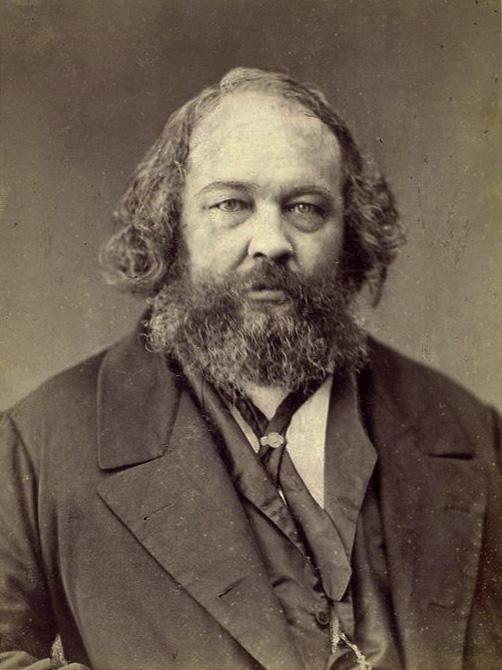
Bakunin photographed by Nadar
Indeed, Marx’s revolutionary prophecy appealed particularly to non-proletarian German Jews. Fritz Kahn hailed him as more than a prophet in Die Juden als Rasse und Kulturvolk (1920): “in 1848, for the second time, the star of Bethlehem was raised to the firmament … and it rose again above the rooftops of Judea: Marx.”[4]
If Marx was the Messiah in 1848, then Benjamin Disraeli could be called his prophet. In his novel Coningsby, published in 1844, the Jewish character Sidonia—“a cross between Lionel de Rothschild and Disraeli himself,” according to Disraeli’s biographer[5]—declared:
“That mighty revolution which is at this moment preparing in Germany, and which will be, in fact, a second and greater Reformation, and of which so little is as yet known in England, is entirely developing under the auspices of Jews, who almost monopolise the professorial chairs of Germany.”
Four years after these words were written, the Communist Manifesto was published and, almost simultaneously, the revolution broke out in Germany, as Disraeli had predicted . Jews did play a major role in the 1848 revolution, as Amos Elon has shown in his book The Pity of It All: A History of Jews in Germany 1743-1933. “80 percent of all Jewish journalists, doctors, and other professionals” supported the revolution. The most prominent were Ludwig Bamberger in Mainz, Ferdinand Lassalle in Dusseldorf, Gabriel Riesser in Hamburg, Johan Jacoby in Koeningsberg, Aron Bernstein in Berlin, Herman Jellinek in Vienna, Moritz Harmann in Prague, and Sigismund Asch in Breslau. “All over the country,” Elon writes, “rabbis in their sermons greeted the revolution as a truly messianic event.” The Jewish magazine Der Orient praised “the heroic Maccabean battle of our brethren on the barricades of Berlin,” and raved, “The savior from whom we have prayed has appeared. The fatherland has given him to us. The messiah is freedom.” The Jewish scholar Leopold Zunz, founder of academic Judaic Studies (Wissenschaft des Judentums),
“described what was happening in specifically biblical terms shot through with the Messianic political view which saw revolutionary politics as the fulfillment of biblical promise. Haranguing the Berlin students from the barricades, Zunz portrayed Metternich [Chancellor of the Austrian Empire] as Haman and hoped that ‘perhaps by Purim, Amalek [meaning the Prussian king Friedrich Wilhelm IV] will be beaten.’”[6]
After the failure of the revolution, many revolutionaries exiled themselves to London, where they were known as the Forty-Eighters. Marx settled there for the rest of his life, “living encased in his own, largely German, world, formed by his family and a small group of intimate friends and political associates,” according to Isaac Berlin.[7] Apart from Engels, Marx’s friends and associates were, in fact, almost all Jewish. Marx’s influence, which had been small in the 1848 revolution, would then develop, thanks to what Bakunin would call in 1872, in an unpublished “Lettre au Journal La Liberté de Bruxelles,” his “remarkable genius of intrigue,” adding:
“he also has in his service a numerous corps of agents, hierarchically organized and acting secretly under his direct orders; a kind of socialist and literary freemasonry in which his compatriots, the German Jews and others, occupy a considerable place and deploy a zeal worthy of a better cause.”
Bakunin was particularly intrigued by Marx’s insistence on the centralization of all banking activity. The Communist Manifesto not only proclaims the abolition of private banks, but: “Centralisation of credit in the hands of the State, by means of a national bank with State capital and an exclusive monopoly.” In another unpublished editorial of 1872, Bakunin wrote:
“this Jewish world is today, for the most part, at the disposal of Marx on the one hand, and of Rothschild on the other. I am convinced that the Rothschilds, on their side, appreciate the merits of Marx and that Marx, on his side, feels an instinctual attraction and a great respect for the Rothschilds. / This may seem strange. What can there be in common between socialism and a major bank? The point is that Marx’s communism wants a strong centralization of the state, and where there is centralisation of the state, there must necessarily be a central bank, and where such a bank exists, the parasitic nation of the Jews, speculating with the Labour of the people, will always thrive.”[8]
Having succeeded to get Bakunin and his “anti-authoritarian” followers expelled from the International Workingmen’s Association (the First International), Marx transferred its General Council from London to New York—the city that would soon become the Western capital of Jewry, where another German Jew, Leon Braunstein aka Trotsky, would be preparing the Bolshevik revolution, with the financial support of Wall Street Jewish bankers like Jacob Schiff.[9]
The Jewish Question in nineteenth-century Germany
 In order to understand Marx’s hidden agenda, the best is to start with his first two significant articles, published in 1844 in the Deutsch-Französische Jahrbücher, four years before the Communist Manifesto. Their topic was the “Jewish Question”. Before we present what Marx had to say about it, we must recall the context.
The “Jewish Question” is the question of the possibility and means of Jewish assimilation. The problem, as it was commonly formulated from the end of the eighteenth century, was that Jews considered themselves, and were considered, as aliens in the European nations among which they lived. One solution was to transform Jewishness from a nationality into a religion compatible with the secular values of modern nations. Moses Mendelssohn (1729–1786) paved the way in Germany for a “Reform Judaism” that defined itself as purely religious and renounced nationalist aspirations. On the basis of this new pact, Napoleon granted political emancipation to the Jews in France, and was hailed as a liberator by German Jews when he invaded the German principalities. Although Jewish emancipation underwent a setback in Prussia when he withdrew in defeat, it was complete by 1848.
 However, the assumption that Jewishness was a matter of private religion created a new problem for the Jewish community, aggravated by residual forms of segregation: for many secular and educated Jews, Judaism had little appeal as a religion, and converting to Christianity seemed the logical continuation of their conversion to the Enlightenment. Half the Jews of Berlin converted to Protestantism or Catholicism in the late eighteenth and early nineteenth century.
Karl Marx’s family falls in that category. His father Herschel Levi, though the son and brother of rabbis, became a Lutheran in order to practice law in the Prussian courts, and had his six children and his wife baptized in 1824, when Karl was six years old. Another famous case is Heinrich Heine (1797–1856), who conceived of his baptism in 1825 (one year after Marx) as the “entrance ticket to European civilization.”[10] Marx met Heine, a generation his elder, shortly after his arrival in Paris in 1843, and the two men met frequently until Marx moved to London in 1849. It is believed that their conversations had a formative influence on both men. Heine may in fact have introduced Communism to Marx, for he wrote in 1842, one year before meeting Marx:
“Though Communism is at present little talked about, vegetating in forgotten attics on miserable straw pallets, it is nevertheless the dismal hero destined to play a great, if transitory role in the modern tragedy… There will then be only one shepherd with an iron crook and one identically shorn, identically bleating human herd.”[11]
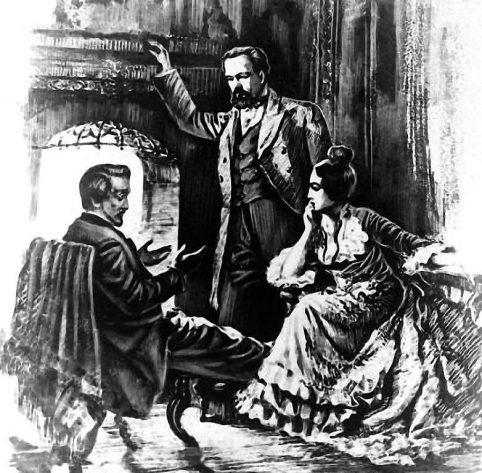
Heine with Marx and his wife Jenny
The dissolution of Jewish identity into a religious faith led to a reaction in the form of a Jewish nationalist movement that would ultimately morph into Zionism. It was the German Jewish historian Heinrich Graetz (1817-1891), almost the same age as Marx, who gave the first impetus to a new Jewish national consciousness with his multivolume History of the Jewish People, published in 1853 . Marx first met Heinrich Graetz in the summer 1874, while “taking the waters” at Carlsbad in Bohemia. The two following summers, they coordinated their vacations there. We do not know what they talked about, but, as Shlomo Avineri comments, “a more dramatic prefiguration of the encounter between Zion and Kremlin could not be imagined.”[12]
Graetz reawakened the national consciousness of European Jews such as Moses Hess (1812-1875), author in 1862 of Rome and Jerusalem: The Last National Question, which in turn impressed Theodor Herzl. According to Hess, the efforts of the Jews to merge with a nationality other than their own are doomed to failure. “We shall always remain strangers among the nations,” for “the Jews are something more than mere ‘followers of a religion,’ namely, they are a race brotherhood, a nation.”[13]
Interestingly, before his conversion to Jewish nationalism, Moses Hess (originally Moritz) was a pre-Marxist communist. He was the founder of the Rheinische Zeitung, for which Marx served as Paris correspondent in 1842-43 . Hess had a strong influence on both Engels and Marx.[14] Marx borrowed from Hess’ 1845 essay on “The Essence of Money” his concept of economic alienation.[15] Hess always remained close to Marx; in 1869, at Marx’s request, he even penned an article slandering Bakunin, accusing him to be an “agent provocateur” of the Russian government.[16]
Marx’s response to Bruno Bauer
Marx’s essays on the Jewish Question were critical reviews of two works by Bruno Bauer (1809-1882), a leading figure of the Young Hegelians: a book titled Die Judenfrage (1842), and a follow-up article on “The Capacity of Present-day Jews and Christians to Become Free.”[17]
Bauer’s approach to the question of Jewish assimilation was innovative. For him, the religious nature of Judaism is the problem, not the solution. He argued that Jews cannot be emancipated politically without first being emancipated religiously, because the Jews’ resistance to assimilation is based on the commandment of the Torah to live permanently in separation from other people. The essence of their religion is their claim to be the chosen people, and that prevents them from even respecting other peoples.
“Jews as such can not amalgamate with peoples and associate their fate with theirs. As Jews, they must wait for a particular future, allotted to them alone, the chosen people, and assuring them the dominion of the world.”
Therefore, there can be no emancipation of the Jews. A Jew can emancipate himself only by ceasing to be a Jew, because his true alienation is his Jewishness.
Bauer was the first since Voltaire to point at the toxic influence of the Tanakh as the key to the Jewish Question. Christians could obviously never reach that conclusion, but even secular thinkers who subscribed to the new science of “higher criticism” (pioneered by David Strauss’ Life of Jesus, 1835) generally looked away from the xenophobia of the Tanakh. “One even screams at betrayal of the human race when the critics try to examine the essence of the Jew as a Jew,” noted Bauer.
In his critical reviews, Marx does not argue against Bauer’s point that Jewish religion is opposed to assimilation. Rather, he denies altogether that Jewishness is a matter of religion.
“Let us consider the actual, worldly Jew—not the Sabbath Jew, as Bauer does, but the everyday Jew. Let us not look for the secret of the Jew in his religion, but let us look for the secret of his religion in the real Jew.”
Since Marx downplays the religious definition of Jewishness, it would be expected that he opt for the second term of the alternative and define Jewishness as a nationality, as will his friend Hess twenty years later. But he doesn’t. Instead, Marx posits, for the first time, his dogma that religion belongs to the cultural “superstructure” of society, while the real “infrastructure” is economic. The essence of the Jew, he writes, is not his religion, but his love of money:
“What is the secular basis of Judaism? Practical need, self-interest. What is the worldly religion of the Jew? Huckstering. What is his worldly God? Money.”
Marx redefines Jewish religion as the cult of money: “Money is the jealous god of Israel, in face of which no other god may exist.” He does the same for Jewish nationality, in one short sentence: “The chimerical nationality of the Jew is the nationality of the merchant, of the man of money in general.” It follows naturally, according to Marx, that if you abolish money you will solve the Jewish question:
“Very well then! Emancipation from huckstering and money, consequently from practical, real Judaism, would be the self-emancipation of our time. An organization of society which would abolish the preconditions for huckstering, and therefore the possibility of huckstering, would make the Jew impossible. His religious consciousness would be dissipated like a thin haze in the real, vital air of society.”
Jews will be emancipated when all men will be emancipated, for there is no other emancipation than emancipation from money.
Marx makes the radical claim that love of money and economic alienation came to the world from the Jews. He equates economic alienation to Jewish influence:
“the practical Jewish spirit has become the practical spirit of the Christian nations. The Jews have emancipated themselves insofar as the Christians have become Jews. … The Jew is perpetually created by civil society from its own entrails. … The god of the Jews has become secularized and has become the god of the world”
And so, “In the final analysis, the emancipation of the Jews is the emancipation of mankind from Judaism.” That sounds terribly anti-Semitic, from today’s standards. Because of these essays on the Jewish Question, Marx’s biographers have been more concerned by the question, “Was Marx an anti-Semite?” (see Edmund Silberner’s 1949 book of that title) than by the issue of his Jewish background, environment, and mindset. This is best illustrated by this article by Michael Ezra, “Karl Marx’s Radical Antisemitism.”
 But in the context of the time, Marx’s view of the Jews as money worshippers was rather banal. It was almost unanimously shared among socialists, as Hal Draper reminds us in “Marx and the Economic-Jew Stereotype.”[18] It was especially common among revolutionary Jews as well as among Zionists who were generally socialists. Moses Hess himself, for instance, wrote in “The Essence of Money”: “The Jews, who in the natural history of the social animal-world had the world-historic mission of developing the beast of prey out of humanity have now finally completed their mission’s work.”
What Marx did was to push the stereotype to its limit: he made the love of money not just an attribute of some Jews, but the very essence of the Jews. But by doing so, he was in effect dissolving the Jewish question into a socio-economic question: the Jew becomes the archetypal bourgeois. By this sleight of hand, Marx eliminated the Jewish question once and for all. He would never come back to it.[19]
In fact, never again would Marx target specifically Jewish financiers. Nesta Webster draws attention to that anomaly in her World Revolution: The Plot Against Civilization (1921):
“The period of 1820 onwards became, as Sombart [Werner Sombart, The Jews and Modern Capitalism, 1911)] calls it, ‘the age of the Rothschilds,’ so that by the middle of the century it was a common dictum, ‘There is only one power in Europe, and that is Rothschild.’ Now how is it conceivable that a man who set out honestly to denounce Capitalism should have avoided all reference to its principal authors? Yet even in the section of his book dealing with the origins of Industrial Capitalism, where Marx refers to the great financiers, the stock-jobbing and speculation in shares, and what he describes as ‘the modern sovereignty of finance,’ he never once indicates the Jews as the leading financiers, or the Rothschilds as the super-capitalists of the world.”[20]
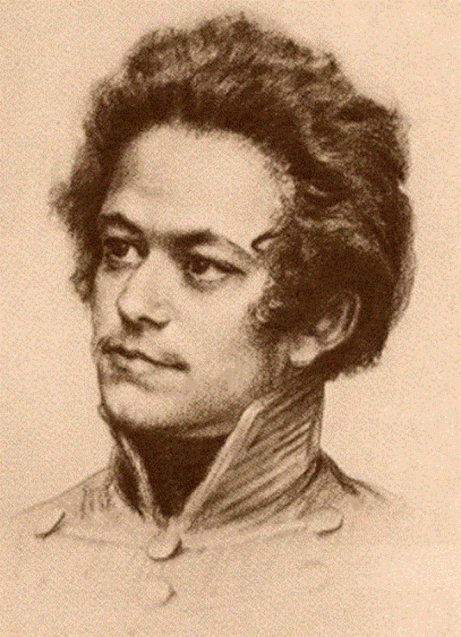
Young Karl Marx
By reducing Jewishness to capitalism, Marx was also overlooking another side of Jewish influence in the world: the revolution. The strong involvement of Jews in revolutionary movements would not become fully apparent to the world before 1848, but Marx, being himself a German Jewish revolutionary, could not be unaware of it. He could not be ignorant of the fact that Jews loved not only money, but also the revolution. Jewish revolutionary activity is one form of resistance to assimilation, especially when it calls for the destruction of the nations in the name of internationalism. By simply ignoring it, Marx was, at the very least, concealing the role of his own Jewishness in his revolutionary enterprise, while at the same time removing in advance all suspicion of his Jewish sympathies.
I believe Marx’s treatment of the Jewish question set the standard of his subsequent method. First, Marx misrepresents the arguments of his adversaries, often turning them upside down before proceeding to criticize them. For example Marx pretends that Bauer sees Jewishness as a religious faith, but that was not Bauer’s point. Rather, Bauer showed that defining Jewishness as a religion or ethnicity makes no big difference, because either way, the essence of Jewishness is separateness. Being religious only worsens the xenophobic nature of Jewishness, because it makes separateness a divine commandment rather than simply an ancestral habit. Secondly, Marx dismisses the complexity of things, in order to focus exclusively on a single and often secondary aspect of reality, making it look two-dimensional. Defining Jewishness as the love of money is obviously inadequate for anyone who has reflected even superficially on the question. Either Marx believes what he says, and that tells a lot about his intellectual ability, or he doesn’t—which is more likely—, and that tells a lot about his intellectual honesty. With the same reductionism Marx will claim in 1848, in the Communist Manifesto (Engels credited this insight to Marx alone), that, “The history of all hitherto existing society is the history of class struggles.” It is obvious to any (non-Marxist) historian that class struggles fall far behind ethnic struggles in the forces shaping history, even in modern times. Even an internationalist socialist like Bakunin could only be puzzled by Marx’s total ignorance of this fact:
“Marx completely ignores a most important element in the historic development of humanity, that is, the temperament and particular character of each race and each people, a temperament and a character which are themselves the natural product of a multitude of ethnological, climatological, economic, and historic causes, but which exercise, even apart from and independent of the economic conditions of each country, a considerable influence on its destinies and even on the development of its economic forces.”[21]
Coming from someone who grew up in a Jewish home and, despite his baptism, evolved in a mostly Jewish circle, counting among his friends zealot Jewish nationalists, I find it unbelievable that Marx’s ignorance of the national factor was sincere. Or perhaps, it must be considered very typical of Jewish discourse targeted at Gentiles. In that sense, Marx’s internationalism confirms Bauer’s remark that Jews consider only their own nationality as real:
“According to their fundamental representation, they wanted to be absolutely the people, the unique people, that is to say the people beside whom other peoples did not have the right to be a people. Any other people was, in comparison with them, not really a people; as the chosen people they were the only true people, the people who were to be All and take the world.”
Proudhon and the socialist movement before Marx
Having examined how Marx positioned himself on the background of the Jewish question, we can now do the same with the social question that occupied socialist thinkers.
At the time when Marx and Engels joined the movement, the most influential socialist theorist was Pierre-Joseph Proudhon (1809-1865), of nine years Marx’s elder. There is no better way to understand the originality of Marx’s economic ideas than by comparing them to Proudhon’s. (Proudhon’s work is accessible to English readers through Iain McKay’s anthology: Property is Theft! A Pierre-Joseph Proudhon Anthology, AK Press, 2011. McKay’s 82-page introductory chapters, including one on “Proudhon and Marx,” can be read here).
Proudhon’s book Qu’est-ce que la propriété? (What is Property? An Inquiry into the Principle of Right and of Government) published in 1840, had a huge echo and became a cornerstone of the European socialist movement. Proudhon was the first to use the expression “scientific socialism”, meaning a society ruled by a scientific government, one whose sovereignty rests upon justice and reason, rather than sheer will. His book was a critic of previous theories of economy (then called “political economy”) developed in Great Britain by Adam Smith (1723-1790) and David Ricardo (1772-1823). As explained by McKay, “It was Proudhon who first located surplus value production within the workplace, recognizing that the worker was hired by a capitalist who then appropriates their product in return for a less than equivalent amount of wages” (McKay 66).
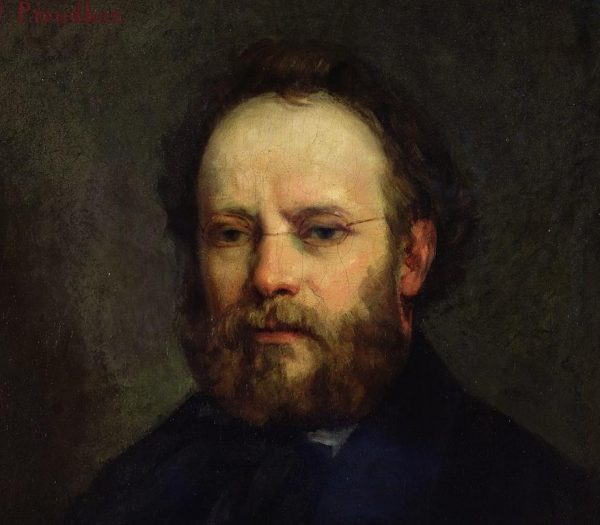
A portrait of Proudhon by his friend Gustave Courbet (1865)
Proudhon’s thought was in constant evolution, and therefore not totally consistent from beginning to end, even in terminology. Nevertheless, if we want to summarize it, we shall say that Proudhon advocated a decentralized, self-managed, federal, bottom-up socialism, which he called “anarchism”. His vision was based on an organic model of society, the basic cell of which was the patriarchal family, while the “commune” was the fundamental unit of democratic sovereignty. In contrast, “governmental power is mechanical” and fundamentally inhuman (Confession of a Revolutionary, McKay 404).
Proudhon consistently spoke against projects of state socialism. For him, state ownership of the means of production was the continuation of capitalism with the state as the new boss. Nationalization would simply make a nation of wage-workers, and Proudhon viewed the condition of the wage-worker as little better than slavery. State control also kills competition, and Proudhon considered that “competition is as essential to labour as division”; it is “the vital force which animates the collective being” (System of Economic Contradictions, McKay 197 and 207).
Although he called himself a revolutionary, Proudhon was a reformist and a democrat. He recommended that workers gain political and economic emancipation by organizing themselves in “clubs”, cooperatives and associations for mutual credit, by electing representatives, and by exercising pressure and influence onto the state.
Proudhon’s central formula, “Property is theft,” is often misunderstood. Proudhon was attacking the capitalistic property of the means of production. Whereas the French constitution of 1793 defined property as “the right to enjoy the fruit of one’s labor,” capitalist property is, according to Proudhon, “the right to enjoy and dispose at will of another’s goods—the fruit of another’s industry and labour” (What is Property? McKay 124). In fact, Proudhon formulates a thesis and an antithesis. While claiming that “property is theft,” he devotes long pages to the apology of the small owner, whether artisan or peasant, whose property is based on use, what he calls “possession”. “Individual possession is the condition of social life. … Suppress property while maintaining possession, and, by this simple modification of the principle, you will revolutionize law, government, economy, and institutions” (What is Property? McKay 137). Proudhon encouraged mutualist forms of possession, but he condemned communism, which called for the complete abolition of private property: “Communism is oppression and slavery” (What is Property? McKay 132). Proudhon’s ideal was less the abolition of private property than its fair distribution.
Marx’s hijacking of the Proudhonian legacy
In The Holy Family, published in 1845, Marx and Engels praised Proudhon’s book What is Property?
“Proudhon makes a critical investigation — the first resolute, ruthless, and at the same time scientific investigation — of the basis of political economy, private property. This is the great scientific advance he made, an advance which revolutionizes political economy and for the first time makes a real science of political economy possible.”
“Proudhon was the first to draw attention to the fact that the sum of the wages of the individual workers, even if each individual labour be paid for completely, does not pay for the collective power objectified in its product, that therefore the worker is not paid as a part of the collective labour power.”
But the praises of Marx and Engels for Proudhon suddenly ceased in 1846. Two reasons can be conjectured. First, in 1846, Proudhon rejected Marx’s invitation to become his correspondent in Paris. In his answer, Proudhon criticizes Marx’s will to forge a unifying dogma:
“Let us seek together, if you will, for the laws of society, the manner in which these laws are manifested, the progress of our efforts to discover them. But for God’s sake, after having demolished all a priori dogmatisms, let us not in turn dream of making our own, of indoctrinating the people; … let us show the world an example of learned and insightful tolerance, but since we are in the lead, let us not set ourselves up as leaders of a new intolerance; let us not be the apostles of a new religion, one that makes itself a religion or reason, a religion of logic. We should welcome and encourage all protestations. Let us get rid of all divisiveness, all mysticism. Let us never consider a question exhausted, and when we do get down to our last argument, let’s start again, if need be, with wit and irony! I will join your organization on that condition—or else not!”
Proudhon also expressed reservations on the idea of violent revolution: “Our proletariat has a great thirst for science, which would be very poorly served if you only brought them blood to drink” (“Letter to Karl Marx,” McKay 163-165).
The second reason for Marx’s about-face regarding Proudhon was the Frenchman’s publication of Philosophie de la Misère (or System of Economic Contradictions), in which he developed new conceptual tools to understand the structure of the capitalist world. Marx, who had announced in 1846 a book of economy, was taken by surprise. He responded with a pamphlet in French, Misère de la philosophie, which Proudhon would describe as “a tissue of vulgarity, of calumny, of falsification and of plagiarism,” written by “the tapeworm of socialism” (McKay 70). McKay agrees:
“While, undoubtedly, Marx makes some valid criticisms of Proudhon, the book is full of distortions. His aim was to dismiss Proudhon as being the ideologist of the petit-bourgeois and he obviously thought all means were applicable to achieve that goal. So we find Marx arbitrarily arranging quotations from Proudhon’s book, often out of context and even tampered with, to confirm his own views. This allows him to impute to Proudhon ideas the Frenchman did not hold (often explicitly rejects!) in order to attack him. Marx even suggests that his own opinion is the opposite of Proudhon’s when, in fact, he is simply repeating the Frenchman’s thoughts. He takes the Frenchman’s sarcastic comments at face value, his metaphors and abstractions literally. And, above all else, Marx seeks to ridicule him.” (McKay 70-71)
Twenty years later, and two years after Proudhon’s death, the most essential concepts of Marx’s Capital: A Critique of Political Economy, would be borrowed from Proudhon, without any credit given him . When Marx writes that, “property turns out to be the right, on the part of the capitalist, to appropriate the unpaid labour of others or its product, and the impossibility, on the part of the worker, of appropriating his own product” (Capital, vol. 1, quoted in McKay 66), he is repeating what Proudhon wrote 27 years earlier in What is Property?
In 1867, when Marx published the first volume of Das Kapital, Proudhon’s notoriety and influence still far exceeded Marx’s in Europe. The International Workingmen’s Association (the First International) had been founded in 1864 by Proudhon’s followers, who called themselves mutualists and anti-authoritarians. Mikhail Bakunin (1814-1876), who became Marx’s strongest opponent within the International after Proudhon’s death, considered his own ideas as “Proudhonism widely developed and pushed right to its final consequences” (as quoted in McKay 46), although he criticized the Proudhonians’ attachment to hereditary property. At the Geneva Congress of 1866, the Proudhonians prevailed and convinced the Congress to vote unanimously in favor of working towards the suppression of salaried status through the development of co-operatives. Marxism had almost no influence on the French Commune of 1871, which was predominantly inspired by Proudhon’s ideas of decentralized federations of communes and workers’ associations.
The intensity of Marx’s will to supplant Proudhon can be seen in a letter to Engels dated July 20, 1870, at the dawn of the Franco-Prussian War, a war in which Marx saw the opportunity to get the upper hand over his rival:
“The French need a thrashing. If the Prussians win, the centralisation of the state power will be useful for the centralisation of the German working class. German predominance would also shift the centre of gravity of the workers’ movement in Western Europe from France to Germany, and one has only to compare the movement in the two countries from 1866 till now to see that the German working class is superior to the French both theoretically and organisationally. Their predominance over the French on the world stage would also mean the predominance of our theory over Proudhon’s, etc.”
The outcome of the war gave entire satisfaction to Marx.
The Communist Manifesto, a monopolist’s dream
Although Marx’s economic theory is largely plagiarized from Proudhon, his solutions are the exact opposite. That is because Marx’s project doesn’t proceed from his economic theories. According to Karl Jaspers, Marx’s approach “is one of vindication, not investigation, but it is a vindication of something proclaimed as the perfect truth with the conviction not of the scientist but of the believer.” British historian Paul Johnson concurs and, after quoting from the apocalyptic and “Luciferian” poetry of Marx’s youth, he concludes that,
“Marx’s concept of a Doomsday … was always in Marx’s mind, and as a political economist he worked backwards from it, seeking the evidence that made it inevitable, rather than forward to it, from objectively examined data.”[22]
Therefore, Marx’s theoretical sum published in 1867, Das Kapital, is almost irrelevant to understand his program, laid out in 1848 with Friedrich Engels in the Manifesto of the Communist Party. “The theory of the Communists,” we read there, “may be summed up in the single sentence: Abolition of private property.” As if responding to protests by the Proudhonians, they add:
“We Communists have been reproached with the desire of abolishing the right of personally acquiring property as the fruit of a man’s own labour, which property is alleged to be the groundwork of all personal freedom, activity and independence. / Hard-won, self-acquired, self-earned property! Do you mean the property of the petty artisan and of the small peasant, a form of property that preceded the bourgeois form? There is no need to abolish that; the development of industry has to a great extent already destroyed it, and is still destroying it daily.”
Abolition of private property naturally includes “abolition of all rights of inheritance,” especially since the Manifesto also proclaims the “abolition of the family,” seen as a bourgeois institution “based … on capital, on private gain.” Nations will disappear too, because “the working men have no country”; capitalism “has stripped him of every trace of national character.”
The current epoch “has simplified class antagonisms. Society as a whole is more and more splitting up into two great hostile camps, into two great classes directly facing each other—Bourgeoisie and Proletariat.” Engels adds in a footnote to the 1888 English edition that, “By bourgeoisie is meant the class of modern capitalists, owners of the means of social production and employers of wage labour.” Marx and Engels await the complete disappearance of “the lower strata of the middle class—the small tradespeople, shopkeepers, and retired tradesmen generally, the handicraftsmen and peasants—all these sink gradually into the proletariat.” The bourgeoisie, on the other hand, “has concentrated property in a few hands.”
Marx and Engels predict that this concentration of wealth in ever fewer hands, and the corresponding increase in misery among the growing working class, will intensify class warfare, and lead inevitably to the violent revolution of the proletariat. The Communists “openly proclaim that their goals cannot be reached except through the violent overthrow of the entire social order of the past.” After the failure of the 1848 revolution in Germany, Marx wrote that, “there is only one way in which the murderous death agonies of the old society and the bloody birth throes of the new society can be shortened, simplified and concentrated, and that way is revolutionary terror.”
The goal of the revolution is to establish the “dictatorship of the proletariat,” as a transition toward the abolition of all classes. This stage is necessary for the proletariat to defend itself against a counter-revolution and to bring about the classless society. Although the expression “dictatorship of the proletariat” doesn’t appear until 1852, the idea is clearly stated in the Manifesto:
“The proletariat will use its political supremacy to wrest, by degree, all capital from the bourgeoisie, to centralise all instruments of production in the hands of the State, i.e., of the proletariat organised as the ruling class; and to increase the total productive forces as rapidly as possible.”
The first thing to note is that Marx and Engels have no intention to appease the antagonism between the proletarians and the bourgeois, by improving the condition of workingmen. On the contrary, they hope that the conflict will intensify to the point of turning into a bloody civil war. For that, the misery of the working class must increase. We should remember here that tearing apart the social fabric of nations by exacerbating social, racial, generational or gender tensions is a strategy that Jewish intellectuals have used to this day.
Secondly, Marx and Engels have no intention to stop or even resist the progress of capitalism. On the contrary, they call for the total disappearance of the social and economic structures that preceded it, and look forward to its most extreme development, when all the means of production have fallen into a few hands. For only then, they claim, the new world can be born. Capitalism contains the seeds of its own destruction, but capitalism must first reach its full maturity, which is the monopoly of a few billionaires.
Obviously, monopolists can support wholeheartedly that goal. Should they fear the next step, the revolution and the appropriation of all capitals and all means of production by the state? Not necessarily, as Bakunin argued in 1872, and as Antony Sutton explained in more detail in Wall Street and the Bolshevik Revolution (2001):
“one barrier to mature understanding of recent history is the notion that all capitalists are the bitter and unswerving enemies of all Marxists and socialists. This erroneous idea originated with Karl Marx and was undoubtedly useful to his purposes. In fact, the idea is nonsense. There has been a continuing, albeit concealed, alliance between international political capitalists and international revolutionary socialists — to their mutual benefit. This alliance has gone unobserved largely because historians — with a few notable exceptions — have an unconscious Marxian bias and are thus locked into the impossibility of any such alliance existing. The open-minded reader should bear two clues in mind: monopoly capitalists are the bitter enemies of laissez-faire entrepreneurs; and, given the weaknesses of socialist central planning, the totalitarian socialist state is a perfect captive market for monopoly capitalists, if an alliance can be made with the socialist powerbrokers. Suppose — and it is only hypothesis at this point — that American monopoly capitalists were able to reduce a planned socialist Russia [or Germany] to the status of a captive technical colony? Would not this be the logical twentieth-century internationalist extension of the Morgan railroad monopolies and the Rockefeller petroleum trust of the late nineteenth century?”
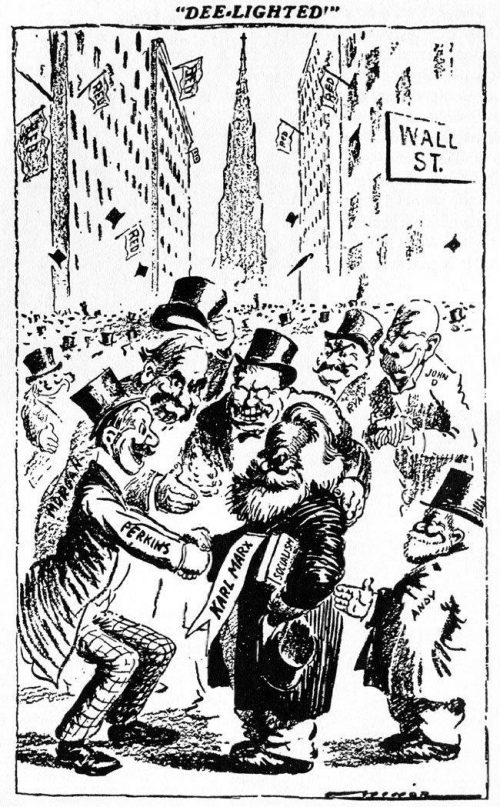
Marx being congratulated by Wall Street bankers (1911 cartoon reproduced by Sutton)
Sutton sees no Jewish conspiracy in this collusion between the Bank and the Revolution. But documents relative to the failed Russian revolution of 1905 show that there is another dimension to that unnatural alliance, as explained in this article by Alexandros Papagoergiou. In 1904, Russian Prime Minister Sergei Witte was tasked to secure a huge foreign loan to stabilize Russian public finances. He tells in his memoirs that, after turning down the offer of the Jewish banks headed by the Rothschilds, because it was conditioned on “legal measures tending to improve the conditions of the Jews in Russia,” he was able to raise the enormous amount of 2,250,000,000 francs via “Christian Banks”.[23] Revolutionary riots started soon after. A report of the Russian Foreign Minister to Tsar Nicholas II notes that it happened “just at the time when our government tried to realize a considerable foreign loan without the participation of the Rothschilds and just in time for preventing the carrying out of this financial operation; the panic provoked among the buyers and holders of Russian loans could not fail to give additional advantages to the Jewish bankers and capitalists who openly and knowingly speculated upon the fall of the Russian rates.” According to the report, the revolutionaries “are in possession of great quantities of arms which are imported from abroad, and of very considerable financial means,” which had been collected by Anglo-Jewish capitalists “under the leadership of Lord Rothschild, … for the officially alleged purpose of helping Russian Jews who suffered from pogroms.”[24]
Marxism vs Zionism: the dialectical pliers
Jewish movements seem to be working history through dialectical antagonisms that ultimately advance the Big Project. The capacity of the Jewish community to present itself either as a religion or as a nationality, depending on the circumstances, is the prime example. After gaining political emancipation in the name of religious freedom in the first part of the 19th century, European Jews were in the position to reclaim their special nationhood. For a few decades, reformed rabbis would ostensibly oppose Jewish nationalism, proclaiming in the 1885 Pittsburgh Conference: “We consider ourselves no longer a nation, but a religion community.”[25] Yet the same Pittsburgh Conference saw no contradiction in adopting the theory of German rabbi Kaufman Kohler, that “Israel, the suffering Messiah of the centuries, shall at the end of days become the triumphant Messiah of the nations,”[26] which amounts to say that Israel is not an ordinary nation, but the super-nation. In the 20th century, any trace of a contradiction between Reformed Judaism and Zionism was removed.
The early collaboration between Marx and Hess and the late encounter between Marx and Graetz both prefigure another dialectical opposition between Communism (the International revolution aimed at destroying Christian nations) and Zionism (the national project aimed at building the Jewish nation). Both movements developed in the same milieu. Chaim Weizmann recounts in his autobiography (Trial and Error, 1949) that in early twentieth-century Russia, revolutionary communists and revolutionary Zionists belonged to the same milieu. Weizmann’s brother Schmuel was a communist, and that was not a source of family discord. These divisions were relative and changeable; many Zionists were Marxists, and vice versa. The borderline was all the more vague that the Communist Bund, born the same year as Zionism (1897), inscribed in its revolutionary agenda the right of the Jews to found a secular Yiddish-speaking nation. As Gilad Atzmon recently wrote, the Bund was “also an attempt to prevent Jews from joining the ‘Hellenic’ route by offering Jews a tribal path within the context of a future Soviet revolution.”
But the most important thing to note is that, from the early days, Jewish revolutionary activity provided Zionists with a diplomatic argument in favor of their alternative program for the Jews. Herzl mentions in his diary (June 4, 1900) that “intensifying Jewish Socialist activities” was a way to “stir up the desire among the European governments to exert pressure on Turkey to take in the Jews” (Palestine was then under Ottoman control). He hawked Zionism as a solution to the problem of Jewish revolutionary subversion when meeting Kaiser Wilhelm II in 1898, and again when meeting Russian ministers in St. Petersburg in 1903.[27] The next generation of Zionists continued the stratagem. Churchill, who spoke with one voice with Chaim Weizmann,[28] dramatized the opposition between the “good Jews” (Zionists) and the “bad Jews” (communists) in his 1920 article “Zionism versus Bolshevism: A struggle for the soul of the Jewish people.” He referred to Bolshevism as “this world-wide conspiracy for the overthrow of civilization” and to Zionism as the solution “especially in harmony with the truest interests of the British Empire.” (Churchill’s later alliance with Stalin proves that his Zionism was stronger than his anti-communism.)
In the aftermath of World War II, the rivalry between the Communist and the Capitalist worlds remained the indispensable context for the creation and expansion of Israel. That explains why Roosevelt’s administration, largely controlled by Jews, helped Stalin conquer half of Europe and thwarted all attempts to stop him. Curtis Dall, Roosevelt’s son-in-law, has revealed a secret diplomatic channel demonstrating that the White House went out of its way to give the USSR all the time and the armament necessary to invade Central Europe.[29] Thus the Second World War was completed with the determined aim of laying the foundations for the Cold War, that is, a highly explosive polarization of the world that would prove crucial for Project Zion. In fact, during this whole period, it is almost impossible to distinguish, among the Jewish advisors of Roosevelt and Truman on foreign policy, the pro-Communists from the pro-Zionists, as David Martin remarks in The Assassination of James Forrestal. A case in point is David Niles (Neyhus), who was guilty of spying for the Soviets while advising Roosevelt, but then played a key role in Truman’s support of the U.N. Partition Plan and the recognition of Israel.[30]
The Cold War proved instrumental when Nasser, Israel’s most formidable enemy, was pushed into the communist camp in 1955, setting off an intense Zionist campaign to present him as a danger to the stability of the Middle East, and to present Israel, by contrast, as the only reliable ally in the region. The Cold War was also the crucial context for Israel’s defeat of Egypt in 1967 and Israel’s annexation of territories stolen from Egypt, Syria and Lebanon.
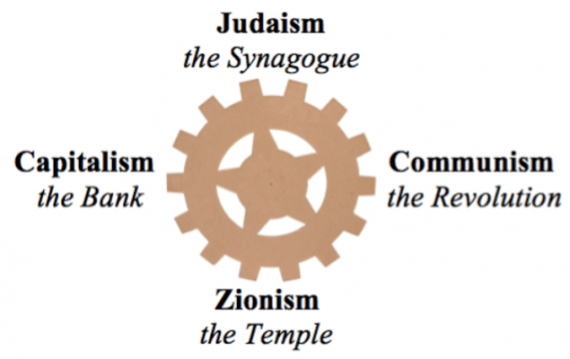
Yahweh’s dialectical machinery
Laurent Guyénot, Ph.D., has recently edited some of his Unz Review articles in book form, under the title Our God is Your God Too, But He Has Chosen Us: Essays on Jewish Power. He is also the author of From Yahweh to Zion: Jealous God, Chosen People, Promised Land … Clash of Civilizations, 2018, and JFK-9/11: 50 years of Deep State, Progressive Press, 2014.
Notes
[1] David Ben-Gurion and Amram Duchovny, David Ben-Gurion, In His Own Words, Fleet Press Corp., 1969, p. 116. Ben-Gurion’s prophecy appeared in the magazine Look on January 16, 1962, reproductions of which can be found on Internet.
[2] Karl Popper, Unended Quest: An Intellectual Autobiography (1976), Routledge, 2002, books.google.com
[3] Bakunin, Statism and Anarchy, trans. Marshall S. Shatz, Cambridge UP, 1990, pp. 538-545.
[4] Quoted in Alexandre Soljénitsyne, Deux siècles ensemble (1795–1995), tome I: Juifs et Russes avant la Révolution, Fayard, 2003, tome 1, p. 269.
[5] Robert Blake, Disraeli (1966), Faber Finds, 2010, p. 202.
[6] Amos Elon, The Pity of It All: A History of Jews in Germany 1743-1933, Metropolitan Books, 2002, pp. 153, 157, 163-164.
[7] Isaac Berlin, Karl Marx: His Life and Environment, 1939, 2nd ed, 1948, p. 17.
[8] Aux compagnons de la Fédération des sections internationales du Jura, quoted in Henri Arvon, Les Juifs et l’Idéologie, PUF, 1978, p. 50. Partial quote in Francis Wheen , Karl Marx, Fourth Estate, 1999, p. 340.
[9] Antony Sutton, Wall Street and the Bolshevik Revolution (1976), Clairview Books, 2011.
[10] Quoted in Kevin MacDonald, Separation and Its Discontents: Toward an Evolutionary Theory of Anti-Semitism, Praeger, 1998, kindle 2013, k. 4732–4877.
[11] Amos Elon, The Pity of It All, op; cit., p. 146.
[12] Shlomo Avineri, Karl Marx: Philosophy and Revolution, Yale UP, 2019, pp. 171-172.
[13] Moses Hess, Rome and Jerusalem: A Study in Jewish Nationalism, 1918 (archive.org).
[14] Sydney Hook, “Karl Marx and Moses Hess,” 1934.
[15] Shlomo Avineri , Moses Hess: Prophet of Communism and Zionism, 1985.
[16] Read Bakunin’s response to Hess’s article, “Aux citoyens rédacteurs du Réveil”
[17] French translation, Bruno Bauer, La Question juive (1843), Union générale d’Éditions, 1968, on
[18] Hal Draper, “Marx and the Economic-Jew Stereotype,” from Karl Marx’s Theory of Revolution, Vol.1: State and Bureaucracy, Monthly Review, New York 1977, pp. 591-608. Read also Gary Ruchwarger, “Marx and the Jewish Question: A Response to Julius Carlebach,” Marxist Perspectives, Fall 1979, pp. 19-38.
[19] I am aware that another “anti-Semitic” article, unsigned and titled “The Russian Loan” (New York Daily Tribune, January 4, 1856), has been attributed to Marx by his daughter, but I find Marx’s authorship dubious. See the discussion on its authenticity here.
[20] Nesta Webster, World Revolution: The Plot Against Civilization, 1921 , on archive.org, pp. 95-96.
[21] “Lettre au Journal La Liberté de Bruxelles,” October 5, 1872.
[22] Paul Johnson, Intellectuals: From Marx and Tolstoy to Sartre and Chomsky (1990), HarperCollins, 2007.
[23] The Memoirs of Count Witte, Doubleday, Page & Co, 1921, on archive.org, pp. 292-294.
[24] Quoted in Boris Brasol, The World at the Cross Roads, 1923, on archive.org, pp. 74-78.
[25] Quoted in Alfred Lilienthal, What Price Israel? (1953), Infinity Publishing, 2003, p. 14.
[26] Kaufmnann Kohler, Jewish Theology, Systematically and Historically Considered, Macmillan, 1918 (www.gutenberg.org), p. 290.
[27] The Complete Diaries of Theodor Herzl, edited by Raphael Patai, Herzl Press & Thomas Yoseloff, 1960, vol. 1 , pp. 362–363, 378–379, and vol. 3, p. 960.
[28] Martin Gilbert, Churchill and the Jews: A Lifelong Friendship, Henry Holt & Company, 2007.
[29] Curtis Dall, FDR: My Exploited Father-in-Law, Christian Crusade Publications, 1968 , pp. 146–157.
[30] David Martin, The Assassination of James Forrestal, McCabe Publishing, 2017, pp. 57-65. On Nile’s influence in the U.N. vote, see Alfred Lilienthal, What Price Israel ? (1953), 50th Anniversary Edition, Infinity Publishing, 2003, p. 50.
February 17, 2020
Posted by aletho |
Book Review, Economics, Ethnic Cleansing, Racism, Zionism, Supremacism, Social Darwinism, Timeless or most popular | Judaism, Zionism |
Leave a comment
Do they even pass basic energy, environmental, economic and human rights tests?

Should Americans follow China in a massive commitment to supposedly eco-friendly battery-electric buses (BEBs)? California has mandated a “carbon-free” bus system by 2040 and will buy only battery or fuel cell-powered buses after 2029. Other states and cities are following suit.
Vehicle decisions are typically based on cost and performance. Cost includes selling price plus maintenance, while performance now includes perceived environmental impacts – which for some is the only issue that matters. But that perception ignores some huge ecological (and human rights) issues.
China today has 420,000 BEBs on the road, with plans to reach 600,000 by 2025. The rest of the world has maybe 5,000 of these expensive, short-range buses. However, the Chinese still get 70% of their energy from coal, so are their BEBs really that green? Are they safe? And are they really ethical?
Battery costs are the main reason BEBs today are much more expensive than buses that run on diesel or compressed natural gas. But bus makers say electric buses require less maintenance, and climate activists say the lower net “carbon footprint” (carbon dioxide emissions) justifies paying a little more.
China gets around the up-front cost problem by establishing national mandates, heavily subsidizing bus (and battery) manufacturers, and rewarding cities that replace entire bus fleets at one time. This ensures that their factories benefit from economies of scale – and that the transition will be swift and complete.
Beijing simply dodges the environmental costs by ignoring the fossil fuels, horrific pollution and human illnesses involved in mining, ore processing and manufacturing processes associated with building the buses. California and other “renewable” energy advocates do likewise. In fact, those costs will skyrocket as China, and the world emphasize electric vehicle, wind, solar and battery technologies.
Meanwhile, the USA and EU nations focus on subsidizing passenger cars. Thus, there are far more zero-emission passenger cars on the road today in the U.S. and Europe than public transit vehicles. No wonder Westerners still view electric vehicles as subsidized luxuries for the “woke wealthy,” who boast about lowering their carbon footprint, despite also often needing fossil fuel electricity to charge batteries.
The huge costs for fast-charging stations across Europe, let alone the vast United States, pose more huge challenges for future expansion of the electric vehicle market. But transit vehicles, even school buses, run regular routes, and if the routes are short enough, the bus can be recharged overnight in the garages.
Tax credits, free HOV lane access, free charging stations and other subsidies for the rich are seen by most as terrible policies. Yet another, says University of California–Davis researcher Hanjiro Ambrose, is the Federal Transit Administration funding formulas that favor short-term cost-efficiency over long-term innovation. “Those funding mechanisms haven’t been aligned with trying to stimulate policy change,” Ambrose says. “The cheapest technology available isn’t usually the newest technology available.”
To work around high upfront battery costs, innovative capitalists are creating new financial products that allow fleet owners to finance battery purchases. Treating battery costs the same way as fuel costs – as ongoing expenses – meets federal guidelines. Matt Horton, chief commercial officer for U.S. BEB maker Proterra, says, “The importance of the private capital coming into this market cannot be understated.”
Green advocates admit the primary reason people choose EVs is their belief that electric cars and buses, even with electricity generated from fossil fuels, are good for the environment. The Union of Concerned Scientists claims BEBs are 2.5 times cleaner in terms of lifespan emissions than diesel buses. That is highly questionable. Moreover, BEBs with today’s strongest batteries can take a full load no more than 150 miles in good weather. That’s fine for airport shuttles, maybe even for short public transit routes.
However, electric battery life is shorter than the 12-year vehicle life that many transit and school bus systems rely upon in their budgets. Battery replacement for BEBs is very expensive and unpredictable.
And then there are the horror stories. Los Angeles Metro purchased BEBs from Chinese-owned BYD Ltd. but yanked the first five off the road within a few months. Agency staff called the buses “unsuitable,” poorly made, and unreliable for more than 100 miles. Albuquerque returned seven out of its 16 BYD buses, citing cracks, leaking fluid, axle problems and inability to hold charges.
French journalist Alon Levy reported that BEB sales teams in Vancouver admitted their buses could not run for an entire day without recharging during layovers. Worse, in Minneapolis, bus performance suffers tremendously in cold weather: at 20o F buses cannot last all day; on Super Bowl Sunday, at 5o F, a battery bus lasted only 40 minutes and traveled barely 16 miles. Imagine being in a BEB in a blizzard.
In largely rural Maine, lawmakers proposed converting all school buses to BEBs. But Maine Heritage Policy Center policy analyst Adam Crepeau found that BEBs can travel no more than 135 miles per charge (in good weather), while diesel buses go up to 400 miles and can be refilled quickly almost anywhere. “This,” he said, “will severely impact the ability of schools to use them for longer trips, for sporting events, field trips and other experiences for students.” Or in bitterly cold Maine winters.
The economic and practical bottom line is simple. Activists and sales teams are pressing American cities, school boards and other public entities to follow China and convert their fleets to BEBs, calling them “the wave of the future.” Even in California, where lengthy power outages have become routine, this climate and anti-fossil ideology dominates. Given the growing vulnerability of our electric grid, among other concerns, cost and performance may not be the only considerations in making such an irreversible choice.
The environmental and ethical bottom line is equally simple – but routinely gets shunted aside.
Electric vehicles require about three times more copper than internal combustion equivalents – plus lithium, cobalt and other metals for their batteries. Wind turbines need some 200 times more steel, copper, plastics, rare earths, concrete and other materials per megawatt than combined-cycle gas turbines. Photovoltaic solar panels have similar materials requirements. 100% “renewable, sustainable” Green New Deal electricity systems on US or Chinese scales would require millions of turbines, billions of solar panels and billions of half-ton Tesla-style battery packs for cars, buses and backup electricity storage.
Those technologies, on those scales, would require mining at levels unprecedented in world history! And the environmental and human rights record we’ve seen for those high-tech metals is terrifying.
Lithium comes mostly from Tibet and the Argentina-Bolivia-Chile “lithium triangle,” where contaminated lands and waters are poisoning fish, livestock, wildlife and people. Most cobalt is mined in the Democratic Republic of Congo, where 40,000 children and their parents slave in open pits and dark, narrow tunnels – and get exposed constantly to filthy, toxic, radioactive mud, dust, water and air. Broken bones, suffocation, blood and respiratory diseases, birth defects, cancer and paralysis are commonplace.
Nearly all the world’s rare earth elements come from Inner Mongolia. Mining the ores involves pumping acid into the ground and processing them with more acids and chemicals. Black sludge from the operations is piped to a huge foul-smelling “lake” that is surrounded by formerly productive farmlands that are now so toxic that nothing can grow on them, and people and wildlife have just moved away. Here too, severe skin and respiratory diseases, cancers and other terrible illnesses have become commonplace.
In many of these cases, the mining and processing operations are run by Chinese companies, under minimal to nonexistent pollution control, workplace safety, fair wage, child labor or other basic standards that American, Canadian, Australian and European companies are expected to follow.
And this is just for today’s “renewable, sustainable, ethical, Earth-friendly, green” technologies. Just imagine what we are likely to see if China, California, New York, Europe and countless other places start mandating a fossil-fuel-free future – and then shut down nuclear power, to boot. Where will we get all the raw materials? Where will we put all the wind turbines, solar panels, batteries and transmission lines?
The prospect is horrifying. And it’s all justified by exaggerated fears of a climate apocalypse. Crazy!
Duggan Flanakin is director of policy research for the Committee For A Constructive Tomorrow (CFACT).
February 16, 2020
Posted by aletho |
Economics, Environmentalism, Science and Pseudo-Science | California, China |
Leave a comment



 In retrospect, notwithstanding the warnings and threats held out by Turkey, Moscow was determined for good reason that the operation must be carried froward to its logical conclusion, namely, liberation of M5 from the clutches of the al-Qaeda terrorist groups.
 The label for Humira, once the best-selling drug in the world, lists its risks in plain print. One of them, in the label’s own words, is new “autoimmune” disease.

