Fools pedal in…
Climate Discussion Nexus | February 12, 2020
They’re really going to do it. Britain is going to ban cars. Well, not all cars. Just all the ones you can afford that work. Because climate. By 2035 instead of 2040, because those extra five years after the 2030 final deadline are really important. And what impact will crippling private transportation and crashing the British economy have on people’s well-being, including their ability to deal with inevitable extreme weather events? They don’t know and apparently don’t care.
For all his willingness to challenge conventional wisdom on a variety of topics, including Brexit, Boris Johnson appears thoroughly orthodox on climate, consorting with David Attenborough and gadding about promoting the launch of the 26th UN Climate Change conference in Glasgow, even though it doesn’t start until November. It’s never too early for a photo op.
There is a remarkably casual arrogance about suddenly moving the deadline for scrapping the family car up by five years, and telling citizens if they have trouble adjusting it’s their tough luck. NBC says “Britain’s step amounts to a victory for electric cars that if copied globally could hit the wealth of oil producers”. Yes, and of everyone else too. It adds that “More than a dozen countries around the world have announced plans to crack down on new sales of gas and diesel vehicles” including France, still on its 2040 target and Norway with a classic “non-binding goal that by 2025 all cars should be zero emissions.” Zero? Really? No net emissions in the construction of the vehicle, the generation and transmission of the power (and thus the construction of the power plant or other facility), the disposal at the end of its life? None? Bosh.
Double-bosh to the British government’s plan to cut total national GHG emissions to net zero by 2050. Nobody knows how to do it and the only way they’ll get there is to fudge the numbers. Humans emit CO2. So does almost everything we do. Nobody can foresee all the consequences of everything everyone does, not even the carbon consequences. And with fading evidence that slow accumulation of CO2 portends catastrophe, it’s astounding to court economic catastrophe in such a confused manner.
For instance, in echoes of Europe’s great diesel debacle, where governments pushed consumers hard to buy this “cleaner” technology including subsidizing both the vehicles and the fuel only to realize it wasn’t cleaner at all, the British government suddenly added the previously subsidized and relatively popular hybrid gas/electric cars to the forbidden zone. And said it will act sooner than 2035 if possible. Plan? What plan?
It is easy to see ways this lack of plan might fail. Including consumers stocking up on gasoline cars to beat the ban. Or crumbling gasoline infrastructure and limits on resale rendering virtually all existing cars worthless over time. Or a vast popular revolt. (Especially if the UK government also goes ahead with a scheme to ban gas furnaces whenever the whim strikes, without any idea who should pay, what it will cost, if there are even enough tradespersons and so forth.)
NBC sees none of these potential drawbacks. Perhaps because it did not look. Instead it burbled that “According to experts, the targets of countries to ban sales of new gas and diesel vehicles won’t be effective without accompanying action.” And these actions evidently include “informing consumers about the vehicles on offer” according to one completely unbiased expert NBC sought out with no preconceived notion what he’d say, namely “Peter Mock, managing director of the International Council on Clean Transportation in Europe.” And certainly consumers will have to be told about cars they are allowed to buy because otherwise they’d only find out from advertisements, the internet, their friends and car dealers.
Then there’s the pesky matter Mock also mentioned of “building of the necessary charging infrastructure”. Um yeah. Don’t forget to do it. Unless of course you enjoy the thought of even lower emissions as people don’t bother buying cars they can’t drive anyway.
NBC did its best to make it all sound easy, saying “In Britain, diesel and gasoline models still account for most new vehicle registrations in Britain. However, registrations of electric vehicles rose 144 percent between 2018 and 2019, according to the Society of Motor Manufacturers and Traders.” Yes, but to what total share? Oh dear. 2.3%.
So the government will totally change the way Britons drive within 15 years, utterly rebuild a vast national infrastructure network, and get it all done right on time from the engineering to the estimates of which technology to back. Sure. Just like it always does. And if you don’t like it, well, don’t worry. They’ll probably have another inspiration and junk this one.
Audit Reveals The High Cost Of Toll Roads
TheNewspaper.com | February 7, 2020
Financial analysis of major toll road systems finds substantial diversion of revenue to third parties.
Of the billions of dollars collected at toll booths around the country, nearly half of the money goes to overhead costs, profit for the private companies involved and other uses that have nothing to do with the road itself. That is the finding of a financial audit released last week by the American Transportation Research Institute (ATRI), which conducted the analysis on behalf of the trucking industry. The report examined financial records for major toll road networks that together collected $14.7 billion in revenue in 2018.
“The findings indicate that the 21 major tolling systems analyzed collect revenue in excess of the actual direct costs of operations and interest expense, with nearly 50 percent of toll revenue diverted to other uses,” the report concluded. “This excess revenue is diverted in a number of ways based upon the individual agency or state that supervises the toll entity. The magnitude of diversion and the lack of standard practice with regard to revenue diversion speaks to the disjointed control under which toll entities operate.”
The roads covered in the report represent 82 percent of all tolls collected in the country. The full nationwide toll network generates an estimated $18 billion in revenue each year. Of that revenue, 15.8 cents on every dollar goes to the cost of collecting the toll itself. Another 26.8 percent goes to the cost of interest and 20.5 percent is diverted to non-road use such as transit, undermining the “user pays” argument used by tolling advocates.
The report found tolls tend to increase far in excess of the rate of inflation — up 72 percent over the last ten years, compared to the consumer price index the went up 16.9 percent in the same period. The data show the number of individual transactions at each toll road only went up 28 percent, while traffic volume increased 2.4 percent. Toll roads received $1.1 billion in taxpayer subsidies.
The report noted that by comparison the cost of collecting the federal fuels tax was just 0.2 percent of the revenue collected. While some have argued that gas tax revenue is no longer viable because this income source is on the decline, the latest federal statistics show Americans used 147 billion gallons of gas in 2018 — an all-time high. Preliminary data for 2019 show gas tax revenue rising for an eighth straight year.
Source:
Financial Analysis of Toll System Revenue (American Transportation Research Institute, 1/31/2020)
Russian oil & gas firms plan to invest $20 BILLION in Iraq’s energy industry
RT | February 11, 2020
Russian oil and gas companies could triple their investments in Iraq in the near future, Yury Fyodorov, first deputy chairman of the Economic Policy Committee at the Russian Federation Council, has announced.
The companies may spend up to $20 billion on oil projects in Iraq, Fyodorov said at a meeting with Iraqi Ambassador to Russia Abdul-Rahman Al-Husseini, according to Russian media.
“Today, our leading oil and gas companies such as Lukoil, Bashneft, Gazprom Neft are actively working in your country. The total investment has exceeded $10 billion,” the official said on Monday. He added that other companies, such as Zarubezhneft, Tatneft, and Rosneftegaz are also interested in working in Iraq.
“We are exploring the possibility of diversifying the activities of Russian operators, in particular by connecting them to the gas sector. According to preliminary forecasts, this could triple our companies’ investment.”
Last year, Russia and Iraq resumed cooperation in energy infrastructure, and in the electricity sector in particular. Some Russian firms could help Baghdad with the restoration and development of electric power facilities, while negotiations are under way over the construction of thermal power plants using the assistance of Russian companies.
Iraq’s proven oil reserves stand at over 145 billion barrels, while gas reserves exceed 3.7 trillion cubic meters.
Irish election result is a victory for Nationalism
By Johanna Ross | February 11, 2020
Once upon a time Gerry Adams, the leader of Ireland’s nationalist party, Sinn Fein, could not be heard speaking on the BBC. He was branded a terrorist and his voice was dubbed. How times have changed. Now his party, led by Mary Lou McDonald, has stormed to victory in the Irish elections. Having won the largest percentage of the vote at 24%, Sinn Fein has ended the decades long domination of Fine Gael and Fianna Fail in what was effectively a two-party political system.
McDonald now seeks to form a government with other left-wing Irish parties and although she doesn’t expect to form a coalition with Fine Gael or Fianna Fail, she would still participate in talks with representatives of the parties: “I also have consistently said that I will talk to and listen to everybody, I think that is what grown-ups do and that is what democracy demands.”
Fianna Fail’s leader, Michael Martin, said however that there were ‘significant incompatibilities’ to working with Sinn Fein. His party, along with Fine Gael have cited Sinn Fein’s previous links to the Irish Republican Army (IRA) – the paramilitary group – as a reason for not working with them. However Mary Lou McDonald has said it is “not sustainable” for either party leader to rule out talks with Sinn Fein. Given the sizeable chunk of the Irish population that voted for her party, you can see she has a fair point.
The Taioseach, Leo Varadkar, has now been forced to admit that Ireland has a three-party system. It may be a marginal win, and one which will force Sinn Fein into a coalition, but it is nevertheless a highly significant turn of events. Although the party won due to its left-wing domestic agenda and promises to combat poverty and rising homelessness, it cannot be ignored that this win is part of a broader, Europe-wide trend. Nationalism is on the rise across Europe, call it populism if you will, but people are increasingly voting for parties which put the nation state first over further European integration. Centrist parties are failing to compete with those offering a nationalist, eurosceptic agenda.
People don’t like to be dictated to. The arguably authoritarian decision by state broadcaster RTE not to include Mary Lou Mcdonald in their leaders’ debate quite possibly only generated more support for her party. It was reported that prior to the election Sinn Fein sent the broadcaster a legal letter asking it to reverse its decision. The Irish establishment will now have to catch up with the reality that Sinn Fein is now an equal player in the political landscape, and a force to be reckoned with.
The nationalist vibe in the air has now awoken the idea of Irish unity. A poll conducted earlier in 2019 demonstrated that two thirds of Irish people are now supportive of Irish reunification. Of 3000 people questioned, 65% said they were in favour of northern and southern Ireland becoming one nation again. Brexit, which has brought with it a surge in English nationalism, along with a Westminster government increasingly detached from the reality of the everyday struggles of working people, has encouraged more people north and south of the Irish border to rethink their stance on a topic few dared to broach in the past due to the violent conflict between nationalists and unionists. Under the Good Friday Agreement, it is indeed possible for Northern Ireland to secede the United Kingdom if a referendum result were to decide this.
Sinn Fein’s stance on the EU is not entirely clear-cut, but the win could be interpreted as a victory for Euroscepticism. The party is against further European integration, campaigned for a ‘No’ vote in the Irish referendum on joining the European Economic Community in 1972 and criticised the proposal of a European Constitution in 2002. Although it did support Britain remaining in the EU in the run-up to the 2016 EU referendum, it has criticised the European Union in the past for its policies of neoliberalism. When it comes to post-Brexit trade talks with the UK, the new Irish government with Sinn Fein at the helm is likely to take a tougher stance.
In addition, it’s likely that under Mary Lou McDonald’s leadership, we will see a referendum on Irish unity. If the outcome is for unification, it will put more pressure on a UK government currently facing a real threat from growing Scottish nationalism. As Irish and Scottish nationalist movements gain popularity, the United Kingdom cannot be taken for granted any longer. As elections continue to demonstrate, the status quo is under threat and it’s becoming increasingly possible that we will see the dissolution of the United Kingdom within our lifetimes.
Johanna Ross is a journalist based in Edinburgh, Scotland.
China, Russia to Defy US Sanctions Over Support to Venezuela
teleSUR | February 10, 2020
The Russian government on Monday rejected the U.S. threats to impose new sanctions against several Russian companies for their cooperation with Venezuela in the oil sector.
Last week, the United States special representative for Venezuela, Elliott Abrams, warned Russia that its support for Venezuela will cost them economically as Washington is looking to sanction them.
“We classify this practice as harmful, we believe that many countries suffer because of this practice, we consider it contrary to international law,” Kremlin spokesman Dmitri Peskov told reporters Monday in regards to Washington’s plans.
“The United States, especially, and several other countries, unfortunately use these trade and other restrictions very frequently against third world countries, which are illegal under international law.”
Peskov added that “they use this practice more and more often in recent times to ensure their own interests in international commercial and economic affairs.”
Also, spokesman Peskov stressed that Russia categorically opposes this practice.
On the other hand, in Beijing, Foreign Ministry spokesman Geng Shuang, in a media briefing session offered online, said China is against any foreign interference in the internal affairs of Venezuela and against the application of unilateral sanctions.
The United States imposed sanctions on the airline Conviasa, the largest airline in Venezuela.
The Treasury Department published on its website that the Office of Foreign Assets Control (OFAC) included 40 aircraft of this airline in the list of specially designated nationals and blocked persons (SDN).
“China’s position on the problem of Venezuela is clear and remains unchanged. We stand against any foreign interference in the internal affairs of Venezuela and against unilateral sanctions,” said the diplomat.
Since 2019, the United States in particular, and some other countries due to pressure from Washington, began applying new sanctions to Caracas, which seriously affected its economy, people’s lives and Venezuela’s relations with other nations, Geng Shuang recalled.
“We urge other countries to take into account the humanitarian reality of Venezuela, stop imposing unilateral and extraterritorial sanctions, and work to create necessary conditions that will lead to the stability of their economic growth,” said Geng.
US oil sanctions on Iran force India to look to Russia
By Shishir Upadhyaya | RT | February 9, 2020
Escalating US pressure on Iran, including sanctions targeting Iranian oil exports, may have had an unexpected consequence – pushing India to diversify its energy supplies by shifting from Tehran to Moscow as a major oil supplier.
State-owned oil refiner Indian Oil Corporation (IOC) has just signed a contract with Russia’s Rosneft for the supply of up to 2 million tons of oil by the end of 2020. The meeting took place on the sidelines of India’s largest weapons fair, DefExpo, currently going on in Lucknow.
“This is just the beginning,” Indian Oil Minister Dharmendra Pradhan told reporters after meeting with Rosneft chairman Igor Sechin in New Delhi on Wednesday.
The contract could be a precursor to an emerging energy security partnership between India and Russia, with more deals to come. India is the world’s third-biggest oil consumer and importer, shipping in more than 80 percent of its crude needs.
Security turmoil in the Middle East impacts energy trade
Iran was the third largest exporter of oil to India in 2018, right behind Iraq and Saudi Arabia. Between sanctions and spillover violence, the escalating tensions between Washington and Tehran have endangered all three of those sources.
US sanctions against Iran are intended to cripple Tehran’s economy and force it to give up any nuclear ambitions, ballistic missile development, and support for militants in Syria, Yemen, Lebanon, and elsewhere.
The conflict has spilled over to neighboring countries, however. The largest Saudi oil complex was hit by a drone strike in September. Yemen’s Houthis claimed responsibility, while the US blamed Iran. Meanwhile, Iraq has been dealing with shipping interruptions due to ongoing protests over economic conditions, which only got worse following the January 3 US drone strike in Baghdad that killed Iranian General Qassem Soleimani. Iranian retaliation by launching missiles against two US bases in Iraq appears to have driven India to take its oil business elsewhere.
Seeking diversification
India has already been seeking other sources for its energy needs away from the Middle East, in a bid to hedge geopolitical risks. Oil imports from the region shrank from 65 percent of India’s total in 2018 to 60 percent in 2019.
Another driver of this policy is the Indian government’s commitment to increase the use of cleaner fuels such as liquefied natural gas (LNG) from six percent to 15 percent by 2030. As a result of security developments in the Gulf since January, India’s energy cooperation with Russia has now acquired a sense of urgency never seen before.
IOC’s historical reliance on Middle Eastern sources has been partly due to their proximity and the resulting difference in shipping costs. Most ports in the Persian Gulf lie within 2,500 kilometers of India, while Russian ports are located over 7,500 kilometers away. For that reason, Indian state refiners have previously preferred to buy Russian oil via the spot market rather than under contract.
Pivot to Russia
The IOC-Rosneft contract is just the latest development in what appears to be India’s energy pivot to Russia. Following Prime Minister Narendra Modi’s visit to Vladivostok in September 2019, Indian companies signed several long-term energy deals with Russian partners. India’s GAIL gas company inked a 20-year LNG contract with Gazprom, while Coal India made arrangements to buy coal from Russia’s FEMC mining company.
“We have had a major breakthrough in the energy sector,” Foreign Secretary Vijay Gokhale said at the time. “This is a sector where we are looking to diversify our sources of supplies and we are increasingly finding it attractive to buy oil and gas from the Russian Federation.”
India’s strategic relationship with Russia can be traced back to the Soviet era, but the relationship between Moscow and New Delhi has evolved in recent years to encompass energy, defense, nuclear cooperation, and space. Russia and India are also committed to expanding bilateral trade, hoping to reach the mark of $30 billion in annual exchange by 2025, up from the current $11 billion.
On the whole, the actions of the Trump government in Iran and their wider impact on the Persian Gulf have elevated the Indo-Russia relationship, something that Washington may not have had in mind.
Shishir Upadhyaya is an internationally acknowledged defence and strategic affairs expert, former Indian naval intelligence officer and author of “India’s Maritime Strategy: Balancing Regional Ambitions and China.” Follow him on Twitter @Shishir6
The Dramatic Fall of Chile as Latin America’s Neoliberal Role Model
By Ariela Ruiz Caro | CounterPunch | February 5, 2020
After the outbreak of the most intense and massive social protests ever recorded in the history of Chile, on November 16 the government and most political parties signed an agreement to restore peace and public order and initiate a process to draft a new constitution.
The protests, triggered by the rise in subway fares on Oct. 18, called into question the supposed Chilean success story of the neoliberal economic model implemented in the country during the dictatorship of General Augusto Pinochet (1973-1989). Developed by the so-called Chicago Boys, successive administrations since the 1990 return to democracy in 1990 sustained the model as state policy.
Economic and especially financial liberalization; privatization of public services, including water; the subsidiary role of the State; unlimited protection for foreign investments; and insertion in the international economy that serves US policies designed for the region were the fundamental elements of the economic model that Chile pioneered globally.
Chile’s achievements in macroeconomic stability, sustained economic growth and significant reduction in poverty levels solidified its image–promoted by the international system–as a role model in Latin America. For many years, Chilean citizens also believed it. However, behind the stable statistics and the high growth rates per capita, lurked growing inequality and concentration of wealth that eventually revealed the deep cracks in the system and sparked the recent protests. Chile is currently the 12th most unequal economy in the world. [1]
The Chilean Government’s Declining Legitimacy
Most analisis of Chile’s surprising social uprising have focused on economic aspects and less on Chile’s deep political crisis, characterized by the loss of citizen representation in political parties and government. An important part of the protest movement’s demands include greater citizen participation.
According to the October Social Thermometer Survey, 85% of citizens support the grassroots protests, and 80% demand a new constitution. The current constitution, written during the military dictatorship, dates from August 1980. The decline in the legitimacy of the Piñera government in the eyes of the popularion has been intensified by the serious criticisms of the Inter-American Commission on Human Rights, the Human Rights Commission of Chile and the OAS General Secretary for violation of human rights by the government to suppress protests.
Loss of Leadership in the International Sphere
All this has resulted in an unquestionable loss of leadership of Chile in the international arena. The Piñera government had to suspend the Asia-Pacific Economic Cooperation Forum (APEC) Summit that should have taken place in Santiago. Likewise, the United Nations Conference on Climate Change (COP25) was forced to make a last-minute move to Madrid. Chile today cannot offer basic guarantees even as the venue for international sporting events. The South American Football Confederation (Conmebol) decided to move the venue of the 2019 Copa Libertadores final that will be played by the Flamengo (Brazil) and River Plate (Argentina) teams from Santiago to Lima.
Chile has lost leadership in regional bodies. It no longer can play its leading role in the Lima Group, an ad hoc body created by 13 Latin American countries and the United States in August 2017 to press for regime change in Venezuela; in the creation of the Forum for the Progress and Development of South America (Prosur) [2] launched March 22 to replace the Union of South American Nations (Unasur); or in the aborted U.S. plot to deliver humanitarian aid to Venezuela across the border with Colombia that had the region in suspense in February. The grassroots explosion, has not only knocked Chile off the pedestal on which the success of its neo-liberal model was erected, but also removed its articulating role with the United States and allied countries in the region.
The demonstrations have also had an impact on the country’s economy. The volume of sales and consumption has dropped, along with imports and exports. The stock market has gone down, and the national currency has been devalued. The limited operation of many domestic activities and the suspension of the aforementioned international events will have an impact on economic growth. In this scenario, the opposition presented the departure of President Piñera and the call to a Constituent Assembly as the key pieces to achieve a solution.
The Hidden Face of Chilean Economic Success
Although Chile sustained per capita economic growth above the Latin American average and poverty levels fell from above 40% of the population to less than 10% in the last three decades, those who came out of poverty generally did not reach the levels of consumption that are usually associated with middle class status.
Fifty percent of the economically active population earns less than 550 dollars per month, with the minimum wage equivalent to 414 dollars. Overwhelmed by the narrow strip that separates it from the poverty, an important part of the population lives in fear of seeing their income fall. [3] In Chile, downward social mobility is greater than upward social mobility, and downward mobility is more highly correlated to political protest than poverty itself. [4]
The biggest factor that exacerbates inequality is probably the nation’s pension system, in force since 1982. Designed during the military government [5], the pension mechanism has not met Chileans’ expectations. According to the group No + AFP (No More Pension Fund Managers), which in 2016 organized a march of 600,000 people, these are “undercover banks of the richest entrepreneurs in our country who use the pension funds to expand their investments and further concentrate capital in a few hands.” [6] The average pension for retirees is $286 per month, and 80% receive pensions below the minimum wage. The amount of pensions is on average close to 40% of people’s income at the time of retirement.
Education is the second major source of inequality. In 2006 and 2011, student s organized massive demonstrations calling for profound reforms in the education system. Chilean education is characterized by the huge gap between public and private education. The withdrawal of the State from its functions as generator, regulator and supervisor of the education sector led to the gap as part of neoliberal reforms beginning in the 1980s.
Former Chilean rulers unanimously recognize that the situation of inequality generated social unrest and led directly to current protests in this country. Rolf Luders, Pînochet’s former minister of economics and now a professor at the Institute of Economics of the Catholic University of Chile, admits that “the income of the vast majority of Chileans is still low in absolute terms and the income differences are very significant.” Luders adds that “there have been abuses not duly sanctioned by the State.” Former president Ricardo Lagos points out that “citizens feel that although poverty has decreased substantially, there is a very high concentration of income, and a level of inequality that has not been adequately addressed.”
Lagos told local press that “Chile needs to increase taxes, especially for the rich because more public services are needed” and warns that people demand a new social contract so that the fruits of growth reach everyone.“ [7] President Piñera himself, after denying and ignoring the protests, said that “It is true that problems had accumulated for many decades and that different governments were not able to recognize this situation in all its magnitude.” In the early days of the demonstrations Piñera sought to disqualify the protests, stating that they were “at war against a powerful, relentless enemy, that respects nothing and no one and is willing to use violence and crime without any limits, even when it means the loss of human lives, with the sole purpose of producing as much damage as possible.” [8]
But the punitive approach of declaring a state of emergency in the country and giving control of citizen security to military commanders only served to fuel the fire and increase violence. Now that the protests have produced some two dozen deaths, thousands of wounded and detained, and complaints of torture, Piñera has been forced to make changes in his Cabinet, to suspend the state of emergency and curfew in force in some cities, and to announce economic measures that favor popular demands.
Politics for the Elite
The uprising has revealed cracks not only in the Chilean economic model, but also in the political and social spheres. The neoliberal economic system requires an exclusionary and limited democracy, which Chile successfully built in the three decades of democracy since the end of the military dictatorship in 1990. For many years, a binomial electoral system designed during the dictatorship encouraged the participation of only two political blocs that alternated in government. [9] That system resulted in the concentration of power among a narrow elite.
One of those two blocks was the Concertation of Forces for Democracy (since 2011, New Majority) while the other, is the center right Alliance for Chile (since 2009, Coalition for Change). Except for the previous period of the government of Sebastián Piñera of the National Renewal Party (2010-2014) and the current one, (2018-2022), the government has been in the hands of the Concertación parties. The Socialist Party ruled three times: first, with Ricardo Lagos (2000-2006), and then Michel Bachelet twice: (2008-2010) and (2014-2018). But in essence, they never moved away from the model, which resulted in political and economic stability that governed for market needs, but not for the citizenry. [10] In La violence des riches, Michel and Monique Pinçon describe a similar phenomenon in Europe, particularly in England and Germany, in which socialist leaders joined neoliberalism and capitulated to the neoliberal model. [11]
The authors point out that neoliberalism creates a social class that mobilizes based on its interests on all fronts (politics, finances, the media, art, music, among others). It leaves nothing to chance. Ideological and linguistic manipulation prevails that causes a loss of critical thinking, also neutralized by the voracity of consumption that paralyzes the claims of citizenship against inequality. In this neoliberal phase, they point out, the financial system imposes policy.
Economic power, they argue, acts to preserve order and the middle and popular classes rarely question it. That is why the model is presented as natural and eternal, like the sun that heats the earth or the moon that shines. However, they warn, this situation could change “when respect for that hierarchy is lost, when citizens recognize themselves as human beings and wonder ‘If I didn’t work, what would they do? They could not achieve anything.’ It is then that, through questioning this type of aristocracy of money, chaos and rebellion ensue.”
This is what is happening in Chile. The WhatsApp audio leaked at the beginning of the protests Chile’s first lady, Cecilia Morel and a friend where she describes the Chilean protesters as “a foreign invasion, alien” [12], evokes Marie Antoinette and the gaping distance between her spouse, Louis XIV, and the French people.
Chile has a deeply elitist society. “People’s capacity for development is limited by their last name, by where they live, by the school they can pay for or not pay for for their children”, in a scenario in which citizens have the perception that 80% of the state administration is corrupt or very corrupt. [13]
Although Chile does not hold the prize for the highest rate of corruption in Latin America, it is not exempt from it. [14] Illegal financing to political parties, embezzlement of public funds in the army, fraud in the police, and collusion between large companies to increase the price of medicines (especially for chronic diseases) and some essential products, have discredited politics and institutions. In addition to economic inequality, a sense of impunity and loss of citizen representation among their elected officials prevail. That also explains why abstention has increased.
Those who refuse to admit the failure of Chile’s development model describe the recent grassroots protests as revolts of the First World, similar to the “indignados” in Spain or the “yellow vests” of France. They argue that the popular demands reflect a crisis of unfulfilled expectations in developed countries. These countries have a margin of negotiation to overcome the conflicts arising from their demands. That is not the case of Chile, whose government is against the ropes because there is no room to negotiate if no profound changes are made in the model.
Others, such as President Trump, have denounced “the interference of other nations in Chile, with the aim of” undermining “Chilean institutions, democracy and society.” [15] Officials from the U.S. State Department have reported that “false accounts that emanate from Russia have been identified, pretending to be Chilean and trying to undermine Chilean institutions and society.” [16] But the Minister of Interior and Public Security of Chile, Gonzalo Blumel, did not corroborate the U.S. claim and instead stated “I prefer to be prudent, to check out the antecedents and, if they are indeed true, to investigate them in the corresponding instances.”
The OAS General Secretariat, on the other hand, stated that the protests in Chile follow the pattern of those that occurred previously in Ecuador and Colombia and noted that “the breezes of the Bolivarian regime driven by madurismo and the Cuban regime bring violence, looting , destruction and a political purpose of directly attacking the democratic system and trying to force disruptions to constitutional mandates.” [18]
The newspaper La Tercera de Chile reported that foreigners of Cuban and Venezuelan origin were behind the attacks on subway stations. However, the prosecutors in charge of the investigation concluded that “there is no evidence regarding specific identities or nationalities”. [19]
Some analysts conclude that the government itself could be behind some violence and destruction of public and private property throughout the country, noting “there are serious suspicions, testimonies and eloquent visual records that, while indicating that they were organized, could have been carried out by Chilean intelligence services”. [22]
The accusations against the protesters sought to justify the declaration of a state of emergency and the consequent control of public security by the military forces after President Piñera pointed out, at the outset, that the country was in a war against a powerful enemy. But it was a serious mistake to criminalize social protest instead of responding politically. Days later, he had to withdraw the measures after apologizing to the citizens for not having listened to their demands.
Piñera Backed in a Corner
Although the president withdrew the price hikes in public transportation and electricity and approved a set of social measures including an increase in minimum wages and pensions of retirees, a plan to support small and medium-sized companies affected by the protests, and higher taxes for the rich, protesters continue to organize throughout the country. Although they lacked a central leadership, their organization began to take shape in the barrios and in neighborhood associations and social groups convened in open councils, in which the common demand was to change the constitution. They view the text of the current constitution as the major limitation to satisfying many of their demands, in particular, that referring to the subsidiary role of the State.
To gain the upper hand and more time, on Nov. 6 Piñera announced his intention to open up a 60-day period of “citizen dialogues” to collect proposals on the public’s main demands. It is a mechanism similar to the one used by Macron when he confronted the yellow vests movement. But Chile is not France. The discontent and social frustration in the Andean country has been incubating for more than three decades and its level of unionization is low. France, on the other hand, has strong civil society organizations and a much more consolidated democratic tradition.
The intensification of the protests reached a level that forced Piñera to announce on November 9 that his government was preparing a project to update the Constitution promulgated in 1980, during the dictatorship of Augusto Pinochet. He stated that it should be discussed with other proposals that had already been presented in Congress. His announcement represented a shift with respect to his initial positions, since when he assumed the presidency in March 2018 he affirmed that he would shelve a bill that his predecessor, Michelle Bachelet, sent to Congress to modify the Constitution. Bachelet’s initiative sought to consecrate the inviolability of human rights, the right to health and education, and guarantee for equal pay for men and women.
Although the government and citizens technically agreed to change the Constitution, there was no agreement on how to do it. Citizens did not agree to modify the Constitution through a Constituent Congress as proposed by President Piñera, since this implied that the current Congress would designate a group among its own members to modify the Constitution for a period of twelve months. The problem was that civic and social organizations wanted to participate directly in the new Constitution so they proposed to draft it through the election of a Constituent Assembly, a group of people directly elected by the population who cannot be members of the current Congress and whose specific function is to design a new Constitution and present it for ratification by plebiscite.
The central point of contention in the text of the Constitution is the principle of state subsidiarity, which mandates that the state can only intervene when basic needs cannot be met by private agents. As historian Nicole Schwabe of the Center for Inter-American Studies at the University of Bielefeld points out, the State left a great void when it withdrew from provision of social services since many basic rights, such as education, health and pensions, were left to private individuals, who applied strictly commercial criteria.
“This has caused the major problems of recent years and the emergence of movements and a series of social protests,” she noted, adding that while there were improvements, “the political system has not been able to respond to the demands of the social movements that have been coming for years. There is no way out of this conflict if there is no constitutional change. If the necessary measures are not taken, the violence could escalate further.” [23]
In this same line of thought, the Catholic Church spoke through the apostolic administrator of Santiago, Celestino Aos, who expressed the imperative need to change the Constitution, arguing that “if no profound changes are made, we will be talking about cosmetic changes and we will go back to repeating the same story.” [24]
Piñera is backed into a corner. His current approval rating stands at 13%, and is in free fall. The massive protests continue. While Chilean citizens have demonstrated peacefully, there is so much discontent and frustration accumulated over the years that, in the midst of these, groups of anarchists and others have lit fires, erected barricades and looted to create chaos.
The high military commanders have pressured the government to respond. At the same time that Piñera extended a hand to citizens by satisfying certain demands, such as proposing French-style citizen dialogues and offering to draft a new constitution, military commanders urged him to exercise a heavy hand against citizen ingovernability and lack of control. This would explain why on Nov. 8, Piñera chose to harden his speech again and criminalize grassroots demonstrations. He announced several measures such as the Anti-hood Law, convening of the National Security Council and initiatives to support the work of Carabineros (militarized police) and the Chilean Investigative Police. This would only contribute to worsening violence.
Meanwhile, complaints of violation of human rights in this country continue to accumulate. The UN denounced the arbitrary and indiscriminate use of tear gas and rubber bullets to contain the protests and asked the country’s security forces to stop using these projectiles immediately. It also drew attention to “the large number of dead and wounded” and made an appeal to “align violence control actions to existing international standards, ratified by the Chilean State.” [25]
The OAS General Secretariat also deplored the deaths, both those caused by the use of force by the State, and those that have occurred in the context of the looting. The regional organization announced it would endorse the investigations and conclusions of the Inter-American Commission on Human Rights (IACHR) on human rights violations in Chile. [26] Representatives of the IACHR traveled to Chile “to respond to the requests of dozens of organizations of Human Rights, Social Movements and Indigenous Peoples, representatives of Political Parties, legislators and legislators, intellectuals, artists, in addition to the Ombudsman’s Office Rights of the Child.” [27]
According to the November report of the National Institute of Human Rights of Chile, 2,365 people have been injured in demonstrations, more than 6,000 have been arrested and the agency has filed 335 complaints of torture, sexual violence, homicide and attempted homicide, among other crimes. It reported that since the beginning of the demonstrations on October 18, a total of 217 people have suffered eye injuries. The current figure is closer to 300. The Chilean Society of Ophthalmology warned of a health emergency in these cases, and the vice president of the Medical College of Chile, Patricio Meza, said that government security forces have not respected the safe distance for firing projectiles, has aimed above the waist and on occasion fired in the presence of children, pregnant women or people with reduced mobility. Both the BBC and the New York Times have reported on the attacks, the latter in an article entitled “It’s Mutilation”: The Police in Chile are Blinding Protesters”. [28]
The Chilean opposition signed a constitutional accusation in Parliament to remove Piñera, who has racked up multiple complaints for human rights violations. At least one of them has been accepted by a Chilean court of justice. This lawsuit filed by a group of human rights lawyers cites “the responsibility that falls (to the president) in his capacity as author, as head of state and of all those responsible as perpetrators, enablers and/or accomplices of these crimes against humanity.” [29]
Can a Peace Agreement and the Promise of a New Constitution Deactivate Protest?
In this context, on Nov. 16 most Chilean political forces represented in Congress reached an agreement to restore peace and public order and convene, in April 2020, a plebiscite for a new Constitution that replace the current one. [30] The popular consultation will contain two questions: Do you agree to change the Constitution, and what should be the mechanism for drafting it. This may be through a mixed constitutional convention – composed of one half of active parliamentarians and the other half new delegates, or with a totally new convention, similar to a constituent assembly.
If citizens choose a constitutional convention, their members must be elected in the same electoral process that will elect regional mayors and governors in October 2020, with universal suffrage. Once the new Constitution has been drafted, within a maximum period of one year, the text will be submitted to a ratifying plebiscite, carried out through mandatory universal suffrage. Finally, Congress will vote again.
Although the agreement has long deadlines given the urgency of citizen demands, the decision to draft a new Constitution and get rid of the current one represents a historical moment for Chile and the world. It demonstrates that it is possible, through citizen protest, for a government to relinquish the primary legal instrument that guarantees political and economic control of society to powerful elites. However, it will be necessary to see how much political parties truly represent the people and how much tolerance economic and media power groups will have with the measure, which threatens their stability. Both factors will depend on whether the measure can deactivate grassroots protest, the citizen councils and the acts of violence.
The popular uprising in Chile has unmasked the image of well-being in Chilean society that the international establishment has been selling. It has affected the government’s regional leadership and its projections of economic growth and has revealed an injured society, which has added issues pending solution such as trials for violations of human rights, reparation for victims of violence and freedom for political prisoners.
Ariela Ruiz Caro obtained her degree in Economics from Humboldt University of Berlin and holds a master’s degree in Economic Integration Processes from the University of Buenos Aires. She has been an international consultant on trade, integration and natural resources issues at ECLAC, Latin American Economic System (SELA), Institute for the Integration of Latin America and the Caribbean (INTAL), among others. She worked in the Andean Community between 1985 and 1994, and as an advisor to the Commission of Permanent Representatives of MERCOSUR between 2006 and 2008, and Economic Attaché of the Embassy of Peru in Argentina between 2010 and 2015. She is an analyst for the Americas Program for the Andean/Southern Cone region.
FOOTNOTES
[1] According to the latest edition of the Social Panorama of Latin America report prepared by the Economic Commission for Latin America and the Caribbean (ECLAC), the wealthiest 1% of the country accumulated in 2017 26.5% of wealth, while that 50% of lower income households accessed only 2.1% of the country’s net wealth.
[2] According to the host of Prosur’s first presidential summit, Sebastián Piñera, it was about “creating a new reference in South America for better coordination, cooperation and regional integration, free of ideologies, open to all and 100% committed to the democracy and human rights.” The problem is that there are no ideology-free forums. Prosur is closely allied with the U.S. government and is an ideological response to the failure of Unasur in its attempt to autonomously solve the problems of the region.
[3] While a Chilean citizen has a 9% chance of seeing their income grow until they join 20% of the population with the highest income, they have a 16% chance of seeing their income decrease and fall into the 20% of the population in the lower income bracket.
[4] Kahhat Farid, “The eternal return, the radical right in the contemporary world”. https://elcomercio.pe/mundo/latinoamerica/la-paradoja-chilena-por-farid-kahhat-noticia/
[5] The pension system in Chile is provided by the Pension Fund Administrators (AFP), which are private financial institutions that are responsible for managing individual pension savings account funds.
[6] https://www.bbc.com/mundo/noticias-america-latina-50124583
[7] “The protests in Chile are from the First World”, Andrés Oppenheimer https://www.elnuevoherald.com/opinion-es/opin-col-blogs/andres-oppenheimer-es/article236564373.html
“The Chilean enigma”, Mario Vargas Llosa, https://www.losandes.com.ar/article/view?slug=el-enigma-chileno-por-mario-vargas-llosa-2
[8] https://www.dw.com/es/pi%C3%B1era-estamos-en-guerra-contra-un-enemigo-poderoso/a-50910426
[9] In January 2015, the binomial electoral system created by the Pinochet dictatorship was eliminated, which, in practice, favored the political right, which under this system controlled half of the Congress with one third of the votes .
[10] The Broad Front founded in 2017 is the exception. It is a Chilean political coalition made up of left-wing political parties and movements, egalitarian liberals and citizens who seek to overcome the dichotomy of Chilean bipartisanship, formed by the New Majority and Chile Vamos
[11] La violance des Riches, Michel Pinçon & Monique Pinçon-Charlot, Paris, 2014 https://www.youtube.com/watch?v=Ys3cjJlTcDE
[12] “We are absolutely overwhelmed, it is like a foreign invasion, alien (…) Please, keep calm, call people of good will, take advantage of rationing meals and we will have to decrease our privileges and share with others. (…) Friend, I think that the most important thing is to try to keep our heads cool, not to get overexcited, because what is coming is very, very, very serious.” “They moved up the curfew because it was known that the strategy is to break the entire food supply chain, even in some areas water, pharmacies. They tried to burn a hospital and tried to take the airport.”
[13] https://www.bbc.com/mundo/noticias-america-latina-50208871
[14] Between 2014 and 2017, both the right-wing political coalition (with the Penta Case and SQM) and Michelle Bachelet’s government (with the Caval case) were tainted by issues related to illegal financing of political campaigns and false ballots
[15] Days earlier, in an interview with Efe, the head of Latin America in the State Department, Michael Kozak, said that the United States had identified in the social networks “false accounts” from Russia that are trying to sow discord in the network. At the moment he has not mentioned a possible interference of Cuba or Venezuela in this country.
[19] Statements by the Eastern Metropolitan Regional Prosecutor, Omar Mérida, said that the investigation he heads “has no precedents regarding specific identities or specific nationalities.”
[20] Héctor Barros, South Metropolitan Regional Prosecutor https://www.t13.cl/noticia/politica/prefiero-ser-prudente-ministro-blumel-se-desmarca-supuesta-intervencion-extranjera-chile
[21] Rubén Alvarado, general manager of the Metro de Santiago https://www.t13.cl/noticia/politica/prefiero-ser-prudente-ministro-blumel-se-desmarca-supuesta-intervencion-extranjera-chile
[22] http://www.noticiasser.pe/opinion/la-nacion-insurrecta-y-el-fin-de-los-tiempos
[24] https://www.cnnchile.com/pais/celestino-aos-pidio-cambio-de-constitucion_20191108/
[27] https://www.cnnchile.com/pais/cidh-visita-chile-derechos-humanos_20191106/
[30] The Communist Party did not participate and the Broad Front split.
Russia was second-biggest energy exporter to US in Autumn 2019, volumes hit 8-year high
By Jonny Tickle | RT | February 6, 2020
Given the dire state of Russia-US political relations, and Washington’s steadfast defense of its alliance with Saudi Arabia, it seems almost unbelievable that Moscow sends more energy exports America’s way than Riyadh.
Nevertheless, figures recently published by the US Energy Information Administration (EIA) say it’s true: Russia is America’s second-biggest source of crude oil and petroleum products.
Despite years of sanctions, the autumn of 2019 saw the amount of Russian ‘black gold’ sold to the US reach levels not seen since before the 2013/14 Ukraine crisis. Last October, imports sharply increased, with the Americans purchasing 20.9 million barrels.
Although volumes sourced from Russia paled in comparison to those from Canada (136.5 million barrels), they managed to overtake both the US’s southern neighbor Mexico and Saudi Arabia – the world’s leading exporter of oil.
Last month, Russian media reported that the US had inadvertently helped Russia boost oil sales through restrictive measures against other countries, such as Iran and Venezuela. This led the Americans to turn to Moscow to make up shortfalls.
Venezuela traditionally ships about 15-20 million barrels of oil to the USA every month, but all imports ceased following sanctions last summer.
Raiffeisenbank analyst Andrey Polishchuk told Moscow daily RBK that another reason for the increase in deliveries may be a fall in prices for Russian Urals oil; in October 2019, the blend cost only $58.5 per barrel – 1.4 times cheaper than the previous year.
The sharp increase in exports beat a record which had stood for over eight years; the last time Russia supplied more oil to the USA was in November 2011, long before the start of tensions over Syria and Ukraine. In November, Russia dropped back into third place, as it delivered 19.2 million barrels compared to Mexico’s 21.2 million.
The U.S.’ Monroe Doctrine Against South America Is Still Alive in the 21th Century

By Lucas Leiroz de Almeida | February 3, 2020
The attitude of the US towards Latin peoples has been one of domination, imposition and imperialism. The core of this policy is in the American ideology itself, based on the Monroe Doctrine of the 19th Century, which, enunciating an “America for Americans”, promoted the American expansion towards other lands of the New World. Specifically in South America, external interference in national policies became even more evident with the advent of the military dictatorships of the last century, which, with the shallow excuse of avoiding a “communist threat”, promoted long decades of misery and persecution whose only end had been to preserve the subjugation of those countries to Washington’s commandments during the Cold War.
The process of redemocratization in Latin America was a flawed and vulnerable one. The transition of power witnessed by the exchange of the Armed Forces for civilian politicians represented nothing but the very interests of the same groups that had financed and supported the military’s takeover. In fact, when the American objectives bequeathed to the military were already achieved, they authorized the transition of power, pacifying national policies with the capitulation of the left, which abandoned the armed struggle in favor of the democratic pact.
Since then, outside interference in Latin America has been triggered by the cooptation of parliamentary factions, feeding gigantic networks of corruption that “fight each other” publicly, when, truly, they work for the interests of the same foreign power. This is the case of the reactionary parties and of the groups from the new left – concerned with the “identitarian” agenda of liberalism and omitted in relation to social problems and national sovereignty.
While the theater of public confrontation of these groups is functioning, the American foreign occupation works perfectly, without major challenges and threats. However, any deviation from this reality is understood as an affront and gives room for the resurgence of Washington’s interference. The most recent cases corroborating this fact are the failed attempted coup against the legitimate Bolivarian government in Caracas and the successful coup d’état carried out against Bolivian President Morales, both in the past year.
In general, American attacks on independent peoples of the South have intensified in recent years. This, most likely, is due to the fact that the period before the current one was marked by the growth of the political left, which, although subordinated to the liberal hegemony, acted with an agenda reasonably linked to social struggles, delaying, even if very little, the neoliberal plans. Now, these same countries are facing the extraordinary advance of reactionary rights, with a greater emphasis on Brazil.
A member of the BRICS, Brazil, with all its potential to achieve prestigious status in the international order, has been suffering the worst period in its recent history. The rise of Bolsonaro brings with it the worst in the country: the growth of the harmful influence of neo-Pentecostal groups – whose greatest commitment is to the interests of Washington and Tel Aviv; the paramilitary armed militias that control organized crime in the poorest regions of the country, truly acting as a mafia and; the business sector as a whole, with enormous progress in dismantling labor laws and permitting agribusiness, with the legalization of pesticides and the criminal burning of native forests for the formation of pastures for livestock. Brazil is going through one of the worst deindustrialization processes ever witnessed in history.
Argentina recently completed this cycle of reactionary ascension and is now witnessing a return of the “soft left”, with the return of the Kirchner Party. The negative legacy of Fernández. Macri’s legacy will not be wiped out so quickly and the left now in power does not seem committed to the complete break with external interests, but to the perpetuation of the liberal-parliamentary cycle.
The most striking cases, however, are the aforementioned examples of Venezuela and Bolivia, countries victimized by American imperialism. Fundamentally, one must realize how both cases reveal real occurrences of foreign invasion, even if camouflaged with a democratic appearance. Venezuela perceived the opposition’s articulations as a true case of war and managed to gain control over the situation: activated the Bolivarian National Guard, intensified security policies and ignored internal and external opposition pressure. As a result, Maduro remains in power and the coup has become an international joke. On the other hand, Morales did not have the same perspicacity and gave way too much to the opposition, falling and being forced to leave the country and hand it over to the coup d’état.
In Chile, recent political unrest is having a positive effect. The claims against neoliberal Piñera, carried out through violent protests that have already given rise to the State of Emergency, are successful and little by little the government is forced to yield to popular pressure.
Currently, the panorama of South America is terrible. With the exception of Venezuela, which is in an undeniable crisis, all countries are, in one way or another, hostages to American interests, with some under governments that make this reality more explicit – like Brazil – and others under more camouflaged regimes. There is no doubt about the fundamental point that American imperialism has never been as aggressive in South America as it has been in recent years. The reason is simple: in the face of progress in the formation of a multipolar world, the geopolitical north is becoming increasingly reactive.
Lucas Leiroz de Almeida is a research fellow in International Law at the Federal University of Rio de Janeiro.
French Popular Uprising: Revolution or Frozen Conflict?
By Diana Johnstone | Consortium News | January 17, 2020
Paris – The people are angry with their government. Where? Just about everywhere. So what makes ongoing strikes in France so special? Nothing, perhaps, except a certain expectation based on history that French uprisings can produce important changes – or if not, can at least help clarify the issues in contemporary social conflicts.
The current ongoing social unrest in France appears to pit a majority of working people against President Emmanuel Macron. But since Macron is merely a technocratic tool of global financial governance, the conflict is essentially an uprising against policies that put the avaricious demands of financial markets ahead of the needs of the people. This basic conflict is at the root of the weekly demonstrations of Yellow Vest protesters who have been demonstrating every Saturday for well over a year, despite brutal police repression. Now trade unionists, public sector workers and Yellow Vests demonstrate together, as partial work stoppages continue to perturb public transportation.
In the latest developments, teachers in Paris schools are joining the revolt. Even the prestigious prep school, the Lycée Louis le Grand, went on strike. This is significant because even a government that shows no qualms in smashing the heads of working class malcontents can hesitate before bashing the brains of the future elite.
Pension System
However general the discontent, the direct cause for what has become the longest period of unrest in memory is a single issue: the government’s determination to overhaul the national social security pension system. This is just one aspect of Macron’s anti-social program, but no other aspect touches just about everybody’s lives as much as this one.
French retirement is financed in the same way as U.S. Social Security. Employees and employers pay a proportion of wages into a fund that pays current pensions, in the expectation that tomorrow’s workers will pay for the pensions of those working today.
The existing system is complex, with particular regimes for 42 different professions, but it works well enough. As things are, despite the growing gap between the ultra-rich and those of modest means, there is less dire poverty among the elderly in France than, for example, in Germany.
The Macron plan to unify and simplify the system by a universal point system claims to improve “equality,” but it is a downward, not an upward leveling. The general thrust of the reform is clearly to make people work longer for smaller pensions. Bit by bit, the input and output of the social security system are being squeezed. This would further reduce the percentage of GDP going into wages and pensions.
The calculated result: as people fear the prospect of a penniless old age, they will feel obliged to put their savings into private pension schemes.
International Solidarity
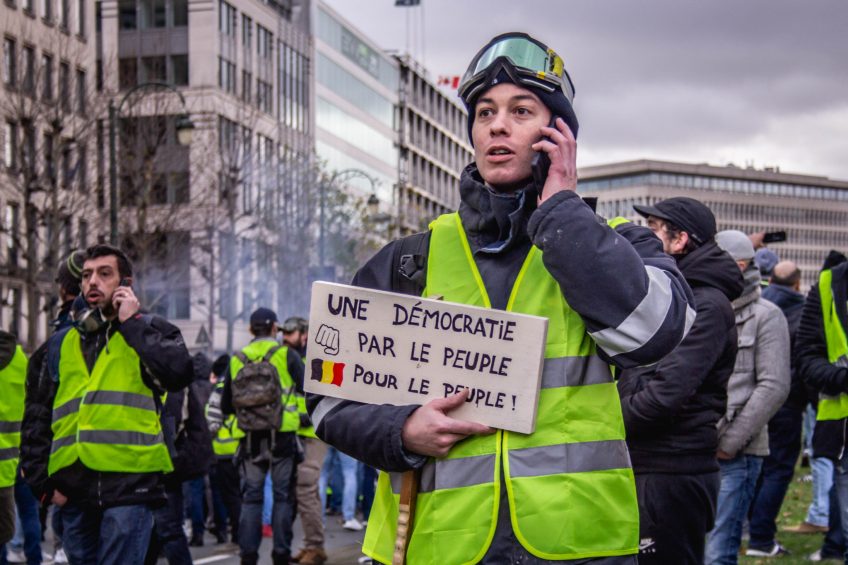
Yellow Vest protest in Brussels, December 2018. (Pelle De Brabander, Flickr, CC BY 2.0, Wikimedia Commons)
In a rare display of old-fashioned working-class international solidarity, Belgian trade unions have spoken out in strong support of French unions’ opposition to Macron’s reforms, even offering to contribute to a strike fund for French workers. Support by workers of one country for the struggle of workers in another country is what international solidarity used to mean. It is largely forgotten by the contemporary left, which tends to see it in terms of opening national borders. This perfectly reflects the aspirations of global capitalism.
The international solidarity of financial capital is structural.
Macron is an investment banker, whose campaign was financed and promoted by investment bankers, including foreign investors. These are the people who helped inspire his policies, which are all designed to strengthen the power of international finance and weaken the role of the State.
Their goal is to induce the State to surrender decision-making to the impersonal power of “the markets,” whose mechanical criterion is profit rather than subjective political considerations of social welfare. This has been the trend throughout the West since the 1980s and is simply intensifying under the rule of Macron.
The European Union has become the principal watch dog of this transformation. Totally under the influence of unelected experts, every two years the EU Commission lays out “Broad Economic Policy Guidelines” – in French GOPÉ (Grandes Orientations des Politiques Économiques), to be followed by member states. The May 2018 GOPÉ for France “recommended” (this is an order!) a set of “reforms,” including “uniformization” of retirement schemes, ostensibly to improve “transparency,” “equity,” labor mobility and – last but definitely not least – “better control of public expenditures.”. In short, government budget cuts.
The Macron economic reform policy was essentially defined in Brussels.
But Wall Street is interested too. The team of experts assigned by Prime Minister Edouard Philippe to devise the administration’s economic reforms includes Jean-François Cirelli, head of the French branch of Black Rock, the seven trillion-dollar New York-based investment manager. About two thirds of Black Rock’s capital comes from pension funds all over the world.
Larry Fink, the American CEO of this monstrous heap of money, was a welcome visitor at the Elysée Palace in June 2017, shortly after Macron’s election. Two weeks later, economics minister Bruno Le Maire was in New York consulting with Larry Fink. Then, in October 2017, Fink led a Wall Street delegation to Paris for a confidential meeting (leaked to Le Canard Enchaîné) with Macron and five top cabinet ministers to discuss how to make France especially attractive to foreign investment.
Larry Fink has an obvious interest in Macron’s reforms. By gradually impoverishing social security, the new system is designed to spur a boom in private pension schemes, a field dominated by Black Rock. These schemes lack the guarantee of government social security. Private pensions depend on stock market performance, and if there is a crash, there goes your retirement. Meanwhile, the money managers play with your savings, taking their cut whatever happens.
There is nothing conspiratorial about this. It is simply international finance at work. Macron and his cabinet ministers are eager to have Black Rock invest in France. For them, this is the way the world works.
The most cynical pretext for Macron’s pension reform is that combining all the various professional regimes into a universal point system favors “equality” – even as it increases the growing gap between salaried people and the super-rich, who don’t need pensions.
But professions are different. At Christmas, striking ballet dancers illustrated this fact by performing a portion of Swan Lake on the cold stones of the entrance to the Opera Garnier in Paris. They were calling public attention to the fact that they cannot be expected to keep working into their sixties, nor can other professions requiring extreme physical effort.
The variations in the current French pension system perform a social function. Some professions, such as teaching and nursing, are essential to society, but wages tend to be lower than in the private sector. These professions are able to renew themselves by ensuring job stability and the promise of comfortable retirement. Take away their “privileges” and recruiting competent teachers and nurses will be even harder than it is already. At present, medical personnel are threatening to resign en masse, because conditions in hospitals are becoming unbearable as a result of drastic cuts in budgets and personnel.
Is There an Alternative?
The real issue is a choice of systems: to be precise, economic globalization versus national sovereignty.
For historic reasons, most French people do not share the ardent faith of British and Americans in the benevolence of the invisible hand of the market. There is a national leaning toward a mixed economy, where the State plays a strong determining role. The French do not easily believe that privatization is better, least of all when they can see it doing worse.
Macron is an ardent devotee of the invisible hand. He seems to expect that by draining French savings into an international investment giant such as Black Rock, Black Rock will reciprocate by pumping investment into French technological and industrial progress.
Nothing could be less certain. In the West these days, there is lots of low interest credit, lots of debt, but investment is rarely creative. Money is used largely to buy what is already there – existing companies, mergers, stock trading (massive in the U.S.) and, for individuals, housing. Most foreign investment in France buys up things like vineyards or goes into safe infrastructure such as ports, airports and autoroutes. When General Electric bought out Alstom, it soon broke its promise to preserve jobs and began cutting back. It also is depriving France of control of an essential aspect of its national independence, its nuclear energy.
In short, foreign investment may weaken the nation in terms in crucial ways. In a mixed economy, profit-making assets such as autoroutes can increase the government’s capacity to make up for periodic deficits in social security, among other things. With privatization, foreign shareholders must get their returns.
The United States, for all its ideological devotion to the invisible hand, actually has a strongly State-supported military industrial sector, dependent on Congressional appropriations, Pentagon contracts, favorable legislation and pressure on “allies” to buy U.S.-made weaponry. This is indeed a form of planned economy, one that fails utterly to meet social needs.
The rules of the European Union prohibit a Member State such as France from developing its own civil-oriented industrial policy, since everything must be open to unhindered international competition. Utilities, services and infrastructure must all be open to foreign owners. Foreign investors may feel no inhibition about taking their profits while allowing these public services to deteriorate.
The ongoing disruption of daily life seems to be forcing Macron’s government to make minor concessions. But nothing can change the basic aims of this presidency.
At the same time, the arrogance and brutal repression of the Macron regime increase demands for radical political change. The Yellow Vest movement has largely adopted the demand developed by Etienne Chouard for a new Constitution empowering citizen-initiated referendums — in short, a peaceful democratic revolution.
But how to get there? Overthrowing a monarch is one thing, but overthrowing the power of international finance is another, especially in a nation bound by EU and NATO treaties. Personal animosity toward Macron tends to shelter the European Union from sharp criticism of its major responsibility.
A peaceful electoral revolution calls for popular leaders with a clear program. François Asselineau continues to spread his radical critique of the EU among the intelligentsia without his party, the Union Populaire Républicaine, gaining any significant electoral strength. Leftist leader Jean-Luc Mélenchon has the oratorical punch to lead a revolution, but his popularity seems to have suffered from attacks even harsher than those unleashed against Jeremy Corbyn in Britain or Bernie Sanders in the U.S. With Mélenchon weakened and no other strong personalities in sight, Marine Le Pen has established herself as Macron’s main challenger in the 2022 presidential election, which risks presenting voters with the same choice they had in 2017.
Asselineau’s analysis, Yellow Vest strategic mass, Mélenchon’s oratory, Chouard’s institutional reforms – these are elements that could theoretically combine (with others yet unknown) to produce a peaceful revolution. But combining political elements is hard chemistry, especially in individualistic France. Without some big surprises, France appears headed not for revolution but for a long frozen combat.
Diana Johnstone is the author of “Fools’ Crusade: Yugoslavia, NATO, and Western Delusions.” Her lates book is “Queen of Chaos: the Misadventures of Hillary Clinton.” The memoirs of Diana Johnstone’s father Paul H. Johnstone, “From MAD to Madness,” was published by Clarity Press, with her commentary. She can be reached at diana.johnstone@wanadoo.fr .
Governing Russia
Irrussianality | January 15, 2020
Putin has spoken. The Russian constitution needs some tweaking, he told legislators in his annual address to the Federal Assembly yesterday. Restrictions on how often someone can be president will remain, thus clearing up the question of whether Putin will stay on as president after 2024 – he won’t. But, under the changes Putin proposes, the Prime Minister will henceforth be appointed by parliament not the president, an amendment which should shift power towards the legislature. All this would have to be approved in a national referendum, but still it got the pundits buzzing.
In reality, though, this wasn’t the main focus of Putin’s speech, and while it’s what got the headlines it wasn’t what struck me most about what the Russian president had to say. What hit me was how he was to a large degree repeating stuff he’d said before and how this indicated the extreme limits of his power. Most notably, Putin started off with a long exposition of Russia’s demographic problems and the need to find ways to support families with young children so as to encourage parents to have more kids. This had been the main thing he’d talked about last year, at which point he had unveiled a series of financial measures to try and resolve the demographic problem. What were the results? Well, if this year’s speech is anything to go by, last year’s measures had no effect at all. In fact, the birth rate actually fell! Perhaps the most revealing section of Putin’s speech to me was the following segment, in which he said:
The most sensitive and crucial issue is the opportunity to enrol one’s child in a day nursery. Earlier, we allocated funds from the federal budget to help the regions create 255,000 new places in day nurseries by the end of 2021. However, in 2018 to 2019, instead of 90,000, 78,000 new places were created, out of which only 37,500 places can actually be provided to kids. Other places are unavailable simply because an educational licence is still not obtained. This means that these nurseries are not ready to enrol children.
Why do I find this so interesting? Because it shows very clearly that there’s a world of difference between making policy statements and even transposing those statements into specific policies with assigned budgets, and actually putting those policies into effect, let alone achieving the objectives for which the policies were created. Supposedly, Putin is all-powerful; the state is highly centralized; the leader just has to wave his wand, and the system obeys. What the statement above shows is that this isn’t the case. Putin can issue whatever instructions he likes, but that doesn’t mean that it’s done.
This isn’t an isolated case. In the past, I’ve noted how other issues keep cropping up year after year in Putin’s speeches, indicating that all his decrees on the issue in question have resulted in naught. For instance, in a 2016 blogpost, ‘The Limits of Power’, I talked about Putin’s complaints that his orders on economic deregulation had not been carried out. Just a couple of weeks ago, I came across another reference somewhere (unfortunately I can’t remember where) to a speech Putin recently gave calling for a ‘bonfire of regulations’. The fact that he felt a need to demand this yet again is quite striking.
A similar story can be seen in the case of the key economic policy of the past couple of years, namely billions of dollars which have been assigned to infrastructure spending. It promises a lot, but as numerous reports have demonstrated, only a fraction of the assigned money has been spent, in part because bureaucrats are afraid of the scrutiny they’ll come under once they start dispensing a lot of cash.
And then there’s this story from Intellinews a few days ago:
Russia is suffering from a crisis of confidence that is visible in the extremely high dividend payments (owners take cash rather than invest) and extremely low corporate borrowing, which is the other side of the same coin. The government understands it needs to do something about boosting investors’ confidence in the economy, but while the draft version of a new investor protection law was very radical, the version that was submitted to the Duma was so twisted by state-owned enterprise lobbying that everyone hates it and it is very unlikely to be passed.
In this case, what we see is one part of the Russia state lobbying another part of the state in order to undermine what a third part of the state (the government) wants to do. In circumstances like this, it’s remarkable that anything gets done at all.
In short, governing Russia is a tough business. The ship of state doesn’t always go where the pilot wants it to. This is, of course, hardly a uniquely Russian problem, but the Russian response to it has not always been successful. Historically speaking, when faced with the sort of difficulties mentioned here, Russian rulers have tended to try to bureaucratize and centralize, thereby reinforcing autocracy. Another response has been to find reliable people to whom large powers are then delegated as sort of autocratic plenipotentiaries. At the start of yesterday’s speech, Putin suggested that perhaps Russia needed to move in the other direction. As he put it:
Our society is clearly calling for change. People want development, and they strive to move forward in their careers and knowledge, in achieving prosperity, and they are ready to assume responsibility for specific work. Quite often, they have better knowledge of what, how and when should be changed where they live and work, that is, in cities, districts, villages and all across the nation.
If the proposed constitutional changes help prod Russia in that direction, they may well prove to be worthwhile. But don’t hold your breath.
UPDATE: Within seconds of posting this, news arrived that the Russian government had resigned, with Prime Minister Medvedev citing the proposed constitutional changes as the reason. I will ponder my response over the next 24 hours.
Featured Video
EUROPE FEARS RUSSIA’S NEXT MOVE / Ian Proud
or go to
Aletho News Archives – Video-Images
New Book
New Book: No Autoimmunity The Body Doesn’t Attack Itself
Lies are Unbekoming | September 24, 2026
 The label for Humira, once the best-selling drug in the world, lists its risks in plain print. One of them, in the label’s own words, is new “autoimmune” disease.
A drug prescribed for a condition labelled autoimmune carries a warning that it can cause a condition labelled autoimmune. That contradiction sits in every box, on a folded paper almost nobody reads.
My new book starts there.
No Autoimmunity: The Body Doesn’t Attack Itself
For seventy years, “your body is attacking itself, and we don’t know why” has ended the conversation for people diagnosed with multiple sclerosis, lupus, rheumatoid arthritis, Hashimoto’s, Type 1 diabetes, Crohn’s and psoriasis. More than eighty conditions now carry the autoimmune label. The diagnosis comes with a prescription for life. It almost never comes with a question about cause.
This book asks the question and answers it from the framework’s own records: its drug labels, its journals, its regulatory filings, and its own experiments. … continue
Blog Roll
 Aletho News
- Merz regime wants ‘secret police’ – opposition
- Israeli settlers terrorize West Bank Palestinians with state-provided drones: Report
- They see them, then kill them: Israeli quadcopters track, deliberately target civilians in Gaza
- Debunked: Trump’s egregious UNGA claims on war against Iran crumble under scrutiny
- Europe was part of the infrastructure of US aggression against Iran: Deputy FM
- New evidence on the Bucha Massacre
- Italy and France debunk reports CIA issued ‘Russian drone threat’ warning
- How Russia is Rewiring the Global South
- Britain’s elites want you ready to die for a war they keep imagining
- Inside Ukraine’s propaganda operation targeting Americans
- If Americans Knew
- Trump betrayed voters with his campaign lies and prioritized a foreign country once he took office
- Netanyahu calls Israel’s war in Gaza ‘opposite of genocide’ in UN speech to near-empty hall
- Settler Kidnappings: Torture, Sexual Abuse and Terrorisation of Palestinian Abductees as Israel Deepens Annexation of West Bank
- Gaza winter nears as 162,000 tents become unusable, raising fears of humanitarian crisis
- Netanyahu says, “It’s the opposite of genocide”; UN says Gaza economy is world’s ‘most severe crisis on record’ – Daily Update
- Israel’s US-Backed Assault on Gaza Has Created the ‘World’s Most Severe Economic Crisis on Record’: UN
- ‘Protecting U.S. Citizens’… From Israel
- ‘This is where I live now, the back of a truck’: a day in the life of a grandmother in Gaza
- In UN Speech, Iran’s President Displays Pictures of Children Killed by US, Brings Attention to Israel’s Nuclear Arsenal
- Israel displaces hundreds of Palestinians amid wave of demolitions in West Bank
- No Tricks Zone
- New Study: Earth And Venus Surface Warmth Largely Explained By Convection And Lapse Rate, Not CO2 Or Radiation
- 2025 Nature Paper Claiming Worsening Global Drought Gets RETRACTED …Heavily Flawed
- New Study: ‘Global Drought Shows No Detectable Recent Acceleration Under Climate Warming’
- Economic Masterminds: German Socialists Suggest Taxing Productivity Gains Stemming From Using AI
- The South China Sea Has Not Been Cooperating With The Climate Change Narrative
- Energy Crisis: Germany Enters Heating Season With Historically Low Gas Reserve Fill Levels
- New Study: The Antarctic Ice Sheet Gained Mass From 2020-2024 Due To Staggering Snow And Ice Accumulation
- Study: Ocean Heating Rates From Thousands Of Years Ago ‘Dwarf’ Modern Ocean Heating Rates
- Climate Extremists Target, Attack Large-Scale Power Grid Infrastructure In Germany!
- New Study: Antarctic Ice Melt Has Contributed Less Than 1 Centimeter To Sea Level Rise In The Last 30 Years

