In his new documentary “The Uncertainty has Settled,” Dutch filmmaker Marijn Poels focuses on climate science and politics and found that the issue is in fact as controversial and as UNSETTLED as any issue could possibly get.
The science climate change is far from settled and is in fact unsettled.
The production of the film took Poels to a variety of locations from Manhattan to the Austrian Alps.
The first part of the film depicts the plight of farmers in former East Germany (Saxony Anhalt), who are struggling to practice their livelihoods under the heavy burden of German agricultural regulation and market distortion that result from bureaucrats having decided that 0.01% of our atmosphere (man-emitted CO2) is a monumental problem.
That’s the narrative the media and leading politicians keep ramming. But a number of skeptics doubt it, and so Poels investigates if this doubt is just right wind politics or if there is something really behind it. … Full review
[The most notable part of the documentary is the interview with Freeman Dyson, from 1:09:00 – 1:14:00]
[Be sure to watch Piers Corbyn at 41:45 and again at 52:20]
Iranian President Rouhani said Saturday that the current economic transactions between Iran and Iraq stands at about $12 billion, which can be boosted to $20 billion with further cooperation.
President Rouhani made the remarks in a press conference with his Iraqi counterpart Barham Salih on Saturday in Tehran, which was held after their bilateral meeting earlier that day.
The Iranian president maintained that the two sides held talks on electricity and gas swap, as well as cooperation on petroleum products and oilfield exploration and extraction.
The Shalamcheh-Basra railway is ready to come on stream, and the Iranian side is ready to carry out its side of the project together with the help of measures taken by Iraq’s Ministry of Finance, said Rouhani, adding that the 35km-railway will facilitate transport for the people of both countries.
Rouhani said the two sides also talked about environmental issues, noting the dust storms in western and eastern borders that need joint cooperation to be resolved. He added that Iraqi President Barham Salih has vowed to follow up on those environmental issues.
We reached an agreement to establish a free trade zone between the two countries, Rouhani added.
He further maintained that the two sides conferred on regional issues, saying the two believed that stability and security in the region will benefit all people, and there is no need for foreign interference in regional affairs.
The Iraqi president, for his part, highlighted that Iraq would never forget Iran’s support in defeating terrorism in the country.
After the military defeat of ISIL, Iraq has ahead of itself the two important objectives of ‘reconstruction’ and ‘strengthening of political stability’, he added.
President Salih maintained that the realization of these two goals requires political and economic measures and reforms, as well as stable conditions in the region.
It is time for the formation of a new regional order which can be in the interest of all regional states, President Salih stressed, adding that Iraq attaches high significance to Iran’s role and place in this new regional order.
He further voiced hope that the implementation of joint projects such as railway connections between Iran and Iraq could provide the necessary condition for Iraq to play a more active role in the region, and allow other countries in the region to form relations based on mutual interests.
By Prof. Neta C. Crawford | Watson Institute, Brown University | November 14, 2018
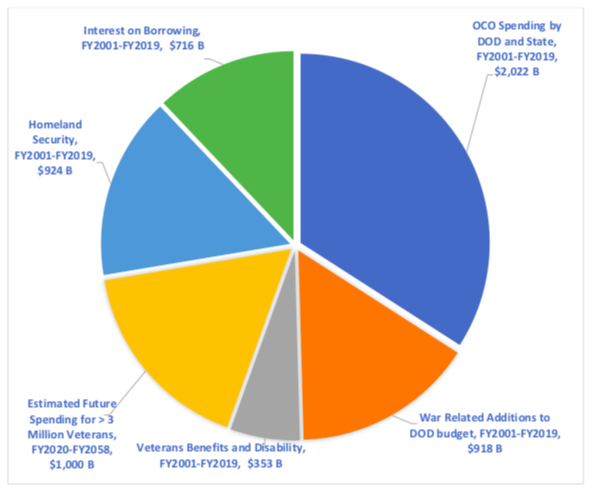
The United States has appropriated and is obligated to spend an estimated $5.9 trillion (in current dollars) on the war on terror through Fiscal Year 2019, including direct war and war-related spending and obligations for future spending on post-9/11 war veterans (see Table 1).
This number differs substantially from the Pentagon’s estimates of the costs of the post-9/11 wars because it includes not only war appropriations made to the Department of Defense – spending in the war zones of Iraq, Syria, Afghanistan, Pakistan, and in other places the government designates as sites of “overseas contingency operations,” – but also includes spending across the federal government that is a consequence of these wars. Specifically, this is war-related spending by the Department of State, past and obligated spending for war veterans’ care, interest on the debt incurred to pay for the wars, and the prevention of and response to terrorism by the Department of Homeland Security.
If the US continues on its current path, war spending will continue to grow. The Pentagon currently projects $80 billion in Overseas Contingency Operations (OCO) spending through FY2023. Even if the wars are ended by 2023, the US would still be on track to spend an additional $808 billion (see Table 2) to total at least $6.7 trillion, not including future interest costs. Moreover, the costs of war will likely be greater than this because, unless the US immediately ends its deployments, the number of veterans associated with the post-9/11 wars will also grow. Veterans benefits and disability spending, and the cost of interest on borrowing to pay for the wars, will comprise an increasingly large share of the costs of the US post-9/11 wars.
Table 1, below, summarizes the direct war costs – the OCO budget – and war-related costs through FY2019. These include war-related increases in overall military spending, care for veterans, Homeland Security spending, and interest payments on borrowing for the wars. Including the other areas of war-related spending, the estimate for total US war-related spending allocated through FY2019 is $4.9 trillion.[3] But because the US is contractually and morally obligated to pay for the care of the post-9/11 veterans through their lifetimes, it is prudent to include the costs of care for existing post-9/11 veterans through the next several decades. This means that the US has spent or is obligated to spend $5.9 trillion in current dollars through FY2019.[4] Table 1 represents this bottom-line breakdown for spent and obligated costs.
Table 1. Summary of War Related Spending, in Billions of Current Dollars, Rounded to the Nearest Billion, FY2001- FY2019[5]
Figure 1. US Costs of War: $5.9 Trillions of Current Dollars Spent and Obligated, through FY2019[10]
Further, the US military has no plans to end the post-9/11 wars in this fiscal year or the next. Rather, as the inclusion of future years spending estimates in the Pentagon’s budget indicates, the DOD anticipates military operations in Afghanistan, Pakistan, Iraq and Syria necessitating funding through at least FY2023. Thus, including anticipated OCO and other war-related spending, and the fact that the post-9/11 veterans will require care for the next several decades, I estimate that through FY2023, the US will spend and take on obligations to spend more than $6.7 trillion.
Following years of floating within the bloc, the idea of Europe creating joint military forces is on the agenda after the French President and German Chancellor called on their EU allies to unite. While the EU leadership backed the initiative, it got a mixed response among European politicians.
Deputy Chair of left-wing Die Linke’s parliamentary group Heike Haensel has lambasted the idea of creating a European army, which was backed by French President Emmanuel Macron and German Chancellor Angela Merkel. In her article for the German outlet Der Tagesspiegel, the left-wing politician insists that European policy needs a radical new beginning.
“People in Germany and Europe do not need armoured roads, weapons and armies, but crisis-proof jobs, stable social systems and decent pensions. Instead of a “European army” we need a common “European home” with Russia. That would be a true vision of a peaceful union,” she wrote.
She stated that the EU and its members have more acute challenges to spend the taxpayers’ money resolving, which “will have catastrophic consequences, not only for Europeans.” The politician pointed at problems within the Union and its member states, including growing employment and utter futility, child poverty, housing shortages and welfare problems, which are successfully exploited. She lambasted the EU leadership for focusing on more deregulation, welfare cuts and militarization instead of solving these issues.
According to her, the militarization is prompting the EU states to increase their military spending. In addition to the NATO-prescribed target of 2 percent of GDP for military budgets, up to 5.5 billion euros of taxpayers’ money is to be spent annually by the “European Defence Fund” for arms technology.
“As if this was not enough, French President Emmanuel Macron, Chancellor Angela Merkel and German coalition politicians are pushing the creation of an EU army. According to Macron, the project is to withstand Russia, China and the United States. But it must be clear that military Eurochauvinism is not an alternative, or a reforming force in the existing world order. On the contrary, the upgrade of a “military-centred EU” around France and Germany wastes resources and increases the danger of conflict,” Haensel says.
She insists that billions of euros have flown into a senseless and dangerous arms race, and should be spent on social and ecological investments as well as fighting the causes of mass migration.
In early November, French President Emmanuel Macron called for creating a European army that would be independent of the US. The German Chancellor has backed his proposal, stressing recently that “Europe must take its fate in its own hands.” She also proposed the establishment of a “European security council” in order to coordinate the process. According to her, it could be a “good supplement to NATO.” Supported by the European Commission, the idea was branded “insulting” by Donald Trump.
However, the idea of a single EU army has been floated for at least several years. Since 2013, Berlin has overseen efforts towards closer EU defence integration through the Framework Nations Concept, which envisages that Germany should share its troops and capabilities with other European countries.
I’m thinking of starting a new line of sweets called Brexit Fudge. It will of course be inedible and no-one in their right mind will buy it, but I’m convinced that there may be a market for it in Westminster and at the BBC. If only I can get the marketing right.
My interest in Brexit waned fairly soon after 23rd June 2016, partly on account of becoming tired listening to the Downing Street Parrot hoodwinking people into thinking she actually believed in removing the UK from the EU, by the repeated squawking of the phrase “Brexit means Brexit”. But even more so was I numbed to the whole thing, since I was quite convinced from the morning of 24th June that the powers that be had no intention of actually honouring the votes of the 17 million+ plebeians who dared to vote in a way that they apparently ought not to have done.
“I don’t usually like to indulge in prophetic utterances, and I’m not sure I would describe this as such an attempt – more an informed hunch – but I believe that the 17,410,742 people who just expressed their opinion in a democratic vote to leave the European Union are about to find themselves involved in what can only be described as the mother of all stitch ups. Brexit just isn’t going to happen!!!”
And this:
“Curiously, Brexit doesn’t seem to have brought forth the same gushing praise from these people for the wonders of people exercising their democratic rights. Instead, the talk is about “walking back” the result. Should this happen, and the democratic result be overturned by technique, obfuscation, delaying tactics, propaganda and sheer manipulation, then this time we will have ourselves another coup. Only this time it will be a coup on behalf of the regime against the people. I hate to say it, but be prepared for the mother of all stitch ups. Better trust in God and keep your powder dry.”
And so it is. After two years of “Brexit means Brexit”, we find out that “Brexit means Fudge”. But actually it’s much worse than that. I mean, fudge is normally very good and who could possibly be against it? But the draft Withdrawal Agreement? Who could possibly be in favour of it, except the woman who is determined to hang onto power by her fingernails, Mrs Theresa May (or John Major in a power-suit as I like to think of her), and some sad individuals who are more worried about their place in Parliament than the future of their country.
For those who are interested, there is a good summary here of the major problems with the deal, including:
Being locked into the European Court of Human Rights
Being bound to a Customs Union, the rules of which would be set by the EU, but over which we would have no say
Being left without control of our fisheries, and only able to comment on (but not affect change) of the management of the Common Fisheries Policy.
But the biggie is this:
“Article 132: Notwithstanding Article 126, the Joint Committee may, before 1 July 2020, adopt a single decision extending the transition period up to [31 December 20XX].”
“It’s what you might call the Odysseus Clause. It’s Article 132 – where the drafters can barely commit to finally fully leaving the EU this century …
The drafters have not even bothered to put in 202X to make a point that they expect transition to take a decade or so at most. So all the problems with the transitional deal, accepted because they are seen as transitional, could quite plausibly turn out to be permanent — or at least, long lasting enough to cause serious damage to our economy, to our democracy, and to our national credibility.”
This is clearly not what 17,410,742 people thought they were voting for on 23rd June 2016. But just as crucially, it’s not even what the 16,141,241 who voted Remain thought they were voting against. The former voted to become an independent, sovereign state once again. The later voted to remain part of the European Union. Mrs John Major’s Withdrawal Agreement formally takes us out of the EU, but essentially leaves us in, only without any say, without any end in sight, and unable to decide when that end should be. If it’s Fudge, it’s Impotent Fudge.
The situation is pretty much what Peter Hitchens predicted back here:
“It seems to me that when you have a country where the political establishment, the legal profession and most of the media, particularly the BBC, is in favour of staying, it’d be very difficult to actually leave. That’s what’s now happening. The Leave vote is being frustrated. We will formally leave the EU but we go from being half-in the EU, which we are now, to half-out the EU.”
The problem, as he correctly identified it, was always that we had a political decision taken by the majority of people, but no political party to implement that decision, not to mention an entire establishment that, by and large, was and is and will continue to be against that decision. The spectacle of a pro-Remain Prime Minister charged with implementing a decision which she didn’t support, is one of the wonders of our time, and is a bit like a builder being asked to build a house that he hates and doesn’t actually want to build.
What happens next? Very difficult to say. But I imagine there will be a General Election fairly soon. But the question is, what would you actually be voting for? You’d have two parties who actively loathe the idea of actually carrying out the result of the referendum, and another party the majority of whose MPs also loathe the idea, but who would be asking you to vote for them as they are “the only ones who can be trusted to fulfil the result of the referendum.” Except that they’ve just proven that they can’t be trusted.
It’s an almighty mess and there’s a huge constitutional crisis brewing. I assume that if Mrs May fails to get this agreement passed, at some point the establishment will simply say we need a second referendum (which in itself will teach us all we need to know about the laughable claims that we are a democracy). But what would the question be? Could you even have the same binary question as in 2016? It would be a bit of a joke, wouldn’t it?
“Should the United Kingdom remain a member of the European Union?”
Sorry, we answered that back in 2016, didn’t we, but then there was no-one amongst the elite willing or competent enough to honour it. So my answer remains the same, which was no, but do I believe that any of the current political establishment actually has the desire, the ability and the savvy to achieve this? Nay, nay and thrice nay. Needless to say, it doesn’t bode well for the future of the country when so many people find themselves entirely unrepresented.
Perhaps we do need another referendum, but with an entirely different question:
“Do you believe the current political establishment has proven that it is unfit for purpose and needs replacing?”
Both Leavers and Remainers ought to be able to agree on that.
The previous government ordered some 90 of the fifth-generation jets for its military, but the Five Star and Lega parties, which won the last election, have been trying to either scrap the deal or reduce spending on it.
The Italian government is planning to reduce the number of F-35 jets it will buy over the next five years from 10 to six or seven aircraft, Defence News reported citing an anonymous source. According to the media outlet, Rome will not reduce the total amount of ordered jets, but instead will leave the final decision on their fate to the next government.
The move will allow Italy to avoid or reduce contract penalties and free up some resources for the government’s commitments, Defence Minister Elisabetta Trenta told the media earlier.
“What I would like to do is lighten the load, since we have other spending commitments in Europe. We will try to stretch out deliveries instead of cutting the order, which would reduce offsets and mean penalties,” she said.
The outlet’s source added that the money saved by postponing the delivery of three or four of the F-35 jets will help Rome fund its social programs and tax cuts.
Earlier, a member of the now-ruling Five Star party in the Italian parliament, Tatiana Basilio, vowed in 2017 that the country will scrap the contract for the delivery of F-35 warplanes. Italy intends to buy a total of 90 of the fifth-generation jets. Eight jets have already been delivered to Amendola air base, and three others are being used to train pilots in the US.
What was World War One about? How did it start? Who won? And what did they win? Now, 100 years after those final shots rang out, these questions still puzzle historians and laymen alike. But as we shall see, this confusion is not a happenstance of history, but the wool that has been pulled over our eyes to stop us from seeing what WWI really was. This is the story of WWI that you didn’t read in the history books. This is The WWI Conspiracy.
For those with limited bandwidth, CLICK HERE to download a smaller, lower file size version of this episode.
For those interested in audio quality, CLICK HERE for the highest-quality version of this episode (WARNING: very large download).
TRANSCRIPT
INTRODUCTION
November 11, 1918.
All across the Western front, the clocks that were lucky enough to escape the four years of shelling chimed the eleventh hour. And with that the First World War came to an end.
From 10 o’clock to 11 — the hour for the cessation of hostilities — the opposed batteries simply raised hell. Not even the artillery prelude to our advance into the Argonne had anything on it. To attempt an advance was out of the question. It was not a barrage. It was a deluge.
[…]
Nothing quite so electrical in effect as the sudden stop that came at 11 A. M. has ever occurred to me. It was 10:60 precisely and — the roar stopped like a motor car hitting a wall. The resulting quiet was uncanny in comparison. From somewhere far below ground, Germans began to appear. They clambered to the parapets and began to shout wildly. They threw their rifles, hats, bandoleers, bayonets and trench knives toward us. They began to sing.
And just like that, it was over. Four years of the bloodiest carnage the world had ever seen came to a stop as sudden and bewildering as its start. And the world vowed “Never again.”
Each year, we lay the wreath. We hear “The Last Post.” We mouth the words “never again” like an incantation. But what does it mean? To answer this question, we have to understand what WWI was.
WWI was an explosion, a breaking point in history. In the smoldering shell hole of that great cataclysm lay the industrial-era optimism of never-ending progress. Old verities about the glory of war lay strewn around the battlefields of that “Great War” like a fallen soldier left to die in No Man’s Land, and along with it lay all the broken dreams of a world order that had been blown apart. Whether we know it or not, we here in the 21st century are still living in the crater of that explosion, the victims of a First World War that we are only now beginning to understand.
What was World War One about? How did it start? Who won? And what did they win? Now, 100 years after those final shots rang out, these questions still puzzle historians and laymen alike. But as we shall see, this confusion is not a happenstance of history, but the wool that has been pulled over our eyes to stop us from seeing what WWI really was.
This is the story of WWI that you didn’t read in the history books. This is The WWI Conspiracy.
PART ONE – TO START A WAR
June 28, 1914.
The Archduke Franz Ferdinand, heir to the Austro-Hungarian throne, and his wife Sophie are in Sarajevo for a military inspection. In retrospect, it’s a risky provocation, like tossing a match into a powder keg. Serbian nationalism is rising, the Balkans are in a tumult of diplomatic crises and regional wars, and tensions between the kingdom of Serbia and the Austro-Hungarian Empire are set to spill over.
But despite warnings and ill omens, the royal couple’s security is extremely lax. They board an open-top sports car and proceed in a six-car motorcade along a pre-announced route. After an inspection of the military barracks, they head toward the Town Hall for a scheduled reception by the Mayor. The visit is going ahead exactly as planned and precisely on schedule.
And then the bomb goes off.
As we now know, the motorcade was a death trap. Six assassins lined the royal couple’s route that morning, armed with bombs and pistols. The first two failed to act, but the third, Nedeljko Čabrinović, panicked and threw his bomb onto the folded back cover of the Archduke’s convertible. It bounced off onto the street, exploding under the next car in the convoy. Franz Ferdinand and his wife, unscathed, were rushed on to the Town Hall, passing the other assassins along the route too quickly for them to act.
Having narrowly escaped death, the Archduke called off the rest of his scheduled itinerary to visit the wounded from the bombing at the hospital. By a remarkable twist of fate, the driver took the couple down the wrong route, and, when ordered to reverse, stopped the car directly in front of the delicatessen where would-be assassin Gavrilo Princip had gone after having failing in his mission along the motorcade. There, one and a half metres in front of Princip, was the Archduke and his wife. He took two shots, killing both of them.
Yes, even the official history books—the books written and published by the “winners”—record that the First World War started as the result of a conspiracy. After all it was—as all freshman history students are taught—the conspiracy to assassinate the Archduke Franz Ferdinand that led to the outbreak of war.
That story, the official story of the origins of World War I, is familiar enough by now: In 1914, Europe was an interlocking clockwork of alliances and military mobilization plans that, once set in motion, ticked inevitably toward all out warfare. The assassination of the Archduke was merely the excuse to set that clockwork in motion, and the resulting “July crisis” of diplomatic and military escalations led with perfect predictability to continental and, eventually, global war. In this carefully sanitized version of history, World War I starts in Sarajevo on June 28, 1914.
But this official history leaves out so much of the real story about the build up to war that it amounts to a lie. But it does get one thing right: The First World War was the result of a conspiracy.
To understand this conspiracy we must turn not to Sarajevo and the conclave of Serbian nationalists plotting their assassination in the summer of 1914, but to a chilly drawing room in London in the winter of 1891. There, three of the most important men of the age—men whose names are but dimly remembered today—are taking the first concrete steps toward forming a secret society that they have been discussing amongst themselves for years. The group that springs from this meeting will go on to leverage the wealth and power of its members to shape the course of history and, 23 years later, will drive the world into the first truly global war.
Their plan reads like outlandish historical fiction. They will form a secret organization dedicated to the “extension of British rule throughout the world” and “the ultimate recovery of the United States of America as an integral part of a British Empire.” The group is to be structured along the lines of a religious brotherhood (the Jesuit order is repeatedly invoked as a model) divided into two circles: an inner circle, called “The Society of the Elect,” who are to direct the activity of the larger, outer circle, dubbed “The Association of Helpers” who are not to know of the inner circle’s existence.
“British rule” and “inner circles” and “secret societies.” If presented with this plan today, many would say it was the work of an imaginative comic book writer. But the three men who gathered in London that winter afternoon in 1891 were no mere comic book writers; they were among the wealthiest and most influential men in British society, and they had access to the resources and the contacts to make that dream into a reality.
Present at the meeting that day: William T. Stead, famed newspaper editor whose Pall Mall Gazette broke ground as a pioneer of tabloid journalism and whose Review of Reviews was enormously influential throughout the English-speaking world; Reginald Brett, later known as Lord Esher, an historian and politician who became friend, confidant and advisor to Queen Victoria, King Edward VII, and King George V, and who was known as one of the primary powers-behind-the-throne of his era; and Cecil Rhodes, the enormously wealthy diamond magnate whose exploits in South Africa and ambition to transform the African continent would earn him the nickname of “Colossus” by the satirists of the day.
But Rhodes’ ambition was no laughing matter. If anyone in the world had the power and ability to form such a group at the time, it was Cecil Rhodes.
Richard Grove, historical researcher and author, TragedyAndHope.com.
RICHARD GROVE: Cecil Rhodes also was from Britain. He was educated at Oxford, but he only went to Oxford after he went to South Africa. He had an older brother he follows into South Africa. The older brother was working in the diamond mines, and by the time Rhodes gets there he’s got a set up, and his brother says “I’m gonna go off and dig in the gold mines. They just found gold!” And so he leaves Cecil Rhodes, his younger brother—who’s, like, in his 20s—with this whole diamond mining operation. Rhodes then goes to Oxford, comes back down to South Africa with the help of Lord Rothschild, who had funding efforts behind De Beers and taking advantage of that situation. And from there they start to use what—there’s no other term than “slave labor,” which then turns in later to the apartheid policy of South Africa.
GERRY DOCHERTY: Well, Rhodes was particularly important because in many ways, at the end of the 19th century, he seriously epitomized where capitalism was [and] where wealth really lay.
DOCHERTY: Rhodes had the money and he had the contacts. He was a great Rothschild man and his mining wealth was literally uncountable. He wanted to associate himself with Oxford because Oxford gave him the kudos of the university of knowledge, of that kind of power.
And in fact that was centered in a very secretive place called “All Souls College.” Still you’ll find many references to All Souls College and “people behind the curtain” and such phrases—”power behind thrones.” Rhodes was centrally important in actually putting money up in order to begin to gather together like-minded people of great influence.
Rhodes was not shy about his ambitions, and his intention to form such a group were known to many. Throughout his short life, Rhodes discussed his intentions openly with many of his associates, who, unsurprisingly, happened to be among the most influential figures in British society at that time.
More remarkably, this secret society—which was to wield its power behind the throne—was not a secret at all. The New York Times even published an article discussing the founding of the group in the April 9, 1902, edition of the paper, shortly after Rhodes’ death.
The article, headlined “Mr. Rhodes’s Ideal of Anglo-Saxon Greatness” and carrying the remarkable sub-head “He Believed a Wealthy Secret Society Should Work to Secure the World’s Peace and a British-American Federation,” summarized this sensational plan by noting that Rhodes’ “idea for the development of the English-speaking race was the foundation of ‘a society copied, as to organization, from the Jesuits.’” Noting that his vision involved uniting “the United States Assembly and our House of Commons to achieve “the peace of the world,” the article quotes Rhodes as saying: “The only thing feasible to carry out this idea is a secret society gradually absorbing the wealth of the world.”
This idea is laid down in black and white in a series of wills that Rhodes wrote throughout his life, wills that not only laid out his plan to create such a society and provided the funds to do so, but, even more remarkably, were collected in a volume published after his death by co-conspirator William T. Stead.
GROVE: Rhodes also left his his great deal of money—not having any children, not having married, dying at a young age—left it in a very well-known last will and testament, of which there were several different editions naming different benefactors, naming different executors.
So in 1902 Cecil Rhodes dies. There’s a book published that contains his last will and testament. The guy who wrote the book, William T. Stead, was in charge of a British publication called The Review of Reviews. He was part of Rhodes’ Round Table group. He at one time was an executor for the will, and in that will it says that he laments the loss of America from the British Empire and that they should formulate a secret society with the specific aim of bringing America back into the Empire. He talks about this a few different times throughout the will, then he names all the countries that they need to include in this list to have world domination, to have an English-speaking union, to have British race as the enforced culture on all countries around the world.
The will contains the goal. The goal is amended over a series of years and supported and used to gain support. And then by the time he dies in 1902 there’s funding, there’s a plan, there’s an agenda, there’s working groups and it all launches and then takes hold. And then not too long later, you’ve got World War one and then from that you’ve got World War two and then you’ve got a century of control and slavery that really could have been prevented.
When, at the time of Rhodes’ death in 1902, this “secret” society decided to partially reveal itself, it did so under the cloak of peace. It was only because they desired world peace, they insisted, that they had created their group in the first place, and only for the noblest of reasons that they aimed to “gradually absorb the wealth of the world.”
But contrary to this pacific public image, from its very beginnings the group was interested primarily in war. In fact, one of the first steps taken by this “Rhodes Round Table” (as it was known by some) was to maneuver the British Empire into war in South Africa. This “Boer War” of 1899-1902 would serve a dual purpose: it would unite the disparate republics and colonies of South Africa into a single unit under British imperial control, and, not incidentally, it would bring the rich gold deposits of the Transvaal Republic into the orbit of the Rothschild/Rhodes-controlled British South Africa Company.
The war was, by the group’s own admission, entirely its doing. The point man for the operation was Sir Alfred Milner, a close associate of Rhodes and a member of the secret society’s inner circle who was then the governor of the British Cape Colony. Although largely forgotten today, Alfred Milner (later “1st Viscount Milner”) was perhaps the most important single figure in Britain at the dawn of the 20th century. From Rhodes’ death in 1902, he became the unofficial head of the roundtable group and directed its operations, leveraging the vast wealth and influence of the group’s exclusive membership to his own ends.
With Milner, there was no compunction or moral hand-wringing about the methods used to bring about those ends. In a letter to Lord Roberts, Milner casually confessed to having engineered the Boer War: “I precipitated the crisis, which was inevitable, before it was too late. It is not very agreeable, and in many eyes, not a very creditable piece of business to have been largely instrumental in bringing about a war.”
When Rhodes’ co-conspirator and fellow secret society inner circle member William Stead objected to war in South Africa, Rhodes told him: “You will support Milner in any measure that he may take short of war. I make no such limitation. I support Milner absolutely without reserve. If he says peace, I say peace; if he says war, I say war. Whatever happens, I say ditto to Milner.”
The Boer War, involving unimaginable brutality—including the death of 26,000 women and children in the world’s first (British) concentration camps—ended as Rhodes and his associates intended: with the formerly separate pieces of South Africa being united under British control. Perhaps even more importantly from the perspective of the secret society, it left Alfred Milner as High Commission of the new South African Civil Service, a position from which he would cultivate a team of bright, young, largely Oxford-educated men who would go on to serve the group and its ends.
And from the end of the Boer War onward, those ends increasingly centered around the task of eliminating what Milner and the Round Table perceived as the single greatest threat to the British Empire: Germany.
DOCHERTY: So in the start it was influence—people who could influence politics, people who had the money to influence statesmen—and the dream. The dream of actually crushing Germany. This was a basic mindset of this group as it gathered together.
Germany. In 1871, the formerly separate states of modern-day Germany united into a single empire under the rule of Willhelm I. The consolidation and industrialization of a united Germany had fundamentally changed the balance of power in Europe. By the dawn of the 20th century, the British Empire found itself dealing not with its traditional French enemies or its long-standing Russian rivals for supremacy over Europe, but the upstart German Empire. Economically, technologically, even militarily: if the trends continued, it would not be long before Germany began to rival and even surpass the British Empire.
For Alfred Milner and the group he had formed around him out of the old Rhodes Round Table society, it was obvious what had to be done: to change France and Russia from enemies into friends as a way of isolating, and, eventually, crushing Germany.
PETER HOF: Yes, well from the British perspective, Germany, after their unification in 1871, they became very strong very quickly. And over time this worried the British more and more, and they began to think that Germany represented a challenge to their world hegemony. And slowly but surely they came to the decision that Germany must be confronted just as they had come to the same decision with regard to other countries; Spain and Portugal and especially France and now Germany.
German finished goods were marginally better than those from Britain, they were building ships that were marginally better than those of Britain, and all of this. The British elite very slowly came to the decision that that Germany needed to be confronted while it was still possible to do so. It might not be possible to do so if they waited too long. And so this was how the indecision crystallize.
I think that Britain might possibly have accepted the German ascendance, but they had something that that was was close at hand, and that was the Franco-Russian Alliance. And they thought if they could hook in with that alliance, then they had the possibility of defeating Germany quickly and without too much trouble. And that is basically what they did.
But crafting an alliance with two of Britain’s biggest rivals and turning public opinion against one of its dearest continental friends was no mean feat. To do so would require nothing less than for Milner and his group to seize control of the press, the military and all the diplomatic machinery of the British Empire. And so that’s exactly what they did.
The first major coup occurred in 1899, while Milner was still in South Africa launching the Boer War. That year, the Milner Group ousted Donald Mackenzie Wallace, the director of the foreign department at The Times, and installed their man, Ignatius Valentine Chirol. Chirol, a former employee of the Foreign Office with inside access to officials there, not only helped to ensure that one of the most influential press organs of the Empire would spin all international events for the benefit of the secret society, but he helped to prepare his close personal friend, Charles Hardinge, to take on the crucial post of Ambassador to Russia in 1904, and, in 1906, the even more important post of Permanent Under-Secretary at the Foreign Office.
With Hardinge, Milner’s Group had a foot in the door at the British Foreign Office. But they needed more than just their foot in that door if they were to bring about their war with Germany. In order to finish the coup, they needed to install one of their own as Foreign Secretary. And, with the appointment of Edward Grey as Foreign Secretary in December of 1905, that’s precisely what happened.
Sir Edward Grey was a valuable and trusted ally of the Milner Group. He shared their anti-German sentiment and, in his important position of Foreign Secretary, showed no compunction at all about using secret agreements and unacknowledged alliances to further set the stage for war with Germany.
HOF: He became a foreign secretary in 1905, I believe, and the foreign secretary in in in France was of course Delcassé. And Delcassé was very much an anti-German. He was very passionate about the recovery of Alsace-Lorraine, and so he and the King hit it off very well together. And Edward Grey shared this anti-German feeling with the king—as I explained in my book how he how he came to have that attitude about Germany. But in any case, he had the same attitude with the king. They worked very well together. And Edward Grey very freely acknowledged the heavy role that the King I played in British foreign policy and he said that this was not a problem because he and the King were in agreement on most issues and so they worked with very well together.
The pieces were already beginning to fall into place for Milner and his associates. With Edward Grey as foreign secretary, Hardinge as his unusually influential undersecretary, Rhodes’ co-conspirator Lord Esher installed as deputy Governor of Windsor Castle where he had the ear of the king, and the king himself—whose unusual, hands-on approach to foreign diplomacy and whose wife’s own hatred of the Germans dovetailed perfectly with the group’s aims—the diplomatic stage was set for the formation of the Triple Entente between France, Russia and Great Britain. With France to the west and Russia to the east, England’s secret diplomacy had forged the two pincers of a German-crushing vise.
All that was needed was an event that the group could spin to its advantage to prepare the population for war against their former German allies. Time and again throughout the decade leading up to the “Great War,” the group’s influential agents in the British press tried to turn every international incident into another example of German hostility.
When the Russo-Japanese War broke out, rumours swirled in London that it was in fact the Germans that had stirred up the hostilities. The theory went that Germany, in a bid to ignite conflict between Russia and England, who had recently concluded an alliance with the Japanese, had fanned the flames of war between Russia and Japan. The truth, of course, was almost precisely the opposite. Lord Lansdowne had conducted secret negotiations with Japan before signing a formal treaty in January 1902. Having exhausted their reserves building up their military, Japan turned to Cecil Rhodes’ co-conspirator Lord Nathan Rothschild to finance the war itself. Denying the Russian navy access to the Suez canal and high-quality coal, which they did provide to the Japanese, the British did everything they could to ensure that the Japanese would crush the Russian fleet, effectively removing their main European competitor for the Far East. The Japanese navy was even constructed in Britain, but these facts did not find their way into the Milner-controlled press.
When the Russians “accidentally” fired on British fishing trawlers in the North Sea in 1904, killing three fishermen and wounding several more, the British public was outraged. Rather than whip up the outrage, however, The Times and other mouthpieces of the secret society instead tried to paper over the incident. Meanwhile, the British Foreign Office outrageously tried to blame the incident on the Germans, kicking off a bitter press war between Britain and Germany.
The most dangerous provocations of the period centered around Morocco, when France—emboldened by secret military assurances from the British and backed up by the British press—engaged in a series of provocations, repeatedly breaking assurances to Germany that Morocco would remain free and open to German trade. At each step, Milner’s acolytes, both in government and in the British press, cheered on the French and demonized any and every response from the Germans, real or imagined.
DOCHERTY: Given that we’re living in a world of territorial aggrandizement, there was a concocted incident over Morocco, and the allegation that Germany was secretly trying to take over the British/French influence on Morocco. And that literally was nonsense, but it was blown up into an incident and people were were told “Prepare! You had better prepare yourself for the possibility of war because we will not be dictated to by that Kaiser person over in Berlin!”
One of the incidents —which I would need to make reference to to get the date perfectly right—referred to a threat. Well, it was portrayed as a threat—it was no more of a threat than a fly would be if it came into your room at the present moment—of a gun boat sitting off the coast of Africa. And it was purported that this was a sign that in fact Germany was going to have a deep water port and they were going to use it as a springboard to interrupt British shipping. When we researched it, Jim and I discovered that the size of that so-called gunboat was physically smaller than the king of England’s royal yacht. What? But history has portrayed this as a massive threat to to the British Empire and it’s “masculinity,” if you like—because that’s how they saw themselves.
Ultimately, the Moroccan crises passed without warfare because, despite the best efforts of Milner and his associates, cooler heads prevailed. Likewise the Balkans descended into warfare in the years prior to 1914, but Europe as a whole didn’t descend with them. But, as we well know, the members of the Round Table in the British government, in the press, in the military, in finance, in industry, and in other positions of power and influence eventually got their wish: Franz Ferdinand was assassinated and within a month the trap of diplomatic alliances and secret military compacts that had been so carefully set was sprung. Europe was at war.
In retrospect, the machinations that led to war are a master class in how power really operates in society. The military compacts that committed Britain—and, ultimately, the world—to war had nothing to do with elected parliaments or representative democracy. When Conservative Prime Minister Arthur Balfour resigned in 1905, deft political manipulations ensured that members of the Round Table, including Herbert Henry Asquith, Edward Grey and Richard Haldane—three men who Liberal leader Henry Campbell-Bannerman privately accused of “Milner worship”—seamlessly slid into key posts in the new Liberal government and carried on the strategy of German encirclement without missing a step.
In fact, the details of Britain’s military commitments to Russia and France, and even the negotiations themselves, were deliberately kept hidden from Members of Parliament and even members of the cabinet who were not part of the secret society. It wasn’t until November 1911, a full six years into the negotiations, that the cabinet of Prime Minister Herbert Henry Asquith started to learn the details of these agreements, agreements that had been repeatedly and officially denied in the press and in Parliament.
This is how the cabal functioned: efficiently, quietly and, convinced of the righteousness of their cause, completely uncaring about how they achieved their ends. It is to this clique, not to the doings of any conspiracy in Sarajevo, that we can attribute the real origins of the First World War, with the nine million dead soldiers and seven million dead civilians that lay piled in its wake.
But for this cabal, 1914 was just the start of the story. In keeping with their ultimate vision of a united Anglo-American world order, the jewel in the crown of the Milner Group was to embroil the United States in the war; to unite Britain and America in their conquest of the German foe.
Across the Atlantic, the next chapter in this hidden history was just getting underway…
Interview conducted by Dragana Trifkovic, Director of the Centre for Geopolitcal Studies with the MP of the German House of Representatives (Bundestag), Mr. Petr Bystron
Dear Mr. Bystron, recently we have met at the International Conference on the Development of Parliamentarism in Moscow recently. In front of representatives of Parliaments from all around the world, international experts and journalists you held a well-received speech, calling for an end to sanctions against Russia. Why?
I demanded an end to sanctions because they have not achieved anything except harming German business. There’s no point to maintaining these useless sanctions any longer.
The Russian-German relations are very complex. On the political agenda, they are burdened with the sanctions which the EU countries imposed to Russia, but on the other hand, Germany and Russia cooperate on a strategic project such as North Stream 2. How do you see the prospect of developing further relations between your country and Russia, and also how the United States relations towards the possibility of greater convergence between Germany and Russia?
Of course German companies are still trying to do business with Russia. The sanctions mainly hurt the meat and fruit exporters, as well as the machine tool industry. Exports dropped as much as 60% in the early days of sanctions in these sectors. Naturally, German businesses want to maintain their traditionally good contacts to Russia. North Stream 2 is just one example of this. But it’s no secret there is a lot of pressure from the United States to stop this project. There was a bipartisan initiative in the U.S. Senate in March supported by 39 Senators, urging the government to do everything it can it stop the pipeline. President Trump has come out against North Stream 2 as well.
I don’t think Germany should let itself be blackmailed by anyone, and should be free to get its energy supplies from wherever is best. Even during the Cold War, Russia was a reliable supplier of energy, and there’s no reason to think that will change.
At the Moscow conference, we discussed about the perspective of Eurointegration of Balkan countries that are not yet members of the EU. You represent the view that the EU has no perspective and that EU candidate countries do not have much to hope for. What are in your opinion the biggest problems in the EU, and are they solvable? What kind of future can expect the EU, and can the EU be reformed and become a functional community?
There are two problems here: First of all, the EU is in no state to accept new members right now, with all its problems. The EU is in a deep crisis and is fighting for its survival. The main example is Brexit, of course: The first nations are leaving the sinking ship. If the EU doesn’t undergo far-reaching and fundamental reform, it is doomed to failure. The Euro currency system is not sustainable in its present form.
These problems have been exacerbated by the migration crisis, which was caused by Angela Merkel’s completely unnecessary and undemocratic opening of the borders in 2015. In a precarious situation like this, it is completely irresponsible to think about expanding the EU even further, especially with candidates who are not able to meet the most basic standards for joining the Union.
We already saw what problems it causes to accept members who don’t meet the criteria or even cheated to get in, as in the case of Greece. The EU now faces huge problems with Greece, Romania and Bulgaria for this reason. These are countries which shouldn’t have been accepted to the EU in the first place. Accepting the West Balkan countries in these circumstances would be tantamount to suicide.
If there is any country from this region which would qualify for membership, both economically and culturally, it is Serbia. Countries like Albania and Macedonia have huge problems in regard to corruption and economic development. And then there’s the problem with Kosovo, which is not recognized as a country by several European nations, Russia or China, for example. That’s a very unstable situation.
The EU wants very much to expand their influence in the Balkans. However, given the current state of the EU, it’s not even advisable for Serbia to want to join the EU, when countries like the UK, Italy and Eastern Europe are moving away from the broken monstrosity in Brussels. Serbia should be glad it is not in the EU, and stand up squarely for its own national interests.
You are particularly interested in the problem of Kosovo and Metohija. The territory of the southern Serbian province since 1999 and the end of the NATO aggression on Yugoslavia is under occupation. The Western powers want to resolve the problem of Kosovo and Metohija outside the framework of international law and UN Security Council Resolution 1244. Negotiations on resolving this issue are underway in Brussels, although Serbia is not a member of the EU and this community has no basis to deal with this problem. How and where, in your opinion, should the issue of Kosovo and Metohija be solved?
Kosovo is a powder keg with no solution in sight. It will remain a problem for many years. I’m convinced the current situation can not be maintained. This territory was part of Serbia for centuries, and I am very sure it will belong to Serbia again in the long run. The EU protectorate in Kosovo will be short-lived.
How well in the German public do you know the facts about what is happening in Kosovo and Metohija and how the so-called democracy in this territory works? Are there known facts about violence against Serbs in the presence of international forces UMNIK, KFOR and EULEX? How well do you know the results of these international missions?
The problem began with the way the EU treated the UCK. We should not be supporting a terrorist organization aiming to break up a country. A group like this would be immediately outlawed if it were trying to break up Germany, for example, and they would all be locked up. In the case of Yugoslavia, the EU and Germany for some reason supported this terrorist group, which was a tragic mistake. We are very concerned about the current situation, the human rights violations and the ethnic cleansing of Serbs in Kosovo.
An entity like Kosovo – which I refuse to call a country – based on injustice and terror, is not viable in the long term, which is evidenced by the continued need for KFOR peacekeeping forces to keep this creation alive.
Recently has been an a discussion in the German Bundestag about the continuation of the mission of German soldiers in Kosovo. At KFOR, there are currently about 400 German soldiers in Kosovo. The Bundestag supported German soldiers remain in Kosovo, thanks to the votes of the ruling CDU / CSU and SPD and the Greens and Liberals (FDP). Alternative for Germany voted against it. How do you assess the mission of the German army in Kosovo and why did you vote against continuation of mission in Kosovo?
This is one of the paradoxes of German politics: That the first German combat mission since WW II was ordered by the formerly pacifist Green Party and their Foreign Minister Joschka Fischer under the Socialist Gerhard Schröder, and they continue to support the KFOR mission. The AfD does not believe in sending German troops to the Balkans, especially not to prop up an artificial entity like Kosovo.
The US supports the formation of the Kosovo Army, although this is contrary to Resolution 1244. German instructors train Albanians to become part of the official army. How is it possible to prevent the taking of illegal actions and violations of the international law by the Western countries?
This is a difficult question and will be a difficult process. But in countries like Germany and the USA, governments and policies can change, thank God. So Serbia needs to be very patient, continue to stand up for itself over the long haul, and reach out to allies and supporters who will see it the same way.
Have you personally, or a delegation from your party Alternative for Germany, visited Kosovo and Metohija? Is there an opportunity for you to do so in the coming period and to make sure of the state of democracy on the spot as well as to evaluate the results of the work of international missions, as well as the the German Bundeswehr?
That’s a good idea. We should definitely visit Serbia and Kosovo with an AfD delegation, to find out more about the situation on the ground. We have already been to Syria, for example, where the situation is completely different from the way it is portrayed in the Western mainstream media, so I’m sure visiting Kosovo would be very interesting.
Petr Bystron is the Speaker of the Alternative for Germany party (AfD)on the Foreign Policy Committee of the German Bundestag.He came to Germany in 1988 as a political refugee and joined the Euro-critical AfD in 2013. He was chair of the AfD for the State of Bavaria 2015-2018. Under his leadership the party reached the best tally of all states in West Germany in the federal elections 2017.
In 2018, he pushed to grant imprisoned British Islam critic Tommy Robinson political asylum in Germany, and filed criminal charges against migrant NGOs engaged in people-smuggling in the Mediterranean. He is a leading political publicist who has won several prizes for his writing and edited a book for University of Geneva with Polish Nobel Peace Prize winner Lech Wałęsa. He is currently one of the 10 most popular German politicians on social media.
The United States has slapped additional sanctions on Russian individuals and a company over Crimea’s re-integration with Russia in 2014.
“The US Department of the Treasury’s Office of Foreign Assets Control (OFAC) today imposed additional sanctions in response to Russia’s continuing malign activity and destabilizing behavior by designating three individuals and nine entities under Ukraine-related authorities,” it announced on Wednesday.
“Our sanctions are a clear reminder that efforts seeking to normalize investment and economic relationships with those operating in Crimea will not be tolerated,” said US Treasury Under Secretary for Terrorism and Financial Intelligence, Sigal Mandelker.
The sanctions will freeze any US-based assets and ban financial transactions with the targets, who include Vladimir Zaritsky, the former commander-in-chief of Russia’s missile forces and artillery who is leading a hotel project in Crimea.
Zaritsky’s firm bought three hotels in Crimea that had been owned by the Ukraine state and were taken over after the integration.
Under the new sanctions is the Mriya Resort and Spa, a luxury hotel that opened in the resort of Yalta shortly after the annexation and which the Treasury Department called “the main Russian platform for showcasing investment opportunities in Crimea.”
One of the entities sanctioned – the Limited Liability Company Southern Project – was linked to Bank Rossiya and Russian businessman Yuri Kovulchuk, the Treasury said in a statement.
The US Congress had mandated the latest round of sanctions slapped on Russia.
The sanctions come as the US State Department says it is preparing more sanctions against Russia, as required by Congress, over an alleged nerve attack carried out in Salisbury, UK against a former double agent and his daughter.
Russia has hit back over US sanctions and vowed reciprocal measures, further damaging the US-Russia relationship despite President Donald Trump’s stated goal of forming a closer relationship with Russian President Vladimir Putin.
Trump has described an affinity for Putin and has at times appeared to be following a different agenda than his administration when it comes to punishing Russia over Crimea.
Both leaders are expected to attend events in Paris this weekend commemorating the 100th anniversary of the end of World War I.
During a press conference at the White House on Wednesday, Trump did not rule out the possibility when asked about a meeting with Putin in Paris.
Instead, Trump referred to his “good” July summit in Helsinki with Putin. “I had a very, very good meeting — a very, very good meeting with President Putin, and a lot was discussed about security, about Syria, about Ukraine, about the fact that President Obama allowed a very large part of Ukraine to be taken,” Trump said.
When a reporter pointed out it was Putin who decided to integrate Crimea, President Trump insisted, “No, no. It was President Obama that allowed it to happen.”
In 2014, after a referendum Russia integrated Crimea, the Black Sea peninsula whose population is largely ethnically Russian but was part of Ukraine. Western powers have vowed never to recognize the integration.
At the most obvious level, it signals the realization among the Gulf States that the brutal war to overthrow the Syrian government has ended. But the pragmatism is stunning. There isn’t even going to be any ‘cooling-off’ period!
What explains the urgency? Analysts may say it is to counter Iran’s influence. After all, the Saudis with UAE backing tried a similar approach in Iraq through the past year – to counter Iran’s multi-vectored influence in Iraq.
But the UAE cannot but be unaware of the exceptionally strong bonding between Damascus and Tehran. Syria may have uses for ‘green money’ to advance its reconstruction agenda but Iran’s backing has existential dimensions.
The western analysts tend to view the Iran factor as the leitmotif of Middle Eastern developments. However, in this cacophony over Iran, we are largely overlooking that simmering differences among the major Sunni states have also surged to the centre stage lately.
Through the past 2-3 year period, a Turkish-Qatari alignment has crystallized. For Qatar, Turkey’s support is invaluable for resisting the pressures on its strategic autonomy from the regimes in Saudi Arabia and the UAE. The establishment of a Turkish military base in Qatar underscores this new axis. Lately, Qatar has become a pillar of financial support for the Turkish economy.
Neither Qatar nor Turkey is flustered by Iran’s rise. Neither is seeking Iran’s isolation, either. Washington recently ‘granted’ a waiver to Turkey to continue to buy oil from Iran, but Ankara shot back saying it opposed US sanctions anyway, calling them ‘imperialistic’.
For Turkey too, Saudi Arabia and the UAE are the principal regional adversaries today. Turkey viewed with disquiet the UAE’s support of terrorist groups in Libya, Yemen and Syria. In next-door Syria, the Saudi and Emirati openly supported ISIS groups and al-Qaeda affiliates. Circles close to Turkey’s ruling elite have alleged that UAE is targeting Erdogan in a concerted way.
However, the ‘red line’ was crossed when the two Gulf oligarchies lent support to the failed coup in 2016 in Turkey to assassinate President Recep Erdogan. (After the coup failed, it took 16 hours for Riyadh to even issue a statement!) Turkey estimated that the UAE provided a staging post for the coup plotters.
As Turkey sees it, the UAE is implementing a western project to weaken it. Meanwhile, reports also appeared that the two Gulf oligarchies have been funding the Kurdish militant groups (who are the US’ allies in Syria.)
No doubt, it is a combustible mix. But what makes it really explosive is the perception in Abu Dhabi and Riyadh that Turkey and Qatar are patronizing the Muslim Brotherhood as a potent vehicle for the democratic transformation of the Muslim Middle East.
Both regimes (Saudi Arabia and the UAE) regard the Brotherhood as existential threat. Their visceral hatred of Brothers is such that they bankrolled the coup d’état against elected Egyptian President Mohamed Morsi in 2013 in a multi-billion dollar project.
Enter Syria. Given the above backdrop, the UAE and Saudi Arabia are inclined to sense a convergence with the Syrian regime on pushing back at Erdogan’s perceived aspirations of ‘neo-Ottomanism’ in general and his support of the Brotherhood as a vehicle of change in particular.
A tantalizing question will be: Where does the US stand apropos the Brotherhood? The Barack Obama administration with a sense of history saw in the Brotherhood much potential to finesse the Arab Spring toward establishment of ‘Islamic democracy’ in the Middle East. The US had dealings with the Brotherhood in Egypt based on estimation that it could do business with them and even influence them to democratize the Muslim Middle East. Of course, the premature end to the transition in Egypt in 2013 changed everything.
The Muslim Brotherhood lobbying US Congress, May 2017
Erdogan always hoped that the US (and the West as a whole) would appreciate that Turkey is uniquely placed to play the leadership role in the transition to a New Middle East. The Khashoggi affair has noticeably rekindled those hopes. (Interestingly, the spokesmen of the US intelligence establishment who have been very vocal about the Kahshoggi affair have also suddenly mellowed toward Erdogan.)
Now, this subtle shift on the part of the ‘Deep State’ in America toward Erdogan couldn’t have gone unnoticed in Riyadh and Abu Dhabi. It has probably prompted them to open a line to Damascus as early as possible.
How this delicate tango will play out remains to be seen, since there are far too many variables. With the US midterm elections over, President Trump may come under pressure to ‘do something’ on the Khashoggi affair.
Meanwhile, the Saudi and Emirati presence in Syria will be a matter of concern for Turkey in the ‘post-truth’ politics after Khashoggi’s murder.
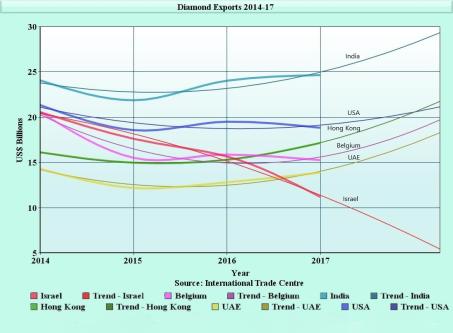
Fig.1 – Graph of diamond exports and trends from main exporting hubs
Israel’s gross diamond exports have crashed by a staggering 45 per cent since the 2014 massacre in Gaza that resulted in the death of over 2,200 people, mainly civilians including over 550 children.
The net value of Israel’s diamond exports has fallen even further, by 60 per cent from $11.25 billion to $4.4 billion over the period. This is about the same as the value of Israel’s total arms exports.
The Israeli diamond exchange initially blamed the decline on weak global demand and more recently on globalisation but the sudden steep decline shows that’s plainly not the case.
De Beers annual insight reports on the state of the global diamond market show demand increased slightly over the past five years.
No other diamond exporting country has suffered such a steep fall.
The Belgian diamond industry, which is a major hub for both the rough and polished diamond trade to and from Israel, has also been impacted by the steep decline in Israel’s exports.
Meanwhile India has gained market share and in 2016, for the first time ever, exported more diamonds to the USA than Israel which has traditionally supplied up to 50 per cent of the US market in value terms.
There can be no doubt that one of the most important and the most vulnerable sector of the Israeli economy is feeling the impact of Israel’s blood-drenched brand image.
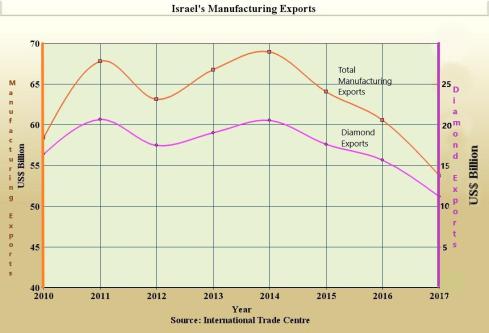
Fig. 2 – Israeli manufacturing exports declined sharply after 2014 led by a 45% fall in diamond exports. The 2012 fall in diamond exports was due to the discovery of major fraud in the Diamond Exchange.
The global campaign of boycott, divestment and sanctions (BDS) has highlighted jewellery industry links to Israeli human rights violations which are funded to a significant degree by revenue from the diamond industry. Both appear to be impacting the Israeli diamond industry particularly hard with exports down a further 6 percent in H1 2018.
The situation has become so serious that Israel is now offering to pay air fares as well as provide free hotel accommodation to attract buyers to Tel Aviv. Although the jewellery industry and NGOs have remained silent about Israel’s leading role in the diamond supply chain human rights activists have campaigned to expose it.
In 2012 activists first revealed the linkage between the Steinmetz Diamond Group (SDG) and the Givati Brigade of the Israeli military which was responsible for the 2009 massacre of the Samouni family in Gaza, a suspected war crime documented by the UN Human Rights Council and others including Israeli human rights group B’Tselem.
This set in motion a series of actions that continue to reverberate through the upper echelons of the diamond industry. When the Anglo American owned De Beers Group put a Forevermark Steinmetz diamond on display in the Tower of London in honour of the Queen of England’s Diamond Jubilee the Inminds human rights group staged regular protests outside the Tower.
A member of the Samouni family in Gaza recorded a video appealing for the blood diamond to be removed. The diamond was removed a few months later without any of the fanfare and publicity that accompanied it’s unveiling. It hasn’t been seen or heard of in public since.
Sotheby’s Diamonds is a 50:50 partnership between Sotheby’s, the famous auction house, and Diacore, the now rebranded Steinmetz Diamond Group.
Since 2012, Inminds has staged a number of protests outside Sotheby’s premises in Bond Street, London, highlighting the link to Israeli war crimes.
In January 2013, Sotheby’s CEO and board were sent a registered letter alerting them to the damage to their reputation and the risks to their brand posed by their partnership with the Steinmetz Group. Months later in Geneva, in a blaze of global publicity, Sotheby’s auctioned the Steinmetz Pink, a specimen diamond. It was bought by a syndicate of investors lead by Isaac Wolf for a world record US$83 million. The pre-auction publicity and spin gave no indication that the diamond was tarnished by association with Israeli war crimes in Gaza and was, therefore, a blood diamond. Four months after the auction it was revealed that the investors defaulted and Sotheby’s were forced to take the diamond into inventory costing them millions.
In April 2017, in a much quieter event, the blood diamond was auctioned in Hong Kong and bought by Chow Tai Fook for $71 million.
The Isaac Wolf syndicate wasn’t sued.
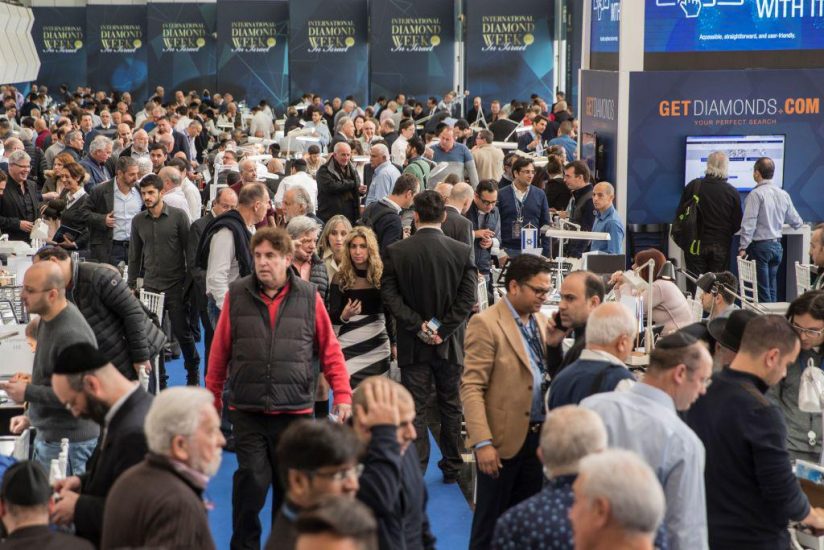
Diamond buyers and sellers attend the International Diamond Week (IDW) in the Israeli city of Ramat Gan, east of Tel Aviv on February 14, 2017. (JACK GUEZ/AFP/Getty Images)
Sotheby’s continues to partner with Diacore despite the fact that the Steinmetz Foundation “adopted” the Givati Brigade which stands accused of war crimes.
As news of the default became public it was also disclosed that Beny Steinmetz sold his interest in SDG to his brother Daniel and the company was rebranded as Diacore. Some observers believe this was an exercise designed to distance leading diamond brands including Tiffany’s, De Beers, Sotheby’s and Forevermark from the tarnished Steinmetz brand which is indelibly linked to the Samouni massacre. Evidence supporting this was leaked in the Panama Papers which showed that in 2015, Beny Steinmetz was still involved and asked Mossack Fonseca to backdate the transfer of his power of attorney to his brother to 2013.
Further indications that jewellers are shunning diamonds linked to Israeli human rights violations emerged earlier this year when it came to light, via a Tiffany & Co Form 10-K submission to the US Securities and Exchange Commission, that the iconic diamond brand had terminated a supply agreement with a Steinmetz owned mine in Sierra Leone. Tiffany’s loaned Steinmetz $50 million to develop the mine and was one of their leading buyers.
Tiffany’s divestment came following pressure from human rights activists who exposed the fact that Tiffany’s sourced diamonds from a miner that donated to and supported suspected Israeli war criminals.
Although Tiffany & Co divested from a Steinmetz mine they continue to conceal the identity of the companies they buy 25-35 per cent of their polished diamonds from. Tiffany’s customers cannot, therefore, know where their jewellery comes from as alluded to by their new CEO Alessandro Bogliono in Tiffany’s Sustainability Report 2017.
“Our customers place great value on sustainability. They want to know where their jewellery comes from, how it is made and how the jewellery-making process impacts the planet as well as its people and communities. Tiffany & Co. holds this kind of transparency dear and, through this creation of shared value, we have a unique opportunity to build meaningful, lasting relationships with our customers. We are committed to sharing more with them — and all of our stakeholders — about what, exactly, Tiffany is doing to achieve sustainability for our business and for the planet as we very broadly define that goal: enriching the people and places we reach through our business; minimising our environmental impact; improving industry-wide practices; and channelling the power of the Tiffany brand as a force for positive change in the world.”
Given Israel’s leading role in the industry and the absence of a statement from Tiffany’s stating, as they have done with Zimbabwe and Angola, they do not buy diamonds from the apartheid state, it is likely Tiffany’s are sourcing diamonds from companies in Israel.
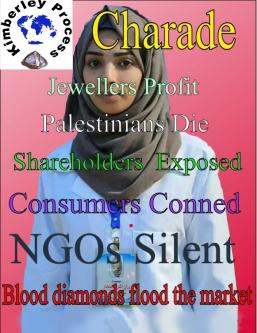
Fig. 3 – On June 1st, Rajan al-Najjar, a 21 year old paramedic, was shot dead by an Israeli sniper as she treated wounded civilians in Gaza.
Diamond companies in Israel employ people who have served in and are members of the Israeli army, have openly funded and supported attacks on the defenceless residents of Gaza, have been widely implicated in serious fraud and who discriminate against non-Jews who make up 20 per cent of the population.
Furthermore, Tiffany’s haven’t paid reparations to the Samouni family or any of the victims of the Steinmetz supported Givati Brigade. Mitigation for damage caused is a key component of “responsible sourcing” as outlined in the OECD Due Diligence Guidelines to which Tiffany and Co, a member of the UN Global Compact, claims it is committed.
Although revenue from the diamond industry is a significant source of funding for an apartheid regime that has killed over 210 Palestinians including women, children, medics and journalists and injured and maimed thousands more with live ammunition in besieged Gaza in the past six months alone, jewellers fraudulently claim diamonds processed in Israel are responsibly sourced and conflict-free.
This blood diamond cover-up and fraud is perpetuated by public companies and governments who collaborate to shield rogue regimes in Israel, Zimbabwe and Angola that they depend on to keep their coffers full, bolster dividends for shareholders and provide fat pension pots for c-suite executives.
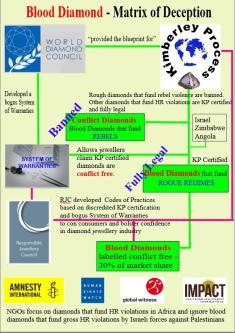
The Kimberley Process Certification Scheme (KP), the blueprint of which was drafted by the World Diamond Council, is the primary vehicle facilitating the ongoing blood diamond trade.
Although the remit of the KP is deliberately restricted to banning rough diamonds that fund rebel violence, jewellers use it to claim other blood diamonds are conflict free even when they fund war crimes and crimes against humanity.
Shamefully, Amnesty International, Global Witness, Human Rights Watch and Impact (Partnership Africa Canada), that the public rely on to expose the blood diamond trade and speak up for the victims, have said and done nothing to hold the diamond jewellery industry to account for funding Israeli war crimes and crimes against humanity.
Fig.4 –The diamond industry has created a matrix of bogus schemes, warranties, standards and codes of practices to con consumers and facilitate the trade in blood diamonds that fund rogue regimes
The silence of NGO’s on Israel’s blood diamond trade means the Kimberley Process charade continues to con most people and can keep mainstream media focused on the mining sector in Africa. Meanwhile, high street jewellers launder cut and polished blood diamonds labelled responsibly sourced and conflict free to unsuspecting customers.
Hilde Hardeman is the EU chair of the Kimberley Process in 2018. Indications to date suggest that she, like others before her in South Africa and Australia, will ignore the latest call from human rights activists for Israel to be suspended from the KP until those responsible for massacres in Gaza are brought to justice and held to account.
Some voices in the jewellery industry are speaking out. The most recent example being the Ethical Jewelry Exposé: Lies, Damn Lies, and Conflict Free Diamonds, from Marc Choyt and his team at Reflective Jewellery. The exposé peels back the layers of bogus schemes “through the metaphor of Russian nesting dolls, with eight layers of babble obscuring the nefarious truth hidden at the core”.
The exposé leaves readers in no doubt as to the magnitude of the fraud being perpetrated by the key stakeholders in the diamond industry, particularly the Responsible Jewellery Council which is now chaired by Signet Jewellers Vice President of corporate affairs, David Bouffard. Signet Jewellers source many of their diamonds from companies in Israel.
The successive withdrawal of human rights organisations from the KP, including Global Witness, Impact Transform, International Alert, Fatal Transactions and Ian Smillie – a key architect of the Kimberly Process scheme – has removed the fig leaf and left its exponents exposed with their bloody diamonds in full view.
Scrambling to conceal the blood diamond trade, the industry’s most recent and emerging addition to the matrix of deception, is the use of blockchain technology to digitally log all transactions a diamond undertakes from mine to market. While the technology has the potential to give consumers the information needed to make an informed decision about the ethical provenance of a diamond, the detailed information will only be available to “authorised users” as “privacy controls” will prevent consumers from accessing “sensitive data”.
Diacore, of the Steinmetz Group, was one of the first companies in a trial conducted by De Beers Group of their blockchain system, Tracr, earlier this year. It is clear, therefore, that blockchain will provide another layer of cover for the blood diamond trade while consumers are kept in the dark.
As the EU chairs a Kimberley Process plenary meeting in Brussels from November 12-16 it will be interesting to observe the corseted language emanating from the spin doctors. No doubt they will inform the public that the major reforms aimed at strengthening the KP and giving added assurance to consumers have been agreed. But one thing is for sure, any reforms that are agreed will not extend to banning blood diamonds that fund rogue regimes guilty of gross human rights violations in Israel, Zimbabwe or Angola.
WASHINGTON – The United States blocked nearly $200 million in assets belonging to Syria, Iran, and North Korea in 2017 as a result of the sanctions imposed on the three countries, the Treasury Department said in its annual report to Congress released on Wednesday.
“Approximately $199 million in assets relating to the three designated state sponsors of terrorism in 2017 have been identified by OFAC as blocked pursuant to economic sanctions imposed by the United States,” the report said.
The statement comes days after the US fully reinstated sanctions against Iran, including measures that curb Tehran’s oil industry. At the same time, the United States temporarily exempted eight nations — China, Greece, India, Italy, Japan, South Korea, Taiwan and Turkey — from the sanctions on importing oil from Iran.
In May, US President Donald Trump announced that the United States would withdraw from the Iran nuclear agreement, officially known as the Joint Comprehensive Plan of Action, and reimpose sanctions against Tehran that were previously lifted under the accord, including secondary restrictions.
The first round of the US sanctions was reimposed in August, while the second round, targeting over 700 Iranian individuals, entities, banks, aircraft and vessels, came into force this week.
By Mazin Qumsiyeh | Popular Resistance | August 18, 2013
There is no way to say this truth nicely: Politicians lie. That includes Japanese, American, Egyptian, Israeli, and Palestinian politicians! Is there something more common sense than that? Yet, so many citizens around the world believe their own politicians or wistfully acknowledge lies but think it is part of the job needed to run things. They believe even when politicians contradict themselves blatantly. This phenomenon is rather remarkable. It is a dissonance and disconnect from reality that many seem oblivious to. It is very dangerous because it can lead to accepting rationales for going to war. These can be deadly wars that lead to millions of lives lost as happened in what was called World War 1 and WW2. Even when incredible and declassified evidence abound, politicians continue to lie and old mythologies refuse to die. Here are just a few of the countless lies told to us over the past few decades… continue
This site is provided as a research and reference tool. Although we make every reasonable effort to ensure that the information and data provided at this site are useful, accurate, and current, we cannot guarantee that the information and data provided here will be error-free. By using this site, you assume all responsibility for and risk arising from your use of and reliance upon the contents of this site.
This site and the information available through it do not, and are not intended to constitute legal advice. Should you require legal advice, you should consult your own attorney.
Nothing within this site or linked to by this site constitutes investment advice or medical advice.
Materials accessible from or added to this site by third parties, such as comments posted, are strictly the responsibility of the third party who added such materials or made them accessible and we neither endorse nor undertake to control, monitor, edit or assume responsibility for any such third-party material.
The posting of stories, commentaries, reports, documents and links (embedded or otherwise) on this site does not in any way, shape or form, implied or otherwise, necessarily express or suggest endorsement or support of any of such posted material or parts therein.
The word “alleged” is deemed to occur before the word “fraud.” Since the rule of law still applies. To peasants, at least.
Fair Use
This site contains copyrighted material the use of which has not always been specifically authorized by the copyright owner. We are making such material available in our efforts to advance understanding of environmental, political, human rights, economic, democracy, scientific, and social justice issues, etc. We believe this constitutes a ‘fair use’ of any such copyrighted material as provided for in section 107 of the US Copyright Law. In accordance with Title 17 U.S.C. Section 107, the material on this site is distributed without profit to those who have expressed a prior interest in receiving the included information for research and educational purposes. For more info go to: http://www.law.cornell.edu/uscode/17/107.shtml. If you wish to use copyrighted material from this site for purposes of your own that go beyond ‘fair use’, you must obtain permission from the copyright owner.
DMCA Contact
This is information for anyone that wishes to challenge our “fair use” of copyrighted material.
If you are a legal copyright holder or a designated agent for such and you believe that content residing on or accessible through our website infringes a copyright and falls outside the boundaries of “Fair Use”, please send a notice of infringement by contacting atheonews@gmail.com.
We will respond and take necessary action immediately.
If notice is given of an alleged copyright violation we will act expeditiously to remove or disable access to the material(s) in question.
All 3rd party material posted on this website is copyright the respective owners / authors. Aletho News makes no claim of copyright on such material.