US-British Threats Against Russia Have a Long History
By T.J. COLES and Matthew ALFORD | CounterPunch | November 6, 2018
In their new book Union Jackboot: What Your Media and Professors Don’t Tell You About British Foreign Policy (Até Books), doctors T.J. Coles and Matthew Alford debate the rationale of Anglo-American policy towards Russia.
Alford: There seems to be a consensus that we need a strong military because Russia is on the rise. What do you think about that rationale?
Coles: There’s no consensus, except among European and American elites. Europe and America are not the world.
There are a lot of issues to consider with regards to Russia. Is it a threat? If so to whom? What kind of threat is Russia? So let’s consider these questions carefully. As far as the British establishment is concerned, Russia is an ideological threat because it is a major power with a substantial population. It’s also self-reliant where oil and gas is concerned, unlike Britain. So there’s lots of potential for Russian political ideology to undermine Britain’s status. In fact, there are European Council on Foreign Relations papers saying that Putin’s Russia presents an “ideological alternative” to the EU.[i] And that’s dangerous.
Britain, or more accurately its policymaking elites, have considered Russia a significant enemy for over a century. Under the Tsar, the so-called Great Game was a battle for strategic resources, trading routes, and so on. The historian Lawrence James calls this period the first Cold War, which went “hot” with the Crimean War (1853-56).[ii] Britain had a mixed relationship with the Tsars because, on the one hand, theirs’ were repressive regimes and Britain tended to favour repressive regimes, hence their brief alliance with Russia’s enemy, the Ottomans. On the other hand, Russia was a strategic threat to Britain’s imperial interests, and thus the Crimean War (1853-56).
When the Bolsheviks took over Russia, beginning 1917, the relationship became much less ambiguous – Russians, and especially Bolsheviks, were clearly the enemy. Their ideology posed a threat internally. So Winston Churchill, who began as a Liberal and became a Conservative, considered the Labour Party, which was formed in 1900, as basically a front for Bolsheviks.[iii] That shows the level of paranoia among elites. The Labour Party, at least at the beginning, was a genuine, working man’s political organisation – women couldn’t vote then, remember. So by associating this progressive, grassroots party representing the working classes as an ideological ally or even puppet of the brutal Bolshevik regime, the Tories had an excuse to undermine the power of organised, working people. So you had the Zinoviev letter in 1924, which we now know was a literal conspiracy between the secret services and elements of the Tory party to fabricate a link between Labour and Moscow. And it famously cost Labour the general election, since the right-wing, privately-owned media ran with the story as though it was real. It’s an early example of fake news.[iv]
That’s the ideological threat that Russia has posed, historically. But where there’s a threat, there’s an opportunity. The British elites exploited the “threat” then and as they do today by associating organised labour with evil Bolshevism and, in doing so, alienate the lower classes from their own political interests. Suddenly, we’ve all got to be scared of Russia, just like in 1917. And let’s not forget that Britain used chemical weapons – M-Devices, which induced vomiting – against the Bolsheviks. Chemical weapons were “the right medicine for the Bolshevist,” in Churchill’s words. This was in 1919, as part of the Allied invasion of Russia in support of the White Army. [v]
So if we’re talking about the historical balance of forces and cause and effect, Britain not Russia initiated the use of chemical weapons against others. But this history is typically inverted to say that Russia poses a threat to the West, hence all the talk about Novichok, the Skripals, and Dawn Sturgess, the civilian who supposedly came into contact with Novichok and died in hospital a few days later.
The next question: What sort of threat is Russia? According to the US Army War College, since the collapse of the Soviet Union and since pro-US, pro-“free market” President Boris Yeltsin resigned in 1999, Russia has pursued so-called economic nationalism. And the US doesn’t like this because markets suddenly get closed and taxes are raised against US corporations.[vi] That’s the real threat. But you can’t tell the public that: that we hate Russia because they aren’t doing what we say. If you look through the military documents, you can find almost nothing about security threats against the US in terms of Russian expansion, except in the sense that “security” means operational freedom. You can find references to Russia’s nuclear weapons, though, which are described as defensive, designed “to counter US forces and weapons systems.”[vii] Try finding that on the BBC. I should mention that even “defensive” nukes can be launched accidentally.
The real goal with regards to Russia is maintaining US economic hegemony and the culture of open “free markets” that goes with it, while at the same time being protectionist in real life. (US protectionism didn’t start under Trump, by the way.) Liberal media like the New York Times run sarcastic articles about Russian state oil and gas being a front for Putin and his cronies. And yes, that may be true. But what threat is Russia to the US if it has a corrupt government? The threat is closing its markets to the US. The US is committed to what its military calls Full Spectrum Dominance. So the world needs to be run in a US-led neoliberal order, in the words of the US military, “to protect US interests and investment.”[viii] But this cannot be done if you have “economic nationalism,” like China had until the “reforms” of the ‘70s and ‘80s, and still has today to some extent. Russia and China aren’t military threats. The global population on the whole knows this, even though the domestic US and British media say the opposite.
Alford: What about military threats?
Coles: The best sources you can get are the US military records. Straight from the horse’s mouth. The military plans for war and defence. They have contingencies for when political situations change. So they know what they’re talking about. There’s a massive divide between reality, as understood from the military records, and media and political rhetoric. Assessments by the US Army War College, for instance, said years ago that any moves by NATO to support a Western-backed government in Ukraine would provoke Russia into annexing Crimea. They don’t talk about Russia spontaneously invading Ukraine and annexing it, which is the image we get from the media. The documents talk about Russia reacting to NATO provocation.[ix]
If you look at a map, you see Russia surrounded by hostile NATO forces. The media don’t discuss this dangerous and provocative situation, except the occasional mention of, say, US-British-Polish war-gaming on the border with Russia. When they do mention it, they say it’s for “containment,” the containment of Russia. But to contain something, the given thing has to be expanding. But the US military – like the annual threat assessments to Congress – say that Russia’s not expanding, except when provoked. So at the moment as part of its NATO mission, the UK is training Polish and Ukrainian armed forces, has deployed troops in Poland and Estonia, and is conducting military exercises with them.[x]
Imagine if Scotland ceded from the UK and the Russians were on our border conducting military exercises, supposedly to deter a British invasion of Scotland. That’s what we’re doing in Ukraine. Britain’s moves are extremely dangerous. In the 1980s, the UK as part of NATO conducted the exercise, Operation Able Archer, which envisaged troop build-ups between NATO and the Warsaw Pact countries. Now-declassified records show that the Russians briefly mistook this exercise for a real-world scenario. That could have escalated into nuclear war. This is very serious.[xi]
But the biggest player is the USA. It’s using the threat of force and a global architecture of hi-tech militarism to shape a neoliberal order. Britain is slavishly following its lead. I doubt that Britain would position forces near Russia were it not for the USA. Successive US administrations have or are building a missile system in Europe and Turkey. They say it’s to deter Iran from firing Scud missiles at Europe. But it’s pointed at Russia. It’s a radar system based in Romania and Turkey, with a battery of Patriot missiles based in Poland. The stationing of missiles there provoked Russia into moving its mobile nuclear weapons up to the border in its Kaliningrad exclave, as it warned it would do in 2008.[xii] Try to find any coverage of that in the media, except for a few articles in the print media here or there. If Western media were interested in survival, there would be regular headlines: “NATO provoking Russia.”
But the situation in Ukraine is really the tipping point. Consider the equivalent. Imagine if Russia was conducting military exercises with Canada or Mexico, and building bases there. How would the US react? It would be considered an extreme threat, a violation of the UN Charter, which prohibits threats against sovereign states.
Alford: So we’ve extended NATO to pretty much the Russian border? But there’s a hard border there. Everyone knows we’re never going to attack Russia, both for reasons of morality and self-preservation. So maybe this situation is safer than you imply.
Coles: There’s no morality involved. States are abstract, amorphous entities comprised of dominant minorities and subjugated majorities who are conditioned to believe that they are relatively free and prosperous. The elites of those states act both in their self-interests – career, peer-pressure, kickbacks, and so on – and in the interests of their class, which is of course tied to international relations because their class thrives on profiting from resource exploitation. So you can’t talk about morality in this context. Only individuals can behave morally. The state is made up of individuals, of course, but they’re acting against the interests of the majority. As we speak, they are acting immorally– or at least amorally – but creating the geopolitical conditions that imperil each and every one of us.
As for invasion, we’re not going to invade Russia. This isn’t 1918. Russia has nuclear weapons and can deter an invasion. But that’s not the point. Do we want to de-escalate an already tense geopolitical situation or make it worse to the point where an accident happens? So while it’s not about invading Russia directly, the issue is about attacking what are called Russia’s “national interests.” Russia’s “national interests” are the same as the elites’ of the UK. National interest doesn’t mean the interests of the public. It means the interests of the policy-making establishment and the corporations. For example, the Theresa May government sacrificed its own credibility to ensure that its Brexit White Paper (2018) appeased both the interests of the food and manufacturing industries that want a soft Brexit – easy trade with the EU – and the financial services sector which wants a hard Brexit – freedom from EU regulation. Everyone else be damned. That’s the “national interest.”
So for its real “national interest,” Russia wants to keep Ukraine in its sphere of influence because its oil and gas to Europe pass through Ukraine. About 80% of Russia’s export economy is in the oil and gas sector. It’s already had serious political tensions with Ukraine, which on several occasions hasn’t paid its energy bills, so Russia has cut supplies. If Europe can bump Ukraine into its own sphere of influence it has more leverage over Russia. This is practically admitted in Parliamentary discussions by Foreign Office ministers, and so forth.[xiii] Again, omitted by the media. Also, remember that plenty of ethnic Russians live in eastern Ukraine. In addition, Russia has a naval base in Crimea. That’s not to excuse its illegal action in annexing Ukraine, it’s to highlight the realpolitik missing in the media’s coverage of the situation.
T. J. Coles is a postdoctoral researcher at Plymouth University’s Cognition Institute and the author of several books.
Matthew Alford teaches at Bath University in the UK and has also written several books. Their latest is Union Jackboot (Até Books).
SOURCES
[i] Mark Leonard and Nicu Popescu (2007) ‘A Power Audit of EU-Russia Relations’ European Council on Foreign Relations, Policy Paper, p. 1.
[ii] ‘Anglo-Russian relations were severely strained; what was in effect a cold war lasted from the late 1820s to the beginning of the next century’. The Crimean War seems to have set a precedent for today. James writes:
[It] was an imperial war, the only one fought by Britain against a European power during the nineteenth century, although some would have regarded Russia as essentially an Asiatic power. No territory was at stake; the war was undertaken solely to guarantee British naval supremacy in the Mediterranean and, indirectly, to forestall any threat to India which might have followed Russia replacing Britain as the dominant power in the Middle East.
Lawrence James (1997) The Rise and Fall of the British Empire London: Abacus, pp. 180-82.
[iii] Churchill said in 1920:
All these strikes and rumours of strikes and threats of strikes and loss and suffering caused by them; all this talk of revolution and “direct action” have deeply offended most of the British people. There is a growing feeling that a considerable section of organized Labour is trying to tyrannize over the whole public and to bully them into submission, not by argument, not by recognized political measures, but by brute force …
But if we can do little for Russia [under the Bolsheviks], we can do much for Britain. We do not want any of these experiments here …
Whether it is the Irish murder gang or the Egyptian vengeance society, or the seditious extremists in India, or the arch-traitors we have at home, they will feel the weight of the British arm.
Winston Churchill (1920) Bolshevism and Imperial Sedition. Speech to United Wards Club. London: The International Churchill Society.
[iv] The fake letter says:
A settlement of relations between the two countries [UK and Russia] will assist in the revolutionising of the international and British proletariat, … [and] make it possible for us to extend and develop the propaganda and ideas of Leninism in England and the colonies.
It also says that ‘British workmen’ have ‘inclinations to compromise’ and that rapprochement will eventually lead to domestic ‘[a]rmed warfare’. It was leaked by the services to the Conservative party and then to the media. Richard Norton-Taylor (1999) ‘Zinoviev letter was dirty trick by MI6’ Guardian and Louise Jury (1999) ‘Official Zinoviev letter was forged’ Independent. For media coverage at the time, see James Curran and Jean Seaton (1997) Power without ResponsibilityLondon: Routledge, p. 52.
[v] Paul F. Walker (2017) ‘A Century of Chemical Warfare: Building a World Free of Chemical Weapons’ Conference: One Hundred Years of Chemical Warfare: Research, Deployment, Consequences pp. 379-400 and Giles Milton (2013) Russian Roulette: A Deadly Game: How British Spies Thwarted Lenin’s Global Plot London: Hodder, eBook.
[vi] ‘The Russian Federation has shown repeatedly that common values play almost no role in its consideration of its trading partners’, meaning the US and EU. ‘It often builds relationships with countries that most openly thwart Western values of free markets and democracy’, notably Iran and Venezuela. ‘In this regard, the Russian Federation behaves like “Russia Incorporated.” It uses its re-nationalized industries to further its wealth and influence, the latter often at the expense of the EU and the U.S.’. Colonel Richard J. Anderson (2008) ‘A History of President Putin’s Campaign to Re-Nationalize Industry and the Implications for Russian Reform and Foreign Policy’ Senior Service College, US Army War College, Pennsylvania: Carlisle Barracks, p. 52.
[vii] Daniel R. Coats (2017) Statement for the Record: Worldwide Threat Assessment of the US Intelligence CommunitySenate Select Committee on Intelligence, Washington, DC: Office of the Director of National Intelligence, pp. 18-19.
[viii] US Space Command (1997) Vision for 2020 Colorado: Peterson Air Force Base.
[ix]The document also says: ‘a replay of the West-sponsored coup against pro-Russian elites could result in a split, or indeed multiple splits, of the failed Ukraine, which would open a door for NATO intervention’.Pavel K. Baev (2011) ‘Russia’s security relations with the United States: Futures planned and unplanned’ in Stephen J. Blank (ed.) Russian Nuclear Weapons: Past, Present, and Future Strategic Studies Institute Pennsylvania: Carlisle Barracks, p. 170.
[x] Forces Network (2016) ‘British troops to deploy to Poland’.
[xi] For example, Nate Jones, Thomas Blanton and Christian F. Ostermann (2016) ‘Able Archer 83: The Secret History’ Nuclear Proliferation International History Project Washington, DC: Woodrow Wilson International Center for Scholars.
[xii] It was reported in the ultra-right, neo-con press at the time that:
[Russian] President Dmitri Medvedev announced in his first state-of-the-nation address plans to deploy the short-range SS-26 (“Iskander”) missiles in the Russian exclave of Kaliningrad if the U.S. goes ahead with its European Ballistic Missile Defense System (BMDS). Medvedev told parliament that the deployment would “neutralize” U.S. plans for a missile defense shield based in Poland and the Czech Republic [now in Romania), which the U.S. claims as vital in defending against missile attacks from ‘rogue states’ such as Iran.
Neil Leslie (2008) ‘The Kaliningrad Missile Crisis’ The New Atlanticist, available at atlanticcouncil.org.
[xiii] For example, a Parliamentary inquiry into British-Russian relations says of the newly-imposed US-British ally in Ukraine:
President Poroshenko’s Government is more openly committed to economic reform and anti-corruption than any previous Ukrainian Administration. The reform agenda has made considerable progress and has enjoyed some successes including police reform, liberalisation of the energy market and the launch of an online platform for government procurement …
The annexation of Crimea also resulted in a ban on importing products from Crimea, on investing in or providing services linked to tourism and on exporting certain goods for use in the transport, telecoms and energy sectors.
House of Commons Foreign Affairs Committee (2017) The United Kingdom’s relations with Russia Seventh report of session 2016-17, HC 120 London: Stationary Office, pp. 28, 31.
US to impose ‘additional sanctions’ on Russia over Skripal poisoning claim
RT | November 6, 2018
Washington will move to impose additional sanctions against Russia, saying Moscow did not meet its demands by the deadline set by the US and accusing Moscow of a chemical attack against a former spy and his daughter in the UK.
“Today, the Department informed Congress we could not certify that the Russian Federation met the conditions required by the Chemical and Biological Weapons Control and Warfare Elimination Act of 1991,” spokeswoman Heather Nauert said on Tuesday. “We intend to proceed in accordance with the terms of the CBW Act, which directs the implementation of additional sanctions.”
Those sanctions may include downgrading diplomatic relations, banning the Russian national carrier Aeroflot from flying to the US, and cutting off nearly all imports and exports, already severely curtailed under a series of sanctions since 2014.
In August, the State Department sent Moscow a note claiming that Russia had violated the CBW Act by using “Novichok” nerve agent against Sergey Skripal and his daughter Yulia in Salisbury.
The Skripals were hospitalized in early March, and the British government accused Moscow of using the deadly toxin. The UK government has offered no evidence for its claims, but the US and a number of NATO countries took London’s word for it and expelled over 150 Russian diplomats. Russia has retaliated in kind.
Among the demands from Foggy Bottom was that Russia stop using chemical weapons and provide “reliable” assurances to the US it will not do so again, subject to verification by international inspectors. Moscow was given a three-month deadline to fulfill these conditions.
“Everyone who is at least a little bit familiar with the so-called Skripal case understands the absurdity of the statement contained in the official State Department document,” Russian Foreign Minister Sergey Lavrov said at the time. Prime Minister Dmitry Medvedev said any further US sanctions could be considered a declaration of a trade war.
Russia says the last of its chemical weapons were destroyed in 2017, and that this was verified by international observers.
Lavrov Calls US Sanctions on Iran ‘Illegitimate’, Slams Pressure on SWIFT
Sputnik – 06.11.2018
Washington implemented tough unilateral sanctions against the Islamic Republic on Monday following President Trump’s withdrawal from the Iran nuclear deal in May.
Russian Foreign Minister Sergei Lavrov has condemned Washington’s decision to slap Tehran with sanctions, calling the restrictions “absolutely illegitimate” and deeply disappointing, and saying that it was “unacceptable” to hold dialogue in the language of ultimatums.
“As far as the US measures against Iran are concerned, they are absolutely illegitimate,” Lavrov said on Tuesday in Madrid following a meeting with Spanish officials.
“They are being implemented in flagrant violation of the decisions of the UN Security Council, and the way in which these measures are announced and implemented cannot but cause a deep sense of disappointment. We proceed from the idea that the norms of not only international law, but of international dialogue, have not been repealed,” Lavrov stressed.
“Pursuing a policy based on ultimatums and one-sided demands is hardly permissible in our times,” according to the Russian foreign minister.
Pressure on SWIFT Also Unacceptable
Commenting on suspected US pressure on international financial messaging system SWIFT, which implied Monday that it would comply with US sanctions against Iranian financial institutions, Lavrov said that such pressure was also illegitimate.
“Within the framework of the participants of the Joint Comprehensive Plan of Action (JCPOA) agreement, mechanisms are being developed which will allow for the continued implementation of the provisions of this document, first of all as regards [nations’] economic ties to Iran without US participation, and this is not a simple matter,” the foreign minister explained. “You can see how, using unacceptable methods, pressure has been placed on the operators of the SWIFT system. But experts are actively engaged in these issues, and they have a sufficiently stable understanding that this is possible and that such measures will be found.”
On Monday, Washington followed through with plans to renew sanctions against Iran following President Trump’s exit from the JCPOA Iran nuclear deal. The tough sanctions target Iran’s energy, banking and sea-based transport sectors, and threaten so-called secondary sanctions against foreign companies and countries doing business with the Islamic Republic.
The Belgium-based SWIFT financial messaging service announced that it would be suspending some Iranian banks’ access to the system, making no mention of US sanctions. Calling the move “regrettable,” SWIFT’s statement said it had taken the step “in the interest of the stability and integrity of the wider global financial system.”
All of the JCPOA’s other signatories, including Iran, Russia, China and several European powers, have made an effort to save the landmark nuclear deal and bypass the US sanctions or otherwise limit their impact. This has included the development of a Special Purpose Vehicle (SPV) on trade. China and India, the largest importers of Iranian crude oil, have resisted US secondary sanctions threats, and were granted exemptions along with five other oil-importing countries plus Taiwan.
India should stay the course on Iran oil
By M. K. BHADRAKUMAR | Indian Punchline | November 5, 2018
The new kids on the block are unaware that not a year had passed since the Islamic Revolution in Iran 40 years ago when US sanctions against that country wasn’t a fact of life. Iran has weathered multiple rounds of sanctions before.
As a BBC commentary put it, “Iranians will be forced into finding creative ways to sell oil, relying on their years of experience of life under previous sanctions. And to fill the gap left by lost European investment, Iran will be looking east to forge new links with Russia and China.”
This is also the signal one gets from the Iranian reaction to the Trump administration’s re-imposition of sanctions. At the most authoritative level, Supreme Leader Ali Khamenei has been plainly dismissive. Some excerpts from his remarks on Saturday:
“The enemy made every attempts against us, with a variety of actions; the US engaged in military, economic, and media warfare against us. Via all these actions, the US aspired, in vain, to regain its previous domineering status over Iran — that it enjoyed during the Pahlavi Regime.”
“Today, an overview of the situation of the US shows that the US’s power is declining. The US is today much weaker than it was forty years ago… US’s soft power has degraded… US’s hard power — that is, its economic and military power — is also declining… It suffers from more than $15 trillion dollars public debt and $800 billion budget deficit… The US is declining. Everyone should know this.”
Clearly, for Tehran, talks with the US will be simply out of the question.
On the other hand, there are no knee-jerk reactions, either – such as that Iran is going to dump the 2015 nuclear deal. As the Iranian ambassador to the UK Hamid Baeidinejad (who was a leading member of Iran’s negotiating team with the US during 2013-2015) put it, “The aspiration that we have with the European Union, Britain, France and Germany, China and Russia, is that we keep the Iran Nuclear Deal alive and give time to the U.S. to rethink and revise its position.”
Baeidinejad added, Tehran will not accept any idea of changing or renegotiating the nuclear deal, because if one word is changed other aspects of the deal will either be changed or compromised. “We have a total loss of confidence” in negotiating with the US, but “we are trying very hard with European countries, with China and Russia, to find mechanisms that this deal could (still) be effectively implemented.”
The ambassador said, “There will be pressure against some countries, particularly European countries, and economic and trade institutions from attempting to enter into working with Iran, there will probably be some risks.” However, there is “total determination” by European countries and other world partners to find “practical solutions” so that the deal will be kept alive.
These remarks sum up the Iranian position. Tehran estimates that it has much elbowroom left to force a rethink on the Trump administration.
Curiously, this is also the assessment of some Israeli experts. A commentary in the Jerusalem Post gives the expert opinion that while the US’ oil sanctions will no doubt hurt Iran, “Tehran maintains key support from Asia,” which means that the sanctions are “insufficient to compel Iran to accept a new tougher nuclear deal.” Equally, support for Iran from China, Russia, India and South Korea would be too strong too [sic] sufficiently isolate the Islamic Republic’s economy… the fundamental dynamics protecting Iran from a total collapse if anything are even more solid (today).”
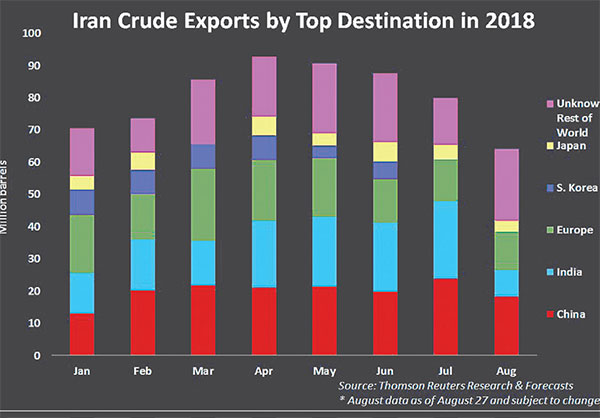
Interestingly, Tehran is not perturbed about the US threat to cut Iran off from the SWIFT. The fact of the matter is that Iran has an alternative to SWIFT – Russia’s SPFS. By the way, SPFS’ clients already include three of the top importers of Iranian oil – China, India and Turkey. (India probably used it recently to make payments for its purchase of the Russian S-400 ABM system!)
Suffice to say, Washington not only needs to accept that SPFS is a viable workaround for countries to import Iranian oil, but also a factor in the long-term implications of the emergence of such a new and parallel monetary system.
Therefore, the Trump administration’s decision to give the ‘waiver’ on import of Iranian oil is understandable. It is only prudent not to jeopardize the US’ relations with countries such as India or Turkey on account of the Iran oil sanctions when these countries are in any case going to find ingenious ways to import Iranian oil.
Then, there are other factors at work. One, as mentioned above, the US realizes that it lacks the ability to bring Iran’s oil exports to anywhere near zero level, as it once boasted. Two, oil sanctions against Iran will impact the world oil prices. Can Trump afford the political cost of oil prices cascading to, say, $100 bpd or more when he gears up for his re-election bid in 2020?
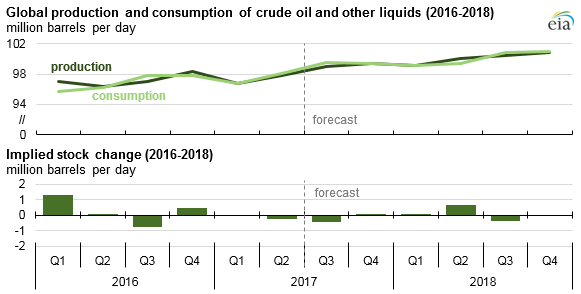
Third, there is great uncertainty about US-Saudi relations in the aftermath of the murder of Jamal Khashoggi. It is turning out to be a high stakes game of rogue operation by intelligence agencies for regime change in Saudi Arabia, which went horribly wrong. The searing experience seriously damages US-Saudi relations. And Saudi Arabia happens to be the only OPEC country that has the means to boost oil production to make up for shortfalls due to US’ oil sanctions against Iran. (Even Saudi surplus capacity is severely restricted.)
The bottom line is that New Delhi must stay the course, no matter what the American lobby in Delhi may say. The point is, the Trump administration is heading toward a cul-de-sac. When this realization dawns on Trump, he’ll, typically, make the course correction. As Ambassador Baeidinejad explained, Iran’s plan is to isolate the US and give it time to rethink. In this wise approach, Iran is getting strong support from the EU and Russia and China. Read the joint statement by the EU + EU-3 foreign ministers here.
IEA Opposed To Cheap Energy For Developing Nations
By Paul Homewood | Not A Lot Of People Know That | October 31, 2018
Once again, the IEA is trying to stir things up re “fossil fuel subsidies”:
Worldwide fossil fuel consumption subsidies almost halved between 2012 and 2016, from a high point in 2012 of more than half a trillion dollars. But the estimate crept higher again in 2017, according to new data from World Energy Outlook 2018, and the run-up in the oil price in 2018 is putting pricing reforms under pressure in some countries.
The new data for 2017 show a 12% increase in the estimated value of these subsidies, to more than $300 billion. Most of the increase relates to oil products, reflecting the higher price for oil (which, if an artificially low end-user price remains the same, increases the estimated value of the subsidy). In 2016, for the first time, the value of subsidies to fossil-fuelled electricity were higher than for oil. The 2017 data sees oil return as the most heavily subsidised energy carrier.
Fossil fuel consumption subsidies are in place across a range of countries. These subsidies lower the price of fossil fuels, or of fossil-fuel based electricity, to end-consumers, often as a way of pursuing social policies including energy access.
There can be good reasons for governments to make energy more affordable, particularly for the poorest and most vulnerable groups. But many subsidies are poorly targeted, disproportionally benefiting wealthier segments of the population that use much more of the subsidised fuel.
Such untargeted subsidy policies encourage wasteful consumption, pushing up emissions and straining government budgets. Phasing out fossil fuel consumption subsidies is a pillar of sound energy policy.
The period of high oil prices from 2010-2014 provided strong motivation for many oil-importing countries to pursue subsidy reform. The fall in price that began in 2014 presented the opportunity. A host of countries, from India to Indonesia and from Mexico to Malaysia, have implemented pricing reforms in recent years.


Every time a report like this comes out, Greenpeace and co leap up and down, pretending that taxpayers are actually handing money over to wicked oil companies.
In fact, as the IEA admit, these are “consumer subsidies”, and not “producer subsidies”. The latter are, of course, what we are paying to wind farms in this country, to enable them to compete with fossil fuels.
By contrast, consumer subsidies are given to keep prices down for the consumer, in this case energy, which may or may not come from fossil fuels.
The IEA explain their methodology below:
The IEA estimates subsidies to fossil fuels that are consumed directly by end-users or consumed as inputs to electricity generation. The price-gap approach, the most commonly applied methodology for quantifying consumption subsidies, is used for this analysis. It compares average end-user prices paid by consumers with reference prices that correspond to the full cost of supply. The price gap is the amount by which an end-use price falls short of the reference price and its existence indicates the presence of a subsidy.
https://www.iea.org/weo/energysubsidies/
My first reaction is just what the hell does any of this have to do with the IEA?
If, for instance, the Indian government wants to subsidise the price of electricity, so that its citizens are able to afford to run air conditioners, then that is up to them, and nobody else.
Similarly, if Iran wants to subsidise natural gas to enable its people to survive in winter, what right does the IEA to criticise?
The Report actually notes that such subsidies can be beneficial, but then ludicrously go on to complain that some richer people might benefit as well:
There can be good reasons for governments to make energy more affordable, particularly for the poorest and most vulnerable groups. But many subsidies are poorly targeted, disproportionally benefiting wealthier segments of the population that use much more of the subsidised fuel.
In reality, energy taxes are one of the most regressive taxes of all. Removal of subsidies would have the same effect.
Subsidising energy for industry is also seen to be important by many countries, who would worry about the loss of competitiveness if they were withdrawn.
The IEA, of course, has ulterior motives, and could not give a toss about the wellbeing or livelihoods of ordinary people in developing nations, where all of the subsidies are concentrated. No EU country appears on the list, nor the US, Canada or Australia:

https://www.iea.org/weo/energysubsidies/
That is because the IEA is set up under the auspices of the OECD, the rich nations club.
Originally the IEA was designed to help countries co-ordinate a collective response to major disruptions in the supply of oil, such as the crisis of 1973/4.
In theory, its four main areas of focus are:
- Energy Security: Promoting diversity, efficiency, flexibility and reliability for all fuels and energy sources;
- Economic Development: Supporting free markets to foster economic growth and eliminate energy poverty;
- Environmental Awareness: Analysing policy options to offset the impact of energy production and use on the environment, especially for tackling climate change and air pollution; and
- Engagement Worldwide: Working closely with partner countries, especially major emerging economies, to find solutions to shared energy and environmental concerns.
https://www.iea.org/about/ourmission/
However, it no longer seems to care about energy security, fostering economic growth or eliminating energy poverty.
Instead, it appears to have an overarching remit to tackle climate change. If there was any doubt at all about this, check out Fatih Birol’s despair last week at the news that CO2 emissions were continuing to climb.
And as far as he is concerned, developing countries can go to hell.
US sanctions on Hezbollah aim to punish Lebanon: Observers
Press TV – October 28, 2018
The US has imposed new sanctions on Hezbollah, but observers say Lebanon as a whole will be affected by the punitive measures.
Earlier this week, the administration of US President Donald Trump imposed a new round of sanctions on Hezbollah targeting individuals and international organizations that do business with the resistance group.
Economist Louis Hobeika said he thought “it is difficult to punish Hezbollah without punishing all of Lebanon.”
“No area fully belongs to Hezbollah. The southern suburb of Beirut is not confined to Hezbollah, so how will the sanctions apply here?” Hobeika told Arab News in remarks published Saturday.
Political activist Ali Al-Amin, the director of Janoubia news website, said the outcome of the US decision could be “disastrous” for Lebanon.
“Is the purpose of the sanctions to embarrass the Lebanese government and state?” he wondered.
In the May parliamentary elections, Hezbollah and its political allies won more than half of the seats at the legislature in a major victory for the party.
Former Lebanese lawmaker Fares Souaid told Arab News that the new sanctions are part of a series of US bans meant to “turn the party (Hezbollah) into a burden on the Lebanese after Hezbollah has come forward as a security guarantee for Lebanon.”
The US has its Arab allies in the Persian Gulf on board in cranking up pressure on the Lebanese leaders over their association with Hezbollah, and they all take their cue from Israel.
Israeli leaders have threatened that they would view the Lebanese state as part of Hezbollah in a future war with the resistance movement.
In May, the US Treasury Department imposed sanctions on the Hezbollah leadership jointly with members of the so-called Terrorist Financing and Targeting Center (TFTC), which includes Saudi Arabia, Bahrain, Kuwait, Oman, Qatar and the UAE.
Hezbollah was formed following the Israeli regime’s invasion of Lebanon and the ensuing occupation of its southern parts in 1980s, and currently constitutes Lebanon’s de facto military power.
Since then, the movement has helped the national army retake the occupied regions from Tel Aviv and thwart two Israeli acts of aggression in 2000 and 2006.
The movement has also been playing a significant role in the Syrian army’s fight against Takfiri terror groups, including Daesh and Nusra Front, thus preventing the spillover of the war into Lebanon.
The New Cold War may never arrive
By M. K. BHADRAKUMAR | Indian Punchline | October 28, 2018
An old Italian friend and a noted Sinologist based in Beijing representing a Vatican paper, Francesco Sisci wrote apropos an article I had posted on Facebook yesterday Donald Trump Meets the End of the Empire authored by Douglas Macgreggor, an ex-US Army decorated combat veteran and an author (National Interest, October 24, 2018):
“Napoleon famously said three things win a war: money, money, money. The word “soldier” comes from soldo, the pay of the soldiers in the renaissance. If the US doesn’t straighten its economy what can it do globally? And if it doesn’t soon, what will China do? With WW 2 the solution in some countries was the war that canceled all debts with massive inflation…”
To my mind, the last sentence in Sisci’s observation will be a last-ditch option for President Trump, because if it fails, that may also mean the end of the United States of America as a nation. And Trump has a rational mind, as his attitude toward Kim Jong-Un or Mohammed bin Salman would testify.
I discount World War 3 in the thermonuclear age. Rivalries will play out below the threshold of wars in which there are no winners.
World nuclear war scenario
That is what makes Macgregor’s article noteworthy. The signs are that Trump is already thinking in terms of cuts in budget expenditure, including the defence budget. In a pithy sentence, Macgreggor highlights the paradigm: “Get ready. “America first” in foreign and defense policy is about to begin. Defense cuts are on the way.”
Macgreggor gives food for thought for Indian pundits who are wildly ecstatic that a US-China New Cold War is about to erupt, which will provide India a historic opportunity to emerge as America’s “counterweight” to China in the Asian context. This is actually a hackneyed thesis dating back to the late K. Subrahmanyam. The George W. Bush presidency brilliantly succeeded in drilling into the mind of the wooly-headed Indians a seductive thought that the US is determined to make a first class world power out of India.
But realism dawned when it became obvious that Barack Obama’s ‘pivot to Asia’ was not getting anywhere. The idea became moribund when President Trump arrived in Asia in November 2016 in a watershed regional tour to explain to a stunned ASEAN and Asia-Pacific audience that he’s dead serious about America First.
Of late, Trump’s ‘tariff war’ with China has lifted the sagging morale of our pundits, many of whom are disillusioned with the Wuhan summit between Modi and Xi Jinping and yearning for a New Cold War. They blithely assume that the logical conclusion of the ‘tariff war’ will be the New Cold War. It doesn’t occur to them that while Trump is mad, there is also a method in his madness. There’s more than a 50:50 chance that the ‘tariff war’ may end before the campaign for the US presidential election 2020 peaks – with Trump declaring ‘victory’, of course, as he did on DPRK’s denuclearization and missile capability.
At any rate, for argument’s sake, is the contemporary world situation ripe for the US to launch a New Cold War against China (or Russia for that matter)? Unlike in the Cold War era of the past century, there is no bipolar struggle on a global scale today. It is impossible to persuade most countries to come to the barricades when they are grappling with their own national priorities – and for most of them China also happens to be the main driver of growth and development, be it in Latin America or Africa or the Asia-Pacific.
The US cannot inject ideology into its competition with China. On the one hand, China is an avid globalizer and proponent of free trade and WTO and a flag carrier at the Davos World Economic Forum, while on the other hand, US’ claim to ‘exceptionalism’ no longer carries credibility with the world community. Meanwhile, the entente with Russia, the alliance with Pakistan, the interdependency with European economies, the diversified relationships in the Middle East and Africa, etc. give China so much ‘strategic depth’ that it is impossible to ‘isolate’ it.
Most important, unlike the former Soviet Union, China understands the mystique of the market and how to leverage it. By the way, a cold war also costs money. Who will step forward to finance the New Cold War? Mohammed bin Salman? No way. Trump himself is notoriously averse to opening his wallet. The Bretton Woods institutions have outlived their utility, too.
From a historical perspective, presiding over a great power in decline is a very difficult thing to handle. Trump is doing remarkably well in the given situation. His tantrums and grandstanding are expedient, diversionary steps become necessary through bluster and rhetoric, but he’s largely getting away with it. The bottom line is, Trump has not started any new war – and to my mind, he has no intentions, either. A withdrawal from Syria, drawdown in Afghanistan and an end to the carnage in Yemen – incidentally, all these were legacies of the Obama era – are on cards.
The intolerable tensions vis-à-vis North Korea (which, again, were an old festering wound) have been dying down – and Trump was willing to take a lot of flak for it in terms of personal attacks and lampooning by detractors.
In sum, Trump has been largely navigating with his America First compass. In the coming period, this can only become more explicit, especially if Trump gets through the November 6 midterm elections intact with no big shift against him in the power equilibrium in the US Congress enabling a further consolidation of his grip on the Republican Party.
Cut Emissions? Who, Me?
By Paul Homewood | Not A Lot Of People Know That | October 22, 2018
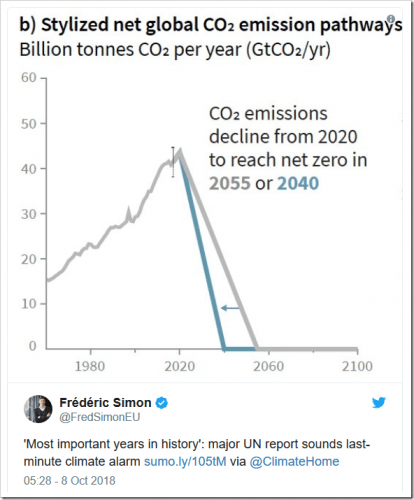
The IPCC says we have got to start cutting emissions radically immediately, but the rest of the world is not listening!
1) Australia rejects UN call to phase out coal
Australia has rejected a call by scientists to phase out coal use by 2050 to prevent the world overshooting targets in the Paris Climate Change agreement with potentially disastrous consequences.
The world’s biggest coal exporter on Tuesday said it would be “irresponsible” to comply with the recommendation by the UN’s Intergovernmental Panel on Climate Change (IPCC) to stop using coal to generate electricity.
Canberra also reiterated its priority is to cut domestic electricity prices rather than curb greenhouse gas emissions, which have risen for four consecutive years.
“To say that it [coal] has to be phased out by 2050 is drawing a very long bow,” said Melissa Price, Australia’s environment minister, who previously worked in the mining industry.
“I just don’t know how you could say by 2050 that you’re not going to have the technology that’s going to enable good, clean technology when it comes to coal. That would be irresponsible of us.” … https://www.ft.com/content/326d7228-cb83-11e8-b276-b9069bde0956
2) Japan Will Defy Calls By The IPCC To Phase Out Coal By Mid Century
Japan’s ambassador to Australia has confirmed Tokyo will defy calls by the Intergovernmental Panel on Climate Change to phase out coal by mid-century as part of a scientific appeal to limit global temperature increases to 1.5C.
Sumio Kusaka told The Australian that Japan would consider “all practical ways to further advance decarbonisation” but would need to bolster coal supply in the immediate future. He said Japanese plans to reduce reliance on fossil fuels in line with its international commitments would see a greater focus on nuclear energy, a form of power prohibited in Australia since 1998.
In recent weeks, Tony Abbott and Ziggy Switkowski, former chair of the Australian Nuclear Science and Technology Organisation, have called for the prohibition on nuclear power to be lifted to provide for the arrival of small modular reactors that can power towns of 100,000 people.
“I am aware the recent IPCC report contains some firm recommendations in relation to coal,” Mr Kusaka told The Australian.
“However, Japan is a country with very limited resources of its own, and bearing in mind our energy security requirements, it would be difficult for us to eliminate coal- fired power altogether.
“With a view to 2050, we are also considering all practical ways to further advance decarbonisation. In relation to this, some of the technologies we are looking at include renewable energy, nuclear energy and carbon capture and storage.’’
Mr Kusaka said Tokyo would continue to buy coal from Australia to secure its energy needs into the future. Japan was the largest importer of Australian thermal coal last year. – https://www.thegwpf.com/japan-will-defy-calls-by-the-ipcc-to-phase-out-coal-by-mid-century/
3) China To Speed Up End Of Green Energy Subsidies
SHANGHAI (Reuters) – China will speed up efforts to ensure its wind and solar power sectors can compete without subsidies and achieve “grid price parity” with traditional energy sources like coal, according to new draft guidelines issued by the energy regulator.
As it tries to ease its dependence on polluting fossil fuels, China has encouraged renewable manufacturers and developers to drive down costs through technological innovations and economies of scale.
The country aims to phase out power generation subsidies, which have become an increasing burden on the state.
The guidelines said some regions with cost and market advantages had already “basically achieved price parity” with clean coal-fired power and no longer required subsidies, and others should learn from their experiences.
They also urged local transmission grid companies to provide more support for subsidy-free projects and ensure they have the capacity to distribute all the power generated by wind and solar plants…
China’s solar sector is still reeling from a decision to cut subsidies and cap new capacity at 30 gigawatts (GW) this year, down from a record 53 GW in 2017, with the government concerned about overcapacity and a growing subsidy backlog.
According to the NEA, the government owed around 120 billion yuan ($17.46 billion) in subsidies to solar plants by the middle of this year.
4) Germany’s Merkel Promises New Law To Ward Off Diesel Driving Bans (And To Save Her Floundering Government)
BERLIN (Reuters) – German Chancellor Angela Merkel, campaigning for her Christian Democrats (CDU) to retain control of the crucial state of Hesse in next Sunday’s election, promised legislation to ward off the threat of air pollution leading to driving bans.
Speaking at a news conference on Sunday evening, Merkel said it would be disproportionate to ban dirty diesel cars from the road in places like Frankfurt, Hesse’s largest city, where nitrogen emissions limits were only marginally exceeded.
Following her allies’ disastrous showing in Bavaria’s regional elections last week, Merkel faces murmurs of dissent within her party. Defeat in the state to the resurgent Greens could prove fatal to her premiership.
US forces Iraq to award $15 billion contract to GE instead of Siemens
Press TV – October 21, 2018
Germany is angry after the US government intervenes in a multi-billion-dollar deal for Siemens AG to develop power stations in Iraq and forces Baghdad to opt for General Electric (GE) instead.
The American company signed a memorandum of understanding with the Iraqi government earlier this week, outlining their cooperation in the fields of oil and gas production and power generation.
A person, who has seen the paperwork, told The Financial Times that Washington plans to offer financing and insurance for US firms doing business in the Iraqi power sector.
GE’s agreement with Iraq dashed Siemens’ hopes of winning a $15 billion contract to supply 11 gigawatts of power-generation equipment to Iraq.
Until the US intervention, Siemens was considered the front-runner after its Chief Executive Joe Kaeser traveled to Iraq in September and spoke with Prime Minister Haider al-Abadi about the contract.
US officials, however, warned Abadi that awarding the contract to Siemens might jeopardize relations between Baghdad and Washington.
A top adviser to the Iraqi premier then told Siemens to give up because it was causing problems for Iraq given the US pressure.
“The US government is holding a gun to our head,” the adviser was quoted as saying by another person familiar with the incident.
According to people familiar with the negotiations, the US highlighted the number of American troops killed in Iraq and claimed that Iran had spurred Baghdad to pursue the Siemens deal.
“This is part of very strong campaign of engagement in Iraqi government formation and a very targeted effort to support the Iraqi government and minimize Iranian influence,” Garrett Marquis, a US National Security Council spokesman, claimed.
The Federation of German Industries (BDI) complained on Sunday that the US pressure to quash the Siemens power deal with Iraq was unacceptable, blaming President Donald Trump’s “America First” policy for corroding business decisions.
“To implement the America First doctrine in this way in the global competition of multinational companies is not acceptable,” Joachim Lang, BDI managing director, told Welt am Sonntag newspaper.
He emphasized that governments and companies should make deals based on business interests.
The US, backed by the UK, invaded Iraq in 2003 under the pretext that the former regime of Saddam Hussein possessed weapons of mass destruction.
No such weapons were ever found, but the invasion plunged Iraq into chaos and led to the rise of terrorist groups which continue to plague the country to this day.
Atlantic Council Podium Used to Force European Allies to March in Step
By Alex GORKA | Strategic Culture Foundation | 21.10.2018
Wess Mitchell, Assistant Secretary of State for European and Eurasian Affairs, the administration’s top diplomat focused on Europe and Eurasia, has warned that Europe’s energy dependence on Russia is unacceptable for the United States. That official was addressing the Atlantic Council’s “Championing the Frontlines of Freedom, Erasing the Grey Zone” event on October 18. According to him, the competition between the great powers has returned to become “the defining geopolitical fact of our time.” Through their lack of vigilance, European and American officials have allowed the growing Russian and Chinese influence in that region to “sneak up on us.” “Western Europeans cannot continue to deepen energy dependence on the same Russia that America defends it against. Or enrich themselves from the same Iran that is building ballistic missiles that threaten Europe,” the assistant secretary emphasized. Adding, “It is not acceptable for US allies in central Europe to support projects like Turkstream 2 and maintain cozy energy deals that make the region more vulnerable to the very Russia that these states joined NATO to protect themselves against.”
Something else that was highly interesting was his mention of Belarus along with Ukraine and Georgia as allies. The assistant secretary believes that “[t]he new principle is respect for the territorial integrity and sovereignty of the allies: Ukraine, Georgia and even Belarus. Washington expects states to respect the rights of their neighbors.” This makes one wonder if the Belarusian government knows it has been granted a new status. The official also mentioned Iran, which should not be allowed to sell oil to Europe because it has refused to abandon its ballistic missile program. Washington calls “on our allies to follow our lead and strengthen their laws to better screen foreign investments in their countries for national security threats.”
So, the US laws are flawless, its allies are not viewed as equal partners because they must follow America’s lead, or, in other words, do what they are told, and it’s up to Washington, not the national governments and parliaments, to decide what investments they need and where that money should come from. The leaders of the Central and Eastern European states should find it awkward, being rebuked for having overlooked “the foundational importance of the nation-state and national sovereignty,” while allowing unfriendly China and Russia to move in. “Our allies in Central Europe must not be under any illusions that these powers are their friends,” Mr. Mitchell explained. Obviously, he is quite sure that the governments of these nations are unable to grasp who is their friend and who is not. They are as naïve as small children. It’s good that the US is right here ready to enlighten them.
This highly-placed diplomat went on to explain that the United States should be seen as the protector of sovereignty, as it “rejects Russia’s territorial aggression against its neighbor Ukraine and [rejects] China’s predatory ‘debt-mongering’ throughout Central and Eastern Europe.”
Unlike its rivals, America does not seek dependencies, but rather independent states that should be “willing and able to share the burden of Western defense.” So, here is what independence à l’américaine is like, with its friends and allies absolutely free to comply with their protector’s instructions offering specific guidance about exactly how much they have to pay for defense, what investments to bring in, who to be friendly with, and how they should properly view the situation in their own region. Whatever happens in Central and Eastern Europe, everything has to revolve around the US.
“The United States has long had a tradition of not interfering in the details of European integration,” Mr. Mitchell assured us. Of course, telling the UK PM to sue the EU and thus expedite Brexit can certainly not be seen as interfering in European integration. Suggesting to French President Macron that he take France out of the EU is another example of noninterference. The Assistant Secretary expressed confidence that the allies could “beat back its competitors in Europe” with a little help from their American friends.
Also addressing the Atlantic Council’s October 18 conference, US Special Representative for Ukraine, Kurt Volker, revealed that Washington plans to stiffen the sanctions regime against Moscow “every month or two” to make it more amenable over Ukraine. The new policy suggests increasing the sanctions periodically, over time. Those remarks came after Russian President Vladimir Putin told the Valdai Club in Sochi that he hoped that a government more friendly toward Russia emerges from the Ukrainian presidential election that will be held on March 31.
Mr. Volker defied logic. On the one hand, he cited his “estimation… that the chances of their changing position now are lower then they were even a year ago.” Nevertheless, the best strategy for the West is to maintain pressure on Moscow through those economic sanctions —i.e., sticking to the very same measures that have proven to be useless, given that the “chances of their changing position now are lower.” So, the US and its allies should continue to implement a policy doomed to failure! But the ambassador states, “I think we need to keep on track. I believe that sanctions do have an impact and we see evidence of that in Russia.” What an bizarre way to convince his listeners!
“This is a shockingly big and important humanitarian catastrophe that no one talks about. We have over 10,000 people killed,” exclaimed this official who represents a nation that has just sent Ukraine, a country notorious for the corruption in its military ranks, a shipment of lethal arms so that it can kill more of its own citizens or let the weapons systems fall into the wrong hands and be used to kill other people outside of Ukraine. The “wrong hands” could use those weapons against the US military. With this kind of people you never know.
There is no penetrating insight, no reading between the lines, no wasting time on anything like analysis, and no attempts to find the logic in anything that’s said — nothing like that is required. It’s easy to understand highly-placed US State Department officials. You guys do what you are told, or else. And, just in case, don’t forget that your best friend and closest ally overseas carries a big stick to force you to march in step. These speeches are delivered from time to time to ensure that their “dear allies” remember that. The Atlantic Council’s podium fits the bill.
Trump Vows to Quit Nuclear Arms Treaty With Russia
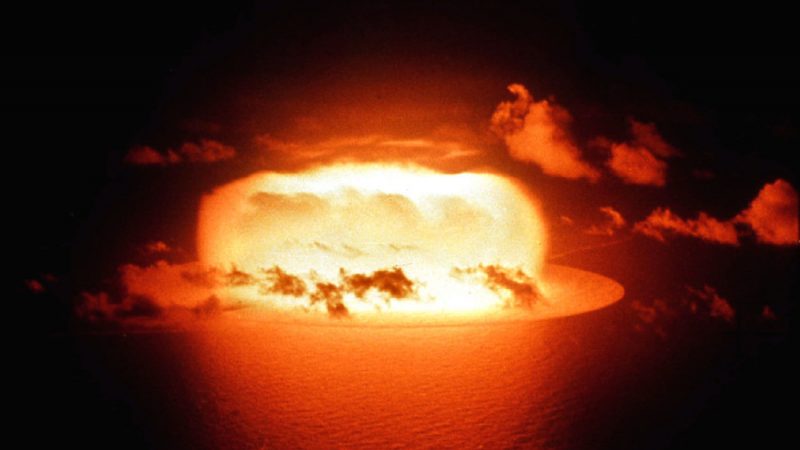
Sputnik – 20.10.2018
US President Donald Trump said that he will pull out of the Intermediate-Range Nuclear Forces Treaty with Russia, media reported.
Donald Trump claimed that Russia violates the Intermediate-Range Nuclear Forces (INF) Treaty with the United States, and that he will pull out of it.
The treaty signed in 1987 by the USSR and the US, stipulated the elimination of nuclear and conventional missiles and their launchers with ranges of 500–1,000 km (310–620 mi) and 1,000–5,500 km (620–3,420 mi).
Commenting on his decision, Donald Trump said that the United States needs to develop this type of military equipment.
“We’ll have to develop those weapons,” the US president said commenting on his announcement.
On Friday, The New York Times reported that the Trump administration was preparing to exit the three-decade-old Cold War-era treaty next week.
Moscow and Washington have repeatedly accused each other of violating the treaty. The previous administration of Former US President Barack Obama however, decided not to leave the treaty.
The previous year, a senior Russian senator warned that Russia may prepare an adequate response to ensure the country’s protection If the United States decides to withdraw from the Intermediate-Range Nuclear Forces Treaty.
Meanwhile, Europe stands for the extension of the Russia-US 2010 New Strategic Arms Reduction Treaty (New START). German Foreign Minister Sigmar Gabriel stated in the previous year that European security could encounter a significant threat should it not be resumed by 2021.
Featured Video

Death Spikes & Rising Cancer In Our Youth Explained
or go to
Aletho News Archives – Video-Images
From the Archives
Politicians lie
By Mazin Qumsiyeh | Popular Resistance | August 18, 2013
There is no way to say this truth nicely: Politicians lie. That includes Japanese, American, Egyptian, Israeli, and Palestinian politicians! Is there something more common sense than that? Yet, so many citizens around the world believe their own politicians or wistfully acknowledge lies but think it is part of the job needed to run things. They believe even when politicians contradict themselves blatantly. This phenomenon is rather remarkable. It is a dissonance and disconnect from reality that many seem oblivious to. It is very dangerous because it can lead to accepting rationales for going to war. These can be deadly wars that lead to millions of lives lost as happened in what was called World War 1 and WW2. Even when incredible and declassified evidence abound, politicians continue to lie and old mythologies refuse to die. Here are just a few of the countless lies told to us over the past few decades… continue
Blog Roll
 Aletho News
- RSF military group defects, joins Sudanese army: State media
- Ireland goalkeeper refuses to play ‘Israel’ as squad weighs boycott
- China pushes back against US on Cuba, Iran
- Ukrainian Soldiers, Potential Mercenaries: Have Gun, Will Travel!
- Burnham’s UN debut… A masterclass in British disinformation
- Iran flights continue despite US aviation sanctions
- Global Tipping Points Lead the World Into a State of Entropy
- The day-after at the White House: USA and Xi Jinping
- The Geopolitical Balance in the Red Sea: The UAE Being Displaced by New Players
- Iraqi resistance group vows to stage airport sit-ins over Iran aerial blockade
- If Americans Knew
- Deconstructing Netanyahu’s pants-on-fire UN rant – Daily Update
- Trump betrayed voters with his campaign lies and prioritized a foreign country once he took office
- Netanyahu calls Israel’s war in Gaza ‘opposite of genocide’ in UN speech to near-empty hall
- Settler Kidnappings: Torture, Sexual Abuse and Terrorisation of Palestinian Abductees as Israel Deepens Annexation of West Bank
- Gaza winter nears as 162,000 tents become unusable, raising fears of humanitarian crisis
- Netanyahu says, “It’s the opposite of genocide”; UN says Gaza economy is world’s ‘most severe crisis on record’ – Daily Update
- Israel’s US-Backed Assault on Gaza Has Created the ‘World’s Most Severe Economic Crisis on Record’: UN
- ‘Protecting U.S. Citizens’… From Israel
- ‘This is where I live now, the back of a truck’: a day in the life of a grandmother in Gaza
- In UN Speech, Iran’s President Displays Pictures of Children Killed by US, Brings Attention to Israel’s Nuclear Arsenal
- No Tricks Zone
- New Study: Earth And Venus Surface Warmth Largely Explained By Convection And Lapse Rate, Not CO2 Or Radiation
- 2025 Nature Paper Claiming Worsening Global Drought Gets RETRACTED …Heavily Flawed
- New Study: ‘Global Drought Shows No Detectable Recent Acceleration Under Climate Warming’
- Economic Masterminds: German Socialists Suggest Taxing Productivity Gains Stemming From Using AI
- The South China Sea Has Not Been Cooperating With The Climate Change Narrative
- Energy Crisis: Germany Enters Heating Season With Historically Low Gas Reserve Fill Levels
- New Study: The Antarctic Ice Sheet Gained Mass From 2020-2024 Due To Staggering Snow And Ice Accumulation
- Study: Ocean Heating Rates From Thousands Of Years Ago ‘Dwarf’ Modern Ocean Heating Rates
- Climate Extremists Target, Attack Large-Scale Power Grid Infrastructure In Germany!
- New Study: Antarctic Ice Melt Has Contributed Less Than 1 Centimeter To Sea Level Rise In The Last 30 Years

