US could use Navy for ‘blockade’ to hamper Russian energy exports – Interior Secretary
RT | September 30, 2018
The US could use its Navy to prevent Russia’s potential energy supplies to the Middle East, Internal Secretary Ryan Zinke said, Washington Examiner reports.
The blockade would actually mean an “act of war,” a Russian Senator fired back.
Zinke alleged that Russia’s engagement in Syria – notably, where it is operating at the invitation of the legitimate government – is a pretext to explore new energy markets.
“I believe the reason they are in the Middle East is they want to broker energy just like they do in eastern Europe, the southern belly of Europe,” he has reportedly said.
And, according to to the official, there are ways and means to tackle it. “The United States has that ability, with our Navy, to make sure the sea lanes are open, and, if necessary, to blockade … to make sure that their energy does not go to market,” he said.
Zinke was addressing the attendees of the event hosted by the Consumer Energy Alliance, a non-profit group which styles itself as the “voice of the energy consumer” in the US.
He went on to compare Washington’s approaches to dealing with Russia and Iran, noting that they are effectively the same.
“The economic option on Iran and Russia is, more or less, leveraging and replacing fuels,” he said, while referring to Russia as a “one trick pony” with an economy dependent on fossil fuels.
Zinke’s statements provoked an angry response from Moscow, which equated a potential maritime blockade to an “act of war,” while calling the interior secretary’s assumptions “nonsense.”
“A US blockade of Russia would be equal to a declaration of war under international law,” Russian Senator Aleksey Pushkov said, commenting on Zinke’s words. Russia does not currently export any energy to the Middle East, which itself is a major oil exporting region. The whole idea is an “absolute nonsense,” the Senator argued.
The comment from the US Interior Secretary come as the Trump administration has been on a mission to boost the export of its liquefied natural gas to Europe, replacing Russia, the far cheaper option for European consumers. To that effect, the Trump administration officials, including US President Donald Trump himself, try to persuade Germany to pull out of the “inappropriate” Nord Stream 2 pipeline project, which according to Trump, made Berlin Moscow’s “captive.”
Moscow has repeatedly stressed that the $11 billion Nord Stream 2 pipeline, which is set to double the existing pipeline capacity to 110 billion cubic meters, is a purely economic project. The Kremlin argues that Washington’s fervent opposition to the project is simply driven by economic reasons and is an example of unfair competition.
“I believe we share the view that energy cannot be a tool to exercise pressure and that consumers should be able to choose the suppliers,” Russian Energy Minister Aleksandr Novak said following a meeting with US Energy Secretary Rick Perry in Moscow in September.
The US stance has drawn a backlash from Germany, which has reaffirmed its commitment to the project.
Germany’s leading organization for industry, the Federation of German Industries (BDI), has called on the US to stay away from EU energy policy and the bilateral agreements between Berlin and Moscow.
“I have a big problem when a third state interferes in our energy supply,” Dieter Kempf, head of the Federation of German Industries (BDI) said following a recent meeting between German Chancellor Angela Merkel and Russian President Vladimir Putin.
BBC’s climate change ‘facts’ are fiction
By Harry Wilkinson – The Conservative Woman – September 22, 2018
In order to avoid giving ‘false balance’ to the climate alarmists at the BBC, I thought it would be a good idea to fact-check their new internal guidance on climate change. This is their totalitarian memorandum aimed at stamping out free scientific discourse, on the basis that certain facts are established beyond dispute.
The problem is that these aren’t, and the BBC is guilty of repeatedly failing to describe accurately the nuances of climate science and the degree to which certain claims are disputed.
The crucial paragraph reads:
‘Most climate scientists regard a rise of 2 degrees C as the point when global warming could become irreversible and the effects dangerous. At current rates, we are on track for a rise of more than 3-4 degrees C by the end of the century.’
There are so many things wrong with this short statement.
That global warming can be somehow ‘irreversible’ is pure propaganda; the climate has always been changing and it always will. The briefing later describes the idea of catastrophic tipping points as a ‘common misconception’, so they have comically failed their own test right at the start.
A temperature rise of more than two degrees is not inherently dangerous either. The majority of economic impact studies put the cost of climate change by the end of the century at between 1.5% and 3% of world GDP, but these studies often make the inaccurate assumption that either no or little adaptation will take place.
In contrast, even the IPCC has admitted (p.15) that the cost of reducing emissions (‘mitigation’) to meet the 2oC target may be up to 4% of world GDP in 2030, 6% in 2050 and 11% in 2100.
These numbers do not incorporate the benefits of reducing our emissions, which are primarily the avoided costs of climate change. But given that a certain amount of warming is already ‘baked in’, it looks almost certain that this ‘mitigation’ will actually be far more expensive than not doing anything. If warming actually turns out to have a positive effect, the gamble will have failed even more spectacularly.
The IPCC has openly admitted that its cost forecasts come with incredibly optimistic assumptions that immediate mitigation takes place in all countries, that there is a single global carbon price, and that there are ‘no additional limitations on technology relative to the models’ default technology assumptions’. With no carbon capture and storage (CCS), they predict the total mitigation cost rises by a staggering 138%. The bad news is that CCS is currently failing to deliver, and few now expect it to play a significant role in reducing emissions.
Given the record of economic forecasts, all these predictions should be taken with a pinch of salt, but on the available evidence it appears we are sleepwalking into spending trillions of pounds to achieve only a negligible reduction in global temperatures.
The father of the two-degree target, veteran climate alarmist Hans Joachim Schellnhuber, has admitted the number is entirely fabricated: ‘Two degrees is not a magical limit; it’s clearly a political goal’. He nonetheless celebrates its cynical effectiveness at motivating international political action.
Other prominent climate scientists, such as Hans von Storch, have been much more critical of this approach. Storch reflects on how scientists have become political sermonisers in a way which damages science as a whole: ‘Unfortunately, some of my colleagues behave like pastors . . . it’s certainly no coincidence that all the mistakes that became public always tended in the direction of exaggeration and alarmism.’
The statement that we are on track for ‘more than 3-4 degrees’ is an even more blatant distortion of the scientific evidence. Earlier this year, Peter Cox of the University of Exeter announced the results of his latest study which ruled out higher levels of warming. He concluded that ‘climate sensitivity’ would be in the narrower range of 2.2-3.4oC, thus ruling out warming of 4 or 5 degrees by 2100. His voice adds to a growing consensus that climate sensitivity will be lower than previously estimated. Does the BBC now consider him a climate denier too?
Quite surreally, the document also describes the statement that ‘climate change has happened before’ as a ‘common misconception’. How much longer before the BBC renames itself The Ministry of Truth?
Estimating the current and future impacts of climate change is a complex and contested enterprise, but the BBC would rather you didn’t know. ‘The science is settled’ they say, so move on. This climate memorandum is nothing less than propaganda presented as fact by controller Fran. There is a critical debate to be had, so inquisitive people had better look elsewhere.
Volvo stops truck assembly in Iran due to US sanctions
RT | September 24, 2018
Swedish truckmaker Volvo has stopped assembling trucks in Iran because of Washington’s sanctions, spokesman for the company, Fredrik Ivarsson, told Reuters.
According to him, the group could no longer get paid for parts it shipped and had therefore decided not to operate in Iran.
“With all these sanctions and everything that the United States put (in place)… the bank system doesn’t work in Iran. We can’t get paid… So for now we don’t have any business (in Iran),” Ivarsson said.
Volvo was working with Saipa Diesel (part of Iran’s second-largest automaker Saipa) which was assembling the Swedish firm’s heavy-duty trucks from kits shipped to Iran. The company had plans to become Iran’s main export hub for the Gulf region and North Africa markets.
An unnamed commercial department manager at Saipa Diesel told the media that more than 3,500 Volvo trucks had been assembled in the year to May. However, none had been assembled in this financial year, he said. The original deal was for at least 5,000 trucks.
The manager confirmed that sanctions had prompted Volvo Trucks to terminate their partnership agreement.
“They have decided that due to the sanction on Iran, from (May) they couldn’t cooperate with us. We had some renovation planned in Iran for a new plant but they refused to work with us,” he said.
Volvo has joined a list of European companies such as Total, Adidas and Daimler, who have been forced to reconsider their investments in Iran. The firms said they will scale back or abandon all operations in Iran due to Washington’s sanctions.
Swedish truckmaker Scania, which is owned by Volkswagen (VW), said it had canceled all orders that it could not deliver by mid-August due to sanctions. French carmaker PSA Group began to suspend its joint venture activities in Iran in June.
Germany’s Daimler said it was closely monitoring any further developments, while Volkswagen rejected reports that it had decided against doing business in Iran. VW said its position had not changed.
Egypt, Cyprus sign accord to build gas pipeline
MEMO | September 20, 2018
Egypt yesterday signed an agreement with Cyprus to construct a maritime pipeline between the two countries, which will transfer of natural gas from Cyprus to Egypt for re-export to different markets, especially the European Union (EU) countries.
The agreement was signed in a meeting held in Cyprus between the Egyptian Minister of Petroleum and Mineral Resources, Tarek El-Molla, and the Cypriot minister of Energy, Industry, Tourism and Trades, Georgios Lakkotrypis.
The project, which was said to cost around $800 million, will involve building a pipeline to transfer natural gas from Cypriot Aphrodite field to Egypt’s liquefied natural gas (LNG) facilities.
El-Molla said that the agreement contributes “to boosting the economic relations between Egypt and Cyprus and is considered as an important step in maximising the benefit of the discoveries of the Cypriot gas fields.”
“The Egyptian-Cypriot agreement is not only about the implementation of a maritime pipeline, but it will contribute positively to securing gas supplies to the EU,” he added.
The deal, El-Molla reiterated, will encourage further research exploration activities in the region and will contribute to further support joint cooperation in the field of oil and gas between the two countries.
Referring to another memorandum of understanding, which was signed between Egypt and the EU in the field of energy last April, the Egyptian minister stressed that it “will open up important prospects for the role that Egypt can play in the industry.”
On his part, Lakkotrypis said that the deal was “an important milestone, not only for Cyprus but also the entire eastern Mediterranean region,” adding that “it’s [the joint agreement] the first of its kind in Cyprus and Egypt’s shared region.”
US-Indian Relations: Trump Gets a Unique Partner for America First
By Melkulangara BHADRAKUMAR | Strategic Culture Foundation | 18.09.2018
The inaugural meeting of the foreign and defence ministers of India and the United States in a new “2+2” format on September 6 in New Delhi assumed added significance as an attempt by the Trump administration to translate its Indo-Pacific vision outlined in the National Security Strategy (NSS) of last December.
The NSS had explicitly singled out Russia and China as “revisionist” powers that “challenge American power, influence and interests.” Equally, it ascribed a pivotal role to India in the Indo-Pacific. The “2+2” deliberations fleshed out these two templates.
For the first time in the post-Cold War era, the US has inserted itself into the “time-tested” relationship between India and Russia. Demolition of Indian-Russian partnership has been a hidden agenda of the US’ regional policy since the 1990s but it surged in an overt and abrasive form last week.
This shift from an aspirational approach to intrusive approach can be seen in the backdrop of the deterioration of US-Russia relations and the probability that tensions are unlikely to dissipate in a foreseeable future. The US sanctions against Russian defence sectors have been enacted in the full knowledge that India would be an acutely affected party. The US sanctions laws against Russia are acting like the Damocles’ sword to wear down India’s resistance to rollback in ties with Russia.
A similar US assault on India-Russia energy cooperation can be expected soon, which is another promising area for US exports to India. Besides, the US is also threatening to sanction Russia’s financial sector. Clearly, what the US is seeking goes far beyond a reset or atrophy in the Indian-Russian relationship. It aims at nothing less than draining the contents of the “Special Privileged Strategic Partnership” between India and Russia and make it an empty shell. Yet, partnership with Russia has been historically an anchor sheet of India’s strategic autonomy.
Indeed, it becomes a sad reflection of the huge inroads the US has made through the recent decade since the signing of the 2008 US-Indian nuclear deal to breach India’s strategic autonomy. Put differently, weakening of the India-Russia relations is an imperative need for Washington to hustle India on the path of becoming its key ally in the Indo-Pacific. Such a profound shift in the US approach can only be understood in terms of the strategic importance and the sense of urgency that the NSS attaches to the Indo-Pacific region.
The NSS ranks the Indo-Pacific as a strategically more vital area than the Middle East (which has been the principal domain so far of the US’ strategic attention.) The NSS prioritizes the “Quad” (quadrilateral alliance of the US, Japan, Australia and India) more emphatically than even Washington’s transatlantic leadership as a platform of the US’ global strategies. Washington intends to checkmate China, which the NSS has portrayed as the US’ competitor who poses challenge to its world leadership and the international order.
Washington’s Indo-Pacific strategy appeals to the Indian audience alongside the NSS’ grand designation of India as a “leading global power”. Delhi exulted over the NSS document: “We appreciate the importance given to India-United States relationship… the two responsible democracies…share the same objectives.” To be sure, the Trump administration has rekindled a decade-old Indian dream of being a “counterweight” to China.
An influential section of India’s foreign-policy elite remains wedded to the notion that fundamentally, the US helped China’s rise in the Cold War era and that India is similarly well positioned to garner American benevolence in the emergent New Cold War conditions. The “2+2” highlighted that the US has astutely tapped into the Indian elite’s “unipolar predicament”.
In the recent period since the NSS was announced, the Trump administration has declared India as a “Major Defence Partner”, opening the door for the sale of more advanced and sensitive military technologies by American vendors at par with the US’ closest allies and partners, and fostering convergence of interests with India on a range of issues like maritime security, domain awareness and so on.
Without doubt, this has been a “win-win” strategy for Washington. The signing of a Communications Compatibility and Security Agreement (COMCASA) at the “2+2” testifies to it. The COMCASA is modeled on agreements Washington has with its most important NATO and treaty allies. It is a big leap forward in developing “inter-operability” between the militaries of the US, its allies, and India, which in turn transforms India into a front-line state in the US’ military-strategic offensive against China in the Indo-Pacific. Another such “foundational agreement”, Logistics Exchange Memorandum Agreement (signed in 2016 and operationalized last year), has already opened India’s air bases and naval ports to routine use by US warplanes and battleships for refueling and resupply.
The “2+2” joint statement announced that India and US will stage their first-ever joint exercise involving all three branches of India’s military next year, and that they are setting up “hotlines” between their respective foreign and defence ministries “to help maintain regular high-level communication on emerging developments.” It commits the two countries to increased bilateral, trilateral and quadrilateral military-security cooperation. On the other hand, COMCASA is expected to pave the way for a major boost in Indian purchases of US weaponry, which is likely to begin with India’s procurement of armed naval drones for anti-submarine warfare.
All this works splendidly for the US. In sum, by playing on India’s geopolitical apprehensions regarding China’s rise as a global power and playing astutely on India’s own great-power ambitions, US is promoting on the one hand its business interests in the Indian market while on the other hand also locking India into its Indo-Pacific alliance system against China as well as progressively undermining the India-Russia “time-tested” relationship.
It’s a “win-win” strategy all the way. The Trump White House has drawn encouragement from the “2+2” to push the idea of concluding a free-trade agreement with India. Informal conversations have already begun.
Trump appears bullish that when push comes to shove, the present Indian government will bend to Washington’s diktats. Indeed, the Trump administration can count on influential back channels, too. It is no secret that the upper caste Indian Diaspora in the US has close links with the Hindu nationalist groups that mentor Modi government.
Thus, it comes as no surprise that Trump sees Prime Minister Modi as a unique partner for his “America First” project. Trump will skip the East Asia Summit in Singapore in November but is signaling interest in Modi’s invitation to him to be the guest of honor at India’s National Day celebrations in January.
No bad reviews? Amazon employees might have deleted them for bribes
RT | September 17, 2018
Some Amazon employees have reportedly been bribed by sellers to remove bad reviews of products sold through the online retail giant. The average bribe is around $300 per review, with most of the demand coming from China.
The retail giant has launched an internal investigation into the shady practice, with a probe ongoing since May, when Eric Broussard, Amazon’s vice president, was reportedly notified of the problem, the Wall Street Journal reported on Sunday.
The transactions were facilitated by middlemen who used the messaging service WeChat in China.
Citing people familiar with the scheme, the WSJ reported that it costs around $300 to delete one review. However, brokers prefer to trade wholesale, with the minimum number of reviews for removal standing at five.
Depending on the type of data and its volume, the brokers also charge between $80 and $2,000 for coveted data.
Up for grabs are internal sales statistics, including keywords, as well as an option to delete reviews or buy customers’ email addresses.
One of the incentives prompting Amazon workers to go down this slippery slope and violate strict internal regulations that ban sharing sales and customer data, is the relatively low wages they receive in China, the publication notes.
Amazon has come under fire in the past for underpaying its employees and forcing them to work in harrowing conditions not only in China, but also across Europe and in the US. An undercover journalist working at an Amazon warehouse in Staffordshire, UK reported that workers are forced to pee in bottles so as not to miss work targets. In the US, a group of employees recently complained of exhaustion, dehydration and fatigue, as they were working without air-conditioning in the company’s warehouse in Minnesota.
At the moment, several suspected bribery cases, including one in the US, are reportedly being investigated by Amazon.
A spokesperson for the company has confirmed that the probe is ongoing, noting that it has been taking steps to avert the malpractice happening in the future by installing systems that would restrict workers’ access and monitor their actions.
While the trustworthiness of online reviews is crucial for businesses like Amazon, since online buyers are not able to examine a product themselves, it has long been plagued by the problem of fake reviews.
FakeSport.com founder Saoud Khalifah has recently estimated that some 30 percent of Amazon reviews are probably fake, with the number nearing 95 percent for “Chinese no-name companies.”
Read more:
‘Credit Card Wars’: Pentagon Grossly Underestimates Cost of Post-9/11 Wars
Sputnik – September 11, 2018
The Pentagon estimates that the cost of war since the fateful terror attacks on 9/11 rounds out to $1.5 trillion, yet experts maintain that this figure wildly underestimates the true financial burden of perpetual war.
“After 16 years, should the taxpayers of America be satisfied we are in a ‘stalemate?’ I don’t think so,” the late Sen. John McCain said in 2017.
The Pentagon’s $1.5 trillion figure purports to cover the time period from September 11, 2001, until March 31, 2018. While this may seem like a large sum of money, it’s only about twice the 2017 Pentagon budget of $700 billion. About $1.5 trillion might be a reasonable ballpark estimate for war spending in the past few years, but to suggest it as the gross cost of 17 years of bombings; costs per hour to fly military aircraft; supplies for personnel overseas; costs of lost, damaged and stolen equipment; soldier pay; and more is almost an offense to reason.
Literally 10 years ago, in 2008, Harvard’s Linda Bilmes and Columbia University’s Joseph Stiglitz found that the cost of the Iraq and Afghan conflicts alone totaled $3 trillion. And now the Pentagon would have credulous news outlets like CNBC believe that 17 years of endless wars in the Middle East and South Asia have run a tab of a mere $1.5 trillion.
The “Costs of War” study by Brown University’s Watson Institute for International and Public Affairs estimates that from 2001 to 2017, Congress appropriated $4.35 trillion for war and war-related expenses. Moving through fiscal year 2018, that figure surged to $4.6 trillion. Both figures, as Brown’s report authors note, do not take into account future expenses for medical and disability coverage for veterans of the Global War on Terror, which the study forecasts will cost $1 trillion.
The Pentagon study tracks just three areas of spending: “war-related operational costs,” such as training, operating tempo, base support and equipment maintenance; “support for deployed troops,” including food, clothing and medical treatment for troops currently overseas; and “transportation of personnel and equipment.”
So what’s included in Brown’s study that is absent from the DoD report?
For one, Brown’s study includes spending on the Department of Homeland Security. DHS was set up under then-President George W. Bush’s administration in November 2002 as part of the Homeland Security Act. Brown’s report states that spending on DHS for “prevention and response to terrorism” adds up to about $783 billion since the inception of the department.
Further, Brown accounts for the cost of financing required to undertake Overseas Contingency Operations, or OCO. Since the Pentagon borrowed incredible sums of money to pay for the war, the department had to make interest payments. “Estimated interest paid on OCO borrowing for wars [from] FY [fiscal year] 2001 to FY 2017” comes out to $534 billion, Brown’s Watson Institute reported. When interest on loans for war operations in 2018 is factored in, that $534 billion figure shoots up another $88 billion.
Another factor accounted for by the Watson Institute and excluded by DoD is how much money the base Pentagon budget grew in 2018 “due to post 9/11 wars,” which adds another $33 billion to Brown’s total figure of $5.6 trillion — or about 25 percent of annual US GDP.
In its addendum, Brown’s Watson Institute notes, “[c]umulative interest on war appropriations through FY 2013 is currently estimated to add more than $7.9 trillion to these totals by 2056.”
Thus, Brown’s estimate adds up to $13.5 trillion — nine times more than DoD’s estimate. Perhaps for this reason, Bilmes has dubbed these wars the “credit card wars.”
To conduct the “Costs of War” study, the Watson Institute gathered together an international team of 35 scholars, activists and legal experts. The study examined costs associated with US wars in Iraq, Syria, Afghanistan and Pakistan, as well as post-9/11 veterans’ care and homeland security.
It’s important to note a few things about the Pentagon’s study. First, the Pentagon has a conflict of interest in auditing its own war-related spending.
Further, the Pentagon has been unable to keep track of incredible sums of money. It has never conducted a complete audit, but that is supposed to change. A year ago the Pentagon agreed to an audit to track the Pentagon’s several hundred billion dollars in yearly expenditures. But military financial managers found themselves on the hot seat after sharing the mammoth $1 billion cost it would take to check the Pentagon’s books, Government Executive reported this year.
In February, the Pentagon’s Defense Logistics Agency was unable to tell auditors from Ernst & Young where $800 million for construction projects had gone, Sputnik reported. In January, the Project on Government Oversight reported that some $675 million had been squandered on economic development projects that were intended to help rebuild Afghanistan.
Don’t Mention the War: Controversial British Army Recruitment Strategies Exposed

7th Army Training Command, CC
Sputnik – September 11, 2018
An internal document setting out the marketing plan for the UK military’s controversial ‘This Is Belonging’ recruitment campaign has revealed the Ministry of Defense is seeking to enlist young people from poor, working-class backgrounds with limited opportunities.
The brief describes the campaign’s target audience as “16 —24, primarily C2DE”, the latter being a demographic classification referring to the UK’s three lowest social and economic groups.
These individuals are said to be; “open to change”; “ambitious and money-driven, but not good at money management”; “highly likely to be influenced by those around them”; have a “thirst for variety and risk”.
‘Focus locations’ for the propaganda blitz are northern cities of Bradford, Leeds, Liverpool, Manchester, Middlesborough, Newcastle, Sunderland and Sheffield. Other major metropoles in recruiters’ crosshairs are Birmingham, Cardiff, Glasgow and, perhaps predictably, London.
In a section titled previous channel learnings,’ ‘out of home’ advertising is said to have previously been “anecdotally reported” as a “strong performer” in gyms, pubs, bars, sports centres and ‘powerleagues.’
In respect of TV ads, the document states the campaign’s ‘hero spots’ should ideally run before, during or after sports, dating, and reality shows, including The Voice, Celebrity Big Brother, Celebrity Bake Off and Gogglebox.
Adverts will also be shown in cinemas, but the document warns against running them prior to “combatant” films — perhaps indicating the romantic and glamorous depiction of army life promoted by ‘This Is Belonging’ may be compromised by association with violent war films.
Child Soldiers?
The campaign provoked controversy earlier in 2018 when it was revealed ads targeting 16-year-olds via social media on and around GCSE results day were promoted via Facebook, suggesting they enroll in the army if they didn’t achieve the grades they were expecting.
Beyond the implied cynicism of targeting potentially stressed, vulnerable children, some were simply shocked to learn the UK routinely recruited under-18s for military service — the only country in Europe, and the only member of NATO and permanent UN Security Council, to do so.
Individuals can apply for the army from the age of 15 years and 7 months old — once enlisted, they can leave after the first six months of their contract if they wish — Ministry of Defense figures indicate one in three recruits who join up at 16 or 17 leave the army after a few months — but those who stay past the age of 18 are locked into military service until 22.This practice has endured despite stringent criticism from the United Nations Committee on the Rights of the Child, Parliament’s own Joint Committee on Human Rights, and numerous charities and NGOs — among them Forces Watch.
“Compared with older personnel, younger recruits are significantly more likely to suffer post-traumatic stress disorder, consume alcohol at harmful levels and behave violently upon returning from deployment. Young recruits from disadvantaged backgrounds are at greatest risk — they’re more vulnerable to stress, be given jobs more exposed to traumatically stressful events on the battlefield, and lack strong social support when they leave the forces in order to manage the effects of any mental health problems they may be experiencing,” spokesperson Rihanna Louise told Sputnik.
This lack of social support may account for why UK army veterans under the age of 24 are three times more likely to take their own lives than their civilian counterparts.
Nonetheless, Forces Watch believe the targeting of vulnerable young people by UK military recruiters is no accident — and in fact suggest ‘This Is Belonging’ specifically seeks to exploit “the typically adolescent desire” to find a sense of kinship and acceptance, at an age when a tendency towards hasty and risky long-term decision-making is almost universal.
“This is also an important time for learning and gaining educational and social skills for healthy development — but while the military does provide some education for its 16-18-year-old personnel, it’s not standardized by the same requirements as mainstream education, falls short of offering satisfactory transferable qualifications — which significantly contributes to veteran unemployment — and is secondary to military training. In any event, adolescents are misled into thinking they needn’t be concerned with civilian qualifications and learning — the Army has a job for them regardless of qualifications,” Rihanna told Sputnik.
See also:
UK Military Academy Cadets Investigated for Waterboarding Claims – Reports
Iran, Russia can cooperate to contain US: Ayatollah Khamenei
Press TV – September 7, 2018
Leader of the Islamic Revolution Ayatollah Seyyed Ali Khamenei says the developments in Syria and the US defeat in the Arab country show that Washington can be contained.
The Leader made the remarks in a Friday meeting with Russian President Vladimir Putin, who traveled to Tehran to participate in a key trilateral summit on Syria, hosted by Iranian President Hassan Rouhani and also attended by Turkish leader Recep Tayyip Erdogan.
“Cooperation between Iran and Russia on the Syrian issue is a prominent example and a very good experience of bilateral cooperation,” the Leader said.
Ayatollah Khamenei added that the two countries can expand cooperation on global issues, saying, “One of the cases that the two sides can cooperate with each other is to contain the US, because it is a danger to humanity and it is possible to contain it.”
The Leader stated that the Americans suffered a real defeat in Syria and failed to achieve their goals.
Ayatollah Khamenei also said sanctions imposed by the US on Iran, Russia and Turkey are a very strong common ground for strengthening cooperation, and urged Tehran and Moscow to develop political and economic relations and follow up on the agreements of the summit in Tehran.
The Leader stressed the importance of pursuing non-dollar transactions in trade.
Europeans did not fulfill JCPOA commitments: Ayatollah Khamenei
Elsewhere in his remarks, Ayatollah Khamenei said Iran has so far remained committed to a multilateral nuclear agreement, officially known as the Joint Comprehensive Plan of Action (JCPOA), reached between Iran and the P5+1 group of countries in 2015.
“But the Europeans did not carry out their duties, and it is not acceptable that we completely fulfill our commitments within the JCPOA while they don’t,” the Leader pointed out.
The Leader praised the Russian president’s approach to the nuclear deal, adding that the Islamic Republic would adopt a stance on the JCPOA which would meet its national interests.
Although the US now raises Iran’s missile program and regional developments, their problem with the Islamic Republic relates to issues beyond them, Ayatollah Khamenei said.
The Leader added that the US has been seeking to topple the Islamic Republic over the past 40 years, but Iran has managed to make substantial advancements during this period.
“The resistance of the Islamic Republic and its advances are another successful example that the US can be contained,” Ayatollah Khamenei said.
The Leader also pointed to the deplorable situation of the Yemeni people and their killing at the hands of Saudi Arabia, adding, “The Saudis will definitely fail to achieve a result in Yemen and will not be able to bring the resilient Yemeni people to their knees.”
During the meeting, which was also attended by Iranian First Vice President Es’haq Jahangiri, the Russian president said he held very fruitful and good negotiations with President Rouhani on mutual issues of interest, including the situation in Syria.
Iran and Russia discussed the expansion of relations in all fields, particularly in the economic and trade sectors, Putin added.
He said the US is putting obstacles, including banking restrictions, in the way of the development of Tehran-Moscow relations, and added that Washington is making a strategic mistake by limiting financial transactions.
The Russian president expressed regret that the remaining sides to the JCPOA failed to fulfill their commitments under the deal after the US withdrawal.
He said although the Europeans announce that they are seeking ways to keep the nuclear accord alive, they are following the US due to their dependence on Washington.
US-Pakistani Relations Head South: Pentagon Cancels Military Aid to Islamabad
By Arkady SAVITSKY | Strategic Culture Foundation | 05.09.2018
The US Defense Department has made a final decision to cancel $300 million (the Coalition Support Funds) in aid to Pakistan. The official reason is Islamabad’s failure to take decisive action against the militants who are waging war in Afghanistan: the Haqqani network and the Afghan Taliban. The move is subject to approval by Congress. It was announced mere days before Secretary of State Mike Pompeo is due to visit Pakistan to meet Imran Khan, the country’s new prime minister. It also took place right on the heels of Iranian Foreign Minister Javad Zarif’s visit to Pakistan, where the leadership expressed support for Iran and the nuclear deal the US abandoned. One is reminded of President Trump’s Aug. 7 tweet warning that “[a]nyone doing business with Iran will NOT be doing business with the United States.”
The announced decision is part of a broader suspension that was proclaimed at the beginning of the year. “The United States has foolishly given Pakistan more than 33 billion dollars in aid over the last 15 years, and they have given us nothing but lies & deceit,” President Trump tweeted on January 1, 2018. “They give safe haven to the terrorists we hunt in Afghanistan, with little help. No more!” The statement was followed by announcement that Secretary Jim Mattis was authorized to grant $300 million in CSF funds over the summer if he saw a change of attitude in Islamabad. He didn’t.
The US has started to suspend its training and educational programs for Pakistani officers. No funds have been provided for the coming academic year. US military institutions, including the National Defense University in Washington DC, the US Army’s War College in Carlisle, Pennsylvania, the US Naval War College, the Naval Staff College, and other courses they offered, including cybersecurity studies, eliminated the 66 slots they had reserved for cadets from Pakistan. It’s rather symbolic that Moscow and Islamabad signed an agreement on August 7 to train Pakistani military personnel in Russia.
With that country’s foreign-exchange reserves plummeting, PM Imran Khan will have to decide whether his government will seek a bailout from the International Monetary Fund (IMF), where the United States controls more votes than any other member. The alternative would be to turn to China, Russia, and other friendly nations. After the victory of the Pakistan Tehreek-e-Insaf (PTI) party in the 2018 general elections, China agreed to grant a $2 billion loan to Islamabad. On July 30, US Secretary of State Mike Pompeo warned that any potential IMF bailout for Pakistan’s new government must not include funds to pay off the country’s Chinese lenders. Pakistan is pinning its hopes on the China-Pakistan Economic Corridor (CPEC) project.
Russia and Pakistan marked the 70th anniversary of their diplomatic relations on May 1, 2018. That relationship has seen its ups and downs, but today it has risen to a new historic high.
Moscow and Islamabad see eye-to-eye on the prospects for ending the conflict in Afghanistan. Pakistan has endorsed the Russian-brokered peace talks that exclude the United States but include the Taliban. Pakistan strongly supports Russia’s Syria policy. Islamabad’s membership in the Shanghai Cooperation Organization (SCO) opens up new prospects for cooperation. Russian President Vladimir Putin has put forward a proposal to create a more extensive Eurasian partnership based on the Eurasian Economic Union (EEU), which would involve China, India, Pakistan, Iran, and those from the Community of Independent States (CIS) that are willing to join. Islamabad is also interested in signing a free-trade agreement with the Russian-led Eurasian Economic Union (EEU).
Pakistan has shown its interest in buying military hardware from Russia, has participated in Russian war games, and has also attended Army exhibitions. In September 2016, Russia and Pakistan held their first-ever joint military exercise. It’s been held yearly ever since. Pakistan’s Chief of Army Staff General Javed Bajwa paid his first visit to Russia in April of this year. In late July, the two countries signed a naval cooperation agreement during the visit of Pakistan’s Vice Chief of the Naval Staff Vice Admiral Kaleem Shaukat to Russia. The Pakistani military plans to purchase Su-35 fighter jets and T-90 tanks from Russia.
Russia is involved in many economic projects, such as the Karachi Steel Mill and Gudhu Power Plants. In 2015, Russia and Pakistan signed a contract to build a 1,100-kilometer gas pipeline from Karachi to Lahore (the North-South pipeline) with a capacity of 12.4 billion cubic meters per annum — the largest economic deal ($1.7 billion) between the two countries since the USSR built the Pakistan Steel Mills in the 1970s. Delayed several times because of tariff disputes, it will be set in motion this year by a Russian company called RT – Global Resource.
Pakistan has already invited the Russian Federation to join the $1.16 billion Central Asia-South Asia power project or CASA-1000, which will allow for the export of surplus hydroelectricity from Tajikistan and Kyrgyzstan to Pakistan and Afghanistan. In 2017, Pakistan’s government gave the go-ahead for the initiation of an agreement with Russia to construct a 600MW Natural Gas Combined Cycle (NGCC) power plant in Jamshoro, Sindh.
US-Pakistani relations are evidently at a low ebb but every coin has two sides. This is prompting Islamabad to diversify its foreign relationships. There are other partners with a lot to offer that could make that country stronger and much less vulnerable to outside pressure.
Populism Revisited
By ADRIAN KUZMINSKI | CounterPunch | September 4, 2018
Ever since the last presidential election the words “populist” and “populism” have been widely bandied about, mostly as pejorative terms. A populist politician, we often hear, is a demagogue who wins votes by inflaming the resentments and emotions of ordinary people at the expense of rational thought. Those who fall prey to populism are no more to be trusted, critics suggest, than the politicians said to manipulate them.
It’s a curious feature of populism that it defies the normal left-right political spectrum. These days we have left-wing and right-wing populists. In the last election, Bernie Sanders and Donald Trump were both called populists. And historically, we’ve had left-wing populists like Huey Long, and right-wing populists like George Wallace.
It is the corrupt elites, populists argue, who are to blame for the insecurities and troubles of the middle-class. If you’ve lost your job, are over your head in debt, can’t pay your bills, don’t have adequate health care, lack a decent pension, and feel that your values are being undermined, populists say, it’s because of them. The elitist agenda, they say, is what drives inequality, including the outsourcing of jobs, corporate globalization, union-busting, deregulation, and the machinations of the deep state. All this, in their view, represents the tyranny of the one percent, not the welfare of the ninety-nine percent.
It doesn’t require a demagogue to convince people that these are real problems, not paranoid fears. The trouble with modern left and right wing demagogues is their unwillingness or inability to get at the root of the problems which they try to leverage for votes. It’s telling that politicians accused of populism today don’t call themselves populists, as well they shouldn’t. They’re faux-populists who stop short of challenging the status quo of continuing inequality.
Some history might be useful here. It’s largely forgotten that there was a vibrant populist movement in nineteenth century America. It was represented first by the Farmers Alliance after the Civil War, and then by the People’s party in the 1890s. The People’s Party candidate for president in 1892, James B. Weaver, got over a million votes and carried four states. Over 40 populists were elected to Congress in the 1890s, including six United States Senators, along with numerous governors and mayors.
Today such a populist wave would be totally shocking, which is a measure of how narrow our political options have become. The classic nineteenth century American populists were the last serious political movement in this country to defy the duopoly of the two major parties and lock-step left-right thinking. Their defeat in the 1890s by their better-funded and organized opponents ensured that the issues they tried to raise would henceforth be excluded from national political debate–as indeed they have been down to the present day.
What were those issues? Classic populists–unlike their modern faux-populist successors–rejected the two options that even then defined American political discourse: corporate capitalism and state socialism. Corporate capitalism consolidates economic and political power into giant top-down structures controlled by a handful of rich investors and executives. State socialism consolidates economic and political power into giant top-down structures controlled by a handful of politicians and bureaucrats. You see the similarity.
Classic populists rejected both socialism and capitalism as tyrannical absolutist ideologies. Instead they tried to balance the need for collective action with individual freedom. They sought to maximize equality by making sure that private property was widely distributed, and that concentrations of economic power were highly regulated, if not eliminated. They were advocates of small, independent producers: farmers, artisans, fabricators, and generally owners of moderate-scale, local, independent enterprises. They aimed to relocalize democratic government in the decentralized Jeffersonian tradition of home rule. You can have genuine free markets and real democracy, they argued, only when citizens enjoy individual economic security as independent owners of productive property, and can practice meaningful local democracy.
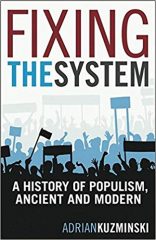 Classical populists weren’t led by demagogues–who flourish in modern, impersonal, mass politics–but by a variety of grassroots activists (as we would say today) who focused on the issues then crucial to economic and political independence, especially the regulation and decentralization of corporate power (especially in government, finance, transportation, and communications). They advocated public banking as a way of redistributing capital to individuals and small businesses by allowing easy public access to credit at low interest rates. (More about populism can be found in my book, Fixing the System: A History of Populism Ancient & Modern.)
The politicians who try to exploit populist concerns today aren’t really populists. They’re usually left-wing state socialists (Bernie Sanders) or right-wing corporate capitalists (Donald Trump). They advocate more big socialism or more big capitalism to solve our problems. But neither socialism nor capitalism is likely to produce the kind of individual economic and political freedom the original populists envisioned. The problems they raised are with us more than ever. Maybe it’s time to take their solutions seriously.
Adrian Kuzminski is a scholar, writer and citizen activist who has written a wide variety of books on economics, politics, and democracy.
Featured Video

Death Spikes & Rising Cancer In Our Youth Explained
or go to
Aletho News Archives – Video-Images
From the Archives
Politicians lie
By Mazin Qumsiyeh | Popular Resistance | August 18, 2013
There is no way to say this truth nicely: Politicians lie. That includes Japanese, American, Egyptian, Israeli, and Palestinian politicians! Is there something more common sense than that? Yet, so many citizens around the world believe their own politicians or wistfully acknowledge lies but think it is part of the job needed to run things. They believe even when politicians contradict themselves blatantly. This phenomenon is rather remarkable. It is a dissonance and disconnect from reality that many seem oblivious to. It is very dangerous because it can lead to accepting rationales for going to war. These can be deadly wars that lead to millions of lives lost as happened in what was called World War 1 and WW2. Even when incredible and declassified evidence abound, politicians continue to lie and old mythologies refuse to die. Here are just a few of the countless lies told to us over the past few decades… continue
Blog Roll
 Aletho News
- RSF military group defects, joins Sudanese army: State media
- Ireland goalkeeper refuses to play ‘Israel’ as squad weighs boycott
- China pushes back against US on Cuba, Iran
- Ukrainian Soldiers, Potential Mercenaries: Have Gun, Will Travel!
- Burnham’s UN debut… A masterclass in British disinformation
- Iran flights continue despite US aviation sanctions
- Global Tipping Points Lead the World Into a State of Entropy
- The day-after at the White House: USA and Xi Jinping
- The Geopolitical Balance in the Red Sea: The UAE Being Displaced by New Players
- Iraqi resistance group vows to stage airport sit-ins over Iran aerial blockade
- If Americans Knew
- Deconstructing Netanyahu’s pants-on-fire UN rant – Daily Update
- Trump betrayed voters with his campaign lies and prioritized a foreign country once he took office
- Netanyahu calls Israel’s war in Gaza ‘opposite of genocide’ in UN speech to near-empty hall
- Settler Kidnappings: Torture, Sexual Abuse and Terrorisation of Palestinian Abductees as Israel Deepens Annexation of West Bank
- Gaza winter nears as 162,000 tents become unusable, raising fears of humanitarian crisis
- Netanyahu says, “It’s the opposite of genocide”; UN says Gaza economy is world’s ‘most severe crisis on record’ – Daily Update
- Israel’s US-Backed Assault on Gaza Has Created the ‘World’s Most Severe Economic Crisis on Record’: UN
- ‘Protecting U.S. Citizens’… From Israel
- ‘This is where I live now, the back of a truck’: a day in the life of a grandmother in Gaza
- In UN Speech, Iran’s President Displays Pictures of Children Killed by US, Brings Attention to Israel’s Nuclear Arsenal
- No Tricks Zone
- New Study: Earth And Venus Surface Warmth Largely Explained By Convection And Lapse Rate, Not CO2 Or Radiation
- 2025 Nature Paper Claiming Worsening Global Drought Gets RETRACTED …Heavily Flawed
- New Study: ‘Global Drought Shows No Detectable Recent Acceleration Under Climate Warming’
- Economic Masterminds: German Socialists Suggest Taxing Productivity Gains Stemming From Using AI
- The South China Sea Has Not Been Cooperating With The Climate Change Narrative
- Energy Crisis: Germany Enters Heating Season With Historically Low Gas Reserve Fill Levels
- New Study: The Antarctic Ice Sheet Gained Mass From 2020-2024 Due To Staggering Snow And Ice Accumulation
- Study: Ocean Heating Rates From Thousands Of Years Ago ‘Dwarf’ Modern Ocean Heating Rates
- Climate Extremists Target, Attack Large-Scale Power Grid Infrastructure In Germany!
- New Study: Antarctic Ice Melt Has Contributed Less Than 1 Centimeter To Sea Level Rise In The Last 30 Years

