Canadian court upholds $1.7 billion ruling against Iran
Press TV – July 4, 2017
A Canadian court has accused Iran of supporting terrorism, upholding a previous ruling that requires the Islamic Republic to pay around $1.7 billion in damages to “American victims of terrorism.”
Ontario’s Court of Appeal rejected Iran’s request to reconsider the ruling on Monday night, arguing that doing so would amount to a breach of Canada’s Justice for Victims of Terrorism Act (JVTA).
The JVTA allows victims of terrorism to sue foreign states for damages.
The accusation came despite Iran’s firm response to similar cases in the past, where various American and European courts had taken punitive measures against Tehran over unproven claims of complicity in terror.
The new case was brought by families of American citizens who had been killed in a series of attacks between 1980s and 2002, mostly blamed on Palestinian and Lebanese resistance movements Hamas and Hezbollah.
The families claimed that the Iranian government supported the two organizations and was therefore responsible for their actions.
The complaints were first filed in the US but the claimants turned to Canada after finding out that the Iranian government had more properties and bank accounts there.
A one-story house in Toronto, an industrial building in Ottawa and two bank accounts were among the assets that were sought in the case.
Without offering further elaboration, the court also claimed in its ruling that Iran was seeking to “frustrate” the JVTA’s implementation.
The Iranian government had reportedly told the court that it had immunity in the case. It had also argued that the judgment was against international law and exceeded the maximum damages allowable in Canadian law.
Tehran also argued that the victims had to prove Iran’s role in each attack instead of just repeating the US government’s baseless allegations.
The court said Iran was only immune in terrorism cases that had occurred before January 1985, when Canada’s State Immunity Act was passed.
A recurring trend
Last year, the US Supreme Court ruled that around $2 billion had to be turned over to the American families of the people killed in a 1983 bombing in Beirut and other attacks blamed on Iran.
Likening the act to “highway robbery,” Iran said back then that it would seek reparations.
The trend of the unfair rulings continued in March, when a New York court ordered Iran to pay $7.5 billion in damage to families of victims of the September 11, 2001 attacks and $3 billion to a group of insurers over related claims.
The ruling surprised many since Washington had clearly blamed the attacks on the al-Qaeda terror group and even investigated members of Saudi Arabia’s royal family who had proven ties to the terrorist organization.
Various investigations have revealed that 15 of the 19 plane hijackers involved in the attacks were Saudi nationals and some of them had received large sums of money from Saudi royals.
The ruling lost even more weight in September, after the US Congress passed the Justice Against Sponsors of Terrorism Act (JASTA), clearing the path to sue Saudi Arabia for the tragic death of over 3,000 people.
It was reported in March, however, that a judge in Luxembourg had quietly put a freeze on $1.6 billion in assets belonging to the Central Bank of Iran (CBI) to compensate the 9/11 victims.
The Canadian court’s ruling came days after yet another anti-Iran ruling by a US court, which allowed the American government to seize an Iranian charity’s office tower in New York City over claims that it was used to breach Iran sanctions.
Which Canada are we supposed to commemorate?
By Greg Felton | July 1, 2017
“He who controls the past controls the future; he who controls the present controls the past.” – George Orwell, 1984
A country’s history is the living inheritance of all its citizens; unfortunately, they have little say in how governments “spend” their inheritance. The elected “trustees” determine the direction that a country takes and so become part of history, which means that they have the power to edit and co-opt the past to promote their present political and popular legitimacy.
In nominally democratic states like Canada, such co-optation is especially evident at a milestone, a time when a government stands atop the historical pyramid to bask shamelessly in the achievements and reputations of those who came before. Justin Trudeau, our current prime minister—or is that “photo-op minister”—is the very definition of such shamelessness: a callow, image-obsessed dilettante who brings no qualities to public office and equates schmoozing with governing.
Marking 150 years of nationhood should be a time for national unity, political optimism and satisfied reflections on the past, yet none of these applies. A political, moral, social and economic chasm divides the Canada of 1967 from the Canada of 2017. The only obvious similarity is that Trudeau is the son of the 1968 prime minister. To imply any sort of cultural or political continuity over these last 50 years amounts to spreading disinformation.
Unlike most Canadians, I can remember a Canada before “terrorism,” before neo-conservatism, before NAFTA, before MTV, before the Internet—when politics determined economic policy, not the other way around. I grew up self-consciously Canadian because I knew that my country was the sort of rational, humane democracy that Americans could only dream of.
Unlike the U.S., Canada does not worship the three toxins of God, guns and greed. This is a generally tolerant, peaceable, secular country where government was expected to participate in the economy, not be an impotent bystander. Our mixed public/private economy mitigated the inhuman cost of unenlightened self-interest, especially regarding medical care. In other words, the Canada where I grew up was a place where political debate was possible, regulation of foreign investment was defensible, and public spending was ethical. It may sound odd, but I grew up accepting the permanence of the idea of Canada. This was true even during the 1970s and early ’80s, when Prime Minister Pierre Trudeau’s pandering to Quebec and his grand obsession with national unity alienated much of Western Canada. We were a querulous nation, but a nation, nevertheless.
In foreign/military policy, Canada may have clung too much to the security blanket of UN peacekeeping, but its reputation as a humanitarian nation and an upholder of international law was never in doubt except where Israel was concerned. This Canada would never deliberately attack another country or engage in provocative again.
Now, jump to Canada 2017: a politician, professor or citizen who challenges the canonical dogma of privatization, free trade, lower corporate taxes or industry deregulation can expect to be marginalized or denigrated as a “socialist” or “communist.” To seek alternatives to U.S./Israeli provocations in the Middle East is to be denounced as a terrorism supporter or an apologist for Vladimir Putin. Every sphere of public life is now so controlled by an anti-intellectual clergy of economic and militaristic high priests that informed dissent on fundamental issues is treated as heresy and the “malefactors” in question can expect to be punished. Rational political discourse, the essence of democratic society, has given way to cognitive dissonance. Democratic 1968 Canada mutated into quasi-fascist 2017 Canada.
Lest readers recoil at the last statement, thinking I have overstated my disaffection for the ruling classes, I invite them to consider the record of the previous régime, including Stephen Harper’s unconcealed zeal to destroy Canada as a functioning political state and sell off its assets piece by piece. Because of Harper, Canada now supports torture, military aggression, corporate welfare (more so), active impoverishment of the citizenry and repression of civil liberties. It’s a sure bet that Trudeau will invoke the images and feelings of Canada’s past and gloss over inconvenient details like the Trans Pacific Partnership, selling arms to the butchers of Yemen (Saudi Arabia), participating in U.S./Israeli/NATO anti-Russian provocations, and selling out B.C. for the Kinder Morgan Pipeline. The present doesn’t offer much to celebrate, does it Harper Jr.?
It’s difficult to convey historical attitudes, feelings or national spirit in words, so let’s use an empirical example. The following three graphs will give some indication of how much worse off economically Canadians are today than they were at the dawn of the neo-fascist era.
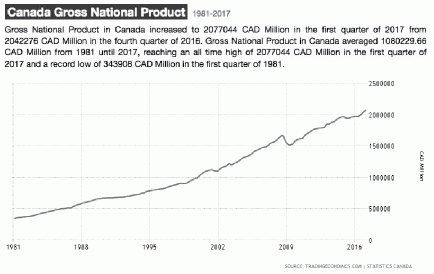
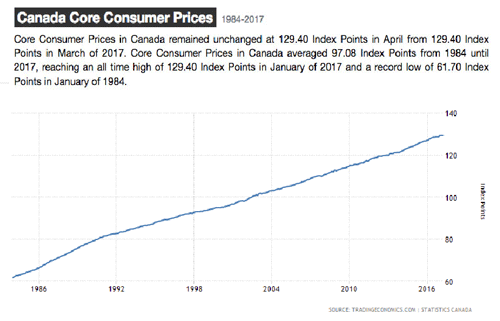
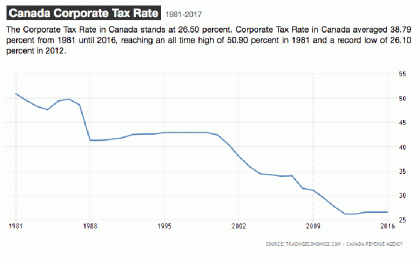
The graph in the top left shows that Canada’s Gross National Product increased more than six times from 1981 to the first quarter of 2017. Over that same period the core consumer price index (top right) doubled. These are both positive economic indicators, and one might glean from them that Canadians enjoyed increasing prosperity. This would be a mistake and in the lower graph we see why. The corporate tax rate was nearly halved during this time, the implication of which should be obvious. As citizens were forced to pay a greater percentage of the tax burden, their disposable income fell as well as their ability to save. Essentially, people are subsidizing overpaid CEOs and foreign corporations, which now coerce governments into betraying the public good in the name of “free trade.”
Canadians are worse off today than they were 50 years ago. I cannot “celebrate” the 150th birthday of Canada because I cannot pretend that appearance is reality. The legacy of optimism, and gaiety that attended the 1967 centennial celebrations (Expo’67) has been squandered. Canada might still exist on a map, but the idea of Canada is gone and must be rediscovered. We must look backwards, not forwards.
‘Forcing us to give up Russian gas to sell own is unacceptable’ – German FM blasts US sanctions bill
RT | June 30, 2017
A US bill threatening to sanction European companies taking part in construction of a Russian pipeline is seen as unacceptable in Berlin, Foreign Minister Sigmar Gabriel said, especially if it actually aims to push America’s own gas exports.
“We deem it absolutely unacceptable when a bill demands that Europeans give up on Russian gas so that they could sell American instead, at a much higher price,” Gabriel said in Krasnodar, Russia, on Thursday as cited by Handelsblatt daily.
Gabriel was referring to new sanctions passed by the US Senate in mid-June. Initially outlined as an amendment to a bill imposing sanctions against Iran, the Russian part of the document threatens penalties for companies doing business with Russian oil and gas firms, possibly affecting the participation of BASF, Shell, Engie, OMV, Wintershall and Uniper in the Nord Stream 2 project.
It also states clearly that US exports are on the agenda.
“The United States government should prioritize the export of United States energy resources in order to create American jobs, help United States allies and partners, and strengthen United States foreign policy,” the bill says, as cited by Bloomberg.
The amendment was approved by the US Senate in mid-June by a majority of 98 to two, but still requires approval by the House of Representatives and the signature of the US president.
The move caused a wave of indignation in the EU and particularly in Germany, which is a prime beneficiary of Nord Stream 2. German Chancellor Angela Merkel also called the bill a “peculiar move” while Gabriel released a statement saying that “Europe’s energy supply is a matter for Europe, and not the United States of America!”
“Sanctions as a political instrument should not be linked to economic interests,” the statement read, adding “the actual goal” of the bill is “to provide jobs for the US gas and oil industry.”
Foreign Minister Gabriel, who has been visiting Russia for the third time since his appointment in February, also said on Thursday that Berlin was determined “to open a new, positive chapter in the history of our relations,” as quoted by RIA Novosti.
“We have differences in terms of political values, but we don’t have to abandon cooperation between our societies as it is important to establish better relations on a societal level,” he added.

Russian President Vladimir Putin meets with German Minister for Foreign Affairs Sigmar Gabriel © Sergey Guneev / Sputnik
President Vladimir Putin, who received the German diplomat later on Thursday, said Russia also wanted to do its part to strengthen ties between Moscow and Berlin. “Our relations are developing despite certain difficulties,” Putin said in Moscow, praising “positive trends” in the dialogue.
US court verdict allows seizure of tower owned by Alavi Foundation
Press TV – June 29, 2017
A US court verdict has allowed the American government to seize an office tower in New York City owned largely by an Iranian charity organization, the Alavi Foundation.
A jury on Wednesday claimed that the charity was controlled by the Iranian government and the rent generated from the tower constituted a violation of US sanctions against Iran.
The verdict means that federal prosecutors can move ahead with their attempt to seize the building at 650 Fifth Avenue in Manhattan. The Alavi Foundation is likely to appeal the verdict.
The government plans to sell the property, which is valued at more than $500 million, and distribute much of the proceeds to victims of terrorist attacks.
The finding “represents the largest civil forfeiture jury verdict and the largest terrorism-related civil forfeiture in US history,” Joon H. Kim, the acting US Attorney in Manhattan, said in a statement.
The Iranian government has said it has no links with the Alavi Foundation.
Prosecutors first sought to seize the tower in 2008.
In 2014, US District Judge Katherine Forrest granted authority to federal prosecutors to confiscate the building. However, an appeals court reversed that ruling last year.
The assets of the Alavi Foundation included the building in Manhattan, as well as Islamic centers consisting of schools and mosques in New York City, Maryland, California, Texas and Virginia.
American Legal scholars said they know of only a few cases in US history in which law enforcement authorities have seized a house of worship. Without rent from the office building, the Alavi Foundation would have almost no way to continue supporting the Islamic centers.
The Alavi Foundation, a non-profit organization established in 1978, works to advance the Islamic and Persian culture in the US.
In the last four decades, the organization has also given millions of dollars to American schools, universities and charitable organizations; among them Harvard, Columbia and Rutgers university.
Macron’s Mission: Save the European Union From Itself

Photo by OFFICIAL LEWEB PHOTOS | CC BY 2.0
By Diana Johnstone | CounterPunch | June 28, 2017
The French capitalist elite that sponsored Macron’s meteoric rise is acutely aware that the European Union is in serious trouble. They chose Emmanuel Macron to save it. His success or failure depends on whether he can persuade the rest of the EU, notably Germany, to let it be saved.
In Trouble Politically
The EU is in serious trouble politically, because the elites love it, and ordinary people do not. A poll published June 20 by the Chatham House Royal Institute of international affairs found a “simmering discontent” with the EU among ordinary Europeans. Over 70% of people classified as decision-makers and opinion influencers – leading politicians, journalists, CEOs and leaders of major civil society organizations such as university presidents – welcomed European integration as beneficial, whereas only 34% of ordinary citizens agreed. On immigration, 57% of the elite consider immigration good for their country compared to 34% of the rest of the population. In short, the “decision-makers and opinion influencers” agree with the decisions they have been making and the opinions they have been advocating, while most other people are not convinced.
This is scarcely surprising since for over half a century the elites “who know what is best for the people” have been forcing European integration down their throats, with massive propaganda to justify major binding decisions taken without consulting the people (or, when the people are consulted, the result is ignored). Member States’ democratic procedures were essentially nullified over half a century ago by the unelected European Court of Justice when it ruled that European laws prevailed over national laws. The vast majority of Europeans were not even aware of how their democracy was being overruled and made obsolete. “Europe” meant escape from the bad past and the promise of a beautiful future of peace and prosperity. The elites saw to it that the real existing “Europe” is based on two principles: “free movement” of everything and absolute respect for “competition”. Presented as the apex of European values, these principles are neither moral nor democratic. They simply give all power to international financial capital.
In Trouble Economically
The elites have long been able to live comfortably with popular discontent. But economic troubles threaten to wreck the whole setup. Throwing together countries with deeply rooted differences in social philosophy and practice, binding them together with a common currency and rules that prohibit adaptation, does not work. As the spearhead of globalization, Europe’s dogmatic enforcement of both competition and “free movement” of goods and capital is enabling foreign capital – Chinese, Qatari, U.S., etc. – to buy up much of its productive resources piece by piece. Instead of growth, the euro has brought stagnation. The reign of unlimited “competition” promotes beggar-thy-neighbor practices rather than solidarity. Germany has lowered its labor costs, and continues to maintain large export surpluses with its neighbors, whose own budgets are broken by the trade imbalance. Concentration of wealth and lowered income decreases consumption and causes businesses to fail and tax revenues to shrink. The European Union finds itself on the edge of a perilous downward spiral.
France’s position in the troubled European Union was the overriding issue in recent French presidential elections. The issue was obscured by trivialities, such as media-inflated “scandals” over politicians hiring their wives and children, or non-issues such as “the fascist threat”. Yet the issue was there. Among leading candidates, both Jean-Luc Mélenchon and Marine Le Pen flirted with the notion of leaving the euro, or even the EU itself, but neither had a clear handle on the issue. In her decisive final debate with Macron, Marine Le Pen proved incapable of clarifying her own position on the euro. In the absence of any clear alternative to EU membership, voters were more frightened than seduced by the notion of getting out. Seeing no clear choice, voters massively abstained.
As a result, the European Union won the French election, in the person of Emmanuel Macron.
Macron’s mission is to bring the alienated couple, the EU and the French people, together – by persuading both to do what they don’t want to do.
Macron’s Protection Strategy
Macron’s June 21 interview with the French daily Figaro and seven other major European newspapers clarified his salvage strategy. The key word is “protection”. The idea is that people can develop loyalty toward institutions that protect them, and people do not feel protected by the EU.
This interview included significant foreign policy statements, notably a change in France’s policy toward Syria. Macron announced that “imported neoconservatism” is no longer welcome in France.
In all our EU societies, “the middle classes have begun to doubt”, Macron observed. “They have the impression that Europe is being built in spite of themselves. This Europe is dragging itself down.” Thus Europe must be made to provide both physical and economic security in order to reassure the citizens and regain their support. The physical protection involves controlling migration and cooperating in eradicating terrorism. The political impact of recent terrorist attacks ensured that any new French government would have to take moves to secure borders and control immigration, but Macron chooses to try to accomplish this at the European level. So far, disagreements between Member States have prevented effective measures from being taken.
Economic Protection
As a slight dissonant note in the usual rhapsody praising unspecified “Western values”, Macron made a subtle distinction between European and American “values”, implying a special European identity. “Americas love freedom as much as we do. But they do not have our taste for justice. Europe is the only place in the world where individual freedoms, the democratic spirit and social justice have been wedded to such a point.”
This implies that there must be limits to demolishing French social benefits in order to satisfy German demands for lower labor costs and a balanced budget. Meeting those demands is seen as the necessary condition for gaining German confidence in order to shift from austerity to prosperity programs. But it requires a quid pro quo. “The strength of some cannot feed for long on the weakness of the others.” In other words, German political leaders need to accept the fact that an EU which benefits Germany at the expense of other member States cannot last forever.
Specifically, Macron denounced the rules on “detached workers” which enable employers to evade the social costs of labor in countries like France by hiring foreign workers from countries like Romania under the rules of their own country. “Detached labor leads to ridiculous situations. Do you think I can explain to the French middle classes that businesses shut down in France in order to go to Poland because it’s cheaper there, and that the construction industry hires Poles because they are paid less? This system is not fair.” (Such observations were denounced as “racist” when made by Marine Le Pen or Jean-Luc Mélenchon, but are in fact totally consensual.)
Macron’s Foreign Policy
Macron’s statements on foreign policy could be seen as hints of a possible joint European foreign policy, partially independent of the United States, at a time when Washington appears to be paralyzed by deep state efforts to overthrow the President.
For the last six years, Paris has been at the forefront of the get-rid-of-Assad propaganda. Former foreign minister Laurent Fabius notoriously declared that Bachar al Assad “has no right to be alive on earth”. In a clear break, Macron said that trying to settle the Syrian problem militarily was “a collective mistake” and stressed his aggiornamento: “I do not proclaim that the destitution of Bachar al Assad is the precondition for everything. For nobody has shown me his legitimate successor!”
His first priority is fighting terrorist groups, with the cooperation of everybody, “particularly Russia”. His second is “Syria’s stability, as I don’t want to see another failed State. With me, there will be an end to the sort of neoconservatism imported into France for the last ten years. Democracy cannot be imposed on people from outside. France did not take part in the Iraq war and was right not to. France was wrong to wage that sort of war in Libya.” The result was failed states where terrorist groups prosper.
Somewhat ambiguously, Macron professed to be “aligned with the United States” on setting a “red line” against use of chemical weapons in Syria. “If it turns out that chemical weapons are used and we know how to trace where they came from, then France will proceed to carry out air strikes to destroy the identified stocks of chemical weapons.” Yet this statement is not precisely aligned with U.S. practice, which has always automatically blamed Assad for chemical weapons attacks, without ever bothering to “trace where they came from” or to limit retaliation to the arms stocks themselves.
Understanding Putin
As for Russia, Macron was also ambiguous, stressing unspecified “disagreements” with Vladimir Putin over Ukraine, while distancing himself from current anti-Putin hysteria in Washington by observing that Putin’s objective is to ensure the survival of his country, not to weaken the West.
Any one of the other leading candidates for the French presidency would almost certainly have gone farther toward rapprochement with Russia. While neoconservative influence has permeated French media and the Socialist Party, it does not control the French establishment as in the United States. Macron’s statements are a long overdue recognition of reality in harmony with informed opinion in France, notably in the diplomatic, military and business communities, which see the U.S.-induced Russian bashing as unjustified, contrary to French interests, and dangerous. These shifts in foreign policy were probably an inevitable reaction against the past ten years of Sarkozy-Hollande’s absurd role as puppy dog running ahead of its American master, yapping at Washinton’s chosen enemy.
Such concessions to reality could contribute to working out a common foreign policy with Germany, which has tended to keep its distance from certain U.S.-led military adventures. However, they are accompanied by urgent appeals to Germany to increase its military spending, at a time when the United States is making similar demands, in order to strengthen NATO against the Russian “threat”. Macron in contrast seems to have in mind the prospect of strengthening Europe by providing it with a strong military defense of its own, presumably not totally under U.S. command. The current struggle for power in Washington favors moves toward European independence. This can sound good if indeed it allows Europe to bow out of various U.S.-incited wars in the Middle East and elsewhere. But military buildups are costly and dangerous in themselves, and not the appropriate way to promote peace in Europe and beyond. The arms race that United States threats have incited in Russia and China shows signs of spreading. There are forces in Germany all too willing to seize any pretext to revive German military strength.
Resistance To Macron
Macron’s efforts to save the EU marriage will encounter stiff resistance from both sides – and not least from the European side.
The resistance in France will be minimal in a parliament entirely under his control. The largest “opposition” party, the Republicans, are moving toward supporting him. The Socialist Party is decomposing rapidly, and the rest of the opposition is tiny and divided. Opposition in the streets sounds revolutionary, but it is not favored by the current relationship of forces, notably the weakness of the unions and the strategic disadvantages of a diminished industrial working class.
The resistance to Macron’s projects in Europe stems from the mere fact that the EU includes too many nations with conflicting interests and cultures. On the issue of control of migration, for example, German Chancellor Angelo Merkel has opened wide the gates to refugees, whereas Hungary is intent on keeping them out. Germans, or at least some of them, consider mass migration good for a country with a low birthrate. Hungarians, in contrast, want above all to preserve their cultural identity. The Baltic States, many of whose current leaders were nurtured in Cold War America, as well as Poland, with its bitter historic rivalry with Russia, support U.S. demands for a defensive/aggressive military posture against Russia. This has virtually no support in France, Italy or Spain. As for economic interests, they are widely contradictory, with important differences between North and South, East and West, that cannot easily be unified. And finally, except for the mobile, multilingual elite, people in Europe do not feel European: they feel French, or Italian, or whatever. Macron’s mission is clear, but it might turn out to be mission impossible.
Diana Johnstone is the author of Fools’ Crusade: Yugoslavia, NATO, and Western Delusions. Her new book is Queen of Chaos: the Misadventures of Hillary Clinton. She can be reached at diana.johnstone@wanadoo.fr
India’s Electricity Transformation
By Paul Homewood | Not A Lot Of People Know That | June 25, 2017
Renewable proponents are getting excited about the latest news from India:

The Indian energy market transformation is accelerating under Energy Minister Piyush Goyal’s leadership.
The most recent and most persuasive evidence is the collapsing cost of solar electricity—a collapse that has gone beyond anyone’s expectations, and the results are in: solar has won.
The global energy market implications are profound.
Recent events have given manifest life to Mark Carney’s landmark 2015 speech in which Carney, the governor of the Bank of England, warned of stranded-asset risks across the coal industry. This month alone has seen the cancellation of 13.7 gigawatts (GW) of proposed coal-fired power plants across India and an admission that US$9bn (8.6GW) of already operating import-coal-fired power plants are potentially no longer viable.
To put an Australian and a global seaborne thermal coal-trade perspective on it, these development strike at the very viability of the Carmichael export thermal coal proposal. They speak as well to a worldwide transition in progress.
India solar tariffs have been in freefall for months. A new 250MW solar tender in Rajasthan at the Bhadla Phase IV solar park this month was won at a record low Rs2.62/kWh,[i] 12 percent below the previous record low tariff awarded across 750MW of solar just three months ago at Rs2.97/kWh.
The Bhalda Phase record lasted two days, with a more recent 500MW Indian solar auction coming in at Rs2.44/kWh, 7 percent below Bhalda Phase.
We see solar pricing continuing to become even more competitive over time.
Several forces are at work.
In December 2016, India released its 10-year Draft National Electricity Plan, calling for the installation of a cumulative 275GW of renewable energy capacity by 2027, as well as 97GW of other zero emissions capacity (primarily large scale hydro, but also nuclear). Relative to a planned total system capacity of 650GW, the plan sees thermal power capacity falling from 69 percent of India electricity-generation mix in March 2016 to 43 percent by 2027.
http://ieefa.org/ieefa-asia-indias-electricity-sector-transformation-happening-now/
We are supposed to believe that solar power is going to rapidly replace coal. But, in fact, the news is not really new at all, and simply confirms what we knew already from India’s Draft National Plan, published in December 2016, and covered here.
But first, some basic facts.
The National Plan called for:
1) An increase in capacity of wind/solar by 2027 of 215 GW, plus 8 GW and 27 GW of nuclear and hydro respectively.
2) Total electricity requirement would rise from the current level of 1400 TWh, to 2132 TWh by 2027.
3) 50 GW of coal capacity was already under construction.
4) Non fossil fuel capacity would account for 56.5% of total capacity by 2027.
5) Wind/solar/bio would provide 24.2% of total generation by 2027.
The renewable commitment simply mirrored that contained in India’s INDC, although that only specified the period up to 2022.
The IEEAFA report acknowledged that the plan looks ambitious but absolutely feasible.
If we plug these capacities in and extrapolate from current load factors (based on BP data), we can take a look at what electricity generation will look like come 2027.
( The figure for fossil fuels is the balancing number).
| Capacity | Load | Twh | Twh | |
| 2027 | Factor % | 2027 | 2016 | |
| Hydro | 73 | 32 | 205 | 129 |
| Nuclear | 14 | 72 | 88 | 38 |
| Wind | 60 | 19 | 100 | 45 |
| Solar | 205 | 19 | 341 | 12 |
| Bio | 10 | 41 | 36 | 16 |
| Sub Total Low Carbon | 362 | 770 | 240 | |
| Fossil Fuels | 279 | 1362 | 1160 | |
| Total Electricity | 641 | 2132 | 1400 |
In other words, under the Plan, there will still be a big increase in power from fossil fuels, nearly all of which will be coal.
Indeed, the Plan itself states this clearly:

So what about all of these cancellations of coal plants? I’m afraid this is all rather fake news.
As the National Plan also states, there is already a surplus of power capacity in the pipeline, from all sources, and this is naturally putting the squeeze on new projects.
But as the Global Coal Plant Tracker revealed, there is nearly three times as much capacity in the pipeline but not started, as there is under construction. Given that the 50 GW under construction is already more than is needed, it is hardly surprising that projects not even started yet are being shelved.
Indeed, as the table shows, a total of 430 GW has already been cancelled or shelved since 2010.
There is simply nothing unusual at all about recent cancellations.

http://et-advisors.com/wp-content/uploads/ETA-Asia-Coal-Juggernaught_final.pdf
But isn’t solar now cheaper than coal?
Unfortunately, we aren’t comparing like with like. Whilst solar power, particularly in a sunny country like India, has a niche role, it cannot provide power reliably as coal does. As such, it can never play a dominant role.
It is worth bearing mind that we aren’t simply talking about day and night here. For three months every summer, most of India sits under the monsoon, beneath thick cloud and heavy rain.
While some solar power will still be generated, output will be much lower than the rest of the year, and at a time when demand tends to be greatest.
The Indian government is well aware of this, and will continue to ensure that sufficient coal power is always available. Indeed the National Plan also builds in enough coal capacity to cover a 30% reduction in Hydro generation, in case of a failure of the monsoon.
However, just as we are seeing here, coal power plants are suffering financially from competition from renewable energy with little or no marginal costs. Coal plants can only be viable if they are allowed to run at economic load factors.
One of the big problems with India’s electricity market is its curious mix of Central Government, State Government and Private power provision.
Just as in the UK, if India’s electricity system had been designed by electrical engineering experts, rather than developed on an ad hoc basis with conflicting objectives, it would not look like it does now.
And it would also be a lot more efficient!
Deep History of America’s Deep State
By Jada Thacker | Consortium News | June 23, 2017
Everybody seems to be talking about the Deep State these days. Although the term appears to have entered the lexicon in the late 1990s, for years it referred only to shady foreign governments, certainly not to our own “indispensable nation.”
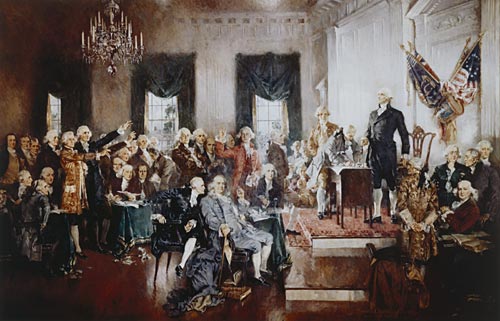
Artist’s rendering of the Constitutional Convention, 1787
Does the sudden presence of an American Deep State – loosely defined as an unelected elite that manipulates the elected government to serve its own interests – pose a novel, even existential, threat to democracy?
Not exactly. The threat seems real enough, but it’s nothing new. Consider these facts: 230 years ago, an unelected group of elite Americans held a secretive meeting with an undisclosed agenda. Their purpose was not merely to manipulate lawful government in their own interests, but to abolish it altogether. In its place, they would install a radically undemocratic government – a “more perfect” government, they said – better suited to their investment portfolios.
History does not identify these conspirators as the Deep State. It calls them the Founders. The Founders did not consider themselves conspirators, but “republicans” – not in reference to any political party, but rather to their economic station in society. But their devotion to “republicanism” was transparently self-serving. A current college text, The American Journey: A History of the United States, explains though does not explicate “republican ideology”:
“Their main bulwark against tyranny was civil liberty, or maintaining the right of the people to participate in government. The people who did so, however, had to demonstrate virtue. To eighteenth century republicans, virtuous citizens were those who were focused not on their private interests but rather on what was good for the public as a whole.
“They were necessarily property holders, since only those individuals could exercise an independence of judgment impossible for those dependent upon employers, landlords, masters, or (in the case of women and children) husbands and fathers.” [Emphasis supplied]
Republicanism was a handy idea if you happened to be a master or a landlord, who were the only persons this ideology considered “virtuous” enough to vote or hold political office. Thus, “republicanism” – virtually indistinguishable from today’s “neoliberalism” – created the original Deep State in the image of the economic system it was designed to perpetuate.
How this was accomplished is not a comforting tale. But it cannot be related nor understood without an appreciation of the historical context in which it occurred.
Masters and Servants
Post-colonial America was predominantly agrarian, and about 90 percent of the population was farmers. (The largest city in 1790 was New York, with a whopping population of 33,000 residents.) There was a small middle class of artisans, shopkeepers, and even a handful of industrial workers, but the politically and economically powerful people were the relatively few big-time merchants and landowners – who also fulfilled the function of bankers.

Gouverneur Morris, Constitutional Convention
delegate and key drafter of the Preamble.
(Painting by Edward Dalton Marchant)
America was not quite a feudal society, but it resembled one. Commoners did not call at the front doors of the rich, but were received around back. Most states had official religions, some with compulsory church attendance backed by fines. Commodity-barter was the currency of the day for the vast majority. Debtors were imprisoned. Parents sold their children into bondage. It wasn’t what most people think of when they hear “Yankee Doodle Dandy.”
All states restricted voting only to men who owned a requisite amount of property, while the majority: un-widowed women, servants, and tenants owned no property. Moreover, most states had property requirements for eligibility to elective office, some with the higher offices reserved for those with the most property. Such restrictions had discriminated against the urban underclass and farmers since the beginning of American colonization.
Nobody at the time characterized this land of masters and servants as a “democracy.” Indeed, the master class considered “democracy” synonymous with “mob rule.” But not everybody was happy with “republican virtue” in post-war America, least of all the slaves of the “virtuous.”
The Revolutionary War had stirred passions among the servant class for social and economic liberty, but when the war ended nothing much had changed. In fact, the war proved not to have been a revolution at all, but represented only a change from British overlords to American overlords. Edmund Morgan, considered the dean of American history in the colonial era, characterized the “non-Revolutionary War” this way:
“The fact the lower ranks were involved in the contest should not obscure the fact that the contest itself was generally a struggle for office and power between members of an upper class: the new against the established.”
About 1 percent of the American population had died in a war fought, they had been told, for “liberty.” (Compare: if the U.S. lost the same proportion of its population in a war today, the result would be over three million dead Americans.) Yet after the war, economic liberty was nowhere in sight.
Moreover, the very concept of “liberty” meant one thing to a farmer and quite another to his rich landlord or merchant. Liberty for a common farmer – who was generally a subsistence farmer who did not farm to make money, but rather only to provide the necessities of life for his family – meant staying out of debt. Liberty for merchants and property owners – whose business it was to make monetary profits – meant retaining the ability to lend or rent to others and access to the power of government to enforce monetary repayment from debtors and tenants.
Much like the American Indians who had first communally owned the property now occupied by American subsistence farmers, agrarian debtors faced the unthinkable prospect of losing their ability to provide for their families (and their vote) if their land were confiscated for overdue taxes or debt. [See Consortiumnews.com’s “How Debt Conquered America.”]
Loss of their land would doom a freeholder to a life of tenancy. And the servitude of tenants and slaves differed mainly as a function of iron and paper: slaves were shackled by iron, tenants were shackled by debt contracts. But iron and paper were both backed by law.
By the end of the Revolutionary War, as few as a third of American farmers owned their own land. When the urban elites began to foreclose on the debts and raise the taxes of subsistence farmers – many of whom had fought a long and excruciating war to secure their “liberty” – it amounted to a direct assault on the last bastion of Americans’ economic independence.
The Original Great Recession
After the war, British merchants and banks no longer extended credit to Americans. Moreover, Britain refused to allow Americans to trade with its West Indies possessions. And, to make matters worse, the British Navy no longer protected American ships from North African pirates, effectively closing off Mediterranean commerce. Meanwhile, the American navy could not protect American shipping, in the Mediterranean or elsewhere, because America did not happen to possess a navy.
In the past, American merchants had obtained trade goods from British suppliers by “putting it on a tab” and paying for the goods later, after they had been sold. Too many Americans had reneged on those tabs after the Revolution, and the British now demanded “cash on the barrelhead” in the form of gold and silver coin before they would ship their goods to America.
As always, Americans had limited coin with which to make purchases. As the credit crunch cascaded downwards, wholesalers demanded cash payment from retailers, retailers demanded cash from customers. Merchants “called in” loans they had made to farmers, payable in coin. Farmers without coin were forced to sell off their hard-earned possessions, livestock, or land to raise the money, or risk court-enforced debt collection, which included not only the seizure and sale of their property but also imprisonment for debt.
The most prominent result of Americans’ war for “liberty” turned out to be a full-blown economic recession that lasted a decade. Even so, the recession would not have posed a life-threatening problem for land-owning subsistence farmers, who lived in materially self-sufficient, rural, communal societies. But when state governments began to raise taxes on farmers, payable only in unavailable gold and silver coin, even “self-sufficient” farmers found themselves at risk of losing their ability to feed their families.
Debt, Speculation, and the Deep State
The Continental Congress had attempted to pay for its war with Britain by printing paper money. The British undermined these so-called “Continental” dollars, not only by enticing American merchants with gold and silver, but by counterfeiting untold millions of Continental dollars and spending them into circulation. The aggregate result was the catastrophic devaluation of the Continental dollar, which by war’s end was worthless.
In the meantime, both Congress and state governments had borrowed to pay for “liberty.” By war’s end, war debt stood at $73 million, $60 million of which was owed to domestic creditors. It was a staggering sum of money. In his now studiously ignored masterpiece, An Economic Interpretation of the Constitution of the United States, historian Charles A. Beard showed that domestically-held war debt was equivalent to 10 percent of the value of all the surveyed land holdings (including houses) in the entire United States at the time.
The war debt carried interest, of course – which is a problem with debt if you owe it, but is a feature of debt if it is owed to you. Not only was “freedom not free” – it came with dividends attached for Deep State investors. This should sound at least vaguely familiar today.

President George Washington
As Continental paper money lost its value, Congress and state governments continued to pay for “liberty” with coin borrowed at interest. When that ran short, government paid only with promises to pay at a later date – merely pieces of paper that promised to pay coin (or land) at some indeterminate time after the war was won.
This was how the government supplied the troops (whenever it managed to do so) and also how it paid its troops. In actual practice, however, Congress often did not pay the troops anything, not even with paper promises, offering only verbal promises to pay them at the end of the war.
But war is never a money-making enterprise for government, and when it ended, the government was as broke as ever. So, it wrote its verbal promises on pieces of paper, and handed them to its discharged troops with a hearty Good Luck with That! Even so, Congress paid the soldiers in bonds worth only a fraction of the amount of time most had served, promising (again!) to pay the balance later – which it never did.
Thousands of steadfast, longsuffering troops were abandoned this way. Most had not been paid any money in years (if ever), and many were hundreds of miles from their homes – ill, injured, and starving – as they had been for months and years. Others literally were dressed only in rags or pieces of rags. Some carried paper promises of money; some carried paper promises of geographically distant land – none of which would be available until years in the future, if at all.
Seven-year Revolutionary War veteran Philip Mead described his plight in a bitter memoir entitled A Narrative of Some of the Adventures, Dangers and Sufferings of a Revolutionary Soldier: “We were absolutely, literally starved. I do solemnly declare that I did not put a single morsel of victuals in my mouth for four days and as many nights, except a little black birch bark which I gnawed off a stick of wood, if that can be called victuals. I saw several of the men roast their old shoes and eat them….
“When the country had drained the last drop of service it could screw out of the poor soldiers, they were turned adrift like old worn-out horses, and nothing said about land to pasture them on.”
Was this liberty? To impoverished veterans, “liberty” looked bleak, indeed. To speculators in government bonds, liberty looked like a golden opportunity, quite literally so.
Vultures possessed of coin swooped in and bought a dollar’s worth of government promises for a dime, and sometimes for just a nickel. Speculators wheedled promises not only from desperate veterans (many of whom sold their promises merely to obtain food and clothes on their long trudge home), but from a host of people whose goods or services had been paid with IOUs.
Optimistic speculators cadged bonds from pessimistic speculators. The more desperate people became during the recession, the more cheaply they sold their promises to those who were not.
Speculators expected their investments, even those made with now-worthless paper money, to be paid in gold or silver coin. What’s more, “insiders” expected all those various government promises would eventually be converted – quietly, if possible – into interest-bearing bonds backed by a single, powerful taxing authority. All the Deep State needed now was a national government to secure the investment scheme. A man named Daniel Shays unwittingly helped to fulfil that need.
Rebellion and Backlash
Thomas Jefferson penned the famous sentence: “The tree of liberty must be refreshed from time to time with the blood of patriots and tyrants.” He was not referring to heroic American Patriots charging up Bunker Hill against British bayonets. He was referring instead to American farmers – many of whom had been the starving soldiers in a war for forsaken liberty – taking their lives into their hands to oppose the tax policies of the government of Massachusetts in 1787. The principal leader of this revolt was a farmer and war veteran Daniel Shays.
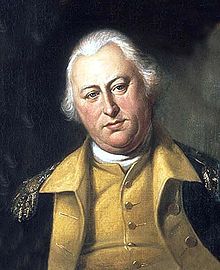
General Benjamin Lincoln led a force in 1787
to put down Shays’ Rebellion in Massachusetts
(Painting by Charles Willson Peale)
In a sense, the most interesting thing about Shays’s Rebellion is that it was not a unique event.
The first notable example of agrarian revolt had been Bacon’s Rebellion in 1676 Virginia, when frontier farmers marched on the rich plantation owners of Jamestown, burned it to the ground, published their democratic “Declaration of the People,” and threatened to hang every elite “tyrant” on their list – which included some of the forefathers of America’s patriot Founders.
Historian Gary Nash reminds us Bacon’s Rebellion had echoes across early American history: “Outbreaks of disorder punctuated the last quarter of the 17th century, toppling established governments in Massachusetts, New York, Maryland, Virginia, and North Carolina.” Jimmy Carter, in The Hornet’s Nest, the only novel ever published by an American president, tells a similar story of the agony of dispossessed farmers in Georgia a century later.
Other farmers had rebelled in New Jersey in the 1740s; in the New York Hudson Valley rent wars in the 1750s and 1760s and concurrently in Vermont by Ethan Allen’s Green Mountain Boys; for a decade in North Carolina in the 1760s, where vigilantes called Regulators battled the government of the urban elite; and in Virginia in the 1770s. Likewise, American cities had been scenes of labor unrest, riots, and strikes for a century. American class rebellion, apparently unbeknownst to most history teachers in America, was closer to the rule than the exception.
Victory in the war against England only intensified the conflict between those who considered “liberty” as a necessary condition to live without debt, against those who considered “liberty” to be their class privilege to grow rich from the debts others owed them. Howard Zinn, in his A People’s History of the United States describes the economic realities of Eighteenth Century America:
“The colonies, it seems, were societies of contending classes – a fact obscured by the emphasis, in traditional histories, on the external struggle against England, the unity of colonists in the Revolution. The country therefore was not ‘born free’ but born slave and free, servant and master, tenant and landlord, poor and rich.”
Although Shays’s Rebellion was not unique, it was a huge event, coming at a time when the rich were owed a great deal of money by impoverished governments. Pressured by rich bondholders and speculators, the government of Massachusetts duly raised taxes on farmers. To make matters far worse, the taxes were to be paid only in gold or silver – which was completely out of the question for most western farmers, who had no way to obtain coined money.
When the farmers complained, their complaints were ignored. When farmers petitioned the government to issue paper money and accept it as payment of debts and taxes, the government refused their petitions. When the farmers pleaded for the passage of “legal tender laws” that would allow them to settle their debts or taxes with their labor, they were rebuffed.
But when farmers could not pay what they did not have, the Massachusetts’s courts ordered their land seized and auctioned. At last, the farmers understood the practical effect, if not the specific intent, of the tax: confiscation of their property and its transfer to the rich, to whom the government owed its interest-bearing debt. Government had become an armed collection agency.
To the utter dismay of the erstwhile proudly tax-rebellious Patriots, the farmers too rebelled. Shaysites forcibly shut down the tax courts that were condemning them to servitude. The rich responded by loaning the destitute government more money (at interest!) to pay a militia force to oppose Shays’s rebels.
At this point, tax rebels abandoned reform for radical revolution and – in a resounding echo of Nathaniel Bacon’s century-old Declaration of the People – pledged to march on Boston and burn it to the ground. This was no Tea Party vandalism, stage-managed by well-to-do Bostonians like Samuel Adams. It was a full-blown, grassroots agrarian revolution a century in the making.
The urban bond-holding merchant-class in Boston and elsewhere panicked. And none panicked more than bond speculators, who intimately understood the rebels threatened their “virtuous” republican “liberty” to extract profit from others. Historian Woody Holton exposes the astonishing callousness of one of America’s major bond speculators in his nationally acclaimed Unruly Americans and the Origin of the Constitution:
“As a bondholder, Abigail Adams would benefit immensely if her fellow Massachusetts citizens [paid the tax] levied by the legislature in March 1786, but she also saw compliance as a sacred duty. If Massachusetts taxpayers were ‘harder-prest by publick burdens than formerly,’ she wrote, ‘they should consider it as the price of their freedom’.”

Abigail Adams,
wife of the second President John Adams,
in a portrait by Benjamin Blythe.
Future First Lady Abigail Adams was not alone in thinking freedom came with dividends payable to her account. Historian David Szatmary reminds us in his Shays Rebellion; The Makings of an Agrarian Insurrection that the former Patriot leadership, especially those in the merchant class, were among the first to advocate violence against democratic rebellion.
Said a published opinion piece at the time: “When we had other rulers, committees and conventions of the people were lawful – they were then necessary; but since I myself became a ruler, they cease to be lawful – the people have no right to examine my conduct.”
Showboat Patriot and bond speculator Samuel Adams –former mastermind of the Boston Tea Party and erstwhile propagandist against unfair British taxes (as well as cousin to Abigail’s husband John Adams) – sponsored a Massachusetts law that allowed sheriffs to kill tax protesters outright.
Another rich bondholder and speculator, ex-Revolutionary War General Henry Knox (the fitting namesake of Fort Knox, the famous repository of gold bullion) wrote an alarming letter to his former commander George Washington, accusing the Shays’s rebels of being “levelers” (which was the closest term to “communists” then in existence). He informed Washington that the country needed a much stronger government (and military) to prevent any riffraff challenge to the elite. His message was not wasted on General Washington, America’s richest slave owner.
In the end, the Congress, under the Articles of Confederation, could raise no money from the states to provide an army, but the privately-financed, for-profit Massachusetts militia successfully defeated Shays’s rebels. Still, the nearly hysterical fear of democratic economic revolution had been planted in the minds of the masters. Shays’s Rebellion proved to be the last straw for bond speculators whose profits were jeopardized by democracy.
Worse even, the governments of many other states were beginning to cave under intense democratic pressure from rebellious debtors. Some states were entertaining laws that prevented the seizure of property for debt; others were creating paper money in order to break the gold and silver monopoly. Rhode Island not only voted in a paper money system, but threatened to socialize all commercial business enterprises in the state.
In response to the threat of populism, the “virtuous” elite reacted decisively – not to remedy the plight of debtors, of course – but to secure their own profits from them. Accordingly, in 1786, five states sent delegates to meet at Annapolis, Maryland, just as Shays’s Rebellion veered into revolution. This unelected minority called for Congress to authorize a convention to be held in Philadelphia the next year “for the sole and express purpose of revising the Articles of Confederation.” The Articles were never to be “revised.” They were to be scrapped altogether by the Deep State.
The Deep State Conspires
Thanks to Charles A. Beard’s An Economic Interpretation of the Constitution of the United States, we know quite a lot about the status of the 55 men who conspired to draft the Constitution. But the very first thing we need to know is that they were not authorized by “We the People” simply because nobody had voted for them; all were political appointees.
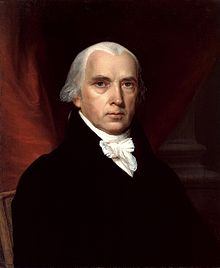
James Madison
Nor were they even a representative sample of the people. Not a single person in the Convention hall “worked for a living,” nor was female, nor was a person of color. Only one claimed to be a “farmer,” the current occupation of about 90 percent of the population. Most were lawyers. Go figure.
If the delegates represented anybody at all, it was the economic elite: 80 percent were bondholders; 44 percent were money-lenders; 27 percent were slave owners; and 25 percent were real estate speculators. Demographically, the 39 who finally signed the final draft of the Constitution constituted .001 percent of the American population reported in the 1790 census. George Washington, who presided, was arguably the wealthiest man in the country. Deep State gamblers all.
And the stakes were high. Recall that the face value of outstanding domestic government bonds in 1787 was $60 million, equivalent to 10 percent of the total improved land value of the country. But these bonds, for the most part, had been obtained by speculators at a fraction of face value. Beard very conservatively estimated the profit of speculators – if the bond were redeemed at face value – would have been some $40 million. Expressed as the same proportion of total improved land value at the time of the Founding, the expected profit from government bonds held then would equal at least $3 trillion today. Tax free.
We still do not know everything that transpired at the convention. No one was assigned to keep a record of what was discussed. Reportedly, even the windows to the meeting hall were nailed shut to prevent eavesdropping – though there would be “leaks.” Because of its secrecy and its unauthorized nature, some historians have called the convention “the second American Revolution.” But revolutions are public, hugely participatory events. This was a coup d’état behind locked doors.
Most delegates presumably understood their undisclosed purpose was to dump the whole system of confederated government (which had cost 25,000 American lives to secure) into a dustbin. They evidently did not intend to obey their instructions “solely to revise” the Articles because a number of them showed up at the convention with drafts for a new constitution in hand.
The conspirators’ ultimate goal was to replace the Confederation with what they later euphemized as “a more perfect Union” – designed from the outset to protect their class interests and to ensure the new government possessed all the power necessary to perpetuate the existing oligarchy.
At the Convention, Alexander Hamilton captured the prevailing sentiment: “All communities divide themselves into the few and the many. The first are the rich and well-born; the other the mass of the people … turbulent and changing, they seldom judge or determine right. Give therefore to the first class a distinct, permanent share in the Government. … Nothing but a permanent body can check the imprudence of democracy.”

A portrait of Alexander Hamilton
by John Trumbull, 1792.
Hamilton further proposed that both the President and the Senate be appointed (not elected) for life. His vision was but half a step removed from monarchy. Though not a Convention delegate, John Jay, Hamilton’s political ally, slaveowner, and the first Chief Justice of the Supreme Court, stated the purpose of “republicanism” with brutal brevity: “The people who own the country ought to govern it.”
The Founders never once envisioned any such a thing as “limited government” – unless perhaps in the sense that the power of government was to be limited to their own economic class. [See Consortiumnews.com’s “The Right’s Made-up Constitution.”]
In Towards an American Revolution: Exposing the Constitution & Other Illusions, historian Jerry Fresia sums the Founders’ views succinctly: “The vision of the Framers, even for Franklin and Jefferson who were less fearful of the politics of the common people than most, was that of a strong centralized state, a nation whose commerce and trade stretched around the world. In a word, the vision was one of empire where property owners would govern themselves.” [Emphasis supplied]
Self-government by the people was to remain permanently out of the question. The Deep State was to govern itself. “We the People,” a phrase hypocritically coined by the ultra-aristocrat Gouverneur Morris, would stand forever after as an Orwellian hoax.
The tricky task of the hand-picked delegates was to hammer out a radical new system of government that would superficially resemble a democratic republic, but function as an oligarchy.
William Hogeland’s excellent Founding Finance, recounts the anti-democratic vehemence expressed at the Convention: “On the first day of the meeting that would become known as the United States Constitutional Convention, Edmund Randolph of Virginia kicked off the proceedings […] ‘Our chief danger,’ Randolph announced, ‘arises from the democratic parts of our constitutions. … None of the constitutions’ – he meant those of the states’ governments – ‘have provided sufficient checks against the democracy.’”
No wonder they nailed the windows shut. It should be no surprise that the word “democracy” does not appear once in the entire U.S. Constitution, or any of its Amendments, including the Bill of Rights. Accordingly, the Constitution does not once refer to the popular vote, and it did not guarantee a single person or group suffrage until the adoption of the 15th Amendment in 1870, over 80 years after ratification. The Preamble aside, the Founders used the phrase “the People” only a single time (Art. I, Sec. 2).
It has been suggested the word “democracy” had a different meaning then than it has now. It did not. “Democracy” to the Convention delegates meant the same thing as it does today: “rule by the people.” That’s why they detested it. The delegates considered themselves the patriarchs of “republicanism,” the ideology that rejected participation in government by people like their wives, servants, tenants, slaves, and other non-propertied inferiors. No doubt, the delegates passionately disagreed on many things, but the “fear and loathing” of democracy was not one of them. Then or now.
The Deep State’s Specific Goals
Embedded within the Founders’ broadly anti-democratic agenda were four specific goals. These were not a list of items jotted down in advance, but were derived by group consensus as the minimum requirements necessary to achieve the Deep State’s ultimate agenda.

Thomas Jefferson in a 1800 portrait
by Rembrandt Peale
To camouflage the stark oligarchic nationalism the measures intended, the Founders disingenuously styled themselves “Federalists.” But nothing about these measures concerned a “federation” of sovereign states; taken together, they were intended to demolish the existing “perpetual” confederation, not to re-create it more effectively.
National government with limited citizen participation. Of all the measures required to achieve a national oligarchy, this was the most daunting. It was achieved by a wide array of provisions.
The Electoral College. The President and Vice President are not elected by popular vote, but by electors – then and now. For example, when George Washington was first elected President, the American population was 3.9 million. How many of those folks voted for George? Exactly 69 persons – which was the total number of electors voting at the time. (Art. I, Sec. 3)
Bi-Cameral Congress. Congress is bi-cameral, composed of two “houses” – the House of Representatives and the Senate. Under the original Constitution, the House members represented the people who vote for them, while the Senate represented states, not persons, and was therefore not a democratic body, at all. It was generally expected that the Senate would “check” the democratic House. Indeed, this was the entire purpose of bi-cameralism wherever it has existed. (Art. I, Secs. 1 and 2)
State Appointment of Senators. Senators were originally appointed by state legislatures (until the 17th Amendment in 1913). It was expected that the Senate would function in Congress as the House of Lords functioned in Parliament: the voice of the aristocracy. Even though Senators are now popularly elected, it is far more difficult to challenge an incumbent because of the prohibitive expense of running a state-wide campaign. (Art. I, Sec. 3)
Appointment of the Judiciary. All federal judges are appointed for life terms by the President and confirmed by the (originally undemocratic) Senate. (Art. III, Sec. 1)
Paucity of Representation. Most undemocratic of all was the extreme paucity of the total number of House members. The House originally was composed of only 65 members, or one member per 60,000 persons. Today, there are 435 members, each representing about 700,000 persons. Thus, current House representation of the public is 12 times less democratic than when the Constitution was written – and it was poor (at best) then.
Compare: The day before the Constitution was ratified, the people of the 13 United States were represented by about 2,000 democratically elected representatives in their various state legislatures (1:1950 ratio); the day after ratification, the same number of people were to be represented by only 65 representatives in the national government (1:60000). In quantitative terms, this represents more than a 3,000 percent reduction of democratic representation for the American people. (Art. I, Sec. 2)
Absence of Congressional Districts. Although House members now run for election in equal-populated districts, the districts were created by Congress, not the Constitution. Until the 1960s, some House members were elected at-large (like Senators). This disadvantaged all but the richest and best-known candidates from winning. (Not referenced in Constitution)
Absence of Recall, Initiative and Referendum. The Constitution does not allow the people to vote to recall (un-elect) a Congress member, demand a Congressional vote on any issue (propose an initiative) or vote directly in a referendum on any issue (direct democracy). (Not referenced in Constitution)
Absence of Independent Amendment Process. One of the reasons Americans now have professional politicians is that the Constitution does not provide a way for “the people” to amend it without the required cooperation of a sitting Congress. At the Constitutional convention, Edmund Randolph of Virginia (surprisingly) proposed that the people be afforded a way to amend the Constitution without the participation of Congress. This excellent idea, however, was not adopted. (Art. V)
National authority to tax citizens directly. (Art. I, Sec. 8; 16th Amendment)
National monopolization of military power. (Art. I, Sec.8, clauses 12, 13, 14, 15, 16)
Denial of states’ power to issue paper money or provide debtor relief. (Art. I, Sec.10; Art. I Sec.8, clause 4)
All of these provisions were completely new in the American experience. For 150 years or more, citizen participation in government, independent militias, and the issuance of paper money had been the prerogative of the several, independent colonies/states – while direct external taxation had been universally and strenuously resisted. When the British Crown had threatened to curtail colonial prerogatives, the very men who now conspired for national power had risen in armed rebellion. The hypocrisy was stunning. And people took note of the fact.
Consent of the Minority
One of the note-takers was Robert Yates, a New York delegate to the Convention, who had walked out in protest. Not long afterwards, Yates (who owned no government bonds) stated his objection to the new Constitution: “This government is to possess absolute and uncontrollable power, legislative, executive and judicial, with respect to every object to which it extends. …
“The government then, so far as it extends, is a complete one. … It has the authority to make laws which will affect the lives, the liberty, and the property of every man in the United States; nor can the constitution or the laws of any state, in any way prevent or impede the full and complete execution of every power given.”

Whipping scars on back of African-American slave
At least half of the American population (collectively called “Anti-federalists”) thought the Constitution was a terrible idea. To be sure, well-to-do Anti-federalists like Yates were not overtaxed farmers, and their objections were often based upon the defense of states’ rights, not peoples’ economic rights. Most Anti-federalists, however, seemed alarmed that the Constitution contained no guarantee of the basic political rights they had enjoyed under the British Empire, such as freedom of speech or trial by jury.
The debate between supporters and critics of the Constitution raged for a year, while partisan newspapers published articles both pro and con. A collection of 85 “pro” articles is known now as The Federalist Papers, which were written by Alexander Hamilton, James Madison and John Jay. Although these articles have been studied almost as religious relicts by historians, they do not tell us “what the Constitution really means.”
The Constitution means what it says. The Federalist Papers are sales brochures, written by lawyers trying to get others to “buy” the Constitution. The same can be said about a similar collection of “Anti-federalist Papers,” from which Yates’s quote above was taken. In any event, it is up to the courts to interpret the Constitution, not lawyers with vested interests.
In due course, the Anti-federalists put their collective foot down. There would be no hope of ratification without amendments guaranteeing fundamental political – but not economic – rights. Although Hamilton argued a guarantee of rights would be “dangerous,” James Madison convinced the Federalists that agreeing to guarantee a future Bill of Rights would be much safer than meddling with the text of the current document, which might entail unraveling its core nationalist, anti-democratic agenda. And so, a deal was struck.
Even so, the battle over the ratification of the Constitution was not ultimately decided by the people of the nation. Although the people of the several states had not voted to authorize the Convention, or the document it had produced, the Founders had been incredibly arrogant, not to mention sly. Not only had they presented the unauthorized document to the states as a take-it-or-leave-it proposition (no changes allowed), but the document itself demanded that only special state “conventions” could ratify it – not the majority popular vote of the people.
Specifying ratification by conventions meant the people would be voting for convention delegates, who would in turn vote for ratification. This was tantamount to turning ratification into a popularity contest between convention delegates, rather than a democratically direct vote on the document, itself. Moreover, ratification by convention would present the possibility that a minority of the people in a state (those in favor of the Constitution) might “pack” a convention with delegates, who would then approve of a document establishing a government for all.
Electoral shenanigans were not just hypothetical possibilities. In Philadelphia, for example, a mob kidnapped elected legislators who were boycotting a convention vote, physically dragged them into the state house, and tied them to their chairs in order to force a convention vote. Other, more subtle methods of manipulation occurred elsewhere, notably the disenfranchisement of voters through property qualifications.
Over a hundred years ago, Charles A. Beard completed his exhaustive study of the Constitution and confirmed that it most likely was ratified by a majority – of a minority of the people.
Among Beard’s final conclusions were these: “The Constitution was ratified by a vote of probably not more than one-sixth of the adult males….The leaders who supported the Constitution in the ratifying conventions represented the same economic groups as the members of the Philadelphia Convention…. The Constitution was not created by ‘the whole people’ as the jurists [judges] have said; neither was it created by ‘the states’ as Southern nullifiers long contended; but it was the work of a consolidated group whose interests knew no state boundaries and were truly national in their scope.”
The Deep State, in other words. It was darkly appropriate that a document whose primary purpose was to defeat democratic rule was, itself, brought into force without a majoritarian vote.
In 1788, nine of the 13 states’ conventions ratified the Constitution (as specified in the Constitution’s own Article VII) and the document became the supreme law of the land for those nine states. By 1789, even the democratic holdout Rhode Island had followed suit. And America’s schoolchildren have been led to believe ever since that the Constitution is a sacred document, inspired and ordained by the public-spirited benevolence of Founding Fathers.
But this had been predicted. It had seemed painfully obvious to Eighteenth Century Genevan political philosopher Jean-Jacques Rousseau that constitutional government was the invention of the Deep State, its designated beneficiary.
Dripping with sarcasm, his virtuoso Discourse on Inequality explained the process: “[T]he rich man … at last conceived the deepest project that ever entered the human mind: this was to employ in his favour the very forces that attacked him, to make allies of his enemies…
“In a word, instead of turning our forces against ourselves, let us collect them into a sovereign power, which may govern us by wise laws, may protect and defend all the members of the association, repel common enemies, and maintain a perpetual concord and harmony among us.”
Rousseau penned these words in 1754, 33 years before Gouverneur Morris oversaw the drafting of the identical sales pitch that constitutes the Preamble to the United States Constitution: “We the People of the United States, in Order to form a more perfect Union, establish Justice, insure domestic Tranquility, provide for the common defence, promote the general Welfare, and secure the Blessings of Liberty to ourselves and our Posterity, do ordain and establish this Constitution for the United States of America.”
Rousseau concludes: “All offered their necks to the yoke in hopes of securing their liberty; for though they had sense enough to perceive the advantages of a political constitution, they had not experience enough to see beforehand the dangers of it; those among them, who were best qualified to foresee abuses, were precisely those who expected to benefit by them….” [Emphasis added]
Does the Deep State pose an existential threat to American democracy today? Move along, folks – nothing new to see here.
Jada Thacker, Ed. D, is the author of Dissecting American History: A Theme-Based Narrative. He teaches History and Government at a college in Texas. Contact: jadathacker@sbcglobal.net
How RCEP affects food and farmers
GRAIN | June 19, 2017
The Regional Comprehensive Economic Partnership (RCEP) is a mega-regional trade deal being negotiated among 16 countries across Asia-Pacific. If adopted, RCEP will cover half the world’s population, including 420 million small family farms that produce 80% of the region’s food. RCEP is expected to create powerful new rights and lucrative business opportunities for food and agriculture corporations under the guise of boosting trade and investment. Several RCEP countries are also part of the Trans-Pacific Partnership (TPP), another mega-regional agreement setting some of the most pro-big business terms seen in trade and investment deals so far. While the fate of the TPP is uncertain, these two agreements may have to co-exist and there is pressure to align them on numerous points. What will this mean for food and farmers in the region?
1. Land will be grabbed
Most RCEP countries do not allow foreigners to buy farmland. Instead, foreign investors can get leases, permits or concessions with varying types of restrictions. The stakes behind this issue are high because companies and investment funds have been aggressively buying up farmland as a new source of revenue in the last years. In the RCEP countries alone, 9.6 million hectares of farmland have been acquired by foreign companies since 2008. Ownership provides corporations far more control than use rights, but it also drives up land prices and speculation, pushing small farmers out.
Two chapters of RCEP could have a decisive impact on access to land. According to leaked drafts, the investment chapter proposes a rule that each government must give investors from other RCEP states the same treatment as domestic investors (‘national treatment’). That means they should have the same rights to purchase farmland as domestic investors, unless the government carves out a special exception for this. The draft chapter also contains proposed ‘standstill’ and ‘ratchet’ clauses which, if adopted, would mean that governments have to lock in their current levels of liberalisation, and if they liberalise more than they commit to in RCEP they cannot go back down to the level set by RCEP. The services chapter draft also proposes that foreign service suppliers not be treated less favourably than domestic companies (‘national treatment’). This includes the ability to own farmland for a service-related purpose. Again, countries may be able to squeeze in an exception for agricultural land, but any such exception would be subject to negotiation and have to be agreed to by all parties.
If governments do not make reservations on these provisions for farmland, RCEP could seriously aggravate land grabbing in the region and sabotage agrarian reform processes that are currently under way in some countries. Currently, farmers asserting their rights to land are being subjected to human rights abuses, criminalisation, incarceration and even assassination. For this reason, there are deep fears that if RCEP is adopted, it will intensify militarisation in rural communities.
2. Seeds will be privatised, GMOs may proliferate
Farmers regularly save seed from one harvest to plant a new crop. Big seed and agrochemical companies like Monsanto and Bayer want to end this practice and force farmers to buy seed each season, so they can boost sales. They do this by lobbying governments to extend intellectual property laws to cover plants and animals. The global seed industry is highly concentrated today with three companies representing more than 60% of global commercial sales. ChemChina is currently in the process of buying Syngenta, one of the world’s top three seed firms. This means that China has a new vested interest in seeing seed laws strengthened under RCEP.
Leaked drafts of RCEP’s intellectual property chapter show countries like Japan and South Korea pushing for all RCEP states to adopt “UPOV 1991”, a kind of patent system for seeds. Under UPOV 1991, farmers are generally not allowed to save seeds of protected varieties. Where limited exceptions are permitted, farmers must pay the seed companies royalties on farm-saved seed. Depending on the country and the crop, royalties can represent a markup of 10-40% over the price of regular commercial seeds, which are already more expensive than farmers’ seed. Civil society groups estimate that UPOV 1991 would raise the local price of seed by 200-600% in Thailand and by 400% in the Philippines.
It could get worse if RCEP moves closer to what was negotiated in the TPP, something which four RCEP states have already agreed to. TPP requires states to allow patents on inventions “derived from plants”, which means genetically modified organisms (GMOs). Right now, GMOs are illegal in all RCEP member countries except for Australia, India, Myanmar and Philippines, plus several provinces of China and Vietnam. And while it’s likely that RCEP will have a chapter aiming to harmonise food safety standards, we have not seen any drafts and do not know how it will regulate GMOs. All of these moves would lead not only to higher seed prices but a loss of biodiversity, greater corporate control and a possible lowering of standards for high risk products such as GMOs.
3. Small dairy and other farmers will go out of business
India is home to 100 million small farmers, most of whom keep livestock. Up until now they have been the backbone of India’s dairy sector, but that situation is now changing. Costs of production are going up while prices paid to farmers are going down, driving many small farmers into dire straits.
RCEP will make things much worse. Frustrated with New Zealand’s failure to conclude a bilateral trade deal with India, NZ dairy giant Fonterra — the world’s biggest dairy exporter — is now looking to RCEP as a way in to India’s massive dairy market. It has openly stated that RCEP would give the company important leverage to open up key markets that are currently protected such as India’s, where it would go head to head with India’s dairy cooperative Amul. As a result, many people fear that Indian dairy farmers will either have to work for Fonterra or go out of business. They will not be able to compete. Similar concerns face dairy farmers in Vietnam, where Fonterra has been investing heavily to increase its presence.
At the same time, some RCEP members like Japan and Australia not only subsidise their farmers tremendously, they also have food safety standards that are incompatible with the small-scale food production and processing systems that dominate in other RCEP countries. This may lead to the growth of mega food-park investments that target exports to such high value markets, as is already happening in India. These projects involve high tech farm-to-fork supply chains that exclude and may even displace small producers and household food processing businesses, which are the mainstay of rural and peri-urban communities across Asia.
4. Fertiliser and pesticide use will go up

Fertiliser and pesticide sales are expected to rise sharply in Asia-Pacific in the next few years, from $100 billion to $120 billion per year by 2021. Agrochemical use is heaviest in China and growing rapidly in India, while imports by the Mekong sub-region are also on the rise. China’s acquisition of Syngenta, the world’s top agrochemical company with more than 20% of the global pesticide market, puts the country in a particularly sensitive position within RCEP.
Beijing will want high levels of ‘market access’, being negotiated under the trade in goods chapter of RCEP, to capitalise on its new position. In January 2017, China already announced that it will scrap export tariffs on nitrogen and phosphorus fertiliser in order to boost its market share abroad. RCEP trade ministers have promised to deliver a deal that immediately cuts tariffs to zero on 65% of trade in goods, followed by a second phase to cut the rest. Farm chemicals are bound to be part of this, resulting in increased residues in food and water, more greenhouse gas emissions and further depletion of soil fertility.
Furthermore, if leaked intellectual property drafts are adopted, RCEP may increase the patenting of other inputs like veterinary medicines, farm machinery, microorganism-based products and agricultural chemicals, and extend their patent terms, making them more expensive.
5. Big retail will wipe out local markets
Over the past five years, Asia-Pacific accounted for more than half of the world’s new food retail sales. Japan is leading this trend, with 7-Eleven and Aeon at the top of food retail sales in the region. Aeon Agri Create, the agriculture production arm of Aeon, has been establishing farms in Japan and Southeast Asian countries like Vietnam. Aeon even aims to push ‘ICT farming’: the use of computers and communication technologies to manage farm operations. In India, the opening up of food retail, including e-commerce, to foreign direct investment (FDI) is almost complete, although many states are yet to adopt FDI in multibrand retail. RCEP would strengthen these trends further.
According to leaked drafts, RCEP’s services chapter may make it impossible for governments to limit the operation of supermarket chains that hail from other RCEP states (‘market access’). Furthermore, the trade agreement may make it illegal for a member government to require a service supplier like Alibaba or Aeon to have a ‘local presence’ in its country or to source food from local producers.
If precedents set by TPP are followed, ICT farming may be boosted under RCEP measures aimed at promoting regional supply chains and e-commerce. China’s Alibaba has just invested $1.25 billion in an online food delivery service, which will rely on more and more high tech facilities that are disconnected from seasons and from local markets. All of these developments pose a real threat to small traders and retailers in Asia.
What to do?
RCEP will usher in a wave of corporate concentration and take over of Asia’s food and agriculture sector. Corporate concentration, as experience in the other regions shows, brings less real choice and higher prices for consumers. In the food sector, it also brings important health and environmental costs from pesticides, excessive processing and chemicals, as well as downward pressure on wages and prices paid to farmers.
The answer is not to reform RCEP but to reject it because it relies on and pushes a corporate model of agriculture that no amount of tweaking will change. Instead, we need to implement policies and initiatives that enable people-led food and agricultural systems to flourish. Only then can trade policies be drawn up to serve these systems – not the other way around.
ACT NOW!
- Get more informed and organise discussions and debates about RCEP in your communities. One resource to check out is the collective open-publishing site http://bilaterals.org/rcep.
- Support the people’s call to stop RCEP and fight for a pro-people trading system that responds to people’s needs not to corporate elites. Contact groups in your country that also signed the call and join forces.
- Go to the RCEP meetings. Demand the public release of negotiating texts to better analyse and build awareness of how the agreement affects the livelihood of people in RCEP member countries. Voice your concerns, as groups have done over several rounds the past months in Perth, Jakarta, Kobe and Manila. The next rounds will be held in Hyderabad (July 2017) and Seoul (later this year).
- Join the region-wide people campaign on RCEP and trade justice, and participate in collective mobilisations like regional days of action
- Keep an eye on http://rceplegal.wordpress.com/, http://keionline.org/ and http://www.bilaterals.org/rcep-leaks for leaked texts and analysis of RCEP chapters.
GRAIN is a small international non-profit organisation that works to support small farmers and social movements in their struggles for community-controlled and biodiversity-based food systems.
Unsustainable: 43 Million Tonnes Of Wind Turbine Blade Waste By 2050
2 New Papers Expose The Environmental Nightmare Of Wind Turbine Blade Disposal

By Kenneth Richard – No Tricks Zone – 22. June 2017
… Despite its extremely limited infiltration as a world energy source, it is assumed that a rapid expansion of wind power will ultimately be environmentally advantageous both due to its reputation as a “clean” energy and because of the potential to contribute to reduced CO2 emissions.
Recently, however, the austere environmental impacts and health risks associated with expanding wind energy have received more attention.
For example, scientists have asserted that wind turbines are now the leading cause of multiple mortality events in bats, with 3 to 5 million bats killed by wind turbines every year. Migratory bats in North America may face the risk of extinction in the next few decades due to wind turbine-related fatalities.
Frick et al., 2017
“Large numbers of migratory bats are killed every year at wind energy facilities. … Using expert elicitation and population projection models, we show that mortality from wind turbines may drastically reduce population size and increase the risk of extinction. For example, the hoary bat population could decline by as much as 90% in the next 50 years if the initial population size is near 2.5 million bats and annual population growth rate is similar to rates estimated for other bat species (λ = 1.01). Our results suggest that wind energy development may pose a substantial threat to migratory bats in North America.”
Wind Turbine Blades Last 20 Years…And Then They Are Tossed Into Landfills
Besides reducing wildlife populations, perhaps one of the most underrated negative side effects of building wind turbines is that they don’t last very long (less than 20 years) before they need to be replaced. And their blades aren’t recyclable. Consequently, 43 million tonnes (47 million tons) of blade waste will be added to the world’s landfills within the next few decades.
Liu and Barlow, 2017
“The blades, one of the most important components in the wind turbines, made with composite, are currently regarded as unrecyclable. With the first wave of early commercial wind turbine installations now approaching their end of life, the problem of blade disposal is just beginning to emerge as a significant factor for the future. … The research indicates that there will be 43 million tonnes of blade waste worldwide by 2050 with China possessing 40% of the waste, Europe 25%, the United States 16% and the rest of the world 19%.”
“Although wind energy is often claimed to provide clean renewable energy without any emissions during operation (U.S. Department of Energy, 2015), a detailed ecological study may indicate otherwise even for this stage. The manufacture stage is energy-intensive and is associated with a range of chemical usage (Song et al., 2009). Disposal at end-of-life must also be considered (Ortegon et al., 2012; Pickering, 2013; Job, 2014).A typical wind turbine (WT) has a foundation, a tower, a nacelle and three blades. The foundation is made from concrete; the tower is made from steel or concrete; the nacelle is made mainly from steel and copper; the blades are made from composite materials (Vestas, 2006; Tremeac and Meunier, 2009; Guezuraga et al., 2012). Considering these materials only, concrete and composites are the most environmentally problematic at end-of-life, since there are currently no established industrial recycling routes for them (Pimenta and Pinho, 2011; Job, 2013).”
In a new paper entitled “Unsustainable Wind Turbine Blade Disposal Practices in the United States“, Ramirez-Tejeda et al. (2017) further detail the imminent and unresolved nightmare of wind turbine blade disposal. The environmental consequences and health risks are so adverse that the authors warn that if the public learns of this rapidly burgeoning problem, they may be less inclined to favor wind power expansion. Advocates of wind power are said to be “largely ignoring the issue”. It’s an “issue” that will not be going away any time soon.
In light of its minuscule share of worldwide consumption (despite explosive expansion in recent decades), perhaps it is time to at least reconsider both the benefits and the costs of wind energy expansion.
‘Adverse Environmental Consequences’ For A Rapidly Expanding Wind Power Grid
Ramirez-Tejeda et al. (2017)
“Globally, more than seventy thousand wind turbine blades were deployed in 2012 and there were 433 gigawatts (GW) of wind installed capacity worldwide at the end of 2015. Moreover, the United States’ installed wind power capacity will need to increase from 74 GW to 300 GW3 to achieve its 20% wind production goal by 2030. To meet the increasing demand, not only are more blades being manufactured, but also blades of up to 100 meters long are being designed and produced.”
“The wind turbine blades are designed to have a lifespan of about twenty years, after which they would have to be dismantled due to physical degradation or damage beyond repair. Furthermore, constant development of more efficient blades with higher power generation capacity is resulting in blade replacement well before the twenty-year life span.”
“Estimations have suggested that between 330,000 tons/year by 2028 and 418,000 tons/year by 2040 of composite material from blades will need to be disposed worldwide. That would be equivalent to the amount of plastics waste generated by four million people in the United States in 2013. This anticipated increase in blade manufacturing and disposal will likely lead to adverse environmental consequences, as well as potential occupational exposures, especially because available technologies and key economic constraints result in undesirable disposal methods as the only feasible options.”
Problems With Landfills
“Despite its negative consequences, landfilling has so far been the most commonly utilized wind turbine blade disposal method. … Landfilling is especially problematic because its high resistance to heat, sunlight, and moisture means that it will take hundreds of years to degrade in a landfill environment. The wood and other organic material present in the blades would also end up in landfills, potentially releasing methane, a potent greenhouse gas, and other volatile organic compounds to the environment.”
“The estimated cost to put blade material in landfills, not including pretreatment and transportation costs, is approximately US $60 per ton. [A typical blade may weigh 30-40 tons]. In the United Kingdom, where landfilling organics is not yet prohibited, the active waste disposal cost (which includes plastics) is approximately US $130 per ton.”
Problems With Incineration
“Incineration of blades is another disposal method with potential for energy and/or material recovery. … Combustion of GFRP is especially problematic because it can produce toxic gases, smoke, and soot that can harm the environment and humans. Carbon monoxide and formaldehyde have been reported as residue from thermal degradation of epoxy resin. Another residue is carbon dioxide, which poses concerns regarding greenhouse gas emissions. In addition, about 60% of the scrap remains as pollutant ash after the incineration process, some of which is sent to landfills, potentially contaminating the sites. Possible emission of hazardous flue gasses is also among the issues with incinerating wind turbine blades.”
“One key issue is that all these thermal processing techniques for wind turbine blades would also require fragmentation of the material into smaller pieces through mechanical processing before being fed into the reactors, increasing energy consumption and carbon dioxide emissions.”
Problems With Mechanical Processing
“Mechanical processing is a relatively simpler disposal method that consists of cutting, shredding, and grinding the material to separate the fibers from resins, so it can be repurposed. This process is energy intensive and produces small fiber particles with poor mechanical properties that can only be used as filler reinforcement material in the cement or asphalt industries. … The dust emitted in the grinding process of FRP creates occupational health and safety risks for workers. Inhalation, as well as skin and eye contact can produce moderate irritation to mucous membranes, skin, eyes, and coughing. Occupational exposure and prolonged inhalation of such particles have been found to produce alterations of the cellular and enzymatic components of the deep lung in humans, identified as acute alveolitis.”
Problems With Chemical Degradation
“The last method is chemical degradation, which consists of first mechanically reducing the size of the blades, then degrading them using a chemical solution. … Although no industrial-level chemical recycling of thermoset polymers has been done yet, some hazardous chemicals such as nitric acids and paraformaldehyde have been used in testing and development processes. Occupational exposure to these chemicals can produce harmful respiratory diseases including potential nasal cancer, and dermal health effects.”
Full article at No Tricks Zone
China may finance Russia’s natural gas pipeline to Europe
RT | June 22, 2017
Gazprom’s Nord Stream 2 pipeline may get Chinese financing if European companies are forced out of the project by the latest round of US sanctions, business daily Vedomosti reports.
Russian officials have already contacted Chinese banks, sources have told the media.
“Nord Stream 2 has a good rate of return and low risks for creditors. Chinese banks may be interested,” explains Aleksey Grivach, deputy CEO at Russia’s National Energy Security Fund.
The extension will double the existing pipeline which delivers natural gas to Germany under the Baltic Sea and is estimated to cost €9.5 billion.
Initially, Engie, OMV, Royal Dutch Shell, Uniper, and Wintershall were to get a 50 percent stake minus one share in Nord Stream 2. However, red tape at the European Commission made Gazprom and its partners come up with another financing option. Under this plan, European companies will each provide an equal long-term loan to Gazprom, which will fully own the pipeline.
Financing of Nord Stream 2 may be affected by new US sanctions which target firms investing in Russian gas and oil projects. According to the new bill passed by the US Senate, and currently, before the House of Representatives, companies will be forbidden from making investments of over $1 million in the Russian energy sector.
On Wednesday, Russian President Vladimir Putin met the CEO of Royal Dutch Shell, Ben van Beurden. Among other things, they discussed Nord Stream 2. Van Beurden told Interfax the new project “will be realized for the benefit of all parties – both Europeans and the Russian Federation.”
A warrior prince rises in Arabia as the monarch of all he surveys
By M K Bhadrakumar | Indian Punchline | June 22, 2017
The royal decree of June 21 by Saudi Arabia’s King Salman appointing his son Mohammed bin Salman as the Crown Prince and next in line to the throne is a watershed event in Middle East politics. Such a development has been expected for some time, but when it actually happened, it still looks momentous and somewhat awesome.
For a start, 31-year old MbS, whom many tend to deride as the “warrior prince”, has earned a reputation for being rash in the use of force. The extremely brutal war in Yemen is his signature foreign-policy project. Saudi Arabia, famous for its caution and its glacial pace of decision-making, has changed remarkably since MbS trooped in alongside King Salman to the centre stage of the Saudi regime in January 2015.
Considering King Salman’s age and health condition, MbS is being positioned in advance so that there will be no succession struggle. MbS has been steadily tightening his grip on the key instruments of power through the past 2-year period – national security apparatus and intelligence, armed forces and oil industry – in a grim power struggle with the Crown Prince Mohammed bin Nayef, who has now lost the game and is retiring from the arena.
With the vast powers of patronage vested in MbS as the Crown Prince, make no mistake, the winner takes it all. In short, the Persian Gulf’s – nay, Middle East’s – power house is about to get a new ruler who is only 31 and he may lead Saudi Arabia for decades.
The timing of the shift in the power fulcrum cannot but be noted. It is exactly one month since US President Donald Trump visited Saudi Arabia. Trump’s visit revived the Saudi-American alliance, which was adrift during the second term of President Barack Obama. MbS has emerged as the Trump administration’s number one interlocutor in the Saudi regime, superseding Nayef who used to be the favorite of the Obama administration.
MbS has forged links at personal level with Trump’s son-in-law Jared Kushner. In a rare gesture, the Prince invited Kushner and wife Ivanka Trump to his residence for a private meal during father-in-law Trump’s visit to Riyadh. So, Saudi-US relations from now onward will be a cozy, exclusive, secretive family affair imbued with a “win-win” spirit – as it used to be in the halcyon days when the Bush family was holding power in the US.
Trump’s visit to Riyadh signalled that Saudi Arabia has regained its stature as the US’ number one partner in the Muslim Middle East. Trump has publicly endorsed the Saudi stance in their standoff with Qatar, which, incidentally, is widely attributed to MbS.
MbS is widely regarded as the mastermind of the tough policy policy to isolate Qatar to make it submissive and has personally identified with the virulently anti-Iran thrust in the Saudi regional strategies. Therefore, MbS’ ascendancy impacts Middle East politics along the following fault lines:
· The war in Yemen;
· The standoff with Qatar;
· The Saudi-Iranian tensions;
· The nascent Saudi-Israeli regional axis;
· Situation in Syria and Gaza and/or Lebanon; and,
· The crackdown in Bahrain.
It remains to be seen whether the unity of the Gulf Cooperation Council (GCC) can be preserved. MbS enjoys personal rapport with Sheikh Mohammed bin Zayed, the crown prince of Abu Dhabi in the United Arab Emirates. But other GCC states — Kuwait, Oman and Qatar — will have a profound sense of unease about the “warrior prince” and this may lead to some major realignments in the Persian Gulf.
On the one hand, MbS may advance a normalization of relations between Saudi Arabia and Israel. If that happens, Israel breaks out of isolation and the Arab-Israeli conflict can never be the same again. Again, it is conceivable that MbS may throw the Palestinians under the bus. On the other hand, Iran too may finally succeed in breaching the GCC cordon that Saudi Arabia had erected, which in turn, may somewhat blur the sectarian divide in the Muslim Middle East and bring about a convergence of interests with Qatar and Turkey as regards perceived Saudi hegemony.
MbS is a man in a hurry. He has radical ideas to transform Saudi society and its economy under the rubric of Vision 2030. He has brought in western-educated technocrats into the governmental apparatus, replacing the Old Guard. How the conservative religious establishment views these winds of change remains the big ‘unknown unknown’ — especially MbS’ management style such as his openness to out-of-the-box thinking, his uniquely public profile in a deeply conservative country, his risk-taking character and his willingness to break conventions.
There is indeed a lot of pent-up disaffection within Saudi Arabia, which makes the period of reform and transition very tricky. The example of Shah’s Iran readily comes to mind. In the ultimate analysis, therefore, the big question is Who is the real MbS?
Clearly, his conduct so far cannot be the yardstick to fathom his personality, since it was primarily a swift, decisive action plan to elbow out the incumbent Crown Prince and take his job. Now that MbS’ actual hold over the levers of power is going to be unchallenged, his priorities can also change. Indeed, there are intriguing sides to his personality – his personal role in forging Saudi Arabia’s working relationships with Moscow, his determination to reduce the economy’s dependence on oil, his appeal to the Saudi youth as the harbinger of “change” and so on. The bottom line is that social and political stability in the country is vital for the success of Vision 2030, in which MbS has staked his prestige, envisaging wide-ranging structural reforms, geo-economic restructuring and the infusion of massive investments.
King Salman’s recent visit to China underscored that MbS understands the potential linkage between his Vision 2030 and China’s Belt and Road Initiative. Of course, China is highly receptive to the idea, too. Deals worth $65 billion were signed in Beijing during King Salman’s visit. Similarly, MbS has been a frequent visitor to the Kremlin and enjoys some degree of personal rapport with President Vladimir Putin. The OPEC decision on cut in oil production has been a joint enterprise in which Putin had a “hands-on” role. Rosneft has signalled interest in acquiring shares in Aramco when its “privatisation” begins next year, and at the recent meet of the St. Petersburg International Economic Forum, the two countries agreed to set up a joint energy investment fund.
MbS, who is Saudi Defence Minister, has also intensified his country’s military cooperation with Russia and China. A notable project will be the Chinese drone factory to be set up in Saudi Arabia. Again, Russia is in talks currently for the sale of T-80 battle tanks to Saudi Arabia, among other weaponry.
Suffice to say, MbS is quite aware of the seamless possibilities that the multipolar world setting offers. It is useful to remember that MbS is a unique Saudi prince who never attended a western university. He is far from a greenhorn in the world of politics either, having begun as fulltime advisor to the council of ministers in 2007.
Indeed, his trademark is his assertiveness in foreign policies that stands in sharp contrast with the traditional Saudi style, and, which, therefore, looks aggressive. But then, it needs to be factored in that the war in Yemen and the strident anti-Iran outlook are immensely popular in the domestic opinion in terms of the surge of Saudi nationalism. The big question, therefore, will be how he deploys the surge of nationalism — amongst the youth, in particular — in his hugely ambitious plan to reform and modernise the country. Traditionally, Saudi rulers used to derive legitimacy from the approval of the Wahhabist religious establishment. (Read an Al Jazeera write-up on MbS’s profile here.)
Ever Closer to War

By Brian CLOUGHLEY | Strategic Culture Foundation | 21.06.2017
The Science and Security Board of the Bulletin of the Atomic Scientists has warned that the likelihood of a catastrophic nuclear war is closer than since 1953. As explained by the Bulletin, in 1947 it devised the Doomsday Clock «using the imagery of apocalypse (midnight) and the contemporary idiom of nuclear explosion (countdown to zero) to convey threats to humanity and the planet».
Each year «the decision to move (or to leave in place) the minute hand of the Doomsday Clock is made by the Bulletin’s Science and Security Board in consultation with its Board of Sponsors, which includes 15 Nobel laureates». In 1953 the Clock was at two minutes to midnight. In the worst years of the cold war it was at 3 minutes to midnight when, in 1984 it was recorded that «US-Soviet relations reach their iciest point in decades. Dialogue between the two superpowers virtually stops. Every channel of communications has been constricted or shut down; every form of contact has been attenuated or cut off…»
And now, in 2017, it is apparent that channels of communication with Russia are being deliberately cut off — and the hands of the Doomsday Clock have been placed at just two-and-a-half minutes from midnight.
Disaster looms.
And as it looms, the United States Senate is heightening its global confrontational approach and announced that it intends to penalise Russia for a number of supposed misdemeanours.
Senator Lindsey Graham told CBS News that the Senate will «punish Russia for interfering in our elections» — concerning which allegation there has not been one shred of proof provided by anyone. All-embracing inquiries are under way, of course, but be assured that if there were the slightest, tiniest, most microscopic morsel of actual proof of any interference, it would by now have been leaked to the media and made headline news.
Senator Graham excelled himself by telling President Trump, via CBS News, that «You’re the commander in chief. You need to stand up to Russia. We’re never going to reset our relationship with Russia until we punish them for trying to destroy democracy. And that starts with more sanctions».
Then the CBS interviewer brought up the subject of the many inquiries into allegations of Trump-Russia plotting and mentioned that a Democrat had said the investigations were a «fishing expedition… What’s your response to that?»
The Senator replied «That’s not your, none of your business. We’re going to do what we think is best. The Russians interfered in our election. They’re doing it all over the world. No evidence yet that the Trump campaign colluded with the Russians. I don’t believe the president colluded with the Russians, just because of the way he behaves. There’s zero evidence that President Trump did anything wrong with the Russians. There’s overwhelming evidence that Russia is trying to destroy democracy here and abroad. And if you forgive and forget with Putin, you’re going to get more of the same and you’re going to entice Iran and China to come in 2018 and 2020».
The US Senate believes there is «zero evidence» that President Trump had help from Russia in his election campaign — which is true — but also thinks there is «overwhelming evidence» that Russia is trying to influence voting in America, although there is not a shred of proof to that effect.
The Senator spoke with the authority, force and majesty of the US Senate, and the world has to accept that his pronouncements represent the wishes of the legislators of his mighty nation which is intent on imposing harsher sanctions on Russia. As observed by Forbes, the new Bill «punishes Russian oil and gas firms even more than the current sanctions regime… Russia has no friends on Capitol Hill».
It is intriguing that the sanctions focus on oil and gas production, and Bloomberg reported that Germany and Austria consider «the measures sought to bolster US economic interests and included an unacceptable intervention in the region’s energy sector». In an unprecedented expression — indeed, explosion — of disapproval, Germany’s Foreign Minister Sigmar Gabriel and Austria’s Chancellor Christian Kern said in a joint statement that «Europe’s energy supply is a matter for Europe, not the United States of America… instruments for political sanctions should not be tied to economic interests» and that the Senate’s amendment heralded a «new and very negative quality in European-American relations».
As London’s Financial Times reported, «the Russia sanctions outline opposition to Nord Stream 2, a pipeline that will double capacity for Gazprom… to supply gas to Europe under the Baltic Sea. The measures could affect European energy companies, including Shell, Engie and OMV, which are financing the pipeline. Shares in all four companies tumbled on Thursday».
Washington’s mission of lucrative destruction was partly achieved, but that’s where we come to the essence of the matter. The part of the Sanctions Bill involving Russia was an add-on to a series of vindictive measures against Iran, but it seemed a good idea to also sanction Russia’s oil and gas production, because nobody would benefit more than the oil and gas companies of the United States.
Bloomberg explained that the Nord Stream pipeline «would compete with US exports of liquefied natural gas to Europe». And the Senate made it plain that the US government «should prioritize the export of United States energy resources in order to create American jobs, help United States allies and partners, and strengthen United States foreign policy».
It’s difficult to see how the Senate’s arrogant dabbling might «help allies and partners,» but those in America who own energy resources and want to continue making vast profits continue to help their allies and partners in the Senate and the House. Without their financial support, many legislators would never have got to Washington.
As recorded by Open Secrets, companies closely associated with oil and gas production gave US politicians over fifty million dollars in 2015-2016 to help their democratic election:
Top Contributors, 2015-2016
| Contributor | Amount |
|---|---|
| Koch Industries | $9,501,803 |
| Chevron Corp | $5,116,216 |
| Ariel Corp | $4,809,612 |
| Stewart & Stevenson | $4,127,231 |
| Western Refining | $4,067,802 |
| Petrodome Energy | $3,000,000 |
| Chief Oil & Gas | $2,977,493 |
| Hunt Companies | $2,709,917 |
| Marathon Petroleum | $2,398,781 |
| Edison Chouest Offshore | $2,198,872 |
| Energy Transfer Equity | $2,164,853 |
| Kinder Morgan Inc | $2,112,160 |
| American Petroleum Institute | $2,085,345 |
| Exxon Mobil | $2,065,787 |
| Occidental Petroleum | $1,855,908 |
| Devon Energy | $1,811,364 |
| Otis Eastern | $1,733,017 |
| Honeywell International | $1,461,284 |
| Anadarko Petroleum | $1,343,741 |
| Red Apple Group | $1,218,312 |
Source: By kind permission of the Center for Responsive Politics
And Senator Lindsay Graham was given a bundle by many commercial organisations, headed by Nelson, Mullins, whose $254,247 in 1993-2016 no doubt helped him along the way. Nelson Mullins, incidentally, has attorneys who «have experience in advising electrical and pipeline providers on legal matters». Then he got $175,605 from SCANA, which is «a $9 billion energy-based holding company, based in Cayce, South Carolina… Its businesses include… natural gas utility operations and other energy-related businesses». Another of Senator Graham’s generous sponsors is the Fluor Corporation ($94,801) which «understands the critical success factors driving onshore oil and gas production and terminal businesses, providing practical solutions to maximize project investment».
It doesn’t matter to these people, or to the legislators they’ve bought with their donations, that the Doomsday Clock has ticked closer to the midnight of Armageddon, and that the hostile approach of the United States is alienating a proud nation that can take only so much before it reacts against Washington’s aggressive confrontation. The sleazy hypocrisy of US legislators is legendary, but it is their ignorance greed and arrogance that are worrying.
While Senator Graham was dancing to the tune of his oil angels, the Washington Post reported that seven percent of American adults believe chocolate milk comes from brown cows. That is «16.4 million misinformed, milk-drinking people». The representative of FoodCorps which encourages sensible nourishment said this was unfortunate, and «We still get kids who are surprised that a French fry comes from a potato, or that a pickle is a cucumber. Knowledge is power. Without it, we can’t make informed decisions».
Just like the US Senate.
Featured Video

AIDS Inc. by Gary Null (2007)
or go to
Aletho News Archives – Video-Images
From the Archives
Clash of Civilization, Iran Part II
By Jamal Kanj – Intifada-Palestine.com – January 14, 2011
Israel’s survival kit is: perpetuate conflict, insecurity to rationalize collective hate and finally playing victim.
Devoid of conflict, Israel implodes internally; without hate, Zionism loses its justification; and playing eternal victim to continue blackmailing the West. Absence of this holy trinity, Israel ceases to exist.
From its inception, the house of Zion has mastered exploiting adversarial powers to advance Israel’s cause. For instance, their influence over the Democratic Party in the US began with President Truman’s bid for 2nd term election in 1948.
Responding to strong opposition from Secretary of State General George Marshall and Department experts urging against recognition of Israel, President Truman replied: “I’m sorry gentlemen but I have to answer to hundreds of thousands [Jewish voters] who are anxious for the success of Zionism. I do not have hundreds of thousands of [voting] Arabs among my constituents”
Zionists influence over liberal American politics was matched with the doctrinal school of Conservative theoreticians aligning the Republican Party’s platform with Israel’s objectives. The Neoconservative Zionists, coined Zioncons, invented the “Clash of Civilization” concept to fight Israel’s wars. … continue
Blog Roll
 Aletho News
- Pro-Palestine protesters arrested outside UK’s ruling Labour Conference in Liverpool
- Mauritius denies landing permit to flight from Israel, forcing cancellation: Tour operator
- Israeli finance minister calls for genocidal war on West Bank, annexation of south Lebanon
- 12 Things Your Psychiatrist Was Trained Not to Tell You
- From Unipolar Universalism to Multipolar Civilizational Distinctiveness
- RSF military group defects, joins Sudanese army: State media
- Ireland goalkeeper refuses to play ‘Israel’ as squad weighs boycott
- China pushes back against US on Cuba, Iran
- Ukrainian Soldiers, Potential Mercenaries: Have Gun, Will Travel!
- Burnham’s UN debut… A masterclass in British disinformation
- If Americans Knew
- Israel forces Gazans to live in constant peril – Daily Update
- Deconstructing Netanyahu’s pants-on-fire UN rant – Daily Update
- Trump betrayed voters with his campaign lies and prioritized a foreign country once he took office
- Netanyahu calls Israel’s war in Gaza ‘opposite of genocide’ in UN speech to near-empty hall
- Settler Kidnappings: Torture, Sexual Abuse and Terrorisation of Palestinian Abductees as Israel Deepens Annexation of West Bank
- Gaza winter nears as 162,000 tents become unusable, raising fears of humanitarian crisis
- Netanyahu says, “It’s the opposite of genocide”; UN says Gaza economy is world’s ‘most severe crisis on record’ – Daily Update
- Israel’s US-Backed Assault on Gaza Has Created the ‘World’s Most Severe Economic Crisis on Record’: UN
- ‘Protecting U.S. Citizens’… From Israel
- ‘This is where I live now, the back of a truck’: a day in the life of a grandmother in Gaza
- No Tricks Zone
- New Study: Earth And Venus Surface Warmth Largely Explained By Convection And Lapse Rate, Not CO2 Or Radiation
- 2025 Nature Paper Claiming Worsening Global Drought Gets RETRACTED …Heavily Flawed
- New Study: ‘Global Drought Shows No Detectable Recent Acceleration Under Climate Warming’
- Economic Masterminds: German Socialists Suggest Taxing Productivity Gains Stemming From Using AI
- The South China Sea Has Not Been Cooperating With The Climate Change Narrative
- Energy Crisis: Germany Enters Heating Season With Historically Low Gas Reserve Fill Levels
- New Study: The Antarctic Ice Sheet Gained Mass From 2020-2024 Due To Staggering Snow And Ice Accumulation
- Study: Ocean Heating Rates From Thousands Of Years Ago ‘Dwarf’ Modern Ocean Heating Rates
- Climate Extremists Target, Attack Large-Scale Power Grid Infrastructure In Germany!
- New Study: Antarctic Ice Melt Has Contributed Less Than 1 Centimeter To Sea Level Rise In The Last 30 Years

