‘World Powers Responsible for Migrant Crisis Must Help Lebanon’

© Sputnik/ Zahraa Al-Amir
Sputnik – 26.09.2016
The international community bears responsibility for what is happening in Syria and should do more to help Lebanon hosting a huge Syrian population, an adviser to the Lebanese Democratic Party (LDP) leader told Sputnik.
“They are giving us nothing absolutely… even though the international community is the one responsible now for what is happening to Syria and in Syria,” Saleem Hamadeh said.
Lebanon, alongside Jordan and Turkey, has been a key destination for thousands of Syrian refugees fleeing the five-year-long war in the country.
According to Hamadeh, Lebanon now hosts around 1,750,000 Syrians, which is a third of its own population.
“I think that international community should give us support in this, financial support and give us direct path on how to deal with this serious issue which will affect the demography of the Lebanese people and our country,” Dr. Hamadeh said.
There are concerns that many Syrians plan to stay in Lebanon after the Syrian crisis has been resolved, the adviser to the LDP president said. The UN relief agency for Palestinian refugees, UNRWA, estimates that Palestinians living in Lebanese refugee camps make up 10 percent of the country’s population.
Israel wants Syria destroyed as presaged by the Oded Yinon plan
By Mark Taliano | American Herald Tribune | September 25, 2016
Before the externally-orchestrated dirty war on Syria started with the externally-orchestrated “Arab Spring” psy op; before the “peaceful protestors” shot the unarmed Syrian security forces; and before the West armed, trained and funded the international mercenary cannibals who loot, rape, and plunder; Syria was an oasis of civilization surrounded by imperial puppet states.
Syria was prosperous, with a growing economy. It had food sovereignty, with a “strategic” stock of millions of tons of high quality wheat , not the “Franken-food” bio-tech variety; it had a strong central bank with no usurious IMF loans; it had a popular, reformer President; it had a mostly well-educated, secular, pluralist, forward-looking population; and it was the fourth safest country in the world.
After almost six years of illegal war launched by some of the most militarily advanced countries, and years of illegal sanctions imposed by these same criminal governments – including Canada’s puppet government – Syria is still standing strong. It still has a popular, elected President and government. And it is still a beacon of civilization.
Despite the collective punishment of sanctions and the terror of war, Syrians remain defiant. Arabi Shaher exemplified this defiance when he said,” Do whatever you like, this is our country; it will remain our country.” He, like many Syrians, sees through the lies. And his appraisal of the root cause of the war is openly shared by many Syrians: Israel.
Israel and its allies “benefit” from a balkanized and destroyed Syria. Even conflicting pipeline interests are subordinated by Israel’s perceived needs as presaged by the Oded Yinon plan. Syrians commonly report that Israel first and foremost, and its allies, are the number one agents driving the current holocaust. These interests are said to subordinate the “oil” interests. Same in Iraq.
Not surprisingly, Syria, ranked among the top five countries in terms of safety before the war, is now a war zone on about 2,000 fronts, but life goes on for all Syrians.
Despite the Western assaults on Syria, Syria still provides free health care and schooling for all in government –controlled areas, even as terrorists teach children to be “child soldiers”, and to adopt the degenerate Wahhabi ideology that violently excludes all other ideologies and religions.
All of the violence, including the daily exposure to bombings, is currently being “normalized”. Outsiders report that when a mortar bomb strikes nearby, Syrian pedestrians barely notice, and continue on their way. The trauma of the war will present challenges for years to come.
Despite, or maybe because of its challenges, Syria treats all of its inhabitants – regardless of their country of origin – as Syrians.
“Wesam”, a man born to Palestinian refugees, explains that Palestinian refugees have the same rights as Syrians. They can buy a home, they can buy land, and they can legally work in Syria. In contrast, he explains that Palestinian refugees have no rights in neighbouring Lebanon; they cannot work legally, and they cannot buy a home outside of the refugee camp.

And so life goes on in Syria. The West is doing everything that it can to change this – economic sanctions, mercenary terrorists, bombing grain silos, bombing Syrian Arab Army (SAA) positions, disinformation warfare – but it isn’t working.
Damascus, one of the oldest continuously-inhabited cities in the world, is strong. Observers mistakenly thought that the capital would fall within months, but it hasn’t happened yet, and it is unlikely to happen at all.
Syria has strong institutions, a strong army, and strong allies. It also has a strong civilizing core. Syria’s victory will be everyone’s victory.
How Big Pharma’s Industrial Waste Is Fueling the Rise in Superbugs Worldwide
By Madlen Davies | Bureau of Investigative Journalism | September 15, 2016
Pharmaceutical companies are fuelling the rise of superbugs by manufacturing drugs in factories that leak industrial waste, says a new report which calls on them to radically improve their supply chains.
Factories in China and India – where the majority of the world’s antibiotics are produced – are releasing untreated waste fluid containing active ingredients into surrounding areas, highlights the report by a coalition of environmental and public health organisations.
Ingredients used in antibiotics get into the local soil and water systems, leading to bacteria in the environment becoming resistant to the drugs. They are able to exchange genetic material with other nearby germs, spreading antibiotic resistance around the world, the report claims.
Ahead of a United Nations summit on antimicrobial resistance in New York next week, the report – by the European Public Health Alliance (EPHA) and pressure group Changing Markets – calls on major drug companies to tackle the pollution which is one of its root causes.
They say the industry is ignoring the pollution in its supply chain while it drives the proliferation of drug resistant bacteria – a phenomenon which kills an estimated 25,000 people across Europe and globally poses “as big a threat as terrorism,” according to NHS England’s Chief Medical Officer Dame Sally Davies.
If no action is taken antimicrobial resistance (AMR) will kill 10 million people worldwide every year – more than cancer – according to an independent review into AMR last year led by economist Professor Jim O’Neill.
Changing Markets compiled previous detailed reports and conducted its own on-the-ground research looking at a range of Chinese and Indian drug manufacturing plants making products for some of the world’s biggest pharmaceutical companies. One of the world’s biggest antibiotic production plants, in Inner Mongolia, was found in 2014 to be “pumping tonnes of toxic and antibiotic-rich effluent waste into the fields and waterways surrounding the factory,” according to Chinese state television.
In India, where much of the raw material produced by Chinese factories is turned into finished drugs, various studies have found “high levels of hazardous waste” and “large volumes of effluent waste” being dumped into the environment. About a quarter of UK medicines are made in India.
The factory pollution mixes with waste from farms and sewage plants, providing an ideal breeding ground for the drug-resistant bacteria. Once established in the environment, the germs can spread around the world through air and water, and by travellers visiting countries where the bacteria are prevalent.
A drug-resistant bacteria first found in India in 2014 has since been found in more than 70 countries around the world, the report highlights.
Most major drug companies display a “shocking lack of concern” about pollution in their supply chains, Changing Markets claims. It is calling for companies that fail to demand environmentally sound manufacturing and waste treatment techniques from their suppliers to be blacklisted.
Large purchasers of medicines, including health services, hospitals and pharmacies should push for cleaner production processes, it adds.
Natasha Hurley, a spokeswoman for Changing Markets, said: “Big Pharma’s role in fuelling drug resistance is all too often overlooked when policies to curb the spread of AMR are being discussed.
“Our research has shown that the industry is failing to take the necessary action to address the threat of a looming environmental and public health crisis in which it is playing a key part.”
Modern medical systems rely on antibiotics to prevent people becoming ill with bacterial infections.
The drugs also prevent infection during surgery and treatments like chemotherapy, which can wipe out the body’s immune system.
As the bugs become resistant to the drugs used to treat them, experts fear more people will die of infections – and common medical procedures will become high risk.
Next week global leaders will meet for a United Nations conference in New York to discuss the growing problem of AMR.
Resistance is fuelled by the overuse of antibiotics in farming as well as in human medicine, a topic the Bureau of Investigative Journalism has been researching for more than six months.
Earlier this year, the Bureau analysed figures released by the Veterinary Medicines Directorate, which regulates what drugs vets prescribe for use in British farming and agriculture, and revealed a significant increase in sales of some critically important antibiotics.
A “critically important” antibiotic is one which is either the sole treatment option or one of few alternatives for a serious infectious disease in humans.
They also treat diseases humans can catch from non-human sources such as animals, water, food or the environment, including some drug-resistant diseases.
The rise in sales of critically important antibiotics is happening despite the fact it is now known that resistant forms of certain food poisoning illnesses, including campylobacter, and some variations of the superbug MRSA, are directly linked to antibiotic use on farms.
In April, the Bureau revealed growing levels of resistance among campylobacter bacteria, which is commonly found in supermarket chickens. The bug infects up to 300,000 people in the UK each year, hospitalising about 1,000 and killing about 100.
Previously unpublished data collated by Public Health England showed almost one in two of all human campylobacter cases tested in England was resistant to the antibiotic ciprofloxacin.
Ciprofloxacin is one of several drugs doctors can turn to when victims of food poisoning develop complications, and is also used to treat other conditions such as urinary tract infections.
Responding the EPHA and Changing Markets’ report, Emma Rose from the campaign group the Alliance to Save our Antibiotics said: “Today’s briefing casts light on how big polluting factories are fueling the emergence of drug resistant bacteria.
“With prescribers of both human and veterinary medicine increasingly urged to take action on antibiotics, the pharmaceutical industry must now play its part in tackling this crisis.”
Follow Madlen Davies on Twitter:@madlendavies
IMF: Mideast conflicts have erased development gains for whole generation
Press TV – September 16, 2016
The International Monetary Fund (IMF) says conflicts in the Middle East are not only devastating economies in countries such as Iraq, Libya, Syria and Yemen, but they have also erased “development gains for a whole generation.”
The fund issued a report titled the Economic Impact of Conflicts and the Refugee Crisis in MENA (Middle East and North Africa) on Friday, where it said conflicts were killing economies in the countries gripped by war and sapping growth in neighboring countries and those hosting millions of refugees.
Middle Eastern and North African countries battered by fighting have suffered average losses of 6-15 percentage points in the gross domestic product (GDP) in three years, compared to a 4-9 percentage-point average worldwide, according to the report.
The IMF report showed that the drops in economic output in Syria, Libya and Yemen in recent years have far exceeded the worldwide average.
Syria’s gross domestic product level is currently less than half the level it was five years ago before the start of the conflict, the IMF stated.
The report showed Yemen lost 25-35 percent of its GDP in 2015 alone, in the wake of the deadly Saudi campaign.
Oil-dependent Libya saw its GDP fall 24 percent in 2014, the IMF said.
Physical infrastructure damage, now estimated at $137.8 billion in Syria and more than $20 billion in Yemen, has reduced trade and output in neighboring countries, according to the report.
Countries bordering high-intensity conflict zone showed an average annual GDP decline of 1.4 percentage points worldwide, with a bigger drop of 1.9 percentage points in the Middle East and North Africa region.
Refugees’ plight
The fleeing of more than half of Syria’s 22 million population, 6.6 million internally and more than five million to other countries, has magnified economic losses, dramatically escalating poverty, unemployment and school dropouts in countries that were already struggling, the IMF said.
Many of the refugees seeking asylum in other countries are skilled workers and professionals forced by war and persecution to leave the conflict zones in hope of better lives.
However, according to the IMF, because refugees often have fewer rights than local populations, those landing in developing countries are often absorbed into already disadvantaged local communities forming a new underclass comprising refugees and the existing poor in the host country, which in turn leads to a detrimental effect on the host countries.
For those refugees that land in Europe, where the influx of refugees has only had a small impact on economy, there have been some positive effects on the host countries, according to the report.
More funds needed
The IMF report has revealed the huge scale of the refugee crisis and the pressure it put on several United Nations institutions, especially the United Nations High Commissioner for Refugees (UNHCR) and the World Food Programme.
The two UN organizations have been playing a leading role in the provision of humanitarian assistance, both to internally displaced people and refugees.
However, the IMF report says funding has not kept up with the sharp increase in needs.
For instance, the World Food Programme and the UNHCR have had to cut their services to refugees in Jordan due to funding constraints, which may have contributed to the acceleration of refugee flows to Europe from late 2014, according to the report.
The IMF report urged policymakers to scale up humanitarian aid in conflict zones and neighboring countries hosting refugees and prioritize fiscal spending to protect human life and serve basic public needs.
The report comes as the UN General Assembly is preparing to host a summit on refugees in New York next week.
The UN plans to use the summit as a platform to urge governments, private donors, and humanitarian agencies to support the organization in its efforts to ease suffering of the victims of world conflicts.
Analysts believe the MENA conflicts and the following refugee crisis are the outcome of the West’s policies in the Middle East and North Africa.
Cost of US post-9/11 wars approaching $5trn – report
RT | September 16, 2016
The US spent $4.79 trillion on wars in the Middle East and on the ‘War on Terror’ after the September 2001 terrorist attacks, a new report estimated.
The report by the Cost of War Project, which is run by Brown University’s Watson Institute, counted the total budgetary cost of the wars America waged in Afghanistan, Iraq, Pakistan and Syria as well as on counter-terrorism.
The $4.79 trillion figure includes future obligations to spend budgetary money through 2053, estimated future spending on veterans, interest already paid for money borrowed for the war effort and other relevant expenditures. This is $300 billion higher than what the project reported in 2015.
The estimate does not include interest the US is expected to pay on war loans, but says the current operational cost may pale in comparison.
“Interest costs for overseas contingency operations spending alone are projected to add more than $1 trillion to the national debt by 2023. By 2053, interest costs will be at least $7.9 trillion unless the US changes the way it pays for the wars,” wrote report author Neta Crawford, professor of political science at Boston University and co-director of the Costs of War Project.
The figure also excludes costs that are difficult to estimate such as the spending on veterans by local and state budgets. Neither does it put a dollar cost on loss of human life or the toll the wars take on the US economy. The former was detailed in an earlier report published in August. The macroeconomic impact is addressed briefly and is said to have “cost tens of thousands of jobs, affected the ability of the US to invest in infrastructure and probably led to increased interest costs on borrowing, not to mention greater overall federal indebtedness.”
The paper details other estimates of the cost of war by US officials and scholars, saying that they were more conservative.
“This paper’s estimate of current and future costs of war greatly exceeds pre-war and early estimates. Indeed, optimistic assumptions and a tendency to underestimate and undercount war costs have, from the beginning, been characteristic of the estimates of the budgetary costs and the fiscal consequences of these wars,” the report said.
IEA says oil market dynamic set to change
Press TV – September 15, 2016
The International Energy Agency (IEA) says the national oil companies (NOCs) will continue to dominate upstream oil and gas investments if oil prices remain at current low levels.
The IEA’s executive director Fatih Birol told Reuters in an interview that the dominance of NOCs in oil investment projects will create a new dynamic in the market.
Birol added that that independent players like Anglo-Dutch Shell, US heavyweight ExxonMobil and France’s Total have already scaled back their investments in upstream projects. He said this is due to falling profit margins caused by weak oil prices.
Birol further emphasized that NOCs like Saudi Aramco, China’s CNPC and Mexico’s Pemex have raised their share of upstream investments to a 40-year high of 44 percent.
On the same front, Reuters highlighted IEA figures as showing that more than $300 billion of upstream oil and gas money has been slashed in 2015 and 2016 – in what appears to be an unprecedented amount.
The largest cost cuts have been implemented by North American independent companies that include Apache, Murphy Oil, Devon Energy and Marathon. The IEA said the companies have all reduced spending by around 80 percent between 2014 and 2016.
The Agency further added, as Reuters reported, that NOCs in Saudi Arabia, the UAE and Qatar have increased their capital for fresh investments via government bond issues. This policy, it said, has allowed them to make up for lower oil revenue.
Birol also said that the oil market could soon enter a new dynamic in which production decisions are less driven by market fundamentals.
“There are some NOCs that take other factors into consideration when making decisions,” Birol said, referring to internal economic or political issues as well as defense of market share.
Italy ‘No Longer Sovereign State, It is on NATO’s, US’ Tight Military Leash’
Sputnik – 14.09.2016
Italy has been packed full of NATO and US military bases across the country, which serve as testing grounds for the US and the alliance; Sputnik Italy talked to Fulvio Grimaldi, Italian journalist, war correspondent and documentarian on the everyday damage these military facilities cause to the country.
“We fell victim to the self-restrictions contrary to our own interests. Europe is tormenting itself,” Grimaldi told Sputnik while commenting on the issue.
“It is in the interests of the US that Italy has imposed sanctions on Russia which have harmed Moscow less than Italian farmers and the country’s industry, which have subsequently found themselves in grave economic conditions,” he noted.
The journalist further acknowledged that his home country has been forcefully militarized. There are around 90 US bases in the country, let alone a lot more NATO bases on its territory, which are at the US disposal.
“We are a country overflowing with military bases, and this is a serious burden for our economy to the detriment of construction, maintenance of medical facilities, schools and land improvement,” the journalist said. These military facilities also put Italy at risk of becoming a potential target for those countries who will decide one day to stand up to NATO aggression.
The correspondent cites as an example the American Mobile User Objective System (MUOS), a modern satellite communications system located in Sicily, the largest Mediterranean island, which is capable of reaching out to Africa and the Middle East.
“It is a huge social and industrial burden for the island,” he said.
Another example is the US military facility on another large Italian island in the Mediterranean Sea, Sardinia, which serves as a testing range for the newly released weaponry which pollutes the environment and threatens the health of local residents.
The economic damage is also substantial. NATO military operations around the globe cost the Italian defense ministry 55 million euro ($61.7mln) per day. If you take into account the expenses of other related ministries, the daily cost rises to 80 million ($89.7mln).
“This is the contribution of the country which has no interest in the military operation in any country of the world, because it is facing no threats,” Grimaldi said.
The US military and political control over the Italian territory comes as the aftermath of the Second World War which deprived Italy of its sovereignty. “I see no reasons for optimism in such a situation.
What I actually see is the acknowledgment of similar subordination in other countries of the EU, and this aggressive strategy of NATO is leading us towards an epic failure,” the journalist said.
However he added that he is certain that one day the authorities will finally come to their senses and change their stance towards the alliance.
UK blocks Iran’s gas revenues over bans
Press TV – September 14, 2016
Iran says it has been paid for selling natural gas from a field that it jointly owns with BP in the North Sea but the payments cannot be accessed due to sanctions.
Ali Kardor, the managing director of the National Iranian Oil Company (NIOC), was quoted by the media as saying that the revenues obtained from selling Iran’s share of the products of Rhum gas field have been deposited into an overseas NIOC account, stressing however that the same account is currently frozen.
Kardor added that Iran is currently negotiating with Britain to unfreeze the account which was established at a British bank before the 1979 Islamic Revolution after Iran and BP signed a deal to jointly invest in Rhum field.
The field started producing 190 million cubic feet of natural gas daily in 2005. However, the British government ordered it shut down in 2010 as a result of sanctions against Iran.
Production from the field resumed in 2013 and is presently supporting about five percent of the gas needs of Britain.
In September 2015, Iran’s Deputy Petroleum Minister for International and Commerce Affairs Amir-Hossein Zamaninia told reporters that UK’s Chargé d’Affaires to Iran Ajay Sharma had told him London would pay Iran its share of revenues from Rhum field after the removal of sanctions against Iran.
Zamaninia also discussed the issue with UK’s trade envoy to Iran and chairman of the British-Iranian Chamber of Commerce Lord Norman Lamont this past April. He told reporters that Britain had pledged to remove the barriers on the way of Iran’s access to revenues made from sales of natural gas from the Rhum gas field.
A new international control regime on armed drones led by the US? What is going on?
By Chris Cole • Drone Wars UK • September 2, 2016
The United States has begun moves to develop what amounts to a new international control regime on the proliferation and use of armed drones. US officials presented details of a ‘Proposed Joint Declaration of Principles for the Export and Subsequent Use of Armed or Strike-Enabled Unmanned Aerial Systems (UAS)’ to international export control officials during the arms trade treaty review conference in Geneva this week.
US officials told Defense News, who first revealed the initative, that the joint declaration – to be signed by as many nations as possible – is the first of a two-stage process. The declaration, official stated, would addresses “the misperceptions” about the use of armed drones, as well as “the complicated, sensitive and controversial aspects”. Although the draft joint declaration has not been made public, it appears to echo the US’ own policy guidance on the export of armed drones put in place in Spring 2015. Defense News reports that the current draft
“lays out five key principles for international norms, including the “applicability of International law” and human rights when using armed drones; a dedication to following existing arms control laws when considering the sale of armed unmanned systems; that sales of armed drone exports take “into account the potential recipient country’s history regarding adherence to international obligations and commitments”; that countries who export unmanned strike systems follow “appropriate transparency measures” when required; and a resolution to continue to “ensure these capabilities are transferred and used responsibly by all States.”
The second stage of the process is the establishment of an international working group on armed drones for those who sign the declaration, which will devise “a voluntary Code of Conduct for exporting and importing nations.”
Why is this happening?
Over the past three years, as we have written previously, there has been a real rise in the proliferation of drones by Israel, the US and in particular by China. Iraq, Nigeria, and apparently Egypt have all gone on to launch drone strikes over the past two years utilising armed drones bought from China.
On the one hand US drone industry lobbyists have long argued that their industry is hampered by the US membership of the Missile Technology Control Regime (MTCR) which controls the export of larger drones as neither China nor Israel are members (although Israel says it abides by its rules voluntarily). The drone industry has argued that the MTCR rules need to be ‘relaxed’ in order for the US to gain its fair share of the market. This new initiative seemingly therefore arises in part from drone industry lobbying to put in place a process which they want to see as levelling the playing field.
On the other hand, the outgoing Obama administration is also legacy shopping. Stung by international criticism of its use of armed drones over the past decade it wants at least the appearance of putting in place international rules to restrict the proliferation and use of such technology
It seems these two disparate and contrary ideas have come together in this new process.
Prospects for success?
Although a number of countries are working individually or jointly to develop an advanced drone industry, currently the US, Israel and China are the market leaders. While China is unlikely to be involved in this new US-led initiative, US officials apparently believe that they can persuade Israel to join. Israel has never even confirmed that it operates armed drones, so Israeli officials often refuse to talk on the record about the issue but early reports indicate a great deal of scepticism and alarm from Israel about the initiative.
Israel and China however will not be the only nations suspicious of any drone control initiative led by US, fearing that it is simply about the US promoting its own commercial and political interests. Campaigners and the human rights community too will need convincing that such an initiative is a genuine attempt to curb proliferation and use beyond the bounds of international law. After all, we have spent the last decade watching the US “interpret” (i.e. bend and break) international law in this area in its own interests.
However, despite genuine suspicions, the seeming acceptance of the need for an international control regime on the proliferation and use of armed drones is to be welcomed. Armed drones are a real and genuine danger to international peace and security. While there is a long, long way to go and many – if not most – will need to be convinced, that this is the right process, failure will also play into the hands of those who argue that there should not and cannot be such controls.
Reported Death Of TTIP – An Abhorrent Political Deception

By Graham Vanbergen | TruePublica | September 9, 2016
The global mainstream media have loudly hailed the stunning success of the peoples uprising against the Transatlantic Trade and Investment Partnership or TTIP in the light of its demise. In the last few years protests broke out all over Europe as the unelected bureaucrats steamed ahead with this unpopular trade deal, even after the results of the largest ever consultation study in the EU Commission’s history resulted in a 97% negative response of 150,000 people.
The emerging movement spawned enormous online activism never seen before, culminating in the largest petition in Europe’s history with a staggering collective of over 3.2 million signatures delivered by passionate foot-soldiers right to the epicentre of where the political elite inhabit in the EU. The beating heart of TTIP activism was Berlin, Paris and London. This is not to forget the huge protest effort made by citizens across almost all of the EU’s major cities.

Infographic: Corporate Europe Observatory
When preparing for TTIP negotiations, 560 meetings took place between 2012 and 2013. Just 4% were represented by public interest and civil society. Unashamedly, the Commission allowed 92% of all TTIP meetings to be dominated by lobbyists and corporate trade associations Today, these shadowy agitators amount to over 30,000 grey suits stalking the halls of the Commission HQ in the de facto capital of the European Union in Brussels.
In May of this year Wikileaks confirmed that TTIP amounted to “a huge transfer of power from people to big business.” Greenpeace Netherlands then leaked 248 secret pages of the controversial trade deal between the U.S. and EU, exposing how environmental regulations, climate protections and consumer rights were effectively being “bartered away behind closed doors.” Tensions amongst civil society rose to fever pitch with the devastating news.
Der Spiegel Germany wrote “Protests Threaten Trans-Atlantic Trade Deal” as the leaks became public. With concerted effort activists seemingly brought the trade agreement to the brink of collapse within days. At the same time, Merkel’s grandly staged meeting with US President Barack Obama in Hanover was nothing more than showmanship. It aimed to show the strain of negotiations, as if somehow Germany (and therefore the EU) was going to get a better deal from TTIP and pacify the building rage of her citizens.
As if to rub salt into the wounds a report by TruePublica, published in The European Financial Review confirmed that corruption in the EU trading bloc had now reached 14 per cent of GDP – a staggering €1 trillion. By now 70 per cent of all European citizens believe corruption to be at the heart of their respective governments and the EU Commission itself, and that a corporate coup d’tat is taking the place of democratic principles that Europe fought so hard for over generations.
Then, out of the blue, an unexpected announcement is made last week. The media on all sides of the spectrum is broadly going along with the story that French Prime Minister Manuel Valls and German Vice Chancellor and Economy Minister Sigmar Gabriel have agreed that negotiations between the EU and the US on TTIP, have essentially failed. That’s it – the deal is dead. Hoorah!
The Telegraph – “EU’s TTIP trade deal with the US has collapsed, says Germany”
The Independent – “TTIP negotiations should stop, French government says”
ZeroHedge – “The Americans Give Us Nothing”: France Effectively Kills TTIP’
RT – ‘TTIP negotiations between EU and US have de facto failed’ – German economy minister”
Not so fast. You don’t think that the American’s are going to let the biggest trade deal in human history fail just because 97% of citizens reject it do you? No, France and Germany just need a plan. After Brexit, Britain can stay out of the firing line of the protest movement for a while.
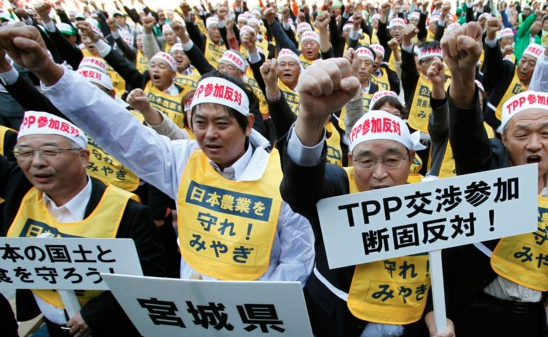
Mass protests in Japan
So, they looked to Japan. It had the same problem with its version of the trade deal similarly called TPP. Mass protests broke out as the same secret meetings gripped the political foreground. Its Prime Minister “Shinzo Abe, instructed the coalition early in the year not to “forcibly” proceed with the TPP negotiations until after elections, Kyodo News reported. Abe genuinely “feared a voter backlash in the Upper House elections” amid the growing scandal of a 242 page leaked document laying bare the bones of the deal. Having been elected June 11th, Abe now intends to force the deal through “this fall”.
I made enquiries with sources close to the ground on the EU/US TTIP deal along the same lines; was this simply a delaying tactic until after elections in 2017 for France’s Hollande and Germany’s Merkel? The response was not wholly unexpected.
“The seemingly early celebration of the end of TTIP has also surprised us a bit. Despite last week’s statements by the German and French trade ministers and the way these have been portrayed, we are continuing to campaign against the deal.”
In another exchange:
“The declarations of French and German leaders aim to: divert attention away from CETA, reduce the numbers in the streets of Germany on 17th September, put TTIP on hold while elections take place in France, Germany and the USA. The fifteenth round of TTIP negotiations will happen in the first week of October… This has been confirmed by our US friends.”
I then contacted Corporate Europe Observatory (CEO). It is a research and campaign group working to expose and challenge the privileged access and influence enjoyed by corporations and their lobby groups in EU policy making. They have been exposing the misinformation and propaganda of the EU Commission for years.
The CEO response to my same question was emphatic and quite clear:
“Public opposition to CETA and TTIP has led French and German leaders to please voters with words against TTIP. Unfortunately, the next round of TTIP negotiations is scheduled for early October and no EU leader has publicly said he or she will vote against CETA in the EU Council in October. This is clearly not the end of TTIP and CETA, just the beginning of electoral campaigns in France and Germany.”
Germany and France have taken the same stance as Japan on these trade agreements, they are not dead at all – they are lying.
I then spoke to Peter Koenig, an economist and geopolitical analyst. He is also former World Bank staff and worked extensively around the world in the fields of environment and water resources and posed the same question. He said:
“Following a debate on PressTV Edition Française, where I was one of the interviewees, the focus was on the German and French Ministers’ expressed conclusion that TTIP negotiations failed. I wrote an article “The TTIP is Dead”, hoping that spreading of this ‘promise’ by the highest authorities of the two key countries in the EU would make sure among the European populace that any deviation from this ‘promise’ would be perceived as a lie and receive strongest public expressions of protest.”
“In the meantime, it has become clear that the TTIP and TISA ‘deals’ are not at all dead. In fact, shortly after the German and French announcements, Jean-Claude Juncker, the unelected President of the European Commission, declared majestically that for him the negotiations are not dead.”
Koenig continues,
“There are other means to infiltrate the TTIP into the EU, i.e. through CETA and according to Juncker, doesn’t need ratification of each EU members’ parliament. Then there is TISA, the even more secret ‘trade agreement’ between 50 countries around the globe. TISA could easily be used to clandestinely impose TTIP rules on Europe.”
Nick Dearden, Director of Global Justice Now confirmed what Peter Koenig is saying in a Guardian piece “Think TTIP is a threat to democracy? There’s another trade deal that’s already signed”
“TTIP is not alone. Its smaller sister deal between the EU and Canada is called CETA (the Comprehensive Economic and Trade Agreement). CETA is just as dangerous as TTIP; indeed it’s in the vanguard of TTIP-style deals, because it’s already been signed by the European commission and the Canadian government. It now awaits ratification over the next 12 months.
The one positive thing about CETA is that it has already been signed and that means that we’re allowed to see it. Its 1,500 pages show us that it’s a threat to not only our food standards, but also the battle against climate change, our ability to regulate big banks to prevent another crash and our power to renationalise industries.
CETA contains a new legal system, open only to foreign corporations and investors. Should the British government make a decision, say, to outlaw dangerous chemicals, improve food safety or put cigarettes in plain packaging, a Canadian company can sue the British government for “unfairness”. And by unfairness this simply means they can’t make as much profit as they expected. The “trial” would be held as a special tribunal, overseen by corporate lawyers.”
What is missing from this statement is that any American corporation headquartered in Canada can sue any nation in the EU via CETA for the same reasons – namely, loss of ‘expected’ profits. They don’t actually have to be Canadian corporations.
As Global Justice also confirms, Canada has itself fought and lost a plentiful and diverse range of legal cases brought by US corporations under the North American Free Trade Agreement (Nafta) for “outlawing carcinogenic chemicals in petrol, reinvesting in local communities and halting the devastation of quarries.” If TTIP doesn’t bring this horrific erosion of democratic power to the shores of Europe, CETA will. ‘Brexit’ will mean for nothing. It will be sold to the British people as a global trade agreement which will be heralded as a great success and supported by much of the media who themselves have a vested interest in such deals.
In the end, does it matter if it’s called TTIP, CETA, TISA and the like, they are all shadowy unaccountable acronyms designed to enrich the few via extreme neoliberal capitalism under the guise of free trade.
Featured Video

AIDS Inc. by Gary Null (2007)
or go to
Aletho News Archives – Video-Images
From the Archives
Fanatical Followers of the Covid Regime: A Jim Jones-Style Cult?
By Professor Roger Watson and Dr. Niall McCrae | The Daily Sceptic | November 15, 2021
As scholars at leading British universities over recent decades, we witnessed the replacement of critical thinking and debate by narrative: facts are discrimination and scientific method is imperialism; truth, instead, is derived from ‘progressive’ values. This educational trend may be a major contributory factor to the ease in which society has been inculcated to the Covid ‘new normal’ of masking, testing, and repeated doses of vaccines for a disease of similar risk to severe influenza.
One doesn’t need much critical reasoning to observe the flawed logic of some vaccination enthusiasts, such as people who respond to experiencing any side effects, however debilitating, by saying “at least I know it’s working”, or, after contracting the disease despite their promised inoculation (over 90% effective, according to initial drug company claims), “I’d have been worse off without the jab.” … continue
Blog Roll
 Aletho News
- Merck Virologists Admitted to Falsely Certifying Vaccine Efficacy
- Mandatory Folic Acid for every man, woman & child
- Pro-Palestine protesters arrested outside UK’s ruling Labour Conference in Liverpool
- Mauritius denies landing permit to flight from Israel, forcing cancellation: Tour operator
- Israeli finance minister calls for genocidal war on West Bank, annexation of south Lebanon
- 12 Things Your Psychiatrist Was Trained Not to Tell You
- From Unipolar Universalism to Multipolar Civilizational Distinctiveness
- RSF military group defects, joins Sudanese army: State media
- Ireland goalkeeper refuses to play ‘Israel’ as squad weighs boycott
- China pushes back against US on Cuba, Iran
- If Americans Knew
- Israel forces Gazans to live in constant peril – Daily Update
- Deconstructing Netanyahu’s pants-on-fire UN rant – Daily Update
- Trump betrayed voters with his campaign lies and prioritized a foreign country once he took office
- Netanyahu calls Israel’s war in Gaza ‘opposite of genocide’ in UN speech to near-empty hall
- Settler Kidnappings: Torture, Sexual Abuse and Terrorisation of Palestinian Abductees as Israel Deepens Annexation of West Bank
- Gaza winter nears as 162,000 tents become unusable, raising fears of humanitarian crisis
- Netanyahu says, “It’s the opposite of genocide”; UN says Gaza economy is world’s ‘most severe crisis on record’ – Daily Update
- Israel’s US-Backed Assault on Gaza Has Created the ‘World’s Most Severe Economic Crisis on Record’: UN
- ‘Protecting U.S. Citizens’… From Israel
- ‘This is where I live now, the back of a truck’: a day in the life of a grandmother in Gaza
- No Tricks Zone
- New Study: Earth And Venus Surface Warmth Largely Explained By Convection And Lapse Rate, Not CO2 Or Radiation
- 2025 Nature Paper Claiming Worsening Global Drought Gets RETRACTED …Heavily Flawed
- New Study: ‘Global Drought Shows No Detectable Recent Acceleration Under Climate Warming’
- Economic Masterminds: German Socialists Suggest Taxing Productivity Gains Stemming From Using AI
- The South China Sea Has Not Been Cooperating With The Climate Change Narrative
- Energy Crisis: Germany Enters Heating Season With Historically Low Gas Reserve Fill Levels
- New Study: The Antarctic Ice Sheet Gained Mass From 2020-2024 Due To Staggering Snow And Ice Accumulation
- Study: Ocean Heating Rates From Thousands Of Years Ago ‘Dwarf’ Modern Ocean Heating Rates
- Climate Extremists Target, Attack Large-Scale Power Grid Infrastructure In Germany!
- New Study: Antarctic Ice Melt Has Contributed Less Than 1 Centimeter To Sea Level Rise In The Last 30 Years

