Many Americans Should Un-Stupid Themselves
By Joel S. Hirschhorn | Dissident Voice | November 18, 2016
To be upfront, I strongly believe that President Trump is exactly what the USA desperately needs at this time, a disrupter. I say this as someone who worked in the political world for over 20 years, is white, highly educated, old and affluent. I ask all who have negative views of Trump to open their minds and consider my arguments.
In September 2015 I published an article in which I said: “Trump surely has more current and potential supporters than the media and political establishment can accept. Unlike Trump, they have no imagination. The Donald, to his credit, is really on to something Great. I hope that many more Americans recognize that he is exactly what the nation needs. Stick that middle finger up at all the chronic liars that have sold out the vast majority of Americans.” More than a year before the election I was correct.
The most fascinating post-election fact I have seen is that Trump prevailed with voters making $100,000 or more a year. Second was that Trump won 53 percent of white women. Would you have ever predicted these from what you heard from the mainstream media?
The craziest moment I had was watching President Obama very close to the election support voting by illegal immigrants.
During the campaign I was appalled at the insane pro-Clinton bias among the corporate media; it made me nauseous and caused me to greatly reduce my watching of CNN and MSNBC and all three major television networks.
Not only were most Trump supporters not deplorable, they were not racist, sexist or stupid. But the media, Democrats and establishment Republicans tried to make them feel like they were.
When 70 percent of the nation consistently says that the country is on the wrong track there is enormous pent up demand for change. Did anyone really think Clinton was a change agent? The media dismissed the significance of the demand for change. When you thirst for change you are willing to ignore a lot of negatives of a change candidate. The media and Clinton were just the opposite; they were status quo supporters.
And now what amazes me is that all these media companies have not fired the many, many pro-Clinton anchors, pundits, columnists and reporters. Days after the election all these people who got nearly everything wrong about this election are still appearing in the same venues. A great many columnists, editors and reporters at the New York Times and Washington Post and countless personalities at CNN and MSNBC should be fired. Not solely because they were wrong, but because they showed themselves to lack any journalistic integrity. That means you Wolf Blitzer.
Even more sickening are the countless Democrat politicians and hacks who refuse to accept full responsibility for all the idiotic and disrespectful things they did that caused their terrible candidate to appropriately lose the election. The clearest sign of Democrat stupidity and delusion is the constant garbage bragging that Clinton got more votes than Trump. Why is this so repulsive? Because presidential campaigns are devised and operated on the basis of the Electoral College system that constitutionally determines the victor. This means that a winning campaign must focus on specific states rather than on states with the largest populations. In other words, Clinton’s larger national popular vote total is irrelevant and meaningless. Moreover, millions of illegal immigrants may have voted for Clinton. Clinton herself has clearly refused to accept personal responsibility for her loss. This makes all of us who intensely opposed her feeling justified as well as even more thrilled with her loss.
What the biased media apparently also has not learned is their behavior helped the Trump victory. Why? Because it pissed off many millions of Americans. Sure, politicians lie a lot, including Trump and Clinton. But to constantly see and hear nearly all media outlets distort and lie about the pros and cons of both major candidates irritated rational, smart Americans who supported Trump for valid reasons having nothing to do with racism and other negative characterization.
The media has done of terrible job of properly informing Americans about the true nature of globalization that is pushed by corporate interests. There are two main dimensions. One is the advocacy for international trade agreements that have already sold out middle class Americans by exporting good jobs in manufacturing. The availability of cheaper goods does not outweigh the incredible costs and pain for a large segment of the American population. There has been a transfer of American wealth to countries such as China, but that wealth has been robbed from the middle class, not the upper wealthy and corporate class that has increased their wealth because of trade.
The other side of globalization is the escalating movement of non-white people from terrible situations and countries to white-majority countries. This too has been pushed by corporate interests seeking low cost labor. Both legal and illegal immigrants have been changing the culture and economy of white-majority democracies. What I greatly resent is that Americans have never been given a clear political choice to vote for changing their beloved white-majority country to a very different kind of country. Neither Obama or Clinton or any other politicians clearly told the American public that their long-term objective was to convert the white-majority nation to something very different. Of course Clinton was pretty clear that her campaign was based on getting the votes of blacks and Hispanics, which, in the end, she failed at. This – I strongly say – is not about racism; it is about the right of a majority population to maintain a major characteristic of their nation and culture. None of the historic waves of immigration in previous centuries did what the current kind and scope of immigration is doing to the fundamental character of the USA. It has been imposed upon the white-majority population in a fundamentally undemocratic way. Americans were never given a chance to vote on this change, except to vote for someone like Clinton who never honestly said what she wanted. So white Americans saw the truth this time and acted on their beliefs and fears.
Here is the truth of contemporary nationalism: Any national majority has a democratic right of self-determination to use their political system to reject immigration that threatens to change that majority, whether that majority is based on race, religion, culture or language. Political leaders that use humanitarian arguments to ignore majority resistance to immigration face defeat such as Hillary Clinton’s loss.
Thus the Trump victory is consistent with what is going on in other democracies, namely a rejection of elitist, establishment, corporate driven systems pushing globalization and intense immigration. So called right wing populist movements reflect a rejection of globalization priorities. Not only is this not about racism, it is also not about isolationism. It is about self-determination of majority populations. Swedes have a right to keep their white culture, the French have a similar right and so do Americans. It is not racist to see connections between fast, massive immigration and threats from terrorism and crime.
Give Trump time to show that he can actually help make America great again. If you did not see the true realities that produced the Trump victory, then un-stupid yourself.
The most stupid thing you can do right now is to ignore the several core serious messages of Trump that resonated so much with so many Americans because for one reason or another you hate the messenger.
Joel S. Hirschhorn was a full professor at the University of Wisconsin, Madison and a senior official at the Congressional Office of Technology Assessment and the National Governors Association; he has authored five nonfiction books, including Delusional Democracy: Fixing the Republic Without Overthrowing the Government.
Newly Discovered Texas Oil Field Could Hold 20 Billion Barrels
Sputnik – 18.11.2016
The United States Geological Survey has announced the discovery of the largest oil field in the United States to date.
The Wolfcamp formation, in the Permian Basin in a West Texas desert, is believed to hold some 20 billion barrels of oil, worth roughly $900 billion at today’s prices. It is also believed that this field contains an estimated 16-trillion cubic feet of natural gas, and 1.6 billion barrels of liquid natural gas. “The estimate lends credence to Pioneer Natural Resources Co. Chief Executive Officer Scott Sheffield’s assertion that the Permian’s shale endowment could hold as much as 75 billion barrels, making it second only to Saudi Arabia’s Ghawar field,” Bloomberg reports.
The Wolfcamp find is three times larger than the previous largest fossil-fuel discovery in the US, the North Dakota’s Bakken field.
The area, controlled by several energy companies, has been producing gas for the past 100 years. The latest find was previously inaccessible as it is buried under four layers of shale. To retrieve it, modern methods such as fracking and horizontal drilling must be used, Newser reported.
“The fact that this is the largest assessment of continuous oil we have ever done just goes to show that, even in areas that have produced billions of barrels of oil, there is still the potential to find billions more,” Walter Guidroz, program coordinator for the USGS Energy Resources Program, said in a statement.
“Changes in technology and industry practices can have significant effects on what resources are technically recoverable.”
Stability Battles Chaos: From London to Aleppo
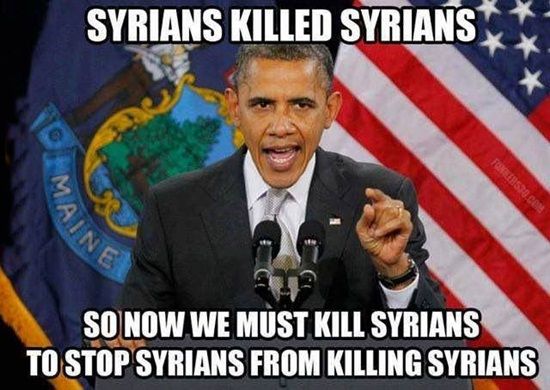
By Caleb Maupin – New Eastern Outlook – 17.11.2016
For over five years the leaders of the United States, Britain, France, and Germany have been working to topple the Syrian Arab Republic. In their efforts to remove the independent nationalist government led by the Baath Arab Socialist Party, the western imperialist powers have enlisted their collection of petroleum vassals and despots in the nearby area. The Kingdom of Saudi Arabia, Qatar, the United Arab Emirates, and Dubai; absolute monarchies that routinely behead, torture, and deny their populations even basic rights like freedom of speech are all sending weapons and training foreign fighters to destabilize Syria in what western leaders still pretend is a fight for “democracy.”
300,000 people are dead. Millions have become refugees. Among the fanatical colossus of anti-government forces in Syria, vile ISIL terrorist organization has emerged, unleashing horrors in Lebanon, Belgium, France, and elsewhere. Yet, western leaders do not end their mantra of “Assad Must Go!” and continue efforts to make the country less stable. It seems not to matter how many innocent people have to die, or how strong the dangerous terrorist “opposition” gets, western leaders seem unwilling to abandon their goal of regime change.
If the Syrian government were to fall, the results would be grim. The Al-Nusra Front, ISIL, and even a number of the forces the US has called “moderate” are devoted to establishing a Sunni caliphate. Syria’s religious minorities, the Christians, the Alawites, and others could face either forced deportation, or even outright extermination.
Russia, along with Iran, China, and Venezuela, have come to the aid of the secular, internationally recognized Syrian government, in the hopes of holding back the wave of extremism. The Syrian city of Aleppo is now divided, with the eastern section of the city under the control of various anti-government factions, including the US backed so-called “moderate” rebels, as well as the Al-Nusra terrorists, who were directly linked to Al-Queda until recent months.
Russia repeatedly requested that a humanitarian corridor be created so that civilians could flee Aleppo and escape the fighting, as the Iraqi forces did when fighting in Mosul. Neither the Al-Nusra terrorists, the US backed “moderate rebels”, or the United Nations, or the western powers would comply with Russia’s request. The call for a humanitarian corridor in Aleppo was denied. When speaking of the citizens of Aleppo, John Kirby of the US State Department insisted “they shouldn’t have to leave.”
Despite their efforts to protect innocent life, Russia and the Syrian government have been forced to fight against the Al-Nusra terrorists and their allies in close proximity to civilians. As Russia fights to retake the city from anti-government extremists, the US media suddenly has developed a concern for the civilian casualties of war. Allegations of Russian war crimes in Aleppo have filled the airwaves and the speeches of western leaders. Meanwhile, anti-government forces continue to shell civilian areas in the western side of the city. Western media ignores the cries of these civilians, while doing everything to demonize the Syrian government and Russia. The hypocrisy shouldn’t be missed by anyone. Some of very same individuals that backed the US invasion of Iraq which caused hundreds of thousands of innocent civilians to die, now voice “humanitarian” outrage about Aleppo. The leaders of NATO, who reduced Libya, then the most prosperous African country, to rubble, now bemoan the impact of war on civilian populations. The very same voices that long dismissed civilians killed by airstrikes, have now discovered that what they once called “collateral damage” indeed has human rights.
At the same time that Russia works with the Syrian government to retake Aleppo, the Kingdom of Saudi Arabia is conducting a relentless bombing campaign against the people of Yemen. There is no dispute that the Saudi attack on Yemen is violating human rights. The UN has documented that civilian targets are being intentionally hit. But no pressure whatsoever is being placed on Saudi Arabia to end its slaughter of Yemeni civilians. The western governments continue to actively assist their Saudi “allies” as they violate international law in Yemen, while demonizing Russia’s cooperation with Syria against terrorism.
When speaking of Aleppo, western leaders employ language that is quite similar to the kind often used by left-wing anti-war activists. The British Foreign Secretary, Boris Johnson, even called for anti-war protests targeting Russia when speaking before parliament on October 11th.
The November 3rd Provocation
 On November 3rd, a group of 25 people wearing “Save Aleppo” T-Shirt presented themselves outside of the Russian embassy in London, and appeared to be following Johnson’s directive. They brought with them a truck full of manikin arms and legs. They proceeded to dump these arms and legs in pile in front of the embassy, effectively blocking its doors and preventing anyone from leaving or entering.
The manikin arms and legs were said to symbolize the innocent people of Aleppo, whose deaths they blamed on Russia. The police did not halt this demonstration, which appeared to have barricaded a foreign mission. As the protest continued, some of the provocative individuals in “Save Aleppo” T-shirts are reported to have chained themselves to the fence surrounding the embassy’s perimeter. Yet, it appears that not a single arrest was made. The police, who were on hand, apparently did not stop the individuals.
So, who were these individuals? The money for the protest was supplied by “Syria Campaign.” This is a non-profit organization funded by a Syrian billionaire named Ayman Asfari, in addition to other anonymous sponsors. It makes sense that a billionaire of Syrian descent, residing in Britain, would want to topple the “Baath Arab Socialist Party” that has run his country for many decades. Parallels between Asfari and the many wealthy Cuban residents of Miami are easy to make. The Syrian government, like the Cuban government, has provided housing, healthcare, and education to its population, achieving this with policies that make the richest people quite uncomfortable.
But beyond Asfari’s well-funded “Syria Campaign” that uses its huge endowment to spread propaganda against the Syrian government and its allies, who were the individuals in the T-shirts? Very few of them appeared to be of Syrian origin, but one cannot assume they were merely hired stooges either.
The answer to this question can be found in the name of an organization that co-sponsored the malicious provocation. The organization “Syria Solidarity UK,” which took credit for the action on its website, is well known to be a front group for the Socialist Workers Party of Britain. This “socialist” organization follows the teachings of Tony Cliff and Leon Trotsky, has its grip on Britain’s “Stop The War Coalition” as well. It is safe to surmise that a decent percentage of those who barricaded the Russian embassy’s entrance were Trotskyites.
Two Currents of Communism
So, who are the Trotskyists? To answer this question we must begin to examine the anatomy of the political left throughout the course of the 20th century.
Within the mass movements associated with Marxism, there are a wide variety of sects, ideologies, and interpretations. However, among the individuals who envision and work toward the overthrow of capitalism there are two distinct personal or psychological categories. These two trends often work in concert with each other. The two trends often do not even intentionally dissociate with each other, and can often be found within the same political parties and movements, despite the huge differences between them. The differences are found in motivation.
Among the political left, the primary and constant current is an extremely alienated minority from within the privileged sectors of society. In Russia it was a current among the children of the aristocracy, as well as from within the emerging bourgeoisie, who made up much of the cadre of the Bolshevik Party in its early years. While they were born in relatively comfortable positions, they knew that things in society at large were deeply wrong. They saw the suffering of the poor, and the many other injustices that existed, and were filled with anger and motivation to correct them. While other members of their social caste could be at peace with society, they could not.
Whether it is due to their unique access to education, or the fact that they are encouraged to ponder political and philosophical questions while other strata are not; regardless of the reason, a section of the most privileged people always seems to be drawn to revolutionary anti-capitalist politics. The trend is not restricted to pre-revolutionary Russia. One can think of the young French radicals depicted in Victor Hugo’s novel Les Miserable, or even the radicals of Students for a Democratic Society or the Weather Underground in the United States, who came from some of the prestigious Universities. No matter how strong or weak the leftist current is in society at large, a certain sector of the privileged classes exists as a kind of “radical intelligentsia.” This is true even in under the most repressive anti-communist dictatorships.
The second current, which constitutes a very solid majority of those attracted to leftist and anti-capitalist currents around the world, are those among the working and impoverished classes. While in times of prosperity they are less politicized, as they see their conditions deteriorating, they become motivated to take action and embrace anti-capitalist and revolutionary ideology.
Unlike the first current, their motivation is not a moralistic impulse based on alienation, but rather the basic desire to see their lives improve. This does not mean that such people do not have political depth or brilliance. Often these forces are actually much more politically effective and ideological. However, their introduction to revolutionary politics originates in a basic material need.
While these two distinct political currents espouse the same phrases and philosophies, they seem to crave two different things. The privileged children of the wealthy who embrace revolutionary politics often have a deep desire to create chaos. They see the world as unjust and cruel. They want it to be smashed, shattered, burned to the ground, and rebuilt anew.
The second current, while espousing the same political line, tends to crave the opposite. They are motivated to take political action as society is becoming less stable. The economic crisis has made their lives more painful and unpredictable, intensifying the suffering all around them, pushing them toward a desperate need for radical change. They embrace anti-capitalism because it offers stability beyond the “anarchy of production.” The revolutionary left is for them, not the road to chaos and revenge, but the path toward a new order with a centrally planned economy, in which justice is created and the chaos is ended.
The Origins of “Trotskyism”
Lenin’s book “What Is To Be Done?,” which laid the foundation for the Bolshevik project of a Central Committee and a “Party of a New Type,” was largely directed at members of the first, moralistic, and privileged group. It urged them to look past their own motivations, abandon terrorism and tailism, and build an highly disciplined organization that could push the broader masses of Russian workers and peasants toward a full revolution.
The October Revolution of 1917 was successful because it merged the two trends. In a time of crisis, the revolutionary intelligentsia who longed to smash the old order, were able to mobilize the workers and peasants who were suffering and desperately wanted “Peace, Land and Bread.” The effective convergence of these two currents created a new political and economic system.
However, almost immediately after the Soviet Union was founded, political space began to develop between the two trends. Lenin banned factions in the Bolshevik Party during the early 1920s in order to hold an increasingly divided ruling party together. Despite the ban on factions, the two trends did not cease to exist. After Lenin’s death, the two poles became personified in Leon Trotsky and Joseph Stalin.
Trotsky, the son of wealthy landowners in Ukraine, who had lived in exile most of his life and was beloved among the world’s cosmopolitan intellectuals, called for “Permanent Revolution.” The Soviet Union, in his view, should exist simply as a temporary hold out in a global revolutionary explosion. In his view, Soviet society should be organized around the military, and focus primarily on seizing the western financial centers of Germany, Britain, and France for the global socialist project to remake all humanity.
Stalin on the other hand called for “Socialism in one country.” He advocated for the Soviet Union to focus on building a good society for the people of Russia and the surrounding countries, while offering limited support to revolutionary forces around the world. “Socialism in One Country” would require signing treaties with the western countries, restoring the traditional family, and eventually even legalizing the Russian Orthodox Church. For Stalin and the majority of the Communist Party of the Soviet Union, socialism did not mean an endless global crusade to behead every last king and capitalist, but rather, building a peaceful, prosperous society with a planned economy in Russia and the surrounding countries.
When Stalin was victorious, the world communist movement began to shed the most adherent members of the first revolutionary category. The Communist parties began building unemployment councils, trade unions, and other organizations dedicated to aiding working people and fighting for direct material gains as capitalism collapsed into a “great depression.” Eventually the “Stalinists” built a People’s Front of anti-fascists that played a decisive role in the Second World War.
Meanwhile, Trotsky took a significant number of western intellectuals out of the Communist International and into his “Fourth International.” The Trotskyists worked to antagonize and isolate the Soviet aligned Communist Parties, while at the same time presenting a negative perception of the Soviet Union as a “totalitarian” and “repressive” society that did to live up to the utopian dreams of middle class radicals.
Trotsky saw the USSR as a “degenerated workers state,” socialist in its economic foundations but “bureaucratized” in its politics. In the final years of his life, a number of Trotsky’s followers disagreed with this assessment and argued that the USSR was capitalist. Max Shachtman, Irving Kristol, and a number of the more middle class elements broke with Leon Trotsky, arguing that the USSR was not a “worker’s state” but rather “bureaucratic collectivism”, “state capitalism”, or fascism. These elements called themselves “Third Camp” or “Neo-Trotskyists.” The International Socialist Tendency, of which the British Socialist Workers Party is aligned, along with the US International Socialist Organization, is the largest group continuing these politics. It is “Third Camp Trotskyists” in Britain who have built the organization called “Syria Solidarity UK” which conducted the recent protests against the Russian embassy.
Interestingly, it is from within the “Trotskyists” who broke with Trotsky, and completely denounced the USSR, that one can find the origins of Neo-Conservative thought in the United States. James Burnham, Edmund Wilson, Max Eastman, and many of the leading right-wing intellectuals of the Cold War were era were originally Trotskyists.
Brzezinski’s Permanent Revolution
Zbigniew Brzezinski, one of the leading CIA strategists during the Cold War, can largely be credited for defeat of the Soviet Union. Brzezinski’s career involved fomenting dissent and unrest in Soviet aligned countries. The gap between revolutionary intellectuals who crave chaos and revolution, and the pragmatic approach of Soviet leaders who wanted a stable, planned economy was a great asset to his activities. The CIA launched the “Congress for Cultural Freedom” to fund anti-Soviet leftists and artists, and further the space between them and the USSR.
In Hungary, Poland, Czechoslovakia, East Germany, and many other socialist countries, the US Central Intelligence Agency enflamed and exploited the grievances of artists and intellectuals, who felt stifled by the Marxist-Leninist political set up, and longed for the “freedom” of the west. It has become almost cliché to talk about the role of Beatles music and other western counter-cultural icons in “the fall of Communism.”
Brzezinski openly bragged that he was “giving the USSR its Vietnam War” in Afghanistan. When the People’s Democratic Party took power in 1978, the CIA worked with the Saudi monarchy to launch a global campaign of Wahabbi Muslims against it. The USSR sent its forces into Afghanistan to protect the People’s Democratic Party.
In the global media, it was a different story. The press painted the Taliban and other forces organized by Osama Bin Laden as romantic guerilla fighters, battling against the USSR, portrayed as a crude, repressive invading force. The “Trotskyists” of the world embraced the Mujahadeen Wahabbi fanatics in much the same manner that such forces now embrace the Free Syrian Army and the Al-Nusra Front. Among the organized left, pro-Soviet sentiments were left only to a small minority, dubbed “Stalinists” and “Hardliners.” The long-haired, counter-cultural “New Left” bought into the CIA narrative, and believed that Osama Bin Laden was some kind of Che Guevara.
In the 21st century, Anti-imperialist governments, even those who completely reject Marxism-Leninism, have a lot in common with the political and economic system developed by Stalin during the 1930s. Anti-imperialist countries tend have five year economic plans or other mobilizations of the population toward raising the living standards. They tend to have a ruling party with a very complex and specific ideology, that sits at the center of a tightly organized and politicized population. The strength of the various anti-imperialist regimes is their ability to control the centers of economic power, raise the standard of living, and provide a comfortable life for the majority of their people.
In China, each child is given a red scarf when they begin their education. They are told that this red scarf is their own piece of the Chinese flag, and that it represents a political project toward building a prosperous society, which they are automatically part of it. Similar rituals exist in the Bolivarian countries, the Arab Nationalist states, and almost every other country where the government can trace its origin to an anti-capitalist revolution.
Meanwhile, the primary strategy of Wall Street for toppling these governments has been to employ the rhetorical style of Trotskyists, and appeal to the alienation and anxiety of the privileged elite. The CIA and its network of aligned NGOs has discovered key methods of manipulating and unleashing the desire for chaos among the middle class. Figures like Samantha Power talk about “mobilizing” for human rights around the world.
The primary way the US has attacked independent countries in recent years has been fomenting revolts such as Euro-Maiden in Ukraine, the “Green Movement” in Iran, the “revolution” in Libya. These uprisings are supported by Non-Governmental Organizations and carried out to serve the interests of the western financial elite. While they effectively maintain the global status quo, they are decorated with the most Guevara and Trotsky-esque propaganda on social media and western television. It seems pretty clear that the vaguely emotional lust for revolution and unrest among the alienated middle class has been effectively harnessed as a mechanism for defeating “Stalinism” and ensuring the rule of western capitalists.
Foreign Affairs: “Open International System” vs. “Populism”
The Council on Foreign Relations, the CIA-linked think tank, shed light on its worldview and strategy in the latest issue of their publication Foreign Affairs. In an essay by Anne-Marie Slaughter, one of the primary architects of the US backed regime change operation in Libya, she described her prescription for the ailments of the global situation.
“The people must come first,” she tells us, like a soap-box agitator. “When they do not, sooner or later they will overthrow their governments.” According to Slaughter, the job of western countries is to facilitate the free flow of information through social media, in order to allow these uprising to come about.
Furthermore, Slaughter argues that the Treaty of Westphalia, and the concept of the nation state is out of date. Rather “responsibility to protect” or R2P has replaced it. The NATO states and their military must intervene in order to strengthen these revolutions, and topple regimes that get in Wall Street’s way. The strategy is global revolution, endless destruction and chaos until “open governments, open societies and an open international system” can be erected. We can almost hear echoes of Trotsky’s fantasy of “permanent revolution” in Slaughter’s writing, though Trotsky’s stated goal was to overturn capitalism, not secure its grip on the planet.
And who are the villains in the CFR narrative? They are “Populists.” The entire issue of “Foreign Affairs” is titled “The Power of Populism.” Listed among them are Hugo Chavez, Evo Morales, the Supreme Leader of Iran, as well as Russian President Vladimir Putin and Chinese President Xi Jinping. According the analysis, it is these dangerous “demagogues” who reject the “open international system” of the World Bank and the International Monetary Fund, but instead mobilize their populations and preside over centrally planned economies that must be smashed. With the word “Populism”, the CFR seeks to link these governments to racism and anti-immigrant bigotry in western countries, and urge “progressive” and “enlightened” people to oppose them in the same manner.
Indeed, political navigation in the 21st Century can be quite difficult. The compass by which analysts have long determined left and right is broken. The defenders of free market capitalism and the rule of internationalist bankers have embraced the revolutionary blood-lust which was long a staple of the political left. Meanwhile, the anti-imperialists and advocates of planned economies now often position themselves as social conservatives and defenders of stability, morality, religion, and tradition.
While it is no longer exactly clear which way is “left” or “progressive,” it is blatantly obvious which way is better for the human race. The NATO regimes, despite mouthing left-sounding rhetoric in the process, have reduced Iraq, Afghanistan, Libya, and Syria to civil war and chaos. The fruits of their imposed vision of an “open society” with “free markets” is not prosperity and freedom but poverty, chaos, and endless civil war.
However right-wing and conservative the governments of China, Russia, and Iran may seem, the societies they have created are ones in which profits are not in total command, and providing a decent life for the masses of people remains a priority. In the anti-imperialist regimes, the state is independent of market forces, and has the ability to restrict and control their actions. Meanwhile, a sense of collective vision and obligation exists, and people are not left isolated to fend for themselves.
Yes, the CFR’s vision of a clash between the “open international community” and the “populists” is certainly accurate as it is playing out before the world. Syria is simply the most visible battlefield.
Caleb Maupin is a political analyst and activist based in New York. He studied political science at Baldwin-Wallace College and was inspired and involved in the Occupy Wall Street movement.
Walmart warns workers not to use app helping them understand company’s labor rules
RT | November 15, 2016
OUR Walmart, a worker-led activist group, has devised a new app, now available for Android smartphones, that uses artificial intelligence to help workers understand company policies and legal rights. Walmart has told workers to not download the app.
The app, WorkIt, was released Monday to offer advice to Walmart workers on a host of issues, according to OUR Walmart.
OUR Walmart is a labor group, but not a union, as Walmart does not offer collective bargaining rights, which has thousands of paying members and has organized Black Friday protests at Walmart locations nationwide.
The OUR Walmart organization teamed up with software development company Quadrant 2 to develop WorkIt. The app uses IBM’s Watson artificial intelligence bot to answer concerns or questions of employee, who are only identified on the app by their username and store position. Watson accesses a database built by Walmart workers to address user questions. When Watson cannot answer one of about 200 queries, “there is a peer network of experts that will interact with the users,” Jason Van Anden, founder of Quadrant 2, told the Wall Street Journal. Watson then has the ability to learn how to answer certain questions from the peer experts.
For its part, Walmart has already addressed store managers about the app, warning that OUR Walmart is “increasingly trying to get our associates to turn over personal information to the union by using deceptive and slick looking social media and mobile apps,” according to a document reported by the WSJ.
“We just wanted to give you a heads up that if someone tries to get you to download an OUR Walmart work-related app on your mobile device, you may unknowingly be giving away valuable personal information like your location and personal contact information that the union can use however it wants,” Walmart wrote to store managers, according to Bloomberg.
“There is no way to know if the details this group is pushing are correct,” Walmart spokesman Kory Lundberg said in a statement. “Our people are smart and see this for what it is; an attempt by an outside group to collect as much personal and private information as possible.”
The app does not track location or ask users to submit their location, according to Cat Huang, a technologist who worked on the app.
“We’re not going to sell the data, ever,” OUR Walmart co-director Andrea Dehlendorf told Bloomberg. “We will share it with researchers and use it to inform conversations with Walmart. But it’s not part of the revenue model.”
The app’s utility emerged in the days when Walmart employees had limited time to access information on the company’s extensive human resources policy guide held on the Walmart intranet known as Wire. (The company says it has offered more access to its policies since early 2016, Bloomberg reported.) In addition, queries to OUR Walmart’s Facebook page became to much for the group to handle.
OUR Walmart directors raised money from various groups, like the Workers Lab, and hired a technologist, Huang, and a developer, Van Anden, to help create the app.
The app will also assist OUR Walmart by gathering data on specific issues that impact employees, allowing the group to address the company with hard proof of the employee experience.
“It will give us real evidence to talk to the company about what’s broken,” Dehlendorf told Bloomberg. “We have to be in a place where we can say, ‘This is the truth. We have massive data.'”
The app does not access Walmart’s policy guide directly, but offers “interpretations of the policies,” Huang told Bloomberg.
OUR Walmart said it expects about 14,000 employees, or around 1 percent of Walmart workers, to download the app by the end of 2017.
Break Up the Democratic Party: It’s Time for the Clintons and Rubin to Go – and Soros Too

Photo – Joshua Roberts, Reuters
By Michael Hudson | CounterPunch | November 15, 2016
In the week leading up to last Tuesday’s election the press was busy writing obituaries for the Republican Party. This continued even after Donald Trump’s “surprising” victory – which, like the 2008 bank-fraud crash, “nobody could have expected.” The pretense is that Trump saw what no other politician saw: that the economy has not recovered since 2008.
Democrats still seem amazed that voters are more concerned about economic conditions and resentment against Wall Street (no bankers jailed, few junk mortgages written down). It is a sign of their wrong path that party strategists are holding on to the same identity politics they have used since the 1960s to divide Americans into hyphenated special-interest groups.
Obviously, the bottom 95 Percent realize that their incomes and net worth have declined, not recovered. National Income and Federal Reserve statistics show that all growth has accrued to just 5 percent of the population. Hillary is said to have spent $1 billion on polling, TV advertising and high-salaried staff members, but managed not to foresee the political reaction to this polarization. She and her coterie ignored economic policy as soon as Bernie was shoved out of the way and his followers all but told to join a third party. Her campaign speech tried to convince voters that they were better off than they were eight years ago. They knew better!
So the question now is whether Donald Trump will really be a maverick and shake up the Republican Party. There seems to be a fight going on for Donald’s soul – or at least the personnel he appoints to his cabinet. Thursday and Friday saw corporate lobbyists in the Republican leadership love-bombing him like the Moonies or Hari Krishna cults welcoming a new potential recruit. Will he simply surrender now and pass on the real work of government to the Republican apparatchiks?
The stock market thinks so! On Wednesday it soared almost by 300 points, and repeated this gain on Thursday, setting a DJIA record! Pharmaceuticals are way up, as higher drug prices loom for Medicaid and Medicare. Stocks of the pipelines and major environmental polluters are soaring, from oil and gas to coal, mining and forestry, expecting U.S. environmental leadership to be as dead under Trump as it was under Obama and his push for the TPP and TTIP (with its fines for any government daring to impose standards that cost these companies money). On the bright side, these “trade” agreements to enable corporations to block public laws protecting the environment, consumers and society at large are now presumably dead.
For now, personalities are policy. A problem with this is that anyone who runs for president is in it partly for applause. That was Carter’s weak point, leading him to cave in to Democratic apparatchiks in 1974. It looks like Trump may be similarly susceptible. He wants to be loved, and the Republican lobbyists are offering plenty of applause if only he will turn to them and break his campaign promises in the way that Obama did in 2008. It would undo his hope to be a great president and champion of the working class that was his image leading up to November 8.
The fight for the Democratic Party’s future (dare I say “soul”?)
In her Wednesday morning post mortem speech, Hillary made a bizarre request for young people (especially young women) to become politically active as Democrats after her own model. What made this so strange is that the Democratic National Committee has done everything it can to discourage millennials from running. There are few young candidates – except for corporate and Wall Street Republicans running as Blue Dog Democrats. The left has not been welcome in the party for a decade – unless it confines itself only to rhetoric and demagogy, not actual content. For Hillary’s DNC coterie the problem with millennials is that they are not shills for Wall Street. The treatment of Bernie Sanders is exemplary. The DNC threw down the gauntlet.
Instead of a love fest within the Democratic Party’s ranks, the blame game is burning. The Democrats raised a reported $182 million dollars running up to the election. But when Russ Feingold in Wisconsin and other candidates in Michigan, Minnesota and Pennsylvania asked for help, Hillary monopolized it all for TV ads, leaving these candidates in the lurch. The election seemed to be all about her, about personality and identity politics, not about the economic issues paramount in most voters’ minds.
Six months ago the polls showed her $1 billion spent on data polling, TV ads and immense staff of sycophants to have been a vast exercise in GIGO. From May to June the Democratic National Committee (DNC) saw polls showing Bernie Sanders beating Trump, but Hillary losing. Did the Democratic leadership really prefer to lose with Hillary than win behind him and his social democratic reformers.
Hillary doesn’t learn. Over the weekend she claimed that her analysis showed that FBI director Comey’s reports “rais[ing] doubts that were groundless, baseless,” stopped her momentum. This was on a par with the New York Times analysis that had showed her with an 84 percent probability of winning last Tuesday. She still hasn’t admitted that her analysis was inaccurate.
What is the Democratic Party’s former constituency of labor and progressive reformers to do? Are they to stand by and let the party be captured in Hillary’s wake by Robert Rubin’s Goldman Sachs-Citigroup gang that backed her and Obama?
If the party is to be recaptured, now is the moment to move. The 2016 election sounded the death knell for the identity politics. Its aim was to persuade voters not to think of their identity in economic terms, but to think of themselves as women or as racial and ethnic groups first and foremost, not as having common economic interests. This strategy to distract voters from economic policies has obviously failed.
It did not work with women. In Florida, only 51 percent of white women are estimated to have voted for Hillary. It didn’t even work very well in ethnic Hispanic precincts. They too were more concerned about their own job opportunities.
The ethnic card did work with many black voters (although not so strongly; fewer blacks voted for Hillary than had showed up for Obama). Under the Obama administration for the past eight years, blacks have done worse in terms of income and net worth than any other grouping, according to the Federal Reserve Board’s statistics. But black voters were distracted from their economic interests by the Democrats’ ethnic-identity politics.
This election showed that voters have a sense of when they’re being lied to. After eight years of Obama’s demagogy, pretending to support the people but delivering his constituency to his financial backers on Wall Street. “Identity politics” has given way to the stronger force of economic distress. Mobilizing identity politics behind a Wall Street program will no longer work.
If we are indeed experiencing a revival of economic class consciousness, who should lead the fight to clean up the Democratic Party Wall Street leadership? Will it be the Wall Street wing, or can Bernie and perhaps Elizabeth Warren make their move?
There is only one way to rescue the Democrats from the Clintons and Rubin’s gang. That is to save the Democratic Party from being tarred irreversibly as the party of Wall Street and neocon brinkmanship. It is necessary to tell the Clintons and the Rubin gang from Wall Street to leave now. And take Evan Bayh with them.
The danger of not taking this opportunity to clean out the party now
The Democratic Party can save itself only by focusing on economic issues – in a way that reverses its neoliberal stance under Obama, and indeed going back to Bill Clinton’s pro-Wall Street administration. The Democrats need to do what Britain’s Labour Party did by cleaning out Tony Blair’s Thatcherites. As Paul Craig Roberts wrote over the weekend: “Change cannot occur if the displaced ruling class is left intact after a revolution against them. We have proof of this throughout South America. Every revolution by the indigenous people has left unmolested the Spanish ruling class, and every revolution has been overthrown by collusion between the ruling class and Washington.”[1] Otherwise the Democrats will be left as an empty shell.
Now is the time for Bernie Sanders, Elizabeth Warren and the few other progressives who have not been kept out of office by the DNC to make their move and appoint their own nominees to the DNC. If they fail, the Democratic Party is dead.
An indication of how hard the present Democratic Party leadership will fight against this change of allegiance is reflected in their long fight against Bernie Sanders and other progressives going back to Dennis Kucinich. The past five days of MoveOn demonstrations sponsored by Hillary’s backer George Soros may be an attempt to preempt the expected push by Bernie’s supporters, by backing Howard Dean for head of the DNC while organizing groups to be called on for what may be an American “Maidan Spring.”
Perhaps some leading Democrats preferred to lose with their Wall Street candidate Hillary than win with a reformer who would have edged them out of their right-wing positions. But the main problem was hubris. Hillary’s coterie thought they could make their own reality. They believed that hundreds of millions of dollars of TV and other advertising could sway voters. But eight years of Obama’s rescue of Wall Street instead of the economy was enough for most voters to see how deceptive his promises had been. And they distrusted Hillary’s pretended embrace of Bernie’s opposition to TPP.
The Rust Belt swing states that shifted away from backing Obama for the last two terms are not racist states. They voted for Obama twice, after all. But seeing his support for Wall Street, they had lost faith in her credibility – and were won by Bernie in his primaries against Hillary.
Donald Trump is thus Obama’s legacy. Last week’s vote was a backlash. Hillary thought that getting Barack and Michelle Obama to campaign as her surrogates would help, but it turned out to be the kiss of death. Obama egged her on by urging voters to “save his legacy” by supporting her as his Third Term. But voters did not want his legacy of giveaways to the banks, the pharmaceutical and health-insurance monopolies.
Most of all, it was Hillary’s asking voters to ignore her economic loyalty to Wall Street simply to elect a woman, and her McCarthy-like accusations that Trump was “Putin’s candidate” (duly echoed by Paul Krugman). On Wednesday, Obama’s former Ambassador to Russia, Michael McFaul tweeted that “Putin intervened in our elections and succeeded.” It was as if the Republicans and even the FBI were a kind of fifth column for the KGB. Her receptiveness to cutting back Social Security and steering wage withholding into the stock market did not help – especially her hedge fund campaign contributors. Compulsory health-insurance fees continue to rise for healthy young people as the main profit center that Obamacare has offered the health-insurance monopoly.
The anti-Trump rallies mobilized by George Soros and MoveOn look like a preemptive attempt to capture the potential socialist left for the old Clinton divide-and-conquer strategy. The group was defeated five years ago when it tried to capture Occupy Wall Street to make it part of the Democratic Party. It’s attempt to make a comeback right now should be heard as an urgent call to Bernie’s supporters and other “real” Democrats that they need to create an alternative pretty quickly so as not to let “socialism” be captured by the Soros and his apparatchiks carried over from the Clinton campaign.
Notes.
[1] Paul Craig Roberts, “The Anti-Trump Protesters Are Tools of the Oligarchy,” November 11, 2016.
Michael Hudson’s new book, Killing the Host is published in e-format by CounterPunch Books and in print by Islet. He can be reached via his website, mh@michael-hudson.com
Trump Sending ‘Good Signals’ on Syria, but the Devil Is in the Details
Sputnik – 14.11.2016
US President-elect Donald Trump has indicated that tackling Daesh will be a key priority for the incoming administration, prompting many to say that Washington will withdraw its tacit support of the Syrian rebels and work with Damascus instead. Professor Alexander Azadgan told Radio Sputnik that these are “good signals.”
“He had some interesting general policy statements, but as you know the devil is in the details. We’ll have to see how he actually implements even the generalities that he talked about,” Azadgan, Professor of Strategic Global Management and International Political Economy, said. “These are good signals. However, saying that ‘we are going to fight [Daesh]’, that’s not good enough. Everybody is fighting [Daesh], even Washington’s fighting [Daesh].”
The analyst urged policymakers in Washington to “change their vocabulary” when it comes to Syria, particularly the Syrian rebels.
“There is no such thing as a Syrian rebel. We’ve got to throw [this word combination] out of our vocabulary. There are mercenary, lunatic Wahhabis from everywhere around the world, especially Qatar, Kuwait, Saudi Arabia and the Gulf countries. They are neither Syrian, nor rebels. They are terrorists and savages.”
Trump appears to have questioned the concept last week when he said that “now we’re backing rebels against Syria and we have no idea who these people are.”
Azadgan expressed concern that Washington was not ready to listen to other countries with regard to resolving the Syrian crisis.
“I don’t think that Washington has good will to want to compromise or have some kind of fruitful negotiation. I think they are just buying time. Every time Washington says that they are going to negotiate, they create a false flag operation, like the bombing of a Syrian convoy that happened two months ago,” he said. “I don’t think they are interested in peace whatsoever. They are into prolonging this conflict. … It’s very dangerous. And war, even planned war, never goes right.”
The analyst was referring to an attack on a UN humanitarian aid convoy in mid-September, a week after a ceasefire brokered by Russian and American diplomats had entered into force. The incident took place near Aleppo, with the US swiftly blaming Moscow and Damascus. The Russian Defense Ministry provided detailed information disproving these allegations.
Azadgan suggested that Washington’s foreign policy could change once Trump is sworn in as the next US president. “We could reason that maybe Washington has realized that these policies are unsustainable and that they are going to have some face-saving change in policy. We have to talk about this potential,” he said.
The analyst further compared the present-day situation with regard to Syria to Serbia a century ago, saying that we are at a dangerous stage when global powers have taken different sides in a local conflict, which could have global implications.
Trump’s apparent willingness to limit to an extent Washington’s engagement overseas is a good sign.
“If you have cooler heads in Washington, if you have people expressing slight forms of isolationism, this is good for world peace. More importantly this is good for American taxpayers who have seen their taxes being plundered in the Middle East by policymakers, who are illiterate, imperialistic and hegemonic.”
Euro-Atlanticist course fails in Bulgaria
Katehon | 14.11.2016
In Bulgaria, the country’s first direct elections in the second round of presidential elections were won by the candidate who has been called pro-Russian. General Rumen Radev won the overwhelming majority of votes.
A former chief of the Bulgarian Air Force and the presidential candidate of the Socialist Party, General Rumen Radev emphasizes his independence from both Russia and the United States. Before the second round of the elections, he said: “Until recently, I was flying a Soviet-made fighter. I am a graduate of a US military academy, but I am a citizen of Bulgaria, and Bulgaria is my main priority.”
Despite the fact that he is called the pro-Russian candidate due to his policy of lifting the anti-Russian sanctions, reality is different. Moreover, Radev supports his country gaining NATO membership and continuing close ties with the West. However, he is certainly a more advantageous president for Moscow than Tsetska Tsacheva, who represented the ruling liberals.
In Bulgaria, the president does not play a serious role. However, Prime Minister Boyko Borisov announced his resignation and the dissolution of the government over the defeat of their candidate. He stressed that he would be going into the opposition and that “there will no longer be any compromises.” The current president, Rosen Plevneliev, began to make quite sharp anti-Russian statements several days before the election.
It is premature to expect any major changes before the new government is formed. But many agree that relations with Moscow will actually significantly improve even if the new president does not initiate the lifting of the EU sanctions against Russia.
In addition, the socialist Radev’s victory comes alongside the victory of the socialist Dodon in Moldova and, of course, against the backdrop of the high-profile election results in the US. Taken together, all of these new elections and their results allow one to speak of impending global changes across the whole world.
China’s nuclear roll-out facing delays
China may scale down plans for nuclear power because of slowing demand for electricity and construction setbacks
By Steve Thomas – ChinaDialogue – 26.10.2016
For China’s nuclear industry, 2016 has been a frustrating year. So far, construction has started on only one new plant, and its target of bringing 58 gigawatts of nuclear capacity in service by 2020 seems impossible to meet.
At present, China has 19.3 gigawatts of nuclear supply under construction and a further 31.4 gigawatts already in service. Given that new plants take five years or more to build, the country faces a shortfall of more than seven gigawatts on its target.
All the plants started between 2008 and 2010 are online except for six imported reactors. These include four AP1000 reactors designed by Westinghouse, based in the USA but owned by Toshiba of Japan; and two European Pressurised Reactors (EPR), developed by Areva, a French multinational group specialising in nuclear power.
The plants are not expected to be completed before 2017 and all will be at least three years late, an unprecedented delay in China’s nuclear history. It would be surprising if China was not disillusioned with its suppliers and their technologies.
Technology problems
The EPR and AP1000 reactors have been problematic to build. The two EPRs are 3-4 years late although there is little available information detailing why. Meanwhile, EPR plants in Finland and France, which should have been completed in 2009 and 2012, respectively, will not be online before 2018.
There are no obvious problems that account for the majority of the delays at any of the sites, just a series of quality and planning issues that suggest the complexity of the design makes it difficult to build.
The four AP1000s are also running 3-4 years late. They are being built by China’s State Nuclear Power Technology Company (SNPTC), which has not built reactors before. There is some publicly available information about the problems suffered in China with the AP1000s, including continual design changes by Westinghouse. The reactor coolant pumps and the squib valves, which are essential to prevent accidents, have been particularly problematic, for example.
Still, China is expected to be the first country to complete construction of AP1000 and EPR designs, a scenario it did not expect or want. The government is required to develop and demonstrate test procedures for bringing the plants into service, which could take up to a year. These test procedures are developed by vendors and generally standardised although national safety regulators must approve them and can add specific requirements.
In 2014, a senior official at China’s nuclear safety regulator, the National Nuclear Safety Administration (NNSA) complained that only a small number of test procedures had been developed for the AP1000, and no acceptance criteria had been submitted for review. He said the same issues affect the EPR.
China will likely be reluctant to commit to further AP1000s (and the CAP1400, a Chinese design modified from the AP1000) until the first of the Westinghouse designs is in service, passes its acceptance tests, and demonstrates safe, reliable operation. There are no plans to build additional EPR reactors.
In fact, state-owned China General Nuclear (CGN) and China National Nuclear Corporation (CNNC) opted instead to develop medium-sized reactors (1000 megawatts), the ACP1000 and the ACPR1000, respectively, based on Areva’s much older M310 design rather than the EPR.
Challenging circumstances
The slowdown in electricity demand growth at home has left China with surplus power-generating capacity. Nuclear is now competing against coal plants supplied with cheap fuel. Furthermore, nuclear has a lower priority for dispatch in winter than combined heat and power plants, which warm homes and factories and typically burn coal and gas.
In 2015, nuclear power accounted for only 3% of China’s electricity and at any plausible rate of building nuclear plants, it is unlikely that nuclear would achieve more than 10% of China’s electricity supply.
This year, one reactor (Hongyanhe 3) in Liaoning, operated for only 987 hours in the first quarter of 2016, just 45% of its availability, while reactors in Fujian (Fuqing) and Hainan (Changjiang) were shut down temporarily.
Another challenge is the strain placed on China’s nuclear regulators in the face of such an ambitious target. The NNSA is under particular pressure to oversee the operation of 36 plants and the construction of 20 plants, as well as being the first regulatory authority to review six new designs. Not even the US Nuclear Regulatory Commission, which monitored standards during the huge build out of the industry in the 1960s and 1970s, has faced such a workload.
Safety authorities are usually reluctant to appear critical of their international peers but in 2014, a senior French safety regulator described NNSA as “overwhelmed”, and claimed that the storage of components was “not at an adequate level”. A senior official from SNPTC said in 2015: “Our fatal weakness is our management standards are not high enough.” To build up the capabilities to support such a large construction programme a pause in ordering new plants and equipment may be necessary.
Uncertain future
The 58GW target of nuclear capacity in service by 2020 is not achievable and, like nuclear capacity targets in the past in China and elsewhere, it will be quietly revised down. The challenge for the Chinese nuclear industry is to do what no other nuclear industry worldwide has been able to do; to bring the cost of nuclear generation down to levels at which it can compete with other forms of generation, particularly renewables.
If it is unable to do this, China cannot afford to carry on ordering nuclear plants and nuclear will retain a small proportion of the electricity mix.
This leaves China’s nuclear export drive in a precarious position. Since 2013, China has turned its attention to nuclear export markets, offering apparently strong advantages over its competitors. The Chinese government can call on all the resources of China to offer a package of equipment, construction expertise, finance and training that none of its rivals, even Russia, can match.
Unlike its competitors, it also has a huge amount of recent construction experience allowing it to supply cheap, good quality equipment. Its attempt to build reactors in the UK is an important element to this strategy; convincing an experienced user of nuclear power that a Chinese plant is worth investing in is a strong endorsement of their technology.
Despite these advantages China has had little export success so far. In part, this is because there are fewer markets open to new nuclear. Such markets are typically found in developing countries where the financial risks are greater, and where governments have tried and failed to launch nuclear power programmes themselves.
It seems clear there is a political element to the Chinese nuclear export strategy, which is to gain influence and leverage in the importing countries. However, if the world nuclear market does not pick up soon, the Chinese government may decide to put its formidable resources behind other technologies that would develop influence with less economic risk. If China’s nuclear home market is not flourishing, this decision will be much easier.
Trumping the climate
By Judith Curry | Climate Etc. | November 13, 2016
So . . . what can we expect from the Trump administration on environment/climate/energy?
There is much angst among the ‘greens’ about what to expect. This is typified by this morning’s headlines from the Huffington Post :
SET TO BOIL: Trump Racing to Scrap Landmark Climate Deal
China Calls Move Ludicrous… ‘GAME OVER’: Scientists Fear Disaster With Donald… ‘Election Of Donald Trump Could Be Devastating For Our Climate And Our Future’… ‘Trump Has A Profound Ignorance Of Science’… Donald Taps Climate-Change Skeptic To Dismantle EPA… Oil Exec Eyed For Sec. Of Interior… New Push For Keystone Pipeline Fires Up…
Lets take a closer look at what President-elect Trump has actually said in recent months, including his policy/issue statements.
Hoax
Whenever the issue of Trump and climate change comes up in the world of the ‘greens’, the first thing they mention is that he said climate change is a ‘hoax.’
Politifact has done a good job of summarizing this (January 2016):
The clearest example comes from a tweet sent by Trump on Nov. 6, 2012. “The concept of global warming was created by and for the Chinese in order to make U.S. manufacturing non-competitive.”
On Jan. 18, after Sanders had attacked Trump’s climate change views in the Democratic debate, Trump told Fox & Friends, “Well, I think the climate change is just a very, very expensive form of tax. A lot of people are making a lot of money. I know much about climate change. I’d be — received environmental awards. And I often joke that this is done for the benefit of China. Obviously, I joke. But this is done for the benefit of China, because China does not do anything to help climate change. They burn everything you could burn; they couldn’t care less. They have very — you know, their standards are nothing. But they — in the meantime, they can undercut us on price. So it’s very hard on our business.”
On Dec. 30, 2015, Trump told the crowd at a rally in Hilton Head, S.C., “Obama’s talking about all of this with the global warming and … a lot of it’s a hoax. It’s a hoax. I mean, it’s a money-making industry, OK? It’s a hoax, a lot of it.”
In August, he stated:
“I’m not a big believer in man-made climate change. Nobody knows for sure.”
Lets first look at the definition of ‘hoax’, here are a few I spotted by googling:
- a humorous or malicious deception.
- to trick into believing or accepting as genuine something false and often preposterous
- a plan to deceive a large group of people
- a deliberately fabricated falsehood made to masquerade as truth.
With these definitions in mind, here are two examples that qualify as hoaxes that I have previously written about:
- The UNFCCC definition of ‘climate change’ arguably qualifies as a hoax: climate change is a change of climate which is attributed directly or indirectly to human activity that alters the composition of the global atmosphere and which is in addition to natural climate variability observed over comparable time periods. [link]. This perversion of the definition of ‘climate change’ was designed to mislead people into thinking that all climate change is caused by humans.
- The propaganda from the UNFCCC that misleads people into thinking that the planned emissions reductions will have any discernible impact (that emerges from natural variability) on the 21st century climate [link], even if you believe the climate models.
So in terms of climate hoaxes, perhaps it is NOT Donald Trump’s whose pants are on fire.
Trump’s answers to ScienceDebate
ScienceDebate.org asked the Presidential candidates questions on a range of science-related issues. The answers to the climate change questions are [here]. Trump’s statement:
There is still much that needs to be investigated in the field of “climate change.” Perhaps the best use of our limited financial resources should be in dealing with making sure that every person in the world has clean water. Perhaps we should focus on eliminating lingering diseases around the world like malaria. Perhaps we should focus on efforts to increase food production to keep pace with an ever-growing world population. Perhaps we should be focused on developing energy sources and power production that alleviates the need for dependence on fossil fuels. We must decide on how best to proceed so that we can make lives better, safer and more prosperous.
Well, I find it difficult to argue with any of this. In fact, I like this statement quite a lot.
Paris
The big news over the weekend is that someone from Trump’s transition team has leaked that Trump plans to pull out of the Paris UNFCCC agreement [link].
Robert Stavins has a concise analysis of Trump’s road ahead re climate change [link]:
Trump, if we take him at his word, will try to pull the United States out of the Paris Agreement on tackling climate change. But it will take four years to do that, now that it has come into force. (It came into force quickly — with countries accounting for 55 percent of global emissions ratifying it — only because countries were afraid of Trump being elected, and wanted to lock the United States in.)
Despite the fact that the Obama administration has already submitted the instrument of ratification through executive agreement, Trump might submit the Paris Agreement to the Senate, where, of course, it would fail in a ratification vote. Or he might just announce that we will not comply with our already submitted nationally determined contributions, a 26 to 28 percent reduction below 2005 emissions by 2025. The big question is what effect all of this will have on the positions of China, India, Brazil, etc. It will surely not encourage greater action.
Domestically, he wants to “bring back the coal industry,” but the problems of the U.S. coal industry are competition from low-price natural gas for electricity generation, not environmental regulation. Also, that’s inconsistent with his pronouncements supporting fracking, because that increases gas supply and lowers gas prices, which hurts coal.
Could he try to amend the Clean Air Act itself? That would be unlikely to succeed, as Democrats in the Senate would filibuster, I assume. Would he eliminate the Environmental Protection Agency, as he also promised at one point? No, again that would require an act of Congress. But he could try to starve the agency through low funding. And he will be appointing people to hundreds of key positions.
A more thorough analysis is provided by Paul Voosen: What Trump can – and can’t – do all by himself on climate.
Energy
Trump’s campaign web site issued a Position Statement on Energy:
DONALD J. TRUMP’S VISION
- Make America energy independent, create millions of new jobs, and protect clean air and clean water. We will conserve our natural habitats, reserves and resources. We will unleash an energy revolution that will bring vast new wealth to our country.
- Declare American energy dominance a strategic economic and foreign policy goal of the United States.
- Unleash America’s $50 trillion in untapped shale, oil, and natural gas reserves, plus hundreds of years in clean coal reserves.
Become, and stay, totally independent of any need to import energy from the OPEC cartel or any nations hostile to our interests. - Open onshore and offshore leasing on federal lands, eliminate moratorium on coal leasing, and open shale energy deposits.
- Encourage the use of natural gas and other American energy resources that will both reduce emissions but also reduce the price of energy and increase our economic output.
- Rescind all job-destroying Obama executive actions. Mr. Trump will reduce and eliminate all barriers to responsible energy production, creating at least a half million jobs a year, $30 billion in higher wages, and cheaper energy.
Read Donald J. Trump’s 100-Day Action Plan, here.
Read Mr. Trump’s Remarks at the Shale Insight Event, and at the Williston Basin Petroleum Conference.
KEY ISSUES
- Energy costs the average American household $5,000 per year. As a percentage of income, the cost is greater for lower-income families. [Fox News, Sept. 3, 2015]
- Shale energy production could add 2 million jobs in 7 years.
- The oil and natural gas industry supports 10 million high-paying Americans jobs and can create another 400,000 new jobs per year. [The New York Times, June 20, 2015]
EPA
Anyone interested in the environment is abuzz with the news that Myron Ebell is leading the transition re the Environmental Protection Agency (EPA). This Wikipedia article summarizes why the ‘greens’ would be alarmed at this appointment.
The Hill has an interesting article: Myron Ebell is Perfectly Suited to Lead the Transition. Excerpts:
Consequently, Ebell has expressed concern about EPA positions, including the Clean Power Plan. The EPA’s controversial power plan is based on an inadequate understanding of global warming and should not drive our middle class into energy poverty against congressional will.
It is critical to understand that while the federal government, through Congress, establishes the overall goals of environmental protection through laws like the Clean Air and Water acts, the implementation of those laws is by state governments.
State governments and their citizens have demonstrated the ability to implement programs that protect our environment without destroying the very thing that makes environmental protection possible: a strong economy.
Over the last eight years the Obama administration has abandoned this successful approach to environmental protection as envisioned by Congress. Instead, they have turned to special interest groups to drive centralized planning. Prime examples include the 2015 EPA Power Plan and the Waters of the United States (WOTUS) rule.
These rules contain illusory flexibility to states when in reality they represent a huge shift of control from states to the federal government. Even the current administration acknowledged that the power plan was symbolic and would do little to improve air quality.
The power plan would be expensive and shut down energy plants that have not yet been paid for, thereby stranding those costs with ratepayers. It would harm the industrial sector by significantly increasing electricity rates, which would throttle manufacturing industries that require low energy prices to compete.
Similarly, under WOTUS land use decisions would be federalized. Our nation’s agricultural industry would be hamstrung by costly and unnecessary land use restrictions, which would stifle growth opportunities. The expansion of manufacturing, commercial and residential development would be left to federal bureaucrats.
Fortunately, dozens of states and state agencies stood their ground against the federal government and won stays against these rules. We hope the Trump EPA will review existing rules and base its policy decisions on sound data and measurable results.
History has demonstrated time and again that just as “all politics is local,” so is environmental protection. State and local governments know best how to apply the many tools available to protect the environment and public health.We still need the EPA, but not the EPA of the past.
Returning control of our environment to the states also limits the dark money from self-serving lobbyists and deep-pocketed special interest groups masquerading as environmentalists.
Environment
I spotted this statement from Trump on the Wikipedia:
Everyone deserves clean air and safe drinking water regardless of race or Water infrastructure will be a big priority. We need to work to protect natural areas, but in a balanced way. End Obama EPA mandates that cost too many jobs, are opposed by most states, and too often have negligible benefit for the environment.
Sep 16, 2016
One of his tweets:
“Give me clean, beautiful and healthy air – not the same old climate change (global warming) bullshit! I am tired of hearing this nonsense.”
Some additional hints from outsideonline :
Don Jr. told reporters: “[W]e’ve broken away from a lot of traditional conservative dogma on the issue, in that we do want federal lands to remain federal.”
Trump himself put it like so to Field & Stream last January: “I mean, are they going to sell if they get into a little bit of trouble? And I don’t think it’s something that should be sold. We have to be great stewards of this land. This is magnificent land.”
The next month, however, Don Jr. gave a more nuanced reply to a reporter’s question about revised leasing requirements coming into place on some federal lands, to enhance protections. “We do have to preserve those lands, and what I’ve seen thus far has been pretty reasonable,” young Don asserted.
JC reflections
In my post Trumping the elites, I stated that Trump’s election provided an opportunity for a more rational energy and climate policy. Many in the blog comments and the twitosphere found this to be an incomprehensible statement.
Here is what I think needs to be done, and I do see opportunities for these in a Trump administration:
- a review of climate science that includes a faithful and transparent representation of uncertainties in 21st century projections of global and regional climate change
- reopening of the ‘endangerment’ issue, as to whether warming is ‘dangerous’
- a do-over on assessing the social cost of carbon, that accounts for full uncertainty in the climate model simulations, the integrated assessment models and their inputs.
- support funding for Earth observing systems (satellite, surface, ocean) and research on natural climate variability.
Even if politics are to ‘trump’ the conclusions of these analyses, it would be clear that the Trump administration has done its due diligence on this issue in terms of gathering and assessing information. If the Trump administration were to accomplish the first 3 items, they might have a scientifically and economically defensible basis for pulling out of the Paris agreement and canceling Obama’s Clean Power Plan.
Environmentalists and ‘greens’ should look for the promising avenues to work with Trump, e.g.:
- Trump is clearly a supporter of clean water and clean air
- Trump seems dedicated to being a good custodian of federal lands (don’t underestimate Don Jr’s influence on this one)
- Trump wants the U.S. to be energy independent; this is easier without an over reliance on fossil fuels
- Trump seems to support win-win energy solutions; e.g. solutions that reduce cost and increase energy security while at the same time reducing emissions.
- Trump is a builder that wants to improve water infrastructure, which will help ameliorate the impacts of droughts and floods.
Working together on these issues would be a good start, if the ‘greens’ can get past the climate hoax thing. Donald Trump does not seem to be particularly beholden to the fossil fuel sector.
In closing, some insights from Andy Revkin:
Is this end times for environmental progress or, more specifically, climate progress? No. The bad news about climate change is, in a way, the good news:
The main forces determining emission levels of heat-trapping carbon dioxide will be just as much out of President Trump’s hands as they were out of President Obama’s. The decline in the United States has mainly been due to market forces shifting electricity generation from coal to abundant and cheaper natural gas, along with environmental regulations built around the traditional basket of pollutants that even conservatives agreed were worth restricting. (Efficiency and gas-mileage standards and other factors have helped, too, of course.)
At the same time, the unrelenting rise in greenhouse-gas emissions in developing countries is propelled by an unbending reality identified way back in 2005 by British Prime Minister Tony Blair, when he said, “The blunt truth about the politics of climate change is that no country will want to sacrifice its economy in order to meet this challenge.”
At the same time, as well, other fundamental forces will continue to drive polluted China and smog-choked India to move away from unfettered coal combustion as a path to progress. An expanding middle class is already demanding cleaner air and sustainable transportation choices — just as similar forces enabled pollution cleanups in the United States in the last century.
That’s why the Paris Agreement on climate change will continue to register progress on emissions and investments in clean energy or climate resilience, but only within the limits of what nations already consider achievable .
So if you’re a working-class family, and dad has to drive 50 miles to get to his job, and he can’t afford to buy a Tesla or a Prius, and the most important thing to him economically to make sure he can pay the bills at the end of the month is the price of gas, and when gas prices are low that means an extra 100 bucks in his pocket, or 200 bucks in his pocket, and that may make the difference about whether or not he can buy enough food for his kids — if you just start lecturing him about climate change and what’s going to happen to the planet 50 years from now, it’s just not going to register.
Featured Video

False Flags and the Dawn of Bioterrorism
or go to
Aletho News Archives – Video-Images
From the Archives
How 1960’s French Nuclear Tests Are Still Claiming Lives in Algeria
Sputnik – 15.02.2018
On February 13, 1960, France carried out its first nuclear test in Algeria’s southern Reggane region. According to official statistics, 17 nuclear tests were carried out in total over the next 6 years. The area remains affected, and local scientists say that radioactive contamination has caused genetic mutations and irreversibly changed the region.
There are no official statistics on the number of victims. The only figures can be found in the records kept by the French representative of the local church, which lists 42,000 victims of nuclear tests. Three years ago, the French Ministry of Defense issued a statement, putting the number at 27,000 people. The victims include French soldiers as well as local Algerians who lived in the surrounding areas. … continue
Blog Roll
 Aletho News
- Using nuclear weapons, the US-Israeli alliance still can’t beat Iran
- Sunset on the Quality of Western Propaganda: Arrival of the Dr Strangelove Moment
- Ukrainian general accused of protecting crime bosses
- US-‘Israel’ alliance faces growing rupture after midterms
- GOP’s Crushing Midterm Loss Could Reshape US Political Landscape – Analyst
- Midterm loss gives Congress power to rein in US war on Iran
- Midterms Were ‘Vote of No Confidence’ in GOP, But Iran Has No Illusions About Democrats – Marandi
- Israeli Soldiers Inadvertently Prove Their Own Genocidal Guilt
- Ukraine arrests woman who exposed Azov battalion’s ‘torture chamber’
- Did Israel lose the midterms?
- If Americans Knew
- An error has occurred; the feed is probably down. Try again later.
- No Tricks Zone
- New Study: The Net Fossil Fuel Contribution To Rising Atmospheric CO2 Has Been Zero For 500 Years
- Germany’s Green Energy Transition Becoming Increasingly Expensive…Another 6 Trillion Euros!
- Sudden Stratospheric Warming, Powerful El Niño Combination May Lead To Extreme Europe Cold, Energy Crisis!
- Two New Studies Find Thwaites Glacier Melt Cannot Be Driven By Human Activity Or A Warming Ocean
- E-Cars Reduce CO2 Emissions By Only 41% Compared To Internal Combustion Engine Vehicles
- Predictions Made By Renowned Climate Professor Over Past Decades Have Been Proven To Be Poor
- New Study Suggests Large Regions Of The Pacific Ocean Have Been Cooling For The Last 80 Years
- Germany’s Green Energy Debacle: High Energy Costs Force Kahla Porzellan to Close After 182 Years!
- New Study: 50 Years Of The Most Aggressive ‘Net Zero’ Policies Can Only Affect The Global Climate By 0.03°C
- US September “Heat” Was No Record…Many Records Set Decades Ago

