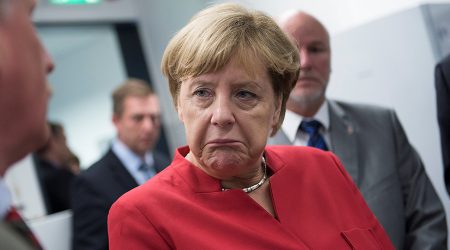
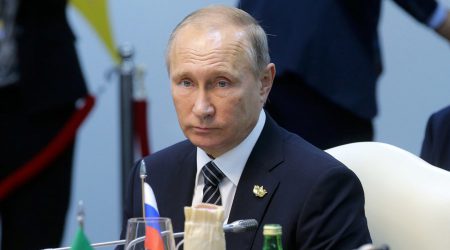
German Foreign Minister Frank-Walter Steinmeier on Tuesday hinted that the renewal of European Union sanctions against Moscow was not yet certain as many countries in the 28-member bloc have raised questions about its efficacy.
“The sanctions are there to ensure a political solution. I don’t know what the European Council will decide on Russia sanctions,” Steinmeier said.
Steinmeier’s comments came weeks ahead of the EU meet that is expected to renew the sanctions against Russia. For sanctions to be extended beyond July, all 28 EU members would have to be in agreement.
The sanctions were imposed following Crimea, an erstwhile part of Ukraine, voting to join Russia in 2014.
Earlier on May 27, Germany’s Federal Foreign Office spokesperson, speaking on behalf of Foreign Minister Frank? Walter Steinmeier, issued a statement saying that “sanctions are not an end in themselves but need to serve to provide an incentive for the political behaviour we would like to see”.
“In the current situation this means that a demand for all or nothing will not bring us any closer to our goal. If substantial progress is made, the gradual reduction of sanctions must also be an option. This is one point on the agenda of the European debate that is just beginning,” said the statement.
The German Foreign Minister had held talks with Russian President Vladimir Putin at the Kremlin on 23 March this year during which the two sides discussed “bilateral relations, Russia’s relations with the European Union”.
On Monday, Russian Foreign Minister Sergey Lavrov said Russia has no plans of recognising the self-proclaimed republics of Ukraine.
Moscow’s move to recognize the self-proclaimed Donetsk and Lugansk People’s Republics would be counterproductive as this would give the West a pretext to stop pressure on Kiev on implementing the Minsk peace deal, Lavrov said in an interview with Komsomolskaya Pravda website.
“I’m convinced that this will be counterproductive,” Lavrov said, stressing that it is very important that the documents signed in Minsk are implemented.
During a state visit by Russian President Vladimir Putin, Greek Prime Minister Alexis Tsipras has criticised the West’s “vicious circle of militarization, of Cold War rhetoric and of sanctions”.
“We have repeatedly said that the vicious circle of militarisation, of Cold War rhetoric and of sanctions is not productive. The solution is dialogue,” Tsipras said in a press conference following talks with Putin on Saturday.
“Everyone recognises that there cannot exist a future for the European continent with the European Union and Russia at loggerheads,” he added.
Earlier in January this year, French Finance Minister Emmanuel Macron also said that France is not keen on the EU extending sanctions against Russia beyond July.
“The objective we all share is to be able to lift sanctions next summer because the process has been respected,” he told Le Figaro.
May 31, 2016
Posted by aletho |
Economics | European Union, Russia, Ukraine |
Leave a comment
President Mauricio Macri will propose an amnesty law for those who bring back to Argentina any undeclared funds that were kept in overseas accounts, in order to settle debts with state pensioners.
“Argentines have billions of pesos overseas because they didn’t trust in the state. We need to tell them to join us, to be part of our new era. We invite them to wipe the fiscal slate clean,” said Macri.
President Macri said he will present the bill to Congress with three options. First, people can pay a tax of 5 percent for up to US$56,000 and 10 percent above that until Jan. 1, 2017. Second, they can convert their funds to bonds in the country. The last option, they can place the money in long-term investment in Argentina.
“Last time we had this process, which was easier, the country collected only $670 million dollars. Therefore, this law has nothing to do with the economy, but that there is dirty money associated with top officials in the government that needs to be cleaned,” said lawmaker Claudio Lozano.
Macri admitted this week that he has US$18 million in tax havens after he repeatedly denied earlier allegations arising from being named in the Panama Papers. He also failed to declare his high-level positions in two offshore companies in Panama in his mandatory declaration at the beginning of his term.
Macri’s fortune went from USD$52 million in December 2015 to USD$110 million in May 2016.
On the other hand, austerity and neoliberal policies rolled out since Macri took power continue to hit the country, such as price hikes in public services, transportation, gas and electricity. The country also holds its highest inflation rate since 2002.
RELATED:
Macri Backs Tax Breaks for the Rich, Layoffs for the Poor
Panama Papers: Macri Implicated in Offshore Tax Haven Scandal
May 29, 2016
Posted by aletho |
Corruption, Deception, Economics | Argentina, Mauricio Macri |
Leave a comment
Recent political developments across the region have prompted celebratory proclamations in the mainstream Western press that Latin America’s decades-long dominance by left-leaning governments is reaching its terminal stages. The landslide victory of the Venezuelan opposition in last December’s legislative elections, the impeachment of President Dilma Rousseff in Brazil, and the triumph of center-right candidate Mauricio Macri in Argentina’s presidential election do indeed seem to point to a region-wide decline in the fortunes of the parties of the Pink Tide. But as is so often the case in the mainstream media, commentators have been too quick to make current events fit neatly into overarching seismic shifts. The cursory and often incomplete news reports on which they are based simply do not provide sufficient support for such catchall explanations. While scholars have naturally initiated a more nuanced and detailed debate to consider whether the region is indeed witnessing the end of a progressive cycle, press analyses have struck a premature and in many cases triumphalist tone by declaring the collapse of the Latin American left both imminent and beyond serious doubt.
In reality, it is the exact opposite that is beyond serious doubt: it is far too early to write off the future of the left in Latin America. Moreover, more research is needed to understand the dynamics of these movements and how things might play out in the coming months and years. But what is most disconcerting about these knee-jerk press responses is that the people making them seem to not even have a strong grasp of the basic facts surrounding the political developments on which they base their claims, let alone of the nuance needed to develop a sophisticated analysis. In a survey of the media declarations of the purportedly imminent collapse of the Latin American left, COHA has found a shocking collection of glaring and demonstrably false statements over basic matters of fact that reveal the profoundly slipshod nature of their research.
The salience of these findings can hardly be overstated: if journalists in the mainstream media cannot even get basic facts correct, they can hardly be trusted to provide a meaningful analysis of the larger picture.
Jackson Diehl
As predictable as the jeers from the DC commentariat were, perhaps the one figure within the Beltway punditry class who could have been most counted on to react gloatingly to the recent setbacks of leftist governments in Latin America was The Washington Post’s deputy editorial page editor Jackson Diehl. Having been a reliable war hawk and right-wing militarist at the Post’s op-ed section since the late 1970s, Diehl was quick to turn his wrath on Pink Tide leaders and their supposedly grave threat to U.S. national security interests. In 2010 he repeated American Enterprise Institute scholar Roger Noriega’s accusation that then-President of Venezuela Hugo Chavez was collaborating with Iran in the development of nuclear capabilities.[1] In 2013 he accused the governments of Venezuela, Nicaragua and Ecuador of “gutting democratic institutions in their countries,” and described Ecuadorian President Rafael Correa as “Latin America’s chief caudillo and Yanqui-baiter.”[2]
His characterization of the latest political developments, inexplicably posted at the Charleston-based Post and Courier rather than his home publication, fits seamlessly with this record of hysterical hyperbole and dubious accuracy. In the article’s first sentence he triumphantly announces: “The encouraging news from Latin America is that the leftist populists who for 15 years undermined the region’s democratic institutions and wrecked its economies are being pushed out — not by coups and juntas, but by democratic and constitutional means.”[3] From this outrageously loaded misrepresentation he quickly moves on to outright falsehoods by claiming that Argentina’s Cristina Fernández de Kirchner was “vanquished in a presidential election.”[4] From a simple Google search one can learn that she was in fact not even a candidate in last year’s presidential election.[5] Apparently Diehl cannot even get past his article’s second sentence without revealing his stupefying ignorance of the most basic of facts.
Aside from blatant inaccuracies, he also makes the remarkable claim that “most of the Western hemisphere is studiously ignoring this meltdown,” despite the fact that Secretary-General of the Organization of American States (OAS), Luis Almagro, has been calling for months to invoke the OAS Democratic Charter against Venezuela.[6] If he is referring not to the OAS but rather to the leaders of the region’s governments, then he is simply confusing their indifference for Washington’s isolation in its condemnations of the Maduro government. Just as the United States was completely isolated in its refusal to recognize Maduro’s election victory in 2013, so it has been alone in calling for sanctions, for which it has lobbied on the basis of largely spurious allegations of human rights violations.
To round out his diatribe, Diehl then describes the “obstacles” to getting a recall referendum to remove President Maduro as “comically steep,” despite the fact that all of the figures he cites regarding the required numbers of petition signatures (which opposition activists need to gather to trigger the recall vote) are calculated from terms set out in Venezuela’s Constitution. By representing the recall referendum as offering the “slim remaining hopes for a democratic solution,” he implies that some sort of extra-democratic methods might be necessary, and presumably also justified.[7] Keep in mind that the provision for a recall referendum to remove a sitting president is a democratic mechanism that scarcely exists in any constitution besides Venezuela’s.
Rafael Ruiz Velasco
In an article published at the PanAm Post, Rafael Ruiz Velasco is just as hasty in his passage of judgment on the fate of Latin America’s left. He announces confidently that “the results are clear: the bet on socialism in Latin America has failed.”[8] But like Diehl, Velasco makes at least one glaring factual error that undermines his already highly suspect piece. He says of Brazil: “The Olympics will be held with a politically defeated Dilma Rousseff out of office, as she faces impeachment on corruption charges.”[9] The truth of the matter is that Rousseff is in fact one of the few leading Brazilian politicians not to be facing corruption charges.[10] Her impeachment was rather premised on vague accusations of fiscal mismanagement and budgetary irregularities[11]—hardly the high crimes that under normal circumstances would merit removal from office. Her replacement Michel Temer, on the other hand, does presently stand accused of corruption, and not over minor allegations either. In addition to being implicated in the country’s ongoing Petrobras scandal, he also stands accused of illegal financing during the 2014 elections[12]; the exact kinds of things, ironically, that would normally be legitimate grounds for impeachment.
Either Velasco is conveniently ignoring these facts, or else just has a very weak understanding of the details of what is taking place in Brazilian politics. Indeed, much else in his article makes one wonder whether he is engaging in willful misrepresentation or is just plain clueless. To give just one example, Velasco describes Rousseff and her predecessor, Luiz Ignácio da Silva, as Brazil’s “figureheads of failure,” in spite of the four electoral victories they have won between them. Leveling this smear against da Silva, whose widespread popularity led to him being affectionately known as Lula, is particularly absurd given that he won both of his presidential election victories with over 60 percent of the vote and left office with 80 percent approval ratings.[13]
Antonio Sampaio
In an article for Foreign Policy magazine, provocatively titled “How Brazil’s Left Destroyed Itself,” Antonio Sampaio pulls no punches in his characterization of Rousseff’s impeachment, claiming that it “marks the final fall from grace not only of the president but also of her ruling Workers’ Party, which has run the country for 13 years.”[14] But one can only feel confounded when Sampaio concedes further down the article that “supporters of the government are right to point out that Rousseff herself is one of the few high-profile political figures who has not been accused of abusing her office for personal enrichment. (Her impeachment is related to alleged manipulation of public accounts to disguise a deficit).”[15] This stands in blatant contradiction to how he begins the article, with the claim that “the biggest corruption scandal in national history is revealing the extent to which Rousseff and her allies actively contributed to the rot of Brazil’s democratic institutions.”[16] It is simply unfathomable how he can lay the blame for the damage done to Brazil’s institutions by this scandal at the feet of Dilma Rousseff when he concedes in the same article that her impeachment has nothing to do with corruption. But in the world of Western press coverage of Latin America, this kind Orwellian doublethink does not seem to matter even when such contradictory statements are being made in the very same article.
Chicago Tribune/Orlando Sentinel
In a “Guest Editorial” in the Orlando Sentinel, the editors of the Chicago Tribune (I’m confused too) argue that the next U.S. president “will need to engage Latin America with a lot more purpose and resolve,” or else “Russia, Iran and China will.”[17] To their credit, they do concede that the recent setbacks of leftist leaders “do not necessarily mean a complete, sweeping repudiation of leftist populism,” since “the gap between the impoverished masses and the few wealthy elite still defines life for much if not all of the continent.” But rather than providing legitimate justifications for progressive policies, this grinding poverty and gross inequality apparently makes these countries “susceptible” to what they term “leftist agendas.”
But in addition to this patronizing jeer, the Tribune editors also make the exact same factual error as Jackson Diehl by claiming that Cristina Fernández de Kirchner “lost her re-election bid to Argentine center-right leader Mauricio Macri last fall.”[18] At the risk of repeating it ad nauseam, Kirchner did not stand in the election, and, moreover, was not even able to since the Argentine Constitution sets a limit of two consecutive presidential terms. Granted, her ruling Justicialist Party lost control of the executive to Macri’s rival Republican Proposal party, but the candidate for the Justicialists was Daniel Scioli[19] (a former vice-president during the administration of Cristina Fernández de Kirchner’s husband and predecessor Nestor Kirchner). To those who might try to dismiss this correction as mere nitpicking, imagine what people in the United States would have thought if a foreign newspaper had reported in November 2008 that U.S. President George W. Bush had lost his re-election bid to Barack Obama. Such shoddy journalism would have surely delivered an instantly fatal blow to the publication’s credibility. But when a U.S. publication demonstrates an exactly analogous ignorance of basic facts about Latin America, its unfounded pronouncements and flimsy arguments still get taken seriously.
Further revealing their risible political illiteracy, the Tribune editors claim that the setbacks for the Latin American left have “all happened with virtually no coddling or stoking from the U.S.”[20] Either the authors have never read anything about the United States’ covert funding of Venezuelan opposition candidates and its threats of sanctions against the Maduro government, the meetings between major regional right-wing figures and allies in the U.S. Congress,[21] and the United States’ use of international organizations to weaken left-leaning governments, or else they are being deliberately duplicitous (and presumably take their readers for a bunch of idiots to boot). The Tribune editors conclude with the unbelievably sweeping statement that the region’s populations are “fed up with failed leftist policies.”[22]
No Alternative?
This last statement neatly sums up the central message that these articles wish to communicate: that any policies that don’t fit the Anglo-American model of unfettered neoliberal capitalism “don’t work” and that though people might at first naively support them, they end up getting disillusioned and begrudgingly come to the realization that neoliberalism is the only viable economic system after all. Though they might not spell it out quite so obligingly, the message is essentially a repetition of Margaret Thatcher’s infamous claim that “there is no alternative” to free markets, free trade, and capitalist globalization. The presentation of the recent setbacks of Latin American left governments as confirmation of this seems to be a deliberate jibe directed at the many people the world over who hold up Latin America as humanity’s beacon of hope for providing a more just, generous, and sustainable way of life.
But though these setbacks of the Pink Tide should not be reflexively explained away and the diminishment in popular support for its parties should not be discounted, there are important distinctions and qualifiers that cast doubt on such a rash declaration of victory for neoliberal orthodoxy. Lest we forget, it was less than a decade ago that an economic crash plunged world economies into disarray and prompted no less a figure than Alan Greenspan to admit that free market ideology is flawed.[23]
First, it is important to make the distinction between a decline in support for the Pink Tide’s parties and support for their policies. Research has suggested that voting publics in Latin America have not become any less supportive of such policies, but rather are becoming disaffected with how they are being administered by those in charge. A poll by Poliarquía in the run up to the 2015 Argentine presidential election, for instance, found that 50 percent of respondents were in favor not of a return to the policies of the pre-Kirchner years, but rather “continuity with change.”[24] As Raanan Rein, a professor of Latin American and Spanish history at Tel Aviv University, put it: “The left lost more than the right won.”[25] He added: “It wasn’t that Macri became so popular, it was simply that his predecessors, the Kirchners, destroyed Peronism.”[26] In other words, what is needed is not a relapse back to tooth and nail neoliberalism, but rather a new and more effective leadership to build on the alternatives that were first attempted by the leftist old guard. The many achievements that resulted from these policies include: expanded access to public services such as healthcare[27] and education;[28] radically reduced poverty[29] and child malnutrition;[30] widespread construction of new homes for those in need;[31] and a significant pushback against the brutal realities of income and wealth inequality[32] that have long plagued the region. Many of these policies’ merits have been recognized by international organizations including the United Nations,[33] the Carter Center,[34] and even the World Bank.[35] Perhaps the most revolutionary of all the changes implemented by the Pink Tide governments were the drafting of new constitutions that guarantee social, political and economic rights to all citizens,[36] and also include unprecedented protections for marginalized groups such as women[37] and indigenous people,[38] and even for nature.[39]
To be sure, legitimate feelings of betrayal exist throughout the region and it is important to hold progressive governments accountable for their share of errors in confronting the economic downturn or failing to prepare for a rainy day. But though many voters might express their anger at the governing Pink Tide parties for their mistakes and lack of foresight by abstaining or even casting a protest vote for the right-wing opposition, this does not indicate a wholehearted endorsement of these parties’ proposals, far less a desire for a return to neoliberalism and the structural adjustment era of the 1980s and 1990s.
Of course, there is also the natural and universal tendency in all societies for people to gradually tire of their governments (regardless of success or failure), to take for granted the gains that were made, and to forget the bad aspects of what came before. All governments, like all human enterprises generally, are deeply imperfect and are not, in Latin America least of all, immune from risks of corruption and other malign influences. But these negative factors are hardly unique to governments of the left. After all, plenty of governments of the right throughout the region have been not just corrupt, but in some cases even murderous. From the military dictatorship of Augusto Pinochet in Chile in which thousands of people were “disappeared”[40] to the torture and extrajudicial executions that took place during Venezuela’s Andres Perez administration,[41] such governments hardly compare favorably to those of the Pink Tide.
Secondly, it is important to make a distinction between left-leaning governments and the social movements and popular sectors that thrust them into power. The continued energy of these movements demonstrates that their drive to resist neoliberalism and fight for social change is as fierce as ever. Indeed, one of the most basic mistakes of these shallow op-ed columns is their failure to consider, let alone grasp, the workings of the internal dynamics of these movements and their relationships with their national governments. If anything, the fall in support for Chavismo in Venezuela among some of its traditional base has more to do with the failure of the Maduro government to maintain its engagement with the popular sectors rather than a newfound enthusiasm on their part for a return to neoliberalism and a repeat of so-called structural adjustment.
Thirdly, it is important to remember that the parties that have opposed the Pink Tide governments have been pressed to the left and have, at least publicly, adopted much of the language and ideas of their political adversaries. During the 2012 and 2013 presidential elections in Venezuela, for instance, opposition candidate Henrique Caprilles Radonski presented himself as a social democrat and the standard-bearer of the moderate left ideas of Brazilian President Luiz Ignácio da Silva[42] (who incidentally endorsed the Chavista candidate[43] in both cases[44]). His campaign also used some of the enduring symbols of Chavismo, calling itself the “Bolivarian Command” and promising to not discontinue the social missions, but rather make them more efficient and less ideological. Though leaked documents subsequently revealed his plan was to make a swift about-face after the election and impose a brutal neoliberal agenda once in office,[45] Caprilles at least understood that the immense popularity of then-President Chavez’s policies meant that he had to publicly present himself as a center-left progressive in order to stand a chance of winning. The Venezuelan opposition has also moved to the left on social issues and even fielded three LGBT candidates in the 2015 December legislative elections.[46] Likewise, Mauricio Macri presented himself during the presidential campaign in Argentina as a pragmatist and moderate technocrat rather than a free market absolutist.[47] As was the case with Caprilles, there is good reason to think such pronouncements were insincere (he has already rekindled Argentina’s relationship with Wall Street[48] and filled his cabinet with bankers[49]), but it at least demonstrates that the political center of gravity amongst Latin American publics is way to the left of the traditional forces of the right.
Fourth, we should not forget that circumstantial factors have created problems for left-leaning governments that are not of their own making. Global drops in commodity prices have made life difficult for all leaders in a region that has long been heavily based on extractivism. Whether it be oil in Venezuela, copper and zinc in Bolivia, or soybeans in Argentina, global downturns have caused problems for these governments which would have been just as pronounced had their right-wing rivals been in power instead. Dependence on exports of raw materials long predates the Pink Tide and moving out of this legacy would have been a challenge for any government.
Fifth, there is a tendency to characterize the policies of Pink Tide governments as “unsustainable.” The unsustainability argument appeals to basic intuition but is based on a false analogy—that a country’s financial situation is akin to a household budget. One could just as easily point out that with the resource wealth and technological sophistication of today’s world, there is clearly the means to provide for every person on planet earth many times over. That we are not doing so is not a failure of the left, but rather of capitalism and explicable largely in terms of the lasting legacy of colonialism and its lingering power structures. These pressures bear particularly heavily on Latin America given its long history of colonial oppression, not to mention its proximity to the major force in the world that has worked to maintain this status quo and long treated the region as its “backyard.”
Finally, therefore, it is important to consider the superpower’s lasting impact on the region. Meddling by the region’s hegemon and its internal allies has consistently caused damage to Pink Tide governments and their efforts at social reform. The United States’ aggressive stance against them is understandable given the threat they pose to its hemispheric dominance and the preeminence of its favored international organizations. Pink Tide governments have established new international bodies to realize the vision of the decades-long struggle for regional integration and provide a buffer against U.S. imperialism. The Bolivarian Alliance for the Peoples of Our America (ALBA) and the Community of Latin American and Caribbean States (CELAC) are attempts to transcend Washington’s “free” trade orthodoxies and forge an alternative to the Organization of American States (OAS). The Union of South American Nations (UNASUR) was founded to mediate regional conflicts and could in the future provide a framework for military cooperation or freedom of movement for citizens of member nations. The monetary fund BancoSur, though still in its nascent stages, is hoped to provide an alternative source of lending free from the dictates of the IMF and the World Bank. Taken together, these organizations have provided a hope that international relations can in the future be based more on international cooperation, rather than competition, and mutual, rather than solely national, interests. This phenomenon is essentially the expression in the international realm of what Roger Harris of the Taskforce on the Americas has described as “the threat of a good example.”[50]
Though it does not completely explain away the failures on the part of progressive governments, there has nonetheless been a clear pattern in terms of the treatment they have received from United States: the more successful Pink Tide governments have become at helping their citizenry and providing an alternative to Anglo-American neoliberalism, the greater the incentive has grown to crush this threat. When the sabotage is successful it provides a double benefit for the United States and its internal allies: in addition to making a different path unviable it also makes these policies appear as intrinsically unworkable, and thereby “proving” that the neoliberal status quo is the only way forward.
Clearly this ghost of Thatcher haunts the minds of mainstream media commentators, explaining both their lazy treatment of the facts and dogmatic commitment to making all news events fit the neoliberal agenda. What is truly important, therefore, is not so much the immediate electoral fortunes of the Pink Tide governments, but rather the efforts to defend the spirit of the movements on which they are based and the intellectual legacy of their principles. A heavy burden lies on those of us who strive to counter the new neoliberal offensive and the mendacity of its propaganda foot soldiers.
[1] Jackson Diehl, “Is Hugo Chavez a real threat to the U.S.?,” The Washington Post, September 27, 2010. http://www.washingtonpost.com/wp-dyn/content/article/2010/09/26/AR2010092603334.html
[2] Jackson Diehl, “Jackson Diehl: Will the Inter-American Commission on Human Rights be gutted?,” The Washington Post, March 3, 2013. https://www.washingtonpost.com/opinions/jackson-diehl-will-the-inter-american-commission-on-human-rights-be-gutted/2013/03/03/c018f9a6-81d0-11e2-b99e-6baf4ebe42df_story.html
[3] Jackson Diehl, “Stop ignoring the implosion in Venezuela,” The Post and Courier, May 4, 2016. http://www.postandcourier.com/20160504/160509752/stop-ignoring-the-implosion-in-venezuela
[4] Ibid.
[5] Simon Romero and Jonathan Gilbert, “Election Will End Kirchner’s Presidency, Not Her Hold on Argentina,” The New York Times, October 24, 2015. http://www.nytimes.com/2015/10/25/world/americas/election-will-end-kirchners-presidency-not-her-hold-on-argentina.html
[6] http://venezuelanalysis.com/news/11815
[7] Ibid.
[8] Rafael Ruiz Velasco, “The Jury Is In: Latin America’s 21st Century Socialism Has Failed,” The PanAm Post, May 19, 2016. https://panampost.com/rafael-ruiz-velasco/2016/05/19/21st-century-socialism-has-failed/
[9] Ibid.
[10] Marina Koren, “Brazil’s Impeachment Battle,” The Atlantic, April 17, 2016. http://www.theatlantic.com/international/archive/2016/04/brazil-impeachment-dilma-rousseff/478632/
[11] Matt Sandy, “Brazil’s Senate Votes to Impeach President Dilma Rousseff: What Happens Now?,” Time magazine, May 12, 2016. http://time.com/4327408/brazil-senate-dilma-rousseff-suspended/
[12] “Brazil President Corruption Scandal,” Open Source Investigations. http://www.opensourceinvestigations.com/corruption/petrobras-scandal-catching-up-to-brazil-president/
[13] Daniela Blei, “Is the Latin American Left Dead?,” The New Republic, April 16, 2016. https://newrepublic.com/article/132779/latin-american-left-dead
[14] Antonio Sampaio, “How Brazil’s Left Destroyed Itself,” Foreign Policy, May 13, 2016. http://foreignpolicy.com/2016/05/13/how-brazils-left-destroyed-itself-dilma-rousseff-impeachment/
[15] Ibid.
[16] Ibid.
[17] “As ‘pink tide’ ebbs, U.S. must engage: Guest Editorial,” Orlando Sentinel, May 17, 2016. http://www.orlandosentinel.com/opinion/os-ed-pink-tide-latin-america-20160516-story.html
[18] Ibid.
[19] Jonathan Watts and Uki Goñi, “Argentina shifts to the right after Mauricio Macri wins presidential runoff,” The Guardian, November 23, 2016. http://www.theguardian.com/world/2015/nov/22/argentina-election-exit-polls-buenos-aires-mauricio-macri
[20] “As ‘pink tide’ ebbs, U.S. must engage: Guest Editorial,” Orlando Sentinel, May 17, 2016. http://www.orlandosentinel.com/opinion/os-ed-pink-tide-latin-america-20160516-story.html
[21] Rachael Boothroyd, “US Republican Senator Meets with Venezuelan Opposition in Caracas,” Venezuela Analysis, July 1, 2015. http://venezuelanalysis.com/news/11432
[22] “As ‘pink tide’ ebbs, U.S. must engage: Guest Editorial,” Orlando Sentinel, May 17, 2016. http://www.orlandosentinel.com/opinion/os-ed-pink-tide-latin-america-20160516-story.html -america-20160516-story.html
[23] Brian Naylor, “Greenspan Admits Free Market Ideology Flawed,” NPR.org, October 24, 2008. http://www.npr.org/templates/story/story.php?storyId=96070766
[24] Daniela Blei, “Is the Latin American Left Dead?,” The New Republic, April 16, 2016. https://newrepublic.com/article/132779/latin-american-left-dead
[25] Ibid.
[26] Ibid.
[27] http://www.worldbank.org/en/results/2014/06/24/argentina-reduces-risk-and-improves-health
[28] Mark Weisbrot, “Why Ecuador Loves Rafael Correa,” The Guardian, February 15, 2013. http://www.theguardian.com/commentisfree/2013/feb/15/rafael-correa-ecuador-elections
[29] http://cepr.net/documents/publications/weisbrot_revista_fall_2008.pdf
[30] James Suggett, “Venezuela Reduces Malnutrition in Children to 4%,” Venezuela Analysis, July 7, 2008. http://venezuelanalysis.com/news/3626
[31] “Venezuelan Social Housing Project Delivers 700,000th Home,” TeleSur, April 19, 2015. http://www.telesurtv.net/english/news/Venezuelan-Social-Housing-Project-Delivers-700000th-Home-20150419-0019.html
[32] “Venezuela, Uruguay Register Lowest Inequality in Latin America,” TeleSur, April 29, 2015. http://www.telesurtv.net/english/news/Venezuela-Uruguay-Register-Lowest-Inequality-in-Latin-America-20150429-0006.html
[33] Antony Boadle, “Brazil’s Rousseff says extreme poverty almost eradicated,” Reuters, February 13, 2013. http://www.reuters.com/article/us-brazil-poverty-idUSBRE91I14F20130219
[34] http://www.cartercenter.org/countries/ecuador-health.html
[35] http://www.worldbank.org/en/results/2014/06/24/argentina-reduces-risk-and-improves-health; http://www.worldbank.org/en/country/venezuela/overview
[36] Sarah Wagner, “Women and Venezuela’s Bolivarian Revolution,” Venezuela Analysis, January 15, 2005. http://venezuelanalysis.com/analysis/877
[37] Michael Fox, “Women and Chavismo: An Interview with Yanahir Reyes,” NACLA. https://nacla.org/article/women-and-chavismo-interview-yanahir-reyes
[38] http://acdivoca.org/our-programs/success-story/new-bolivian-constitution-guarantees-more-rights-indigenous-people
[39] http://therightsofnature.org/ecuador-rights/
[40] “Chile recognises 9,800 more victims of Pinochet’s rule,” BBC News, August 18, 2011. http://www.bbc.com/news/world-latin-america-14584095
[41] https://www.hrw.org/sites/default/files/reports/Venez93O.pdf p. 8
[42] “Profile: Henrique Capriles,” BBC News, October 3, 2012. http://www.bbc.com/news/world-latin-america-16811723
[43] http://www.correodelorinoco.gob.ve/nacionales/lula-da-silva-respalda-reeleccion-presidente-hugo-chavez/
[44] Tamara Pearson, “Ex Brazilian President Lula Supports Venezuela’s Maduro,” Venezuela Analysis, April 3, 2013. http://venezuelanalysis.com/news/8476
[45] Jody McIntyre, “Who is Henrique Capriles Radonski?,” New Internationalist. https://newint.org/blog/2012/09/25/venezuela-elections-capriles-chavez/
[46] Corina Pons, “Venezuela’s first transgender candidate to run for Congress,” Reuters, August 8, 2015. http://uk.reuters.com/article/uk-venezuela-politics-idUKKCN0QC25P20150808
[47] Daniela Blei, “Is the Latin American Left Dead?,” The New Republic, April 16, 2016. https://newrepublic.com/article/132779/latin-american-left-dead
[48] Benedict Mander, “Argentina rekindles its relationship with Wall Street,” The Financial Times, May 12, 2016. http://www.ft.com/intl/cms/s/2/6aeb9ae2-17aa-11e6-b8d5-4c1fcdbe169f.html
[49] Astrid Prange, “Macri to take Argentina in a new, neoliberal direction,” Deutsche Welle, December 6, 2015. http://www.dw.com/en/macri-to-take-argentina-in-a-new-neoliberal-direction/a-18898041
[50] Roger Harris, “Venezuela: Supporting A Once and Future Revolution,” Counterpunch, June 26, 2013. http://www.counterpunch.org/2013/07/26/venezuela-supporting-a-once-and-future-revolution/
To download a PDF version of this article, click here.
May 28, 2016
Posted by aletho |
Deception, Economics, Mainstream Media, Warmongering | Argentina, Brazil, Dilma Rousseff, Latin America, United States, Venezuela, Washington Post |
Leave a comment
A Syrian official has censured the European Union (EU)’s recent extension of sanctions against the government of President Bashar al-Assad, saying the move could be an impediment to efforts for finding a political solution to the Syrian conflict.
Khalaf Muftah, the head of the ruling Ba’ath Party’s department of culture and information, made the criticism in an interview with Russia’s Sputnik news agency on Friday.
The EU bans are illegal and contradict international law and the United Nations (UN)’s Charter, Muftah said, adding, “These measures hamper the political process, because they increase the sufferings of the Syrian nation and do not promote the creation of conditions for a political dialogue with Europe.”
He further called for the lifting of the economic blockade on Syria, noting that the measure has led the Syrian nation to poverty and misery and forced people to migrate.
“The sanctions contradict the statement that migration has political causes, because the real cause is the economic blockade imposed by Europe,” he said.
The remarks came hours after the European Commission, the EU’s executive arm, extended its sanctions against the government in Damascus until June 2017.
The bans include investment restrictions, an embargo on Syrian oil and a freeze on Syrian central bank assets within the 28-nation bloc. They also cover export restrictions on certain equipment and technologies as well as travel bans and asset freezes against more than 200 people and 70 entities.
The measures come as part of an EU decision in December 2014 to continue sanctions against Syria as long as what the bloc calls government repression goes on.
The development comes as some European countries and their regional allies are accused of supporting terrorist groups that have been wreaking havoc in the Arab country over the past five years.
May 28, 2016
Posted by aletho |
Economics, Ethnic Cleansing, Racism, Zionism, War Crimes | European Union, Middle East, Syria |
Leave a comment
The United States has been pursuing an audacious project to fashion a global system according to its specifications and under its tutelage since the Cold War’s end.
For a quarter of a century, the paramount goal of all its foreign relations has been the fostering of a system whose architectural design features the following:
–a neo-liberal economic order wherein markets dictate economic outcomes and the influence of public authorities to regulate them is weakened;
–this entails a progressive financializing of the world economy which concentrates the levers of greatest power in a few Western institutions – private, national and supranational;
–if inequality of wealth and power is the outcome, so be it;
–security provided by an American-led concert that will have predominant influence in every region;
–a readiness to use coercion to remove any regime that directly challenges this envisaged order;
–the maintenance of a large, multi-functional American military force to ensure that the means to deal with any contingency as could arise;
–all cemented by the unquestioned conviction that this enterprise conforms to a teleology whose truth and direction were confirmed by the West’s total victory in the Cold War.
Therefore, it is inherently a virtuous project whose realization will benefit all mankind. Virtue is understood in both tangible and ethical terms.
American ‘Destiny’
The motto: There is a tide running in the affairs of man; so, now is the time for America to steer the current and fulfill its destiny.
The project has registered some remarkable successes (at least by its own definitions). The Washington sponsored Trans-Pacific Partnership (TPP) and its counterpart`, the Transatlantic Trade and Investment Partnership (TTPI), ensconce a privileged position for corporate interests that supersedes that of governments in binding international law.
The towering financial conglomerates have emerged from the great financial panic and Great Recession, which they caused, not only unscathed but bigger, stronger and with a stranglehold over macro-economic policy across most of the globe.
The United States, the progenitor of neo-liberalism and its operational guide, has seen its democracy converted into a plutocracy in all but name. The more things change, the more they must be made to seem the same.
These tenets of neo-liberalism have been codified into an orthodoxy whose dogma permeates the intellectual fiber of academia, the media and the corridors of state power. Challengers are ruthlessly put down – as witness the crucifying of Greece’s first Syriza government. Political leaders who deviate find themselves the object of international campaigns to oust them, e.g., Honduras, Venezuela, Bolivia, Paraguay, Brazil, Argentina, Iran and Russia.
As an indirect consequence of the project’s successes, political resistance now comes not from the Left but rather from a recrudescent nationalist Right as is occurring in Europe – the rebellion in both the East and the West against the European Union’s brave new world of technocracy of, by and for the corporate elites.
Trumpism represents the analogous phenomenon decked out in stars-and-stripes garb. This exacerbates the tensions generated internally by the guided globalization project. Within the decision centers of Washington power, that could either provide new impetus to the external dimension of establishing a global order under American aegis – or handicap it.
Whichever proves to be the case, the turn toward authoritarianism and xenophobia within the liberal democracies shows how ill-conceived and ineptly executed the design for a new world order is. For it has overreached at home and abroad.
Wealth Concentration
At home, the flaw (fatal or not) is the absence of all restraint in grabbing for riches and powers without leaving a reasonable portion, along with credible illusions of democratic control, for the mass of citizenry. Abroad, hubris fed by a combination of faith in American exceptionalism, the intoxication of power, and studied ignorance has generated fantasies of molding alien societies in our image – while ignoring the strength of countervailing forces as embodied by China, Russia and the multiple expressions of fundamentalist Islam.
It is in the political/security sphere that the historic American project faltered badly. Individual developments signal at once basic design flaws and obtuse implementation The upwelling of serious counter currents carries the message that setbacks are neither temporary nor readily containable.
The Middle East, of course, is where the pressure cooker of our own creation has exploded leaving a mess that covers the entire region, with the further risk of spreading beyond it.
Every major initiative has failed – and failed ignominiously. Iraq has fragmented into factions none of whom are reliable friends of Washington. Once a forbidden zone for Islamist jihadis, our intervention has spawned the most dangerous movement yet – ISIL, while inspiring Al Qaeda and its other spin-offs.
Syria, where we have dedicated ourselves to unseating the still internationally recognized government, is embroiled in an endless civil war whose main protagonists on the anti-Assad side are ISIL and Al Qaeda/Al Nusra & Assoc. So, the Obama people have put themselves in the position of feeding arms and providing diplomatic cover to groups who were our No. 1 security threat just yesterday.
Accordingly, for all of our bluster, we refuse to confront Turkey which has provided invaluable aid, comfort and refuge for both groups. Nor do we call out the Saudis for their succoring with money and political backing.
Embracing the Saudis
Washington’s deference to the Saudi royals has reached the extremity of its participating in the Saudi organized and led destruction of Yemen despite the cardinal truths that the Houthis, their enemy, is not a foe of the United States, and that Al Qaeda in the Arabian Peninsula has made extensive gains as a result of the war (and ISIL has succeeded in implanted itself there as well).
For these contributions to the War on Terror, Secretary of State John Kerry effusively thanks Deputy Crown Prince Mohammed bin-Salman – the author of these reckless Saudi policies – for the fulsome contribution the Kingdom is making to suppress Islamic extremism. Why? American diplomacy is locked into the idea that it must reassure Saudi Arabia of our loyalty in the wake of the Iran nuclear deal.
Hence, we embrace an obscurantist autocratic regime whose self-defined interests are antithetical to our stated objectives, and whose behavior highlights the hypocrisy of America’s trumpeted crusade to promote democracy and to protect human rights. It has the added effect of vitiating any chances to engage Iran pragmatically to deal with the civil wars in Iraq and Syria.
Fifteen years ago, the United States launched its Middle East wars to make us secure from terrorism and to politically transform the region. Instead, we face a greater menace, we have destroyed governments capable of maintaining a modicum of order, we have registered no success in nation-building or democracy building, and we have undercut our moral authority worldwide.
Our leaders talk of “pivots” away from the turbulent Middle East, President Barack Obama voices an ambition to demilitarize foreign policy, yet the reality is that today there are American troops fighting in Afghanistan, Iraq, Syria, Yemen, Somalia, and now Libya with no prospect of those conflicts concluding.
The most stunning, and noteworthy, reaction at home to this unprecedented record of unrelieved failure is the lack of reaction. All the elements in America’s fantastic views of another, post-Cold War American Century not only survive, they exercise near total influence over our foreign policy elite – in government and outside it. The learning curve is flat.
The number of places where the U.S. is militarily engaged grows rather than diminishes. The definition of “terrorism,” of security, of American national interest broadens rather than narrows. The defense budget points upwards rather than downwards. The contradictions multiply. How to explain this perverse pattern?
Ignoring Consequences
Avoidance behavior is a natural if not universal response to stress and cognitive dissonance. It passes into the range of the pathological when it becomes persistent and diverges more and more from experienced reality. At that point, it enters the realm of fantasy – often, with fantasies succeeding each other in serial fashion.
To adapt what Clarence Ayres has written: “In important ways, (American foreign policy) is being run by a web of Belief that has been separated from Reason and Evidence. Its ways resemble … the network of mythological convictions” that characterize some primitive tribes. “The contradiction between experience and one mystical notion is explained by reference to other mystical notions.”
Hence, the Belief that human societies carry the innate political DNA for democracy (to be spontaneously recognized by Iraqis once liberated by the Americans) is supplanted by the belief in COIN (counter-insurgency warfare) which, in turn, is supplanted by faith in the power Special Operations forces … ad infinitum.
This behavior pattern matches that associated with classic avoidance devices. One feature is compulsive reiteration. In terms of actions, that means the repeated attempt to resolve complex political problems through the application of coercive force. The national instinct when confronted with a challenge is to hit out – from Congolese warlords and Nigerian thugs to Islamist jihadis and anyone whom our so-called friends dislike, e.g., the Houthis.
This is the mind-set of the muscle-bound bully whose mental development hasn’t caught up with his physical development. In Afghanistan, we continue fighting and spurring the hapless Kabul government to keep it up when there isn’t a snowball’s chances in hell of defeating the Taliban (an outfit that never has killed an American outside of Afghanistan).
In Iraq-Syria, we struggle mightily to check the ISIL irregulars while blithely allowing them to carry on a lucrative oil commerce without interference from the U.S. air force. There, too, we make believe that the Russian presence doesn’t exist even though it has done more to shift the balance away from the jihadist groups than we have. Why? The powers-that-be have decided that Putin’s Russia actually is a bigger threat to America than is ISIL and Al Qaeda.
Black Hats/White Hats
Reiteration also takes the form of populating the strategic map with good guys and bad guys whose identification never changes whatever the evidence says. Hence, the white hats include the Saudi royals along with their school of Gulf Cooperation Council minnows, Erdogan’s Turkey, and of course Israel.
The black hats include: Iran, the Baathist regime in Syria, Hezbullah, Hamas, some Shi’ite factions in Iraq (Moqtada al-Sadr), and whoever opposes our sponsored, obedient would-be leaders in Libya, Yemen, Somalia, or wherever (think Latin America). Washington’s costume department does not stock gray hats.
The Global War on Terror notwithstanding, this casting makes us friends of ISIL’s and Al Qaeda’s friends and enemies of their enemies. No intellectual effort is evident to make the reconciliation.
In extreme circumstances, one resorts to outfitting with white hats whatever bunch of guys you can round up through Central Casting. That is exactly what we currently are doing in cobbling together an odd lot of stray Libyans into an ersatz “government” which Washington and its more obedient allies literally escorted into a bunker outside of Tripoli last month where they are offering themselves as national saviors.
This so-called Government of National Accord (GNA), which no significant body of Libyans had asked for, is meant to supersede the democratically elected government whose parliament is seated in Benghazi and engaged in a multi-party civil war with an array of sectarian and tribal formations.
Our seven-man GNA controls no territory but has entered into tacit alliance with a variety of Islamist militias attracted by the money and arms which the United States and partners have transferred to them from official Libyan accounts abroad. Shades of Syria circa 2011 -2013.
Prolonged residence in one or another fantasy bubble is made all the more comfortable by eluding contact with any respected party who might offer a different perspective that more closely conforms to reality. An oddity of our times is that the only criticism within range of power centers comes from those whose answer to all these dilemmas is to “hit ‘em harder.”
That is to say, the John McCains and fellow travelers among Republican hawks reinforced by the aggressive neocon contingent ensconced in the think tanks and media. The unfortunate consequence is that the President, and his less than sterling foreign policy team, now add the belief in their own moderation and prudence to their complacent plodding along the same rutted paths to nowhere.
We got a candid, uncensored look at one member of Obama’s inner circle when Ben Rhodes, Deputy National Security Adviser, was featured in that embarrassing Sunday New York Times Magazine story a few weeks ago.
Susan Rice, National Security Advisor and Presidential confidant since 2007, put herself on display via an interview with Fareed Zakaria (May 15) where she declared that “almost the whole Russia Air Force is deployed in Syria.” The truth is that the 70-odd Russian aircraft in Syria represent roughly 5 to 6 percent of their combat aircraft and about 2 to 2.5 percent of all aircraft in the Russian Air Force. It is one thing to off by a factor of 20 when spouting forth at a think-tank seminar where other participants’ minds are on their own next intervention or imagining whom they plan to latch onto during the coffee break. It is quite another to be so casually ignorant when you are in a position to shape actions that could affect the lives of millions and major interests of the United States.
This all too typical failure to recognize the difference helps to explain why the Obama administration’s foreign policy-making is so undisciplined and its diplomacy is so disjointed.
Pathological Element
There is yet another pathological element in this mix of illusion and faith. Manifest failure poses a threat to the powerful image of prowess and superiority imbued in our national leaders, and in the country’s collective personality.
Heavy doses of reality by now should have brought to light our ultimate “ordinariness” – however impressive the national record of accomplishment has been. That, though, is proving very hard for Americans to swallow.
Instead, we discern a pattern of denying manifest outcomes while relentlessly searching for fresh opportunities to establish our unique greatness. It took decades and much self-induced amnesia to come to terms with the loss of Vietnam. We seemingly shed that shroud in the first Gulf War. But then came 9/11 and the vengeful reaction of a scared country which led us into a new string of failures.
One psychological method for handling that dissonance is to claim that the game isn’t really over. The fat lady hasn’t sung (or if she did, we tuned her out). In Iraq, our most ignominious failure, the concrete manifestation of that failure in ISIL, gives us a second chance to demonstrate that Americans are winners after all.
In this warped psychology, if we are able to push them back and/or cripple them, that achievement somehow will confirm that we are winners. It just took a little while longer than expected. Political chaos in Baghdad and across the country? No one is perfect – only Allah. Besides, there are always the Iranians to blame.
What about Afghanistan? There, too, the final whistle hasn’t blown. There is no time limit – 48 minutes, 60 minutes, or nine innings – or 15 years. Operation Eternal Effort.
A quite different psychological coping mechanism, one that carries the seed of far greater risk, is to demonstrate macho self-confidence by searching out additional challengers to confront. That mechanism not only offers several new chances to prove to oneself and to the world how great we are; it also demonstrates our brave sense of duty.
So, we expand Special Operations and send teams of various sizes into scores of countries to take on the bad guys. More demonstrably, we make it known that our nuclear deal with Tehran notwithstanding, we’re ever ready to go one-on-one with the mullahs who just aren’t our sort of people.
Fighting the Big Boys
The ultimate expression of this psycho-mentality is to pick a fight with the really big guys: Russia and China. We know them from the last movie – and everybody remembers how we whipped the Russians’ ass – to use the hard-nosed parlance favored around Washington.
The extreme hostility toward a more assertive Russia and Vladimir Putin personally goes well beyond any realpolitik calculus. It has an emotional side clearly evident in the cartoonish exaggeration that marks almost all coverage of the country and the man – and the remarks of President Obama himself. Indeed, it is all the starker for the contrast to Putin’s cool rationality.
Obama, personally, cannot abide Putin. To continue the line of psychological analysis, we might find some clues why in the President’s behavioral record. He typically is uneasy around, and therefore tries to avoid, strong, independent-minded persons who are at least as intelligent as he is. None of his inner circle are exceptions to this generalization.
The real tough guys on Wall Street and in the Pentagon/Intelligence Establishment he defers to – anticipating what they want and holding them at a respectful distance. Putin fits neither category. In addition, he is as cerebral and exhibits as much self-control as does Obama – thereby challenging the latter’s sense of uniqueness and superiority. Putin also is infinitely more skillful politically.
Of course, there is ample evidence that significant elements of the American government and foreign policy Establishment have long viewed Russia as a potential obstacle to the American grand design. Therefore, they have reached a calculated conclusion that it must be denatured as a political force or eliminated.
The resources that we expended in bending Russian institutions and policies to our will during the Yeltsin years testify to that. Putin, though, has shown himself a far sterner, autonomous character with his own pronounced view as to how the world should be structured and Russia’s place within it.
His objective from the first was to restore Russian dignity, Russian independence and a measure of Russian control over its strategic space. That inevitably brought him into conflict with the American plan to keep Russia dependent, weak and marginalized.
The central element of that strategy was the policy of bringing all of the former Soviet republics into Western institutions – Ukraine above all, as Zbignew Brzezinski has explained with brutal candor. The Washington encouraged coup in Kiev two years ago was the culmination of a plan that temporarily had been thwarted by Moscow’s maneuvers that aimed at keeping Ukraine out of the E.U. (aka NATO) orbit.
Putin’s unexpectedly decisive action on Crimea, the Donbass and then Syria has changed the strategic map and upset American assumptions about the insignificance of its old foe. That in itself helps to explain the intensity and emotionalism of Washington reaction.
In the Middle East, in particular, the Russians have been useful partners: in winning Iran’s acquiescence to concessions that cleared the way for the nuclear accord; in resolving of the sarin gas crisis when Putin opened an avenue for Obama to escape the corner he had painted himself into by making hasty accusations that were contradicted by the intelligence community; and finally by forcing us to face up to the unwelcome truth that the only alternative to Assad is a radical jihadist dominated regime that would empower the very people we have been trying to exterminate since 2001.
Rejecting Logic
Rather than acting on that pragmatic logic, the Obama administration – egged on by the country’s entire foreign policy Establishment – has decided to treat Russia as America’s global enemy No. 1, officially.
In Syria, blocking the Russians at every turn and doubling-down on the ouster of Assad now shapes everything else we do in that country. In Europe, the United States has pushed NATO into a full-blown confrontation: stationing several brigades in the Baltics and Poland; staging a ribbon-cutting ceremony in Romania for the missile defense system that also can serve as a platform for nuclear tipped cruise missiles; conducting exercises in Georgia; and proposing to make Georgia and Ukraine de facto NATO members whose militaries would be integrated into the NATO command structure (the 28 + 2 formula).
These moves have been accompanied by a barrage of bellicose rhetoric from top American commanders and the Secretary of Defense to the President himself. These are all steps that contravene long established treaties, some dating back to the Soviet era, and fly in the face of solemn promises made by President George H.W. Bush and Secretary of State James Baker to Soviet leader Mikhail Gorbachev between 1989 and 1991.
This provocative strategy is justified as a response to Russia’s alleged aggressive and growing moves darkly portrayed as a precursor to a possible assault against former lands of the defunct Soviet empire. The empirical evidence for this dire assertion is lacking – nor is there interest in making the case with a modicum of empirical logic. For the impulses spring from within the American political psyche – not from our external environment.
There are those who calculatingly have actively sought to isolate Russia, topple Putin and remove both as thorns in the side of American grand strategy. And there are those, including President Obama, whose behavior reveals a deep compulsion to portray a complex situation in terms of a simple, exaggerated threat; to show their mettle; to strut; and to compensate for the frustrations and failures that have bedeviled the United States’ foreign policies.
This is foreign policy by emotion, not by logical thought. It is rooted in the psychological reaction to the hopelessness of the post-Cold War grand design. It stems as well from the unpalatable experience of being unable to live up to the exalted self-image that is at the core of Americans’ national personality.
And it is intensified by the need, compensating for heightened insecurities, to prove that America is Number One, always will be Number One, and deserves to be Number One. That maelstrom of emotion was almost palpable in Obama’s last State of the Union Address where he declaimed:
“Let me tell you something. The United States of America is the most powerful nation on Earth. Period. It’s not even close. Period. It’s not even close. It’s not even close!”
So? Is this meant as a revelation? What is the message? To whom? Is it any different than crowds of troubled and frustrated Arab demonstrators shouting “ALLAH AKBAR!” Words that are neither a prelude to action nor inspire others to act – nor even impart information – are just puffs of wind. They are affirmations of self rather than communication. As such, they are yet another avoidance device whereby bluster substitutes for a deliberate appraisal of how to adjust to the gap between aspiration and declining prowess.
Making Narratives Fit
A complementary device for perpetuating a crucial national myth of exceptionalism and superiority is to stress systematically those features of other nations, or situations, that conform to the requirements of the American national narrative while neglecting or downplaying opposite features.
Currently, we are witnessing the unfolding of an almost clinical example in the treatment of China. The emergence of the PRC as a great power with the potential to surpass or eclipse the United States poses a direct threat to the foundation myth of American superiority and exceptionalism. The very existence of that threat is emotionally difficult to come to terms with.
Psychologically, the most simple way to cope is to define it out of existence – to deny it. One would think that doing so is anything but easy. After all, China’s economy has been growing at double digit rates for almost 30 years. The concrete evidence of its stunning achievements is visible to the naked eye.
Necessity, though, is the mother of invention. Our compelling emotional need at the moment is to have China’s strength and latent challenge subjectively diminished. So what we see is a rather extraordinary campaign to highlight everything that is wrong with China, to exaggerate those weaknesses, to project them into the future, and – thereby – to reassure ourselves.
Coverage of Chinese affairs by the United States’ newspaper of record, The New York Times, has taken a leading role in this project. For the past year or two, we have been treated to an endless series of stories focusing on what’s wrong with China. Seemingly nothing is too inconsequential to escape front page, lengthy coverage.
The current signs of economic weakness and financial fragility have generated a spate of dire commentary that China’s great era of growth may be grinding to a halt – not to be restarted until its leaders have seen the error of their ways and taken the path marked out by America and other Western capitalist countries.
This latest upwelling of China-bashing could well serve as a clinical exhibit of avoidance behavior. For it goes beyond sublimation and simple denial. It also reveals the extreme vulnerability of the American psyche to the perceived China “threat,” and the compelling psychological need to neutralize it – if only by verbal denigration.
At present, the United States has no strategic dialogue with either China or Russia. That is a failure of historic proportions. There is no vast ideological chasm to bridge – as in the Cold War days. There are no bits of contested geography that directly involve the parties. Putin and Xi are eminently rational leaders – whether we agree with them or not.
The Russian leader, in particular, has laid out his conception of the world system; of the Russo-American relations; of why Russia is pursuing certain polices – all with a concision and candor that probably is unprecedented. He also stresses the need for cooperation with Washington and offers guidelines for sustained exchanges. We have done nothing analogous. Indeed, it appears that no policy-maker of consequence even bothers to read or listen to Putin.
To take him seriously, to engage the Chinese on the strategic plane, requires statesmanship of a high order. An America – and its leaders – who are tied into psychological knots by their inability to view reality with a measure of detachment and self-awareness never will muster that statesmanship.
Michael Brenner is a professor of international affairs at the University of Pittsburgh. mbren@pitt.edu
May 27, 2016
Posted by aletho |
Economics, Militarism, Progressive Hypocrite, Timeless or most popular | Iran, Iraq, Russia, United States |
Leave a comment
Irene Gendzier makes two main claims about US Middle East policy in the late 1940s in her book Dying to Forget. Oil, Power, Palestine and the Foundations of U.S. Policy in the Middle East. One is that there was no contradiction between US support for Zionism and its goal of establishing a Jewish state in Arab Palestine, and US interest in the region’s oil reserves. This claim is based on heretofore unexamined contacts between Max Ball, who headed the Oil and Gas Division of the U.S. Department of the Interior, and Eliahu Epstein, Washington representative of the Jewish Agency, the Jewish state in the making in Palestine. Gendzier argues that these contacts, outside official foreign policy, enabled the Jewish Agency to address US concerns about the impact of Zionism on US oil interests, and to insert its arguments into the discussion in the Truman White House. The “encounter between Max Ball and Eliahu Epstein in 1948 forms the basis of the ‘oil connection’ discussed in this book. The encounter. . . revealed that major U.S. oil executives were pragmatic in their approach to the Palestine conflict and were prepared to engage with the Jewish Agency and later with Israeli officials, albeit within existing constraints.” (xxi)
The second is that Israel’s military prowess in the 1948 war showed the Pentagon that Israel had changed the regional balance of power, and should be included in US military planning, and oriented toward the West and away from the Soviet Union. The USSR had supported partition of Palestine into Arab and Jewish states, and Czechoslovakia in the emerging Soviet bloc had supplied Israel with arms. These “strategic” concerns about Israel’s potential role, Gendzier claims, outweighed US concerns for the effects of the war that established Israel: the destruction of Arab Palestine, the creation of a large refugee population, the antagonism of the Arab world, and potential “instability,” the hegemon’s bugbear, with consequences for US interests. The Pentagon’s judgment about Israel’s military ability has been noted by other writers, but Gendzier makes stronger claims. These “strategic reasons,” she argues, “undermined Washington’s critical position on Israeli policy toward refugee repatriation and territorial expansion. These vital factors in the conflict between Israel-Palestine and the Arab world thereby assumed a subordinate position.” (xxii)
Here, then, is the logic of U.S. oil policy, which was responsible for the increasing deference to Israeli policies whose purpose was to ensure that Israel turned toward the United States and away from the USSR. This objective, in turn, was allied to Washington’s principal goal in the Middle East—protection of its untrammeled access and control of oil. (xxii)
Observers of US politics recognize the US-Israel “special relationship,” and the “strategic asset” and “Israel Lobby” conceptions of it. The “asset” concept holds that the relationship expresses fundamental “US interests” that are independent of any Lobby influence, that the Lobby is powerful only when it promotes those interests. The Lobby proponents see a quasi-sovereign force capable of defining or undermining US interests. This book is clearly intended to enhance the “strategic asset” view.
The first chapter is entitled “The Primacy of Oil,” and “oil” is a primary, even the dominant theme of the book. For all this emphasis, Gendzier does not fully address the nexus of US oil interests, Zionism, and Arab resistance. She overlooks pre-war Arab and oil industry opposition, an “oil connection” that predates hers, and doesn’t do justice to the Trans-Arabia Pipeline (Tapline), a key postwar project and US policy instrument. She depicts a natural, inevitable synthesis of Zionism and US oil interests that was disproven by events she omits.
In 1933 Saudia Arabia awarded an oil concession to Standard Oil of California, through a subsidiary, California Arabian Standard Oil Company, Casoc. Standard of California was eventually joined by three other major US oil companies. In 1938 oil in commercial quantities was found. The Saudi monarch, Abd al Aziz ibn Saud, decided to award another concession, and Casoc again won the bidding.
The potential conflict between American support for Zionism and US oil interests arose in 1936 and later, following increased Jewish immigration to Palestine, and ruthless British suppression of the Palestinian Arab revolt against British rule. This elicited strong protest, from Arabs to US diplomats, from at least one oil industry executive, and from King Saud himself. “King Ibn Saud of Saudi Arabia made an eloquent appeal to President Roosevelt in a letter of November 29 [1938] criticizing the main points in the Zionist argument and pleading for justice for the Palestinian Arabs on the basis of self-determination.” Gendzier omits all of this.
World War II consolidated the position of Casoc and the US in Saudi Arabia, against potential British influence. The US extended Lend-Lease to Saudi Arabia to ease the financial crisis of the war, upgraded its diplomatic representation, and developed an air base at Dhahran near the oil fields. Casoc renamed itself Arabian American Oil Company, Aramco, and expanded the small oil refinery it had built.
Building a pipeline from the oil fields in eastern Saudi Arabia to the eastern Mediterranean was discussed during the war. Postwar, the Trans-Arabian Pipeline (Tapline) became a major instrument of US policy; it would support Saudi Arabia, assist the economies of the transit countries, fuel the recovery in western Europe, enhance “stability,” diminish Soviet influence, and profit the oil companies. Tapline was delayed and almost cancelled due to political complications in the Middle East, and also, despite its strategic importance, in the US.
The direct pipeline route led through Jordan and Palestine to the oil refinery and tanker terminal at Haifa, which was precluded by emphatic opposition from King Saud. The alternative led through Jordan, Syria and Lebanon. Terms were readily agreed with the Christian Maronite government in Lebanon, and with King Abdullah in Jordan, despite strong public opposition to Zionism.
In Syria, opposition was stronger still, but agreement was reached in September, 1947, after intervention by the CIA, Aramco, King Saud and US diplomats. Parliamentary ratification was suspended after the UN partition resolution in November, when a crowd of 2,000 stormed the US Embassy in Damascus, and snipers fired on Aramco survey teams. In February, 1948, the Arab League “prohibited its members from granting any new Western oil concessions ‘until the Palestine situation was clarified.’” Moreover, Arab League officials “were ‘studying nationalization precedents’ and claimed that even ‘Ibn Saud, in case of a showdown, would not oppose any oil resolutions, even suspension of American oil operations, if faced with united front of all Arab states.’”
The US steel export license needed for the pipe subjected Tapline to the opposition of the domestic oil companies. Executive departments approved licenses, but in late 1947 Congress began three months of hearings over allegations that Aramco overcharged the US Navy during the war, and that the pipeline would ruin the domestic oil industry. As violence in Palestine escalated prior to the British withdrawal in May, 1948, followed by the Arab-Israeli war, congressional critics asked why licenses for export to an unsettled region seething with anti-Americanism should be granted, when steel was urgently needed elsewhere. By mid-year, “some American officials doubted that the project would ever be completed, and others worried that the stalemate would play into the hands of the Kremlin, which was rumored to have designs on Saudi petroleum.”
Tapline finally cleared US politics, but a pipeline route was obtained in Syria only after the CIA, in March, 1949, engineered a coup. Zionism had forced the re-routing of Tapline, increased the cost, and held up completion by twenty months. Gendzier mentions the coup, but omits the US political wrangle, including American Zionism’s initial opposition to Tapline.
American Zionists were preternaturally sensitive to their potential conflict with US oil interests. In July, 1942, Emmanuel Neumann of the American Zionist Emergency Committee met with State Department officials. In November, 1943, Nahum Goldmann, of the Zionist Organization of America, met with Harold Ickes, Roosevelt’s wartime oil czar. In October, 1945, Eliahu Epstein, Washington representative of the Jewish Agency, met with Arthur G. Newmayer, public relations director of Standard of New Jersey. In 1946, Zionist officials met with James Terry Duce, vice-president of Aramco. In these meetings, the Zionist officials
voiced concern about the strengthening ties with Saudi Arabia that could push the Zionist movement outside the circle of America’s strategic interests. They stressed the importance of a strong and stable Jewish state, given the loyalty of the Jewish community in Palestine to allied interests during the war. Moreover, they denied categorically that a pro-Zionist policy would harm the status of American oil companies in the Middle East; because oil has no significance while in the depths of the earth, the oil-producing states would need American companies in order to profit from their resources even if the United States pursued a pro-Zionist policy. There were even veiled threats as Zionist representatives hinted at damage to the oil companies’ image, should they appear anti-Zionist after the Holocaust, in a decisive hour for continued Jewish existence.
As the debate over Tapline began late in the war, the renamed American Zionist Emergency Council “set up a subcommittee for oil. It prepared a series of position papers and memoranda to establish guidelines for Zionist policy.” The “campaign was designed to prevent the construction of the pipeline unless it went through the Jewish state.” At first Zionists denied a need for the pipeline, “assuming that not laying it at all was better than not laying it through the future Jewish state, and thus removing that state from the circle of American interests.” They “tried to exploit differences of opinion within the oil industry and to reinforce the opposition of companies without Middle East concessions and those not participating in the project.” They argued that tanker transport was cheaper and safer, that a pipeline was vulnerable to terrorist attacks. (In 1947, Jewish terrorists attacked the Haifa oil refinery and the pipeline from Iraq three times). As agreements were signed and work begun, they advocated a “route through areas likely to be under Jewish sovereignty in the future.” Zionist officials presented the pipeline through Palestine as a contribution to regional development, to the integration of the Jewish state into the region, and to peace. Gendzier omits this campaign, which pitted American Zionism against Tapline for a time, even as she cites the article that discusses it.
The Truman White House, against the judgment of its diplomats and military experts, supported the historic vote recommending partition in the General Assembly of the UN in November, 1947. Palestine, unsettled by the Zionist campaign against British rule, erupted into civil war. By early 1948, the US had begun to consider alternatives to partition, including UN trusteeship, and extending British administration. Oil interests were chief among US concerns, and Gendzier mentions a weaker version of the February, 1948 threat by the Arab League against American oil companies cited above.
In January, 1948 the Jewish Agency prepared a “Note on Palestine Policy,” for private circulation in Washington during Congressional hearings on US oil interests. (99-101) In February, Max Ball, head of the Oil and Gas Division of the Interior Department, met Eliahu Epstein of the Jewish Agency, through family relations. Drawing on the Note, Epstein argued that Zionism was a progressive economic and political force, and asserted the harmony of Zionist and US interests in that respect, and the dependency of the Arab oil producers on western oil companies.
Ball argued that oil development was a progressive force in the Arab world, and that it would also fuel Europe’s recovery and stave off Communism and chaos there. Partition would antagonize the Arabs and jeopardize this, hence was not in US interests. Epstein replied that “ ‘imposition of the will of the U.N. by the loyal implementation of the partition scheme would have a soothing effect on the Arabs and make them regain their right sense of proportion’ ” (105) about their weakness. Epstein cited Palestine Jewry’s support of the Allied war effort. He mentioned the oil prospects of the Negev (Naqab), the southern desert of Palestine, and Ball offered to introduce Epstein to oil company executives. Ball later advised Epstein that such meetings could happen “ ‘only when the Jewish state is established both de facto and de jure. The Oil Companies’ policies are based on practical advantages’ ” which could be pursued only “when the Jewish state becomes a reality.” (108) Ball thus implicitly endorsed partition, at least in the Jewish Agency’s account which Gendzier quotes, when his government was still debating it.
These “historic encounters” (101) of Epstein and Ball are the high point of Gendzier’s “oil connection.” “From this vantage point, the future of the Jewish state appeared more promising than expected. . . major oil companies were not categorically set against [Zionism], which was interpreted as an indication of fu- ture interest.” (111) She claims that the “Jewish Agency strategy developed in the ‘Notes’ appeared to be effective in addressing the fear of partition endangering U.S. oil interests,” when disseminated in the White House by Clark Clifford, special counsel to Truman and Zionist advocate. (111) Ball’s role in oil policy and wide contacts, Gendzier claims, made his belief that Israel had a place in the oil companies’ plans “of no small importance in the period leading up to Israel’s unilateral declaration of independence and. . . the reassessment of U.S. policy toward Israel.” (112)
Gendzier’s account of the Truman Administration debate over partition vs. trusteeship in spring, 1948 does not cite the Jewish Agency’s blandishments about oil-related development, or their assurances that the Arabs had no alternatives. They would have been quite out of place as Palestine was being destroyed, with atrocities reported, refugees fleeing, and US officials fearing the destruction of US interests with the disaster. The State Department would shortly despair of Tapline ever being built. In June, the US ambassador in Saudi Arabia reported King Saud’s warning that Saudi Arabia would conform with any Arab League actions, and that consequences could include “(a) transfer Dhahran air base to British; (b) cancellation ARAMCO concession; (c) break in diplomatic relations.” (178)
After reviewing the studies of US recognition of Israel on May 15, which all stress domestic politics, Gendzier notes the absence of “any reference to the interactions between Max Ball and Eliahu Epstein.” These contacts “seemed to open unforeseen possibilities. At least, they invited oil company executives. . . to think about pragmatic possibilities after independence.” They “may have figured in [Clifford’s] calculations.” (168-9, emphasis added) This speculation is Gendzier’s “oil connection.”
In her final chapter, “The Israeli-U.S. Oil Connection and Expanding U.S. Oil Interests,” Gendzier tries to thicken this tenuous connection with accounts of two meetings between oil executives and Israeli officials, US government discussion, Aramco’s growing Saudi interests, and Max Ball’s authorship of the petroleum legislation of Israel and of Turkey. She mentions in passing the Arab League boycott of Israel, which actually began in 1945, as a boycott of the Palestine Jewish economy.
Two Aramco partners also had operations in Palestine, utilizing the Haifa refinery, which continued in Israel. Gendzier cites Uri Bialer’s statement from his Oil and the Arab-Israeli Conflict, 1948-1963 that “agreements with AIOC, Shell, Socony Vacuum and Standard Oil of New Jersey—made, in fact, in open defiance of the Arab boycott—did indeed open up opportunities for Israel.” After 1948 the Haifa refiners obtained crude oil mostly from Venezuela, though the British also procured from Kuwait via the Cape of Good Hope. Gendzier omits Bialer’s further history and his statement: “Within four years, from late 1954 through 1958, all British and American companies which had constituted the backbone of Israel’s oil supply system, ceased operations in the country. . . While commercial considerations certainly played a part. . . the overriding one was undoubtedly political. . . by late 1958 the Arab League had in fact accomplished one of its main objectives—to force the foreign oil companies out of Israel.”
The Arab oil producers attempted an embargo on the US, Britain and Germany during and after the June, 1967 war, but the supply-demand balance in the marketplace did not favor it. Between 1970 and 1973 oil prices doubled, and demand rose to 99% of production capacity. From the outbreak of Arab-Israeli war in October to December 1973, OPEC price increases and Arab production cuts and embargo on the US raised the oil price four-fold, causing supply dislocations, long lines and fights for gasoline, a deep recession, and discussion in Congress of nationalizing the oil industry. In 1976 Aramco and Saudi Arabia agreed on terms for nationalization. Gendzier’s augury of a natural, inevitable mixing of oil and Zion was not borne out by events.
A decade ago Professors John Mearsheimer and Stephen Walt published their article “The Israel Lobby,”precursor to their 2007 book, The Israel Lobby and U.S. Foreign Policy. They argue that the Israel Lobby is much more powerful than the oil lobby, and disagree that oil had much to do with the decision to invade Iraq, as does historian Stephen Sniegoski. In the 1940s, the US international oil companies (and the foreign policy executive) were weaker politically than the domestic oil industry, which held up Tapline over steel export licenses, and were also weaker than the nascent Israel Lobby.
Gendzier claims that Israel’s “strategic value” led the US to accept Israel’s refusal to repatriate Palestinian refugees, and its extension of sovereignty to conquered territory. This is no more persuasive than the “oil connection,” for similar reasons. Gendzier deprecates or omits US efforts to secure repatriation, misrepresents Israel’s access to arms sales and alliances, and exaggerates Israel’s role in US strategy.
As Gendzier notes, US diplomats and the CIA were clear-eyed about Israel’s military superiority and aggressive proclivities, and about the atrocities and coercion that led to the expulsion of around 85% of the Palestinian Arab civilian population when hostilities finally ended, 750-800,000 souls. This was far more than the Jewish displaced persons population in Europe, the largest population displacement since the war. A March, 1949 State Department report stated:
Failure to liquidate or materially reduce the magnitude of the Arab refugee problem would have important consequences. The Arab states presently represent a highly vulnerable area for Soviet exploitation, and the presence of over 700,000 destitute, idle refugees provides the likeliest channel for such exploitation. In addition, their continued presence will further undermine the weakened economy of the Arab states, and may well provide the motivation for the overthrow of certain of the Arab Governments.
The issues of refugees and territory dominated US relations with Israel into late 1949. In mid-September, 1948, Swedish diplomat and UN mediator Folke Bernadotte proposed an armistice and settlement that accepted partition, but called for territorial exchanges, for Jerusalem to be under UN administration, and most critically, for the Palestinian refugees to be repatriated as early as practicable. Two days after releasing the plan, Bernadotte was assassinated by Jewish terrorists. When US secretary of state George Marshall endorsed Bernadotte’s plan three days after his murder, “the floodgates of domestic protest really burst.” In late October Truman told the State Department and Marshall expressly that he wanted no statements or votes at the UN on Palestine until after the election.
In late October and November, Israel conquered the Negev, in December the Galilee, and in late De- cember and January battled with Egypt, before the final cease-fire. After the election, as Lovett explained to Marshall, “ ‘the President’s position is that if Israel wishes to retain that portion of the Negev granted it under Nov 29 resolution, it will have to take rest of Nov 29 settlement, which means giving up western Galilee and Jaffa,’ ” with the proviso that changes “ ‘should be made only if fully acceptable to the State of Israel.’ ” (229) Gendzier attributes this to US “strategic interest” in Israel. Yet, while
Truman remained responsive to domestic political pressures to back Israel, after his re-election he demonstrated an unprecedented degree of impartiality. . . Truman appointed as secretary of state Dean G. Acheson, who had earned the president’s trust and confidence. . . Under Acheson, State Department officials obtained Truman’s explicit consent to their policies on Arab-Israeli issues, and he refrained from overturning their handiwork.
Or tried harder to refrain.
The UN established the Palestine Conciliation Commission in December, 1948, which led to a peace conference at Lausanne, Switzerland in May, 1949. In preparation, “Truman originally authorized the State Department to contest Israeli retention of land beyond the partition borders. . . Accordingly, Truman wrote King Abdullah of Jordan that ‘Israel is entitled to the territory allotted to her’ by partition, but ‘if Israel desires additions. . . it should offer territorial compensation.’” At Lausanne, Israel proposed to retain Jaffa and the western Galilee without giving compensation, angering the US delegate, Mark Etheridge, a personal friend of Truman. The State Department was angered by “evidence that ‘certain agents of the Israeli government’ had indirectly pressured Truman to relent,” and suggested “ ‘immediate adoption of a generally negative attitude toward Israel.’ ”
State presented Truman “with a choice between approving department policy ‘on behalf of our national interest’ or overruling it in light of ‘strong opposition in American Jewish circles.’” Truman warned Israeli prime minister Ben-Gurion that “his refusal to honor partition borders would force the U.S. to conclude ‘that a revision of its attitude toward Israel has become unavoidable.’” Initially, “the president decided ‘to stand completely firm.’” In August, Truman endorsed a plan “to remove the southern Negev from Israel, and declared that Israel ‘sh[ou]ld be left under no illusion. . . that there is any difference of view’ between the White House and the State Department.” Israel claimed that Arab aggression had invalidated the partition resolution, and that its security depended on occupying further territory. “The Foreign Ministry also intensified its indirect pressure on Truman by ‘recruiting everybody we’ve got. . . all the Baruchs, Crums, Frankfurters, Welles, young and old Roosevelts, etc., and making an all-out effort’ to change Truman’s mind.”
Israeli President Chaim Weizmann, Truman’s Zionist anti-conscience during the statehood campaign, wrote another eloquent, sentimental appeal. Eddie Jacobson, Truman’s old Army buddy, postwar business partner, and Zionist last resort, again visited the White House, at Israeli Ambassador Elath’s request, and secured a pledge that “ ‘no single foot of land will be taken from Israel in [the] Negev.’ ” “Truman’s change of heart forced Acheson to suspend pressure on Israel and adjourn the Lausanne conference.”
Gendzier’s account discusses the frustration of Etheridge and the State Department, and Zionist lob- bying, but downplays Truman’s support for State, which Zionism overwhelmed. (Chapter 12, “The PCC, Armistice, Lausanne and Refugees”) Her chronology of US policymaking is subsumed in August, 1949, at the height of tension over territory and refugees, by discussion of an alleged epiphany of Israel’s “strategic value” in the government. She claims that this, rather than the machinations of the Israel Lobby, led the US to accept Israel’s sovereignty over conquered territory, and its adamant opposition to refugee repatriation. “The importance of the changing assessments of Israel and the Middle East by the Joint Chiefs of Staff (JCS) and the secretary of defense cannot be overestimated. . . the JCS concluded that Israel’s military justified US interest, and such interest merited lowering the pressure on Israel to ensure that it turned away from the USSR and toward the West and the United States.” (239)
Gendzier notes Acheson’s comment on an Israeli request in March 1949 for US military training. “ ‘Giving such permission could be one way of encouraging Israel towards a western orientation.’ ” (279) As Gendzier acknowledges, the Joint Chiefs turned down the request, “so long as a risk of war between Israel and the Arab states continued to exist. The Israeli army was not in dire need of foreign technical assistance, and the United States might become overtly involved if the Arab-Israeli conflict resumed. . . US strategic interests in the Middle East would unquestionably suffer under these circumstances” because of identification with Israel. Israel’s “orientation” was less important than US standing in Arab eyes.
Gendzier notes Acheson’s insistence to Israeli foreign minister Moshe Sharett in March, 1949, that “Israel consider accepting ‘a portion, say a fourth, of the refugees eligible for repatriation’.” (259) A State Department mission called for “Israel to repatriate at least 200,000 refugees” for any “satisfactory solution of the refugee problem” at the same time. (262) State rejected an Israeli offer to repatriate 100,000, and Truman supported Acheson’s decision to withhold $49 million of a $100 million loan. Yet “Israel used [Truman aide David] Niles as a conduit to complain about Acheson’s ‘coercion and blackmail,’ and Acheson, feeling pressured by the White House, capitulated,” releasing further sums, “even though Israel remained unyielding on the refugee issue.”
From 1949-52, the State Department proposed a mixture of development projects in the Arab countries and political initiatives, revisiting the 100,000 figure. All foundered on Israeli hostility, Congressional limits on funding, Arab aversion to implicit recognition of Israel, and the refugees’ desire to return home. “By 1951, officials in Washington concluded that large-scale repatriation would prove impossible in light of Israeli resistance, thus essentially embracing the Israeli view that resettlement on a grand scale provided the only realistic solution.”
The “realistic solution” proved to be the refugee camps, whose restive populations formed the guerilla factions that were the popular base of the Palestinian national movement of the 1960s, with all their political and social consequences. The State Department had foreseen this outcome and sought to ameliorate the conditions that produced it. Acheson’s withholding of the balance of the loan, until Israel reached Truman and countermanded him, and later efforts, strongly suggest that the Israel Lobby, not a concern for Israel’s orientation, was the decisive factor.
Gendzier notes that the Pentagon opposed partition, but argues that, after the Arab-Israeli war, it recognized Israel’s strategic value in the event of war with the USSR. The Soviet Union was expected to occupy the Middle East to prevent attacks on its southern regions from there, and to deny the Suez Canal, the Gulf and the oil fields to the Allies. The US declined to commit ground forces to the region in advance, but would station bombers at Britain’s Suez Canal bases to attack the USSR. The US had no plans to defend the oil fields, but would sabotage and bomb them.
In a brief memo titled “United States Strategic Interests in Israel,” in spring, 1949, the Joint Chiefs noted Israel’s harbor at Haifa, its network of bases and airfields (British legacies), both excellent but small and limited, and its battle-tested fighting forces. Israel flanked the Suez Canal, and dominated communications northward. The Chiefs did not view Israel as a potential base because it could not support large forces, nor was there need to develop facilities “because of the more highly developed and more accessible Cairo-Suez area some two hundred miles to the West.” Those British facilities “along the Suez Canal comprised 38 army camps and 10 airfields. In 1945 it was the single largest military base in existence, anywhere across the globe.”
Britain was charged with defending the Middle East, and US confidence in Britain’s ability to secure even the Suez Canal declined steadily after 1945. This culminated in the US abandoning the Middle East en- tirely, including the Canal, to concentrate its forces outside Britain in northwest Africa. The US announced this strategy at the ABC (American-British-Canadian) planners’ conference in fall, 1949 in Washington, and implemented it in the Offtackle plan, approved by the Joint Chiefs by year-end. US war planners viewed Israel as cannon fodder, which would expend itself defending a target they doubted could be held and would abandon.
The abandonment of Egypt for northwest Africa was in turn superseded by a “northern tier” strategy centered on Turkey, scene of early Cold War skirmishes. In 1947 the Truman Doctrine proclaimed the defense of Greece and Turkey. The US genuinely viewed Turkey as a “strategic asset,” and US policy was predictable. By the end of 1950 US military aid to Turkey totaled $271 million, with $154 million allocated in fiscal year 1951. By 1950, the US had trained Turkish troops in eight military schools, supplied the Turkish army with 50,000 tons of war materiel, and provided 11 surface vessels and four submarines to the Turkish navy. The Turkish air force received 314 World War II aircraft, with 25 jet fighters to be delivered in 1951, while numerous airfields were modernized or built outright. Turkey had remained neutral in World War II, and resisted being turned into an offensive base against the USSR without concrete assurances of western support. The US recognized this, and Turkey became an associate member of Nato in 1950, and a full member in 1951.
This was a total contrast with Israel. Gendzier cites the Pentagon’s statements about Israel as momentous portents, but concedes that the US refused Israel’s repeated requests for military ties. As noted, Gendzier acknowledged that the Joint Chiefs turned down the March, 1949, request for training. Gendzier also acknowledges that the Pentagon rejected a 1950 Israeli request for advanced weaponry, after Britain sold arms to Egypt. The Pentagon still found that “Israel had ‘the preponderance of striking power’ in the region and that additional arms acquisitions ‘would increase Israel’s offensive capabilities and give incentive to offensive planning.’”
Gendzier omits the denouement of this episode. Sharett decided to mount a major campaign in the US, and Truman yielded to crushing pressure and instructed the State Department “to formulate an arms supply policy that would satisfy the ‘many active sympathizers with Israel in this country.’” The “resourceful State Department” crafted the Tripartite Declaration with Britain and France, conditioning arms sales to Middle East states on a pledge of non-aggression, for purposes of “ ‘internal security and their legitimate self-defense’ ” and “ ‘defense of the region as a whole.’ ” Arab and Israeli reaction was guardedly positive, and the effect was to limit overall arms sales to the region.
Nor does Gendzier discuss military alliances. The Korean War in 1950 raised US concern about the Middle East, and to defend “against the Soviets and to assuage Arab anger about Israel, U.S. planners resolved to erect a security pact on Arab foundations.” The Middle East Command would be centered on Egypt, but exclude Israel “in light of Israeli neutralism and Arab-Israeli dynamics.” Israel in any event declined to join the pact, fearing obligations and compromises, and preferring direct relations with the US. Egypt rejected the MEC, abrogated its defense treaty with Britain, which ceded the bases in the Suez Canal Zone, and demanded that British forces leave Egypt. A successor proposal, the looser Middle East Defense Organization, foundered for the same reasons.
At the end of Chapter 13, “The View from the Pentagon and the National Security Council,” having strongly implied otherwise, Gendzier states that the “reassessment of Israel in 1949 cannot be interpreted as evidence that the JCS envisioned a ‘special relationship’ with Israel at this date.” (292)
What it signified was recognition of the potential value, in terms of U.S. strategy, of a state whose origins had originally aroused opposition due to the fear that U.S. support would imperil access to oil. Its reconsideration was in the context of U.S. calculations with respect to the overall assessment of “U.S. Strategic Position in the Eastern Mediterranean and Middle East,” in which the exclusion of communist penetration into Greece, Turkey and Iran was paramount. (292)
At the end of the final Chapter 14, “The Israeli-U.S. Oil Connection and Expanding U.S. Oil Interests,” Gendzier claims that “after independence, Israel emerged as an asset,” which “led U.S. officials to reduce their pressure on Israel” over refugee repatriation, territorial exchange and Jerusalem. “The decision to defer to Israel on these core issues signified Washington’s subordination of the Palestine Question, and its legitimation of Israel’s use of force in its policy toward the Palestinians to considerations of US interest.” (301)
The first set of claims is greatly exaggerated, the second is unproven at best. Israel’s “potential value” in US strategy was negligible. The US declined to sell Israel arms or include it in regional alliances. It abandoned the only theater in which Israel would be useful, before settling on its northern tier strategy. The US was concerned about the Cold War alignment of the entire region, and certainly not more for Israel than for the Arab states. The authoritative “Report by the National Security Council on United States Policy Toward Israel and the Arab States” in October, 1949, is even-handed, not a brief for Israel, and referred to a settled policy of refugee repatriation, territorial exchange and the internationalization of Jerusalem. The US was concerned about the destruction of Palestine for its own strategic reasons, because it feared Arab resentment of Israel as an opening for Soviet influence, and because of the radicalizing potential of the refugee population. The US continued to seek both refugee repatriation and territorial exchange, but was overwhelmed by the Israel Lobby.
Gendzier is trying to make the Israel Lobby disappear, to insert the “strategic asset” argument in the 1940s, in the face of a large body of writing depicting the Lobby’s paramount influence in this period. The overriding lesson of the 1940s is not the “primacy of oil,” but the “primacy of Zion.” “The Zionist lobby came into its own during the Truman presidency.” The Israel Lobby was powerful enough to overwhelm the US diplomatic and military establishments, and major business interests, and their settled policy, and to force them to adapt to its imperatives, beginning, but certainly not ending, with the destruction of Palestine.
No reader with an interest in the period will be persuaded about Gendzier’s “foundations” of Middle East policy, but her account does show that the US made practical adjustments after Israel’s establishment. The US abandoned the idea of Palestinian sovereignty embodied in the partition resolution, and acceded to Jordanian control of the remainder of Palestine, which disappeared as a political subject, replaced by discussion of refugees and ameliorative economic development. Some US officials advocated population transfer and border revisions to make Israel more compact and homogeneous. This was practical accommodation to Zionist realities, not a “strategic” adoption of Israel. US policymakers advanced plans for a general settlement and joint Arab-Israeli projects, in pursuit of “stability,” against Zionism’s destabilization. In October, 1947 the CIA predicted that “ ‘no Zionists in Palestine will be satisfied with the territorial arrangements of the partition settlement. Even the more conservative Zionists will hope to obtain. . . eventually all of Palestine.’ ” (70)
Too much of the book is unoriginal, or too long and distant from Gendzier’s main claims. The book begins with four pages establishing that senior US government officials were drawn from business elites. A discussion of US immigration and refugee policy misnames Roosevelt confidante Morris L. Ernst as “Ernest Morris.” (37) Curiously, for a work with high ambitions, by a professor emerita at Boston University, from a leading academic press, there is no bibliography.
The reader will learn from this book, if not the expected lessons. It reveals perhaps most of all the level of discussion in the United States, ten years after Professors John Mearsheimer and Stephen Walt tried to mainstream the issue of the Israel Lobby.
A PDF with notes of this article is at https://questionofpalestine.net/2016/04/21/dying-to-forget-the-israel-lobby/
May 27, 2016
Posted by aletho |
Book Review, Economics, Ethnic Cleansing, Racism, Zionism, Timeless or most popular, Wars for Israel | Central Intelligence Agency, CIA, Israel, Middle East, Palestine, Saudi Arabia, Syria, Tapline, United States, Zionism |
Leave a comment
From ministerial offices to barricades on the streets, Europe is in open revolt against anti-Russian sanctions which have cost workers and businesses millions of jobs and earnings. Granted, the contentious issues are wider than anti-Russian sanctions. However, the latter are entwined with growing popular discontent across the EU.
Germany’s vice chancellor Sigmar Gabriel is among the latest high-profile politicians to have come out against the sanctions stand-off between the European Union and Russia.
At stake is not just a crisis in the economy, of which the anti-Russian sanctions are symptomatic. It is further manifesting in a political crisis that is challenging the very legitimacy of EU governments and the bloc’s institutional existence. The issue is not so much about merely trying to normalize EU-Russian relations. But rather more about preserving the EU from an existential public backlash against anti-democratic and discredited authorities.
Gabriel, who also serves as Germany’s economy minister, said that relations between the EU and Moscow must be quickly normalized. And he called for the lifting of sanctions that have been imposed since early 2014 as a result of the dubious Ukraine conflict. The EU followed Washington’s policy of slapping sanctions on Russia after accusing Moscow of «annexing» Crimea and interfering in Ukraine’s internal affairs. The charges against Russia are tenuous at best and are far removed from the mundane pressing concerns of ordinary EU citizens, who are being made to bear a heavy economic price for a stand-off that seems unduly politicized, if not wholly unwarranted.
Russia responded to the sweeping sanctions by implementing counter-measures banning exports from the EU and the US. The stand-off has hit the European economies hardest, with the Austrian Institute of Economic Research estimating that the trade war will cost the EU over €100 billion in business and up to 2.5 million in jobs. By contrast, the US has scarcely felt a pinch from the trade impasse.
Germany, Europe’s biggest economy with the largest trade links to Russia, has suffered most from the sanctions rift. Up to 30,000 German businesses are invested in Russia, amounting to as many as half a million jobs in danger and €30 billion in lost revenues, according to the Austrian Institute of Economic Research.
In one German state alone, Saxony-Anhalt, the local economy minister Jorg Felgner says that exports to Russia have been slashed by 40 per cent, with the loss of €200 million to his state. Felgner is among the growing chorus of EU voices who are calling for the anti-Russian sanctions to be lifted when the EU convenes in July to decide on whether to extend its embargo or not.
The EU has been reviewing its sanctions policy on Russia every six months since 2014. To extend the measures, a unanimous decision is required among all 28 member states. It looks increasingly unlikely that the EU will maintain its hitherto unanimity. It can be safely assumed that if Brussels were to end the sanctions, then Moscow will respond in kind to promptly resume normal trade with the bloc.
In addition to the country’s vice chancellor, Germany’s foreign minister Frank-Walter Steinmeier has also expressed disquiet with the ongoing EU-Russian tensions stemming from the sanctions. Steinmeier noted that «resistance to anti-Russian sanctions is growing across the EU».
He also reiterated dismay over a fundamental contradiction in EU policy objectives. «How can we expect Russia’s help in solving the Syrian crisis while at the same time imposing economic sanctions on Russia?» asked Steinmeier.
It’s not just Germany that is growing leery with the deterioration in relations with Russia. Hungary and Italy, which have also strong historic trade ties with Russia, are increasingly opposed to the EU’s policy towards Moscow, according to a recent Newsweek report.
Added to the maligned mix is Greece. The country’s six-year economic crisis has been greatly exacerbated by the loss of a once-bustling agricultural export business to Russia. The country’s finance minister Dimitrios Mardas attributed major losses specifically to the anti-Russian sanctions, which have piled on fiscal deficits to the teetering Greek economy. Greece is no isolated problem. It threatens to undermine the whole EU from its chronic bankruptcy.
In France, the National Assembly’s Lower House voted last week by 55 to 44 votes to end the EU sanctions on Russia. The vote is non-binding on the government of President Francois Hollande. Nevertheless, it demonstrates the growing popular opposition to what is widely seen as a self-defeating policy of trade antagonism with Russia.
The cancellation last year by the Hollande government of the Mistral dual helicopter-ship contract with Moscow epitomizes the self-inflicted pain on French workers. The cancellation – cajoled by Washington – cost the French government revenues of over €1.5 billion and has put thousands of shipyard jobs at risk. Paris claims to have since directed the ships’ order to Egypt, but that remains doubtful.
The economic losses from anti-Russian sanctions have rebounded severely on French farmers too. Dairy, meat, vegetable and fruit exports to the once lucrative Russian market have been pummeled. Hollande recently vowed to release €500 million in state aid to placate angry farmers. The absurdity is not lost on the French agricultural sector that such state handouts would not be necessary if the Hollande government hadn’t sabotaged Russian markets in the first place by following US hostility towards Moscow, as in the case of the Mistral fiasco.
France’s economic problems, as with the rest of Europe, are not entirely related to the downturn in relations with Russia. But there seems little doubt that the issues intersect and are compounded. And the public knows that.
Hollande – the most unpopular French president since the Second World War – is ramming through draconian labor reforms. The president and his truculent prime minister Manuel Valls claim that the retrenchment of workers’ rights will boost the economy and reduce France’s soaring unemployment rate of 10 per cent nationally and 25 per among French youth.
In opposition to the French government’s deeply unpopular assault on workers’ rights, the country is to observe nationwide strikes this week. The protests have been going on now for several months and seem set to escalate, as Hollande’s administration digs its heels in and refuses to relent.
Among students and farmers joining France’s nationwide strike are workers in the transport sectors of road haulage, rail, shipping and airports. With exports to Russia slashed due to the French government-backing of EU sanctions, the transport sectors are among the hardest hit. The Hollande government’s attempt to force through labor cuts, purportedly to reinvigorate the economy, is seen as it trying to offload responsibility for economic woes on to workers and businesses. If Hollande did not pick a fight with Russia – at Washington’s goading – then the country’s economy wouldn’t be under such duress.
Across Europe, the popular revolt against economic austerity is bound up with the EU’s self-defeating sanctions on Russia. And it is leading to a crisis of authority among EU governments who are held with increasing disdain by their citizens. More enlightened political leaders like Germany’s vice chancellor Sigmar Gabriel and foreign minister Frank-Walter Steinmeier are obviously aware of the geopolitical connection that citizens are making.
As Europe’s economic crisis deepens, the policy of anti-Russian sanctions is tantamount to the EU cutting off its nose to spite its face. The growing public disaffection is also fueling the electoral rise of anti-EU political parties in Germany, France, Britain, Netherlands, Hungary, Poland, Slovakia and other member states.
Mainstream EU parties like the ruling coalition government in Berlin realize that the EU’s trade war with Russia is simply becoming untenable. It is an ideologically driven and dubious antagonism that the EU can ill-afford. That policy speaks to EU citizens of a political leadership that is losing legitimacy from its fundamentally wrongheaded and anti-democratic governance. As well as from slavish pandering to American hegemonic ambitions.
Brussels, in following Washington’s hostility to Moscow, is inflicting further economic pain on the bloc’s 500 million citizens. Something has to give way if Europe is not to implode, or explode, from popular fury. Normalizing relations with Russia is not the whole solution to Europe’s economic and political crises. But such a move would certainly alleviate. And is long overdue.
EU governments are thus facing a stark choice. Are they to continue on the path of destruction at Washington’s reckless behest, or can they find an independent policy of pursuing mutual relations with Russia? Undoing the crass anti-Russian sanctions is taking on an urgency – before such a policy leads to the undoing of the EU itself.
May 26, 2016
Posted by aletho |
Economics | European Union, France, Hollande, Human rights, Russia, United States |
Leave a comment
The ability of Israel to continue its illegal settlement on Palestinian land is wholly dependent on profits from its bilateral trade with the EU which is the single most important factor that fuels the illegal occupation of the West Bank, East Jerusalem and the Golan Heights by the Right-wing Likud government.
Without the extraordinary agreement that allows a non-European state (in the Middle East) to freely exploit the European Single Market, the policy of expropriating Palestinian land would not be possible and the Israeli government would be forced to sue for peace.
It has been long established that the Israel lobby exerts considerable influence over the European Parliament’s decisions to not only offer Israel free access to the single market but also to make research grants of billions of euros to the Israeli defence industries that currently export arms to regimes worldwide.
There are many factors that will influence Britain’s decision to leave the EU but the ability to break away from the hold of the Israel lobby on EU trade is of prime importance to both the safety of Europe and to world peace.
The United Kingdom should no longer be associated with a European Union that has already seen the delivery by Germany of a fleet of high-powered, Dolphin 2-class AIP submarines to the Israeli navy that were designed for and subsequently retrofitted with, undeclared cruise missiles (SLCMs) with a minimum range of 1500km and carrying 200kg nuclear warheads.
This astonishing fact has provided Israel with an offshore nuclear second strike capability that has now made it the 3rd most powerful nuclear-armed entity in the world after the US and Russia. It is not known what Chancellor Merkel was thinking when she made Germany itself, and the entire European community with its 750 million inhabitants, vulnerable to an offshore nuclear threat from the Mediterranean or what pressures were applied to the German government that enabled this extraordinary act of apparent negligence that has irrevocably changed the balance of military power in the region.
BREXIT cannot rectify the failure of the EU to have ensured the safety of the 500m citizens in its 28 member states but it is beyond time that Britain now extricates itself from such a dangerously infiltrated, political union.
Britain needs to make urgent plans for the future defence and security of its own people, which is the primary duty of any government and one that supersedes even that of trade and jobs, for without security there is no future.
May 26, 2016
Posted by aletho |
Economics, Timeless or most popular, War Crimes | BREXIT, European Union, Israel, UK, Zionism |
Leave a comment
Russia has not and will not get into discussions on criteria to lift sanctions, Russian Foreign Minister Sergei Lavrov said.
The West has introduced several rounds of sanctions against Russia since 2014, accusing Moscow of meddling in Ukraine’s internal affairs and fueling the conflict in the southeast of Ukraine, however Russia denies the allegations and has responded to the restrictive measures with a food embargo.
“As for the future of these restrictions, this question should be directed to those who initiated the sanctions spiral. We have not and will not discuss any conditions or criteria for lifting these restrictive measures,” Lavrov told Hungary’s Magyar Nemzet newspaper.
“The European Union has linked this to Russia fulfilling the Minsk agreements,” the minister said. “Such a connection is absurd, because our country, as is well known, is not party to the conflict in Ukraine. Such a stance only encourages Kiev to sabotage the Minsk measures without any consequences.”
Unilateral Sanctions Unable to Force Russia to Sacrifice National Interests
Russia will not give up on pursuing its national interests due to attempts to pressure it through unilateral sanctions, Russian Foreign Minister Sergei Lavrov said.
“It is clear that attempts to pressure Russia through unilateral sanctions will not force us to abandon our principled line or to sacrifice our national interests,” Lavrov told Hungary’s Magyar Nemzet newspaper.
May 25, 2016
Posted by aletho |
Economics | European Union, Russia, United States |
Leave a comment
Russian energy giant Gazprom is no longer interested in participating in the development of Israel’s Leviathan gas field in the Mediterranean Sea, Russian media reported Wednesday, citing an unnamed Gazprom source.
According to the Vedomosti newspaper, the source did not specify why the company had decided to abandon the project. Gazprom is reportedly not considering any other projects in Israel at the moment.
In 2012, the company was in talks with Leviathan’s operating firms on buying a 30-percent stake in the development project. At the time, Total, ExxonMobil, ConocoPhillips, Chevron, Woodside Petroleum also wanted a part in the project, however Gazprom offered the largest sum.
Currently, the Leviathan gas field, first drilled in 2011, is one of the largest young gas reserves in the world. According to the US Geological Survey, Leviathan’s volume of undiscovered reserves amounts to some 620 billion cubic meters of natural gas.
May 25, 2016
Posted by aletho |
Economics | Israel, Russia |
Leave a comment
Conflicting with a prior industry study, a new analysis claims 96 nuclear facilities in the US are less safe than reported, citing risks such as terrorism and sabotage. The study says there remain lessons to be learned from the Fukushima disaster.
Neglect of the risks posed by used reactor fuel, or spent nuclear fuel, contained in 96 aboveground, aquamarine pools could cost the US economy $700 billion, cause cancer in tens of thousands of people as well as compel the relocation of some 3.5 million people from an area larger than New Jersey, a study released May 20 finds.
The National Academies of Sciences, Engineering, and Medicine’s study, ‘Lessons Learned from the Fukushima Nuclear Accident for Improving Safety and Security of US Nuclear Plants,’ is the second installment of a two-part study ordered by Congress on the 2011 Fukushima Daiichi nuclear disaster in Japan. It not only cites, but also outright challenges a 2014 study by the Nuclear Regulatory Commission, the US industry’s regulator and enforcer of safety standards.
The spent fuel, The Academies’ study recommends, is safer in dry casks rather than pools, because of the risk of leaks, drawing water away from the irradiated nuclear rods. An accident, terrorist attack or malicious employee all pose greater dangers to the pools, the study says.
Aside from calling on the Nuclear Regulatory Commission to offer a better evaluation of the health risks posed, The Academies study conducted by 17 engineers, nuclear physicists and other scientists demands the commission fulfill a 10-year-old promise to put together an impartial review of the surveillance and security policies on spent nuclear fuel.
“Even with the recommendations that the Academies’ board has put together,” Nuclear Regulatory Commission spokesman Scott Burnell responded, “we continue to conclude that spent fuel is being stored safely and securely in the US.”
“Nothing in the report causes immediate concern,” Burnell added, although the commission is planning a more formal follow-up later this year, according to The Center for Public Integrity.
Congress felt compelled to fund the study on Japan’s natural-turned-nuclear disaster to help prevent a similar accident from occurring in the US. On March 11, 2011, the Daiichi nuclear plant in Fukushima was thrashed by an earthquake and tsunami, leaving three reactors without power or coolants, which resulted in their radioactive cores melting down.
Pure luck kept the disaster from becoming even worse, The Acadamies found. Instead of Daiichi’s highly radioactive rods being exposed to oxygen, which would have sent over 13 million people packing from as far as 177 miles south in Tokyo, a leak happened to be situated between a fuel rod pool and a reactor core, which sent just enough coolant to keep the vulnerable rods from rising above the water. In the end, 470,000 people were evacuated and the still ongoing cleanup is estimated to cost about $93 billion.
The Nuclear Regulatory Commission’s 2014 study put the highest odds of an earthquake happening near spent fuel storage at one in 10 million years, boasting that “spent fuel pools are likely to withstand severe earthquakes without leaking,” while the odds of a terrorist attack or internal subversion were deemed incalculable and left out of any risk assessment.
Calling that cost-benefit analysis “deeply flawed,” The Academies panel member Frank von Hippel, also an emeritus professor and senior research physicist at Princeton University, complained that the commission’s study also left out the impact on property contamination in a 50-mile radius of an accident, tourism rates and the economy, The Center for Public Integrity reported.
The new analysis also calls for new officially designated risk assessments of safety and financial impacts at the federal level as well as what improvements aboveground dry casks may bring compared to pools. The latter is estimated to cost upwards of $4 billion by the industry.
May 25, 2016
Posted by aletho |
Economics, Environmentalism, Nuclear Power | Human rights, Nuclear Regulatory Commission, United States |
Leave a comment