Millions Spent, No One Served: Who Is to Blame for the Failure of GMO Golden Rice?
By Angelika Hilbeck and Hans Herren | Independent Science News | August 10, 2016
The recent Nobel laureates’ letter accusing Greenpeace of a “crime against humanity” for opposing genetically modified (GMO) golden rice reveals a deep division not only between civil societies and some science circles but also within the science community – a division in the visions for our common future and which path to take for our joint development. A division we see growing and escalating. A strong indication of this division is that among the Nobel laureate signatories, there seems to be hardly anybody with a solid scientific track record in agriculture, food production, development, or the socio-ecological and political causes of poverty and hunger. Others with notable competence – at least in the economic and social domains of development, poverty, and hunger – are not among the signatories. Signs of escalation also include the emotional, accusing language in the letter and the ample use of scientifically unsubstantiated claims. What is missing in the letter and among the supporters and developers of GMOs is the recognition and scientific analysis of some tough facts.
Fact no. 1: Still no functioning vitamin A rice despite unlimited resources
No functioning vitamin A rice has been produced in over 20 years of research. This is despite full support at every level: financial, institutional, political, and corporate. By ‘functioning’, we mean farmer’s rice varieties that reliably and stably express sufficient amounts of beta-carotene (pro-vitamin A, the precursor of Vitamin A) over many generations of seed saving. These seeds must continuously express beta-carotene at a level that has been documented to be efficiently convertible to Vitamin A in mammals and, most importantly, can (statistically) significantly relieve the symptoms of Vitamin A deficiency in hungry people. None of this is scientifically trivial but that’s what has been promised.
The first golden rice, GR1, was unsuccessful and is long gone. Golden rice 2 (GR2) is a patented pro-vitamin A GM rice developed from scratch by the multinational biotech firm Syngenta and still in the field trial stage at the International Rice Research Institute (IRRI) at least one decade after it’s creation.
The vast majority of scientists in the world will never see such comprehensively generous support for their research – yet they still deliver, and must deliver if they ever want to renew funding for their research. This is more than can be said for the golden rice project.
Fact no. 2: Lack of recognition of real reasons for failure to deliver
A quick evidence check is sufficient to reveal the simple reason why golden rice is not in farmer’s fields: it is still not ready because it is not performing agronomically. Furthermore, it is far from being medically documented to relieve symptoms of Vitamin A deficiency. Neither Greenpeace nor the destruction of a test plot in the Philippines by local activists can be held responsible for this lack of scientific achievement.
Fact no. 3: Questionable conceptual underpinning
Leaving aside its scientific aspects, the very concept of golden rice – and all other similar conceptual approaches as solutions to malnourishment – remain doomed from the start as similar approaches have failed repeatedly. The problem lies in the underlying reductionist (disembedded) approach. Combating hunger and malnutrition one vitamin and mineral at a time is a failed ideology, no matter which vitamin or mineral one starts with and which kind of delivery system one chooses. Malnourished people do not suffer from single-vitamin-deficiencies added up. They suffer from hunger, as in ‘lack of food’. This is compounded by poverty and a myriad of contributing factors working simultaneously together. That means they lack regular access to real foods containing the necessary variety of ALL essential nutrients, which, in conjunction, make up a healthy diet.
These contributing factors differ according to culture, place and time. There exists a huge amount of research and analyses to read for anybody who cares about the real causes of hunger and the real solutions (we list some old and new references at the end – or just check out the United Nations World Food Program website. For the golden rice project, we recommend for starters, the recent analysis by Stone and Glover who locate its failure in its ‘disembeddedness’ and ‘placelessness’.
Consequently, hunger and malnutrition with its complex, ‘place-based’ causes cannot be battled by a uniform, de-contextualized and placeless one-vitamin-at-a-time approach which is what GMO golden rice has to offer.
This reductionistic approach to hunger is matched by similar reductionism in the genetic engineering world where organisms are viewed as the sum of their genes and proteins. Genes are added one at a time as blueprint construction instructions for lego-like products and many more projects of this kind are underway, e.g. vitamin A banana and cassava, or iron-fortified cassava, or whatever lies within their technical reach. Stone and Glover describe this as “a preoccupation with the molecular scale” that “favors a form of reductionist thinking that conceives of traits of interest as being governed primarily by genetics rather than through interactions with the environment or management” (Stone and Glover 2016).
Supplying vitamin A or any other nutrient in isolation only works for a transitional period of time, curing a symptom at best, while work progresses on the underlying place-based causes of hunger – lack of access to food, money, education and secure living conditions. Under those circumstances, as in parts of the Philippines, cheap vitamin A pills do the job much better, in a more targeted, controlled, and effective way than any patented GM crop could ever do.
Fact no. 4: A missing roll-out plan
But even if the golden rice researchers do eventually manage to get some GM pro-Vitamin A rice varieties to perform agronomically, there seems to be no roll-out plan to ensure that it gets to those who need it. Those reasons have nothing to do with regulations and everything to do with logistics, institutions and finances.
Will the golden rice developers truck their harvest into the urban slums and remote rural areas of Asia or Africa, or at least the Philippines, every day? Will they bring with them also the fat that malnourished people need to eat along with the rice to ensure they absorb the beta-carotene and convert it to vitamin A? And if they can do that, why aren’t they bringing existing foods into those areas already? Why wait until a patented GM food is ready for delivery? There is no shortage of vitamin-rich foods on this planet and beta-carotene is one of the commonest molecules in nature.
Frequently, vitamin A-rich food exists in abundance and rots in storage or under trees not that far away from the places where people suffer from malnutrition. An alternative already in the field is, for example, a non-GMO orange sweet potato, a root crop compatible with improved crop rotations whose developers have been awarded the 2016 World Food Prize. Without a massive and expensive roll-out plan, golden rice will not even leave the field station of the International Rice Research Institute (IRRI), which is overseeing the golden rice project.
Epic endeavor
If their plan is to cross the pro-vitamin A trait into the rice varieties that farmers grow in hunger-stricken areas, they face an uphill logistic, financial, scientific and institutional battle. How will they get the transgenic trait reliably expressed in all of these varieties at the necessary concentrations over many generations of rice plantings and seed recycling? Who will pay for this epic endeavour?
If they decide instead to only put the pro-vitamin A trait into a handful of, say, IRRI rice varieties (which we believe is the most likely plan – if there is a plan in the first place), many will fail because they will not perform in different local conditions and they typically require fertilizers and pesticides. If the plan is to switch farmers to growing a handful of patented biofortified varieties all over Asia and Africa, how will this be implemented? Who will deliver the seeds and accompanying chemicals to farmers – year after year, everywhere where it’s needed, for free? And is this a sustainable solution?
And what will happen to the thousands of existing ecologically and culturally well adapted varieties? The genetic diversity of crops and animals is our life-support system.
Furthermore, have they asked the rice producers and consumers of Asia and Africa if they want many of their rice varieties to be yellow forever – even in times when the food shortages and nutrition deficiencies are over?
Unresolved patent and ownership issues
According to the website www.goldenrice.org., a resource-poor farmer will be allowed to grow golden rice without license fees as long as his/her income is less than $10,000 per year. But, in practice, who decides which farmers are eligible? Who decides which income limit is appropriate in what country or region, and who enforces it on what authority and criteria? What about those farmers whose incomes exceed $10,000 per year? Who will decide when to collect fees, from whom, and for how long? How will the finances be arranged between Syngenta, which owns GR2, the seed multipliers and distributors, and the government? And if all this can be settled with Syngenta – how about the next-in-line patented, biofortified GM crops? In case of dispute, will there be free access to lawyers for the resource-poor farmers?
In their weekly column Schaffer and Ray (2016) reported about a meeting with an employee of the US State Department and discussing the benefits of GM crops for farmers and consumers in the Global South and whether or not farmers would have to pay a technology fee and purchase, for example, the golden rice seed each year. The State Department representative stated that the companies that own the patents would be willing to make the golden rice (or virus-resistant cassava) available at no cost provided that the countries adopted US patent regimes to protect other GM crops. From a policy perspective, such a ‘humanitarian’ license agreement would thereby present a highly profitable transaction, a means to ‘encourage’ developing countries that often do not even have patent laws of their own to accept the US patent regime and so ensure the profits of US companies and patent holders in perpetuity. In corporate agriculture it seems, nothing is really for free.
These are just a few of the tough questions that have never been addressed or even acknowledged by promoters of golden rice or any other such projects. Shooting genes into nuclei and getting a few varieties to express a transgene is the easy part – although even that has proved elusive so far for GR2.
Fact 5: Colonial mindset
Blaming Greenpeace for the failure of not only golden rice but other patented products of genetic engineering has been an irrational (or maybe calculated) obsession of some proponents and developers since the discussion began decades ago. Yet, it also reveals more subtle issues. Farmers and indigenous people are outraged when gene technology proponents accuse them of being instructed or manipulated by big Western NGOs like Greenpeace. They say that promoters of golden rice and other techno-solutions offered by developed countries rarely ask for or listen to their views and, thereby, reveal their lack of respect and comprehension.
This attitude towards peasant farmers and indigenous peoples is typical of the still prevailing colonial, Western mindset – hidden or open. It assumes that the peasant farmers are ignorant people without the relevant knowledge entitling them to make informed decisions based on their own values and visions for their future. Sadly, the letter signed by Nobel laureates appears to be a continuation of this way of thinking. It reveals an attitude of supremacy over, and disrespect for, traditional and indigenous knowledge and peoples who want to have a say in their lives and communities and which path to take to ‘development’.
Take-home message: Hungry (and poor) people deserve better. And Nobel laureates can do better!
The Authors:
Dr Angelika Hilbeck is Chair, European Network of Scientists for Social and Environmental Responsibility (ENSSER). She is a researcher and lecturer on biosafety and agroecology at Swiss Federal Institute of Technology Zurich (ETHZ) who has worked closely with farmers and civil societies in many developing countries for more than two decades, including the Philippines, the country targeted for the rollout of GM golden rice. She is a member of the Board of Directors of ‘Bread for All’. She was a lead author of the International Assessment of Agricultural Sciences, Knowledge and Technology for Development (IAASTD)
Dr. Hans R Herren, Agronomist/Entomologist (ETHZ) who worked in agricultural research and development for 27 years in Africa. Member of the International Panel of Experts on Sustainable Food Systems, President and Founder Biovision Foundation for Ecological Development www.biovision.ch, president and CEO www.Millennium-Institute.org.
Laureate: Sustainability Prize, Germany 2016, Right Livelihood Award (Alternative Nobel Prize 2013; One World Award 2010; World Food Prize 1995; Kilby Award 1995; Brandenberger Prize 2002; Tyler Prize 2003.
Foreign Associate of the US Academy of Sciences 1999; Member of the Academy of Sciences for the Developing World (TWAS) 2005
Co-Chair International Assessment of Agricultural Science and Technology for Development (IAASTD), Member CGIAR Science Council (2005-2010)
[1] “On 13 August 2013, after farmers had got nowhere in their arguments with the Philippine government, they uprooted an experimental field of Golden Rice in Pili, Camarines Sur, where trials were taking place. By taking this action, they sent a clear signal that they would not tolerate the advance of GMOs. However, the Filipino farmers were outraged when the media, accusing them of ‘vandalism’, made it appear that the uprooting had been orchestrated by international NGOs which had supposedly made use of the farmers to uproot the rice. Farmers explained that it was their decision to turn to civil disobedience to defend rice, a crop that is central to their diet, their livelihood and their culture. While the funders and supporters of Golden Rice carry on with their goal of commercialising the crop in the Philippines, Indonesia and Bangladesh in the near future, Filipino farmers continue to mobilise and protest, vowing that they will go on opposing the advance of GMOs.”
Banking problems prevent Iran exports
Press TV – August 15, 2016
More indications emerge to show that banking problems remaining from the sanctions against Iran are still obstructing the country’s exports.
Fariborz Karimaei, the deputy head of the Association of Petrochemical Industry Corporation of Iran, was quoted by the media as saying that Iran’s petrochemical exports to Europe are facing problems as a result of sanctions-related banking issues that have not been fully settled.
Karimaei emphasized that the European banks are still failing to cooperate with the Iranian exporters of petrochemical products even eight months after the removal of the sanctions.
In January, a series of economic sanctions that had been imposed against Iran were removed after a deal that the country had last year reached with the P5+1 – the five permanent members of the UN Security Council plus Germany – came into effect.
The sanctions restricted banking transactions with the country among other issues.
Iran has been persistently urging European countries to take the required measures to encourage their banks to facilitate transactions with Tehran now that the sanctions have been removed.
However, the country’s plea appears to have fallen on deaf ears so far.
Analysts have already emphasized that the banks remain wary of the impacts of the remaining American sanctions against Iran, specifically those that address banking transactions with the country.
Reports earlier said they want a promise that the US will not prosecute or punish them for transactions involving Iran — a step the US has so far been reluctant to take.
In May, US Secretary of State John Kerry told a meeting of top EU bankers that they will not be penalized for conducting or facilitating business with Iran.
However, European banks have already emphasized that Kerry’s assurances are not enough and a series of confusions that remain over transactions with Iran need to be cleared by Washington.
The significance of the GOP’s attempted purge of Donald Trump
By Daniel Haiphong | American Herald Tribune | August 11, 2016
The GOP is trying to oust Donald Trump from the Presidential campaign trail. Numerous GOP officials and corporate media reports have indicated that Donald Trump may drop out of the race. Curiously, the news comes just weeks after Trump walked away from the Republican National Convention with the nomination. No other candidate came close in total number of delegates in the state primaries and the proposed roll call from dissenting delegates failed to bring results. The attempted ousting of Trump reflects both the fracturing of the Republican Party and the rupture of the two-party corporate duopoly generally in this election cycle.
This isn’t the first time establishment Republicans have attempted to push Trump out of the race. When Trump began picking up momentum earlier in 2016, many well-known Republicans refused to endorse him. Republican Mitt Romney made a video appearance at the Democratic Party National Convention to warn of the dangers of a Trump presidency. The Business Round Table, a collection of corporate executives, also warned New York Times readers of Trump’s possible Presidential victory. Even the Koch Brothers are sabotaging Republican Party supporters of Trump by pulling their funding from his supporters in Washington.
The reason for the ruling class’s fear of Trump is clearly articulated from the source. Trump is unpredictable and his message uncontrolled. There are times when Trump speaks to working class anxiety by repudiating trade deals and calling to re-regulate the financial sector. There are others when Trump is easily baited into traps set by the Democratic Party. In recent weeks, the Democratic Party has attempted to frame Trump as an unpatriotic traitor. Trump has reaffirmed his support of Russian President Vladimir Putin and refused to take back remarks regarding the heroism of a Muslim American soldier who died in combat in Iraq.
While power struggle between the Democratic Party and Republican Party is nothing new, Trump’s impact on the two-party corporate duopoly should not be understated. Trump has destroyed the GOP’s infrastructure. His rhetoric has inspired emboldened racist elements of the working class as well as legitimate class grievances among the Republican Party base. Trump has occupied a vacuum that its corporate-backers have refused to fill. No longer can the Republican Party operate as it did in the past without losing ground to the increasingly conservative Democratic Party.
For nearly five decades, the Republican Party has positioned itself the party of white supremacy. The Democratic Party has been able to place unions, Black voters, and white liberals under its tent over this period. However, the neo-liberal crisis of capitalism has changed this dynamic dramatically. The gap between Democratic Party rhetoric and policy has widened since the early 1980s. This has forced Republicans to move further to the right in the midst of Democratic Party-led wars, austerity measures, and assaults on civil liberties.
Donald Trump represents an existential threat to the very existence of the GOP. In her speech at the Democratic National Convention, Hillary Clinton herself admitted that she would be a President for “Democrats, Republicans, and Independents.” She was thus very forthright in extending an invitation to refugee Republicans into her “big tent” campaign. Clinton’s neo-liberal, imperialist agenda is attractive to a Republican Party establishment that has effectively lost its base to Trump. Trump’s erratic behavior only further endangers his ability to defeat Clinton’s strategy and bring victory to what is left of the Republican Party.
A series of interviews on “Democracy Now!” have clarified the depths to which the Clinton campaign seeks to use fear of Donald Trump as its catalyst for victory. In two separate debates, Green Party supporters Kshama Sawant and Chris Hedges confronted Clinton operatives Rebecca Traiser and Robert Reich. Traitser and Reich refused to address concrete policy and instead promoted a Clinton Presidency on the basis of the dangers of Donald Trump. The debates confirmed that Hillary Clinton and the Democratic Party have become virtuously indefensible. Such a realization has forced the two-party corporate duopoly into a crisis situation, especially on the Republican Party side. Either the Republican Party establishment gets behind Trump or it joins forces with the increasingly conservative Democratic Party machinery led by Clinton to defeat the “fascist” casino capitalist.
The fact the Republican Party has not distanced itself from rumors of Trump’s departure indicates that there is a significant portion of GOP leaders who would prefer a Hillary Clinton Presidency. Hillary Clinton is, after all, the chosen politician to serve the capitalist oligarchy. Clinton has received tens of millions of dollars in donations from hedge funds and various other Wall Street donors. This places Trump at a glaring disadvantage. Yet this disadvantage has been mitigated by the open rebellion both Democratic and Republican Party bases are waging against the establishment.
The conditions that created the revolt of young voters in the Democratic Party and the entire base of the Republican Party are not going away. Trump may step down, or he may continue on in his campaign. Whatever the case, the legitimacy of the two-party duopoly will remain tenuous at best. Millions of people are sick and tired of war, austerity, poverty, and a system that represents no one but the elite. A mass break with the two-party system is on the horizon and Trump’s campaign has played a significant role in speeding up the process. So the conversation about Trump should not be confined to his personality or his reactionary character. It should center on the root causes of his rise to the GOP nomination and what that means for the future of US political landscape.
Washington considers sanctioning Moscow over DNC email leak – report
RT | August 12, 2016
US officials are considering new economic sanctions against Russia over the DNC email leak released by WikiLeaks, the Wall Street Journal reports, citing sources familiar with the situation.
Officials have not so far, however, reached common ground on how exactly to impose sanctions, the WSJ reports.
Adopting more anti-Russian economic sanctions would mean delivering public accusations against Moscow or exposing links of the alleged hackers to Russia.
The White House has so far not commented, although the FBI and intelligence agencies investigating the cyberattack have “signaled” that the attack was “almost certainly” carried out by “Russian-affiliated hackers,” according to the WSJ.
The breach of the Democratic Congressional Campaign Committee, already compared to the Watergate scandal, is far from reaching its peak, as WikiLeaks founder Julian Assange has dropped a broad hint he has much more material to potentially publish.
Speaking in Washington DC on Thursday, House Democratic Leader Nancy Pelosi said she does not know exactly how the notorious DNC leak was possible, but that there could be no mistake about its initiator.
“I know for sure it is the Russians,” Pelosi told reporters, adding “we are assessing the damage.”
“This is an electronic Watergate… The Russians broke in. Who did they give the information to? I don’t know. Who dumped it? I don’t know,” she said, as quoted by the WSJ.
The Democrats are now urging the Obama administration to take decisive action.
“When the administration believes it has sufficient evidence of attribution, it will make that attribution public as well as consider any other steps necessary,” said Adam Schiff, the top Democrat on the House Intelligence Committee.
During President Barack Obama’s two terms in office, relations between Moscow and Washington have dropped to lows similar to those seen in the years of the Cold War.
Washington has already imposed a wide range of sanctions against Russian politicians and state companies following the reunification of Crimea with Russia, and accuses Moscow of being involved in the civil war in Ukraine.
Moscow has consistently denied allegations about its possible role in the hacking of US Democratic Party emails published by WikiLeaks.
“We are again seeing these maniacal attempts to exploit the Russian theme in the US election campaign,” Russian presidential spokesman Dmitry Peskov said.
Last year, President Obama signed an executive order that facilitates imposing sanctions against any country endangering US national security through cyberattacks.
“Our tools now include an executive order authorizing sanctions against those that engage in significant malicious cyber activities, such as harming our nation’s critical infrastructure – our transportation systems or power grid,” White House counterterrorism adviser Lisa Monaco said last month.
“Nations like Russia and China are growing more assertive and sophisticated in their cyber operations,” the US counterterrorism adviser claimed, before mentioning cyber threats from “non-state actors,” including Islamic State (IS, formerly ISIS/ISIL).
There is the view in the US that the DNC breach is a tit-for-tat payback operation.
“They believe we are trying to influence political developments in Russia, trying to effect change, and so their natural response is to retaliate and do unto us as they think we’ve done unto them,” the director of US national intelligence, James Clapper, said last month, without making specific statements about the alleged Russian role in the DNC breach.
Democratic presidential candidate Hillary Clinton seems to have no doubts whatsoever about the Russian involvement in the leaks.
“Russian intelligence services, which are part of the Russian government, which is under the firm control of Vladimir Putin, hacked into the DNC and we know that they arranged for a lot of those emails to be released…,” Clinton told Fox News earlier this week.
Read more:
Kremlin: Idea of Russia’s involvement in US Democratic Party mail hack is ‘absurd’
Rockefeller, Ford Foundations Behind World Social Forum (WSF). The Corporate Funding of Social Activism
By Michel Chossudovsky | Global Research | August 10, 2016
This year the World Social Forum is being held in Montreal, regrouping committed social activists, anti-war collectives and prominent intellectuals.
Most of the participants are unaware that the WSF is funded by corporate foundations including Ford, Rockefeller, Tides, et al. Much of this funding is channelled to the WSF organizers under the helm of the WSF International Council.
This is an issue which has been raised on numerous occasions with progressive organizations and WSF activists: you cannot effectively confront neoliberalism and the New World Order elites and expect them to finance your activities.

The World Social Forum operating under the banner of “Another World is Possible” was founded in 2001 at its inaugural venue of Porto Alegre. Brazil.
From the outset in 2001, the WSF has been upheld as an international umbrella representing grassroots people’s organizations, committed to reversing the tide of globalization. Its stated intent is to challenge corporate capitalism and its dominant neoliberal economic agenda.
The World Social Forum at its inaugural meeting defined itself as a counter-offensive to the World Economic Forum (WEF) of business leaders and politicians which meets annually in Davos, Switzerland. The 2001 Porto Alegre WSF was held simultaneously with that of the WEF in Davos.
While there have been many important accomplishments of the WSF, largely as a result of the commitment of grassroots activists, the core leadership of WSF –rather than effectively confronting the New World Order elites– has (often unwittingly) have served their corporate interests. In this process, co-optation has been achieved through the corporate funding of the WSF.
Among the two major accomplishments are the participation of the WSF in the February 2003 Worldwide protest against the US led war on Iraq. The WSF has also supported progressive movements and governments, particularly in Latin America.
In contrast, at the Tunis 2013 WSF, the final declaration paid lip service to to the US sponsored “Syrian opposition”. Similarly the Al Qaeda affiliated Libya Islamic Fighting Group (LIFG) which allegedly led the “Arab Spring” against the government of Muammar Gaddafi was tacitly upheld as a revolutionary force. Several workshops on Libya applauded Western military intervention. A session entitled “Libya’s transition to democracy” focused on “whether Libya was better off without Muammar Gaddafi.”
Funding dissent
From the outset in 2001, the World Social Forum was funded by governments and corporate foundations, including the Ford Foundation which has ties to US intelligence.
The anti-globalization movement is opposed to Wall Street and the Texas oil giants controlled by Rockefeller, et al. Yet the foundations and charities of Ford, Rockefeller et al will generously fund progressive anti-capitalist networks as well as environmentalists (opposed to Wall Street and Big Oil), etc. with a view to ultimately overseeing and shaping their various activities.
The mechanisms of “manufacturing dissent” require a manipulative environment, a process of arm-twisting and subtle co-optation of a small number of key individuals within “progressive organizations”, including anti-war coalitions, environmentalists and the anti-globalization movement. Many leaders of these organizations have in a sense betrayed their grassroots.
The corporations are funding dissent with a view to controlling dissent.
The Ford Foundation (which has links to the CIA) provided funding under its “Strengthening Global Civil Society” program during the first three years of the WSF.
When the WSF was held in Mumbai in 2004, the Indian WSF host committee declined support from the Ford Foundation. This in itself did not modify the WSF’s relationship to the donors. While the Ford Foundation formally withdrew, other foundations positioned themselves.
The WSF (among several sources of funding is supported by a consortium of corporate foundations under the advisory umbrella of Engaged Donors for Global Equity (EDGE).
This organization, which previously went under the name of The Funders Network on Trade and Globalization (FTNG), has played a central role in the funding of successive WSF venues. From the outset in 2001, it had an observer status on the WSF International Council.
 In 2013, the Rockefeller Brothers representative Tom Kruse co-chaired EDGE’s program committee. At the Rockefeller Brothers Fund, Kruse was responsible for “Global Governance” under the “Democratic Practice” program. Rockefeller Brothers grants to NGOs are approved under the “Strengthening Democracy in Global Governance” program, which is broadly similar to that put forth by the US State Department.
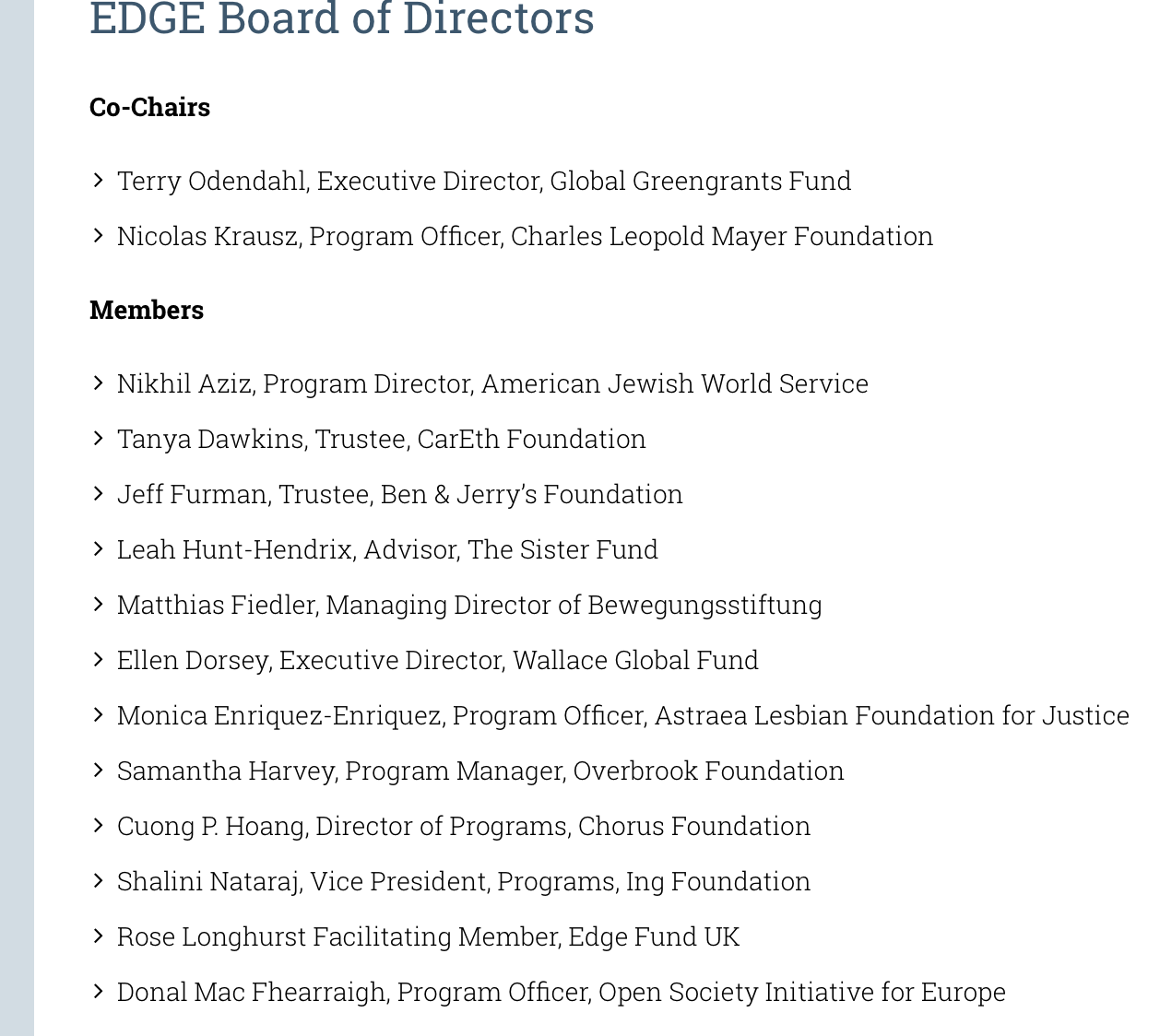
A representative of the Open Society Initiative for Europe currently sits on EDGE’s Board of directors. The Wallace Global Fund is also on its Board of Directors. The Wallace Global Fund is specialized in providing support to “mainstream” NGOs and “alternative media”, including Amnesty International, Democracy Now (which supports Hillary Clinton’s candidacy for president of the US).
Several members of the EDGE BoD, however, are from non-corporative and family foundations with a social mandate. (see below).
 In one of its key documents (2012), entitled Funders Network Alliance In Support of Grassroots Organizing and Movement-Building (link no longer available) EDGE acknowledged its support of social movements which challenge “neoliberal market fundamentalism.” including the World Social Forum, established in 2001:
“From the Zapatista uprising in Chiapas (1994) to the Battle in Seattle (1999) to the creation of the World Social Forum in Porto Alegre (2001), the TINA years of Reagan and Thatcher (There Is No Alternative) have been replaced with the growing conviction that “another world is possible.” Counter-summits, global campaigns and social forums have been crucial spaces to articulate local struggles, share experiences and analyses, develop expertise, and build concrete forms of international solidarity among progressive movements for social, economic and ecological justice.”
But at the same time, there is an obvious contradiction: another world is not possible when the campaign against neoliberalism is financed by an alliance of corporate donors firmly committed to neoliberalism and the US-NATO military agenda.
The following is the EDGE Montreal WSF Communique. The donors not only fund the activities, they also influence the structure of the WSF venue, which was determined in Puerto Alegre in 2001, namely the decentralized and dispersed mosaic of “do it yourself” workshops.
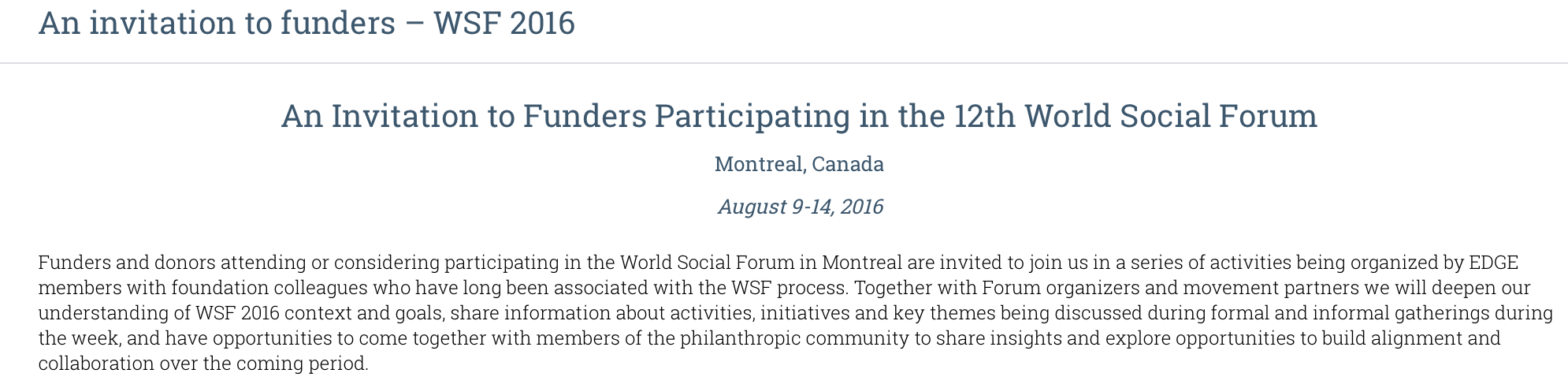

With regard to the Montreal WSF, the Consortium of Donors (EDGE) intent is:
“… to develop an intersectional space for funders and various movement partners – organizers thought leaders and practitioners – to build alignment by cultivating a shared understanding of the visions, values, principles and pathways of a “just transition.” (See http://edgefunders.org/wsf-activities/)
“Just Transition” implies that social activism has to conform to a “shared vision” with the corporate foundations, i.e. nothing which in a meaningful way might upset the elite structures of global capitalism.
From the standpoint of the corporate donors “investing in the WSF” constitutes a profitable (tax deductible) undertaking. It ensures that activism remains within the confines of ”constructive dialogue” and “critique” rather than confrontation. Any deviation immediately results in the curtailment of donor funding:
“Everything the [Ford] Foundation did could be regarded as “making the World safe for capitalism”, reducing social tensions by helping to comfort the afflicted, provide safety valves for the angry, and improve the functioning of government (McGeorge Bundy, National Security Advisor to Presidents John F. Kennedy and Lyndon Johnson (1961-1966), President of the Ford Foundation, (1966-1979))
The limits of social dissent are thereby determined by the “governance structure” of the WSF, which was tacitly agreed upon with the funding agencies at the outset in 2001.
“No Leaders”
The WSF has no leaders. All the events are “self-organized”. The structure of debate and activism is part of an an “open space” (See Francine Mestrum, The World Social Forum and its governance: a multi-headed monster, CADTM, 27 April 2013, http://cadtm.org/The-World-Social-Forum-and-its ).
This compartmentalized structure is an obstacle to the development of a meaningful and articulate mass movement.
How best to control grassroots dissent against global capitalism?
Make sure that their leaders can be easily co-opted and that the rank and file will not develop “forms of international solidarity among progressive movements” (to use EDGE’s own words), which in any meaningful way might undermine the interests of corporate capital.
The mosaic of separate WSF workshops, the relative absence of plenary sessions, the creation of divisions within and between social movements, not to mention the absence of a cohesive and unified platform against the Wall Street corporate elites, against the fake US sponsored “global war on terrorism”, which has been used to justify and US-NATO’s ‘humanitarian’ R2P interventions (Afghanistan, Syria, Iraq, Libya, Ukraine, etc).
The corporate agenda is to “manufacture dissent”.“The limits of dissent” are established by the foundations and governments which ultimately finance this multimillion dollar venue. The financing is twofold:
1. Core financing of the WSF Secretariat and the Costs of the WSF venue.
2. Many of the constituent NGOs which participate in the venue are recipients of donor and/or government support.
3. The WSF venue in Montreal also receives funding from the Government of Canada as well as from the Quebec provincial government.
What ultimately prevails is a ritual of dissent which does not threaten the New World Order. Those who attend the WSF from the grassroots are often misled by their leaders. Activists who do not share the WSF consensus will ultimately be excluded:
“By providing the funding and the policy framework to many concerned and dedicated people working within the non-profit sector, the ruling class is able to co-opt leadership from grassroots communities, … and is able to make the funding, accounting, and evaluation components of the work so time consuming and onerous that social justice work is virtually impossible under these conditions” (Paul Kivel, You Call this Democracy, Who Benefits, Who Pays and Who Really Decides, 2004, p. 122 )
“Another World is Possible” is nonetheless an important concept, which characterizes the struggle of the peoples movements against global capitalism as well as the commitment of thousands of committed activists who are currently participated in the Montreal 2016 WSF.
Activism is being manipulated: ”Another World is Possible” cannot, however, be achieved under the auspices of the WSF which from the outset was funded by global capitalism and organized in close liaison with its corporate and government donors.
The important question for activists in Montreal:
Is it possible to build “an Alternative” to global capitalism, which challenges the hegemony of the Rockefellers et al and then asks the Rockefellers et al to foot the bill?
We call upon participants of the Montreal World Social Forum (WSF) to raise and debate these issues: the campaign against neoliberalism is financed by corporate foundations (and governments) which are firmly committed not only to the tenets of neoliberalism but also to the US-NATO led military agenda.
Why would they fund organizations which are actively campaigning against war and globalization? The answer is obvious. …
Copyright © Prof Michel Chossudovsky, Global Research, 2016
Obama versus Trump, Putin and Erdogan: Can Coups Defeat Elected Governments?
By James Petras | Dissident Voice | August 9, 2016
Many of our interlocutors have been purged or arrested.
James Clapper, US Director of Intelligence on Turkish Coup, Financial Times, 8/3/16, p. 4
Washington has organized a systematic, global, no holds barred campaign to oust Republican Presidential candidate Donald Trump from the electoral process. The virulent anti-Trump animus, the methods, goals and mass media resemble authoritarian regimes preparing to overthrow political adversaries.
Comparable propaganda efforts led to political coups in Chile in 1973, Brazil 1964, and Venezuela in 2002. The anti-Trump forces include both political parties, a Supreme Court judge, Wall Street bankers, journalists and editorialists of all the major media outlets and the leading military and intelligence spokespeople.
Washington’s forcible and illegal ouster of Trump is part and parcel of a world-wide campaign to overthrow leaders and regimes which raise questions about aspects of the imperial policies of the US and EU.
We will proceed to analyze the politics of the anti-Trump elite, the points of confrontation and propaganda, as a prelude to the drive to oust opposition in Latin America, Europe, the Middle East and Asia.
The Anti-Trump Coup
Never in the history of the United States, has a President and Supreme Court Judge openly advocated the overthrow of a Presidential candidate. Never has the entire mass media engaged in a round-the-clock one-sided, propaganda war to discredit a Presidential candidate by systematically ignoring or distorting the central socio-economic issues of their opposition.
The call for the ouster of a freely elected candidate is nothing more or less than a coup d’état.
Leading television networks and columnists demand that the elections be annulled, following the lead of the President and prominent Republican and Democratic Congressional and Party leaders.
In other words, the political elite openly rejects democratic electoral processes in favor of authoritarian manipulation and deception. The authoritarian elite relies on magnifying tertiary, questionable personal judgement calls to mobilize coup backers.
They systematically avoid the core economic and political issues which candidate Trump has raised – and attracted mass support – which challenge fundamental policies backed by the two Party elites.
The Roots of the Anti-Trump Coup
Trump has raised several key issues which challenge the Democratic and Republican elite.
Trump has drawn mass support and won elections and public opinion polls by:
(1) rejecting the free trade agreements which has led major multinationals to relocate abroad and disinvest in well-paying industrial jobs in the US.
(2) calling for large scale public investment projects to rebuild the US industrial economy, challenging the primacy of financial capital.
(3) opposing the revival of a Cold War with Russia and China and promoting greater economic co-operation and negotiations.
(4) rejecting US support for NATO’s military build-up in Europe and intervention in Syria, North Africa and Afghanistan.
(5) questioning the importation of immigrant labor which lowers job opportunities and wages for local citizens.
The anti-Trump elite systematically avoid debating these issues; instead they distort the substance of the policies.
Instead of discussing the job benefits which will result from ending sanctions with Russia, the coupsters screech that ‘Trump supports Putin, the terrorist’.
Instead of discussing the need to redirect investment inward to create US jobs, the anti-Trump junta mouth clichés that claim his critique of globalization would ‘undermine’ the US economy.
To denigrate Trump, the Clinton/Obama junta resorts to political scandals to cover-up mass political crimes. To distract public attention, Clinton-Obama falsely claim that Trump is a ‘racist’, backed by David Duke, a racist advocate of “Islamophobia”. The anti-Trump junta promoted the US-Pakistani parents of a military war casualty as victims of Trump’s slanders even as they rooted for Hillary Clinton, promotor of wars against Muslim countries and author of military policies that sent thousands of US soldiers to their grave.
Obama and Clinton are the imperial racists who bombed Libya and Somalia and killed, wounded, and displaced over 2 million sub-Saharan Black-Africans.
Obama and Clinton are the Islamaphobes who bombed and killed and evicted five million Muslims in Syria and one million Muslims in Yemen, Afghanistan, Pakistan and Iraq.
In other words, Trump’s mistaken policy to restrict Muslim immigration is a reaction to the hatred and hostility engendered by the Obama-Clinton million-person Muslim genocide.
Trump’s “America First” policy is a rejection of overseas imperial wars – seven wars under Obama-Clinton. Their militarist policies have inflated budget deficits and degraded US living standards.
Trump’s criticism of capital and job flight has threatened Wall Street’s billion-dollar profiteering – the most important reason behind the bi-partisan junta’s effort to oust Trump and the working class’s support for Trump.
By not following the bi-partisan Wall Street, war agenda, Trump has outlined another business agenda which is incompatible with the current structure of capitalism. In other words, the US authoritarian elite does not tolerate the democratic rules of the game even when the opposition accepts the capitalist system.
Likewise, Washington’s quest for ‘mono-power’ extends across the globe. Capitalist governments which decide to pursue independent foreign policies are targeted for coups.
Obama-Clinton’s Junta Runs Amok
Washington’s proposed coup against Trump follows similar policies directed against political leaders in Russia, Turkey, China, Venezuela, Brazil, and Syria.
Russian President Putin has been demonized by the US propaganda media on an hourly basis for the better part of a decade. The US has backed oligarchs and promoted economic sanctions; financed a coup in the Ukraine; established nuclear missiles on Russia’s frontier; and launched an arms race to undermine President Putin’s economic policies in order to provoke a coup.
The US backed its proxy Gulenist ‘invisible government’ in its failed coup to oust President Erdogan, for failing to totally embrace the US Middle East agenda.
Likewise, Obama-Clinton have backed successful coups in Latin America. Coups were orchestrated in Honduras, Paraguay, and more recently in Brazil to undermine independent Presidents and to secure satellite neo-liberal regimes. Washington presses forward to forcibly oust the national-populist government of President Maduro in Venezuela.
Washington has escalated efforts to erode, undermine and overthrow the government of China’s President Xi-Jinping through several combined strategies. A military build-up of an air and sea armada in the South China Sea and military bases in Japan, Australia, and the Philippines; separatist agitation in Hong Kong, Taiwan, and among the Uyghurs; a US-Latin American-Asia free trade agreement which excludes China.
Conclusion
Washington’s strategy of illegal, violent coups to retain the delusion of empire stretches across the globe, ranging from Trump in the US to Putin in Russia, from Erdogan in Turkey to Maduro in Venezuela to Xi Jinping in China.
The conflict is between US-EU imperialism backed by their local clients against endogenous regimes rooted in nationalist alliances.
The struggle is ongoing and sustained and threatens to undermine the political and social fabric of the US and the European Union.
The top priority for the US Empire is to undermine and destroy Trump by any means necessary. Trump already has raised the question of ‘rigged elections’. But each elite media attack of Trump seems to add to and strengthen his mass support and polarize the electorate.
As the elections approach, will the elite confine themselves to verbal hysteria or will they turn from verbal assassinations to the ‘other kind’?
Obama’s global coup strategy shows mixed results: they succeeded in Brazil but were defeated in Turkey; they seized power in the Ukraine but were defeated in Russia; they gained propaganda allies in Hong Kong and Taiwan but suffered severe strategic economic defeats in the region as China’s Asian trade policies advanced.
As the US elections approach, and Obama’s pursuit of his imperial legacy collapses, we can expect greater deception and manipulation and perhaps even frequent resort to elite-designed ‘terrorist’ assassinations.
Israel pops up in Gulf riding Arab coattails
By M K Bhadrakumar – Indian Punchline – August 7, 2016
The reported statement by former Israeli minister Diaspora Affairs Rabbi Michael Melchior that Saudi Arabia will open its doors to Israeli visitors “much sooner than you dream about” will not come as surprise. To be sure, a critical mass is developing in the secretive Saudi-Israeli intercourse.
The Saudi regime has been chary about links with Israel for fear of annoying the ‘Arab Street’, whereas, Israel has been all along eager to flaunt the breach in the Berlin Wall of Arab-Israeli conflict. But Saudis seem to estimate that the time has come to be open about the relationship.
The point is, if the raison d’etre of the dalliance is the ‘containment’ of Iran, it is resource-sharing. An open relationship is needed to optimally develop security and military cooperation. The Custodian of Holy Places seems to think the Muslim world will learn to live with his country’s strategic cooperation with Israel.
Well, the Palestine issue no longer poses hurdles, either. Arab Spring, conflicts in Syria and Iraq, military coup in Egypt, Saudi-Iranian rivalry, breakdown in Iran’s ties with Hamas, Islamic State – all these have relegated the Palestine issue to the backburner. Besides, Palestine President Mahmoud Abbas is on a tight American and Saudi leash. Abbas even received in Ramallah recently a Saudi delegation led by former general Anwar Majed Eshki who visited Jerusalem and met senior Israeli officials, including the head of the foreign ministry Dore Gold.
Again, Saudi Arabia’s keen interest in taking possession of two Red Sea islands at the mouth of the Gulf of Aqaba – Tiran and Sanafir – needs to be understood as a move to be Israel’s ‘neighbor’. Sanafir and Tiran sit at the mouth of the Gulf of Aqaba, on a strategically important stretch of water called the Strait of Tiran, used by Israel to access Red Sea. King Salman personally camped in Cairo in April to persuade Egyptian President Abdel Fattah al-Sisi to transfer the two islands in lieu of a seductive multi-billion dollar offer to Sisi.
Indeed, both Saudi Arabia and Israel are making haste to position themselves for a new phase of the Middle East’s politics in the post-Barack Obama era. They expect Hillary Clinton to pick up the threads where George W. Bush left them — a muscular regional policy involving switch back to containment of Iran and resuscitation of the pivotal relationships with Israel and Saudi Arabia.
Neither Saudi Arabia nor Israel is willing to reconcile with the Iran nuclear deal. They are doing everything possible, no matter what it takes, to see that the deal gets derailed. On Saturday, Israeli Defence Ministry issued a harshly-worded statement slamming Obama and comparing the Iran deal with the 1938 Munich agreement to appease Hitler. (Jerusalem Post )
Equally, Saudis and Israelis have convergent interests in regard to the conflicts in Syria and Iraq — supporting extremist Sunni groups, promoting the Kurdistan project, creation of ‘spheres of influence’ on Syrian and Iraqi territory, and ultimately, entrapping Iran in a quagmire that will exhaust the regime.
The Saudi-Israeli strategic regional realignment is something that Washington historically encouraged. It is just the underpinning needed for creating a regional security architecture supported by the NATO’s network of partnerships with the GCC states under the canopy of a US missile shield.
Alas, Turkey too could have been a key partner in this enterprise, but for the failure of the July 15 coup. Israel looked distressed when it transpired that the coup failed. As for Saudi Arabia, it probably played a role in the failed coup. (Sputnik )
Without doubt, it is against a complex backdrop that the recent reports regarding Israel and Pakistan taking part in a major air exercise hosted by the US also needs to be viewed. Neither Islamabad nor Tel Avi has denied the reports. Of course, the US always encouraged a Pak-Israeli proximity. Now, the big question is: With Saudi Arabia establishing ties with Israel, can Pakistan be far behind? (Times of Israel )
From the Israeli, Saudi and American perspective, it is of utmost importance that Pakistan aligns with Saudi Arabia instead of remaining neutral in regard of Iran’s rise. Pakistan’s role is crucial to any major plans of destabilization of Iran.
Israel and Saudi Arabia pretended until recently that they have a special thing going with Moscow, too, with a view to create ‘strategic ambiguity’. Moscow played along, while making a strategic decision that Iran is its ‘natural ally’ in the Middle East. This is perfectly understandable, because in the ultimate analysis, Israel and Saudi Arabia are bit players only, while Iran (or Turkey for that matter) is an authentic regional power credited with a world view.
It is possible to see the Russia-Azerbaijan-Iran trilateral summit in Baku on Monday as a strategic counter-move by Moscow and Tehran.
The proposed North-South Transport Corridor is admittedly an old idea with a pronounced economic dimension, but in the present context, an access route for Russia to the Persian Gulf and Middle East via Iran’s territory becomes a geopolitical event of far-reaching significance in the regional alignment that is under way. (See my blog China’s One Belt One Road isn’t only show in town.)
Struggling U.S. Gives Israel Largest Aid Package Ever
teleSUR – August 1, 2016
With more unemployed people than at any time in U.S. history, President Obama next week is scheduled to sign the most lavish foreign aid package in the country’s history – $3.1 billion in military assistance to Israel – raising an urgent question: can the U.S. afford it?
The United States already transfers $3.1 billion in taxpayer money to Israel every year, far more than any other country, but the deal that will be signed into law next week will guarantee foreign aid to the country until the year 2027, a decade after Obama has left office. In Monday’s edition of The Intercept, the journalist Glenn Greenwald notes that Israeli living standards already surpass those in the U.S. in some critical areas.
While Israeli citizens enjoy universal health care, 33 million citizens in the United States don’t have coverage, Greenwald notes. Israelis also have a higher life expectancy, 82.27 years, compared to 79.68 years in the U.S. And Israel’s infant mortality rate – one of the best indicators of human development – is one of the lowest in the world, at 3.55 deaths for every 1,000 live births. Conversely, in the United States, 5.87 babies die before their first birthday.
The U.S. Bureau of Labor Statistics reported last year that the number of Americans 16 years and older who were not in the workforce eclipsed 93 million people, an all-time high and nearly a third of the total US population of 321 million.
A 2012 Congressional Resources Service report, as reported by The Intercept, found that “U.S. military aid [to Israel] has helped transform Israel’s armed forces into one of the most technologically sophisticated militaries in the world.” Despite that aid, Israeli Prime Minister Benjamin Netanyahu has reportedly demanded as much as US$5 billion in aid a year.
What’s more, he has also opposed U.S. requirements that some of that money is spent with U.S. military contractors rather than Israeli ones. With the U.S. presidential elections just three months away, both political parties are campaigning to restore the once-vaunted middle-class prosperity in the country, but Israeli aid is all-but-sacrosanct in the electoral discourse. Early in the campaign Trump had suggested that he might not oppose the international Boycott, Divestment and Sanctions movement, or BDS, against Israeli-made products – but has since reversed his position.
Featured Video

New positive ivermectin evidence
or go to
Aletho News Archives – Video-Images
From the Archives
Fanatical Followers of the Covid Regime: A Jim Jones-Style Cult?
By Professor Roger Watson and Dr. Niall McCrae | The Daily Sceptic | November 15, 2021
As scholars at leading British universities over recent decades, we witnessed the replacement of critical thinking and debate by narrative: facts are discrimination and scientific method is imperialism; truth, instead, is derived from ‘progressive’ values. This educational trend may be a major contributory factor to the ease in which society has been inculcated to the Covid ‘new normal’ of masking, testing, and repeated doses of vaccines for a disease of similar risk to severe influenza.
One doesn’t need much critical reasoning to observe the flawed logic of some vaccination enthusiasts, such as people who respond to experiencing any side effects, however debilitating, by saying “at least I know it’s working”, or, after contracting the disease despite their promised inoculation (over 90% effective, according to initial drug company claims), “I’d have been worse off without the jab.” … continue
Blog Roll
 Aletho News
- New positive ivermectin evidence
- Met Office Caught Fabricating Daily Temperature Record Claims
- Merck Virologists Admitted to Falsely Certifying Vaccine Efficacy
- Mandatory Folic Acid for every man, woman & child
- Pro-Palestine protesters arrested outside UK’s ruling Labour Conference in Liverpool
- Mauritius denies landing permit to flight from Israel, forcing cancellation: Tour operator
- Israeli finance minister calls for genocidal war on West Bank, annexation of south Lebanon
- 12 Things Your Psychiatrist Was Trained Not to Tell You
- From Unipolar Universalism to Multipolar Civilizational Distinctiveness
- RSF military group defects, joins Sudanese army: State media
- If Americans Knew
- Israel forces Gazans to live in constant peril – Daily Update
- Deconstructing Netanyahu’s pants-on-fire UN rant – Daily Update
- Trump betrayed voters with his campaign lies and prioritized a foreign country once he took office
- Netanyahu calls Israel’s war in Gaza ‘opposite of genocide’ in UN speech to near-empty hall
- Settler Kidnappings: Torture, Sexual Abuse and Terrorisation of Palestinian Abductees as Israel Deepens Annexation of West Bank
- Gaza winter nears as 162,000 tents become unusable, raising fears of humanitarian crisis
- Netanyahu says, “It’s the opposite of genocide”; UN says Gaza economy is world’s ‘most severe crisis on record’ – Daily Update
- Israel’s US-Backed Assault on Gaza Has Created the ‘World’s Most Severe Economic Crisis on Record’: UN
- ‘Protecting U.S. Citizens’… From Israel
- ‘This is where I live now, the back of a truck’: a day in the life of a grandmother in Gaza
- No Tricks Zone
- New Study: Earth And Venus Surface Warmth Largely Explained By Convection And Lapse Rate, Not CO2 Or Radiation
- 2025 Nature Paper Claiming Worsening Global Drought Gets RETRACTED …Heavily Flawed
- New Study: ‘Global Drought Shows No Detectable Recent Acceleration Under Climate Warming’
- Economic Masterminds: German Socialists Suggest Taxing Productivity Gains Stemming From Using AI
- The South China Sea Has Not Been Cooperating With The Climate Change Narrative
- Energy Crisis: Germany Enters Heating Season With Historically Low Gas Reserve Fill Levels
- New Study: The Antarctic Ice Sheet Gained Mass From 2020-2024 Due To Staggering Snow And Ice Accumulation
- Study: Ocean Heating Rates From Thousands Of Years Ago ‘Dwarf’ Modern Ocean Heating Rates
- Climate Extremists Target, Attack Large-Scale Power Grid Infrastructure In Germany!
- New Study: Antarctic Ice Melt Has Contributed Less Than 1 Centimeter To Sea Level Rise In The Last 30 Years

