Siemens to invest in Iran’s petchem projects
Press TV – August 22, 2016
Iran’s media say German engineering giant Siemens has started talks to invest in the country’s petrochemical industry in a fresh sign of growing post-sanctions opening in the business environment of the Islamic Republic.
Mehr News Agency reported that Siemens is already engaged in serious negotiations with Iran’s Ministry of Petroleum over investing in a certain number of the country’s petrochemical projects.
The report added that a ranking delegation from Siemens had visited Tehran over the past few days to meet the related Iranian officials for investment talks.
It also said that another topic in the meetings of the German firm with Iranian officials was providing the advanced technology as well as the related technical and management solutions for Iran’s petrochemical projects.
In May, Siemens reported a rise in its second-quarter profit by €130 million in what it says was a result of the promising prospects of future activities in Iran.
The company announced in a statement that the resurgent business prospects in Iran after the removal of international sanctions has already increased its expectations of second-quarter revenues by €174 million.
The Munich-based company has always been one of the most active German enterprises in Iran. Even during the multiple years of sanctions that a majority of foreign companies left the Islamic Republic, Siemens kept its office in Tehran open to maintain its business in the country.
It has been mostly providing engineering services as well as technical parts including turbines to Iran’s gas projects. After the removal of the sanctions against Iran in January, it became even more active to pursue an ambitious Iran investment agenda.
In March, the company signed memoranda of understanding on rail infrastructure and gas equipment projects potentially worth billions of euros, as well as an energy agreement with Iranian power and infrastructure group MAPNA.
Syria, India call for rejection of foreign influence in internal affairs
![India's junior Foreign Minister Mubashir Javed Akbar met Assad in Damascus on 20 August 2016 [Image: Ministry of External Affairs, India]](https://i0.wp.com/thebricspost.com/wp-content/uploads/2016/08/CqUYptqUAAAUiDU-e1471843144421.jpg)
India’s junior Foreign Minister Mubashir Javed Akbar met Assad in Damascus on 20 August 2016 [Image: Ministry of External Affairs, India]
The BRICS Post | August 22, 2016
During a weekend meeting with an Indian official, Syrian President Bashar al-Assad has invited India to play an active role in the reconstruction of the Syrian economy.
India’s junior Foreign Minister Mubashir Javed Akbar met Assad in Damascus on Saturday. The visit will boost Syrian President Assad’s efforts to highlight continued critical support for his government.
State media reports in both countries quoted sources as saying New Delhi and Damascus have reasserted their rejection of “foreign interference in the internal affairs of states”.
The two sides discussed terrorism, faith equality and the need to upgrade bilateral security consultations, the Press Trust of India quoted Indian government sources.
As a growing power, India has a role to play in meeting the challenge of terrorism, Assad has said as the two countries agreed to upgrade their security consultations.
BRICS are opposed to the ouster of Assad as sought by the US and its allies.
Earlier in May, South African junior Foreign Minister Nomaindia Mfeketo had also called on Assad in Damascus to discuss the crisis.
Assad had told the South African Minister that the BRICS countries have played a key role in decreasing western hegemony in global affairs.
During the Indian Minister’s visit on Saturday, Syrian Foreign Minister Walid Mouallem said terrorism is the common adversary of both Syria and India.
There was an agreement between both sides for further upgrading security consultations, sources said.
No details of the security cooperation has been provided by the Indian government yet.
On Saturday, Vikas Swarup, spokesperson of the Indian Foreign Ministry, tweeted a picture of Assad and the Indian Minister.
“During his official visit to Syria, MoS @mjakbar called on President Bashar Al Assad in Damascus today,” Swarup said.
The Indian Minister stressed that “India is ready to offer all that could help in alleviating the suffering of the Syrian people and contribute effectively to the development process and reconstruction in Syria”, Syrian state news agency SANA said.
During the meeting, Assad also welcomed India’s objective position on the conflict in Syria and both leaders acknowledged that terrorism was a global problem.
“As a growing power, India has a role to play in meeting the challenge of terrorism,” Assad said.
On his part, Akbar, during their meeting, said “the age of destruction” should give way to the age of “reconstruction” in Syria.
Russia, which is aiding the Syrian government’s fight against ISIL and the Al-Nusra front, said on Thursday it was willing to support weekly 48-hour ceasefires to allow aid to reach besieged areas.
The Democrat’s foolish War on Climate
By David Wojick | Climate Etc. | August 17, 2016
The party platform adopted at the Democratic National Convention, on page 45, calls for a national mobilization on the scale of World War II. What enemy deserves the wrath endured by Hirohito and Hitler? Climate change! Democrats want to declare a war on climate.
Here is the amazing declaration: “We believe the United States must lead in forging a robust global solution to the climate crisis. We are committed to a national mobilization, and to leading a global effort to mobilize nations to address this threat on a scale not seen since World War II.”
This scale of mobilization is incredibly expensive and disruptive to people’s lives, something to which the Democrats seem oblivious. Great sacrifices by average Americans were required for mobilization during the Second World War, enforced by massively intrusive government authority. Is this what the Democrats want, the supreme government control that comes with a wartime effort?
To begin, there was widespread government rationing of essential products. For most families, driving was limited to just three gallons of gas a week. If the Democrat’s war on climate is designed to curtail fossil fuel use then will gasoline again be rationed, in spite of longer commutes due to massive post-war suburbanization? What about natural gas and coal-fired electric power? Meat and clothing were also rationed. Will this be repeated?
Even worse, many consumer products were simply not produced; their production prohibited in favor of war materials. These included most appliances, including refrigerators, plus cars, of course. Today’s banned appliance list might well include computers, smart phones and televisions, and again cars, as well as air conditioners and refrigerators. Will all these technologies be stopped in favor of building climate war materials like windmills, batteries and solar panels?
Not only is mobilization horrendous, there is no scientific justification for it. It is now clear that what is called “lukewarming” is probably the correct scientific view. Human activity may be causing a modest global warming that is actually beneficial. Beyond that climate change is natural and so beyond human control.
The only purpose for which a war on climate makes sense is justifying a massive increase in government power. Mobilization means controlling both production and consumption, as well as wage and price controls, all of which require detailed central planning of economic activity. This in turn requires a host of new agencies, programs, boards, etc. We have seen it all before.
Of course we have had so-called “war” policies before, such as the war on drugs. But these were mostly metaphorical policy names, typically just a shift in focus with a modest budget increase. The Democratic platform is very different because it specifies that the scale of the war on climate will be comparable to the Second World War mobilization, which entailed wrenching lifestyle changes.
If the Democrats are in fact serious, then we are talking about central economic planning on a massive scale, imposing great sacrifices on Americans, all in the futile name of stopping climate change. Sacrifice is harmful in its own right so this raises a host of moral issues. Which immediate harms will be deemed less harmful than speculative future climate change? Medical care is now a major sector of the economy, will it be curtailed? Will poverty be left to languish, or even encouraged via wage controls? Will travel be forbidden? Unfortunately the platform gives no clue, so this should be a major election issue.
In fact the specter of a WWII-scale mobilization to fight climate change dwarfs everything else proposed in the Democrats’ platform combined. It is also contrary to most of these other proposals, given the widespread restrictions that mobilization requires. Perhaps they do not understand what they are calling for, but if they do then they need to tell us what it is. Clarifying and justifying this outrageous mobilization declaration is essential to the election process.
Voting for mobilization without knowing what it means would be incredibly foolish.
David Wojick is a former consultant with the Office of Scientific and Technical Information at the U.S. Department of Energy in the area of information and communication science. He has a Ph.D. in the philosophy of science and mathematical logic from the University of Pittsburgh and a B.S. in civil engineering from Carnegie Tech. He has been on the faculty of Carnegie Mellon and the staffs of the U.S. Office of Naval Research and the Naval Research Lab.
Putin: Vital to Revive Economic Ties With Ukraine – Putin
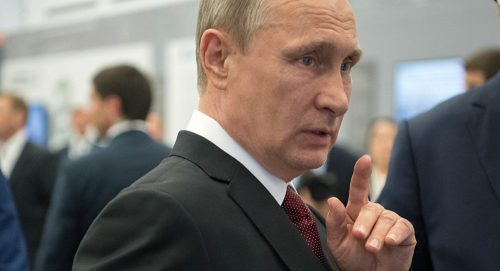
© Sputnik/ Sergey Guneev
Sputnik – 19.08.2016
Russia deems it vital to restore economic relations with Ukraine, Russian President Vladimir Putin said Friday after appointing the former education minister to the post of trade envoy with the neighboring country.
Putin accepted the prime minister’s proposal to appoint Olga Vasilyeva as the new Minister of Education and Science. Her predecessor Dmitry Livanov was assigned special envoy for trade and economic relations with Ukraine.
“The development of trade and economic relations [with Ukraine] should be in the permanent field of our attention,” Putin said during a working meeting with Prime Minister Dmitry Medvedev on arrival to Crimea.
Noting Livanov’s “purely civilian” credentials with extensive public sector experience, Putin noted that his “personal business acumen will help in building and reviving economic relations with our neighboring country, which is important to us.”
Norway offers €1bn in credit to Iran

Iranian Parliament Speaker Ali Larijani (R) and Norwegian Foreign Minister Borge Brende in Tehran on August 17, 2016. ©IRNA
Press TV – August 17, 2016
Iran says it has been offered a major export credit line by Norway worth €1 billion in what could be a fresh indication of Oslo’s determination to expand relations with the Islamic Republic in post-sanctions era.
The two countries have signed an agreement to the same effect after a meeting between the visiting Norwegian Foreign Minister Borge Brende and his Iranian host Mohammad Javad Zarif in Tehran, Iran’s IRNA news agency reported.
The agreement was part of a total of three agreements that the Export Guarantee Fund of Iran and the Norwegian Export Credit Guarantee Agency signed to fund some of Iran’s key development and infrastructure projects.
“After the lifting of sanctions, good opportunities have emerged for cooperation and Norway is ready to utilize the post-deal situation to expand cooperation in various fields,” Brende has been quoted as saying by IRNA in a report that was also carried by AFP.
The report added that Brende and Zarif had also discussed the expansion of economic relations between Iran and Norway in different areas, particularly in monetary and banking sectors.
Brende will leave Tehran for Islamabad later in the day. Apart from Zarif, he is scheduled to meet several other top Iranian officials during his single-day stay in the Islamic Republic. They included President Hassan Rouhani, Petroleum Minister Bijan Zangeneh, Parliament Speaker Ali Larijani, and Secretary of the Supreme National Security Council Ali Shamkhani.
Iran, the U.S., and Nuclear Development
By Robert Fantina | Aletho News | August 17, 2016
In 2015, after much ado, and with great, international fanfare, the United States and 5 other nations (China, France, Russia, Great Britain and Germany) entered into an agreement with Iran, regulating that country’s nuclear activities. This was not an easy sell to the U.S. Congress, which, apparently, exists to serve Israel first, and U.S. citizens only after Israel’s needs have been satisfied.
A group of 47 senators succeeded in humiliating the nation by sending a letter to Mohammad Javad Zarif, the Iranian Foreign Minister, purportedly explaining U.S. law.
Mr. Zarif, a U.S. constitutional expert, responded by schooling them.
Then, none other than Israeli Prime Minister Benjamin Netanyahu addressed Congress, telling its members, yet again, for the umpteenth time in the last ten years, that Iran was only ‘months away’ from having a nuclear weapon.
Democratic members of Congress particularly beholden to Israel but not wanting to embarrass a Democratic president, danced to a particularly awkward tune as they waited to see if the agreement had enough votes in the Senate to pass. Once it was apparent that the agreement would be approved by a Congressional majority, they were at liberty to express their opposition to it, knowing that doing so would please their Israeli masters, and not impact the vote, thus embarrassing President Barack Obama.
Now, the bizarre reasoning behind why Iran, a nation that hasn’t invaded another country in decades, should be forbidden from developing nuclear weapons, when Israel, a brutal, apartheid regime with more blood on its hands than a doctor after a botched surgery, can, is a topic for another essay. Our purpose today is to examine the agreement that was made with Iran, what concessions were made on each side, and how each is following through.
Iran, which never claimed it had the development of nuclear weapons as its goal, agreed to major reductions in its nuclear development program. It also agreed to allowing an international monitoring team to verify compliance. In return, the U.S. agreed to lift decades-old sanctions that, like most of U.S. sanctions, did little to impact the government, but caused untold suffering among the Iranian population.
It seems, however, that Iran overlooked an important aspect in its negotiations with the U.S. While there is a mechanism in place to monitor Iranian compliance with the agreement, no such measures exist to monitor U.S. compliance.
The U.S., in its usual hypocritical way, has released the obligation of European banks to avoid doing business with Iran, yet maintains some sanctions, thus effectively preventing the banks from conducting any business with that country. As reported by CNN Money in May of this year, “HSBC, Standard Chartered and France’s BNP Paribas have all been in trouble before — and paid billions in fines — for dealing with Iran while U.S. sanctions were in place. So while they may see attractive commercial opportunities in the country of about 80 million people, they’re treading very carefully because some sanctions still linger, including a ban on conducting transactions with Iran in U.S. dollars.”
So while the U.S. adheres to the letter of the law, it violates the spirit of it, and as a result, Iran is getting next to nothing for the concessions it made. “We hold the US responsible for all violations [of the nuclear agreement]. The US must accept responsibility for reneging on its promises on the international level,” Alaeddin Boroujerd, Chairman of the Iranian Parliament’s Committee on National Security and Foreign Policy, stated on August 1. He further emphasized that the U.S., despite Iran’s adherence to the terms of the agreement, continued to damage “Iran’s economic relations with other countries.”
Now, isn’t the U.S. the land of the free and the home of the brave? Does it not proclaim its moral superiority around the globe, even as it bombs innocent men, women and children? Is its word not worth gold?
The U.S. does not want Iran to have nuclear weapons, because doing so would provide an equal, yet opposing, force to Israel in the Middle East. Current Democratic candidate, the corrupt former Secretary of State Hillary Clinton, has made support for Israel a cornerstone of her campaign. She has stated that the best way to serve Israel is to topple the government of Syrian president Bashar Assad. So if U.S. government officials will go so far as to overthrow foreign governments (please see Ecuador, Guatemala, Brazil, Bolivia (twice), Portugal, Nicaragua, etc.), with all the killing, mass arrests and oppression that accompanies each coup, certainly crippling the economy of one of Israel’s enemies, and violating its word in order to do so, is a trivial matter by comparison.
When one party to any contract violates the terms of that contract, the other party is no longer bound by it. So when Iran decides that it need not slow its nuclear program, because the U.S. hasn’t respected its side of the agreement, we will all watch U.S. members of Congress proclaiming “I told you so! Those Iranians can’t be trusted!’, when, in fact, it is the U.S. that can’t be trusted. But the corporate-owned media will only report on what it will see as Iran’s violations of the agreement, without mentioning that the U.S. violated it first.
U.S. citizens will gasp in horror at the perfidy of Iran; after all, most Iranians are Muslim, and as the news media either hints at, or boldly proclaims, all Muslims are terrorists. And the way will be open for another U.S. imperial misadventure, something to match the tragedy of Iraq, Afghanistan, Vietnam or the countless other places where the U.S. has disastrously and illegally intervened. Countless innocent people will suffer and die, the Middle East will be further destabilized, and military contractors’ profits soar. It will be business as usual in the mighty, corrupt U.S.A.
Will Hungary Be Next to Exit the EU?
By F. William Engdahl | New Eastern Outlook | August 17, 2016
Will Hungary be the next nation to exit the dysfunctional European Union? The question isn’t at all as far-fetched as it might seem. On October 2, voters in Hungary will participate in a nationwide referendum to vote whether they agree to the forced settlement of migrants in Hungary by the EU or not. It’s a major issue in Hungary, a land of proud and staunchly independent-minded people who have endured 150 years of Ottoman rule; wars with Habsburg Austria until the Austro-Hungarian Compromise of 1867 created a peaceful coexistence under the dual Monarchy of Austria–Hungary. After that, Hungarians were subject to the Soviet Union since 1945, initially under the dreaded Mátyás Rákosi, until it became the first Warsaw Pact communist country to declare a constitutional republic in October, 1989 and open its borders to Austria, setting in motion the domino fall of East Germany and then of the entire Warsaw Pact and, ultimately, the Soviet Union. Like every nation, they have a very special history.
It might well be said that Hungarians, always an ethnic melting-pot population whose parliament enacted the first laws of ethnic and minority rights in the world in 1849, are not a passive people when they sense something is wrong in the way they are being treated. So it is today regarding the Brussels proposal that Hungary and other EU member states must accept a Brussels-determined number of political war refugees from the Middle East and pay for all their costs whether they want them or not. Countries that refuse to take their quota would face severe financial penalties. In 2015 some 400,000 refugees arrived in Hungary in 2015 before a four-meter high razor wire fence was erected on the border with Serbia.
About half, or 200,000, attempted to gain asylum in Hungary, and after government procedures, only 264 refugees were granted political asylum. Since the erection of the fence the inflow via the so-called Balkan Route has all but stopped. The Austrian government has also decided to cooperate with the Orban government in jointly patrolling their common border.
Hungary is joined in opposing the Brussels mandatory refugee quota proposal by the Czech Republic, Slovakia and Poland–the so-called Visegrad Four group. So far only Hungary has decided on a national referendum on the issue. Polls show well over 66% opposed to the mandatory quotas, including Orban, who has urged a No vote.
Hungary’s outspoken Prime Minister, Viktor Orban, the only prime minister since 1989 to serve a full term and be re-elected, is very popular among Hungarians for speaking his mind against what he feels are wrong policies coming out of Brussels. Many Hungarians see him as a modern David pitted against the far larger Goliath, the faceless, unelected EU Commission.
On October 2 Hungarians will vote on a single question in a special national referendum: “Do you want the European Union to prescribe the mandatory settlement of non-Hungarian citizens in Hungary even without the consent of Parliament?”
Orban: ‘terror risk…’
On the war refugee issue Orban minces no words: “Hungary does not need a single migrant for the economy to work, or the population to sustain itself, or for the country to have a future,” he said in a recent interview. On the contrary, he stated, “Every single migrant poses a public security and terror risk. This is why there is no need for a common European migration policy.” Whoever needs migrants can take them, but don’t force them on us, we don’t need them.” As far as Hungary is concerned, he stated in an interview with RT, “migration is not a solution but a problem… We don’t need it and won’t swallow it.” The Hungarian government insists that the right to decide refugee issues should be reserved exclusively for national governments.
Hungary and three other central European states that constitute the Visegrad Four group, which includes Czech Republic, Slovakia and Poland, have been opposing the mandatory quotas the EU wants to impose on each member state. Last December Hungary filed a lawsuit with the European Court of Justice to thwart the EU’s attempt to redistribute incoming arrivals across the European Union. A decision could take years. The referendum is intended to give a broad popular mandate against Brussels’ forced quota attempts.
First step to EU Exit?
Clear to all from Brussels to Berlin to Budapest is that Hungarians will vote an overwhelming No to refugee forced quotas. At that point the real question will be whether Hungarians hold a second referendum, as the British did recently, to vote on leaving the EU or not when it becomes clear that Brussels will ignore the Hungarian vote with their usual deafening silence. The idea of a Hungarian EU exit is not unthinkable at all at this point now that Britain has become “first out the door,” establishing the precedent exit is possible.
The Orban government to date has moved with a certain directed caution to test the limits of EU rules. Far from a “right-wing tyrant” as Brussels bureaucrats and politically-correct mainstream EU media have portrayed him, the Oxford-educated Orban is a highly-sophisticated, apparently not corrupt (a real novelty in today’s politics if true) genuine democrat who always turns to his voters on key policy decisions to be sure he has them with him, something anathema to the unelected Brussels oligarchy.
Viktor Orban’s views on the current refugee crisis, which media deliberately misnames the far more benign-sounding mass migration situation of the EU, he outlined in detail in his February 28 annual State of the Union address to the nation, midway into his third term as (elected) Prime Minister.
Referring to the country’s recent experience extricating itself from the destructive decades of communist rule, now as an EU member state since 2004, Orban notes, “we are concerned as to how we should protect our national interests within the European Union.” This sounds reasonable enough unless one realizes that the aim of the EU as an institution is precisely the opposite–to ultimately destroy any and all national interests in favor of a top-down Brussels-centered autocracy of the unelected.
Real accomplishments
As so much about the true Hungary and Orban’s actual accomplishments is either ignored or distorted by mainstream non-Hungarian media, it’s first useful to note some of what Viktor Orban has accomplished in the first term from 1998-2002 when his Fidesz Party won in a coalition with the Hungarian Democratic Forum (MDF) and the Independent Smallholders, Agrarian Workers and Civic Party (FKGP) and in his sole majority government since 2010. After 8 years out of office, Orban’s Fidesz Party won an overwhelming popular mandate of 53% of the vote and two-thirds of Parliament seats in 2010 and re-election in 2014 to the present.
As Orban notes in his February address to the nation, “within three years we had consolidated the budget, stabilized the economy, avoided bankruptcy, curbed inflation and reduced unemployment – the latter not marginally, but from 11.5% to 6.2%. We sent the IMF packing, repaid our loan ahead of schedule, and this year we shall also repay the last blessed penny of our debt to the European Union. All in all, in 2014 we rounded off this period of stabilization with economic growth of 3.7%, and opened a new chapter.”
In addition, under Orban’s term, the government managed “in five years to reduce personal income tax from 35% to 15%, and in five years we have left 1,300 billion forints in the pockets of families. We have reduced household utility bills by 25%, and in five years the minimum wage in Hungary has increased by 50%. We have achieved this together: the state and the market; the Government and the business sector; employers and employees; Hungarian micro-, small and medium-sized enterprises and the local subsidiaries of global conglomerates… Compared with 2010, we have allocated forty per cent more funding to health care. We have halved waiting lists. We have allocated more than five hundred billion – more than five hundred billion forints – to the development of our hospitals.”
That is the background of Hungary’s present economy under Orban’s term and the background to understand why the population supports his call for a no to mandatory refugee quotas. Now his remarks on the refugee crisis are relevant.
‘name of this danger is mass migration…’
Orban continues, “I would now like to explain why I have said all this. In summary, it is because all of this is now in danger. The financial stability we have worked so hard for is in danger… Our nationally-oriented foreign policy – which has been built with such painstaking attention to detail – is in danger. Restored public order and public security free of terrorist threats are in danger. And our national culture… is also in danger.”
He gets precise: “The name of this danger is mass migration… The year 2015 brought to an end an age in which, believing that it was under Europe’s control, we took the protection and safety of our continent for granted. One year ago, on this same occasion, we were already warning that a new age of mass migration had begun. We were mocked mercilessly, and insulted by friends, allies and rivals alike… The reality is that those coming here have no intention whatsoever of adopting our way of life, because they see their own as more valuable… And why, indeed, would they give it up? The reality is that they will not provide the supply of labor needed by the factories of Western Europe. Facts show that, across entire generations, the unemployment rate is much higher – sometimes several times higher –among those born outside Europe. The reality is that the European nations have been unable to integrate even the masses who arrived from Asia and Africa gradually, over a number of decades. How could they succeed in doing so now, so rapidly and for such large numbers?”
All those statements can be argued. But here is the core point on which Orban bases his strategy of Referendum, and the ultimate reason he will next be forced after October 2 to begin preparing a ‘Huexit’ from the EU for Hungary:
“… it is hardly the migrants whom we should be so angry with. The majority of them are also victims: victims of their countries’ collapsing governments, victims of bad international decisions, victims of people smugglers. They are doing what they see as being in their own interests. The problem is that we Europeans are not doing that which would be in our own interests. There is no better word for what Brussels is doing than “absurd”. It is like a ship’s captain heading for collision who, instead of wanting to take avoiding action, is more interested in deciding which lifeboats should be non-smoking. It is as if, instead of repairing the leaking hull, we are arguing about how much water should flood into which cabins…”
Orban then continues:
“It is a big enough problem that Brussels is not capable of organizing the defense of Europe, but it is an even bigger problem that it lacks the intent to do so. In Budapest, Warsaw, Prague and Bratislava it is difficult for us to understand how we have reached a point at which it is even possible that those wanting to come here from other continents and other cultures can be let in without controls. It is difficult to understand the weakening of our civilization’s natural and fundamental instinct for the defense of ourselves, our families, our homes and our land… This is Europe. Europe is Hellas, not Persia; it is Rome, not Carthage; it is Christianity, not a caliphate. When we say this we are not claiming that we are better, but that we are different. To point to the existence of an independent European civilization does not mean that it is better or worse; it only means that “we are like this, and you are like that.”
This move by Hungary, its Prime Minister and its population is no superficial political ploy to bargain for a better deal from Brussels as David Cameron intended with his Brexit fiasco (seen from Cameron’s view). It’s a fundamental drawing of a line in the sand of the entire European Union between countries who believe in a dissolved national sovereignty in favor of a supranational Brussels-based United Europe, and those countries who fiercely intend in the wake of this refugee crisis and all its ramifications, to demand essential national sovereign rights.
Brussels, and clearly Merkel’s Berlin, will oppose Hungary tooth-and-nail to defend their supranational concept. They will do that with the backing of George Soros and his European Council on Foreign Relations think tank. Not surprising, Viktor Orban has repeatedly openly opposed Hungarian-born billionaire speculator George Soros and his NGOs for trying to destabilize Hungary. Soros money also funded the document known as the Merkel Plan, which is the direct opposition to Orban’s defense of national sovereignty over the admission of refugees.
At this point the unfortunate experiment known as the European Union is flying apart in every direction. Hungary may well be forced to rethink its EU identity after October 2 if not well before as events are going, and that will ineluctably feed the forces of dissolution in the EU, perhaps a not at all bad consequence.
Eastern Europe wants countrymen back as emigrant tide hurts GDP
RT | August 17, 2016
Twenty-one countries in Eastern and Central Europe want their citizens to return from abroad as emigration has led to a 7 percent drop in GDP. According to the IMF, the figure could grow to 9 percent if the trend continues.
Countries such as Latvia, whose population has been falling since the early 1990s due to low birth rates, have seen hundreds of thousands of people emigrate. After Latvia joined the European Union in 2004, many people left the country to seek a better life in the bloc’s more prosperous states.
Overall, the Baltic region has been hit most by the trend. Latvia and Lithuania have seen 0.6-0.9 percent of their GDP shaved off annually by emigration.
According to the IMF, Eastern European migrants’ education levels tend to be higher than their home country averages.
This has inspired a Latvian institute to launch the ‘I want you back’ campaign, inviting Latvians to tell their relatives and friends abroad they are welcome to return to the country.
“The initiative concerns our relationships with our relatives, friends and people close to us that are abroad, and [aims to] tell them clearly and directly – ‘I want you back,’” the initiative’s leader, Aiva Rozenberga, told national radio.
Latvian residents are being encouraged to use the hashtag #GribuTeviAtpakaļ (“I want you back” in Latvian) on Twitter and other social networks.
“The diaspora living abroad represent a huge untapped potential for their countries of origin,” Lithuania-based economist Rokas Grajauskas, working for Danske Bank, told Bloomberg.
Why Russia Keeps Investing in US Economy Despite Political Tensions
Sputnik – 17.08.2016
Despite deep political tensions between Russia and the West, Moscow will continue to invest its surplus of currency in US Treasuries, a reliable and stable investment tool, analysts say.
As for the end of June, Russia increased its holdings of United States Treasuries to $90.9 billion, three percent more against the previous month, according to data from the US Treasury.
A year ago, Russia held $72 billion in US Treasuries. Thus, in 12 months, Russia increased investment in the US economy by 26 percent.
Moscow is the 16th biggest holder of US debt. The top three countries are China ($1.24 trillion), Japan ($1.15 trillion) and Ireland ($270.6 billion).
Currently, Russia is dealing with a sluggish economy. However, the government has ruled out the possibility of a default. Flexible exchange rates and low sovereign debt are helping to stabilize the economy. In addition, Russia has formidable gold and foreign exchange reserves of nearly $400 billion. The Russian Central Bank plans to increase reserves, from the actual $400 billion to $500 billion.
In theory, Russian gold and foreign exchange reserves, including the Reserve Fund ($38 billion), should be put in operations and bring profits.
Currently, there is a discussion between Russian economists and politicians about the ways to boost the Russian economy.
Some say that all reserves should be accumulated within one investment fund and used to invest in the economy. However, there is the risk that such a measure will not be effective and would only accelerate inflation rate. Finally, the Russian government has confirmed it will continue to invest in foreign assets.
Relations between Moscow and Washington now seem to be at their worst phase since the end of the Cold War. At the same time, nearly a fourth of the sum ($91 billion) has been invested to the US economy.
Many in Russia have repeatedly called to abandon investment in US debt. One of the arguments is that US Treasuries have a low yield. The most popular 10-year bonds have an annual yield of 1.5 percent. This is higher than the dollar inflation rate (0.7 percent in 2015), but is still extremely low. If all of Russia’s reserves were invested in US Treasuries Moscow would gain $6 billion of annual profits and only $3 billion in real terms (adjusted for inflation in the US).
However, Russia’s gold and foreign exchange reserves as well as its sovereign wealth fund are very limited financial tools. These funds can be invested only in the most reliable assets, including bonds issued by countries with high credit ratings. By contrast, for example, Norway’s welfare fund can invest across the world, buying stakes in European, Asian and American companies.
Russia invests the bulk of its money in conservative low-yield assets denominated in US dollars and euros. In this context, investing in US Treasuries is logical and clear.
Currently, bonds issued by European countries are a bit more profitable than US debt but their reliability is in question, taking into account the permanent debt crisis in the eurozone and uncertainty about the bloc’s future.
“Treasury bonds of the US and other developed countries are the most popular tool to invest surplus of currency. It is risk-free, in terms of liquidity, volatility and the possibility of a default. In fact, US Treasuries are a low-yield deposit account that can be closed at any moment and the money can be used for other needs,” Evgeny Loktyukhov, senior analyst at Promsvyazbank, told the Russian news website Lenta.ru.
According to the expert, the Russian government is investing in the US economy because this is the only possible way to invest. Loktyukhov said that there is no significant domestic demand for foreign currency in Russia. What is more, Russia does not have a large-scale international investment program.
US treasuries are high in demand because of their reliability and high liquidity, Bogdan Zvarich, analyst at Finam, added.
“The default risk on US Treasuries is extremely low. Of course, the flip side is their low yield. Nevertheless, US Treasuries are very attractive as an investment tool. As for their liquidity, US Treasuries can always be sold in the market at actual prices without serious losses,” he pointed out.
As for the increase of Russian investments in the US economy, analysts say the reason is that the situation with moving capital across Russian borders has improved.
“Increased investment in foreign obligations, including US Treasuries, is the consequence of the improved situation with the current account balance,” Loktyukhov said.
Millions Spent, No One Served: Who Is to Blame for the Failure of GMO Golden Rice?
By Angelika Hilbeck and Hans Herren | Independent Science News | August 10, 2016
The recent Nobel laureates’ letter accusing Greenpeace of a “crime against humanity” for opposing genetically modified (GMO) golden rice reveals a deep division not only between civil societies and some science circles but also within the science community – a division in the visions for our common future and which path to take for our joint development. A division we see growing and escalating. A strong indication of this division is that among the Nobel laureate signatories, there seems to be hardly anybody with a solid scientific track record in agriculture, food production, development, or the socio-ecological and political causes of poverty and hunger. Others with notable competence – at least in the economic and social domains of development, poverty, and hunger – are not among the signatories. Signs of escalation also include the emotional, accusing language in the letter and the ample use of scientifically unsubstantiated claims. What is missing in the letter and among the supporters and developers of GMOs is the recognition and scientific analysis of some tough facts.
Fact no. 1: Still no functioning vitamin A rice despite unlimited resources
No functioning vitamin A rice has been produced in over 20 years of research. This is despite full support at every level: financial, institutional, political, and corporate. By ‘functioning’, we mean farmer’s rice varieties that reliably and stably express sufficient amounts of beta-carotene (pro-vitamin A, the precursor of Vitamin A) over many generations of seed saving. These seeds must continuously express beta-carotene at a level that has been documented to be efficiently convertible to Vitamin A in mammals and, most importantly, can (statistically) significantly relieve the symptoms of Vitamin A deficiency in hungry people. None of this is scientifically trivial but that’s what has been promised.
The first golden rice, GR1, was unsuccessful and is long gone. Golden rice 2 (GR2) is a patented pro-vitamin A GM rice developed from scratch by the multinational biotech firm Syngenta and still in the field trial stage at the International Rice Research Institute (IRRI) at least one decade after it’s creation.
The vast majority of scientists in the world will never see such comprehensively generous support for their research – yet they still deliver, and must deliver if they ever want to renew funding for their research. This is more than can be said for the golden rice project.
Fact no. 2: Lack of recognition of real reasons for failure to deliver
A quick evidence check is sufficient to reveal the simple reason why golden rice is not in farmer’s fields: it is still not ready because it is not performing agronomically. Furthermore, it is far from being medically documented to relieve symptoms of Vitamin A deficiency. Neither Greenpeace nor the destruction of a test plot in the Philippines by local activists can be held responsible for this lack of scientific achievement.
Fact no. 3: Questionable conceptual underpinning
Leaving aside its scientific aspects, the very concept of golden rice – and all other similar conceptual approaches as solutions to malnourishment – remain doomed from the start as similar approaches have failed repeatedly. The problem lies in the underlying reductionist (disembedded) approach. Combating hunger and malnutrition one vitamin and mineral at a time is a failed ideology, no matter which vitamin or mineral one starts with and which kind of delivery system one chooses. Malnourished people do not suffer from single-vitamin-deficiencies added up. They suffer from hunger, as in ‘lack of food’. This is compounded by poverty and a myriad of contributing factors working simultaneously together. That means they lack regular access to real foods containing the necessary variety of ALL essential nutrients, which, in conjunction, make up a healthy diet.
These contributing factors differ according to culture, place and time. There exists a huge amount of research and analyses to read for anybody who cares about the real causes of hunger and the real solutions (we list some old and new references at the end – or just check out the United Nations World Food Program website. For the golden rice project, we recommend for starters, the recent analysis by Stone and Glover who locate its failure in its ‘disembeddedness’ and ‘placelessness’.
Consequently, hunger and malnutrition with its complex, ‘place-based’ causes cannot be battled by a uniform, de-contextualized and placeless one-vitamin-at-a-time approach which is what GMO golden rice has to offer.
This reductionistic approach to hunger is matched by similar reductionism in the genetic engineering world where organisms are viewed as the sum of their genes and proteins. Genes are added one at a time as blueprint construction instructions for lego-like products and many more projects of this kind are underway, e.g. vitamin A banana and cassava, or iron-fortified cassava, or whatever lies within their technical reach. Stone and Glover describe this as “a preoccupation with the molecular scale” that “favors a form of reductionist thinking that conceives of traits of interest as being governed primarily by genetics rather than through interactions with the environment or management” (Stone and Glover 2016).
Supplying vitamin A or any other nutrient in isolation only works for a transitional period of time, curing a symptom at best, while work progresses on the underlying place-based causes of hunger – lack of access to food, money, education and secure living conditions. Under those circumstances, as in parts of the Philippines, cheap vitamin A pills do the job much better, in a more targeted, controlled, and effective way than any patented GM crop could ever do.
Fact no. 4: A missing roll-out plan
But even if the golden rice researchers do eventually manage to get some GM pro-Vitamin A rice varieties to perform agronomically, there seems to be no roll-out plan to ensure that it gets to those who need it. Those reasons have nothing to do with regulations and everything to do with logistics, institutions and finances.
Will the golden rice developers truck their harvest into the urban slums and remote rural areas of Asia or Africa, or at least the Philippines, every day? Will they bring with them also the fat that malnourished people need to eat along with the rice to ensure they absorb the beta-carotene and convert it to vitamin A? And if they can do that, why aren’t they bringing existing foods into those areas already? Why wait until a patented GM food is ready for delivery? There is no shortage of vitamin-rich foods on this planet and beta-carotene is one of the commonest molecules in nature.
Frequently, vitamin A-rich food exists in abundance and rots in storage or under trees not that far away from the places where people suffer from malnutrition. An alternative already in the field is, for example, a non-GMO orange sweet potato, a root crop compatible with improved crop rotations whose developers have been awarded the 2016 World Food Prize. Without a massive and expensive roll-out plan, golden rice will not even leave the field station of the International Rice Research Institute (IRRI), which is overseeing the golden rice project.
Epic endeavor
If their plan is to cross the pro-vitamin A trait into the rice varieties that farmers grow in hunger-stricken areas, they face an uphill logistic, financial, scientific and institutional battle. How will they get the transgenic trait reliably expressed in all of these varieties at the necessary concentrations over many generations of rice plantings and seed recycling? Who will pay for this epic endeavour?
If they decide instead to only put the pro-vitamin A trait into a handful of, say, IRRI rice varieties (which we believe is the most likely plan – if there is a plan in the first place), many will fail because they will not perform in different local conditions and they typically require fertilizers and pesticides. If the plan is to switch farmers to growing a handful of patented biofortified varieties all over Asia and Africa, how will this be implemented? Who will deliver the seeds and accompanying chemicals to farmers – year after year, everywhere where it’s needed, for free? And is this a sustainable solution?
And what will happen to the thousands of existing ecologically and culturally well adapted varieties? The genetic diversity of crops and animals is our life-support system.
Furthermore, have they asked the rice producers and consumers of Asia and Africa if they want many of their rice varieties to be yellow forever – even in times when the food shortages and nutrition deficiencies are over?
Unresolved patent and ownership issues
According to the website www.goldenrice.org., a resource-poor farmer will be allowed to grow golden rice without license fees as long as his/her income is less than $10,000 per year. But, in practice, who decides which farmers are eligible? Who decides which income limit is appropriate in what country or region, and who enforces it on what authority and criteria? What about those farmers whose incomes exceed $10,000 per year? Who will decide when to collect fees, from whom, and for how long? How will the finances be arranged between Syngenta, which owns GR2, the seed multipliers and distributors, and the government? And if all this can be settled with Syngenta – how about the next-in-line patented, biofortified GM crops? In case of dispute, will there be free access to lawyers for the resource-poor farmers?
In their weekly column Schaffer and Ray (2016) reported about a meeting with an employee of the US State Department and discussing the benefits of GM crops for farmers and consumers in the Global South and whether or not farmers would have to pay a technology fee and purchase, for example, the golden rice seed each year. The State Department representative stated that the companies that own the patents would be willing to make the golden rice (or virus-resistant cassava) available at no cost provided that the countries adopted US patent regimes to protect other GM crops. From a policy perspective, such a ‘humanitarian’ license agreement would thereby present a highly profitable transaction, a means to ‘encourage’ developing countries that often do not even have patent laws of their own to accept the US patent regime and so ensure the profits of US companies and patent holders in perpetuity. In corporate agriculture it seems, nothing is really for free.
These are just a few of the tough questions that have never been addressed or even acknowledged by promoters of golden rice or any other such projects. Shooting genes into nuclei and getting a few varieties to express a transgene is the easy part – although even that has proved elusive so far for GR2.
Fact 5: Colonial mindset
Blaming Greenpeace for the failure of not only golden rice but other patented products of genetic engineering has been an irrational (or maybe calculated) obsession of some proponents and developers since the discussion began decades ago. Yet, it also reveals more subtle issues. Farmers and indigenous people are outraged when gene technology proponents accuse them of being instructed or manipulated by big Western NGOs like Greenpeace. They say that promoters of golden rice and other techno-solutions offered by developed countries rarely ask for or listen to their views and, thereby, reveal their lack of respect and comprehension.
This attitude towards peasant farmers and indigenous peoples is typical of the still prevailing colonial, Western mindset – hidden or open. It assumes that the peasant farmers are ignorant people without the relevant knowledge entitling them to make informed decisions based on their own values and visions for their future. Sadly, the letter signed by Nobel laureates appears to be a continuation of this way of thinking. It reveals an attitude of supremacy over, and disrespect for, traditional and indigenous knowledge and peoples who want to have a say in their lives and communities and which path to take to ‘development’.
Take-home message: Hungry (and poor) people deserve better. And Nobel laureates can do better!
The Authors:
Dr Angelika Hilbeck is Chair, European Network of Scientists for Social and Environmental Responsibility (ENSSER). She is a researcher and lecturer on biosafety and agroecology at Swiss Federal Institute of Technology Zurich (ETHZ) who has worked closely with farmers and civil societies in many developing countries for more than two decades, including the Philippines, the country targeted for the rollout of GM golden rice. She is a member of the Board of Directors of ‘Bread for All’. She was a lead author of the International Assessment of Agricultural Sciences, Knowledge and Technology for Development (IAASTD)
Dr. Hans R Herren, Agronomist/Entomologist (ETHZ) who worked in agricultural research and development for 27 years in Africa. Member of the International Panel of Experts on Sustainable Food Systems, President and Founder Biovision Foundation for Ecological Development www.biovision.ch, president and CEO www.Millennium-Institute.org.
Laureate: Sustainability Prize, Germany 2016, Right Livelihood Award (Alternative Nobel Prize 2013; One World Award 2010; World Food Prize 1995; Kilby Award 1995; Brandenberger Prize 2002; Tyler Prize 2003.
Foreign Associate of the US Academy of Sciences 1999; Member of the Academy of Sciences for the Developing World (TWAS) 2005
Co-Chair International Assessment of Agricultural Science and Technology for Development (IAASTD), Member CGIAR Science Council (2005-2010)
[1] “On 13 August 2013, after farmers had got nowhere in their arguments with the Philippine government, they uprooted an experimental field of Golden Rice in Pili, Camarines Sur, where trials were taking place. By taking this action, they sent a clear signal that they would not tolerate the advance of GMOs. However, the Filipino farmers were outraged when the media, accusing them of ‘vandalism’, made it appear that the uprooting had been orchestrated by international NGOs which had supposedly made use of the farmers to uproot the rice. Farmers explained that it was their decision to turn to civil disobedience to defend rice, a crop that is central to their diet, their livelihood and their culture. While the funders and supporters of Golden Rice carry on with their goal of commercialising the crop in the Philippines, Indonesia and Bangladesh in the near future, Filipino farmers continue to mobilise and protest, vowing that they will go on opposing the advance of GMOs.”
Featured Video
New positive ivermectin evidence
or go to
Aletho News Archives – Video-Images
From the Archives
Fanatical Followers of the Covid Regime: A Jim Jones-Style Cult?
By Professor Roger Watson and Dr. Niall McCrae | The Daily Sceptic | November 15, 2021
As scholars at leading British universities over recent decades, we witnessed the replacement of critical thinking and debate by narrative: facts are discrimination and scientific method is imperialism; truth, instead, is derived from ‘progressive’ values. This educational trend may be a major contributory factor to the ease in which society has been inculcated to the Covid ‘new normal’ of masking, testing, and repeated doses of vaccines for a disease of similar risk to severe influenza.
One doesn’t need much critical reasoning to observe the flawed logic of some vaccination enthusiasts, such as people who respond to experiencing any side effects, however debilitating, by saying “at least I know it’s working”, or, after contracting the disease despite their promised inoculation (over 90% effective, according to initial drug company claims), “I’d have been worse off without the jab.” … continue
Blog Roll
 Aletho News
- Merck Virologists Admitted to Falsely Certifying Vaccine Efficacy
- Mandatory Folic Acid for every man, woman & child
- Pro-Palestine protesters arrested outside UK’s ruling Labour Conference in Liverpool
- Mauritius denies landing permit to flight from Israel, forcing cancellation: Tour operator
- Israeli finance minister calls for genocidal war on West Bank, annexation of south Lebanon
- 12 Things Your Psychiatrist Was Trained Not to Tell You
- From Unipolar Universalism to Multipolar Civilizational Distinctiveness
- RSF military group defects, joins Sudanese army: State media
- Ireland goalkeeper refuses to play ‘Israel’ as squad weighs boycott
- China pushes back against US on Cuba, Iran
- If Americans Knew
- Israel forces Gazans to live in constant peril – Daily Update
- Deconstructing Netanyahu’s pants-on-fire UN rant – Daily Update
- Trump betrayed voters with his campaign lies and prioritized a foreign country once he took office
- Netanyahu calls Israel’s war in Gaza ‘opposite of genocide’ in UN speech to near-empty hall
- Settler Kidnappings: Torture, Sexual Abuse and Terrorisation of Palestinian Abductees as Israel Deepens Annexation of West Bank
- Gaza winter nears as 162,000 tents become unusable, raising fears of humanitarian crisis
- Netanyahu says, “It’s the opposite of genocide”; UN says Gaza economy is world’s ‘most severe crisis on record’ – Daily Update
- Israel’s US-Backed Assault on Gaza Has Created the ‘World’s Most Severe Economic Crisis on Record’: UN
- ‘Protecting U.S. Citizens’… From Israel
- ‘This is where I live now, the back of a truck’: a day in the life of a grandmother in Gaza
- No Tricks Zone
- New Study: Earth And Venus Surface Warmth Largely Explained By Convection And Lapse Rate, Not CO2 Or Radiation
- 2025 Nature Paper Claiming Worsening Global Drought Gets RETRACTED …Heavily Flawed
- New Study: ‘Global Drought Shows No Detectable Recent Acceleration Under Climate Warming’
- Economic Masterminds: German Socialists Suggest Taxing Productivity Gains Stemming From Using AI
- The South China Sea Has Not Been Cooperating With The Climate Change Narrative
- Energy Crisis: Germany Enters Heating Season With Historically Low Gas Reserve Fill Levels
- New Study: The Antarctic Ice Sheet Gained Mass From 2020-2024 Due To Staggering Snow And Ice Accumulation
- Study: Ocean Heating Rates From Thousands Of Years Ago ‘Dwarf’ Modern Ocean Heating Rates
- Climate Extremists Target, Attack Large-Scale Power Grid Infrastructure In Germany!
- New Study: Antarctic Ice Melt Has Contributed Less Than 1 Centimeter To Sea Level Rise In The Last 30 Years

