U.S. Anti-Hezbollah Law Unfairly Targeting Charity Network
teleSUR | May 21, 2016
A Lebanese charity network run by a Shiite Muslim cleric said it had been unfairly caught up in new U.S. financial sanctions against Hezbollah, accusing Lebanese banks of applying the restrictions too widely.
The U.S. act passed in December threatens to punish any organization providing significant finance to Lebanese Shiite group Hezbollah, deemed a terrorist organization by Washington.
The Mabarrat foundation told Reuters that some Lebanese banks, scared of risking international isolation, had frozen some of its accounts, even though it had no political affiliation.
The foundation was established by the late Grand Ayatollah Sayyed Muhammad Hussein Fadlallah, a top authority in Shiite Islam who was an early mentor to Hezbollah but later distanced himself from its ties to Iran. He died in 2010.
Sayyed Ali Fadlallah, his son, declined to say which bank or banks had frozen the accounts.
“The foundation’s name was not mentioned in this law … what is happening now are precautionary measures taken by some institutions that are dealing with this matter far removed from the accuracy required to ensure no one is done an injustice,” Fadlallah told Reuters in an interview on Friday.
The foundation generates funding through individual donations and a network of businesses including hotels, restaurants and petrol stations.
“We felt from our meeting with some of the banks that they are afraid and wanted to take precautions that were greater than necessary,” said Fadlallah, whose charities include schools, hospitals and orphanages.
The U.S. Hezbollah International Financing Prevention Act has ignited an unprecedented dispute between Hezbollah, Lebanon’s most powerful group, and the central bank.
The Shiite militia is Lebanon’s most powerful political and military group, has provided crucial support to the Syrian army, along with Iranian forces and the Russian air force. The group is estimated to have lost around 1,200 fighters in Syria’s five-year-old conflict. It has dealt serious blows to the Nusra Front, which is linked to al-Qaeda, and the Islamic State group.
The organization has said the law will lead to “a wide rift” between Lebanese citizens and the banks, suggesting many Shiites would stop dealing with banks for fear of being sanctioned.
The central bank has said the U.S. law must be applied to avoid the international isolation of Lebanon’s banking sector.
Central bank governor Riad Salameh said in a May 17 statement that banks that intended to close accounts of individuals or organizations considered to be in breach of the U.S. law must provide justification for that decision, and wait for a response from a central bank committee.
RELATED:
Hezbollah Claims Electoral Victory in Lebanon’s Eastern Region
How US Creates Safety Risks for Nuclear Power Plants in Europe
© Wikipedia/ Maxim Gavrilyuk
Sputnik – 21.05.2016
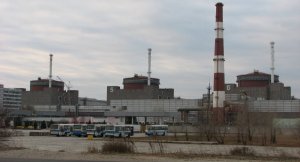
Washington is promoting commercial interests of the energy corporation Westinghouse in Europe, creating risks for European nuclear power plants, an article in Forbes read.
For example, in 2015, two of the Westinghouse-made fuel assemblies at the South Ukraine nuclear power plant (NPP) were found to be leaking. Since 2015, the NPP has been using US-made fuel.
In 2014, Ukraine and Westinghouse reached an agreement to supply nuclear fuel to some Ukrainian NPPs. The alleged reason behind the contract was the need to help Ukraine become energetically independent from Russia. Russia was a long-time supplier of nuclear fuel to Ukraine.
Experts have repeatedly warned that the deal would create serious risks for the safety of Ukrainian NPPs.
They cited the example of an incident which took place several years ago at the Temelin nuclear power plant, in the Czech Republic. The NPP operated on Russian-designed reactors and used fuel supplied by Westinghouse. The fuel was leaking and the rods were bending. All the Westinghouse fuel was removed from the core and replaced with Russian-made fuel.
As for Ukraine, the company announced that its fuel for Ukrainian NPPs had been improved.
Despite experts’ warnings, in March 2015, the first 42 fuel assemblies made by Westinghouse were loaded to the third reactor unit at the South Ukraine NPP.
According to Forbes, the two Westinghouse-made assemblies were found leaking during a scheduled outage at the third unit of the NPP.
The author of the article, Forbes contributor Kenneth Rapoza described how Washington has promoted Westinghouse’s interest in Eastern Europe, neglecting safety recommendations.
“Westinghouse is more than a brand name American power company. It’s a battering ram used by Washington to promote energy security,” the author wrote.
A source who wished to remain anonymous told Forbes that Westinghouse wants a market share in Eastern Europe in a bid to prevent the company from insolvency.
“Their new reactor division is loss-making, the fuel division is their only cash cow and it is not growing and existing margins are getting slimmer and slimmer. We think Westinghouse has spent millions of dollars to include nuclear fuel as part of the energy security narrative, and the current EU sentiment against Russia play into their hand,” the source said.
“But derailing nuclear projects while running into technical difficulties with Westinghouse fuel assemblies in Rosatom reactors is a dangerous way to promote energy security,” Rapoza noted.
According to former Czech Prime Minister Jiri Paroubek, the US has been promoting Westinghouse for years.
In the 1990s, US diplomats supported contribution between the Czech Republic and Westinghouse. The company pledged to improve Russian-designed nuclear plants to Western standards.
“However, the opposite proved to be true. Fuel assemblies delivered by Westinghouse were of inferior quality and higher price compared with than Russian fuel and caused frequent outages of Temelin reactors,” Paroubek told Forbes.
After, Westinghouse’s fuel assemblies were found leaking in the 2000s the Czech company CEZ decided to return to Russian-made nuclear fuel for the Temelin NPP.
“CEZ’s decision serves as a testament to the fact that the Russian fuel assembly was safer and that Washington was selling a product that did not quite work at the time, potentially putting nuclear power plants in danger,” the article read.
US presidential hopeful Hillary Clinton was also involved in promoting Westinghouse in Eastern Europe. In 2012 when she served as US State Secretary Clinton met with then Czech Prime Minister Petr Necas, using the energy security argument to promote the company.
According to the article, Westinghouse can produce fuel for Russia-designed reactors as well as Rosatom can build fuel assemblies for Western-designed power units. However, for third parties working with Westinghouse is less economically efficient.
“Russia is the cheaper producer of the two, so when countries turn to Westinghouse for the fuel assemblies, they have to pay a premium for diversification,” Rapoza wrote.
Nevertheless, the largest initiative by Westinghouse is squeezing Russia from the Ukrainian nuclear fuel market, using again the argument of diversifying supplies.
In 2012, the Ukrainian nuclear regulator banned the use of Westinghouse’s fuel assemblies in the country pending an investigation over the incident at the South Ukraine NPP.
“Two years later, then-Prime Minister, Arseniy Yatsenyuk consulted Westinghouse on picking a new nuclear safety regulator for his new government,” the author wrote citing a source in Ukraine.
In April, the Ukrainian Energy Ministry announced it would buy more nuclear fuel from Westinghouse. The company is planning to deliver five reloads of fuel to South Ukraine and Zaporizhia NPPs.
According to the author, Westinghouse’s commercial interests are closely tied to politics and thus the company neglects safety.
“Regardless, anti-Russia politics trumps technological problems,” Rapoza concluded.
Clintons Accept Money From TPP Supporters
Sputnik – 21.05.2016
As the current Democratic presidential front-runner Hillary Clinton was entering the presidential race, her husband and former US President Bill Clinton received millions of dollars from special interest groups, including $325,000 from a group lobbying for the TPP (Trans-Pacific Partnership).
In October 2015, Hillary Clinton was pressured by her Democratic rival, Bernie Sanders, to openly oppose the controversial global deal to deregulate trade. The Vermont Senator did not hesitate to condemn the deal early in his campaign, claiming that it favors the corporate elite at the expense of American jobs.
Meanwhile, the National Association of Manufacturers, from which Bill Clinton received a substantial fee just one month before his wife announced her campaign, backs the TPP.
According to the Center for Responsive Politics (CRP), the manufacturing business group affirmed its support for the hotly-debated deal three months before turning to Bill Clinton. The CRP called the proposed deal “a significant improvement over the status quo” for corporations.
Another $300,000 was donated to candidate Clinton from technology firm Oracle, when the former Secretary of State’s Democratic primary was in full swing. Disclosure forms reveal that Oracle supports ratification of the TPP.
Previously Hillary Clinton indicated that she would support the global deregulation deal, calling it the “gold standard” of free trade.
Brazil Coup Regime Moves to Change Definition of Slavery
teleSUR – May 20, 2016
Brazil’s new unelected government is looking to introduce new measures that would “soften the definition of slavery” in the country in what is being seen as a roll-back of many of the reforms introduced by the leftist government of President Dilma Rousseff.
The new measures will be introduced by the newly appointed Agriculture Minister Blairo Maggi and are expected to worsen conditions for vulnerable workers in farming and food processing, according to a report by The Guardian Friday.
Maggi, one of the richest men in Brazil who owns the world’s largest Soya company, has proposed legislation that would separate “degrading conditions” and “exhausting shifts” from the definition of slavery, the newspaper reported, citing public record documents available online.
In February, Brazil’s Ministry of Labor fined 340 Brazilian companies for slave labor practices, including forced labor and people working in degrading conditions for little or no pay in rural and urban areas.
The companies were included in a “dirty list” published by the Ministry of Labor of employers benefiting from modern slavery in the country. The list was part of the Rousseff government’s efforts to crack down on modern day slavery practices.
About 400 workers have been freed from slave-like conditions in Brazilian coffee plantations since 2002, according to rights groups and activists.
The Guardian also reported that the controversial billionaire and his lobby group have also been seeking to reverse measures introduced by Rousseff that acknowledged several quilombolos (territories inhabited by the descendants of runaway slaves), created 56 million hectares of conservation land and recognized Indigenous claims on other areas.
Maggi and the new government want to retake these lands and territories from their rightful owners and open them up for large-scale agriculture and cattle-ranching by massive corporations.
Maggi is an agribusiness mogul, known as the “Soybean King,” who has been accused of destroying large portions of the the Amazon rainforest in order to turn it into areas for soybean production.
Maggi received the Golden Chainsaw Award in 2006 from Greenpeace for being the Brazilian who most contributed to the destruction of the Amazon Rainforest.
RELATED:
Brazil’s Coup Cabinet Riddled with Corrupt Corporate Stooges
‘EU is in process of collapsing on itself’ – Marine Le Pen
RT | May 20, 2016
The EU is on the brink of collapse, as two of its main “pillars” are “crumbling” despite the billions of euros spent on keeping the structure from falling, far-right French leader Marine Le Pen told RT, adding that the union would fail if France left it.
“The two pillars on which it’s founded – Schengen and the euro – are in the process of crumbling,” Le Pen told Marie De Douhet of RT France in an exclusive interview. “So they’re in a sort of mad downward spiral in which they’re capable of anything today to try and keep this building standing.”
The leader of France’s hard-right Front National party believes the collapse is not a matter of “if” but “when,” saying the EU “shines from the light of a dead star” while its leaders are struggling to play for time “at the cost of billions trying to hold this structure up.”
As a “revealing” piece of evidence supporting her opinion, Le Pen cited one of Brussels’ recent punitive measures.
“The threat of condemnation of countries which do not accept migrants – a €250,000 fine for each migrant not taken in – is in itself revealing,” Le Pen said.
The European Commission unveiled plans earlier in May to impose a penalty of around €250,000 per rejected refugee on countries that refuse to share the burden of Europe’s migrant crisis.
For countries such as Poland, which is adamantly opposed to taking in refugees, the new compulsory measure would result in a fine of over €1 billion ($1.1 billion), given its existing quota of 6,500 people.
“The threats, the blackmail, now used systematically by the European Union is, above all, a gigantic problem of weakness,” Le Pen said.
Commenting on the migrant crisis, Le Pen said the EU is using immigrants as a tool to drive down labor costs across the 28-country bloc.
“That’s why the European Union supports tens of millions of immigrants in the coming years which will come onto the European Union labor market to push down wages,” she said. “So, in fact they have betrayed, if you like, the working class.”
Marine Le Pen has been a vocal supporter of the UK leaving the European Union, a move that the National Front hopes would inspire a similar “Frexit” campaign.
According to a March poll, 53 percent of French citizens surveyed would like to hold a Brexit-like referendum on France’s membership in the EU.
When asked if she feared any consequences for a “Frexit,” or Brussels’ retribution if it should go through, Le Pen said, “If France leaves the European Union, the European Union no longer exists.”
Addressing the EU’s foreign policy towards Russia, Le Pen stressed that her party has consistently opposed economic sanctions and find them “stupid.”
“From the very start when these sanctions were announced, we spoke out against them in the strongest possible terms… We find them to be completely stupid, obviously I can’t but welcome the National Assembly vote that has allowed the expression of refusal of these sanctions,” Le Pen said.
She expressed doubts that President Francois Hollande will “have the courage to go against the demands of the European Union” and scrap the sanctions, however.
Le Pen added that France’s recognition of Crimea as part of Russia is “quite clear and even quite credible possibility,” particularly if she wins the 2017 presidential election.
READ MORE:
Brexit poll: Almost half of Europeans want own vote on leaving EU
Human traffickers exploit EU migrant crisis to increase child smuggling – EU report
Recognize Crimea as Russian, lift harmful sanctions: Italy’s Veneto passes defiant resolution
‘Clinton as president is danger to world peace’ – far-right French leader Le Pen to RT
Obama’s ‘Killer’ Policies May Be Carried On by His Political Twin
By Martin Berger | New Eastern Outlook | 18.05.2016
Those American citizens that have put their trust in Barack Obama back when he was running for president must be infinitely disappointed while reading countless articles about Obama’s actual policies. These are not just failures, but incredibly deadly ones.
For instance, Forbes would note that from 1999 to 2014 the suicide rate in the United States went up by 24%, while among certain ethnic and demographic sub-groups the situation looks even more surreal. For instance, over the same time period, Native American women saw an increase in suicide of 89%. America’s current level of suicide is abnormally high and it’s a huge change from the not too distant past. And Russia has nothing to do with it, even though the rule of thumb in Washington today is to push blame on it for every single thing that goes wrong. President Barack has even stated that global crises such as Ebola, ISIS and Russian aggression have made the world spin so fast, nobody is able to control it.
The The New York Post would note:
Middle-aged people laid off and unable to find work are taking another way out They’re killing themselves.. Especially in economically depressed states. People in need of work are twice as likely to take their own lives as employed people, and people fired in their 40s and 50s find it hardest to get hired again. That makes boosting economic growth a life-or-death issue for many. But you would not know it listening to President Obama and Hillary Clinton. President Obama whitewashes reality, claiming the “American economy is pretty darn good right now. “False. The Obama economy is stalled.
In his article for The Washington Post American historian David Mereniss underlined that President Obama came to office with the goal of changing “the trajectory of America”. However, he failed to keep his promises. In the end, this will be Obama’s enduring domestic legacy.
Obama’s rise to power was facilitated by the promise he made to stop US wars, but has he fulfilled this promise? The Atlantic reminds us than when Barack Obama first entered the White House, with George W. Bush’s long wars in Afghanistan and Iraq ongoing, he stated that “he was not seeking new dragons to slay.” Instead he elected to scale back America’s commitments overseas and shift responsibilities to allies. But you could be forgiven for thinking the dragons have stubbornly remained, and even multiplied, on Obama’s watch.
During Obama’s time in office the US military would have allocated more money to war-related initiatives than it did under Bush: 866 billion dollars under Obama. Obama has unleashed 372 drone strikes against suspected terrorists in Pakistan, according to data gathered by the Bureau of Investigative Journalism, 112 strikes in Yemen and 19 in Somalia. In fiscal year 2014, US special-operations forces were deployed to 133 countries, or roughly 70 percent of the entire world. The size of SOCOM has expanded by almost 25 percent since Obama took office.
In turn, Hillary Clinton is eager to urge the US to carry on its militaristic policies, so it’s no wonder that Obama has recently made a joke at his final correspondents’ dinner that he can see Hillary Clinton in his seat.
In Obama’s term, the US national debt increased by 8.3 trillion dollars, according to a new report released by the US Treasury. The debt of the federal government increased by 8,314,529,850,339.07 dollars in President Barack Obama’s first seven years in office, according to official data published by the US Treasury. That 13,213,630,160,947.51 dollars increase in the debt during the Bush-Obama years equals 112,219.57 dollars for each of the 117,748,000 households that were in the country as of September. When Obama completed his seventh year in office, the federal debt was 18,941,406,899,252.15 dollars.
It’s therefore not surprising that The Huffington Post would note a bitter split within American society. It would note:
Republicans and Democrats may as well have been living in different countries for the past eight years. When President Barack Obama delivered his final State of the Union address, he was speaking to two very different countries. One of them he leaves happier and better off than it was when he started his tenure in the White House nearly eight years ago, with an improving economy and a dominant international position. The other is, by almost every measure, worse.
A majority of Democrats in a new HuffPost poll say that since Obama took office, their own lives have improved, the economy has gotten better and the United States has retained its role as the most powerful nation on Earth. Republicans disagree on all three points. The partisan divide over the president’s legacy, and the direction of the country as a whole, transcends all other demographic lines, far outstripping age, race, region or income level. the only real point of agreement between the parties, in fact, is the near-universal sentiment that partisanship has worsened over the past eight years.
Therefore, one shouldn’t view US elections as a new prime time reality show, as it is being presented to us by the establishment, since it remains eager to replace Barack Obama with Hillary Clinton. But we shouldn’t forget that the influential alternative media source the Global Research has described Hillary Clinton as Barack Obama’s political twin for a reason, since she’s devoted to the ideas of American expansionism and militarism.
The presidential elections should serve as an emergency brake for those Americans that have somehow survived Obama’s killer policies. Those who are still able to elect a true leader that would be able to mend American society and raise the international prestige of the US, instead of carrying on the irresponsible policies that may destroy America along with the better part of this world.
Cost of Western Unity: Anti-Russia Sanctions Hit EU 10 Times Harder Than US
Sputnik – 18.05.2016
Europe has suffered ten times worse than the US in terms of trade with Russia since the onset of anti-Russian sanctions, according to Stephen Szabo, the Executive Director of the Transatlantic Academy, and the “Western unity” remains crucial to the allies’ relationship with Moscow; however it will be seriously tested in the months to come.
“The European economies have suffered ten times the losses in trade with Russia than has the United States,” Stephen Szabo acknowledges in his introduction to the recent report of the Transatlantic Academy, entitled Russia: A Test for Transatlantic Unity.
“For example, total EU trade in goods with Russia fell from €326.5 billion ($368,4 bln) in 2013 to €210 billion ($237 bln) in 2015,” he says, “while the total US trade in goods with Russia dropped from $38.2 billion to $23.6 billion during that period.”Therefore the transatlantic cooperation and the “Western unity” will remain crucial to the allies’ relationship with Moscow.
However, Szabo adds, it will be seriously tested in the months to come, when “major changes in key western governments occur over the next year and a half.”
“A new US Administration will take office in January 2017, with key elections in France and Germany following later that year. Sanctions will be up for a number of renewals over that period and Western resolve will be tested,” he says.
The Executive Director of the Transatlantic Academy however does not mention that the sanctions have already been challenged by a number of the European countries, which demand the soonest lifting of the imposed measures.
Thus, a wide array of politicians and businessmen in Germany and France are saying that the anti-Russian sanctions have already weighed heavily on their countries’ political and economic sectors.They accuse the United States of using financial pressure to prevent them from abolishing these restrictive measures,
Hungary, Greece, Austria and Italy have also begun to oppose the punitive measures against Russia,
In Italy, the Council of its North-Eastern region of Veneto, with the administrative center in Venice, is set to vote on Wednesday on the recognition of Crimea as part of Russia and on lifting the sanctions.
Germany’s top diplomat, Frank-Walter Steinmeier also recently said that when the EU’s anti-Russia sanctions expire this summer, it will be far more difficult for the bloc to find common ground on the issue, as more of its members are now resisting the prolongation of the restrictive measures.
Read more: Break the Silence About Crimea, Italian MP Says, Demanding End to Sanctions
Clinton and Trump
By James Petras | May 17, 2016
Over half the US electorate views the two leading candidates for the 2016 Presidential elections with horror and disdain.
In contrast, the entire corporate mass media, here and abroad, repeat outrageous virtuous claims on behalf of Hillary Clinton and visceral denunciations of Donald Trump.
Media pundits, financial, academic and corporate elites describe the prospects of her presidency as one of responsibility, national security, business prosperity and political normalcy.
In contrast, they paint billionaire Republican candidate, Donald Trump as a grave threat, likely to destroy the global economic and military order, polarize US society and destined to lead an isolated and protectionist US into deep recession.
The super-charged rhetoric, flaunting the virtues of one candidate and vices of the other, ignores the momentous consequences of the election of either candidate. There is a strong chance that the election of ultra-militarist Hillary Clinton will drive the world into catastrophic global nuclear war.
On the other hand, Trump’s ascent to the US Presidency will likely provoke unprecedented global economic opposition from the corporate establishment, which will drive the US economy into a profound depression.
These are not idle claims: The destructive consequences of either candidate’s presidency can best be understood through a systematic analysis of Mme. Clinton’s past and present foreign policies and Trump’s belief that he has the ability to transform the US from an empire to a republic.
Clinton on the Road to Nuclear War
Over the past quarter century, Hillary Clinton has promoted the most savage and destructive wars of our times. Moreover, the more directly she has been engaged in imperial policymaking, the greater her responsibility in implementing foreign policy, the closer we have come to nuclear war.
To identify Hillary Clinton’s path to global war it is necessary to identify three crucial moments. Hillary’s bloody history can be dated initially to her de facto ‘joint Presidency’ with husband Bill Clinton (1993-2001).
Stage One: The Conjugal Militarist Presidency (1993-2001)
During Hilary Clinton’s joint presidency with William Clinton (the Billary Regime) the First Lady actively promoted an aggressive militarized takeover of Eastern Europe, the Balkans, the Middle East and Eastern Africa – often under her favorite messianic doctrine of ‘humanitarian intervention and regime change’.
This justified the relentless bombing of Iraq, destroying its infrastructure and blockading its population into starvation while preparing to carve its territory into ethnic and religious divisions. Over 500,000 Iraqi children were murdered as proudly justified by then-Secretary of State Madeline Albright (1997-2001) and lauded by the Clintons.
In the same manner, Yugoslavia was bombed by the US humanitarian coalition air forces and cruise missiles over 1,000 times from March 24 to June 11, 2009 in the course of sub-dividing the country into five backward ‘ethnically cleansed’ mini-states. Thousands of factories, public buildings, bridges, passenger trains, radio stations, embassies, apartment complexes and hospitals were devastated; over a million victims became refugees while hundreds of thousands were wounded or killed.
The Conjugal Presidency successfully carried out the bloodiest war of aggression in Europe since the Nazi invasion during WWII, in order to subdivide an ethnically diverse and industrially advanced federation whose independent foreign policies had angered the Western corporate empire.
The Clintons launched the military invasion of Somalia (in East Africa) to impose a vassal regime, leading to the death of many thousands and a regional imperial war. Faced with desperate popular resistance from the Somalis, the Clintons were forced to withdraw US troops and bring in thousands of Sub-Saharan African and Ethiopian mercenaries – whose death would pass unnoticed among the US electorate.
From 1992 through 2001 the Clinton war machine helped set up the Yeltsin kleptocratic vassal state in Russia facilitating the greatest peace-time pillage of state resources in world history.
In the post-Soviet breakup era, over 1 trillion dollars of former public assets were seized especially by US and British-allied Zionist gangsters, Clinton-affiliated officials and ‘academics’ and Wall Street bankers. Under Clinton’s vassalage the entire Soviet public health system was eliminated and Yeltsin’s Russia experienced a population decline of 4.3 million citizens, mostly due to diseases, alcohol and drug toxicity, suicide, malnutrition, unemployment and loss of wages, pensions and and an unprecedented epidemic of tuberculosis and infectious diseases once thought wiped out, like syphilis and diphtheria.
Senator Hillary Clinton’s War Crimes by Association: January 3, 2001 to January 21, 2009
During the George W. Bush dynastic regime, Mme. Senator Clinton supported the US war machine ‘sowing death and destruction to the four corners of the earth’ (to quote Bush Jr.), millions in Iraq and Afghanistan died or fled in terror. Bush had only deepened and expanded the mayhem that the Clinton Conjugal Presidency had begun a decade earlier.
Mme. Senator Clinton promoted the US direct and unprovoked invasion and occupation of Iraq and the war in Afghanistan. Mme. Senator Clinton embraced crippling economic sanctions against Iran and she blessed Israel’s military assault against Palestinians in the West Bank and Gaza and Israeli massacres in Lebanon.
Mme. Senator Clinton supported President Junior Bush’s aborted coup against Venezuelan President-elect Hugo Chavez (2002), a prelude to the coup attempts in Latin America that she directed later as US Secretary of State.
Hillary Clinton’s Senatorial term served as a transition linking her initial joint presidential period of wars of conquest onto the next period. As US Secretary of State under President Obama she aggressively promoted global military supremacy.
Secretary of State Hillary Clinton: Naked Militarism Unleashed (2009-2014)
Whatever restraints Mme. Clinton faced as Senator dissolved as she ran amok during her term as Secretary of State. Across Europe, Africa, Latin America and the Middle East, Hillary Clinton bombed, massacred and dispossessed millions of families, shredding entire societies and dismantling the institutions of organized civil life for scores of millions. She never balked at the prospect of ethnocide and even joked that NATO might become ‘Al Qaeda’s Air Force’ as she pushed for a ‘no-fly zone’ over Syria.
A wild-eyed cackle echoed down the marbled corridors as the Foggy Bottom turned into a psycho- ward.
Mme. Secretary promoted the terror mercenary brigades invading Syria in a bid to ‘regime change’ the secular government of Al Assad, driving several million Syrian refugees into flight. Entire ancient Syrian Christian communities were wiped out under her reign of ‘regime change’.
Mme. Secretary Clinton directed US air force bombers and missiles to buttress the despotic Saudi monarch’s drive to obliterate Yemen.
Clinton unleashed the most savage bombing against Libya destroying the country and leading to the ethnic cleansing of a million and a half of Sub-Sahara workers and Black Libyans of sub-Saharan descent.
Under the aegis of murderous jihadi warlords and tribal chiefs, Mme. Clinton joked over the torture death of the wounded captive President Gaddafi, whose nauseating, almost pornographic murder by anal impalement was documented as a kind of ‘regime-change’ snuff film. Less known is the earlier, almost Old Testament-type slaughter of several of Gaddafi’s non-political children and five small grandchildren by a deliberate US missile strike aimed at ‘teaching the dictator’ that even his smallest grandchild cannot be hidden.
Mme. Clinton, who bragged that her Biblical role-model is the ethnocidal Queen Ester, has declared unconditional support for Israel’s war crimes against Palestinians in Gaza, the West Bank and among the diaspora. Hillary endorsed and defended Israeli torture and prison camps for children, the elderly and the homeless.
Mme. Secretary sent her criminal sub-secretary Victoria Nuland (an unreconstructed Neo-Con holdover from the Bush Administration) to orchestrate the violent putsch in the Ukraine. Millions from Ukraine’s huge ethnic Russian population were dispossessed from the Donbas region. Mme. Clinton had sought to convert Russian strategic military assets in Crimea to US-NATO bases aimed at Moscow, causing the residents of Crimea to overwhelmingly reject the coup and vote to re-join Russia.
The forceful intervention by Russian President Vladimir Putin prevented Mme. Clinton’s ethnic cleansing power grab in Crimea and the Donbas. The US retaliated by pushing for massive European Union economic sanctions against Russia.
Consistent with her pitiless Biblical role model, Mme. Clinton openly threatened to obliterate Iran with a nuclear war and incinerate 76 million Iranians to please her Uncle Netanyahu – a demented process that would poison a hundred million Arabs and perhaps a few million Israelis. Even the insane Israeli ‘Samson option’ was never dreamt of being ordered from Washington, DC!
During her tenure as Secretary of State, Mme. Clinton actively obstructed any diplomatic moves to achieve a US-Iran agreement on nuclear technology, parroting the Israeli militarist solution against regional rivals!
Mme. Clinton has remained an unrepentant enemy to the emerging independent Latin American governments. In search of vassal states, Clinton promoted successful military coups in Honduras and Paraguay, but was defeated in Venezuela. She proudly touts the death squad regime in Honduras among her foreign policy successes.
Mme. Hillary backed the death squad and narco-regimes in Colombia and Mexico, which killed over a hundred thousand civilians.
On the path to global war, Mme. Militarist has prepared to encircle Russia, stationing nuclear weapons in the Balkans and Poland. She promised that missiles would be placed in south central Europe and Ukraine.
Clinton raised the nuclear ante by hysterically claiming that the elected Russian President Vladimir Putin was ‘worse than ISIS’… ‘worse’ than Hitler.
Repeatedly threatening global war and actually making aggressive regional war should clearly have marked Mme. Hillary Clinton as unfit for the Presidency of the United States. She is politically, intellectually and emotionally unable to deal realistically with an independent Russia and any other independent power, including China and Iran. Her monomania is a course of violent ‘regime changes’, unable to evaluate any of the catastrophes her policymaking has in fact already produced.
Hillary Clinton was the proud author and director of the so-called US ‘pivot to Asia’. Clinton’s ‘pivot’ has led to a massive buildup of the US air and naval forces surrounding China’s maritime routes to its global markets and access to essential raw materials.
Clinton’s hyper-militarism expanded US war zones to cover Australia, Japan and the Philippines, greatly heightening tensions and increasing the possibility of a military provocation leading to nuclear war with China.
No US presidential contender, past or present, has engaged in more offensive wars, in a shorter time, uttering greater nuclear threats than Mme. Hillary Clinton. That she has not yet set off the nuclear holocaust is probably a result of the Administrative constraints imposed on the Mme. Secretary of State by the less blood-thirsty President Obama. These limitations will end if and when Mme. Hillary Clinton is ‘elected’ President of the United States in a process that the electorate increasingly knows is ‘rigged’ toward that outcome.
Donald Trump: the Peaceful Road to Recession
In sharp contrast to the militarist Mme. Clinton, Donald Trump, ‘the Businessman’, has adopted a relatively peaceful approach to international politics for an American presidential candidate in the current era.
‘Businessman’ Trump envisions productive negotiations with Russian President Putin. Employing his loudly trumpeted deal-making genius to benefit the United States, Trump predicts economic and diplomatic successes with Russia, China and other major powers.
Angered at US military allies enjoying decades of US Treasury largesse, a President Trump promises to withdraw US military bases from Asia and Europe and demanding that overseas allies ‘pony-up’ for their own defense.
What the war mongers in the mass media, academia and Washington bureaucracy, dismiss as ‘Trump’s isolationism’, The Businessman describes as rebuilding America by converting overseas military spending into domestic infrastructure projects and ‘real’ jobs in America.
Trump’s ‘America First’ policy, under his ‘Make America Great Again’ slogan, does not envision wars of conquest against Muslim countries, especially since they have already led to massive floods of Muslim refugees, threatening trade and stability, and Trump opposition to the entry of more Muslim refugees into the US. Trump’s foreign policy of limited military goals and warfare is diametrically opposed to Clinton’s total war strategy. Trump, ridiculed by his rivals for ‘his small hands’, does not appear to have Hillary’s itchy trigger finger on the nuclear button!
Trump mouths contradictory economic statements, especially his proposals to “rebuild America”, while operating in the framework of an imperial system. As President of the United States, his protectionist policies will come into direct confrontation with US and global ‘finance and monopoly capitalism’ and will likely lead to systematic disinvestment and a disastrous economic collapse or, more likely, the Businessman-President’s capitulation to the status quo.
The problem is not Trump’s pledges to tax the rich (as he occasionally promises) , or expand Social Security (as he claims), but his failure to admit that these policies would lead to massive flight by the capitalist elite to avoid taxes. The major threat is that, if Trump follows-up on his America-First policies, there will be massive capital resistance and a Congressional revolt by both finance-dominated political parties, which will paralyze any hope for his economic agenda.
Without political independence to implement his domestic economic agenda, Trump will have to face a massive investment and lending revolt from capitalists and bankers who would be very willing to drive the fragile economy into a major recession – threatening a kind of ‘domestic economic sabotage’.
Trump’s Republican Party (and certainly the Democrats) will never support a program which will force multi-national capital to sacrifice its reliance on cheap overseas labor and double digit profits in order to create American jobs and employ American workers at living wages.
A President Trump would not even secure a handful of Congressional votes to increase taxes on plutocrats to fund his proposed large-scale public works, infrastructure and job creation projects.
The Businessman President would face the full fury of the powerful military-industrial-high tech complex if and when he attempted to retire US global military forces from Europe, Asia, the Middle East and Africa.
The non-politician Trump’s historic rise to national political prominence has its roots in the ideas and values of the majority of working people who have been marginalized to the fringes by the media moguls and Wall Street riff-raff. Today Trump’s themes and ideas resonate with the mainstream of voters.
Several dominant ideas circulate in his speeches and interviews.
First, Trump rejects ‘globalization’ (the watered-down PR term for imperialism) and ‘free trade’ (a euphemism for the transfer of profits extracted from US workers to business investment abroad).
Trump’s narrative resonates with the recent anti-Wall Street ‘Occupy’ movements opposing the power of 0.1% super rich against the vast majority.
Secondly, Trump embraces economic nationalism in his slogan “Make American Great Again”. Too many American workers and their families resent having been exploited, maimed and slaughtered to serve multiple wars in the Middle East, Asia and Europe for the interests of US warlords, bankers, Zionists and other imperial royalties. Trump argues that the entire inflated security and corporate welfare system has led to an untenable debt payments spiral.
The third theme that draws millions is Trump’s notion that the US should reject the policy of serial ‘regime change’. We should not initiate and engage in perpetual overseas wars against Muslim countries as a way to avoid domestic attacks by individual terrorists. During an early foreign policy debate, Trump shocked the political establishment when he accused the Bush Administration of deliberately lying the country into the disastrous invasion of Iraq. This ‘truth-telling’ elicited wild applause from the mass Republican electorate.
Trump’s goal is to strengthen American civilization and avoid provoking more ‘clashes of civilizations’…
The fourth, and probably most attractive, message to most Americans is Trump’s powerful assault on Washington and Wall Street elites and their academic and media apologists.
Millions of Americans have been disgusted with the Bushes, Clintons and Obamas, as well as the Morgans, Goldman Sachs and Paulsons, whose policies have exacerbated class inequalities through multiple banking swindles and financial crashes, all ‘bailed out’ by the American tax payers.
Fifth, Trump’s loud, brash exposure of the mass media’s lies and propaganda has resonated with the same deep distrust felt by the American public. His talent for talking directly and bluntly to the public and on the internet has led to his enormous appeal. He does not engage in ‘conspiracy’ but acknowledges that the Edward Snowden revelations have unmasked the government’s deceptions and its program of espionage against the people, destroying the foundations for democratic discourse.
Trump might win the election based on his ‘five truths’ and his pledge to ‘make America great again’, but more likely he will lose because he has insulted the traditional establishment, the Latinos, Afro-Americans, feminists, trade union bureaucrats and their followers from both parties. Even if he succeeds at the ballot box, his political agenda with relying on Republican elites in Washington and Wall Street, the Pentagon and the ‘international security system’ will lead to a major economic crisis. For the elite, if blocking Trump’s domestic economic agenda requires a financial crash to defend ‘globalization’, serial wars and the 0.1%, then tighten your belts!
This November, the country will face the disagreeable choice between a proven nuclear warmonger and a captive of Wall Street. I will try to keep warm, roast chestnuts and avoid thinking about Mme. President’s Looming Mushroom Cloud.
Osborne called university fees ‘very unfair’ in 2003… but was happy to triple them in 2010
RT | May 17, 2016
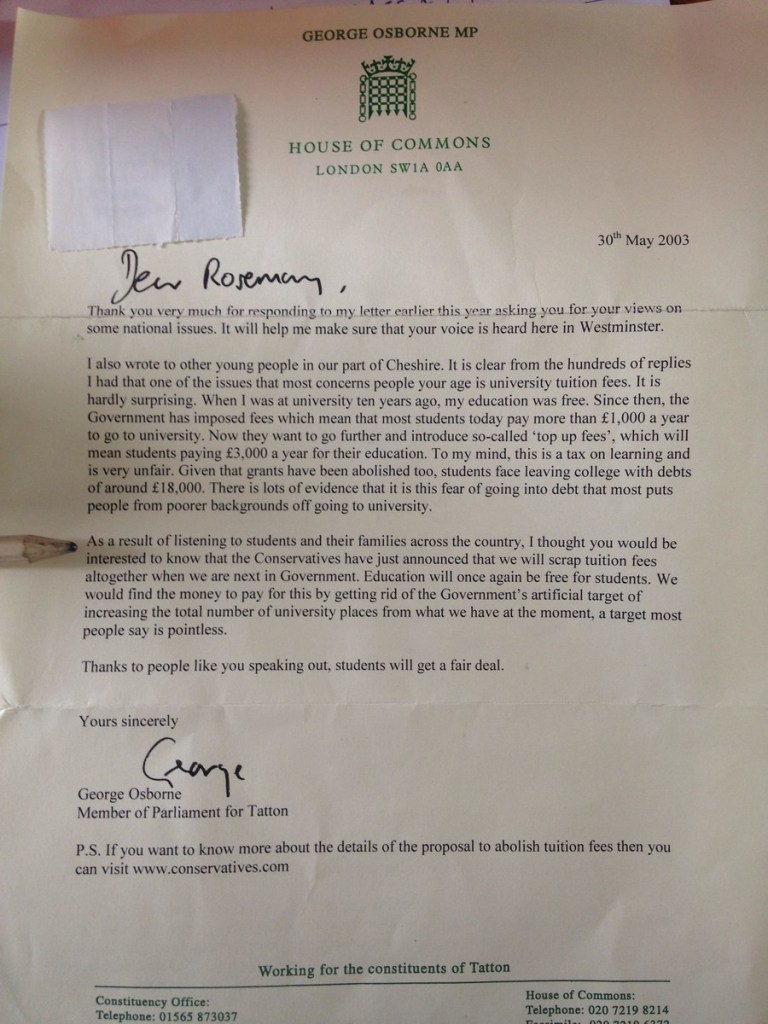
Well, that’s embarrassing. Chancellor George Osborne said university tuition fees were a “tax on learning” and “very unfair” in a letter he wrote 13 years ago – but that didn’t stop him from tripling fees after taking office in 2010.
The letter, sent by Osborne when he was a Tory whip, criticised the then-Labour government’s plan to triple fees to £3,000 (about US$4,350), and pledged to scrap fees totally. Osborne wrote:
“To my mind, this is a tax on learning and is very unfair.”
“There is a lot of evidence that it is this fear of going into debt that puts most people from poorer backgrounds off going to university.
“I thought you would be interested to know that the Conservatives have just announced that we will scrap tuition fees altogether when we are next in government.”
How he must regret making that pledge all those years ago.
When the Tories came to power in coalition with the Liberal Democrats in 2010, one of Osborne’s first acts was to triple tuition fees from £3,000 per year to £9,000 per year.
The chancellor’s embarrassing letter has re-emerged a day after a new government white paper suggested universities that meet certain ‘high standards’ will soon be allowed to raise fees yet again in line with inflation.
Violinist Rosy Williams posted the letter on Facebook on Tuesday afternoon after finding it in storage.
“Rooted through a box of old letters last night and discovered this brief exchange … with a young, up and coming MP by the name of George Osborne.
“So glad he made sure our ‘voices were heard in parliament.’”
Labour’s shadow business secretary, Angela Eagle, told the Mirror :
“This letter exposes George Osborne’s rank hypocrisy. He called the tuition fees a ‘tax on learning.’
“Then, when he was Chancellor, he trebled them. He warned of the fear of debt putting young people off, but on his watch, students are leaving university owing tens of thousands of pounds.”
Read more:
£9,000 not enough? University fees may rise again under new Tory white paper
Dear Sony Music: It’s Not “Fee Use,” But “Fair Use”
By Mitch Stoltz | EFF | May 16, 2016
We’re pleased to report that Sony Music backtracked on its accusation of copyright infringement against the Hudson Valley Bluegrass Association, and HVBA’s educational video remains freely available to the public. But the music label’s response leads us to think that Sony’s misuse of copyright and of YouTube’s automated enforcement system will continue.
We wrote last week about how YouTube’s system, Content ID, incorrectly flagged HVBA’s own video as infringing. The video, an hour-long lecture on the history of bluegrass music, triggered the Content ID filters because it contained three clips of bluegrass recordings copyrighted by Sony, each around 30 seconds and surrounded by a discussion of the music and its historical relevance. That’s an obvious fair use under copyright law, one that any human reviewer with minimal training would recognize.
A fair use doesn’t require permission from the copyright holder, or a fee. It’s the sort of use that’s free to all. But when HVBA’s webmaster wrote to Sony Music and asked them to withdraw the Content ID match, the company responded by asking for a $500 “administrative fee” and detailed information about HVBA’s use of the song clips. Fortunately, HVBA’s webmaster knew her rights, and after some prodding—and a post by EFF—Sony Music agreed to withdraw its claim.
We’re glad Sony stopped trying to block or monetize HVBA’s video. But the company’s response is troubling all the same. A Sony executive emailed HVBA to say that the company “has decided to withdraw its objection to the use of its two sound recordings” and “will waive Sony Music’s administrat[ive] fee.” That sounds like Sony was simply acting out of courtesy, when in fact the company had no right to demand a fee, by any name, for an obvious fair use. Other YouTube users with less knowledge of the law may have been convinced to pay Sony $500 or more, and provide detailed information, for uses of the music that the law makes free to all.
As Congress and the Copyright Office review the law and examine the effectiveness of automated systems like Content ID, they should keep in mind that automated flagging or filtering combined with misleading statements about a company’s legal rights can lead to abuse. That’s another reason why YouTube-style automatic filtering should never be mandated by law, and why we need real penalties for false takedowns.
Peace, Not Russia, Is Real Threat to US Power
By Finian CUNNINGHAM | Strategic Culture Foundation | 16.05.2016
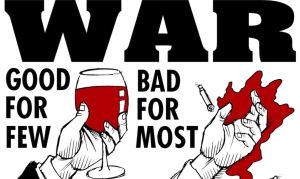 The monstrous US military budget is a classic illustration of the proverb about not seeing the wood for the trees. It is such an overwhelming outgrowth, all too often it is misperceived.
In recent years, Washington’s military expenditure averages around $600 billion a year. That’s over half of the total discretionary spending by the US government, exceeding budgets for education, health and social security. It’s well over a third of the total world military annual spend of $1.7 trillion.
The incipient military-industrial complex that President Dwight Eisenhower warned of in his farewell speech in 1961 has indeed become a central, defining feature of American society and economy. To talk of «American free-market capitalism» is a staggering oxymoron when so much of the country’s economy is wholly dependent on government-funded militarism.
Or put it another way: if the US military budget were somehow drastically reduced in line with other nations, the all-powerful military-industrial complex and the American state as we know it would collapse. No doubt something better would evolve in time, but the impact on established power interests would be calamitous and therefore is trenchantly resisted.
This is the context for the escalation in Cold War tensions with Russia this week, with the deployment of the US missile system in Romania. The $800 million so-called missile shield is set to expand to Poland over the next two years and eventually will cover all of Europe from Greenland to southern Spain.
Washington and NATO officials maintain that the Aegis anti-missile network is not targeted at Russia. Unconvincingly, the US-led military alliance claims that the system is to defend against Iranian ballistic missiles or from other unspecified «rogue states». Given that Europe is well beyond the range of any Iranian ballistic capability and in light of the international nuclear accord signed last year between Tehran and the P5+1 powers, the rationale of «defense against Iranian rockets» beggars belief.
The Russian government is not buying American and NATO denials that the new missile system is not directed at Russia. The Kremlin reproached the latest deployment as a threat to its security, adding that it would be taking appropriate counter-measures to restore the strategic nuclear balance. That’s because the US Aegis system can be reasonably construed as giving NATO forces a «first-strike option» against Russia.
A couple of things need to be clarified before addressing the main point here. First, European states are chasing Iranian business investments and markets following the breakthrough P5+1 accord signed last July. Germany, France, Italy, Britain and Austria are among the Europeans who have been vying to tap Iran’s huge economic potential. The notion that Iran is harboring a military threat to such prospective partners is ludicrous, as Russian officials have pointed out.
Secondly, the US protestations of innocent intentions towards Russia are a contemptible insult to common sense. They contradict countless statements by Washington, including President Obama and his Pentagon top brass, which have nominated Russia as an aggressive threat to Europe. Washington is quadrupling its military spending in Europe, increasing its troops, tanks, fighter jets, warships and war exercises on Russia’s borders on the explicit basis of «deterring Russian aggression».
In other words, Russia is viewed as a top global enemy – an existential threat – according to Washington. So, the deployment of the US Aegis missile system this week in Eastern Europe is fully consistent with Washington’s bellicose policies towards Russia. It would thus be irrational and foolishly naive to somehow conclude otherwise, that the US and its NATO allies are not on an offensive march towards Russia.
The depiction of Russia as a global security threat is of course absurd. We can also include similar US claims against China, Iran and North Korea. All such US-designated «enemies» are wildly overblown.
Western claims – amplified relentlessly in the Western news media – of Russia «annexing» Crimea and «invading» eastern Ukraine can be easily contested with facts and indeed counterpoised more accurately as belying Washington’s covert regime change in Kiev.
Nevertheless, Western fear-mongering supported by unremitting media propaganda has to a degree succeeded in conflating these dubious claims into a bigger specter of Russia menacing all of Europe with hybrid warfare. It is, to be sure, a preposterous scare story of a Russian bogeyman which has racist undertones and antecedents in Nazi ideology of demonizing Slavic barbarians.
But this demonizing of Russia, as with other global enemies, is a necessary prop for the American military-industrial complex and its essential functioning for the US economy.
The $600 billion-a-year military spend by Washington is roughly tenfold what Russia spends. And yet, inverting reality, Russia is presented as the threat!
The US military budget is greater than the combined budgets of the world’s next nine big military spenders: China, Saudi Arabia, Russia, Britain, France, Germany, India, Japan and South Korea, according to the Stockholm International Peace Research Institute.
Arguably, the US economy as we know it – dominated by Pentagon, corporate, Wall Street and congressional interests – would cease to exist were it not for the gargantuan government-subsidized military budget.
Structurally, the US economy has ossified into a war economy and the only way for this to be maintained is for the US to be continually placed on a war footing, either in the form of a Cold or Hot conflict. Historians will note that out of its 240 years of existence as a modern state, the US has been in war or overseas conflict for more than 95 per cent of its history.
During the former Cold War with the Soviet Union, a recurring theme in Washington was the alleged «missile gap» which purported to portray the US as losing its military edge. This resulted in relentless military expenditure and an arms race that in part led to the collapse of the Soviet Union.
Washington’s self-ordained privilege to run up endless debt (currently nearly $20 trillion) because of its dollar dominance as the world’s reserve currency has permitted the US to escape a day of reckoning for its ruinous military profligacy.
This madcap situation continues to prevail. A quarter of a century after the official end of the old Cold War, US military spending continues at the same profligate, unsustainable pace.
What Washington needs in order to keep the fiasco going is to whip the rest of the world into a frenzy of fear and loathing. That’s why the Cold War with Russia and China has had to be rehabilitated in recent years. Swords cannot be turned into plowshares because the US power interests that command its economy have no use for plowshares.
Russian President Vladimir Putin has on several occasions invited global cooperation on security matters, and with the US in particular. Moscow has also recently said that it does not want to embark on a new arms race. The latter wariness is understandable given the deleterious experience for the Soviet Union from runaway military spending.
However, that is precisely what the US wants and needs to induce: a global arms race which it can then invoke as justification for its own monstrous military.
According to SIPRI, both China and Russia have significantly increased their military budgets, by about 7.5 per cent each in 2015.
Russia may not want to engage in an arms race, mindful of the warping pressure that can inflict on its national resources and development.
But when the US installs a new missile system on Russia’s doorstep, the impetus for Russia to likewise scale up military commitments is onerous.
And that is what Washington is driving at. It is not that Russia is an objective security threat to Washington or its allies. The real threat to Washington is peaceful international relations which would make its military-industrial complex redundant.
It is a disturbing reality that world peace is antithetical to the very foundation of America’s corporate capitalist power.
Shamefully, the world is subjected to the risk of war and even annihilation all for the purpose of maintaining elite American power privileges. And among those who suffer this diabolical injustice are none other than the majority of American citizens, who have to endure poverty and misery while their corporate elite siphon off $600 billion a-year in military obscenity.
‘Suburban militants trained by Soros-backed groups to fight against French police violence’
RT | May 14, 2016
The violence in France today might be organized provocation, said Bruno Drweski, Nat. Inst. of Languages and Eastern Civilizations. It is easy to manipulate people’s discontent, especially in the current situation of hopelessness, he added.
A number of French cities were hit Thursday by violent protests over government plans to reform labor laws.
RT: Do you think the government will be forced to listen to the peoples’ demands?
Bruno Drweski: You really don’t know what the government will do. Anyway we have in France very strong discontent. To a certain extent the way the manifestations are unorganized, it’s helping the government in a certain way. There is no organized movement, organized strong social movement and organization against the law on labor regulation, which is very unpopular. So I don’t exclude the government is using violence as a pretext to force its policies.
RT: Following weeks of protests the French government still managed to survive a no-confidence vote, does that mean support for President [Francois] Hollande is still in a reasonable state?
BD: I think the government is forced to a certain extent to introduce this law because of the European Union laws. The French government has no real power anymore – it’s decided at the Brussels level. So they will be forced to organize that process of desocialization of the working laws. In that situation violence is helping them to a certain extent.
I don’t exclude even that quite a lot of that violence is a kind of organized provocation. And it is not only limited to France. Two or three years ago I met suburban militants, which were trained in the US by [George] Soros foundations to fight against what they call ‘French police violence’. So in a certain sense it has already been planned for a long time.
RT: And if it is working, do you think violence could escalate?
BD: Yes, of course it can escalate, because it is to a large extent an unorganized movement. And with an unorganized movement it is very easy for a provocation group to do what they want. You have a lot of people, and especially young people, which are strongly discontent about the situation in France. They tempt to violence.
It is very easy to manipulate their discontent, especially in the situation of hopelessness. And we are in a situation of hopelessness, because it is obvious that the French government doesn’t lead the policies in France. France is part of the globalization; France is part of the EU process; people know that the different political parties existing now in France are not able to change anything.
Featured Video
New positive ivermectin evidence
or go to
Aletho News Archives – Video-Images
From the Archives
Fanatical Followers of the Covid Regime: A Jim Jones-Style Cult?
By Professor Roger Watson and Dr. Niall McCrae | The Daily Sceptic | November 15, 2021
As scholars at leading British universities over recent decades, we witnessed the replacement of critical thinking and debate by narrative: facts are discrimination and scientific method is imperialism; truth, instead, is derived from ‘progressive’ values. This educational trend may be a major contributory factor to the ease in which society has been inculcated to the Covid ‘new normal’ of masking, testing, and repeated doses of vaccines for a disease of similar risk to severe influenza.
One doesn’t need much critical reasoning to observe the flawed logic of some vaccination enthusiasts, such as people who respond to experiencing any side effects, however debilitating, by saying “at least I know it’s working”, or, after contracting the disease despite their promised inoculation (over 90% effective, according to initial drug company claims), “I’d have been worse off without the jab.” … continue
Blog Roll
 Aletho News
- Najaf airport to reopen to Iranian flights within 24 hours: Ambassador
- From ‘How Will This End For Iran’ to ‘When America Walks Away’: A tale of two Economist covers
- Tehran blasts ‘baseless’ speculation linking Iran to alleged bomb plot at UK air base
- The Rise And… Rise Of ‘Color Revolutions’
- The Coming GOP Bloodbath?
- Arctic Scare Stories Melt Away
- Wrong, Euronews: Climate Change Has Not Created a Food, Energy, and Economic “Meta-Crisis”
- New positive ivermectin evidence
- Met Office Caught Fabricating Daily Temperature Record Claims
- Merck Virologists Admitted to Falsely Certifying Vaccine Efficacy
- If Americans Knew
- Netanyahu Asked UAE Leader to Deny Report on Oct. 7 Warning in Secret Visit, Sources Say
- CNN Chief Int’l Correspondent Clarissa Ward on Journalists in Gaza
- Democratic Party Consultants Surround Troy Jackson with Pro-Israel Donors
- Christian Leader Responds To Netanyahu’s Claims Regarding Palestinian Christians
- In Gaza, ‘Whoever Survives the Bombing Won’t Survive the Rubble’
- Israel kills more Palestinians, amid push to resettle Gaza – Daily Update
- Israel forces Gazans to live in constant peril – Daily Update
- Deconstructing Netanyahu’s pants-on-fire UN rant – Daily Update
- Trump betrayed voters with his campaign lies and prioritized a foreign country once he took office
- Netanyahu calls Israel’s war in Gaza ‘opposite of genocide’ in UN speech to near-empty hall
- No Tricks Zone
- New Study: Earth And Venus Surface Warmth Largely Explained By Convection And Lapse Rate, Not CO2 Or Radiation
- 2025 Nature Paper Claiming Worsening Global Drought Gets RETRACTED …Heavily Flawed
- New Study: ‘Global Drought Shows No Detectable Recent Acceleration Under Climate Warming’
- Economic Masterminds: German Socialists Suggest Taxing Productivity Gains Stemming From Using AI
- The South China Sea Has Not Been Cooperating With The Climate Change Narrative
- Energy Crisis: Germany Enters Heating Season With Historically Low Gas Reserve Fill Levels
- New Study: The Antarctic Ice Sheet Gained Mass From 2020-2024 Due To Staggering Snow And Ice Accumulation
- Study: Ocean Heating Rates From Thousands Of Years Ago ‘Dwarf’ Modern Ocean Heating Rates
- Climate Extremists Target, Attack Large-Scale Power Grid Infrastructure In Germany!
- New Study: Antarctic Ice Melt Has Contributed Less Than 1 Centimeter To Sea Level Rise In The Last 30 Years

