Democrats, Too Clever by Half on Clinton

By Robert Parry | Consortium News | May 14, 2016
Last year when Democratic insiders looked forward to Election 2016, they expected a run-of-the-mill Republican, possibly even legacy candidate Jeb Bush. So they countered with their own “safe” next-in-line legacy candidate, Hillary Clinton, who would supposedly win by playing up the prospect of the first woman president.
In such an expected match-up, the concern of rank-and-file Democrats about Clinton’s hawkish foreign policy would be negated by the GOP nominee still defending President George W. Bush’s Iraq War and again surrounded by neocons pounding the drums for even more wars. With both parties putting forward war candidates, anti-war Democrats would accept Clinton as the lesser evil, or so the thinking went.
The likely Republican nominee also would be burdened by reactionary domestic proposals, including GOP plans for privatizing Social Security and Medicare. By contrast, centrist Clinton would look reasonable in promising to protect those popular programs, albeit with some modest trimming of benefits to please the budget hawks.
But the Democratic insiders didn’t count on the unlikely emergence of populist billionaire Donald Trump, who repudiated Bush’s Iraq War and the GOP’s neocon foreign policy and rejected Republican orthodoxy on “entitlement reform,” i.e., slashing Social Security and Medicare.
The unabashed Trump also has made clear that he is not afraid of countering Clinton’s “woman card” by playing his own “man card,” including attacks on her troubled marriage and her tolerance of Bill Clinton’s notorious womanizing, even claiming that she was her wayward husband’s “enabler.”
At first, the Democratic hierarchy couldn’t believe its luck as the Republican Party seemed to splinter over Trump’s disdain for the GOP’s neocon interventionism and rejection of the party’s cutbacks in Social Security and Medicare. Trump’s mocking attacks on his rivals also shattered the decorum that Republican leaders had hoped would mark their primary campaign.
So, the Democratic insiders initially rubbed their hands with glee and imagined not only an easy presidential victory but major gains in the House and Senate. However, new polls show Trump running neck-and-neck with Clinton nationally and in key battleground states, while other polls reveal strong public doubts about Clinton’s honesty, thus wiping the premature smiles off the Democrats’ faces.
Panic Mode
Indeed, some Democrats reportedly are slipping into panic mode as they watch Clinton’s poll numbers tank and the Republican Party come to grips with the Trump phenomenon. The new storyline of Campaign 2016 is the tale of top Republicans reconciling to Trump’s populist conquest of the party. At least, these GOP leaders acknowledge, Trump has excited both average Republicans and many independents.
The obsessive media coverage of Trump’s meetings on Thursday with senior congressional Republicans made the narcissistic real estate mogul and reality TV star look like some major world leader being received in Washington as a conquering hero. And, with the GOP rallying behind Trump, the likelihood is that his poll numbers and favorable/unfavorable ratings will continue to improve.
So, instead of Democratic dreams of a landslide victory, the party insiders are worrying now about their decision to coronate a deeply flawed and wounded candidate in Hillary Clinton. Not only could she lose to Trump but she could take many of the House and Senate candidates down with her. It’s dawning on some Democrats that they may have squandered a historic opportunity to realign American politics to the left by promoting the wrong person in 2016.
At a moment when the American people are demanding change – even willing to risk entrusting the White House to the unorthodox and inexperienced Donald Trump – the Democratic Party may be stuck with an uninspiring status quo candidate who also is pro-war, indeed far more hawkish than President Barack Obama.
Thus, in the fall election, not only would Trump be in a position to bait Clinton about her dysfunctional marriage, reminding the nation of the messy scandals of the 1990s, but he could challenge her on her warmongering positions, including her years of support for the Iraq War and her hawkish policies as Secretary of State, including her instigation of the disastrous “regime change” war in Libya. [See Consortiumnews.com’s “Yes, Hillary Clinton Is a Neocon.”]
This November could be the first time in modern American history when the Republican nominee would be the relative “peace candidate” and the Democrat would be the “war candidate.” That changing places could lose Clinton much of the “anti-war left,” a significant faction within the Democratic coalition with many “peace Democrats” either voting for Trump or choosing a third party, such as the Greens.
Of course, the Democrats didn’t have to be in this position. The party leaders could have encouraged a more competitive primary contest instead of trying to keep alternative candidates, such as Sen. Elizabeth Warren and some younger Democratic prospects, on the sidelines, all the better to give Hillary Clinton an unimpeded path to the nomination. The party insiders treated Clinton like an incumbent president seeking reelection, a foregone conclusion.
Alternatives, Anyone?
But the best laid plans of mice and politicians often go astray. How weak Clinton is as a candidate has been underscored by her struggle to put away a progressive challenge from Sen. Bernie Sanders, a 74-year-old “democratic socialist” from Vermont, who isn’t even technically a Democrat, listing himself as an Independent.
Even though the vast majority of “super-delegates” – i.e., party insiders – have lined up behind Clinton and she leads in pledged delegates, Sanders continues to win primaries, including recent ones in Indiana and West Virginia, and he could roll up a series of victories in upcoming western state races.
Clinton could stagger to the Democratic convention in July with a dispirited party lining up glumly to witness her long-delayed coronation. The onlookers might sense that they had made a terrible mistake but couldn’t correct it. They would be left to grit their teeth and hope that Clinton’s self-inflicted wounds, such as her private emails as Secretary of State, don’t fester and become fatal.
Arguably, it is the Democrats who would benefit the most from a contested convention, one that might give them an opportunity to reconsider the choice of Clinton and either nominate Sanders, who fares much better against Trump in poll match-ups, or pick someone else, possibly a fresh face like Sen. Warren.
While that may be highly unlikely – even if Sanders sweeps the remaining primaries – it is beginning to dawn on Democratic insiders that their scheme to grease the skids for a Clinton nomination might end up slipping Donald Trump into the White House.
Investigative reporter Robert Parry broke many of the Iran-Contra stories for The Associated Press and Newsweek in the 1980s. You can buy his latest book, America’s Stolen Narrative, either in print here or as an e-book (from Amazon and barnesandnoble.com).
The Clinton Economy Is The Wal-Mart Economy
By Brandon Turbeville | Activist Post | May 10, 2016
If any corporate donation can accurately predict the direction in which a Hillary Clinton presidency would take the American economy, it would be the sizeable donations made by Wal-Mart executives.
As early as 2013, Alice Walton, heiress to the Wal-Mart fortune, donated the maximum allowed amount ($25,000) to the Ready For Hillary PAC. [1]
The Clinton Foundation has also received a sizeable amount of direct donations from Wal-Mart. Indeed, the Wal-Mart Foundation has even donated anywhere from $1 to $5 million to the Clinton Foundation in 2013 alone. The Wal-Mart Foundation has also funded and hosted a number of “energy and climate change” awards for the Clinton Global Initiative. [2]
The assistance and promotion has been reciprocal, of course, with the Clinton Global Initiative posting a rave review of the Wal-Mart corporation, naming it a company that makes great “efforts to empower girls and women.” It was unclear as to whether it was the slave labor wages, the humiliating work environment, or the abusive labor policies of Wal-mart that were the “empowerment of girls and women.” Such questions generally do go unanswered.[3]
The Clinton’s have also assisted Wal-Mart in the past regarding its effort to appear as more environmentally-friendly. For this reason, Bill Clinton met with past Wal-Mart CEO Lee Scott in order to help boost the company’s relationship with environmentalists.[4]
Yet the Clinton connection to Wal-Mart goes much further back than 2013. As Kevin Young and Diana C. Sierra Becerra of Solidarity wrote in their article “Something That Might Be Called A Neo-Con: Hillary Clinton And Corporate Feminism,”
Hillary Clinton’s record on such issues is hardly encouraging. Her decades of service on corporate boards and in major policy roles as First Lady, U.S. Senator, and Secretary of State give a clear indication of where she stands. One of Clinton’s first high-profile public positions was at Walmart, where she served on the board from 1986 to 1992. [5] She “remained silent” in board meetings as her company “waged a major campaign against labor unions seeking to represent store workers,” as an ABC review of video recordings later noted.[6]
Clinton recounted in her 2003 book that Walmart CEO Sam Walton “taught me a great deal about corporate integrity and success.” Though she later began trying to shed her public identification with the company in order to attract labor support for her Senate and presidential candidacies, Walmart executives have continued to look favorably on her, with Alice Walton donating the maximum amount to the “Ready for Hillary” Super PAC in 2013.[7] Walton’s $25,000 donation was considerably higher than the average annual salary for Walmart’s hourly employees, two-thirds of whom are women. [8] [9] [10]
In regards to her “remaining silent” on Wal-Mart’s war on labor and labor unions while she served on the Wal-Mart corporate board, it appears that Clinton did much more than merely remain silent. Patrick Caldwell of Mother Jones reports that she was actually involved in these decisions. Caldwell writes,
Clinton was the first woman to serve on the board of the company. As the Village Voice noted in a 2000 article denouncing Clinton Walmart past, Clinton’s spot on the board was designed just for her: she wasn’t filling any open vacancies, and the company didn’t replace her seat when she resigned in 1992.[11] Her ties to Walmart weren’t confined to her role on the board, either. Walmart was one of Rose’s clients and, according to a 1994 New York Times article, Hillary served as “director” for the firm’s representation of Walmart.[12] [13]
In 2007 the New York Times reported that during her time on the board, Clinton pushed for greater representation for women in the company’s management and led an advisory group that focused on ways Walmart could improve its environmental practices.[14] During a shareholder meeting the year after she joined the company, Walton said they’d added a “strong-willed young lady on the board now who has already told the board it should do more to ensure the advancement of women.”
But on unionization—the primary liberal complaint against Walmart—Clinton had little to say. A 2008 ABC review of videotapes from Walmart meetings found that “Clinton remained silent as the world’s largest retailer waged a major campaign against labor unions seeking to represent store workers.”[15]
“She was not a dissenter,” one of her fellow board members told the Los Angeles Times in 2007. “She was a part of those decisions.”[16]
Even while Bill Clinton served as Governor of Arkansas, the Clintons, due to Hillary’s position on the board, traveled for free on the Wal-Mart corporate jet 14 times in the time span between 1990 and 1991. Bill was a widespread defender of Wal-Mart during his tenure as Governor. This is, of course, not surprising, since Bill depended on Wal-Mart for funding his campaigns both on the State and Federal level.[17]
It is thus a true pity that union members – we can assume the big union bosses are not unaware of Clinton’s Wal-Mart, anti-union history – find themselves at Clinton rallies, with their hard-earned dues being donated to the Clinton campaign merely to hear empty slogans of how Clinton supports labor, unions, and the right to collectively bargain.[18] All the evidence shows that, when Clinton finally seizes the reins of power, she does her part in crushing union formation, worker’s rights, and reasonable working conditions. In the meantime, however, the empty slogans come flowing out like rushing water.
[1] Caldwell, Patrick. “Retail Politics: Hillary Clinton Heads To Costco, Skips Walmart On Latest Book Tour.” Mother Jones. June 14, 2014. http://www.motherjones.com/politics/2014/06/hillary-clinton-costco-walmart Accessed on September 8, 2015.
[2] Caldwell, Patrick. “Retail Politics: Hillary Clinton Heads To Costco, Skips Walmart On Latest Book Tour.” Mother Jones. June 14, 2014. http://www.motherjones.com/politics/2014/06/hillary-clinton-costco-walmart Accessed on September 8, 2015.
[3] Abeywardena, Penny. “How Walmart Is Reimagining Its Investments To Empower Girls And Women.” Clinton Foundation website. April 29, 2014. https://www.clintonfoundation.org/blog/2014/04/29/how-walmart-reimagining-its-investments-empower-girls-and-women Accessed on September 8, 2015.
[4] Eidelson, Josh. “Wal-mart’s Big Green Con: Environmentalists Blast Megastore, As Worker’s Strike.” Salon. November 13, 2013. http://www.salon.com/2013/11/13/wal_marts_big_green_con_environmentalists_blast_megastore_as_workers_strike/ Accessed on September 8, 2015.
[5] Harkavy, Ward. “Wal-Mart’s First Lady.” Village Voice. May 23, 2000. http://www.villagevoice.com/news/wal-marts-first-lady-6418414 Accessed on September 8, 2015.
[6] Ross, Brian; Schwartz, Rhonda. “Clinton Remained Silent As Walmart Fought Unions.” ABC News. January 31, 2008. http://abcnews.go.com/Blotter/story?id=4218509 Accessed on September 8, 2015.
[7] Caldwell, Patrick. “Retail Politics: Hillary Clinton Heads To Costco, Skips Walmart On Latest Book Tour.” Mother Jones. June 14, 2014. http://www.motherjones.com/politics/2014/06/hillary-clinton-costco-walmart Accessed on September 8, 2015.
[8] “Fact Sheet – Wages.” Making A Change At Walmart website. http://makingchangeatwalmart.org/factsheet/walmart-watch-fact-sheets/fact-sheet-wages/ Accessed on September 9, 2015.
[9] “Walmart’s Women Workers Take Case To Supreme Court.” Alternet. http://www.alternet.org/rss/breaking_news/542766/walmart%27s_women_workers_take_case_to_supreme_court Accessed on September 9, 2015.
[10] Young, Kevin; Becerra, Diana C. Sierra. “’Something That Might Be Called A Neocon:’ Hillary Clinton And Corporate Feminism.” Solidarity. March 3, 2015. https://solidarity-us.org/node/4389 Accessed on September 8, 2015.
[11] Harkavy, Ward. “Wal-Mart’s First Lady.” Village Voice. May 23, 2000. http://www.villagevoice.com/news/wal-marts-first-lady-6418414 Accessed on September 9, 2015.
[12] Labaton, Stephen. “Rose Law Firm, Arkansas Power, Slips As It Steps Onto A Bigger Stage.” New York Times. February 26, 1994.
[13] Caldwell, Patrick. “Retail Politics: Hillary Clinton Heads To Costco, Skips Walmart On Her Latest Book Tour.” Mother Jones. June 14, 2014. http://www.motherjones.com/politics/2014/06/hillary-clinton-costco-walmart Accessed on September 9, 2015.
[14] Barbaro, Michael. “As A Director, Clinton Moved Wal-Mart Board, but Only So Far.” New York Times. May 20, 2007. http://www.nytimes.com/2007/05/20/us/politics/20walmart.html?pagewanted=all&_r=0 Accessed on September 9, 2015.
[15] Ross, Brian; Schwartz, Rhonda. “Clinton Remained Silent As Wal-Mart Fought Unions.” ABC News. January 31, 2008. http://abcnews.go.com/Blotter/story?id=4218509 Accessed on September 9, 2015.
[16] Braun, Stephen. “At Wal-Mart, Clinton Didn’t Upset Any Carts.” Los Angeles Times. May 19, 2007. http://www.latimes.com/la-na-clintonwalmart19-2007may19-story.html#page=1 Accessed on September 9, 2015.
[17] Harkavy, Ward. “Wal-Mart’s First Lady.” Village Voice. May 23, 2000. http://www.villagevoice.com/news/wal-marts-first-lady-6418414 Accessed on September 9, 2015.
[18] Harkavy, Ward. “Wal-Mart’s First Lady.” Village Voice. May 23, 2000. http://www.villagevoice.com/news/wal-marts-first-lady-6418414 Accessed on September 9, 2015.
Brandon Turbeville – article archive here – is the author of seven books, including Codex Alimentarius — The End of Health Freedom, 7 Real Conspiracies, Five Sense Solutions and Dispatches From a Dissident, volume 1 and volume 2, The Road to Damascus: The Anglo-American Assault on Syria. Brandon Turbeville’s new book, The Difference it Makes: 36 Reasons Why Hillary Clinton Should Never Be President is available in three different formats: Hardcopy (available here), Amazon Kindle for only .99 (available here), and a Free PDF Format (accessible free from his website, BrandonTurbeville.com). Please contact activistpost (at) gmail.com.
The London Mayoral Election: a Victory for Whom?
By Thomas Barker | CounterPunch | May 13, 2016
The last couple of weeks have been tumultuous for the Labour Party, to say the least. Jeremy Corbyn’s anti-austerity message has made significant gains at the polls, despite the best efforts of Labour right wingers to smear the left of party with accusations of anti-Semitism.
One of the biggest wins for Labour was the election of Sadiq Khan as Mayor of London.
Khan’s campaign benefitted enormously from the surge of grassroots support for Corbyn, many of whom took to social media and the streets under the slogan “Jez We Khan” – an extension of “Jez We Can”, used to back Corbyn in last year’s leadership race.
Curiously, however, whilst accepting support from these activists, London’s first Muslim Mayor has constantly sought to distance himself from his party’s leader, claiming that he has his “own mandate” and is not beholden to Corbyn.
Although Khan is frequently described as “soft-left” or a “social democrat”, his political record reveals an active hostility toward the principles which saw Corbyn elected as Labour leader last year.
During his election campaign, Khan vowed to be “the most pro-business Mayor London has ever had”; stated his opposition to the “mansion tax”, the nationalisation of banks, and has pledged to work with the Tory government to defeat Corbyn’s push for a “Robin Hood Tax” – a fee on buying stocks, shares and derivatives publicly backed by the Labour leader last summer; and in recent weeks, Khan has described the fact that there are 140-plus billionaires and 400,000 millionaires in London as “a good thing” – echoing the haughty words of Labour’s true blue Tory Peter Mandelson,
Khan has also come out in opposition to Corbyn on the issue of defence, in particular the renewal of Britain’s nuclear “deterrent” Trident – estimated to cost the tax payer a cool £100billion. In an interview with the Telegraph, Khan states unequivocally: “I’m quite clear that I can’t foresee any circumstances in which I would vote to unilaterally end our nuclear capability.”
Since his election, Khan has now expressed support for Chicago Mayor Rahm Emanuel who, he states, “is doing interesting stuff with the infrastructure bank in Chicago.”
The Chicago Infrastructure Trust is a project, backed by former President Bill Clinton, to entice private investors to fund public projects – hardly a left wing solution.
Mayor Emanuel, a former investment banker, is himself a controversial figure, and has been implicated in a number of high profile corruption cases and is renowned for his hostility toward the public sector.
It has also been exposed that Khan, the man who has pledged to solve London’s housing crisis, accepted almost £30,000 in donations from parasite landlords during his election campaign. £10,000 came from a Mancunian firm which Magistrates fined £14,000 for breaching tenant safety rules. And £19,900 came from a south London developer which campaigns against landlord licensing.
But perhaps most revealing of all, is Khan’s eagerness to join in the witch-hunt against Labour members who criticise the brutal militarism of the Israeli government, which has been purposefully conflated with anti-Semitism.
Just last week, Khan was one of many Labour MPs calling for the suspension of Corbyn’s close political ally Ken Livingstone over alleged anti-Semitic (in reality anti-Israeli government) statements.
Such scurrilous attacks are intended to discredit the left wing leadership of the Labour Party.
The Labour right, with the full backing of the capitalist class, are cynically and sickeningly using this very real form of discrimination to undermine Corbyn, who has close links with pro-Palestine groups, with an eye, first of all, to isolate him, then eventually to remove him as the party leader.
His high profile mayoral campaign has meant that Khan has played a key role in this process.
But perhaps we should not be surprised. Khan’s association with the Labour right goes back to his election as Labour MP in 2005 – the same year that he became a patron to the Blairite faction of the Labour Party, Progress, the group responsible for organising attacks on Corbyn’s leadership.
Apparently, Sadiq Khan’t stop supporting the 1%
Detaining Suspects Without Trial
In February 2005, Tony Blair’s government voted in favour of the Prevention of Terrorism Bill which, amongst other things, legislated to create “control orders”: civil orders made by the Home Secretary against individuals who the intelligence services suspect of “involvement in terrorism-related activity” on a domestic or an international level.
Control orders allow for a range of restrictions from house arrest and electronic tagging to rules on whom the suspect may contact, where they can go and where they may work. The orders also significantly lowered the standard of proof necessary to detain terror suspects (no trial is necessary, for instance).
The legislation was roundly criticised by human rights organisations for providing the Home Secretary, then Charles Clarke, with powers equivalent to that of the judiciary.
Although Khan was not yet an elected MP when this vote was passed, in 2007 and 2010 he voted to renew these highly undemocratic measures… despite being a former human rights lawyer himself and despite being a persistent critic of the War in Iraq!
Corbyn consistently voted against control orders.
Pro-Academisation
In 2006, Blair’s government voted on the Education and Inspections Bill. The bill served as an important step toward expanding the academisation (i.e. privatisation) project, the rotten fruits of which are being reaped today, by encouraging councils to pass schools from the hands of democratically elected Local Authorities into those of private sponsors.
One representative from the National Union of Teachers described Blair’s Education Bill as giving “even greater opportunities to business and religious sponsors to instil their ideas on young people.”
Khan voted in favour of this bill, but the Labour Party faced a major backbench rebellion, with over fifty MPs (including Corbyn) voting against the proposed legislation.
Revealingly, Blair could rely on the full support of the Tory opposition to push through this attack on comprehensive schools, the leader of whom, David Cameron, said that the reforms were in line with Conservative Party policy.
Anti-Worker
With the Prison Officer Association coordinating a series of strikes at the end of 2007 because of privatisation and cuts to pay, the government responded on January 9, 2008 by strengthening the Criminal Justice and Public Order Act 1994, section 138 of which prohibits prison workers from taking strike action.
Khan voted in favour of this act, Corbyn against.
Treaty of Lisbon
A few weeks later, the news media was dominated by the issue of the Treaty of Lisbon, which was widely understood as providing an EU-wide legislative basis for the privatisation of public services, as well as facilitating attacks on the wages, conditions, and rights of workers.
Article 188c, for instance, helps to remove the ability of states to veto trade deals involving health and education, opening up the prospect that financial speculators, as a right, could intervene and cherry pick the most profitable aspects of health and education.
The Lisbon Treaty was opposed overwhelmingly by delegates at the Trade Union Congress (TUC). Irish workers rejected the Treaty outright in a referendum.
Whether or not one is in favour of remaining or leaving in the upcoming EU referendum, the decision as to whether or not the Lisbon Treaty should have approved should have been put to the public.
Khan voted in favour of the Treaty, and against a referendum on its imposition. Corbyn voted against the Treaty, and in favour of a referendum.
Khan’s Record on Welfare 1
Perhaps one of the most pernicious attacks on welfare that the Tory-Liberal coalition government (2010-2015) carried out was the introduction of the 2013 Jobseeker’s Bill. After the court of appeal quashed the regulations that underpinned the government’s hated Back to Work programme (introduced in 2011) for “lack of clarity”, the Tories responded by rushing through “emergency” Jobseeker’s legislation to set out the bill in more stark terms.
The Workfare program has been described by Dr Simon Duffy, the Director of the Centre for Welfare Reform, as a form of “modern slavery.”
So, what was Labour’s response?
After much debate, discussion, and disputation, the Labour leadership took the bold move of whipping its MPs into abstaining from the vote.
The reason given for this was that by abstaining, and allowing the coalition government to fast-track the workfare scheme through parliament, Labour were able to negotiate concessions, including a full review into the sanctions regime. And yet, just two months prior, the Labour Party described the Work programme as “a worse outcome than no programme at all.”
If this was the case, what would be the purpose of a review?
Khan was one of the many who abstained on the vote. Corbyn voted against it.
Khan’s Record on Welfare 2
Next up is the Welfare Cap which was introduced by the Tory-Liberal coalition in 2014 as a way of curtailing the amount in state benefits that an individual can claim per year, as well as the amount of overall welfare spending.
Diane Abbot gave a particularly impassioned speech against the bill:
This benefits cap is arbitrary and bears no relationship to need, as our benefits system should. It does not allow for changing circumstances—rents going up and population rising—and will make inequality harder to tackle. There are ways to cut welfare. We could put people back to work, introduce a national living wage, build affordable homes and have our compulsory jobs guarantee.
Others read the bill as an attempt to perpetuate a false divide between “strivers” and “scroungers”.
And yet, under the leadership of Ed Miliband, the Labour Party, including Khan, voted overwhelmingly in favour of the cap. Thirteen Labour backbenchers, including Corbyn, defied the party whip to vote against the cap.
Khan’s Record on Welfare 3
More recently we have the controversial Welfare Reform and Work Bill, voted on in the aftermath of the 2015 general elections. The Tories, having narrowly been elected with an outright majority – although with the smallest mandate since Universal Suffrage – took the opportunity to hammer home their cuts agenda against a weak, divided, and (apparently) confused Labour Party.
Amongst other things, the Bill was committed to reducing the household benefit cap from £26,000 to £20,000 (£23,000 in London); freezing the rate of many major benefits and tax credits for four years; limiting the child element of universal credit to a maximum of two children; and stopping those on certain benefits being able to claim additional help towards their mortgage payments.
Against a backdrop of huge anger, the interim Labour leader Harriet Harman whipped fellow MPs to abstain on the vote in order to show the electorate that Labour “was listening” to their concerns about welfare. According to Harman:
The temptation is always to oppose everything. That does not make sense. We have got to wake up and recognise this is not a blip and we have got to listen to why. No one is going to listen to us if they think we are not to listening to them.
Amongst those who absented themselves, many remain in the Labour shadow cabinet: Tom Watson, Angela Eagle, Seema Maholtra, Hilary Benn, Andy Burnham, Heidi Alexander, Rosie Winterton, Lucy Powell, Owen Smith, Jon Trickett, Lisa Nandy, Chris Bryant, Lilian Greenwood, Vernon Coaker, Ian Murray, Nia Griffith, Kerry McCarthy, Kate Green, Maria Eagle, Gloria de Piero, Luciana Berger, Karl Turner, John Ashworth, and John Healey.
That is an astonishing 89% of the current shadow cabinet who refused to oppose the Tories’ Welfare Bill (anyone looking for evidence of Corbyn’s isolation within the Parliamentary Labour Party need look no further than this fact). In fact, only three members of the current shadow cabinet opposed it: Corbyn, McDonnell, and Abbott.
Credit to Khan, however, who, unlike the majority of his right wing colleagues, defied the whip to oppose this bill, but given his background and his planned Mayoral bid it is tempting to speculate that there was no small amount of political opportunism in this vote.
In Summary
Jeremy Corbyn’s landslide election as Labour leader showed the potential for creating a mass anti-capitalist party. Unfortunately, however, the majority of Labour MPs and councillors remain pro-capitalist and pro-austerity. Khan is amongst this group
To defeat the right means starting to mobilise the currently fragmented anti-austerity mood into a mass, democratic movement. This will not succeed if it remains trapped within the current undemocratic structure of the Labour Party, vainly trying to compromise with “the 4.5%” – the Blairite representatives of big business in the Labour Party.
Instead it means building an open, democratic movement – organised on federal lines – that brings together all of those who have been inspired by Corbyn and want to see a determined anti-capitalist party.
Thomas Barker is an independent journalist and PhD student in Aesthetics and Politics. He can be reached at https://durham.academia.edu/ThomasBarker
US Financial System, Tax Authorities Refuse to Police Super-Rich
Sputnik – 12.05.2016
Only a handful of wealthy Americans and institutions bother to use overseas tax havens because they know the US government and financial regulators will let them get away with illegal behavior, US analysts told Sputnik.
Mossack Fonseca was the source of 11.5 million leaked documents, referred to as the Panama Papers, identifying more than 360,000 individuals and corporations around the world, among which only 36 American entities or persons were found.
“None of the big banks or ratings agencies that were engaged in criminal behavior and so were responsible for the [2008 Wall Street financial] crash was even indicted let alone prosecuted and jailed.” scientist and political commentator John V. Walsh said.
Only one very small investor was convicted but no serious action was taken against any of the major US banks or other financial institutions involved, Walsh recalled.
Walsh concluded that the major Wall Street financial institutions that survived the 2008-9 crisis were not only too big to be allowed to fail, they were also too big to be prosecuted.
Walsh dismissed an article published in the US journal Foreign Policy arguing that the United States benefitted from vigorously enforced financial laws and regulations as “gibberish.”
He said the problem was the opposite – that financial regulations already on the books had not been effectively implemented.
Executive Intelligence Review (EIR) senior editor Jeff Steinberg said there could have been many more Americans exposed in the Panama papers but the Mossack Fonseca law firm had stopped taking on US clients after it became aware of new federal government investigations into its activities.
“The law firm policy [was] to stop taking American clients after the FBI-DOJ [Department of Justice] started probes,” Steinberg explained.
On Monday the International Consortium of Investigative Journalists (ICIJ) published a searchable database of nearly 214,000 offshore entities created in 21 jurisdictions, from Nevada to Hong Kong and the British Virgin Islands.
Parliamentary Coups: the New Strategy of Latin America’s Right
By Pablo Vivanco – teleSUR – May 12, 2016
Like Honduras and Paraguay, Brazil’s elites used the legislature against Dilma Rousseff. Is Venezuela next?
For most, the decades of the 1970’s and 1980’s are regarded as a dark period for Latin America.
The majority of South American nations were taken over by brutal military juntas, while in Central America civil wars claimed the lives of hundreds of thousands. The armed forces in the region, often trained and financed by the United States, ruled through force and where civilian governments didn’t heed their agendas, these were ignored or overthrown.
Despite entailing the onslaught of disastrous neoliberal economic policies that exacerbated poverty and inequality, the 1990’s also ushered in an end to the military dictatorships in Latin America. Elected governments returned to Chile, Argentina, Brazil, Uruguay and Paraguay, while peace accords in Guatemala and El Salvador also meant that the militaries would see a diminished role in the politics of those countries (at least in theory).
Latin America did not solve its numerous problems, but a general consensus was arrived at — no coups or military regimes should be permitted again in the region.
Of course, this consensus began to break with the resurgence of Latin America’s left, beginning with the Bolivarian movement and Hugo Chavez in Venezuela. Even though he initially harbored very modest proposals for reforms, Venezuela’s ruling class almost immediately sought to topple Chavez’s government. In April 2002 they acted as Latin American elites had done in previous decades and enlisted the upper echelons of the military to stage a coup to remove Chavez. The results were predictable — Venezuelans revolted against the coup and its leaders and the region (except for the U.S. government led by George W. Bush), rejected the move.
The lesson: military coups make for bad PR.
As the decade and Latin America’s left advanced, the regional right adopted a different strategy to counter the trend. While in many countries the left was winning presidencies, in these countries the legislative branches remained largely under the control of traditional (and generally right-wing) parties. Far from providing checks and balances on the authority of the executive branch, opposition-controlled legislatures began to be used as the instrument to overthrow elected presidents.
The first test came in 2009, when Honduran President Manuel Zelaya was removed from office after calling for a non-binding referendum on changing the country’s constitution. The Honduran Congress had voted to remove Zelaya from office, and the country’s Supreme Court — dominated by figures connected to the previous military government — ordered his arrest. The Honduran military dutifully complied with their order, kidnapping Zelaya and forcing him onto a plane to Costa Rica.
Three years later, Paraguay’s parliament impeached President Fernando Lugo, a former bishop who ended 61 years of one-party rule in the country. The charges and process against Lugo were met with skepticism in Paraguay as well as in the region, prompting Paraguay to be suspended from the Mercosur pact.
The impeachment process against the president of Latin America’s largest nation mirrors the intentions of the coups of the 70’s and 80’s and the methods of those in the last decade. Despite the absence of evidence that could justify an impeach against Dilma Rousseff, a majority of Brazilian legislators — many of whom are implicated or being investigated in a massive corruption scandal — have approved removing her from the office she was elected to. The man who will fill the seat is one of those being investigated, but he faces no repercussions from his colleagues.
In neighboring Venezuela, the opposition-led National Assembly has the same objective and has initiated the “recall” clause in the country’s constitution in an attempt to oust Nicolas Maduro from the Miraflores presidential palace.
In all of these cases, the objective is not merely power, but what power facilitates. Since 1998, numerous left-leaning governments have been elected to redistribute wealth and decision-making power. Not only has this led to inequality and poverty being slashed, but the political dynamics in those countries have shifted and the region has become more unified and independent.
The new strategy to stem the Pink Tide builds from the same objectives as those employed by the dictatorships of Pinochet, Videla and others: stop the left from being able to implement its program. But while it uses one elected institution to subvert another, it should be clear that these maneuvers are no less undemocratic than their military predecessors.
Pablo Vivanco is Director of teleSUR English.
The Dangers of Free Trade Agreements: TTIP’s Threat to Europe’s Elderly
By Michael Hudson | CounterPunch | May 11, 2016
The most obvious approach to look at how European care for the elderly will evolve is to project technological trends and the costs of people living longer as diagnostic equipment, drug treatments and other medical science continues to improve. This kind of projection shows a rising cost to society of pensions and health care, because a rising proportion of the aging population is retiring. How will economies pay for it?
I want to point to some special problems that are looming on the political front. I assume that the reason you have invited me from America is that my country has been doing just about everything wrong in its health care. Its experience may provide an object lesson for what Europe should avoid (and indeed, has avoided up to this point).
For starters, privatization is much more expensive than European-style Single Payer public health care. Monopoly prices also are higher. And of course, fraud is a problem.
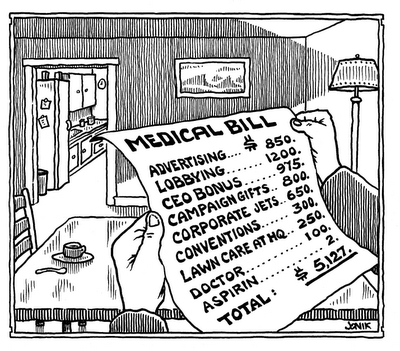
America’s Obamacare and health insurance laws have been written by political lobbyists for special interests. So has the TTIP: Transatlantische Handelsabwollen. Since George W. Bush, the U.S. Government has been prohibited from bargaining for low bulk prices from the pharmaceutical companies. Most Americans think that Health Management Organizations (HMOs) are rife with corruption and billing fraud. The insurance sector has made a killing by spending a great deal of money on bureaucratic techniques to reject patients who seem likely to require expensive health care. Doctors need to hire specialists working full time just to fill out the paperwork. Error is constant, and any visit to the doctor, even for a simple annual checkup, requires many hours by most patients on the phone with their insurance company to correct over-billing.
The dream of U.S. “free market” lobbyists to shift the costs of health care onto its users instead of as a public program. According to current plans backed both by the Republicans and by much of the Democratic Party leadership, these user costs ideally would be paid by pre-saving in special “health savings” accounts, to be managed by Wall Street banks as a kind of mutual fund (with all the financial risks this entails – the same kind of risks that are troubling most U.S. pension funds today).
The reason why the U.S. discussion of health care for the elderly is so relevant for Europeans is that the Transatlantic Trade and Investment Partnership (TTIP) that President Barack Obama pushed on German Chancellor Angela Merkel two weeks ago poses a far-reaching threat to European policies.
The agreement has been drawn up in secret, and has only been available to Congressmen in a special room as a read-only copy. Not even Congressional staff have been permitted to see the details. The reason is that the terms of the TTIP are so awful that it could never be approved by voters. That is why the lobbyists for banks, insurance companies, drug companies, oil and gas companies and other special interests that wrote the law are trying to bypass democratic government and are going directly to Brussels – and in the United States to the Executive Branch of government.
The aim of the TTIP is to replace the application of national laws with special courts of referees nominated by the special interests. This includes the organization of health care. Last week Britain’s main labor union, Unite, warned that the TTIP would mean that the National Health Service would have to be wound down and privatized.[1] Although “Austria, Germany, Greece and Italy do have explicit reservations in the TTIP text to protect existing rules relating to healthcare,” the privatization lobbyist strategy is to have the treaty “provisionally applied” to force matters, by backing compliant politicians. Objections will be sidestepped as the “provisional’ law becomes a fait accompli.
I think that the best perspective that I can give you is to discuss how the various interest groups are working to shape political decisions regarding the public and private role of health care. This is an area I have been involved with for forty years. In 1976, I contributed the economic section for two reports by The Futures Group in Glastonbury, Connecticut for the National Science Foundation analyzing the economic and financial consequences of life‑extending technology: When We Live Longer: Prospects for America (with Herb Gurjuoy et al., 1977) and A Technology Assessment of Life-Extending Technologies (Vol. 5: Demography, Economics and Aging, 1977). I believe these were the first reports to pinpoint the implications for the Social Security system of an aging population and its inter-generational financial tensions.
American politicians and economic futurists were concerned with the effect on public health budgets of a rising proportion of the population able to live out the maximum present human lifespan of 125 years (called “squaring” the life expectancy curve). What is the best public response to what should be a dream being realized? More to the point, how should governments cope with special interests seeking merely to profiteer from such breakthroughs – and use their promise in an extortionate manner?
Every interest group has its own perspective. Most politicians in the United States are lawyers, and they worried that the Social Security, pension and health care contracts were a legal right that could not be broken or modified. President Eisenhower had called Social Security the “third rail” of American politics – meaning that any politician or party that sought to downgrade its promises would quickly be voted out of office.
It was obvious that a population living longer would receive more Social Security and pension payments, and that a rising proportion of national income would be spent on their health care. Some of the politicians I talked to were so pessimistic about the costs involved that one said that he was sorry that kidney dialysis procedures had been invented, because with so many people having kidney problems, it would cost a fortune to provide this service to everyone who medically needed it.
Some politicians sought ways to not to fund expensive medical technologies – on the ground that if these were developed, the government might have an obligation to supply the most expensive technologies (especially dialysis and organ transplants) to the population at large. The costs of doing this would absorb nearly all the economic growth.
One set of futures envisioned that the more costly medical treatments might become available only on islands – in the Caribbean, for instance. After all, did not Hippocrates practice on the island of Cos?
As forecast decades ago, health care is the most sharply rising cost in the United States. What none of us were cynical enough to forecast was the corrupt role played by special interests in maximizing the costs by treating each element of health care as a profit center – indeed, as an opportunity to extract monopoly rent.
Privatization of health insurance under Obamacare has been a bonanza for the financial sector and the insurance industry. Initially a Republican “free market” proposal, it required the Democratic Party in power to disable popular pressure for “Medicare for all” in the form of single payer public health care. No discussion within Congress was even permitted to favor public health care. (I was economic advisor to Presidential candidate Dennis Kucinich, whom the Democratic Party leadership blocked from even discussing a public option in the Congressional debate.)
The enormous power of lobbyists from the pharmaceutical industry bought the loyalty of politicians who blocked anti-trust laws from being applied against the drug companies. As I noted earlier, these lobbyists even succeeded in blocking the government from negotiating directly with the drug companies over prices.
I mention these points because the U.S. solution should serve as an object lesson for what European and other countries should avoid in managing their care for the elderly. This is especially important to Europe, because its neoliberal policies favoring the financial sector imply a slow economic crash squeezing household and employer budgets. Five concerns are paramount.
Triage: restricting the most expensive health care only to the wealthy
Lower incomes lead to shorter lifespans as a result of worse health, and also suicides. Marriage and birth rates also are lower as economies polarize and growth slows. Russia, Ukraine, Latvia and other post-Soviet states show this – and it may be a forecast of European experience. This raises the ratio of elderly to working-age populations. A slowly growing labor force must support more and more retirees.
Studies in almost every country have shown that health standards and lifespans are polarizing between wealthy and poor. A recent U.S. study notes: “The life-expectancy gap between rich and poor in the United States is actually accelerating. Since 2001, American men among the nation’s most affluent 5 percent have seen their lifespans increase by more than two years. American women in that bracket have registered an almost three-year extension to their life expectancy. Meanwhile, the poorest five percent of Americans have seen essentially no gains at all.”[2]
This has important implications regarding recent proposals to raise the retirement age at which people can qualify for Social Security. Only the well to do are living longer, not blue-collar labor. Raising the retirement age would deprive the latter of the retirement years that better-paid individuals enjoy as a result of their healthier lives.
I mentioned above one scenario drawn by futurists: that the best medical care might only be available in “medical islands” or their equivalent in the United States, called “Cadillac health insurance plans.”
Blaming the victims for their unhealthy environment as the problem were their “personal responsibility.”
George W. Bush recommended that the poor simply should go to hospital emergency wards when they get sick. This obviously is the most expensive approach. Prevention is by far more economical. But public moves along this line are being fought tooth and nail by the tobacco and soft-drink industries, and other purveyors of bad health.
Better health and longer lifespans are achieved not only by advanced medical technology, but by better public health standards, and personal diets and exercise. The most serious behaviors impairing health and longevity are smoking cigarettes, drinking alcohol and eating junk foods to the point of obesity. In the United States, childhood diabetes is rising sharply, especially among racial and ethnic minorities, and the poor in general.
An obvious way to keep down health expenditures is to lead a more healthy life. In New York City, Mayor Bloomberg sought to ban the sale of large sugar-drink servings. Lawyers for the junk-food industry, supported by fast food restaurants and movie theaters, blocked his initiative. And an even more powerful legal tool to block public health warnings is contained in the Trans-Pacific Trade Agreement and its European counterpart, the Transatlantic Trade and Investment Partnership. These proposed treaties follow the earlier North American Free Trade Agreement (NAFTA) in levying enormous fines on government who warn populations of the dangers of smoking or other unhealthy behavior that is highly profitable to cigarette companies, soft drink “sugar water” makers, and fast food restaurants selling food-like substances that give little nourishment. Under the proposed neoliberal agreement being put in the hands of Brussels politicians by American lobbyists, government warnings of the health hazards of smoking will require these governments to pay the tobacco companies what they would have earned if cigarette sales had not declined as a result of these warnings! Fines already have been levied against Australia for seeking to improve public health by requiring such warnings on cigarette packages. A recent Australian report concludes:
Tobacco policies implemented in the past have been effective at decreasing overall rates of smoking, but new and innovative interventions will be needed in the future to affect change in all populations.
Six chapters were identified with potential to limit governments’ ability to implement tobacco control policies. The key chapters are: investment, particularly the ISDS mechanism; rules related to trademarks in intellectual property, regulatory coherence, cross-border services and technical barriers to trade. … Multiple chapters may also interact with the potential for amplified effects on tobacco control. Various provisions in these parts of the TPP may provide the tobacco industry with greater influence over policymaking and more avenues to contest tobacco control measures, as well as preventing governments from introducing new policies.[3]
Last week the European Court of Justice upheld the 2014 Tobacco Products Directive against challenges from British-American Tobacco (BAT) and Philip Morris. Like similar laws in other countries, the European law called for public warnings on cigarette packs telling smokers that nicotine kills. But the tobacco companies vowed to fight back, and the TTIP is now their major hope.
Dangers of privatization of health law under the TTIP
A recent British article lays out the problem:
A salient goal of TTIP is to shadow the Investor-State Dispute Settlement system (ISDS), an instrument of public international law granting firms the right to raise an action in a tribunal on the basis that a state’s policies have harmed their commercial interests. … The economist Max Otte has called ISDS ‘a complete disempowerment of politics’. The tribunals are confidential, as is usual in arbitration. Negotiations over ISDS within TTIP are also secret, the aim being to get the ink dry on the agreement before it can provoke opposition by being made public. …
As the Economist put it, ‘if you wanted to convince the public that international trade agreements are a way to let multinational companies get rich at the expense of ordinary people, this is what you would do.’[4]
Dangers of financialization
The most efficient way to finance care for the elderly – and pensions – remains pay-as-you-go planning. This is becoming difficult in a neoliberal political environment with shrinking economic growth and consequent demographic shrinkage. The horror story today is a Ukraine-like situation where the labor force has fled, leaving the elderly to be supported without much of a social budget. That is becoming the post-Soviet model, from East Germany to the Baltics.
The American situation is worse, because Social Security, Medicare and pensions are front-loaded by being financialized – paid for in advance. For decades, savings have been set aside in the form of stock and bond purchases. The problem is that when more workers retire than are contributing to the pension plan or similar plans, their prices will decline. This will leave the retirement plan under-funded.
As interest rates have been reduced to nearly zero since 2008 by Quantitative Easing by the U.S. Federal Reserve and now European Central Bank, pension funds and insurance companies have become desperate to meet their statistically required targets. They have turned to gambling on complex financial derivatives – and have lost heavily, because their managers are no match for Wall Street sharpies.
It may be appropriate here to note the monetary madness of the eurozone not having a central bank to monetize budget deficits to spend into the economy to help it grow. That is the proper function of a real central bank, from the Bank of England to the U.S. Federal Reserve System. European voters are being frightened by junk economics claiming that only commercial banks should create money and credit, not central banks. The reality is that central banks can create the money to fund health programs without inflating the economy. What would inflate health care costs, especially proper care for the elderly, would be privatization and a relinquishing of health policy to the large corporations best in a position to profiteer.
Danger of trade agreements raising the cost of drugs and medical technology
The technological medical revolution involves high rent-extracting opportunities, especially in treating the elderly. The Australian study cited above notes the dangers posed by the TPP (and hence also by its European version) to public health expenditure, especially health costs for the elderly. Designed largely to protect “intellectual property rights,” the proposed treaty aims to increase monopolyrent extraction by the pharmaceutical sector.
Provisions proposed for the TPP that have the potential to limit implementation of new food labelling requirements in Australia include the ISDS mechanism; the regulatory coherence chapter and technical barriers to trade chapter. Provisions in these parts of the TPP have the potential to restrict policymakers to regulate using the most effective public health nutrition instruments. For example, the food industry could argue that introduction of mandatory front-of-pack nutrition labelling would be a technical barrier to trade. Without strong compensatory intervention to improve consumer awareness of the relative healthfulness of foods, it is likely that there will be no change to current high rates of obesity, metabolic syndrome and non-communicable diseases. This would have a negative impact on health, particularly for vulnerable populations.
For starters, the trade agreement limits the ability of public or community pharmacies to bargain for lower drug prices. Also, any attempt at anti-monopoly legislation would require governments to pay the foreign producers or investors as much money as they would have earned if no “interference with markets” (that is, regulation of monopoly prices) had existed. This would sharply increase the cost of healthcare, and “many TPP provisions proposed during the negotiations are likely to be harmful to health.”
There is sufficient evidence which show that increases in the cost of medicines lead to greater patient copayments through the PBS, and that increases in patient copayments lead to lower rates of prescription use. Changes to prescription costs impact particularly on vulnerable populations who have less capacity to accommodate increased out-of-pocket expenses such as women, elderly adults, cultural and linguistic minorities, and low-income populations; people with chronic disease; geographically remote communities; and Aboriginal and Torres Strait Islander populations.
Many provisions proposed for the TPP had the potential to increase the cost of medicines. These were identified in leaked drafts of the intellectual property chapter; the healthcare transparency annex; and the investment chapter, which includes an investor-state dispute settlement (ISDS) mechanism. These provisions, if adopted, could be expected to lead to an increase in the costs of managing the PBS by delaying the availability of generic medicines, and constraining the ability of the PBS to contain costs. An increase in the cost of the PBS to government would be likely to lead to higher copayments for patients.
Summary
European sponsors of U.S.-style neoliberalism pose a threat of transforming European politics, and with it the structure of economies and society. Enormous sums of money are being spent on public relations, and to support politicians willing to shepherd corporate monopoly power against that of democratic government and voters. The most serious threat to European health care and care for the aging population in general is pressure from U.S. firms and diplomats to ram through the TTIP.
It is much more than a free trade agreement. Its “investor dispute” mechanism threatens to disenfranchise governments. The intent is to block them from protecting Europe’s economy, population and basic social philosophy that has developed over the past century of social democracy.
That is why so many of us in the United States also are fighting against this agreement. It has been a major issue in this year’s presidential campaign. Republican nominee Donald Trump has affirmed that the public option is by far the most economic. And Democratic contender Bernie Sanders has opposed Hillary Clinton’s support for her patrons on Wall Street and in the pharmaceutical monopolies. I hope that a similar fight will be waged in Europe.
This is the text of Michael Hudson’s speech to SANICADEMIA, May 9, 2016 in Villach, Austria for the 5th International Congress on Geriatrics and Gerontology = 59th Austrian Convention for Hospital Management, “We’re Living Longer: The healthcare challenges for today and tomorrow.”
Notes.
[1] Hazel Sheffield, “TTIP could cause an NHS sell-off and UK Parliament would be powerless to stop it, says leading union,” The Independent, April 29 2016. http://www.independent.co.uk/news/business/news/ttip-could-cause-an-nhs-sell-off-and-parliament-would-be-powerless-to-stop-it-says-leading-union-a7006471.html
[2] Sam Pizzigati, “Inequality Kills: Top 1% Lives 15 Years Longer Than the Poorest,” Naked Capitalism, May 3, 2016, originally published at Other Words. http://www.nakedcapitalism.com/2016/05/inequality-kills-top-1-lives-15-years-longer-than-the-poorest.html
[3] Katherine Hirono, Fiona Haigh, Deborah Gleeson, Patrick Harris, Anne Marie Thow and Sharon Frie, “Is health impact assessment useful in the context of trade negotiations? A case study of the Trans Pacific Partnership Agreement,” April 4, 2016. http://bmjopen.bmj.com/content/6/4/e010339.full. The report notes: “The final agreement also included an optional tobacco carve-out from ISDS, allowing TPP countries to prevent the use of ISDS to challenge tobacco control measures. Yet even these apparent ‘wins’ have some limitations. Unlike tobacco, the health system, food and alcohol were not carved out from ISDS, leaving these policy areas vulnerable to claims by foreign investors. While various safeguards have been included to try and protect public health, experts have raised doubts about whether they will be sufficient.”
[4] Glen Newey, “Investors v. States,” London Review of Books blog, April 29, 2016. http://www.lrb.co.uk/blog/2016/04/29/glen-newey/investors-v-states/
Pemex No Longer to Be Main Producer of Oil in Mexico
teleSUR | May 11, 2016
The country’s state oil company, Pemex, which is one of the federal government’s main sources of revenue, is since May 10 no longer be the country’s only producer of oil, reports revealed Wednesday, after the state-owned company granted the first six licenses for oil extraction since left-leaning Mexican former President Lazaro Cardenas nationalized the industry in 1938.
The country’s oil production will now include the participation of private energy companies in the extracting fossil fuels from designated oil fields across the country.
Mexico’s energy ministry awarded six foreign companies with contractual licences for oil extraction, during the first round of government led energy auction on Tuesday.
The Mexican Secretary of Energy Pedro Joaquin Coldwell said on Tuesday that the signing of contracts generated “great trust” between investors and companies seeking to put their money to work in the country.
International oil companies are keenly interested in the forthcoming bidding processes, which includes the participation of 28 companies are in in the upcoming bidding rounds.
The news takes place as Mexican President Enrique Peña Nieto intends to move forward with energy-sector reforms, which will allow foreign participation and financing in the energy sector, with the assumption that these measures will result in a more efficient exploitation of the country’s untapped energy potential.
RELATED:
WikiLeaks: Hillary Clinton Pushed Mexico’s Oil Privatization
Nigerian president doesn’t want Cameron corruption apology… just all the country’s money back
RT | May 11, 2016
Nigerian leader Muhammadu Buhari used a keynote speech at a major anti-corruption conference in London to blast Prime Minister David Cameron for calling the African country “fantastically corrupt.”
The conference, which is currently underway, was meant to address global corruption, but a shadow was cast when Cameron was caught on camera calling Afghanistan and Nigeria “fantastically corrupt” in a conversation with the Queen and Speaker of the House John Bercow.
“What would I do with an apology? I need something tangible,” Buhari said.
“I am not going to demand any apology from anyone. What I am demanding is a return of assets.”
Buhari freely admitted before his address that his country had a graft problem and is thought to have been referring to major assets stashed in the UK by corrupt Nigerian figures.
In April 2016 a group of leading figures from Nigerian civil society raised a similar issue in an open letter, demanding Britain end its role as a “safe haven” for white-collar criminals who steal Nigeria’s wealth and resources for personal gain.
The letter’s signatories stressed the devastating effect corruption can have on ordinary citizens, stunting economic growth and exacerbating violent conflict and mass migration in its wake.
“Our Nigeria is one of those countries that has most bitterly suffered the impact. Despite the blessings of nature, which endowed us with abundant oil wealth, our infrastructure is deplorable,” the letter said.
The conference, a pet project of the PM’s, is likely to see Cameron file a motion to create a global anti-corruption body.
However, his plans have been attacked by critics on the basis the organization would have no meaningful powers of enforcement, instead relying on national and international policing agencies to intervene.
The summit comes only weeks after Cameron himself was caught up in a scandal relating to his father’s offshore company, Blairmore Holdings.
Following the Panama Papers leak that showed Cameron had profited from offshore tax schemes, the parliamentary standards committee said the PM would not be investigated. It gave no reason why.
Sanders Supporters Can Bring Down the Democrats
By Margaret Kimberley | Black Agenda Report | May 11, 2016
 Donald Trump’s ascension to the Republican presidential nomination has created an enormous rift between the Republican elites and the rank and file. This process is a welcome development that could lead to the end of that party.
While the Republicans implode Hillary Clinton moves towards the Democratic party nomination by moving ever more towards the right. She and former president Bill Clinton have made it clear. They intend to get votes from independents and Republicans who can’t stomach the idea of a Trump presidency. That has been her modus operandi throughout her political career. She bragged about being a teenaged Goldwater girl and now brags about killing in Libya.
She ignores the Bernie Sanders phenomenon because she has no reason to do otherwise. From the moment he started his campaign he said he would endorse her if she won the nomination. Of course Sanders followers might change the trajectory of history by refusing to go along with the charade. If they stand firm they can also send their party into the historical dustbin where it belongs.
Trump’s supporters epitomize white nationalist sentiment but they are also driven by personal need. They have been left behind by the machinations of both parties. The trade deals concocted by Republicans and Democrats have taken the living wage jobs they expected to have forever. While they prosper more than any other group in the country they still feel affronted by their change in fortune. They don’t care about the imperial project and wouldn’t mind if Trump made good on his pledge to cease invasions and regime change plots.
Democrats on the other hand are less likely to send their party packing. They have been hypnotized by years of lies which have allowed wars, austerity, and mass incarceration to be considered acceptable, small prices to pay to keep the Republicans at bay. Black voters in particular are so fearful of Republican victory that any Democratic Party policy, no matter how damaging to them, gets the go ahead.
The election of 2016 should be historic not just because two people who are disliked by millions will run for president. It should be ground breaking because it will mean that Americans who love to think of themselves as independent will finally live up to that self-image.
The Sanders people in particular claimed to want a revolution. Now is their chance to make good on this assertion. Their task is a simple one. They must not support or vote for Hillary Clinton in November and they must say so loudly and clearly. They can vote for another party’s candidate or write in one of their own. They may exhort Sanders to deny her an endorsement. Any tactic will do. But if they follow tradition and vote for a conservative Democrat they will have made a mockery of their demand for change.
Liberal Democrats who like to think of themselves as leftists must put up or shut up. They should know by now that their party cannot be reformed. It must be done away with for good. The duplicity of the Democrats is fully on display for everyone who really wants to see it. On the one hand they will use the infamous Koch brothers to strike fear, raise money and keep their voters in line. Will they continue to do that now that Charles Koch has declared Hillary Clinton to be possibly more acceptable than Donald Trump?
In reality the Bernie Sanders campaign held more pretense than reality. Sanders isn’t really a socialist and neither are most of his voters. Yet they found it appealing to be connected to a candidate who gave them political cache. Neither are Sanders or his supporters revolutionary. The word revolution was more of a marketing ploy than anything else and continued the mirage of the possibility for change.
Sanders was always the sheep dog, as Black Agenda Report said in 2015. That does not mean his followers have to follow suit. The necessary rejection of Hillary Clinton will also mean a rejection of the man they admired and voted for if he does as he promised and endorses her.
Sanders voters can be the revolutionaries they aspired to be if they loudly and publicly state that they won’t vote for Hillary Clinton. They will need a great deal of determination as they will surely be scapegoated, guilt whipped and blamed for her defeat. But those attacks should be considered as a badge of honor in what may well be a revolutionary effort.
Of course if people “felt the Bern” only because they hoped for a better Democrat then this effort is for naught. By now everyone should know that the corruption in the Democrat party cannot be cut out. The party doesn’t want to change itself and makes sure that opponents end up just driving the sheep.
It is time for the Sanders supporters to make good on calls for revolution. They can do that by actively and openly denying Hillary Clinton the presidency. When they are called spoilers they must proudly own the charge and declare that they meant what they said. They are fighting for a revolution.
Margaret Kimberley can be reached via e-Mail at Margaret.Kimberley(at)BlackAgendaReport.com.
Israel imposes “general closure” on Palestinian territory for Israeli Independence day

Ma’an – May 11, 2016
BETHLEHEM – Israeli authorities declared a “general closure” on Gaza and the occupied West Bank since midnight on Tuesday and continuing until midnight on Thursday as Israel celebrates its Memorial and Independence day.
The general closure was implemented on the West Bank and the besieged Gaza Strip yesterday, marking Israeli Memorial day, and will continue until the finish of Israel’s Independence day on Thursday.
Crossings into Israel from the West Bank and Gaza are only being permitted in humanitarian cases. However, a representative of the Palestinian Authority (PA) has requested approval for Palestinians in need of serious medical assistance, a spokesperson for the Coordination of Government Activities in the Territories (COGAT) told Ma’an.
An Israeli army spokesperson said the closure was implemented following an army “security assessment” and added that the closure restrictions included the passage of products and the movement of people into Israel and its illegal settlements.
Debilitating poverty and lack of employment drives many workers in the occupied West Bank to enter Israel in search of work. Israel’s imposition of closures on the Palestinian territory has severely affected the livelihoods of hundreds of thousands of Palestinians who depend on entering Israel, or its illegal settlements, for employment opportunities.
The number of Palestinians employed, both documented and undocumented, in Israel and its illegal settlements for the first quarter of 2016 was 114,000, according to the Palestinian Central Bureau of Statistics (PCBS).
The average unemployment rate for the Palestinian territory was 26.6% for this same period: 18% in the West Bank and a staggering 41.2% in Gaza. The poor state of the Palestinian territory’s economy is largely attributed to the decades-long Israeli military occupation of the West Bank and the nearly nine year Israeli blockade on the Gaza Strip which severely undermines any economic developments.
Israeli authorities movement restrictions on Palestinians in the West Bank as recently as a few weeks ago during the Jewish holiday of Passover, including implementing a full closure on the besieged enclave of Gaza.
Sweatshop Turkey
By Stephen Lendman | May 6, 2016
Turkey shamelessly exploits its Syrian refugee population. Hundreds of thousands of adults and children work for sub-poverty wages under deplorable conditions.
State-authorized sweatshops exist in many parts of the world, Turkey a notorious example, a hugely repressive police state, profiting from human misery.
London’s Guardian reported on Syrian child refugees in Turkey, many unable to go to school, forced to choose between harsh sweatshop labor or war at home.
They work 12 hours a day, six days a week, earning sub-minimum wage pay and no benefits. Syrian Relief Network (SRN) director Kais al-Dairi explained “irreversible” harm done to vast numbers of young Syrian refugee children.
“Even if everything stopped now and we had peace, we would just be doing damage control. We have lost a generation. We are trying not to lose a second one.”
Children in Turkish refugee camps are forced to work to help their families survive. They earn less than $10 a day. Syrian families in Turkey spend more than they earn, so are forced to borrow to get by and have their children work.
They’re victims of laws benefiting employers at workers’ expense, denied rights afforded Turkish nationals.
Sub-poverty pay prevents adult workers from caring for family members properly. It gets worse.
Many adults can’t find work. Research shows in nearly half of Hatay, Turkey, Syrian refugee families, a child is the only breadwinner, earning far too little for members to survive.
Many employers prefer hiring easily exploitable children at less pay than adults for maximum profits. They’re entitled to education in Turkey but don’t get it.
The Guardian said legal loopholes “give headmasters the right not to admit Syrians if their presence would conceivably affect the learning of Turkish students.”
Child workers are often ill-treated. Sexual and physical abuse are common, SRN’s Kais al-Dairi saying “I have interviewed kids and they say in their innocent way, ‘this guy held my hand. This guy tried to lead me here. This guy tried to touch me here.’ “
One child reported his sweatshop boss “beat(ing) (him) with a screwdriver, metal, whatever is in his hand. Once… he threw a bottle at me.”
UNICEF said Syrian “(c)hildren report being actively encouraged to join the war” at home at much higher pay than from sweatshop labor. According to al-Dairi, child soldiers have no futures, able only to fight and die as warriors.
Despite enormous hardships most people can’t imagine, many Syrians see Europe as their best option – for themselves and their children. Disappointment awaits them.
Stephen Lendman lives in Chicago. He can be reached at lendmanstephen@sbcglobal.net.
His new book as editor and contributor is titled Flashpoint in Ukraine: US Drive for Hegemony Risks WW III.
Featured Video

New positive ivermectin evidence
or go to
Aletho News Archives – Video-Images
From the Archives
Fanatical Followers of the Covid Regime: A Jim Jones-Style Cult?
By Professor Roger Watson and Dr. Niall McCrae | The Daily Sceptic | November 15, 2021
As scholars at leading British universities over recent decades, we witnessed the replacement of critical thinking and debate by narrative: facts are discrimination and scientific method is imperialism; truth, instead, is derived from ‘progressive’ values. This educational trend may be a major contributory factor to the ease in which society has been inculcated to the Covid ‘new normal’ of masking, testing, and repeated doses of vaccines for a disease of similar risk to severe influenza.
One doesn’t need much critical reasoning to observe the flawed logic of some vaccination enthusiasts, such as people who respond to experiencing any side effects, however debilitating, by saying “at least I know it’s working”, or, after contracting the disease despite their promised inoculation (over 90% effective, according to initial drug company claims), “I’d have been worse off without the jab.” … continue
Blog Roll
 Aletho News
- Najaf airport to reopen to Iranian flights within 24 hours: Ambassador
- From ‘How Will This End For Iran’ to ‘When America Walks Away’: A tale of two Economist covers
- Tehran blasts ‘baseless’ speculation linking Iran to alleged bomb plot at UK air base
- The Rise And… Rise Of ‘Color Revolutions’
- The Coming GOP Bloodbath?
- Arctic Scare Stories Melt Away
- Wrong, Euronews: Climate Change Has Not Created a Food, Energy, and Economic “Meta-Crisis”
- New positive ivermectin evidence
- Met Office Caught Fabricating Daily Temperature Record Claims
- Merck Virologists Admitted to Falsely Certifying Vaccine Efficacy
- If Americans Knew
- Netanyahu Asked UAE Leader to Deny Report on Oct. 7 Warning in Secret Visit, Sources Say
- CNN Chief Int’l Correspondent Clarissa Ward on Journalists in Gaza
- Democratic Party Consultants Surround Troy Jackson with Pro-Israel Donors
- Christian Leader Responds To Netanyahu’s Claims Regarding Palestinian Christians
- In Gaza, ‘Whoever Survives the Bombing Won’t Survive the Rubble’
- Israel kills more Palestinians, amid push to resettle Gaza – Daily Update
- Israel forces Gazans to live in constant peril – Daily Update
- Deconstructing Netanyahu’s pants-on-fire UN rant – Daily Update
- Trump betrayed voters with his campaign lies and prioritized a foreign country once he took office
- Netanyahu calls Israel’s war in Gaza ‘opposite of genocide’ in UN speech to near-empty hall
- No Tricks Zone
- New Study: Earth And Venus Surface Warmth Largely Explained By Convection And Lapse Rate, Not CO2 Or Radiation
- 2025 Nature Paper Claiming Worsening Global Drought Gets RETRACTED …Heavily Flawed
- New Study: ‘Global Drought Shows No Detectable Recent Acceleration Under Climate Warming’
- Economic Masterminds: German Socialists Suggest Taxing Productivity Gains Stemming From Using AI
- The South China Sea Has Not Been Cooperating With The Climate Change Narrative
- Energy Crisis: Germany Enters Heating Season With Historically Low Gas Reserve Fill Levels
- New Study: The Antarctic Ice Sheet Gained Mass From 2020-2024 Due To Staggering Snow And Ice Accumulation
- Study: Ocean Heating Rates From Thousands Of Years Ago ‘Dwarf’ Modern Ocean Heating Rates
- Climate Extremists Target, Attack Large-Scale Power Grid Infrastructure In Germany!
- New Study: Antarctic Ice Melt Has Contributed Less Than 1 Centimeter To Sea Level Rise In The Last 30 Years

