NAM slams US court ruling on Iran’s frozen assets
Press TV – May 5, 2016
The Non-Aligned Movement (NAM) has denounced the US Supreme Court’s recent ruling that allows for the seizure of frozen Iranian assets, describing the measure as violation of the international law.
The movement, which is comprised of 120 member states, in a statement released on Thursday called the decision a violation of Washington’s international and treaty obligations concerning “the sovereign immunity of states.”
It also lambasted the ruling as an illegal US practice and in defiance of the international law, urging the US administration “to respect the principle of state immunity.”
NAM also warned that Washington’s failure to adhere to this principle will have “adverse implications, including uncertainty and chaos in international relations.”
The movement further criticized the US Congress for paving the way for illegal confiscation of foreign assets, and the actions by the US government to unlawfully hold them.
The US Supreme Court ruled on April 20 that Iran’s assets frozen in a bank account, which are worth around $2 billion, should be turned over to American families of those killed in a 1983 bombing in Beirut and other attacks blamed on Iran. Tehran has denied any role in the attacks.
The money, which belongs to the Central Bank of Iran (CBI), had been blocked under US sanctions before the court ruling.
Iranian Foreign Minister Mohammad Javad Zarif has denounced the seizure of the frozen assets as “highway robbery,” vowing that the Islamic Republic will retrieve the sum anyway.
“It is a theft. Huge theft. It is highway robbery. And believe you me, we will get it back,” Zarif told The New Yorker magazine in an interview published on April 25.
The chairman of Iran’s parliamentary National Security and Foreign Policy Committee, Alaeddin Boroujerdi, said on Tuesday that Iranian nationals can file more than 190 cases with domestic courts against Washington compared to the 90 cases pending against Iran in US courts.
“In the world of politics, one should possess counter-pressure levers. Iran should therefore respond to the American move. We possess the means to take action against the US,” he added.
South China Sea Dispute: How Russia Could Help China Win in The Hague

© Sputnik/ Ramil Sitdikov
Sputnik | May 4, 2016
The Kremlin could one day regret any US detachment from the South China Sea, American geopolitical analyst Tim Daiss insists. Are Washington’s efforts truly aimed at maintaining the freedom of navigation in the region or is it part of Obama’s plan to write the rules and call the shots in the Asia Pacific region?
Russia’s opposition to internationalizing the South China Sea dispute and the US deployment of the Terminal High-Altitude Area Defense (THAAD) system in South Korea has promted deep concerns among American geopolitical analysts.
Moscow’s support for Beijing has put the US plan to pressure China into making concessions on the maritime dispute in the South China Sea at risk. On the other hand, India’s decision to side with China on the issue has caught Western observers by surprise.
“China and Russia have agreed on the need to limit US influence in the Asia Pacific Region. On Friday, following bilateral talks in Beijing Russia’s foreign minister Sergey Lavrov and his Chinese counterpart Wang Yi expressed opposition to the US deployment of an anti-missile system in South Korea and also said that non-claimants should not take sides in the dispute over maritime territorial claims in the South China Sea,” American geopolitical analyst Tim Daiss wrote in his Op-Ed for Forbes.
Russian Foreign Minister Lavrov has repeatedly stated that the South China Sea dispute should be resolved by the parties directly concerned, while outside powers should refrain from interfering.
A joint communiqué of the 14th Meeting of the Foreign Ministers of the Russian Federation, the Republic of India and the People’s Republic of China singed on April 18, 2016, reads:
“Russia, India and China are committed to maintaining a legal order for the seas and oceans based on the principles of international law, as reflected notably in the UN Convention on the Law of Sea (UNCLOS). All related disputes should be addressed through negotiations and agreements between the parties concerned. In this regard the Ministers called for full respect of all provisions of UNCLOS, as well as the Declaration on the Conduct of Parties in the South China Sea (DOC) and the Guidelines for the implementation of the DOC.”

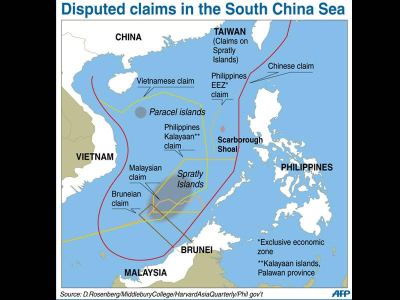
South China Sea claims map (© Photo: Wikipedia/Voice of America)
The statement coincided with reports that Beijing is seeking Moscow’s support over the South China Sea court battle with the Philippines in the Hague.
Nearly three years ago, the Philippines, backed by America, filed a lawsuit against China in the Hague International Tribunal Court. In October 2015 the Permanent Court of Arbitration in The Hague confirmed that it would hold a hearing on the matter. The hearing is expected to take place in May or June 2016.
“China is lobbying Russia for support in opposing international court proceedings launched by the Philippines over the disputed South China Sea,” South China Morning Post reported April 20.
Beijing has reason to believe that Moscow can provide it with juridical assistance to solve the problem, Alexander Shpunt of Russia’s Regnum media outlet suggested.
Shpunt called attention to the fact that on April 20 Moscow won the Yukos case in the District Court in the Hague; a Dutch court overturned an award of $50 billion to former shareholders of the now defunct Yukos oil company that Russia had been ordered to pay by the Permanent Court of Arbitration in 2014.
The journalist continued that Lavrov’s notion about “outside parties” in the South China Sea dispute is a direct reference to the Permanent Court of Arbitration in the Hague that will soon hold hearing on the Philippines’ complaint against China.
This is the issue of utmost importance for Beijing that Moscow has outplayed the Permanent Court of Arbitration, Shpunt emphasized.
However, according to Daiss, Beijing is the major troublemaker in the region that plans to outwit its “much smaller Asian neighbors.”
“Who knows what the future holds geopoliticaly?” he wrote, adding that “the Kremlin could one day regret any US detachment from the South China Sea.”
Like many other Western observers Daiss remained silent about the fact that China’s Asian neighbors are also involved in controversial building activities in the South China Sea region, while, for example, Taiwan’s constructions in the Spratlys are located outside any claimed Taiwanese exclusive economic zone.”Of the six countries claiming an interest in the Spratlys, only Brunei has failed to construct structures, mostly on stilts, on more than 40 of these islets and reefs. Yet the western media again focuses exclusively on [China’s] ‘aggressive’ reclamation and building activities,” Australian lawyer James O’Neill wrote in his article for New Eastern Outlook.
What lies at the root of this double-standard approach? And is Washington really “trying to keep the sea lanes open in the name of freedom of navigation for any and all countries” as Daiss claims?
Apparently, US President Barack Obama’s latest Op-Ed in the Washington Post could shed some light on the matter.
“Today, some of our greatest economic opportunities abroad are in the Asia-Pacific region, which is on its way to becoming the most populous and lucrative market on the planet,” Obama wrote.
“Of course, China’s greatest economic opportunities also lie in its own neighborhood, which is why China is not wasting any time,” he noted referring to Beijing’s New Silk Road initiative.
“Instead, America should write the rules. America should call the shots. Other countries should play by the rules that America and our partners set, and not the other way around,” Obama stressed.
Given this, it becomes clear that what Washington is truly interested in is not the freedom of navigation “for any and all countries,” but its dominance in the region.
Read more:
All for One: How Russia, China, India Will Solve South China Sea Dispute
‘They Said No’: China Denies US Aircraft Carrier Entry to Hong Kong
What is Really Going on Behind the Curtains in South China Sea?
Why the US Will Not Sign the UN Convention on the Law of the Sea
By Ken Meyercord | Dissident Voice | May 4, 2016
Critics of American foreign policy love to point out instances where our policy reeks of hypocrisy. No current issue in international affairs affords a better illustration of our inconsistent sanctimoniousness than the dispute over competing claims to insular territories (whether to call them “islands” or “rocks” is of great significance, as we shall see) in the South China Sea.
Symptomatic of our hypocrisy on this issue, we protest Chinese “aggressive” actions in the area by sailing the Seventh Fleet through the territorial waters of atolls turned into landing-strips to demonstrate our commitment to protecting freedom of navigation. Yet we refuse to sign the UN’s Convention on the Law of the Sea (UNCLOS), the international effort to formalize the rules governing freedom of navigation on the high seas. The convention, which has been around since 1982, has been ratified by over 160 UN member states, including China, but not by the U.S. of A.
Opponents of the UNCLOS, like Senators Portman and Ayotte, contend that the convention infringes on US sovereignty, in particular with regard to its provision for international arbitration of disputes (keep that in mind when the Permanent Court of Arbitration rules on a suit brought by the Philippines over China’s claims in the South China Sea). But I believe the main reason for our unwillingness to ratify the UNCLOS lies elsewhere.
The convention makes a distinction between “islands”, which can support human habitation, and “rocks”, which cannot. The territorial waters around either type of sea-bound outcrop can be claimed up to 12-miles out, but a 200-mile Exclusive Economic Zone (EEZ) can only be claimed around an island, not a rock.
We have a number of possessions in the Pacific, formally called US Minor Outlying Islands, around which we claim EEZs. Here’s a map showing them:
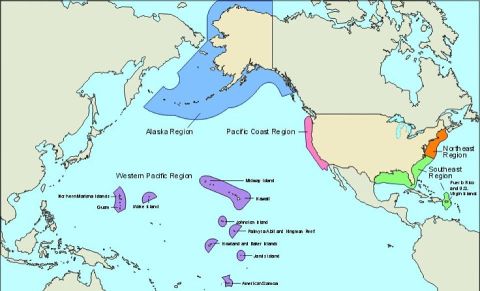
Most of these possessions were acquired in the late 19th century under the Guano Islands Act of 1856. There was a gold rush, so to speak, for guano deposits at the time as the phosphate-rich bird poop was much sought after as a fertilizer. The act authorized any American captain who stumbled on an uninhabited, unclaimed island covered in guano to claim it in the name of the United States. Under the act dozens of islands came into America’s possession, most of which we gave up once an island had been stripped clean, literally. Currently, none of our outlying islands have permanent residents.
As can be seen, the EEZs around these outlying “islands” cover a sizeable area. In fact, the projection used causes the EEZs in the South Pacific to look smaller than they actually are compared to zones in more northern latitudes. Just one of the equatorial EEZs, that around the Howland and Baker Islands, is larger than the EEZ off the California coast.
Under UNCLOS, many of these “islands” would be deemed mere rocks, not entitled to EEZs. The same is probably true of some of the “islands” in the Aleutian Islands chain. Hence, ratification of the Convention on the Law of the Sea would result in a significant diminution of our Exclusive Economic Zones, something our world-beaters are not likely to agree to readily.
Despite the rocky grounds for many of our own claims, we pooh-pooh Chinese claims based on similar grounds. I recently heard a former Deputy Under Secretary of Defense, Kathleen Hicks, belittle China’s claim to the Scarborough Shoal because it is almost underwater at high tide (see this video at the 2:55:26 minute mark); yet we claim not only the territorial waters but also an EEZ around a reef in the Hawaiian Islands chain, Maro Reef, which is entirely submerged, even at LOW tide.
As mentioned previously, the Philippines has taken China to court over its claims in the South China Sea. The court in question, the Permanent Court of Arbitration, is often referred to in the press as a “UN tribunal” to give it greater cachet, but, in fact, it is not part of the UN, being a body created in 1899 when imperialism ruled the waves. No wonder China refuses to participate in the proceedings (a Palestinian in an Israeli court stands a better chance) and will no doubt ignore an adverse ruling. If so, you can count on our media howling about China flaunting the rule of law, how outraged the “the international community” (read “NATO”) is, and the like.
Perhaps some courageous, soon-to-be-unemployed journalist will be brave enough to point out that when Nicaragua took us before the International Court of Justice – an actual UN body – over our mining of their harbors and other offenses, we refused to participate in the proceedings, claiming the court did not have jurisdiction. When the court ruled against us, we blocked enforcement of the ruling through our veto in the Security Council. Embarrassingly, in light of current posturing, one of the charges levelled against us was interrupting peaceful maritime commerce – this by the self-proclaimed protector of freedom of navigation in the western Pacific.
To the uninformed (read “Kathleen Hicks”), it will seem obvious to whom sovereignty over the Scarborough Shoal belongs. Just look at how close they are to the Philippines and how far from China.
Ms. Hicks has probably never heard of Navassa Island, another Guano Islands Act possession of ours (see the map of US EEZs above). It lies far from our shores but just off the coast of Haiti, which also claims it. We’ve shown no willingness to give up the former El Dorado of avian defecation simply based on geography.
Similarly, when bemoaning how far China’s nine-dash-line delineating its claims in the South China Sea (shown as a solid red line above) extends from the Chinese mainland, we should consider what a line encompassing our own far-flung possessions would look like. Our line, like China’s, would reflect past naval exploits, not proximity to ours or someone else’s coast, and our line would extend much farther from our mainland than China’s does from theirs.
Adopting a conveniently faulty memory, we call for peaceful resolution of the disputes and require all disputants (read “China”) to refrain from aggressive actions, like populating disputed territories, but in 1935 we secretly started placing settlers on Howland, Baker, and Jarvis Islands, former Guano Islands Act possessions long forgotten and by then of lapsed and uncertain ownership. After a year of surreptitious colonizing, President Roosevelt revealed the sneaky scheme and proclaimed the islands American territory. That sort of behavior would not be condoned under the Convention on the Law of the Sea, another reason our wily buccaneers will not sign it.
Ken Meyercord can be reached at: kiaskfm@verizon.net.
US Republican lawmakers push Boeing to scrap any Iran deal
Press TV – May 4, 2016
Three US Republican lawmakers are pushing the American aerospace giant, Boeing, to refrain from getting into any deal with Iran.
In a letter to Boeing CEO Dennis Muilenburg, the Illinois Republican congressmen asked the company no to business with Tehran for any supply of planes and other services.
Congressmen Peter Roskam, Bob Dold and Randy Hultgren referred to a last July nuclear agreement between Iran and the permanent UN Security Council members plus Germany (P5+1) that removed anti-Iran sanctions in return for curbs on Tehran’s nuclear program, saying in their letter that any Iran deal with Boeing would be legal but “not right,” according to Fox News.
“This is not about doing what is legal – it is about doing what is right,” the letter said.
The Republican lawmakers reiterated US allegations of Iranian support for terror, telling Boeing that Iran’s Islamic Revolution Guards Corps (IRGC) can turn the planes into combat aircraft.
“We urge you not to be complicit in the likely conversion of Boeing aircraft to IRGC warplanes,” said the lawmakers.
Congressman Roskam, chairman of the US House Committee on Ways and Means Oversight, has been particularly vocal in his anti-Iran position, previously pushing for Europe’s multinational plane-maker Airbus to scuttle its $25 billion deal to sell 118 planes to Iran.
Roskam on Friday introduced an amendment to the National Defense Authorization Act, which would prohibit the US Department of Defense from awarding contracts to any entity that does business with Iran.
This is while Boeing is not alone in its interest in Iranian ventures. General Electric Co., among others, is also reportedly exploring business opportunities in Iran.
“Should any agreements be reached at some future point, they would be contingent on the approval of the US government,” Boeing said in a statement in April.
Last month, Iranian officials said Boeing had proposed to sell new models of its 737, 777 and 787 aircraft to Iran and promised after-sales support.
In late January, Iran’s Deputy Transport Minister Asghar Fakhrieh-Kashan said the country was planning to purchase over 100 planes from Boeing.
The official noted that Iran’s order list from the American company included 737s for domestic flights and two-aisle 777s for long-haul routes.
Iranian officials have already emphasized that the country will need to buy 500 commercial jets of various models for various short-, medium- and long-distance routes.
Massive May Day rallies show support for Brazil’s Rousseff
The BRICS Post | May 2, 2016
Even as May Day protests were expected in cities across the world on Sunday, as economic crises and a rise in unemployment have fuelled anti-government sentiment, Brazil saw some radically different scenes.
Hundreds of thousands of people marched in Brazil’s main cities on International Workers’ Day in a show of support for the embattled President Dilma Rousseff.
Protests were seen in 16 of the country’s 27 states, called by Central Union of Workers (CUT) and numerous other labor and left-wing organizations.
The support for the embattled leftist leader Rousseff in Brazil was in sharp contrast to France which was on high alert after protests against planned labour changes this week sparked a frenzy, with cars set on fire and dozens of police officers being injured in Paris in clashes with protesters.
On Sunday, the Brazilian city of Sao Paulo saw the largest march with around 100,000 people, according to organizers, in three separate marches.
Rousseff appeared at the CUT march in Sao Paulo, alongside the mayor of Sao Paulo, Fernando Haddad, and the president of the Workers’ Party, Rui Falcao.
During a speech to the crowd, Rousseff announced a new policy measure, according to Brazilian daily O Globo, saying that her flagship social welfare program Bolsa Familia would be increased by 9 per cent.
Bolsa Familia is an ambitious cash-transfer scheme that has helped elevate millions of Brazilians out of poverty. Funds are channelled through the mothers of poor and working-class families.
The scheme was launched nationwide by President Lula’s administration in 2003 and its exemplary success has cemented support for Rousseff’s Workers Party among the poorest in Brazil.
On Sunday, Rousseff also announced that 25,000 new houses would be built within the Mi Casa, Mi Vida (My Home, My Life) program, the renewal of the contracts of foreign doctors in the Más Médicos (More Doctors) program, an increase in paternity leave for public officials and an adjustment to the rental tax to benefit workers.
In other cities such as Rio de Janeiro, Curitiba, Fortaleza, Manaus, Joao Pessoa, Recife and Salvador, Rousseff supporters marched, saying they would not allow her impeachment.
The Brazilian Senate is currently considering whether to open an impeachment trial against Rousseff, over alleged fiscal irregularities in 2014 and 2015.
President Obama: The Race for the Imperial Legacy
By James Petras :: 04.29.2016
President Obama is racing forward to establish his imperial legacy throughout Russia, Asia and Latin America. In the last two years he has accelerated the buildup of his military nuclear arsenal on the frontiers of Russia. The Pentagon has designed a high tech anti-missile system to undermine Russian defenses.
In Latin America, Obama has shed his shallow pretense of tolerating the center–left electoral regimes. Instead he is has joined with rabid authoritarian neo-liberals in Argentina; met with the judges and politicians engineering the overthrow of the current Brazilian government; and encouraged the emerging far-rightwing regimes in Peru under Keiko Fujimori and Colombia under President Santos.
In Asia, Obama has clearly escalated a military build-up threatening China’s principle waterways in the South China Sea. Obama encouraged aggressive and violent separatist groupings in Hong Kong, Tibet, Xinjian and Taiwan. Obama invites Beijing billionaires to relocate a trillion dollars in assets to the ‘laundry machines’ of North America, Europe and Asia. Meanwhile he has actively blocked China’s long-planned commercial ’silk route’ across Myanmar and west Asia.
In the Middle East, President Obama joined with Saudi Arabia as Riyadh escalated its brutal war and blockade in Yemen. He directed Kenya and other African predator states to attack Somalia. He has continued to back mercenary armies invading Syria while collaborating with the Turkish dictator, Erdogan, as Turkish troops bomb Kurdish, Syrian and Iraqi fighters who are engaged on the front lines against Islamist terrorism.
President Obama and his minions have consistently groveled before the Jewish State and its US Fifth Column, massively increasing US ‘tribute’ to Tel Aviv. Meanwhile, Israel continues to seize thousands of acres of Palestinian land murdering and arresting thousands of Palestinians, from young children to aged grandparents.
The Obama regime is desperate to overcome the consequences of his political, military and economic failures of the past six years and establish the US as the uncontested global economic and military power.
At this stage, Obama’s supreme goal is to leave an enduring legacy, where he will have: (1) surrounded and weakened Russia and China; (2) re-converted Latin America into an authoritarian free-trade backyard for US plunder; (3) turned the Middle East and North Africa into a bloody playpen for Arab and Jewish dictators bent on brutalizing whole nations and turning millions into refugees to flood Europe and elsewhere.
Once this ‘legacy’ is established, our ‘Historic Black President’ can boast that he has dragged our ‘great nation’ into more wars for longer periods of time, costing more diverse human lives and creating more desperate refugees than any previous US President, all the while polarizing and impoverishing the great mass of working Americans. He will, indeed, set a ‘high bar’ for his incumbent replacement, Madame Hilary Clinton to leap over and even expand.
To examine the promise of an Obama legacy and avoid premature judgements, it is best to briefly recall the failures of his first 6 years and reflect on his current inspired quest for a ‘place in history’.
Fear, Loathing and Retreat
Obama’s shameless bailout of Wall Street contrasted sharply with the desires and sentiments of the vast majority of Americans who had elected him. This was a historic moment of great fear and loathing where scores of millions of Americans demanded the federal government reign in the financial criminals, stop the downward spiral of household bankruptcies and home foreclosures and recover America’s working economy. After a brief honeymoon following his ‘historic election’, the ‘historic’ President Obama turned his back on the wishes of the people and transferred trillions of public money to ‘bailout’ the banks and financial centers on Wall Street.
Not satisfied with betraying the American workers and the beleaguered middle class, Obama reneged on his campaign promises to end the war(s) in the Middle East by increasing the US troop presence and expanding his drone-assassination warfare against Afghanistan, Iraq, Yemen, Libya, Somalia and Syria.
US troops re-invaded Afghanistan, fought and retreated in defeat. The Taliban advanced. The US expanded its training of the puppet Iraqi army, which collapsed on its first encounters with the Islamic State. Washington retreated again. Regime change in Libya, Egypt and Somalia created predator-mercenary states without any semblance of US control and dominance.
Obama had become both a master of military defeats and financial swindles.
In the Western Hemisphere, a continent of independent Latin American governments had emerged to challenge US supremacy. The ‘Historic President’ Obama was dismissed as a clueless hack of the US Empire who lacked any rapport with governments south of the Panama Canal. While trade and investment flourished between Latin America and Asia; Washington fell behind. Regional political and economic agreements expanded, but Obama was left without allies.
Obama’s clumsy attempts at US-backed ‘regime change’ were defeated in Venezuela and elsewhere. Only the small, corrupt narco-state of Honduras fell into Obama’s orbit with the Hillary Clinton-engineered overthrow of its elected populist-nationalist president.
China and Russia expanded and flourished as commodities boomed, wealth expanded and demand for Chinese manufactures exploded.
By 2013 Obama had no legacy.
The Recovery: Obama’s Lost Legacy
Obama began the road to establishing his ‘legacy’ with the US-financed coup in Ukraine, spearheaded by the first bona fide Nazi militia since WWII. After celebrating the violent ‘regime change’ against Ukraine’s elected government, Obama’s new oligarch-puppet regime and its ethno-nationalist army have been a disaster, losing control of the industrialized Donbas region to ethnic Russian rebels and completely losing the strategic Crimea when the population overwhelmingly voted to re-join Russia after 50 years. Meanwhile, the oligarch-’president’ Poroshenko and his fellow puppets have pilfered several billion dollars in ‘aid’ from the EU… all in pursuit of the Obama legacy’.
Obama then slapped devastating economic sanctions against Russia for its role in the Crimean referendum and its support for the millions of Russian speakers in Donbas, and in the process forced the European Union to make major trade sacrifices. For their role in creating a real “American legacy” for Mr. Obama, the Germans, French and the other twenty-eight countries have sacrificed billions of Euros in trade and investments – alienating large sectors of their own agricultural and manufacturing economy.
The Obama regime placed nuclear weapons on the Polish border with Russia, pointed at the Russian heartland. Estonians, Lithuanians and Latvians joined Obama’s military exercises stationing US ships and attack aircraft in the Baltic Sea threatening Russia’s security.
Obama’s Legacy in Latin America
The Obama regime intensified its efforts to re-establish supremacy with the demise of the center-left regimes following elections in late 2013 to the present.
Obama’s ‘legacy’ in Latin America is based on the return to power of neo-liberal elites in the region. Their successful elections were the result of several factors, including: (1) the rise of rightwing economic power in Latin America; (2) the decay and corruption of political power within the Left; 3) incapacity of the Left to develop its own independent mass media to challenge the media monopoly of the right; and (4) the failure of center-left regimes to diversify their economy and develop growth outside the boundaries defined by the dominant capitalist sectors.
The Obama regime worked closely with the political-business elite, organizing the political campaigns and controlling key economic policies even during the center-Left governments. The Left regimes had financed, subsidized and rewarded right-wing business interests in agro-mineral industries, banking, and the media as well as in manufacturing and imports.
As long as worldwide demand for primary materials was strong, the Center-Left governments had plenty of room to adjust their social spending for workers while accommodating business interests. When demand and prices fell, budget deficits forced the Center-Left to cut back on social spending for the masses as well as subsidies for the business elite. In response, the business sector organized a full-scale attack on the government – in defense of elite power. The Center-Left failed to counter the growing power and position of their business elite adversaries.
The business elite launched a full-scale propaganda war via its captive mass media – focusing on real or imagined corruption scandals discrediting Center-Left politicians. The Left lacked its own effective mass media to answer the Right’s accusations, having failed to democratize the corporate media monopolies.
The Center-Left parties adopted the elite’s technique of financing political campaigns – namely, through bribes, contract concessions, patronage other deal making with billionaire private and state contractors. The center-Left imagined it could compete with the free-market rightwing in financing campaigns and candidates via swindlers – and not through class struggle. This was a game they could never master.
The Right, however, mobilized their allies within police, judicial and public institutions to prosecute and disqualify the Center-Left for committing the same crimes the Right had evaded.
The Center-Left did not mobilize the workers and employees to establish even minimal controls over the elite and assume some managerial power. They thought they could compete with the Right on its own terms, through shady business and chicanery.
The Center-Left relied on financing its administration and policies through the commodity boom in demand for its natural resources – overlooking the fundamental instability and volatility of the global commodity market. While the Right openly condemned the ‘weakness of the Center-Left’ – in private, it pursued policies even more dependent on overseas speculators and narrow elites.
In Argentina, as the economy declined, the leadership of the rightwing, led by Mauricio Marci, launched a successful presidential campaign involving the mass media, banks, middle class voters and agro-mining elites. Immediately upon taking power, the Macri regime cut social services for workers and the lower middle class, slashing their living standards and lay off thousands of government employees. Obama saw Macri as his kind of legacy savior and viewed Argentina as the new center of US power in Latin America – with plans for more regime change in Brazil, Venezuela and throughout the region.
In Brazil, the Center-Left Workers’ Party (PT) faced a massive attack on its power base by the extreme rightwing parties. Corruption scandals rocked the entire spectrum of the political class, but the PT was most heavily implicated by massive fraud in Brazil’s huge national oil company, Petrobras. The PT regime’s troubles intensified as the country entered a recession with the drop in demand for its agro-mining exports. Growing fiscal deficits compounded the regime’s problems. The Brazilian hard Right mobilized its entire apparatus of elite power – the courts, judges, police and intelligence agencies – in a bid to overthrow the PT government and impose an authoritarian neo-liberal regime seizing all financial, business and productive assets.
The Center-Left had never been very left, if at all. Under Presidents Lula and Rousseff (2003-2016), the powerful mining and agricultural elites flourished; banking, investment and multi-national enterprises prospered. The Center-Left made some paternalistic concessions to the lowest income classes, and increased wages for labor and farm workers. But the PT relegated labor to the background while it signed business agreements and granted tax concessions to capital. It failed to engage Brazilian workers in class struggle.
The Right was never engaged in any struggle with a genuine leftist government pressing business for structural changes. Nevertheless, the Right sought to eliminate even the most superficial reforms. It would accept nothing short of total control, including: the privatization of the major national oil company, the reduction of wages, pensions and transport subsidies and a slashing of social programs. The Brazilian Rightwing coup – a fake impeachment organized by indicted crooks – is designed to vastly re-concentrate wealth, and re-establish the power of business, while plunging millions into poverty and repressing the principal organized mass movements. In Brazil, the elite-controlled media, courts and politicians act as judge, jury and jailers – against a center-left regime which had never taken control over the major institutions of elite power.
Obama and the Axis of his Legacy
Political rightists join police to control the multitudes and seize power, re-establishing deep ties among Brazil, Washington and Argentina. They will then move toward the neo-liberal re-conquest of all Latin America. Against this new wave, it must be understood that Obama’s Latin American legacy is too recent, too hasty and too disjointed – the new Right exhibits the same or even worse features of the recently deceased Left.
Argentina’s Marci borrows $15 billion at 8% interest, when the economy is fracturing, employment is collapsing, exports and worldwide demand is declining. At the same time, President Mauricio Marci’s cabinet is plagued by major financial scandals ‘a la Panama Papers’. The entire political party-trade union-employed working class is profoundly disenchanted with Marci’s minority rule.
Argentina may not turn out to be Obama’s enduring Latin Legacy: While Macri may open the door for a brief Washington take-over, the results will be catastrophic and the future, given Argentina’s recent history of popular street uprisings, is uncertain.
Likewise in Brazil, the impeachment/coup will result in new and more numerous investigations with trials of post-impeachment politicians and a deepening economic crisis. Brazil’s Vice-President, who turned against Rouseff, now faces corruption charges, as do his supporters. The prolonged confrontation precludes any basic continuity. The rightwing regime’s policy of slashing wages, pensions and poverty ‘baskets’ will detonate large-scale confrontations with the polarized population. Obama’s ‘legacy’ will be a brief episode – celebrating the ouster of the Workers’ Party President followed by a long period of instability and disorder.
Rightist regimes in Venezuela, Colombia and Peru will be part of Obama’s ‘legacy’ but to what lasting end?
The Venezuelan rightwing congress – dubbed the MUD – seeks to overthrow the elected president. It demands the release of several right-wing assassins from prison, the privatization of the oil industry, and a deep cut in social programs (health and education). They would reduce employees’ wages and eliminate food subsidies. The MUD has no competent plan or capacity to grow the oil economy and overcome chronic food shortages. The MUD would merely replace the Left’s subsidized economy with massive price increases for basic commodities — reducing domestic consumption to a fraction of its current level. In other words, the right-wing offensive may defeat the Chavista left but it will not stabilize Venezuela or develop a viable neo-liberal alternative. Any new rightwing regime will deteriorate rapidly and the chronic problem of criminal violence will exceed the current levels. The alliance between Washington and Venezuela’s far right will hardly support Obama’s claim to a historic legacy. More likely, it will serve as another example of a failed right wing state unable to replace a weakening left regime.
Similar circumstances can be found among other ‘emerging’ rightist regimes.
In Colombia, the current rightwing President Santos talks to the FARC guerrillas, but also accommodates the paramilitary death squads. His talks of peace settlements and social reform are linked to the genocidal right, led by the former President Uribe. Meanwhile, the economy stagnates with oil and metal prices collapsing on the world market. Colombian living standards have declined and the promise of a rightwing revival grows dim. The US-Colombian alliance may undercut the FARC but the rightwing does not offer any prospect for modernizing the economy or stabilizing the society.
Similarly in Peru, the rightwing wins votes and embraces free markets, but growth declines, investments and profits dry up and mass disenchantment grows among the poor promising street conflicts.
The Obama ‘legacy’ in Latin America has followed a series of brutal victories, which have no capacity to re-impose a stable ‘new order’ of free markets and free elections. The initial wave of favorable investments and lucrative concessions will fail to revive and recalibrate a new growth dynamics.
More ominously, Obama relied on mass murder to replace an elected leftist-nationalist president in Honduras and imposed a regime of terror against the poor and indigenous population. Meanwhile, illicit offshore handouts reward speculators in Argentina.
Obama’s legacy in Latin America reflects an entire spectrum from illicit-rightwing coups to oust the elected governments in Brazil and Venezuela, to elected authoritarian presidents in Peru and Colombia with historic links to death squads and multi-million dollar overseas accounts.
Obama’s contemporary ‘Latin American legacy’ reeks of gross electoral manipulation preparing the ground for bloody class wars.
Obama’s Legacy in the Ukraine, Yemen and Syria
The Obama regime thought it could manage widespread conflicts, uprisings and wars to advance its global supremacy.
To that end, Obama spent billions of dollars in weapons and propaganda arming Neo-Nazi para-military troops to seize power in Ukraine. A grotesque, brutal gang of oligarchs (and disgraced, foreign fugitives – like the ousted Georgian leader, Mikhail Saakashvili) served Washington in the puppet Kiev regime. Critics, journalists, jurists and citizens are being assassinated. The economy has collapsed; prices skyrocket; incomes declined by half; unemployment tripled and millions have sought refuge abroad. Wars raged between Russian ethnic citizen armies in the Donbas and the puppet Kiev regime. The people of Crimea voted to rejoin Russia. Meanwhile, economic sanctions against trade with Russia have exacerbated shortages for the people of Ukraine.
Under Obama’s stewardship the Ukraine became a world-class… basket case: so much for his European legacy. He can rightly claim credit for imposing a thoroughly retrograde regime of Klepto-capitalism with no redeeming feature.
Obama embraced Saudi Arabia’s war against Yemen – destroying the life and cities of the poorest nation in the Middle East. Obama’s ‘legacy’ in Yemen stands for the systematic obliteration of a sovereign people: Obama performs his tricks for billionaire Saudi despots while savaging the innocent. To the Israelis in Palestine and the Saudis in Yemen, Obama pays homage to the criminals responsible for millions of shattered lives.
What of the Obama ‘legacy’ in Syria and Libya? How many million Africans and Arabs have been murdered or fled on rotten boats in destitution. Only the rankest gang of corrupt media pundits in the US media can pretend this gangster President should evade a war crimes tribunal.
Conclusion
The Obama regime has pursued wars of unremitting destruction. It has forged partnerships with terrorists and death squads as it seeks short-term imperial victories, which end in dismal failures.
The imperial legacy of this ‘historic’ president is a mirage of pillage, squalor and destruction. The effect of his political lies has even begun register here among the American public: Who trusts the US Congress and the President? And in Europe, who trusts Obama’s European partners as they eagerly pushed for wars in the Middle East and North Africa and now fear and loathe the millions of their victims–refugees fleeing to the cities of Europe, with the drowned corpses of uprooted communities spoiling their beaches?
Obama pushed for wars and the Europeans receive the victims – with fear and disgust.
Obama’s victories are temporary, blighted and reversed.
Obama bombed Afghanistan yesterday and now flees renewed resistance.
Obama’s allies are again plundering Latin America but face imminent ouster via popular uprisings.
Obama terrorized and fragmented Syria yesterday but lost elections the day after.
Obama threatens China’s economy while eagerly buying China’s products.
The Obama legacy began as a failed military and economic offensive accompanying a profound social crisis. During his final year in office, Obama tries to forge alliances with the dregs of the hard right to save his legacy. His brief advance into this sordid world of neo-liberals, neo-Nazis and Saudi despots is a prelude to more retreat and chaos.
Obama’s public celebration of the right turn in Asia, Latin America, Europe and the Middle East applauds the most retrograde alignment of forces in modern times: Saudis and Israelis; Egyptian generals and Libyan jihadis; neo-Ottoman Turks with Ukrainian gangster-oligarchs. Regime changes in Argentina and Brazil encourage Obama to claim vindication of his imperial legacy.
His ‘moment’ of imperial truth is brief, all too brief. Everywhere, we witness the rapid rise of imperial success followed by a series of debacles.
Throughout Latin America capitalist profiteers plunge into wild financial adventures, theft and chaos. In the Middle East, the US stands on the crumbling palaces of a moribund Saudi regime. The much-proclaimed imperial advances are based on grand theft everywhere, from Egypt and Turkey to the Ukraine.
Simply stated: the US formula for a successful legacy is failing at the precise moment that it claims success! Obama and the Right have created a world of chaos and disintegration. Obama and his legions, the US and Europe have no future in peace or war, election or defeats.
There is no imperial legacy for the ‘historic’ President Obama!
Ecuador’s Earthquake and the NYT’s Spin Doctors
By Joe Emersberger | teleSUR | April 25, 2016
On April 23, a New York Times article by Nicholas Casey quoted a businessman in the earthquake-ravaged city of Portoviejo complaining about temporary tax increases that Rafael Correa’s government announced to pay for reconstruction which is presently estimated to cost US$2 to US$3 billion. Casey didn’t tell his readers that the areas impacted by the earthquake would be exempt from the new taxes and also given tax cuts.
The article inaccurately reported there would be “a one-time garnishing of government wages for those earning more than US$1,000 a month.” The measure would apply to all wages outside the disaster areas, not just “government wages.” Casey neglected to mention that most Ecuadorians earn less than US$1,000 per month. The average monthly salary is US$574 per month, not exactly a fact that would be common knowledge to the vast majority of NYT readers.
The biggest howler in the article is the assertion that the IMF has been “long shunned” in Ecuador “for its demands to cut government spending”. That’s like saying people avoid dealing with the Mafia because “they‘ve been known to be unpleasant”: true but wildly misleading. By the beginning of the 21st century, the IMF lost a tremendous amount of influence in Latin America because from 1980 to 2000 it had bullied governments into adopting disastrous policies which are known as “neoliberalism.”
Ecuador’s real GDP per capita grew by a pitiful 5 percent from 1980 to 1998 compared to over 100 percent in the previous two decades. Then, in 1999, Ecuador’s banking sector collapsed under the weight of corruption and a neoliberal obsession with “central bank independence” and financial deregulation. By 2000, real GDP per capita fell below what it had been in 1980.
Casey quotes Jose Hidalgo, an economist who has praised Ecuadorian governments of the neoliberal era for having “saved” money. Those governments certainly “saved” for various huge bailouts of Ecuador’s super rich like the infamous “secretization” of 1983 and the bank bailouts in 1999. Those governments also “saved” in order to make interest payments to foreign investors for debt that had often been illegally contracted.
By the time Correa took office in 2007, decades of neoliberalism had left Ecuador’s roads, public hospitals, schools and other basic infrastructure in shambles. The World Economic Forum ranked Ecuador’s roads tenth among 18 countries in the region in 2006. By 2015 they were ranked as the best. The efficiency of Ecuador’s public services, as ranked by the Inter-American Development Bank, rose from next to last among the 16 countries it evaluated to sixth best in the region. Comparative studies by the U.N. found that the quality of Ecuador’s educational system is one of the most improved in the region since 2006.
Economists like Hidalgo don’t generally try to deny the vast improvements in Ecuador’s infrastructure under Correa’s government. Instead they vaguely decry “excessive public spending.” Presumably, Ecuador’s infrastructure and public services should have been left in a deplorable state. Imagine Ecuador’s government refusing to rebuild the damage from the recent earthquake and then bragging about how much money it “saved.”
That sums up the warped logic behind Hidalgo’s view, one that was tragically put into practice during the neoliberal era. Is a country better equipped to confront natural disasters when traveling through the country is badly hampered by dilapidated roads; when hospitals are in short supply and are under equipped and understaffed; when rescue workers and other public servants are poorly paid, inadequately trained and do not have proper equipment?
Casey wrote that oil prices “once fueled a government spending bonanza.” The “bonanza” actually had more to do with clamping down on tax avoidance by the rich and sensibly regulating its financial sector. Real per capita tax revenues doubled between 2006 (the year Correa was first elected) and 2012. At their highest point during Correa’s time in office, inflation-adjusted oil revenues per capita, accounting for costs of extraction, were lower than they were during much of the 1970s and 1980s.
Moreover, early on in Correa’s presidency, Ecuador’s economy suffered a massive external shock due to the global recession of 2009 which drove oil prices down. So even before oil prices collapsed in 2014, Correa’s government did not have exceptionally high oil revenues compared to previous governments.
Another blow from the 2009 global recession was a drop in remittances from Ecuadorians living abroad. One legacy of the neoliberal era is that remittances from Ecuadorians who fled their country during those years became very important to Ecuador’s economy. The fact that Ecuador has reduced poverty by about half during Correa’s time in office cannot be rationally attributed to luck.
Based on resilience to external shocks, there is also no credible argument for returning to economic policies endorsed by Casey’s article. In 2015, Ecuador avoided recession despite losing 7 percent of its GDP to the oil price collapse. In 1987, under the neoliberal government of Febres Cordero, Ecuador went into recession when export revenues dropped by only 1.84 percent of GDP.
Casey never seemed to consider that there were facts and counterarguments to the views expressed by his sources. In the United States, newspapers like the New York Times present Paul Ryan, who wants to eliminate the entire federal government (with the exception of the military) from the U.S. economy, as a serious policy expert. So it isn’t surprising that successful public investment in Ecuador is eagerly presented as wasteful. If you can’t identify extremists and charlatans at home, you probably won’t do so abroad either.
Argentina Forks Over $6.2 Billion to Vulture Funds
teleSUR – April 23, 2016
Former economy minister Axel Kicillof warned Friday that the decision would lead to harsh austerity in the country.
Argentina repaid its holdout creditors on Friday, ending a 15-year dispute with vulture fund holders who rejected debt restructuring that followed Argentina’s US$100 billion debt default in 2001.
“The republic has made full payment in accordance with the specific terms of each such agreement,” Argentina’s chief lawyer working on the case said in a statement to a U.S. court on Friday.
Argentina handed over US$6.2 billion to settle disputes with 20 creditors. It is due to pay another US$3.1 billion in the coming days to settle lingering claims, the finance ministry explained in a statement.
The move follows a decision handed down earlier this month by a U.S. court that cleared the way for Argentina to start borrowing again, which had been excluded from international markets after breakdown in talks with the country’s the holdout creditors.
Argentina has since raised US$16.5 billion in funds from international lenders in order to payback the creditors that have been holding out for more than a decade.
However, the decision by the government of President Mauricio Macri to reopen negotiations with vulture funds has been met with sharp criticism within Argentina.
Former economy minister Axel Kicillof told Argentine media on Friday that the new debts would be followed by further painful public spending cuts that will affect the poorest Argentines most.
The case also raised crucial questions about contracts and the rights of both borrowers and lenders in the massive and largely unregulated global sovereign debt markets.
Last September, the U.N. General Assembly voted overwhelmingly in favor of a sovereign debt restructuring proposal, which would grant countries the right to design their own macro economic policy, including restructuring its own sovereign debt.
Minimum wage of $7.25 an hour is a starvation wage
By Steve Hough | American Herald Tribune | April 19, 2016
Whether one supports or opposes raising the minimum wage, there are any number of studies with which to reinforce either position. There is an old adage which states that while figures will not lie, liars will figure. Consequently, the issue continues to provide ample fodder for those operating in our hyper-partisan political arena.
While Republicans have created an echo chamber with the soundbite that raising the minimum wage inevitably results in job losses, most studies representing that point of view are tailored to fit a particular industry or class of workers.
The federal minimum wage was last increased on July 24, 2009, when it rose from $6.55 to $7.25per hour. It was approved by Congress in 2007 and was raised incrementally over a period of three years. Before 2007, the minimum wage had been stuck at $5.15per hour for ten years. Given the intransigence of Republicans in Congress, the Democrats have recently adopted a strategy of framing the minimum wage in terms of a “living wage”. No one in their right mind would consider $7.25 per hour a living wage, but there still exists valid arguments on multiple fronts against raising the minimum.
Teen employment and voluntary part-time employment as a convenience for the employee provide instances where a living wage may not be paramount in one’s decision to seek employment. However, shouldn’t a low-skilled employee, necessary for a business’ operations, deserve a wage sufficient to provide a minimum standard of living? My libertarian friends would argue that the government has no proper role in determining such things but, given our network of subsidies for the working poor, doesn’t the current minimum wage in fact equate to a taxpayer-funded subsidy to some in the business sector?
There are few certainties in life, but one is that raising the minimum wage would affect individual businesses differently and they could/would respond differently. Soundbites will never adequately explain the ramifications of such a decision.
To complicate matters, states and localities have adopted minimum wage laws exceeding the federal mandate. Most recently, cities such as Seattle and states such as New York and California have passed laws to raise the minimum wage to $15 per hour over time. While I certainly support such efforts, these changes can put these early adopters at a competitive disadvantage.
In an era where the domestic supply of labor has outstripped demand, due to businesses shipping jobs overseas and importing lower-wage foreign workers, an artificial imbalance has occurred. The result of these developments has created downward pressure on wages and states and communities with lower minimum wage laws will continue to cannibalize those with higher wage mandates. While I believe other actions must be taken to reverse the trend of offshoring jobs and importing foreign labor, an increase in the federal minimum wage would provide much needed consistency nationwide.
If and when the federal minimum wage is raised, not only should it be raised to an agreed upon rate adjusted for inflation, it should also be raised in the future as a function of inflation instead of Congressional whim. The practice would achieve a dual benefit for both employees and employers. Employees working for minimum wage could rely on increases to offset inflation and employers would have more certainty when preparing future budgets and profit projections.
The Invisibility of U.S. Oligarchs: The Case of Penny Pritzker
By Sam Husseini | April 19, 2016
Other countries, not the U.S., have oligarchs apparently.
Billionaire and Commerce Secretary Penny Pritzker came and went to the National Press Club with hardly a tough question on Monday — see video and PDF.
I’d submitted several questions, but first a word on the choreography of the event: Virtually every “news maker” event I recall seeing at the Press Club had the speaker at the head table which is on a stage a few feet up, speaking at a podium. This event, it was just her and the moderator, Press Club President Thomas Burr on two cushy chairs on the stage, with the “head table” below them. Whether this was to elevate the two of them, save her the trouble of having prepared remarks, a new thing, an attempt to cast the billionaire in a more casual light — inspired by Davos type events — I don’t know. But it was weird.
Speaking of choreography, on the other end of Pennsylvania Avenue around the same time, several hundred people were arrested at the Capitol Building as part of the “Democracy Spring” and “Democracy Awakening” actions. It seemed odd to me, protests happening, with “arrests” as part of a very planned action, aimed in part against money in politics, while the very personification of big business advocacy in government received virtually no scrutiny.
It’s not just her job, or that she and her family is incredibly rich. It’s that Pritzker enriched herself by crashing a bank with sub-prime loans, causing 1,400 people to lose their savings. In addition, a relation of hers was mentioned in the Panama Papers. So while so many were breathlessly reporting on associates of official bad guys like Putin being mentioned in the Panama Papers, hardly a soul noted the Pritzker connection. Finally, and perhaps most incredibly, Forbes several years ago did an investigation in to the Pritzker family and found that they set up shell companies decades ago in ways that would be illegal now. It’s in a sense not just oligarchy, it’s aristocracy. A newly rich person can’t do what they’ve done, according to Forbes. [See a summery off each of these issues, based on investigations by Tim Anderson, Dennis Bernstein, Stephane Fitch and McClatchy.]
And off shore shell companies were in the news of late. Oxfam just released a report claiming: “Tax dodging by multinational corporations costs the U.S. approximately $111 billion each year and saps an estimated $100 billion every year from poor countries” [PDF]. A prior report from the Tax Justice Network would seem to indicate that this was a severe under estimate. That found that as of 2010, the super-rich are hiding at least $21 trillion in accounts outside their home countries [PDF].
I’d at least expected a mild question about off shore activity — and figured she’d talk about how the Obama administration is allegedly now making moves to stop tax inversions.
But there was nothing about any of this. At the news maker event, the question I wrote on a card on the nub of the issues at play, was something like this: “A relation of yours — Liesel Pritzker Simmons — is mentioned in the recently released Panama Papers. Do you have comment on the extent of off shore shell companies — especially given your family uses them through grandfather clauses in ways that would not be legal for anyone new now?”
That didn’t get asked, nor did several I’d submitted in an email prior to the to the Press Club president by email:
The Pope — and Bernie Sanders — talk about a “moral economy” — that it’s inherently unjust if a very few individuals and families have enormous wealth while billions on the planet have virtually nothing. Your family of course is enormously wealthy — What do you think of that? (for overview, “Panama Papers: Pritzkers, American Oligarchs“.)
You have been charged with crashing Superior Bank in Chicago with a subprime mortgage scheme, resulting in 1,400 people losing their savings. How do you respond to these charges? (“Obama’s Subprime Conflit” and Bloomberg “Pritzker’s Superior Bank Subprime Losses Blemish Resume“)
Do you argue that your massive fundraising efforts for Obama in 2008 and 2012 had nothing to do with him appointing you as Sec of Commerce? (See from Public Campaign “Penny Pritzker, Not Just an Obama Donor.”)
The name of Liesel Pritzker Simmons appears in the recently released Panama Papers, a relative who sued much of the rest of the family for allegedly trying to cheat her. But what’s perhaps notable about your family, as Forbes has written, is that you set up shell companies decades ago and thus can do things because of grandfather clauses that are not legal any more. Is that moral?
Forbes — which estimates your net worth at 2.3 billion — had specific questions for you for —
* ‘Tell us from the very, very beginning: What led to your being paid $53.6 million in “consultant” income by your family’s offshore trusts in 2012?
* ‘Did your family’s carve-up finally produce significant tax payments?
* ‘Why are you your own biggest debtor?
* ‘Why is even your house in an LLC?
* ‘How do you rack up $250,000 on an American Express card?’
On trade issues and the TPP — how do you respond to —
Zahara Heckscher, a breast cancer patient and writer: “If ratified, the TPP would lock in monopolies for certain new medicines, biological medicines that help people like me stay alive. Monopolies allow drug companies to increase prices dramatically, and high prices decrease access.”
Lori Wallach of Public Citizen: “The aggregate U.S. goods trade deficit with Free Trade Agreement (FTA) partners is more than five times as high as before the deals went into effect, while the aggregate trade deficit with non-FTA countries has actually fallen.”
Manuel Pérez-Rocha of the Institute for Policy Studies — who has argued that NAFTA has pushed many Mexicans to migrate to the US since it has become an “engine of poverty in Mexico” since it has gutted family farming in Mexico, as wells as mom and pop stores, and indigenous industry.
The questions that did get asked were fairly pedestrian and quite friendly: “Can you give us your perspective on the trade and trade agreements, in particular, and any fears about possible trade wars that have been talked about? … What is the Commerce Department doing with the U.S. and international partners to combat the cyber threat to the United States businesses? … Intellectual property of U.S. businesses in many forms; music, movies, have been stolen and stolen frequently. How much does this cost American businesses? [Prizker: ‘I don’t have the exact number in front of me.’] … Do you believe that China is manipulating its currency to gain a trade advantage, and do you see any other countries doing that?” The toughest question was probably “We’ve added nearly $10 trillion to the U.S. debt in the last seven, eight years. Is this a ticking time bomb for the U.S. and the global economy?” See video and PDF.
The last question was: “I understand you are a marathon runner. I would like to know, and our audience, I think, would like to know, what is the secret for training for a marathon?”
It turned out Pritzker didn’t have to run from much in her appearance at the Press Club.
Featured Video

New positive ivermectin evidence
or go to
Aletho News Archives – Video-Images
From the Archives
Fanatical Followers of the Covid Regime: A Jim Jones-Style Cult?
By Professor Roger Watson and Dr. Niall McCrae | The Daily Sceptic | November 15, 2021
As scholars at leading British universities over recent decades, we witnessed the replacement of critical thinking and debate by narrative: facts are discrimination and scientific method is imperialism; truth, instead, is derived from ‘progressive’ values. This educational trend may be a major contributory factor to the ease in which society has been inculcated to the Covid ‘new normal’ of masking, testing, and repeated doses of vaccines for a disease of similar risk to severe influenza.
One doesn’t need much critical reasoning to observe the flawed logic of some vaccination enthusiasts, such as people who respond to experiencing any side effects, however debilitating, by saying “at least I know it’s working”, or, after contracting the disease despite their promised inoculation (over 90% effective, according to initial drug company claims), “I’d have been worse off without the jab.” … continue
Blog Roll
 Aletho News
- Najaf airport to reopen to Iranian flights within 24 hours: Ambassador
- From ‘How Will This End For Iran’ to ‘When America Walks Away’: A tale of two Economist covers
- Tehran blasts ‘baseless’ speculation linking Iran to alleged bomb plot at UK air base
- The Rise And… Rise Of ‘Color Revolutions’
- The Coming GOP Bloodbath?
- Arctic Scare Stories Melt Away
- Wrong, Euronews: Climate Change Has Not Created a Food, Energy, and Economic “Meta-Crisis”
- New positive ivermectin evidence
- Met Office Caught Fabricating Daily Temperature Record Claims
- Merck Virologists Admitted to Falsely Certifying Vaccine Efficacy
- If Americans Knew
- Netanyahu Asked UAE Leader to Deny Report on Oct. 7 Warning in Secret Visit, Sources Say
- CNN Chief Int’l Correspondent Clarissa Ward on Journalists in Gaza
- Democratic Party Consultants Surround Troy Jackson with Pro-Israel Donors
- Christian Leader Responds To Netanyahu’s Claims Regarding Palestinian Christians
- In Gaza, ‘Whoever Survives the Bombing Won’t Survive the Rubble’
- Israel kills more Palestinians, amid push to resettle Gaza – Daily Update
- Israel forces Gazans to live in constant peril – Daily Update
- Deconstructing Netanyahu’s pants-on-fire UN rant – Daily Update
- Trump betrayed voters with his campaign lies and prioritized a foreign country once he took office
- Netanyahu calls Israel’s war in Gaza ‘opposite of genocide’ in UN speech to near-empty hall
- No Tricks Zone
- New Study: Earth And Venus Surface Warmth Largely Explained By Convection And Lapse Rate, Not CO2 Or Radiation
- 2025 Nature Paper Claiming Worsening Global Drought Gets RETRACTED …Heavily Flawed
- New Study: ‘Global Drought Shows No Detectable Recent Acceleration Under Climate Warming’
- Economic Masterminds: German Socialists Suggest Taxing Productivity Gains Stemming From Using AI
- The South China Sea Has Not Been Cooperating With The Climate Change Narrative
- Energy Crisis: Germany Enters Heating Season With Historically Low Gas Reserve Fill Levels
- New Study: The Antarctic Ice Sheet Gained Mass From 2020-2024 Due To Staggering Snow And Ice Accumulation
- Study: Ocean Heating Rates From Thousands Of Years Ago ‘Dwarf’ Modern Ocean Heating Rates
- Climate Extremists Target, Attack Large-Scale Power Grid Infrastructure In Germany!
- New Study: Antarctic Ice Melt Has Contributed Less Than 1 Centimeter To Sea Level Rise In The Last 30 Years

