Is US-Funded Destabilization in Latin America Now Paying Off?
By Francisco Dominguez – teleSUR – April 14, 2016
Most progressive governments in Latin America find themselves under intense attack in what is evidently a well synchronized and well financed continental plan of destabilization.
Riots, street demonstrations, anti-corruption campaigns, protests about the domestic negative impact of the world economic crisis, general strikes, impeachment efforts, economic sabotage, and the like, have become the battle horses on which oligarchic forces in cahoots with Washington are riding to carry out “regime change.”
So far, conservative forces in Latin America have been successful in overthrowing President Manuel Zelaya in Honduras in 2009 and President Fernando Lugo in 2012 in Paraguay. Both presidents were ousted by oligarchic parliamentary majorities with mass support from middle class “civic associations”, in complicity with the judiciary, with the latter providing a veneer of legality.
The preconditions for “regime change” take, in some cases, years of careful preparation. This normally involves intoxicating media campaigns of demonization aimed to exacerbate political polarization to the maximum, through the instilling of fear, the staging of aggressive and sometimes violent, middle class mobilizations, the activating of many associations of civil society, and the setting up of, sometimes hundreds, of externally funded NGOs.
The aim is to question the legitimacy of the “target government” which usually involves the systematic discrediting of existing political institutions so as to foster chaos as the most conducive context for “regime change”. This strategy has been “theorized” in manuals that are mass-produced and get heavily promoted free of charge by establishment outfits.(1)
Despite the fastidiousness with which Washington and domestic perpetrators seek to enshrine their efforts at “regime change” in any one nation with the veil of legality, constitutionality, democracy promotion, regional autonomy, and virtuous legitimacy, always a powerful media apparatus is activated the world over, unleashing a barrage of negative reporting and demonization of the “target government” with one overriding message: the solution to created crisis is the ousting of the government.
The favorite demonization is to label the “target government” as a totalitarian dictatorship or in the process of becoming so, unless stopped. This is coupled with regular official condemnatory statements of the “target government” from the U.S. State Dept. and a barrage of U.S. official bodies.
In this “regime change” narrative, the ousting of the target government, being the cause of “civil society’s rebellion”, is fully justified. Thus for example the highly illustrative New York Times editorial of April13, 2002, on occasion of the brief ousting of Hugo Chavez: “Venezuelan democracy is no longer threatened by a would-be dictator.”
The NYT explained that Chavez had been ousted “after the military intervened and handed power to a respected business leader.” The key, therefore, is to portray the “ruler” of the target government as a threat to democratic civilization, thus the NYT editorial justifies the 2002 coup in Venezuela because Chavez “battled the media and alienated virtually every constituency from middle-class professionals, academics and business leaders to union members and the Roman Catholic Church.(2)
So, 21st century “regime change”, different from the more traditional 20th century U.S.-orchestrated coup d’état, involves an intense “battle for hearts and minds”, an essential component of the strategy.(3) Thus, huge financial, political and cultural resources are mobilized to bring about hegemony for “regime change” in society and in all state and civil society institutions, going as far, in some cases, as even co-opting sections of the downtrodden. Most of this is “facilitated” with generous NED and USAID grants awarded over many years.
Faced with its own steady decline and the rise of radical governments in the post-Soviet era, the U.S. seeks to destabilize and oust governments through “color revolutions” as in Georgia, 2003 and the Ukraine, 2004 and 2014. Consequently the U.S. has substantially reorganized its architecture for intervention with the CIA becoming a mere appendix but with USAID and the National Endowment for Democracy and their many associated bodies taking center stage and receiving the lion’s share of the resources. The modality may have changed but U.S. foreign policy remains pretty much what it was: to remove governments it does not like. U.S. State Dept. and USAID budget is bigger than the GPD of many states, in 2016 it was US$50.3 billion.
Among the key U.S. institutions involved in “regime change” is the U.S. State Department, the body with the biggest authority, but there is also the United States Southern Command, the Congress and Senate Foreign Affairs Committees, and the CIA. Then further down the food chain, there are USAID, NED, Office for Transition Initiatives, American Center for International Labor Solidarity and American Institute for Free Labor Development, among the most important ones.
They work closely together and in the pursuance of the same aims, with the International Republican Institute, chaired by John McCain of CHECK; the National Democratic Institute, chaired by Madeline Albright; Transparency International; and Centre for International Private Enterprise. They all channel huge sums to support civil (and when possible) military subversion to create the conditions for “regime change”. They also channel huge sums to fund “civil society” associations, political parties, media outfits, NGOs, professional bodies, trades unions, think tanks, business, student groups and so forth.(4)
These institutions are the field commanders that coordinate the national detachments in every target country around a regional perspective so as to maximize the results of every push for “regime change” in any individual Latin American nation. We are increasingly seeing former right-wing Latin American presidents acting jointly to contribute to the destabilization of Bolivarian Venezuela, for instance.
Additionally there is a raft of “private” or “independent” bodies concerned chiefly with Latin America, the most important of which are Inter-American Press Association; Fundacion para el Analisis y los Estudios Sociales – led by Jose Maria Aznar; the Instituto Prensa y Sociedad; hundreds of Think Tanks; and possibly thousands of NGOs that share the “regime change” aim but that do it from a specialist angle. To all of this architecture of U.S. intervention, the overwhelming majority of the world corporate media play a decisive role, making any U.S. led intervention, a lethal political threat to the survival of any “target government”.
Most progressive governments in Latin America have been or are subjected to systematic levels of traumatic and deliberately created social, economic and political chaos, politics and culture, which in many cases it can go on for years. In Cuba for five decades, in Nicaragua (on and off) nearly four decades and in Venezuela for 17 years thus far, with no end in sight.
Venezuela’s Bolivarian government is currently in the crosshairs of U.S. destabilization plans and “regime change” efforts through an economic war that has the Bolivarian process on the ropes. In Argentina, three years of an intense dirty war against Cristina Fernandez’s government, aspects of which had sinister overtones, paid off when at the November 2015 presidential election, the Right’s candidate, Mauricio Macri, won the election by a small margin of 1 percent. In Ecuador, a police mutiny in September 2010, obviously instigated from abroad and with huge U.S. support, nearly succeeded in ousting the government with with President Rafael Correa miraculously escaping with life.
The destabilization against Ecuador continues with the “revolt” of civil society and very violent street protests. And in Brazil, through a very intense and thoroughly intoxicating media campaign, a “regime change” push seeking to oust the democratically elected and legitimate president Dilma Rousseff is underway, as we write it is not clear whether the effort to oust Dilma will be successful or not.
By substantially reducing export revenues that fund progressive social programs, the persistent world economic crisis significantly helps the “regime change” efforts by the U.S. and its allies. It may be just coincidence but the U.S. ambassador in Paraguay when elected president Fernando Lugo was ousted by a right-wing parliamentary coup, was Liliana Ayalde. The current U.S. ambassador in Brazil, where a right-wing parliamentary coup against elected president Dilma Rousseff is in progress, is Liliana Ayalde.
Bolivar once said that the United States appears to be destined by Providence to plague America with misery in the name of liberty. Exactly, through the NED, USAID and others, the United States must stop destabilizing elected governments in the name of “democracy,” “good governance” and “national security.”
Francisco Dominguez is a senior lecturer at Middlesex University, where he is head of the Centre for Brazilian and Latin American Studies.
(1) See Gene Sharp, “From Dictatorship to Democracy,” Serpent’s Tail, 2011, first published in 2002.
(2) “Hugo Chavez Departs,” New York Times, April 13th, 2002
(3) The overthrow of Honduras President Manuel Zelaya, in June 2009, has led to the book with the very suggestive title “The Good Coup” (Mario Caceres di Iorio, CCB, Canada, 2010).
(4) See “Evolution of USAID and NED in Dominguez,” Lievesley and Ludlam, Right-Wing Politics in the New Latin America, Zed, 2011.
Media Pretend Not To Know About British Boots on the Ground in Libya
By Craig Murray | April 19, 2016
Yesterday Philip Hammond, UK foreign secretary, visited a naval base in Tripoli to be shown docking facilities for British military vessels. The authoritative Jane’s Defence Weekly published that the 150 strong amphibious Special Purpose Task Group of commandos and special forces is in the Mediterranean on the amphibious warfare vessel Mounts Bay. Obviously purely a coincidence with Hammond’s visit!
Just as in Syria and in Yemen it will not be admitted that British forces are in combat. In classic Cold War fashion, they are “military advisers and trainers.” There is a specific development which disconcerts me in Yemen, where the SAS operatives supporting the devastating Saudi bombings of the Houthi population have been seconded to MI6. There is a convention that military operations are reported to Parliament and MI6 operations are not, so the sole purpose of screening the SAS as MI6 is to deceive the UK’s own parliament.
That of course only adds to the utter immorality of British support of the appalling Saudi bombing campaign. Britain’s supplying the arms to the Saudis and lending direct military assistance amounts to complicity in war crime.
Saudi Arabia pursued the overproduction of oil initially to force out high cost US fracking producers. That objective has largely been achieved with a substantive fall in US production. But Saudi strategists have now been struck by the potential for continued low oil prices to cause pressure for the Russian budget. This was a key factor in the Saudi decision to block any moves towards OPEC production curbs. The Saudis are now obsessed with the notion of full Sunni control over Syria, and aim to pile economic pressure on Russia to achieve this. But it is by no means clear that the level of pain which would be required to force Putin to end military support for Assad, would not also put so much strain on the Saudi budget that it would risk destabilising the Saudi regime itself.
Just what could cause western elites to acknowledge that Saudi Arabia is the largest single problem in the Middle East, and that continued support of the House of Saud is entirely counterproductive, it is difficult to envisage. The problem of course is that what is bad for the world can be very profitable for the 1%.
US Energy Envoy Flies to Kuwait, Qatar, Egypt and Israel for Discussions
Sputnik — 18.04.2016
WASHINGTON – The US government has sent Special Envoy Amos Hochstein to Kuwait, Qatar, Egypt and Israel to discuss falling oil prices after the failure of the Doha energy talks, the US Department of State announced in a media note on Monday.
“Special Envoy and Coordinator for International Energy Affairs Amos J. Hochstein will be travelling to the region to meet with key interlocutors in Jerusalem, Cairo, Kuwait City and Doha,” the note stated.
As global oil prices remain near record lows, and the United States emerges as a global exporter of liquefied natural gas, Hochstein will be seeking to strengthen US relationships with partners in the region as well as discuss strategies for addressing the market realities of the energy sector, the note explained.
Hochstein will discuss energy security issues in Israel, power generation issues in Egypt and plans to investment in developing new oil fields and build additional oil refineries in Kuwait, the State Department pointed out.
In Qatar, Hochstein will give a speech emphasizing US support for liquefied natural gas development and its role in reducing global carbon emissions, the note said.
Dutch people are stupid and they shouldn’t be allowed to vote!*
(*What Anne Applebaum really meant but couldn’t say in her Washington Post column.)
By Bryan MacDonald | RT | April 16, 2016
The Washington Post’s foreign affairs columnist seems to believe that Dutch people are stupid and, as a result, they shouldn’t be allowed to vote. Of course, she can’t write it directly. So, instead, she blames RT, and other Russian media, for a democratic choice that delivered a result she doesn’t like.
In the legendary 1976 movie, Network, Peter Finch, as Howard Beale, famously bellowed: “I’m mad as hell and I’m not going to take it anymore.” The film was loaded with preachy rants and self-righteous contempt for ordinary folk watching the television channel in question.
Anne Applebaum is a pro-establishment Howard Beale. Given to similar hubris from her various soapboxes. Yet, her visceral hatred of Russia helps makes her position even more entrenched than the fictional anti-hero. As a result, Applebaum seems incapable of reviewing a situation without seeing Russia’s hand somewhere.
Take last week’s Dutch Referendum on the proposed association agreement between Ukraine and the EU.
Numerous analysts, actual EU officials, the Dutch Prime Minister and voters themselves, have given reasons why the scheme was rejected. They have, most prominently, cited anger with the EU’s lack of transparency, Ukrainian corruption, fear of eventual EU membership for another large, poor eastern state and internal Dutch disillusion with the country’s elite.
Over in Kiev, locals have blamed “their (own) political leaders for not doing enough to tackle corruption and improve the country’s image,” according to Reuters correspondents on the ground. Here’s a sample reaction: “People there in Europe understand the level of corruption, that the authorities are now simply incapable of doing anything better for their own citizens,” said Ilya Zhyzhyyan, a 29-year-old Kiev resident. “So the Dutch probably think – why do they need a country that can’t do any good for its own people?”
The head of the Ukrainian parliament’s own committee on European integration MP, Iryna Herashchenko, blasted the fallout from the Panama Papers. The massive data leak contained information that Ukraine’s President Petro Poroshenko was probably evading taxes while his impoverished country endured a brutal civil war.
As you can see, people directly affected by the Netherlands ballot are capable of offering reasonable explanations for the negative verdict. They make grown up, measured arguments. Yet, Applebaum can only see Russia, Russia, Russia!
Blinkered views
In her latest Washington Post column, her primary argument is that “the Dutch just showed the world how Russia influences Western European elections.” You can translate that to mean that Applebaum refuses to accept any other reason for failure aside from dastardly Russian meddling. This is utterly bizarre.
She takes issue with 59 percent of Dutch ‘no’ voters stating that Ukrainian corruption motivated their unfavorable ballots. Applebaum derides their, quite understandable, worries as “hardly a rational argument.” Yet, two years ago, she wrote: “The West has let Russian corruption destabilize Europe. It’s time to stop it.” It’s beyond reasonable logic that anybody could believe that Russian corruption is a grave threat to Europe, but extortion in Ukraine is totally harmless.
Even Ukrainians admit that bribery in their nation is endemic. In fact, Transparency International reports that it’s the “most corrupt country in Europe.” Indeed, many experts believe that graft has actually worsened since the Maidan coup in 2014. Even the Wall Street Journal has acknowledged the fact. Without question, this situation is depressing, considering that corruption was ostensibly the motivation for the initial, peaceful, marches against Viktor Yanukovich’s government. Nevertheless, remaining in denial about it isn’t going to help matters.
A European Dream
She also argues that Dutch voters are wrong to blame Ukraine for the MH17 disaster. However, families of the victims are suing Kiev for not closing its airspace during a time of war. Even if, as investigators believe, the Donbass rebels were responsible, they didn’t have control of civilian aviation.
Applebaum further rails against the belief “that the treaty would (eventually) guarantee Ukraine’s membership in the European Union.” The problem is that it’s not Russians scaring people with this notion. It’s Ukrainians. President Poroshenko has stated that Ukraine will be “ready to join the EU in five years.” Meanwhile, outgoing Prime Minister Arseny Yatsenyuk recently said that he is “sure that Ukraine will become a European Union member state despite all the challenges and hardships.”
Applebaum has written extensively about her support for democracy. Indeed, she’s warned that we “shouldn’t take it for granted.” Now, because of a verdict she objects to, she backtracks. “A treaty already approved by 27 countries can’t be renegotiated from scratch,” our hero writes.
The problem here is that these countries didn’t vote on the Ukrainian question. Their governments merely nodded through the agreement, as is the norm on EU issues. Yet, when one country actually let the people decide, the verdict was an overwhelming ‘no.’ Now, Applebaum, a self-styled champion of democracy, suggests we ignore that choice. This is amazing hypocrisy.
Applebaum is blinkered by her association with a Eurocrat elite, who are doing their best to suppress suffrage within the EU. Despite platitudes about “liberation” and “freedom,” these people are vigorously anti-populist and are determined to deny people the right to choose their own fate. It’s revealing that Carl Bildt, a close political ally of Applebaum’s husband Radoslaw Sikorski, expressed almost identical sentiments on Twitter after the results became known.
Utterly convinced that their Atlanticist, neoliberal outlook is the only possible future for Europe, they are unwilling to accept their own inadequacies or admit their own failures. Thus, whenever something puts a brake on their plans, they need to blame a third-party. Russia, as the only major European nation outside the EU/NATO blocs, is their favorite whipping boy.
If something doesn’t go the way Brussels/Washington establishments want, the Kremlin is always behind it. This denies ordinary EU citizens any kind of respect for their own concerns and interests.
Nobody, with any grip on reality, could honestly believe that 2.5 million Dutch voters rejected closer cooperation with Ukraine because Russia, and its media services, told them to. So why does the Washington Post’s star foreign affairs columnist, and, presumably, the editorial board who appointed her, think people will swallow this nonsense?
Dutch Set to Deliver Second EU Bombshell Referendum Over TTIP Deal
Sputnik | April 15, 2016
A Dutch petition demanding another referendum – this time on the controversial Transatlantic Trade and Investment Partnership (TTIP) negotiations between the European Union and the United State – has gone past the 100,000 mark and is rapidly gaining support.
People in the Netherlands delivered a blow to the European Union last week in a referendum over Ukraine’s accession to the EU, which developed into a vote of confidence in the EU. On a turnout of about 33 percent, 61 percent voted against the Approval Act.
Both petitions use the Dutch system, whereby 300,000 signatures are needed to force a referendum and, although the Ukraine one was started as a joke by a satirical magazine, the TTIP vote could prove more damaging and controversial.
The TTIP negotiations are due to create the biggest trade pact in the world, between the European Union and the United States. However, the talks have been beset by controversy — not least over the massive lobbying by multinational companies and worries that they are likely to be able to sue governments for loss of trade.
Critics of the TTIP deal point to the fact the European food regulations are different from — and some say more stringent than — those in the US.
They also fear strict European environmental regulations will be flouted under the proposed deal, which critics say has been dominated by big business lobbying. Concerns have also been raised that EU regulations in every sector will be rendered powerless, because multinational companies will hold more powers under TTIP.
States Sued
Crucially, at the heart of the TTIP is a controversial proposal for an investor-state dispute settlement (ISDS) mechanism, which would allow companies to sue governments if their regulations or laws affected their profits. Thus, if a US multinational company lost profits because their product or service was banned by law for health or other reasons, they would be able to sue a government — or the EU — for loss of earnings.
Under ISDS, in April 1997 the Canadian parliament banned the import and transport of MMT, a gasoline additive, over concerns that it poses a significant public health risk. Ethyl Corporation, the additive’s manufacturer, sued the Canadian Government for US$251 million, to cover losses resulting from the “expropriation” of both its MMT production plant and its “good reputation.”
Tobacco giant Philip Morris is currently suing Uruguay and Australia over tobacco packaging and the Dutch insurance company, Achmea, is suing the Slovakia for trying to reverse health privatization.
The Dutch petitioners say:
“Large companies can sue governments in special tribunal. Europe will have to accept the often poorer American standards for consumer protection, social rights and environmental protection. Then we will see the introduction of US legislation in Europe without citizens or parliaments having any say over it.”
Iran Accuses US of Violating Nuclear Deal
By Stephen Lendman | April 16, 2016
America’s history shows trustworthiness isn’t its long suit, treaties and other deals agreed to systematically violated – culpability ignored or counterparties wrongfully blamed for its breaches.
After last year’s nuclear deal was consummated, Obama lied, saying “(h)istory shows that America must lead not just with our might, but with our principles. It shows we are stronger not when we are alone, but when we bring the world together.”
According to a complaint filed last August with the IAEA, Iran said Washington breached nuclear deal principles straightaway – three days after the deal was reached.
At the time, White House press secretary Josh Earnest said “(t)he military option… remain(s) on the table…enhanced because we’ve been spending (past) years gathering significantly more (intelligence) about Iran’s nuclear program.”
Tehran said this threat to use military force preemptively without just cause constitutes a “material breach of the commitments just undertaken.”
The agreement was never meant to be a vehicle to facilitate US spying on the Islamic Republic.
Iran “(r)ecall(ed) past instances, in which highly confidential information provided by the Islamic Republic of Iran to the Agency inspectors had been leaked, posing a grave threat to the national security of Iran… it is absolutely essential and imperative for the Agency to take immediate and urgent action to reject such flagrant abuses,” a statement said.
Washington used the nuclear deal to justify expanding its regional military footprint, increase aid to Israel and sell billions of dollars more weapons to Saudi Arabia and other Gulf states.
On Friday, Iranian central bank head Valiollah Seif accused US-led Western countries of locking Tehran out of the international financial system, another flagrant deal breach with likely more coming.
According to Seif, Western nuclear deal counterparties have done “almost nothing” to live up to provisions agreed on.
“(W)e are not able to use our frozen funds abroad.” Unless resolved, the deal “breaks up on its own terms,” he said without further elaboration.
White House press secretary Josh Earnest lied, claiming “(t)he United States, along with the rest of the international community, is committed to living up to our end of the bargain” – at the same time saying Washington has no intention of giving Tehran access to America’s financial system.
State Department spokesman admiral John Kirby compounded the Big Lie, claiming Washington fulfilled its part of the deal.
“There is no need to do more when we have met all of our commitments,” he disingenuously claimed.
It’s well known Iran’s nuclear program is peaceful with no military component and no known intention to have one.
Washington’s concerns otherwise were and remain red herring cover for its real aim – regime change, replacing Iran’s sovereign independence with puppet governance it controls.
Longstanding US hostility persists. Normalization remains unattainable as long as neocons infesting Washington, Israel and AIPAC reject it.
Stephen Lendman can be reached at lendmanstephen@sbcglobal.net.
His new book as editor and contributor is titled Flashpoint in Ukraine: US Drive for Hegemony Risks WW III.
Tackling Child Labor in Latin American One Step At A Time
Two Approaches
teleSUR | April 14, 2016
April 16 is the International Day Against Child Slavery in South America. The day marks the death of Iqbal Masih, a Pakistani child who was sold into slavery and murdered at the age of 12. El Movimiento Cultural Cristiano commemorated the young child’s life by vowing to bring awareness to the plight of children forced into labor, especially in South America.
teleSUR English looks at some innovative approaches the progressive governments of Ecuador and Bolivia are taking to combat forced child labor and improve working conditions.
Ecuador
In Ecuador, the government follows a strictly prohibitionist policy. The current Labor Code formally prohibits the employment of children under 15 years old, while the labor day for teenagers over 15 cannot exceed six hours per day and 30 hours a week, without interfering with his or her education.
The Ecuadorean state also implemented various measures and agreements with the production sector, in order to reduce child labor. As a result, both sectors that have employed the highest number of children – agriculture and trade – have reduced their figure by 66 and 15 percent respectively.
As a result, the number of working children under 15-years-old has dropped by almost nine percent since 2007 according to the government, which plans to eradicate child labor by 2017.
Two other factors have helped to make the difference in recent years: one, the improvement of the global employment situation in the country in recent years; and two, better and free access to school, reducing school desertion of children.
Nevertheless, according to a 2015 UNESCO report, rural areas remain the most affected, as children work five more times than in urban areas, while Indigenous children are fives time more affected than Mestizo children. Girls are also still employed to do household work without receiving any remuneration.
Bolivia
In Bolivia, the context is slightly different, as poverty affects more people than in Ecuador: an estimated 850,000 children work in Bolivia according to a 2012 UNESCO report, including 120,000 in the dangerous mining sector. This represents 17 percent of the total labor force, which makes Bolivia the country with the highest ratio of child labor per population.
First, following a prohibitionist approach similar to Rafael Correa in Ecuador, the progressive government of Evo Morales finally ceded to the pressure of a large movement of child workers, organized since the 2011 in a union called Unatsbo.
In December 2013, they protested strongly against a reform of the Labor Code prohibiting further child labor. As the protest turned violent with clashes against the police, their mobilization was largely covered in the media, and Morales finally agreed to hear their requests at the presidential palace.
After months of tough debates in Congress, on Aug. 6, 2014, lawmakers eventually approved the government’s proposal to allow children from 10-years-old to work, yet only if the activity is not “dangerous” and if it does not harm the child’s access to education. In Bolivia, children usually need to work if they want to continue studying, because their parents usually cannot afford the school expenses, even with the governmental help allocated since Morales’ government.
Many professionals working with children in Bolivia admitted that the measure represented a significant improvement for children, providing legal protection in the many cases where they are exploited, and access to health services, at least until Bolivia can totally eradicate poverty.
Since Morales has been in power, the extreme poverty rate declined from 38 percent to 21 percent, and the government has vowed to reach below 10 percent by 2020.
Aeroflot to cut Airbus & Boeing orders after Transaero takeover
RT | April 15, 2016
Russian flagship airline Aeroflot may cut back on new aircraft from Boeing and Airbus after inheriting 35 airliners from bankrupt rival Transaero, says the company’s Deputy CEO Giorgio Callegari cited by Bloomberg.
State-run Aeroflot plans to take over leases on 16 Boeing 737-800 and Airbus A321 single-aisle aircraft as well as operate 19 Boeing 747 and 777 wide-bodies which were in service with Transaero.
Aeroflot is reviewing the order for 22 Airbus A350s and the same number of 787 Dreamliners manufactured by Boeing.
“It would be inaccurate and unprofessional to say that if I put 19 wide-bodies into my group then the plan stays the same. It cannot be,” said Callegari, adding that the overall fleet plan needed corrections and updates.
The 19 planes Aeroflot will get from Transaero are to be deployed on routes to Russia’s Far East, including Khabarovsk, Vladivostok, and the Kamchatka peninsula.
They’ll be operated under the Rossiya brand, around which Aeroflot is consolidating regional operations, though some of the jets will also provide charter services in collaboration with Russian tour operators.
The company doesn’t need the four new Boeing 747-8s ordered by Transaero, according to the CEO.
Transaero, once the second biggest airline in Russia, filed for bankruptcy in October 2015. The company was unable to service its debts including leasing obligations of about $4 billion.
As part of the takeover of some of Transaero’s routes and aircraft, Aeroflot is obliged to save as many jobs as possible at the bankrupt airline.
READ MORE: Transaero, Russia’s biggest private airline files for bankruptcy
China investments in US to double
Press TV – April 14, 2016
A report by researchers from Rhodium Group as well as the National Committee on US-China Relations showed that investments by China in the US for 2015 stood at $15 billion. However, this could see a major rise as more Chinese companies are expected to bring in their capital to the US.
By the end of 2015 more than 1,900 Chinese-affiliated companies were operating in the US across more than 80 percent of its congressional districts and employing some 90,000 people, said the report.
The study showed that only an eighth of China’s $120 billion in outward investment last year went to the US.
Nevertheless, the amount invested in American businesses is growing rapidly as Beijing wants to shift the economy toward technology, services and greater consumer spending.
More than $5 billion in US deals have been completed in the first three months of this year alone, reported Russia Today on its website.
The study found that last year New York saw the most Chinese investment at $4.1 billion topping California’s $1.8 billion. New York has benefited from deals related to tourism and financial services.
Over the past 15 years, Chinese firms invested $70 million in Californian food and agriculture companies while total investment in the sector across the US reached $7.4 billion, RT added.
The report further added that California will be a top destination in coming years for a variety of Chinese investment in the US, which could reach $200 billion by 2020.
5 Things You Really Need to Know About the Plot to Oust Brazil’s President Roussef
teleSUR | April 13, 2016
Brazil, Latin America’s largest economy and most populous nation, could be on the verge of major political change that could have ramifications not just across the region but globally.
A committee of the lower house of Congress voted 38-27 on Monday April 10 to recommend the impeachment of leftist President Dilma Rousseff.
The president could soon be ousted from her post in what could be the first impeachment of a Brazilian president since 1992 when Fernando Collor de Mello faced massive protests over corruption charges and resigned moments before his conviction by the Senate.
It’s Aimed at a President Elected by Millions
Dilma Rousseff is Brazil’s first woman president and took office on Jan. 1, 2011 after scoring a resounding victory in the presidential election held in October 2010 under promises she will improve the education system and cut inequality.
Rousseff’s victory in 2011 was also largely attributed to her close association with her predecessor, Luiz Inacio Lula da Silva, also of the Workers Party.
After a successful first term she was re-elected in 2014 seeing off Aécio Neves from the Brazilian Social Democracy Party (PSDB) amassing 52 percent of the electorate’s vote and 54 million vote.
The Workers Party, known as the PT, has now been in power for over a decade, much to the chagrin of the country’s conservative political forces.
Former President Lula da Silva has publicly suggested that efforts to impeach Rousseff are driven by politicians who want to take a shortcut to the presidency.
“Anyone who wants to become president, instead of trying to take down the president, they can run in an election. I ran three of them and didn’t get angry,” said Lula in a recent interview.
Political Opponents of Dilma Have a Majority in the Body That Will Decide Her Fate
The speaker of the lower chamber of Congress, Eduardo Cunha, a political opponent of Rousseff, accepted a petition for impeachment in what was described by the president’s supporters as a vengeful move. Cunha, who is under investigation for undeclared Swiss bank accounts totalling U.S. $5 million, only began impeachment proceedings when lawmakers from the PT voted to open an investigation.
A vote in the full lower house, which comprises of 513 lawmakers, is expected to take place on Sunday. If two-thirds vote in favor, the impeachment will be sent to the Senate. Should the Senate move forward with the impeachment process, Rousseff will immediately be suspended for up to six months while the Senate decides her fate.
In this scenario, Vice President Michel Temer – who comes from the same PMDB party as Cuhna, the man who helped push the call for impeachment – will take office as acting president.
The PT only has 57 lawmakers in the lower house, the PMDB has 67 while the rest are made up of smaller parties whose affiliations will be vital in deciding her fate.
Rousseff’s government has seen a number of defections, including the PMDB, the Progressive Party, and the Social Democratic Party, making it very likely that the lower house will vote for impeachment.
A total of 342 of the 513 lawmakers need to approve of Rousseff’s impeachment in order for the process to proceed to the Senate. The Senate will hold a simple-majority vote whether or not to convene a trial.
The Brasilia-based consultancy Arko Advice said committee votes for impeachment were higher than expected and it raised to 65 percent the odds of Rousseff being ousted by Congress.
The Senate trial would be overseen by the chief justice of the Supreme Federal Tribunal, Ricardo Lewandowski, and two-thirds of the 81 senators must vote for conviction to remove Rousseff from office. If no decision is reached within 180 days, the suspension of the president ends.
Like the lower house, the PT does not command a majority in the Senate, holding only 11 of the seats, meaning that many of Rousseff’s adversaries will be those deciding her fate.
The First Vote for Impeachment Was Dominated by Those Facing Corruption Charges
The committee, largely of comprising of Rouseff opponents, voted on Monday 38-27 in favor of continuing the impeachment process of the President. Amazingly, 36 out of the 65 members of the impeachment commission themselves are accused of corruption. Of those 36, 20 voted in favor of impeachment.
In other words, people accused of corruption voted to open an investigation into a president who has not been found guilty of any wrongdoing.
This is why Rousseff’s supporters say that impeachment without proof of a crime is a coup.
If Ousted, Economic Shock Therapy Will Be Implemented
Brazilian law stipulates that if a trial is convened in the Senate, the president must automatically step down. That means Temer could very soon be the president of Brazil, even if only on a temporary basis.
His party, the PMDB, has already revealed what they intend to do with power.
In a report revealed by “O estado de Sao Paulo,” the PMDB indicated that they would implement sweeping austerity reforms, including cuts to the lauded “Bolsa Familia” program.
The report also said the PMDB would consider cutting a large housing program for the poor and displaced workers and a program to make college education more accessible.
This Impeachment Process Isn’t Even About Corruption
Pressure began mounting on Rousseff in 2015 after Brazil’s once impressive economy shrank by 3.8 percent, the biggest decline since 1981 and a multi-billion dollar corruption scandal was exposed in the country’s state-run oil company Petrobras.
In the past two years, over 100 people have been arrested for their alleged involvement, including senators and top executives at Petrobras and members from both sides of the political spectrum. Dilma though has not been formally investigated.
Yet the investigation into the corruption scandal has taken a political course, with the lead investigator, Sergio Moro, coming under heavy criticism for his alleged anti-PT bias. Most of the politicians under investigation are not members of the PT, yet the cases involving the PT receive the most attention from the press and investigators.
Rousseff’s potential impeachment is totally unrelated to her or PT’s dealings with the state run oil company. Rather Rousseff is accused by her political opponents of breaking fiscal laws. They allege she manipulated government accounts to make the country’s deficit seems smaller than it was ahead of the 2014 presidential election to garner support for her re-election campaign.
The government maintains that the audit court is criticizing steps taken by the government to maintain social programs for Brazil’s poor, such as the widely-praised Bolsa Familia.
Former US State Department Official to Buy Ukraine’s Largest Telecom Company
By Robert Wenzel | Economic Policy Journal | April 13, 2016
This is just about as insane and open of an inside look, as to how US empire operators grab the spoils of their interventions that result in turmoil, that you are ever likely to get.
As is clear, the US played an important role in the Ukrainian revolution as revealed by the release of a recording of a phone call between Assistant US Secretary of State Victoria Nuland and U.S. Ambassador to the Ukraine Geoffrey Pyatt (SEE: An Important Second Listen to the “F–k the EU” Ukraine Recording).
But, Nuland isn’t the only US State Department official playing a major role in Ukraine.
A US citizen, the Elmhurst, Illinois-born Natalie Jaresko, obtained a second citizenship (Ukrainian) on December 2, 2014, the day of, get this, her appointment as Minister of Finance of Ukraine.
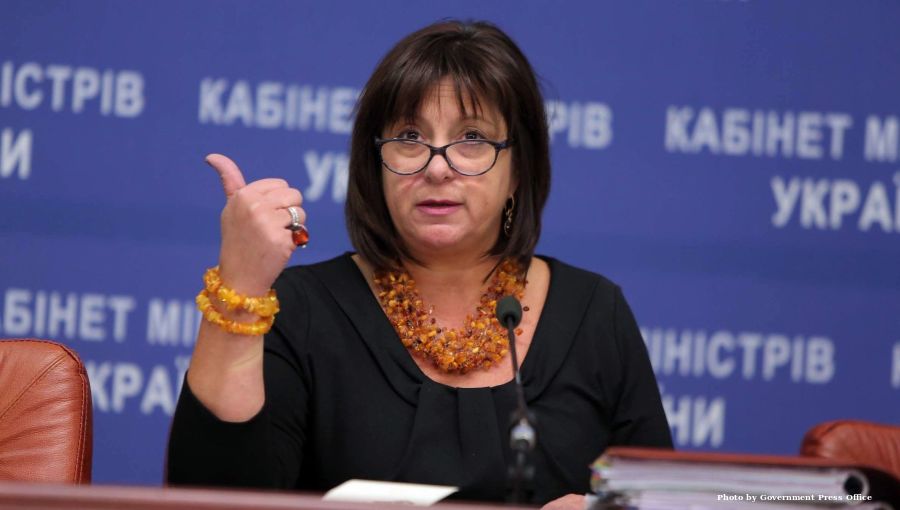 |
| Natalie Jaresko |
Prior to Jaresko becoming Ukraine’s finance minister, she, according to Wikipedia:
…. held several economics-related positions at the US Department of State in Washington, D.C., and eventually coordinated activities of the State Department, the Departments of Commerce, Treasury, the United States Trade Representative, and Overseas Private Investment Corporation (OPIC) in their economic relations with the Soviet Union and its successors. As part of her work she interacted with the International Monetary Fund, World Bank, and the European Bank for Reconstruction and Development. Later from 1992 to 1995, she was the first Chief of the Economic Section of the U.S. Embassy in Ukraine, responsible for strengthening economic cooperation between the two countries.[8] In 2003 she was awarded the Ukrainian Order of Princess Olga for her contributions to the Ukrainian economy.
Between 2005 and 2010 Jaresko was a member of President Viktor Yushchenko’s Foreign Investors Advisory Council and the Advisory Board of the Ukrainian Center for Promotion of Foreign Investment under the auspices of the Cabinet of Ministers of Ukraine.
So what is Jaresko up to as finance minister of Ukraine?
She is about to take control, for herself, of Datagroup, the Ukraine telecom company that controls 85% of the Ukranian telecom market.
Datagroup is owned by Oleksandr Kardakov but his personal empire has collapsed due to foreign currency loan debt.
Foreign loan debt is an old muscle trick of economic hit men (SEE John Perkins, Confessions of an Economic Hit Man). Banksters and international global financial organizations (think the World Bank) load up third-world governments with debt that can’t possibly be repaid and they go in to pick off the juicy meat when the third-world governments can’t make the debt payments.
The loans to Kardakov were a spin-off on the basic maneuver. With Nuland fomenting revolution and turmoil in Ukraine, the Ukranian currency, the hryvnia, has collapsed on foreign exchange markets.

This has made it impossible for Kardakov to pay off his US dollar-denominated loans.
Enter Jaresko.
Ukraine Today reports:
In late February, the company began its liquidation procedure. The company’s other major asset – ‘Datagroup’ telecom operator – may soon be sold out to pay off debts. It may be purchased by its current minority shareholder – investment company ‘Horizon Capital’, co-founded by Ukraine’s current Finance Minister Natalie Jaresko.
Robert Wenzel is Editor & Publisher at EconomicPolicyJournal.com and at Target Liberty. He is also author of The Fed Flunks: My Speech at the New York Federal Reserve Bank. Follow him on twitter:@wenzeleconomics
Featured Video

New positive ivermectin evidence
or go to
Aletho News Archives – Video-Images
From the Archives
Fanatical Followers of the Covid Regime: A Jim Jones-Style Cult?
By Professor Roger Watson and Dr. Niall McCrae | The Daily Sceptic | November 15, 2021
As scholars at leading British universities over recent decades, we witnessed the replacement of critical thinking and debate by narrative: facts are discrimination and scientific method is imperialism; truth, instead, is derived from ‘progressive’ values. This educational trend may be a major contributory factor to the ease in which society has been inculcated to the Covid ‘new normal’ of masking, testing, and repeated doses of vaccines for a disease of similar risk to severe influenza.
One doesn’t need much critical reasoning to observe the flawed logic of some vaccination enthusiasts, such as people who respond to experiencing any side effects, however debilitating, by saying “at least I know it’s working”, or, after contracting the disease despite their promised inoculation (over 90% effective, according to initial drug company claims), “I’d have been worse off without the jab.” … continue
Blog Roll
 Aletho News
- ‘Grave, alarming’: Iran mission on Trump’s UNGA ‘annihilation’ threats
- Najaf airport to reopen to Iranian flights within 24 hours: Ambassador
- From ‘How Will This End For Iran’ to ‘When America Walks Away’: A tale of two Economist covers
- Tehran blasts ‘baseless’ speculation linking Iran to alleged bomb plot at UK air base
- The Rise And… Rise Of ‘Color Revolutions’
- The Coming GOP Bloodbath?
- Arctic Scare Stories Melt Away
- Wrong, Euronews: Climate Change Has Not Created a Food, Energy, and Economic “Meta-Crisis”
- New positive ivermectin evidence
- Met Office Caught Fabricating Daily Temperature Record Claims
- If Americans Knew
- Netanyahu Asked UAE Leader to Deny Report on Oct. 7 Warning in Secret Visit, Sources Say
- CNN Chief Int’l Correspondent Clarissa Ward on Journalists in Gaza
- Democratic Party Consultants Surround Troy Jackson with Pro-Israel Donors
- Christian Leader Responds To Netanyahu’s Claims Regarding Palestinian Christians
- In Gaza, ‘Whoever Survives the Bombing Won’t Survive the Rubble’
- Israel kills more Palestinians, amid push to resettle Gaza – Daily Update
- Israel forces Gazans to live in constant peril – Daily Update
- Deconstructing Netanyahu’s pants-on-fire UN rant – Daily Update
- Trump betrayed voters with his campaign lies and prioritized a foreign country once he took office
- Netanyahu calls Israel’s war in Gaza ‘opposite of genocide’ in UN speech to near-empty hall
- No Tricks Zone
- New Study: Earth And Venus Surface Warmth Largely Explained By Convection And Lapse Rate, Not CO2 Or Radiation
- 2025 Nature Paper Claiming Worsening Global Drought Gets RETRACTED …Heavily Flawed
- New Study: ‘Global Drought Shows No Detectable Recent Acceleration Under Climate Warming’
- Economic Masterminds: German Socialists Suggest Taxing Productivity Gains Stemming From Using AI
- The South China Sea Has Not Been Cooperating With The Climate Change Narrative
- Energy Crisis: Germany Enters Heating Season With Historically Low Gas Reserve Fill Levels
- New Study: The Antarctic Ice Sheet Gained Mass From 2020-2024 Due To Staggering Snow And Ice Accumulation
- Study: Ocean Heating Rates From Thousands Of Years Ago ‘Dwarf’ Modern Ocean Heating Rates
- Climate Extremists Target, Attack Large-Scale Power Grid Infrastructure In Germany!
- New Study: Antarctic Ice Melt Has Contributed Less Than 1 Centimeter To Sea Level Rise In The Last 30 Years

