Human resources: Walmart hired Lockheed Martin to keep tabs on employees
RT | November 25, 2015
Walmart hired global security giant Lockheed Martin a few years ago to monitor activism in its massive workforce, according to new documents. The defense contractor tracked employees’ social media and reported protest participation to the retail giant.
Lockheed Martin, the world’s largest defense contractor, provided Walmart, the world’s largest retailer, with intelligence-gathering and surveillance services in 2012, according to a lengthy report by Bloomberg Businessweek. The news has emerged just before Black Friday protests by a union-funded group called OUR Walmart, the report claims. Participants demand higher wages and reliable scheduling for Walmart employees.
While Walmart publicly dismissed the demonstrations as “just another union publicity stunt,” their subsequent actions indicate that they took it seriously. In addition to hiring Lockheed Martin to keep tabs on employees’ social media feeds, the companies ranked stores by labor activity and monitored employees who were known to be involved in labor activism, according to Bloomberg.
The defense contractor offers a product called LM Wisdom, which is marketed as a tool for fighting drug and human trafficking, but which Walmart used to track employees in 2012 and 2013. Lockheed Martin analysts would follow the Twitter and Facebook feeds of workers and then report information about labor activism back to the company’s corporate headquarters. The defense contractor also put together a map of likely routes for five “Ride for Respect” bus caravans that were sent to HQ to demonstrate.
In one of the documents obtained, when asked about the company’s relationship with Lockheed Martin, Walmart Senior Vice President of Labor Relations Karen Ann Cassey said that the company was even “partnering with the FBI/the Joint Terrorism Task Force” to monitor protesters that planned to go to the company’s headquarters, saying that similar protests have become violent.
Walmart didn’t comment on the specific allegations in the Bloomberg story, but sent a statement via email arguing that the measures had been taken to protect their shoppers, employees and business.
“Unfortunately, there are occasions when outside groups attempt to deliberately disrupt our business and on behalf of our customers and associates we take action accordingly,” the statement reads.
Bloomberg retrieved the information on Lockheed Martin’s labor-monitoring services by acquiring documents ahead of a National Labor Relations Board hearing. The case concerns Walmart’s alleged history retaliation against employees who protested against the retailer.
Earlier this year, Walmart announced that its company-wide minimum wage would go from $9 in 2015 and [to] $10. While OUR Walmart touts this wage increase as a victory, they remain steadfast in their demand for a minimum of $15 an hour. The group will be protesting this Black Friday for the fourth year in a row.
READ MORE: Walmart accused of dodging US taxes by storing $76 billion in assets abroad
Argentina: Mauricio Macri’s Dubious Dictatorship Ties
teleSUR English | November 23, 2015
 The election of Mauricio Macri in Argentina’s presidential race comes as a welcome victory to the country’s business elite and right-wing parties across Latin America, but the president-elect has some dubious ties that could signal a lasting legacy in the new head of state of darker times in Argentina.
Macri has been particularly criticized for his indirect ties to the last military dictatorship in Argentina in the late 1970s and early 1980s that cracked down on left-wing activists and political opposition.
While many of Macri’s powerful economic backers and corporate allies propped up the dictatorship that benefited them economically, Macri’s closest ties to the dictatorship are through his own family business Macri Society, known as Socma.
Macri, a long-time business magnate and former mayor of Buenos Aires, has been a director of his father’s Socma corporate conglomerate since a young age. The Macris are one of Argentina’s wealthiest families, and Socma was among the companies that directly benefited from the dictatorship.
In 1973, prior to the 1976 military coup that ousted the civilian Peronist government of President Maria Estela de Peron and installed a dictatorship, Socma owned seven companies. When the dictatorship ended 10 years later, in 1983, the Socma corporate empire had expanded to 46 companies.
Among Socma’s dozens of companies were various businesses that benefited the Macri family economically by providing services to the dictatorship regime, such as the solid waste management company Manliba, privatized under the dictatorship in 1979, and the postal company Correo Argentino, later nationalized in 2003 under former President Nestor Kirchner.
Macri also showed his sympathies for corporate complicity in dictatorship-era abuses earlier this year when he and his party opposed a government move to end impunity for dictatorship supporters.
Argentina’s Parliament decided in September to launch an investigation into how people and businesses participated in crimes committed by the 1976-1983 dictatorship. While the vote passed by a wide margin of 170-14, Macri and his Republican Proposal Party made up the minority of lawmakers opposing the bill.
The U.S.-backed Dirty War disappeared between 7,000 and 30,000 people in Argentina under the dictatorship regime.
Argentina’s right-wing newspaper La Nacion, which supported the dictatorship, hailed Macri’s election as signalling an end to “revenge” for the dictatorship years.
“The desire for revenge should be buried once and for all,” a La Nacion editorial said on Monday following Macri’s victory. The editorial referred the end to a “culture of revenge” under the governments of Nestor Kirchner and Cristina Fernandez in reference to their efforts to seek truth and justice for dictatorship-era crimes, including Kirchner’s 2003 repeal of amnesty laws for crimes against humanity.
Macri’s election marks the first victory for the country’s right-wing business elite through electoral means rather than military coup. He will be the third non-Peronist head of state in the more than three decades since the end of the dictatorship.
Right-Wing Alliances in Latin America
While corporate elites and dictatorship-supporters celebrate Macri’s election in Argentina, right-wing organizations across Latin America also welcome his victory as a win for their neoliberal political project in the region.
Macri has already made his foreign policy plans clear, vowing to reshape international ties to strengthen relations with the United States and European Union while requesting that Venezuela be suspended from the South American regional bloc Mercosur.
Macri’s relationship with the United States has been demonstrated in leaked diplomatic cables, published by WikiLeaks, in which he accused the U.S. of being “too soft” on the Kirchner governments and called on the U.S. to crack down on Cristina Fernandez de Kirchner.
Macri’s stance against the Venezuelan government was also clearly solidified when Lilian Tintori, wife of Venezuelan opposition leader Leopoldo Lopez, took to the stage with Macri during his victory celebration on Sunday night. Tintori hailed Macri’s win as the start of “political change in Latin America and Venezuela’s opposition was “delighted” by Macri’s win, Reuters reported.
Many of Macri’s supporters are those who hope to reinvigorate neoliberal free trade politics in Latin America and roll back the regional integration projects launched by former Venezuelan President Hugo Chavez.
For example, the Argentine think tank Thinking Foundation, focused on developing projects and strategies to get Macri’s party elected, has collaborated with the Spanish FAES Foundation, which promotes neoliberal politics and has strong ties to Spain’s conservative People’s Party.
The Thinking Foundation is also part of the Atlas Foundation, which in turn is part of the global Atlas Network, a think tank that promotes neoliberal free trade and market-based public policy through over 400 member think tanks worldwide.
Macri’s Majority Pro-Kirchner Opposition Government
Macri’s plans to shift Argentina to the right may still face resistance. The president-elect will be forced to govern without majority support from Congress.
In the Argentine Senate and House of Representatives, the majority of lawmakers are not representatives of Macri’s Let’s Change coalition, but of the pro-Kirchner alliance Front for Victory that backed Daniel Scioli’s bid for president. Of 257 seats in the Lower House, 114 are held by the Front for Victory. In the Senate, 42 of 72 senators are Front for Victory officials.
The era of “Kirchnerismo” under Cristina Fernandez and Nestor Kirchner may have come to an end with Macri’s election, but the Peronist movement that has long fought for social justice in Argentina now forms the official opposition.
While change under Macri is certain, the question that remains is what the long-term legacy of the Peronist movement and Kirchner governments will be in Argentina and Latin America.
Global gas demand to grow 32% by 2040 – Putin
RT | November 23, 2015
World demand for gas is growing faster than any other energy source, and will grow by a third in the next 25 years, according to Russian President Vladimir Putin.
“The growing demand opens up great opportunities for increasing production and exports of gas. At the same time, it’s a major challenge, because there’s a need to dramatically accelerate the development of new deposits, modernize the refining capacities, expand gas transportation infrastructure, bring into operation additional pipelines and make new LNG routes”, said Putin at a Gas Exporting Countries Forum in Tehran on Monday.
According to Putin, Russia seeks to increase its gas output by 40 percent by 2035, reaching 885 billion cubic meters. One of the biggest tasks ahead of Russia is to boost the supplies of gas to China, India and other Asian countries from the current 6 percent to 30 percent, said Putin. Kremlin also intends to triple the LNG supplies. He added that Russia would be able to deal with all these tasks.
During his visit, Putin is meeting with Iranian leaders. He’s talked to Supreme Leader Ali Khamenei about energy cooperation, Syria and other key issues. Putin’s also meeting Iran’s President Hassan Rouhani.
Cheap Gas Is Killing Nuclear Power, and the Outlook is Grim
Nuclear’s greatest hope may be the ‘Clean Power Plan’
By Thomas Overton – POWER magazine– 11/17/2015
Another month, another premature nuclear plant retirement.
About two weeks ago, Entergy finally threw in the towel on the James A. FitzPatrick Nuclear Power Plant in Scriba, N.Y., a move that came as a surprise to exactly no one who has been paying attention to the merchant nuclear business in the U.S. the past few years. FitzPatrick joined the long-troubled Pilgrim plant in Plymouth, Mass., which Entergy gave up on in October, and Vermont Yankee, which it shut down in late 2014.
Since the end of 2012, the U.S. has lost an astonishing eight nuclear reactors to premature retirements: Kewaunee, San Onofre (2), Crystal River, and Vermont Yankee (all now shut down); FitzPatrick (retiring in late 2016); and Pilgrim and Oyster Creek (both retiring in 2019, well ahead of their planned lifetimes).
Several other reactors are on life support. Exelon’s R. E. Ginna plant in Ontario, N.Y., has been fighting to secure a rate support agreement that would keep it running a few more years, while the company’s Quad Cities and Byron plants got a reprieve after they unexpectedly cleared PJM auctions this fall. Industry observers see anywhere from five to 10 other plants as being at risk of premature retirement.
Death Knell?
What’s remarkable about this trend is how it’s come about not from government pressure or mandates as in Germany or Japan—where nuclear is also in retreat—but from pure market pressures. In mid-2013, I wrote a post asking, “Is Cheap Gas Killing Nuclear Power?” Two years later, I’m prepared to answer that question in the affirmative.
In the case of Pilgrim, FitzPatrick, and Vermont Yankee, Entergy specifically named wholesale power prices driven to record low levels by cheap shale gas as one factor in its decisions. As my colleague Kennedy Maize has noted, observers now strongly suspect that Entergy is planning to exit the merchant nuclear business altogether—because it’s clearly become a big money-loser.
If you look at the list of retired and most at-risk plants, one common element jumps out immediately. Most of them exist in deregulated markets where power prices are largely set by the price of natural gas: ISO-New England (Vermont Yankee and Pilgrim), New York ISO (FitzPatrick and Ginna), and PJM (Oyster Creek, Byron, and Quad Cities). The other two plants, San Onofre and Crystal River, operated in more regulated markets, and while both were retired because of mechanical defects that were too expensive to repair, competition from gas-fired generation factored into both decisions to some degree.
Since 2012, when the problems for merchant nuclear really began, natural gas spot prices have stayed below $4/MMBtu except for a brief period last year, when a bitterly cold winter led to low stocks that pushed things up for a few months.
Since then, prices have fallen consistently, flirting with sub-$2 levels this fall. With gas in storage hitting a record high at the end of this year’s injection season, a repeat of 2014 seems unlikely. Meanwhile, gas production hit another record high in August at 81.3 Bcf/day. None of this, according to Energy Information Administration projections, seems likely to change in the short term, as production stubbornly continues climbing ahead of demand growth.
Where is nuclear still viable? That’s best answered by looking at the three states where a total of five nuclear plants are under construction: Georgia, South Carolina, and Tennessee. The common denominator there is clear. All three projects are being built in tightly regulated markets where the utility building them enjoys a government-sanctioned monopoly and the ability to recover costs in advance of operation.
Killing Nuclear
The problem for nuclear is that momentum in the electricity markets over the past couple of decades has been toward flexibility and competition and away from monopolies and subsidies.
At the state level, attempts by Exelon and others to secure changes in the law to provide greater support for nuclear have been given the cold shoulder, while solar advocates are prying open previously closed markets like the Carolinas and Florida. Despite the challenges for merchant nuclear plants, no states are even considering an exit from problematic wholesale power markets, and independent system operators like PJM have shown no interest in rigging the game for nuclear either.
At the federal level, the Production Tax Credit and Investment Tax Credit, which provided enormous support for renewable generation, appear on their way out one way or another. The odds that the current Congress might pass some sort of nuclear production credit (an idea I mentioned in my 2013 post) would seem to be close to zero.
Nuclear’s greatest hope may be the Clean Power Plan (CPP)—which was revised in its final form to give more credit to nuclear generation—but that is far from a done deal. Even if the Democrats retain control of the White House in 2016, control of Congress is another matter, and the Supreme Court could still throw out or handicap the CPP on a variety of grounds.
Cheap gas is not going away. Greater state-level regulatory support seems highly unlikely. Even if the CPP survives in its current form, it won’t substantially change the economics of merchant nuclear.
The impending loss of nuclear generation presents a problem for a variety of reasons. Loss of generation diversity is never a good thing, and the loss of low-carbon electricity will complicate efforts to reduce carbon dioxide emissions. But the solution remains elusive.
—Thomas W. Overton, JD is a POWER associate editor (@thomas_overton, @POWERmagazine).
Climate talks in Paris: India to stay firm on use of coal
By Amitabh Sinha | The Indian Express | November 19, 2015
While India has embarked on an ambitious renewable energy pathway, coal is likely to remain its primary source of energy for the next couple of decades at least.
India will not agree to any proposal at the climate change negotiations that will seek to restrict the use of coal as a source of energy in the near term, a key member of the country’s negotiating team said on Wednesday.
More than 190 countries will gather in Paris later this month for a two-week annual climate change conference that is expected to deliver a global agreement this year.
“We cannot agree to any proposal that will restrict our ability to generate energy from coal or inhibit our efforts to ensure energy access to all our people in an accelerated manner,” Ajay Mathur, director general of Bureau of Energy Efficiency, told The Indian Express.
While India has embarked on an ambitious renewable energy pathway, coal is likely to remain its primary source of energy for the next couple of decades at least.
In a recent projection, the government had said it hoped to bring down its dependence on coal for electricity production from the current 61 per cent to 57 per cent by 2031-32. By that year, the contribution of renewable energy — solar, wind and biogas — in total electricity generation was projected to grow to 29 per cent from the current 12 per cent.
“There is no looking away from it. Coal is going to remain India’s primary source of electricity generation for some time. We cannot agree to anything that restrains us from using coal,” he said.
Mathur said that in Paris, India will ask for a more stringent international mechanism to ensure that the developed countries deliver on the commitments they have made to reduce their greenhouse gas emissions. In the last few months, countries have submitted their climate action plans — steps that they intend to take to deal with climate change — up to the year 2032. There is debate over the mechanism to be adopted to assess whether all the actions are consistent with the objective of keeping the rise of global average temperatures within 2 degree celsius compared to pre-industrial times.
The climate change negotiations accept a principle of differentiation in the responsibilities of developed and developing countries in dealing with climate change. Mathur said this differentiation must extend to the compliance process as well.
“The assessment of the developed countries’ actions must be subjected to a stronger review as compared to other countries,” Mathur said.
Colombia: 300 Campesino Leaders Killed in 2015

Campesino leaders say the government is criminalizing their movements and does not protect their rights. | Photo: @marchapatriota
teleSUR – November 21, 2015
At least 300 campesino leaders have been killed in Colombia in 2015, according to Andres Gil, human rights leader and spokesperson of the Marcha Patriotica.
Many of these deaths have come as campesino leaders are attempting to defend their land and their natural resources. Another 7,000 campesino leaders have been jailed.
Land distribution in Colombia is extremely unequal. Less than 1 percent of the population owns roughly half of the land, and 70 percent of the population owns only 5 percent of the land. Campesinos who fight for their land are often risking their lives.
At least three campesinos leaders where killed just in the last two weeks, including the young Afro-descendent leader Jhon Jairo Ramirez Olaya in the Valle region; the environmental and campesino leader Daniel Abril, in the Orinoquia region; and the representative of Afro-descendent victims from Cordoba, Luis Francisco Hernandez Gonzales.
Another young campesino leader allegedly killed by the armed forces last Friday, according to Marcha Patriota.
According to Verdad Abierta — an investigative project on the armed conflict of Colombia’s Semana magazine — Abril accused various state officials of corruption, and was fighting against multiple oil corporations with extensive land interests.
Feliciano Valencia, another indigenous leader from the region of Cauca who was controversially sentenced to 18 years in jail, was also victim of a homicide attempt on Tuesday, as four men opened fire on his home, according to local social organizations.
Still in Cauca, in the end October, the armed forces were recently involved in the murder of indigenous leader Alfredo Bolaño, the 58th victim from security forces in the region, one of the most affected by violence because of its highly fertile lands.
On Friday, the Colombian army killed one campesino and wounded five others after it raided a rural area in what military officials said was an effort to “manually eradicate” illegal coca crops.
According to the local community, the armed forces opened fire on a peaceful march last Thursday in Argelia, Cauca.
The country’s ombudsman Fabian Laverde told teleSUR that this issue was rooted in several causes.
“First, the national government refuses to recognize the existence of paramilitarism. Second, the complaints from the social movements made about situations of threats or concrete actions against residents of these territories have been completely ignored,” he said.
Why Boycott Coca Cola?
US Palestinian Community Network | January 31, 2015
In 2005, Palestinians issued a call for a campaign of boycotts, divestment and sanctions (BDS) against Israel, because of its violations of international law and attacks on Palestinian rights. BDS is now a worldwide movement against Israeli Apartheid, and USPCN wants to work with you to target Coca-Cola, as our contribution to the campaign. Do not contribute to helping Zionist Israel steal and occupy more Palestinian land. Do not contribute to helping Israel continue its colonization of Palestine, and its suppression of Palestinian rights. With every single penny you spend on Coca-Cola, you are indirectly contributing to Israel’s crimes.
Why Boycott Coca-Cola?
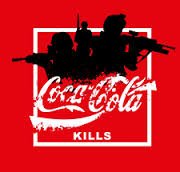 The Central Bottling Company (Coca-Cola Israel), an Israeli company that manufactures and distributes CocaCola in Israel, has subsidiaries in the illegal settlements of Katzrin (in the Syrian Golan Heights) and Shadmot Mechola (in the Besan Valley, northeastern tip of the West Bank). The company also owns Tara, whose subsidiary, Meshek Zuriel Dairy, has a dairy farm in the occupied section of the Jordan Valley. In return for $55 million in tax breaks, Coca-Cola built a plant in Qiryat Gat, which sits on stolen land (the villages of Al-Falluja and Iraq al-Manshiya) in 1948 Palestine. The residents were ethnically cleansed in 1949, in contravention of International Law. In October 2005, Coca-Cola increased its investment in Israel by buying a 51% controlling interest in the Tavor Winery. Tavor Winery is an Israeli company based on occupied Palestinian land, at the foot of Mount Tavor, overlooking the Sea of Galilee.
The Government of Israel Economic Mission honored Coca-Cola at an Israel Trade Award Dinner for its continuous support over the previous 30 years, and for “refusing to abide by the Arab League economic boycott of Israel.” (from The Southern Shofar—American Jewish newspaper of Alabama).
Environmentalists have long criticized Coca-Cola for posing a serious threat to communities across the world. In India, the Mehdiganj Coca-Cola plant was recently closed by Indian officials, because of its over-utilization of natural water resources, which depleted the local groundwater and released pollution above legal limits.
Coca-Cola, which has always been strongly anti-union, is involved in the intimidation, kidnapping, torture, and murder of union leaders in Latin American, especially for years in Colombia. Labor unionists there have constantly been under threat from paramilitary death squads supported by Coca-Cola.
Businesses in Turkey and India are shunning Coca-Cola over the current Israel – Gaza conflict, according to several news sources.
The Coca-Cola conflict comes as part of the boycott movement targeting Israeli goods and those companies that do business in Israel. Coca-Cola has had a bottling plant in Israel since the 1960s, Haaretz reported.
Pepsi, which left Israel during the Cold War in response to the Arab boycott, has also been spurned in this bout of intensified boycotts.
In Mumbai, India, Muslims called for a boycott of PepsiCo, Kraft Foods Group, and Nestle in addition to Coca-Cola, the Jakarta Globe reported.
Omar Shaikh, a restaurant owner in Mumbai, said “This is our way of showing our anger against Israel. For us, Coke and Pepsi is human blood. They are financing the war against Palestine.”
Transdniestria says its relations with Chisinau keep on deteriorating
TASS – November 17, 2015
TIRASPOL – Relations between Moldova and Transdniestria keep on deteriorating, Transdnieastria’s acting Foreign Minister Vitaly Ignatyev said on Tuesday at a meeting with Special Representative of the acting OSCE Chairman-in-Office for the Transdnistrian settlement process Radojko Bogojevic.
“The Moldovan side is seeking to evade contacts with Transdniestria,” he said. “Osipov [Moldova’s negotiator – TASS ] keeps on refusing to take part in talks in the bilateral format citing Moldova’s having no government as a reason. The dynamics of meetings of joint expert groups is very low as well.”
He said the two sides have accumulated a lot of problems in their relations. The most pressing of them, in his words, were Moldova’s and Ukraine’s decision to install joint customs control at the border with Transdniestria and criminal prosecution of Transdniestria’s officials.
Moldova’s acting Deputy Prime Minister Viktor Osipov said on Monday the talks between Moldova and Transdniestria were failing to yield any progress due to a gap in the parties’ positions. “Chisinau invited to discuss political issues, including a future status of unrecognized Transdniestria within Moldova, whereas Tiraspol says a certain atmosphere is needed for that,” he said after talks with Bogojevic. “We consider it as a violation of our earlier agreements. It is inadmissible to lay any conditions for the beginning of talks.”
Bogojevic, for his part, noted that Germany, which takes over presidency in the Organization for Security and Cooperation in Europe (OSCE) in 2016, will be tasked to get Moldova and Transdniestria back at the negotiating table in the 5+2 format. He admitted that despite all the efforts, the Serbian presidency in the OSCE had failed to resume the settlement talks. He said he had arrived in Moldova to prepare an OSCE ministerial meeting due in December and to prepare the ground for Germany’s presidency, which would have to deal with that problem.
Talks in the 5+2 format, involving Moldova and Transdniestria as parties to the conflict, the OSCE as a mediator, Russia and Ukraine as guarantors and the European Union and the United States as observers, have been stuck for the second year. Only two out of five scheduled meetings were held in 2014. Earlier, Transdniestrian leader Yevgeny Shevchuk said that Tiraspol could resume the talks in the extended format only on condition relevant documents were prepared. “I don’t see perspectives for holding a meeting in the 5+2 format unless expert groups prepare solutions that might ease the situation,” he said, adding that Moldova’s policy of pressure and economic sanctions “exerted jointly by Moldova and Ukraine” were hampering the negotiating process.
Corporate Sycophants and the TPP
By Yves Engler | ricochet | November 13, 2015
The hypocrisy of “free market” advocates is astounding. While they trumpet increased competition and the elimination of state imposed barriers as a means of spurring economic advancement, they ignore how the Trans Pacific Partnership (TPP) and other “free trade” accords increase monopolistic intellectual property provisions.
In a recent CTV interview on the TPP Carleton business professor Ian Lee began by saying we’ve known for three centuries that “free trade” increases wealth while a Maclean’s editorial “celebrating” the accord noted “as with most things, the best sort of trade is free: free from tariffs, restrictions and other government-imposed barriers.”
But the TPP significantly strengthens many “government imposed barriers” to free exchange. The recently negotiated accord harmonizes intellectual property provisions upwards across the 12 nation zone. In Canada the deal will increase the length of copyright from 50 to 70 years after the death of an author. It will also increase (corporate) copyright holders’ capacity to compel Internet Service Providers to block content on websites and to pursue individuals who transfer content they own between devices or upload/repost highlights from trademarked work such as professional sports.
The TPP will also extend drug patent protections. Brand-name pharmaceutical companies in Canada will be given patent term restoration to compensate for time lost during the drug approval process.
In some other TPP countries the patent extensions will be even greater, along with the resulting social costs. Médecins Sans Frontières warns that “the deal will further delay price-lowering generic [drug] competition by extending and strengthening monopoly market protections for pharmaceutical companies.”
Intellectual property is also listed as an asset under the Investor State Dispute Settlement section of the agreement. This will give patent or copyright holders the ability to sue governments – in a private, investor-friendly international tribunal – for pursuing policies that interfere with their profit making. Techdirt editor blog Mike Masnick notes, “including intellectual property in the investment chapter is a poison pill designed to ensure that intellectual property can only continue to ratchet up, rather than back.”
And, one might ask, what does extending patent, trademark or copyright provisions have to do with free trade? In fact, as a type of monopoly, they stifle competition, which is supposed to be a pillar of free trade ideology.
The TPP isn’t the only “free trade” agreement that promotes anti-competitive monopolies. The Canada-Europe Comprehensive Economic and Trade Agreement (CETA) gives patent holders the ability to appeal overturned patents, increases patent data protection terms and grants patent term restoration for any time lost during the approval process. The extension of Canadian patents under the yet to be signed CETA is expected to drive up already high pharmaceutical drug costs in this country by between $850 million and $1.65 billion a year, according to a Canadian Centre for Policy Alternatives study. This far surpasses the $225 million Canadian companies paid in tariffs to the EU in 2013.
To a lesser extent, other “free trade” accords such as the World Trade Organization and North American Free Trade Agreement also strengthened intellectual property monopolies. With patents, trademarks and copyright ever more important to big corporations, there’s been heavy pressure to extend intellectual property systems.
While the Maclean’s editors denounce “government imposed barriers”, they ignore how the TPP and similar agreements they promote extend state designated monopolies. I guess it’s preferable to consider oneself a “free marketer” rather than a “sycophant of corporate power”.
Unmasking the GMO ‘Humanitarian’ Narrative
By Colin Todhunter | CounterPunch | November 13, 2015
Genetically modified (GM) crops are going to feed the world. Not only that, supporters of GM technology say it will produce better yields than non-GM crops, increase farmers’ incomes, lead to less chemical inputs, be better suited to climatic changes, is safe for human consumption and will save the lives of millions. Sections of the pro-GMO lobby are modern-day evangelists who denounce, often with a hefty dose of bigoted zeal, anyone who questions their claims and self-proclaimed humanitarian motives.
But their claims do not stack up. Even if some of their assertions about GMOs (GM organisms) appear to be credible, they are often based on generalisations, selective data or questionable research and thus convey a distorted picture. The claims made about GMOs resemble a house of cards that rest on some very fraudulent foundations indeed (see ‘Altered Genes and Twisted Truth’ by Steven Druker).
The fact that many of the pro-GMO lobby spend a good deal of their time attacking and smearing critics and flagging up the technology’s alleged virtues while ignoring certain important issues says much about their priorities.
If they care about farmers so much, indeed if they value food security, choice and democracy so much – as they frequently claim to – why do they not spend their time and energy highlighting and challenging the practices of some of the corporations that are behind the GM project and which have adversely impacted so many across the world?
For instance, consider the following.
1) There is a massive spike in cancer cases in Argentina which is strongly associated with glyphosate-based herbicides – a massive earner for agribusiness. Not only that but throughout South America smallholders and indigenous peoples are being driven from their lands as a result of a corporate takeover aimed at expanding this type of (GM) chemical-intensive agriculture. The outcome has been described as ecocide and genocide.
2) GM technology has not enhanced the world’s ability to feed itself and has arguably led to greater food insecurity (also see this).
3) Petrochemical, industrialised agriculture is less productively efficient than smallholder agriculture. However, the latter is being squeezed onto less and less land as a result of the expansion of corporate commodity crop farming and the taking over of fertile land by institutional investors and agribusiness concerns. As a result of this, the world is in danger of losing the ability to feed itself. Across the world, not least in Asia, peasant farming is being dismantled in favour of this type of corporate agriculture, which is unsustainable and associated with cancers, water contamination, soil degradation and falling water tables.
4) This is a model that from field to plate is causing obesity, diabetes and various other ailments and diseases. Facilitated and supported by trade agreements like NAFTA, people’s quality of food is being sacrificed and local farming devastated (see this to read about the situation in Mexico).
5) In India, 300,000 farmers have committed suicide over the past 20 years as farming has deliberately been made financially non-viable. The aim is to displace hundreds of millions who rely on agriculture to make a living and free up land for Western agribusiness to reshape farming. As NAFTA has done to Mexico, the agribusiness-backed Knowledge Initiative on Agriculture seems likely to do to India. The aim is to dismantle Indian agriculture for the benefit of corporate agribusiness.
We now witness grass-root responses to what is outlined above on a daily basis: farmer protests on the streets of Delhi and local movements from Ghana to Brazil resisting the corporatization of seeds, land, water, food processing, food retail and decision making/regulatory processes.
We also see the wrecking of traditional, productive rural economies and the attack on indigenous knowledge at the behest of global agribusiness, facilitated by compliant politicians. If corporate aims cannot be achieved via trade agreements or the machinations of international institutions like the WTO (whose rules agribusiness shape), they are sought on the back of war or through strings-attached loans as is the case in Ukraine. Objectives are sought by various means.
The world can feed itself without GMOs. It is current policies and the global system of food production that militate against achieving global food security and which contribute towards hunger and poverty. No amount of gene splicing can rectify this.
How convenient it is for sections of the pro-GMO lobby to ignore, side-line or dismiss all of the above and offer a techno-fix supposed panacea that comes courtesy of the same companies whose practices are helping to undermine food security and which are fuelling much of the devastation in the first place. It betrays an ideological adherence to a pro-corporate neoliberal agenda.
Instead of attempting to dismiss the issues set out here as being based on ‘romantic twaddle’, the ramblings of wicked ideologues or the fads and inventions of some notional ‘green blob’ red in tooth and claw that hates humanity, science and freedom of choice (all of which have been levelled at critics), it would be better to acknowledge the issues described here and work to address them and challenge the practices that fuel them.
The pro-GMO lobby is fond of trying to discredit its critics and engages in pious, emotive rhetoric. They often ask them: ‘What are you doing to save the lives of millions?’
The question for them is: What are you?
Featured Video

New positive ivermectin evidence
or go to
Aletho News Archives – Video-Images
From the Archives
Fanatical Followers of the Covid Regime: A Jim Jones-Style Cult?
By Professor Roger Watson and Dr. Niall McCrae | The Daily Sceptic | November 15, 2021
As scholars at leading British universities over recent decades, we witnessed the replacement of critical thinking and debate by narrative: facts are discrimination and scientific method is imperialism; truth, instead, is derived from ‘progressive’ values. This educational trend may be a major contributory factor to the ease in which society has been inculcated to the Covid ‘new normal’ of masking, testing, and repeated doses of vaccines for a disease of similar risk to severe influenza.
One doesn’t need much critical reasoning to observe the flawed logic of some vaccination enthusiasts, such as people who respond to experiencing any side effects, however debilitating, by saying “at least I know it’s working”, or, after contracting the disease despite their promised inoculation (over 90% effective, according to initial drug company claims), “I’d have been worse off without the jab.” … continue
Blog Roll
 Aletho News
- EU Council Advances Chat Control 2.0 Scanning Proposal
- Ex-Greek MEP files complaint against Israeli spyware firm over alleged Pegasus surveillance
- Troubling ideas throughout the Torah, Talmud, Mishneh Torah and Tanya
- ‘Grave, alarming’: Iran mission on Trump’s UNGA ‘annihilation’ threats
- Najaf airport to reopen to Iranian flights within 24 hours: Ambassador
- From ‘How Will This End For Iran’ to ‘When America Walks Away’: A tale of two Economist covers
- Tehran blasts ‘baseless’ speculation linking Iran to alleged bomb plot at UK air base
- The Rise And… Rise Of ‘Color Revolutions’
- The Coming GOP Bloodbath?
- Arctic Scare Stories Melt Away
- If Americans Knew
- Netanyahu Asked UAE Leader to Deny Report on Oct. 7 Warning in Secret Visit, Sources Say
- CNN Chief Int’l Correspondent Clarissa Ward on Journalists in Gaza
- Democratic Party Consultants Surround Troy Jackson with Pro-Israel Donors
- Christian Leader Responds To Netanyahu’s Claims Regarding Palestinian Christians
- In Gaza, ‘Whoever Survives the Bombing Won’t Survive the Rubble’
- Israel kills more Palestinians, amid push to resettle Gaza – Daily Update
- Israel forces Gazans to live in constant peril – Daily Update
- Deconstructing Netanyahu’s pants-on-fire UN rant – Daily Update
- Trump betrayed voters with his campaign lies and prioritized a foreign country once he took office
- Netanyahu calls Israel’s war in Gaza ‘opposite of genocide’ in UN speech to near-empty hall
- No Tricks Zone
- New Study: Earth And Venus Surface Warmth Largely Explained By Convection And Lapse Rate, Not CO2 Or Radiation
- 2025 Nature Paper Claiming Worsening Global Drought Gets RETRACTED …Heavily Flawed
- New Study: ‘Global Drought Shows No Detectable Recent Acceleration Under Climate Warming’
- Economic Masterminds: German Socialists Suggest Taxing Productivity Gains Stemming From Using AI
- The South China Sea Has Not Been Cooperating With The Climate Change Narrative
- Energy Crisis: Germany Enters Heating Season With Historically Low Gas Reserve Fill Levels
- New Study: The Antarctic Ice Sheet Gained Mass From 2020-2024 Due To Staggering Snow And Ice Accumulation
- Study: Ocean Heating Rates From Thousands Of Years Ago ‘Dwarf’ Modern Ocean Heating Rates
- Climate Extremists Target, Attack Large-Scale Power Grid Infrastructure In Germany!
- New Study: Antarctic Ice Melt Has Contributed Less Than 1 Centimeter To Sea Level Rise In The Last 30 Years

