After the Default: A Neoliberal Debt Solution For Puerto Rico
Puerto Rico’s debt crisis will likely lead to the privatization of public enterprises including the electrical power authority and the water agency. The proposed solution reflects the application of neoliberal policies as if they were magic recipes for resolving a most complex situation.
By Carlos Marichal | NACLA | August 18, 2015
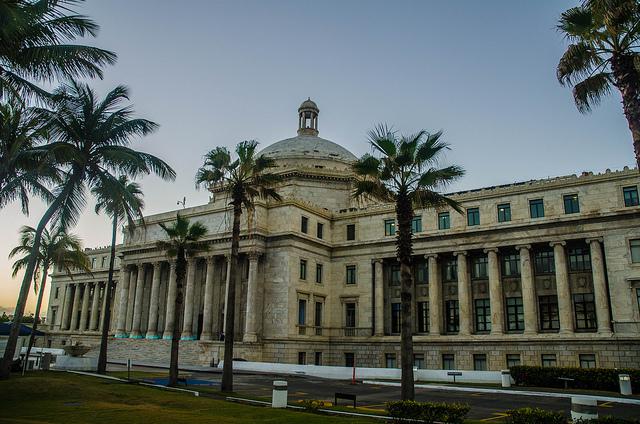
The capitol building in San Juan. Payments on Puerto Rico’s public debt will likely favor large U.S. investment firms at the expense of small local creditors.
(Wayne Hsieh / Creative Commons)
This past June 29, the governor of the Commonwealth of Puerto Rico, Alejandro García Padilla, declared the island’s $72 billion public debt unpayable and said that his government would likely be forced to default on its next round of scheduled payments. A month later, García Padilla’s government did exactly that, paying only $628,000 of the $58 million payment due on its Public Finance Corporation (PFC) bonds.
The inevitability of the default has become a major—and contentious—subject of debate on the island and in the U.S. financial media. New York-based financial information agencies, have warned that the default could pose serious problems for several major U.S. investment firms and money funds. Ominously, the debt crisis also threatens to accentuate the economic and social decline of the island’s population, which has long lived in political, social, cultural, and economic limbo.
In all probability, the fiscal and financial dilemmas faced by García Padilla’s government will be resolved by a proposed debt exchange in which new bonds are issued with terms more favorable to the borrowers—the Puerto Rico financial administration. But not all creditors are likely to be treated equally. The noted Puerto Rican economist, Elías Gutiérrez, has argued that the decision by the Puerto Rican government to suspend payments to PFC bondholders on August 1 was not due to a lack of funds but to the willingness to allow the weakest creditors pay for the lack of foresight shown by fiscal and financial authorities. In other words, the neocolonial relationship between the United States and Puerto Rico will play an important role in the resolution of this crisis.
It is estimated that a significant percentage of PFC bonds were sold to small investors resident in Puerto Rico. The bondholders placed their savings in the public bonds because they had confidence in the longstanding positive debt service record of the Puerto Rican government. Among these small bondholders are cooperatives, small banks, 401K pension funds, retirement funds as well as many individuals.
Gutiérrez argues that the government of García Padilla is following its lawyers’ legal and financial advice, essentially dividing the debtors into separate groups: the most powerful—basically U.S. banks and money funds—which will continue to get full service and payment, while the second group, the weaker local investors, would be forced to accept delays and an unfavorable debt exchange. This outcome is the most likely because big Wall Street firms and banks will take their cases against Puerto Rico to the federal courts and, if precedent is followed, probably win. This has been the case in decisions handed down in recent years by New York courts regarding Argentina’s debt. On the other hand, cooperatives, small savers and Puerto Rican retirees are most likely to lose their cases.
The current Puerto Rican financial crisis is different from the older Latin American debt crises because the public debt incurred by the government of Puerto Rico from 1950 to the 1990s was quite small. Budgets were traditionally balanced and deficits limited. The Government Development Bank, founded in 1942, was long effective in raising finance on good terms for development and infrastructure programs and projects, which helps explain the success of the Puerto Rican economic expansion, at least until the 1970s. The oil crisis of the 1970s hit the local economy hard, but continued emigration to the United States made it possible to avoid social collapse. (While the island now has about 3.5 million inhabitants, there are an estimated five million self-identified Puerto Ricans—either born on the island or of Puerto Rican descent—resident in the United States, with over a million living in New York City.)
Puerto Rico’s public debt began to more closely resemble those in Latin America in the 1990s when the conservative administration headed by Governor Pedro Roselló went on a loan binge, increasing the public debt by over ten billion dollars. Roselló was head of the Partido Nuevo Progresista, which is closely linked to the Republican Party, and while in office led an unsuccessful campaign to make Puerto Rico the 51st U.S. state. He also privatized state companies, reinforced law-and-order programs and negotiated loans for public works that benefitted major companies linked to his party.
Nonetheless, the administrations of the rival Partido Popular, which held office from 2001 to 2009, did not do much better. Aside from accusations of electoral fraud, corruption, and lax handling of public finances, Puerto Rico’s public debt—much of it issued as municipal bonds—rose by another 22 billion dollars.
The champion in the debt game, however, was the conservative government headed by Governor Luis Fortuño between 2009 and 2013, which managed to add on another 17 billion dollars to the public debt in a mere four years. This profligacy is a major cause of the current debt crisis, which cannot simply be ignored, not least because the economy of Puerto Rico has fallen on hard times.
From the 1950s to the late 1970s, Puerto Rico successfully moved away from the old agricultural export model to light industrialization based principally in textiles, and subsequently to investments by U.S. multinationals, particularly in pharmaceuticals and some electronics. This was complemented by expansion of construction and by a tourist boom. But in the 1980s, the economy took a downturn, and unemployment increased.
In the 1990s this trend was temporarily reversed as U.S. companies took advantage of the tax credits available under section 936 of the U.S. Internal Revenue Code, which had been designed specifically to attract mainland investors to Puerto Rico. After 2000, however, these tax breaks were reduced dramatically, and hundreds of factories on the island closed, leading to a notable drop in manufacturing employment and tax income. As a result, local governments increased public spending to maintain the economy and sustain employment.
In recent years, more and more bonds have been issued in large part to refinance the old ones. But the debt game has reached a breaking point. The government of Governor García Padilla recently decided on a new strategy and commissioned a study by former officials at the International Monetary Fund and the World Bank. The officials recommended a debt relief program which includes exchanging old bonds for new ones with a longer period of amortization and lower interest rates.
According to a confidential copy obtained by The New York Times, one of the chief authors of the report, Anne O. Krueger, a former chief economist at the International Monetary Fund, commented: “There is no U.S. precedent for anything of this scale or scope.” This document has been baptized the “Krueger Report,” an ironic choice, considering that as vice president of the IMF in 2001, Krueger recommended that Argentina not be given any debt relief, forcing that nation to default.
A likely sequel to the Puerto Rico debt crisis is the privatization of public enterprises including the electrical power authority and the water agency, which in all probability will be declared bankrupt if Governor García Padilla can convince the U.S. Congress to treat them as if they were private companies and to apply Chapter 11 to them. Of Puerto Rico’s $72 billion in bonds, some $25 billion have been issued by public corporations.
As in so many Latin American nations in the 1980s and 1990s, responses to Puerto Rico’s debt crisis entail privatizations and the application of neoliberal solutions as if they were elements of a magic recipe for a most complex situation. In this case, neoliberalism and neocolonialism appear to have much in common.
Carlos Marichal is professor of economic history at El Colegio de Mexico and author of studies on the history of Latin American debts.
Bomb the Budget: US Stealth Bomber Financials Defy Laws of Physics
Sputnik – 19.08.2015
The US Air Force apparently made a ‘slight’ miscalculation worth several billions of dollars regarding the cost of research, procurement and support of its upcoming top-secret long-range bomber, according to media reports.
In 2014, in its annual report to the US Congress, the Air Force estimated the cost of the Long-Range Strike Bomber program between fiscal years 2015 through 2025 would be $33.1 billion. A year later however a similar report contained quite a different figure — $58.4 billion for fiscal 2016-2026.
In an attempt to explain this ‘minor’ discrepancy, Air Force officials claimed that both figures were in fact off the mark, with the correct numbers in both cases being $41.7 billion, according to Bloomberg.
US Air Force spokesperson Ed Gulick said in a statement that the program costs remained stable and that the service “is working through the appropriate processes to ensure” the report, requested by lawmakers is “corrected, and that our reports in subsequent years are accurate.”
The Air Force originally intended to award the development and production contract for the bomber in June or July, but eventually delayed the announcement until September. Currently, two entities, Northrop Grumman and a joint team of Lockheed Martin and Boeing, – are working to secure the contract.
The Pentagon intends to use the new stealth aircraft to bolster its aging bomber fleet. According to the US Air Force’s estimates, it would cost about $55 billion to construct up to 100 of the new bombers, with each aircraft being worth about $550 million.
Fish farms in Gaza counter Israeli restrictions on fishing limit
MEMO | August 17 2015
 Israel’s occupation of the Gaza Strip is ongoing, despite frequent reminders that it “withdrew” its settlers and army posts 10 years ago. Legally and practically it is still the occupying power and it remains inflexible.
For example, Palestinian territorial waters off the coast of the Gaza Strip as defined by the 1982 UN Convention on the Law of the Sea, should extend to 12 nautical miles (22.2 km or 13.8 miles) but the Israeli navy enforces a six mile limit, sometimes even five and a half miles, for Gaza’s fishermen. In addition, the Israeli occupation authorities often make petty and spiteful “security” excuses to reduce the already reduced fishing limit to three miles.
On top of that, Palestinian fisherman are harassed by the Israeli navy on a daily basis; their boats are fired upon, sunk and confiscated, and the fishermen themselves are often arrested if they are not killed or wounded in the process. All of this, of course, has an impact on the amount of fish caught off the Gaza coast, which should be a rich fishing ground. Catching more and larger fish requires sailing into international waters, as fishermen from other countries do.
Palestinian investors in Gaza have thus resorted to fish farming. Speaking to MEMO, Yasser Al-Haj said that he invested in this sector for personal gain as well as to ease the crisis in the Palestinian market. Although it is not regarded as a solution to the crisis, it can alleviate it.
Al-Haj’s newly-opened fish farm only produces one type of fish, sea bream. It is imported from Israel and then raised in this farm and others. He says that his farm produces 7 per cent of the Gaza Strip’s needs and sells about 250kg a day. One kilo of sea bream costs about $12.
For an ordinary middle-class citizen, this price is high, but for a poor citizen it is very expensive, given the average income in the Gaza Strip. The high price is set by many factors, including the price of fish feed from Israel, which is $1,850 per tonne, plus the issue of the power cuts suffered across the territory.
Fish farms require generators to keep the oxygen moving and water pumping continuously in the ponds. Yasser Al-Haj notes that he is unable to breed the fish in the sea because of pollution, which poses a danger to the fish and people who eat them. The sewage processing plants aren’t working due to the power cuts and lack of maintenance resulting from the Israeli blockade.
Images from MEMO photographer: Mohammad Asad
US warns Swiss companies about Iran sanctions
Press TV – August 13, 2015
The United States has cautioned Swiss companies against dealing with Iran until the implementation of the nuclear agreement reached between Tehran and the P5+1 group of countries.
State Department spokesman Mark Toner said on Wednesday that US sanctions against Iran will remain in place until the International Atomic Energy Agency (IAEA) verifies the Joint Comprehensive Plan of Action (JCPOA).
His remarks came after the Swiss government announced that it’s going to lift sanctions against Iran on Thursday.
The Swiss government said it wants the decision to be seen as a sign of support for the Iran nuclear agreement reached in Vienna last month.
“This agreement opens up new political and economic prospects with Iran, including bilateral relations,” the government said in a statement.
The decision underscores Switzerland’s “support for the ongoing process to implement the nuclear agreement, and its confidence in the constructive intentions of the negotiating parties,” it said.
The sanctions had been suspended since January 2014 following an interim nuclear deal between Tehran and the P5+1 group of countries – the US, Britain, France, Russia, China, and Germany.
Other European countries are awaiting the final approval of the conclusion of nuclear talks by Tehran and the P5+1.
The illegal sanctions on Iran were imposed based on the unfounded accusation that Tehran is pursuing non-civilian objectives in its nuclear energy program.
Iran rejects the allegation, arguing that as a committed signatory to the nuclear Non-Proliferation Treaty (NPT) and a member of the IAEA, it has the right to use nuclear technology for peaceful purposes.
Generic Medicines Used to be Cheap… Not Any More
By Noel Brinkerhoff and Steve Straehley | AllGov | August 12, 2015
Disappearing are the days of going to the pharmacy and asking for a generic version of a drug and expecting it to cost a lot less than its name brand equivalent. Consolidation in the generic drug industry has allowed manufacturers to raise prices dramatically.
Only two years ago, the cost of the antibiotic tetracycline in generic form was only $1.50 for pharmacies, according to Steve Hendricks at Truthout. But by 2014, the same drug cost $257.70 … a 17,080% increase. Another antibiotic, doxycycline, went from costing $1.20 to $111 in just six months. That’s an increase of 9,150%.
One of the big players in the generic field is Israeli company Teva Pharmaceuticals. Teva has bought up competitors and as it has done so, it has raised its prices. The company now controls 22% of the generic market.
Teva even bought a name-brand manufacturer, Cephalon, and in doing so became liable to pay a $1.2 billion fine for paying generic companies to give up their rights to manufacture a drug after patent protection expires. “Pay for delay” lets a drug’s originator keep its monopoly longer. Its drug Provigil went from $166 for a month’s supply to $1,001.
Hendricks also cited data from Medicare and Medicaid that showed from July 2013 to July 2014, “the price of half of all generics went up, and nearly 10 percent of them went up by double or more,” he wrote. Among that 10%, the average increase was 448%.
Something that would help cut costs would be giving the federal government the right to negotiate Medicare Part D drug prices. President George W. Bush and the Republican-controlled Congress inexplicably gave up that right when the law was passed in 2003.
To Learn More:
The Rise of Big Generic: Why Knockoff Prescriptions Now Cost $1,200 (by Steve Hendricks, Truthout )
How High? The Backlash Over Rising Prescription Drug Prices Gains Steam (by Ed Silverman, Wall Street Journal )
CVS Health Accused in Suit of Overcharging for Generic Drugs (by Michael Hytha, Bloomberg )
This Hepatitis C Drug, Developed with U.S. Government-Funded Research, Costs $300 per Treatment Course in India… and $84,000 in the U.S. (by Noel Brinkerhoff and Steve Straehley, AllGov )
Six Years After Pro-European Revolution Moldova Is a ‘Captured State’
Sputnik – 11.08.2015
Six years after the so-called “Twitter Revolution” which ousted the ruling communist regime in Moldova and brought pro-Europeans to power, and one year since the ratification of the country’s association agreement with the EU, the country has found itself on the brink of ruin and in the tight grip of the oligarchs, according to a European official.
Six years of pro-European rule in Moldova has done little good for the country. Even though last year it signed and ratified an association agreement with the European Union, “corruption [in Moldova] remains endemic” and the state is “still in the hands of oligarchs, while punishingly low incomes have propelled hundreds of thousands of Moldovans to go abroad in search of a better life,” according to Thorbjorn Jagland, a former prime minister of Norway, who is the current secretary-general of the Council of Europe.
“The value of the Moldovan currency, the leu, has dropped, interest rates have rocketed and a recession looms,” he adds in his article in The New York Times.
The high-ranking politician however suggests that the remedy is “outside financing”.
“If the authorities fail to do what is needed to restore external support — and quickly — the country will face serious economic turmoil. Social programs for the poor and vulnerable will be cut just before the harsh winter months,” he therefore predicts.
“Alongside the urgent measures needed to fix the banks, the government must immediately begin purging corrupt officials from public bodies. As a start, the dozens of judges — some very high-profile — who have been accused of egregiously abusing their power should be investigated. Law enforcement agencies must also do everything they can to arrest the individuals responsible for the massive bank fraud.”
“In order to give people confidence that justice will be served in these cases, murky political interference must be eliminated from the judicial system. Legislation currently before Parliament that would guarantee the impartiality of state prosecutors should be implemented without delay. And to prove that no one is above the law, the current blanket immunity from prosecution enjoyed by members of Parliament should be reduced.”
It yet remains to be seen what reforms Moldova, which the politician calls a “captured state” will introduce in the nearest future.
Will Obama’s Clean Power Plan save consumers money?
By Dave Rutledge | Climate Etc. | August 10, 2015
On August 3, President Obama declared that “under the Clean Power Plan, by 2030, renewables will account for 28% of our capacity,” and “will save the average American family nearly $85 on their annual energy bill in 2030.”
In the accompanying EPA rule, the word renewables is not used consistently. Sometimes it includes hydroelectric power, sometimes not. Sometimes the focus is on wind and solar power, sometimes it is broader. As the readers are aware, capacity is not the same thing as generation, and for generation, prices vary widely during the day. This makes it unclear how we get from a 28% capacity to $85 in annual savings. It is common for energy analysts to use levelized costs to compare different sources, but a residential consumer is paying for 24/7 access to a working grid, not for electricity from individual sources.
Without any enabling legislation, President Obama plans to force the United States to make an enormous capital investment, of the order of a trillion dollars, in wind and solar power and the associated grid infrastructure. Politicians often talk about investments when they mean forced transfers, but this really would be an investment, and the goal of this post is to estimate the return for the consumer. The post was inspired by a post by Willis Eschenbach at What’s Up With That. I will not consider the health and climate impacts of the plan. Judy Curry started the discussion of these in her August 3 post.
If the residential electricity bills actually do go down $85 a year as President Obama promised, then that $85 would be the return on our investment. To evaluate an investment, we divide it by the annual return to get a payback time. The situation is different if the electricity bills go up. The return is negative. We are never paid back and we have also lost our investment. One can still calculate a payback time using the same formula but we get a negative payback time, which is worse than any investment with a positive payback time. The readers who are scientists and engineers may appreciate the analogy to negative-temperature systems that are hotter than any system with a positive temperature. Among those awful investments with negative payback times, the smaller the negative payback time the worse the investment.
One complication in assessing a return on wind and solar investments is that the primary subsidies for renewables in the United States are the 30% federal tax credit and the 2.2¢/kWh producer tax credit for wind. These subsidies are effectively paid for by the people who pay income taxes. The toll falls heavily on the upper 1% in income who pay 46% of net US income taxes. Another problem in assessing a possible return is that the US has not gotten very far in wind and solar power. They accounted for only 4% of the electricity generation in 2013.
Europe is a better place to evaluate an investment in wind and solar power. The primary subsidy in Europe is a feed-in-tariff. Who pays in the end is different from the US. The people who are well off enough to buy solar arrays effectively are paid by the people who are not well off enough to buy solar arrays. I will leave the question of whether this is good social policy or not to the Europeans, but for this post it is useful because it means that the residential electricity bills reflect the wind and solar installation costs. It also helps that Europe has installed more than twice as much wind and solar capacity as the US.
Our starting point is Figure 1, which shows a plot of residential electricity prices compared with the residential component of wind and solar capacity for OECD-Europe countries. The data and the figures for this post are available as an Excel file. Willis Eschenbach and Jonathan Drake also made price plots for EU countries. Our emphasis will be on the higher-income European countries that are members of the OECD. Some countries, like Norway and Switzerland, are in OECD Europe but not the EU, while Romania is in the EU, but not the OECD. BP deems that Estonia, Iceland, Luxembourg, and Slovenia are not significant enough to include in their electricity spreadsheets, and I omitted them also.
The residential component of the wind and solar capacity is calculated from the residential share of the final consumption reported by the IEA. At 15¢/kWh, Norway is an outlier, well below the other countries. It has a very large per-person residential consumption of electricity generated by hydroelectric power. Norway also provides profitable balancing services to the continent, consuming wind and solar electricity when the price is low and providing hydroelectric power when the price is high. Roger Andrews has an excellent post on this balancing. The trend line is calculated without Norway. Incidentally, the US residential price is 12¢/kWh, even lower than Norway. The US has low-cost natural gas and coal and the US emphasizes tax credits rather than feed-in-tariffs to subsidize wind and solar power. As Willis noted, higher wind and solar capacities are associated with higher prices. For European consumers the return on their wind and solar investment is negative.

Figure 1. Residential electricity prices vs the residential component of the per-person wind and solar capacity for OECD Europe Countries. The electricity prices are taken from the IEA, the capacities from BP, and the populations from the UN. Data are for 2013, except for the Spanish price, where I filled from 2011. The IEA prices are converted at the market exchange rates.
How negative is the return? I propose that we interpret the y-intercept of the trend line, 18.8¢/kWh, as the price of electricity without any wind or solar capacity. As a check, in Germany in 2000, when the wind and solar capacity were negligible, the price was 16.3¢/kWh, expressed in 2013 dollars with BP’s deflator. The difference between the actual price and the zero-wind-and-solar price becomes a per kWh surcharge for the wind and solar capacity.
If we multiply this by the annual residential consumption we get an annual per-person wind and solar surcharge. These are shown in Figure 2. Again there is a clear trend. More capacity is associated with a greater surcharge. The slope of the trend line in the figure is $1.14/y/W. If we divide this by the average cost of the cumulative wind and solar capacity, we get the return on the investment, which will be negative. I will take the average cost to be $4/W. Expressed as a negative payback time, this is 3.5 years. Expressed as a negative return, it is 29% per year.

Figure 2. Calculated annual per-person wind and solar surcharge vs the residential component of per-person wind and solar capacity for OECD Europe Countries. Hungary (11W/p, –$7/p/y) is omitted from the graph, but included in the trend calculation. The trend is constrained to go through the origin.
As investments, these are inconceivably bad and we would expect large opportunity costs at the national level. It is interesting that if we start on the right in our graphs and move left past Denmark and Germany, the big spenders are the PIIGS (Portugal, Italy, Ireland, Greece, and Spain) that have been in the financial doghouse in recent years.
For consumers, the high electricity prices discourage the use of electricity for increasing safety. During the great European Heat Wave of 2003, 70,000 people died, most of them indoors. This is a horrible way to die. The people who were indoors could have been saved by a $140 Frigidaire window unit, but only if they could afford to pay for the electricity.
Dave Rutledge is the Tomayasu Professor of Electrical Engineering at the California Institute of Technology.
Scioli Vows to Keep Argentina on Progressive Path as President

Argentina’s Daniel Scioli (R) during a press conference in Buenos Aires, Aug. 10, 2015. | Photo: teleSUR
teleSUR | August 10, 2015
After winning Sunday’s presidential primaries in Argentina, the ruling party candidate Daniel Scioli promised to continue progressive social programs if he wins the general election to be held on October 25, at a press conference Monday.
With more than 90 percent of Sunday’s votes counted, Scioli leads the race with more than 38 percent of the vote cast, against his closest rival, the opponent Buenos Aires mayor Mauricio Macri who reached 22 percent in the ballots.
At the press conference the candidate of current President Cristina Fernandez’s Front for Victory party said he is seeking to show all Argentinians who voted for him and also those who didn’t, that he will continue a project of government that has taken the country in the right direction.
“This is a new chapter, Argentina is free of debt and the social programs are the backbone of our programs, we will continue showing the people that their confidence in us is being rewarded.” Scioli said and revealed that his current strategy includes also an ambitious international agenda.
The candidate will travel to China and Russia in order to ratify agreements that have been reached in sectors like construction and education, but also substantial investments in general.
Scioli ended saying that his campaign will try now to reach “other political forces, independent and undecided voters to persuade them from their current position” ahead the October general elections.
How rejecting neoliberalism rescued Bolivia’s economy

CONALCAM brings Bolivia’s main indigenous and popular organisations together with state representatives to coordinate and debate economic policies.
By Fred Fuentes | Green Left | August 10, 2015
The small Andean nation of Bolivia has received praise from many quarters due to the economic transformation it has undergone over the past decade.
Curiosity regarding this conversion from “economic basket case” to the fastest growing economy in the region has been heightened by the fact it occurred under left-wing president Evo Morales. Understanding how the Morales’ government achieved this transformation is of great interest for those seeking an alternative to crisis-ridden neoliberalism.
Before Morales’ election in December 2005, Bolivians suffered through 20 years of neoliberalism. Successive right-wing governments privatised state-owned companies and handed over control of important chunks of the state to international financial institutions.
As public revenue shrank, the country entered a vicious cycle of deficits and debt. Each new budget required further international loans that were always accompanied by greater restrictive conditions. International loans and aid ended up covering about half of Bolivia’s public investment.
However, since electing their first indigenous president in a nation with a majority of previously excluded indigenous peoples, Bolivians have experienced economic growth rates higher than any period during the past three and a half decades.
At the same time, inequality has been greatly lessened and public debt brought under control. These successes are the result of the government’s overall strategy of focusing on recovering sovereignty over the economy and state.
Nationalisations
When Morales was sworn into office in January 2006, he said: “After hearing the reports from the transition commissions, I have seen how the state does not control the state and its institutions. There is a total dependency.”
He described Bolivia as “a transnationalised country” and noted that, under the pretext of “capitalisation” — a euphemism for privatisation — “the country has been decapitalised”.
Morales said, therefore, Bolivia needed “to nationalise our natural resources and put in process a new economic model”.
This new model, known as the “New Economic, Social, Communitarian and Productive Model”, has sought to roll back neoliberalism by:
• Reasserting state sovereignty over the economy, particularly Bolivia’s natural resources;
• Breaking out of Bolivia’s traditional position as an exporter of primary materials by industrialising these resources;
• Promoting productive sectors such as manufacturing and agriculture;
• Redistributing the nation’s wealth to tackle poverty; and
• Strengthening the organisational capacity of working class and campesino (peasant) forces as the two essential pillars of the transition to socialism in Bolivia.
According to the minster of the economy Luis Arce Catacora, this economic model rests on two pillars: strategic sectors, such as hydrocarbons and mining, which generate rent; and productive sectors, such as manufacturing, tourism, housing and agriculture, which generate profits and jobs.
To break the economy’s dependency on raw material exports, the government has begun using rent generated in the strategic sector to industrialise natural resources and promote productive sectors, with an emphasis on collective, cooperative, and family-based enterprises.
A key plank of the new economic model was the May 2006 nationalisation of the hydrocarbon sector. Before nationalisation, transnational capital claimed 82% of the wealth generated by gas royalties. Under the new system, the state keeps about 80% of gas rent.
This means the total amount of gas revenue received by the Bolivian government during Morales’s first six years was about seven times greater than that obtained during the previous five years.
Revenue collection is set to rise further as Bolivia starts to export value-added processed gas as a result of its industrialisation program.
The Morales government has also carried out nationalisations in other strategic sectors such as mining, telecommunications and electricity. Taken as a whole, these nationalisations have enabled the state to become the largest player in the economy.
Unlike transnational capital, whose sole motivation is profits, the state has directed its economic activities towards ensuring Bolivians have greater access to basic services.
Within the first five years of the Morales government, the number of households with gas connections had risen by 835%. The percentage of rural households with access to electricity jumped from 20% to 50% and the number of municipalities with telecommunications coverage has gone from 110 to 324 out of 339.
Bolivians have also benefited increased spending on health and education, the introduction of social security benefits, wage rises and price controls on staple foods.
These pro-poor policies have helped push a surge in internal demand. This has been the real driving force in Bolivia’s spectacular economic growth. External demand — hit by the global economic crisis — had a negative impact on growth. But internal demand rose at an average 5.2% a year between 2006 and 2012.
State redistribution of funds has also helped fuel a dramatic rise in the number of registered enterprises – from less than 20,000 in 2005 to more 96,000 by mid-2013. This in turn has created jobs, leading to a big fall in unemployment.
To help foster the “communitarian” (collectively run) sector, the government has experimented with small state-owned enterprises in food processing, gold and cardboard production. The plan is to hand these companies over to local communities to run.
Furthermore, more than 20 million hectares of land have been handed over to campesino communities as communitarian property or placed under the direct control of the land’s indigenous owners. Small agricultural producers now have preferential access to equipment, supplies, no-interest loans and state-subsidised markets.
Refounding the state
These economic advances have been accompanied by changes in the political arena aiming to empower Bolivia’s indigenous and popular classes.
The Morales government continues to function within the framework of deeply entrenched capitalist culture and social relations. But it has been able to use the increased revenue from gas nationalisation to break its dependency on international funding and begin “nationalising” the state.
As taxes and royalties collected by the state went from 28% of GDP in 2004 to 45% in 2010, public debt dropped from 90% of GDP in 2003 to 31.5% in 2012.
This strong economic position has allowed the government to dictate its own domestic and foreign policy, free from impositions set by international financial institutions.
Today, it is not US or International Monetary Fund officials who develop government policies; instead, Bolivia’s social movements play this role. To facilitate this process, the government initiated the National Coalition for Change (CONALCAM) in 2007.
CONALCAM brings together Bolivia’s main indigenous and popular organisations with state representatives to coordinate and debate strategies.
When debates between the government and its social base have spilled out onto the street, the government sought dialogue and consensus. It has retreated where necessary, but always tried to continue to drive the process forward.
The most important step taken by the Morales government in the political sphere was convening an elected Constituent Assembly. Established to rewrite Bolivia’s constitution, the assembly’s goal was to create a new “plurinational” state that finally recognised the previously excluded indigenous “nations” and provided them with a legal framework to help advance their demands.
Bolivia’s traditional capitalist elites tried to block the changes pushed by the Constituent Assembly. Their opposition to the threat to their interests from a new constitution triggered their unsuccessful September 2008 coup attempt.
The profound nature of the class mobilisations during this period, combined with the Morales government’s ability to expand and unite its support base among the indigenous working classes, the military and internationally, was the key factor in its ability to crush the right-wing revolt.
Notwithstanding some important weaknesses, the final version of the constitution approved at the end of 2008 is generally viewed as a significant achievement of the social movements. It satisfies three key social movement demands: plurinationalism, indigenous autonomy and popular control over natural resources.
The new constitution has facilitated the process of “decolonising” the state. For example, it paved the way for Bolivia’s first popular elections to elect judicial authorities.
After the October 2010 elections, a record number of women (50%) and indigenous people (40%) flooded into a judiciary, whose membership was previously restricted to those with connections to the traditional ruling parties of the old elite.
‘Govern by obeying’
The Morales government has showed that an alternative to neoliberalism is possible. At the heart of this alternative has been the recovery of popular control over the state and economy. The results are plain to see.
None of this has been easy: the government has had to face down a right-wing revolt that threatened to become a military coup. It also had to deal with an inherited capitalist state apparatus that is largely ill-equipped to implement progressive reforms.
Finally, it has faced protests from among its own supporters who have mobilised to raise their particular sectoral demands.
Despite this, 10 years on, the Morales government maintains the support of most Bolivians. This has been possible because the majority agree with their government’s strategy and because Morales has remained true to his word of “governing by obeying” the people.
Those seeking lessons from Bolivia’s example should also learn from this approach to governing.
Mainstream Media Stock Prices Collapsing as People Choose Internet Over TV
Nick Bernabe | ANTIMEDIA |August 7, 2015
The long-term decline in viewership for America’s big TV outlets is finally starting to catch up to their stock prices. Since 2009, media stocks have been some of the best performers in S&P 500, but the last few days have seen $50 billion wiped from these companies.
According to Bloomberg, “Ignited by a plunge in Walt Disney Co., shares tracked by the 15-company S&P 500 Media Index have tumbled 8.2 percent in two days, the biggest slump for the group since 2008…In just five stocks — Disney, Time Warner Inc., Fox, CBS and Comcast Corp. — almost $50 billion of value was erased in two days. Viacom slid 14 percent on Thursday alone, its biggest drop since October 2008.”
Stock analysts say the reason behind the drop is simple on the surface: many of the media companies missed their profit projections, prompting investors to drop their stocks. Disney has lowered its growth projections for its sports brand, ESPN, while Viacom reported lower revenues than expected, which triggered a sell-off.
However, there is a larger trend at play here—one that the mainstream media—which is owned by these very companies facing the stock beat-down—doesn’t want to talk about. People are simply outgrowing the old media paradigm, and instead, are turning to the internet for both their news and entertainment at a break-neck pace. As we reported last month, Netflix will have more viewers than ABC, CBS, NBC, or Fox by 2016.
Viewership of television media is dropping — and it’s left the old media scrambling for answers. According to the Huffington Post,
“Though overall video viewing is up thanks to a plethora of new online services, fewer people are sitting down in front of a television set and a growing number of households — roughly 2.6 million, or 2.8 percent — are becoming ‘broadband only,’ forgoing cable and broadcast signals altogether. In the third quarter of 2014, the average viewer watched 141 hours of TV a month, down 6 hours from the same time last year, and a full 12 minutes less per day.
Digital, on the other hand, has shown strong growth over the past year across all age groups, with viewership up 53 percent among people 18-49, up 62 percent among people 25-54, and up 55 percent among those 55 and older since the third quarter of 2013.”
In the past, TV news outlets relied on a virtual monopoly between the big six companies that own 90% of the media to make their numbers. This left viewers with no choice but to consume media from one of these companies if they watched TV.

But now, as people have multiple sources and choices of news thanks to the internet and independent media, the monopoly is coming under pressure. Aging generations, which will probably never break their TV habits, are now the only reliable audiences for the likes of CNN, Fox News, NBC, CBS, and the rest of the mainstream media. Members of the internet age would rather have choices and read or watch news from sources they both trust and believe in. This is major problem for the old media, as poll after poll has shown eroding trust in the big six. According to Gallup polling numbers, Americans’ confidence in the media’s ability to report “the news fully, accurately, and fairly” reached an all-time low of 40% in 2014.
The reason for the falling ratings and trust in the media is not mentioned in the poll, but one could speculate that younger generations have become disillusioned by endless war mongering, partisanship, racial bias, politician and police worship, reality TV, and celebrity media frenzies that have become the trademarks of TV news. However, one thing is clear: television media will soon suffer the same fate as the near-extinct newspaper industry—barring some unexpected miracle—and that is a positive development for the well being of the political and social conversation in America. America’s new media is becoming more like America as a whole: diverse.
Iran nuclear deal: Why Empire blinked first
By Sharmine Narwani | RT | August 5, 2015
We’ve now spent three weeks watching American politicians argue needlessly over the Iran nuclear deal. For or against, they all miss this one salient point: It is the US that needed to end this standoff with Iran – not the other way around.
For years we have been hearing that US sanctions “were biting” and had “teeth.” Sanctions, it was said, would “change Iranian behaviors,” whether in regards to the Islamic Republic’s “support of terrorism,” its “calculations” over its nuclear program, or by turning popular Iranian sentiment against its government.
Here is US President Obama spinning the fairytale at full volume:
“We put in place an unprecedented regime of sanctions that has crippled Iran’s economy… And it is precisely because of the international sanctions and the coalition that we were able to build internationally that the Iranian people responded by saying, we need a new direction in how we interact with the international community and how we deal with this sanctions regime. And that’s what brought President Rouhani to power.”
There is, of course, scant evidence that any of this is true.
If anything, on the economic front, the net effect of sanctions has been to rally Iranians behind domestic production and thrift – establishing both the discipline and policy focus necessary to sustain the country indefinitely. A 2013 Congressional Research Service (CRS) report explains this unintended consequence of sanctions:
“There is a growing body of opinion and Iranian assertions that indicates that Iran, through actions of the government and the private sector, is mitigating the economic effect of sanctions. Some argue that Iran might even benefit from sanctions over the long term by being compelled to diversify its economy and reduce dependence on oil revenues. Iran’s 2013-2014 budget relies far less on oil exports than have previous budgets, and its exports of minerals, cement, urea fertilizer, and other agricultural and basic industrial goods are increasing substantially.”
Sanctions didn’t succeed on the political front either. By in large, Iranians did not hold their leadership responsible for sanctions-related economic duress, nor did they seek rapprochement with the West as a way out. The US continues to flog the narrative that Iranians elected President Hassan Rouhani in a bid to “moderate” foreign policy stances, but a survey conducted by US pollster Zogby Research Services in the immediate aftermath of Rouhani’s election turns that premise on its head:
Ninety-six percent of Iranians surveyed agreed with the statement that “maintaining the right to advance a nuclear program is worth the price being paid in economic sanctions and international isolation.” Of those polled, a mere five percent of Iranians felt that improved relations with the US and the West were their top priority.
No, sanctions have not worked in any of the ways they were intended.
So if the Iranians were not ‘dragged’ to the negotiating table, then what was the sudden incentive behind a multilateral effort to forge a deal in 2015 – 36 years after the first US non-nuclear sanctions were levied against the Islamic Republic, and nine years after the UN Security Council first issued nuclear-related sanctions?
Keep in mind that both the Iranians and the permanent members of the UNSC have offered up proposals to end the nuclear deadlock since 2003. So why, this deal, now?
Could it be that the Americans had simply blinked first?
And the world turned
It must be understood that much of this nuclear brouhaha has nothing to do with Iran actually possessing or aspiring to possess nuclear weapons. The Islamic Republic neither has nuclear weapons, nor does it profess to want them.
US intelligence agencies, over the years, have conceded that Iran has not even made the “decision” to pursue weaponization, and the IAEA has repeatedly stated in 52 periodic assessment reports that there has been “no diversion” of nuclear materials to a weapons program.
In short, all the fuss has really only ever been about containing, isolating and taming a developing nation with aspirations that challenge Empire’s hegemony. Iran was never going to be able to change the rules of the game single-handedly. That is, until the game itself shifted hands and direction.
In 2012, cracks in the global economic and political power structures started to shift dramatically. We started to see the emergence of the BRICS, in particular Russia and China, as influential movers of global events. Whether it was a shift in trading currencies from the conventional dollar/euro to the rupee/yuan/ruble, or the emergence of new global economic/defense institutions initiated by BRICS member states, the world’s middle powers began to assert themselves and project power on the international stage.
But it was in the vast and complicated Middle East arena that old power and new power came to clash most ferociously.
In November 2011, the year of the Arab uprisings, the BRICS announced their first collective foreign policy statement, urging the rejection of foreign intervention in Syria’s internal affairs.
By 2012, it started becoming clear that the crisis in Syria was being heavily fomented by external players, including the three UNSC Western permanent members, the US, UK and France and their regional allies, Saudi Arabia, Qatar and NATO-member Turkey.
In 2012, it also became clear that Al-Qaeda and other militant Islamist fighters were dominating the opposition inside the Syrian military theater and that these elements were being backed by the United States and its allies.
The American calculus, at this point, was to allow and even encourage the proliferation of fighters prepared to unseat the government of Syrian President Bashar Assad, anticipating that at some future date they could then reverse the gains of radicals.
Assad did not fall, but extremism – fueled by funding, arming and training from US allies – entrenched itself further in Syria.
This did not go unnoticed in Washington, which has always struggled to make a coherent case for its Syria strategies. The rise of ISIS (IS, formerly ISIS/ISIL) and the flood of jihadists into the Syrian theater began to change the American calculations. The US began to work on hedging its bets… and that is when Iran began to factor significantly in America’s Plan B.
That Plan B began in mid-2012, just as Saudi Arabia’s incoming intelligence chief Bandar bin Sultan was preparing for a violent escalation in Syria, one that would exacerbate the Islamist militancy in the Levant exponentially.
That July, secret backchannel talks between the United States and Iran were established in Oman, kicked off, according to the Wall Street Journal, by “a pattern of inducements offered by Washington to coax Tehran to the table.”
Take note that the Americans initiated this process, not the allegedly “sanctions-fatigued” Iranians, and that this outreach began when Iranian President Mahmoud Ahmadinejad was at the helm, not his successor Rouhani.
Iran – or bust
Iran’s elite Quds Force Commander Qassem Soleimani said a few months ago: “Today, there is nobody in confrontation with [IS] except the Islamic Republic of Iran, as well as nations who are next to Iran or supported by Iran.”
If you look at the array of ground forces amassed against Islamist radicals from Lebanon to Iraq, they consist almost entirely of elements allied with the Islamic Republic, or are recipients of weapons and sometimes training provided by the Iranians.
There are no combat forces from Western states and none from their Arab or Turkish allies within the region.
‘Boots on the ground’ are essential in asymmetrical warfare, but the US military will continue to oppose inserting its troops into direct combat situations in Syria and Iraq.
In a Telegraph op-ed on the eve of the Vienna nuclear agreement, Britain’s influential former ambassador to Washington Christopher Meyer wrote:
“Whether we like it or not, we are in de facto alliance against ISIL with Assad of Syria and with Iran, the implacable foe of our long-standing ally, Sunni Saudi Arabia…. if ISIL is able to expand further in the Middle East, won’t this unavoidably lead to the conclusion that our strategic ally in the region for the 21st century must be Iran?”
This is the conundrum Washington began facing in 2012. And so it set in motion a face-saving strategy to enable itself to “deal” with Iran directly.
The Vienna Agreement
Here’s what the Iran nuclear deal does – besides the obvious: it takes the old American-Iranian “baggage” off the table for the US administration, allowing it the freedom to pursue more pressing shared political objectives with Iran.
The Iranians understood full well in Vienna that they were operating from a strong regional position and that the US needed this deal more urgently. The Americans tried several times to get Iran to expand discussions to address regional issues on a parallel track, but the Iranians refused point-blank. They were not prepared to allow the US to gain any leverage in various regional battlefields in order to weaken Iran’s position within broader talks.
Although the Iranians are careful to point out that the Vienna agreement is only as good as the “intentions” of their partners, this deal is essentially a satisfactory one for Tehran. It ensures rigorous verification that Iran is not pursuing a nuclear weapons program, which is great for a country that doesn’t seek one.
It also provides Iran with protections against ‘over-inspection’ and baseless accusations, dismisses all UNSC resolutions against the Islamic Republic, recognizes the country’s enrichment program, provides extensive international sanctions relief, binds all UN member-states to this agreement (yes, Israel too) and nails down an end-date for this whole nuclear saga.
The deal also frees up Iran to pursue its regional plans with less inhibitions.
“What the president (Obama) and his aides do not talk about these days — for fear of further antagonizing lawmakers on Capitol Hill who have cast Iran as the ultimate enemy of the United States — are their grander ambitions for a deal they hope could open up relations with Tehran and be part of a transformation in the Middle East,” reads a post-Vienna article in the New York Times.
US Secretary of State John Kerry, commenting after the deal, said: “I know that a Middle East that is on fire is going to be more manageable with this deal and opens more potential for us to be able to deal with those fires, whether it is Houthi in Yemen or ISIL in Syria and Iraq than no deal and the potential of another confrontation with Iran at the same time.”
“The Iran agreement is a disaster for ISIS,” blares the headline from a post-agreement op-ed by EU foreign affairs chief Frederica Mogherini. She explains:
“ISIS is spreading its vicious and apocalyptic ideology in the Middle East and beyond… An alliance of civilizations can be our most powerful weapon in the fight against terror… We need to restart political processes to end wars. We need to get all regional powers back to the negotiating table and stop the carnage. Cooperation between Iran, its neighbors and the whole international community could open unprecedented possibilities of peace for the region, starting from Syria, Yemen and Iraq.”
Clearly, for Western leaders Iran is an essential component in any fight against ISIS and other like-minded terror groups. Just as clearly, they have realized that excluding Iran from the resolution of various regional conflicts is a non-starter.
That is some significant back-tracking from earlier Western positions explicitly excluding Iran from a seat at the table on Mideast matters.
And stay tuned for further policy revisions – once this train gets underway, it will indeed be “transformative.”
As for the Iran nuclear deal… except for some hotheads in Congress and the US media, most of the rest of the world has already moved on. As chief US negotiator and undersecretary for political affairs, Wendy Sherman said recently: “If we walk away, quite frankly we walk away alone.”
The balance of power has shifted decisively in the Middle East. Washington wants out of the mess it helped create, and it can’t exit the region without Iran’s help. The agreement in Vienna was reached to facilitate this possibility. Iran is not inclined to reward the US for bad behavior, but will also likely not resist efforts to broker regional political settlements that make sense.
It was not a weak Iran that came to the final negotiations in Vienna and it was not a crippled Iran that left that table.
As New York Times columnist Thomas Friedman (for once) aptly observed: “It is stunning to me how well the Iranians, sitting alone on their side of the table, have played a weak hand against the United States, Russia, China, France, Germany and Britain on their side of the table. When the time comes, I’m hiring (Iran’s Supreme Leader) Ali Khamenei to sell my house.”
Iran just exited UNSC Chapter 7 sanctions via diplomacy rather than war, and it’s now focusing its skill-sets on unwinding conflict in the Middle East. If you’re planning to challenge Empire anytime soon, make sure to get a copy of Iran’s playbook. Nobody plays the long game better – and with more patience.
~
Sharmine Narwani is a commentator and analyst of Middle East geopolitics. She is a former senior associate at St. Antony’s College, Oxford University and has a master’s degree in International Relations from Columbia University. You can follow her on Twitter at @snarwani
Kyrgyzstan becomes 5th member of Russia-led Eurasian Economic Union
RT | August 5, 2015
Kazakhstan was the last member of the Eurasian Economic Union (EEU) to adopt the accession of Kyrgyzstan to the bloc. Kazakhstan’s President Nursultan Nazarbayev signed a corresponding law on Tuesday.
Before that, the document was ratified by the EEU members Armenia, Belarus and Russia. Kyrgyz President Almazbek Atambayev signed a bill on his country’s accession to the EEU on May 21.
Atambayev told TASS last week that Kyrgyzstan would open its customs borders to other EEU member states soon. According to Kyrgyz Minister of Economy Oleg Pankratov, Kazakhstan decided to abolish sanitary and quarantine control on the state border with Kyrgyzstan. Kazakhstan is the only EEU bloc country to have a border with Kyrgyzstan.
The Eurasian Economic Union was started in 2015 based on the Customs Union of Russia, Kazakhstan and Belarus. Armenia soon joined the union. The bloc was launched to ensure the free movement of goods, services, capital and workforce within its borders.
Many countries have expressed interest in setting up a free trade zone with the EEU. Vietnam has already signed the agreement, while India is on the way. Thailand is expected to launch a free trade zone with the EEU in 2016. Syrian Prime Minister Wael Halqi said in July that Damascus wants to join the Eurasian Union and set up customs-free zone to boost economic relations with friendly states.
Featured Video

New positive ivermectin evidence
or go to
Aletho News Archives – Video-Images
From the Archives
Fanatical Followers of the Covid Regime: A Jim Jones-Style Cult?
By Professor Roger Watson and Dr. Niall McCrae | The Daily Sceptic | November 15, 2021
As scholars at leading British universities over recent decades, we witnessed the replacement of critical thinking and debate by narrative: facts are discrimination and scientific method is imperialism; truth, instead, is derived from ‘progressive’ values. This educational trend may be a major contributory factor to the ease in which society has been inculcated to the Covid ‘new normal’ of masking, testing, and repeated doses of vaccines for a disease of similar risk to severe influenza.
One doesn’t need much critical reasoning to observe the flawed logic of some vaccination enthusiasts, such as people who respond to experiencing any side effects, however debilitating, by saying “at least I know it’s working”, or, after contracting the disease despite their promised inoculation (over 90% effective, according to initial drug company claims), “I’d have been worse off without the jab.” … continue
Blog Roll
 Aletho News
- EU Council Advances Chat Control 2.0 Scanning Proposal
- Ex-Greek MEP files complaint against Israeli spyware firm over alleged Pegasus surveillance
- Troubling ideas throughout the Torah, Talmud, Mishneh Torah and Tanya
- ‘Grave, alarming’: Iran mission on Trump’s UNGA ‘annihilation’ threats
- Najaf airport to reopen to Iranian flights within 24 hours: Ambassador
- From ‘How Will This End For Iran’ to ‘When America Walks Away’: A tale of two Economist covers
- Tehran blasts ‘baseless’ speculation linking Iran to alleged bomb plot at UK air base
- The Rise And… Rise Of ‘Color Revolutions’
- The Coming GOP Bloodbath?
- Arctic Scare Stories Melt Away
- If Americans Knew
- Netanyahu Asked UAE Leader to Deny Report on Oct. 7 Warning in Secret Visit, Sources Say
- CNN Chief Int’l Correspondent Clarissa Ward on Journalists in Gaza
- Democratic Party Consultants Surround Troy Jackson with Pro-Israel Donors
- Christian Leader Responds To Netanyahu’s Claims Regarding Palestinian Christians
- In Gaza, ‘Whoever Survives the Bombing Won’t Survive the Rubble’
- Israel kills more Palestinians, amid push to resettle Gaza – Daily Update
- Israel forces Gazans to live in constant peril – Daily Update
- Deconstructing Netanyahu’s pants-on-fire UN rant – Daily Update
- Trump betrayed voters with his campaign lies and prioritized a foreign country once he took office
- Netanyahu calls Israel’s war in Gaza ‘opposite of genocide’ in UN speech to near-empty hall
- No Tricks Zone
- New Study: Earth And Venus Surface Warmth Largely Explained By Convection And Lapse Rate, Not CO2 Or Radiation
- 2025 Nature Paper Claiming Worsening Global Drought Gets RETRACTED …Heavily Flawed
- New Study: ‘Global Drought Shows No Detectable Recent Acceleration Under Climate Warming’
- Economic Masterminds: German Socialists Suggest Taxing Productivity Gains Stemming From Using AI
- The South China Sea Has Not Been Cooperating With The Climate Change Narrative
- Energy Crisis: Germany Enters Heating Season With Historically Low Gas Reserve Fill Levels
- New Study: The Antarctic Ice Sheet Gained Mass From 2020-2024 Due To Staggering Snow And Ice Accumulation
- Study: Ocean Heating Rates From Thousands Of Years Ago ‘Dwarf’ Modern Ocean Heating Rates
- Climate Extremists Target, Attack Large-Scale Power Grid Infrastructure In Germany!
- New Study: Antarctic Ice Melt Has Contributed Less Than 1 Centimeter To Sea Level Rise In The Last 30 Years

