EU bloc demands abolition of partnership agreements with Israel
MEMO | May 9, 2015
The European United Left group of MEPs has demanded the abolition of partnership agreements with Israel due to its indiscriminate aggression against the Palestinians, Arabs48.com reported on Friday. The demand was made in the wake of the acknowledgement by dozens of Israeli soldiers who took part in the last summer’s Israeli offensive in Gaza that they targeted civilians intentionally; some claimed that they targeted Palestinians “for fun“.
In a statement issued on Friday, a spokesperson for the EU group, Angel Vaina, demanded that Europe’s Foreign Policy Chief Federica Mogherini answer several questions regarding the Israeli human rights abuses. Beside the witness statements of the Israeli soldiers, he noted, there is a UN report which proves that Israel killed 44 civilians and wounded 227 others in UN shelters during the Israeli war against Palestinian civilians.
Vaina said that the Geneva Conventions ban aggression against the offices of humanitarian organisations. “As such, we demand an end to economic preferences and dealing with this aggressive state.”
He pointed out that Israel signed an agreement in 2000 that guarantees human rights, but violates it repetitively. As an example, he cited Israeli violations in respect of 26 foreign activists on 3 May, when police cracked down on a peaceful demonstration in Tel Aviv against institutional violence and racial discrimination targeting Ethiopian Jews.
On a Fast Track to National Ruin
By Pat Buchanan • Unz Review • May 8, 2015
In the first quarter of 2015, in the sixth year of the historic Obama recovery, the U.S. economy grew by two-tenths of 1 percent.
And that probably sugarcoats it.
For trade deficits subtract from the growth of GDP, and the U.S. trade deficit that just came in was a monster.
As the AP’s Martin Crutsinger writes, “The U.S. trade deficit in March swelled to the highest level in more than six years, propelled by a flood of imports that may have sapped the U.S. economy of any growth in the first quarter.”
The March deficit was $51.2 billion, largest of any month since 2008. In goods alone, the trade deficit hit $64 billion.
As Crutsinger writes, a surge in imports to $239 billion in March, “reflected greater shipments of foreign-made industrial machinery, autos, mobile phones, clothing and furniture.”
What does this flood of imports of things we once made here mean for a city like, say, Baltimore? Writes columnist Allan Brownfeld:
“Baltimore was once a city where tens of thousands of blue collar employees earned a good living in industries building cars, airplanes and making steel. … In 1970, about a third of the labor force in Baltimore was employed in manufacturing. By 2000, only 7 percent of city residents had manufacturing jobs.”
Put down blue-collar Baltimore alongside Motor City, Detroit, as another fatality of free-trade fanaticism.
For as imports substitute for U.S. production and kill U.S. jobs, trade deficits reduce a nation’s GDP. And since Bill Clinton took office, the U.S. trade deficits have totaled $11.2 trillion.
An astronomical figure.
It translates not only into millions of manufacturing jobs lost and tens of thousands of factories closed, but also millions of manufacturing jobs that were never created, and tens of thousands of factories that did not open here, but did open in Mexico, China and other Asian countries.
In importing all those trillions in foreign-made goods, we exported the future of America’s young. Our political and corporate elites sold out working- and middle-class America — to enrich the monied class.
And they sure succeeded.
Yet, remarkably, Republicans who wail over Obama’s budget deficits ignore the more ruinous trade deficits that leech away the industrial base upon which America’s self-reliance and military might have always depended.
Last month, the U.S. trade deficit with the People’s Republic of China reached $31.2 billion, the largest in history between two nations.
Over 25 years, China has amassed $4 trillion in trade surpluses at our expense. And where are the Republicans?
Talking tough about building new fleets of planes and ships and carriers to defend Asia from the rising threat of China, which those same Republicans did more than anyone else to create.
Now this GOP Congress is preparing to vote for “fast track” and surrender its right to amend any Trans-Pacific Partnership trade deal that Obama brings home.
But consider that TPP. While the propaganda is all about a deal to cover 40 percent of world trade, what are we really talking about?
First, TPP will cover 37 percent of world trade. But 80 percent of that is trade between the U.S. and nations with which we already have trade deals. As for the last 20 percent, our new partners will be New Zealand, Malaysia, Vietnam, Brunei and Japan.
Query: Who benefits more if we get access to Vietnam’s market, which is 1 percent of ours, while Hanoi gets access to a U.S. market that is 100 times the size of theirs?
The core of the TPP is the deal with Japan.
But do decades of Japanese trade surpluses at our expense, achieved through the manipulation of Japan’s currency and hidden restrictions on U.S. imports, justify a Congressional surrender to Barack Obama of all rights to amend any Japan deal he produces?
Columnist Robert Samuelson writes that a TPP failure “could produce a historic watershed. … rejection could mean the end of an era. … So, when opponents criticize the Trans-Pacific Partnership, they need to answer a simple question: Compared to what?”
Valid points, and a fair question.
And yes, an era is ending, a post-Cold War era where the United States threw open her markets to nations all over the world, as they sheltered their own. The end of an era where America volunteered to defend nations and fight wars having nothing to do with her own vital interests or national security.
The bankruptcy of a U.S. trade and foreign policy, which has led to the transparent decline of the United States and the astonishing rise of China, is apparent now virtually everywhere.
And America is not immune to the rising tide of nationalism.
Though, like the alcoholic who does not realize his condition until he is lying face down in the gutter, it may be a while before we get out of the empire business and start looking out again, as our fathers did, for the American republic first.
But that day is coming.
Copyright 2015 Creators.com.
Hillary Clinton’s Dirty Money
By ROBERT FANTINA | CounterPunch | May 8, 2015
As she bulldozes her way to the Democratic presidential nomination, former First Lady, New York Senator and Secretary of State Hillary Clinton is leaving no gold nugget unturned as she finances her campaign. Having amassed a wide variety of very wealthy friends throughout the global community, she is in an excellent position to call in favors and promise new ones in return for their financial assistance, as she purchases a four-year lease on the most exclusive real estate in the world.
One recent donation, not directly to her campaign, that has raised some eyebrows, although not in Democratic circles, where Mrs. Clinton, who has done little right can do nothing wrong, is money the Clinton Foundation accepted from a company owned by the government of Morocco. One might ask what the problem with such a donation might be. Cannot a foreign government donate funds to a charitable organization based in the United States?
Unfortunately, it isn’t quite as simple as that. This is not the American Red Cross we are talking about, but an organization operated by one of the most politically active and connected families in U.S. history. As late as 2011, when Mrs. Clinton was Secretary of State, the State Department accused the government of Morocco of ‘arbitrary arrests and corruption in all branches of government’. Now, we could discuss the concept of the kettle calling the pot black in terms of government corruption, but we’ll leave that for a later essay. Let’s look at some detail from the State Department report:
“The most significant, continuing human rights problems were the lack of citizens’ right to change the constitutional provisions establishing the country’s monarchical form of government, arbitrary arrests, and corruption in all branches of government.
“Other human rights problems reported during the year included police use of excessive force to quell peaceful protests, resulting in dozens of injuries and at least four deaths; torture and other abuses by the security forces; incommunicado detention; poor prison and detention conditions; political prisoners and detainees; infringement of freedom of the press; lack of freedom of assembly; lack of independence of the judiciary; discrimination against women and girls; trafficking in persons; and child labor, particularly in the informal sector.”
Following the announcement of the $1 million donation from the government-owned Office Cherifien des Phosphates (OCP), Mrs. Clinton announced that the money would be used to sponsor a conference for the Clinton Foundation in Marrakech. She called Morocco “a vital hub for economic and cultural exchange”, eliminating any mention of political prisoners, police violence or human trafficking. Might that sum of money have been sufficient to blind the former Secretary of State to facts she was aware of when she had that job?

The donation was made, and the conference announced, prior to Mrs. Clinton’s long-expected declaration of candidacy for president. But still one wonders what possible benefit there could be for the OCP in making this donation? Is this anything more than a sincere desire to help those who might benefit from the Clinton Foundation largesse?
Well, yes, there may be another beneficiary. The OCP is involved in the extraction of mineral resources from the Western Sahara, disputed territory often referred to as the ‘last colony in Africa’, that Morocco controls. It is illegal under international law for an occupying or controlling power to extract for profit the natural resources of the country in dispute. The OCP is owned by the Moroccan government. The U.S. has a long history of allowing occupying powers to exploit, in violation of international law, the natural resources of their victims: note Israel’s extraction of resources from the Dead Sea. The money that the American Israel Political Affairs Committee (AIPAC) funnels to U.S. politicians is sufficient to cause the U.S. to look the other way; there is no equivalent lobby group representing Morocco, so perhaps this donation will suffice.
Money talks in U.S. governance. The same State Department report that detailed Moroccan abuses also commented on Israel. The influence of AIPAC is clear in these so-called ‘findings’:
* “The law prohibits arbitrary arrest and detention, and the government generally observed these prohibitions for all citizens.” This, despite the almost constant arrests without charge and detention of countless Palestinian men, women and children, both in Palestine and those living in Israel.
* “Criminal suspects are apprehended with warrants based on sufficient evidence and issued by an authorized official. Authorities generally informed such persons promptly of charges against them.” See above.
* “Defendants enjoy the right to presumption of innocence and the right to consult with an attorney, or if indigent, to have one provided at public expense.” This, of course, does not apply to Palestinians.
* “Arbitrary Interference with Privacy, Family, Home, or Correspondence. The law prohibits such actions, and the government generally respected those prohibitions in practice.” Israel Defense Forces (IDF; read: Terrorists) break into Palestinian homes at any time of the day or night, search the homes, steal valuables and generally terrorize the residents. Palestinian homes are arbitrarily bulldozed to make room for illegal and internationally-condemned settlements.
The list goes on, but this should suffice to indicate the degree to which money runs roughshod over human rights in U.S. governance. One thinks that the executives of the OCP can now sleep peacefully, confident that there will be no U.S. interference in their rape of the Western Sahara.
What other foreign governments may see benefit to themselves in a future Hillary Clinton presidency? Since the U.S. is always ready to invade a nation that displeases it, often by some perceived threat to U.S. economic dominance, one would think that most nations will be running to Mrs. Clinton with checkbook in hand, wanting to please the fairy queen and appease the economic gods so worshiped by the U.S. Additionally, such homage would enable them to ignore human rights and exploit the poor for the benefit of the rich, without the U.S. complaining about such abuses. And who will the presumptive Democratic nominee turn away? Anyone? After all, with an alleged target of $2 billion dollars for her campaign, there really are no human rights abuses that can’t be overlooked. Perhaps Syria will make a substantial donation, and thus end U.S. aggression against it.
But are there not built-in protections against this sort of thing, government ‘watchdogs’, if you will, to assure that no such collusion exists? In an article published in The New York Times on May 3, Federal Election Commission (FEC) chairwoman Ann M. Ravel said that “…her organization is powerless to safeguard against misconduct in 2016 presidential campaign fundraising and spending”, mainly due to partisan gridlock. So no, there is nothing to stop Mrs. Clinton, and any and all other candidates, from taking donations from whomever and wherever those donations are offered. And it is unlikely that any of those proffering untold amounts of money have the best interest of the common U.S. citizen at heart. No, they will be foreign governments who wish to begin or continue the exploitation of oppressed people without interference from the U.S., or domestic corporations seeking to continue the vast profits their shareholders earn from war, or from manufacturing products with limited safety or environmental restrictions.
As each presidential election approaches, pundits from the right and left proclaim that this is the most important in the history of the U.S., and that the very survival of the country depends on the outcome. Yet following each election, the nation does not implode in a ball of flames, but continues on, mainly with business as usual. That business is war, disregard for human rights at home and abroad and the worship of the almighty dollar. Mrs. Clinton will usher in no change; her every action speaks volumes to that fact.
Robert Fantina’s latest book is Empire, Racism and Genocide: a History of US Foreign Policy (Red Pill Press).
Nations ready to move beyond Iran bans despite US Congress move: German envoy
Press TV – May 8, 2015
The German ambassador to Washington warns that his country and other nations are ready to move beyond sanctions imposed on Iran over its peaceful nuclear program, regardless of any decision that the US Congress may be willing to make.
Peter Wittig made the comments on Thursday in reaction to the US Senate’s recent approval of a bill that potentially makes removal of sanctions conditional on congressional consent.
The US Senate passed legislation on Thursday, which would make it possible for Congress to review and potentially reject a nuclear deal with Iran over its nuclear program.
The legislation will allow for a 30-day review of any final agreement with Iran. During the review period, President Barack Obama would be able to waive those Iran sanctions, which were imposed by the executive branch. However, the president would have to leave in place sanctions that Congress had previously drafted.
Addressing the Columbus Metropolitan Club in central Ohio, the German ambassador said, “The alternatives to a negotiated deal are not very attractive.”
Wittig said while Congress would probably be willing to impose new sanctions on Iran, other countries would not follow, adding that such state of affairs would cause “this universal sanctions regime” against Iran to “crumble.”
He also dismissed as not viable Washington’s talks of a military option against Iran saying it will not lead to a lasting solution.
The German ambassador stated that his government pleads to give diplomacy a chance, adding that any agreement that may be signed between Iran and the P5+1 group – the US, the UK, France, Germany, China, and Russia – will be reviewed and judged on its merits.
At the beginning of 2012, the US and EU imposed sanctions on Iran’s economic sectors with the goal of preventing other countries from cooperating with the Islamic Republic in those sectors.
The sanctions were imposed over allegations about possible diversion in Iran’s nuclear program toward military objectives. Iran categorically rejected the allegation.
Iran and the P5+1 reached a mutual understanding on April 2 in the Swiss city of Lausanne as a prelude to a comprehensive deal before a self-designated deadline at the end of June. A key point of Lausanne statement was a promise to lift a series of sanctions on Iranian economy.
The Clintons and Their Banker Friends
The Wall Street Connection (1992 to 2016)
By Nomi Prins | TomDispatch | May 7, 2015
[This piece has been adapted and updated by Nomi Prins from chapters 18 and 19 of her book All the Presidents’ Bankers: The Hidden Alliances that Drive American Power, just out in paperback (Nation Books).]
The past, especially the political past, doesn’t just provide clues to the present. In the realm of the presidency and Wall Street, it provides an ongoing pathway for political-financial relationships and policies that remain a threat to the American economy going forward.
When Hillary Clinton video-announced her bid for the Oval Office, she claimed she wanted to be a “champion” for the American people. Since then, she has attempted to recast herself as a populist and distance herself from some of the policies of her husband. But Bill Clinton did not become president without sharing the friendships, associations, and ideologies of the elite banking sect, nor will Hillary Clinton. Such relationships run too deep and are too longstanding.
To grasp the dangers that the Big Six banks (JPMorgan Chase, Citigroup, Bank of America, Wells Fargo, Goldman Sachs, and Morgan Stanley) presently pose to the financial stability of our nation and the world, you need to understand their history in Washington, starting with the Clinton years of the 1990s. Alliances established then (not exclusively with Democrats, since bankers are bipartisan by nature) enabled these firms to become as politically powerful as they are today and to exert that power over an unprecedented amount of capital. Rest assured of one thing: their past and present CEOs will prove as critical in backing a Hillary Clinton presidency as they were in enabling her husband’s years in office.
In return, today’s titans of finance and their hordes of lobbyists, more than half of whom held prior positions in the government, exact certain requirements from Washington. They need to know that a safety net or bailout will always be available in times of emergency and that the regulatory road will be open to whatever practices they deem most profitable.
Whatever her populist pitch may be in the 2016 campaign — and she will have one — note that, in all these years, Hillary Clinton has not publicly condemned Wall Street or any individual Wall Street leader. Though she may, in the heat of that campaign, raise the bad-apples or bad-situation explanation for Wall Street’s role in the financial crisis of 2007-2008, rest assured that she will not point fingers at her friends. She will not chastise the people that pay her hundreds of thousands of dollars a pop to speak or the ones that have long shared the social circles in which she and her husband move. She is an undeniable component of the Clinton political-financial legacy that came to national fruition more than 23 years ago, which is why looking back at the history of the first Clinton presidency is likely to tell you so much about the shape and character of the possible second one.
The 1992 Election and the Rise of Bill Clinton
Challenging President George H.W. Bush, who was seeking a second term, Arkansas Governor Bill Clinton announced he would seek the 1992 Democratic nomination for the presidency on October 2, 1991. The upcoming presidential election would not, however, turn out to alter the path of mergers or White House support for deregulation that was already in play one iota.
First, though, Clinton needed money. A consummate fundraiser in his home state, he cleverly amassed backing and established early alliances with Wall Street. One of his key supporters would later change American banking forever. As Clinton put it, he received “invaluable early support” from Ken Brody, a Goldman Sachs executive seeking to delve into Democratic politics. Brody took Clinton “to a dinner with high-powered New York businesspeople, including Bob Rubin, whose tightly reasoned arguments for a new economic policy,” Clinton later wrote, “made a lasting impression on me.”
The battle for the White House kicked into high gear the following fall. William Schreyer, chairman and CEO of Merrill Lynch, showed his support for Bush by giving the maximum personal contribution to his campaign committee permitted by law: $1,000. But he wanted to do more. So when one of Bush’s fundraisers solicited him to contribute to the Republican National Committee’s nonfederal, or “soft money,” account, Schreyer made a $100,000 donation.
The bankers’ alliances remained divided among the candidates at first, as they considered which man would be best for their own power trajectories, but their donations were plentiful: mortgage and broker company contributions were $1.2 million; 46% to the GOP and 54% to the Democrats. Commercial banks poured in $14.8 million to the 1992 campaigns at a near 50-50 split.
Clinton, like every good Democrat, campaigned publicly against the bankers: “It’s time to end the greed that consumed Wall Street and ruined our S&Ls [Savings and Loans] in the last decade,” he said. But equally, he had no qualms about taking money from the financial sector. In the early months of his campaign, BusinessWeek estimated that he received $2 million of his initial $8.5 million in contributions from New York, under the care of Ken Brody.
“If I had a Ken Brody working for me in every state, I’d be like the Maytag man with nothing to do,” said Rahm Emanuel, who ran Clinton’s nationwide fundraising committee and later became Barack Obama’s chief of staff. Wealthy donors and prospective fundraisers were invited to a select series of intimate meetings with Clinton at the plush Manhattan office of the prestigious private equity firm Blackstone.
Robert Rubin Comes to Washington
Clinton knew that embracing the bankers would help him get things done in Washington, and what he wanted to get done dovetailed nicely with their desires anyway. To facilitate his policies and maintain ties to Wall Street, he selected a man who had been instrumental to his campaign, Robert Rubin, as his economic adviser.
In 1980, Rubin had landed on Goldman Sachs’ management committee alongside fellow Democrat Jon Corzine. A decade later, Rubin and Stephen Friedman were appointed cochairmen of Goldman Sachs. Rubin’s political aspirations met an appropriate opportunity when Clinton captured the White House.
On January 25, 1993, Clinton appointed him as assistant to the president for economic policy. Shortly thereafter, the president created a unique role for his comrade, head of the newly created National Economic Council. “I asked Bob Rubin to take on a new job,” Clinton later wrote, “coordinating economic policy in the White House as Chairman of the National Economic Council, which would operate in much the same way the National Security Council did, bringing all the relevant agencies together to formulate and implement policy… [I]f he could balance all of [Goldman Sachs’] egos and interests, he had a good chance to succeed with the job.” (Ten years later, President George W. Bush gave the same position to Rubin’s old partner, Friedman.)
Back at Goldman, Jon Corzine, co-head of fixed income, and Henry Paulson, co-head of investment banking, were ascending through the ranks. They became co-CEOs when Friedman retired at the end of 1994.
Those two men were the perfect bipartisan duo. Corzine was a staunch Democrat serving on the International Capital Markets Advisory Committee of the Federal Reserve Bank of New York (from 1989 to 1999). He would co-chair a presidential commission for Clinton on capital budgeting between 1997 and 1999, while serving in a key role on the Borrowing Advisory Committee of the Treasury Department. Paulson was a well connected Republican and Harvard graduate who had served on the White House Domestic Council as staff assistant to the president in the Nixon administration.
Bankers Forge Ahead
By May 1995, Rubin was impatiently warning Congress that the Glass-Steagall Act could “conceivably impede safety and soundness by limiting revenue diversification.” Banking deregulation was then inching through Congress. As they had during the previous Bush administration, both the House and Senate Banking Committees had approved separate versions of legislation to repeal Glass-Steagall, the 1933 Act passed by the administration of Franklin Delano Roosevelt that had separated deposit-taking and lending or “commercial” bank activities from speculative or “investment bank” activities, such as securities creation and trading. Conference negotiations had fallen apart, though, and the effort was stalled.
By 1996, however, other industries, representing core clients of the banking sector, were already being deregulated. On February 8, 1996, Clinton signed the Telecom Act, which killed many independent and smaller broadcasting companies by opening a national market for “cross-ownership.” The result was mass mergers in that sector advised by banks.
Deregulation of companies that could transport energy across state lines came next. Before such deregulation, state commissions had regulated companies that owned power plants and transmission lines, which worked together to distribute power. Afterward, these could be divided and effectively traded without uniform regulation or responsibility to regional customers. This would lead to blackouts in California and a slew of energy derivatives, as well as trades at firms such as Enron that used the energy business as a front for fraudulent deals.
The number of mergers and stock and debt issuances ballooned on the back of all the deregulation that eliminated barriers that had kept companies separated. As industries consolidated, they also ramped up their complex transactions and special purpose vehicles (off-balance-sheet, offshore constructions tailored by the banking community to hide the true nature of their debts and shield their profits from taxes). Bankers kicked into overdrive to generate fees and create related deals. Many of these blew up in the early 2000s in a spate of scandals and bankruptcies, causing an earlier millennium recession.
Meanwhile, though, bankers plowed ahead with their advisory services, speculative enterprises, and deregulation pursuits. President Clinton and his team would soon provide them an epic gift, all in the name of U.S. global power and competitiveness. Robert Rubin would steer the White House ship to that goal.
On February 12, 1999, Rubin found a fresh angle to argue on behalf of banking deregulation. He addressed the House Committee on Banking and Financial Services, claiming that, “the problem U.S. financial services firms face abroad is more one of access than lack of competitiveness.”
He was referring to the European banks’ increasing control of distribution channels into the European institutional and retail client base. Unlike U.S. commercial banks, European banks had no restrictions keeping them from buying and teaming up with U.S. or other securities firms and investment banks to create or distribute their products. He did not appear concerned about the destruction caused by sizeable financial bets throughout Europe. The international competitiveness argument allowed him to focus the committee on what needed to be done domestically in the banking sector to remain competitive.
Rubin stressed the necessity of HR 665, the Financial Services Modernization Act of 1999, or the Gramm-Leach-Bliley Act, that was officially introduced on February 10, 1999. He said it took “fundamental actions to modernize our financial system by repealing the Glass-Steagall Act prohibitions on banks affiliating with securities firms and repealing the Bank Holding Company Act prohibitions on insurance underwriting.”
The Gramm-Leach-Bliley Act Marches Forward
On February 24, 1999, in more testimony before the Senate Banking Committee, Rubin pushed for fewer prohibitions on bank affiliates that wanted to perform the same functions as their larger bank holding company, once the different types of financial firms could legally merge. That minor distinction would enable subsidiaries to place all sorts of bets and house all sorts of junk under the false premise that they had the same capital beneath them as their parent. The idea that a subsidiary’s problems can’t taint or destroy the host, or bank holding company, or create “catastrophic” risk, is a myth perpetuated by bankers and political enablers that continues to this day.
Rubin had no qualms with mega-consolidations across multiple service lines. His real problems were those of his banker friends, which lay with the financial modernization bill’s “prohibition on the use of subsidiaries by larger banks.” The bankers wanted the right to establish off-book subsidiaries where they could hide risks, and profits, as needed.
Again, Rubin decided to use the notion of remaining competitive with foreign banks to make his point. This technicality was “unacceptable to the administration,” he said, not least because “foreign banks underwrite and deal in securities through subsidiaries in the United States, and U.S. banks [already] conduct securities and merchant banking activities abroad through so-called Edge subsidiaries.” Rubin got his way. These off-book, risky, and barely regulated subsidiaries would be at the forefront of the 2008 financial crisis.
On March 1, 1999, Senator Phil Gramm released a final draft of the Financial Services Modernization Act of 1999 and scheduled committee consideration for March 4th. A bevy of excited financial titans who were close to Clinton, including Travelers CEO Sandy Weill, Bank of America CEO, Hugh McColl, and American Express CEO Harvey Golub, called for “swift congressional action.”
The Quintessential Revolving-Door Man
The stock market continued its meteoric rise in anticipation of a banker-friendly conclusion to the legislation that would deregulate their industry. Rising consumer confidence reflected the nation’s fondness for the markets and lack of empathy with the rest of the world’s economic plight. On March 29, 1999, the Dow Jones Industrial Average closed above 10,000 for the first time. Six weeks later, on May 6th, the Financial Services Modernization Act passed the Senate. It legalized, after the fact, the merger that created the nation’s biggest bank. Citigroup, the marriage of Citibank and Travelers, had been finalized the previous October.
It was not until that point that one of Glass-Steagall’s main assassins decided to leave Washington. Six days after the bill passed the Senate, on May 12, 1999, Robert Rubin abruptly announced his resignation. As Clinton wrote, “I believed he had been the best and most important treasury secretary since Alexander Hamilton… He had played a decisive role in our efforts to restore economic growth and spread its benefits to more Americans.”
Clinton named Larry Summers to succeed Rubin. Two weeks later, BusinessWeek reported signs of trouble in merger paradise — in the form of a growing rift between John Reed, the former Chairman of Citibank, and Sandy Weill at the new Citigroup. As Reed said, “Co-CEOs are hard.” Perhaps to patch their rift, or simply to take advantage of a political opportunity, the two men enlisted a third person to join their relationship — none other than Robert Rubin.
Rubin’s resignation from Treasury became effective on July 2nd. At that time, he announced, “This almost six and a half years has been all-consuming, and I think it is time for me to go home to New York and to do whatever I’m going to do next.” Rubin became chairman of Citigroup’s executive committee and a member of the newly created “office of the chairman.” His initial annual compensation package was worth around $40 million. It was more than worth the “hit” he took when he left Goldman for the Treasury post.
Three days after the conference committee endorsed the Gramm-Leach-Bliley bill, Rubin assumed his Citigroup position, joining the institution destined to dominate the financial industry. That very same day, Reed and Weill issued a joint statement praising Washington for “liberating our financial companies from an antiquated regulatory structure,” stating that “this legislation will unleash the creativity of our industry and ensure our global competitiveness.”
On November 4th, the Senate approved the Gramm-Leach-Bliley Act by a vote of 90 to 8. (The House voted 362–57 in favor.) Critics famously referred to it as the Citigroup Authorization Act.
Mirth abounded in Clinton’s White House. “Today Congress voted to update the rules that have governed financial services since the Great Depression and replace them with a system for the twenty-first century,” Summers said. “This historic legislation will better enable American companies to compete in the new economy.”
But the happiness was misguided. Deregulating the banking industry might have helped the titans of Wall Street but not people on Main Street. The Clinton era epitomized the vast difference between appearance and reality, spin and actuality. As the decade drew to a close, Clinton basked in the glow of a lofty stock market, a budget surplus, and the passage of this key banking “modernization.” It would be revealed in the 2000s that many corporate profits of the 1990s were based on inflated evaluations, manipulation, and fraud. When Clinton left office, the gap between rich and poor was greater than it had been in 1992, and yet the Democrats heralded him as some sort of prosperity hero.
When he resigned in 1997, Robert Reich, Clinton’s labor secretary, said, “America is prospering, but the prosperity is not being widely shared, certainly not as widely shared as it once was… We have made progress in growing the economy. But growing together again must be our central goal in the future.” Instead, the growth of wealth inequality in the United States accelerated, as the men yielding the most financial power wielded it with increasingly less culpability or restriction. By 2015, that wealth or prosperity gap would stand near historic highs.
The power of the bankers increased dramatically in the wake of the repeal of Glass-Steagall. The Clinton administration had rendered twenty-first-century banking practices similar to those of the pre-1929 crash. But worse. “Modernizing” meant utilizing government-backed depositors’ funds as collateral for the creation and distribution of all types of complex securities and derivatives whose proliferation would be increasingly quick and dangerous.
Eviscerating Glass-Steagall allowed big banks to compete against Europe and also enabled them to go on a rampage: more acquisitions, greater speculation, and more risky products. The big banks used their bloated balance sheets to engage in more complex activity, while counting on customer deposits and loans as capital chips on the global betting table. Bankers used hefty trading profits and wealth to increase lobbying funds and campaign donations, creating an endless circle of influence and mutual reinforcement of boundary-less speculation, endorsed by the White House.
Deposits could be used to garner larger windfalls, just as cheap labor and commodities in developing countries were used to formulate more expensive goods for profit in the upper echelons of the global financial hierarchy. Energy and telecoms proved especially fertile ground for the investment banking fee business (and later for fraud, extensive lawsuits, and bankruptcies). Deregulation greased the wheels of complex financial instruments such as collateralized debt obligations, junk bonds, toxic assets, and unregulated derivatives.
The Glass-Steagall repeal led to unfettered derivatives growth and unstable balance sheets at commercial banks that merged with investment banks and at investment banks that preferred to remain solo but engaged in dodgier practices to remain “competitive.” In conjunction with the tight political-financial alignment and associated collaboration that began with Bush and increased under Clinton, bankers channeled the 1920s, only with more power over an immense and growing pile of global financial assets and increasingly “open” markets. In the process, accountability would evaporate.
Every bank accelerated its hunt for acquisitions and deposits to amass global influence while creating, trading, and distributing increasingly convoluted securities and derivatives. These practices would foster the kind of shaky, interconnected, and opaque financial environment that provided the backdrop and conditions leading up to the financial meltdown of 2008.
The Realities of 2016
Hillary Clinton is, of course, not her husband. But her access to his past banker alliances, amplified by the ones that she has formed herself, makes her more of a friend than an adversary to the banking industry. In her brief 2008 candidacy, all four of the New York-based Big Six banks ranked among her top 10 corporate donors. They have also contributed to the Clinton Foundation. She needs them to win, just as both Barack Obama and Bill Clinton did.
No matter what spin is used for campaigning purposes, the idea that a critical distance can be maintained between the White House and Wall Street is naïve given the multiple channels of money and favors that flow between the two. It is even more improbable, given the history of connections that Hillary Clinton has established through her associations with key bank leaders in the early 1990s, during her time as a senator from New York, and given their contributions to the Clinton foundation while she was secretary of state. At some level, the situation couldn’t be less complicated: her path aligns with that of the country’s most powerful bankers. If she becomes president, that will remain the case.
Nomi Prins is the author of six books, a speaker, and a distinguished senior fellow at the non-partisan public policy institute Demos. Her most recent book, All the Presidents’ Bankers: The Hidden Alliances that Drive American Power (Nation Books) has just been released in paperback and this piece is adapted and updated from it. She is a former Wall Street executive.
Copyright 2015 Nomi Prins

US frowns at India-Iran port deal

An Iranian man sits on the beach in the port city of Chabahar, southeastern Iran, on March 7, 2015 [Xinhua]
The BRICS Post | May 7, 2015
As New Delhi aims to take advantage of a thaw in Tehran’s relations with world powers, India and Iran have reached a deal on Wednesday to develop a strategic port in southeast Iran.
Abbas Ahmad Akhoundi, Iranian Minister for Transport and Urban Development and his Indian counterpart Nitin Gadkari signed an inter-Governmental Memorandum of Understanding (MoU) regarding India’s participation in the development of the Chabahar Port in Iran.
“With the signing of this MoU, Indian and Iranian commercial entities will now be in a position to commence negotiations towards finalisation of a commercial contract under which Indian firms will lease two existing berths at the port and operationalise them as container and multi-purpose cargo terminals,” the Indian Foreign Ministry said in a statement.
Richard Verma, US Ambassador in India, cautioned against “rushing in” with the deal saying there is no guarantee that a final deal will be secured with Tehran by a June 30 deadline.
India intends to lease two berths at Chabahar for 10 years. The port will be developed through a special purpose vehicle (SPV) which will invest $85.21 million to convert the berths into a container terminal and a multi-purpose cargo terminal.
The port of Chabahar in southeast Iran is central to India’s efforts to open up a route to landlocked Afghanistan where it has developed close security ties and economic interests.
“The availability of a functional container and multipurpose cargo terminal at Chabahar Port would provide Afghanistan’s garland road network system alternate access to a sea port, significantly enhancing Afghanistan’s overall connectivity to regional and global markets, and providing a fillip to the ongoing reconstruction and humanitarian efforts in the country,” said the Indian Foreign Ministry late on Wednesday evening.
Iranian President Hassan Rouhani, in his meeting with the Indian Minister in Tehran said, “Resumption of Iran-India cooperation in the southeastern Iranian port city of Chabahar would lead to a new chapter in relations of two countries.”
Meanwhile, India’s fellow BRICS member, South Africa is sending a delegation headed by its Foreign Minister for talks with Iranian leaders.
South Africa hopes to restore energy ties with Iran, its energy minister, Tina Joemat-Pettersson, said on Sunday.
Austria Demands Info on German-US Spying on Officials, Companies
Sputnik – 05.05.2015
Austria filed a formal complaint over suspicions that German and American intelligence agencies have spied on its authorities and firms, the Austrian interior minister said on Tuesday.
“Austria demands clarification,” Interior Minister Johanna Mikl-Leitner told Reuters, following German media reports about such activities. She added that Austria’s security authorities were in contact with their German counterparts.
“Today we have filed a legal complaint with the prosecutor’s office,” she said, “against an unknown entity due to secret intelligence services to Austria’s disadvantage.”
German media reports said the BND, Germany’s intelligence agency, used its Bad Aibling listening post in Bavaria to spy on the French presidential palace, French foreign ministry and European Commission.
The snooping was done at the behest of US spy agency National Security Agency (NSA), which also asked the BND to monitor European firms to check if they were breaking trade embargos, according to reports.
Mikl-Leitner said that while there is not yet concrete evidence, “it’s not far-fetched to suspect that Austria was also spied on.”
She added that Austria will try to resolve the situation through its security, diplomatic and judicial bodies.
The NSA is believed to have passed a list of some 800,000 IP addresses, phone numbers and email addresses to the BND for monitoring, some of which belonged to European politicians and companies.
Citing an unnamed source from the German parliamentary committee on the US spying agency, German newspaper Bild said Berlin chose to remain silent and close its eyes to the information in order to avoid “endangering cooperation” with Washington and the NSA.
German Interior Minister Thomas de Maiziere has denied reports that he was aware of the spying since at least 2008.
During a press briefing Monday, German Chancellor Angela Merkel said Berlin is engaged in consultations with Washington on the NSA’s surveillance practices.
“I think what’s important here is that friends do not spy on each other. The answer is that it should not be so,” Merkel said.
She continued: “We are at the disposal of respective parliamentary bodies. The chancellor’s office is ready to provide all necessary information. This process is already under way. We are also consulting the United States.”
Secret documents leaked in 2013 by former NSA contractor Edward Snowden showed that the US spy agency monitored Merkel’s personal cell phone too.
Read more:
Airbus to Launch Criminal Complaint Against Germany in Spy Scandal
Russia sanctions killing German companies: MP
Press TV – May 5, 2015
A German lawmaker has condemned the European Union and Chancellor Angela Merkel’s anti-Russia policy, saying the EU bans are destroying the country’s businesses, with dozens of reported bankruptcies.
Franz Wiese, a Brandenburg lawmaker and member of the eurosceptic Alternative for Germany party, made the remarks on Monday.
“Approved by the European Union and conducted by German Chancellor Angela Merkel, the anti-Russian sanctions policy is destroying small and medium businesses in Brandenburg as well as in the rest of the country,” said Wiese.
According to Wiese, Merkel’s anti-Russia policy has so far resulted in the bankruptcy of 90 German companies.
Wiese’s remarks came a day after neighboring Czech Republic’s President Miloš Zeman criticized the Western sanctions on Russia over the crisis in Ukraine, describing the policy as counterproductive and provocative. Zeman also called for the immediate abandonment of such bans.
Western powers have imposed several rounds of sanctions against Russia over accusations that Moscow is involved in the deadly crisis in neighboring Ukraine, which broke out when Kiev launched military operations against pro-Russians in eastern Ukraine last year. Russia has denied the allegation.
In a tit-for-tat measure, Moscow imposed yearlong food bans on the United States, the EU, Australia, Canada and Norway in August last year.
The move is estimated to cost European agricultural industries millions of dollars in damage. Prior to the food ban, Russia received a quarter of its produce from the EU nations.
On April 27, Russia said it will tighten an existing ban on the import of fruits and vegetables from Bulgaria over concerns that Sofia may be attempting to send European products into Russia, using false documents.
US State Department ignorant on oil industry interests, threatens investors
Press TV – May 5, 2015
The US State Department says it cannot confirm a report that an American oil delegation plans to visit Tehran within the next few days to discuss business.
State Department spokesman Jeff Rathke told reporters at a daily press briefing that it is difficult to verify the report since “not a single individual or company is identified” in it.
Rathke was reacting to an announcement by Abbas Sheri Moqadam, Iran’s deputy petroleum minister, that a US oil delegation is scheduled to travel to Tehran this week “to hold talks with a number of Iranian petroleum ministry officials as well as oil industry contractors.”
Rathke said he wouldn’t “speculate about a visit” which “has not even been confirmed and the nature of which is completely obscure right now.”
“It’s hard to verify whether these reports are accurate at all,” he said, “but also we’ve been quite clear that we don’t consider Iran to be open for business yet, and that if there is any sanctionable activity happening, then we will take action.”
Sheri Moqadam, who heads Iran’s National Petrochemical Company (NPC), had been quoted by the country’s Mehr News Agency as saying that “oil dealers and investors from the US are scheduled to have a business tour of Iranian oil industry and meet with Iranian authorities.”
In response to a question about legal restrictions for American companies in Iran, he had explained that to invest in Iran, companies are required to “register an Iranian company and as a result there is no boundary for foreigners to invest in Iran.”
“It is predicted that following the visit by the American delegation to Tehran and possible removal of sanctions against the oil industry, we will witness the presence of major international US oil and gas companies in Iran in future,” Sheri Moqadam added.
Washington has imposed a series of draconian sanctions on Iran that prevent American firms from trading with Iran and investing in its oil sector projects.
Some of the sanctions are expected to be removed if Iran and the P5+1 reach a final agreement over the country’s nuclear energy activities. The agreement has a deadline of June 30th and its fate is still not clear. However, global traders are already looking into the prospects of investing in the Iranian market.
Tehran has been hosting major trade delegations from Europe and Asia over the past few weeks. A surprise visit by an American trade team made headlines in Tehran last month in what many believed was a sign that the taboo over the presence of US companies in the country was already breaking.
The delegation was comprised of 22 US entrepreneurs, investors and consultants who were reportedly visiting the country to study post-sanctions investment potentials.
Sheri Moqadam, in another report by Shana news agency affiliated with the Ministry of Petroleum, has been quoted as referring to the visit by the same American trade team in Tehran. This, he said, could be the start of the presence of companies from the US in Iran’s 20th International Oil, Gas, Refining and Petrochemical Exhibition – the Oil Show.
“The presence of expert and experienced staff at the Ministry of Foreign Affairs have given us the confidence to be optimistic about the participation of foreign companies in this year’s Oil Show,” the official has told Shana.
The Show will open in Tehran on May 6 and will continue until May 9. Iranian officials have already told the media that a large number of national and international companies operating in various areas down the oil chain will participate in this year’s exhibition.
How Intermittent Is Wind Power?
By Paul Homewood | Not A Lot Of People Know That | May 1, 2015

According to Gridwatch, wind power averaged 1901GW during April, some 5.9% of UK total demand. Hardly awe inspiring, but the reality is really far, far worse, as this average hides huge variations within the month, as the chart below makes clear. (The Grid reports at 5-minute intervals).

http://www.gridwatch.templar.co.uk/
As the wind ebbed and flowed, wind’s contribution ranged from a low of 79MW, or 0.2% of demand, up to 21.2%. Even within a day, there have still been huge variability, for instance on the 26th:

During the month, less than 1% of demand was being supplied by wind on 789 occasions, i.e. 9% of the time, For 34% of the time, it failed to exceed 3% contribution.
While wind farms are still no more than Mickey Mouse operations within the overall UK mix, the National Grid can cope with this sort of variability. When, however, wind capacity is tripled or quadrupled, as is the plan in the not so distant future, it will be another story.
Featured Video
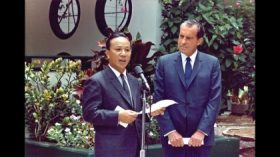
The American Retreat from Vietnam
or go to
Aletho News Archives – Video-Images
From the Archives
Secret document reveals plans for civil war in Lebanon, Israeli false flags, and invasion
By Randi Nord | Geopolitics Alert | April 5, 2019
Beirut – During his visit with US Secretary of State, Mike Pompeo, Lebanese President Michael Aoun reportedly received a US-Israeli document detailing plans for creating a civil war in Lebanon with covert false flag operations and possible Israeli invasion.
Although the source of the document is Israeli and created in partnership with Washington, no one knows who presented it to Aoun. The Lebanese TV station, Al-Jadeed, initially reported the document on Lebanese TV and a video on its website. Geopolitics Alert translated the report for this article. … continue
Blog Roll
 Aletho News
- ‘Distance yourselves from Israel’: IRGC urges US population to question govt policies
- America’s Greenland deal has a radioactive backstory
- The RAF Fairford ‘terror plot’: Unpacking escalation in the UK echo-chamber
- EU Council Advances Chat Control 2.0 Scanning Proposal
- Ex-Greek MEP files complaint against Israeli spyware firm over alleged Pegasus surveillance
- Troubling ideas throughout the Torah, Talmud, Mishneh Torah and Tanya
- ‘Grave, alarming’: Iran mission on Trump’s UNGA ‘annihilation’ threats
- Najaf airport to reopen to Iranian flights within 24 hours: Ambassador
- From ‘How Will This End For Iran’ to ‘When America Walks Away’: A tale of two Economist covers
- Tehran blasts ‘baseless’ speculation linking Iran to alleged bomb plot at UK air base
- If Americans Knew
- US arms sales to Israel worth $21.6 billion in 20 months
- Three Palestinians Killed in Israeli Attacks on Gaza
- Revealed: German “Anti-Semitism Expert” Driving Crackdown on Palestine Solidarity is Former Israeli Spy
- Egypt’s Warning to Israel Before Oct 7
- Israel’s siege signals another cruel winter for 1.8 million Gazans – Daily Update
- Netanyahu Asked UAE Leader to Deny Report on Oct. 7 Warning in Secret Visit, Sources Say
- CNN Chief Int’l Correspondent Clarissa Ward on Journalists in Gaza
- Democratic Party Consultants Surround Troy Jackson with Pro-Israel Donors
- Christian Leader Responds To Netanyahu’s Claims Regarding Palestinian Christians
- In Gaza, ‘Whoever Survives the Bombing Won’t Survive the Rubble’
- No Tricks Zone
- New Study: Earth And Venus Surface Warmth Largely Explained By Convection And Lapse Rate, Not CO2 Or Radiation
- 2025 Nature Paper Claiming Worsening Global Drought Gets RETRACTED …Heavily Flawed
- New Study: ‘Global Drought Shows No Detectable Recent Acceleration Under Climate Warming’
- Economic Masterminds: German Socialists Suggest Taxing Productivity Gains Stemming From Using AI
- The South China Sea Has Not Been Cooperating With The Climate Change Narrative
- Energy Crisis: Germany Enters Heating Season With Historically Low Gas Reserve Fill Levels
- New Study: The Antarctic Ice Sheet Gained Mass From 2020-2024 Due To Staggering Snow And Ice Accumulation
- Study: Ocean Heating Rates From Thousands Of Years Ago ‘Dwarf’ Modern Ocean Heating Rates
- Climate Extremists Target, Attack Large-Scale Power Grid Infrastructure In Germany!
- New Study: Antarctic Ice Melt Has Contributed Less Than 1 Centimeter To Sea Level Rise In The Last 30 Years

