The Real Looting of Baltimore…

RenegadeEconomist | April 30, 2015
Why don’t we look at the root causes of the Baltimore riots…?
Poland approves joint force with Ukraine & Lithuania, calls on EU to spend more on defense

RT | May 4, 2015
Poland’s President Bronislaw Komorowski has signed a resolution approving the organization of a joint Lithuanian-Polish-Ukrainian brigade, whose creation has been in the works since 2007.
When brought to full operation in 2017, the brigade is set to constitute 4,500 servicemen. They will operate separately from the three countries’ respective militaries, but will take part in NATO exercises and missions. Preliminary drills are scheduled for later this year. The brigade will be stationed at its headquarters in Libulin, Poland. So far, it only houses 250 servicemen and 50 command staff contributed by the Polish military.
The joint force was discussed as far back as 2007, but the agreement to create it was signed by the three countries’ defense ministers in September 2014, in response to the Ukrainian crisis and what they call Russian aggression.
Creating the joint force is “part of a wider plan … to support Ukraine, among others, in the area of modernization,” President Bronislaw Komorowski said as cited by Reuters.
He also urged other European countries to spend more on defense. To that end, President Komorowski has suggested excluding defense spending from EU rules on budget deficit limits. This means that EU nations will be able to allocate more money to the military without fearing increased budget controls from Brussels. Komorowki’s offer comes at a time of heightened tensions with Russia.
Poland now has the fifth-strongest army in the EU, and has ambitious plans to modernize it, spending about $36 billion until 2022. However, the Polish government is unhappy about a lack of similar eagerness in some of the other European nations, the Rzeczpospolita newspaper reports.
While NATO is advising its member states to spend the maximum allowed of three percent of GDP on defense, most are spending far less: Germany allocates 1.2 percent of its GDP, the Netherlands 1.3 percent and Spain under 1 percent. France is the only Western European country that is boosting defense spending. However, some Eastern European nations are increasing their military expenses citing what they call Russian aggression. Lithuania, for instance, wants to allocate twice as much on defense as last year.
Lomborg, Ridley and Power to the People
The Lukewarmer’s Way | April 28, 2015
Bjorn Lomborg has been invited by the Australian government via the University of Western Australia to relocate the Copenhagen Consensus Center to the lucky country. I wish him well in his new surroundings.
News of this has revived the muttering and outright ranting about how Evil!!! Lomborg is. This is because the policy conclusions of the Consensus Centre (and Lomborg in his writings prior to the CC being established) shows that investing in renewable energy and other mitigation and adaptation measures regarding climate change is less effective at improving health and raising living standards in the developing world than other measures, such as insuring access to micro nutrients, suppressing and treating malaria, etc.
Obviously, Lomborg and the CC are right. Nicholas Stern estimates the cost of dealing with climate change at between 1% and 5% of global GDP. Providing micro nutrients for the poor costs pennies per person. The only real question is are healthy poor people more important than reducing CO2 emissions?
Although Stern and a few other economists argue that eliminating or reducing the threat of climate change for people in 2100 is more important than providing sustenance to today’s poor, not many agree, which is why the argument is rarely put in such stark terms.
However, the argument is clearest in discussions about provision of power to the poor. Those most alarmed about climate change wish to push the developing world into using renewable energy sources instead of the much cheaper and more available fossil fuels, especially coal. As Matt Ridley notes over at his blog, “In 2013 Ed Davey, the energy secretary, announced that British taxpayers will no longer fund coal-fired power stations in developing countries, and that he would put pressure on development banks to ensure that their funding policies rule out coal. (I declare a commercial interest in coal in Northumberland.)
In the same year the US passed a bill prohibiting the Overseas Private Investment Corporation — a federal agency responsible for underwriting American companies that invest in developing countries — from investing in energy projects that involve fossil fuels.”
This argument is not actually new–those of us who remember the Greenpeace thug who threatened skeptics saying “We know where you live and we be many while you be few” know that the subject under discussion was Greenpeace and the WWF’s efforts to stop World Bank funding for a coal plant in South Africa.
The average household income for someone with solar panels on their roof in the USA is $150,000. The capital costs of renewable energy make it unaffordable for Africa and India in most cases.
There are numerous exceptions, of course. In areas where it is expensive to extend the transmission grid to villages, Rural Electrification Programs using solar power have been used effectively since the 1980s. However, these don’t provide enough power to truly power a village–at most they provide radio and some lighting. These are hugely valuable and I support the expansion of such programs.
But they are insufficient for powering the light industry the region needs to truly improve their lot and they cannot power the refrigeration needed for improved health outcomes.
Lomborg is right that the poor of today need more concrete aid than they do emission reductions. Ridley is right to point out that coal fired power plants are what they are crying out for and would make possible the concrete aid that we all know they need.
And the manic Alarmists have forgotten that coal, bad as it is (I am no friend of coal), is a denser fuel than dung and firewood, emitting less than what it will replace. Obviously, because of the potential to provide more power to more people, emissions will rise as it saves lives, but dung burnt indoors kills millions and the relentless search for firewood denudes forests and exposes the women who undertake the daily search to threats of attack from animals and unscrupulous men.
The developing world has found an unlikely savior in China, who are well-pleased to help them build the infrastructure that Africa and Southern Asia need, want and are crying out for.
Because the argument is truly clear, alarmists are reduced to insinuations about Lomborg’s motives (does he really want to help the poor?) and the horror of his being offered a post in Australia, while Ridley is attacked because he used to serve on the board of a bank that went broke some years ago. Phoney arguments such as these keep the alarmists occupied, the water muddied and the Greens still dictating policy to western governments. Alarmists agonize over whether or not climate scientists should fly (coming to the conclusion that they should), but after sober reflection they call helping Africa a ‘serious and complex issue’.
Perhaps the clearest example of their hypocrisy is their accusation that people like “Lomborg and Ridley, if they were serious, would be encouraging dialogue, not trying to demonize” their opponents.
After ten years of a concerted effort by Greens to demonize Lomborg and Ridley, the very people who have demonized Lomborg and Ridley say they shouldn’t demonize their opponents. But Lomborg and Ridley do not. They don’t make attacks on people or even organizations. They just show quite clearly that stringent caps on emissions that are enforced first on the poor and loosely or not at all on the rich kill, sicken and immiserate the poor. It is the Greens that have vigorously pursued a policy of vicious and calculated demonization of those like Lomborg and Ridley.
At some point, future generations will have a different color code–and they will say that Greens have no right to advocate policies that trap Black and Brown people in poverty. They may use a different ‘G’ word to describe the net effects of what Greens are doing today.
There is a case to be made for saying the aggregate effect of Green policy in the developing world is perilously close to being complicit in genocide. At the very least they are showing an appalling indifference to the plight of people in the developing world. I wonder if the skeptics will mention that while they’re touring the Vatican?
China is doing more for the world’s poor than Greenpeace. Go figure.
The Myth of the Irish Recovery
Pliable Stats vs Stubborn Facts
By CILLIAN DOYLE | CounterPunch | May 2, 2015
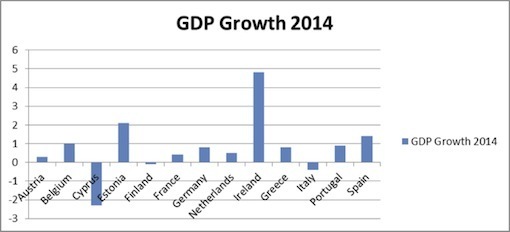
Dublin, Ireland – Have you heard the news? Dear old Ireland is in the midst of a great economic recovery. Well, that’s according to the government, the mainstream media, the multinational sector and even Angela Merkel. Yes, one by one they have been lining up to cheer on the poster boy of European austerity. Their hearty tale goes something like this; after experiencing one of the greatest economic shocks in history, Ireland having swallowed the austere medicine mandated by the Troika became – in defiance of all economic logic – the fastest growing economy in Europe (see graph 1 of Eurostat data).
Our Prime Minister Enda Kenny talks of a ‘Celtic Phoenix’ rising from the ashes. The domestic and international media have been crowing ‘Ireland is on the way back’, ‘Economic recovery keeps on motoring’ and ‘Ireland shows struggling Europe the way ahead’. The multinationals (MNCs) think things are going so well we should be giving the rich tax cuts again – something the government is all for. Whilst Angela Merkel has credited us as a ‘tremendous success story’ – one the austerity averse Greeks should be emulating.
But alas, this is just one version of events, and there is certainly another, albeit a less publicised and more depressing account. This is what could be described as the everyday experience of ordinary Irish people. It’s by no means the tale of triumph over adversity that the government are trumpeting. On the contrary, it is one of ongoing economic hardship, tragedy and farce.
The supposed ‘recovery’ that our leaders are harping on about is completely alien to the hundreds of thousands of ordinary people who have been consistently taking to the streets to protest against their policies. It’s alien to the ever growing number of people who are in long term mortgage arrears and face losing their homes, or to the people who have already lost theirs. And it’s alien to 10,000 people who just this month snapped up the entire allocation of work visas for Canada in less than 12 minutes, therein joining the 170,000 of our young people who have left since 2010.
So how do we reconcile these two contrasting/conflicting accounts? Could it be the case that a recovery is indeed underway but has yet to ‘trickle’ down to all sectors of the economy? Or is deprivation and stagnation a harsh reality which is merely being hidden by headline growth figures which just don’t add up?
Pliable Stats vs Stubborn Facts
The government are quick to point to our growth figures of 4.8% GDP and 4% GNP, but what does this really tell us? In short, not much. Ireland’s unique position in the global tax avoidance operation has rendered the standard economic indicator of GDP (gross domestic product) useless as measures of the health of the economy. It’s been well documented that the profit shifting activities of the multinational sector (MNCs) based here leads to massive distortions in this statistical indicator. So our politicians, analysts and commentators turned to GNP (gross national product) for a more accurate picture of the economy’s health.
But GNP is just GDP after we control for all the money that is flowing in and out of the country in a given period – and it too suffers from the same kind of distortions from MNCs profit shifting. Take for example the case of management consultancy firm Accenture who, along with several other big international groups, chose to relocate their headquarters to Ireland.
Now such ‘headquarters’ might consist of a small office with a single phone in it (see: Brassplate Company), which might lead you to believe makes it of zero consequence to domestic economy – but you’d be wrong. Even if such firms engage in no economic activity beyond their one roomed office, their massive profits are still recorded in the national accounts (GDP and GNP).
Then there’s issue of the major financial institutions located in the Irish Financial Services Centre (IFSC) which are currently managing some of the world’s largest investment funds. The Irish Funds Industry Association (IFA) recently announced that ‘Assets domiciled in Ireland in 2014 have reached a new high of €1.6 trillion‘. This is worth more than the entire value of all final goods and services produced in Australia last year.
And whilst you might be thinking that sounds great, the effect on the real economy has been negligible – aside from the distortions to our GNP. But don’t take my word for it, it was the Central Bank that stated ‘Financial Sector developments, which are for the most part unrelated to the domestic economy, account for a significant portion of the rise in GNP’.
So right about now you might be feeling like GDP and GNP offer us no great insight into the health of the real Irish economy, but let me tell, it gets worse. The methodology by which the national accounts (GDP and GNP) are compiled was recently changed to inflate the figures. How did they do this? Well, now goods that are not even being made here are being counted as if they were.
Once again it’s the Irish Central Bank we can thank for drawing our attention to this little peculiarity as they point out that ‘goods owned by an Irish entity that are manufactured in and shipped from a foreign country are now recorded as Irish exports’. In other words, goods that never saw Irish soil or touched the hands of Irish workers are being recorded as if they were one of our exports. The only criteria being that they are owned by an ‘Irish entity’. A term so elastic it can be stretched to fit just about any purpose. I’d say you couldn’t make this stuff up, but it appears somebody already has.
The Slow Death of Domestic Demand
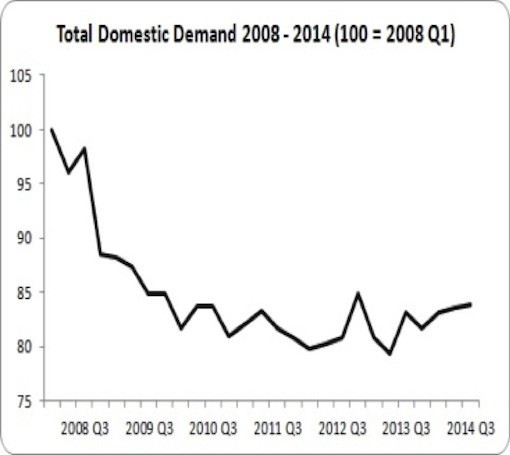
The only means of comprehending the true health of the economy is to look at domestic demand – or what’s left of it. Domestic demand, which makes up about three quarters of the economy, is comprised of government investment and expenditure on public services and consumer spending. Thus it doesn’t suffer from the kind of distortions attributable to the MNCs that the likes of GDP or GNP does.
The two graphs below illustrate perfectly the superficial nature of this ‘recovery’. As we can see domestic demand fell off a cliff in 2008 and has pretty much remained there. Consumer spending – which is the largest component of domestic demand – is actually below 2009 levels. Given that disposable income has fallen by 20% since 2008, largely as a result of falling wages, rising taxes and cuts to welfare spending (in other words austerity), is it any wonder that the Irish Small and Medium Size Enterprise Association (ISME) just this month described the government’s recovery as ‘glacially slow and patchy’. But surely this was to be expected? If you depress people’s incomes to breaking point where’s your demand going to come from? And if you’ve got no demand, then you’ve got recovery.
The fact of the matter is you can’t tax and cut your way out of a recession in the same way that you can’t diet and starve your way out of a famine. But with over half a million Irish people now experiencing food poverty – try telling the government that.

A very ‘Irish’ Recovery
Have you ever heard the expression ‘that’s a bit Irish’? Collins English dictionary defines ‘Irish’ – in its adjective form – as something ‘ludicrous or illogical’. Well, judging by that standard, this is a very ‘Irish’ recovery.
Oh sure, there’s been a recovery for some. Ireland’s richest 250 individuals saw their combined wealth increase by 16% to a whopping 75 billion in the last year alone, so it’s fair to say they’re doing ok. Then there’s the multinationals, whose massive profits continue to enjoy de facto tax immunity. And things are even looking up for the politicians, who are planning to give themselves a pay increase as recognition for masterminding this great ‘recovery’.
Call me old fashioned if you will, but to me a recovery isn’t a recovery until the lives of the people who make up the bulk of that economy start to improve. We still seem a long way away from that point. And for that reason most Irish people don’t believe in this recovery; because they don’t see it and they certainly don’t feel it.
Cillian Doyle is an economist with the People Before Profit Alliance of Ireland.
How Air Canada broke the law, laid off thousands of workers, and outsourced operations to Israeli military drone maker
ThinkPol | March 9, 2015

Air Canada had a very simple plan to increase its profits.
Step 1: Spin the airline’s heavy maintenance unit off as a separate entity
Step 2: Starve the spin-off of work and bankrupt it gradually
Step 3: Outsource the operations to an Israeli military drone manufacturing company wholly owned by the government of Israel.
Air Canada spun off its in-house maintenance, repair and overhaul (MRO) unit Air Canada Technical Services as a separate company, AVEOS, in 2007, four years after the national carrier entered into bankruptcy protection.
In 2011, many Air Canada workers were transferred against their will to AVEOS, despite a legal challenge by International Association of Machinists and Aerospace Workers to prevent this transfer.
Slowly, but surely, Air Canada started taking work away from AVEOS, and sending it abroad. First it was to Germany then to China. As Air Canada accounted for 90% of AVEOS’s business, Air Canada’s actions hit the maintenance company hard, and AVEOS was forced to file for bankruptcy in March 2012 leaving 2,600 employees jobless.
Air Canada CEO Calin Rovinescu, who raked in $9.5 million the same year, justified Air Canada’s actions by placing the blame squarely on AVEOS for not being “cost competitive”.
The Attorney General of Canada filed a law suit against Air Canada for breaching the Air Canada Public Participation Act which reads:
6. (1) The articles of continuance of the Corporation shall contain
…
(d) provisions requiring the Corporation to maintain operational and overhaul centres in the City of Winnipeg, the Montreal Urban Community and the City of Mississauga;
In February 2013, the Quebec Superior Court issued a 139-page ruling finding Air Canada guilty of violating the Air Canada Public Participation Act.
“The court concludes that Air Canada doesn’t respect the law put in place when it privatized in 1988,” Justice Martin Castonguay wrote.
Georges Bujold, general chairman, eastern region, for the International Association of Machinists and Aerospace Workers warned the workers not to have too high expectations about getting their jobs back anytime soon, as he expected Air Canada to drag this all the way to the Supreme Court, and a final ruling won’t be made for years.
Bujold’s prediction came true in the form of a terse email from Air Canada: “Air Canada will be appealing this Quebec Superior Court decision, given the importance of the matter, and makes no further comment at this time.”
Even if the Supreme Court rules in the Canadian workers’ favour, Bujold fears that the Harper government will simply pass legislation to overturn the decision.
“We never know with the Tories what position they would take but it wouldn’t surprise the IAM that Air Canada would make that request to the prime minister or the minister of transport to revisit the Air Canada Act and make those modifications,” Bujold said.
In January 2014, the Air Canada CEO accompanied Stephen Harper on the Prime Minister’s official visit to Israel. A year later, Air Canada signed a maintenance deal with Israel Aerospace Industries, a company wholly owned by the government of Israel, and considered to be a pioneer of drone technology.
Senate Judiciary Committee – Subcommittee on Constitution, Civil Rights and Human Rights heard from journalist and author Peter Bergen that “Israel is the world’s largest exporter of drones and drone technology, and the state-owned Israeli Aerospace Industries (IAI) has sold to countries as varied as Nigeria, Russia and Mexico. IAI has also reportedly sold a ‘loitering weapon’ called the Harop to India, Turkey, France, and Germany.”
Meanwhile, it has been a turbulent time for many of the 2,600 workers who lost their jobs and had to wait almost two years to hear any news of their severance pay or pensions. Some workers are hopeful that Air Canada will drop its appeal and bring maintenance jobs back to Canada. Many others, however, are not holding their breath.
Maersk vessel to be released after company pays debt: Iran
Press TV – April 30, 2015
The Iranian Embassy in Denmark has reportedly said that a cargo ship recently impounded in the Persian Gulf by Iranian Navy forces will be released if the ship’s operator company settles its overdue debts to an Iranian plaintiff.
“Iranian authorities reiterate that there has been absolutely no political or security intentions or considerations behind the incident,” read a statement by the Iranian Embassy on Thursday, AFP reported.
The cargo ship, Maersk Tigris, which was seized on Tuesday in the Strait of Hormuz in the Persian Gulf, had trespassed on Iranian waters carrying the flag of the Marshal Islands, a pacific nation.
A spokesman for Iran’s Ports and Maritime Organization said on Wednesday that the seizure of Maersk Tigris was based on a court ruling issued on March 16, 2015, which reportedly came after a plaintiff sued the Maersk Line, the Danish company operating the ship, over unpaid debts.
“The seizure of the ship was solely an enforcement of a judicial court ruling resulting from a commercial dispute between two private parties,” the statement said, adding, “Naturally the ship will be released after settlement of debts by Maersk Shipping Line and will be allowed to sail to its final destination.”
According to IRNA, the ship’s captain is Bulgarian and the first mate is Russian. Other crew members include 13 nationals of Myanmar, four Romanians, one Ukrainian, one British national, two Sri Lankans, and a national of Poland.
The statement added that diplomats can meet the crew “in case of need or request.”
Iranian Foreign Ministry Spokeswoman Marziyeh Afkham has defended as legal Iran’s decision to impound the ship, which is currently docked at the Bahonar Port near Bandar Abbas in southern Iran.
Airbus goes to court over reports of NSA/BND espionage
RT | May 1, 2015
European aviation consortium Airbus said it would file criminal charges over industrial espionage, following reports that US and German foreign intelligence spied on the industry giant.
“We are aware that as a large company in the sector, we are a target and subject of espionage,” the company said in a statement to AFP on Thursday. “However, in this case we are alarmed because there is concrete suspicion of industrial espionage.”
The move follows reports in Bild newspaper and Der Spiegel news magazine based on intelligence documents, claiming US spy agency, the NSA, deliberately targeted Airbus and Eurocopter – also run by the French-based company. The reports additionally revealed Berlin was aware of the espionage and kept quiet since 2008.
Following the allegations, Airbus “asked the German government for information.”
“We will now file a criminal complaint against persons unknown on suspicion of industrial espionage,” the company said.
It is alleged the German Foreign Intelligence service (BND) collaborated with the NSA in providing information about Airbus’ industrial secrets. The German media reports also alleged BND used the Bad Aibling monitoring station in Bavaria not only to spy on industrial business, but also to eavesdrop on the French president, the French foreign ministry, and the European Commission.
A French foreign ministry spokesman was quoted by DW as saying: “We are in close contact on this issue with our German partners.”
The German public and the political elite were furious following the 2013 disclosures by former NSA contractor Edward Snowden, into the NSA hack of Chancellor Angela Merkel’s cell phone. Yet while promising to respond, Germany has done nothing over the years.
‘The de-industrialization of Ukraine has acquired an irreversible character’ – former minister of economy
PolitNavigator | April 24, 2015
It makes no sense to campaign for the preservation of economic relations of Ukraine with the Commonwealth of Independent States (CIS)* markets, as the de-industrialization of the country has become irreversible nature, economist Viktor Suslov told a press conference in Kyiv recently.

“Unfortunately, the process of de-industrialization and destruction of our industry is already impossible to stop,” Suslov said.
Suslov was minister of economy of Ukraine in 1997-98. In 2013, he was appointed Ukraine’s representative to the Eurasian Economic Union. Last October, he told Ukraine’s government that a condition for stabilizing the country’s currency is to end the war in the east of the country.
“During the past year, I have worked hard for the preservation of economic ties with the CIS and Russia, for the preservation of these markets. But I now realize that nothing has happened and nothing will happen. I’m not campaigning for it anymore.
“I understand that we are losing these markets and the losses are irreversible. I realize that thousands of our enterprises will be closed and, accordingly, the financial situation of the country will be much worse than it was projected for this year.”
The ex-minister of economy believes that some financial revenues for public budget can be obtained from privatization of state assets. “But the main result of such privatization, I think, will be the transition of objects mostly of infrastructure – ports, energy, transport, communications, agricultural land into the hands of foreign owners.
“One consolation for us is that, as announced by the minister of economic development, the privatization processes will keep Russians out and we’ll sell assets to other foreigners. I don’t know how this can serve as great comfort”.
See also:
Ukraine preparing mass privatization of assets
Press TV | April 28, 2015
‘The Ukrainian government is considering a list of state-owned assets for privatization in a bid to raise funds for an economy that has come within an inch of bankruptcy. The majority of the reforms will happen in energy, transport and agriculture sectors. But as our correspondent Lena Savchuk reports, the process will begin only if the parliament approves the list of the companies.’
* From Wikipedia: The Commonwealth of Independent States is a loose association of states coordinating in the realm of trade, finance, lawmaking, and security. There are nine member states—Armenia, Azerbaijan, Belarus, Kazakhstan, Kyrgyzstan, Moldova, Russia, Tajikistan, Uzbekistan. Eight of these form the CIS Free Trade Area, and five of these form the Eurasian Economic Union—a customs union and common market of over 180 million people. Six member states participate in a mutual defence alliance, the Collective Security Treaty Organization.
Department of Homeland Security Accused of Giving Tech Jobs to H-1B Guest-Workers
By JAMIE ROSS | Courthouse News | April 27, 2015
A recent Homeland Security regulation may replace American workers with the spouses of foreign workers in the country with H-4 visas, a group of former computer workers claim in court.
Save Jobs USA, a group made up of former Southern California Edison computer workers who were replaced by foreign workers on H-1B guest-worker visas, filed suit in D.C. Federal Court against the U.S. Department of Homeland Security.
According to the lawsuit, DHS implemented the “Employment Authorization for Certain H-4 Dependent Spouses” recently, which grants work authorization to certain spouses of foreign workers in the U.S. on H-4 visas.
“The H-4 Rule extends employment authorization to an alien possessing an H-4 visa who is the spouse of an H-1B alien who is the principal beneficiary of an approved Immigrant Petition for Alien Worker, or has been granted H-1B status extending beyond the normal 6-year term,” the complaint states.
As many as 179,600 new foreign workers will be added to the U.S. workforce in the first year of the rule, DHS says, with 55,000 added annually in the following years.
“The H-4 Rule is in excess of DHS authority and directly contradicts several provisions of the Immigration and Nationality Act,” the lawsuit says.
The complaint details the struggles of Save Jobs USA member Brian Buchanan to find work after he was displaced by Edison with a H-1B worker supplied to the California energy provider by India-based Tata Consultancy Services. Tata Consultancy is the largest IT provider in India.
Buchanan, an IT specialist, says he was forced to train his H-1B replacement to perform his job after he was told he would be replaced.
“If Mr. Buchanan had not trained his replacement he would have been denied a severance package and could have been terminated with cause, making him ineligible for unemployment benefits,” the complaint states. Buchanan claims he now faces competition from H-1B Workers and soon H-4 visa holders to find a new job in the computer job market.
“This is a slap in the face to the tens of millions of Americans suffering from unemployment and underemployment, especially those who are most vulnerable such as students, seniors, single mothers and minorities,” said Dale L. Wilcox of the Immigration Reform Law Institute, which is representing Save Jobs USA. “The law states that foreign work permits cannot adversely affect American wages, but all we’ve seen during this administration is standards of living fall and outsized corporate profits continue to rise.”
Save Jobs USA seeks to stop DHS from authorizing spouses with an H-4 visa to work.
Southern California Edison’s alleged replacement of American workers with workers from India has been subject to criticism, including a bipartisan letter written by 10 U.S. senators asking the Labor Department to investigate into the legality of its actions.
Solicitor General M. Patricia Smith says in a letter to Sen. Dick Durbin, D-Illinois, that the agency “lacks a basis to initiate an investigation,” because the wage and hour division had not received a complaint. She referred the matter to the Office of Special Counsel.
“We will continue pressing the administration to use its legal authority to stop the displacement of American workers wherever possible and to conduct a thorough investigation of responsible parties,” Durbin and Sen. Jeff Sessions, R-Alabama, said in a statement.
Southern California Edison denied that it was acting unlawfully, though, claiming that it is “transitioning some IT operations to external vendors.”
The Office of General Counsel could not be reached for comment.
Iran says seizure of ship a legal matter
Press TV – April 29, 2015
Iran seized a cargo ship in the Persian Gulf because the company operating the vessel owed an outstanding debt to an Iranian private company which it is refusing to pay, an official says.
“A legal complaint by a domestic private company resulted in the seizure of the Marshal Islands-flagged vessel in Iranian waters by the Coast Guard,” head of the Ports and Maritime Organization of Iran Mohammad Sa’eednejad said.
The Coast Guard intercepted the ship belonging to the MV Maersk Tigris on the order of a court in Tehran, he said.
Sa’eednejad said the Iranian company has an outstanding amount of claims against Maersk which it has failed to settle.
“The complaint by a private plaintiff resulted in an order issued on March 17 for the confiscation of assets held by Maersk,” he added.
The ship was sailing in the Iranian waters when it was intercepted by the Coast Guard and diverted toward Larak Island near Bandar Abbas.
The US Navy’s Fifth Fleet in Bahrain dispatched the destroyer USS Farragut and a reconnaissance aircraft to the area following a distress call by the Maersk Tigris, the Pentagon said.
Sa’eednejad said the American forces left the scene when the situation was explained to them.
“It was announced that the issue was a legal dispute between two trade companies and the American forces accepted it,” he told IRNA.
The vessel has been described as a 65,000-tonne container ship and listed as sailing from Saudi Arabia’s Red Sea port of Jeddah, bound for the United Arab Emirates port of Jebel Ali in the Persian Gulf.
It reportedly had 24 crew on board, mostly from eastern Europe and Asia.
Iranian researchers produce anti-cancer nano-drug
Press TV – April 27, 2015
Iranian researchers have produced a nano-drug which has proven effective in battling treatment resistant cancers.
The Cancer Research Center of Tehran University of Medical Sciences produced the polymer-based nanocarrier for the targeted release of the anti-cancer drug curcumin, ISNA reported on Sunday.
“This nanocarrier was made without the use of poisonous catalysts and has proven successful in clinical trials on a number cancer patients,” said Dr Ali Mohammad Alizadeh from the Iran Nanotechnology Initiative Council.
Research has proven that curcumin, which is found in turmeric, has anti-cancer and cancer preventing properties apart from its anti-oxidant and anti-inflammatory properties, he added.
When curcumin is prescribed in its edible form, it has a low effect on the targeted tissues because of its low absorption rate and fast metabolism which causes it to be flushed from the body, he noted.
However, by capsuling curcumin in nano-emulsions (nano curcumin) its medical properties increase, Alizadeh noted.
Even if prescribed in high dosages, the drug is proven not poisonous during first-stage clinical trials and is currently near the end of stage two clinical trials on drug-resistant breast and digestive tract cancers.
Alizadeh added that because all the basic materials required to manufacture nano-curcumin are available in the country it can be domestically mass-produced as an anti-cancer drug.
The Trans-Pacific Sellout
Guaranteed profits—at any price
By Jason Hirthler | Dissident Voice | April 26, 2015
Last Tuesday, President Barack Obama told beltway bullhorn Chris Matthews that Senator Elizabeth Warren was “wrong” about the Trans-Pacific Partnership (TPP), the largest trade deal in American history, linking United States and Australia, Brunei, Canada, Chile, Japan, Malaysia, Mexico, New Zealand, Peru, Singapore and Vietnam in a pervasive and binding treaty. The president was referring to Warren’s claim that the trade treaty will license corporations to sue governments, and her contention that this was, to put it mildly, a bad idea.
Warren isn’t wrong, Obama is. And he knows it. The entire TPP, as understood, is based on a single overarching idea: that regulation must not hinder profiteering. This is a fundamentally anti-democratic concept that—if implemented—would effectively eliminate the power of a demos to make its own law. The final authority on any law’s validity would rest elsewhere, beyond the reach of popular sovereignty. From the TPP point-of-view, democracy is just another barrier to trade, and the corporate forces behind the draft treaty are intent on removing that barrier. Simple as that.
That’s why the entire deal has been negotiated in conclave, deliberately beyond the public purview, since the president and his trade representatives know that exposing the deal to the unforgiving light of popular scrutiny would doom it to failure. That’s why the president, like his mentor President Clinton, has lobbied hard for Trade Promotion Authority, or Fast Track, which reduces the Congressional role in the passage of the bill to a ‘yea’ or ‘nay.’
Cracks have begun to show in the formidable cloak behind which the deal has been structured. A coalition of advocacy groups advanced on the U.S. Trade Representatives office this week. Wikileaks has obtained and released chapters from the draft document. Senator Harry Reid declared his position on Fast Track as “… not only no, but hell no.” Warren has proved to be a persistent thorn in the side of White House efforts to smooth over troubling issues with the deal. But the monied interests that rule the beltway have all pressed for passage. And as a Fast Track draft makes its way through Congress, stakes are high. The TPP is, in the apt estimation of political activist Jim Hightower, a “corporate coup d’état.”
Not for the first time, the president and his Republican enemies are yoked by the bipartisan appeal of privilege against this faltering fence of protest. The marriage of convenience was described in last Friday’s sub-head to a New York Times article on TPP: “G.O.P. Is Allied With President Against His Own Party.”
All The Usual Suspects
Who else supports the TPP? Aside from this odd confection of neoliberals, the corporations that rule the beltway feverishly back the TPP. From the leak of Sony digital data we learn that it and its media peers have enthusiastically pressed for the passage of the deal. Sony is joined by major agricultural beneficiaries (Monsanto), mining companies like Infinito Gold, currently suing Costa Rica to keep an ecology-harming mine pit active, as well as pharmaceutical coalitions negotiating stiff intellectual property rights unpopular even in Congress, and various other technology and consumer goods groups. And don’t forget nicotine kingpins like Philip Morris.
Obama reinforces the corporate line: “We have the opportunity to open even more new markets to goods and services backed by three proud words: Made in America.” Perhaps he isn’t aware that our leading export is the workforce that once took pride in that moniker. We’ve exported five million manufacturing jobs since 1994, largely thanks to NAFTA, the model on which the TPP is built. The TPP will only continue that sad trend. The only jobs not being offshored are the ones that can’t be: bartenders and waitresses and health care assistants. That’s the Obama economy: a surfeit of low-wage service jobs filled by debt-saddled degree holders. As Paul Craig Roberts argued in The Failure of Laissez Faire Capitalism, between 2007 and 2014, some eight million students would graduate from American universities and likely seek jobs in the United States. A mere one million degree-requiring jobs would await them. The irony of Obama’s statement is that the TPP would actually move to strip the use of labels like, “Buy American,” since they unduly advocate for local goods.
In truth, the authors of the treaty already know all this. The bill concedes as much, with Democrats building in some throwaway provisions of unspecified aid to workers whose jobs have been offshored, and a tax credit to ostensibly help those ex-workers purchase health insurance. Cold comfort for the jobless, as they are exhorted by the gutless paladins of globalization to ‘toughen up’ and deal with the harsh realities of a globalized economy. As neoliberal stooge Thomas Friedman has said, companies in the glorious global marketplace never hire before they ask, “Can this person add value every hour, every day — more than a worker in India, a robot or a computer?” Of course, the answer is invariably no, so the job goes to Bangladesh or a robot. No moral equation ever enters the picture. Just market discipline for the vulnerable and ingenious efforts by a captive state to shelter capital from the market dynamics it would force on others.
The Investment Chapter
Despite Obama’s disingenuous clichés about “… fully enforceable protections for workers’ rights, the environment and a free and open Internet,” the trade deal makes it clear that labor law and environmental law are both barriers to profitability. We know this thanks to Wikileaks, which once again proved its inestimable value by acquiring and releasing another chapter from the cloak-and-dagger negotiations. This time it was the investment chapter, in which so much of the treaty’s raison d’etre is expressed.
As Public Citizen points out in its lengthy analysis of the chapter, any domestic policy that infringes on an investor’s “right” to a regulatory framework that conforms to their “expectations,” is grounds for a suit. Namely, the suit may be pressed to “the extent to which the government action interferes with distinct, reasonable investment-backed expectations.”
Here’s what the TPP says about such legislation as it relates to investor expectations:
For greater certainty, whether an investor’s investment-backed expectations are reasonable depends, to the extent relevant, on factors such as whether the government provided the investor with binding written assurances and the nature and extent of governmental regulation or the potential for government regulation in the relevant sector.
Try putting that tax on financial transactions. Forget it. Barrier to a reasonable return. Don’t believe it? Just read the TPP investment protocols that would ban capital controls, which is what a financial tax is considered to be by TPP proponents. Try passing that environmental legislation. Not a chance. Hindrance to maximum shareholder value. Just ask Germany how it felt when a Swiss company sued it for shutting down its nuclear industry after Fukushima. Try enacting that youth safety law banning tobacco advertising. Sorry. Needless barrier to profits. Just ask Australia, which is being sued by Philip Morris for trying to protect kids from tar and nicotine.
Public Citizen has tabulated that, “The TPP would newly empower about 9,000 foreign-owned firms in the United States to launch ISDS cases against the U.S. government, while empowering more than 18,000 additional U.S.-owned firms to launch ISDS cases against other signatory governments.” It found that “foreign investors launched at least 50 ISDS claims each year from 2011 through 2013, and another 42 claims in 2014.” If these numbers seem small, recall that for a crucial piece of labor legislation to be struck down, only one firm need win in arbitration in order to financially hamstring a government and set a precedent that would likely ice the reformist urge of future legislatures.
As noted earlier, the text also appears to suggest to ban the practice of promoting domestic goods over foreign—another hurdle to shareholder value. This would effectively prohibit a country from implementing an import-substitution economy without threat of being sued. Governments would be relieved of tools, like tariffs, historically used to protect fledgling native industries. This is exactly what IMF prescriptions often produce—agricultural reforms, for instance, that wipe out native crop production and substitute for it the production of, say, cheap Arabica coffee beans, for export to the global north. Meanwhile, that producer nation must then accept costly IMF lending regimes to pay to import food it might have grown itself.
Of course, it is rarely mentioned that protectionism is how the United States and Britain both built their industrial economies. Or that removing competitor market protections is how they’ve exploited developing economies ever since. The TPP would effectively lock in globalization. It’s a wedge that forces markets open to foreign trade—the textual equivalent of Commodore Perry sailing his gunships into Tokyo Harbor.
ISDS Tribunals
The bill’s backers point to language in which natural resources, human and animal life, and public welfare are all dutifully addressed in the document. The leaked chapter explicitly says that it is not intended to prevent laws relating to these core concerns from being implemented. So then, what’s the problem? The problem is that these tepid inclusions lack the teeth of sanctions or punitive fines. They are mere rhetorical asides designed to help corporate Democrats rationalize their support of the TPP. If lawmakers really cared about the public welfare, they’d move to strip the treaty of its various qualifiers that privilege trade over domestic law. By all means, implement your labor protection, but just ensure “… that such measures are not applied in an arbitrary or unjustifiable manner, or do not constitute a disguised restriction on international trade or investment.”
If lawmakers cared about national sovereignty, they wouldn’t outsource dispute settlement to unelected arbitration panels, more fittingly referred to as, “tribunals.” (Think of scrofulous democracy hunched in the dock, peppered with unanswerable legalese by a corporate lawyer, a surreal twist on the Nuremberg Trials.) Just have a glance at Section B of the investment chapter. Suits will be handled using the Investor-State Dispute Settlement (ISDS) model, itself predicated on the tribunal precedent. And in the event a government lost a suit or settled one, legal costs would be picked up by taxpayers, having been fleeced by an unelected committee whose laws it has no recourse to challenge.
Perhaps investor protections like ISDS were once intended to encourage cross-border investment by affording companies a modicum of reassurance that their investments would be safeguarded by international trade law. But the ISDS has been used for far more than that. The ISDS tribunals have a lovely track record of success (first implemented in a treaty between Germany and Pakistan in 1959). Here’s Public Citizen:
Under U.S. “free trade” agreements (FTAs) alone, foreign firms have already pocketed more than $440 million in taxpayer money via investor-state cases. This includes cases against natural resource policies, environmental protections, health and safety measures and more. ISDS tribunals have ordered more than $3.6 billion in compensation to investors under all U.S. FTAs and Bilateral Investment Treaties (BITs). More than $38 billion remains in pending ISDS claims under these pacts, nearly all of which relate to environmental, energy, financial regulation, public health, land use and transportation policies.
New Era, New Priorities
Now the ISDS is a chisel being used to destroy the regulatory function of governments. All of this is being negotiated by corporate trade representatives and their government lackeys, which appear to have no qualms about the deleterious effects the TPP will have on the general population. But then the corporations these suits represent have long since discarded any sense of patriotic duty to their native nation-states, and with it any obligation to regulate their activities to protect vulnerable citizenries. That loyalty has been replaced by a pitiless commitment to profits. In America, there may have been a time when “what was good for Ford was good for America,” as memorably put by Henry Ford. But not anymore. Now what’s good for shareholders is good for Ford. This was best articulated a couple of years ago by former Exxon CEO Lee Raymond, who bluntly reminded an interviewer, “I’m not a U.S. company, and I don’t make decisions based on what’s good for the U.S.” Those decisions usually include offshoring, liberalizing the labor market, practicing labor arbitrage, relocating production to “business friendly climates” with lax regulatory structures, the most vulpine forms of tax evasion, and so on—all practices that ultimately harm the American worker.
Apple says it feels no obligation to solve America’s problems nor, one would assume, any gratitude to the U.S. taxpayer for funding essential research that Apple brilliantly combined in the iPod and iPhone. Former Labor Secretary Robert Reich finally admits corporations don’t want Americans to make higher wages. The U.S. Chamber of Commerce encourages shipping American jobs abroad. World Bank chiefs point to the economic logic of sending toxic waste to developing nations. Wherever you look, there seems to be little if any concern for citizenry.
The Financial Times refers to ISDS as, “investor protection.” But what it really is, is a profitability guarantee, a legal bulwark against democracy expressed as regulation. Forgive me for thinking that navigating a fluid legislative environment was a standard investment risk. Evidently the champions of free trade can’t be bothered to practice it. Still the White House croons that it has our best interests at heart. If that were true, it would release the full text, launch public charettes to debate its finer points, or perhaps just stage a referendum asking the American people to forfeit their hard-won sovereignty. No such thing will ever happen, of course. As it turns out, democracy is the price of corporate plunder. After all, the greatest risk of all is that the mob might vote the wrong way. And, as the language of the TPP makes explicitly obvious, there are some risks that should be avoided at all costs.
Jason Hirthler can be reached at: jasonhirthler@gmail.com.
Featured Video
The American Retreat from Vietnam
or go to
Aletho News Archives – Video-Images
From the Archives
Secret document reveals plans for civil war in Lebanon, Israeli false flags, and invasion
By Randi Nord | Geopolitics Alert | April 5, 2019
Beirut – During his visit with US Secretary of State, Mike Pompeo, Lebanese President Michael Aoun reportedly received a US-Israeli document detailing plans for creating a civil war in Lebanon with covert false flag operations and possible Israeli invasion.
Although the source of the document is Israeli and created in partnership with Washington, no one knows who presented it to Aoun. The Lebanese TV station, Al-Jadeed, initially reported the document on Lebanese TV and a video on its website. Geopolitics Alert translated the report for this article. … continue
Blog Roll
 Aletho News
- ‘Distance yourselves from Israel’: IRGC urges US population to question govt policies
- America’s Greenland deal has a radioactive backstory
- The RAF Fairford ‘terror plot’: Unpacking escalation in the UK echo-chamber
- EU Council Advances Chat Control 2.0 Scanning Proposal
- Ex-Greek MEP files complaint against Israeli spyware firm over alleged Pegasus surveillance
- Troubling ideas throughout the Torah, Talmud, Mishneh Torah and Tanya
- ‘Grave, alarming’: Iran mission on Trump’s UNGA ‘annihilation’ threats
- Najaf airport to reopen to Iranian flights within 24 hours: Ambassador
- From ‘How Will This End For Iran’ to ‘When America Walks Away’: A tale of two Economist covers
- Tehran blasts ‘baseless’ speculation linking Iran to alleged bomb plot at UK air base
- If Americans Knew
- Israel Has Kidnapped Another American Teenager
- US arms sales to Israel worth $21.6 billion in 20 months
- Three Palestinians Killed in Israeli Attacks on Gaza
- Revealed: German “Anti-Semitism Expert” Driving Crackdown on Palestine Solidarity is Former Israeli Spy
- Egypt’s Warning to Israel Before Oct 7
- Israel’s siege signals another cruel winter for 1.8 million Gazans – Daily Update
- Netanyahu Asked UAE Leader to Deny Report on Oct. 7 Warning in Secret Visit, Sources Say
- CNN Chief Int’l Correspondent Clarissa Ward on Journalists in Gaza
- Democratic Party Consultants Surround Troy Jackson with Pro-Israel Donors
- Christian Leader Responds To Netanyahu’s Claims Regarding Palestinian Christians
- No Tricks Zone
- New Study: Earth And Venus Surface Warmth Largely Explained By Convection And Lapse Rate, Not CO2 Or Radiation
- 2025 Nature Paper Claiming Worsening Global Drought Gets RETRACTED …Heavily Flawed
- New Study: ‘Global Drought Shows No Detectable Recent Acceleration Under Climate Warming’
- Economic Masterminds: German Socialists Suggest Taxing Productivity Gains Stemming From Using AI
- The South China Sea Has Not Been Cooperating With The Climate Change Narrative
- Energy Crisis: Germany Enters Heating Season With Historically Low Gas Reserve Fill Levels
- New Study: The Antarctic Ice Sheet Gained Mass From 2020-2024 Due To Staggering Snow And Ice Accumulation
- Study: Ocean Heating Rates From Thousands Of Years Ago ‘Dwarf’ Modern Ocean Heating Rates
- Climate Extremists Target, Attack Large-Scale Power Grid Infrastructure In Germany!
- New Study: Antarctic Ice Melt Has Contributed Less Than 1 Centimeter To Sea Level Rise In The Last 30 Years

