Kerry to Bulgaria: End energy dependence on Russia
Press TV – January 15, 2015
US Secretary of State John Kerry has called on Bulgaria to end its dependence on Russia for energy.
Kerry made the remarks on Thursday in meetings with Bulgaria’s president, prime minister and foreign minister in the capital Sofia.
Bulgaria must move toward “diversifying supplies and distribution and increasing connectivity with neighbors,” Kerry told a news conference with Bulgarian Prime Minister Boyko Borisov.
He said Washington is interested in helping the country take “practical steps to enhance energy security in Bulgaria and across Europe.”
Kerry also talked about the possible construction of a natural gas pipeline from Greece and moving ahead with a stalled contract with Westinghouse Electric Co. to build a nuclear power plant.
“We hope very much that the issues that (the government and Westinghouse) are discussing can be quickly resolved,” Kerry said.
Kerry, however, stressed that the US push is not aimed at Russia.
“That is not directed against any one country,” Kerry said. “It is simply a reality. No country in the world should be totally dependent for its energy supply on one other country. We need diversified supplies across the world.”
He said the US will send its special energy envoy to Sofia to look into how the US Export-Import Bank could finance the country.
Bulgaria relies on Russia for 85 percent of its gas and 100 percent of its nuclear power.
On security issues, Kerry said the US is determined in its commitment to defend NATO member Bulgaria if it is attacked.
The US would increase joint military exercises with Bulgaria and also help the country modernize its defenses, Kerry said.
Dude, Where’s My Peace Dividend?
By Robert Ted Hinds | CounterPunch | January 14, 2015
In the 1970s and 1980s, Americans were conditioned with the idea that the extraordinary growth in military expenditure for the U.S. to “win the arms race” with the USSR would somehow lead to a “peace dividend.” That’s what the elected officials of the United States and its NATO allies called it. Eventually the Soviet Union did collapse under the weight of its own economic dysfunction and hyper-militaristic bureaucracy. When the Berlin Wall came down on November 9, 1989, compelled by massive nonviolent noncooperation with the dictatorial regime, it seemed that the leaders of the world might finally declare the peace dividend we had all been expecting. Mankind as a whole seemed to have hope that the specter of nuclear war had vanished and that a constitutional democracy could operate as a benevolent superpower.
It wasn’t long before President Bush Sr. replaced the old war with a new one. The New York Times disclosed official transcripts of a conversation between US Ambassador to Iraq, April Glaspie, and Saddam Hussein where she said, “We have no opinion on the Arab-Arab conflicts like your border disagreement with Kuwait. James Baker (Secretary of State) has directed our official spokesmen to emphasize this instruction.”
Soon after, Saddam Hussein invaded Kuwait and America’s action toward war was swift. King Hussein of Jordan, one of America’s strongest allies in the region (and whose wife was American), told the New York Times that the day of the invasion, Bush gave him 48 hours to negotiate a withdrawal of Iraqi forces from Kuwait.
The Jordanian king secured a promise from Saddam to withdraw all of his forces within a week to avert war. King Hussein could not understand why the deal was undermined by the Bush Administration. The US and its Allies proceeded to annihilate the Iraqi army it had supported for 10 years during the Iran-Iraq War which ended in 1988. George Bush had been able to maintain diplomatic relations with Saddam when Saddam was waging war against Iran, but not when he was offering to withdraw from Kuwait. Thus began the Gulf War in 1991 and a process of political destabilization in the Middle East that has been a pretense for ongoing military intervention to this day.
Harvard public policy professor Linda Bilmes published a study in 2013 estimating that the true cost of the current wars in Iraq and Afghanistan will run between $4 trillion and $6 trillion, including ongoing healthcare for veterans and interest on the war debt. A similar study by Brown University put the price tag at $4 trillion, but both of these studies preceded the rise of ISIS and do not account for rising tensions with Iran and Syria, or Russia in the Ukraine.
Where’s the peace dividend we were promised throughout the Cold War, that payback for defeating the evil superpower that prevented America from spreading peace and democracy by way of its “benevolent hegemony?” Where’s our $4 trillion? The war hawks and politicians in Washington D.C. will tell you it is being reinvested to defeat terror and secure American interests abroad; that the elusive dividend payment is just another war or two away. In an October 2014 interview with USA Today to promote his book Worthy Fights, President Obama’s former Secretary of Defense and CIA Director, Leon Panetta, stated that “we can expect kind of a 30-year war” that would need to include Nigeria, Yemen, Libya and other threats. Those who profit from the military-industrial complex will continue to recognize a return on their investments. The American people will only realize a peace dividend when their government begins to practice peace instead of war as a means to foreign policy.
Robert Ted Hinds is an activist, journalist, and professional analyst. He holds a Master of Business Administration from Washington State University and Bachelor of Science degrees in Psychology and Finance from the University of Oregon.
Uruguay Discovers ‘Extremely Encouraging’ Oil Deposits
teleSUR | January 14, 2015
Australian company Petrel Energy has announced that it has found and certified the existence of 20 potential oil deposits in the north of Uruguay, the only country in the region that imports all the hydrocarbons that it consumes.
Uruguayan state petrol enterprise ANCAP said that the certification includes “20 conventional explorations,” with an estimation of risk-free resources “of up to 1.8 billion recoverable barrels which implies 5.6 billion barrels originally in the sub-soil.”
ANCAP emphasized that there may be more oil yet to discover, for which “more exploratory work is required, like various drillings, in order to determine the existence of significant hydrocrabon accumulations.”
The results are “extremely encouraging,” the company said, adding that the Australian company Schuepach confirmed that it will drill four exploratory wells in the zone between 2015 and 2017.
In recent years, Uruguay set itself the task of trying to find oil in its territory, sparking several offshore projects in 2009 and 2012.
Energy bills surge for poorest in UK: Official data
Press TV – January 14, 2015
Official figures show the energy bills of the poorest 10 percent of British households have grown at almost twice as the average rate in the country under the Tory-led Coalition government.
The research by the House of Commons Library published on Wednesday showed electricity bills for the affected group rose by 39.7 percent between 2010 and 2013, compared to 7.5 percent for the top 10 percent of British households and 22.2 percent on average.
In addition, the poorest group saw their gas bills increased by 53.3 percent compared to 23.9 percent for the top 10 percent and 29.2 percent for the average British home.
Shadow Energy Secretary Caroline Flint said since Prime Minister David Cameron’s government took office in 2010 the average household energy bill has risen by 260 pounds.
“These figures show that the poorest households are paying the heaviest price for the Tories’ failure to stand up to the energy companies and ensure that the full savings from wholesale cost falls are passed on to all consumers,” said Flint.
Ann Robinson, director of consumer policy at the uSwitch.com website also called for lower energy tariffs amid falling world oil and gas prices.
“Given the huge reduction in wholesale prices – which make up around half of energy bills – we believe standard tariffs can and should be cut even further,” said Robinson.
The data comes just days after British think tank Policy Exchange revealed that of the 2.3 million homes living in fuel poverty, 1.1 million are working households with one or more members holding employment.
The UK has seen rising energy costs in recent years. A separate report has shown that the average gap between the family’s energy bill and what it can afford is estimated to be around £400.
Taking a Meaningless Progressive Stand in Congress
By Dave Lindorff | This Can’t Be happening! | January 12, 2015
The Democrats are showing their true colors now that they have lost control of both houses of Congress.
Suddenly, with the assurance that they don’t have to worry about being taken seriously, the “party of the people” has come forward with a proposal to levy a 0.1% tax on short-term stock trades, particularly on high speed trading.
Don’t get me wrong. A stock-trade tax is a great, and long-overdue idea. In fact, such a tax, which could raise some $800 billion in revenue over a decade, should probably be bigger than just 0.1%, and targeted more directly at high speed trading. (Most experts agree high-speed trading has been undermining any semblance of a fair market for stocks and bonds by handing an outsized advantage to companies that have access to huge computers that can make enormous trades, front-running other investors by getting into and out of the market in microseconds, so why not levy a graduated trading tax that is progressively higher the shorter the time period an investment is held?)
The point is that this trading tax is something that progressives have been calling for now for years, if not longer, but while they were in a position to actually make it happen, Democrats in Congress were silent about it.
Now though, with Republicans, who are dead-set against a tax on stock trading, in control of Congress so that there is no chance of passage, the Democrats as a party are calling for it, with Rep. Chris Van Hollen (D-MD) planning to introduce the measure this week as part of an ironically named “action plan” to combat income inequality which would also include a measure to cut $2000 in income taxes for families earning less than $200,000 a year, and to more nearly triple the child care credit.
If the Democrats had passed such measures back when they had the White House and both Houses of Congress, back in 2009 or 2010, they wouldn’t be looking at a Republican Congress today. If they’d proposed such measures last year, when they still at least controlled the Senate, they wouldn’t have lost the Senate last November.
But of course, if they had made these proposals when there was a chance of them becoming law, the Democrats in Congress would have lost all the fat campaign donations and other legal bribes that they receive from Wall Street banks, brokerages and hedgefunds.
Now it’s safe for them to make those proposals as part of their “inaction plan.” The fat cats on Wall Street know they’re not serious, and will continue to buy them in 2016, when you won’t see them making these kinds of populist proposals anymore.
It’s all part of a long-running game in which the Democratic Party pretends to be the party of the working person, while actually being just another pro-capitalist party, working hand-in-glove with the Republicans to continue sucking the life out of the American middle class and the poor to enrich the wealthiest 1% of Americans who already control some 40% of the nation’s assets, and the wealthiest 10%, who control as much national wealth as the other 90% of us put together.
Meanwhile, the real people to watch in Congress are those Democrats who are going to vote with the ruling Republicans in House and Senate to allow pro-rich and pro-capitalist measures to get to a vote, and to provide the votes to over-ride any vetoes by President Obama. Behind all the anti-inequality talk, these are the people who really represent the leadership and the political bedrock of the Democratic Party.
We got an early look at what is coming last week, when a group of 13 Democratic senators (the scabs clearly visible on their exposed flesh), voted with an almost unanimous Republican bloc, to defeat an amendment offered by Sen. Elizabeth Warren (D-MA) that would have stripped a measure weakening the Dodd-Frank financial regulatory law out of an already pro-financial corporate bail-out bill extending federal backing for terrorism coverage in insurance policies. The vote killing the Warren amendment passed 66-31 meaning there were only three abstentions. Without the 13 Democratic votes against fellow Democrat Warren, her amendment would have passed because of a 60-vote requirement for amendments.
Keep an eye on those 13 Democrats. Given that the Republicans now have 54 seats in the Senate, they only need an extra six votes from Democrats to move bills and amendments to a vote, and only 13 votes to override a presidential veto.
Here, for reference, are the 13 members of the Senate Democratic caucus who killed the Warren amendment:
Michael Bennet (D-CO)
Tom Carper (D-DE)
Bob Casey (D-PA)
Joe Donnelly (D-IN)
Martin Heinrich (D-NM)
Heidi Heitkamp (D-ND)
Angus King (I-ME)
Amy Klobuchar (D-MN)
Joe Manchin (D-WV)
Claire McCaskill (D-MO)
Gary Peters (D-MI)
Debbie Stabenow (D-MI)
Jon Tester (D-MT)
They of course are not the only pro-corporate Democratic senators. There are plenty more who can be counted on to vote to further enrich the rich and empower the powerful when called upon to do so — people like Sen. Charles Schumer (D-NY) and Cory Booker (D-NJ) for example.
This will be important when, later this year, we see Republicans in Congress putting forwards bills to gut Social Security and Medicare, to step up military funding, and to further undermine environmental, banking and worker safety regulation, for example.
Britain scraps Sellafield nuclear deal
Press TV – January 13, 2015
Britain said on Tuesday that it had scrapped a deal worth $30.2 billion with an international consortium to clean up the Sellafield nuclear facility in Cumbria in the northwest of the country.
The contractors of the project were Amec of Britain, Areva of France and URS, an American company. They have been fired from the job that was delegated to them six years ago after their leader was accused by the government of “delays and exceeding budgets”.
Meanwhile, there are reports that while rising costs have been a major motivation for the decision, among the problems encountered was the accidental shipping of radioactive waste to a landfill, which resulted in a fine of more than $1 million.
Despite the problems, members of parliament hesitated to tear up the contract last year in part because of concerns about the government’s ability to get the decommissioning job done, the Telegraph said.
The government’s Nuclear Decommissioning Authority (NDA) will now take ownership of the clean-up.
Energy and Climate Change Secretary Ed Davey described Sellafield as “the biggest and most complex nuclear site in Europe” and said “it’s right that we keep the way it’s being managed under constant review”.
He added that a “strategic partner” would be found from the private sector.
Minister leads UK-Egypt trade visit, despite human rights concerns
Reprieve | January 13, 2015
The UK has launched its biggest trade delegation to Egypt in a generation, despite widespread concerns about mass trials and death sentences handed down by authorities in the country.
The Foreign Office Minister for the Middle East and North Africa, Tobias Ellwood, is this week leading a major UK trade delegation to Egypt in an effort to take advantage of what the Foreign Office has called “signs of recovery after recent turbulence.” In a statement late last year, the Foreign Office said that the UK was “by far the largest foreign investor in Egypt” and that UK firms in the country have enjoyed “continued profitably [sic] and growth… even in the difficult years” – an apparent reference to the 2011 revolution and subsequent 2013 ousting of Mohammed Morsi’s government.
The UK embassy in Egypt tweeted last week that the visit was “the biggest British trade delegation to #Egypt in more than 15 years”.
Scores of protestors have been arrested in Egypt since 2013 and put on trial en masse, with hundreds receiving death sentences in proceedings that have been condemned by the UN, rights groups and countries including the UK. Speaking last September, Prime Minister David Cameron said the Egyptian government must “ensure human rights are respected in Egypt.”
Legal organisation Reprieve has written to Mr Ellwood raising concerns about the timing and scale of the trade visit in light of an ongoing mass trial of nearly 500 people, who face potential death sentences if convicted by the Cairo court. Among them is an Irish teenager, 19 year old Ibrahim Halawa, who was arrested at a 2013 protest when he was 17, and legally a juvenile. Mr Halawa has been subjected to continued mistreatment during his 2 years of confinement in Cairo’s Tora prison. Last week saw the latest of several recent hearings in which he was not brought into the court.
Maya Foa, director of the death penalty team at Reprieve, which is assisting Mr Halawa, said: “It beggars belief that the UK is taking a ‘business as usual’ approach to a country where hundreds of people, including children, face potential death sentences in farcical mass trials. If David Cameron’s proclamations about the need for human rights in Egypt are to be believed, why is his government boasting about its biggest trade visit there in 15 years?”
What is Going On in Spain?
The End of an Era and the Beginning of Podemos
By VICENTE NAVARRO | CounterPunch | January 9, 2015
Something is happening in Spain. A party that did not exist one year ago, Podemos, with a clear left-wing program, would win a sufficient number of votes to gain a majority in Spanish Parliament if an election were held today. Meanwhile, the leaders of the group G-20 attending their annual meeting in Australia were congratulating the president of the Spanish conservative-neoliberal government, Mr. Mariano Rajoy, for the policies that his government had imposed. (I use the term “imposed” because none of these policies were written in its electoral program.) These included: (1) the largest cuts in public social expenditures (dismantling the underfunded Spanish welfare state) ever seen since democracy was established in Spain in 1978 and (2) the toughest labor reforms, which have substantially deteriorated labor market conditions. Salaries have declined by 10% since the Great Recession started in 2007, and unemployment has hit an all-time record of 26% (52% among the youth). The percentage of what the trade unions defined as “shit work” (temporary, precarious work) has increased, becoming the majority of new contracts in the labor market (more than 52% of all contracts), and 66% of unemployed people do not have any form of unemployment insurance or public assistance.
These measures have created an enormous problem of lack of domestic demand, a major cause of the long-term recession. It has been only recently that very limited growth has appeared, due primarily to the decline in the price of gasoline, a devaluation of the euro, and a tentative commitment by the European Central Bank (ECB) to buy public bonds. The Spanish government did not have anything to do with any of these events, although it claims now that the short recovery is a result of its neoliberal policies.
These neoliberal policies were promoted by the European Union (EU) establishments (European Council, European Commission, and ECB) and by the International Monetary Fund. They were carried out in Spain with the support and encouragement of financial capital, major business enterprises, and their political instrument, the Popular Party (PP), now in government. It seems that the right-wing in Spain was finally getting what it had always wanted: the reduction of salaries and the weakening of social protection with a dismantling of the welfare state. Those policies are what the international elites of the G-20 who met in Australia were presenting as a model for all countries to follow, championing Spain as a model country.
The Historical Causes of These Events
I have written extensively about the reasons why Spain, Portugal, Greece, and Ireland are in deep trouble. I refer readers to one of these articles (“Capital-Labor: The Unspoken Causes of the Crises,” www.vnavarro.org, Economic Section). Let me briefly summarize it. All these countries, referred to rather unkindly in the Anglo-Saxon economic literature as PIGS (Portugal, Ireland, Greece, and Spain), have had ultra-right-wing dictatorships (fascist or fascistoid), except Ireland, governed by a very conservative party close to the Church. These dictatorships were the result of military coups (in the case of Spain, supported by Hitler and Mussolini in 1936) against democratically elected governments that had initiated meaningful reforms affecting the privilege of the oligarchy, i.e., the agricultural, financial, and (in the case of Catalonia and Basque Country in Spain) industrial bourgeoisie, in addition to the Catholic Church and the Army. The Spanish fascist coup established one of the most brutal repressions that has ever taken place in Western Europe during the 20th century. For every political assassination that Mussolini carried out, Franco’s dictatorship had 10,000. Even today, there are more than 120,000 people who were assassinated during the dictatorship whose bodies have yet to be found. After Cambodia, Spain has the second-largest number of people who have disappeared for political reasons without any trace of their bodies being found. Franco’s dictatorship was a class dictatorship against the working population. That dictatorship was responsible for the enormous economic and cultural underdevelopment in Spain. When the military coup took place in 1936, Spain’s Gross National Product (GNP) per capita was similar to Italy’s. In 1978, when the dictatorship ended and the democracy was established, Spain’s GNP per capita was only 62% of Italy’s. That was the economic cost of having a fascist dictatorship.
The Transition from Dictatorship to Democracy
When the dictator died in 1975, the dictatorship had lasted 40 years. The apparatus of the state, a coalition of fascist forces known as El Movimiento Nacional and the Opus Dei (a religious sect of the Catholic Church), as well as the Army and the Catholic Church, had wanted to continue the dictatorship under the leadership of Franco’s deputy Admiral Carrero Blanco. But this admiral had been killed by ETA, creating a vacuum in the leadership of the dictatorship.
Meanwhile, the antifascist resistance had been growing considerably, with strong and wide social agitation, led primarily by the working class in the major cities of Barcelona, Bilbao, and Madrid and in specific areas of Spain such as the mining region in Asturias (the Appalachia of Spain). The working class clearly was asking for change. From 1975 to 1978, Spain had the largest number of labor strikes (despite these being forbidden) in Western Europe. This labor unrest shook up the Spanish establishment, which included large sectors of the Spanish bourgeoisie who did not consider the continuation of the dictatorship as a viable option. They wanted to be integrated in the EU, and even the Eurozone, and the dictatorship represented an obstacle to achieving that goal. King Juan Carlos, who had been appointed by Franco, was leading the demand for state changes that would guarantee the continuation of the Spanish financial and industrial establishments under a different political regime. He appointed Adolfo Suarez, who had been the general secretary of Movimiento Nacional, as president of the country, with the mandate to establish changes in the Spanish state. These changes were aimed primarily at integrating the Social Democratic Party (PSOE) into the state apparatus and marginalizing the Communist Party (PCE), which had been the main force in the antifascist struggle.
Before dissolving, the Movimiento Nacional had imposed a series of conditions. One was that the electoral law would be designed to make it impossible for the Communist Party to have a major parliamentarian representation. The law was approved and later modified during the democratic period, although it continued to discriminate against the working class in urban centers (where most of the communist votes existed). As a consequence, whereas a conservative city like Salamanca needs 32,000 votes to elect a member of the Spanish Parliament, Barcelona (a city historically aligned to the left) needed 150,000 votes. The new electoral law did favor bipartidismo, i.e., the permanence of a two-party system—the conservative neoliberal (PP) and socialist party (PSOE) that control the whole state apparatus, under the hegemony of the PP.
The Dominance of the Conservative Forces in the State
In this way, the right-wing establishment had full control of all the branches of the state and all the media (press, radio, and television). The democratic forces (led by the Communist party), however, had just left the clandestinity and/or come back from exile. Thus, the transition took place under very difficult conditions for the left. There was no equilibrium between right-wing and left-wing forces. The product of that disequilibrium was the Spanish Constitution and the democratic institutions, clearly influenced by conservative establishments. It solidified the structure of power that existed during the dictatorship. Banking continued to be the major player in the economic life of the country. And the major industries (established primarily in Barcelona, Bilbao, and Madrid) that were powerful during the dictatorship continued to be equally powerful, with new additions: the privatization of major public enterprises—from energy to communications—which were now controlled by the elites of the political parties, particularly by the Partido Popular (PP), which appointed friends of the president of the government and of the party to top positions in these newly privatized businesses. As in Russia, the major businesses that used to be controlled by the party apparatus were now controlled by the same individuals, as part of the new plutocracy.
The major inheritor of the Spanish dictatorship is the governing party, the PP, a coalition of post-fascist groups (such as the Alliance Popular, with ultra-right-wing ideology), liberal associations (“liberal” in Europe means very right-wing forces representing the major business community, with antagonisms toward labor), and conservative (such as Christian democratic institutions close to the Catholic Church). The PP also has a large post-fascist, chauvinist, and anti-migrant component, which explains why Spain does not have a major chauvinist movement, since this movement is already within the PP.
The Social and the National Question
One major consequence of the right-wing domination of the state has been the poverty of the welfare state and the very poor conditions of the labor markets. Unemployment has been a constant in Spain, and the public social expenditures per capita are among the lowest in the EU-15 (the group of richest countries in the EU). These situations have become even worse because of the crisis.
Another consequence was the continuation of a vision of Spain, inherited from the dictatorship and previous monarchic regimes, which denied its plurinationality. Instead, the Spanish Constitution recognized only one nation, the Spanish nation, denying the historical demand of the left-wing parties—the Socialist and the Communist—that saw Catalonia, Basque Country, and Galicia as other nations within Spain. Both parties had, during the clandestine time, called for the right to self-determination for the different nations of Spain. This demand was put aside, however, during the transition due to the opposition of the Monarch and the Army. Since 1978, when the new Constitution was established and democracy started, the socialist party (PSOE) has fully accepted the uninational vision of Spain.
Europe, from a Dream to a Nightmare: The Integration of Spain in the Euro
During the dictatorship, Europe had been a dream for the anti-fascist democratic forces, struggling against the fascist regime under very difficult conditions. Democracy and the welfare state were then identified with Europe, and they were considered to be the objective to be reached when democracy was established. Europe was what Spanish democratic forces had always wanted. Europe was the dream to be realized later on. It has become, however, a nightmare. Why?
The design of the euro was the starting point of the nightmare. It was formulated by financial interests to give financial capital a strong command of the governance of the euro. It is not by chance that the ECB is physically located in front of the Bundesbank, the German Central Bank, in Frankfurt. The Bundesbank is basically the spokesperson of German financial capital, the center of the European financial system.
The ECB, however, is not a central bank: It is a lobby for the banks, primarily the German ones. The ECB prints money but it does not help the states: It does not buy states’ public debt, making them dependent on the financial markets (i.e., the private banks). The ECB lends money to the private banks at very low interest rates. And the banks buy public debt at extremely high interest. It is a killing for the private banks! These are the causes of the enormous growth of the Spanish public debt (of which, German banks own 20% of all the public debt owed by foreign banks, which is 50% of all Spanish public debt). Consequently, the second item in the Spanish budget, after social security, is payment of public debt interests. Germany has 700,000 million euros it lent to the PIGS (200,000 to Spain). This was the reason the EU lent up to 100,000 million euros to Spain (el Rescate Bancario) with the understanding that Spain must pay back the debt to German banks. Meanwhile, public debt in Spain is increasing to an unpayable level.
But there was another reason the euro hurt the Spanish state. The Maastricht criteria had indicated that the public deficit of the state could not be higher than 3% of the GNP. Since it was 6%, it had to be cut. And it was cut, not by increasing taxes or correcting tax fraud (Spain’s tax fraud is among the highest in the Eurozone, with 80,000 million euros evaded, 80% of which is done by the banks, large fortunes, and large enterprises whose sales are more than 150 million euros a year, representing 0.12% of all enterprises) but by reducing public expenditures (in particular, public social expenditures). Spanish entry into the Eurozone took place at the cost of weakening the Spanish welfare state, used primarily by the popular classes.
Why the Cuts?
The reduction of salaries and of the number of people receiving salaries, as well as the reduction of public expenditures, meant an enormous decline of domestic demand and, as a result, of economic growth. The waning of salaries meant increased indebtedness of families and of small and medium enterprises. Debt increased enormously. This meant that banking also increased enormously (Spain has one of the largest banking sectors in Europe, proportionally three times as large as in the United States). But the low profitability of the productive economy meant a large increase of banking investments in speculation, causing huge bubbles, the most important of which was the housing bubble.
When the bubble was occurring, there was a feeling of euphoria among the political establishment. None other than the governing socialist leader, José Luis R. Zapatero, felt that, in a time of such exuberant growth, taxes should be reduced. His slogan was “Reducing taxes should be an objective of the left!” He reduced taxes enormously, primarily on capital and high incomes. He announced his slogan in 2005. He passed the Tax Reform Act with the tax cuts in 2006. And in 2007, when the bubble exploded, a huge hole appeared in state revenues: 27,000 million euros. According to economists of the statistical office of the Ministry of Finances, 70% of this hole was due to the tax cuts and only 30% to the decline of economic activity at the beginning of the Great Recession.
This is how the cuts started, under the false argument that the country needed to face austerity measures because it was spending too much. Actually, when the crisis started, the Spanish state was on surplus. In reality, Spain’s public expenditure is far too low, much lower than its economic level of development would call for. The cuts demonstrate the class nature of those interventions. Socialist Zapatero froze public pensions to save 1,500 million euros, when he could have obtained much more money, 2,500 million, by recovering the property taxes that he had abolished, reversing the lowering of inheritance taxes (2,300 million), or reversing the reduced taxes of individuals making 120,000 euros a year (2,200 million). These cuts were expanded later by conservative-liberal Rajoy, who cut 6,000 million from the National Health Service, stressing, as Zapatero said before, that “there were not alternatives,” the most frequently used sentence in the official narrative. There were alternatives, however. He could have reversed the lowering of taxes on capital to large corporations that he had approved, obtaining 5,500 million. The economists Vicenç Navarro, Juan Torres, and Alberto Garzón wrote a book There are Alternatives (Hay Alternativas: Propuestas para Crear Empleo y Bienestar Social en España). The book showed, with clear and convincing numbers, that there were alternatives. The book became a major bestseller in Spain and was widely used by the indignados movement.
The Indignados Movement
These cuts of public social spending and the three labor market reforms carried out first by the socialist (PSOE) government, and later by the liberal conservative-liberal (PP) government, angered people, since not one of these measures had any popular mandate. None of those policies had been mentioned in the electoral program of the governing parties. The supposedly democratic representative institutions have acted on behalf of financial and large-employer interests, who were achieving the policies they always wanted—the decline of salaries and the dismantling of social protections—and presenting these policies as the only possible ones, since “there were no alternatives.” This message was also promoted by the European Council, European Commission, and ECB (plus the IMF). This is how the European dream became a nightmare.
In response to this nightmare, the indignados movement appeared and quickly spread all over the country. Its slogans, such as “They, the political class, do not represent us” became widely popular. Consequently, state institutions started losing legitimacy very quickly. The state responded with enormous repression. That did not stop the indignados, however. Many of their leaders were young—very affected by the crisis.
The indignados movement demanded a second transition, calling for an end to the 1978 regime (the political system established in 1978 when the dictatorship ended) and for the establishment of a new democratic order, explaining the need to substitute existing representative institutions with new ones, complemented by other forms of democratic participation such as referendums and/or popular assemblies. The goal was to establish an authentic democratic system with systems of direct forms of citizen participation such as referendums, plus indirect forms of participation such as representative democracy, requiring political parties that were much more democratic than they are today.
This movement had an enormous impact, and its starting movement (a major manifestation in Plaza del Sol) was a protest against the slogan “There are no alternatives.” In fact, the leadership of the indignados showed the book Hay Alternativas in front of the police who were trying to control the demonstration. The photograph of thousands of people showing the book was widely distributed within the movement and published in the press. Their major slogan was to question the claim that “there are no alternatives,” showing that there were indeed alternatives, and to question the legitimacy of the state, which was imposing policies that did not have any popular mandate.
The New Political Party: Podemos
Such a movement wanted to go beyond simply a protest movement to be perceived as the conscience of the country. The indignados became aware that they had to intervene in the political arena, and this is how Podemos appeared. The leaders of Podemos were drawn from individuals who had played a leading role in the indignados movement. Some are junior faculty in the Department of Political and Social Sciences in the largest public university in Spain, Complutense. Many have been active in the youth movements of the Spanish Communist Party. Regardless of where they come from, they all felt that the root of the problem was the control of the state by a caste of politicians, based primarily in the major parties—the liberal-conservative party (PP) and the socialist (PSOE)—who were closely related and tied to the major financial and banking corporations that have corrupted state institutions. They called for the establishment of a democratic state and a democratic Europe, “a Europe of the people, not the Europe of the bankers.”
They presented themselves in the elections to the European Parliament and the great surprise is that they received a much larger vote than they had expected. But the most important event was that all the polls showed a fantastic growth of their electoral support, to a point that in the last poll, it became clear that they could become the governing party, a situation that they never felt would be possible, and so fast. Podemos’s message, “Vote against the caste: Throw all of them out,” was highly successful. It was clear that the majority of people were fed up with the political and media establishments.
Their problem was the party did not have a structure. That created an urgent need to develop an organization, based on an assembly-like type of structure within a frame developed by the leadership. To prepare its program, they asked the economists Vicenç Navarro and Juan Torres (authors of the Hay Alternativas book) to prepare an outline of the economic program that the Podemos government should carry out. This outline would be the basis for a full discussion within the Party. The title Democratizar la Economía para Salir de la Crisis Mejorando la Equidad, el Bienestar y la Calidad de Vida: Una Propuesta de Debate para Solucionar los Problemas de la Economía Española (The Need to Democratize the Economy in Order to End the Crisis and Improve Justice, Well-Being and Quality of Life: A Proposal to Initiate a Debate to Resolve the Problems of the Spanish Economy) described the intention of the document. It was very widely distributed by Podemos, under the new title Un Proyecto Económico para la Gente (An Economic Project for the People). It had an enormous impact.
The presentation of the proposal by Pablo Iglesias and the authors of the document became the major event of the day in Spain. The hostility of the mainstream and economic media, as well as the intellectuals and spokespersons of the major governing parties (PP and PSOE) became enormously aggressive against that document and its authors. And in Europe, the President of the Bundesbank, the German Central Bank, indicated that the proposals put forward in the document will be very harmful to the Spanish and the European economies. Never before had a document created such a hostile response from the financial, economic, political, and media establishments. However, it created considerable positive responses at the street level in Spain and contributed substantially to change the character of the economic debate, because it challenged frontally the neoliberal ideology.
The economic document was not a budget for the future Podemos government, but rather the strategic lines to be followed. The analysis of the causes of the crisis focused on the enormous growth of inequalities responsible for the financial, economic, and political crisis. It puts at the center of the analysis the conflict of capital (under the hegemony of financial capital) against labor. That has led to an enormous decline of domestic demand caused by the decline of wages, increase in unemployment, and cuts of social public expenditures. The proposals, therefore, aimed at reversing that growth of inequalities by increasing domestic demand (via salaries and employment growth) and by expanding public expenditures and investments (in particular, the social infrastructure). It also underlined the need to expand public banking, as a way of providing credit to families and to small and middle-sized enterprises. It also proposed reducing the working week to 35 hours and reducing the age of retirement from 67 to 65, reversing policies approved by the PP and the PSOE. The impact of the program would strengthen labor at the cost of capital. Also, it showed the great need to correct gender inequalities as a way to increase employment. It also suggested how all the proposals could be funded, asking for substantial changes in the fiscal policies of the country and the reduction of tax fraud.
Why the Success of Podemos?
It is easy to answer this question. There is enormous anger toward what Podemos calls “la casta,” the cast. That includes the governing elites in the political establishment who have developed close complicities with the major financial and non-financial corporations that dominate the political and media institutions of the country. The call for “throwing all of them out” awakens general support among the majority of the Spanish people.
In addition, Podemos uses a language that people relate to, redefining class struggle as the conflict between those on the top and everyone else, a narrative that mobilizes a transversal support. A third reason for its wide appeal is that Podemos makes the calls for democracy center in its strategy, redefining democracy to include different forms of democracy such as referendums (defined as the right to decide, el derecho a decidir) together with indirect or representative forms of democracy. It is because of this commitment to democracy that it has accepted the right of self-determination for the different nations that exist in Spain, breaking with the vision of Spain as a uninational state. This understanding of Spain as a plurinational state has been a historic demand of all left-wing parties (including the PSOE), abandoned during the Transition by the socialist party because of the King (appointed by Franco) and the Army. The enormous popular demand by the Catalan population for the right of self-determination (not to be confused with the call for independence: 82% of Catalans support the first, 33% support the second) has created enormous tension with the central government and today is very unpopular. Podemos has become the first party in Catalonia, by popular support, according to the polls (if there were elections for the Spanish Parliament).
The success of Podemos has become a major threat to the Spanish (and to the European) establishment. Today, the Spanish financial, economic, political, and media establishments are on the defensive and in panic, having passed laws that strengthen the repression. The heads of the major banks in Spain are particularly uneasy. Mr. Botín, president of the major bank Santander, indicated four days before he died (a few weeks ago) that he was extremely worried, indicating that Podemos and Catalonia were very threatening to Spain. He, of course, meant his Spain. And he was right. The future is quite open. As Gramsci once indicated, it is the end of a period without a clear view of what the next one will be. Europe, Spain, and Catalonia are ending an era. This is clear. What still is unclear is what will come next. We will see.
Barcelona, 28th December 2014.
Vicente (Vicenç in Catalan) Navarro, is professor of Public and Social Policy in The John Hopkins University USA and the Pompeu Fabra University Catalonia, Spain. He is also the Director of the JHU-UPF Public Policy Center in Barcelona, Spain.
NYT Still Pretends No Coup in Ukraine
By Robert Parry | Consortium News | January 6, 2015
During my years at Newsweek in the late 1980s, when I would propose correcting some misguided conventional wisdom, I’d often be told, “let’s leave that one for the historians,” with the magazine not wanting to challenge an erroneous storyline that all the important people “knew” to be true. And if false narratives only affected the past, one might argue my editors had a point. There’s always a lot of current news to cover.
But most false narratives are not really about the past; they are about how the public perceives the present and addresses the future. And it should fall to journalists to do their best to explain this background information even if it embarrasses powerful people and institutions, including the news organizations themselves.
Yet, rather than take on that difficult task, most major news outlets prefer to embroider onto their existing tapestry of misinformation, fitting today’s reporting onto the misshapen fabric of yesterday’s. They rarely start from scratch and admit the earlier work was wrong.
So, how does the mainstream U.S. news media explain the Ukraine crisis after essentially falsifying the historical record for the past year? Well, if you’re the New York Times, you keep on spinning the old storyline, albeit with a few adjustments.
For instance, on Sunday, the Times published a lengthy article that sought to sustain the West’s insistence that the coup overthrowing elected President Viktor Yanukovych wasn’t really a coup – just the crumbling of his government in the face of paramilitary violence from the street with rumors of worse violence to come – though that may sound to you pretty much like a coup. Still, the Times does make some modifications to Yanukovych’s image.
In the article, Yanukovych is recast from a brutal autocrat willfully having his police slaughter peaceful protesters into a frightened loser whose hand was “shaking” as he signed a Feb. 21 agreement with European diplomats, agreeing to reduce his powers and hold early elections, a deal that was cast aside on Feb. 22 when armed neo-Nazi militias overran presidential and parliamentary offices.
Defining a Coup
One might wonder what the New York Times thinks a coup looks like. Indeed, the Ukrainian coup had many of the same earmarks as such classics as the CIA-engineered regime changes in Iran in 1953 and in Guatemala in 1954.
The way those coups played out is now historically well known. Secret U.S. government operatives planted nasty propaganda about the targeted leader, stirred up political and economic chaos, conspired with rival political leaders, spread rumors of worse violence to come and then – as political institutions collapsed – chased away the duly elected leader before welcoming the new “legitimate” order.
In Iran, that meant reinstalling the autocratic Shah who then ruled with a heavy hand for the next quarter century; in Guatemala, the coup led to more than three decades of brutal military regimes and the killing of some 200,000 Guatemalans.
Coups don’t have to involve army tanks occupying the public squares, although that is an alternative model which follows many of the same initial steps except that the military is brought in at the end. The military coup was a common approach especially in Latin America in the 1960s and 1970s.
But the preferred method in more recent years has been the “color revolution,” which operates behind the façade of a “peaceful” popular uprising and international pressure on the targeted leader to show restraint until it’s too late to stop the coup. Despite the restraint, the leader is still accused of gross human rights violations, all the better to justify his removal.
Later, the ousted leader may get an image makeover; instead of a cruel bully, he is ridiculed for not showing sufficient resolve and letting his base of support melt away, as happened with Mohammad Mossadegh in Iran and Jacobo Arbenz in Guatemala.
The Ukraine Reality
The reality of what happened in Ukraine was never hard to figure out. George Friedman, the founder of the global intelligence firm Stratfor, called the overthrow of Yanukovych “the most blatant coup in history.” It’s just that the major U.S. news organizations were either complicit in the events or incompetent in describing them to the American people.
The first step in this process was to obscure that the motive for the coup – pulling Ukraine out of Russia’s economic orbit and capturing it in the European Union’s gravity field – was actually announced by influential American neocons in 2013.
On Sept. 26, 2013, National Endowment for Democracy President Carl Gershman, who has become a major neocon paymaster, took to the op-ed page of the neocon Washington Post and called Ukraine “the biggest prize” and an important interim step toward toppling Russian President Vladimir Putin.
At the time, Gershman, whose NED is funded by the U.S. Congress to the tune of about $100 million a year, was financing scores of projects inside Ukraine – training activists, paying for journalists and organizing business groups.
As for that even bigger prize – Putin – Gershman wrote: “Ukraine’s choice to join Europe will accelerate the demise of the ideology of Russian imperialism that Putin represents. … Russians, too, face a choice, and Putin may find himself on the losing end not just in the near abroad but within Russia itself.”
At that time, in early fall 2013, Ukraine’s President Yanukovych was exploring the idea of reaching out to Europe with an association agreement. But he got cold feet in November 2013 when economic experts in Kiev advised him that the Ukrainian economy would suffer a $160 billion hit if it separated from Russia, its eastern neighbor and major trading partner. There was also the West’s demand that Ukraine accept a harsh austerity plan from the International Monetary Fund.
Yanukovych wanted more time for the EU negotiations, but his decision angered many western Ukrainians who saw their future more attached to Europe than Russia. Tens of thousands of protesters began camping out at Maidan Square in Kiev, with Yanukovych ordering the police to show restraint.
Meanwhile, with Yanukovych shifting back toward Russia, which was offering a more generous $15 billion loan and discounted natural gas, he soon became the target of American neocons and the U.S. media, which portrayed Ukraine’s political unrest as a black-and-white case of a brutal and corrupt Yanukovych opposed by a saintly “pro-democracy” movement.
The Maidan uprising was urged on by American neocons, including Assistant Secretary of State for European Affairs Victoria Nuland, who passed out cookies at the Maidan and told Ukrainian business leaders that the United States had invested $5 billion in their “European aspirations.”
In the weeks before the coup, according to an intercepted phone call, Nuland discussed with U.S. Ambassador Geoffrey Pyatt who should lead the future regime. Nuland said her choice was Arseniy Yatsenyuk. “Yats is the guy,” she told Pyatt as he pondered how to “midwife this thing.”
Sen. John McCain, R-Arizona, also showed up, standing on stage with right-wing extremists from the Svoboda Party and telling the crowd that the United States was with them in their challenge to the Ukrainian government.
As the winter progressed, the protests grew more violent. Neo-Nazi and other extremist elements from Lviv and western Ukrainian cities began arriving in well-organized brigades or “sotins” of 100 trained street fighters. Police were attacked with firebombs and other weapons as the violent protesters began seizing government buildings and unfurling Nazi banners and even a Confederate flag.
Though Yanukovych continued to order his police to show restraint, he was still depicted in the major U.S. news media as a brutal thug who was callously murdering his own people. The chaos reached a climax on Feb. 20 when mysterious snipers opened fire on police and some protesters, killing scores. As police retreated, the militants advanced brandishing firearms and other weapons. The confrontation led to significant loss of life, pushing the death toll to around 80 including more than a dozen police.
U.S. diplomats and the mainstream U.S. press immediately blamed Yanukovych for the sniper attack, though the circumstances remain murky to this day and some investigations have suggested that the lethal sniper fire came from buildings controlled by Right Sektor extremists.
To tamp down the worsening violence, a shaken Yanukovych signed a European-brokered deal on Feb. 21, in which he accepted reduced powers and an early election so he could be voted out of office. He also agreed to requests from Vice President Joe Biden to pull back the police.
The precipitous police withdrawal then opened the path for the neo-Nazis and other street fighters to seize presidential offices and force Yanukovych’s people to flee for their lives. Yanukovych traveled to eastern Ukraine and the new coup regime that took power – and was immediately declared “legitimate” by the U.S. State Department – sought Yanukovych’s arrest for murder. Nuland’s favorite, Yatsenyuk, became the new prime minister.
Media Bias
Throughout the crisis, the mainstream U.S. press hammered home the theme of white-hatted protesters versus a black-hatted president. The police were portrayed as brutal killers who fired on unarmed supporters of “democracy.” The good-guy/bad-guy narrative was all the American people heard from the major media.
The New York Times went so far as to delete the slain policemen from the narrative and simply report that the police had killed all those who died in the Maidan. A typical Times report on March 5, 2014, summed up the storyline: “More than 80 protesters were shot to death by the police as an uprising spiraled out of control in mid-February.”
The mainstream U.S. media also sought to discredit anyone who observed the obvious fact that an unconstitutional coup had just occurred. A new theme emerged that portrayed Yanukovych as simply deciding to abandon his government because of the moral pressure from the noble and peaceful Maidan protests.
Any reference to a “coup” was dismissed as “Russian propaganda.” There was a parallel determination in the U.S. media to discredit or ignore evidence that neo-Nazi militias had played an important role in ousting Yanukovych and in the subsequent suppression of anti-coup resistance in eastern and southern Ukraine. That opposition among ethnic-Russian Ukrainians simply became “Russian aggression.”
This refusal to notice what was actually a remarkable story – the willful unleashing of Nazi storm troopers on a European population for the first time since World War II – reached absurd levels as the New York Times and the Washington Post buried references to the neo-Nazis at the end of stories, almost as afterthoughts.
The Washington Post went to the extreme of rationalizing Swastikas and other Nazi symbols by quoting one militia commander as calling them “romantic” gestures by impressionable young men. [See Consortiumnews.com’s “Ukraine’s ‘Romantic’ Neo-Nazi Storm Troopers.”]
Yet, despite the best efforts of the Times, the Post and other mainstream outlets to conceal this ugly reality from the American people, alternative news sources – presenting a more realistic account of what was happening in Ukraine – began to chip away at the preferred narrative.
Instead of buying the big media’s storyline, many Americans were coming to realize that the reality was much more complicated and that they were again being sold a bill of propaganda goods.
Denying a Coup
To the rescue rode the New York Times on Sunday, presenting what was portrayed as a detailed, granular “investigation” of how there was no coup in Ukraine and reaffirming the insistence that only Moscow stooges would think such a thing.
“Russia has attributed Mr. Yanukovych’s ouster to what it portrays as a violent, ‘neo-fascist’ coup supported and even choreographed by the West and dressed up as a popular uprising,” wrote Andrew Higgins and Andrew E. Kramer. “Few outside the Russian propaganda bubble ever seriously entertained the Kremlin’s line. But almost a year after the fall of Mr. Yanukovych’s government, questions remain about how and why it collapsed so quickly and completely.”
The Times’ article concluded that Yanukovych “was not so much overthrown as cast adrift by his own allies, and that Western officials were just as surprised by the meltdown as anyone else. The allies’ desertion, fueled in large part by fear, was accelerated by the seizing by protesters of a large stock of weapons in the west of the country. But just as important, the review of the final hours shows, was the panic in government ranks created by Mr. Yanukovych’s own efforts to make peace.”
Yet, what is particularly curious about this article is that it ignores the substantial body of evidence that the U.S. officials were instrumental in priming the crisis and fueling the ultimate ouster of Yanukovych. For instance, the Times makes no reference to the multitude of U.S.-financed political projects in Ukraine including scores by Gershman’s NED, nor the extraordinary intervention by Assistant Secretary of State Nuland.
Nuland’s encouragement to those challenging the elected government of Ukraine would surely merit mentioning, one would think. But it disappears from the Times’ version of history. Perhaps even more amazing there is no reference to the Nuland-Pyatt phone call, though Pyatt was interviewed for the article.
Even if the Times wanted to make excuses for the Nuland-Pyatt scheming – claiming perhaps it didn’t prove that they were coup-plotting – you would think the infamous phone call would deserve at least a mention. But Nuland isn’t referenced anywhere. Nor is Gershman. Nor is McCain.
The most useful part of the Times’ article is its description of the impact from a raid by anti-Yanukovych militias in the western city of Lviv on a military arsenal and the belief that the guns were headed to Kiev to give the uprising greater firepower.
The Times reports that “European envoys met at the German Embassy with Andriy Parubiy, the chief of the protesters’ security forces, and told him to keep the Lviv guns away from Kiev. ‘We told him: “Don’t let these guns come to Kiev. If they come, that will change the whole situation,”’ Mr. Pyatt recalled telling Mr. Parubiy, who turned up for the meeting wearing a black balaclava.
“In a recent interview in Kiev, Mr. Parubiy denied that the guns taken in Lviv ever got to Kiev, but added that the prospect that they might have provided a powerful lever to pressure both Mr. Yanukovych’s camp and Western governments. ‘I warned them that if Western governments did not take firmer action against Yanukovych, the whole process could gain a very threatening dimension,’ he said.
“Andriy Tereschenko, a Berkut [police] commander from Donetsk who was holed up with his men in the Cabinet Ministry, the government headquarters in Kiev, said that 16 of his men had already been shot on Feb. 18 and that he was terrified by the rumors of an armory of automatic weapons on its way from Lviv. ‘It was already an armed uprising, and it was going to get worse,’ he said. ‘We understood why the weapons were taken, to bring them to Kiev.’”
The Times leaves out a fuller identification of Parubiy. Beyond serving as the chief of the Maidan “self-defense forces,” Parubiy was a notorious neo-Nazi, the founder of the Social-National Party of Ukraine (and the national security chief for the post-coup regime). But “seeing no neo-Nazis” in Ukraine had become a pattern for the New York Times.
Still, the journalistic question remains: what does the New York Times think a coup looks like? You have foreign money, including from the U.S. government, pouring into Ukraine to finance political and propaganda operations. You have open encouragement to the coup-makers from senior American officials.
You have hundreds of trained and armed paramilitary fighters dispatched to Kiev from Lviv and other western cities. You have the seizure of an arsenal amid rumors that these more powerful weapons are being distributed to these paramilitaries. You have international pressure on the elected president to pull back his security forces, even as Western propaganda portrays him as a mass murderer.
Anyone who knows about the 1954 Guatemala coup would remember that a major element of that CIA operation was a disinformation campaign, broadcast over CIA-financed radio stations, about a sizeable anti-government force marching on Guatemala City, thus spooking the Arbenz government to collapse and Arbenz to flee.
But the Times article is not a serious attempt to study the Ukraine coup. If it had been, it would have looked seriously at the substantial evidence of Western interference and into other key facts, such as the identity of the Feb. 20 snipers. Instead, the article was just the latest attempt to pretend that the coup really wasn’t a coup.
~
Investigative reporter Robert Parry broke many of the Iran-Contra stories for The Associated Press and Newsweek in the 1980s. You can buy his latest book, America’s Stolen Narrative, either in print here or as an e-book (from Amazon and barnesandnoble.com).
Wobbles in US-EU axis against Russia
By FINIAN CUNNINGHAM | Press TV | January 6, 2015
French President Francois Hollande this week called for an end to Western sanctions on Russia. He is the latest senior European political figure to express misgivings about the hostile policy that Washington and Brussels have embarked on against Russia over the year-old Ukrainian crisis.
Hollande was speaking during a traditional New Year interview with French media covering a range of issues, both domestic and international. Referring to upcoming political negotiations in Kazakhstan aimed at finding an end to the Ukraine conflict, Hollande said that he was in favor of lifting sanctions imposed on Russia “if progress was made” at the talks.
Senior French, German and Russian officials are to meet in the Kazakh capital Astana on January 15, along with representatives from Ukraine. The aim is to find a lasting solution to the violence that has been raging in eastern Ukraine since last April. That conflict has taken nearly 5,000 lives and threatens to escalate, despite a shaky ceasefire put in place last month.
As a preliminary to the Astana summit, officials from the above countries were meeting in Berlin this week to sketch out a possible agreement. Significantly, American officials are not involved, even though Washington is closely aligned with the regime in Kiev that seized power illegally last February, and which has launched a military offensive on the eastern Donbas Russian-speaking population, who refuse to recognize the legitimacy of the coup.
Washington and Brussels have sought to blame Russia for the crisis, claiming that Moscow is fueling separatist fighters in Donbas to undermine the Western-backed Kiev regime. Russia has repeatedly denied any such involvement. Moscow has pointed to the dearth of evidence for Western claims. It says the crisis stems from the illegal intervention in the internal affairs of Ukraine by the Western states, and that the ethnic Russian populations of Crimea and the eastern regions have simply responded, out of their own volition, with dissent towards the neo-Nazi anti-Russian regime that seized power in Kiev.
The Washington-Brussels axis has slapped economic and diplomatic sanctions on Russia, which have been met by counter-sanctions from Moscow. The deterioration in relations is not only having economic impacts on Russia, it is rebounding to cast a pall over Europe’s own faltering economy. Trade and commerce between Russia and the European Union are tenfold that between Russia and the US, so in the unfolding economic war the EU has much more to lose than Washington.
This partly explains why EU leaders are increasingly showing trepidation over the widening impasse.
“France seeks end to Russia sanctions over Ukraine,” reported the BBC this week on Hollande’s public call for restraint. The French leader is the latest high-profile EU figure expressing serious doubts about the Washington-Brussels aggressive policy towards Russia.
As the BBC report added: “Politicians in Italy, Hungary and Slovakia are among those who want the sanctions eased.”
To that list we could append Germany, Austria, Spain, Greece, Czech Republic and Bulgaria, among others.
Last weekend, Czech President Milos Zeman deplored the warmongering attitude of the Kiev regime, denouncing the CIA-installed Prime Minister Arseniy Yatsenyuk as “the prime minister of war.”
The day before Hollande made his comments, Germany’s Vice Chancellor Sigmar Gabriel warned against sanctions bringing Russia “to its knees” and risking “a conflagration.”
Germany’s second highest politician, and deputy to Chancellor Angela Merkel, is thus giving notice of significant opposition to the Washington-Brussels axis and its anti-Russian policy, which his boss, Merkel, has been up to now an ardent supporter of.
Gabriel told the Bild am Sonntag newspaper that the Washington-led policy is ruinous. “The goal was never to push Russia politically and economically into chaos,” said Gabriel, a member of the Social Democrat party, which historically prefers cordial relations with Russia.
In a hint at malign external forces thriving on conflict between Europe and Russia, Gabriel noted: “Whoever wants that [Russia’s political and economic chaos] will provoke a much more dangerous situation for all of us in Europe.”
At the end of last month, German Foreign Minister Frank-Walter Steinmeier, a fellow Social Democrat member, also voiced disquiet over the Washington-Brussels axis that Merkel has dutifully followed.
“It cannot be in our interests that this runs out of control. We need to keep this in mind in our sanctions policy,” said Germany’s top diplomat, as reported in Deutsche Welle on December 19.
Hollande’s latest high-profile call for a reversal in policy towards Russia is not based on vague altruism. France, like Germany, is feeling the brunt of the sanctions war.
French unemployment hit a record high at the end of the year, reaching near 3.5 million or 10.5 per cent of the workforce. Bad news on the parlous state of the French economy keeps on piling up, and Hollande’s personal rating among increasingly angry French voters keeps on plumbing new depths.
European citizens know that the crisis over Ukraine and between Europe and Russia is wholly unnecessary. They know that the tensions have been whipped up by Washington for its own selfish strategic interests of driving a wedge into the continent. Up to now, EU leaders have stupidly gone along with this reckless policy even though it is rebounding in further economic hardship for EU citizens and risking an all-out war.
The latest wobble in the Washington-Brussels axis against Russia, as expressed this week by Francois Hollande, has to be seen as good news. In that, at last, finally, official Europe is coming to its senses about the dangerous course the US is driving.
A political theme that has gained momentum over the past year is the “democratic deficit” across the EU that is alienating millions of its citizens. What more disturbing democratic deficit can you get than Brussels slavishly following Washington’s warmongering policy against Russia – in total detriment to the interests of EU citizens over crucial matters of their livelihoods and ultimately over the risk of an all-out war in Europe.
British mis-leader David Cameron is too much of an American puppet to ever come to his senses. But with France’s Hollande now beginning to show some long overdue common sense towards Russia, there may be grounds to believe that European governments are waking up to the recklessness of the Washington-Brussels axis against Russia – and ditching it.
The Coming War on Pensions
By Michael Hudson | CounterPunch | January 5, 2015
On the Senate’s last day in session in December, it approved the government’s $1.1 trillion budget for coming fiscal year.
Few people realize how radical the new U.S. budget law was. Budget laws are supposed to decide simply what to fund and what to cut. A budget is not supposed to make new law, or to rewrite the law. But that is what happened, and it was radical.
Wall Street’s representatives in Congress – the Democratic leadership as well as Republicans – took the opportunity to create an artificial crisis. The press called this “holding the government hostage.” The House – backed by the Senate – said that it would shut the government down at some future date if two basic laws were not changed.
Most of the attention has been paid to Elizabeth Warren’s eloquent attack on the government guaranteeing bank trades in derivatives. Written by Citigroup lobbyists, this puts taxpayer funds behind future bank bailouts if banks make more bad bets on complex financial derivatives, such as packaged junk mortgage loans.
Critics have focused on how there must be a loser for every winner in a derivatives contract. The problem is that if banks lose, the government will bail them out just as it did in 2008.
Less attention has been paid to what happens if banks win. They will win largely in making bets against pension funds. Indeed, pension funds have not been treated well by Wall Street in recent years.
They are in a bind. Pension funds will fall further and further behind what they need to pay retirees if they do not make the impossibly high returns of 8.5%. The guiding philosophy of pension funds has been that instead of making employers pay enough to cover the pensions they have promised, funds can make money purely financially – by Wall Street sharpies.
The problem is that safe interest rates today are less than 1% for Treasury bonds. Everyithing else – stocks, corporate bonds, and hedge fund derivatives – are much more risky. And when Goldman Sachs, or JPMorgan Chase draw up a derivative for a client, their aim is to make money for themselves, not for the client.
So pension funds have been at the losing end. Most funds would have done better simply to turn their money over to Vanguard in an indexed fund, and saved management fees.
At the state and local levels, pension funds in New Jersey and other states threaten to go the way of Detroit pension funds – to be cut back so that bondholders can be paid.
Many corporate pension funds also are behind, because companies are using their record profits to pay higher dividends and to buy back their stocks to create price gains for speculators.
But the funds most under attack are union pension funds. These are the funds that Congress has gone after. The fight is not merely to scale back pension funds – and avoid the government’s Pension Benefit Guarantee Corp (PBGC) being bailed out – but to break the power of unions to attract members or to defend them.
The Congressional budget act states that pension funds with more than one employer – such as construction industry funds, teamster funds for truckers and public service workers funds – can be scaled back in order to pay Wall Street creditors.
Labor now is told to go to the back of the line behind Wall Street. If the economy is too debt strapped to pay everyone what is owed, then the new motto is Big Fish Eat Little Fish.
Wall Street is eating the pension funds.
This goes hand in hand with Obama’s fight to scale back Social Security and, ultimately, to privatize it. Now that Republicans are in a majority of both the House and Senate, the Democrats will be able to take an anti-labor position and then try to blame it on Republicans.
Yet Democrats themselves were the leading advocates of the anti-labor, anti-pension fund policy. This special “rider” to the budget bill was known last spring to the House Budget Committee. Yet something tricky happened: While the committee approved the anti-labor pension rule, no record was taken of which members and which party voted for the radical change, and who opposed it.
For instance, Marcy Kaptur, who replaced Dennis Kucinich from Cleveland after the Democrats helped the Republicans gerrymander his district, said that she should remember who voted which way on the House Appropriations Committee she served on.
So this is the problem: the supposedly liberal Democrats are in the lead for scaling back pension funding, Social Security and labor protection in general.
Here’s an indication of how bad the situation is. Pension funds – union pension funds as well as corporate pension funds – are supposed to be backed up by the PBGC. But that agency has been headed by a former Lazard Freres investment banker, Joshua Gotbaum. He’s now at the Democratic Party’s pro-Wall Street think tank to refine their anti-pension policies. He has explained to the press that he wants to “save” pensions – by scaling them back.
This is the new Orwellian anti-labor rhetoric. “Saving” pensions means reducing what workers were promised – back when they negotiated lower wage gains in exchange for greater retirement security.
The new law permits pension plan trustees – often Wall Street financiers – to cut benefits without having to ask the PBGC to take over the plan. This “balances the federal budget” by saving the bailout funds for Wall Street, not for labor.
The problem is that the Employee Retirement Income Security Act (ERISA) of 1974 — vastly underpriced the contributions that employers would have to make in order to pay retirees. The problem was designed to fail from the beginning, because Wall Street and corporate lobbyists fought to underfund the program. They knew from the very beginning that pensions would fail in the end.
Yet at the same time, the law stated that benefits already earned by workers cannot be cut back. But last December’s Congressional budgetary coup d’état ruled that now, employee retirement benefits can indeed be cut back. Retiree claims are not treated on the same level as financial debts to Wall Street investors. They are sent to the bottom of the line of claimants.
Their strategy is basically Malthusian: to blame the pension problem on the fact that America is de-industrializing, leaving not enough new union members to pay the dues that are necessary to pay retirees. This is because the pensions were designed to be a Ponzi scheme from the outset – needing new contributors to pay the early entrants.
This is of course the argument that President Obama is making regarding the need to cut back Social Security too.
This turns out to be the big picture at work for the next two years. Outside of Wall Street, the economy is not really growing. Obama is escalating military spending in his heating-up confrontation with Russia and China, and that will take a large part of the budget. More bailouts and subsidies for Wall Street over their derivatives bets – the rule that Senator Warren criticized – will eat up more government revenue.
So something must give – and the PBGC is one of the designated victims. The aim is to avoid government help for pension funds in arrears – and nearly all funds are in arrears, because of the basically malstructured idea of making money financially instead of helping the economy actually grow by investing to produce more goods and services and raise living standards.
Congress has just legislated the right to scale back pension funds if they’re managed by labor unions, e.g. on multi-employer contributors. This will hit blue collar labor the hardest, especially unionized building superintendents, and service workers.
Once this is done, the idea of rolling back pensions can spread to other kinds of pension funds besides union funds. State and local pensions, corporate pensions and even insurance company annuities can be cut back.
And the great aim at the end is to privatize Social Security. Scaling back labor union and corporate pension funds will enable Wall Street propagandists to come out and say, “See, the only way you can be safe is to have your own private accounts, and manage your own money.”
The problem with this approach is that “managing our own money” turns out to be deciding which Wall Street firm is going to manage it – and of course, they manage it in their own interest first and foremost. They do this by raking high management fees that keep most of the returns for their own salaries and bonuses. In the end, they place their clients funds in bad bets.
The great argument for having Wall Street manage pension funds instead of labor union economists or their own people is that the mafia is strong in many unions. That’s indeed the case. In 1982 a federal consent degree stripped the Teamsters of its power to control its investments. The assumption was that if labor unions are crooked, then Wall Street must be more honest, is absurd. It’s basically one set of financial predators against another set.
Here’s how Prudential Insurance became notorious for ripping off the funds of clients it managed, for instance. It might make two bets on a given day: one, that a stock or bond would go up, and two that it would go down. At the end of the day it would put the winning bet in its own account, and the losing bet in the account of its clients.
This is how crooked commodity traders have worked for many decades. In Ghana, for instance, the cocoa commission traders would place two bets: one, that cocoa prices would rise, and two, that they would fall. They kept the winning bet for themselves or their family members; the losing bet would be placed on the government’s balance sheet.
In a nutshell, this is how Wall Street has been treating pension funds. This is why Orange County, California, sued Wall Street, and why other cities have sued Wall Street firms over mismanagement that have led to huge losses for their funds – and super gains for Wall Street at the other end of these trades. The idea of “fiduciary responsibility” is no longer enforced, now that Obama’s Justice Department has made it clear that it is not going to charge large Wall Street banks and their brokerage arms with criminal fraud. The gates are now wide open for such fraud, as Bill Black has described.
With this in mind, now let’s go back to the new Congressional budget law. It gives priority to debts owed to Wall Street; debts to labor now will go to the back of the line, and be scaled down so s to pay corporate raiders and banks.
The first great test case is expected to be the Teamsters’ Central States Fund. The rationale for cutting back pensions for drivers is that in 1980 it had four employees for every retiree. Today, it has just one driver for every five retirees. How can such a plan succeed?
The normal answer would be, by turning to the PBGC.
But let’s look more closely at the alleged source of the problem. It’s not just that there are so many fewer employees per retiree. The Teamsters Central States Fund is a prime example of Wall Street mismanagement. Goldman Sachs, Northern Trust and other firms make the decisions, not the Fund’s own board. A recent report has found that “Roughly a third of the pension system’s shortfalls — or almost $9 billion – can be traced to investment losses accrued during the financial industry’s 2008 collapse. These losses were in addition to more than $250 million in fees paid by the plan to financial firms in just the last 5 years.”
Obviously there is as much conflict of interest at work in letting Wall Street sharpies manage pension funds as there is in letting Mafiosi rip them off.
The important thing is that the PBGC has been as lax in oversight as the Federal Reserve has been lax in overseeing the banking system. But whereas the Fed then bailed out the banks in 2008 on the ground that they were systemically necessary for the economy to function, no such assumption is being made with regard to labor’s pensions.
It seems part of a long-term strategy to cut back pensions, privatize them into individual accounts managed by Wall Street investment banks and insurance companies, and then to privatize Social Security.
This is part of the strategy to use the demand for budgetary balance to privatize the nations’ infrastructure too as it falls apart – on the ground that the government is broke, and cannot raise taxes on the rich or simply print the money itself to fuel economic growth.
It looks like Greece may be the test case for where the American economy is heading.
Michael Hudson’s book summarizing his economic theories, “The Bubble and Beyond,” is now available in a new edition with two bonus chapters on Amazon. His latest book is Finance Capitalism and Its Discontents. He is a contributor to Hopeless: Barack Obama and the Politics of Illusion. He can be reached via his website, mh@michael-hudson.com
Featured Video
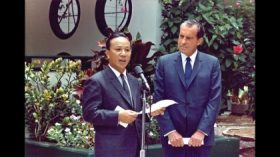
The American Retreat from Vietnam
or go to
Aletho News Archives – Video-Images
From the Archives
Secret document reveals plans for civil war in Lebanon, Israeli false flags, and invasion
By Randi Nord | Geopolitics Alert | April 5, 2019
Beirut – During his visit with US Secretary of State, Mike Pompeo, Lebanese President Michael Aoun reportedly received a US-Israeli document detailing plans for creating a civil war in Lebanon with covert false flag operations and possible Israeli invasion.
Although the source of the document is Israeli and created in partnership with Washington, no one knows who presented it to Aoun. The Lebanese TV station, Al-Jadeed, initially reported the document on Lebanese TV and a video on its website. Geopolitics Alert translated the report for this article. … continue
Blog Roll
 Aletho News
- There’s a drought in academia: A drought in honest research on the subject of drought and other weather extremes
- Department of War Awards $20.7 Billion Contract to Raytheon for Air-to-Air Missiles
- ‘Distance yourselves from Israel’: IRGC urges US population to question govt policies
- America’s Greenland deal has a radioactive backstory
- The RAF Fairford ‘terror plot’: Unpacking escalation in the UK echo-chamber
- EU Council Advances Chat Control 2.0 Scanning Proposal
- Ex-Greek MEP files complaint against Israeli spyware firm over alleged Pegasus surveillance
- Troubling ideas throughout the Torah, Talmud, Mishneh Torah and Tanya
- ‘Grave, alarming’: Iran mission on Trump’s UNGA ‘annihilation’ threats
- Najaf airport to reopen to Iranian flights within 24 hours: Ambassador
- If Americans Knew
- New Report: “Scholasticide and Genocide in Gaza: Assessment, Testimonies and Legal Analysis”
- Ex-Biden officials are desperate for a Gaza scapegoat
- Israeli “settlers” Invade Al-Aqsa; Pour Boiling Water on 75-Year-Old
- Israel Has Kidnapped Another American Teenager
- US arms sales to Israel worth $21.6 billion in 20 months
- Three Palestinians Killed in Israeli Attacks on Gaza
- Revealed: German “Anti-Semitism Expert” Driving Crackdown on Palestine Solidarity is Former Israeli Spy
- Egypt’s Warning to Israel Before Oct 7
- Israel’s siege signals another cruel winter for 1.8 million Gazans – Daily Update
- Netanyahu Asked UAE Leader to Deny Report on Oct. 7 Warning in Secret Visit, Sources Say
- No Tricks Zone
- New Study: Earth And Venus Surface Warmth Largely Explained By Convection And Lapse Rate, Not CO2 Or Radiation
- 2025 Nature Paper Claiming Worsening Global Drought Gets RETRACTED …Heavily Flawed
- New Study: ‘Global Drought Shows No Detectable Recent Acceleration Under Climate Warming’
- Economic Masterminds: German Socialists Suggest Taxing Productivity Gains Stemming From Using AI
- The South China Sea Has Not Been Cooperating With The Climate Change Narrative
- Energy Crisis: Germany Enters Heating Season With Historically Low Gas Reserve Fill Levels
- New Study: The Antarctic Ice Sheet Gained Mass From 2020-2024 Due To Staggering Snow And Ice Accumulation
- Study: Ocean Heating Rates From Thousands Of Years Ago ‘Dwarf’ Modern Ocean Heating Rates
- Climate Extremists Target, Attack Large-Scale Power Grid Infrastructure In Germany!
- New Study: Antarctic Ice Melt Has Contributed Less Than 1 Centimeter To Sea Level Rise In The Last 30 Years

