New York Police Work Slowdown Backfires, Revealing Time Wasted on Petty Violations
By Steve Straehley | AllGov | January 5, 2015
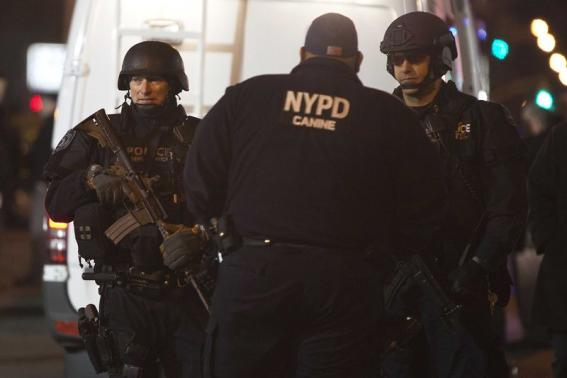
An alleged work slowdown in a fit of pique by New York City police officers could turn out to have the opposite of its intended effect, causing Big Apple residents to lose respect for “New York’s Finest.”
The work slowdown is the latest NYPD tactic in its battle with New York Mayor Bill de Blasio. Officers turned their backs on the mayor when he spoke at the funeral of Rafael Ramos, an officer killed on December 20 by a gunman, Ismaaiyl Brinsley, who cited police abuses as the reason for his crime. Now police officers, at the behest of the Patrolmen’s Benevolent Association, are not enforcing the law “unless absolutely necessary.” During the week of December 22, arrests were down 66% and traffic and parking tickets and summons for minor offenses were down more than 90% from the same week in 2013.
Instead of concern, many are grateful for the diminished police presence. Tickets and summons have been issued disproportionally to those in the working class, forcing them to bear much of the city’s revenue burden. Now the targeting has stopped and those around the political spectrum wonder if it was ever necessary, according to BBC News.
“Well, we can only hope the NYPD unions and de Blasio settle their differences soon so that the police can go back to arresting people for reasons other than ‘when they have to’,” Scott Shackford of the libertarian Reason magazine wrote. In Rolling Stone, Matt Taibbi’s response to the slowdown was that it “shines a light on the use of police officers to make up for tax shortfalls using ticket and citation revenue.”
And Harry Siegel wrote in the New York Daily News on what might be the effect on attitudes toward police. “It’s tough to run a protection racket when people don’t feel threatened, and New York ended 2014 with new lows in murders, rapes, burglaries, grand larcenies and robberies,” he wrote. “For over 20 years, crime has dropped as the NYPD has doubled and redoubled its enforcement efforts. At some point, the chemo is deadlier than the cancer.”
Police felt slighted by de Blasio when the mayor decried the decision of a grand jury not to indict the police officers responsible for the death of Eric Garner, who was put in a chokehold while being arrested for selling individual cigarettes. De Blasio said the decision was one that “many in our city did not want.”
He went on to speak of his son Dante, who is black. “I couldn’t help but immediately think what it would mean to me to lose Dante. Life would never be the same for me after,” de Blasio said. “Chirlane and I have had to talk to Dante for years about the dangers that he may face,” he added. “No family should have to go through what the Garner family went through.” NYPD officers and their union took that as a sign of disrespect.
Some police officers repeated their back-turning protest at Sunday’s funeral for Wenjian Liu, who was also killed by the man who killed Officer Ramos.
To Learn More:
Is New York Police’s ‘Virtual Work Stoppage’ a Boon For Critics? (by Anthony Zurcher, BBC News)
Arrests Plummet 66% With NYPD in Virtual Work Stoppage (by Larry Celona, Shawn Cohen and Bruce Golding, New York Post )
How Low Income New Yorkers Are Benefiting From the NYPD’s Work Stoppage (by Kira Lerner and Igor Volsky, ThinkProgress )
Respect for NYPD Squandered in Attacks on Bill de Blasio (New York Times )
Bill de Blasio Responds to Eric Garner Grand Jury Decision (by Sam Levine, Huffington Post )
The Overlooked Third Victim of the New York Cop Killer (by Noel Brinkerhoff, AllGov )
Two Most-Sued Cops in New York Cost City $1.9 Million in Payouts (by Noel Brinkerhoff, AllGov )
Bystanders Hit by Police Bullets in New York City Get Little Sympathy and No Compensation (by Noel Brinkerhoff and Danny Biederman, AllGov )
Rapprochement Between the United States and Cuba and Sanctions Against Venezuela
By WILLIAM CAMACARO and FREDERICK B. MILLS | CounterPunch | January 2, 2015
In a historic address on December 17, 2014 on “Cuba policy changes” President Barack Obama declared, “our shift in policy towards Cuba comes at a moment of renewed leadership in the Americas.” This “renewed leadership,” in our view, seeks to gradually undermine socialism in Cuba, check waning U.S. influence in the region, and inhibit a growing continental Bolivarian movement towards Latin American liberation, integration, and sovereignty. To be sure, normalization of relations with Cuba and the release of Gerardo Hernández, Ramón Labañino and Antonio Guerrero were long overdue, and the reunification of Alan Gross with his family was an important and welcome gesture. The rapprochement between the United States and Cuba and the simultaneous imposition of a new round of sanctions by the U.S. against Venezuela, however, do not signal a change in overall U.S. strategy but only a change in tactics. As President of Venezuela Nicolas Maduro remarked in a letter to President Raul Castro “there is still a long road to travel in order to arrive at the point that Washington recognizes we are no longer its back yard…” (December 20, 2014).
From Embargo to Deployment of U.S. Soft Power in Cuba
The Obama gambit arguably seeks to move Cuba as far as possible towards market oriented economic reforms, help build the political community of dissidents on the island, and improve U.S. standing in the region, and indeed in the world. In a Miami Herald op-ed piece (December 22, 2014), John Kerry (Secretary of State), Penny Pritzker (Secretary of Commerce) and Jacob J. Lew (Treasury Secretary) wrote that normalization of relations between the U.S. and Cuba will “increase the ability of Americans to provide business training and other support for Cuba’s nascent private sector” and that this will “put American businesses on a more equal footing.” Presumably the op-ed is referring to “equal footing” with other nations that have been doing business for years with Cuba despite the embargo. The essay also indicates that the U.S. will continue its “strong support for improved human-rights conditions and democratic reforms in Cuba” by “empowering civil society and supporting the freedom of individuals to exercise their freedoms of speech and assembly.” Such a version of “empowering civil society” is probably consistent with decades of U.S. clandestine attempts to subvert the Cuban government, documented by Jon Elliston in Psy War on Cuba: The declassified history of U.S. anti-Castro propaganda (Ocean Press: 1999). It is also in line with more recent efforts, through USAID funded social media (phony Cuban Twitter) and a four year project to promote “Cuban rap music” both of which ended in 2012, designed to build dissident movements inside Cuba. In December 2014, Matt Herrick, spokesman for USAID, defended the latter unsuccessful covert program saying, “It seemed like a good idea to support civil society” and that “it’s not something we are embarrassed about in any way.” Moreover, a fact sheet on normalization published by the U.S. Department of State mentions that funding for “democracy programming” will continue and that “our efforts are aimed at promoting the independence of the Cuban people so they do not need to rely on the Cuban state” (December 17, 2014). The Cuban government, though, has a different take on the meaning of “independence of the Cuban people.” They emphasize “sovereign equality,” “national independence,” and “self determination.” In an address on normalization, Raul Castro insisted on maintaining Cuban sovereignty and stated “we have embarked on the task of updating our economic model in order to build a prosperous and sustainable Socialism” (December 17, 2014). Obviously the ideological differences between Washington and Havana will shape the course of economic and political engagement between these two nations in the months and years ahead.
Rapprochement Between the U.S. and U.S. Isolation in Latin America
Through normalization of relations with Cuba, the U.S. also seeks to end its increasing isolation in the region. Secretary of State John Kerry, in his Announcement of Cuba Policy Changes, remarked that “not only has this policy [embargo] failed to advance America’s goals, it has actually isolated the United States instead of isolating Cuba” (December 17, 2014). In October 2014, the United Nations General Assembly voted against the U.S. Cuba embargo for the 23rd year in a row, with only the U.S. and Israel voting in favor. The inclusion of Cuba in the political and, to a certain degree, economic life of Latin America, has also been part of a larger expression of Latin American solidarity that clearly repudiates regional subordination to Washington. Since the sixth Summit of the Americas in Cartagena (April 2012), the U.S. has been on very clear notice by the Community of Latin American and Caribbean States (CELAC) that there will be no seventh Summit of the Americas in Panama in April without Cuba, a condition to which Washington has ceded.
The flip side of Washington’s growing “isolation” has been the critically important regional diversification of diplomatic and commercial relations between Latin America and the BRICS nations (Brazil, Russia, India, China, and South Africa) and the construction of alternative development banks and currency reserves to gradually replace the historically onerous terms of the World Bank and the International Monetary Fund. The financial powerhouse of the BRICS nations is China. Over the past year, China has sent high level delegations to visit CELAC nations and in some cases these meetings have resulted in significant commercial agreements. As a follow up, there will be a CELAC–China forum in Beijing in January 2015 whose main objective, reports Prensa Latina, “is exchange and dialogue in politics, trade, economy and culture.” These ties with BRICS and other nations are consistent with the Chavista goal that the Patria Grande ought to contribute to building a multi-polar world and resist subordination to any power block on the planet. By bringing a halt to its growing isolation, Washington would be in a better position to increase its participation in regional commerce. The terms of economic engagement with most of Latin America, however, will no longer be determined by a Washington consensus, but by a North—South consensus. The Obama gambit, though, appears to be trading one source of alienation (embargo against Cuba) for another (sanctions against Venezuela).
Obama’s Gambit: Pushing Back the Bolivarian Cause at its Front Line–Venezuela
The Obama administration’s move to normalize relations with Cuba, while a welcome change of course, can be seen as a modification in tactics to advance the neoliberal agenda as far as possible in Havana while ending a policy that only serves to further erode U.S. influence in the region. Such diplomacy is in line with what appears to be a major U.S. policy objective of ultimately rolling back the ‘pink tide’, that is, the establishment, by democratic procedures, of left and center left regimes in two thirds of Latin American nations. It is this tide that has achieved some measure of progress in liberating much of Latin America from the structural inequality, social antagonism, and subordination to transnational corporate interests intrinsic to neoliberal politics and economics. And it is the continental Bolivarian emphasis on independence, integration, and sovereignty that has fortified the social movements behind this tide.
The Obama gambit, from a hemispheric point of view, constitutes a tactical shift away from the failed U.S. attempt to isolate and bring the Cuban revolution to its knees through coercion, to an intensification of its fifteen year effort to isolate and promote regime change in Venezuela. The reason for this tactical shift is that Venezuela, as the front line in the struggle for the Bolivarian cause of an increasingly integrated and sovereign Latin America, has become the biggest obstacle to the restoration of U.S. hegemony and the rehabilitation of the neoliberal regime in the Americas.
If this interpretation of U.S. hemispheric policy is near the mark, Obama’s grand executive gesture towards Cuba is immediately related to the context of Washington’s unrelenting antagonism towards Chavismo and, in particular, to the latest imposition of sanctions against Caracas. The reason for this is quite transparent. It has been Venezuela, more than Cuba, during the past fifteen years, that has played the leading role in the change of the balance of forces in the region on the side of sovereignty for the peoples of the Americas, especially through its leadership role in ALBA, CELAC, UNASUR and MERCOSUR, associations that do not include the U.S. and Canada. Argentine sociologist Atilio Boron, in an interview with Katu Arkonada of Rebelión (June 24, 2014), points out, “It is no accident… that Venezuela in particular is in the cross hairs of the empire, and for this reason we must be clear that the battle of Venezuela is our Stalingrad. If Venezuela succumbs before the brutal counter offensive of the United States…the rest of the processes of change underway on the continent, whether very radical or very moderate, will end with the same fate.” The latest U.S. sanctions against Venezuela can be viewed as one component of this counter offensive. It is to a closer look at the sanctions bill, signed into law by the president on December 18, 2014, that we now turn.
The “Venezuela Defense of Human Rights and Civil Society Act of 2014” (S 2142) not only targets Venezuelan officials whom U.S. authorities accuse of being linked to human rights abuses by freezing their assets and revoking their travel visas (Sec. 5 (b) (1) (A) (B)), it also promises to step up U.S. political intervention in Venezuela by continuing “to support the development of democratic political processes and independent civil society in Venezuela” (section 4 (4)) and by reviewing the effectiveness of “broadcasting, information distribution, and circumvention technology distribution in Venezuela” (section 6). One of the instruments of this support for “democratic political processes” has been the National Endowment for Democracy (NED). Sociologist Kim Scipes argues that, “the NED and its institutes are not active in Venezuela to help promote democracy, as they claim, but in fact, to act against popular democracy in an effort to restore the rule of the elite, top-down democracy” (February 28 – March 2, 2014). Independent journalist Garry Leech, in his article entitled “Agents of Destabilization: Washington Seeks Regime Change in Venezuela,” (March 4, 2014) examines Wikileaks cables that indicate similar efforts have been carried out in Venezuela by USAID’s Office of Transition Initiatives (OTI) during the past decade. Hannah Dreier (July 18, 2014), reported that “the State Department and the National Endowment for Democracy, a government-funded nonprofit organization, together budgeted about $7.6 million to support Venezuelan groups last year alone, according to public documents reviewed by AP.” The sanctions bill (S 2142), then, in light of these precedents, contains provisions that suggest an imminent escalation in the use of soft power to support the political opposition to Chavismo in Venezuela, though such funding has been banned by Caracas.
The current U.S. sanctions against Caracas are consistent with fifteen years of U.S. antagonism against the Bolivarian revolution. The measures send a clear signal of increased support for a Venezuelan political opposition that has suffered division and discord in the aftermath of their failed “salida ya” (exit now) strategy of the first quarter of 2014. The sanctions also undermine any near term movement towards normalization of relations between the U.S. and Venezuela. It is no surprise that provisions of the law that targets Venezuelan officials accused of human rights violations have gotten some limited traction inside this South American nation, with the executive secretary of the Venezuelan opposition Democratic Unity Roundtable (MUD), Jesús Torrealba, openly supporting this measure. This is probably not going to get the MUD a lot of votes. According to a Hinterlaces poll taken in May, a majority of Venezuelans are opposed to U.S. sanctions. There has also been a swift repudiation of sanctions by the Maduro administration and the popular sectors. On December 15, 2014, in one of the largest and most enthusiastic gatherings of Chavistas in the streets of Caracas since the death of Hugo Chavez, marchers celebrated the fifteenth year anniversary of the passage by referendum of a new constitution (December 15, 1999) and vigorously protested against U.S. intervention in their country. Even dissident Chavistas appear to be toning down their rhetoric and circling the wagons in the face of Washington’s bid to assert “renewed leadership” in the region.
There is no doubt that the Maduro administration is under tremendous pressure, from left Chavistas as well as from the right wing opposition, to reform and improve public security and deal effectively with an economic crisis that is being exacerbated by falling petroleum prices. What the government of Venezuela calls an “economic war” against the country has domestic and well as international dimensions. Although there is no smoking gun at this time that exposes a conspiracy, some analysts interpret the recent fall in oil prices as part of a campaign to put severe economic pressure on Iran, Russia and Venezuela, countries whose fiscal soundness relies a great deal on petroleum revenues. For example, Venezuelan independent journalist, Jesus Silva R., in his essay entitled “The Government of Saudi Arabia is the Worst Commercial Enemy of Venezuela,” argues that the Saudis and Washington are complicit in the “economic strangulation, planned from the outside, against Venezuela” (December 22, 2014). Whatever the cause of falling petroleum prices and despite the domestic challenges facing Caracas, it will most probably be the Venezuelan electorate that decides, through upcoming legislative elections, whether to give Chavismo a vote of confidence, not outside intervention or a fresh round of guarimbas and terrorist attacks perpetrated by the ultra right. For the large majority of Venezuelans reject violence and favor constitutional means of resolving political contests.
U.S. Sanctions Against Venezuela Evoke Latin American Solidarity with Caracas
The good will generated by rapprochement between the U.S. and Cuba has already been tempered by the almost simultaneous new round of sanctions imposed by Washington against Venezuela. It is important to recall, perhaps with some irony, that it was precisely the late Venezuelan President Hugo Chavez’s establishment of fraternal ties with a formerly isolated Cuba that drew, in particular, the ire of Washington and the virulent antagonism of the right wing Venezuelan opposition. Now it is Latin American and to a significant extent, international solidarity with Venezuela that may prove to be a thorn in Washington’s side. On December 12, 2014, ALBA issued a strong statement against the Senate passage of the sanctions bill, expressing its “most energetic rejection of these interventionist actions [sanctions] against the people and government of the Bolivarian Government of Venezuela.” The statement also warned “that the legislation constitutes an incitement towards the destabilization of…Venezuela and opens the doors to anticonstitutional actions against the legal government and legitimately elected President Nicolas Maduro Moros.” The communiqué also expressed solidarity with Venezuela adding that the countries of ALBA “desire to emphasize that they will not permit the use of old practices already applied to countries in the region, directed at bringing about political regime change, as has occurred in other regions of the world.” MERCOSUR issued a statement on December 17, 2014 that “the application of unilateral sanctions… violate the principle of non-intervention in the internal affairs of States and does not contribute to the stability, social peace and democracy in Venezuela.” On December 22, the G77 plus China countries expressed solidarity and support for the government of Venezuela in the face of “violations of international law that in no way contributes to the spirit of political and economic dialogue between the two countries.” On December 23, the Movement of Non-Aligned Nations stated that it “categorically rejects the decision of the United States Government to impose unilateral coercive measures against the Republic of Venezuela…with the purpose of weakening its sovereignty, political independence and its right to the self determination, in clear violation of International Law.” It is also important to recall that on October 16, 2014 the UN General Assembly elected Venezuela (by a vote of 181 out of 193 members) to a non-permanent seat on the UN Security Council with unanimous regional support, even crossing ideological lines. This UN vote came as a grave disappointment to opponents of the Bolivarian revolution and reinforced Venezuelan standing in CELAC. In yet another diplomatic victory, as of September 2015, Venezuela will assume the presidency of the Movement of Non-Aligned Nations for a three year term. Clearly, it is Washington, not Venezuela that has already become an outlier as the Obama administration launches its “renewed leadership in the Americas.” If these immediate expressions of solidarity with the first post-Chavez Bolivarian government in Venezuela are an indicator of a persistent and growing trend, then by the time of the upcoming seventh Summit of the Americas, April 10 – 11, 2015 in Panama, President Obama can expect approbation for Washington’s opening to Havana, but he will also face a united front against U.S. intervention in Venezuela and anywhere else in the region.
Note: Translations by the authors from Spanish to English of government documents are unofficial. Where citations are not present in the text, hyperlinks provide the source.
William Camacaro MFA. is a Senior Analyst at the Council on Hemispheric Affairs and a member of the Bolivarian Circle of New York “Alberto Lovera.”
Frederick B. Mills, Ph.D. is Professor of Philosophy at Bowie State University and Senior Research Fellow at the Council on Hemispheric Affairs.
Putin’s Approval Spikes as US Admits Attack on Russian Economy
teleSUR | December 30, 2014
According to a survey made by Gallup, Vladimir Putin’s popularity increased by 29 percent compared with 2013 data, when 54 percent of Russians surveyed approved his role as leader of the country.
Gallup attributed recent nationalism following Crimea’s incorporation into Russia and the Sochi Winter Olympic Games to explain the rise in Putin’s popularity to 83 percent, despite the economic trouble that his nation currently faces due to the drop in oil prices.
“Despite U.S. and European sanctions earlier this year over Moscow’s intervention in Ukraine, more Russians see their economy getting better now than has been the case since 2008,” said Gallup.
This week, US President Barack Obama acknowledged a strategy to weaken Russia’s economy through sanctions as well as a drop in oil prices.
“For the first time since 2008, a majority of Russians (73%) believe their country’s leadership is leading them in the right direction. This renewed faith is apparent in their record-level confidence in the country’s military (78%), their national government (64%), and honesty of elections (39%),” states the survey.
Gallup also revealed that Russians also expressed increased satisfaction with their lifestyles.
In 2014, a record-high 65 percent of Russians said they were satisfied with their freedom.
After Ukraine: Are the Czech Republic, Slovakia, and Hungary Veering Off The NATO/EU Reservation?
By Christine Stone | Ron Paul Institute | December 15, 2014

Prague “red card” protest, November 2014
Despite the firmness shown by the EU’s biggest players when it comes to sanctioning Putin’s Russia, lower down the pecking order some member states are not happy. Unlike the most craven and obedient puppets — the Baltic States and Poland — it took some arm twisting to get the Czech Republic, Slovakia and Hungary to agree to punish Moscow for annexing Crimea. Each country is dependent for much of its energy on Russia with which there are also valued economic ties. Why rock the boat? Despite hyperbole claiming that Vladimir Putin was intent on taking them over and rebuilding the iron curtain, in reality, Russia has been an unproblematic neighbor for a quarter of a century.
Could these ripples of discontent with the famed Washington consensus develop into something more troubling for both the US and Brussels? What can they do about it? All three countries are members of both NATO and the EU. Promoting regime change inside the Euro-Atlantic tent surely becomes more problematic. Or, does it? Let us examine each case separately and see what the auguries bode.
On 17th November 2014, it was drab and raining in Prague as the Czechs celebrated 25 years since the so-called “velvet revolution,” unlike the classic freezing, East European winter day of 17th November 1989. Demonstrations to mark the event were slated to take place and a mass of candles filled the passage way on Národní Třida (National Street) where student “Martin Šmid” died at the hands of the police, an event that was said to have triggered the collapse of the communist regime. But, hold on: it soon emerged that Martin Šmid didn’t exist; he had been invented by the Czechoslovak security services, the St. B. (Státní Bezpečnost) as part of a ploy to bring a new, reformed post-communist regime to power.
Emoting over a death that never took place seems weird but, in a way it sums up the banality that lays at the heart of all things connected with the “velvet” events. This was only reinforced later in the day when a group of anti-capitalist protesters snaked its way through the city centre wearing papier maché masks, some bearing the image of the evil Putin, others the reviled (at least, by the local cogniscenti) Czech president, Miloš Zeman. A few Ukrainian flags brought up the rear. Other banners denounced Ecuador’s left wing president, Rafael Correa, hardly a household name in Prague.[i] As the hundred or so protesters passed the Rudolfinum concert hall, a group of elderly rock musicians with lank, grey hair plugged away at some ancient protest songs watched by a handful of leather clad biker types.
Over the river, at Prague castle, a more serious group had been gathering during the afternoon: students bent on delivering a message to President Zeman that it was time to go. They did this by leaving a trail of red cards inside the presidential palace complex (the red card is used in football matches to send a player off the pitch). Several hundred protesters ended up under the ceremonial balcony demanding Zeman leave. Fluttering over the courtyard was the presidential flag denoting that Zeman was in residence. It is difficult to imagine such protests taking place in front of the White House or 10 Downing Street but, no one tried to remove the students who did not, to be fair, behave in a violent or intimidating manner. However, there had been scuffles earlier in the day at a “velvet revolution” ceremony attended by various European dignitaries, including Germany’s President Gauck. When students pelted Zeman (who was protected by an umbrella) with eggs one misdirected and managed to hit Gauck.
What, then, has caused the animus against Zeman? The president is a rather shambolic figure who, his detractors allege, besmirches his office by drinking heavily and speaking “off the cuff” (he even smokes and is regularly photographed with a lighted cigarette as if to highlight his malevolence).
As long time leader of the Czech Social Democrats and a former prime minister, Zeman earned the ire of the chattering classes by joining a coalition with former president Vaclav Klaus between 1998 and 2002. By then, Klaus had developed a healthy scepticism towards the EU and both men opposed US sponsored wars in Kosovo and later Iraq which led to their being anathematized by Brussels and Washington and, by extension, the local bien pensants, whose hero ex-dissident Vaclav Havel was the first Czech to advocate bombarding Belgrade since the Good Soldier Sweijk in 1914! When Klaus’s term ended in 2012, such people assumed that their candidate, Prince Kari Schwarzenberg, would be effortlessly elected to replace him. However, even though the Czech Republic is the repository of much Hapsburg charm in the form of castles and cultural artifacts, the electorate consists of a majority of post- communist bumpkins unlikely to feel represented by a Knight of the Golden Fleece. 54.8 percent voted for Zeman while 45.2 percent (mainly in Prague) chose Schwarzenberg.
As the role is mainly ceremonial, the president could have been ignored but Zeman has chosen to speak out on numerous occasions and in ways to infuriate his imperial masters. He has regularly demanded normal relations with Putin’s Russia, called the Ukrainian crisis a “civil war” and then, in a radio interview categorised Mikhail Khodorkovsky as a criminal while reminding listeners of the double entendre involved in the moniker “Pussy Riot.” Despite their usual boasts of über-liberal sexual mores, the intellectual elite of Prague expressed outrage at this outburst of vulgarity. “They don’t like him because he’s naughty,” a young reporter from Czech Television said of the student protesters. “How can we have a president like that,” they moan. “He must go”.
Added to their woes has been the seemingly inexorable rise of a new political party, Ano 11[ii], which came a close second in the 2013 parliamentary election and is now in coalition with the Social Democrats. Many people take it for granted that Ano’s founder, the billionaire Andrej Babiš, now the country’s minister of finance, will end up as prime minister; the party did well in autumn, 2014 local elections. What, then, is wrong with Ano 11?
According to the Czech media (and the Euro-American oriented elite) Babiš is a Berlusconi clone, boss of one of the Czech Republic’s largest conglomerates, Agrofert, who, like Berlusconi, is also buying up media outlets. Ano is composed of old secret policemen and headed by Informer-in-Chief, Babiš.[iii] A Slovak by origin, Babiš took the allegations to court and was cleared, but the rumours have persisted as has the intention to appeal. However, it seems clear that, apart from the twitterings of the Prague elite, ordinary Czechs are not particularly concerned by such allegations nearly 30 years after the Communists fell from power. Anyway, many of the alleged Ano nest of spies and informers were too young at the time of their “service” to have been very important cogs in the machine. All this is a smoke screen. Babiš has trodden on various entrenched local interests. He has also supported the extension of nuclear power in the Czech Republic which has angered the EU’s generously subsidised renewables lobby which probably sees the troubles with Russian gas as a golden opportunity to cash in.
Are things any better, more reliable from the Euro-Atlantic perspective, in neighbouring Slovakia? The answer is: not entirely. Slovakia has thrown up politicians frowned upon by the West since its independence was secured by Vladimir Mečiar in 1993. Milan Knažko, an old “sixty eighter” and sometime dissident feared that all the elderly would have to die off before Mečiar finally exited the stage. “Slovaks are stupid,” he said. But, it took twenty years to eliminate Mečiar as a political force only for him to be replaced by another “populist,” Robert Fico, whose leftish Smer (Direction) party won an overall victory in the last Slovak election in 2012. Fico has criticised the EU’s sanctions on Russia and seems to have been forced against his will to implement them, as well as allowing the reverse flow of gas to Ukraine from Slovakia’s own reserves. Of course, his hands are tied as Slovakia is a member of the EU and the single currency. Nevertheless, the empire demands 100 percent obedience, nothing less. Fico stood as a candidate in the March 2014 presidential elections but was surprisingly beaten by a maverick outsider, businessman Andrej Kiska, who made what is described as his “fortune” in hire purchase. Unlike Babiš, his business back ground is regarded as a plus rather than an exercise in predatory capitalism. He is popular with the elites both at home and in Brussels (unlike Fico) and will be an ideal advocate for pushing Slovakia in the “right” direction, for example, by recognising Kosovan independence, something it has refused so far to do to avoid trouble with its restless Hungarian minority.
But, nothing said or done by politicians in Prague and Bratislava equal the level of disobedience that has been coming from further down the Danube in Hungary. There, Prime Minister Viktor Orban has adopted an openly defiant position on a range of issues that have infuriated the EU. But even more dangerously for his long term survival, he has fallen into the cross hairs of Washington. Since summer 2014, demonstrations regularly take place on some pretext or other against the Orban government and long-term regime change watchers can only debate how the situation will finally be resolved. Supporters are confident Orban will survive as he is “popular,” but that never stopped the engine of regime change. Viktor Yanukovich’s party handily won elections in 2012 but he was deposed a year later; the hugely popular Hugo Chavez and Muammar Gaddafi both ended up dead.
Viktor Orban has come a long way from the days of his Soros scholarship at Pembroke College, Oxford. His party, Fidesz, was a classic middle of the road liberal outfit – a proud member of the Liberal International where it now sits somewhat uneasily. However, Hungarians have always been more nationalistic than many Europeans as manifested in their almost unique language; their sense of national identity and solidarity goes back a long time. When Fidesz won an overwhelming majority in the 2010 parliamentary elections, Viktor Orban, now prime minister, started to put Hungary first. In the wake of the 2008 financial collapse he threw out the IMF and cancelled Hungary’s debt repayments in foreign currency thus lowering the pain for ordinary Hungarians. In 2011, he expelled Monsanto – Hungary has banned the use of GM crops – lowered fuel prices and, in the same year, changed the voting system to a mixed majority and proportional system modeled on Germany. A new constitution has reduced the number of MPs by half. Something must have gone right because in spring 2014’s parliamentary election, Fidesz again won an overall majority. All this took place against the back drop of a broken political order with most Hungarian parties, particularly on the left, scarred by corruption and failure. The ultra-right Jobbik remained as the only functioning opposition party, something unappealing to most right thinking people, including in Hungary.
Accusations of Orban’s “authoritarianism” have gone on for some time, bolstered by a growing number of NGOs in Budapest (mainly foreign funded and backed) as well as tame academics like Princeton’s Kim Lane Scheppele who has tied herself in knots trying to show that Fidesz’s successive victories at the polls (in 2014 alone the party overwhelmingly won parliamentary, local and European elections) were really failures! Perhaps this might just rumble along, going nowhere while – as in Prague – providing low level political gossip for the chattering classes in Budapest to feed on, were it not for Orban’s rather bold foreign policy moves in the past year.
In January 2014 he announced that a deal had been reached with Russia to fund the expansion of Hungary’s Paks nuclear facility. As the Ukrainian events unfolded and energy security came under the spotlight, this could have been viewed as strategic foresight. Not so; the Americans were now very angry. On top of this, when sanctions came up for discussion after the Crimean annexation, Orban baulked at implementing them: “Why should Hungary ‘shoot itself in the foot,’” he said. Like Fico, he dragged his heels over providing Ukraine with reverse flow gas from Hungary’s reserves. As the hate campaign against Putin entered the stratosphere, Viktor remained committed to participating in the South Stream gas project which only came undone when Bulgaria, the weakest link in the chain, pulled out followed by Russia itself redirecting the pipeline to Turkey. According to observers on the ground in Budapest, Orban was now being “warned” by the Cosa Nostra in Washington that he was going “too far.”
At this time, Hungary was without a US ambassador. Colleen Bell, a producer of TV soap operas, was stuck in the congressional vetting process, so finger wagging was left to the Chargé d’Affaires in Budapest, André Goodfriend. Goodfriend has an impressive CV for such a lowly diplomat and his excursions into Hungarian political life, including the now formulaic support for LGBT events, have been high profile culminating in the announcement that six members of the Hungarian government were to be sanctioned and prevented from visiting the US. No names were mentioned but rumors abounded as to the whys and wherefores of the decision.
What to do? With a hopelessly divided and weak opposition given the implosion of the Hungarian Socialists who backed EU-demanded austerity all the way, and with the paramilitary, ultra-nationalist Jobbik as the only substantial alternative to Orban’s party, all that remains is to split Fidesz in the hope of producing something more compliant. On 23rd October, 2014, as if on cue, the BBC’s long time Budapest correspondent, Nick Thorpe, reported that “cracks” were appearing in the ruling party although he failed to put any substance behind the allegation, or name names.[iv] Otherwise, there are the NGOs of which there are numerous as well as blogs and online publications which trash Orban and the Fidesz government. In September 2014, the authorities in Budapest cracked down on the Ökotárs Foundation, which disbursed grants to local NGOs from Norway. In a way, this was quite a clever ruse as it followed an expose in the New York Times detailing Norway’s many involvements in influence peddling via NGO in Washington.[v]
Do these expressions of dissent in Prague, Bratislava and Budapest mean that the Euro-Atlanticist order that has ruled the post-communist world so comprehensively since the early 1990s is under threat? Not quite: in the end, even Orban caved in to Brussels’ demand for sanctions against Russia. He still maintains that Hungary is a loyal EU and NATO member. Ditto, the Czech Republic and Slovakia. But, there does seem to be a change in the air. After years filled with allegations of corruption, most political parties in Central Europe are morally bankrupt and derided by local populations. Massaging election results is becoming more difficult when parties acceptable to Brussels and Washington can barely make single percentage points. In the Czech Republic, Ano 11 is heading in the same direction as Fidesz with the prospect of getting overall control of parliament in the next parliamentary elections. Another headache for Washington looms if that happens.
These unexpected shifts away from former subservience in the Central European heartland of Euro-conformity may explain why many of the old anti-communists from the era of perestroika and glasnost are being brought out and dusted down. On 11th December, the Center for European Policy Analysis (CEPA) “the only US think-tank dedicated to the study of Central and Eastern Europe” announced it was beefing up its membership with many formidable regime change figures including Toomas Hendrik Ilves, Anne Applebaum, Carl Bildt,Eliot A. Cohen,and Timothy Garton Ash.[vi] It is hard to see these old regime change advocates changing much without resources to put into play, but remember the successful application of their policies after 1989 resulted in socio-economic collapse and mass emigration from Poland and Baltic States where they were most influential. Does Central Europe want to repeat that implosion by following these horsemen of the apocalypse? It is unlikely that Central Europeans other than the sponsored demonstrators be asked.
Notes:
[i] The US embassy was listed at the top of the backers of the protest in a leaflet handed out as the procession marched by. This so-called “Prague Maidan” was an obvious imitation of the protests in Kiev’s main square a year ago which toppled the Ukrainian president.
[ii] Ano is short for the Action of Dissatisfied Citizens (Akce nespokojených občanů). “Ano” also means “yes” in Czech. The party was founded in 2011.
[iii] Fidesz has also been accused of co-opting Hungary’s former secret policemen
[iv] Nick Thorpe “Hungary’s Fidesz: Cracks emerge in ruling party” BBC 23rd October, 2014 http://www.bbc.co.uk/news/world-europe-29740030
[v] http://www.nytimes.com/2014/09/07/us/politics/foreign-powers-buy-influence-at-think-tanks.html?_r=0
[vi] See, the CEPA press release: http://hosted-p0.vresp.com/1111079/ea59c56522/ARCHIVE
Christine Stone is co-author of Post-Communist Georgia: A Short History.
2014: year of futility in the fight against climate change
By Steve Goreham | Communities Digital News | December 29, 2014
The year 2014 was another year of futility in the fight against climate change. Climatists redoubled efforts to convince citizens that urgent action is needed to stop dangerous global warming. But the gap between public warnings and actual events produced an endless stream of climate irony.
January began with a frosty bang as an arctic air mass descended on the central United States, following a similar event in December. What was once called a cold snap is now ominously christened a “polar vortex.” Record-low daily temperatures were recorded from Minnesota to Boston, along with all-time seasonal snowfalls in many cities.
In a White House video released on January 8, John Holdren, chief science advisor to President Obama, made the paradoxical statement, “But a growing body of evidence suggests that the kind of extreme cold being experienced by much of the United States as we speak is a pattern that we can expect to see with increasing frequency as global warming continues.”
Also in January, passengers of the research ship Akademik Shokalskiy were rescued after the ship was locked in ice for 10 days near the antarctic coast. The expedition lead by professor Chris Turney had intended to study how weather patterns near Antarctica were changing due to man-made global warming.
On February 16, during a presentation in Indonesia, Secretary of State John Kerry stated that climate change was “perhaps the world’s most fearsome weapon of mass destruction.” Only two days later, protestors set fire to Kiev, the capital of Ukraine, leading to the resignation of President Viktor Yanukovych. In March, Russia seized the Crimea. In July, Malaysia Airlines Flight 17 was shot down over eastern Ukraine, and political unrest continues today. In the Middle East, slaughter of innocent civilians and beheading of western captives became a growing trend. Man-made climate casualties seem remarkably scarce in comparison.
In March, the Intergovernmental Panel on Climate Change of the United Nations released Climate Change 2014: Impacts, Adaptation, and Vulnerability, part of its Fifth Assessment Report. The report said that man-made climate change would reduce world agricultural output. Lead author Dr. Mark Howden stated, “There’s increasing evidence that climate change is also impacting on agriculture, particularly on some of the cereal crops such as wheat and maize. The negative impacts are greater and quicker than we previously thought.”
Meanwhile, farmers continued to ignore the warnings of the IPCC. According to the US Department of Agriculture, world agricultural production set all-time records for all three major cereal crops in 2014, with rice output up 1.1 percent, wheat up 11.2 percent, and corn up a whopping 14.0 percent over 2013.
The Obama administration continued its attack on coal-fired power plants, which provide about 40 percent of US electricity. In June, the EPA proposed new restrictions on carbon emissions that would make it virtually impossible to build a new coal-fired plant in the US. At the same time, more than 1,200 new coal-fired plants are planned across the world, with two-thirds to be built in India and China.
In his 2007 Noble Prize acceptance speech, former Vice President Al Gore warned that the arctic ice could be gone in “as little as seven years.” But arctic sea ice rebounded in 2014 and antarctic sea ice has been growing for decades. According to the University of Illinois, satellites measured global sea ice area at above the 30-year average at the end of 2014.
In September, the United Nations held a climate summit in New York City to urge the world to conserve energy and reduce emissions. Spokesman Leonardo DiCaprio stated, “This disaster has grown beyond the choices that individuals make.” Mr. DiCaprio neglected to mention his frequent flights on carbon-emitting private jets or his ownership of the world’s fifth largest yacht, purchased from a Middle East oil tycoon.
In October, climate skeptics reported the eighteenth straight year of flat global temperatures. Satellite data shows no temperature increase since 1997. The “pause” in global warming is now old enough to vote or to serve in the military.
Hurricanes and tornadoes are favored events for generating alarming climate headlines, but US weather events were few in 2014. US tornadic activity was below average and the lack of strong hurricanes continued. No Category 3 or stronger hurricane has made US landfall for more than eight years, the longest period since records began in 1900.
The last half of 2014 witnessed a steep drop in world petroleum prices from over $100 per barrel to under $60 per barrel. Hydraulic fracturing and horizontal drilling, technologies perfected by US geologists and petroleum engineers over the last two decades, produced an explosion in US oil production and triggered the fall in world prices.
But the concurrent drop in US gasoline prices to two dollars per gallon is not welcomed by man-made global warming believers. Former Energy Secretary Stephen Chu said in 2008, “So we have to figure out how to boost the price of gasoline to the levels in Europe.” English journalist George Monbiot has lamented, “We were wrong about peak oil: there’s enough in the ground to deep-fry the planet.”
With all the climate fun in 2014, what will 2015 hold?
Steve Goreham is Executive Director of the Climate Science Coalition of America and author of the book The Mad, Mad, Mad World of Climatism: Mankind and Climate Change Mania.Chi
The Prison State of America
By Chris Hedges | Truthdig | December 28, 2014
Prisons employ and exploit the ideal worker. Prisoners do not receive benefits or pensions. They are not paid overtime. They are forbidden to organize and strike. They must show up on time. They are not paid for sick days or granted vacations. They cannot formally complain about working conditions or safety hazards. If they are disobedient, or attempt to protest their pitiful wages, they lose their jobs and can be sent to isolation cells. The roughly 1 million prisoners who work for corporations and government industries in the American prison system are models for what the corporate state expects us all to become. And corporations have no intention of permitting prison reforms that would reduce the size of their bonded workforce. In fact, they are seeking to replicate these conditions throughout the society.
States, in the name of austerity, have stopped providing prisoners with essential items including shoes, extra blankets and even toilet paper, while starting to charge them for electricity and room and board. Most prisoners and the families that struggle to support them are chronically short of money. Prisons are company towns. Scrip, rather than money, was once paid to coal miners, and it could be used only at the company store. Prisoners are in a similar condition. When they go broke—and being broke is a frequent occurrence in prison—prisoners must take out prison loans to pay for medications, legal and medical fees and basic commissary items such as soap and deodorant. Debt peonage inside prison is as prevalent as it is outside prison.
States impose an array of fees on prisoners. For example, there is a 10 percent charge imposed by New Jersey on every commissary purchase. Stamps have a 10 percent surcharge. Prisoners must pay the state for a 15-minute deathbed visit to an immediate family member or a 15-minute visit to a funeral home to view the deceased. New Jersey, like most other states, forces a prisoner to reimburse the system for overtime wages paid to the two guards who accompany him or her, plus mileage cost. The charge can be as high as $945.04. It can take years to pay off a visit with a dying father or mother.
Fines, often in the thousands of dollars, are assessed against many prisoners when they are sentenced. There are 22 fines that can be imposed in New Jersey, including the Violent Crime Compensation Assessment (VCCB), the Law Enforcement Officers Training & Equipment Fund (LEOT) and Extradition Costs (EXTRA). The state takes a percentage each month out of prison pay to pay down the fines, a process that can take decades. If a prisoner who is fined $10,000 at sentencing must rely solely on a prison salary he or she will owe about $4,000 after making payments for 25 years. Prisoners can leave prison in debt to the state. And if they cannot continue to make regular payments—difficult because of high unemployment—they are sent back to prison. High recidivism is part of the design.
Corporations have privatized most of the prison functions once handled by governments. They run prison commissaries and, since the prisoners have nowhere else to shop, often jack up prices by as much as 100 percent. Corporations have taken over the phone systems and charge exorbitant fees to prisoners and their families. They grossly overcharge for money transfers from families to prisoners. And these corporations, some of the nation’s largest, pay little more than a dollar a day to prison laborers who work in for-profit prison industries. Food and merchandise vendors, construction companies, laundry services, uniforms companies, prison equipment vendors, cafeteria services, manufacturers of pepper spray, body armor and the array of medieval instruments used for the physical control of prisoners, and a host of other contractors feed like jackals off prisons. Prisons, in America, are a hugely profitable business.
Our prison-industrial complex, which holds 2.3 million prisoners, or 25 percent of the world’s prison population, makes money by keeping prisons full. It demands bodies, regardless of color, gender or ethnicity. As the system drains the pool of black bodies, it has begun to incarcerate others. Women—the fastest-growing segment of the prison population—are swelling prisons, as are poor whites in general, Hispanics and immigrants. Prisons are no longer a black-white issue. Prisons are a grotesque manifestation of corporate capitalism. Slavery is legal in prisons under the 13th Amendment of the U.S. Constitution. It reads: “Neither slavery nor involuntary servitude, except as punishment for crime whereof the party shall have been duly convicted, shall exist within the United States. …” And the massive U.S. prison industry functions like the forced labor camps that have existed in all totalitarian states.
Corporate investors, who have poured billions into the business of mass incarceration, expect long-term returns. And they will get them. It is their lobbyists who write the draconian laws that demand absurdly long sentences, deny paroles, determine immigrant detention laws and impose minimum-sentence and three-strikes-out laws (mandating life sentences after three felony convictions). The politicians and the courts, subservient to corporate power, can be counted on to protect corporate interests.
Corrections Corporation of America (CCA), the largest owner of for-profit prisons and immigration detention facilities in the country, had revenues of $1.7 billion in 2013 and profits of $300 million. CCA holds an average of 81,384 inmates in its facilities on any one day. Aramark Holdings Corp., a Philadelphia-based company that contracts through Aramark Correctional Services to provide food to 600 correctional institutions across the United States, was acquired in 2007 for $8.3 billion by investors that included Goldman Sachs.
The three top for-profit prison corporations spent an estimated $45 million over a recent 10-year period for lobbying that is keeping the prison business flush. The resource center In the Public Interest documented in its report “Criminal: How Lockup Quotas and ‘Low-Crime Taxes’ Guarantee Profits for Private Prison Corporations” that private prison companies often sign state contracts that guarantee prison occupancy rates of 90 percent. If states fail to meet the quota they have to pay the corporations for the empty beds.
CCA in 2011 gave $710,300 in political contributions to candidates for federal or state office, political parties and so-called 527 groups (PACs and super PACs), the American Civil Liberties Union reported. The corporation also spent $1.07 million lobbying federal officials plus undisclosed sums to lobby state officials, according to the ACLU. CCA, through the American Legislative Exchange Council (ALEC), also lobbies legislators to impose harsher detention laws at the state and federal levels. The ALEC helped draft Arizona’s cruel anti-immigrant law SB 1070.
The United States, from 1970 to 2005, increased its prison population by about 700 percent, according to statistics gathered by the ACLU. The federal Bureau of Justice Statistics, the ACLU report notes, says for-profit companies presently control about 18 percent of federal prisoners and 6.7 percent of all state prisoners. Private prisons account for nearly all newly built prisons. And nearly half of all immigrants detained by the federal government are shipped to for-profit prisons, according to Detention Watch Network.
But corporate profit is not limited to building and administering prisons. Whole industries now rely almost exclusively on prison labor. Federal prisoners, who are among the highest paid in the U.S. system, making as much as $1.25 an hour, produce the military’s helmets, uniforms, pants, shirts, ammunition belts, ID tags and tents. Prisoners work, often through subcontractors, for major corporations such as Chevron, Bank of America, IBM, Motorola, Microsoft, AT&T, Starbucks, Nintendo, Victoria’s Secret, J.C. Penney, Sears, Wal-Mart, Kmart, Eddie Bauer, Wendy’s, Procter & Gamble, Johnson & Johnson, Fruit of the Loom, Motorola, Caterpillar, Sara Lee, Quaker Oats, Mary Kay, Microsoft, Texas Instruments, Dell, Honeywell, Hewlett-Packard, Nortel, Nordstrom’s, Revlon, Macy’s, Pierre Cardin and Target. Prisoners in some states run dairy farms, staff call centers, take hotel reservations or work in slaughterhouses. And prisoners are used to carry out public services such as collecting highway trash in states such as Ohio.
States, with shrinking budgets, share in the corporate exploitation. They get kickbacks of as much as 40 percent from corporations that prey on prisoners. This kickback money is often supposed to go into “inmate welfare funds,” but prisoners say they rarely see any purchases made by the funds to improve life inside prison.
The wages paid to prisoners for labor inside prisons have remained stagnant and in real terms have declined over the past three decades. In New Jersey a prisoner made $1.20 for eight hours of work—yes, eight hours of work—in 1980 and today makes $1.30 for a day’s labor. Prisoners earn, on average, $28 a month. Those incarcerated in for-profit prisons earn as little as 17 cents an hour.
However, items for sale in prison commissaries have risen in price over the past two decades by as much as 100 percent. And new rules in some prisons, including those in New Jersey, prohibit families to send packages to prisoners, forcing prisoners to rely exclusively on prison vendors. This is as much a psychological blow as a material one; it leaves families feeling powerless to help loved ones trapped in the system.
A bar of Dove soap in 1996 cost New Jersey prisoners 97 cents. Today it costs $1.95, an increase of 101 percent. A tube of Crest toothpaste cost $2.35 in 1996 and today costs $3.49, an increase of 48 percent. AA batteries have risen by 184 percent, and a stick of deodorant has risen by 95 percent. The only two items I found that remained the same in price from 1996 were frosted flake cereal and cups of noodles, but these items in prisons have been switched from recognizable brand names to generic products. The white Reebok shoes that most prisoners wear, shoes that last about six months, costs about $45 a pair. Those who cannot afford the Reebok brand must buy, for $20, shoddy shoes with soles that shred easily. In addition, prisoners are charged for visits to the infirmary and the dentist and for medications.
Keefe Supply Co., which runs commissaries for an estimated half a million prisoners in states including Florida and Maryland, is notorious for price gouging. It sells a single No. 10 white envelope for 15 cents—$15 per 100 envelopes. The typical retail cost outside prison for a box of 100 of these envelopes is $7. The company marks up a 3-ounce packet of noodle soup, one of the most popular commissary items, to 45 cents from 26 cents.
Global Tel Link, a private phone company, jacks up phone rates in New Jersey to 15 cents a minute, although some states, such as New York, have relieved the economic load on families by reducing the charge to 4 cents a minute. The Federal Communications Commission has determined that a fair rate for a 15-minute interstate call by a prisoner is $1.80 for debit and $2.10 for collect. The high phone rates imposed on prisoners, who do not have a choice of carriers and must call either collect or by using debit accounts that hold prepaid deposits made by them or their families, are especially damaging to the 2 million children with a parent behind bars. The phone is a lifeline for the children of the incarcerated.
Monopolistic telephone contracts give to the states kickbacks amounting, on average, to 42 percent of gross revenues from prisoner phone calls, according to Prison Legal News. The companies with exclusive prison phone contracts not only charge higher phone rates but add to the phone charges the cost of the kickbacks, called “commissions” by state agencies, according to research conducted in 2011 by John E. Dannenberg for Prison Legal News. Dannenberg found that the phone market in state prison systems generates an estimated $362 million annually in gross revenues for the states and costs prisoners’ families, who put money into phone accounts, some $143 million a year.
When strong family ties are retained, there are lower rates of recidivism and fewer parole violations. But that is not what the corporate architects of prisons want: High recidivism, now at over 60 percent, keeps the cages full. This is one reason, I suspect, why prisons make visitations humiliating and difficult. It is not uncommon for prisoners to tell their families—especially those that include small children traumatized by the security screening, long waits, body searches, clanging metal doors and verbal abuse by guards—not to visit. Prisoners with life sentences frequently urge loved ones to sever all ties with them and consider them as dead.
The rise of what Marie Gottschalk, the author of “Caught: The Prison State and the Lockdown of American Politics,” calls “the carceral state” is ominous. It will not be reformed through elections or by appealing to political elites or the courts. Prisons are not, finally, about race, although poor people of color suffer the most. They are not even about being poor. They are prototypes for the future. They are emblematic of the disempowerment and exploitation that corporations seek to inflict on all workers. If corporate power continues to disembowel the country, if it is not impeded by mass protests and revolt, life outside prison will soon resemble life in prison.
US Senate will vote on Iran sanctions bill in January
Press TV – December 28, 2014
Hawkish Republican Senator Lindsey Graham has announced that the US Senate will vote on Iran sanctions legislation next month despite ongoing nuclear negotiations.
“In January of next year, there will be a vote on the Kirk-Menendez bill, bipartisan sanction legislation,” he said in a press conference with Israeli Prime Minister Benjamin Netanyahu on Saturday.
He was referring to sanctions legislation drafted by Senate Foreign Relations Chairman Bob Menendez and Sen. Mark Kirk.
 The bill that would impose more sanctions against Iran came one month after Tehran and six world powers reached an interim nuclear agreement in Geneva in November 2013.
Several important lobby groups, including the American Israel Public Affairs Committee (AIPAC), are working hard to build support for the measure.
The White House has said President Barack Obama will veto the bill if it is passed.
“We continue to believe that adding on sanctions while negotiations are ongoing would be counterproductive,” White House spokesman Josh Earnest said last month.
The Obama administration is under pressure to put additional sanctions against Iran following the extension of nuclear talks between Tehran and the P5+1 countries — the US, Britain, France, Russia, China and Germany.
Last month, Iran and the six world powers agreed to extend the negotiations.
They also agreed that the interim deal they had signed in Geneva last November remain in place during the remainder of the negotiations until July 1, 2015.
Predictions Based on the 2015 Federal Budget – An Analysis
By Lawrence Davidson | To the Point Analyses | December 28, 2014
Part I – Predictions
I can make high-probability predictions for 2015 and the near-beyond without the benefit of a crystal ball, tarot cards or tea leaves. The only thing that I need is a list of items from the new 2015 federal budget. Here are some of my forecasts and the budget items that make them so highly probable:
1. There will be more deadly truck-related accidents than necessary on the nation’s highways in 2015. That means more deaths, injuries, highway delays, stress and frustration. How do I know? Because the 2015 budget rolls back the safety requirement that truckers need to get more rest between driving assignments. The regulation that was rolled back was itself barely adequate. It restricted drivers to a 70-hour week with mandated rest times between long periods behind the wheel. Nonetheless, despite obviously being in the public interest, this regulation could not survive the pressure of the lobbies representing the trucking industry and its corporate customers. Now we are back to truckers working 85-hour weeks with hardly any mandated rest at all.
2. Either in 2015 or soon thereafter there will be another major banking crisis requiring the outlay of enormous sums of public money to avert economic meltdown. How do I know? Because the 2015 federal budget rolls back the requirement, put in place after the last financial crisis, that forced the trading of derivatives to be done by corporate entities separated from the banks and not covered by the Federal Deposit Insurance Company. In other words, if the banks wanted to devise unreasonably risky investment strategies for their more gullible customers, they had to insulate these strategies from their main banking operations that are crucial to the national economy. In addition the government was not required to insure such undue risks through the Federal Deposit Insurance Corporation. Although obviously in the public interest, these regulations could not survive the pressure coming from the banking lobbies and so, once more, we all must be prepared to pay the price of this version of insufficiently regulated capitalism.
3. The political influence of the nation’s wealthiest individuals will increase by a factor of ten in 2015, making the United States more of a plutocracy and less of a democracy than at any time since the 1920s. How do I know? Because the new federal budget emasculates what little was left of the 2002 McCain-Feingold Bipartisan Campaign Finance Reform Act by increasing tenfold the amount of money individuals can give to political parties. This is the result of conservatives’ demanding that political campaigns be underwritten wholly by private funds. Common sense tells us that such an arrangement can only confirm political power in the hands of those who are already economically dominant. By the way, most countries claiming to be democracies regulate against just this dominance of private money because it is recognized as politically corrupting.
4. Environmental protection will deteriorate in 2015. If you live in a rural area where there are large farms, your water supply will become more suspect. How do I know all this? Because the 2015 federal budget slashes funding for the Environmental Protection Agency by $60 million and forbids the same agency from applying the Clean Water Act to farm ponds and irrigation ditches. In the public interest? Of course not. However this move pleases agribusiness concerns and other industries.
5. Israel, the economically developed nation that has violated just about every human rights regulation listed under international law, and also has repeatedly broken U.S. law forbidding the use of U.S.-supplied weapons for offensive actions against civilian populations, will continue to be both economically and militarily subsidized by the American taxpayer in 2015. How do I know this? Because the 2015 federal budget follows in the footsteps of so many past budgets by setting aside huge sums of money – in the present case $3.1 billion in total aid – for the Zionist state. Of that aid package, $619.8 million is military related.
I could not get exact gross figures for how much money the federal government gives back per year to U.S. states for various programs, but certainly Israel gets more of your federal tax dollar than any single state does, and maybe more than all fifty states put together.
On the same topic of foreign aid to undeserving governments, the 2015 budget will help insure the survival of the brutal military dictatorship in Egypt. That bunch of gangsters will be getting $1.3 billion in military aid.
These dubious expenditures are also not in the U.S. public interest for they will undermine democracy in Egypt and uphold dictatorship. In the case of Israel the money will help uphold racist authoritarianism, ethnic cleansing and religious bigotry. All of which (including the aid to Egypt) has been successfully encouraged by the financial power of the Zionist lobby.
Part II – John Boehner’s Bipartisanism
According to House Speaker John Boehner, the 2015 federal budget is a product of bipartisan compromise: “Understand all these provisions … were worked out in a bi-partisan, bi-cameral fashion.” However, this can hardly be the whole story. Boehner’s statement implies that there were only Republicans and Democrats in the proverbial back room where the budget was worked out and that everyone was practicing sweet reason so as to come to a compromise that benefits the nation. In truth, looking over the shoulders of those representing both parties were numerous lobbyists who had given a lot of money to all these politicians and now wanted something back for their investment. As a result, we as a nation, as a community, were thoroughly outbid by the trucking industry, the bankers, agribusiness, and a good number of conservative ideologues who want the right to gut the federal government (particularly the Environmental Protection Agency and the Internal Revenue Service) while monopolizing funding of our two major political parties. They want to do this so that, among other things, they don’t have worry about regulations or pay even a reasonable amount of taxes.
Part III – Conclusion
The ultimate conclusion we can draw from this “bipartisan” process is that there is no sense of national interest, and damn little sense of community, in the American political system. Both concepts have been superseded by the particular parochial goals and sense of solidarity of groups and subgroups with the deep pockets necessary to buy legislators and legislation. This is what happens when democracy allows itself to be captured by an increasingly unregulated capitalist ethic – an erosion of any politically based sense of a need to work for the common good.
The really depressing part is that for most of our national history it has not been very different. In the mid nineteenth century President James Polk, himself a man of questionable integrity, observed, “There is more selfishness and less principle among members of Congress than I had any conception of, before I became President of the United States.” Well, the problem persists, and given our political way of doing things, it may never be fully overcome
Cold logic on climate change policy
By Judith Curry | Climate Etc. | December 26, 2014
Politically correct climate change orthodoxy has completely destroyed our ability to think rationally about the environment. – Richard Tol
Richard Tol as an essay at The American Interest entitled Hot Stuff, Cold Logic. This is probably the most sensible overview on climate policy that I’ve encountered. I encourage you to read the entire article, here are some excerpts:
Change, after all, can be for the better or the worse, and at any rate it is inevitable; there has never been a lengthy period of climate stasis.
Just as there is no logical or scientific basis for thinking that climate change is new, there is no self-evident reason to assume that the climate of the past is “better” than the climate of the future.
Others argue that the impacts of climate change are largely unknown but may be catastrophic. The precautionary principle thus enjoins that we should work hard, if not do our utmost, to avoid even the slim possibility of catastrophe. This logic works fine for one-sided risks. Climate policy is about balancing risks, and there are risks to climate policies as well as risks caused by climate change. So there is a cost to human well-being in constraining fossil fuel use.
What this means is that, instead of assuming the worst, we should study the impacts of climate change and seek to balance them against the negative effects of climate policy. It is especially important to maintain an objective attitude toward the tradeoff between possible dangers and the costs of policy, because estimating the impacts of climate change has proven to be remarkably hard.
Besides, the faint signal of past climate change is drowned out by all the other things that have changed. Many things are changing, often much faster than the climate, and in ways that confound all unifactoral explanations potentially relevant to policy.
Studies, assessed by the Intergovernmental Panel on Climate Change in its latest report, that have used such methods find that the initial, net impacts of climate change are small (about 1 percent of income) and may even be positive.
In the long run, however, negative impacts may surge ahead of positive ones. The long-run impacts are what matter most for policy. The climate responds only slowly to changes in emissions, and emissions respond only slowly to changes in policy. The climate of the next few decades is therefore largely beyond our control. It is only in the longer term that our choices affect climate change, and by then its impacts are likely to be negative on net. This implies that climate change is an economic problem, and that if economics could be rid of politics, greenhouse gas emissions should be taxed.
The question is therefore not whether there is an economic case for climate policy; it’s how much emission reduction can be justified at given losses to social welfare. To answer that question, we need to understand the size of the impacts of climate change. The current evidence, weak and incomplete as it may be, as summarized by the Intergovernmental Panel on Climate Change, suggests that a century worth of climate change is about as bad as losing a year of economic growth.
But even if we take this into account [worst case scenario], a century of climate change is not worse than losing a decade of growth. So if, as Bjørn Lomborg has been at pains to point out, we “spend” the equivalent of a decade of growth or more trying to mitigate climate change, we will not have spent wisely.
Climate change is a problem, but at least as an economics problem, it is certainly not the biggest problem humankind faces.
The best course of action is to slowly but surely move away from fossil fuels. Many disagree with this plan of action, of course, calling for a rapid retirement of fossil fuel use. Economically, their justification rests on assuming that we should care more about the future than we do in contexts other than climate change, that we should care more about small risks than we do, or that we should care more about poor people than we do.
If our resources were unlimited, we could do all things worthwhile. With a limited budget, we should focus on those investments with the greatest return.
These three examples—of coastal protection, agriculture, and malaria—show that development and vulnerability to climate change are closely intertwined. Slowing economic growth to reduce climate change may therefore do more harm than good. Concentrating the reduction of greenhouse gas emissions in rich countries will not solve the climate problem. And slower growth in rich countries means less export from and investment in poor countries.
A fifth of official development aid is now diverted to climate policy. Money that used to be spent on strengthening the rule of law, better education for girls, and improved health care, for instance, is now used to plug methane leaks and destroy hydrofluorocarbons.
In sum, while climate change is a problem that must be tackled, we should not lose our sense of proportion or advocate solutions that would do more harm than good. Unfortunately, common sense is sometimes hard to find in the climate debate. Desmond Tutu recently compared climate change to apartheid. Climate experts Michael Mann and Daniel Kammen compared it to the “gathering storm” of Nazism in Europe before World War II. That sort of nonsense just gets in the way of a rational discussion about what climate policy we should pursue, and how vigorously we should pursue it.
JC comments
The American Interest is one of my favorite sources for policy analysis, and I follow Walter Russell Mead on Twitter.
Richard Tol is IMO one of the most interesting thinkers on the economics of climate change.
For my previous posts on climate change policy, see the policy tag.
Origins of the police
By David Whitehouse | Worx in Theory | December 7, 2014

The Five Points district of lower Manhattan, painted by George Catlin in 1827. New York’s first free Black settlement, Five Points was also a destination for Irish immigrants and a focal point for the stormy collective life of the new working class. Cops were invented to gain control over neighborhoods and populations like this.
In England and the United States, the police were invented within the space of just a few decades—roughly from 1825 to 1855.
The new institution was not a response to an increase in crime, and it really didn’t lead to new methods for dealing with crime. The most common way for authorities to solve a crime, before and since the invention of police, has been for someone to tell them who did it.
Besides, crime has to do with the acts of individuals, and the ruling elites who invented the police were responding to challenges posed by collective action. To put it in a nutshell: The authorities created the police in response to large, defiant crowds. That’s
— strikes in England,
— riots in the Northern US,
— and the threat of slave insurrections in the South.
So the police are a response to crowds, not to crime.
I will be focusing a lot on who these crowds were, how they became such a challenge. We’ll see that one difficulty for the rulers, besides the growth of social polarization in the cities, was the breakdown of old methods of personal supervision of the working population. In these decades, the state stepped in to fill the social breach.
We’ll see that, in the North, the invention of the police was just one part of a state effort to manage and shape the workforce on a day-to-day basis. Governments also expanded their systems of poor relief in order to regulate the labor market, and they developed the system of public education to regulate workers’ minds. I will connect those points to police work later on, but mostly I’ll be focusing on how the police developed in London, New York, Charleston (South Carolina), and Philadelphia.
* * * * *
To get a sense of what’s special about modern police, it will help to talk about the situation when capitalism was just beginning. Specifically, let’s consider the market towns of the late medieval period, about 1,000 years ago.
The dominant class of the time wasn’t in the towns. The feudal landholders were based in the countryside. They didn’t have cops. They could pull together armed forces to terrorize the serfs—who were semi-slaves—or they could fight against other nobles. But these forces were not professional or full-time.
The population of the towns was mostly serfs who had bought their freedom, or simply escaped from their masters. They were known as bourgeois, which means town-dweller. The bourgeoisie pioneered economic relations that later became known as capitalism.
For the purposes of our discussion, let’s say that a capitalist is somebody who uses money to make more money. At the beginning, the dominant capitalists were merchants. A merchant takes money to buy goods in order to sell them for more money. There are also capitalists who deal only with money—bankers—who lend out a certain amount in order to get more back.
You could also be a craftsman who buys materials and makes something like shoes in order to sell them for more money. In the guild system, a master craftsman would work alongside and supervise journeymen and apprentices. The masters were profiting from their work, so there was exploitation going on, but the journeymen and apprentices had reasonable hopes of becoming masters themselves eventually. So class relations in the towns were quite fluid, especially in comparison to the relation between noble and serf. Besides, the guilds operated in ways that put some limits on exploitation, so it was the merchants who really accumulated capital at that time.
In France, in the 11th and 12th centuries, these towns became known as communes. They incorporated into communes under various conditions, sometimes with the permission of a feudal lord, but in general they were seen as self-governing entities or even city-states.
But they didn’t have cops. They had their own courts—and small armed forces made up of the townsmen themselves. These forces generally had nothing to do with bringing people up on charges. If you got robbed or assaulted, or were cheated in a business deal, then you, the citizen, would press the charges.
One example of this do-it-yourself justice, a method that lasted for centuries, was known as the hue and cry. If you were in a marketplace and you saw somebody stealing, you were supposed to yell and scream, saying “Stop, thief!” and chase after the thief. The rest of the deal was that anybody who saw you do this was supposed to add to the hue and cry and also run after the thief.
The towns didn’t need cops because they had a high degree of social equality, which gave people a sense of mutual obligation. Over the years, class conflicts did intensify within the towns, but even so, the towns held together—through a common antagonism to the power of the nobles and through continued bonds of mutual obligation.
For hundreds of years, the French carried an idealized memory of these early commune towns—as self-governing communities of equals. So it’s no surprise that in 1871, when workers took over Paris, they named it the Commune. But that’s jumping a little farther forward than we should just yet.
* * * * *
Capitalism underwent major changes as it grew up inside feudal society. First of all, the size of capital holdings grew. Remember, that’s the point—to make smaller piles of money into bigger piles of money. The size of holdings began to grow astronomically during the conquest of the Americas, as gold and silver were looted from the New World and Africans were kidnapped to work on plantations.
More and more things were produced for sale on the market. The losers in market competition began to lose their independence as producers and had to take wage jobs. But in places like England, the biggest force driving people to look for wage work was the state-endorsed movement to drive peasants off the land.
The towns grew as peasants became refugees from the countryside, while inequality grew within the cities. The capitalist bourgeoisie became a social layer that was more distinct from workers than it used to be. The market was having a corrosive effect on solidarity of craft guilds—something I’ll take up in more detail when I talk about New York. Workshops got bigger than ever, as a single English boss would be in command of maybe dozens of workers. I’m talking about the mid-1700s here, the period right before real factory industrialization began.
There still weren’t cops, but the richer classes began to resort to more and more violence to suppress the poor population. Sometimes the army was ordered to shoot into rebellious crowds, and sometimes the constables would arrest the leaders and hang them. So class struggle was beginning to heat up, but things really began to change when the Industrial Revolution took off in England.
* * * * *
At the same time, the French were going through a political and social revolution of their own, beginning in 1789. The response of the British ruling class was to panic over the possibility that English workers would follow the French lead. They outlawed trade unions and meetings of more than 50 people.
Nevertheless, English workers put together bigger and bigger demonstrations and strikes from about 1792 to 1820. The ruling class response was to send in the army. But there are really only two things the army could do, and they’re both bad. They could refuse to shoot, and the crowd would get away with whatever it came to do. Or they could shoot into the crowd and produce working-class martyrs.
This is exactly what happened in Manchester in 1819. Soldiers were sent charging into a crowd of 80,000, injuring hundreds of people and killing 11. Instead of subduing the crowd, this action, known as the Peterloo Massacre, provoked a wave of strikes and protests.
Even the time-honored tactic of hanging the movement’s leaders began to backfire. An execution would exert an intimidating effect on a crowd of 100, but crowds now ranged up to 50,000 supporters of the condemned man, and the executions just made them want to fight. The growth of British cities, and the growth of social polarization within them—that is, two quantitative changes—had begun to produce qualitatively new outbreaks of struggle.
The ruling class needed new institutions to get this under control. One of them was the London police, founded in 1829, just 10 years after Peterloo. The new police force was designed specifically to inflict nonlethal violence upon crowds to break them up while deliberately trying to avoid creating martyrs. Now, any force that’s organized to deliver violence on a routine basis is going to kill some people. But for every police murder, there are hundreds or thousands of acts of police violence that are nonlethal—calculated and calibrated to produce intimidation while avoiding an angry collective response.
When the London police were not concentrated into squads for crowd control, they were dispersed out into the city to police the daily life of the poor and working class. That sums up the distinctive dual function of modern police: There is the dispersed form of surveillance and intimidation that’s done in the name of fighting crime; and then there’s the concentrated form of activity to take on strikes, riots, and major demonstrations.
That’s what they were invented for—to deal with crowds—but what we see most of the time is the presence of the cop on the beat. Before I talk about the evolution of police in New York, I want to explore the connection between these two modes of police work.
*****
I’ll begin with the more general topic of class struggle over the use of outdoor space. This is a very consequential issue for workers and the poor. The outdoors is important to workers
— for work
— for leisure and entertainment
— for living space, if you don’t have a home
… and for politics.
First, about work. While successful merchants could control indoor spaces, those without so many means had to set themselves up as vendors on the street. The established merchants saw them as competitors and got the police to remove them.
Street vendors are also effective purveyors of stolen goods because they’re mobile and anonymous. It wasn’t just pickpockets and burglars who made use of street vendors this way. The servants and slaves of the middle class also stole from their masters and passed the goods on to the local vendors. (By the way, New York City had slavery until 1827.) The leakage of wealth out of the city’s comfortable homes is another reason that the middle class demanded action against street vendors.
The street was also simply where workers would spend their free time—because their homes were not comfortable. The street was a place where they could get friendship and free entertainment, and, depending on the place and time, they might engage in dissident religion or politics. British Marxist historian EP Thompson summed all this up when he wrote that 19th century English police were
impartial, attempting to sweep off the streets with an equable hand street traders, beggars, prostitutes, street-entertainers, pickets, children playing football and freethinking and socialist speakers alike. The pretext very often was that a complaint of interruption of trade had been received from a shopkeeper.
On both sides of the Atlantic, most arrests were related to victimless crimes, or crimes against the public order. Another Marxist historian Sidney Harring noted: “The criminologist’s definition of ‘public order crimes’ comes perilously close to the historian’s description of ‘working-class leisure-time activity.’”
Outdoor life was—and is—especially important to working-class politics. Established politicians and corporate managers can meet indoors and make decisions that have big consequences because these people are in command of bureaucracies and workforces. But when working people meet and make decisions about how to change things, it usually doesn’t count for much unless they can gather some supporters out on the street, whether it’s for a strike or a demonstration. The street is the proving ground for much of working-class politics, and the ruling class is fully aware of that. That’s why they put the police on the street as a counter-force whenever the working class shows its strength.
Now we can look at the connections between the two major forms of police activity—routine patrols and crowd control. The day-to-day life of patrolling gets police accustomed to using violence and the threat of violence. This gets them ready to pull off the large-scale acts of repression that are necessary when workers and the oppressed rise up in larger groups. It’s not just a question of getting practice with weapons and tactics. Routine patrol work is crucial to creating a mindset among police that their violence is for the greater good.
The day-to-day work also allows commanders to discover which cops are most comfortable inflicting pain—and then to assign them to the front lines when it comes to a crackdown. At the same time, the “good cop” you may meet on the beat provides crucial public-relations cover for the brutal work that needs to be done by the “bad cops.” Routine work can also become useful in periods of political upheaval because the police have already spent time in the neighborhoods trying to identify the leaders and the radicals.
* * * * *
Now we can jump back into the historical narrative and talk about New York City.
I’ll begin with a couple of points about the traditions of crowds before the revolution. During the colonial period, people got rowdy sometimes, but it was often formalized in ways that the colonial elite would approve or at least tolerate. There were various celebrations that fell in the category of “misrule,” in which social positions were reversed and the lower orders could pretend that they were on the top. This was a way for the subordinate classes to blow off steam by satirizing their masters—a way that acknowledged the right of the elite to be in charge on every other day of the year. This tradition of symbolic misrule was especially prominent around Christmas and New Year’s. Even slaves would be allowed to participate.
There was also a yearly celebration of Pope Day, in which members of the Protestant majority would parade around with effigies, including one of the Pope—until they burned them all at the end. A little sectarian provocation, “all in good fun,” all approved by the city fathers. At that point, Pope Day didn’t usually lead to violence against actual Catholics because there were only a few hundred in New York and not a single Catholic church before the revolution.
These crowd traditions were loud and even riotous, but they tended to reinforce the connection between the lower orders and the elite, not to break that connection.
The lower orders were also bound to the elite by constant personal supervision. This applied to slaves and house servants, of course, but apprentices and journeyman craftsmen also lived in the same house with the master. So there were not a lot of these subordinate people roaming around the streets at all hours. In fact, there was a colonial ordinance for a while that said that working people could be on the streets only when they were going to and from work.
This situation left sailors and day laborers as the city’s rowdiest unsupervised elements. But sailors spent most of their time near the waterfront, and the laborers—that is, the class of regular wage workers—were not yet a large group.
Under these circumstances where most people were already supervised during the day, there was no need for regular police force. There was a night watch, which tried to guard against vandalism and arrested any Black person who couldn’t prove that s/he was free. The watch was not professional in any way. All of them had day jobs and rotated into watch duty temporarily, so they didn’t patrol regular beats—and everybody hated doing it. The rich bought their way out of it by paying for substitutes.
During the day, a small number of constables were on duty, but they didn’t patrol. They were agents of the court who executed writs like summonses and arrest warrants. They did not do detective work. In the 1700s and well into the 1800s, the system relied almost entirely on civilian informants who were promised a portion of any fine that the offender might have to pay.
* * * * *
The revolutionary period changed a few things about the role of crowds and the relation between classes. In the 1760s, beginning with the agitation against the Stamp Act, the elite of merchants and property-holders endorsed new forms of popular mobilization. These were new loud demonstrations and riots that borrowed from existing traditions, obviously in the use of effigies. Instead of burning the Pope, they’d burn the governor, or King George.
I don’t have time to go into detail about what they did, but it’s important to note the class composition of these crowds. Members of the elite might be there themselves, but the body of these crowds was the skilled workers, collectively known as the mechanics. That means that a master would be out in the crowd with his journeymen and apprentices. People of higher social rank tended to view the master craftsmen as their lieutenants for mobilizing the rest of the mechanics.
As the conflict with Britain intensified, the mechanics became more radicalized and organized themselves independently from the colonial elite. There was friction between the mechanics and the elite, but never a complete breach.
And, naturally, when the British were defeated and the elite set up their own government, they had had enough of all this street agitation. There continued to be rebellions and riots in the new independent United States, but they were taking new shapes—partly because economic development was breaking up the unity of the mechanics themselves.
* * * * *
I’ll turn now to those developments that followed the revolution—changes that produced a new working class out of a conflicted hodgepodge of social elements.
Let’s start with the skilled workers. Even before the revolution, the division between masters and journeymen had sharpened. To understand this, we should look more closely at the lingering influence of the guild system; formal guilds did not exist in United States, but some of their traditions lived on among skilled workers.
The old guilds had essentially been cartels, unions of workers who had a monopoly on a particular skill that allowed them to manage the market. They could set customary prices for their goods and even decide beforehand how big the market was going to be.
The managed market allowed for some customary stability of relations among workers of the same trade. A master acquired an apprentice as an indentured servant from his parents in return for a promise of teaching him a skill and giving him room and board for seven years. Apprentices graduated to become journeymen, but often continued to work for the same master as long as there is no slot for them to become masters themselves. Journeymen received customary wages with long-term contracts. This meant that pay would keep coming in despite seasonal variations in the amount of work. Even without the formal structure of guilds, much of this customary set of relations was still in place in the pre-revolutionary period.
From about 1750 to 1850, however, this corporative structure within the skilled trades was falling apart because the external relation—the tradesmen’s control of the market—was also beginning to break down. Trade that came from other cities or from overseas would undermine the masters’ ability to set prices, so workshops were thrown into competition with each other in a way that’s familiar today.
Competition drove the masters to become more like entrepreneurs, seeking out labor-saving innovation and treating their workers more like disposable wage workers. Enterprises became larger and more impersonal—more like factories, with dozens of employees.
In the first decades of the 19th century, employees were not only losing their long-term contracts, but they also were losing their place to live in the masters’ households. The apprentices found this to be a liberating experience, as young men got out from under the authority of their parents and their masters. Free to come and go as they pleased, they could meet young women and create their own social life among their peers. Working women were employed mostly in household service of various types unless they were prostitutes.
Outdoor life became transformed as these young people mingled with the other parts of the population that comprised the developing working class.
The mingling wasn’t always peaceful. Irish Catholic immigration expanded after 1800. By 1829, there were about 25,000 Catholics in the city—one person out of eight. The Irish were segregated by neighborhood, often living alongside Blacks, who themselves were now about 5 percent of the population. In 1799, Protestants burned an effigy of St. Patrick, and the Irish fought back. These battles recurred over the next few years, and it was clear to the Irish that the constables and the watch were taking sides against them.
So, before there were even modern police forces, the lawmen were doing racial profiling. The city’s elite took note of the Irish lack of respect for the watch—their open combativeness—and responded by expanding the watch and making its patrols more targeted. This went along with increasing police attention to Africans, who lived in the same areas and often had the same attitude toward the authorities.
Underlying the sectarian and racial divisions were economic competition, since Irish workers were generally less skilled and drew lower wages than craft workers. At the same time, masters were trying to de-skill the jobs in the workshops. In this way, Anglo apprentices became part of a real labor market as they lost their long-term contracts. When this happened, they found themselves just a rung above Irish immigrants on the wage scale. Black workers, who performed domestic service or worked as general laborers, were a further rung or two down the wage scale from the Irish.
At the same time, the older unskilled part of the wage-working class, centered around the docks and building construction, was expanding because trade and construction both expanded after the Revolution.
Overall, population expanded rapidly. New York was 60,000 in 1800, but it doubled in size by 1820. In 1830, New York had more than 200,000 people—and 312,000 by 1840.
* * * * *
That’s a rough profile of New York’s new working class.
In these decades, all sections of the class went into collective action on their own behalf. It’s quite a complicated story, because of the number of actions and the fragmentation of the class. But we could start with a generalization that the most common form of struggle was also the most elementary—the riot.
Now some specifics. From 1801 to 1832, Black New Yorkers rioted four times to prevent former slaves from being sent back to their out-of-town masters. These efforts generally failed, the watch responded violently, and the participants received unusually harsh sentences. White abolitionists joined in the condemnations of these riots. So these riots illustrate popular self-activity despite elite disapproval—not to mention racial disparity in the application of the law.
There was also white harassment of black churches and theaters, sometimes rising to the level of riots. Poor immigrants were involved, but sometimes rich whites and the constables themselves took part. One anti-Black riot raged for three days in 1826, damaging Black houses and churches—along with houses and churches of white abolitionist ministers.
But there wasn’t just conflict between Black and white workers. In 1802, white and Black sailors struck for higher wages. As with most strikes during this period, the method was something that historian Eric Hobsbawm called “collective bargaining by riot.” In this case, strikers disabled the ships that were hiring at the lower wages. Dockworkers also united across racial and sectarian lines for militant strikes in 1825 and 1828.
Job actions by skilled workers like journeymen didn’t usually need to resort to such physical coercion, because they possessed a monopoly on the relevant skills. Journeymen nevertheless became more militant in these years. Strikes in the skilled trades happened in 3 waves, starting in 1809, 1822 and 1829. Each wave was more militant and coercive than the previous—as they targeted other skilled workers who broke solidarity. In 1829, the journeymen led a movement to limit the workday to 10 hours and created the Workingmen’s Party. The party collapsed in the same year, but it led to the founding the General Trade Union in 1833.
While workers grew more conscious of themselves as a class, they also began to engage in more and more “run-of-the-mill” riots wherever crowds gathered, in taverns or in theaters or in the street. Such riots may have had no clear economic or political objective, but they were still instances of collective self-assertion by the working class—or by ethnic and racial fractions of the class. In the opening decades of the century, there was one of these riots about four times a year, but in the period from 1825 to 1830, New Yorkers rioted at a rate of once per month.
One of these riots in particular alarmed the elite. Known as the Christmas riot of 1828, it actually happened at New Year’s. A noisy crowd of about 4,000 young Anglo workers brought out their drums and noisemakers and headed toward Broadway where the rich lived. On the way, they busted up an African church and beat the church members. The watch arrested several of the rioters, but the crowd rescued them and sent the watch running.
The crowd picked up some more numbers and turned toward the commercial district, where they busted up the stores. At the Battery, they broke windows in some of the city’s richest homes. Then they headed back up Broadway because they knew that the rich were having their own celebration at the City Hotel. There the crowd blocked the coaches from exiting.
A large contingent of the watch showed up, but the leaders of the crowd called a five-minute truce. This allowed the watch to think about the fight that they were about to get into. When the five minutes were up, the watch stepped aside, and the deafening crowd marched past them up Broadway.
This spectacle of working-class defiance took place in full view of the families that ran New York City. Newspapers immediately began calling for a major expansion of the watch, so the Christmas Riot accelerated a set of incremental reforms that finally lead to the creation the New York City Police Department in 1845.
The reforms of 1845 enlarged the police force, professionalized them, and centralized them with a more military chain of command. The watch was expanded to 24 hours, and policemen were forbidden from taking a second job. The pay was increased, and police no longer received a portion of the fines that were extracted from offenders.
This meant the cops were no longer going out on patrol looking for how they were going to make a living, a process that could lead to a strange selection of prosecutions. Eliminating the fee system gave commanders greater freedom to set policy and priorities—and thus made the department more responsive to the shifting needs of the economic elite.
That’s how the New York police got started.
*****
The story of police in the South is a bit different, as you might expect.
One of the first modern-type police forces came in Charleston, South Carolina, in the years before New York force became fully professional. The precursor of the Charleston’s police force was not a set of urban watchmen but slave patrols that operated in the countryside. As one historian put it, “throughout all of the [Southern] states [before the Civil War], roving armed police patrols scoured the countryside day and night, intimidating, terrorizing, and brutalizing slaves into submission and meekness.”
These were generally volunteer forces of white citizens who provided their own weapons. Over time, the system got adapted to city life. Charleston’s population did not explode like New York’s. In 1820, there were still less than 25,000 people—but half of them were Black.
The only way that the South could pull off any real industrialization was to allow slaves to work in wage jobs in the cities. Some slaves were owned directly by factory owners, especially in the South’s most industrial city, Richmond. Most urban slaves, however, were owned by white town-dwellers who used them for personal service and “rented them out” to wage-paying employers.
At first, the masters found the jobs for their slaves and took all of the wages for themselves. But they quickly found it most convenient to let their slaves find their own jobs while collecting a flat fee from the slave for the time spent away from the master.
This new set of arrangements fundamentally altered the relation between slaves and their masters—not to mention among the slaves themselves. For long stretches of time, the slaves got out from under the direct supervision of their masters, and slaves could make cash for themselves above and beyond the fees they paid their masters. Many African Americans could even afford to live outside their masters’ households. Slaves could marry and cohabit independently. By the first decades of the 19th century, Charleston had a Black suburb, populated mostly by slaves alongside some freedmen.
The South’s white population, both in town and country, lived in constant fear of insurrection. In the countryside, however, Blacks were under constant surveillance, and there were few opportunities within the grueling work regime for slaves to develop wide social connections. The dramatically freer circumstances in the cities meant that the state had to step in to do the job of repression that the slavemasters had usually taken care of themselves.
The Charleston Guard and Watch developed by trial and error into a recognizably modern city-run police force by the 1820s, performing both day-to-day harassment of the Black population and staying on call for rapid mobilization to control crowds. It received a big push toward professionalization in 1822 when plans for a coordinated slave insurrection were discovered. They crushed the insurrection, and then they bulked up the force.
The Southern force was more militarized than in the North, even before professionalization. Mounted police were the exception in the North, but they were the rule in the South. And Southern police carried guns, with bayonets.
The specific history of police forces varied in all American cities, but since they were facing similar problems in repressing urban workers and the poor, they all tended to converge on similar institutional solutions. The Southern experience also reinforces the point that was already clear in the North: Anti-Black racism was built into American police work from the very first day.
* * * * *
Toward the end, I’ll say a few words about Philadelphia, but before that, I’m going to draw out some themes that apply to all of these cases.
First of all, we need to put policing in the context of a bigger ruling-class project of managing and shaping the working class. I said at the beginning that the emergence of workers’ revolt coincided with a breakdown of old methods of constant personal supervision of the workforce. The state stepped in to provide supervision. The cops were part of that effort, but in the North, the state also expanded its programs of poor relief and public schooling.
Police work was integrated with the system of poor relief, as constables worked on registration of the poor and their placement in workhouses. That’s even before the police were professionalized—the constables were sorting out the “deserving poor” from the “undeserving poor.” If people were unemployed and unable to work, constables would direct them toward charity from churches or the city itself. But if folks were able to work, they were judged to be “idlers” and sent off to the horrors of the workhouse.
The system for poor relief made a crucial contribution to the creation of the market for wage labor. The key function of the relief system was to make unemployment so unpleasant and humiliating that people were willing to take ordinary jobs at very low wages just to avoid unemployment. By punishing the poorest people, capitalism creates a low baseline for the wage scale and pulls the whole scale downward.
The police no longer play such a direct role in selecting people for relief, but they do deliver a good deal of the punishment. As we know, lots of police work has to do with making life unpleasant for unemployed people on the street.
The rise of modern policing also coincides with the rise of public education. Public schools accustom children to the discipline of the capitalist workplace; children are separated from their families to perform a series of tasks alongside others, under the direction of an authority figure, according to a schedule ruled by a clock. The school reform movement of the 1830s and 40s also aimed to shape the students’ moral character. The effect of this was supposed to be that students would willingly submit to authority, that they would be able to work hard, exercise self-control, and delay gratification.
In fact, the concepts of good citizenship that came out of school reform movement were perfectly aligned with the concepts of criminology that were being invented to categorize people on the street. The police were to focus not just on crime but on criminal types—a method of profiling backed up by supposedly scientific credentials. The “juvenile delinquent,” for example, is a concept that is common to schooling and policing—and has helped to link the two activities in practice.
This ideology of good citizenship was supposed to have a big effect inside the heads of students, encouraging them to think that the problems in society come from the actions of “bad guys.” A key objective of schooling, according to reformer Horace Mann, should be to implant a certain kind of conscience in the students—so that they discipline their own behavior and begin to police themselves. In Mann’s words, the objective was for children to “think of duty rather than of the policeman.”
Needless to say, an analytic scheme for dividing society between good guys and bad guys is perfect for identifying scapegoats, especially racial ones. Such a moralistic scheme was (and is) also a direct competitor to a class-conscious worldview, which identifies society’s basic antagonism as the conflict between exploiters and exploited. Police activity thus goes beyond simple repression—it “teaches” an ideology of good and bad citizenship that dovetails with the lessons of the classroom and the workhouse.
The overall point here is that the invention of the police was part of a broader expansion of state activity to gain control over the day-to-day behavior of the working class. Schooling, poor relief and police work all aimed to shape workers to become useful to—and loyal to—the capitalist class.
* * * * *
The next general point is about something we all know, and that’s this:
There is the law … and then there’s what cops do.
First, a few words about the law: Despite what you may have learned in civics class, the law is not the framework in which society operates. The law is a product of the way society operates, but it doesn’t tell you how things really work. The law is also not a framework for the way that society should operate, even though some people hold out that hope.
The law is really just one tool among others, in the hands of those who are empowered to use it, to affect the course of events. Corporations are empowered to use this tool because they can hire expensive lawyers. Politicians, prosecutors and the police are also empowered to use the law.
Now, specifically about cops and the law. The law has many more provisions than they actually use, so their enforcement is always selective. That means that they are always profiling what part of the population to target and choosing which kinds of behavior they want to change. It also means that cops have a permanent opportunity for corruption. If they have discretion over who gets picked up for a crime, they can demand a reward for not picking somebody up.
Another way to see the gap between the law and what cops do is to examine the common idea that punishment begins after conviction in a court. The thing is, anybody who’s dealt with the cops will tell you that punishment begins the moment they lay hands on you. They can arrest you and put you in jail without ever filing charges. That’s punishment, and they know it. That’s not to mention the physical abuse you might get, or the ways they can mess with you even if they don’t arrest you.
So the cops order people around every day without a court order, and they punish people every day without a court judgment. Obviously, then, some of the key social functions of the police are not written into the law. They’re part of police culture that cops learn from each other with encouragement and direction from their commanders.
This brings us back to a theme that I started with at the very beginning. The law deals with crimes, and individuals are charged with crimes. But the police were really invented to deal with what workers and the poor had become in their collective expressions: Cops deal with crowds, neighborhoods, targeted parts of the population—all collective entities.
They may use the law as they do this, but their broad directives come to them as policy from their commanders or from their own instincts as experienced cops. The policy directives frequently have a collective nature—say, to gain control of an unruly neighborhood. They decide to do that, and then they figure out what laws to use.
That’s the meaning of “zero tolerance” policies, “broken windows” policies—policies that, in the past, might have been frankly termed “uppity nigger” policies. The aim is to intimidate and assert control over a mass of people by acting on a few. Such tactics have been built into police work from the very beginning. The law is a tool to use on individuals, but the real goal is to control the behavior of the larger mass.
* * * * *
I’ll use my last few minutes to talk about some alternatives.
One of them is a justice system that existed in the United States before the rise of the police. It’s well documented for Philadelphia, so that’s the place I’ll discuss. Colonial Philadelphia developed a system called the minor courts in which most criminal prosecutions took place. The mayor and the aldermen served as the judges—the magistrates. Poor people would save up money so they could pay a fee to the magistrate to hear a case.
Then, as now, most crime was committed by poor people against poor people. In these courts, the victim of assault, theft, or defamation would act as prosecutor. A constable might get involved in order to bring in the accused, but that’s not the same thing as a cop making an arrest. The whole action was driven by the victim’s desires, not the state’s objectives. The accused could also counter-sue.
There were no lawyers involved on either side, so the only expense was the fee to the magistrate. The system wasn’t perfect, because the judge might be corrupt, and the life of the poor didn’t stop being miserable when they won a case. But the system was quite popular and continued operating for some time even after a system of modern police and state prosecutors developed in parallel.
The rise of the police, which came along with the rise of the prosecutors, meant that the state was putting its thumb on the scales of justice. In court, you might hope to be treated as innocent until proven guilty. Before you get to court, though, you have to pass through the hands of the cops and prosecutors who certainly don’t treat you like you’re innocent. They have a chance to pressure you or torture you into a confession—or nowadays a confession in the form of a plea bargain—before you ever get to court.
However unfair the system came to be as it was dominated by cops and prosecutors, the minor courts had shown Philadelphians that an alternative was possible that looked a lot more like dispute resolution among equals.
That’s the key—we can make an alternative available again if we abolish the unequal social relations that that police were invented to defend. When the workers of Paris took over the city for two months in 1871, they established a government under the old name of the Commune. The beginnings of social equality in Paris undercut the need for repression and allowed the Communards to experiment with abolishing the police as a separate state force, apart from the citizenry. People would elect their own officers of public safety, accountable to the electors and subject to immediate recall.
This never became a settled routine because the city was under siege from day one, but the Communards had the right idea. In order to overcome a regime of police repression, the crucial work was to live up to the name of the Commune—that is, to build a self-governing community of equals. That’s still pretty much what we need to do.
* * * * *
This is an edited text of a talk I gave in Chicago in late June 2012 at the annual Socialism conference. Audio of the talk is available at wearemany.org, but the text here corrects some mistakes I made back then.
* * * * *
Some sources.
On law and order in the European Middle Ages:
Tigar, Michael. Law and the Rise of Capitalism. New York: Monthly Review Press, 2000.
On the working class and the police in England:
Thompson, E. P. The Making of the English Working Class. Vintage, 1966.
Farrell, Audrey. Crime, Class and Corruption. Bookmarks, 1995.
For some history in the US and insight into the functions of the police:
Williams, Kristian. Our Enemies in Blue: Police and Power in America. Revised Edition. South End Press, 2007.
Silberman, Charles E. Criminal Violence, Criminal Justice. First Edition. New York: Vintage, 1980.
The key source on the evolution of the police in the major cities of the US:
Bacon, Selden Daskam. The Early Development of American Municipal Police: A Study of the Evolution of Formal Controls in a Changing Society. Two volumes. University Microfilms, 1939.
Specific sources on New York, Philadelphia and the South:
Gilje, Paul A. The Road to Mobocracy: Popular Disorder in New York City, 1763-1834. The University of North Carolina Press, 1987.
Steinberg, Allen. The Transformation of Criminal Justice: Philadelphia, 1800-1880. 1st edition. Chapel Hill: The University of North Carolina Press, 1989.
Wade, Richard C. Slavery in the Cities: The South 1820–1860. Oxford University Press, 1964.
On the early years of public schooling in the US:
Bowles, Samuel, and Herbert Gintis. Schooling In Capitalist America: Educational Reform and the Contradictions of Economic Life. Reprint. Haymarket Books, 2011.
U.S. War Against Russia Is Now Against Hungary Too
By Eric Zuesse | Blacklisted News | December 25, 2014
Hungary has decided to align itself with Russia against the United States.
The Western Alliance is starting to fray, over the insistence by Barack Obama and the U.S. Congress to go to war against Russia.
This is called a ‘new cold war,’ but it’s actually already a hot war within Ukraine, immediately next door to Russia.
America’s plan to locate nuclear missiles there aimed against Russia has made stunning progress this year. The formerly neutral nation of Ukraine has now become officially anti-Russian. Because of the Obama coup, Ukraine is suffering a civil war between the Ukrainian regime that Obama’s CIA and mercenaries installed in Kiev on 22 February 2014, versus the people in Ukraine’s far eastern districts, where the Ukrainian President whom Obama was overthrowing had received around 90% of all the votes that had been cast there, and so the newly installed Obama regime in Kiev in the west was overwhelmingly rejected by them — hence, Ukraine’s civil war is raging there now, with Obama’s Kiev regime trying to eliminate the residents there.
But, within the European Union, and especially among its former member-states of the Soviet Union, this is, as of yet, still only a cold war, which is in the process of heating up toward perhaps the super-hot temperature of a nuclear conflict between Russia and NATO (the latter organization consisting of the United States and its vassal nations against Russia). And America is already investing heavily in it.
According to German Economic News (GEN), on December 25th, “Hungary Will Not Take Part in the Cold War Against Russia.” They report that, “Hungary’s Prime Minister Viktor Orban takes his distance from the EU, and accuses the US government of trying to instigate a new Cold War against Russia. Hungary will not participate.” GEN also links to an earlier, October 19th, GEN article, which had reported that, “After Russia, Hungary is now apparently also being targeted by Americans: the United States is hitting senior Hungarian government officials and businessmen with entry bans. The Americans throw corruption-charges against the Hungarians.”
Actually, the United States Government is also very corrupt, and uses corruption-charges against other nations’ officials in order to provide a pretext to force them to buckle to America’s aristocracy — to become vassal nations. Will the U.S. Government now place entry-bans against high U.S. officials, also, such as against Joe Biden even now, and perhaps including against Barack Obama after his Presidency ends and he starts taking favors that are widely expected for him, on and from Wall Street (such as did his friend Timothy Geithner)? (And this was already after the cascade of corruption during George W. Bush’s Presidency — none of which Obama allowed to be investigated and prosecuted.)
In 2013, a Gallup poll asked Americans, “Is corruption widespread throughout the government in the United States?” and 73% said “Yes.” But the corrupt Obama Administration pretends to be in the position of international arbiter against corruption in other corrupt nations. Whom is he fooling? (Perhaps people who don’t read this news-site, for example?)
On Tuesday, December 23rd, Reuters headlined, “Hungary PM Orban: U.S. uses corruption charges to gain influence,” and reported that, “The United States is using corruption allegations against some Hungarian public officials as a ‘cover story’ to boost its influence in central Europe amid the Russia-Ukraine conflict, Prime Minister Viktor Orban said on Tuesday. Orban’s comments come amid a wider souring of relations between Hungary, a NATO ally, and the United States over what America perceives as Orban’s increasingly authoritarian rule and Budapest’s warm relations with Russia.”
America’s pervasive NSA snooping, militarizing of local police-forces, and invasions of Iraq, Syria, Libya, and other countries that never threatened the United States, are not considered (by the British Reuters ) ‘authoritarian,’ but somehow Hungary now is ‘authoritarian.’ Suddenly (though the U.S. didn’t say this when Hungary was trying to meet the demands of the American aristocracy), Hungary is ‘authoritarian,’ and is ‘too’ corrupt to do business with.
When more than two-thirds of the United States public are against the U.S. Government’s selling arms to the Ukrainian Government, but 98% of the U.S. House of Representatives wants not only to sell them to Ukraine but to donate them to Ukraine, with U.S. taxpayers paying the tab for this largesse, and when 100% of the U.S. Senate then goes along with that, and the U.S. President signs it into law, how fake is American ‘democracy’?
Even on such a vital war-and-peace issue as nuclear war, America’s aristocracy, which overwhelmingly finances all ‘elections’ to national office, is controlling the U.S. Government, no matter what the U.S. public want.
Obama hasn’t succeeded in fooling the American public into invading Russia, as George W. Bush succeeded in fooling the American public into invading Iraq, but now he won’t even need to.
All of this trouble is being done in order to surround Russia with our nuclear missiles. It’s not resulting from too much democracy; it’s resulting from fake ‘democracy.’
So: now we know that it’s fake.
It’s fake: that’s the reality. Once this reality is understood, everything else can begin to make sense. Getting rid of the illusion from the lies from the many liars is the prerequisite to understanding. Before that, is only myths. They’re getting more dangerous day-by-day. Nuclear war is deadly serious.
Featured Video
The American Retreat from Vietnam
or go to
Aletho News Archives – Video-Images
From the Archives
Secret document reveals plans for civil war in Lebanon, Israeli false flags, and invasion
By Randi Nord | Geopolitics Alert | April 5, 2019
Beirut – During his visit with US Secretary of State, Mike Pompeo, Lebanese President Michael Aoun reportedly received a US-Israeli document detailing plans for creating a civil war in Lebanon with covert false flag operations and possible Israeli invasion.
Although the source of the document is Israeli and created in partnership with Washington, no one knows who presented it to Aoun. The Lebanese TV station, Al-Jadeed, initially reported the document on Lebanese TV and a video on its website. Geopolitics Alert translated the report for this article. … continue
Blog Roll
 Aletho News
- There’s a drought in academia: A drought in honest research on the subject of drought and other weather extremes
- Department of War Awards $20.7 Billion Contract to Raytheon for Air-to-Air Missiles
- ‘Distance yourselves from Israel’: IRGC urges US population to question govt policies
- America’s Greenland deal has a radioactive backstory
- The RAF Fairford ‘terror plot’: Unpacking escalation in the UK echo-chamber
- EU Council Advances Chat Control 2.0 Scanning Proposal
- Ex-Greek MEP files complaint against Israeli spyware firm over alleged Pegasus surveillance
- Troubling ideas throughout the Torah, Talmud, Mishneh Torah and Tanya
- ‘Grave, alarming’: Iran mission on Trump’s UNGA ‘annihilation’ threats
- Najaf airport to reopen to Iranian flights within 24 hours: Ambassador
- If Americans Knew
- New Report: “Scholasticide and Genocide in Gaza: Assessment, Testimonies and Legal Analysis”
- Ex-Biden officials are desperate for a Gaza scapegoat
- Israeli “settlers” Invade Al-Aqsa; Pour Boiling Water on 75-Year-Old
- Israel Has Kidnapped Another American Teenager
- US arms sales to Israel worth $21.6 billion in 20 months
- Three Palestinians Killed in Israeli Attacks on Gaza
- Revealed: German “Anti-Semitism Expert” Driving Crackdown on Palestine Solidarity is Former Israeli Spy
- Egypt’s Warning to Israel Before Oct 7
- Israel’s siege signals another cruel winter for 1.8 million Gazans – Daily Update
- Netanyahu Asked UAE Leader to Deny Report on Oct. 7 Warning in Secret Visit, Sources Say
- No Tricks Zone
- New Study: Earth And Venus Surface Warmth Largely Explained By Convection And Lapse Rate, Not CO2 Or Radiation
- 2025 Nature Paper Claiming Worsening Global Drought Gets RETRACTED …Heavily Flawed
- New Study: ‘Global Drought Shows No Detectable Recent Acceleration Under Climate Warming’
- Economic Masterminds: German Socialists Suggest Taxing Productivity Gains Stemming From Using AI
- The South China Sea Has Not Been Cooperating With The Climate Change Narrative
- Energy Crisis: Germany Enters Heating Season With Historically Low Gas Reserve Fill Levels
- New Study: The Antarctic Ice Sheet Gained Mass From 2020-2024 Due To Staggering Snow And Ice Accumulation
- Study: Ocean Heating Rates From Thousands Of Years Ago ‘Dwarf’ Modern Ocean Heating Rates
- Climate Extremists Target, Attack Large-Scale Power Grid Infrastructure In Germany!
- New Study: Antarctic Ice Melt Has Contributed Less Than 1 Centimeter To Sea Level Rise In The Last 30 Years

