More Militarization Expected for 2015 in Honduras
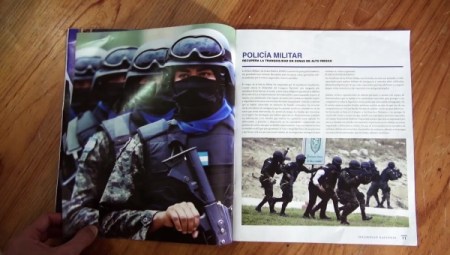
Government propaganda is based on repeating that security has improved with militarization
teleSUR | December 24, 2014
In Honduras, after one year of President Juan Hernandez’s term, there has been an increase in privatization, militarization and budget cutbacks in public services. It is expected this will continue next year, but social movements say that they will not sit idle.
According to leaders of the social and political movement, next year will see massive dismissals of public sector workers, reductions in health and education budgets, and the unity of the political opposition against President Hernandez.
Juan Barahona, coordinator of the National Resistance Front explained that, “We see that the budget which was recently approved in the National Congress, is a budget that in 2015 cuts millions off the health system, education, and millions off agrarian programs. There is not even a cent for wage increases or for new jobs. And as a response to this national budget, there is going to be a great deal of social protest, but also there is going to be strong repression and that’s why they (the government) are preparing themselves with the militarization of security forces.”
Repression
According to Barahona, in Honduras next year there will be more persecution of social movement leaders, stronger repression during public demonstrations, and more presence of military intelligence agencies in surveillance of government dissidents.
However, in the last two months of 2014, new fronts have been created in Honduras. The Rural Women’s front has been demanding cheap credit and true agrarian reform such as the titles of the land they have been working on. The Public Workers Front faces the privatization of public services and the dismissal of more than 8,000 workers. Also the opposition National Resistance Front is calling on people to go into the streets, and opposition political parties have pledged unity.
Salvador Nasralla of the Anti-Corruption Party said, “If we continue along this path, it is going to be a dictatorship. When there is a dictatorship people don’t have the right to an opinion. And we three opposition political parties believe that this is going to get worse.”
While the national media, which for the most part supports the government, claims that violence has been reduced and that the forthcoming decisions will bring solutions for the profound crisis in Honduras, everyday there are more and more expressions of discontent among the population. Confrontation is expected to be ongoing all through Honduras during 2015.
India slashes health budget by 20%
The BRICS Post | December 24, 2014
In a setback to efforts to provide affordable healthcare to some of India’s poorest people, the Indian government has decided to cut 20 per cent of its health budget.
More than 60 billion rupees ($948 million) has been slashed from their budgetary allocation for the year ending 31 March 2015, said officials from the Indian Ministry of Health on Tuesday. The move could severely tax government-run hospitals and clinics that are invariably over-stretched and under-resourced.
Apart from being lowest among BRICS, India’s health expenditure is lower than military expenditure. India spends about 1.3 per cent of its gross domestic product (GDP) on public health while it spends 2.4 per cent on military defense. In contrast, India’s BRICS partner South Africa spent more than 8.5 per cent of GDP on healthcare in 2012.
The Indian Finance Minister Arun Jaitley is struggling to achieve the 2014/15 fiscal deficit target of 4.1 per cent of GDP.
A Reuters report quoted unnamed Indian Health Ministry officials as saying the Finance Ministry has also ordered a spending cut for India’s HIV/AIDS programme by about 30 per cent to 13 billion rupees ($205.4 million).
According to a 2011 study in the medical publication Lancet, 39 million Indians are pushed into poverty every year due to medical costs.
Meanwhile, the neighbouring Chinese government has poured billions of pounds into healthcare reform in recent years, and the system has improved accordingly. Currently, 99 per cent of the rural population gets some kind of insurance, up from 21 per cent a decade ago. China plans to roll out universal coverage by 2020.
India fares poorly in socio-economic indicators, writes development economist, Professor Reeitka Khera.
“India’s use of its meagre public resources is also a cause for concern. Public services tend to have the first claim on public revenues in other countries. With close of half of Indian children being undernourished, one-third being illiterate it is not clear how the ruling class obsessed with “superpower” status hopes to achieve it. The refusal to invest in its main economic “resource” – her own people – will ultimately prove counterproductive for the ruling class as well as ordinary people,” says Khera.
IMF Policies Blamed for Rapid Ebola Spread in West Africa
teleSUR | December 23, 2014
Strict public spending cuts imposed by the International Monetary Fund (IMF) on Guinea, Liberia and Sierra Leone may have contributed to the rapid spread of Ebola in these countries, according to Cambridge University researchers.
“A major reason why the Ebola outbreak spread so rapidly was the weakness of healthcare systems in the region,” said Cambridge sociologist Alexander Kentikelenis, lead author of the study that appeared in the latest issue of medical journal The Lancet.
“Policies advocated by the IMF have contributed to underfunded, insufficiently staffed and poorly prepared health systems in the countries with Ebola outbreaks,” added Kentikelenis.
The first cases of the deadly virus were discovered in Guinea earlier this year, but quickly spread to neighboring Liberia and Sierra Leone. The three countries have been the worst affected by the epidemic, both in terms of lives lost and the damages to their already fragile economies.
According to the researchers, all three countries have been receiving aid from the IMF since the 1990s. However, the lending came with what the IMF calls “conditionalities” that required all three governments “to adopt policies that favor short-term economic objectives over investment in health and education,” reads the report.
Kentikelenis told the BBC that IMF imposed government spending cuts and caps on wages meant countries could not hire health staff and pay them adequately. He also added that the IMF emphasizes and supports decentralized health care systems, which made it harder to mobilize a coordinated response to the virus outbreak.
The IMF denied all accusations in a press release, and called them “factual inaccuracies.”
As of Dec. 21, at least 7,580 people have died from Ebola in six countries: Liberia, Guinea, Sierra Leone, Nigeria, the United States and Mali, making it the worse outbreak of the virus since it was first identified in 1976 in what is now the Democratic Republic of the Congo.
China’s Second ‘Cultural Revolution’
By James Petras :: 12.23.2014
Introduction
China is in the midst of its second ‘cultural revolution’ in a half century. While the first (under Chairman Mao Tse Tung) was intended to ‘revitalize socialism’; the current is directed to ‘moralizing’ capitalism.
The first CR was a frontal attack on the hierarchy of power and privilege inside and outside of the Communist Party, launched from above by Mao Tse Tung, but taken up from below by Red Guards in order to bring about a more egalitarian society.
The current ‘cultural revolution’, launched by President Xi Jinping, is directed at ending widespread corruption, theft and pillage of the Chinese economy and society by high and low officials in government and the capitalist sector.
The two cultural revolutions are linked by Deng Xiaoping, the Chinese leader who officially put closure on the first and set in motion the policies and slogans (“Getting Rich is Good!”), necessitating a second cultural revolution three decades later.
The Socio-Economic Roots of the Cultural Revolution Today
Deng’s call to ‘get rich’ was directed at the Communist Party elite, their family, friends and overseas backers; it was an open invitation to the multi-nationals of the world to freely exploit China’s resources, infrastructure and labor – educated, nurtured and organized through the collective efforts of the preceding Communist regime. Deng ‘liberated’- or privatized – the means of production and rapidly turned public control and appropriation of earnings over to emerging private capitalists. The corollary was the elimination of all social rights, benefits and protections of labor. The dual incentives were designed to maximize private profits in order to attract long-term, large-scale investments and to achieve high growth in the shortest time possible. Deng telescoped a century of growth and exploitation into a few decades.
His strategy succeeded.
Profits soared. By the late 1980’s and early 1990’s millionaires multiplied like mushrooms after a downpour. Then came the billionaires. Aided and abetted by the wholesale privatization of lucrative industries and public lands, a new class of real estate speculators and so-called ‘developers’ emerged , closely linked to corrupt local municipal, regional and national state officials. Millions of peasants were dispossessed and barely (if ever) compensated; hundreds of millions of workers were employed at starvation wages without the free housing, medical care, education, recreational benefits and lifetime employment of the past, socialist system.
China’s GNP exploded at a double-digit rate for three decades – an unprecedented performance. Most of the profits circulated among a narrow elite of party – state officials and capitalists, while a smaller share ‘trickled down’ to middle and low level functionaries. The seizure of public wealth, followed by three decades of intense exploitation of labor and the private land grabbing of farmland and homesteads, spurred the boom in real estate profits and laid the basis for all pervasive and large-scale corruption .The pillage of the public treasury led to large-scale conspicuous consumption – of imported luxury goods, multi-tiered mansions in gated communities, multiple purchases of luxury condos for offspring, mistresses and bribe-takers and givers.
By the mid 2000’s the concentration of wealth, property and privilege had reached astronomical heights: hundreds of billions accrued to the top 2%, millions to the top 10%, and hundreds of thousands to the top 15% – the self-styled ‘middle class’ who thrived on lesser but equally pervasive corruption and theft and who aped the elite and imitated their life style of luxury consumerism.
Beginning in the mid-2000s, hundreds of strikes by exploited factory workers demanded and secured higher wages; millions of households, farmers and peasants fought against municipal party officials, linked to real estate capitalists, who were attempting to ‘grab’ their land, homes and neighborhoods. Hundreds of millions of Chinese in the countryside protested exorbitant medical and educational costs, induced by the privatized health and educational system, which had bankrupted millions of households. They quickly became aware of the luxurious private medical facilities and specialized clinics for the rich -capitalists and corrupt officials. The internal migrant workers, who built the hyper-luxury condos and mansions, lived in paper shacks, far from the twelve-course banquets celebrating the ‘grand openings’ by business swindlers and ‘bought officials’. As wealth grew among the elite, so did the people’s hostility and rejection of the Party and the State, which they personified.
The ever-cautious klepto-capitalists and public pillagers, fearing for their illicit fortunes, smuggled out enormous wealth. Big swindlers, with big fortunes engaged in massive money laundering while publicly demanding the ‘de-regulation” of the financial sector (i.e. to make it easier to launder and hide their fortunes in overseas accounts). Between 2005-2011 China hemorrhaged over $2.83 trillion in illegal overseas financial outflows.
Part II: The Consequences of Corruption, Pillage and Exploitation
The illicit flow of Chinese wealth overseas resulted from the elite’s savage and illegal exploitation of labor (failure to meet minimum official standards concerning pay, work safety, child labor, excessive hours). Wealth from bribes, kickbacks on government contracts, speculation on illicit seizures of land, and making false invoices overpricing imports and underpricing exports, flowed upward and outward. While China was profiting from double-digit growth the regime could ‘tolerate’ corruption and illicit outflows. However, by the beginning of the second decade of the 21st century, when China’s economy de-accelerated to about 7 – 7.5%, the regime became less tolerant of wholesale corruption accompanied by capital flight.
Moreover, the new billionaires, millionaires and affluent middle class indulged in what Thorsten Veblen described as “conspicuous consumption”, the purchase and ostentatious display of superfluous luxury products as status symbols of “success”. According to a Special Report on “Luxury” in the Economist (12/13/14, p.8 -10) “nearly one-third of all personal luxury goods sold worldwide are bought by Chinese consumers.” Since the global crises of 2009, 70 – 80% of global growth in the (luxury) sector has come from China.
China’s emerging private-public ruling class has advanced from concentrating wealth, to consolidating political power to seeking prestige and social status – recognition from their domestic and foreign peers. Ideologically, they are decidedly neo-liberal and pro-Western – as evidenced by the billions they spend in the top-end real estate markets of North America, Europe and Australia as well as the millions they spend on their pampered offspring for ‘elite’ private education. Their children live in half-million dollar condos in Cambridge, Massachusetts, Oxford and Cambridge (England), Toronto and Vancouver (Canada), Sydney and Melbourne Australia. The Chinese oligarchs “make the market” for six-figure Swiss watches, five figure handbags and four digit French cognac.
Corruption, conspicuous consumption and class polarization has delegitimized the ruling Communist Party elite in the eyes of the great mass of the Chinese working class, as well as the professionals and salaried employees who make-up the lower middle class.
The ‘political rot’- the privileged social networks derived from kinship ties-is leading to a relative closed ruling class – excluding the mass of urban workers and rural peasants, with potentially explosive social consequences.
Already thousands of local protests, strikes and other forms of direct action occur every year, even as they are repressed or resolved.
In addition to the social and political dangers resulting from the massive illegal, ‘squandering and theft of wealth’, the illicit outflow of wealth is undermining domestic investment and productive overseas investments, and corruption is preparing the way for stagnation and financial crisis.
The stars are lining up for a ‘perfect political storm’ – which has unfolded in the form of President Xi Jingping’s launch of China’s second cultural revolution (CR).
Xi Jingping’s Cultural Revolution
From the start of the 2nd CR in 2012 to mid-2014, the Chinese Communist Party’s internal corruption body has prosecuted and punished 270,000 cadres. That figure includes both the “tigers” (high officials) and the “flies” (low level functionaries). “Over three dozen officials with ranks of ministers or above, including former security Tsar and Politburo Standing Committee member Zhou Yongkang”, have been arrested and jailed (Financial Times 12/4/14, p. 4). Earlier, the former Railways Minister was arrested and sentenced to death for rigging contracts worth about $26 billion dollars over his seven-year tenure. Hundreds of thousands of private business people, paying bribes, have been arrested and sentenced.
President Xi’s campaign has attacked bribes, ‘gift giving’, frequent ostentatious banquets serving expensive delicacies, and high Party officials’ lodging in five star hotels for weeks on end, ostensibly “tending to business”, but more frequently ‘cavorting with their mistresses’.
To be precise, President Xi is attacking the triple evils of corruption, conspicuous consumption, and pillage of public wealth. The new austerity agenda and the public revelations of ill-gained wealth are focused on exposing public officials and private business people in order to regain public legitimacy. And it is succeeding,…. as far as it goes. Public indignation at the revelations is matched by high approval for the Xi leadership’s anti –corruption campaign.
What makes this far more than just a “power struggle among privileged elites” as the Wall Street Journal and the Financial Times have routinely claimed, are: 1. the duration of the campaign of over 2 years, 2. the scope of the campaign, covering top officials and Chinese business equivalents of Wall Street moguls, 3. The nature of the punishment including long prison terms and even death sentences (rather than the mere ‘slap on the wrists and paltry fines’ that US regulators have given to Wall Street’s billion-dollar swindlers), and 4. the ongoing nature of the process. The sweep and magnitude of Xi’s campaign has all the makings of a ‘cultural revolution’ – not the episodic ‘blowing off steam’ or ‘scapegoating of rivals’ described in the Western press.
The Nature of Xi’s Cultural Revolution
Xi’s ‘cultural revolution’ is directed and driven from above – established legal authorities are in charge – the masses are excluded, and preemptory justice is eschewed: regular court proceedings decide guilt and sentencing.
Secondly, Xi’s ‘cultural revolution’ does not, in any way or place, call into question capitalist property relations, foreign investors, or large-scale inflows and outflows of investment or legally registered speculative capital. Nor has Xi called into question existing capital-labor relations.
Xi’s ‘cultural revolution’ is an attempt to sanitize existing capitalist relations, and to infuse a new capitalist ethic. He wants to ‘revise’ Deng’s famous precept “Getting Rich is Good” to read “Get Rich Lawfully . . . or Face Jail”. China is rated number 100 out of 175, on a corruption scale published by Transparency in 2014 (Financial Times 12/4/14, p. 4). Xi’s war on corruption is based on the premise that corruption undermines China’s status as a global power – it ranks with Algeria and Surinam. Secondly, Xi hopes that he can ‘reform’ the public sector in order to privatize it and he wants the sale to go to the highest bidder, not the biggest bribe giver.
His campaign attacks privileged elites, who accumulate and dispose of wealth illegally but he has never sought to diminish the class system, the hierarchy and inequalities which concentrate political power and forms the basis of corrupt bribe giving and taking.
Xi’s ‘cultural revolution’ is continuing and corruption may lessen. Ostentatious public spending is declining. But this layer of ‘new morality’ is spread thinly over a system of power that can easily revert to the ‘old system’ once the ‘revolution’ ends.
Xi’s noteworthy ‘cultural revolution’, the moralization of public administration and private capitalism, can only succeed if it is accompanied by a social transformation: ethics at the service of social justice and equality and by a democratization of the economic decision-making process. The problem is that Xi, by family, social ties and political allegiances is deeply embedded in a milieu which absolutely rejects any such ‘deepening’ of Xi’s ‘cultural revolution’.
His cultural revolution is strictly guided by a singular objective: to force ‘morality’ on the ‘captains of capital’ in order to facilitate the smooth transition to fully liberalizing China’s economy. President Xi, along with his anti-corruption campaign, is steadily loosening state control over foreign financial investments in Chinese stocks and financial sector; he is moving strongly to expand China’s overseas investments; he is accelerating the privatization of public enterprises and increasingly opening financial services to Wall Street and the City of London. He is also internationalizing the use of the yuan-the Chinese currency- in global transactions, displacing the dollar.
In other words, his cultural revolution is a bridge to a new stage of Chinese capitalist expansion; it will lessen the crude open plunder of the public treasury, but it will not lessen the exploitation of labor nor slow the increasing concentration of wealth and privilege. That will require a different kind of ‘cultural’ revolution- one led from below by workers, peasants and salaried employees. A real ‘cultural revolution’ that realizes the ethical ideals of ‘good government’ through a transformation of class relations.
Xi’s anti-corruption campaign confirms what many workers already knew – but it also unmasks the systemic decay and forges an elementary class consciousness: counter-posing honest, hardworking workers to corrupt privileged oligarchs. Xi is aware of the danger that his campaign could ignite a popular fire: That is why he has kept a tight hold on the process. He is trying to navigate the liberal capitalist transition around the shoals of existing capitalist rot without arousing mass unrest.
Sisi seeks closer economic ties with China
Mada Masr | December 21, 2014
Economic ties appear to be at the top of the agenda, as Egyptian President Abdel Fattah al-Sisi prepares for a state visit to China this week.
At a December 18 press briefing for Chinese official media, Sisi announced, “we are looking forward to developing our strategic relations with our friends in China,” reported Xinhua news agency.
“Cooperation between Egypt and China is not new, and the purpose of the visit is to confirm and develop this cooperation and discuss Chinese investment chances in Egypt,” the president reportedly added.
During the visit, which is scheduled to run from December 22 to 25, officials expect to sign 25 bilateral agreements, mostly concerning economic and investment plans, according to Egypt’s State Information Service.
The president’s visit is preceded by a delegation including the ministers of trade and industry, transport and international cooperation. The delegation set off for Beijing on December 19, and is scheduled to meet with Chinese companies interested in investing in Egypt. They are also set to discuss ways of boosting trade, investment and cooperation in industry and transport.
Trade between Egypt and China was worth around US$10 billion in 2013, a figure officials expect to exceed $11 billion in 2014. However, the balance of trade is overwhelmingly in favor of China. Egypt’s exports to China have historically made up around 10 percent of the total trade volume.
China’s investments in Egypt amount to $8.4 billion, according to The China Global Investment Tracker, a project of the US based Heritage Foundation. These investments include the North West Suez Special Economic Zone, a joint Egyptian-Chinese venture near Ain Sokhna. The project is part of a 2006 plan by China to internationalize its economy by developing 50 such zones in strategic locations around the world.
Sisi is hoping to increase investment and boost exports to China during his visit, which comes ahead of a March summit for international investors in Egypt. As a sign of the state’s hopes for Chinese involvement in the summit, one potential date was nixed due to a conflict with the Chinese New Year holiday.
During his meeting with the Chinese press, Sisi mentioned the Suez Canal Development Project as a potential area for Chinese investment, as well as plans to redevelop Egypt’s road network.
Sisi’s predecessor, Mohamed Morsi, made a similar state visit to China in 2012. For his first state visit outside of the MENA region, Morsi traveled to Beijing, along with a delegation of seven ministers and 80 businessmen. Whilst he was there, China agreed to grant Egypt US$69 million in development assistance, and to facilitate access to a multi-billion dollar credit line for development projects in Africa. Private companies claimed to have secured billions of dollars worth of deals.
At the time, Morsi’s decision to visit China was viewed as an assertion of independence from the United States and other Western powers.
Despite its hostility to the regime it ousted from power, the Sisi administration appears to be continuing this policy, courting aid from foreign powers like Russia and China, as well as from the United States and its allies in the Arab Gulf.
Sisi has praised China, in particular, for separating economic aid from political issues. “China has balanced policies and does not interfere in other countries’ domestic affairs, which is one of the reasons for China’s success,” Xinhua quotes Sisi as saying.
By contrast, Western powers like the United States and the European Union are more likely to tie aid money to human rights and other political concerns. The United States has suspended hundreds of millions of dollars in aid until Egypt can meet democracy and human rights benchmarks, although earlier this month it allowed an exemption in the case of national security interests.
Neoliberal Reforms Passed in Ukraine
teleSUR | December 22, 2014
Ukrainian Prime Minister Arseniy Yatsenyuk justified his country’s recently passed neoliberal reforms Monday, referring to them as essential for Ukraine’s incorporation into the European Union.
In an interview with German media outlet Der Spiegel, Yatsenyuk assured that the measures taken represent “the greatest triumph in this process as Ukrainian youth want to go to Europe.”
Regarding international support, the Ukrainian official indicated that assistance from the United States and the EU has been invaluable since the coup on Feb. 22 that ousted former President Viktor Yanukovich.
“The West does what it can in this situation, because the operational space is limited in relation to Putin,” said Yatseniuk.
The reforms include cost increases in public services, the dismissal of additional public officials, the elimination of free medicine, and the sale of certain state enterprises.
Minister of Economic Development Aivaras Abramovicius said that Ukraine “is bankrupt.”
Ukrainian official statistics show an increase of 20 percent in prices since 2014, while industrial production has decreased by nine percentage points, reports Slavic media outlet Segodnia.
Another economic indicator that is rapidly growing is Ukraine’s external debt, which is expected to rise this year above 41 percent, according to the International Monetary Fund. The debt currently stands at $US42 billion. Foreign investment has also decreased from 15.7 percent to 8.2 percent.
Last week, the United States signed new sanctions against Russia under the Ukraine Freedom Support Act of 2014. The latest sanctions target Russia’s defense industry and allows the United States to provide military aid to Ukraine.
Climate Policy Risk: Who’s In Denial?
By Marlo Lewis | Cooler Heads | December 19, 2014
Earlier this week, economist Roger Bezdek gave a presentation at the Ronald Reagan Building titled “Carbon Dioxide: Social Cost or Social Benefit?” Washington Post columnist Dana Milbank covered the event and published a short review titled “The new climate denialism: More carbon dioxide is a good thing.”
Granted, it’s hard to develop an argument about a complex, technical subject in a 760-word column, but Milbank doesn’t even try. He takes cheap shots and spouts off without knowing whereof he speaks.
Milbank starts with a snarky putdown, asserting that “though Bezdek is an economist, not a scientist, he played one on Monday.” How so? Some of Bezdek’s slides show the fertilization effects of carbon dioxide (CO2) emissions on crop yields and plant growth. For example:

That is not playing scientist, it is citing scientific research.
Another slide shows that, over the past 250 years, CO2 emissions closely correlate with population growth, life expectancy, and per capita GDP.

Milbank retorts that “correlation is not the same as causation.” Deep! But does he really think unprecedented improvements in the human condition — a greater than doubling of average human life expectancy, an eight-fold increase in the sheer abundance of human life, and an eleven-fold increase in global per capita GDP — would have occurred without fossil fuels?
Milbank repeatedly misfires, as the excerpts below (indented in blue) and my comments (standard width in black) show.
For years, the fossil-fuel industries have been telling us that global warming is a hoax based on junk science.
Name a single CEO of any major energy company or trade association who says that! If there are any, they are outliers. Skeptics argue that predictions of catastrophic global warming are based on speculative interpretations of selective evidence and models projections that increasingly diverge from observations. That’s a different thesis — and much harder to refute. Milbank inveighs against a straw man.
But now these industries are floating an intriguing new argument: They’re admitting that human use of coal, oil and gas is causing carbon dioxide in the atmosphere to rise — but they’re saying this is a good thing.
New argument? The Center for the Study of Carbon Dioxide and Global Change has emphasized the ecological and health benefits of atmospheric CO2 enrichment since its inception in 1998. Founder Sherwood Idso’s first peer-reviewed paper on the subject was published in 1991.
I pointed out to Bezdek that increasing energy use fueled the economic growth, and CO2 was just a byproduct. So wouldn’t it make more sense to use cleaner energy?
CO2 does not dirty the air, so reducing/capturing CO2 emissions does not make energy cleaner. CO2 is not “just” a byproduct; it is the inescapable byproduct. Thus, UN emission reduction targets endanger both existing economic, health, and welfare benefits and progress towards a wealthier, healthier world.
He [Bezdek] went on to point out that “35,000 people every year in the United States die in automobile accidents, but the solution is not to ban automobiles. You try to make them safer.” And the solution to climate change is not to ban energy but to make it cleaner.
Making energy “cleaner” in the present context means banning (rapidly phasing out) the carbon-based fuels that currently supply 82% of U.S. and world energy consumption, and are projected — absent additional market-rigging interventions — to supply 80% of U.S. energy in 2040.
The presentation began as a standard recitation of the climate-change denial position, that “there’s been no global warming for almost two decades” and that forecasts are “based on flawed science.”
Milbank provides no evidence that the “standard recitation” is incorrect – very likely because he can’t.

So instead, he resorts to name calling and labels Bezdek a ‘denialist.’
Enough back and forth. What matters is the big picture. Some 1.3 billion people in developing countries have no access to electricity and 2.3 billion people face chronic electricity shortages.

Source: International Institute for Applied Systems Analysis
Even in Europe and the United States, millions of low-income households struggle with high energy costs. Many must choose between heating and eating.

Source: EU Fuel Poverty Network

Source: Bezdek (2014)
Forcing an energy-starved planet to abandon fossil fuels before cheaper substitutes are available is bound to have profound social costs. That is Bezdek’s thesis, and it is spot on. Milbank is in denial.
The Customs Union and Israel’s No-State Solution
By Amal Ahmad | Al-Shabaka | November 29, 2014
Trade regimes between nation states are either autonomous, implying that nation X has no trade obligations towards nation Y, or preferential, establishing low barriers between X and Y and binding them with reciprocal obligations and benefits.
Customs unions are a form of preferential trade, although they take it one step further by establishing uniform barriers against the rest of the world, thereby harmonizing the external trade policy of the union’s member states. Israel and the Palestinian territory have been bound by a customs union de facto since 1967 and de jure since 1994.
Theoretically, a customs union carries mutual benefits to the member states. However, as the United Nations Conference on Trade and Development noted in a 1988 report, between 1967 and 1988 the customs union between Israel and the OPT treated the two economies as dualisms that entrenched the status quo, which, at that time, had established the OPT as a reservoir of cheap labor and Israel as a production and export powerhouse.
Importantly, the arrangement allowed for the unrestricted flow of Israeli goods into the Palestinian economy. Since then, the state of the Palestinian economy has only worsened, and its dependence on imports from Israel has deepened.
The economy is marked by industrial stagnation and the decline of other productive sectors, particularly agriculture, as well as growing trade deficits and a weak export base. The customs union has been key to this process of stagnation, keeping the Palestinian economy industrially weak, underdeveloped, and dependent on imports.
Such skewed results are to be expected given the vast asymmetry of productive capacity between Israel and the OPT. The harm to the Palestinian economy has been further magnified by Israel’s ability to impose at will, as the occupying military power, a one-sided and inconsistent implementation of the union.
Israel’s use of duty-free import quotas is a particularly egregious example of how Israeli actions have magnified the skewedness of the customs union (see the recent analysis by the Palestine Economic Policy Research Institute, MAS). As part of its free trade agreements with other countries, Israel is able to export a certain amount of its goods to country Z, duty free or at a discounted customs rate, while pledging to import a certain amount of goods from country Z at a similarly discounted rate. The goods Israel pledges to import from its partners are often agricultural commodities and food products, which otherwise enjoy a high level of commercial protection in Israel.
Since signing the Paris Protocol in 1994, Israel has given the Palestinian Authority 20 percent of its import quotas. So, if Israel pledges to import 2,000 tons of milk from country Z duty-free, Palestinian retailers can apply for a license (given by Israel) to import up to 400 tons of that product duty-free. Obviously, this is advantageous for the Palestinian retailers who reap a profit margin by buying the imported milk for less while selling it at the same price.
However, the problem is greater than meets the eye. Israel gives Palestinians 20 percent of the import quota but none of the corresponding export quota. For example, if country Z pledges to buy 2,000 tons of tomatoes from Israel in exchange, 100 percent of these tomatoes come from Israeli producers.
Effectively, then, Israel is using the Palestinian economy to divert pressure off its own market by reducing the penetration of cheap imports by 20 percent, while reserving the full benefits of export deals to itself. This example underscores Israel’s ingenious protectionist strategy and its use of the Palestinian economy simply as an appendage when convenient.
Any benefit to Palestinians in the process is purely ad hoc and actually comes at the expense of productive industry.
No Way Out
Many analysts have, over the years, argued that if the implementation of the customs union were “better” or more in line with theory, then it would be optimal for the OPT’s trade and development. However, such calls to “rescue” or “modify” the union obfuscate the real problems facing the OPT, including the vicious cycle and vast asymmetry with its largest and most “free” trading partner, Israel.
In theory, two alternatives exist. The first alternative would involve a relatively closed (non-preferential) arrangement or an asymmetric free trade agreement.
Such arrangements would restrict the access of Israeli imports to the Palestinian market by instating barriers (tariffs) against these imports, temporarily protecting Palestinian producers and encouraging industrial development. However, such arrangements, including a standard free trade agreement, involve rules of origin to distinguish which goods came from where and therefore require the presence of a hard border between the partners.
In other words, such an arrangement could only be implemented in a post-conflict two-state solution scenario.
The second alternative would be to keep trade open but under the auspices of a future single bi-national state that would be responsible for the well-being of both Israeli and Palestinian producers. Such a state would manage a common fiscal platform with targeted support for the backward areas, implying protection of Palestinian producers via fiscal transfer instead of external tariffs. Clearly, this option, too, could only be implemented in a post-conflict one-state solution scenario.
In practice, however, no alternatives exist. As shown above, all alternative arrangements, regardless of their economic merits, presuppose either the delineation of internal borders or their elimination, translating into either a sovereign Palestinian state or an integrated bi-national state.
However, this policy brief argues that both these political scenarios undermine Israel’s strategic interests. All other trade arrangements, therefore, are off the table, regardless of economics, except for the one that requires neither borders nor integration: a customs union.
Indeed, the major benefit of the customs union to its Israeli architects has been the postponement of the border issue and keeping borders interim. Penetration into the Palestinian market is of minor importance to the Israeli economy and could have been achieved via other regimes such as a free trade area.
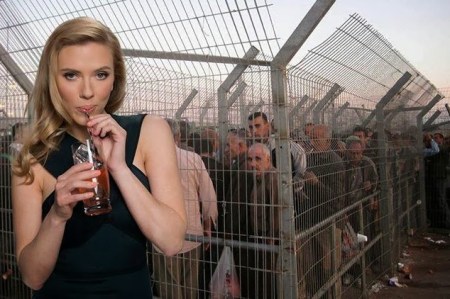
The union, then, is a choice made out of political necessity rather than economic desirability. It illustrates that the only “solution” for Israel is a no-state solution where the Palestinians are neither sovereign nor integrated, but perennially contained, with repercussions across the political and economic spheres.
The Importance of Borders — or Lack Thereof
In the rest of the world, politics reflect underlying economic interests. However, in the OPT, economic arrangements reflect political interests, and to a perverse degree. Israeli interests are imposed through military power, which is why the Israeli military was the “economic” administrator of the OPT from 1967-1988 and remains the main Israeli point of liaison with today’s Palestinian administrators.
Indeed, the political border considerations of Oslo dictated the economic trade arrangements of the Paris Protocol: Given Israel’s insistence on precluding final status border arrangements, the customs union was the only viable option.
Rather than an economically desirable choice, it was an outcome of political necessity for Israel, and there is substantial evidence that the Palestinian side was blackmailed into accepting the union after Israel threatened to stop Palestinian labor flow, as seen in the documents produced by the Ben-Shahar Committee and the Israeli government at the time. Furthermore, documents by the Bruno Committee as far back as 1967 attest to the far-reaching history of border considerations dictating “impure” trade integration of the OPT with Israel.
Instead of elaborating on the potential significance to Palestinian trade of this political trajectory, the literature on the customs union has managed to ignore it altogether, preferring to keep the analysis “politics-free” beyond vague references to the Israeli occupation while focusing on post-conflict frameworks.
In the case of the Palestinians, however, this should be the point of departure for analysis. Border considerations reflect strategic interests that offer the ultimate political economy context for the trade debate.
Not for nothing were the Oslo Accords, and, by extension, the Paris Protocol, incomplete and vague contracts that did not discuss many contingencies (the protocol is 35 pages compared to the 1,000+ page NAFTA) and were, most importantly, interim in nature. Several Palestinian economists, including Raja Khalidi as well as Adel Zagha and Husam Zomlot, point out that the economic problems in the OPT do not have an economic solution, and that the fundamental problem of the Paris Protocol is political.
What this policy brief argues is that the point of the protocol was not to give Israel the upper bargaining hand in final status, given that incomplete contracts favor the stronger party. The aim was to put off final status altogether in line with Israel’s policy since 1967. Further, this brief argues that the Zionist project lies at the heart of Israel’s desire for and design of an incomplete and interim contract with the OPT.
Zionism’s desire for a Jewish majority and for differential national rights for Jews within that majority has, as Mushtaq Khan has argued, dictated a political reality in which the Israeli state cannot delink from the OPT but also cannot swallow it into a single state.
A sovereign Palestinian state does not solve “the Palestinian problem” inside Israel, while one bi-national state defeats the Zionist national project outright. From a Zionist perspective, the best, or indeed only, solution to the Palestinian “problem” of demography and claim to rights, is a no-state solution, in which the Palestinians are contained manageably and in perpetuity. Israeli minister of economy Naftali Bennett recently explicitly expressed this as a “plan for peace.”
Thus, the customs union will persist so long as Israel’s interest in maintaining what could be termed “strategically absent” borders persists. This understanding helps to explain the historical endurance of an “economic” union that serves no rationale in theory and is full of contradictions in practice.
The relevance of this analysis to assessing developments in Israel-Palestine is illustrated by the recent controversy over customs stations. Customs stations are stations for collecting tariffs on imports. They are not supposed to exist in customs unions where trade between member states is supposed to be free. However, they are sometimes placed along an internal border to begin the transition to a free trade agreement or to more protectionist agreements.
Some economists have long advocated the establishment of customs stations between Israel and the OPT in the hope that the stations could pave the transition to a more economically desirable trade regime. Furthermore, this thinking goes, as a symbol of fiscal autonomy for the Palestinians, such stations might pave the way for political autonomy. However, this reflects a failure to comprehend the political containment context, which precludes the possibility of these stations ever translating into a functioning, sovereign border.
This reality became crystal clear when, after six months of secret negotiations, the Israeli government and the PA signed an agreement to “tighten cooperation” on tax and customs in July 2012. The agreement reevaluated the tax clearance mechanism and established new customs stations. The stated purpose was to reduce funds leakage from Israeli customs to the PA and to improve Palestinian customs capabilities.
The PA, no doubt, signed out of desperation given that even a marginal improvement in customs revenue, which constitutes 70 percent of the non-aid budget, would help. And they joined the Israeli signatories in lauding the deal as a step towards Palestinian fiscal and political sovereignty.
In fact, the deal did not foresee a better reality but rather reflected an extremely adverse one. Tweaking the union to secure incremental improvements certainly brought some small gains in terms of revenue but none at all for Palestinian productive capabilities since it left the majority of trade flows with Israel intact, maintaining the asymmetry.
The fact that the custom stations set out by the deal were and are being placed along Israel’s Separation Wall, the illegal and de facto structure that penetrates the West Bank, confirms Israel’s commitment to containment along interim lines that separate the populations while keeping borders strategically absent.
The customs stations issue highlights a crucial point: Analyses of trade and of the economy more broadly must be situated in the relevant context of Israel’s policy of containment as conflict management, including its pursuit of a no-state solution whereby borders are strategically absent and the Palestinians and their economy are contained manageably and in perpetuity.
Post-conflict frameworks, which assume a final status with defined borders and underpin the calls for the different trade scenarios described above, may appeal to a community within Israel and Palestine and internationally that is desperately looking for a two-state solution. However, they obfuscate the real issues facing the Palestinian economy and, in doing so, validate and help to sustain the adverse status quo.
Bringing Borders Back: Refocusing the Israel-Palestine Trade Debate
Israel’s strategic containment lies at the heart of the Palestinian economic challenge. In an economy as underdeveloped and severely deformed as the Palestinian economy, rigorous development policy is required to overcome the vicious cycles and initiate virtuous developmental ones.
The exact policies are highly context-specific and are often the result of trial and error learning processes. But the political economy requirements are clear: There must be a sovereign centralized power within defined borders that can navigate the fiscal platform for state taxation and spending policies. The fiscal platform is necessary not only for building local capacities and incentives, but also for mediating between the country’s stage of development and the competitive pressures of international markets, and for supporting nascent capitalists.
Here lies the full tragedy of the Palestinian economy. For trade to serve development goals, certain fiscal capacities like import substitution and export promotion are required especially in the initial stages. But since development more broadly requires a fiscal base that in turn presupposes a sovereign, then the current containment of the OPT and their preclusion from any sovereign is the worst possible scenario for any developing economy.
The absence of both fiscal transfer within a one-state Israel-Palestine and sovereign protection under a Palestinian state incapacitates the taxation capabilities at the heart of all development processes and prevents any strategy of supporting domestic capability. The contained economy will necessarily operate in an entirely ad hoc fashion that is catastrophic not only to long-term development but to short-term viability.
What can be done to redress the situation? First, development actors should eschew ex-post conflict frameworks, including state-building and final-border scenarios, as inappropriate to understanding, assessing, or planning the Palestinian economy.
Rather, their point of departure must be an understanding of not only the subjugation of the Palestinian economy to Israel’s mode of conflict management but also to its specific kind of conflict management, i.e., containment. Otherwise, it is impossible to grasp the real roots of the ongoing deterioration of the economy and the absence of development prospects
Second, if the international community truly wants to support Palestinian development, it must confront, expose, and challenge Israel’s containment of the OPT. This includes the rejection of the façade of a two-state solution or “peace process”” and an acknowledgement of the way that Israel is managing the Palestinian population and their economy in perpetuity, refusing to consider any arrangement that separates them into a sovereign state (see e.g., recent statements by Prime Minister Benjamin Netanyahu and Justice Minister Tzipi Livni) or to integrate them into a bi-national state.
In addition, it is past time for the international community to call out the racist vision, of differential rights for Jews and non-Jews within Israel as well as in the OPT that underpins this strategy. While such positions by the international community would not guarantee a “solution” one way or the other, they would certainly support the struggle against what might otherwise be perennial political containment and economic backwardness.
In short, there is a need to refocus debate, analysis, and action on Israel’s containment strategy — a de facto no-state solution for the OPT — and the repercussions of this strategy on the economic sphere. Until then, the underdevelopment of Palestinian trade and the economy more broadly will remain institutionally guaranteed.
Al-Shabaka is an independent non-profit organization whose mission is to educate and foster public debate on Palestinian human rights and self-determination within the framework of international law.
Amal Ahmad is a Palestinian economic researcher whose work focuses on fiscal and monetary relations between Israel and Palestine.
Ecuador ends deal with Germany on environmental issues
Press TV – December 20, 2014
Ecuador has terminated its environmental cooperation with Germany after German legislators tried to visit an Amazon rainforest recently opened for oil exploitation, the country’s foreign minister says.
“Ecuador unilaterally ends all cooperation with Germany on environmental issues,” Ricardo Patino said on Friday.
In 2012, Germany and Ecuador inked a cooperation deal worth 36 million euros ($44 million) to protect the environmentally sensitive rainforest known as Yasuni. They also signed another deal worth 7 million euros ($9 million) in other environment projects.
“If they think they had the right to doubt the word of Ecuador’s government on the issue of Yasuni because they were providing funds, we’ll give them their money back with interest,” Patino added.
He also noted that the Latin American country has not received the funds for the rainforest, and the money allocated for the other projects will be returned soon.
In 2007, Ecuadorian President Rafael Correa asked rich countries to donate $3.6 billion to help protect the Yasuni in exchange for pledges not to drill for the oil beneath it.
However, Correa allowed the national oil company to do drilling after his proposal was not welcomed by the other countries.
Earlier this month, Correa did not permit the German lawmakers to visit the Yasuni to observe oil production and talk to activists opposing the measure.
The Ecuador government assured that it will take every measure possible to protect the sensitive Amazon environment during the extraction process. However, the Correa government was not pleased that the German delegation wanted to meet with opposition groups first.
“We either have relations based on equality, or none at all,” Correa said in a statement to the German delegation, asking if Germany would likewise accept a delegation from Ecuador coming to their country to inspect their nuclear projects, for instance. Correa added that his country “stopped being a colony 200 years ago.”
Obama authorizes sanctions against Russia’s Crimea
RT | December 19, 2014
US President Barack Obama has authorized sanctions against individuals and entities operating in Russia’s Crimean peninsula, the White House said in a statement.
Obama has issued an executive order that “prohibits the export of goods, technology, or services to Crimea and prohibits the import of goods, technology, or services from Crimea, as well as new investments in Crimea,” according to the statement.
The executive order also authorizes the Secretary of the Treasury to impose sanctions on “individuals and entities operating in Crimea.”
The move comes just a day after the European Union introduced similar action against the Russian region of Crimea and Sevastopol, accepted into the Russian Federation following the referendum last March.
The United States did not recognize the reunification and has been calling on Russia to “end its occupation and attempted annexation of Crimea.”
“We will continue to review and calibrate our sanctions, in close coordination with our international partners, to respond to Russia’s actions,” Obama’s statement reads.
The bill that opened way for further sanctions against Russian economy – dubbed Ukraine Freedom Support Act of 2014 – was signed on Thursday. However Obama was hesitant to introduce any new measures until they are synchronized with European partners.
Money Buys Influence in US for Fugitive Ecuadorean Bankers
teleSUR | December 18, 2014
Family members of Ecuador’s fugitive Isaias brothers appear to have received preferential treatment in the U.S. thanks to political donations to the Democratic Party, The New York Times revealed Tuesday.
Estefania Isaias — the daughter of Roberto Isaias, one of two brothers wanted in Ecuador for bank fraud — had been barred from entering the United States after committing immigration fraud. That ban was lifted thanks to the intervention of high-ranking officials in the U.S. State Department. The lifting of the ban was made possible thanks to the assistance of Robert Menendez, a Democratic Senator.
The New York Times investigation reveals that the office of Menendez lobbied extensively in support of Estefania Isaias, even reaching out to Cheryl Mills, Hilary Clinton’s chief of staff while Clinton was she was U.S. secretary of state. He succeeded in getting Ms. Isaias into the United States and wrote to her to tell her the news a mere day after the Isaias family gave a donation to the Democratic Party.
Estefania’s sister Maria also faced a ban on entering the United States and Menendez’s office once again worked to intervene in her favor — also after receiving a donation from the Isaias family.
A spokesperson for Menendez told the Times that his office’s advocacy in the case of Ms. Isaias was routine. However, Linda Jewell, former U.S. ambassador to Ecuador, told the Times, “Such close and detailed involvement by a congressional office in an individual visa case would be quite unusual, especially for an applicant who is not a constituent of the member of Congress.”
The U.S. newspaper reported that the family donated hundreds of thousands of dollars to political campaigns, which were often followed by favorable decisions by the U.S. government.
The Isaias brothers, Roberto and William, were found guilty in absentia for a fraud worth US$400 million. They were sentenced to eight years in prison. The Isaias brothers have been living in the United States, fugitives from Ecuadorean justice. The government of Ecuador has requested their extradition but the U.S. government has denied the request.
Ecuador claims that the political donations made by the family is buying them protection in the U.S. However, The New York Times also reported that the U.S. Department of Homeland Security is currently working to have the Isaias brothers deported.
The U.S. Justice Department is investigating Senator Menendez for his support of the Isaias brothers. The senator is suspected of attempting to influence immigration officials in exchange for donations from the fugitive brothers.
America’s wealthiest families smash income ceiling, middle-class left far behind
By Robert Bridge | RT | December 18, 2014
Despite, or because of, the fallout from the 2007 Great Recession, annual earnings between the richest Americans and everybody else have exploded to record levels. Meanwhile middle- and lower-class wealth growth remains stagnant.
The median wealth for high-income families hit $639,400 last year, a whopping 7 percent jump from three years earlier and seven times greater than middle-class incomes, which stood at $96,500 according to Pew Research Center, citing data from the Federal Reserve.
Middle-class median wealth, which Pew defines as the difference between the value of a household’s total assets and debts, has not advanced since 2010.
The financial chasm now separating the rich and everybody else is the widest since the Fed began tracking earnings 30 years ago, which became even more pronounced following the 2008 global financial crisis.
“The latest data reinforces the larger story of America’s middle-class household wealth stagnation over the past three decades,” Pew said. “The Great Recession destroyed a significant amount of middle-income and lower-income families’ wealth, and the economic ‘recovery’ has yet to be felt for them.”
Pew defines middle-income households – a broad grouping – as those earning between two-thirds of and double the median income, after adjusting for the number of family members living under one roof.
For example, a single individual living alone was ranked as middle income if his/her earnings last year were between $22,000 and $66,000. For a family of four to qualify as middle-income, earnings would have to be between $44,000 and $132,000.
According to this standard, 46 percent of US households last year fell into the middle-income category, while about 33 percent were considered lower income, and 21 percent high income.
Perhaps the most shocking bit of information skimmed from the data is the poor performance of the American middle- and lower-class wealth accumulation over the last 30 years.
For middle-income families, Pew reported “practically no change in wealth over the 30-year period.” The median wealth for the middle class was $94,300 in 1983. That peaked at $158,400 in 2007 and has since fallen back to $96,500.
At the same time, the wealth of lower-income families jumped to a high of $19,100 in 2001, but has since plummeted to $9,300 last year. Median wealth for this group stood at just $11,400 in 1983.
It should perhaps come as no surprise that the wealthiest US families showed the smallest percentage drop of wealth from the outbreak of the 2007 crisis to 2010.
Due in large part to their “disproportionately large stock holdings,” the upper-income class recovered a “substantial part” of losses sustained during the crisis – primarily due to government bailout packages that injected trillions of dollars into the market to shore up the financial system – while lower-income families saw no recovery.
Over the longer period, the average wealth of upper-income families recorded last year was about double what it was in 1983, when it stood at $318,100 to $639,400 in 2013, it reported.
Pew ventured to speculate that the wide wealth disparity between the classes “could help explain why…the majority of Americans are not feeling the impact of the economic recovery, despite an improvement in the unemployment rate, stock market and housing prices.”
In October, just 20 percent of Americans rated the country’s economic conditions as ‘excellent’ or ‘good’, the polling agency said, an increase from the 8 percent who said that four years ago, but far from an optimistic outlook.
READ MORE: Wealth inequality in US not seen since Great Depression – study
Featured Video

Dan Dicks with James Corbett on Solutions Watch
or go to
Aletho News Archives – Video-Images
From the Archives
Secret document reveals plans for civil war in Lebanon, Israeli false flags, and invasion
By Randi Nord | Geopolitics Alert | April 5, 2019
Beirut – During his visit with US Secretary of State, Mike Pompeo, Lebanese President Michael Aoun reportedly received a US-Israeli document detailing plans for creating a civil war in Lebanon with covert false flag operations and possible Israeli invasion.
Although the source of the document is Israeli and created in partnership with Washington, no one knows who presented it to Aoun. The Lebanese TV station, Al-Jadeed, initially reported the document on Lebanese TV and a video on its website. Geopolitics Alert translated the report for this article. … continue
Blog Roll
 Aletho News
- There’s a drought in academia: A drought in honest research on the subject of drought and other weather extremes
- Department of War Awards $20.7 Billion Contract to Raytheon for Air-to-Air Missiles
- ‘Distance yourselves from Israel’: IRGC urges US population to question govt policies
- America’s Greenland deal has a radioactive backstory
- The RAF Fairford ‘terror plot’: Unpacking escalation in the UK echo-chamber
- EU Council Advances Chat Control 2.0 Scanning Proposal
- Ex-Greek MEP files complaint against Israeli spyware firm over alleged Pegasus surveillance
- Troubling ideas throughout the Torah, Talmud, Mishneh Torah and Tanya
- ‘Grave, alarming’: Iran mission on Trump’s UNGA ‘annihilation’ threats
- Najaf airport to reopen to Iranian flights within 24 hours: Ambassador
- If Americans Knew
- New Report: “Scholasticide and Genocide in Gaza: Assessment, Testimonies and Legal Analysis”
- Ex-Biden officials are desperate for a Gaza scapegoat
- Israeli “settlers” Invade Al-Aqsa; Pour Boiling Water on 75-Year-Old
- Israel Has Kidnapped Another American Teenager
- US arms sales to Israel worth $21.6 billion in 20 months
- Three Palestinians Killed in Israeli Attacks on Gaza
- Revealed: German “Anti-Semitism Expert” Driving Crackdown on Palestine Solidarity is Former Israeli Spy
- Egypt’s Warning to Israel Before Oct 7
- Israel’s siege signals another cruel winter for 1.8 million Gazans – Daily Update
- Netanyahu Asked UAE Leader to Deny Report on Oct. 7 Warning in Secret Visit, Sources Say
- No Tricks Zone
- New Study: Earth And Venus Surface Warmth Largely Explained By Convection And Lapse Rate, Not CO2 Or Radiation
- 2025 Nature Paper Claiming Worsening Global Drought Gets RETRACTED …Heavily Flawed
- New Study: ‘Global Drought Shows No Detectable Recent Acceleration Under Climate Warming’
- Economic Masterminds: German Socialists Suggest Taxing Productivity Gains Stemming From Using AI
- The South China Sea Has Not Been Cooperating With The Climate Change Narrative
- Energy Crisis: Germany Enters Heating Season With Historically Low Gas Reserve Fill Levels
- New Study: The Antarctic Ice Sheet Gained Mass From 2020-2024 Due To Staggering Snow And Ice Accumulation
- Study: Ocean Heating Rates From Thousands Of Years Ago ‘Dwarf’ Modern Ocean Heating Rates
- Climate Extremists Target, Attack Large-Scale Power Grid Infrastructure In Germany!
- New Study: Antarctic Ice Melt Has Contributed Less Than 1 Centimeter To Sea Level Rise In The Last 30 Years

