‘Made in Palestine’: New sales pitch for marketing Israeli products
MEMO | September 23, 2014
Along one of the roads in the city of Ariha in the north of the occupied West Bank, merchants Khaldoun and Hassan regularly receive 30 tons of dates produced in the neighbouring Israeli agricultural settlements, in preparation for their transfer to one of the packaging factories built on the outskirts of the city, Anadolu news agency reported.
Inside the factory, about 13 minors are working on “screening” the dates and repackaging them in bags that read “dates of the Holy Land” in both Arabic and English and “Made in Palestine” in order to market them locally, in the Arab states and in Europe.
This is what one of the farms that is owned by Israeli settlers does in order to market its produce of dates to customers of European Union countries after the enforcement of a decision earlier this year to boycott any products of settlements in the West Bank.
Anadolu cited a statement issued by the Palestinian national economy minister saying that members of the ministry have found dozens of tons of produce coming from the settlements in this way, on its way to either the local market or to the packaging factories in the city of Ariha and the neighbouring villages.
Merchant Khaldoun, 45 years, told Anadolu’s reporter, “We do trade in dates of the settlements, which we buy at prices that are 40 per cent lower than the market price. And in order to be able to market the dates, we clean and re-package them and choose the best in preparation for selling them in the local market, as well as the Arab and European markets.”
He added that the annual volume of his seasonal sales of dates is nearly 350 tons, pointing out that other merchants who work in this field and in other varieties of vegetables and fruits, such as citrus fruits, nuts, and medical herbs have similar practices.
His fellow trader Hassan said that he has a licensed company that is registered officially. The export process takes place after the official bodies check the quality and specifications of the product, ensuring the product’s conformity with European specifications and international standards. It is then exported under the “Made in Palestine” label.
The minister of economy said in its statement that any truck carrying dates must also be carrying a transfer permit to move the dates from inside the farm of production to the factory that will process the packaging, noting that it has begun to take stricter steps over the trade of dates through listing the names of the farmers who grow dates, the number of trees they own and their annual average production.
Palestine enjoys customs exemptions and export-related facilities in trade with the countries of the European Union, so the Israeli companies cooperate with Palestinian merchants to export the dates produced in the settlements illegally established in the West Bank to the European Union, while benefiting from such exemptions.
In the beginning of 2014, the European Union announced its decision to boycott economic, scientific and academic relations with institutions, factories and farms that have any investments or presence in the Israeli settlements established in the occupied Palestinian territories.
Earlier, the ministry of economy confiscated more than 20 tons of corrupt and damaged dates coming from the Israeli settlements while on their way to one of the factories for repackaging to later sell them as a product of Palestine.
A scramble for lands
GRAIN | September 22, 2014
With all this money pouring into palm oil companies, lands for oil palm plantations are at an all time premium, wherever they can be found.
Oil palm plantations can, however, only be established on a narrow band of lands in tropical areas that are roughly 7 degrees North or South of the equator and that have abundant and evenly spread rainfall. This makes the potential area for new oil palm plantations rather limited. Plus, most of these lands are composed of forests and farmlands that are occupied by indigenous peoples and peasants, some of whom are already growing oil palms for local markets.
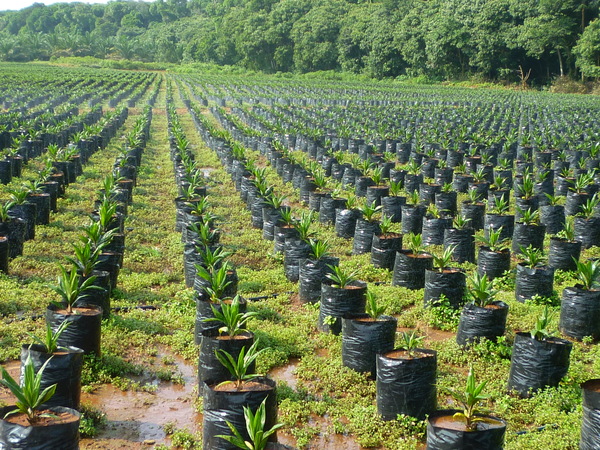
The expansion of oil palm plantations, therefore, depends upon companies getting these people to give up their lands. This is not an easy sell, given the meagre jobs and other benefits that an oil palm plantation generates in comparison with the destruction that it causes and the value that the lands already hold for the people. A typical oil palm plantation requires only one poorly paid worker for every 2.3 hectares, while the surrounding communities pay a high price for the deforestation, water use, soil erosion and chemical fertiliser and pesticide contamination that it causes.1 Companies trying to acquire lands from communities also run into customary forms of land governance that do not allow for a company to buy up land one parcel at a time.
The easy way for companies to get around these hurdles is to ensure that the communities do not even know that their lands have been signed away. It is very common in Africa, for instance, for companies to sign land deals directly with the national government without the knowledge of the affected communities. In many cases, the companies signing the deals are obscure companies registered in tax havens with their beneficial owners hidden from view. The managers of these companies tend to come from the mining sector or other extractive industries with long histories of shady deals in Africa. In Papua New Guinea and Indonesia, land deals are typically brokered between local elites and foreign investors, also often with obscure ownership structures registered in tax havens.
Such small shell companies are not in the business of developing plantations. Once the land contracts are signed, they immediately look to sell out to larger companies with the technical capacity and financial resources to build the plantations. And it is usually at this point that the communities come to understand that their lands have been sold.
Most of these cases eventually lead to a situation where a large multinational plantation company, backed by a national government and a multimillion dollar contract, faces off against a poor community trying desperately to hold onto to the lands and forests it needs to survive. It is incredibly difficult for communities to defend themselves against such powerful forces, and those that do risk the threat of violence, whether by paramilitaries in Colombia, police in Sierra Leone, or the army in Indonesia.
Tax havens and land grabs for palm oil in Africa
The case of Atama Resources Inc
In 2010, the Government of the Republic of the Congo signed away more than 400,000 ha to a Congolese registered company called Atama Plantation whose owners remain unknown.2 In return, this mysterious company promised to develop the Congo Basin’s largest ever oil palm plantation, converting 180,000 ha of mostly forested land in the provinces of Cuvette and Sangha while paying the government a token annual fee of $5 per hectare of planted land. The company was under no obligation to conduct environmental or social impact assessments or to consult with affected populations.
When the contract was signed, Atama Plantation was wholly owned by Silvermark Resources Inc, a company registered in the offshore fiscal paradise of the British Virgin Islands.3 The only publicly available information on Silvermark is that it is owned and directed by two shell companies registered in Brunei. Because of the rules of secrecy governing companies registered in Brunei and the British Virgin Islands, it is impossible to know who the actual owners of these companies are.
In 2011, ownership of Atama Plantation was transferred to a holding company in Mauritius, another fiscal paradise, before finally being sold, in 2012, to Malaysia’s Wah Seong Corporation, a “pipe-coating specialist” company with no history in the palm oil sector that is controlled by Malaysian businessman Robert Tan.4
Whoever the owners of Silvermark are, they pocketed an estimated $25 million, without doing anything more than orchestrate the contract with the Congolese government. And, under the deal with Wah Seong, they still hold 39% of the shares with yet another British Virgin Islands registered company with unknown owners holding the remaining 10%.
The case of Liberian Forest Products Inc. (LFPI)
On August 21, 2006 a little known London minerals exploration company announced to the world that it had taken control of 700,000 ha of land in Liberia– equal to about 7% of the country’s entire land area. The owners of Nardina Resources PLC claimed they had acquired rights over this massive chunk of land through a take over of a Liberian company called Liberian Forest Products Inc. (LFPI). Nardina then changed its name to Equatorial Biofuels PLC and then again to Equatorial Palm Oil Ltd (EPO) to reflect its new mandate as a palm oil company. Meanwhile, the original owners of LFPI walked away with £1,555,000 in shares and cash.
But how did the owners of LFPI get hold of such an obscene amount of territory in a country just emerging from over a decade of civil war? And who were these owners anyway?
EPO’s disclosure documents from its listing on the London AIM stock exchange in 2010 show that the money it paid for LFPI went to two offshore companies, Kamina Global Ltd of the British Virgin Islands and Subsea BV of Liberia, which each had 50% shares of LFPI.
Searches conducted in December 2013 through the company registry in Liberia found no record of registration for a company called Subsea BV. However, the articles for registration for LFPI of November 2006 indicate that LFPI is a Liberian company owned by Tony Smith (50%) and A. Kanie Wesso (50%), who are both trustees for a new company to be formed, called Subsea BV. The sole LFPI director named in the document is Mark Slowen, a British businessman operating from Liberia whose name also turns up as the CEO of SubSea Resources DMCC (Dubai Multi Commodities Centre), a company that acquired mineral rights in Liberia at around the same time.
A second business registry document for LFPI from August 2007 refers to LFPI as a British owned company– with ownership split between Mark Slowen (50%) and Kanie Wesso (50%). Both documents describe LFPI as a company whose sole business is logging.
Subsea BV also turns up in the UK business directory as a director of the G4 Group, which has several business interests in Liberia and is controlled by the notorious financial fraudster Lincoln Fraser.5 The G4 Group’s Liberian subsidiary, G4 WAO Inc., exports rubber tree logs and holds a phosphate exploration concession covering 36,000 ha in Bopolu. According to the company website, G4 WAO “manages in excess of one million acres of the best crop growing conditions in the world” and has partnered with the International Crops Research Institute for the Semi-Arid-Tropics (ICRISAT) “to establish trial sites on various G4 farming enterprises in Liberia, Ghana and Kenya.”6
Kamina Global Ltd, the other company that was paid by EPO for the acquisition of LFPI, is even more opaque. Legislation in the British Virgin Islands does not require companies to disclose their directors or shareholders, so it was not possible to identify the people behind Kamina Global through company records.7
When EPO acquired LFPI, the contract was under examination by Liberia’s Public Procurement and Concession Commission. It would conclude that the agreement contained “gross irregularities and non-compliance with the law” and EPO was forced to renegotiate. LFPI, now under the ownership of EPO, signed a new contract with the government in 2008, this time covering a much reduced but still valuable 55,000 ha area of land in Butaw. With this concession and another of a similar size in Liberia, EPO went public on the London AIM stock exchange, eventually attracting significant investment from the Siva Group, a Singapore-based holding company of Indian billionaire Chinnakannan Sivasankaran, who has quietly amassed one of the world’s largest land banks for oil palm in just a few years. The Siva Group started buying shares of EPO in 2010 and by 2013 it controlled 36.7% of the company and had formed a 50:50 joint venture with EPO based in Mauritius, called Liberian Palm Developments Ltd, that took control of all of EPO’s Liberian land concessions.8
In 2013, the Siva Group would sell its shares in EPO and its Mauritian joint venture to KL Kepong of Malaysia, one of the world’s largest palm oil companies.
Are Chinese companies grabbing land for palm oil?
China runs neck and neck with India for the world’s number 1 palm oil importer. So it would only make sense that Chinese companies would be involved in the current rush for lands for oil palm plantations. But while there have been several reports of massive land grabs for palm oil by Chinese companies, few of these have materialised.
China’s telecom giant ZTE, which has a biofuels division, was said to have signed an agreement with the Democratic Republic of the Congo to develop 2 million hectares of oil palm plantations. The numbers were later scaled down to 100,000 ha and it now seems like the project has been scrapped entirely.
In 2005, Indonesia’s President Yudhoyono announced a plan to develop 1.8 million hectares of land along the Kalimantan border into oil palm plantations. Several Chinese companies including state-owned investment company CITIC Group were offered one third of the area in return for building roads and railways and details were released of a $600 million project between CITIC and Indonesian palm oil giant Sinar Mas to develop a 100,000 ha plantation in the area, with a $380 million dollar loan from the China Development Bank.9 Sinar Mas’ subsidiary Golden Agri Resources is one of the main suppliers of palm oil to China. The plans, however, were never put into operation.
In 2012, Sinar Mas, which is controlled by Indonesia’s Widjaja family, announced a new partnership for oil palm development with China, this time with state-owned China National Offshore Oil Corp. and another Widjaja controlled company, HKC Holdings of Hong Kong. Wang Jun, the former chairman of CITIC Group, is the honorary chairman and a director of HKC. The companies said the project would be rolled out over eight years in Papua and Kalimantan, “where regional governments had reserved about one million hectares of land for it.”
Less than a year later, the Widjajas cemented another major palm oil deal with China. This time in Africa. In March 2013, Golden Agri Resources’ wholly-owned subsidiary Golden Veroleum Limited procured a $500 million term loan facility from the China Development Bank to support the construction of its 220,000 ha oil palm plantation project in LIberia. Typically the CDB only loans to overseas companies or projects when Chinese companies are directly involved.10
For now, China appears to be channeling most of its investments in palm oil through Asian palm oil companies, such as Sinar Mas, that dominate the global palm oil trade. The only Chinese company making significant direct investments in oil palm plantations has so far been China’s state-owned oil company Sinochem. In April 2012, Sinochem paid 193 million euros to acquire 35% of the Belgian plantations company SIAT, which has oil palm plantations in Gabon, Ghana and Nigeria. It also announced that its rubber company in Cameroon would be expanding its plantations and starting to move into palm oil production.
Cash crop | Communities lose out to oil palm plantations
Notes
1 UNEP, “Oil palm plantations: threats and opportunities for tropical ecosystems,” December 2011
2 See the excellent report, “Seeds of Destruction“, Rainforest Foundation UK, 2013
3 Silvermark is owned by Tinaldi Ltd and the Director is Greenland Ltd. Greenland Ltd is reported to be controlled by Benny Lum (who may just be a proxy). It controls Lamington Capital Inc (maybe Singapore) which is also a shareholder in African Petroleum Corporation Limited. It was also used to direct a transfer of funds to a Thai company that is linked to Thaksin. Both Tanaldi Ltd and Greenland Ltd (Brunei) are registered in Brunei to the address of HMR Trust Ltd (which is involved in offshore financial services). Other documents indicate that Tanaldi Limited is owned by Tan Sri Barry Goh Ming Choon of Malaysia and the company acts as a trust for other Malaysian businessmen. Barry Goh controls B&G Capital Resources Berhad (“BCGR”) which he started in 1994. BGCR has served as the principal contractor to Tenaga Nasional Berhad (TNB), one of the largest government link companies in Malaysia
4 Atama Resources Inc was registered in Mauritius in July 2011, as 100% owned by Silvermark. In 2012, Wah Seong purchases 51% of Atama Resources Inc. through its 100% owned subsidiary WS Agro Ind Pte Ltd (Singapore). 39% remains with Silvermark. 10% is taken by Giant Dragon Group (BVI), which is 100% owned by Marston International Ltd. (BVI), who’s director is Eastern Sky Ltd. (Hong Kong). Eastern Sky is a nominee director for several other companies. The Wah Seong Corporation is largely controlled by Malaysian businessman Robert Tan. Marston International Ltd. is the owner of Pergenia International Limited (PIL) incorporated in British Virgin Island on 10 January 2007 and Netstar Holdings Limited registered in BVI in 2003. Marston International Ltd is also the controlling shareholder of PT Jaya Pari Steel Tbk. (Indonesia). Reports from PT Jaya Pari Steel Tbk say that Marston International Ltd is owned by John Matthew Ashwood (50%) and Brian Whiteman and Robinson McKinstry (50%), who seem only to be proxies and John Ashwood likely works for Vistra, an offshore financial company based in Hong Kong. PT Jaya Pari Steel is a company of the Gunawan family of Indonesia, which is involved in finance and steel. The family controls 46 percent of Indonesia’s PT Bank Panin. Marston International Limited is also a major shareholder in another Gunawan steel company, Betonjaya Manunggal Tbk PT, through its ownership of Profit Add Limited (Samoa). Marston International is listed as a shareholder of Best Dragon Enterprises Limited, alongside Tito Sulistio, who is connected to the Suharto family.
5 Fraser is described by Offshore Alert as a “British conman who masterminded the $400 million Imperial Consolidated fraud” which robbed thousands of pensioners and others of their savings when it went bankrupt in 2002.
7 Kamina’s company registration information indicates that it was registered on 17 March 2006 and struck off on 2 November 2009. It’s registered agent is TMF (BVI) Ltd, a company which manages numerous shell companies on behalf of clients around the world. As written on the same document: “Under the BVI Business Companies Act, 2004 companies are not required to file information on Directors and Shareholders of a company.”
8 Siva Group’s 36.7% share of EPO is held by way of several subsidiaries: Biopalm Energy Limited (16.62%), The Siva Group (16.62%) and Broadcourt Investments Ltd (3.46%).(The joint venture is between EPO’s wholly-owned subsidiary Equatorial Biofuels (Guernsey) Limited and Biopalm Energy Limited, a wholly owned subsidiary of Geoff Palm Ltd based in the offshore city of Labuan, Malaysia, and which is owned by Broadcourt Investments Ltd, a British Virgin Islands registered holding company with Chinnakannan Sivasankaran, the Siva Group’s founder and owner, listed as its only director and shareholder since January 2007.
9 “The Kalimantan border oil palm project,” Milieudefensie – Friends of the Earth Netherlands and the Swedish Society for Nature Conservation, 2006; “China’s investment foray into Indonesia,” Asia Sentinel, 6 June 2013
Well oiled resistance
GRAIN | September 22, 2014
The rush to develop oil palm plantations in Africa is a double whammy for the continent. Not only does it involve a huge land grab of peoples’ lands and food producing resources, it also directly undercuts the livelihoods of millions of people involved in Africa’s traditional oil palm sector.
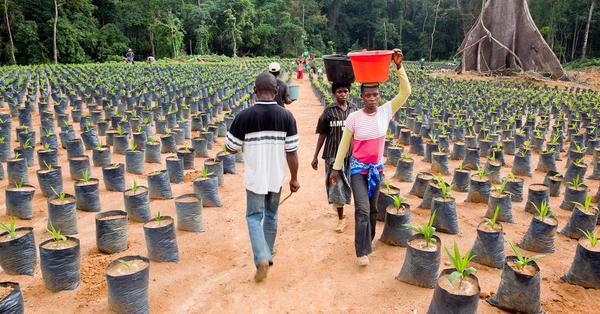
This is not the first time foreigners have pushed an expansion of oil palm in Africa. During the the colonial occupation of the continent, the European powers became interested in palm oil as an industrial lubricant and for making candles. African families were forced to pay a special tax, known as the “takouè” to the colonial authorities, in the form of palm oil and palm nut. King Léopold II of Belgium forced every farmer in the province of Equateur in the Congo to plant 10 palms a year.1
The European powers also established their own oil palm plantations around this time. Plantations were created in West and Central Africa as well as in Southeast Asia. Research stations and collection missions were launched to develop high yielding varieties of oil palms through the cross breeding of traditional or wild varieties.
With independence, most of these plantations and research stations were nationalised, and the new African governments reenergised the expansion of national production. In Bénin, for example, the state-owned Société Nationale du Développement Rural (SONADER) led an expansion of oil palm plantations in the south immediately after independence, while another state-owned company, the Société Nationale pour l’Industrie des Corps Gras (SONICOG) built new palm oil refineries and palm nut processing factories.
But, at the end of the 1990s, World Bank and donor imposed structural adjustment programmes forced African governments to privatise their national palm oil companies and to sell off their mills and plantations. While many national companies simply crumbled away, European companies with old colonial connections captured the most lucrative operations. SOCFIN, controlled by billionaires Vincent Bolloré of France and Hubert Fabri of Belgium, took over national companies in Cameroon, the DRC, Guinea and Nigeria. SIAT, controlled by the family of South African diamond magnate Ernest Oppenheimer and the Belgian Vandebeeck family, took plantations in Gabon, Ghana and Nigeria, while another old money Belgian company, SIPEF took over a chunk of the state-owned oil palm plantations of Côte d’Ivoire. Unilever, one of the world’s largest and oldest food companies, scored plantations too – in the DRC, Ghana and Côte d’Ivoire.
Today there is a second wave of foreign interest in oil palm plantations in Africa. With land for oil palm plantations becoming more difficult and expensive to acquire in Malaysia and Indonesia, companies and speculative investors are keen to open up new frontiers for export production. Some investment is going to Papua and to Latin America, but the biggest target is Africa. A long list of companies, from Asian palm oil giants to Wall Street financial houses, are scrambling to get control over lands on the continent that are favourable to oil palm, especially in the West and Central regions.
Over the past five years, vast areas of land in Africa have been allocated to foreign companies for oil palm plantations by African governments, with minimal if any consultation with the affected populations and many allegations of corruption. Table 1 lists 60 deals covering nearly 4 million hectares over the past decade and a half.
A number of different actors are involved. There are established Asian plantation companies, like Wilmar and Sime Darby, and multinational palm oil traders, like Cargill and Olam, both looking to establish a new basis of palm oil supply for global markets in Africa. But many of the first movers are in fact small obscure companies, typically domiciled in tax havens, whose owners intend only to sign land deals and then sell their companies as soon as possible to larger players with the capacity to develop the plantations. In many cases it is difficult to work out who the owners of these companies are.
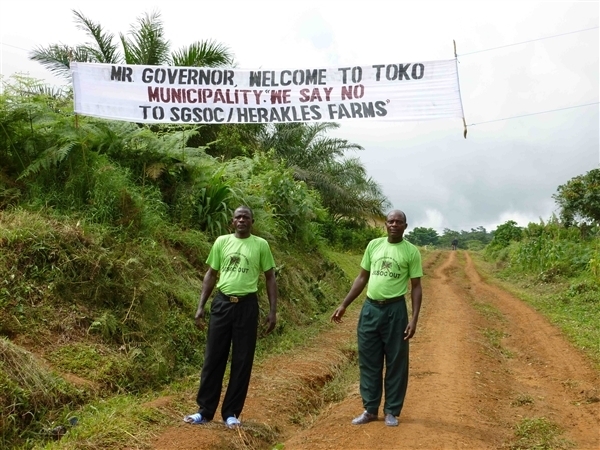
Resistance to a landgrab for a new oil palm plantation in Cameroon. (Photo : SEFE)
The communities facing land grabs from palm oil companies are under tremendous pressure to accommodate them, with pressure coming from the companies, the government, the local chiefs and even the army and paramilitaries. Those who resist face arrest, harassment and violence. And yet communities in Africa and around the world, from Papua New Guinea to Sarawak, from Cameroon to Guatemala, continue to struggle to stop palm oil companies from entering their lands.
Communities in southwest Cameroon have been involved in a three year struggle to stop the US company Herakles Capital from setting up an oil palm plantation in their area. Despite support from the president of Cameroon, Herakles has been unable to move forward with its plans because the communities are united in their total opposition to the plantation and because of the creative actions that they have undertaken, with support from national and international partners, to put pressure on the company to leave. The company and the government keep coming back and presenting new terms, the latest being a presidential decree that reduces the land allocated to Herakles from 73,000 ha to 20,000 ha and boosts the rent that the company must pay. Community leaders have been arrested and harassed with lawsuits. Yet the communities are sticking to their bottom line demand – no oil palm plantations on their lands.
Cameroon is also a target for the Luxembourg based company SOCFIN, owned by billionaires Vincent Bolloré of France and Hubert Fabri of Belgium. Over the past decade and a half, SOCFIN has taken over lands for oil palm and other crops in several African countries, including Cameroon, DRC, Guinea, Nigeria, Sao Tome & Principe, and Sierra Leone. The company is notorious for human rights abuses and land conflicts at its operations, and for its aggressive tactics against those who oppose it. In the past few years, the company has slapped defamation suits on several organisations and journalists in Africa and Europe that have spoken out against it.
On June 5, 2013, communities affected by SOCFIN plantations in four African countries held simultaneous protest actions against the company, as a delegation of diaspora from these countries and supported by the French group Réseaux d’Action Transnationale (ReAct) presented a joint letter from the various communities to the Annual General Meeting of the Bolloré Group, which is a major shareholder in SOCFIN.
“This initial international protest is just the beginning. We are committed to upholding our rights and Mr. Bolloré will have to understand that,” said Emmanuel Elong, spokesperson for Synaparcam, the Socapalm resident farmers’ union in Cameroon.2
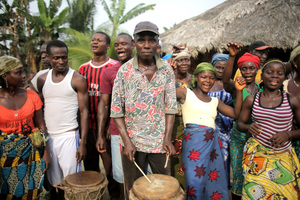
The Jogbahn Clan convinced Liberia’s government to stop the expansion of plantations onto their lands. (Photo : Cargo Collective)
Strong community resistance combined with national and international, well targeted pressure, can roll back land grabs. The Jogbahn Clan in Liberia provides an inspiring example. When the British company Equatorial Palm Oil began surveying their lands as part of a deal it signed with the Liberian government, the communities took action to stop the work crews. They then marched to the local government offices to make it clear that they had never been consulted about the deal and that they would never give up their lands for the project. Along the way they were beaten, arrested and thrown in jail. But the communities refused to back down. Local and international NGOs joined their struggle, and exposed what was happening to the world. Finally, in March 2014, community leaders met with the Liberian President, Ellen Johnson Sirleaf, and secured a commitment from her to stop the company from expanding on their lands. Now Liberian groups are hoping to replicate these efforts with other affected communities in the country.3
The many different efforts to resist land grabs and maintain local control over palm oil production in Africa, Asia and Latin America demonstrate how committed local communities are to maintaining control over their ancestral lands and their biodiversity, for themselves and for future generations.
Notes
1 World Rainforest Movement, “Oil palm in Africa: past, present and future scenarios,“ 2010
2 Synaparcam, SoGB residents committee, Concern Union Citizen, and MALOA, “West African farmers stand up against Bolloré,” 5 June 2013
3 For more information about the case see: http://sdiliberia.org/node/263
‘China won’t support sanctions against Moscow’
RT | September 23, 2014
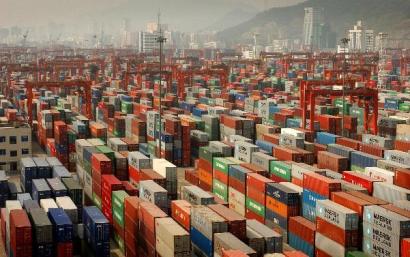 China will never support any sanctions against Russia and will never join them, Valentina Matviyenko, speaker of the Russian parliament’s upper house said, citing Chinese President Xi Jinping, with whom she met on Tuesday.
Both Russia and China believe the sanctions are illegal, ineffective and counterproductive, according to Matviyenko. They are nothing but an attempt “to exert pressure on sovereign states to change their position and to weaken them and suppress their development,” she stressed.
Matviyenko thanked Beijing for its public position towards Western sanctions imposed on Russia over the Ukrainian conflict. China has offered an “absolutely objective” assessment of what is now going on in Ukraine. Moreover, no sanctions will affect the long-term strategic partnership between Moscow and Beijing, which reflects the interests of both peoples, she noted.
Cooperation of Russia and China remains a serious factor in international politics, Matviyenko said, adding that the two states have no disputable issues. Their positions are either close or coincide on major problems, including how to settle international and regional conflicts or deal with new challenges and threats.
‘Anti-nuclear’ Obama plans to spend $1 trillion on nukes
RT | September 22, 2014
Despite campaigning on a platform that endorsed having “a nuclear-free world” in the not so distant future, United States President Barack Obama is overseeing an administration that’s aim has taken another path, the New York Times reported this week.
On Sunday, journalists William Broad and David Sanger wrote for the Times that a half-decade of “political deals and geopolitical crises” have thrown a wrench in the works of Obama’s pre-White House plans, as a result eviscerating his previously stated intentions of putting America’s — and ideally the world’s — nuclear programs on ice.
According to the Times report, an effort to ensure that the antiquated nuclear arsenal being held by the US remains secure has since expanded to the point that upwards of $1 trillion dollars is now expected to be spent on various realms of the project during the next three decades, the likes of which are likely to keep the trove of American nukes intact and do little to discourage other nations from doing likewise.
“The original idea was that modest rebuilding of the nation’s crumbling nuclear complex would speed arms refurbishment, raising confidence in the arsenal’s reliability and paving the way for new treaties that would significantly cut the number of warheads,” the journalists wrote. “Instead, because of political deals and geopolitical crises, the Obama administration is engaging in extensive atomic rebuilding while getting only modest arms reductions in return.”
Shortly after he first entered the oval office in early 2009, the Nobel Peace Prize commission awarded Pres. Obama with its highest award for, among other factors, taking a strong stance against international nuclear procurement.
“I’m not naïve,” Obama said that year. “This goal will not be reached quickly — perhaps not in my lifetime. It will take patience and persistence.”
After speaking with analysts, however, the Times journalists — both Pulitzer winners — now raise doubts that the commander-in-chief’s campaign goals will come to fruition anytime soon.
“With Russia on the warpath, China pressing its own territorial claims and Pakistan expanding its arsenal, the overall chances for Mr. Obama’s legacy of disarmament look increasingly dim, analysts say,” they wrote. “Congress has expressed less interest in atomic reductions than looking tough in Washington’s escalating confrontation with Moscow.”
Indeed, international disputes have without a doubt raised concerns in recent years over the nuclear programs of other nations. The Washington Post reported this week that Pakistan is working towards achieving the capability to launch sea-based, short-range nuclear arms, and concurrently the Kremlin confirmed that Russia is set to renew the country’s strategic nuclear forces by 100 percent, not 70 percent as previously announced.
As those countries ramp up their nuclear programs on their own, the Times report cites a recent study from the Washington, DC-based Government Accountability Office to show that the US is making more than just a minor investment with regards to America’s nukes. According to that report, 21 major upgrades to nuclear facilities have already been approved, yet in the five years since Obama took office, “the modernization push” to upgrade the nukes has been “poorly managed and financially unaccountable.”
“It estimated the total cost of the nuclear enterprise over the next three decades at roughly $900 billion to $1.1 trillion,” the journalists noted. “Policy makers, the [GAO] report said, ‘are only now beginning to appreciate the full scope of these procurement costs.’”
Protests in Egypt against energy price hikes and politicised trials
MEMO | September 20, 2014
Opponents of the military coup have organised mass protests across Egypt condemning the deterioration of living conditions, price hikes and the ongoing electricity crisis. They are also calling for the prosecution of President Abdel Fattah Al-Sisi for “crimes against humanity”.
The protests came in response to a call by the Anti-Coup Alliance, which called for a “new revolutionary week” starting Friday under the slogan, “The oath of the revolution and the vow of the martyr”.
In the affluent Maadi neighborhood in Cairo, protesters denounced lifting subsidies and the increase in fuel prices. They also chanted for the release of all political prisoners and putting an end to torture in prisons.
In Hilwan, the alliance organised a morning protest against military rule and worsening living conditions. They vowed to continue protests until the leader of the coup is prosecuted.
In Baltim town in Kafr Al-Sheikh governorate, protesters condemned politicised trials and price hikes. In Desouk, protesters waved pictures of Mohamed Morsi and Rabaa signs and chanted against the deteriorating living conditions and poor services, especially electricity.
‘Sanctions war’ has nothing to do with Ukraine; it’s just a pretext – Rusal CEO
RT | September 19, 2014
The Ukrainian conflict was just a trigger for the sanctions, which demonstrated the failure of all previous efforts to set up healthy relations between Russia and the West, Russian tycoon and head of Rusal, Oleg Deripaska, told RT in Sochi.
“I think the sanctions have nothing to do with Ukraine. Ukraine was just a reason. [The sanctions] were a failure of any attempt which was taken in the past to build normal relations between Europe and Russia – from both sides,” Deripaska told RT at the Investment Forum in Sochi.
Oleg Deripaska said the West started pressing Russia before the first sanctions were imposed – just ahead of the Sochi Olympics.
“We should give a lot of credit to Sochi, [as it showed] a different world, [despite] whatever appeared in the Western press,” he said.
Asked if people across the globe are more anti-Russia than ever, Deripaska answered that “it’s not people, it’s [about] various lobbying groups and various interests.”
“You remember all the complaints before the Olympics. They’ve been intentionally stopping any efforts from the Russian side to be normal, to look normal in the West. My view is we should go down as deep as possible, as quick as possible, and then touch the bottom and go up, and think what’s actually common between us, if there is any chance to have this Portugal-Vladivostok trade zone and opportunities to live together.”
Japan puts on hold Russian sanctions in view of possible FM talks
RT | September 19, 2014
The Japanese government has pushed back imposing new sanctions on Russia, which it planned to impose on Friday, in expectation of a possible meeting of foreign ministers next week.
The Japanese media reported Thursday of Tokyo’s intention to issue additional sanctions against Russia. The move was discussed on Tuesday at a National Security Council meeting and was expected to be announced on Friday, but according to The Japan Times the government is yet to make a final decision.
The implementation could be postponed until at least next week, when Japanese Foreign Minister Fumio Kishida may meet his Russian counterpart Sergey Lavrov on the sidelines of the UN General Assembly in New York. Tokyo wants to give Moscow more time to respond to the reports of the looming sanctions, the newspaper said.
Japan imposed sanctions on Russia in March as a gesture of solidarity with the US and the EU, which are championing a policy of punishing Russia for its stance on the crisis in Ukraine. Tokyo suspended talks with Moscow over visa restrictions, investment, space cooperation and military tension prevention. It also targeted 40 individuals from Russia and Ukraine with asset freezes and travel bans.
The new round of sanctions was expected to be individual rather than sectorial.
Featured Video

Dan Dicks with James Corbett on Solutions Watch
or go to
Aletho News Archives – Video-Images
From the Archives
Secret document reveals plans for civil war in Lebanon, Israeli false flags, and invasion
By Randi Nord | Geopolitics Alert | April 5, 2019
Beirut – During his visit with US Secretary of State, Mike Pompeo, Lebanese President Michael Aoun reportedly received a US-Israeli document detailing plans for creating a civil war in Lebanon with covert false flag operations and possible Israeli invasion.
Although the source of the document is Israeli and created in partnership with Washington, no one knows who presented it to Aoun. The Lebanese TV station, Al-Jadeed, initially reported the document on Lebanese TV and a video on its website. Geopolitics Alert translated the report for this article. … continue
Blog Roll
 Aletho News
- Sheikh al-Asadi warns of Iraqi government compliance with US demands
- How to MAKE THE CONSPIRATORS PAY for their crimes! Dan Dicks with James Corbett on Solutions Watch
- There’s a drought in academia: A drought in honest research on the subject of drought and other weather extremes
- Department of War Awards $20.7 Billion Contract to Raytheon for Air-to-Air Missiles
- ‘Distance yourselves from Israel’: IRGC urges US population to question govt policies
- America’s Greenland deal has a radioactive backstory
- The RAF Fairford ‘terror plot’: Unpacking escalation in the UK echo-chamber
- EU Council Advances Chat Control 2.0 Scanning Proposal
- Ex-Greek MEP files complaint against Israeli spyware firm over alleged Pegasus surveillance
- Troubling ideas throughout the Torah, Talmud, Mishneh Torah and Tanya
- If Americans Knew
- New Report: “Scholasticide and Genocide in Gaza: Assessment, Testimonies and Legal Analysis”
- Ex-Biden officials are desperate for a Gaza scapegoat
- Israeli “settlers” Invade Al-Aqsa; Pour Boiling Water on 75-Year-Old
- Israel Has Kidnapped Another American Teenager
- US arms sales to Israel worth $21.6 billion in 20 months
- Three Palestinians Killed in Israeli Attacks on Gaza
- Revealed: German “Anti-Semitism Expert” Driving Crackdown on Palestine Solidarity is Former Israeli Spy
- Egypt’s Warning to Israel Before Oct 7
- Israel’s siege signals another cruel winter for 1.8 million Gazans – Daily Update
- Netanyahu Asked UAE Leader to Deny Report on Oct. 7 Warning in Secret Visit, Sources Say
- No Tricks Zone
- Two More Paleo Reconstructions Affirm Meters-Higher Sea Levels Across Ireland, Brazil 7000-6000 Years Ago
- New Study: Earth And Venus Surface Warmth Largely Explained By Convection And Lapse Rate, Not CO2 Or Radiation
- 2025 Nature Paper Claiming Worsening Global Drought Gets RETRACTED …Heavily Flawed
- New Study: ‘Global Drought Shows No Detectable Recent Acceleration Under Climate Warming’
- Economic Masterminds: German Socialists Suggest Taxing Productivity Gains Stemming From Using AI
- The South China Sea Has Not Been Cooperating With The Climate Change Narrative
- Energy Crisis: Germany Enters Heating Season With Historically Low Gas Reserve Fill Levels
- New Study: The Antarctic Ice Sheet Gained Mass From 2020-2024 Due To Staggering Snow And Ice Accumulation
- Study: Ocean Heating Rates From Thousands Of Years Ago ‘Dwarf’ Modern Ocean Heating Rates
- Climate Extremists Target, Attack Large-Scale Power Grid Infrastructure In Germany!

