Trade legerdemain on both sides of the Atlantic
By Pete Dolack | Systemic Disorder | April 23, 2014
The Democratic Party has responded to the resistance against ramming through new trade agreements by giving the process a new name. “Fast-track” has been rebranded as “smart-track” and, voilà, new packaging is supposed to make us forget the rotten hulk underneath the thin veneer.
Don’t be fooled. The Obama administration and its Senate enablers are nowhere near giving up on its two gigantic trade deals, the Trans-Pacific Partnership and the Transatlantic Trade and Investment Partnership. Because the stealthy “fast track” route — special rules speeding trade legislation through Congress with little opportunity for debate and no possibility of amendments — is the only way these corporate wish lists can be enacted, a “rebranding” is in order.
The new chair of the U.S. Senate’s Finance Committee, Oregon Democrat Ron Wyden, earlier this month, in a speech given to apparel-industry corporate executives, announced his intention to replace the “fast track” process with a “smart track” process. That is noteworthy because the Finance Committee has responsibility in the Senate for trade legislation. It also noteworthy because Senator Wyden has voted to approve the last five U.S. “free trade” agreements, going back to 2005.
Although the Transatlantic Partnership being negotiated between the United States and the European Union receives less attention than the 12-nation Trans-Pacific Partnership, neither has much chance of passing without special fast-track authority. Should Congress agree to grant the White House fast-track authority, the Obama administration would negotiate a deal and submit the text for approval to Congress under rules that would prohibit any amendments or changes, allow only a limited time for debate, and require a straight yes or no vote.
None other than the previous U.S. trade representative, Ron Kirk, said the Trans-Pacific Partnership has to be secret because if people knew what was in it, it would never pass. We should take him at his word.
Tell the people what they want to hear
On the surface, Senator Wyden’s speech to the American Apparel & Footwear Association Conference on April 10 sounds conciliatory. He made the standard ritual references, calling for trade agreements that create jobs and “expand … the winners’ circle.” The senator proclaimed:
“I want to be very clear: only trade agreements that include several ironclad protections based on today’s great challenges can pass through Congress. I am not going to accept or advance anything less.”
He did not fail to declare that “strong standards and enforcement” on labor and environmental standards “is an imperative.” But we can be forgiven skepticism here because Senator Wyden had this to say on existing labor and environmental standards:
“People on all sides of the trade debate should more openly acknowledge the progress in these areas and the hard work that went into getting those reforms.”
Progress? There are no enforceable rules concerning these areas in existing trade agreements such as the North American Free Trade Agreement. Lost jobs, reduced wages, more unemployment, higher food prices and reversals of environmental laws have invariably been the results. Unaccountable, secret tribunals staffed by corporate lawyers have enabled corporations to overturn regulations in all three NAFTA countries — and the U.S. government, in its current trade negotiations, wants rules even more weighted in favor of multi-national corporations than exists in NAFTA.
If this is what Senator Wyden considers to be “progress,” what possible basis could there be for believing the Trans-Pacific and Transatlantic partnerships will deliver anything other than more corporate-dictated austerity?
The existing version of fast-track legislation — the Bipartisan Congressional Trade Priorities Act of 2014, better known as the Camp-Baucus bill — was effectively dead not long after its January release. It was expected that a new version of fast-track, with a couple of small, cosmetic changes and a cover story that opponents had been heard, would come. Senator Wyden has not disappointed, and it’s coming perhaps quicker than activists expected. This will become a hot potato as the November mid-term elections approach, so the senator was careful in his speech to not provide a timetable:
“I am going to work with my colleagues and stakeholders on a proposal that accomplishes these goals [of more transparency] and attracts more bipartisan support. As far as I’m concerned, substance is going to drive the timeline.”
‘Consultation’ only to let people vent
The perception of more transparency and public participation is all that we are likely to see, perhaps on the model of the European Union’s new public-consultation process. The process centers on a web site that E.U. citizens can use to fill out a questionnaire. The page is complicated to use, and has a 90-minute time limit, after which any imputed data is wiped out. Write fast! And for good measure, the E.U. trade commissioner, Karel De Gucht, once again declared, in his last visit to Washington:
“[W]e are happy to be scrutinized on this: no standard in Europe will be lowered because of this trade deal; not on food, not on the environment, not on social protection, not on data protection. I will make sure that [the Transatlantic Trade and Investment Partnership] does not become a ‘dumping’ agreement.”
Neither his office, nor that of the U.S. trade representative, Michael Froman, have been kind enough to share with the public when the next Transatlantic negotiating session will be held. There has been no lack of communication with corporate lobbyists, however. A European public-interest group, Corporate Europe Observatory, requested documents from the European Commission (the bureaucratic arm of the E.U.) to discover with whom E.U. negotiators are consulting.
It was revealed that of 127 closed meetings concerning the Transatlantic Partnership talks, at least 119 were with large corporations and their lobbyists. The Observatory reports:
“The list of meetings reveals that … there is a parallel world of a very large number of intimate meetings with big business lobbyists behind closed doors — and these are not disclosed online. These meetings, moreover, were about the EU’s preparations of the trade talks, whereas the official civil society consultation was merely an information session after the talks were launched. The Commission’s rhetoric about transparency and about consulting industry and NGOs on an equal basis is misleading and gives entirely the wrong impression of [the European Commission’s] relations with stakeholders.”
Three German Green Party members of the European Parliament (Ska Kellar, Rebecca Harms and Sven Giegold) have leaked the E.U.’s position paper on the Transatlantic Partnership negotiations (Members of the European Parliament are shut out of the negotiations.) Although this leak offers only a glimpse at E.U. negotiating positions, Europeans have a basis for concern. A rough English translation of the leaked document (available only in German) states:
“The agreement will provide for the reciprocal liberalization of trade in goods and services and rules on trade-related issues, which it pursues through ambitious goals that go beyond what is available via the existing WTO commitments.”
Although it also says the agreement will include a “general exception clause” on the basis of articles XX and XXI of the General Agreement on Tariffs and Trade (GATT), which purport to allow exceptions to trade agreements when necessary to safeguard human, animal or plant life or health, such clauses are meaningless. Other agreements have similar clauses, but are consistently superseded by rules such as Article 12.6 of the Trans-Pacific Partnership text that “Each Party shall accord to covered investments treatment in accordance with customary international law.”
‘Customary law’ is what a secret tribunal says it is
Precedents handed down in secret tribunals are what constitute “customary international law.” That the E.U. negotiators intend to “go beyond” the rules of the World Trade Organization should leave no doubt that “law” as desired by multi-national corporations is what is contemplated. Indeed, the leaked E.U. text states an intention to:
“Provide a level playing field for investors in the U.S. and in the EU. … The agreement should provide an effective mechanism for the settlement of disputes between investors and the state.”
That goal should be borne in mind when evaluating the E.U.’s April 10 announcement that it has refused to include the standard investor-state dispute rules in its proposed trade agreement with Canada, despite Canada’s now dropped insistence that it be included. Inside U.S. Trade reports that:
“Canada and the EU have agreed to a ‘closed list’ approach toward defining what constitutes a breach of fair and equitable treatment that was proposed by the EU. … The closed list that the two parties agreed upon is comprised of: denial of justice in criminal, civil or administrative proceedings; a fundamental breach of due process; manifest arbitrariness; targeted discrimination on manifestly wrongful grounds; and abusive treatment of investors.”
On the surface, the “closed list” approach to the bases over which a corporation can sue a government appears to have narrowed from the more common approach that places no limits on corporate suits. But, critics say, the list of arbitrable issues remains open-ended and open to corporate abuse. The Canadian public interest group International Institute for Sustainable Development, in a recently updated paper, warns:
“The definition of investment is defined too broadly, covering any kind of asset, independent of whether or not investments are associated with an existing enterprise in the host state. … [The E.U. proposal would] make the concept of fair and equitable treatment very open-ended and, as a consequence, highly problematic.”
The agreed-upon language, by not defining what constitutes an “asset,” would enable corporations unlimited opportunities to sue governments. Any rule or regulation that a corporation says will reduce its profits remains eligible to be overturned under the precedents of “customary international law.” The text of the agreements — and how they are likely to be interpreted — count for vastly more than the happy talk of trade negotiators, whichever side of the Atlantic or Pacific oceans.
European countries with strong regulations on the environment or food safety are at grave risk from the U.S., and environmental laws everywhere are prime targets. Activist work against these multi-national trade agreements has gained momentum in the past year, but there is much work to be done to stop what constitutes the most destructive corporate power grabs yet. Popular pressure is the only means to stop the Trans-Pacific, Transatlantic and Canada-E.U. trade deals. The next task will be to reverse existing trade deals that have done so much damage.
Internet for the Wealthy on the Way Unless We Stop It
By Kevin Zeese | Dissident Voice | April 24, 2014
In what the New York Times describes as “a net neutrality turnaround” the Obama administration’s new FCC chairman is proposing rules that will create an Internet for the wealthy. The new plan to create a pay to play Internet came to light Wednesday in the Wall Street Journal.
Under the plan wealthy corporations will be able to purchase faster service, while those that cannot do so will have slower service. Rather than an open Internet for all the US will be moving to a class-based Internet. Of course, this will mean that when Netflix and other corporations purchase faster Internet, the consumers who use their service will be paying more to watch movies and download information. As a result, more money will be funneled from working Americans to wealthy telecom giants.
We recently wrote that the United States has lost its democratic legitimacy and now was a plutocratic oligarchy. This is what plutocracy looks like – policies designed for the wealthy, so they can make more money from the rest of us.
The new rules, according to the people briefed on them, will allow a company like Comcast or Verizon to negotiate separately with each content company – like Netflix, Amazon, Disney or Google – and charge different companies different amounts for priority service.
That, of course, could increase costs for content companies, which would then have an incentive to pass on those costs to consumers as part of their subscription prices.
In the future, if a new start-up – the future Twitter or Facebook – begins it will have a very hard time competing with those who are established Internet companies because the slower service of the start-ups will make them less consumer friendly. As a result we can expect less creativity on the Internet. As Stacy Higginbotham wrote: “The plans took the hallmark of network neutrality — the notion that ISP shouldn’t discriminate between the traffic flowing over their networks — and turned it on its head.”
The proposal is being shared with other members of the Commission today. There will then be amendments suggested to garner majority support and the plan is to vote on the proposal on May 15,
Take action now. To Contact the Commissioners via E-mail
Chairman Tom Wheeler: vog.ccf@releehW.moT
Commissioner Mignon Clyburn: vog.ccf@nrubylC.nongiM
Commissioner Jessica Rosenworcel: vog.ccf@lecrownesoR.acisseJ
Commissioner Ajit Pai: vog.ccf@iaP.tijA
Commissioner Michael O’Rielly: Mike.O’vog.ccf@ylleiR
To call and contact commissioner’s offices, call 1-888-225-5322.
In addition, call your elected representatives. Tell them if net neutrality is ended, you will hold them accountable by withholding your vote. Both parties hope to control the senate after the mid-term elections, so you have more power than usual to let them know they are losing your vote if they fail to take action to stop the FCC proposal. The number for Congress is 202-224-3121.
Dear Commissioners:
I am writing to oppose rules that will allow for discrimination on the Internet — where the wealthy can purchase faster Internet service and everyone else continues to have slower service.
We do not want telecom giants and wealthy Internet companies to determine the future of the Internet. We want new ideas to flourish on the Internet and not be blocked because they do not have sufficient funds to purchase fast service and compete.
We do not want the Internet turned into another vehicle that allows money to flow from working Americans to the wealthiest — where they purchase fast service then charge consumers more money for rapid Internet service.
The proposal being considered would kill rather than protect Net Neutrality and allow rampant discrimination online. The Internet should be viewed as a public good and should be operated consistent with our rights to Freedom of Speech and Freedom of the Press. Turning the Internet into a pay to play scheme is unacceptable.
We demand an open Internet and real net neutrality.
Chairman Wheeler knows this proposal is going to be unpopular and in response to the Wall Street Journal and New York Times is denying there has been a “turnaround.” But, his statement is carefully worded and would allow exactly was has been reported.
How Did We Get To Class-Based Internet?
This move to end net neutrality should be placed at the door of President Obama and the US Senate. Obama appointed a former industry head to become chair of the FCC and the Senate unanimously confirmed him.
In April 2008 during his presidential campaign, Barack Obama took the side of the people saying: “The most important thing we can probably do is to preserve the diversity that’s emerging through the Internet…something called net neutrality. I will take a backseat to no one in my commitment to network neutrality.” While he campaigned as a populist he has governed as a plutocrat – on this issue and so many others.
When Tom Wheeler was nominated by President Obama to become the Chairman of the FCC many in the internet freedom community expressed deep concerns. For decades Wheeler had represented the telecom industry in Washington, DC. From 1979 to 1984, Wheeler headed the National Cable Television Association, now named the National Cable and Telecommunications Association. He then worked in the telecom industry for 8 years followed by taking over as head of the Cellular Telecommunications & Internet Assn. in 1992, leaving in 2005. Wheeler went on to become a major Obama fundraiser and adviser. In fact on his bio page at the FCC this is expressed as “He is the only person to be selected to both the Cable Television Hall of Fame and The Wireless Hall of Fame, a fact President Obama joked made him ‘The Bo Jackson of Telecom.’” Appointing Wheeler was akin to putting the industry in charge of the future of the Internet.
Now Wheeler is set to propose what the industry has wanted, an end to net neutrality, that will allow them to charge us more for service and created financial barriers that will prevent new services from challenging their domination of the Internet.
If you want an open Internet, take action today. We can stop this – but we must act now.
Please contact the people above and forward this to everyone you know.
Critics say new Egyptian business law to foster corruption
Al-Akhbar | April 24, 2014
A new Egyptian law that prevents third parties from challenging contracts made with the government may encourage foreign investors, but critics say it will increase scope for corruption.
President Adly Mansour on Tuesday approved the law that will restrict the right to challenge state business and real estate deals to only the government, the institutions involved and business partners.
The law is meant to revive investment hit by political instability since a 2011 uprising toppled autocratic president Hosni Mubarak.
“Uncertainty over the legality of contracts has been one factor behind the lack of foreign investment into Egypt since the Arab Spring revolution, and so this law could provide the protection that some investors have been craving,” said Jason Tuvey, assistant economist at Capital Economics.
Many state-land and business deals were revoked after court challenges by people with no direct links to the transactions, harming business confidence in a country where population growth has long outpaced job creation.
The lawsuits have been brought by activists and lawyers who allege that companies were sold off too cheaply, reflecting corrupt business practices during the Mubarak era.
Since the 2011 uprising, Egyptian courts have issued at least 11 rulings ordering the state to reverse deals signed by former administrations.
Direct foreign investment in Egypt fell to $3 billion in the fiscal year ending June 2013, $1 billion less than the previous year. Foreign reserves fell to a critical low of $13.4 billion last year and the economy grew a meager 2.1 percent.
Gulf investors have been lobbying for more assurances that their money will be safe in Egypt.
In 2011 a court annulled a deal to sell Egypt’s historic Omar Effendi department store chain to a Saudi investor after activists argued it was sold too cheaply. Similar cases have kept wealthy Saudis wary of buying Egyptian assets, said Abdullah Bin Mahfouz, Chairman of the Saudi Egyptian Business Council.
“I’m sure that due to this law we will see an inflow of investment no less than $15 billion in the next three years because there are huge opportunities in steel and mining and factories that are considered the biggest in the Middle East,” Mahfouz said.
Although the new law is expected to remove legal hurdles, political stability may still deter investment. The new legislation is also likely to anger activists and lawyers who say it would foster corruption.
“Although the law prior to this change was abused constantly, and to a large extent by vexatious litigants, this amendment effectively removes part of the judicial and civilian oversight over government deals,” Mustafa Bassiouny, an economist at Signet Institute, said.
Another concern is that companies that miss out on a tender process have no legal avenue to challenge government decisions.
“This could lead to a situation where the authorities agree to contracts that ultimately represent poor value for money,” said Tuvey at Capital Economics.
Mika Minio-Paluello, researcher at Platform London, an advocacy group focused on social and environmental justice issues, said the new law would undermine democratic oversight.
“There’s no mechanism or means for citizens to intervene and prevent corruption, to challenge breaches of the law and unfair contracts,” said Minio-Paluello.
“If you are a decent investor, it is not in your interest because you will come up against other investors who are dodgy – breaching environmental standards, not paying workers properly.”
Egypt’s government has faced 37 international and domestic arbitration cases worth $14.3 billion in the three years since the 2011 uprising, Ezzat Ouda, head of the state’s lawsuits authority, told state newspaper Al-Ahram.
Since general Abdel Fattah al-Sisi toppled the country’s first freely elected president, Mohammed Mursi of the Muslim Brotherhood, last July, Islamist militants based in the Sinai Peninsula have stepped up attacks on security forces, killing hundreds.
The government has outlawed the Brotherhood, quashed protests and sentenced hundreds of its members to death.
(Reuters, Al-Akhbar)
Ford and IBM May Have to Answer for Their Role in Apartheid
A Black Agenda Radio commentary by Glen Ford | April 23, 2014
The United States court system, whose value to anyone but the rich is rapidly disappearing, may yet play a role in the unfinished business of South African liberation. A federal district judge in Manhattan ruled that a group of South Africans can proceed with a suit against Ford Motor Company and IBM for doing business with the white regime during the time of apartheid. The plaintiffs include victims of torture and relatives of people killed by the racist government. They will have to prove, not only that the American corporations knew that their products would be used to oppress and torture South Africans, but that Ford and IBM’s purpose in doing business in the country was to “aid and abet” the white authorities.
That’s a very high burden of proof. However, it’s a better shot than the U.S. Supreme Court gave to a group of Nigerian refugees who tried to sue Shell Oil for helping the Nigerian military to systematically torture and kill environmentalists in the 1990s. The High Court’s interpretation of the relevant U.S. law was that the crimes committed in Nigeria didn’t have a close enough connection to the United States. However, the justices left the door open to other cases that might have a stronger connection to the U.S.
This week, federal judge Shira Scheindlin – the same judge who issued the sweeping ruling against New York City’s stop-and-frisk policies, last year – gave the South African plaintiffs permission to make their case. She also rejected Ford and IBM’s contention that multinational corporations are legally shielded from these kinds of lawsuits. Judge Scheindlin found no basis in law to argue that international laws against such things as genocide, slavery, war crimes and piracy “apply only to natural persons and not to corporations.”
The South African plaintiffs are part of the Khulumani Group, which was created as a response to the weaknesses of the Truth and Reconciliation Commission set up by the new Black government of South Africa. The Khulumani activists say the government failed to prosecute perpetrators from the old regime and paid out only paltry reparations to the victims. Most importantly, the Black government that came to power in 1994 and its reconciliation program provided no redress for the systematic social and economic crimes of apartheid. The Khulumani Group agreed with Frank Meintjies, a South African activist and intellectual who wrote that the Truth and Reconciliation Commission “failed to address the more collective loss of dignity, opportunities and systemic violence experienced by the oppressed.” He continued: “No hearings were held on land issues, on the education system, on the migrant labor system and on the role of companies that collaborated with, and made money from, the apartheid security system” – companies like Ford and IBM.
Thanks to the Khulumani Group’s lawsuit in Manhattan, two U.S.-based multinational corporations may finally have to explain why they gave aid and comfort to South African apartheid.
~
Glen Ford can be contacted at Glen.Ford@BlackAgendaReport.com.
Profit from Crisis
Why capitalists do not want recovery, and what that means for America
By Jonathan Nitzan and Shimshon Bichler | Frontline | April 16, 2014
Can it be true that capitalists prefer crisis over growth? On the face of it, the idea sounds silly. According to Economics 101, everyone loves growth, especially capitalists. Profit and growth go hand in hand. When capitalists profit, real investment rises and the economy thrives, and when the economy booms the profits of capitalists soar. Growth is the very lifeline of capitalists.
Or is it?
What motivates capitalists?
The answer depends on what motivates capitalists. Conventional economic theories tell us that capitalists are hedonic creatures. Like all other economic “agents” – from busy managers and hectic workers to active criminals and idle welfare recipients – their ultimate goal is maximum utility. In order for them to achieve this goal, they need to maximize their profit and interest; and this income – like any other income – depends on economic growth. Conclusion: utility-seeking capitalists have every reason to love booms and hate crises.
But, then, are capitalists really motivated by utility? Is it realistic to believe that large American corporations are guided by the hedonic pleasure of their owners – or do we need a different starting point altogether?
So try this: in our day and age, the key goal of leading capitalists and corporations is not absolute utility but relative power. Their real purpose is not to maximize hedonic pleasure, but to “beat the average.” Their ultimate aim is not to consume more goods and services (although that happens too), but to increase their power over others. And the key measure of this power is their distributive share of income and assets.
Note that capitalists have no choice in this matter. “Beating the average” is not a subjective preference but a rigid rule, dictated and enforced by the conflictual nature of the system. Capitalism pits capitalists against other groups in society – as well as against each other. And in this multifaceted struggle for greater power, the yardstick is always relative. Capitalists – and the corporations they operate through – are compelled and conditioned to accumulate differentially; to augment not their personal utility but their relative earnings. Whether they are private owners like Warren Buffet or institutional investors like Bill Gross, they all seek not to perform but to out-perform – and outperformance means re-distribution. Capitalists who beat the average redistribute income and assets in their favor; this redistribution raises their share of the total; and a larger share of the total means greater power stacked against others. In the final analysis, capitalists accumulate not hedonic pleasure but differential power.
Now, if you look at capitalists through the lens of relative power, the notion that they should love growth and yearn for recovery is no longer self-evident. In fact, the very opposite seems to be the case. For any group to increase its relative power in society, that group must be able to strategically sabotage others in that society. This rule derives from the very logic of power relations. It means that capitalists, seeking to augment their income-share-read-power, have to threaten or undermine the rest of society. And one of the key weapons they use in this power struggle –sometimes consciously, though usually by default – is unemployment.
Joblessness affects redistribution
Unemployment affects distribution mainly through the impact it has on relative prices and wages. If higher unemployment causes the ratio of price to unit wage cost to decline, capitalists will fall behind in the redistributional struggle, and this retreat is sure to make them eager for recovery. But if the opposite turns out to be the case – that is, if higher unemployment helps raise the price/wage cost ratio – capitalists would have good reason to love crisis and indulge in stagnation.
In principle, both scenarios are possible. But as Figure 1 shows, in America the second prevails: unemployment redistributes income systematically in favor of capitalists. The chart contrasts the share of pretax profit and net interest in domestic income on the one hand with the rate of unemployment on the other (both series are smoothed as 5-year moving averages). Note that the unemployment rate is lagged three years, meaning that every observation shows the situation prevailing three years earlier.

This chart does not sit well with received wisdom. Mainstream economics tells us that the two series should be inversely correlated; that the capitalist income share should rise in the boom when unemployment falls and decline in the bust when unemployment rises. But that is not the case in the United States. In this country, the correlation is positive, not negative. The share of capitalists moves counter-cyclically: it rises in downturns and falls in booms – exactly the opposite of what economic convention would have us believe. The math is straightforward: for every 1% rise in unemployment, capitalists can expect their income share three years later to jump by 0.8%. Needless to say, this equation is very bad news for most Americans – precisely because it is such good news for the country’s capitalists.
Remarkably, the positive correlation shown in Figure 1 holds not only over the short-term business cycle, but also in the long term. During the booming 1940s, when unemployment was very low, capitalists appropriated a relatively small share of domestic income. But as the boom fizzled, growth decelerated and stagnation started to creep in, the share of capital began to trend upward. The peak power of capital, measured by its overall income share, was recorded in the early 1990s, when unemployment was at post-war highs. The neoliberal globalization that followed brought lower unemployment and a smaller capital share, but not for long. In the late 2000s, the trend reversed again, with unemployment soaring and the distributive share of capital rising in tandem. Looking forward, capitalists have reason to remain crisis-happy: with the rate of unemployment again approaching post-war highs, their income share has more room to rise in the years ahead.
The power of capitalists can also be examined from the viewpoint of the infamous Top 1%. Most commentators stress the “social” and “political” problems created by the disproportional wealth of this group, but this emphasis puts the world on its head. Redistribution is not an unfortunate side-effect of growth and stagnation, but the main force driving them.
Figure 2 shows the century-long relationship between the income share of the Top 1% and the annual growth rate of U.S. employment (with both series smoothed as 10-year moving averages). And as the chart makes clear, the distributional gains of this group have been boosted not by growth, but by stagnation. The overall relationship is clearly negative. When stagnation sets in and employment growth decelerates, the income share of the Top 1% actually rises – and vice versa during a long-term boom.
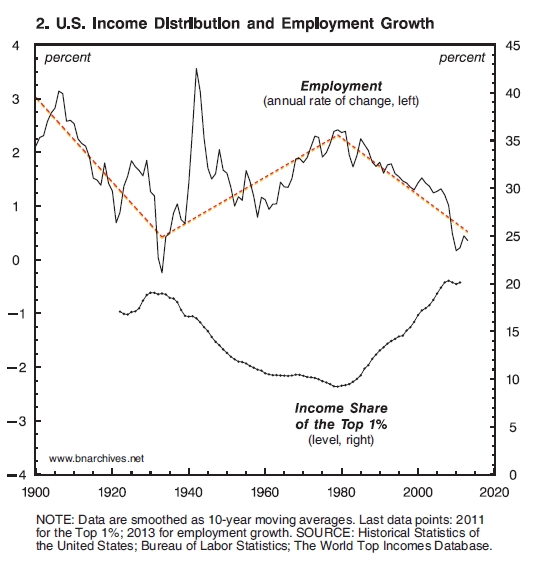
Historically, this negative relationship can be divided into three distinct periods, indicated by the dashed, freely drawn line going through the employment growth series. The first period, from the turn of the twentieth century till the 1930s, is the so-called Gilded Age. Income inequality is rising and employment growth is plummeting.
The second period, from the Great Depression till the early 1980s, is marked by the Keynesian welfare-warfare state. Higher taxation and public spending make distribution more equal, while employment growth accelerates. Note the massive acceleration of employment growth during the Second World War and its subsequent deceleration brought by post-war demobilization. Obviously these dramatic movements were unrelated to income inequality, but they did not alter the series’ overall upward trend.
The third period, from the early 1980s to the present, is marked by neoliberalism. In this period, monetarism assumes the commanding heights, inequality soars and employment growth plummets. The current rate of employment growth hovers around zero while the Top 1% appropriates 20 per cent of all income – similar to the numbers recorded during Great Depression.
So what do these facts mean for America?
First, they make the fault-lines obvious. The old slogan “what’s good for GM is good for America” now rings hollow. Capitalists seek not utility through consumption but more power through redistribution. And they achieve their goal not by raising investment and fueling growth, but by allowing unemployment to rise and jobs to become scarce. Clearly, we are not “all in the same boat.” There is a distributional struggle for power, and this struggle is not a mere “sociological” issue. It is the center of our political economy, and we need a new theoretical framework to understand it.
Second, macroeconomic policy, whether old or new, cannot offset the aggregate consequences of this distributional struggle. Not by a long shot. Till the late 1970s, the budget deficit was small, yet America boomed. And why? Because progressive taxation, transfer payments and social programs made the distribution of income less unequal. By the early 1980s, this relationship inverted. Although the budget deficit ballooned and interest rates fell, economic growth decelerated. New methods of upward redistribution have caused the share of the Top 1% to zoom, making stagnation the new norm.
Third, and finally, Washington can no longer hide behind the bush. On the one hand, the concentration of America’s income and assets, having been boosted by large post-crisis bailouts and massive quantitative easing, is now at record levels. On the other hand, long-term unemployment remains at post-war highs while job growth is at a standstill. Eventually, this situation will be reversed. The only question is whether it will be reversed through a new policy trajectory or through the calamity of systemic crisis.
Jonathan Nitzan teaches political economy at York University in Canada. Shimshon Bichler teaches political economy at colleges and universities in Israel. All of their publications are available for free on The Bichler & Nitzan Archives.
Putin calls on EU for joint aid to Ukraine
BRICS Post | April 19, 2014
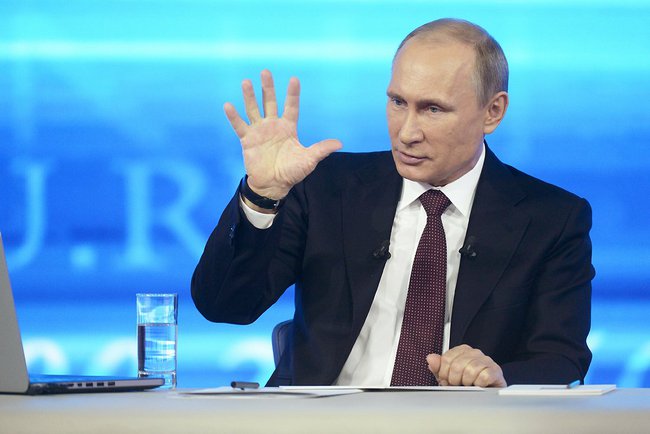
Russian President Vladimir Putin on Saturday called on all European states concerned to join efforts to keep the Ukrainian economy afloat.
“We do not want to undermine the Ukrainian economy or to call the reliability of [gas] transits to Europe into question. That’s why we call on all European states, all countries interested in supporting the Ukrainian economy to join the process of helping Ukraine and to flesh out measures to finance the budget,” said Putin.
The Russian President said on Saturday he currently saw no obstacles to bringing relations between Moscow and the West back to normal.
The Russian president, who appeared on the Vesti v Subbotu (Vesti on Saturday) TV show, was asked by its host Sergey Brilev about whether the relations between Russia and the West, which sank to record lows amid the ongoing political crisis in Ukraine, can improve by the end of the year.
“It depends on our partners,” Putin replied.
“I think that currently there is nothing to prevent us from normalizing [the relations] and [returning to] normal cooperation,” he continued.
The Russian Foreign Ministry has earlier condemned as “hypocrisy” attempts by the West to justify violent acts during pro-European rallies in Ukraine earlier this year, at the same time accusing pro-federalization protesters in the east of terrorism.
What’s the punishment for a 300 million euro tax fraud?
By Tom Gill ⋅ RevoltingEurope ⋅ April 18, 2014
What’s the punishment for a 300 million euro tax fraud? If you are in Italy and your name is Silvio Berlusconi it is about a week hanging out with people your age.
A court in Milan ruled earlier this week that as his sentence the 77-year-old billionaire media mogul and thrice Italian PM would be performing community service in the small northern town of Cesano Boscone – “once a week and for a period of no less than four consecutive hours” – in a centre for the elderly and disabled.
The ruling came eight months after his conviction for tax fraud was made definitive by Italy’s supreme court. In August last year the country’s top court had found him guilty of having had a role in allowing his Mediaset company – which has a virtual private terrestrial TV monopoly in Italy – to fraudulently lower its tax bill by buying US film and television rights at inflated prices.
Last August, the supreme court judges handed down a four-year sentence, but immediately commuted it to a year.
Under this week’s ruling, the poor ex-premier will be subject to a curfew of 11pm and will not be able to leave the region of Lombardy.
Except, that is, to go to his home in the centre of Rome. And he will be able to do that every week from Tuesday to Thursday, providing he is back at his vast Arcore palace – the venue of his bunga bunga parties located just 40 kilometres down the road – by 11pm on the Thursday.
Furthermore, the sentence could be further cut for good behaviour to nine months.
It is not just the punishment that is scandalously soft.
Just how appropriate is it? His job may entail entertaining the elderly guests of the home – and his past life as a cruise ship crooner will no doubt help.
But according to Article 47 of the Prison Administration Act community service should only be offered to the criminal “in cases where it can be assumed that the measure…contributes to the rehabilitation of the offender and ensures the prevention of the danger of committing other crimes,” Rossella Guadagnini highlights in the Italian journal Micromega.
As Al Jazeera points out Berlusconi claims total innocence of any crime he has ever been charged with. And he is currently involved in two other court cases.
In a trial set to start on June 20, he will appeal a seven-year prison sentence and lifetime ban from parliament for having sex with an underage 17-year-old prostitute and abusing his official powers. He is also a defendant in a trial for allegedly paying a $4m bribe to get a centre-left senator to join his party in 2006 in a move that helped bring down a rival government.
As a indicator of the seriousness of the crime of robbing a heavily indebted state blind, the punishment speaks for itself. Tax dodging – running at 130 billion euros annually officially but double that figures according to some sources – is bleeding the public coffers dry. The result is two trillion euros in public debts, which are being used as the excuse for swinging cuts to welfare and public services, privatisation, roll back of labour rights, and attacks on public servants’ wages.
Italian businessmen with access to expensive lawyers and good political links (any serious player in Italy has them) will have been taking due note of Berlusconi’s case.
The worst of it is that, as the Guardian reports, although he has been booted out of the Senate and is now banned from office, he’ll still be ‘allowed time’ to continue his political activities – nominally behind the scenes but no doubt very visible on Italians’ screens – as head of Forza Italia.
The party is the third largest political force in the country, behind PM Matteo Renzi’s centre-left Democratic Party and Beppe Grillo’s anti-establishment Five Star Movement, according to recent polls. The first appointment is the European elections next month.
Italy has lost two decades under the rule of Berlusconi, who entered politics in person in 1994 when his political protectors – notably former right-wing Socialist PM Bettino Craxi – melted away under the scrutiny of the same ‘communist’ judges Berlusconi has so long railed against. But if this is the best the toghe rosse can do, it can only be said that communism is well and truly dead in Italy.
DECONSTRUCTING THE RESULT OF THE FOUR PARTY TALKS
By Anatoly Karlin | Da Russophile | April 18, 2014
The media refers to the document that emerged out of today’s four party talks as an “agreement”. This is not strictly correct. The text of the document is here.
As its text makes clear what this document is in reality is not an an agreement to settle the Ukrainian crisis or even an outline of such an agreement but rather a statement of basic principles around which an agreement should be negotiated. The real agreement (if it comes about) will emerge from negotiations based on the principles set out in this document.
A number of points:
1. Kiev’s claims to the contrary notwithstanding, the statement that “all sides must refrain from all violence, intimidation and provocative actions” clearly rules out the “anti terrorist operation” in the eastern Ukraine that Kiev launched on Sunday;
2. As Lavrov has correctly pointed out the provisions in the third paragraph that require the disarmament and dissolution of armed groups is clearly intended to refer as much to Right Sector and the Maidan Self Defence Force as it does to the protesters in the east. Note specifically that the statement calls for a general amnesty except for those who have committed capital crimes (ie. murder). So far no protesters in the east have murdered anyone. Even Kiev admits that none of its soldiers have so far been killed. The same obviously cannot be said of Right Sector and of the Maidan Self Defence Force even if one disregards their likely responsibility for the sniper killings in Kiev on 20th February 2014;
3. The document clearly refers to Maidan itself, which it says must be cleared. Specifically alongside illegally occupied buildings the document refers to “all illegally occupied streets, squares and other public places in Ukrainian cities”. The reference to “squares” clearly is intended to refer to Maidan, which the militants in Kiev have said they will continue to occupy at least until the elections on 25th May 2014 and even beyond;
4. Importantly there is NO time line in the document. There is no demand therefore that buildings be evacuated by any particular date or time. That has to be agreed and coordinated with the OSCE monitors on the ground. The people in the eastern Ukraine are therefore entirely within their rights to stay in the buildings at the moment until a timeline is agreed with the OSCE monitors, one requirement of which will surely be parallel evacuations of occupied squares and buildings in Kiev and the west including Maidan.
5. The referral to the OSCE as the enforcement and mediation agency between the regime and its opponents gives Russia a formal role in the process since it is a member of the OSCE. By contrast the negotiations which took place before 21st February 2014 were negotiated and mediated by the EU of which Russia is not a member;
6. The reference to the fact that in the negotiations concerning constitutional changes there should be “outreach to all the Ukraine’s regions and constituencies” (note especially use of the word “constituencies”) gives a role to the protesters in the east in the negotiations and not just to those formal official bodies currently recognised by Kiev.
This document on its face therefore represents a shift towards the Russian/east Ukrainian side. Indeed it basically sets out principles Russia has been arguing for ever since Yanukovitch was deposed on 22nd February 2014.
Unfortunately that does not mean this road map is going to be successfully followed. Already Kiev is trying to argue that the “anti terrorist operation” it has ordered is somehow exempt from it (it isn’t) whilst the US is threatening to impose more sanctions on Russia if following the weekend Russia fails to impose pressure on the eastern Ukrainians to evacuate buildings they occupy without the US undertaking to put any corresponding pressure on its clients in Kiev (shades of Syria here). It is very easy to see how the US and its allies could then blame Russia for the failure of the road map whilst having caused that failure themselves.
However the Russians do have a number of strong cards to play of their own:
1. The growing unrest in the Donbass, which will almost certainly spread to more regions of the eastern Ukraine unless some serious concessions are made. The events of the last few days have exposed Kiev’s difficulties in suppressing this unrest. Significantly no further step in pursuit of the “anti terrorist operation” seems to have been taken today as Kiev reels from the military defections of yesterday;
2. Russia as Putin pointedly reminded everybody in his television marathon today can always refuse to recognise the results of the Presidential elections on 25th May 2014 if the negotiations are failing to make progress and also has authority from the Federation Council to send troops into the eastern Ukraine if the situation there deteriorates further. A refusal to recognise the results of the election will further undermine the legitimacy of whoever is elected. It is now clear that there will be no significant military resistance from forces loyal to Kiev if the Russian army moves into the eastern Ukraine. If that happens the likelihood is that Kiev will lose the eastern Ukraine forever (note Putin’s pointed reference to “Novorossiya” in his television marathon today) – a nightmare scenario for both Kiev and the west though not one Russia is pursuing at the moment;
3. It is now clear that without Russia’s assistance the possibility of stabilising the Ukraine’s economy quite simply does not exist. The last paragraph specifically refers to the importance of the Ukraine “financial and economic stability” to “the participants” and says “the participants…. would be ready to discuss additional support as the above steps are implemented”. The most important of the “participants” in this regard is Russia. It bears repeating (as Putin has recently pointed out) that Russia is the only participant so far providing any economic assistance to the Ukraine at all. The US is only offering $1 billion in loan guarantees and the EU is offering just 1.6 billion euros none of which have so far been provided. What this document in effect therefore says is that whilst Russia is prepared to assist in the stabilisation of the Ukraine’s economy its help is conditional on the fulfilment of the provisions of the road map;
4. It is becoming increasingly clear that there is growing resistance within the EU to further sanctions against Russia. The fact that a process has now been launched to settle this crisis will redouble European reluctance to introduce more sanctions and will increase pressure within the EU for the process to be treated seriously so that it can succeed.
In conclusion, we are not out of the woods or anywhere close. This is not the beginning of the end of the crisis. But we may be a small step closer to that point. A lot will depend on what happens next and the key decisions will be made on the ground in the Ukraine itself.
BRICS countries to set up their own IMF
By Olga Samofalova | Russia Beyond the Headlines | April 14, 2014
The BRICS countries (Brazil, Russia, India, China and South Africa) have made significant progress in setting up structures that would serve as an alternative to the International Monetary Fund and the World Bank, which are dominated by the U.S. and the EU. A currency reserve pool, as a replacement for the IMF, and a BRICS development bank, as a replacement for the World Bank, will begin operating as soon as in 2015, Russian Ambassador at Large Vadim Lukov has said.
Brazil has already drafted a charter for the BRICS Development Bank, while Russia is drawing up intergovernmental agreements on setting the bank up, he added.
In addition, the BRICS countries have already agreed on the amount of authorized capital for the new institutions: $100 billion each. “Talks are under way on the distribution of the initial capital of $50 billion between the partners and on the location for the headquarters of the bank. Each of the BRICS countries has expressed a considerable interest in having the headquarters on its territory,” Lukov said.
It is expected that contributions to the currency reserve pool will be as follows: China, $41 billion; Brazil, India, and Russia, $18 billion each; and South Africa, $5 billion. The amount of the contributions reflects the size of the countries’ economies.
By way of comparison, the IMF reserves, which are set by the Special Drawing Rights (SDR), currently stand at 238.4 billion euros, or $369.52 billion dollars. In terms of amounts, the BRICS currency reserve pool is, of course, inferior to the IMF. However, $100 billion should be quite sufficient for five countries, whereas the IMF comprises 188 countries – which may require financial assistance at any time.
BRICS Development Bank
The BRICS countries are setting up a Development Bank as an alternative to the World Bank in order to grant loans for projects that are beneficial not for the U.S. or the EU, but for developing countries.
The purpose of the bank is to primarily finance external rather than internal projects. The founding countries believe that they are quite capable of developing their own projects themselves. For instance, Russia has a National Wealth Fund for this purpose.
“Loans from the Development Bank will be aimed not so much at the BRICS countries as for investment in infrastructure projects in other countries, say, in Africa,” says Ilya Prilepsky, a member of the Economic Expert Group. “For example, it would be in BRICS’ interest to give a loan to an African country for a hydropower development program, where BRICS countries could supply their equipment or act as the main contractor.”
If the loan is provided by the IMF, the equipment will be supplied by western countries that control its operations.
The creation of the BRICS Development Bank has a political significance too, since it allows its member states to promote their interests abroad. “It is a political move that can highlight the strengthening positions of countries whose opinion is frequently ignored by their developed American and European colleagues. The stronger this union and its positions on the world arena are, the easier it will be for its members to protect their own interests,” points out Natalya Samoilova, head of research at the investment company Golden Hills-Kapital AM.
Having said that, the creation of alternative associations by no means indicates that the BRICS countries will necessarily quit the World Bank or the IMF, at least not initially, says Ilya Prilepsky.
Currency reserve pool
In addition, the BRICS currency reserve pool is a form of insurance, a cushion of sorts, in the event a BRICS country faces financial problems or a budget deficit. In Soviet times it would have been called “a mutual benefit society”, says Nikita Kulikov, deputy director of the consulting company HEADS. Some countries in the pool will act as a safety net for the other countries in the pool.
The need for such protection has become evident this year, when developing countries’ currencies, including the Russian ruble, have been falling.
The currency reserve pool will assist a member country with resolving problems with its balance of payments by making up a shortfall in foreign currency.
Assistance can be given when there is a sharp devaluation of the national currency or massive capital flight due to a softer monetary policy by the U.S. Federal Reserve System, or when there are internal problems, or a crisis, in the banking system. If banks have borrowed a lot of foreign currency cash and are unable to repay the debt, then the currency reserve pool will be able to honor those external obligations.
This structure should become a worthy alternative to the IMF, which has traditionally provided support to economies that find themselves in a budgetary emergency.
“A large part of the fund goes toward saving the euro and the national currencies of developed countries. Given that governance of the IMF is in the hands of western powers, there is little hope for assistance from the IMF in case of an emergency. That is why the currency reserve pool would come in very handy,” says ambassador Lukov.
The currency reserve pool will also help the BRICS countries to gradually establish cooperation without the use of the dollar, points out Natalya Samoilova. This, however, will take time. For the time being, it has been decided to replenish the authorized capital of the Development Bank and the Currency Reserve Pool with U.S. dollars. Thus the U.S. currency system is getting an additional boost. However, it cannot be ruled out that very soon (given the threat of U.S. and EU economic sanctions against Russia) the dollar may be replaced by the ruble and other national currencies of the BRICS counties.
Russia following UN, not US, in oil deal with Iran
Press TV – April 12, 2014
Russian Finance Minister Anton Siluanov says Moscow will act in accordance with United Nations rules and not US regulations on sanctions against Iran in conducting any “oil-for-goods” transactions with Tehran.
“We act on the basis of the decisions made by the United Nations that set sanctions, set product groups which would be sanctioned and we operate within those decisions,” Siluanov told reporters during the International Monetary Fund-World Bank meetings in Washington on Friday.
“There is a nuance. Our American partners have their own legislation which differs somewhat from the provisions set by the United Nations and they follow their own rules,” he added.
On Thursday, US Treasury Secretary Jack Lew warned the Russian minister that any possible oil-for-goods deal between Moscow and Iran in the future could run afoul of US sanctions.
Lew also said it would run counter to an interim deal reached between Iran and the five permanent members of the UN Security Council – Russia, China, France, Britain and the US – plus Germany over Tehran’s nuclear energy program.
Iran and the six nations reached an interim nuclear deal on November 24, 2013, in the Swiss city of Geneva. The deal took effect on January 20.
Under the Geneva deal, the six countries agreed to provide Iran with some sanctions relief in exchange for Iran agreeing to limit certain aspects of its nuclear activities during a six-month period. It was also agreed that no nuclear-related sanctions would be imposed on the Islamic Republic within the same time frame.
Russia sets 4 conditions in return for aid to Ukraine
RT | April 12, 2014
Ukraine should recognize Crimea’s independence, reform the country’s constitution, regulate the crisis in its eastern regions and guarantee the rights of Russian speakers if it wants to get financial help from Moscow, Russia’s finance minister has said.
“If Ukraine fulfils these four conditions, then Russia will be able to propose further steps on additional help both on financial and gas issues,” Finance Minister Anton Siluanov said after meeting with his German counterpart, Wolfgang Schauble, in Washington.
Deescalating tensions in eastern Ukraine should be peaceful, based on Ukraine’s legislation, “without discrimination against Russian-speaking population, without victims and bloodshed,” Siluanov said.
It is necessary for Ukraine to conduct constitutional reform, hold legitimate presidential elections and “form a government with which one may negotiate,” he said.
Ukraine’s gas debt is now estimated at over $2.2 billion. On Thursday, President Vladimir Putin wrote letters to the leaders of 18 European countries, including Germany and France, warning that Ukraine’s debt crisis had reached a “critical” level and could threaten transit to Europe. He also called for urgent cooperation, urging Russia’s partners in the West to take action.
According to German Chancellor Angela Merkel “there are many reasons to seriously take into account this message […] and for Europe to deliver a joint European response.”
In total, Moscow has subsidized Ukraine’s economy to the tune of $35.4 billion, coupled with a $3 billion loan tranche in December. Due to Ukraine’s gas debts, Gazprom revoked all discounts and is now charging $485 per 1,000 cubic meters of gas, a price Ukraine says it will not be able to pay.
The deteriorating economic situation is coupled with escalating tensions in Ukraine. The country’s Interior Ministry promised a harsh response to the riots in the east, especially in the “separatist regions” of Donetsk, Lugansk and Kharkov. The coup-appointed authorities said they would arrest all violators, “regardless of the declared slogans and party affiliation.”
Eastern and southern Ukraine have been showing discontent with the new government in Kiev for weeks. Tensions escalated Monday when protesters in several cities started seizing local administration buildings. Major protests took place in the cities of Donetsk, Kharkov and Lugansk, while smaller actions and some clashes were reported in Odessa and Nikolayev.
After Donetsk activists proclaimed the region independent and demanded a referendum on its future status, Ukraine’s coup-imposed president Aleksandr Turchinov ordered the sending in of armed personnel and armored vehicles to the east.
At least 70 activists have been arrested in the course of the crackdown launched by Ukraine’s Interior Ministry in the eastern city of Kharkov. Most of them remain in prison, with 62 people detained for at least two months.
Sanctions are ‘counterproductive’ for all
At the G20 finance ministers’ meeting in Washington, sanctions against Russia’s alleged interference into Ukraine’s affairs dominated the background. While speaking with journalists, Siluanov said that he was against US and EU sanctions against Russian and that the widening of such sanctions would be “counterproductive” for all sides.
In the latest series of sanctions, leading Crimean officials were targeted; those, according to the US Treasury, who were responsible for organizing the March 16 referendum, which led to the peninsula leaving Ukraine and joining Russia.
Among the seven officials forbidden from entering the US or engaging in economic activity with America-based companies are acting Sevastopol governor Aleksey Chaliy, the head of the Crimean security service Pyotr Zima, and Mikhail Malyshev, the head of the electoral commission that oversaw the poll.
Additionally, US-based assets of Chernomorneftegaz, the former subsidiary of the Ukrainian state gas company located on the Crimean peninsula, will be frozen.
The US, the EU and several international groups have imposed sanctions on senior Russian officials. The US also introduced measures including a ban on exporting defense items and services to Russia to pressure Moscow over recent events in Ukraine.
The G7 group has voiced its readiness to introduce additional sanctions against Russia, if Moscow continues to “escalate” the turmoil in neighboring Ukraine, US Treasury Secretary Jack Lew said.
Meanwhile, the Russian Foreign Ministry and parliament have repeatedly denounced the policy of sanctions as inappropriate and counter-productive.
Some Russian MPs have suggested the possibility of retaliatory sanctions against US businesses, but these ideas have not been implemented as they might harm all the countries.
“Sanctions hurt all countries. We do not intend to introduce reciprocal sanctions,” Deputy Prime Minister Igor Shuvalov told reporters during the International Eastern Forum in Berlin.
Meanwhile, the meeting between Russia, Ukraine, EU and the US to discuss the ongoing political crisis in Ukraine will take place on April 17 in Geneva, the office of EU foreign policy chief Catherine Ashton said. Proposals for Ukraine’s constitutional reforms will also be presented in Geneva. However, Russian FM Sergey Lavrov on Tuesday expressed concern that Ukraine’s southeastern regions were not being invited to take part directly in the discussions on a new constitution for the country.
Siluanov said that similar concerns were voiced on Friday during a meeting with Treasury Secretary Lew.
He added that “Russia is ready to participate in supporting Ukraine together with the IMF and the European Union.” He also told Lew that Russia was concerned about Ukraine’s unpaid debt for supplies of natural gas.
Putin: ‘We urgently need to stabilize Ukraine’s economy’
President Vladimir Putin’s letter to leaders of European countries
ITAR-TASS | April 10, 2014
Ukraine’s economy in the past several months has been plummeting. Its industrial and construction sectors have also been declining sharply. Its budget deficit is mounting. The condition of its currency system is becoming more and more deplorable. The negative trade balance is accompanied by the flight of capital from the country. Ukraine’s economy is steadfastly heading towards a default, a halt in production and skyrocketing unemployment.
Russia and the EU member states are Ukraine’s major trading partners. Proceeding from this, at the Russia-EU Summit at the end of January, we came to an agreement with our European partners to hold consultations on the subject of developing Ukraine’s economy, bearing in mind the interests of Ukraine and our countries while forming integration alliances with Ukraine’s participation. However, all attempts on Russia’s part to begin real consultations failed to produce any results.
Instead of consultations, we hear appeals to lower contractual prices on Russian natural gas – prices which are allegedly of a “political” nature. One gets the impression that the European partners want to unilaterally blame Russia for the consequences of Ukraine’s economic crisis.
Right from day one of Ukraine’s existence as an independent state, Russia has supported the stability of the Ukrainian economy by supplying it with natural gas at cut-rate prices. In January 2009, with the participation of the then-premier Yulia Tymoshenko, a purchase-and-sale contract on supplying natural gas for the period of 2009-2019 was signed. The contract regulated questions concerning the delivery of and payment for the product, and it also provided guarantees for its uninterrupted transit through the territory of Ukraine. What is more, Russia has been fulfilling the contract according to the letter and spirit of the document. Incidentally, Ukrainian Minister of Fuel and Energy at that time was Yuriy Prodan, who today holds a similar post in Kiev’s government.
The total volume of natural gas delivered to Ukraine, as stipulated in the contract during the period of 2009-2014 (first quarter), stands at 147.2 billion cubic meters. Here, I would like to emphasize that the price formula that had been set down in the contract had NOT been altered since that moment. And Ukraine, right up till August 2013, made regular payments for the natural gas in accordance with that formula.
However, the fact that after signing that contract, Russia granted Ukraine a whole string of unprecedented privileges and discounts on the price of natural gas, is quite another matter. This applies to the discount stemming from the 2010 Kharkiv Agreement, which was provided as advance payment for the future lease payments for the presence of the (Russian) Black Sea Fleet after 2017. This also refers to discounts on the prices for natural gas purchased by Ukraine’s chemical companies. This also concerns the discount granted in December 2013 for the duration of three months due to the critical state of Ukraine’s economy. Beginning with 2009, the total sum of these discounts stands at 17 billion US dollars. To this, we should add another 18.4 billion US dollars incurred by the Ukrainian side as a minimal take-or-pay fine.
In this manner, during the past four years, Russia has been subsidizing Ukraine’s economy by offering slashed natural gas prices worth 35.4 billion US dollars. In addition, in December 2013, Russia granted Ukraine a loan of 3 billion US dollars. These very significant sums were directed towards maintaining the stability and creditability of the Ukrainian economy and preservation of jobs. No other country provided such support except Russia.
What about the European partners? Instead of offering Ukraine real support, there is talk about a declaration of intent. There are only promises that are not backed by any real actions. The European Union is using Ukraine’s economy as a source of raw foodstuffs, metal and mineral resources, and at the same time, as a market for selling its highly-processed ready-made commodities (machine engineering and chemicals), thereby creating a deficit in Ukraine’s trade balance amounting to more than 10 billion US dollars. This comes to almost two-thirds of Ukraine’s overall deficit for 2013.
To a large extent, the crisis in Ukraine’s economy has been precipitated by the unbalanced trade with the EU member states, and this, in turn has had a sharply negative impact on Ukraine’s fulfillment of its contractual obligations to pay for deliveries of natural gas supplied by Russia. Gazprom neither has intentions except for those stipulated in the 2009 contract nor plans to set any additional conditions. This also concerns the contractual price for natural gas, which is calculated in strict accordance with the agreed formula. However, Russia cannot and should not unilaterally bear the burden of supporting Ukraine’s economy by way of providing discounts and forgiving debts, and in fact, using these subsidies to cover Ukraine’s deficit in its trade with the EU member states.
The debt of NAK Naftogaz Ukraine for delivered gas has been growing monthly this year. In November-December 2013 this debt stood at 1.451,5 billion US dollars; in February 2014 it increased by a further 260.3 million and in March by another 526.1 million US dollars. Here I would like to draw your attention to the fact that in March there was still a discount price applied, i.e., 268.5 US dollars per 1,000 cubic meters of gas. And even at that price, Ukraine did not pay a single dollar.
In such conditions, in accordance with Articles 5.15, 5.8 and 5.3 of the contract, Gazprom is compelled to switch over to advance payment for gas delivery, and in the event of further violation of the conditions of payment, will completely or partially cease gas deliveries. In other words, only the volume of natural gas will be delivered to Ukraine as was paid for one month in advance of delivery.
Undoubtedly, this is an extreme measure. We fully realize that this increases the risk of siphoning off natural gas passing through Ukraine’s territory and heading to European consumers. We also realize that this may make it difficult for Ukraine to accumulate sufficient gas reserves for use in the autumn and winter period. In order to guarantee uninterrupted transit, it will be necessary, in the nearest future, to supply 11.5 billion cubic meters of gas that will be pumped into Ukraine’s underground storage facilities, and this will require a payment of about 5 billion US dollars.
However, the fact that our European partners have unilaterally withdrawn from the concerted efforts to resolve the Ukrainian crisis, and even from holding consultations with the Russian side, leaves Russia no alternative.
There can be only one way out of the situation that has developed. We believe it is vital to hold, without delay, consultations at the level of ministers of economics, finances and energy in order to work out concerted actions to stabilize Ukraine’s economy and to ensure delivery and transit of Russian natural gas in accordance with the terms and conditions set down in the contract. We must lose no time in beginning to coordinate concrete steps. It is towards this end that we appeal to our European partners.
It goes without saying that Russia is prepared to participate in the effort to stabilize and restore Ukraine’s economy. However, not in a unilateral way, but on equal conditions with our European partners. It is also essential to take into account the actual investments, contributions and expenditures that Russia has shouldered by itself alone for such a long time in supporting Ukraine. As we see it, only such an approach would be fair and balanced, and only such an approach can lead to success.
Featured Video
Dan Dicks with James Corbett on Solutions Watch
or go to
Aletho News Archives – Video-Images
From the Archives
MMR (Measles, Mumps and Rubella) – Vaccine Risk Statement
MMR Vaccine (Measles, Mumps, and Rubella) Is It Safer Than Measles, Mumps and Rubella?
Physicians for Informed Consent | December 2024
… It has not been proven that the MMR vaccine is safer than measles, mumps, and rubella. The vaccine package insert raises questions about safety testing for cancer, genetic mutations, and impaired fertility. Although VAERS tracks some adverse events, it is too inaccurate to measure against the risk of measles, mumps, and rubella. Clinical trials do not have the ability to detect less common adverse reactions, and epidemiological studies are limited by the effects of chance and possible confounders. Safety studies of the MMR vaccine are particularly lacking in statistical power. A review of more than 60 MMR vaccine studies conducted for the Cochrane Library states, “The design and reporting of safety outcomes in MMR vaccine studies, both pre- and post-marketing, are largely inadequate.”19 Because permanent sequelae (aftereffects) from measles, mumps, and rubella are so rare (especially in children with normal levels of vitamin A and infected after birth),6,15-17 the level of accuracy of the research studies available is insufficient to rule out the possibility that the MMR vaccine causes greater death or permanent disability than measles, mumps, and rubella. – Read full article
Blog Roll
 Aletho News
- Moscow issues warning to NATO over Russian exclave
- Yes, the Iran war has destroyed Trump’s presidency
- The fallacy of US delusions about Iran’s economic collapse
- Hezbollah denies Syria cell link, warns of Israeli plan to sow discord
- The legacy of US sanctions, war, and occupation in Iraq
- Iraqi resistance group rejects disarmament, vows to maintain support for Lebanon
- Sheikh al-Asadi warns of Iraqi government compliance with US demands
- How to MAKE THE CONSPIRATORS PAY for their crimes! Dan Dicks with James Corbett on Solutions Watch
- There’s a drought in academia: A drought in honest research on the subject of drought and other weather extremes
- Department of War Awards $20.7 Billion Contract to Raytheon for Air-to-Air Missiles
- If Americans Knew
- An error has occurred; the feed is probably down. Try again later.
- No Tricks Zone
- Green Energy Debacle: German Expert Professor Fritz Vahrenholt Warns Of Severe Economic And Social Consequences
- Two More Paleo Reconstructions Affirm Meters-Higher Sea Levels Across Ireland, Brazil 7000-6000 Years Ago
- New Study: Earth And Venus Surface Warmth Largely Explained By Convection And Lapse Rate, Not CO2 Or Radiation
- 2025 Nature Paper Claiming Worsening Global Drought Gets RETRACTED …Heavily Flawed
- New Study: ‘Global Drought Shows No Detectable Recent Acceleration Under Climate Warming’
- Economic Masterminds: German Socialists Suggest Taxing Productivity Gains Stemming From Using AI
- The South China Sea Has Not Been Cooperating With The Climate Change Narrative
- Energy Crisis: Germany Enters Heating Season With Historically Low Gas Reserve Fill Levels
- New Study: The Antarctic Ice Sheet Gained Mass From 2020-2024 Due To Staggering Snow And Ice Accumulation
- Study: Ocean Heating Rates From Thousands Of Years Ago ‘Dwarf’ Modern Ocean Heating Rates

