Where the Money Isn’t Going
By JAMES G. ABOUREZK | June 29, 2009
Wherever I heard that hackneyed phrase, “If you find yourself in a hole, stop digging,” it applies more today than anytime I can remember. What I don’t understand is, when our government has spent billions on bank bailouts (not a good idea) on bailing out the stupidity of the automobile executives (a better idea because it saves jobs for working people), why are members of Congress and the drug and insurance lobbies feeding this fairy tale that we cannot afford single payer health care.
Virtually every industrialized country in the world has a health care system that is paid for by tax revenues, making sure that it is available to everyone. Even Syria, which is not a rich country, sends medical students to medical school, then requires them, upon graduation, to serve in a village clinic at a very low salary. Medical care is provided for every Syrian citizen, although there is a private medical system for those who want to pay.
Neither, we are told, can we afford a national passenger rail system that would do a great deal to decrease pollution, cut down on the use of oil, and that would move people to every part of our country, just like it’s done in Europe and in Japan.
But we can’t afford either of these common sense projects, even though we are digging our financial hole deeper and deeper with other projects that we should bring to a close.
Israel. We are still shoveling money out of the door of our national treasury giving Israel all the money they need to finance their brutal occupation of the Palestinians, plus giving them one of the highest living standards in the world. The last time I checked with the Library of Congress, Israel had drained our treasury (money from American taxpayers) to well over 100 billion dollars.
And what have we received in return? Well, I am currently reading Attack on the Liberty, written by James Scott, a journalist whose father was an ensign on board the Liberty when Israel tried to destroy the U.S. Navy ship during the 1967 Middle East War. Whenever I feel like having my blood boil, I pick up the book and read another chapter describing the deliberate attack on our ship, which killed over 30 American sailors and wounded another 170. As bad as the attack was, the continuing cover up both by Israel and the U.S. government is an ongoing outrage.
Add to that, the unknown number of Israeli spies who are burrowing into our government to learn our secrets. Jonathan Pollard, for example, was paid by Israel to unload what authorities have described as “a truckload of secret documents” to Israel’s agents in this country. The latest episode of Israeli spying is notable for the speed with which the U.S. Justice Department dismissed the charges against the two pro-Israeli spies, despite the finding of guilty and a 12 year sentence to the U.S. official–Larry Franklin–who handed over the documents to the spies.
Other things we can do without include the manned space program. The shuttle program, which costs American taxpayers several billion dollars a year, would look better viewing it from the rear view mirror. Several Nobel laureate scientists, as well as this writer, have advocated an unmanned program for space exploration instead of the much costlier manned program. First of all, the manned program cannot go as far into space as an unmanned program can, and secondly, it is vastly cheaper while being more rewarding. But it’s difficult to stop the bleeding of taxpayers’ money once it starts
We have the same trouble financing our NATO involvement. Now, NATO was designed during the Cold War to protect Europe from the nasty Soviets. Now that the Soviets are no longer around, who does NATO protect? Only the arms manufacturers who benefit from weapons sales both to the U.S. and to NATO members.
I don’t think a lot of explanation is needed for reasons to get the U.S. out of Iraq and Afghanistan. Yes, I include Afghanistan in my exit strategy, mostly for the reason that we shouldn’t need the second kick of a mule to learn to stay away from the mule. We all witnessed the Soviets who were almost destroyed by their adventure in Afghanistan, and we should have learned that American troops are a natural target in places like that country. The only logical conclusion is to get our troops out of there, leaving it to the Taliban and the warlords and the Pakistanis to deal with that quagmire.
Although the pro-Israeli Zionists do not like to hear it, but a lot of our Middle East woes derive from the brutality of the continuing occupation of Palestine by the Israelis. What is unfortunate is that the American press spends its time and its talents trying to avoid discussing what Israel is doing in the Middle East.
I saw NBC’s David Gregory interviewing Bibi Netanyahu on Meet the Press. Discussing Iran, Netanyahu said that true democracies such as Israel would never commit violence against protesters. Gregory let that one go right past him, going on to the next puffball question to Bibi, which again he knocked over the fence. If I recall, it was another bit of hypocrisy meted out by the slick talking Prime Minister.
But that’s the state of our media today. There is 40 times the coverage of Michael Jackson’s heart attack than there was of the slaughter of 1,200 Gazans during Israel’s invasion last year. At times I feel sad about the death of America’s newspapers, but after seeing how they behave, and how they fail in their job of watching the government for the rest of us, maybe it’s for the best to let them all go under. They contribute little more than crossword puzzles and sports scores (which are for the betting public anyway).
We’ve reached the place in the hole we’re digging which might make us think about stopping.
James G. Abourezk is a lawyer practicing in South Dakota. He is a former United States senator and the author of two books, Advise and Dissent, and a co-author of Through Different Eyes. This article also runs in the current issue of Washington Report For Middle East Affairs. Abourezk can be reached at georgepatton45@gmail.com
Source

New book: “The politics of empire. The US, Israel and the Middle East”
By James Petras | Clarity Press
This book provides a unique conception of US empire building, linking overseas expansion with:
– the growth of a police state and declining living standards;
– advanced technologically driven global spying on adversaries and allies with declining economic competitiveness and military defeats;
– large scale, long term commitments of economic and military resources to wars in the Middle East to the detriment of major corporate interests, but for the benefit of a pariah state, Israel; and
– the power of a foreign state (Israel) over US policy via its domestic pro-Zionist power configuration The interplay of these four specific features of US empire building has no past or present precedent among imperial states.
Because of Israeli-Zionist influence on US imperial policy, the main targets and objectives of imperial wars are located in the Middle East. The objectives of Israeli and Zionist- influenced US policy in the Middle East is to enhance Israeli regional power and the dispossession of the Palestinian people. The trillion dollar cost of US wars for Israel, however, has alienated the vast majority of US society and driven a wedge between the political elite backing new wars for Israel, and the public prioritizing of domestic economic welfare. This study highlights how the domestic foundations of empire building have deteriorated and forced the imperial presidency to modify its approach, seeking diplomatic negotiations over new military interventions, specifically in the cases of Syria and Iran.
Imperial politics is viewed as a multi-sided power struggle between military and economic elites, Israel and the Zionist power configuration, overseas resistance movements and nationalist regimes, and the US public. The resolution of this power struggle is more than an academic question; it will determine whether the US will become a full blown police state, ruled by the pawns of a racist-colonial state engaged in endless wars or return to its roots as an independent democratic republic “free of foreign entanglements”.

The politics of empire. The US, Israel and the Middle East
by James Petras
ISBN: 978-0-9860731-0-6 $18.95 / pp. / 2014
Available in the US from Clarity Press, amazon.com, Baker & Taylor, Barnes & Noble, Ingram and online booksellers
Available from Distributors in the USA, the UK/Europe, Middle East, Malaysia/Singapore
Request a review or desk copy
America’s Unceasing Contempt for Venezuela
By Jason Hirthler | CounterPunch | March 11, 2014
Some things never change. The petulant and undemocratic Venezuelan opposition is at it again, with the full backing and check-writing support of the U.S. government. Recent protests have inflamed the streets of Caracas, as opposition groups, as they have in the Ukraine, called for the ouster of the sitting president. I suppose it’s needless to note that Nicolás Maduro is Venezuela’s democratically elected president, and that he won by a higher victory margin in a cleaner election than did Barack Obama in 2012. Nor is it worth asking, one supposes, that if the entire country is engulfed by dissent, as The New York Times insidiously suggested by claiming the “The protests are expressing the widespread discontent with the government of President Nicolás Maduro, a socialist…”, then why did Maduro’s party, Partido Socialista Unido de Venezuela (PSUV), claim wide majorities in municipal elections in December? Or why are these “widespread” protests largely confined to middle-class or student areas of Caracas and not rife within much larger poor neighborhoods? Or if a government has the right to arrest opposition leaders (in this case Leopoldo Lopez, the latest rabid ideologue) for inciting violence?
Public Virtue, Private Vice
Secretary of State John Kerry has ratcheted up the drivel stateside, claiming to be “alarmed” by reports that Maduro has “detained scores of anti-government protesters” and that the crackdown would have a “chilling effect” on free expression. A bit rich coming from a man whose own government has been icing free speech since the Snowden revelations. Kerry failed to mention whether the millions of American taxpayer dollars being funneled to the opposition were behind the violence. The Los Angeles Times described Maduro’s administration as an “autocratic government.” Opposition leader Henrique Caprilles, demolished by Maduro in last year’s landslide election, rejected Maduro’s invitation to talks and claimed one of the Latin America’s most popular political parties was a “dying government.”
For its part, Mercosur, the alliance of South America’s southern cone countries, denounced the violence as an attempt to “destabilize” a democratic government. Of course, the behavior of Maduro’s government in response to these street provocations ought to closely watched, as this is the new president’s first real test coping on an international stage with the intrigues of a small but virulent neoliberal opposition.
There’s plenty to suggest that this is, like Ukraine, another external attempt to uproot a democratically elected government through a volatile cocktail of in-country agitation and violence paired with global media defamation of the existing administration. It wouldn’t come as a surprise. Like a frustrated and petulant infant, the United States has repeatedly attempted to derail the Bolivarian Revolution launched by former President Hugo Chavez in the late nineties, as CEPR’s Mark Weisbrot has noted. It backed an anti-democratic coup by business elites in 2002 that actually succeeded for a couple of days and happily dissolved parliament before Chavez regained power. It supported an oil strike in an attempt to destabilize the economy and perhaps bring down the government. It encouraged opposition members of parliament to push for recalls (failed) and boycott National Assembly elections (useless) and clamor incessantly that last year’s national presidential election was rigged (false). Of course, despite being widely held to be a superior electoral process than that of the United States, Kerry was only shamed into recognizing the legitimacy of the election long after the rest of the world had.
The U.S. has poured millions into opposition activities on an annual basis since the failed coup in 2002. (NGOs are convenient destinations for this money since foreign contributions to political parties are illegal in both countries.) Just look at 2013 alone. Washington would hardly stand for interference of this kind from, say, China. Or, better, from Venezuela itself. Imagine if it was discovered that Chavez had been seeding major American metropolises with anti-capitalist pamphleteers. Obama wouldn’t be able to hit the “signature strike” button fast enough. Nevertheless, Kerry, in his role as Secretary of State, has turned out to be a masterful mimic capable of registering a fusty outrage on short notice, especially over claimed violations of civil liberties. Curious, since the ceaseless trampling of civil liberties by his own Democratic party have elicited nothing from this flag-bearer for democratic values.
Dollars & Bolivars
This is not to say that Venezuela does not have protest-worthy problems. Inflation has been chronic since the pre-Chavez days. Now food shortages are trying the patience of the population. And in one sense, these shortages are self-inflicted. According to Gregory Wilpert of VenezuelAnalysis, the government’s currency controls have been undermined by an all-too-predictable black market. While the government has placed strict criteria on the ability of citizens to purchase dollars with bolivars, the black market allows citizens to buy dollars without any criteria whatsoever. The government’s exchange rate is likewise controlled, and has over time begun to distort the real value of the bolivar. The black market exchange rate, by contrast, reflects the external value of the currency. The gap between these exchange rates has grown rapidly, such that there now exist huge incentives for citizens to play currency arbitrage. If they satisfy the federal criteria—such as needing dollars to travel or import goods—Venezuelans can buy dollars cheaply using the government exchange rate. They can then pay those dollars to import goods, then export those goods in exchange for the dollars they just spent on the imports. From there it is a simple step to the black market, where they can sell those dollars for many times what they paid at the government’s official rate, making a tidy profit for themselves. If they happen to be rabid anti-socialists, they can enjoy the companion thrill of generating food shortages that can be blamed on the government. Ah, the timeless magic of import/export.
These are legitimate grievances, however, as are crime figures, which top the regional table. Yet the question is, do they merit the overthrow of a legitimate government backed by a wide majority of the population at the behest of a small but fierce oppositional faction openly funded by an imperial power committed to its overthrow? To do so would risk the absurdity of gratifying the strident demands of a few at the expense of the many. … The fact is, despite the inflation and shortages, the population continues to support the Bolivarian Revolution because of its accomplishments—massive reductions in poverty, extreme poverty, and illiteracy. Significant growth in per capita GDP and other important metrics.
A Doctrine in Decline
We’re seeing in clear images the viciousness with which neoliberal factions resent the loss of power and seek to restore it by any means necessary. Democracy is the least of their concerns. But this has been the Latin American back-story for a couple of centuries. Much of the U.S. activity in Latin America feels like a frantic and desperate last-ditch effort to preserve the Monroe Doctrine, by which we essentially declared Latin America to be our own backyard, off-limits to European empires. What was ostensibly a call to respect independent development in the Southern hemisphere rather predictably evolved into an excuse for self-interested intervention. But now, for the first time in centuries, Latin America has struck out on its own, slipping from beneath the clutch of the eagle’s claw to form organizations like Mercosur and CELEAC, PetroCaribe and Petrosur, the Bank of the South as well as the Bolivarian Alliance for the Americas (ALBA). Aside from Columbia, an implacable outpost of American influence, the region has shunned greater U.S. involvement, and begun to view its proffered trade agreements with far more suspicion, particularly in the long wake of NAFTA, the poster child for lopsided and economically destructive trade treaties.
Whether the U.S. will eventually succeed in a cynical ploy to unseat Maduro remains to be seen. If recent events in the Ukraine are any indication, that may have been a test run for Venezuela, as Peter Lee suggests. It hasn’t helped that, as in practically every country that comes to mind, an elite class of neoliberal ideologues own the mainstream media. The tools of propaganda have rarely been more fiercely deployed than since Chavez launched his socialist revolution. And yet, since then, practically the entire continent has experimented with left-leaning leadership: Rafael Correa in Ecuador, Evo Morales in Bolivia, Nicanor Duarte in Paraguay, Tabare Vazquez in Uruguay, to some degree Luiz Inácio Lula da Silva in Brazil, and Maduro in Venezuela. Nor should exiled Honduran president Manuel Zalaya be forgotten. These figures have collectively stepped back from the brink of dubious integration with North America and sought stronger regional ties and continental autonomy.
The U.S. has replied with a predictable confection of threats, lies, and sacks of cash for ferociously anti-democratic elements. Perhaps it most fears the bad karma it generated for itself with Operation Condor, which on September 11, 1973 overthrew and murdered Chile’s socialist leader Salvador Allende and replaced him with a gutless sadist, Augusto Pinochet. Pinochet—a repressive militarist—happily instituted the untested prescriptions of the Chicago School of Economics’ sermonizing armchair guru Milton Freidman, with predictable results. Now, Maduro, carrying the mantle of Chavez and his Bolivarian manifesto, is arguably the spiritual vanguard of the socialist left in South America. Venezuela’s efforts to continue to forge its own independence in the coming decade will surely influence the mood and courage of other leftists in the region. The stakes are obviously high. Hence the relentless American effort to destabilize and publicly discredit the PSUV. The fate of the global left is in a very real sense being tested in the crucible of Caracas.
Jason Hirthler can be reached at jasonhirthler@gmail.com.
EU responsible for Crimea situation: Ex-German chancellor
Press TV – March 10, 2014
Former German Chancellor Gerhard Schroeder says the European Union (EU) is responsible for the situation in Ukraine’s Crimea as its policy toward the Eastern European country was erroneous in the first place.
Schroeder made the comments on Sunday in Hamburg during a press event, in which he said that Brussels made a mistake in the outset when it offered Ukraine an association agreement on “either/or” terms.
The former chancellor wondered if it was right to offer Ukraine, which is a culturally divided country, an alternative of either signing the deal with the EU or a customs agreement with Russia.
Schroeder said it would have instead been more reasonable to offer Ukraine a “both/and” alternative.
He was referring to the ousted Ukrainian president Viktor Yanukovych refraining from signing the association agreement with the EU in favor of closer ties with Russia in November 2013 that triggered the political crisis in the country.
The remarks come amid the standoff between Russia and the West over Ukraine’s autonomous territory of Crimea.
Amid increasingly violent protests, Yanukovych left Ukraine for Russia and a new pro-EU government was formed in Kiev.
Subsequently, and as the protests inside mainland Ukraine lost momentum with the departure of Yanukovych, a crisis began to emerge in Ukraine’s Crimea, where a large majority of ethnic Russians reside and where Russia has a naval base.
Troops, who wear military apparel that bears no insignia but who are largely believed to be Russian, were deployed to several locations in Crimea, taking control of key points in the region.
Last week, lawmakers in Crimea unanimously declared they wanted to join Russia and would put the decision to a referendum on March 16.
The new Ukrainian government, however, has declared the planned vote illegal.
Who will threatened sanctions hit most? US-EU-Russia trade in numbers
RT | March 4, 2014
US lawmakers are already threatening Russia with economic sanctions over the crisis in Ukraine. Trade, business, investment, and G8 membership closely link the Russian, American and European economies.
While the West is considering going down the ‘sanction road’, here’s a look at what’s at stake for the markets.
Trade
In terms of billions of dollars, trade is higher between Russia and the EU, but the US remains Europe’s biggest export market.
Net trade between Russia and the US was $38.1 billion in 2013, according to US Chamber of Commerce data. The US exported $11.26 billion to Russia, and imported $26.96 billion worth of goods.

Russia exports more than $19 billion of oil and petroleum products to the United States, as well as $1 billion in fertilizer products, according to Chamber of Commerce data.
“Is Russia going to be cut off from the world? That is very unlikely given what Russia provides to the world, which are oil, gas, raw materials,” Alexis Rodzianko, president of the American Chamber of Commerce in Russia told Reuters.
Russia is very dependent on trade with the EU, as member states account for about 50 percent of total Russian imports and exports. In 2012, trade between the two neighbors reached €123 billion.

One of Russia’s most valuable exports to Europe is something factories and households run on every day: natural gas. Europe imports one-third of its natural gas from Russia, with Germany being the biggest client importing nearly 30 billion euro annually. In 2012, 75 percent of all European imports from Russia were energy.
Many countries in Europe have strategic partnerships with Russia’s state-owned gas giants, Rosneft and Gazprom.
According to Eurostat data, Russia accounts for 7 percent of total imports and 12 percent of total exports in the 28 European Union bloc, making it the regions third most important trading partner, behind the USA and China.
US companies with big Russia presence
Several of America’ biggest companies- Boeing, Cargill, Ford, General Motors, ExxonMobil, to name a few- all have a huge presence in the Russian market.
Boeing’s investment in Russia is deep, as the aerospace carrier sources a considerable amount of steel, titanium, and aircraft parts from Russian companies. Boeing receives about 35 percent of its titanium from state-owned, Rostec. In 2013, Boeing’s deliveries to Russian carriers were valued at $2.1 billion, and the company plans to spend $27 billion in Russia, Bloomberg reports.
“We are watching developments closely to determine what impact, if any, there may be to our ongoing business and partnerships in the region,” Doug Alder, a spokesman for Chicago-based Boeing, told Bloomberg by email.
Last year, Russia was a $11.2 billion market for the US, with heavy trade in automobiles and aircrafts, according to Commerce Department data.
US automakers have a high exposure to Russian markets, so are closely watching US economic actions against Russia. Ford has sold over 1 million automobiles in Russia, and in 2013, sold 105,000 cars. GM, which has a 9 percent market share, sold 258,000. Both companies have shifted production plants from Europe to Russia, which is set to become Europe’s biggest car market by 2016.
ExxonMobil has partnered with Rosneft in exploring the Bazhenov oil field in Western Siberia, a deal that could be worth up to $500 billion. ExxonMobil is planning to build a $15 billion LNG terminal project in the Bazhenov field, and also has joint venture projects set up to explore Black Sea reserves.
Senator Chris Murphy, chairman of the Senate’s subcommittee on Europe, said the sanctions could be extended to Russia’s banks. Russia’s two largest state banks are Sberbank, Europe’s third largest, and VTB. Both banks have a strong industry presence in London, which has indicated it isn’t moving towards the sanctions. A leaked document from Downing Street shows that the UK government doesn’t plan to follow America-led asset freezes or trade restrictions, but are mulling over visa restrictions and travel bans on key Russian politicians.
Pensions in Ukraine to be halved – sequestration draft
RT | March 6, 2014
The self-proclaimed government in Kiev is reportedly planning to cut pensions by 50 percent as part of unprecedented austerity measures to save Ukraine from default. With an “empty treasury”, reduction of payments might take place in March.
According to the draft document obtained by Kommersant-Ukraine, social payments will be the first to be reduced.
“The Finance Ministry has prepared a plan for optimizing budget expenditures, which implies budget sequestration is to be in force before the end of March. For this purpose, in particular, it has been proposed to reduce capital costs, eliminate tax schemes and preferences and to cut social benefits, for example, 50 percent of pensions to working pensioners,” Kommersant-Ukraine reported.
Ukraine’s Ministry of Social Policy reported on December 1, 2013, that an average pension in Ukraine is $160.
Right after the formation, the self-proclaimed government in Kiev announced that the “treasury is empty”.
Ukraine’s new prime minister, Arseny Yatsenyuk, promised the government would do its best to avoid a default, adding that he expects an EU/IMF economic stabilization package soon. The plan has been formulated in record time, with the government’s strategy ratified in the Ukrainian parliament on February 27, and the document being sent for evaluation to the Ministry of Economic Development and Trade on March 3.
The European Commission offered Ukraine an 11 billion euro loan if Kiev agrees a deal with the IMF, European Commission President Jose Barroso announced on Wednesday. As a rule, help from financial organizations such as the IMF or the World Bank normally includes drastic austerity measures.
Accepting IMF money will mean many sacrifices for Ukraine’s economy, which are likely to include increased gas bills, frozen government salaries, and all around budget cuts.
The government in Kiev has already announced sequestration plans from $6.8 to $8.4 billion in 2014.
Related article

Russia to retaliate for US sanctions over Ukraine
Press TV – March 4, 2014
Russia says it will retaliate against any possible sanctions that the United States may impose on Moscow over its involvement in Ukraine.
In a statement released on Tuesday, the Russian Foreign Ministry said that Moscow would have to respond in such situations that are provoked by “Washington’s rash and irresponsible actions.”
“We have frequently explained to the Americans… why unilateral sanctions do not fit the standards of civilized relations between states,” Foreign Ministry spokesman Alexander Lukashevich said.
Lukashevich also added that such response would not be necessarily symmetrical.
Russian Foreign Minister Sergei Lavrov on Monday criticized the West’s threats of “sanctions and boycotts” against the country.
At the opening session of the UN Human Rights Council in Geneva, Lavrov said those who speak of sanctions are the ones that “ultimately polarized Ukrainian society.”
Earlier, the US and the European Union had warned Moscow of the consequences of its military action in Ukraine.
Lavrov also said that the presence of Russian troops in Ukraine’s Crimean peninsula is necessary to protect the country’s citizens.
“We are talking here about protection of our citizens and compatriots, about protection of the most fundamental of the human rights—the right to live and nothing more,” he noted.
The US Senate and the Obama administration are discussing possible measures against the Russian government such as a halt to military cooperation, and economic sanctions in addition to moves against individual Russians, including visa bans and asset freezes.
Imperialism and NGOs in Latin America
By James Petras :: 12.18.1997
By the early 1980s the more perceptive sectors of the neoliberal ruling classes realized that their policies were polarizing the society and provoking large-scale social discontent.
Neoliberal politicians began to finance and promote a parallel strategy “from below,” the promotion of “grassroots” organization with an”anti-statist” ideology to intervene among potentially conflictory classes, to create a “social cushion.” These organizations were financially dependent on neoliberal sources and were directly involved in competing with socio-political movements for the allegiance of local leaders and activist communities. By the 1990s these organizations, described as “nongovernmental,” numbered in the thousands and were receiving close to four billion dollars world-wide.
Neoliberalism and the NGOs
The confusion concerning the political character of the nongovernmental organizations (NGOs) stems from their earlier history in the 1970s during the days of the dictatorships. In this period they were active in providing humanitarian support to the victims of the military dictatorship and denouncing human rights violations. The NGOs supported “soup kitchens” which allowed victimized families to survive the first wave of shock treatments administered by the neoliberal dictatorships. This period created a favorable image of NGOs even among the left. They were considered part of the “progressive camp.”
Even then, however, the limits of the NGOs were evident. While they attacked the human rights violations of local dictatorships, they rarely denounced the U.S. and European patrons who financed and advised them. Nor was there a serious effort to link the neoliberal economic policies and human rights violations to the new turn in the imperialist system. Obviously the external sources of funding limited the sphere of criticism and human rights action.
As opposition to neoliberalism grew in the early 1980s, the U.S. and European governments and the World Bank increased their funding ofNGOs. There is a direct relation between the growth of social movements challenging the neoliberal model and the effort to subvert them by creating alternative forms of social action through the NGOs. The basic point of convergence between the NGOs and the World Bank was their common opposition to”statism.” On the surface the NGOs criticized the state from a “left” perspective defending civil society, while the right did so in the name of the market. In reality, however, the World Bank, the neoliberal regimes, and western foundations co-opted and encouraged the NGOs to undermine the national welfare state by providing social services to compensate the victims of the multinational corporations (MNCs). In other words, as the neoliberal regimes at the top devastated communities by inundating the country with cheap imports, extracting external debt payment, abolishing labor legislation, and creating a growing mass of low-paid and unemployed workers, the NGOs were funded to provide “self-help” projects, “popular education,” and job training, to temporarily absorb small groups of poor, to co-opt local leaders, and to undermine anti-system struggles.
The NGOs became the “community face” of neoliberalism, intimately related to those at the top and complementing their destructive work with local projects. In effect the neoliberals organized a “pincer” operation or dual strategy. Unfortunately many on the left focused only on “neoliberalism” from above and the outside (International Monetary Fund, World Bank) and not on neoliberalism from below (NGOs, micro-enterprises). A major reason for this oversight was the conversion of many ex-Marxists to the NGO formula and practice. Anti-Statism was the ideological transit ticket from class politics to “community development,” from Marxism to the NGOs.
Typically, NGO ideologues counterpose “state” power to “local” power. State power is, they argue, distant from its citizens, autonomous, and arbitrary, and it tends to develop interests different from and opposed to those of its citizens, while local power is necessarily closer and more responsive to the people. But apart from historical cases where the reverse has also been true, this leaves out the essential relation between state and local power—the simple truth that state power wielded by a dominant, exploiting class will undermine progressive local initiatives, while that same power in the hands of progressive forces can reinforce such initiatives.
The counter position of state and local power has been used to justify the role of NGOs as brokers between local organizations, neoliberal foreign donors (World Bank, Europe, or the United States) and the local free market regimes. But the effect is to strengthen neoliberal regimes by severing the link between local struggles and organizations and national/international political movements. The emphasis on “local activity” serves the neoliberal regimes since it allows its foreign and domestic backers to dominate macro-socio-economic policy and to channel most of the state’s resources toward subsidies for export capitalists and financial institutions.
So while the neoliberals were transferring lucrative state properties to the private rich, the NGOs were not part of the trade union resistance. On the contrary they were active in local private projects, promoting the private enterprise discourse (self-help) in the local communities by focusing on micro-enterprises. The NGOs built ideological bridges between the small scale capitalists and the monopolies benefiting from privatization—all in the name of “anti-statism”and the building of civil societies. While the rich accumulated vast financial empires from the privatization, the NGO middle class professionals got small sums to finance offices, transportation, and small-scale economic activity.
The important political point is that the NGOs depoliticized sectors of the population, undermined their commitment to public employees, and co-opted potential leaders in small projects. NGOs abstain from public schoolteacher struggles, as the neoliberal regimes attack public education and public educators. Rarely if ever do NGOs support the strikes and protests against low wages and budget cuts. Since their educational funding comes from the neoliberal governments, they avoid solidarity with public educators in struggle. In practice, “non-governmental” translates into anti-public-spending activities, freeing the bulk of funds for neoliberals to subsidize export capitalists while small sums trickle from the government to NGOs.
In reality non-governmental organizations are not non-governmental. They receive funds from overseas governments or work as private subcontractors of local governments. Frequently they openly collaborate with governmental agencies at home or overseas. This “subcontracting”undermines professionals with fixed contracts, replacing them with contingent professionals. The NGOs cannot provide the long-term comprehensive programs that the welfare state can furnish. Instead they provide limited services to narrow groups of communities. More importantly, their programs are not accountable to the local people but to overseas donors. In that sense NGOs undermine democracy by taking social programs out of the hands of the local people and their elected officials to create dependence on non-elected, overseas officials and their locally anointed officials.
NGOs shift people’s attention and struggles away from the national budget and toward self-exploitation to secure local social services. This allows the neoliberals to cut social budgets and transfer state funds to subsidize bad debts of private banks, and provide loans to exporters. Self exploitation (self-help) means that, in addition to paying taxes to the state and not getting anything in return, working people have to work extra hours with marginal resources, and expend scarce energies to obtain services that the bourgeoisie continues to receive from the state. More fundamentally, the NGO ideology of “private voluntaristic activity” undermines the sense of the “public”: the idea that the government has an obligation to look after its citizens and provide them with life, liberty, and the pursuit of happiness; that the political responsibility of the state is essential for the well-being of citizens. Against this notion of public responsibility, the NGOs foster the neoliberal idea of private responsibility for social problems and the importance of private resources to solve these problems. In effect they impose a double burden on the poor who continue to pay taxes to finance the neoliberal state to serve the rich, but are left with private self-exploitation to take care of their own needs.
NGOs and Socio-political Movements
NGOs emphasize projects, not movements; they “mobilize” people to produce at the margins but not to struggle to control the basic means of production and wealth; they focus on technical financial assistance of projects, not on structural conditions that shape the everyday lives of people. The NGOs co-opt the language of the left: “popular power,” “empowerment,” “gender equality,” “sustainable development,” “bottom-up leadership.” The problem is that this language is linked to a framework of collaboration with donors and government agencies that subordinate practical activity to non-confrontational politics. The local nature of NGO activity means that “empowerment” never goes beyond influencing small areas of social life, with limited resources, and within the conditions permitted by the neoliberal state and macro-economy.
The NGOs and their post-Marxist professional staff directly compete with the socio-political movements for influence among the poor, women, and the racially excluded. Their ideology and practice diverts attention from the sources and solutions of poverty (looking downward and inward instead of upward and outward). To speak of micro-enterprises, instead of the elimination of exploitation by the overseas banks, as the solution, is based on the notion that the problem is one of individual initiative rather than the transference of income overseas. The NGO’s aid affects small sectors of the population, setting up competition between communities for scarce resources, generating insidious distinctions and inter- and intra-community rivalries, thus undermining class solidarity. The same is true among the professionals: each sets up its NGO to solicit overseas funds. They compete by presenting proposals more congenial to the overseas donors, while claiming to speak for their followers.
The net effect is a proliferation of NGOs that fragment poor communities into sectoral and sub-sectoral groupings unable to see the larger social picture that afflicts them and even less able to unite in struggle against the system. Recent experience also demonstrates that foreign donors finance projects during “crises”—political and social challenges to the status quo. Once the movements have ebbed they shift funding to NGO-style “collaboration,” fitting the NGO projects into the neoliberal agenda. Economic development compatible with the “free market” rather than social organization for social change becomes the dominant item on the funding agenda.
The structure and nature of NGOs, with their “apolitical” posture and their focus on self-help, depoliticizes and demobilizes the poor. They reinforce the electoral processes encouraged by the neoliberal parties and mass media. Political education about the nature of imperialism, and the class basis of neoliberalism, the class struggle between exporters and temporary workers, are avoided. Instead the NGOs discuss “the excluded,” the “powerless,” “extreme poverty,” “gender or racial discrimination,” without moving beyond the superficial symptom to the social system that produces these conditions. Incorporating the poor into the neoliberal economy through purely “private voluntary action,” the NGOs create a political world where the appearance of solidarity and social action cloaks a conservative conformity with the international and national structure of power.
It is no coincidence that as NGOs have become dominant in certain regions, independent class political action has declined, and neoliberalism goes uncontested. The bottom line is that the growth of NGOs coincides with increased funding under neoliberalism and the deepening of poverty everywhere. Despite the claims of many local successes, the overall power of neoliberalism stands unchallenged and the NGOs increasingly search for niches in the interstices of power.
The problem of formulating alternatives has been hindered in another way too. Many of the former leaders of guerrilla and social movements, trade union and popular women’s organizations have been co-opted by the NGOs. Some have undoubtedly been attracted by the hope—or the illusion—that this might give them access to levers of power which would allow them to do some good. But in any case, the offer is tempting: higher pay (occasionally in hard currency), prestige and recognition by overseas donors, overseas conferences and networks, office staff, and relative security from repression. In contrast, the socio-political movements offer few material benefits but greater respect and independence and, more importantly, the freedom to challenge the political and economic system. The NGOs and their overseas banking supporters (Inter-American Development Bank, the World Bank) publish newsletters featuring success stories of micro-enterprises and other self-help projects—without mentioning the high rates of failure as popular consumption declines, low-priced imports flood the market, and interest rates spiral, as in Mexico today.
Even the “successes” affect only a small fraction of the total poor and succeed only to the degree that others cannot enter the same market. The propaganda value of individual micro-enterprise success, however, is important in fostering the illusion that neoliberalism is a popular phenomenon. The frequent violent mass outbursts that take place in regions of micro-enterprise promotion suggests that the ideology is not hegemonic and the NGOs have not yet displaced independent class movements.
Finally NGOs foster a new type of cultural and economic colonialism and dependency. Projects are designed, or at least approved, based on the “guidelines” and priorities of the imperial centers and their institutions. They are administered and “sold” to communities. Evaluations are done by and for the imperial institutions. Shifts of funding priorities or bad evaluations result in the dumping of groups, communities, farms, and co-operatives. Everything and everybody is increasingly disciplined to comply with the donors and project evaluators’ demands. The new viceroys supervise and ensure conformity with the goals, values, and ideologies of the donor as well as the proper use of funds. Where “successes” occur they are heavily dependent on continued outside support, without which they could collapse.
In many ways the hierarchical structures and the forms of transmission of “aid” and “training” resemble nineteenth-century charity, and the promoters are not very different from Christian missionaries. The NGOs emphasize “self-help” in attacking “paternalism and dependence” on the state. In this competition among NGOs to capture the victims of neoliberals, they receive important subsidies from their counterparts in Europe and the United States. The self-help ideology emphasizes the replacement of public employees by volunteers, and upwardly mobile professionals contracted on a temporary basis. The basic philosophy of the NGO intellectuals is to transform “solidarity” into collaboration and subordination to the macro-economy of neoliberalism, by focusing attention away from state resources of the wealthy classes toward self-exploitation of the poor.
But, while the mass of NGOs are increasingly instruments of neoliberalism, there is a small minority which attempt to develop an alternative strategy that is supportive of anti-imperialist and class politics. None of them receive funds from the World Bank, European, or U.S. governmental agencies. They support efforts to link local power to struggles for state power. They link local projects to national socio-political movements: occupying large landed estates, defending public property and national ownership against multinationals. They provide political solidarity to social movements involved in struggles to expropriate land. They support women’s struggles linked to class perspectives. They recognize the importance of politics in defining local and immediate struggles. They believe that local organizations should fight at the national level and that national leaders must be accountable to local activists.
Some Examples
Let us examine some examples of the role of NGOs and their relation to neoliberalism and imperialism in specific countries:
Bolivia
In 1985 the Bolivian government launched its New Economic Policy (NEP) by decree: freezing wages for four months while inflation raged at a 15,000 percent annual rate. The NEP annulled all price controls and reduced or ended food and fuel subsidies. It also laid the basis for the privatization of most state enterprises and the firing of public-sector employees. Massive cutbacks in health and education programs eliminated most public services. These structural adjustment policies (SAP) were designed and dictated by the World Bank and the IMF and approved by the U.S. and European governments and banks. The number of poverty stricken Bolivians grew geometrically. Prolonged general strikes and violent confrontations followed. In response the World Bank, European, and U.S. governments provided massive aid to fund a “poverty alleviation program.” Most of the money was directed to a Bolivian government agency, the Emergency Social Fund (ESF), which channeled funds to the NGOs to implement its program. The funds were not insignificant: in 1990 foreign aid totaled $738 million.
The number of NGOs in Bolivia grew rapidly in response to international funding: prior to 1980 there were 100 NGOs; by 1992 there were 530 and growing. Almost all the NGOs are directed toward addressing social problems created by the World Bank and the Bolivian government’s free market policies, which the dismantled state institutions no longer can deal with. Of the tens of millions allocated to the NGOs, only 15 to 20 percent reached the poor. The rest was siphoned off to pay administrative costs and professional salaries. The Bolivian NGOs functioned as appendages of the state and served to consolidate its power. The absolute levels of poverty stayed the same and the long-term structural causes—the neoliberal policies—were cushioned by the NGOs. While not solving the poverty problem, the NGO-administered poverty programs strengthened the regime and weakened opposition to the SAP. The NGOs, with their big budgets, exploited vulnerable groups and were able to convince some leaders of the opposition that they could benefit from working with the government. According to one observer, commenting on the NGO role in the “poverty program”: “If this (NGO programs) did not create direct support, it at least reduced potential opposition to the government and its program.”
When the public school teachers of La Paz went on strike to protest $50-a-month wages and crowded classrooms, the NGOs ignored it; when cholera and yellow fever epidemics raged in the countryside, the NGO self-help programs were helpless where a comprehensive public health program would have been successful in preventing them. The NGOs did absorb many of Bolivia’s former leftist intellectuals and turned them into apologists for the neoliberal system. Their seminars about “civil society” and “globalization” obscured the fact that the worst exploiters (the private mine owners, new rich agro-exporters, and high paid consultants) were members of “civil society” and that the SAP was an imperial design to open the country’s mineral resources to unregulated pillage.
Chile
In Chile under the Pinochet dictatorship in 1973-1989, the NGOs played an important role denouncing human rights violations, preparing studies critical of the neoliberal model and sustaining soup kitchens and other poverty programs. Their numbers multiplied with the advent of the massive popular struggles between 1982 and 1986 that threatened to overthrow the dictatorship. To the extent that they expressed an ideology, it was oriented toward “democracy” and “development with equity.” Of the close to two hundred NGOs, fewer than five provided a clear critical analysis and exposition of the links between U.S. imperialism and the dictatorship, the ties between World Bank funded free market policies and the 47 percent level of poverty.
In July of 1986 there was a successful general strike—a guerrilla group almost succeeded in killing Pinochet—and the United States sent a representative (Gelbard) to broker an electoral transition between the more conservative sectors of the opposition and Pinochet. An electoral calendar was established, a plebiscite was organized, and the electoral parties re-emerged. An alliance between Christian Democrats and Socialists was forged and eventually won the plebiscite, ending Pinochet’s rule (but not his command of the armed forces and secret police); this alliance subsequently won the presidency.
The social movements which played a vital role in ending the dictatorships were marginalized. The NGOs turned from supporting the movements to collaborating with the government. The Socialist and Christian Democratic NGO professionals became government ministers. From critics of Pinochet’s free market policies they became its celebrants. Former President of CIEPLAN (a major research institute) Alejandro Foxley publicly promised to continue managing the macro-economic indicators in the same fashion as Pinochet’s minister. The NGOs were instructed by their foreign donors to end their support for independent grassroots movements and to collaborate with the new civilian neoliberal regime. Sur Profesionales, one of the best known research NGOs, carried out research on the “propensity for violence” in the shantytowns—information that was useful to the police and the new regime in repressing independent social movements. Two of its chief researchers (specialty: social movements) became government ministers administering economic policies that created the most lopsided income inequalities in recent Chilean history.
The NGOs’ external links and the professional ambitions of its leaders played a major role in undermining the burgeoning popular movement. Most of its leaders became government functionaries who co-opted local leaders, while undermining rank-and-file style community assemblies. Interviews with women active in the shantytown Lo Hermida revealed the shift in the post-electoral period. “The NGOs told us that because democracy has arrived there is no need to continue the (soup-kitchen) programs. You don’t need us.” Increasingly the NGOs conditioned their activities on supporting the “democratic” free market regime. The NGO functionaries continued to use their participatory rhetoric to hustle votes for their parties in the government and to secure government contracts.
One striking impact of the NGOs in Chile was its relationship to the “women’s movement.” What started as a promising activist group in the mid-1980s was gradually taken over by NGOs who published expensive newsletters from well-furnished offices. The “leaders” who lived in fashionable neighborhoods represented a shrinking number of women. During the Latin American Feminist Conference in Chile in 1997, a militant group of rank-and-file Chilean feminist (”the autonomists”) provided a radical critique of the NGO feminists as sellouts to government subsidies.
Brazil
The most dynamic social movement in Brazil is the Landless Rural Workers Movement (MST). With over five thousand organizers and several hundred thousand sympathizers and activists, it has been directly involved in hundreds of land occupations over the past few years. At a conference organized in May 1996, by the MST, at which I spoke, the role of NGOs was one of the subjects of debate. A representative from a Dutch NGO appeared on the scene and insisted on participating. When he was told the meeting was closed, he told them that he had a “proposal” for funding ($300 thousand) community development, and insisted on entering. In no uncertain terms the MST leaders told him that they were not for sale and that anyway, they, the MST, design their own “projects” according to their own needs and don’t need NGO tutors.
Later the women’s caucus of the MST discussed a recent meeting with rural-based feminist NGOs. The MST women pushed for a class struggle perspective, combining direct action (land occupations) and the struggle for agrarian reform with gender equality. The NGO professionals insisted that the MST women break with their organizations and support a minimalist program of strictly feminist reforms. The end result was a tactical agreement opposing domestic violence, registering women as heads of families, and encouraging gender equality. The MST women, mostly daughters of landless peasants, perceived the NGO professionals as divisive careerists, not willing to challenge the political and economic elite that oppressed all peasants. Despite their criticisms of their male comrades, they clearly felt greater affinity with the movement than with the class-collaborationist “feminist” NGOs.
In our discussion, the MST distinguished between NGOs that contribute to the movement (money, resources, etc.) to finance class struggle, and NGOs that are essentially missionary outfits that fragment and isolate peasants, as is the case with many pentecostal and USAID and World Bank sponsored NGO projects.
El Salvador
Throughout Latin America peasant militants have voiced serious criticisms of the role and politics of the vast majority of NGOs, particularly about the patronizing and domineering attitude that they display behind their ingratiating rhetoric of “popular empowerment” and participation. I encountered this directly during a recent visit to El Salvador, where I was giving a seminar for the Alianza Democratica Campesino (the ADC, or Democratic Peasant Alliance) which represents 26 peasant and landless workers’ organizations.
Part of our collaboration involved the joint development of a project to fund a peasant-directed research and training center. Together with the leaders of the ADC we visited a private Canadian agency, CRC SOGEMA, which was subcontracted by CIDA, the Canadian government’s foreign assistance agency. They administered a $25 million (Canadian) aid packet for El Salvador. Before our visit, one of the ADC leaders had held an informal discussion with one of the Salvadoran associates of CRC SOGEMA. He explained the proposal and its importance for stimulating peasant-based participatory research. The CRC SOGEMA representative proceeded to draw a figure of a person on a piece of paper. He pointed to the head. “That,” he said, “is the NGOs: they think, write, and prepare programs.” He then pointed to the hands and feet, “that’s the peasants: they provide data and implement the projects.”
This revealing episode was the background to our formal meeting with the head of CRC SOGEMA. The director told us that the money was already earmarked for a Salvadoran NGO: FUNDE (Fundacion Nacional para el Desarrollo, the National Foundation for Development), a consulting firm of upwardly mobile professionals. She encouraged the peasant leaders to co-operate and to become involved because, she said, it would be “empowering.” In the course of our conversation, it emerged that the Salvadoran associate of CRC SOGEMA who had expressed that outrageous view of the relation between NGOs (the head) and peasants (the hands and feet) was a “link” between FUNDE and SOGEMA. The ADC leaders responded that, while FUNDE was technically competent, their “courses” and research did not meet the needs of the peasants and that they had a very paternalistic attitude toward the peasants. When the Canadian director asked for an example, the ADC leaders related the incident of the “political drawing” and the role to which it relegated peasants.
This was, said the director of SOGEMA, a “very unfortunate incident,” but they were nonetheless committed to working with the FUNDE. If the ADC wished to have an impact they would best attend FUNDE meetings. The ADC leaders pointed out that the project’s design and goals were elaborated by middle class professionals, while peasants were invited to collaborate by providing data and attending their “seminars.” In a fit of annoyance, the director called the meeting to an end. The peasant leaders were furious. “Why were we led to believe that they (the Canadian agency) were interested in peasant participation, democracy, and all the other crap, when they are already plugged into the NGOs, who don’t represent a single peasant? That study will never be read by any peasant, nor will it be at all relevant to our struggle for land. It will be about “modernization” and how to swindle the peasants out of their land and turn them into commercial farms or tourist areas.”
The managers of NGOs have become skilled in designing projects. They transmit the new rhetoric of “identity” and “globalism” into the popular movements. Their activities and texts promote international cooperation, self-help, micro-enterprises, and forge ideological bonds with the neoliberals while forcing people into economic dependency on external donors. After a decade of NGO activity these professionals have “depoliticized” and de-radicalized whole areas of social life: women, neighborhoods, and youth organizations. In Peru and Chile, where the NGO’s have become firmly established, the radical social movements have declined.
Local struggles over immediate issues are the food and substance that nurture emerging movements. NGOs certainly emphasize the “local,” but the crucial question is what direction local actions will take: whether they will raise the larger issues of the social system and link up with other local forces to confront the state and its imperial backers, or whether they will turn inward, while looking to foreign donors and fragmenting into a series of competing supplicants for external subsidies. The ideology of NGOs encourages the latter.
NGO intellectuals frequently write about “co-operation” but without dwelling on the price and conditions for securing the co-operation of neoliberal regimes and overseas funding agencies. In their role as mediators and brokers, hustling funds overseas and matching the funds to projects acceptable to donors and local recipients, the “foundation entrepreneurs” are engaged in a new type of politics similar to the “labor contractors” (enganchadores) of the not too distant past: herding together women to be “trained”; setting up micro-firms subcontracted to larger producers or exporters employing cheap labor. The new politics of the NGOs is essentially the politics of compradores: they produce no national products; instead, they link foreign funders with local labor (self-help micro-enterprises) to facilitate the continuation of the neoliberal regime. The managers of NGOs are fundamentally political actors whose projects and training workshops do not make any significant economic impact in raising workers’ and peasants’ incomes. But their activities do make an impact in diverting people from the class struggle into forms of collaboration with their oppressors.
To justify this approach, NGO ideologies will often invoke “pragmatism” or “realism,” citing the decline of the revolutionary left, the triumph of capitalism in the East, the “crisis of Marxism,” the loss of alternatives, the strength of the United States, the coups and repression by the military. This “possibilism” is used to convince the left to work within the niches of the free market imposed by the World Bank and structural adjustment, and to confine politics to the electoral parameters imposed by the military.
The pessimistic “possibilism” of the NGO ideologues is necessarily one-sided. They focus on neoliberal electoral victories and not on the post-electoral mass protests and general strikes that mobilize large numbers of people in extra-parliamentary activity. They look at the demise of communism in the late eighties and not to the revival of radical social movements in the mid-nineties. They describe the constraints of the military on electoral politicians without looking at the challenges to the military by the Zapatista guerrillas, the urban rebellions in Caracas, the general strikes in Bolivia. In a word, the possibilists overlook the dynamics of struggles that begin at the sectoral or local level within the electoral parameters of the military, and then are propelled upward and beyond those limits by the failures of the possibilists to satisfy the elementary demands and needs of the people.
The pragmatism of the NGOs is matched by the extremism of the neoliberals. The 1990’s has witnessed a radicalization of neoliberal policies, designed to forestall crisis by handing over even more lucrative investment and speculative opportunities to overseas banks and multinationals: petroleum in Brazil, Argentina, Mexico, Venezuela; lower wages and less social security payments; greater tax exemption; and the elimination of all protective labor legislation. Contemporary Latin American class structure is more rigid and the state more directly tied to the ruling classes than ever. The irony is that the neoliberals are creating a polarized class structure much closer to the Marxist paradigm of society than to the NGO vision.
This is why Marxism offers a real alternative to NGOism. And in Latin America, there do exist Marxist intellectuals who write and speak for the social movements in struggle, committed to sharing the same political consequences. They are “organic” intellectuals who are basically part of the movement—the resource people providing analysis and education for class struggle, in contrast to the “post-Marxist” NGO intellectuals, who are embedded in the world of institutions, academic seminars, foreign foundations, international conferences and bureaucratic reports. These Marxist intellectuals recognize the centrality of local struggles, but they also acknowledge that the success of those struggles depends to a large extent on the outcome of the conflict between classes over state power at the national level.
What they offer is not the hierarchical “solidarity” of foreign aid and collaboration with neoliberalism, but class solidarity, and within the class, the solidarity of oppressed groups (women and people of color) against their foreign and domestic exploiters. The major focus is not on the donations that divide classes and pacify small groups for a limited time, but on the common action by members of the same class, sharing their common economic, predicament struggling for collective improvement.
The strength of the critical Marxist intellectuals resides in the fact that their ideas are in tune with changing social realities. The growing polarization of classes and the increasingly violent confrontations are apparent. So while the Marxists are numerically weak in the institutional sense, they are strategically strong as they begin to connect with a new generation of revolutionary militants, from the Zapatistas in Mexico to the MST in Brazil.
Treasury Secretary Jack Lew: “The future of the United States is tied to the future of Israel”
EPJ | March 2, 2014
Below are the remarks of US Treasury Secretary Jack Lew before the 2014 Policy Conference of the American Israel Public Affairs Committee(AIPAC) These are clearly the remarks of the banker for the Empire. It should be noted that Lew’s remarks on Ukraine appear to be in line with those of Rand Paul and though Lew’s comments clearly show that he considers Israel as the 51st, and most important state, his views on sanctions are more moderate than those of Rand.
Read the remarks only if you have a strong stomach. Note the re-introduction of the IMF as key financial enforcer. During a stop over in SF, Lew admitted that the IMF is a tool of the US.
I want to thank President Kassen, incoming President Cohen, the Board of Directors, and everyone for inviting me here today. There are so many familiar faces in this room—friends of many years from my time in Washington, New York, and around the country. It is truly wonderful to be with you.
Before turning to the focus of my remarks, let me say that we are closely monitoring the situation in Ukraine with grave concern. As President Obama told President Putin yesterday, Russia’s clear violation of Ukrainian sovereignty and territorial integrity is a breach of international law. I have spoken several times to the Ukrainian Prime Minister who assures me that the government is prepared to take the necessary steps to build a secure economic foundation, including urgently needed market reforms that will restore financial stability, unleash economic potential, and allow Ukraine’s people to better achieve their economic aspirations.
The United States is prepared to work with its bilateral and multilateral partners to provide as much support as Ukraine needs to restore financial stability and return to economic growth, if the new government implements the necessary reforms.
An IMF program should be the centerpiece of the international assistance package, and the United States is prepared to supplement IMF support in order to make successful reform implementation more likely and to cushion the impact of needed reforms on vulnerable Ukrainians.
Now the reason we are all here is because for more than 40 years, AIPAC has been the indispensable leader in keeping the alliance between the United States and Israel unbreakable. And you have done that through your powerful example of advocacy and activism—you make your voices heard, you take your case to your representatives here in Washington, and you stand up for what you believe in. This is not just your right as Americans. It is your responsibility. It is the essence of our democratic system.
And as everyone here recognizes, the future of the United States is tied to the future of Israel. This is something that every President since Harry Truman has understood.
In fact, in 1948, it took President Truman only 11 minutes to recognize the Jewish state of Israel. And from then on, the American-Israel relationship has not been a Democratic cause or a Republican cause, it has been an American cause.
President Obama has remained true to this proud legacy since the first day he took office, and he has made it clear that for him and for this Administration, America’s commitment to Israel is ironclad. As he said as President-elect, before he even took office: “Israel’s security is sacrosanct. It is nonnegotiable.” And he has never wavered from that position.
Like the President, Israel’s security is not only a public policy conviction for me, it is a personal one. As many of you know, no one grew up with a deeper appreciation for the state of Israel than I did. And I have no doubt that a strong and secure Israel is vital to America’s strength and America’s security.
As we meet, America’s support for Israel’s security has never been stronger. And over the next three days, you’re going to hear about all the things that the Administration is doing to advance Israel’s security—from promoting a lasting peace with the Palestinians to preserving Israel’s military edge so it can protect itself against any threat.
Today, I will discuss one of the most pressing national security concerns for Israel and the United States—and that is Iran’s nuclear program.
Let us not forget that when President Obama took office, Iran was strengthening its position throughout the region and the international community was unable to provide a unified response. But because of President Obama’s leadership, Congressional actions, American diplomacy, which AIPAC has supported, we put in place a historic sanctions regime and Iran now finds itself under the greatest economic and financial pressure any country has ever experienced.
Initially, many claimed sanctions on Iran would never work, but we have proven exactly the opposite. From the beginning, this sanctions program has had one purpose: Persuade Iran to abandon its pursuit of a nuclear weapon. There can be no alternative.
To be clear, we never imposed sanctions just for the sake of imposing sanctions. We did it to isolate Iran and sharpen the choice for the regime in Tehran. And we did it by bringing the community of nations together. We are talking about China, Russia, India, Japan, Europe, Canada, South Korea, and the list goes on.
Having the international community united in opposition to Iran’s pursuit of a nuclear weapon made an enormous difference.
We now have in place the most sweeping, most powerful, most innovative, and most comprehensive sanctions regime in history. And because of the impact of these unprecedented, international sanctions, Iran finally came to the negotiating table seeking relief and fully aware that to get relief, it had to take concrete steps to curtail its nuclear program. Those negotiations led to the Joint Plan of Action, which went into effect in January.
Today, for the first time in a decade, progress on Iran’s nuclear program has been halted and key elements have been rolled back.
The temporary deal struck in Geneva provides us with a six-month diplomatic window to try to hammer out a comprehensive, long-term resolution, without fear that Iran, in the meantime, will advance its nuclear program. Now, I want to emphasize something: Before we agree to any comprehensive deal, Iran will have to provide real proof that its nuclear program, whatever it consists of, is—and will remain—exclusively peaceful.
This deal will only be acceptable if we are certain that Iran could not threaten Israel or any other nation with a nuclear weapon.
Yet make no mistake: Even as we pursue diplomacy, and even as we deliver on our commitments to provide limited sanctions relief, the vast majority of our sanctions remain firmly in place. Right now, these sanctions are imposing the kind of intense economic pressure that continues to provide a powerful incentive for Iran to negotiate. And we have sent the very clear signal to the leadership in Tehran that if these talks do not succeed, then we are prepared to impose additional sanctions on Iran and that all options remain on the table to block Iran from obtaining a nuclear weapon.
We are under no illusions about who we are dealing with. Iran has threatened Israel’s very existence, supports terrorist organizations such as Hezbollah, and has failed to live up to its promises in the past.
Still, it is critically important that we give negotiations, backed by continuing economic pressure, a chance to succeed. I have sat with two presidents as they weighed the enormous decision to send men and women into harm’s way to protect our nation. And while all options must remain available, I believe it is our responsibility to do as much as we reasonably can to reserve force as a last option.
This is as much a strategic obligation as it is a moral one. You see, maintaining the sanctions regime that has crippled Iran’s economy requires international cooperation. No amount of U.S. sanctions would have the same crippling power as this international effort. For other nations to continue to remain steadfast with us, they need to know that we have given negotiations every chance to succeed. And if the moment comes when we have to use force, the whole world needs to understand that we did everything possible to achieve change through diplomacy.
To that end, we do not believe that now is the time to adopt new sanctions legislation. We do not need new sanctions now – the sanctions in place are working to bring Iran to the negotiating table and passing new sanctions now could derail the talks that are underway and splinter the international cooperation that has made our sanctions regime so effective. But as I have said, and as President Obama has said, we continue to consult closely with Congress, and if these talks fail, we will be the first to seek even tougher sanctions.
Now, in the next two days or so, you may hear some say that the very narrow relief in the interim agreement has unraveled the sanctions regime or eased the choke-hold on Iran’s economy. Nothing could be further from the truth. And I want to take a few moments to go through a few basic facts.
The Treasury Department, which administers and enforces the sanctions, monitors the numbers carefully. And when you consider the ongoing sanctions that remain in place, the temporary, targeted, and reversible sanctions relief is extremely limited—totaling an estimated $7 billion. To put that into context, during the same six month period, Iran will lose roughly $30 billion in oil sales alone from the sanctions that remain in place.
Put simply, this relief will not enable Iran’s economy to recover from the deep economic damage inflicted by the sanctions program. The bulk of this relief does not come from suspending sanctions on economic activity like manufacturing or exports. It comes from the measured release of Iran’s own funds that are now impounded in overseas banks. The fact is, because of years of sanctions enforcement, Iran has about $100 billion locked up in overseas banks. The interim agreement allows Iran to access $4.2 billion of these funds.
I want to underscore that Iran’s access to this limited relief is neither immediate nor instantaneous. It will be provided in separate installments on a rolling basis over the six-month period of the Joint Plan, and it will only flow if Iran demonstrates week by week that it continues to comply with its agreement to freeze and rollback its enrichment program.
Other measures amount to less than $2 billion — the limited suspension of sanctions on the export of plastics, the import of parts for Iran’s automotive sector, and tuition assistance for students studying abroad. And the core architecture that makes the program work, oil and financial sanctions, remains in effect fully.
If at any point Iran fails to fulfill its commitments under the Joint Plan, the money will stop, and the suspended sanctions will snap right back into place. And when the six-month deal expires, so does the relief.
The bottom-line is: Promises are not enough—Iran must meet its obligations. This is not a case of trust and verify. This is a case of verify everything.
No matter what, Iran’s economy will continue to feel severe economic pressure from our ongoing sanctions regime. For example, our oil sanctions that remain in place have forced Iran’s oil exports to drop by more than 60 percent over the last two years. And we will continue to enforce them.
All told, the crushing sanctions have deeply damaged economic conditions in Iran. There are four key indicators that tell the whole story: first, last year the economy shrunk by 6 percent and it is expected to shrink again this year; second, the value of its currency, the rial, has plummeted, having lost about 60 percent of its value against the dollar; third, the unemployment rate is over 15 percent; and finally, the inflation rate is about 30 percent, one of the highest in the world.
The economic sanctions have crippled Iran’s economy on many fronts.
Claims that Iran’s economy is undergoing a recovery because of the Joint Plan of Action are just plain wrong. After the election of President Rouhani last June, and well before the Joint Plan took effect, there was a slight drop in the country’s very high inflation rate and small improvements in other economic indicators. This was due to a wave of public optimism that greeted the election of a new president, the appointment of a more capable economic team, and the hope that a deal to lift sanctions would soon materialize.
But the slight improvements in these indicators only mean that a badly wounded economy is not getting worse. It does not mean the economy is getting better. And it certainly does not mean that the Joint Plan has led to a recovery.
Further, if Iran fails to reach a deal with us, business and consumer confidence will quickly erode as will many of the gains the economy has seen over the last few months.
Iran’s economy suffered a serious blow from sanctions, and the impact of sanctions is not being reversed. Iran’s economy remains in the same state of distress that brought the government to the table in the first place. Imagine how any economy would feel, if, by a recovery, it meant leveling off at the bottom of a recession. That is what is happening in Iran today.
There is no question that the relief provided under the six-month plan will not steer Iran’s economy to a real recovery. It is a drop in the bucket. In fact, there will be a net deepening of the impact of sanctions when you consider the new damage that will be inflicted like the $30 billion in additional lost oil sales.
What this relief will do is give the people of Iran and their leaders a small taste of how things could improve if they were to take the steps necessary to join the community of nations. This is a choice for Iran to make. If it wants to pull its economy out of the deep hole it is in, it must remove any doubt that its nuclear program is peaceful and come to a comprehensive agreement with the international community. Until then, we will remain steadfast in our enforcement of U.S. and international sanctions.
Now, when I say we remain firm in our enforcement of sanctions, these are not just words, we are talking about action. For instance, shortly after the Joint Plan went into effect, we moved against more than 30 Iran-related entities and individuals around the globe for evading U.S. sanctions, for aiding Iranian nuclear and missile proliferation, and for supporting terrorism. As President Obama recently said, if anyone, anywhere engages in unauthorized economic activity with Tehran, the United States will—and I quote—“come down on them like a ton of bricks.”
I have personally delivered that message to hundreds of business and banking executives in America and around the world, and we are in regular contact with our international partners—including Israel—to sustain the pressure on Iran’s government.
On top of that, our enforcement officials at the Treasury Department who have been responsible for crafting and implementing this historic sanctions regime have been traveling around the world and putting their expertise and unremitting effort to bear to keep Iran isolated.
Even though I have said this before, it bears repeating: Iran is not open for business. Have no doubt, we are well aware that business people have been talking to the Iranians. We have been very clear that the moment those talks turn into improper deals, we will respond with speed and force. Anyone who violates our sanctions will face severe penalties. Our vigilance has not, cannot, and will not falter.
In closing, let me say, this is a time of great uncertainty. But during difficult times like these, the bonds between the United States and Israel do not grow weaker, they grow stronger.
The U.S.-Israel relationship, which is rooted in our shared story of people yearning to be masters of their own destiny, is as vibrant as ever. And that vibrancy is very much on display here. As I look out across this room, I am reminded of how every year hundreds of young people come to this conference from every corner of the United States. They travel to our nation’s capital because of their boundless hope, their sense of duty, and their unshakeable belief that the future can be brighter, better, more prosperous and more secure. And I am confident that by all of us working together, we can make that happen.
Thank you.
Related article
How International Financial Elites Change Governments to Implement Austerity
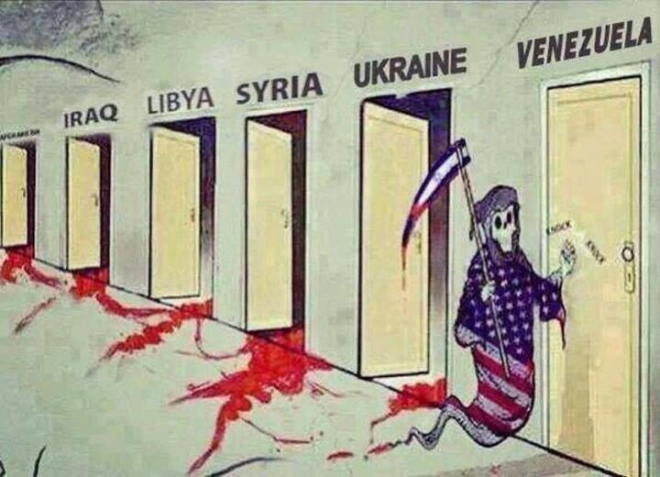
By ISMAEL HOSSEIN-ZADEH | CounterPunch | February 28, 2014
Many countries around the world are plagued by all kinds of armed rebellions, economic sanctions, civil wars, “democratic” coup d’états and/or wars of “regime change.” These include Ukraine, Venezuela, Syria, Thailand, Iran, Afghanistan, Iraq, Egypt, Yemen, Somalia and Lebanon. Even in the core capitalist countries the overwhelming majority of citizens are subjected to brutal wars of economic austerity.
While not new, social convulsions seem to have become more numerous in recent years. They have become especially more frequent since the mysterious 9-11 attacks on the World Trade Center in 2001 and the 2008 financial collapse in the United States, which soon led to similar financial implosions and economic crises in Europe and beyond.
Despite their many differences, these social turbulences share two common features. The first is that they are largely induced, nurtured and orchestrated from outside, that is, by the Unites States and its allies—of course, in collaboration with their class allies from inside. And the second is that, contrary to the long-established historical pattern of social revolutions, where the desperate and disenfranchised masses rebelled against the ruing elites, in most of the recent struggles it is the elites that have instigated insurgencies and civil wars against the masses. The two features are, of course, integrally intertwined: essentially reflecting the shared interests and collaborative schemes of the international plutocracies against the global 99%.
Fighting to Make Austerity Economics Universal
The official rationale (offered by the U.S. and its allies) that the goal of supporting anti-government opposition forces in places such as Syria, Ukraine and Venezuela is to spread democracy no longer holds any validity; it can easily be dismissed as a harebrained pretext to export neoliberalism and spread austerity economics. Abundant and irrefutable evidence shows that in places where the majority of citizens voted for and elected governments that were not to the liking of Western powers, these powers mobilized their local allies and hired all kinds of mercenary forces in order to overthrow the duly elected governments, thereby quashing the majority vote.
Such blatant interventions to overturn the elections that resulted from the majority vote include the promotion of the Orange Revolution in Ukraine (2004 and 2014), Rose Revolution in Georgia (2003), Cedar Revolution in Lebanon (2005), Tulip Revolution in Kyrgyzstan (2005) and the Green Revolution in Iran (2009). They also include the relentless agitation against the duly elected governments of the late Hugo Chavez and now his successor Nicolás Maduro in Venezuela, as well as the rejection (and effective annulment) of the duly elected Hamas government in Palestine.
So, the real driving forces behind wars of regime change need to be sought elsewhere; specifically, in the imperatives of expansion and accumulation of capital on a global level. Socialist, social-democratic, populist or nationalist leaders who do not embrace neoliberal economic policies, and who may be wary of having their markets wide open to unbridled foreign capital, would be targeted for replacement with pliant leaders, or client states. This is, of course, not a new explanation of economic imperialism; it is as old as the internationalization of trade and investment.
What is relatively new, and seems to be the main driving force behind the recent wars of regime change, is that, as the U.S. and other major capitalist powers have lately embarked on austerity economic policies at home they also expect and, indeed, demand that other countries follow suit. In other words, it is no longer enough for a country to open its markets to investment and trade with Western economic powers. It seems equally important to these powers that that country also dismantle its public welfare programs and implement austerity measures of neoliberalism.
For example, after resisting imperialist pressures for years, the late Libyan leader Muammar al-Gaddafi eventually relented in 1993, and granted major oil and other transnational corporations of Western powers lucrative investment and trade deals. Under pressure, he even dismantled his country’s nuclear technology altogether in the hope that this would please them to “leave him” alone, so to speak. None of the concessions he made, however, proved satisfactory to the U.S. and its allies, as his regime was violently overthrown in 2011and he was literally butchered by the thuggish gangs that were trained and armed by Western powers.
Why? Because the U.S. and its allies expected more; they wanted him to follow the economic guidelines of the “experts” of global finance, that is, of the U.S. and European economic “advisors,” of the International Monetary Fund and of the World Trade Organization—in short, to dismantle his country’s rather robust state welfare programs and to restructure its economy after the model of neoliberalism.
The criminal treatment of al-Gaddafi can help explain why imperialist powers have also been scheming to overthrow the populist/socialist regimes of the late Hugo Chavez and his successor in Venezuela, of the Castro brothers in Cuba, of Rafael Correa Delgado in Ecuador, of Bashar Al-assad in Syria and of Evo Morales in Bolivia. It also helps explain why they overthrew the popularly elected nationalist governments of Mohammad Mossadeq in Iran, of Jacobo Arbenz in Guatemala, of Kusno Sukarno in Indonesia, of Salvador Allende in Chile, of Sandinistas in Nicaragua, of Jean-Bertrand Aristide in Haiti and of Manuel Zelaya in Honduras.
The imperialist agenda of overthrowing al-Gaddafi and other “insubordinate” proponents of welfare state programs abroad is essentially part of the same evil agenda of dismantling such programs at home. While the form, the context and the means of destruction may be different, the thrust of the relentless attacks on the living conditions of the Libyan, Iranian, Venezuelan or Cuban peoples are essentially the same as the equally brutal attacks on the living conditions of the poor and working people in the US, UK, France and other degenerate capitalist countries. In a subtle way they are all part of an ongoing unilateral class warfare on a global scale. Whether they are carried out by military means and bombardments or through the apparently “non-violent” processes of judicial or legislative means does not make a substantial difference as far as their impact on people’s lives and livelihoods is concerned.
The powerful plutocratic establishment in the core capitalist countries does not seem to feel comfortable to dismantle New Deal economics, Social Democratic reforms and welfare state programs in these countries while people in smaller, less-developed countries such as (al-Gaddafi’s) Libya, Venezuela or Cuba enjoy strong, state-sponsored social safety net programs. Plutocracy’s intolerance of “regimented” economies stems from a fear that strong state-sponsored economic safely net programs elsewhere may serve as “bad” models that could be demanded by citizens in the core capitalist countries.
In a moment of honesty, former U.S. President Harry Truman is reported as having expressed (in 1947) the unstated mission of the United States to globalize its economic system in the following words: “The whole world should adopt the American system. The American system can survive in America only if it becomes a world system” [1].
In a similar fashion, Lord Cecil Rhodes, who conquered much of Africa for the British Empire, is reported to have suggested during the heydays of the Empire that the simplest way to achieve peace was for England to convert and add the rest of the world (except the United States, Germany and few other Western powers of the time) to its colonies.
The Mafia equivalent of Truman’s or Rhodes’ statements would be something like this: “You do it our way, or we break your leg.”
The mindset behind Truman’s blunt statement that the rest of the world “should adopt the American system” has indeed served as something akin to a sacred mission that has guided the foreign policy of the United States ever since it supplanted the British authority as the major world power.
It explains, for example, the real and the main reason behind the Cold War hostilities between the U.S. and its allies, on the one side, and the Soviet Union and its allies, on the other. While the “threat of communism” has been the official rationale for the start and escalation of those hostilities, there is convincing evidence that not only Joseph Stalin and his successors in the Soviet Union had no plans to wage war against the United States or its allies but that, in fact, they played a restraining role to contain independent revolutionary movements worldwide. “It is often forgotten,” points out Sidney Lens, “that for a few years after the war, he [Stalin] assumed an exceedingly moderate posture. . . . His nation had lost 25 million people in the war, was desperately in need of aid for rebuilding, and continued for a long time to nurture hopes of coexistence. Far from being revolutionary, Stalin in those years put the damper on revolution wherever he could” [2]. To accommodate the United States and other Western powers in the hope of peaceful coexistence, Stalin often advised, and sometimes ordered, the pro-Moscow communist/leftist parties in Europe and elsewhere in the world to refrain from revolutionary policies that might jeopardize the hoped-for chances of coexistence.
The goal or mission of converting other economies to the U.S.-style capitalism also helps explain why the United States has engaged in so many military operations and engineered so many coup d’états and regime changes around the world. The Federation of American Scientists has recorded a list of U.S. foreign military engagements which shows that in the first decade after the collapse of the Berlin Wall (1989-99) the U.S. engaged in 134 such operations, the majority of which are altogether unknown to the American public [3].
Global financial elites change “unaccommodating” regimes not only in the less developed countries but also in the core capitalist countries. They accomplish this not so much by military means as by utilizing two very subtle but powerful means: (a) artificial, money-driven elections, peddled as “democracy in action”; and (b) powerful financial institutions and think tanks such as the International Monetary Fund (IMF), central banks and bond/credit rating agencies like Moody’s, Standard & Poor’s and Fitch Group. An unfavorable rating report by these agencies on the credit status of a country can create havoc on that country’s economic, financial and currency position in world markets, thereby dooming its government to collapse and replacement. This is how during the ongoing financial turbulence of recent years a number of governments have been changed in places like Greece and Italy—no need for the traditional or military style regime change, the “soft-power” financial coup d’état engineered by the IMF and/or rating agencies would serve the purpose even more effectively.
Class War on a Global Scale
As noted, all the schemes and wars of regime change, whether by the traditional military means or by the “soft” power of the global financial juggernaut, essentially represent one thing: a disguised class war on a global level, a relentless worldwide economic war by the one percent financial-economic oligarchy against the rest of the world population.
Class struggle in an economically-tiered society is of course not new. What is relatively new in the recent years’ war of the 1% against the 99% is its escalated pace, its widespread scale and its globally orchestrated character. While neoliberal austerity attacks on the living conditions of the public in the core capitalist countries began (formally) with the supply-side economics of President Ronald Reagan and Prime Minister Margaret Thatcher more than three decades ago, the brutality of such attacks have become much more severe in the context of the current financial/economic crisis, which began with the 2008 financial crash in the United States.
Taking advantage of the crash (as an economic shock therapy, as Naomi Klein put it), the financial oligarchy and their proxies in the governments of the core capitalist countries have been carrying out a systematic economic coup d’état against the people the ravages of which include the following:
• Transfer of tens of trillions of dollars from the public to the financial oligarchy through merciless austerity cuts;
• Extensive privatization of public assets and services, including irreplaceable historical monuments, priceless cultural landmarks, and vital social services such as healthcare, education and water supply;
• Substitution of corporate/banking welfare policies for people’s welfare programs;
• Allocation of the lion’s share of government’s monetary largesse (and of credit creation in general) to speculative investment instead of real investment;
• Systematic undermining of the retirement security of millions of workers (both white and blue collar) and civil servants;
• Ever more blatant control of economic and/or financial policies by the representatives of the financial oligarchy.
Combined, these policies have significantly aggravated the already lopsided income/wealth distribution in these countries. The massive cuts in social spending have resulted in an enormous transfer of economic resources from the bottom up. The transfer has, indeed, more than made up for the 2008 losses of the financial speculators. In the U.S., for example, the wealthiest one percent now own 40 percent of the entire country’s wealth; while the bottom 80 percent own only seven percent. Likewise, the richest one percent now take home 24 percent of the country’s total income, compared to only nine percent four decades ago [4].
This shows that, as pointed out earlier, while neoliberal attacks on the 99% in the core capitalist countries may not seem as violent as those raging, for example, in Venezuela, Syria or Ukraine, the financial impact of such attacks on the living conditions of the 99% is not any less devastating.
Plutocrats of the World Are United
Policies of regime change are usually designed and carried out as collaborative schemes by cross-border plutocracies, that is, by the financial oligarchies of the imperialist countries in partnership with their native counterparts in the less-developed countries.
In addition to constant behind-the-scenes strategizing, representatives of transnational capital and their proxies in capitalist governments also routinely meet at international conferences in order to synchronize their cross-border business and financial policies—a major focus of which in recent years has been to implement global austerity measures and entrench neoliberal policies worldwide. These include the World Economic Forum in Davos, Switzerland, the World Bank and IMF annual meetings, the Periodic G20 meetings, the Aspen Institute’s Ideas Festival, The Bilderberg Group annual geopolitics forum, and the Herb Allen’s Sun Valley gathering of media moguls—to name only a handful of the many such international policy gatherings.
Through its global strategies and operations, transnational capital has broken free from national constraints and commitments at home and successfully shifted the correlation of class forces and social alliances worldwide. Today’s elites of global capitalism “are becoming a trans-global community of peers who have more in common with one another than with their countrymen back home,” writes Chrystia Freeland, Global Editor of Reuters, who travels with the elites to many parts of the world. “Whether they maintain primary residences in New York or Hong Kong, Moscow or Mumbai, today’s super-rich are increasingly a nation unto themselves,” she adds [5].
Implications for Globalization from Below
What conclusions can the 99% draw from this? What can the working people and other grassroots do to protect their jobs, their sources of livelihood, their communities and their environment? What can communities of ordinary people do to undermine the strategies of the global 1% that block life-sustaining progressive social and economic reforms?
In the same fashion that, in their fight against the working people, the elites of the international capitalist class are not bound by territoriality or national boundaries, so does the working class need to coordinate its response internationally.
A logical, first step deterrent to transnational capital’s strategy of blackmailing labor and communities through threats such as destroying or exporting jobs by moving their business elsewhere would be to remove the lures that induce plant relocation, capital flight or outsourcing. Making labor costs of production comparable on an international level would be crucial for this purpose. This would entail taking the necessary steps toward the international establishment of wage and benefits, that is, of labor cost parity within the same company and the same trade, subject to (a) the cost of living, and (b) productivity in each country.
A strategy of this sort would replace the current downward competition between workers in various countries with coordinated bargaining and joint policies for mutual interests and problem-solving on a global level. While this may sound radical, it is not any more radical than what the transnational 1% is doing: coordinating their anti-99% strategies on a global scale. If at an earlier stage of capitalist development “workers of the world unite” seemed an outlandish dream of the leading labor champion Karl Marx, internationalization of capital, the abundance of material resources and developments in technology, which has greatly facilitated cross-border organizing and coordination of actions by the 99%, has now made that dream an urgent necessity.
As capital and labor are the cornerstones of capitalist production, their respective organizations and institutions evolve more or less apace, over time and space. Thus, when production was local, so was labor: carpenters, shoemakers, bricklayers, and other craftsmen organized primarily in their local communities. But as capitalist production became national, so did trade unions. Now that capitalist production has become global, labor organizations too need to become international in order to safeguard their and their communities’ rights against the profit-driven whims of the footloose and fancy-free transnational capital.
Many would argue that these are not propitious times to speak of radical alternatives to capitalism. The present state of the sociopolitical landscape of our societies appears to support such feelings of pessimism. The high levels of unemployment in most countries of the world and the resulting international labor rivalry, combined with the austerity offensive of neoliberalism on a global level, have thrown the working class and other grassroots on the defensive. The steady drift of the European socialist, Social Democratic, and labor parties/governments toward the U.S.–style market economies and the erosion of their traditional ideology, power, and prestige have led to workers’ confusion there. The collapse of the Soviet Union, however much some socialists have always distanced themselves from that system, haunts the specter of socialism, and is likely to do so for some time to come. These developments have understandably led to workers’ and other grassroots’ confusion and disorientation globally.
None of these, however, mean that there is no way out of the status quo. Capitalism is not only “destructive,” it is also “regenerative,” as Karl Marx put. As it captures world markets, universalizes the reign of capital, and disrupts the living conditions for many, it simultaneously sows the seeds of its own transformation. On the one hand, it creates common problems and shared concerns for the majority of the world population; on the other, it creates the material conditions and the technology that facilitate communication and cooperation among this majority of world citizens for joint actions and alternative solutions.
When the majority of world population, the global 99%, will come to the realization and determination to actually appropriate and utilize the existing technology and material resources for a better organization and management of the world economy, no one can tell. But the potential and the long term trajectory of global socioeconomic developments point in that direction. The distance between now and then, between our immediate frustrations and the superior but elusive civilization of our desire, can be traversed only if we take the necessary steps toward that end [6].
Ismael Hossein-zadeh is Professor Emeritus of Economics, Drake University, Des Moines, Iowa. He is the author of The Political Economy of U.S. Militarism (Palgrave – Macmillan 2007), the Soviet Non-capitalist Development: The Case of Nasser’s Egypt (Praeger Publishers 1989), and most recently, Beyond Mainstream Explanations of the Financial Crisis (forthcoming from Routledge, April 29, 2014).
Ukrainian Democracy: A Barrier to Washington’s Goals
What Do Ukrainians Really Want?
By Nick Alexandrov | CounterPunch | February 28, 2014
When Ukraine is the topic, the major U.S. media outlets agree: “Europe and the United States have made a priority of fostering democracy in the former Soviet republics,” David M. Herszenhorn wrote in the New York Times. The Washington Post asserted that Ukraine is “a country that has been struggling to become a genuine democracy” with help from Western powers, who keep it “from becoming an autocratic Kremlin colony, like neighboring Belarus.” “Ukraine is the crossroads between a free and an authoritarian Europe,” the Wall Street Journal concurred, while Yale professor Timothy Snyder urged, in a CNN piece, Europe and America to back the Ukrainian protesters—“a chance to support democracy,” he emphasized. Marvelous. But in the real world, Ukrainian democracy is not merely something Washington has failed to support, but is actually incompatible with U.S. governmental aims.
U.S. officials are quite open about their opposition to Ukrainian self-determination and well-aware how unpopular Washington’s preferred policies are. Nearly a decade ago, for example, the U.S. House of Representatives’ Subcommittee on Europe met for a hearing on “Ukraine’s Future and U.S. Interests.” Rep. Doug Bereuter (R-NE) opened the session, noting that “a recent survey conducted by a center for economic and political research suggests that up to 40 percent of Ukrainians believe that relations with Russia should be a priority.” Meanwhile, “28 percent gave preference to the EU,” and “2 percent said that relations with the U.S. should be a foreign policy priority. Another survey suggested that almost two-thirds of the population would consider supporting a political union with Russia,” Bereuter concluded. “So,” he went on, “I think that United States policy must remain focused” on incorporating Ukraine “into European and Euro-Atlantic structures.” Rep. Robert Wexler (D-FL) spoke next, reiterating that U.S. policy should “further Ukraine’s integration in Euro-Atlantic institutions;” Steven Pifer, the former Ambassador to Ukraine, drove the point home, outlining “the United States Government’s vision for Ukraine”: “increasingly close ties to Europe and Euro-Atlantic institutions.” This vision persisted over the following decade. The Atlantic Council’s Damon Wilson, speaking before the U.S. Senate’s Subcommittee on European Affairs—the topic was “Ukraine at a Crossroads”—in February 2012, explained that “Ukraine’s genuine European integration” remained a major objective.
And recent commentary and news coverage depicts European integration as something most Ukrainians desire. In early February, Secretary of State Kerry, at the Munich Security Conference, remarked that Ukrainians should be permitted “to associate with partners who will help them realize their aspirations”—Europe and the U.S. obviously being the partners, integration to be deepened via what the Times’ Herszenhorn referred to as “sweeping political and trade agreements” that Ukrainian President Viktor Yanukovych “refused to sign” last November, resulting in “a broken promise between a leader and his citizens,” and then the uprisings. Now Al Jazeera reports that the acting president, Oleksander Turchinov, has “made clear that Kiev’s European integration would be a priority,” thereby giving Ukrainians what we’re told they want.
But British and U.S. governmental studies reveal the Ukrainian public is ambivalent about European integration. Britain’s Foreign and Commonwealth Office, for example, funded a “scoping study” through the British Embassy in Kyiv a year ago, titled “A blueprint for enhancing understanding of and support for the EU-Ukraine Association Agreement [AA] including DCFTA [Deep and Comprehensive Free Trade Area] in Ukraine.” The AA was one of the key “sweeping political and trade agreements” Yanukovych refused to sign. British officials, in their report, stressed that “support for the AA is not overwhelming amongst the population at large,” observing that “opinion polls show that about 30% of respondents are in favour of European integration, 30% for the Customs Union [Moscow-led integration], and about 30% are undecided.” This bleak situation called for a propaganda offensive, or “a national public awareness ‘Campaign of Arguments,’” as the British dubbed it, which was to “be aimed at the general public as its primary target audience.” British advisers urged PR teams “to formulate advertising slogans, global and targeted messages,” and to play up “the European civilizational model” and other benefits the AA allegedly would bring. This “civilizational model” today entails “massive attacks on public services, wages, pensions, trade unions, and social rights” under imposed “draconian austerity policies,” Asbjørn Wahl wrote in January’s Monthly Review—a reality the British indoctrination scheme’s outline studiously avoided, it’s hardly worth mentioning.
The propaganda barrage may have been successful to some extent. But as the year progressed, the U.S. government had a hard time finding evidence of overwhelming Ukrainian support for European integration. The International Republican Institute (IRI), for example, polled Ukrainians last September: “If Ukraine was able to enter only one international economic union, with whom should it be?” Forty-two percent of respondents chose the EU, while 37% preferred the Russian Customs Union. IRI then asked, “How would you evaluate your attitude towards the following entities?” Fifty percent of respondents felt “warm” towards Russia; 41% felt “warm” towards Europe—and just 26% were fond of the U.S. IRI figures resembled those USAID published in a December 2013 report. Its authors found it “interesting to note that Ukrainians are split on whether the country should join the European Union or the Customs Union. Thirty-seven percent would like Ukraine to take steps to join the European Union, 33% prefer the Customs Union and 15% say Ukraine should join neither of these blocs.” Furthermore, “34% say that Ukraine should have closer economic relations with Russia, 35% say it should have closer economic relations with Europe and 17% say it should have good relations with both.” A Kyiv International Institute of Sociology poll reinforced these findings: “Ukraine is split practically 50/50 over the accession to the European Union or the Customs Union,” Interfax-Ukraine summarized the study’s conclusions.
Reviewing this data forces us to ask: Who is Washington’s chief enemy in Ukraine? Is it Russia, bent on killing Ukraine’s budding democracy? Is it the tyrant Yanukovych? The U.S. policy record points to a different conclusion, one a Johns Hopkins Center for Transatlantic Relations study—included in the official transcription of the Senate’s 2012 “Ukraine at a Crossroads” hearing—discusses in the context of Ukraine’s potential NATO membership. “The main obstacle” to Ukraine’s joining the organization “is not Russian opposition,” its authors emphasized, “but low public support for membership in Ukraine itself.” Again: on this and other issues, the Ukrainian people are “the main obstacle” to U.S. foreign policy aims. We should bear this fact in mind as the crisis deepens in Eastern Europe.
Nick Alexandrov lives in Washington, DC.
Roger Cohen Defecates On Argentina, Gets Many Things Wrong
By Mark Weisbrot | CEPR Americas Blog | February 28, 2014
Roger Cohen, what a disappointment. He is not Tom Friedman or David Brooks, and shouldn’t be insulting an entire nation based on a clump of tired old clichés and a lack of information. Argentina is “the child among nations that never grew up” he writes, and “not a whole lot has changed” since he was there 25 years ago. OK, let’s see what we can do to clean up this mess with a shovel and broom made of data.
For Cohen, Argentina since the government defaulted on its debt has been an economic failure. Tens of millions of Argentines might beg to differ.
For the vast majority of people in Argentina, as in most countries, being able to find a job is very important. According to the database of SEDLAC (which works in partnership with the World Bank), employment as a percentage of the labor force hit peak levels in 2012, and has remained close to there since. This is shown in Figure 1.
FIGURE 1
Argentina: Employment Rate, Percent of Total Population
 Source: SEDLAC (2014).
We can also look at unemployment data from the IMF (Figure 2). Of course the current level of 7.3 percent is far below the levels reached during the depression of 1998-2002, which was caused by the failed neoliberal experiment that the Kirchners did away with – it peaked at 22.5 percent in 2002. But it is also far below the level of the boom years of that experiment (1991-1997) when it averaged more than 13 percent.
FIGURE 2
Argentina: Unemployment Rate
 Source: IMF WEO (Oct 2013).
How about poverty? Here is data from SEDLAC (Figure 3), which does not use the official Argentine government’s inflation rate but rather a higher estimate for the years after 2007. It shows a 76.3 percent drop in the poverty rate from 2002-2013, and an 85.7 percent drop in extreme poverty.
FIGURE 3
Argentina: Poverty and Extreme Poverty
 Source: SEDLAC (2014).
Most of the drop in poverty was from the very high economic growth (back to that in a minute) and consequent employment. But the government also implemented one of the biggest anti-poverty programs in Latin America, a conditional cash transfer program.
Finally, there is economic growth. In a terribly flawed article today, the Wall Street Journal reported on a soon-to-be published study showing that Argentina’s real (inflation-adjusted) GDP is 12 percent less than the official figures indicate. (As the article noted, the government, in co-operation with the IMF, implemented a new measure of inflation in January, which should resolve this data problem that has existed since 2007). If we assume that the 12 percent figure is correct, then using IMF data Argentina from 2002-2013 still has real GDP growth rate of 81 percent, or 5.6 percent annually. That is the third highest of 32 countries in the region (after Peru and Panama). And incidentally, very little of this growth was driven by a “commodities boom,” or any exports for that matter.
Despite current economic problems, the country that Cohen ridicules has done extremely well by the most important economic and social indicators, since it defaulted on most of its foreign debt and sent the IMF packing at the end of 2002. This is true by any international comparison or in comparison with its past. Many foreign corporations and the business press, as well as right-wing ideologues, are upset with Argentina’s policies for various reasons. They don’t really like any of the left governments that now govern most of South America, and Washington would like to get rid of all of them and return to the world of 20 years ago when the U.S. was in the drivers’ seat. But there’s really no reason for Roger Cohen to be jumping on this bandwagon.
Featured Video

Dan Dicks with James Corbett on Solutions Watch
or go to
Aletho News Archives – Video-Images
From the Archives
$1.5bn up in smoke: US THAAD missile stockpile dries up defending Israel against Iran
By Ivan Kesic | Press TV | July 2, 2025
According to American media, defense news outlets, and independent analysts, the 12-day Israeli military aggression against Iran significantly depleted the US stockpile of THAAD (Terminal High Altitude Area Defense) interceptor missiles.
Citing official sources, American magazine Newsweek reported on Friday that the US transferred a substantial portion of its advanced missile defense capabilities to support the Israeli regime, an effort with questionable results and a critical impact on US strategic reserves.
THAAD, developed by Lockheed Martin arms manufacturing company, is a key component of Israel’s multi-layered air defense architecture. It is designed to intercept medium-range ballistic missiles, including those launched from Iran and Yemen.
The US-made system is capable of targeting short-, medium-, and intermediate-range ballistic missiles during their terminal phase, whether inside or outside Earth’s atmosphere.
THAAD uses a “hit-to-kill” method, relying on kinetic energy rather than explosive warheads to destroy incoming threats, intercepting at altitudes of up to 150 km and ranges between 150-200 km.
Operated exclusively by American personnel, the US military maintains eight THAAD batteries with an estimated 350–400 interceptors in total. The eighth battery was activated during the June 20 Israeli aggression against Iran and is capable of intercepting hypersonic missiles. … continue
Blog Roll
 Aletho News
- While Gaza dominates the UN, these are the people keeping it alive
- New Report: “Scholasticide and Genocide in Gaza: Assessment, Testimonies and Legal Analysis”
- ‘THAAD Delusion’: Iran war exposes US missile shield limits – The Atlantic
- Moscow issues warning to NATO over Russian exclave
- Yes, the Iran war has destroyed Trump’s presidency
- The fallacy of US delusions about Iran’s economic collapse
- Hezbollah denies Syria cell link, warns of Israeli plan to sow discord
- The legacy of US sanctions, war, and occupation in Iraq
- Iraqi resistance group rejects disarmament, vows to maintain support for Lebanon
- Sheikh al-Asadi warns of Iraqi government compliance with US demands
- If Americans Knew
- Iran’s Revolutionary Guards Publish Letter to the American People
- DMFI launches $1 million ad campaign supporting Virginia’s Elaine Luria
- US Senate blocks resolution seeking report on Americans killed by Israel
- Israeli Attacks Kill Ten Palestinians in Gaza
- Massacre at Minab: The School That Became a Grave
- Israeli media: The IDF Shows It Doesn’t Turn a Blind Eye; It Actively Emboldens Settler Havoc
- As settlers ravage West Bank, Israeli forces kill 10 in Gaza – Daily Update
- New Report: “Scholasticide and Genocide in Gaza: Assessment, Testimonies and Legal Analysis”
- Ex-Biden officials are desperate for a Gaza scapegoat
- Israeli “settlers” Invade Al-Aqsa; Pour Boiling Water on 75-Year-Old
- No Tricks Zone
- Green Energy Debacle: German Expert Professor Fritz Vahrenholt Warns Of Severe Economic And Social Consequences
- Two More Paleo Reconstructions Affirm Meters-Higher Sea Levels Across Ireland, Brazil 7000-6000 Years Ago
- New Study: Earth And Venus Surface Warmth Largely Explained By Convection And Lapse Rate, Not CO2 Or Radiation
- 2025 Nature Paper Claiming Worsening Global Drought Gets RETRACTED …Heavily Flawed
- New Study: ‘Global Drought Shows No Detectable Recent Acceleration Under Climate Warming’
- Economic Masterminds: German Socialists Suggest Taxing Productivity Gains Stemming From Using AI
- The South China Sea Has Not Been Cooperating With The Climate Change Narrative
- Energy Crisis: Germany Enters Heating Season With Historically Low Gas Reserve Fill Levels
- New Study: The Antarctic Ice Sheet Gained Mass From 2020-2024 Due To Staggering Snow And Ice Accumulation
- Study: Ocean Heating Rates From Thousands Of Years Ago ‘Dwarf’ Modern Ocean Heating Rates

