Thirty years ago, the international development community was abuzz with excitement. This was because it appeared that the perfect solution to poverty, exclusion and under-development had finally been found in the form of microcredit. As originally conceived, microcredit is the provision of micro-loans to the poor to allow them to establish a range of income-generating activities, supposedly facilitating an escape from poverty through individual entrepreneurship and self-help. Perhaps nowhere more than in Latin America was the excitement so intense. Stoked by the uplifting claims of Peruvian economist, Hernando de Soto [1], that a vastly expanded informal economy would prove to be the economic salvation of the continent, the U.S. government through the World Bank and its own aid arm, USAID, along with the Inter-American Development Bank (IDB), led the charge to establish the microcredit movement as the dominant local intervention to address poverty.
However, the sour reality that Latin America faces today is that all the excitement over microcredit was fundamentally misplaced. As I argue in a recent article [PDF] published in the Mexican journal Ola Financiera, the microcredit movement has likely proved to be one of the most destructive interventions brought to Latin America over the last 30 years. A growing number of Latin American governments and international development agencies are now finally reconsidering their once unconditional support for the microcredit model. So what went wrong? Let me point to a few of the most important problems.
First, the overarching outcome of the microcredit model in Latin America has been an increase in the supply of “poverty-push” informal microenterprises and self-employment ventures. Yet rather than creating a De Soto-esque foundation for rapid growth and poverty reduction, the very worst possible foundation for promoting long-term poverty reduction and sustainable development was created. As economists such as Alice Amsden, Robert Wade and Ha-Joon Chang have convincingly shown, the now wealthy developed countries and the East Asian “miracle” economies found that what is really needed to escape poverty is for the state to engineer an entirely different constellation of the “right” enterprises: that is, enterprises that are formalized, large enough to reap important economies of scale, can innovate, can use new technology, are willing to train their workers, can supply larger enterprises with quality inputs, can facilitate new organizational routines and capabilities, and can eventually export. Economic history shows, too, that financing the expansion of the “wrong” sort of informal microenterprises and self-employment ventures will simply not lead to sustainable development. As Ha-Joon Chang brilliantly points out, Africa has more individual entrepreneurs than perhaps any other location on the planet, and many more are being created all the time thanks to rafts of microcredit programs backed by the developed countries, yet Africa remains in poverty precisely because of this fact. Likewise in Latin America: by programmatically channelling its scarce financial resources (savings and remittances) into informal microenterprises and self-employment ventures, and so away from virtually all other higher-value uses, the continent has actually been progressively destroying its economic base.
Mexico exemplifies the microcredit trap created in Latin America. Its financial institutions have all proved to be adept at channelling their funds into hugely unproductive and all too often temporary informal microenterprises and self-employment ventures – so-called “changarros” – leaving the bulk of potentially growth-oriented, but low profit and high risk, small and medium industrial enterprise projects increasingly without financial support. Over the last two decades this “crowding out” trend has undoubtedly undermined Mexico’s once powerful industrial and technological base.
A very similar story emerged in Bolivia since the 1980s, where the U.S. government-supported push for microcredit has played a not-unimportant role in gradually destroying an economy that was once slowly industrializing under Import Substitution Industrialization (ISI) policies. Essentially, Bolivia’s carefully built-up raft of efficient industrial small and medium-sized enterprises was starved of funding and left to collapse. Resources were instead shifted into promoting the hugely unproductive and no-growth informal microenterprise and self-employment sector, which has, not surprisingly, dramatically expanded in recent years. Today, with nearly 40 percent of Bolivia’s financial resources now independently intermediated into these “wrong” sort of (micro)enterprises, the Bolivian government has its work cut out to try to stop the damaging de-industrialization trajectory underway in the country.
The second key problem with the microcredit model in Latin America arises from the fact that in the neoliberal 1990s it was aggressively commercialized and extensively deregulated. The primary motive for this move was to eradicate all government and international development community subsidies from the world of microcredit. The use of subsidies (typically to maintain low interest rates) was felt to be ideologically suspect by the main U.S.-based international development agencies, and it was also thought to unjustifiably add to the tax burden on business elites. With extensive advice and financial support provided by USAID, Bolivia was turned into the “best practice” example of commercialised microcredit, thanks mainly to BancoSol, the world’s first dedicated commercially-driven microcredit bank. Yet turning microcredit into a for-profit business under minimal regulation has proved to be a singular disaster: spectacularly damaging levels of Wall Street-style greed, profiteering and financial market chaos soon ensued. Microcredit effectively became the developing world’s very own version of the USA ’s sub-prime lending crisis.
In Bolivia, the commercialization of microcredit has been a major development disaster for the poor. First, Bolivia’s scarce financial resources were disastrously shifted into the “wrong” enterprises, as I just pointed out. Commercialization also directly precipitated the “microcredit meltdown” that Bolivia experienced across 1999-2000, an event that inflicted very serious long-term damage on the Bolivian economy. Crucially, however, commercialization has been a massive success for those managing and investing in Bolivia’s microcredit institutions. The elite group of individuals involved in running Bolivia’s main microcredit institutions, famously including BancoSol and its predecessor, PRODEM, have all become very rich indeed. High salaries, bonuses and dividends have been important to those most closely associated with the management and ownership of BancoSol. The first employees in PRODEM, an institution that has its origins as an NGO funded by the international community to “help the local community,” eventually made millions of dollars after they gradually took control of PRODEM and then brazenly sold it off to a Venezuelan bank. We should, of course, not be surprised to find that little trust, respect or solidarity exists between Bolivia’s poor and the microcredit sector supposedly established at great expense to help them.
Mexico’s experience also exemplifies the tremendous damage wrought by the commercialization of microcredit in Latin America. Even more so than in Bolivia , it is not the poor that have been benefitting from the increased supply of microcredit, but a small financial elite that has been quietly profiteering to a simply stupendous extent. Probably the best/worst example here is that of Banco Compartamos, an organization founded in 1990 as an NGO and making extensive use of international donor grant funding. Even with laudable goals written into its founding articles, very early on it became clear that the main intended beneficiaries of Compartamos’s operations were going to be its senior staff. After 2000, for example, the senior staff began to reward themselves with Wall Street-style salaries, bonus packages and cheap internal loans which allowed them to buy shares in Compartamos. Then in 2007, when Compartamos underwent the inevitable IPO, key senior staff really hit the big-time, with a number of them pocketing several tens of millions of dollars when they off-loaded their shares into the market. A number of external investors also made vast fortunes from their shareholdings in Compartamos, notably the Boston-based microcredit advocacy and investor body ACCIÓN, which saw an initial $1 million stake in Compartamos (of which $800,000 was actually a grant to ACCIÓN) rise in value to nearly $270 million. Note also that Compartamos generates the revenues to support such high financial rewards to senior staff by charging as much as 195 percent real interest rates on its microloans to mainly poor Mexican women.
Inevitably, the supply of microcredit has begun to reach its saturation point in Mexico. Compartamos’s growth has been nothing short of dramatic, while many other domestic microcredit institutions have also grown very rapidly. Compartamos has been the world’s most profitable microcredit institution for five of the past six years, and its nearly $100 million dividend payout to investors is now larger than the balance sheets of most other microcredit institutions. With such huge financial rewards made possible by lending to Mexico’s poor, the big profit-hungry international banks, such as Citigroup, have entered the market, clearly adding to the lending frenzy underway. However, real fears exist that Mexico cannot now avoid a destructive sub-prime-like “microcredit meltdown” episode not unlike the one that hit the Indian state of Andhra Pradesh in 2010. Indeed, it is well known that multiple lending to households has begun to reach epidemic proportions in many parts of Mexico, especially in the massively over-supplied state of Chiapas.
Nevertheless, the question remains: has microcredit in Latin America in general, and Compartamos specifically, been helping the poor to escape their poverty? If the answer is broadly positive, then the spectacular financial rewards accruing to the providers of microcredit might be justified to an extent if meaningful benefits are accruing to the recipients – the poor. However, the unpalatable answer to this question is a resoundingly negative one: there is not a shred of real evidence to support the claim that Compartamos’s microcredit activities have played a role in resolving poverty. First consider that a U.K. government-funded study of virtually all previous impact evaluations of microcredit dramatically showed there is no empirical evidence anywhere [PDF] to show that microcredit has had a positive impact on poverty. Even long-standing supporters of microcredit now accept this extremely unpalatable fact.
More specifically, consider the findings of a just-released impact evaluation of Compartamos [PDF], financed by Compartamos itself and centrally involving one of the most high-profile microcredit supporters, professor Dean Karlan, who is based at Yale University in the U.S. In spite of Comapartamos’s huge presence in poor communities across Mexico, and its previous claims to be greatly helping Mexico’s poor, the impact evaluation team could only come up with a tiny amount of evidence of any positive impact arising from its activities. This was bad enough. But this tepid conclusion actually hides a much more disturbing fact, which is that the research team could only manage to arrive at this sliver of good news by effectively refusing to adopt/adapt an evaluation methodology that would capture the most important downsides to the microcredit model. One can only presume that this was felt necessary in order to ensure that they could come up with the required (very limited) positive impact result they later disingenuously claimed to have found, and which allowed Compartamos and other institutions involved to inevitably spin into the specious claim that Compartamos “generally benefits (its) borrowers”.”
Notably, the research team entirely overlooked so-called “displacement” effects – that is, the negative impact on incumbent microenterprises in the same community that lost business and income thanks to waves of new Compartamos-supported microenterprises. With most Mexican communities for a long time adequately served by simple informal microenterprises providing retail and other services to the poor, the arrival of rafts of new microenterprises operating in exactly the same sub-sector will inevitably have precipitated very large displacement effects. But these downside impacts were ignored. The team also failed to factor in the impact of exits, which is when a microenterprise fails – which the vast majority actually do, and usually very quickly – and the hapless individuals involved then have to either divert other funds (pensions, remittances, savings, etc.) to continue to repay their microloan, or else they lose assets lodged as collateral when they are forced into outright default.
But perhaps the most egregious downside impact ignored by the research team relates to the fact that they also chose to examine a very short and unrepresentative time period – introducing microcredit into a community where before there was none. This then allowed them to simply aggregate the short-term results in such virgin territory into a generally upbeat assessment of the longer-term impact. This is utter nonsense. By doing this, the research team chose to ignore, first, the fact that Compartamos has contributed to further inflating Mexico’s already over-blown and massively unproductive “changarros” sector, which a growing number of analysts now accept is creating an existential threat to the Mexican economy. Second, there was also no comment on the huge opportunity cost involved when scarce funds are gradually diverted away from the “right” enterprises. This silence prevailed in spite of the fact that even the neoliberal-oriented IDB had the guts to publicly admit in 2010 that this “crowding out” issue actually lies at the heart of Latin America’s recent history of poverty and exclusion. Third, you will find nothing in this impact evaluation that discusses the over-indebtedness problems that are clearly looming on the horizon for Mexico’s poor communities, and particularly for many of Compartamos’s long-standing clients.
The Latin American economies have all been ill-served by the microcredit model, which has provided, and continues to provide, a serious headwind to those governments in Latin America hoping to escape once and for all from poverty, exclusion and primitivizing development trajectories. That microcredit continues to attract such support today thus needs some explanation. I would argue it is down to two factors. First, the politics and ideology; principally the need by the U.S.-led international development community to ensure that individual entrepreneurship and self-help remain the only potential paths out of poverty for the poor in Latin America, and not the exercise of any form of “collective capabilities” through social movements, trade unions, pro-poor governments, or any other similarly “subversive” intervention that the poor might wish to collectively deploy to escape their poverty, and might even have voted for as part of the “pink tide” of leftist governments. Second, there is the issue of the massive wealth that a tiny financial elite has been able to generate for itself thanks to (over)lending to the poor, and which it is now, quite predictably, unwilling to forego. This wealth has allowed, among other things, for the microcredit industry to aggressively lobby governments, mount massive PR campaigns and effortlessly finance deliberately dodgy impact evaluations, all in order to persuade the key actors in Latin America to continue to support the microcredit model.
All told, Latin American governments urgently need to disentangle themselves from the egregious myths and neoliberal-inspired fantasies surrounding microcredit, and begin to completely re-think their (often imposed) allegiance to what has proved to be an ultimately destructive poverty reduction and local development model.
[1] Hernando de Soto (1986): El otro sendero: la revolución informal. Lima: ILD
Milford Bateman is a freelance consultant on local economic development and also, since 2005, a Visiting Professor of Economics at Juraj Dobrila at Pula University in Croatia.
July 24, 2013
Posted by aletho |
Deception, Economics, Timeless or most popular | Africa, Bolivia, Import Substitution Industrialization, Inter-American Development Bank, Latin America, Mexico, Microcredit, United States, World Bank |
Leave a comment
Detroit hit the Trifecta last week—the third in a series of body blows that politicians have landed on the city’s working people.
The Michigan legislature passed “right-to-work” in December and gave the governor the right to impose “emergency managers” on cities two days later. When Detroit’s emergency manager Kevyn Orr announced Chapter 9 bankruptcy Thursday, he was following a predicted trajectory that will lead to further impoverishment and privatization.
The bankruptcy will enable an appointed judge to impose further cuts to city expenses and to void union contracts. A prime target for cost-cutting is the pensions owed to 21,000 city retirees and 9,000 active workers. The city estimates its pensions are underfunded by $3.5 billion, and wants to reduce payments to both workers and the bondholders who have lent the city money over the years: equality of sacrifice.
Michael Mulholland, vice president of the city’s largest AFSCME local, said city workers are “in a state of somewhere between perplexion and total anger. Everything they’ve been promised, both contractually and kind of a social contract, is being pulled out from under them. It’s morally indefensible.”
Mulholland retired in February, after 29 and a half years in the Water Department. “I could have worked someplace else and made more money,” he said, “but I was told if I worked here I’d have a steady job and in my old age not be in poverty.”
The bankruptcy of Detroit, which now has fewer than 700,000 residents, is the largest city bankruptcy in U.S. history.
Orr sprung the hurry-up filing yesterday because union pension fund attorneys were scheduled to be in court on Monday, arguing for an injunction against bankruptcy.
The state constitution appears to protect public employee pensions: “The accrued financial benefits of each pension plan and retirement system of the state and its political subdivisions shall be a contractual obligation thereof and shall not be diminished or impaired thereby.”
But proponents of making city workers bite the bullet note that bankruptcy judges have wide latitude to break contracts.
Tag-Teaming with the Governor and the Banks
Pundits said other states and cities would look to Detroit as a template for how to manage ailing city budgets. A recent law in Rhode Island specifies that in a city bankruptcy, bondholders must be paid first, before pensioners.
Asked if the Michigan legislature could pass a similar law, Mulholland laughed. “If they proposed a law that Detroiters should all be shot,” he said, “some of them would get up at midnight to sign that one.” Governor Rick Snyder has guided the process of putting Detroit through a “consent decree,” Orr’s rule, and now the bankruptcy.
The Republican-dominated legislature has long been hostile to majority-black Detroit. In November 2012, the state’s voters passed a referendum that threw out a previous “emergency manager” law, which had been used almost exclusively to take over majority-black cities and school districts. A few weeks later the legislature simply passed the law again.
Although the law requires negotiations with affected parties before a city files for bankruptcy, Mulholland, who was in the talks, said, “It wasn’t negotiations, it was PowerPoint presentations about how bad the situation is.
“Orr wouldn’t answer AFSCME’s requests for negotiations, so they went and taped a letter to the door of his office.”
As an AFSCME member who had reached the top of the pay scale, Mulholland’s pension is $1,600 a month before health care contributions are taken out. He said exactly how much Orr intends to take from retirees has always been left vague, though union leaders were told health care would be slashed.
Two years ago, he said, city officials encouraged workers to retire right away. Now active workers are told to “relax, we’re going after the retirees.”
Local 207 is planning a demonstration in downtown Detroit July 25.
Orr touts the bankruptcy as a way to improve city services—which often, in the world he comes from, is code for privatization. Water, garbage pickup, an island park called Belle Isle, and the Detroit Institute of the Arts have all been mentioned as potential salable items. “The only thing they’re going to ‘improve’ is somebody’s bottom line,” Mulholland predicted.
General Motors, which is headquartered downtown, said it wouldn’t be affected by the bankruptcy. Apparently, with Snyder—who ran on his record as a businessman—in charge, business is going to be just fine.
July 24, 2013
Posted by aletho |
Economics, Supremacism, Social Darwinism | AFSCME, American Federation of State County and Municipal Employees, Detroit, General Motors, Jane Slaughter, Kevyn Orr, Michigan, Rhode Island, Rick Snyder |
Leave a comment
The Iranian Oil Ministry says Tehran and Baghdad have agreed to explore and develop oil and gas fields lying along the common border between the neighboring OPEC members, Press TV reports.
The ministry added that the two sides have agreed to work together to settle territorial and ownership differences.
Under the agreement, the two countries will establish joint ventures to carry out the exploration and development of joint oil and gas fields.
The energy cooperation is also expected to minimize the impacts of interferences made by international oil giants in regional affairs.
The agreement came during Iranian President Mahmoud Ahmadinejad’s official visit to Iraq.
Ahmadinejad arrived in Iraq on Thursday at the head of a high-ranking delegation for an official two-day tour aimed at strengthening bilateral relations between the two neighboring countries.
The Iranian president held talks with Iraqi Prime Minister Nouri al-Maliki and Vice President Khudayr al-Khuzai and also met with Iraqi Parliament Speaker Osama al-Nujaifi and the country’s lawmakers on Thursday .
Ahmadinejad also paid a visit to the holy shrine cities of Karbala and Najaf.
The two-term Iranian president will leave office on August 3 to be succeeded by Hassan Rohani, who won an outright victory in the country’s presidential elections of July 14.
July 19, 2013
Posted by aletho |
Economics, Solidarity and Activism | Iran, Iraq, Mahmoud Ahmadinejad, Nouri al-Maliki |
Leave a comment
Recent reports about the Pakistan government’s plan to allot thousands of acres of land to foreign countries and private corporations are alarming to say the least. The proponents of the plan argue that this agricultural outsourcing will attract foreign investment, helping the country to reduce its debts while generating greater productivity and rural employment. However, there is little evidence that this plan will offer any major advantages to the rural poor. Far from benefiting the poor, in fact, one is concerned that peasants may be displaced from their lands to ensure access to foreigners. Moreover, if the land that will be given away is indeed lying “idle” as some reports have claimed, why not distribute it amongst landless farmers to ensure their food security instead of privileging the needs of foreign countries? Giving large chunks of land to other states that want to secure food availability for their population goes against the very logic of sustainable local and national development, especially in times of severe food crises that Pakistan is currently facing.
Given the history of exploitative work conditions in Saudi Arabia and Gulf states, it is very likely that the new corporate farms will function like colonial plantations. According to wikipedia, “a plantation is a large farm or estate, usually in a tropical or subtropical country, where crops are grown for sale in distant markets, rather than for local consumption.” Colonial planters, like today’s advocates for corporate farming, saw themselves as investors and innovators of commercial agriculture. The history of plantations in South America, Asia and the Caribbean tells us that far from eradicating poverty, this kind of intensive transnational agriculture accelerates dependency while weakening food sovereignty among the poorer nations.
In Pakistan, there has already been a radical neglect of important livelihood issues as the country has increasingly became embroiled in a series of security crises. A lot more ink has been spilled on explaining the proliferation of religious and sectarian violence, than on the effects of economic factors in feeding these movements. Missing in these analyses is a discussion of enduring forms of structural violence that lie in extreme disparities of wealth, diminishing protections for vulnerable populations like peasant farmers, the mass movement of rural workers to urban slums, and the increasingly precarious access to food. Far from serving the poor, the state has often resorted to a militarized response in order to suppress poor peoples’ struggles for land and sustenance. This is all the more reason for us to suspect the government’s claims of “rural investment” as a justification for its proposal to lease land to foreign investors.
At the military farms in Okara, for example, tenant farmers have been struggling to retain access to the land that they have been tilling for almost a century. Since 2000, the farmers have been defying the military’s edict to impose a new tenancy system of contract farming. They have refused to sign onto a cash tenancy system because it does not guarantee secure, long-term access to the land. In fact, the contract system will make them more vulnerable to evictions. During the course of their struggle, the mazarin (landless peasants) have discovered that the military farmlands are actually owned by the Punjab Government, as the military’s official lease expired long before the creation of Pakistan.
The tenant farmers see the new contract system as a threat to their subsistence and food security. I recall talking to Nazeer Bola, a tenant farmer, about what gave the tenant farmers the will to defy the military in 2003. He simply answered, “We knew that as soon as we accept this contract system, we will be thrown out of these lands. We can accept death but we don’t accept this contract system.” Nazeer gave the example of the slum-dwellers of Karachi to illustrate what life would be like for the mazareen if they lost their rights over their lands. He argued that in contrast with the extreme poverty in the cities, even the poorest group in the village (like the lower caste kammis) had a marla (a small plot) where they could grow enough food to survive, whereas being destitute in the city meant having no place to sleep and no land to grow one’s food.
Instead of giving away land to serve other people’s food needs, the government needs to provide greater support for farmers like Nazeer Bola by ensuring their access to land, as well as by facilitating policies such as farmer cooperatives that can hold distributors accountable and collectively promote the interests of rural families.
July 16, 2013
Posted by aletho |
Economics, Ethnic Cleansing, Racism, Zionism, Malthusian Ideology, Phony Scarcity, Timeless or most popular | Pakistan |
Leave a comment
Members of the US Congress have called for the imposition of sanctions against Argentina over its growing ties with Iran and Buenos Aires’ bid for joint investigations with Tehran into the 1994 AMIA Jewish center bombing.
In a letters to US Secretary of State John Kerry and US Attorney General Eric Holder, the Congressmen cited growing economic and diplomatic relations between Iran and Argentina as grounds for slapping sanctions against Buenos Aires.
A memorandum of understanding (MoU) signed by Iran and Argentina to probe the bombing at the Argentine Israelite Mutual Association (AMIA) was cited as another reason to take action against Buenos Aires.
The July 10 letter to Kerry said the US Congressmen found it “extremely troubling” that Argentina had agreed to a joint effort with Iran to investigate the AMIA bombing, which left 85 people dead.
Iranian Foreign Minister Ali Akbar Salehi and his Argentinean counterpart, Hector Timerman signed the MoU in Addis Ababa, Ethiopia, on January 27.
Under intense political pressure from the US and Israel, Argentina had previously accused Iran of having carried out the bomb attack. The Islamic Republic has categorically denied any involvement in the terrorist bombing.
Earlier in July, Washington reacted fiercely when Argentina prevented AMIA case special prosecutor Alberto Nisman from taking part in a US Congress meeting to level allegations against Iran.
Nisman had collected a 500-page indictment in which he accused the Islamic republic of “infiltrating” regional countries to spread an “intelligence network”.
In a letter personally addressed to Argentine President Cristina Fernandez de Kirchner, American lawmakers expressed disappointment over the veto of Nisman’s visit to the US Congress and questioned the “veracity” of the South American country’s intentions to probe the 1994 AMIA attack through the MoU with Iran.
July 15, 2013
Posted by aletho |
Economics, Wars for Israel | AMIA, Argentina, Cristina Fernández de Kirchner, Iran, United States, United States Congress |
Leave a comment
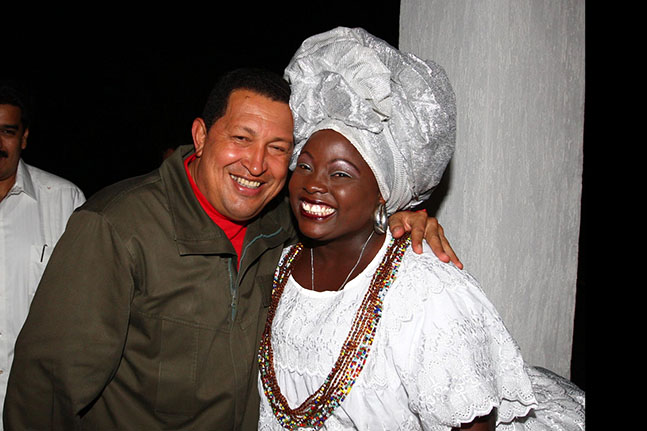
Venezuela’s foreign policy under the late President Hugo Chávez, and now his successor Nicolas Maduro, has been subject to sharply differing interpretations. Some observers see the oil-rich country’s foreign relations since Chávez’s election in December 1998 as shaped by a visionary who has promoted international solidarity with the oppressed, combated poverty, and pushed for a just world order free of uni-polar domination. For critics, however, Venezuela’s foreign policy has been incoherent, militaristic, and prejudicial to regional stability.
Does Venezuelan foreign policy include ethical considerations, as its supporters claim? The evidence suggests it does and that as a result we can be more optimistic about possibilities for incorporating ethics into international affairs than some scholars would have us believe.
The Ethical Dimension of Venezuelan Foreign Relations
To evaluate a possible ethical dimension to Venezuelan foreign policy, it is necessary to understand the ideology Chávez imbued in the country’s international affairs. Five concepts are central. The first two are the primacy of national sovereignty and Latin American and Caribbean integration. These are based on an understanding of foreign policy as a continuation of the Pan-American vision of Venezuela’s founder and 19th century independence hero Simon Bolivar, who also gives the name to Chávez’s “Bolivarian” political project. The third and fourth are the importance of international solidarity and south-south cooperation, which hold that Venezuela’s development should be based on mutual solidarity and cooperation with the countries of the global south. Finally, these concepts coalesce to form the pursuit of a multi-polar world order, which sees Venezuela’s international role in strengthening ties with emerging powers across different regions as part of a shift to a more balanced international system which will guarantee “world peace” and “universal well-being.” This implicitly involves an attempt to counter-balance the weight of the United States in international affairs.1
One example of Venezuela’s pursuit of these values is the Bolivarian Alliance for the Peoples of Our America (ALBA). This alliance of leftist Latin American nations founded by Venezuela and Cuba in 2004 has implemented regional development strategies based on the principles of “solidarity, cooperation and complementing.” Programs aiming to guarantee food security, universal literacy, free health and education, and decent housing are strongly marked by values of social justice and human development.2 Social programs promoted by the ALBA include the “Miracle Mission,” which provides free eye treatment and surgery to Venezuelan citizens and those of several Latin American countries. The program has treated around 1.2 million people in Venezuela since its launch in 2004.3
Development assistance and solidarity have also been evident in Venezuela’s outreach to the Caribbean, particularly with the PetroCaribe initiative. Launched in 2005, the program offers Venezuelan petroleum to Caribbean nations at a discount rate. Participating nations only pay a percentage of the oil’s market price up front, with the rest converted into low-interest, long-term loans. A portion of these loans can be amortised through payment in goods and services; for example, Cuba sends medical personnel to Venezuela in exchange for oil shipments. The loans also become important sources of capital spending for the region’s governments. Eighteen Caribbean states now participate in the program, and Venezuelan oil minister Rafael Ramirez estimated in 2011 that PetroCaribe covers 43 percent of participating nations’ energy needs.4 In the context of rising oil prices in the 2000s, a Council on Hemispheric Affairs (COHA) report on the scheme described it as “the most concrete proposal on the table to alleviate the region’s suffering.”5
Perhaps no other Caribbean nation has benefitted more from this kind of regional solidarity than Haiti. Following the devastating January 2010 earthquake, Venezuela pledged $2.4 billion in financial and relief aid, more than any other of 58 donors. This aid has included building power plants, shelters, a new hospital (in collaboration with Cuba), sending food and medical supplies, and assistance to develop Haiti’s agricultural sector.6 Venezuela even wrote off $400 million of Haiti’s PetroCaribe debt. This important reconstruction aid was given despite the fact that Haiti is by no means an ideological ally of Venezuela’s leftist government; its president, Michel Martelly, is close to Haiti’s business elite and the United States. Nevertheless Martelly has publicly thanked Venezuela for its solidarity and help since the earthquake, commenting in December 2011 that for Haiti, “cooperation with Venezuela is the most important right now, in terms of impact, direct impact.”7
Africa is another continent where relations seem to be driven as much by ideology and ethical values as by strategic interests. From 2005, Chávez began referring to Africa as a “motherland” and pursuing “south-south cooperation,” or mutual development strategies, in the region. Over the next six years Venezuela established diplomatic relations with all 54 African countries, opened new embassies, and signed over 200 cooperation agreements with the continent, where only 20 had existed beforehand.8 Many of these agreements contain a clear element of solidarity and humanitarian assistance. In 2009 Venezuela pledged $20 million to the West African ECOWAS group for malarial eradication programs, while in February 2013 it offered technical assistance and personnel training to the Sahrawi Democratic Republic to improve the population’s access to safe drinking water. Further, around 500 students from over 15 African countries study in Venezuela courtesy of government scholarships, many of these in medical courses, with the intention that after their studies these newly-trained professionals return to their home countries to provide much needed public services.9 A similar program is offered to Palestine, where Venezuela has also committed to build medical facilities.
Such attempts at greater cooperation with countries of the global south have led Venezuela to play a key diplomatic role in moves toward intensifying Latin American and south-south integration. In addition to founding the ALBA and PetroCaribe, Venezuela was also a founding member of the Union of South American Nations (UNASUR) in 2008, and played host to the founding conference of the Community of Latin American and Caribbean States (CELAC) in 2011, which brings together every nation in the Americas with the exception of the U.S. and Canada. Venezuela was also host to the II Africa–South America (ASA) summit in 2009, and is set to host the tri-annual summit of the Non-Aligned Movement in 2015, and thereafter become the president of the grouping of 130 developing nations. The country was also elected to serve on the UN Human Rights Council for 2013–2016 and is a mediator in peace talks underway between the FARC guerrilla group and the Colombian government. Taken together, these aspects of Venezuela’s foreign policy have led observers such as Venezuelan geographer and analyst Rosalba Linares to conclude that Bolivarian-era foreign relations aim to construct “a sovereign, democratic and more humanitarian multi-polar world, of greater social justice and fair trade in benefit of those most in need in Venezuela and the world.”10
The Pursuit of Strategic Interests
Of course, it would be mistaken to understand Venezuelan foreign relations as solely motivated by ethical or altruistic considerations. Even solidarity-based policies have clear “soft” benefits such as raising the government’s diplomatic and international standing. Venezuela’s foreign relations have also been shaped by concrete strategic interests. Chief among these are energy interests, which are woven throughout foreign policy, as Venezuela holds the largest crude oil reserves in the world. The Bolivarian government has sought to increase ties with other energy powers for the extraction of Venezuelan crude and to diversify its oil export markets. In the context of the deterioration of relations with the United States, strategic policy goals have also included creating a robust network of international alliances and securing alternative sources of financing, technological assistance, and military hardware.
In the first years of Chávez’s presidency the state oil company PDVSA was brought under greater government control. At the same time the government pushed for the revitalisation of OPEC, advocating the policy of production quotas to help ensure that world oil prices rose to levels favourable to exporting countries. The elevation of oil prices in the 2000s gave the Venezuelan government flexibility to pursue active energy diplomacy abroad while funding a wave of new social programs at home.
The government has built what it calls “strategic alliances” with several energy powers, including Russia and China. Russian energy giant Gazprom now works with PDVSA to explore gas deposits in the Gulf of Venezuela and Russian firms are active in the extraction of oil in Venezuela’s Orinoco Belt. Russia is also useful to Venezuela as a source of military hardware, with Chávez’s government becoming Russia’s biggest customer of military goods after India.11
Meanwhile China has provided Venezuela with a new market for its petroleum exports. Oil exports to China rose from almost zero in 2004 to 460,000 bpd in 2010, a number that officials want to increase to one million.12 The relationship has also resulted in over 300 bilateral agreements and 80 major projects, and has allowed the Venezuelan government access to financing and technology, the latter exemplified by the launching of Venezuela’s first satellites with Chinese assistance in 2008 and 2012.
Venezuela has formed a web of links with other countries enjoying oil and gas reserves, such as Iran, Syria, Brazil, and certain African countries. Given their relatively independent diplomatic stance in world affairs, strengthening ties with these nations has also fitted within the ideological goal of building “south-south cooperation” and a “multi-polar world order.”
Meanwhile relations with Venezuela’s traditional commercial partner and top recipient of crude exports, the United States, have been frozen at the charge de affairs level since 2010. Venezuelan officials blame this on the U.S. government’s belligerence and lack of respect for Venezuela’s independence and sovereignty, including support for and alleged involvement in the short-lived coup attempt to topple the Chávez administration in 2002. For its part, the United States has accused Venezuela of failing to sufficiently cooperate with counter-narcotics and anti-terrorism efforts, and of acting against U.S. interests by pursuing relations with “enemy” states such as Iran. Nevertheless, there are signs that the relationship is improving under the presidency of Nicolas Maduro, after Venezuelan foreign minister Elias Jaua met with Secretary of State John Kerry during an OAS summit in early June. “We would like to see our countries find a new way forward, to establish a more constructive and positive relationship,” said Kerry following the meeting. However, it remains to be seen whether the recent decision by President Maduro to offer asylum to ex-NSA intelligence leaker Edward Snowden will have an impact on efforts to improve bilateral relations.
Criticisms and Contradictions
Critics point to contradictions in the conduct of Venezuela’s foreign policy, and question the existence of an ethical dimension to Venezuelan foreign relations.
An accusation which emanates principally from the United States is that rather than seeking “world peace,” Venezuela in fact pursues an aggressive policy of building up its arms stockpile while forming alliances seen as threatening to U.S. national security. In September 2009 then-Secretary of State Hilary Clinton raised concerns over Venezuela’s arms purchases from Russia, arguing that the Chávez administration was engaging in a military build-up which could trigger a South American “arms race.” “They [Venezuela] outpace all other countries in South America [in military purchases] and certainly raise the question as to whether there is going to be an arms race in the region,” she said.13 Further, some conservative politicians and analysts have argued that Venezuela should be considered a “national security threat” due to its ties with countries regarded as hostile to the U.S, such as Iran and Syria.14
However, neither the figures nor events bear out fears that Venezuela is unduly arming itself or seeking military-style alliances with U.S. adversaries. According to the CIA World Factbook, in 2009 Venezuela put 1.4 percent of GDP toward military spending, the 5th highest in the region and less than the U.S., Colombia, and Chile. By 2012, military spending in Venezuela had halved as a percentage of GDP to 0.7 percent, with the country spending less than most major countries in the region, being only 153rd out of 173 countries measured globally for military spending.15 Venezuelan government officials meanwhile state that its international alliances are “about peace” and not in any way an aggression toward a third party. This point was highlighted during the visit from former Iranian president Mahmoud Ahmadinajad to Venezuela in January 2012. Nicolas Maduro, in his capacity of foreign minister, said to press at the time that bilateral ties between the two countries were part of a “peaceful relationship…we have a relationship of cooperation for development… and above all, for peace”.16
This appraisal of Venezuela’s diplomatic and defence policy appears to be shared by the U.S. military establishment. In August 2012 General Douglas Fraser, chief of U.S. Southern Command, said that although he would like greater cooperation from Venezuela against drug trafficking, he did not consider Venezuela a security threat to the United States. When asked if he thought Venezuela’s arms purchases constituted a danger to the U.S., Fraser replied, “From my standpoint, no…I don’t see them [Venezuela] as a national security threat.” Further, when asked whether Venezuela’s relationship with Iran amounted to a “military alliance,” the general disagreed, stating, “As I look at Iran and their connection with Venezuela, I see that still primarily as a diplomatic and economic relationship.”17 President Barack Obama has taken a similar stance, announcing in an interview in July 2012, “Overall my sense is that what Mr. Chávez has done over the last several years has not had a serious national security impact on us.”18
Thus the notion that Venezuelan military purchases and bilateral relationships represent a threat to the United States appears to be an overreaction from certain observers within U.S. political and media spheres, who confuse Venezuela’s independent foreign policy with one threatening U.S. security.
Others argue that there exists a contradiction in Venezuelan foreign policy between claims to pursue the values of democracy, humanitarianism, and solidarity, while supporting governments considered authoritarian or with poor human rights records. In 2011, political sociologist and author Gregory Wilpert argued that Venezuela ran a “significant” risk of losing legitimacy among progressives when Chávez continued to support former Libyan president Muammar Gaddafi against an insurgency in that country, a point that could be extended to several other of Venezuela’s allies in the Middle East.19
Another seemingly contradictory move by a government purporting to promote ethical values in its foreign policy is Venezuela’s decision to withdraw from the OAS’ Inter-American Court and Human Rights Commission (IACHR) in 2012, on the basis of the body’s alleged “shameful” bias against the Chávez administration. The decision is also part of a shifting focus toward Latin American autonomy and integration, with several states in the region pushing for the formation of new mechanisms to promote human rights within the UNASUR and CELAC. 20
A final question for Venezuela’s foreign relations is the extent to which policies pursued under Chávez will continue under the presidency of Nicolas Maduro, who was elected to power in April, following Chávez’s death in March. Maduro was Chávez’s foreign minister from 2006–2012, and in that role helped to build Venezuela’s contemporary foreign relations. The new president has pledged to continue these policies and his active foreign diplomacy over the previous three months seems to confirm this. Present challenges for Maduro include assuming the presidency of the Mercosur trade bloc this summer, and seeking productive relationships with the U.S. and Europe; steps toward which appear to have already been taken.
Between Ethics and Interests
In common with all nation states, over the past 14 years Venezuela has pursued clearly defined strategic and economic interests through its foreign policy. These have included developing greater links with other energy powers and ensuring access to sources of financing and military hardware. The government has also sought commercial, technological, agricultural, educational, health, and other forms of cooperation considered beneficial to Venezuela’s national development.
Although certain criticisms of contradictory behaviour can be levelled at Venezuela’s foreign relations, policymaking has followed a coherent logic. From technological cooperation with China to malaria eradication assistance in Africa, Venezuela’s new foreign relations have been built within an ideological framework embodied by the notions of “south-south cooperation” and a “multi-polar world.”
Further, while all nations could be said to act in their own strategic interests, not all have also placed norms of cooperation, solidarity and humanitarianism as a central focus of foreign policy. These values can be seen in agreements Venezuela has made with countries across all continents, but especially in the Americas and Africa. Even in the United States, PDVSA subsidiary CITGO aids around 100,000 low-income families during the winter with donated Venezuelan heating oil.21 Thus while it would be false to state that Venezuelan foreign policy is solely motivated by ethical considerations, it would be misleading to explain the country’s external relations without reference to these. This ethical dimension to Venezuela’s foreign policy is a demonstration that if the political will exists, governments can pursue such values within their foreign relations. In doing so, concrete and mutual benefits can be reaped for both the development of societies and the wellbeing of peoples.
NOTES
1 Chávez, H. (2012), Plan de la Patria: Programa del Gobierno Bolivariano 2013 – 2019, accessed at: http://www.minci.gob.ve/wp-content/uploads/downloads/2013/04/PLANDELAPATRIA-20133-4-2013.pdf.
2 Ullán de la Rosa, F.R. (2012), La Alianza Bolivariana para las Americas – Tratado de Comercio de Los Pueblos (ALBA-TCP): Análisis de un Proyecto de Integración Regional Latinoamericana con Una Fuerte Dimensión Altermundista, Estudios Politicos, no. 25, (Enero – Abril), pp131 – 170, Mexico, D.F. (p151-152).
3 Morales, M. (27/5/2013), Hija de Chávez Manejará Presupuesto Millonario en la Misión Milagro, El Nacional.
4 Rojas, R. (December, 2011), Venezuela Increasing Influence in Caribbean through PetroCaribe, Press TV.
5 Lai, K. (January, 2006), PetroCaribe: Chávez’s Venturesome Solution to the Caribbean Oil Crisis, Council on Hemispheric Affairs (COHA).
6 Information taken from, Wyss, J. (05/07/2010), Venezuela Leads the World in Earthquake Relief, Miami Herald; Edmonds, K. (February 2012), ALBA Expands its Allies in the Caribbean, North American Congress on Latin America (NACLA.org); Robertson, E (01/06/2012), Venezuela, Cuba and Argentina Sign Development Assistance Agreements with Haiti, Venezuelanalysis.com.
7 The Editors, (April, 2012), Haiti Using Funds from PetroCaribe to Finance Reconstruction, Council for Economic and Policy Research (CEPR).
8 Bolivar, R. J., (February, 2011), “Entrevista: Reinaldo José Bolívar, Viceministro de Relaciones Exteriores para África,” Encontrarte.
9 (14/01/2011), “Venezuela ha Firmado 200 Acuerdos de Cooperación con África,” Agencia Venezolana de Noticias.
10 Linares, R., (2010), “La Estrategia Multipolar de la Political Exterior Venezolana,” Aldea Mundial, Año 15, No. 15, Julio – Diciembre (2), pp51-62, (p60).
11 Rinna, A. (09/03/2013), “Russia’s Uncertain Position in Post-Chávez Venezuela,” Centre for World Conflict and Peace blog.
12 Ellis, R.E. (2010), “Venezuela’s Relationship with China: Implications for the Chávez Regime and the Region,” Centre for Hemispheric Policy, University of Miami, pp1-10; Cornejo, R. & Garcia, A.N. (2010), “China y América Latina: Recursos, Mercados y Poder Global,” Nueva Sociedad, No. 228 (Julio-Agosto), pp79-99 (p95); Manduca, P.C. (2012), “La Energía en la Política Sudamericana: Características de las Relaciones entre Brasil y Venezuela,” Revista Mexicana de Ciencias Políticas y Sociales,” no. 216, (Septiembre – Diciembre), pp81-100.
13 Labott, E. (16/09/2009), “U.S. Fears Venezuela Could Trigger Regional Arms Race,” CNN.
14 Noriega, R. (08/02/2013), “Hugo Chávez: An Uncounted Enemy,” The Washington Times.
15 Central Intelligence Agency: The World Factbook (Military Expenditures, Venezuela), accessed at: https://www.cia.gov/library/publications/the-world-factbook/rankorder/2034rank.html?countryname=Venezuela&countrycode=ve®ionCode=soa&rank=153#ve.
16 Pearson, T. (10/01/2012), “Iran-Venezuela Relationship “About Peace,” Venezuelanalysis.com.
17 (01/08/2012), ” Top US General: Venezuela Not a National Security Threat,” Associated Press.
18 Mazzei, P., Bolstad, E., (11/07/2012), “Mitt Romney, GOP howl over President Barack Obama’s remark about Hugo Chávez,” Miami Herald.
19 Wilpert, G, (06/03/2011), “Venezuela and Libya: An Interview with Gregory Wilpert,” Venezuelanalysis.com.
20 Britto Garcia, L. (12/05/2013), Avanza el Golpe Judicial, Aporrea.org.
21 Citgo Press, (31/01/2013), “Eighth Annual Citgo-Venezuela Heating Oil Program Launched,” Venezuelan Embassy, Washington.
July 14, 2013
Posted by aletho |
Deception, Economics, Militarism, Solidarity and Activism, Timeless or most popular | Caribbean, Haiti, Hugo Chávez, Latin America, Nicolás Maduro, PetroCaribe, United States, Venezuela |
Leave a comment
According to declassified data Russia holds 17 billion tons of oil and 48 billion cubic meters of gas. Moscow believes revealing the extent of the vast reserves will lead to a surge of investment in the extraction and production of hydrocarbons.
The country’s recoverable oil reserves in the C1 category (proven reserves) totals 17.8 billion tons; category C2 (preliminary estimated reserves) is 10.2 billion tons, according to data collected on January 1, 2012.
Meanwhile, gas reserves were equally bountiful at 48.8 trillion cubic meters C1 category; gas stores of the C2 category is estimated at 19.6 trillion cubic meters.
The Minister of Natural Resources of the Russian Federation Sergey Donskoy said the resource potential for these kinds of mineral resources remains one of the most significant in the world. “I am convinced that the opening of this data will give a powerful impetus to investment in reproduction and production of hydrocarbons,” he said. He also added that Russia’s potential for the mineral resources is one of the most significant in the world.
Russia’s available hydrocarbon potential will be able to provide the nation’s growing economy for 30 years, according to expert estimates put out by the Russian Ministry of Natural Resources and the Federal State Commission on Mineral Reserves.
Meanwhile, increased exploration of mineral resources consistently exceed the level of production, the minister said, noting that last year 49 oil fields were discovered.
Last week, Prime Minister Dmitry Medvedev signed a government decree that removed the lid of secrecy on oil reserve data.
Earlier, President Putin, explained the necessary level of cooperation that exists between the domestic fuel and energy sector and foreign investors, called the former level of secrecy “an obvious anachronism.”
Putin also called on the development and approval of a new classification of Russian oil and gas reserves as close as possible to international standards.
Before the release of the official data Russia was placed second in the world by gas reserves after Iran, with 32.9 trillion cubic meters, and eighth by crude oil reserves, after Venezuela, Saudi Arabia, Canada, Iran, Iraq, Kuwait and UAE, with 11.8 trillion cubic meters of oil.
July 13, 2013
Posted by aletho |
Economics, Malthusian Ideology, Phony Scarcity | Gas, Natural resources, Oil, Oil reserves, Russia, Russian economy |
Leave a comment
The United States has been accused of spying on numerous countries in Latin America in an effort to collect intelligence on trade secrets and military capabilities.
Using information provided by former National Security Agency (NSA) contractor Edward Snowden, a Brazilian newspaper, O Globo, published a story that said the U.S. spy agency has gathered data on telephone calls and emails from Brazil, Colombia, Mexico, Venezuela and others.
The account indicated that the NSA had collected military and security data on countries including Venezuela, while also carrying out surveillance operations to acquire trade secrets from within the oil industry in Venezuela and the energy sector in Mexico.
O Globo also published a story over the weekend saying Brazil was a major target of the NSA’s global spying on telecommunications, which involved the cooperation of American and Brazilian companies (which were not named).
It was additionally reported that the CIA and NSA jointly operated monitoring stations to gain foreign satellite data in 65 countries, including five in Latin America.
In response to the accusations, the U.S. ambassador to Brazil, Thomas Shannon, reportedly denied that Washington has been conducting surveillance operations on Brazilian communications.
News of the alleged spying upset many in Brazil and other Latin countries, which have a history of military governments—often supported by the United States—that spied on their own people.
Brazilian President Dilma Rousseff, who was jailed and tortured in the 1970s under the ruling junta, said her government would raise concerns with the U.N. Commission on Human Rights.
“Brazil’s position on this issue is very clear and very firm,” Rousseff told the media. “We do not agree at all with interference of this kind, not just in Brazil but in any other country.”
To Learn More:
U.S. Spy Spread Through Latin America (by Glenn Greenwald, and Kaz and Roberto Jose’ Casado; O Globo)
Capitals 4 Countries Also Housed the Office of the NSA and CIA (by Kaz and Roberto Jose’ Casado; O Globo)
U.S. and Britain Eavesdropped on World Leaders at 2009 Summits (by Noel Brinkerhoff, AllGov)
US NSA Spied on Venezuela When President Chavez Died, Documents Reveal (alethonews.wordpress.com)
July 11, 2013
Posted by aletho |
Civil Liberties, Corruption, Deception, Economics, Full Spectrum Dominance | Brazil, Dilma Rousseff, Latin America, National Security Agency, NSA, O Globo, United States, Venezuela |
Leave a comment
In ousting Egypt’s first freely elected president, Mohammed Morsi, the Egyptian military have certainly not acted to preserve democracy. They’ve never shown much interest in that. They’re determined to put a break on the mounting political and economic chaos that is ripping the country apart. That turbulence was threatening not just the survival of Egypt, but, more to the point, it was menacing the vast state within a state that Egypt’s military presides over.
Of course, the Egyptian Army is not monolithic. Its lower ranks are very much of the people: filled with hundreds of thousands of conscripts, drawn from the most humble ranks of society—and has a strong identity with the Egyptian people.
It has traditionally been the most important means of socializing and educating the lower classes, in theory, inculcating them with a sense of pride and patriotism.
Indeed the 1971 Constitution says that the Egyptian Army shall “belong to the people”
Thus, as I have previously blogged, in 1977 when the army was called in to quell riots after President Sadat announced cuts in basic food subsidies, the generals refused to intervene unless the subsidies were reestablished. Sadat restored the subsidies.
The top ranks of the army, however, have other concerns—beginning with personal survival. They certainly will never forget the lurid spectacle of Iranian generals being publicly executed in the aftermath of Khomeini’s revolution in Iran. Iran also demonstrated that a radical revolution also means a radically transformed military. (Egypt’s generals have a constant reminder of that lesson nearby: The Shah is buried in a Cairo mosque.).
But since the fall of Mubarak, the military have feared not just a takeover by radical Muslims. There is also the fact that real civilian rule could spell an end to the system of massive military corruption and patronage that has gone on for decades in Egypt, a system that has given the military unimpeded control over an estimated 40% of the Egyptian economy–“a state within a state” as a well-informed Egyptian friend of mine puts it.
For years, Egypt’s top military ranks have enjoyed a pampered existence in sprawling developments such as Cairo’s Nasr City, where officers are housed in spacious, subsidized condominiums. They enjoy other amenities the average Egyptian can only dream of, such as nurseries, bonuses, new cars, schools and military consumer cooperatives featuring domestic and imported products at discount prices. In other areas, top officers are able to buy luxurious apartments on generous credit for 10 percent of what those apartments are actually worth.
But we’re not just talking about sensational official perks. Many of Egypt’s brass are notoriously corrupt. Vast swathes of military land, for instance, were sold by the generals to finance some major urban developments near Cairo — with little if any accounting.
Other choice military property ran on the Nile Delta and Red Sea coast boasted idyllic beaches, and exquisite coral reefs. In return for turning the land over to private developers, military officers became key shareholders in a slew of gleaming new tourist developments.
The generals also preside over 16 enormous factories that turn out not just weapons, but an array of domestic products from dishwashers to heaters, clothing, doors, stationary pharmaceutical products, and microscopes. Most of these products are sold to military personnel through discount military stores, but a large amount are also sold commercially.
The military also builds highways, housing developments, hotels, power lines, sewers, bridges, schools, telephone exchanges, often in murky arrangements with civilian companies.
The military are also Egypt’s largest farmers, running a vast network of dairy farms, milk processing facilities, cattle feed lots, poultry farms, fish farms. They’ve plenty left from their huge output to sell to civilians through a sprawling distribution network.
The justification for all this non-military activity is that the military are just naturally more efficient than civilians. Hard not to be “more efficient” when you are able to employ thousands of poorly paid military recruits for labor.
Many civilian businessmen complain that competing with the military is like trying to compete with the Mafia. And upon retiring, top military officers are often rewarded with plum positions running everything from factories and industries to charities.
Whatever the number, Robert Springborg, who has written extensively on Egypt, says officers in the Egyptian military are making “billions and billions and billions” of dollars.
But there’s no way to know how efficient or inefficient the military are, nor how much money their vast enterprises make, nor how many millions or billions get skimmed off since the military’s operations are off the nation’s books. No real published accountings.
No oversight. Even Mohammed Morsi when he became president, was obliged to agree to the military’s demand that there would be no civilian oversight of the military budget.
Of course none of the above is a surprise to U.S. officials who dole out some 1.3 billion dollars a year in military aid to the Egyptian Army, and hope that sum and the neat weapons it provides will keep the army in line. [One of the most detailed studies of the military’s non-military activities was done by a U.S. military researcher at Fort Leavenworth.]
The U.S. also has a 1.3 billion dollar carrot dangling in front of the Egyptian Army. That annual American military aid to Egypt has allowed the Egyptian officers to get their hands on some of the most sophisticated of modern weapons—as we’ve seen over the past couple of years in downtown Cairo.
The generals realize there is no way the U.S. will continue paying for those goodies if a new regime more hostile to Israel takes power in Cairo.
A perceptive look into all this came via a 2008 U.S.diplomatic cable released by WikiLeaks. The writer in the U.S. Embassy in Cairo ticked off the various businesses the military was involved in, and considered how the military might react if Egypt’s then president, Hosni Mubarak, were to lose power.
The military would almost certainly go along with a successor, the cable’s author wrote, as long as that successor didn’t interfere in the military’s business arrangements.
But, the cable continued, “in a messier succession scenario, it becomes more difficult to predict the military’s actions.”
No scenario could be “messier” than the mounting chaos in Egypt over the past few months.
The military acted.
July 5, 2013
Posted by aletho |
Corruption, Economics, Timeless or most popular | Cairo, Egypt, Egyptian Armed Forces, Egyptian Army, Hosni Mubarak |
Leave a comment
Global Power Project, Part 4
In May, JPMorgan Chase was listed as the largest bank in the world with assets at roughly $4 trillion — some $1.53 trillion of it in derivatives. This was reported a month after the announcement that the bank had posted a record first-quarter profit of $6.5 billion.
Jamie Dimon, the bank’s CEO and Chairman, has faced a host of scandals in relation to his management of the megabank, including the loss of roughly $6 billion through the London branch of the bank — losses that Dimon was accused of hiding. A 300-page report by the U.S. Senate, investigating the “creative accounting” of JPMorgan, noted that the bank “hid losses, did not share information with its regulators, and misled the public” in what one banking regulator referred to as “make believe voodoo magic.” Stated bluntly in The New York Times, JPMorgan Chase, the largest derivatives dealer in the world, “is too big to regulate.”
In the midst of the scandal, the bank faced a potential “revolt” of its shareholders in a bid to strip Dimon of his dual role as CEO and Chairman. In confidential government reports which were leaked to The New York Times, the bank was accused of “manipulative schemes” which transformed “money-losing power plants into powerful profit centers” while executives made “false and misleading statements” under oath.
Yet even in the midst of scandal, Jamie Dimon was praised in a storm of support by billionaires, corporate kingpins and media barons. Calling JPMorgan Chase “as good a bank as there is,” New York City mayor and billionaire media baron Michael Bloomberg went on to call Dimon “a very smart, honest, great executive.” News Corporation chairman Rupert Murdoch praised Dimon as “one of the smartest, toughest guys around,” while Jack Welch, former chairman and CEO of General Electric, referred to him as a “great leader” and said he had earned the “right to hold both Chairman and CEO titles.” To top it off, billionaire investor and CEO of Berkshire Hathaway, Warren Buffet, dubbed Dimon “a fabulous banker.”
And the adoration goes all the way to the top rung. In 2009, The New York Times referred to Jamie Dimon as “President Obama’s favorite banker.” In 2010, Obama told Bloomberg BusinessWeek that he didn’t “begrudge” bank CEOs like Jamie Dimon and Lloyd Blankfein of Goldman Sachs for their massive bonuses of $17 and $9 million, respectively. Obama explained: “I, like most of the American people, don’t begrudge people success or wealth. That is part of the free-market system.” The president added, “I know both those guys; they are very savvy businessmen.”
In May of 2012, Obama rushed to Jamie Dimon’s defense in light of the financial scandals, stating that Dimon was “one of the smartest bankers we got.” The Financial Times referred to Dimon as “the last king of Wall Street.” And when finally faced with the decision to strip Dimon of his dual role as chairman and CEO, Obama’s “favorite banker” ended up winning “a decisive victory” by maintaining both his roles.
But this is just the surface of JPMorgan Chase’s financial manipulations. The bank, in fact, was at the forefront of creating Credit Default Swaps (CDS), a key aspect of the derivatives market that led to the inflation and subsequent blowout of the housing bubble. JPMorgan developed these “financial instruments” as a type of insurance policy in 1994, allowing the bank to trade its debt (in the form of loans to corporations and governments) to third parties, thus handing off the risk and removing the debts from its accounts, which allowed it to make further loans. JPMorgan opened up the first CDS desk in New York in 1997, “a division that would eventually earn the name the Morgan Mafia for the number of former members who went on to senior positions at global banks and hedge funds.” Back in 2003, the same Warren Buffet who would later praise Dimon referred to credit default swaps as “financial weapons of mass destruction.”
JPMorgan was also at the forefront in the United States pushing for financial deregulation, particularly the slow-motion dismantling of the Glass-Steagall Act that had been put in place in 1933 in response to the financial speculation which had helped spark the Great Depression. After hearing proposals from banks such as Citicorp, JP Morgan and Bankers Trust, which advocated the loosening of “restrictions” put in place by Glass-Steagall, the Federal Reserve Board in 1987 voted to ease many of the regulations. That same year, Alan Greenspan, who had previously been a director of JP Morgan, became the chairman of the Fed. In 1989, the Fed approved an application submitted by JP Morgan, Chase Manhattan, Citicorp and Bankers Trust to further reduce the regulations imposed by Glass-Steagall. In 1990, JP Morgan became “the first bank to receive permission from the Federal Reserve to underwrite securities.”
Financial deregulation accelerated under President Clinton, much to the delight of Wall Street banks, which were then permitted to merge into megabanks, with JPMorgan merging with Chase Manhattan to form JPMorgan Chase. As early as 2006 and 2007, multiple megabanks were beginning to bet against the housing market through various hedge funds, allowing them to make profits on the housing collapse they created. JPMorgan continued to sell mortgages as it bet against the mortgage market, passing on the risk while it hedged its bets to profit from the failure and losses of others. In 2011, the bank paid a $153 million fine to the Securities and Exchange Commission (SEC) to settle allegations of “securities fraud.”
In the midst of the financial crisis in 2008, JPMorgan Chase became not only a major criminal, but also a prime beneficiary. In 2007, the global investment bank Bear Stearns was named by Fortune magazine as the second “most admired” financial securities company in the United States, while Lehman Brothers was put in first place. As the financial crisis erupted, Bear Stearns executives “discovered” that they were “nearly out of cash” in March of 2008. The CEO of Bear Stearns, Alan Schwartz, made a phone call to Jamie Dimon — JPMorgan Chase was the clearing agent for Bear Stearns — asking for an overnight loan. Dimon, who also sat on the board of directors of the Federal Reserve Bank of New York, turned there instead of providing the loan through his own bank. The president of the New York Fed – who was elected by the banks that own the New York Fed – was Timothy Geithner. Geithner began discussions with Bear Stearns, and the following morning he held a meeting with Federal Reserve Chairman Ben Bernanke and Treasury Secretary Henry Paulson, the former CEO of Goldman Sachs, where they agreed to an emergency loan for Bear Stearns, providing the funds through JPMorgan Chase.
Over the following day, Geithner and Paulson informed Bear Stearns that it must sell the bank within days, and a deal was negotiated in which JPMorgan Chase would purchase Bear Stearns at $2 per share. Though Dimon had first refused to purchase the failed bank, he now engaged in negotiations with Geithner who won over Dimon by guaranteeing $30 billion for JPMorgan to purchase the sunken bank. Long story short: through the New York Fed, the U.S. government purchased billions of dollars in bad debts made by Bear Stearns, including $16 billion in credit default swaps that were downgraded to “junk” assets, while JPMorgan Chase acquired $360 billion in Bear Stearns assets with little or no risk.
With the purchase of Bear Stearns facilitated by the New York Fed, and for the benefit of JPMorgan, Geithner continued in his role as willing servant to the banks who had elected him as president. Then, in September of 2008 when the insurance conglomerate American International Group (AIG) plunged into crisis and sought support from the government, the Fed and Treasury initially refused. AIG turned to JPMorgan Chase and Goldman Sachs, who went to the government to pressure for state support. The New York Fed, with Geithner at the helm, again organized a secret bailout of the institution, valued at $85 billion. In October, the government added an extra $38 billion to the AIG bailout, and the New York Fed provided a further $40 billion in November. Overall, U.S. taxpayers bailed out the insurance giant with $150 billion.
Because many banks kept junk assets with AIG which didn’t affect its balance sheets, the insurance giant was allowed to continue making risky loans. Meanwhile, the New York Fed, noted Bloomberg journalist David Reilly, acted as “a black-ops outfit for the nation’s central bank,” and as a “quasi-governmental institution [which] isn’t subject to citizen intrusions such as freedom of information requests.” The AIG bailout, wrote Reilly, revealed what could be described as a “secret banking cabal.” Through AIG, bailout funds went to American, French, German, British, Swiss, Dutch and even Canadian banks. Goldman Sachs received over $12 billion, and billions also went to Merrill Lynch, Bank of America, Citigroup, Wachovia, Morgan Stanley, and JPMorgan Chase.
JPMorgan Chase was using bailout money from the government to purchase other banks and companies. As one executive at the bankcommented in regards to a $25 billion bailout from the government, “I think there are going to be some great opportunities for us to grow in this environment.” The banks repaid the bailout loans from other bailout funds they got from government, siphoning off taxpayer moneyback and forth and rewarding them for their risky behavior. One university study noted that banks with political access – whether through lobbying efforts or board membership on the Fed – were more likely to get bailout funds, and in bigger numbers, than other banks. Notably among the most politically connected banks were Goldman Sachs, JPMorgan Chase and Morgan Stanley.
According to a 2012 study by the International Monetary Fund and Bloomberg magazine, JPMorgan Chase continues to receive government support far beyond the bailouts, as it is a major recipient of corporate welfare and state subsidies. In fact, according to the study, the biggest bank in the world gets roughly $14 billion per year in state subsidies and welfare, largely helping “the bank pay big salaries and bonuses.”
The Biggest and Most Connected Bank
Not only is JPMorgan Chase the biggest bank in the world with over $4 trillion in assets, but its power and influence extends far beyond financial matters. It is a major political force in the world, highly integrated within the network of global elites who make up the plutocratic ruling class. As the subject of study for the Global Power Project, I examined 55 people at JPMorgan Chase, including all members of the executive committee, the board of directors and the international advisory council.
Of the 55 individuals examined at the bank, a total of 13 (or roughly 24%) of the individuals were either members or held leadership positions (previously or presently) with the Council on Foreign Relations (CFR). The CFR has been at the heart of the foreign-policy elite of the United States since it was created in 1921. Further, a total of eight JPMorgan officials held leadership positions in the World Economic Forum, the second most represented institutional affiliation of the bank. Holding yearly conferences that bring together thousands of participants from elite financial, corporate, political, cultural, media and other institutions, the WEF is one of the principal forums for the global elite, with JPMorgan operating right there at the center.
The next most represented institution is the Trilateral Commission, with 5 individuals at JPMorgan Chase holding membership in the international think tank – or “global policy group” – uniting elites from North America, Western Europe and Japan (and now also including China, India, and other Pacific-rim nations). The Trilateral Commission itself was founded in 1973 by the CEO of Chase Manhattan Bank – which later merged into JPMorgan Chase – David Rockefeller.
In descending order, the other most highly represented institutions having cross membership between leadership positions with JPMorgan Chase are: the Federal Reserve Bank of New York (4), the Business Council (4), Citigroup (4), Bilderberg (4), the Group of Thirty (4), Sara Lee Corporation (3), Harvard (3), American Express (3), American International Group (3), the Business Roundtable (3), Rolls Royce (3), the Center for Strategic and International Studies – CSIS (3), the European Round Table of Industrialists (3), the Peterson Institute for International Economics (2), the U.S.-China Business Council (2), and the National Petroleum Council (2).
Institutions which hold two individual cross leadership positions with JPMorgan Chase include: the Monetary Authority of Singapore, the University of Chicago, Kohlberg Kravis Roberts & Co., General Electric, Asia Business Council, the U.S. President’s Foreign Intelligence Advisory Board, the National Bureau of Economic Research (NBER), the Coca-Cola Company, National Bank of Kuwait Advisory Board, INSEAD, China-United States Exchange Foundation, Mitsubishi, the Carlyle Group, and the IMF.
Meet the Elites at JPMorgan Chase
It’s worth taking a look at some specific individuals who serve in a leadership and/or advisory capacity to JPMorgan Chase to get an idea of the composition of some of these global plutocrats.
Jamie Dimon, the CEO of JPMorgan Chase, sits on the boards of directors of: the Federal Reserve Bank of New York, Harvard Business School, and Catalyst. He is a Trustee of the New York University School of Medicine, a member of the Executive Committee of the Business Council, a member of the Council on Foreign Relations, a member of the International Business Council of the World Economic Forum, a member of the Financial Services Forum, and a member of the International Advisory Panel of the Monetary Authority of Singapore.
Members of the board of JPMorgan Chase include James A. Bell, former President of Boeing and a current member of the board of Dow Chemical; Crandall C. Bowles, a director of Deere & Company and the Sara Lee Corporation, a former director of Wachovia, a Trustee of the Brookings Institution, on the Governing Board of the Wilderness Society, and a member of the Business Council and the Economic Club of New York. Other JPM board members include Stephen B. Burke, CEO of NBC Universal and Executive Vice President of Comcast Corporation; David M. Cote, the Chairman and CEO of Honeywell International who sits on President Obama’s National Commission on Fiscal Responsibility and Reform, on the advisory panel to Kohlberg Kravis Roberts & Co. (KKR), and is a member of the Trilateral Commission; and Lee Raymond, director of the Business Council for International Understanding, who sits on the advisory panel to KKR, is a member of the Council on Foreign Relations, and former Chairman of the National Petroleum Council as well as former Chairman and CEO of ExxonMobil, from which he retired in 2006 with a compensation package of $398 million.
JPMorgan Chase has an International Council which provides advice to the bank’s leadership on economic, political and social trends across various regions and around the world. The International Council is chaired by Tony Blair, former Prime Minister of the UK, who also sits as an adviser to Zurich Financial. The Council includes Khalid A. Al-Falih, the President and CEO of Saudi Aramco (Saudi Arabian Oil Company), the world’s largest oil company, who also sits on the International Business Council of the World Economic Forum. Former UN Secretary General Kofi Annan is also on JPMorgan’s International Council, and sits as Chairman of the Alliance for a Green Revolution in Africa (AGRA), a partnership between the Bill & Melinda Gates Foundation and the Rockefeller Foundation. Annan is also on the boards of the United Nations Foundation, the World Economic Forum, and he is a member of the Global Board of Advisors of the Council on Foreign Relations.
The Council includes the third richest man in Mexico, Alberto Bailléres, as well as the Chairman and CEO of Telecom Italia, Franco Bernabé, who was the former CEO of Eni, one of the world’s largest oil companies (and Italy’s largest corporation), as well as the former Vice Chairman of Rothschild Europe. Bernabé sits on the board of PetroChina, China’s largest oil company. Bernabé is also a member of the European Round Table of Industrialists (a group of roughly 50 major European CEOs who directly advocate and work with EU political leaders in designing and implementing policy), he was a former Advisory Board member of the Council on Foreign Relations, a member of the board of FIAT, and is actively a member of the Steering Committee of the Bilderberg Meetings.
Martin Feldstein, a prominent Economics professor at Harvard and the President Emeritus of the National Bureau of Economic Research, is another member of the International Council. Feldstein was the Chairman of the Council of Economic Advisers to President Ronald Reagan and sat on the Foreign Intelligence Advisory Board (an “independent” group that advises the president on intelligence matters) under President George W. Bush (from 2007-2009). President Obama appointed Feldstein to the Economic Recovery Advisory Board, and he also sits on the board of the Council on Foreign Relations, is a member of the Trilateral Commission, a participant in Bilderberg Meetings, and is a member of the International Advisory Board of the National Bank of Kuwait.
Gao Xi-Qing is the Vice Chairman, President and Chief Investment Officer of the China Investment Corporation (CIC), China’s sovereign investment fund. He was referred to by the Atlantic as “the man who oversees $200 billion of China’s $2 trillion in dollar holdings.” Another notable Chinese member of the International Council is Tung Chee Hwa, the former Chief Executive and President of the Executive Council of Hong Kong, a core policy-making institution in the government of Hong Kong. Tung Chee Hwa is also the Vice Chairman of the National Committee of the Chinese People’s Political Consultative Conference (CPPCC), a major political advisory group in the People’s Republic of China, once chaired by Mao Zedong. Tung Chee Hwa as well is the founder and Chairman of the China-United States Exchange Foundation, and a former member of the International Advisory Board of the Council on Foreign Relations.
Carla A. Hills is the only woman on the JPMorgan International Council, and is Chairman and CEO of Hills & Company International, a global consulting firm. She was the former United States Trade Representative in the George H.W. Bush administration, where she was the primary negotiator for the North American Free Trade Agreement (NAFTA). She is also the Co-Chair of the Council on Foreign Relations, and sits on the International Boards of Rolls Royce and the Coca-Cola Company, as well as sitting on the board of directors of Gilead Sciences. Hills is a Counselor and Trustee of the Center for Strategic and International Studies (CSIS), a major American think tank where she also sits as Co-Chair of the Advisory Board (alongside Zbigniew Brzezinski, co-founder of the Trilateral Commission). In addition, Hills is a member of the Executive Committee of both the Trilateral Commission and the Peterson Institute for International Economics, as well as sitting on the boards of the International Crisis Group and the US-China Business Council, as Chair of the National Committee on US-China Relations, and Chair of the Inter-American Dialogue.
Henry Kissinger – former U.S. Secretary of State, National Security Adviser to President Richard Nixon, and Secretary of State to President Ford – also sits on the International Council of JPMorgan. Kissinger was a former adviser to Nelson Rockefeller, who recruited Kissinger as director of the Special Studies Project of the Rockefeller Brothers Fund in the 1950s. Kissinger was a director of the Council on Foreign Relations from 1977-1981, is a member of the Trilateral Commission, a former member of the Steering Committee and continuous participant in the Bilderberg Meetings, and is founder and chair of Kissinger Associates, an international consulting and advisory firm. Kissinger Chaired the National Bipartisan Commission on Central America during the Reagan administration, which provided justification for Reagan’s wars in Central America, and he was also a member of the Foreign Intelligence Advisory Board from 1984-1990, advising both Presidents Reagan and George H.W. Bush. Alongside Zbigniew Brzezinski, Kissinger was a member of the Commission on Integrated Long-Term Strategy of the National Security Council and Defense Department, established in the late 1980s to develop a long-term strategy for the United States in the world. Kissinger has also been a member of the Defense Policy Board, providing “independent” advice to the Pentagon leadership on matters of foreign policy, from 2001 to the present, for both the George W. Bush and Barack Obama administrations. Kissinger is also a Counselor and Trustee of the Center for Strategic and International Studies (CSIS), Honorary Governor of the Foreign Policy Association, an Honorary Member of the International Olympic Committee, an adviser to the board of directors of American Express, and is a Trustee Emeritus of the Metropolitan Museum of Art. In addition, Kissinger is a director of the International Rescue Committee, the Atlantic Institute, and is on the advisory board of the RAND Center for Global Risk and Security, as well as Honorary Chairman of the China-United States Exchange Foundation.
Mustafa V. Koc is also a member of the International Council, and is Chairman of Koc Holding AS, Turkey’s largest multinational corporation. He also sits on the International Advisory Board of Rolls Royce, the Global Advisory Board of the Council on Foreign Relations, is a member of the Steering Committee of the Bilderberg Meetings, a former member of the International Advisory Board of the National Bank of Kuwait, and is Honorary Chairman of the Turkish Industrialists and Businessmen’s High Advisory Council.
Gérard Mestrallet is the Chairman and CEO of GDF Suez, one of the largest energy conglomerates in the world, and is on the board of Suez Environment (one of the major water privatization companies in the world), and also sits on the supervisory board of AXA, a major global French financial conglomerate. He is also an advisory board member of Siemens, and is a member of the European Round Table of Industrialists and the International Business Council of the World Economic Forum.
John S. Watson is the Chairman and CEO of Chevron Corporation. He is on the board of the American Petroleum Institute and is a member of the National Petroleum Council, the Business Roundtable, the Business Council, the American Society of Corporate Executives, and the Chancellor’s Board of Advisors of the University of California Davis. He is also a member of the International Business Council of the World Economic Forum.
The Chairman of JPMorgan Chase International, Jacob A. Frenkel, is Chairman and CEO of the Group of Thirty, and a member of the International Council. He is also a former Vice Chairman of American International Group (from 2004 to 2009, when it was rescued with the massive government bailout); the former Chairman of Merrill Lynch International (from 2000 to 2004), and the former Governor of the Bank of Israel (from 1991 to 2000). Frenkel was an Economic Counselor and Director of Research at the International Monetary Fund (from 1987 to 1991) and prior to that he was the David Rockefeller Professor of International Economics at the University of Chicago (from 1973 to 1987). In addition, Frenkel is the former Editor of the Journal of Political Economy, former Vice Chairman of the Board of Governors of the European Bank for Reconstruction and Development, former Chairman of the Board of Governors of the Inter-American Development Bank, and a former member of the International Advisory Board of the Council on Foreign Relations. Frenkel is currently a member of the board of directors of the National Bureau of Economic Research (NBER), a member of the Trilateral Commission, member of the International Advisory Council of the China Development Bank, member of the board of the Peterson Institute for International Economics, member of the Economic Advisory panel of the Federal Reserve Bank of New York, member of the Council for the United States and Italy, member of the Investment Advisory Council of the Prime Minister of Turkey, and sits on the board of Loews Corporation.
To sum: it should be clear, from the evidence, that the leadership of JPMorgan Chase is not an isolated group of individuals involved in finance and exclusively relegated to the banking world, but a highly networked and influential group consisting of central figures in the global plutocracy – referred to as the “Transnational Capitalist Class” – with significant economic, social and political power. To refer to JPMorgan Chase simply as “a bank” is like referring to the United States as just “a country.” A geopolitical force unto itself, and a conglomerate embedded within a transnational network of elite institutions and individuals, JPMorgan Chase goes beyond the financial indicators. Put simply, it is one of the most powerful banks in the world.
Andrew Gavin Marshall is an independent researcher and writer based in Montreal, Canada. He is Project Manager of The People’s Book Project, head of the Geopolitics Division of the Hampton Institute, the research director of Occupy.com’s Global Power Project, and has a weekly podcast with BoilingFrogsPost.
July 5, 2013
Posted by aletho |
Corruption, Economics, Progressive Hypocrite, Timeless or most popular | Credit default swap, Dimon, Jamie Dimon, JPMorgan Chase, Lloyd Blankfein |
Leave a comment
Centuries of oppression have made black people particularly susceptible to the tempting siren song which comes with the image of black success. It is harmless to want a black person to win some coveted acclaim like a Pulitzer prize or even an Oscar, but quite another to be rendered stupid by the sight. Our history teaches us that we must be wary lest we be carried away by emotion that is without substance.
Barack Obama is the most obvious example of this phenomenon and its pernicious influence. A black man being elected as president of the United States was long hoped for but seemingly impossible. The realization of what had long been imagined and the often racist attacks against this dream create common cause with Obama and intense personal happiness on his behalf. Yet what seems inspirational is in fact anything but. The feelings of affection for Obama have been a negative force which impede rational thought and political common sense. The people who most epitomized the American search for true democracy have given it up completely because they love seeing a black man wearing a POTUS jacket and get angry when white people don’t like seeing it.
That history of struggle and the group identity it creates have not been limited to the American experience. The decades long fight against the racist apartheid system in South Africa was supported by millions of people in this country too. Jim Crow was America’s own apartheid. It is only logical that the sight of black people being treated cruelly in the name of white supremacy would elicit feelings of affinity in this country and around the world.
Nelson Mandela’s release from 27 years of imprisonment and his subsequent election as president created a surge of pride and joy among black people everywhere. Unfortunately we did not truly understand what we were witnessing. These events came about as a result of forces unacknowledged in America and they also came with a very high price.
The name of the Angolan town Cuito Cuanavale means little to all but a handful of Americans but it lies at the heart of the story of apartheid’s end. At Cuito Cuanavale in 1988 Cuban troops defeated the South African army and in so doing sealed apartheid’s fate.
It is important to know how apartheid ended, lest useless stories about a miraculously changed system and a peaceful grandfatherly figure confuse us and warp our consciousness. Mandela was freed because of armed struggle and not out of benevolence. He was also freed because the African National Congress miscalculated and made concessions which have since resulted in terrible poverty and powerlessness for black people in South Africa. By their own admission, some of his comrades concede that they were unprepared for the determination of the white majority to hold the purse strings even as they gave up political power.
Now the masses of black South Africans are as poor as they were during the time of political terror. The Sharpeville massacre of 1960 which galvanized the world against South Africa was repeated in 2012 when 34 striking miners were killed by police at Marikana. The Marikana massacre made a mockery of the hope which millions of people had for the ANC and its political success.
Obama’s recent visit to South Africa when the 94 year old Mandela was hospitalized created a golden opportunity for analysis and a questioning of long held assumptions about both men but the irrefutable fact is this. The personal triumphs of these two individuals have not translated into success for black people in either of their countries.
The victory of international finance capital wreaks havoc on both sides of the Atlantic ocean. In the U.S. black people have reached their political and economic low point during the Obama years. The gains won 50 years ago have been reversed while unemployment, mass incarceration, and Obama supported austerity measures have all conspired to undo the progress which was so dearly paid for.
Obama’s visit to Africa as Mandela lay critically ill brought very sincere but very deeply misled people to remember all of the wrong things. It isn’t true that black people benefit from the political success of certain individuals. It isn’t true that role models undo systemic cruelty or that racism ends because of their presence or that white people see or treat the masses of black people any differently when one black person reaches a high office.
The maudlin sentiment was all built on lies. Mandela fought the good fight for many years and is worthy of respect for that reason alone. But his passing should be a moment to reflect on his mistakes and on how they can be avoided by people struggling to break free from injustice. Obama’s career is a story of ambition and high cynicism which met opportunity. There is little to learn from his story except how to spot the next evil doer following in his footsteps.
It is high time that myths were called what they are. They are stories which may help explain our feelings but they are stories nonetheless and they do us no good.
Margaret Kimberley’s Freedom Rider column appears weekly in BAR. She can be reached via e-Mail at Margaret.Kimberley(at)BlackAgendaReport.com.
July 4, 2013
Posted by aletho |
Economics, Progressive Hypocrite, Timeless or most popular | Africa, African National Congress, Mandela, Nelson Mandela, Obama, South Africa, United States |
Leave a comment
 Aletho News
