Ecuador snubs US trade ‘blackmail’ over Snowden, offers human rights training
RT | June 28, 2013
Ecuador renounced trade benefits which the US threatened to revoke over the Latin American country’s consideration of harboring NSA leaker Edward Snowden. It offered $23 million a year to fund human rights education for Americans instead.
The government of leftist President Rafael Correa came up with an angry response on Thursday after an influential US senator said he would use his leverage over trade issues to cut preferential treatment of Ecuadoran goods at the US market, should Ecuador grant political asylum to Snowden.
“Ecuador will not accept pressures or threats from anyone, and it does not traffic in its values or allow them to be subjugated to mercantile interests,” government spokesman Fernando Alvarado said at a news conference.
He added that Ecuador is willing to allocate $23 million annually, an equivalent of the sum that it gained from the benefits, to fund human rights training in the US. It will “avoid violations of privacy, torture and other actions that are denigrating to humanity,” Alvarado said.
US Senator Robert Menendez, who heads the Foreign Relations Committee in the Senate, said this week that Ecuador risks losing the benefits it enjoys under two trade programs because of its stance on the NSA whistleblower.
“Our government will not reward countries for bad behavior,” he said.
The US is Ecuador’s prime trade partner, with over 40 percent of exports going to the US market.
Both programs were due to expire by the end of next month and were subject to congressional review. Before the Snowden debacle arose, the US legislature was expected to scrap one of them while renewing another one.
Snowden has applied for political asylum, hoping to find protection from American prosecutors, who charged him with espionage over his leaking of classified documents on US surveillance programs.
He is currently thought to be staying in the transit zone of a Moscow airport. He became stranded in the Russian capital after arriving from Hong Kong, because the US annulled his travel passport as part of its effort to get him to American soil for trial.
‘Vitoria!’ Mass protests force Brazil congress to reject ‘bill of discontent’
RT | June 26, 2013
Brazil’s legislative body has thrown out a proposed constitutional amendment, which was a key grievance of protesters across the country. The government is also planning to introduce a range of political reforms to appease demonstrators.
In what in being seen as a victory for people power, the measure was defeated on Tuesday by Congress by 430 votes to nine; with the Rio Times saying the protests were “largely fueled by social media and citizen journalists.”
The amendment, known as PEC 37, would have limited the power of state prosecutors to investigate crimes.
The protesters had argued that PEC 37 might have opened the way to more corruption; a problem which is endemic in Brazil.
Brazil ranks 69 out of 174 countries on the 2012 Transparency International index, a score that indicates significant problems with corruption.
The defeat of PEC 37 will keep public prosecutors at the forefront of the fight against corruption. If the amendment had become law, it would have granted power to carry out criminal investigations exclusively to the police.
Critics to the bill argued that it would have prevented prosecutors from conducting fair, impartial and effective criminal investigations, particularly into organized crime and corruption, in which the police themselves have been embroiled. In December last year 63 police officers were arrested after a yearlong bribery investigation.
The police in Brazil are amongst the most corrupt in the world and have been mired in recent years in a number of corruption scandals.
Congress also voted Tuesday to funnel all revenue and royalties from newly-discovered oil fields off the Brazilian coast into education and health.
The new fields are among the largest finds in recent years and, once fully operational, are expected to produce tens of billions of barrels of oil; although they are located deep on the ocean floor and extracting the oil will require expensive new technology and carries huge risks.
Protestors also voiced their anger at other issues, which they say the government is mishandling, including soaring levels of corruption, poor public services and the huge cost of staging the 2014 World Cup and 2016 Summer Olympics, both to be held in Brazil.
The government, though, has promised a range of initiatives, which they say will combat corruption and improve public services.
A referendum proposing political reform is meant to address campaign financing and political representation, and the government says a vote may take place as soon as September 7.
A controversial plan to bring in foreign doctors to reverse a shortfall in the country is being pushed through despite the objections of Brazilian medical practitioners and an increase in public transport fares in many cities has also been scrapped. The President of the Senate, Renan Calheiros, has even proposed free transport for students.
Yet it is still unclear whether or not these hasty political concessions are having an impact. Protests are due to continue in the city of Belo Horizonte Wednesday, with tens of thousands of people expected to take part.
In a security nightmare for police, the demonstration will take place at the same time as the semifinal of the Confederation Cup between Brazil and Uruguay. One protest group has said it plans to protest outside the national team’s hotel.
Last Saturday there were violent clashes in Belo Horizonte during another protest and President Rousseff has warned against a repeat of violence.
UK spying on Germany’s major data cable to US triggers media storm
RT | June 25, 2013
A wave of outraged comments have swept the German media after it was revealed Monday that British secret Government Communications Headquarters (GCHQ) wiretapped the dataflow of Germany’s major transatlantic cable.
The northern German public broadcaster NDR and Süddeutsche Zeitung newspaper reported late on Monday that Germany’s external intelligence service BND (Bundesnachrichtendienst) has been in the dark about GCHQ wiretapping Transatlantic Telephone Cable No. 14 (TAT-14) connecting Germany with the US via UK, in the framework of its Tempora data collection project.
The TAT-14 fiber optic cables entered service in 2001. It is operated by private consortium German Telekom and used by around 50 international communication companies for phone calls, internet connection, data transfer etc.
Countries like Denmark, France, the Netherlands, and the UK itself also use this cable for internet connection to North America.
The capacity of the 15,000km TAT-14 is enormous; it transfers hundreds of gigabytes of data per second in both directions. The report claimed British GCHQ has already had access to 21,600 terabytes of private and business German data transferred through the cable.
‘We haven’t asked NSA and GCHQ to protect us’
The initial reaction from official Berlin concerning Edward Snowden’s revelations about British intelligence straddling Germany’s major fiber optics cables without Berlin’s knowledge was rather moderate.
Senior German Interior Ministry official Ulrich Weinbrenner admitted to the Bundestag committee that it was known “in general form” that foreign tapping programs – like American PRISM and British Tempora – existed.
Having met American President Barack Obama last week, German Chancellor Angela Merkel cautiously commented that collecting information needs ‘proportionality’ and that “the free democratic order is based on people feeling safe.”
However, German government spokesman Steffen Seibert announced that Berlin wanted explanations from NATO allies “on what legal basis and to which extent” surveillance had been conducted.
The head of the Free Democratic Party parliamentary group, Rainer Brüderle, demanded an investigation.
“A comprehensive monitoring of citizens in the network cannot and will not be accepted ,” he told Passau Neue Presse.
“We need to step back here and say clearly: mass surveillance is not what we want,” said Jan Philipp Albrecht, a German Green member in charge of a planned overhaul of the European Union’s data protection laws.
“We urge the Federal Government and the EU Commission to initiate an infringement proceedings against the UK government,” which would have to deal with the matter, Albrecht said to Berliner Zeitung.
“The Federal Government and the Commission must take the issue of protecting fundamental rights seriously,” the rapporteur added in the Judiciary Committee.
Albrecht’ thoughts were echoed by CSU MEP Manfred Weber who told Berliner Zeitung that “If European law has been broken, such as in relation to the retention, the Commission must act.”
The harshest comment came from German Justice Minister Sabine Leutheusser-Schnarrenberger, who dubbed the total eavesdropping from a NATO ally a “Hollywood nightmare.”
Federal Commissioner for Data Protection Peter Schaar called on the federal government to proceed on an international level against data espionage from abroad.
“The federal government must insist that our emails will not be penetrated by foreign intelligence services,” he demanded according to Bild newspaper.
The methods used by the American NSA and British GCHQ agencies are “secret, but lawful” and “subject to proper UK statutory controls and safeguards,” stated UK Foreign Secretary William Hague.
But such statements have produced little effect on the public or within expert communities.
“How much and which data of German citizens and companies had been secretly accessed by the Anglo-American intelligence services NSA and GCHQ, for example by tapping glass fiber cables?” questioned Greens party parliamentarian Hans-Christian Ströbele, as quoted by Deutsche Welle (DW).
‘Not our laws’
“The shoulder-shrugging explanation by Washington and London that they have operated within the law is absurd. They are not our laws. We didn’t make them. We shouldn’t be subject to them,” Spiegel online columnist Jakob Augstein. “We have not asked the NSA and GCHQ to ‘protect’ us,” he said.
Gisela Pilz, a data protection expert with the parliamentary group of the liberal FDP, the junior partner in the governing coalition, agrees.
“We observe with a great deal of concern and dismay the amount of data that has been collected and stored,” she told DW.
Chancellor Angela Merkel’s coalition government was caught in the crossfire of criticism for not ensuring national digital security.
It is the responsibility of the German government to see that foreign agencies no longer process the data of German citizens and companies, Augstein stressed, because “a government that cannot make that assurance is failing in one of its fundamental obligations: to protect its own citizens from the grasp of foreign powers,” he concluded. “Germans should closely observe how Angela Merkel now behaves.”
The head of the Bundestag’s intelligence supervisory committee, opposition Social Democrats deputy Thomas Oppermann, called to speed up the elaboration of data privacy legislation currently being drafted in the EU.
Related articles
- ‘Brit brother’ taps Germany-US data cable (thelocal.de)
- A simple guide to GCHQ’s internet surveillance program Tempora (wired.co.uk)
- Germany blasts UK over cable trawl (realnewsnow.com)
Protests in Brazil Reflect Ongoing Disparities
By Kyle Barron | NACLA | June 25 2013
Hundreds crammed into a room for over six hours, passing around the microphone so that everyone could weigh in. The protestors, mostly students, called the meeting in order to better articulate their message after Rio de Janeiro’s Mayor, Eduardo Paes, had requested to meet with one of the university groups. They emerged that Thursday night with five demands—”five points”—they felt would bring cohesion to the slogans splashed across the signs being waved in the street.
This meeting, or plenaria, took place on Tuesday, June 18, the day after the protests first surged and two days before over a million people took to the streets in over 100 cities across Brazil. While there is no uniformity to all the protests from city to city, and—as Kate Steiker-Ginzberg, a 23-year-old from Philadelphia who attended the plenaria insisted—there exists diversity among protestors within each city, the five points coming out of the plenaria address issues cutting across the various protests.
The first point addresses the 20-cent increase in transportation fare, what has been seen as the catalyst for the protests. While this may not sound like a significant fare hike, as Steiker-Ginzberg explains, it represents a “political miscalculation” on the part of the administration. The fare increase was implemented the same day as the Confederation Cup opened in Brazil. Since 2005, this international soccer tournament had served as a rehearsal for the World Cup, which will be held in Brazil next year. Many were frustrated that the price hike would go toward the extravagant sporting facilities instead of improving the dismal public transportation that is often slow, overcrowded, and dangerous—despite the relatively steep price Brazilians pay for their public transportation.
The fare hike was one among many contributing factors to these protests, and together with the other points addressed by the plenaria, reflects grievances that have been brewing across Brazil for quite some time. The second point concentrates specifically on the excessive spending on mega-events instead of on investment in health and education. Along with the World Cup, Brazil is slated to host the 2016 Olympics.
This taps into the broader question of who benefits from these mega-events. While the country is pouring massive amounts of public funds into the construction and improvement of stadiums, some people complain of the poor state of public infrastructure, hospital overcrowding, and low educational performance in Brazil. As soccer-player-turned-congressman Romário de Souza Faria criticizes, the money for the World Cup could have been used for “8,000 new schools, 39,000 school buses or 28,000 sports courts in the whole country.”
Cost benefit analysis of mega–events shows that these exorbitant affairs rarely deliver many of the economic outcomes promised. While it is estimated that Brazil will spend over $12.5 billion in preparation for the World Cup, it looks as though private interests are the ones poised to benefit most from these events. FIFA reported a profit of $202 million from the 2010 World Cup in South Africa. As their financial statement boasts, “The 2010 FIFA World Cup South Africa™ was a huge success, a fact that was reflected by its financial result.” Most of these profits are a result of selling broadcasting rights and sponsorships, with a smaller percentage coming from ticket prices. Similarly, the International Olympic Committee (IOC) garnered $250 million from the last Olympic games, the majority of those profits coming from television licensing.
Furthermore, Brazil has spent over $473 million in public funds on improvements to the Maracanã, Rio de Janeiro’s iconic soccer stadium, which will host the World Cup Final as well as stage the opening and closing ceremonies of the Olympic games. This investment was on top of the almost $300 million that had been spent on renovations to the stadium during the last 15 years. Earlier this year, after months of negotiations, Maracanã was privatized with the granting of a 35-year contract to a consortium of investors for a comparatively low price tag of $85 million. After public outcry over the deal, a judge reversed the ruling, citing irregularities and claiming that one of the companies involved in the deal had an unfair advantage in the process. Finally, on May 13, the judgment was reversed again, allowing the privatization to continue. Beyond the importance as the site for the most high-profile moments in the upcoming mega-events, the stadium has long been a cultural symbol for Brazil. According to Steiker-Ginzberg, “this major symbol of democracy and public space and class intermingling in the city is now being destroyed and privatized.”
The megalopolises of Rio and São Paulo are not the only places the public’s money is being spent. Throughout Brazil, $13.9 million will be put toward preparing for the World Cup and the Olympics. In many of these places, such as the northeastern city of Manaus, the excessive and over-budget spending does not seem justified. This is especially true considering that after the games are over, Manaus’s $246 million Amazonia Arena is predicted to be underutilized in the city of 2.3 million people. This could be true of other stadiums around Brazil as well—Brasília, Cuiabá, and Natal simply don’t have clubs with a following that would justify the investment over the long term.
The third concern of the plenaria focused on the criminalization of protests and the militarized response of the police to demonstrations. Social media has been rife with images of the riot police with Choque emblazoned on their shields, indicating they are “shock troops,” shooting rubber bullets, using pepper spray, and hurling seemingly endless canisters of tear gas at protestors. These crowd-control tactics have been so aggressive that some have termed this the Vinegar Revolution, in reference to the palliative effects the common kitchen staple has against tear gas. As Brazil and Security Policy expert Joseph Bateman explained in an interview with the Washington Office on Latin America, while other sectors throughout the government have opened up to civil participation since the end of the military dictatorship in 1985, the security sector has only just begun to do so, and “a lot of police still see their role as protecting the state, not protecting citizens.” This has been especially salient in São Paulo, where protests intensified in response to images of police brutality, particularly against journalists, that circulated on social media. Shock police shot a journalist, Juliana Vallone, at point-blank range in the face.
This violence against protestors is tied into the fourth point, which aims to democratize the media. There has been criticism that the major media networks, primarily O Globo, have been concentrating on the vandalism and violence of the protestors while largely ignoring the police brutality against the protestors. The fixation on the violent aspects of the protests is also at the expense of the reporting of the largely peaceful expression coming from the majority of protestors. As a university professor remarked after recently arriving for a visit to her native Rio de Janeiro, “it’s sad that some television stations only show the destruction and fail to show the people that want a better Brazil.”
The fifth point concerns the forced evictions and community removals resulting from the major urban transformation taking place in Brazil. In 2012 in São Paulo, 2,000 riot police were called in to suppress the uprising of more than 6,000 residents who refused eviction in the community of Pinheirinho. Many of these evictions throughout Brazil are being done in preparation for the World Cup and Olympics. Rio’s oldest favela, Providência, has lost its central square—the community’s only public space—to Olympic construction. Almost 5,000 residents are slated for eviction in this community alone. Altogether 170,000people throughout Brazil are facing removal or have already been evicted. The Popular Committee for the World Cup and the Olympics, a human rights group based in Rio, estimates that over 10,000 families will be affected in Rio de Janeiro alone because of these mega-events.
These forced evictions have been taking place amidst a major real estate boom throughout Brazil.

According to Forbes, Brazil is the country with the most rapidly increasing home prices in the world. In Rio, the rise in home prices has been four times greater than the rise in wages over the last five years. Donald Trump is investing in five skyscrapers in the city that, according to the developer’s website, will be the “largest urban office development in the BRIC [Brazil, Russia, India, and China] countries.”
Critics contend that many of these evictions are driven by economic incentives. The city of Rio de Janeiro has used a host of reasons to justify the demolition of the community of Vila Autódromo—from environmental and safety concerns to its use as a security or media zone for the Olympics. It is reported that the mayor of Rio de Janeiro, Eduardo Paes, entered into a partnership with private companies that will open up 75% of this site for private development after the Olympics. His reputation for these kinds of deals recently made headlines after a physical altercation with a constituent who accused him of catering to the interests of developers.
While the government does provide several forms of compensation to communities facing removal, the resettlement programs have systematically moved poor residents away from the high-value land and into peripheral areas of the city with little access to transportation or employment opportunities. Furthermore, O Estadão reported that the City of Rio de Janeiro paid $8.9 million for resettlement land to two companies—both contributors to Mayor Paes’s election campaign. After this was revealed, Paes revoked the deal.
On Saturday, June 15, communities affected by these evictions came together on the same day as the Confederation Cup opened, not far from Maracanã stadium for their own soccer tournament. The People’s Cup Against Removals was organized to “give a voice, to give time, to give space for those being excluded and for those being removed.” The stark contrast between the newly renovated stadium hosting the precursor to the World Cup and the small and humble field occupied by the People’s Cup players reflected the disparities at the heart of many of these protests. “I think that’s something that people woke up to,” remarked Steiker-Ginzberg, “the disparity between the investment in these stadiums and then people overflowing out of the public hospitals and ambulances not arriving on time . . . You can’t just reverse a 20 cent hike and expect everyone to get off the streets.”
Related
- Brazilian legend Romario questions 2014 World Cup (prosoccertalk.nbcsports.com)
- The Last Word: Mr Blatter, the party’s over (revoltadosvintecentavos.wordpress.com)
- Brazil: In The Eye Of The Storm – Video
The US’s Afghan Exit May Depend on a Syrian One
By Sharmine Narwani | Al-Akhbar | 2013-06-25
Washington’s options in Syria are dwindling – and dwindling fast.
Trumped up chemical weapons charges against the Syrian government this month failed to produce evidence to convince a skeptical global community of any direct linkage. And the US’s follow-up pledge to arm rebels served only to immediately underline the difficulty of such a task, given the fungibility of weapons-flow among increasingly extremist militias.
Yes, for a brief few days, Syrian oppositionists congratulated themselves on this long-awaited American entry into Syria’s bloodied waters. They spoke about “game-changing” weapons that would reverse Syrian army gains and the establishment of a no-fly zone on Syria’s Jordanian border – a la Libya. Eight thousand troops from 19 countries flashed their military hardware in a joint exercise on that border, dangling F-16s and Patriot missiles and “superb cooperation” in a made-for-TV show of force.
But it took only days to realize that Washington’s announcement didn’t really have any legs.
Forget the arguments now slowly dribbling out about why the US won’t/can’t get involved directly. Yes, they all have merit – from the difficulties in selecting militia recipients for their weapons, to the illegalities involved in establishing a no-fly zone, to the fact that more than 70% of Americans don’t support an intervention.
The single most critical reason for why Washington will not risk entering the Syrian military theater – almost entirely ignored by DC policy wonks – may be this: the 2014 US military withdrawal from Afghanistan.
“Help, we can’t get out”
There are around 750,000 major pieces of American military hardware costing approximately $36 billion sitting in Afghanistan right now. The cost of transporting this equipment out of the country is somewhere close to the $7 billion mark. It would be easier to destroy this stuff than removing it, but given tightening US budgets and lousy economic prospects, this hardware is unlikely to be replaced if lost.
Getting all this equipment into Afghanistan over the past decade was a lot easier than getting it out will be. For starters, much of it came via Pakistani corridors – before Americans began droning the hell out of that country and creating dangerous pockets of insurgents now blocking exit routes.
An alternative supply route through Afghan border states Uzbekistan, Turkmenistan and Tajikistan called the Northern Distribution Network was set up in 2009, but is costlier and longer than going via Pakistan. And human rights disputes, onerous conditions on transport and unpredictable domestic sentiment toward the Americans places far too much leverage over these routes in the hands of regional hegemon Russia.
Unlike Iraq, where the US could count on its control over the main ports and Arab allies along the Persian Gulf border, Afghanistan is landlocked, mountainous and surrounded by countries and entities now either hostile to US interests or open to striking deals with American foes.
In short, a smooth US exit from Afghanistan may be entirely dependent on one thing: the assistance of Russia, Iran, and to a lesser degree, China.
All three countries are up against the US and its allies in Syria, refusing, for the better part of 18 months, to allow regime-change or a further escalation of hostilities against the state.
In the past few months, the Russian and Iranian positions have gained strength as the Syrian army – with assistance from its allies – pushed back rebel militias in key towns and provinces throughout the country.
Western allies quickly rushed to change the unfavorable equilibrium on the ground in advance of political talks in Geneva, unashamedly choosing to further weaponize the deadly conflict in order to gain “leverage” at the negotiating table.
But none of that has materialized. As evidence, look to the recent G8 Summit where western leaders sought to undermine Russian President Vladimir Putin, calling him “isolated” and referring to the Summit as “G7+1.”
In the meeting’s final communiqué, Putin won handily on every single Syria point. Not only was it clear that the international community’s only next “play” was the negotiations in Geneva, but there was no mention of excluding President Bashar al-Assad from a future Syrian transitional government, once a key demand of opponents. Furthermore, the declaration made it clear that there was no evidence linking chemical weapons use to the Syrian government – had there been any “evidence” whatsoever, it would have made it to paper – and Syrian security forces were empowered, even encouraged, to weed out extremist militias by all the G8 nations.
This was not an insignificant victory for the Russians – it was the first public revelation that Washington, London and Paris have conceded their advantage in Syria. And it begs the question: what cards do the Russians hold in their hand to bring about this kind of stunning reversal, just a week after Washington came out guns blazing?
America – choose your Afghan exit
The US military establishment has, for the most part, stayed out of the fray in Syria, where special ops have been ceded to the CIA and external contractors.
But as the gargantuan task of extricating the US from its decade-long occupation of Afghanistan nears, President Barack Obama has scrambled to accommodate the Pentagon’s top priority. Having assiduously avoided a negotiated political or diplomatic solution with the Taliban for years, he hopes to now pull a face-saving, 11th hour deal out of his hat with foes who will sell him down the river at a moment’s notice.
“The Americans are deeply worried that if the war continues the Kabul government and army might collapse while American bases, advisers, and special forces remain in the country, thereby putting the U.S. in an extremely difficult position,” says Anatol Lieven, a professor and Afghanistan expert at King’s College London, about the already-stalled US-Taliban talks in Doha last week. “They would obviously like to bring about a ceasefire with the Taliban.”
Even if Americans could get to the table, there are myriad issues that could conclusively disrupt negotiations at any time – in a process that “could take years,” as various US officials concede.
For starters, the involved parties – Afghan President Hamid Karzai’s government (which consists of competing ethnic and tribal leaders) and the “new Taliban” – now have multiple interests with regional players like Iran, Pakistan, Russia, China, and the neighboring “Stans” which puts a serious strain on any straightforward negotiation goals.
As an example, the very same Taliban delegation now sitting with the Americans in Doha, were traipsing through Tehran late last month – ostensibly with the knowledge of all parties. And this was certainly not the first visit between the two.
While the US arrogantly kept its Afghan foes at arm’s length for years, the Iranians were busy employing soft power in their neighborhood – a task facilitated by a decade of US regional policy mismanagement that has aggravated its own allies in and around Afghanistan.
This isn’t just a matter of Pakistan and Iran inaugurating a once-inconceivable gas pipeline, as they did earlier this year. Iran is now participating in infrastructure and social service projects in the heart of Kabul, has forged working relationships with Pakistani intelligence on a variety of mutual security issues, and has built deep networks within Afghanistan’s political and tribal elite – even with the Taliban, courtesy of mentors in Islamabad.
A US security expert and frequent advisor to US military forces inside Afghanistan and Iraq gives me the bottom line:
“Iran has basically exploited our vulnerabilities and filled those gaps well.
The US’s very presence in Afghanistan has helped Iran gain tremendous influence in both Afghanistan and Pakistan because of widespread disdain for US military activities and intervention, period. This is where Iranian diplomacy has excelled. Iran and Pakistan have ramped up their relationship both in military terms and with local insurgents during the past seven years. Iran has moved in and built mosques, schools in the middle of Kabul, for God’s sakes.”
The Iranians may be able to upset hopes of a smooth US military withdrawal from Afghanistan, but, this source warns, the Russians can potentially play “spoiler” in a big way as well:
“In Kyrgyzstan we have a base there to airlift a lot of supplies – mostly food, small scale things, not heavy equipment – for US soldiers and troops inside Afghanistan. Russia has so much influence there that at one point they threatened to give the Kyrgyz more money for the base that we were renting to kick us out and shut down that essential supply route. We were forced to heavily increase our rent payments to stay there.”
A few days ago, the Kyrgyz parliament voted overwhelmingly to shut down this very Manas base by July 2014, a full six months before the US withdrawal from Afghanistan is set to complete. Was it a coincidence that the vote came up around the time of the G8 huddle in Ireland, dominated almost entirely by news about a stand-off on Syria?
The US military source also explains how easily the Russians can sweeten the pot for the Pentagon:
“We have, concurrently, gained some support to withdraw from Afghanistan thru neighboring Tajikistan with the help of the Russians – and in return we are going to have to help build some infrastructure, like roads, under the auspices of US aid. These negotiations within and between the US and Tajik governments are ongoing. On this, the Russians have given their word that if we can find a way to exit through any of these countries, they will not interfere. Of course, the politics are fluid and anything can change at anytime.”
In April, NATO reached out to Moscow for help and advice on their military withdrawal from Afghanistan. NATO is keen to ensure the cleanest exit possible, but is also concerned about volatility in the aftermath of its departure – and desperately wants to avoid the perception of “mission defeat.”
What about the Chinese?
“China’s interests are a bit different. Less focused on our military withdrawal, more inclined to undermine our long-term influences and goals,” explains my source. “The Chinese are hell-bent on influencing countries for resource extraction and allocation, given their huge domestic demand. They are very competitive with the US and are going after the same resource pool. They undermine US influence because they play the game differently – they will bribe where we have strict rules on bidding, etc., and therefore enjoy more flexibility going after these same resources.”
In other words, like just about everybody else in that neighborhood, China will edge out any US gains made over the past decade – in both the political and economic sense.
In terms of near-term domestic and international political perception, however, that loss will pale in comparison to a failure by the Pentagon to secure the safe exit of its assets from Afghanistan.
“In the final analysis,” says the US military source with great irony, “if we want to get out of Afghanistan quickly and with minimum sacrifice to troops and hardware, it would save us a great deal of trouble if we could exit with the help of – and through – Iran.”
Enter James Dobbins, who was named Obama’s special envoy for Afghanistan and Pakistan in May. The veteran US diplomat, who I had the opportunity to interview in Washington three years ago, is an interesting choice for this position precisely because he has been so vocal in advocating for US-Iranian negotiations when few others dared.
Dobbins, notably, engaged actively with Iran in the aftermath of the US invasion of Afghanistan, based on a mutual interest of replacing the extremist Taliban with a more moderate, inclusive government. But further dealings came to an abrupt halt just weeks later, when then-US President George W. Bush delivered his infamous “Axis of Evil” speech, including Iran in this trio of top American foes.
It is doubtful that Dobbins or the Doha talks can work any miracles though. The kind of exit the US needs from Afghanistan must rely on a constellation of determined players and events that would be quite remarkable if amassed.
While it is obvious to all that the combined weight of Russia, Iran and China could tip that balance in favor of an expeditious American exit, what would motivate any of these three – who have all recently been at the receiving end of vicious US political and economic machinations – to help?
A grand bargain over Syria would surely be a sweetener: you and your allies exit Syria, we’ll help you exit Afghanistan.
The problem with Washington though, is that it never fails to botch up an opportunity – always striving for that one last impossible power-play which it thinks will help it gain dominance over a situation, a country, an enemy.
There remains the concern that the US’s oft-repeated Al Qaeda mantra – “disrupt, dismantle, defeat” – will prove to be its one-stop solution for every problem.
And that is the exception to my premise about a Syrian exit. That US spoilers who cannot accept even the perception of vulnerability – let alone an outright defeat – may instead choose to catapult the entire Mideast into a region-wide war for the sake of avoiding a painful compromise.
Sharmine Narwani is a commentary writer and political analyst covering the Middle East. You can follow Sharmine on twitter @snarwani.
New Snowden leak reveals US hacked Chinese cell companies, accessed millions of sms – report
RT | June 23, 2013
US government has been hacking Chinese mobile operator networks to intercept millions of text messages, as well as the operator of region’s fibre optic cable network, South China Morning Post writes citing Edward Snowden.
More information on National Security Agency activity in China and Hong Kong has been revealed by SCMP on Sunday, shedding light on statements Snowden made in an interview on June 12.
“The NSA does all kinds of things like hack Chinese cell phone companies to steal all of your SMS data,” Snowden was quoted as saying on the SCMP website.
In a series of reports the paper claims Snowden has provided proof of extensive US hacking activity in the region.
The former CIA technician and NSA contractor reportedly provided to the paper the documents detailing specific attacks on computers over a four-year period, including internet protocol (IP) addresses, dates of attacks and whether a computer was still being monitored remotely. SCMP however did not reveal any supporting documents.
The US government has been accused of a security breach at the Hong Kong headquarters of the operator of the largest regional fibre optic cable network operator, Pacnet. Back in 2009, the company’s computers were hacked by the NSA but since then the operation has been shut down, according to the documents the paper claims to have seen.
Pacnet’s network spans across Hong Kong, China, Korea, Japan, Taiwan, the Philippines and Singapore and provides connections to 16 data centers for telecom companies, corporations and governments across the region.
The whistleblower has also allegedly revealed the US had viewed millions of text messages by hacking Chinese mobile phone companies. That is a significant claim since the Chinese sent almost billion text messages in 2012 and China Mobile is the world’s largest mobile network carrier.
In his very first leak to the media, Snowden had already exposed the scale of the American government spying operation on its domestic mobile network operators. He later revealed that the US and the UK possessed technology to access the Blackberry phones of delegates at two G20 summit meetings in London in 2009.
In a third article, SCMP claims that the US on a regular basis has been attacking the servers at Tsinghua University, one of country’s biggest research institutions. The whistleblower said that information obtained pointed to hacking activities, because it contained such details as external and internal IP addresses in the University’s network, which could only have been retrieved by a security breach.
Tsinghua University is host to one of Chinas’ six major backbone networks, the China Education and Research Network (CERNET) containing data about millions of Chinese citizens.
Corporatizing National Security: What It Means
By Ralph Nader | June 20, 2013
Privacy is a sacred word to many Americans, as demonstrated by the recent uproar over the brazen invasion of it by the Patriot Act-enabled National Security Agency (NSA). The information about dragnet data-collecting of telephone and internet records leaked by Edward Snowden has opened the door to another pressing conversation—one about privatization, or corporatization of this governmental function.
In addition to potentially having access to the private electronic correspondence of American citizens, what does it mean that Mr. Snowden—a low-level contractor—had access to critical national security information not available to the general public? Author James Bamford, an expert on intelligence agencies, recently wrote: “The Snowden case demonstrates the potential risks involved when the nation turns its spying and eavesdropping over to companies with lax security and inadequate personnel policies. The risks increase exponentially when those same people must make critical decisions involving choices that may lead to war, cyber or otherwise.”
This is a stark example of the blurring of the line between corporate and governmental functions. Booz Allen Hamilton, the company that employed Mr. Snowden, earned over $5 billion in revenues in the last fiscal year, according to The Washington Post. The Carlyle Group, the majority owner of Booz Allen Hamilton, has made nearly $2 billion on its $910 million investment in “government consulting.” It is clear that “national security” is big business.
Given the value and importance of privacy to American ideals, it is disturbing how the terms “privatization” and “private sector” are deceptively used. Many Americans have been led to believe that corporations can and will do a better job handling certain vital tasks than the government can. Such is the ideology of privatization. But in practice, there is very little evidence to prove this notion. Instead, the term “privatization” has become a clever euphemism to draw attention away from a harsh truth. Public functions are being handed over to corporations in sweetheart deals while publicly owned assets such as minerals on public lands and research development breakthroughs are being given away at bargain basement prices.
These functions and assets—which belong to or are the responsibility of the taxpayers—are being used to make an increasingly small pool of top corporate executives very wealthy. And taxpayers are left footing the cleanup bill when corporate greed does not align with the public need.
With this in mind, let us not mince words. “Privatization” is a soft term. Let us call the practice what it really is—corporatization.
There’s big money to be made in moving government-owned functions and assets into corporate hands. Public highways, prisons, drinking water systems, school management, trash collection, libraries, the military and now even national security matters are all being outsourced to corporations. But what happens when such vital government functions are performed for big profit rather than the public good?
Look to the many reports of waste, fraud, and abuse that arose out of the over-use of corporate contractors in Iraq. At one point, there were more contractors in Iraq and Afghanistan than U.S. soldiers. Look to the private prisons, which make their money by incarcerating as many people as they can for as long as they can. Look to privatized water systems, the majority of which deliver poorer service at higher costs than public utility alternatives. Visit privatizationwatch.org for many more examples of the perils, pitfalls and excesses of rampant, unaccountable corporatization.
In short, corporatizing public functions does not work well for the public, consumers and taxpayers who are paying through the nose.
Some right-wing critics might view government providing essential public services as “socialism,” but as it now stands, we live in a nation increasingly comprised of corporate socialism. There is great value in having public assets and functions that are already owned by the people, to be performed for the public benefit, and not at high profit margins and prices for big corporations. By allowing corporate entities to assume control of such functions, it makes profiteering the central determinant in what, how, and why vital services are rendered.
Just look at the price of medicines given to drug companies by taxpayer-funded government agencies that discovered them.
(Autographed copies of my new book Told You So: The Big Book of Weekly Columns are available from Politics and Prose, an independent book store in Washington D.C.)
Venezuela Promotes Breastfeeding over Baby Food, Corporate Media Spins Out of Control
By Tamara Pearson | Venezuelanalysis | June 20, 2013
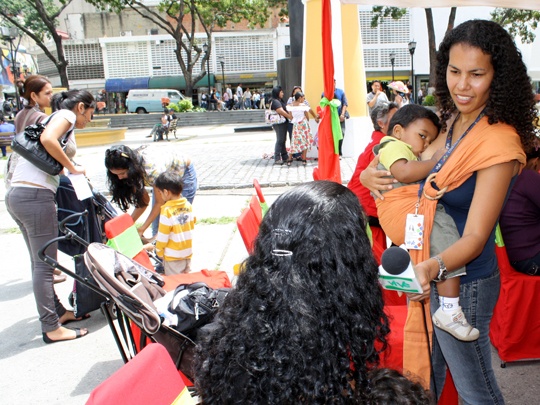
A Venezuelan public media journalist breastfeeds as she works. Public breastfeeding is fairly accepted in Venezuela (blog.chavez)
Venezuela’s national assembly is debating a reform to its breastfeeding law which could see baby food companies like Nestle fined in certain situations. The corporate media have reacted hysterically to the law, claiming that President Nicolas Maduro is “taking bottles from babies’ mouths”.
Though breastfeeding is widely promoted by the Venezuelan government, and public breastfeeding is relatively de-stigmatised, a study by Venezuela’s National Nutrition Institute (INN) between 2006 and 2008 showed that only 55% of mothers exclusively breastfed when their baby was born, going down to 20% when their baby was three months old, and 11% by six months.
The percentages have probably increased since then, with broad educational campaigns in public schools and health centres, and actions such as mass public breastfeeding in plazas, organised by the INN.
However, the low figures reflect the low confidence some mothers have in their ability to breastfeed, as well as the power of multinational infant formula companies in health centres. It is common practice to give infant formula to babies from the moment they are born, without the consent of parents, according to LactArte, a pro-breastfeeding collective in Venezuela. Companies give gifts and other promotions to health workers and health centres in order to create alliances with them, and give free samples of the products to new mothers, thereby creating dependent consumers of new born babies, or at least discouraging exclusive breast feeding.
What the law actually says
In 2007 Venezuela’s national assembly passed the Law of Protection, Promotion, and Support for Breastfeeding. The law regulates the way baby formula and baby food companies advertise and label their products, and how they interact with hospitals and clinics. However, the companies have been ignoring the law, as it doesn’t specify penalties. The reform to the law currently being discussed is looking at penalties of US$600 – $50,000, and also training for health professionals. Once the reform is passed in first discussion by the assembly, it will be subject to “street parliament” – discussion by collectives and Venezuelan citizens, to then be passed by the national assembly in second discussion.
The 2007 law argues that breastfeeding provides babies with “all the necessary nutrients” in their first six months, as well as “protecting them and immunising them from illness and contributing to the development of their breathing and gastrointestinal capacity”. It states that “mothers have the right to breastfeed their children, with the support and collaboration of the fathers… [who] should provide all the support necessary so that mothers can provide this human right… The state, with solidarious participation from organised communities, will promote, protect, and support exclusive breastfeeding…of children under six months of age and breastfeeding with complementary food … until the age of two”.
Concretely under the law, health workers and health centres must help mothers start breastfeeding within the first half hour of birth, and guarantee that the newborn is always near the mother after birth, except in exceptional medical situations. They should also educate mothers, fathers, and the family on the issue, and abstain from providing babies under the age of 6 months with food other than breast milk, except when there is a specific medical need. Health centres must create human milk “banks”.
Baby food and formula products must be in Spanish or Venezuelan indigenous languages (Nestle products for example, often aren’t), and they should inform of the risks of including such food in the baby’s diet too early. Publicity or labelling can’t create the impression that such food is equal to breast milk, and publicity of any kind discouraging breastfeeding is not allowed.
All food aimed at children under three must include labelling that clearly states its ingredients, including any GMO products, and milk formulas must including a warning that “breast milk is the best food for children under two years old”.
Samples, prizes, and promotions of baby food and formula are prohibited. Likewise, companies are prohibited from donating toys, books, posters or other products which promote or identify their company to health centres, and they are also prohibited from donating “gifts” to health centre workers and from sponsoring events or campaigns aimed at pregnant or breastfeeding women, fathers, health professions, families, and communities.
Breastfeeding rights in Venezuela
Last year, with the passing of the new labour law, women’s breastfeeding rights were further expanded. Post-natal leave was extended to six months, and articles 344-352 state that mothers have the right to two half hour breaks per day to breastfeed. If there is no breastfeeding room provided by the work place, that is extended to two 90 minute breaks, and all employers of more than 20 workers must maintain a nursery centre with a breastfeeding area.
For Luisa Calzada and Kaustky Garcia, of LactArte, breastfeeding is also an act of food sovereignty – that is, third world productive or economic independence from greedy transnationals. Garcia argued that such sovereignty has been “sabotaged” in Venezuela by the “transnational industry dedicated to the business of infant formulas”. Indeed the industry is huge here – visit any supermarket or corner shop and you’ll see full aisles or shelves of powdered baby milk formula and compote.
LactArte supports a boycott of Nestle, one of the main powdered milk formula companies here, producing the infamous Cerelac since 1886. They argue that there is“collusion” between the baby food industry and the medical industry, with the food transnationals enlisting an “army of health professionals” to sell baby formula.
According to Business Insider, infant formula is an $11.5 billion market. The International Baby Food Action Network (IBFAN) claims that Nestle, apart from distributing free samples of its products in maternity wards, also uses “humanitarian aid” to create markets, and offers gifts and sponsorship to influence health workers to promote its products. According to a 1982 New Internationalist article, Nestle makes mostly third world mothers dependent on its formula in three ways: “Creating a need where none existed, convincing consumers the products are indispensable, and linking products with the most desirable and unattainable concepts- then giving a sample”.
What the corporate media are saying
The 2007 law and the draft reforms do not ban the production or sale of baby food or formula, as national and international media have alleged, nor do they apply any fines to mothers or penalise any choices regarding her body that a mother may make. The penalties are only for health care centres and their workers, and baby food and formula companies.
However the corporate media over the last two weeks has completely distorted the issue. Fox News Latino headlined “Venezuela Wants To Ban Baby Bottles To Promote Breast-Feeding” and stated that “Motherly love has become a state affair in Venezuela”.
Growing Your Baby also headlined “Venezuela considering baby bottle ban”, and opened with the utterly misinformed and misleading question, “What would you do if you woke up one morning and learned that baby bottles were no longer being made or sold in your country? This question may become a reality for Venezuelan moms who may not have planned on breastfeeding”.
Reuters won the prize however for manipulation and sensationalism, with the headline “Venezuela considers taking bottles from babies’ mouths”, while other agencies have carried similar titles along the “banning” theme, with CNN’s article “Venezuela considering a ban on baby bottles” and Huffington Post ‘Venezuela considers baby bottle ban to encourage breastfeeding’. Al Jazeera went as far as to argue in its piece that “some mothers don’t want the government telling them how to feed their children”. If Al Jazeera had bothered to read the 2007 law, it would have discovered that is actually the point of the law – to stop companies interfering, through misleading information and other gimmicks, in the breastfeeding process.
Venezuelan corporate press and other Spanish language media have been equally manipulative. Here is a small selection of their headlines: EFE: “Venezuela is debating a law to prohibit baby bottles”, Semana: “Baby bottle and dummy: the new enemies of Chavismo”, El Pais: “The Venezuelan government wants to oblige mothers to breastfeed”, El Popular: “Venezuela: Nicolas Maduro wants to eliminate the use of baby bottles”, Noticias24 “They’ll prohibit baby bottles in health centres of Venezuela in order to force breastfeeding”, El Mundo, “Venezuela declares war on the baby bottle”, and Entornointeligente, “Goodbye to baby bottles for stimulating breastfeeding”.
Garcia argued that the media campaign to demonise the law and the proposed reforms is being pushed by the milk formula industry. She said it has had an impact in Venezuela, with “many women, even those not using baby bottles, feeling scared”.
“They are worried that the government is going to try to help them to breastfeed, that the government will take away their baby bottles and infant formulas, and is going to prohibit them from feeding their infants with baby bottles, but that’s absolutely false. First of all it’s unpractical, and secondly it is this government which has most given freedom and provided information so that families can freely chose the path they desire for their children,” she said.
The World Health Organisation recommends that babies be exclusively breast fed during the first six months, and in 1981 the 34th World Health Assembly adopted a resolution which included the International Code of Marketing Breast-Milk Substitutes. Funnily enough, it stated that food companies shouldn’t promote their products in hospitals, give free samples to mothers, or provide misleading information. One wonders if these international bodies were also accused of “stealing the bottle from babies mouths”, or is that sort of rubbish reserved for countries like Venezuela where a revolution is trying to get some justice at the expense of the poor transnationals?
UK Supreme Court votes to lift sanctions on Iranian bank
Tehran Times | June 19, 2013
LONDON – The UK Supreme Court has ruled in favor of Bank Mellat, Iran’s largest private bank, in a result which will see it removed from the United Kingdom’s sanction list.
The appeal was heard by nine out of the Supreme Court’s twelve judges after the UK’s highest court was forced to enter closed session for the first time in its history, in order to receive secret evidence from the security services.
Her Majesty’s Treasury imposed sanctions against the bank in 2009 alleging that the bank’s activities supported the Iranian nuclear program, but Wednesday’s ruling found no evidence to support this claim. The UK Supreme Court result follows similar success for the bank at the European Court in January of this year in respect of sanctions which had been imposed on the bank by the EU Council.
The ruling is a blow to the controversial system of “secret courts” which have allowed the security services to provide evidence to the Supreme Court behind closed doors for the first time in its history.
The Supreme Court reluctantly entered into closed session in March, effectively barring the bank from accessing the evidence against it. Zaiwalla & Co Solicitors, the London-based international law firm representing the bank, had argued against the imposition of closed courts on the grounds that it contravenes the British common law principle of open justice. The failure of the Treasury to produce compelling evidence, despite the controversial new powers, puts the spotlight back on the Justice and Security Bill, which expanded the system of closed courts to civil cases.
The ruling sends a strong message to the UK government that political expediency is not a sufficient legal justification for sanctions placed against Iranian private businesses which operate out of Iran. The Supreme Court is now expected to order the British government to pay Bank Mellat all of its legal costs and damages for the wrongful listing of Bank Mellat.
After initial failure to challenge sanctions before the English High Court and the Court of Appeal, Bank Mellat turned to Zaiwalla & Co in 2010 and has since gone from strength to strength in the European and now Supreme Court. The firm, led by Sarosh Zaiwalla, have shown that even in cases of national security, the UK government must abide by the rule of law, with the some of the justifications for the sanctions considered “arbitrary”, “discriminatory” and even “irrational”.
Sarosh Zaiwalla, senior partner at Zaiwalla & Co said, “Today’s ruling is a victory for the rule of law as much as it is for Bank Mellat.
“The judgment will put enormous confidence in the independence of the British judiciary and sets an example that even controversial disputes can be resolved by applying the principle of rule of law through the British courts.
“Nevertheless, the reading of the closed judgment clearly contravenes the British principle of open justice, the bank’s success demonstrates just how unjustified closed sessions are.”
War by another name in Syria
By Franklin Lamb | Al-Manar | June 19, 2013
Beirut – The Group of Eight leaders meeting in Lough Erne, Northern Ireland, having called for an international conference on the ongoing crisis in Syria to be held “as soon as possible” could not agree on much else that might end the civil war anytime soon there. The White House now is reportedly in private agreement with Russia and Iran that the Assad government will remain in power until next year’s election.
Consequently, an 18 month old US-led Plan B has been dusted off by the Obama administration according to Washington Congressional and Beirut diplomatic sources. If successful, there is growing confidence among pro-Zionist neocons in Congress that while Syrian regime-change has failed for several reasons that thwarted the Gulf funded military campaign, Syria can still be brought to heel through an economic campaign dressed to look, well, down right “humanitarian.”
The term “equivalent of the Marshall Plan” is being employed by some in the White House and Pentagon this month to describe a proposed large-scale “humanitarian rescue program” being prepared for Syria, according to some Western diplomats based in Lebanon.
However, the 1948 Marshall Plan (officially the European Recovery Program or ERP) was an American program to aid Europe, through which the United States provided $13 billion, in today’s monetary terms, approximately 100 billion dollars of economic support, to help rebuild European economies devastated by war.
With respect to Syria, the “equivalent of the Marshall Plan” currently being finalized is very different from what General George C. Marshall explained to his Harvard University audience, 66 years ago this month, when he announced the post WW II initiative.
The Syria project already amounts to 19th century economic imperialism as a means to achieve control of Syria by hijacking its economy while shielding Israel from the rising tide of protests in this region, as armed groups across the spectrum are beginning to focus on directly confronting the Zionist theft and continuing occupation of Palestine.
What Washington has in mind constitutes an attempt to gain control over Syria by controlling its economy via contracts for rebuilding the country and “lending” the hoped for post-Assad Syrian government as much as 300 billion dollars to be secured by Syrian assets. IMF economists estimate the value of the public sector in Syria, exceeds half a trillion dollars. Under the US-led pan, creditors can take control of ownership of the public sector, if Syria accepts the plan for pledges to secure debt. The buyers of the debt will be largely American and indirectly Israeli businessmen as well as from the Gulf. Qatar specifically is gambling on this plan, to work with “international parties”, to immerse Syria in debt, and then drive the country to sell [its public sector assets] to the private sector at a very small fraction of their true values.
Some who are warning against the scheme point out that Syrians are capable of rebuilding their own country and have the labor force and raw materials to do it. Foreign aid will be welcomed by the Syrian government but not at the price of ceding the Arab Syrian Republic to a new western crafted economic order. What is hidden in the war on Syria is reported to be much bigger than has been divulged to date, and involves winding down the military actions in favor of economic aggression against the Syrian population which the layers of US sanctions to date is just a harbinger.
In this context, according to Western Diplomatic sources, the US government and some Gulf countries have tried to bribe Rami Makhlouf, a cousin of Syria’s President, to break with the government and leave the country. Some other well-known figures have also been offered large sums of cash to break ranks. Last month, one prominent Syrian nationalist who works with the government told this observer of receiving a $ 50 million dollar offer to defect and leave Syria. The official rejected the bribe and ridiculed the government that made the offer by explaining that as proud Syrian nationalists, no amount of money would break the sacred bond between Syrians and their country.
With respect to Mr. Maklouf, he did not react to being placed on the US Treasury Department’s “Specially Designated Nationals” (SDN) list which blocks assets and prohibits, under severe penalties, U.S. citizens from dealing with them, nor did he dignify an American clemency offer with even a reply. Rather he has maintained his steadfast support for Syria in the face of several attempts to assassinate him as well as targeting him, as a leader of the Syrian business community, with American orchestrated Office of Foreign Assets Control (OFAC) defamatory media campaigns, to pressure him to break with President Bashar al-Assad. Rather than rejecting Syria for American offers of protection, Makhlouf channeled much of his assets for the benefit of domestic charities and rehabilitative projects, providing jobs for the unemployed and loans for small investors as well as “at cost” family housing for many of the internally displaced. This initiative continues. Makhlouf has provided his bourse shares in the largest telecommunications companies in Syria to charity associations in order to insure financial independence and resources that the Authority can rely upon, to ease somewhat, the devastating effects on the current crisis on the Syrian civil society.
According to analysts among the Western diplomatic corps in Beirut, many wealthy Syrian capitalists fell into the U.S. trap, wherein SDN economic sanctions prompted them to leave Syria and defect from the regime. The United States and its European partners continue to wage an economic war against Syria by imposing crippling sanctions which are affecting the lives of ordinary citizens in many ways from food and fuel costs to medical care.
Why Rami Makhlouf and other strong nationalists in Syria’s business community are being targeted as a prelude to fully launching the US-led “Syrian Marshall Plan” is that their bonds with Syria as well as their business acumen are blocking the Western scheme because they provide the Syrian government with much needed additional financial strength to rebuild Syria, in cooperation with other countries, but without being subject to the economically fatal conditions the US-led plan envisages. Many in the financial and academic community view the proposed SDN plan as nearly certain to hold the Syrian economy hostage to foreigners for scores of years.
The US Treasury Department considers Makhlouf and others like him in the Syrian business community as fully capable, if allowed, of helping Syria’s government to collect huge sums from international investors to help rebuild Syria without being subject to Western domination.
The anti-Mahhlouf black propaganda campaign, according to a Washington DC source familiar with the intensified preparations, was designed to include a wide ranging assault in the visual and written media, audio, as well as in the electronic media: “Qatar and Saudi Arabia, both of which like their western partners who are actually constructing the SDN project, view Makhlouf as a key obstacle to realizing their plans to hijack and control the Syrian economy as part of a soft war, whereby the US and its allies, western and middle eastern, control Arab economies while keeping US boots off the grounds of Arabia or spending more US treasure in this region.”
Targeting of Rami Makhlouf, and other Syrian businessmen by Qatari media and other Arabic paid media outlets, is designed to hit Syria economically, because weakening the Syrian economic security at its core, is a more certain path, than endless military campaigns, to quickly smash the state. Makhlouf and his colleagues are seen as preventing this.
The ultimate goal of Qatar and certain Gulf countries, with US complicity, is not just expanding their investments in this region, as much as Doha is intent on connecting the Arab world to the American-Zionist axis politically and economically. The speed with which Israeli, Gulf, and Western businessmen showed up at the Corinthian, Radisson, and Rixos hotels in Tripoli, Libya, literally within days of the murder of Moammar Qaddafi, “to help rebuild this country” is instructive on these same interests seeking to control a war damaged country by removing obstacles. Indeed, Russian intelligence reported at the time that the salafists who apprehended Qaddafi in Sirte on October 20, 2011, as he attempted to flee, received verbal instructions from a Gulf country (UAE) to kill him in order to eliminate competition for dominating the Libyan economy and to silence those who might torpedo their best laid plans.
The targeting of Mr. Rami Makhlouf and dozens of like-minded Syrian businessmen, who refused to abandon their country, continues. Yet today, like thousands of other Syrian volunteers including the approximately 10,000 who work with the Syrian Arab Red Crescent Society (SARCS) their time and resources serve their country in order to lessen the suffering of the civilian population. They have stood firm and did not flee, as did some corrupt former supporters and officials of the government.
This week, Syria’s President put the goal of the Marshall Plan for Syria succinctly, without identifying it, “What is happening in Syria is a project for those states to push a non-submissive state towards the brink and to look for a new president who says ‘yes’ (to their orders). They have not found and they will not find in the future,” Assad stressed while adding, “The interference is a blatant violation of international law and the sovereignty of this country; they (western states and their Gulf allies) want to destabilize the country and spread chaos and backwardness.”
Featured Video

Can the U.S. Afford to Annihilate Iran?
or go to
Aletho News Archives – Video-Images
From the Archives
Sanctions, War and the Policy of Dual Containment
By SASAN FAYAZMANESH | March 17, 2008
It is now nearly three decades since the Unites States adopted the policy of dual containment of Iran and Iraq. While much has been written about the containment of Iraq, there has been very little in-depth analysis of this policy when it comes to Iran. In a book that is going to be released on March 31, 2008, entitled The United States and Iran: Sanctions, Wars and the Policy of Dual Containment (Routledge), I attempt to address this shortcoming by investigating when and why the US policy of containment of Iran came about, how it evolved, and where it stands today.[1] To the extent that Israel has been involved in US policy making, the study will also include the role that Israel has played in the containment of Iran. Also, since the fate of Iran has been inextricably linked to that of Iraq, occasionally the investigation will overlap with the containment of Iraq.
The policy of dual containment of Iran and Iraq originated during the Carter Administration, but it was not until the Clinton Administration that the expression “dual containment” became popular. … continue
Blog Roll
 Aletho News
- Can the U.S. Afford to Annihilate Iran? /Seyed M. Marandi
- Elmo Sold mRNA Jabs to Your Toddler. Now They Are “Off-Label.”
- British state targets Palestine Action with yet another crooked trial
- Americans are paying the price to preserve Israel’s nuclear hegemony
- Resistance factions are necessary to ensure a permanent US Iraq withdrawal
- How Israel destabilizes the Middle East: Denying sovereignty and the right to exist
- Europe’s Establishment Is Embracing War – and Losing Voters
- NATO chief advocates war of aggression
- No Vote, No Representation, No State: Democracy, Israeli Style
- Zionist Bought Senate Blocks Information About American Citizens Killed By Israel
- If Americans Knew
- Israeli Soldiers Abduct At Least 22 Across Occupied West Bank
- Eight Palestinians Killed in Israeli Attacks on Gaza
- Israeli former leaders and security chiefs threaten legal action over ‘Jewish terrorism’
- Israel map in LA Times ad includes all land from the river to the sea
- Inside Lebanon’s 200-page dossier on Israeli war crimes
- Flydubai, genocide, settler violence, Trump abuse of power to deport – Daily Update
- Counting Antisemitic Incidents: What the ADL Audit Reveals — and Obscures
- Mamdani releases plan to combat antisemitism and hate crimes in New York City
- Iran’s Revolutionary Guards Publish Letter to the American People
- DMFI launches $1 million ad campaign supporting Virginia’s Elaine Luria
- No Tricks Zone
- Green Energy Debacle: German Expert Professor Fritz Vahrenholt Warns Of Severe Economic And Social Consequences
- Two More Paleo Reconstructions Affirm Meters-Higher Sea Levels Across Ireland, Brazil 7000-6000 Years Ago
- New Study: Earth And Venus Surface Warmth Largely Explained By Convection And Lapse Rate, Not CO2 Or Radiation
- 2025 Nature Paper Claiming Worsening Global Drought Gets RETRACTED …Heavily Flawed
- New Study: ‘Global Drought Shows No Detectable Recent Acceleration Under Climate Warming’
- Economic Masterminds: German Socialists Suggest Taxing Productivity Gains Stemming From Using AI
- The South China Sea Has Not Been Cooperating With The Climate Change Narrative
- Energy Crisis: Germany Enters Heating Season With Historically Low Gas Reserve Fill Levels
- New Study: The Antarctic Ice Sheet Gained Mass From 2020-2024 Due To Staggering Snow And Ice Accumulation
- Study: Ocean Heating Rates From Thousands Of Years Ago ‘Dwarf’ Modern Ocean Heating Rates

